化工进展 ›› 2025, Vol. 44 ›› Issue (4): 2285-2296.DOI: 10.16085/j.issn.1000-6613.2024-0608
活化过硫酸盐降解土壤典型环境内分泌干扰物
牛经纬1( ), 陈孝杨1,2(), 张健1, 周育智1, 陈敏3
- 1.安徽理工大学地球与环境学院,安徽 淮南 232001
2.深部煤炭安全开采与环境保护全国重点实验室,安徽 淮南 232001
3.浙江大学台州研究院,浙江 台州 318000
-
收稿日期:2024-04-11修回日期:2024-10-10出版日期:2025-04-25发布日期:2025-05-07 -
通讯作者:陈孝杨 -
作者简介:牛经纬(1999—),男,博士研究生,研究方向为煤矿区土壤固碳技术。E-mail:Stronger7059@163.com。 -
基金资助:国家自然科学基金(41572333);安徽省重点研究与开发计划(202104a06020027)
Activated persulfate-induced degradation of typical environmental endocrine disruptors in soil
NIU Jingwei1(), CHEN Xiaoyang1,2(), ZHANG Jian1, ZHOU Yuzhi1, CHEN Min3
- 1.School of Earth and Environment, Anhui University of Science and Technology, Huainan 232001, Anhui, China
2.National Key Laboratory of Deep Coal Safety Mining and Environmental Protection, Huainan 232001, Anhui, China
3.Taizhou Research Institute, Zhejiang University, Taizhou 318000, Zhejiang, China
-
Received:2024-04-11Revised:2024-10-10Online:2025-04-25Published:2025-05-07 -
Contact:CHEN Xiaoyang

摘要:
随着我国工农业的迅速发展,大量环境内分泌干扰物(EEDs)在自然或人为因素作用下迁移至土壤介质中。EEDs污染造成了土壤质量的下降,引发了系列生态安全和人体健康问题,制约了我国农业的进一步发展。过硫酸盐(PS)高级氧化技术具有成本低、周期短、效率高等优势。在EEDs污染土壤修复领域,热活化、过渡金属离子活化、碳材料活化是3种极具代表性的、广受关注的典型PS活化技术。本文介绍了土壤典型EEDs分类、应用、来源及危害,论述了典型活化技术的基本原理和优缺点,重点综述了典型活化技术在降解过程中的影响因素,阐述了土壤性质对降解的影响,最后对未来研究方向进行了展望,如土壤EEDs排放清单建立、因地制宜匹配工艺、二次污染防控、土壤质量保证等,以期为EEDs污染土壤修复的现场工程应用提供理论支持。
中图分类号:
引用本文
牛经纬, 陈孝杨, 张健, 周育智, 陈敏. 活化过硫酸盐降解土壤典型环境内分泌干扰物[J]. 化工进展, 2025, 44(4): 2285-2296.
NIU Jingwei, CHEN Xiaoyang, ZHANG Jian, ZHOU Yuzhi, CHEN Min. Activated persulfate-induced degradation of typical environmental endocrine disruptors in soil[J]. Chemical Industry and Engineering Progress, 2025, 44(4): 2285-2296.
| EEDs | 分子式 | 实际应用 | 土壤来源 | 危害 | 参考文献 |
|---|---|---|---|---|---|
| 菲(PHE) | C14H10 | 用于树脂、植物生长激素、生物碱、鞣料、无烟火药稳定剂、纸浆防雾剂等的生产制备 | 由各种矿物燃料(煤、石油、天然气等)、木材、纸、其他含碳氢化合物的不完全燃烧或在还原条件下热解产生后释放到大气中,随后与各种类型的固体颗粒物、气溶胶进行结合,最后通过干、湿沉降进入土壤 | 具有强烈的致毒、致癌、致突变性;对人类生殖系统、神经系统、呼吸系统、免疫系统均会造成损伤 | [ |
| 蒽(ANT) | C14H10 | 用于染料、荧光增白剂、医药、农药、涂料杀虫剂、杀菌剂、汽油阻凝剂等的生产制备 | |||
| 芘(Pry) | C16H10 | 用于树脂、分散性染料、工程塑料、杀虫剂等的生产制备 | |||
| 苯并[a]芘(BaP) | C20H12 | 在工业上无生产和使用价值,在生产过程中作为副产物被排放 | |||
| 萘(Naph) | C10H8 | 用于邻苯二甲酸酐、染料中间体、橡胶助剂、杀虫剂等的生产制备 | |||
| 荧蒽(FLA) | C16H10 | 作为非磁性金属表面探伤荧光剂;用于染料、医药等的生产制备 | |||
| 莠去津(ATZ) | C8H14ClN5 | 用于农作物中杂草的去除 | 在对农田中的杂草进行施药的过程中,部分直接进入土壤表层;茎叶残留部分经雨水淋洗后进入土壤表层;土壤表层中部分随雨水进一步下渗 | 已被证明是一种致癌物;对生物体的繁殖、发育、免疫均有损伤;容易对大豆、小麦、水稻等敏感作物产生植物毒性 | [ |
| 对硝基酚(PNP) | C6H5NO3 | 用于医疗药物、农药、染料、杀虫剂、杀菌剂、皮革、纺织品等的生产制备,作为化学分析试剂、植物细胞赋活剂 | 在工业生产和产品使用的过程中被排放到土壤中 | 具有强烈的致毒、致癌、致突变性 | [ |
| 四溴双酚A(TBBPA) | C15H12Br4O2 | 作为反应型阻燃剂 | 在电子垃圾拆解、TBBPA生产和TBBPA基材料加工的过程中被排放到土壤中 | 造成甲状腺激素水平紊乱;妨碍大脑和骨骼发育等 | [ |
| 三氯生(TCS) | C12H7Cl3O2 | 被添加进牙膏、漱口水、洗手液、沐浴露、洗发水、肥皂、除臭剂、化妆品、医药等产品中,起到杀菌消毒的作用 | 产品使用后排入水中,污水处理厂净化废水后,TCS在生物固体中富集,结束后生物固体被排入土壤 | 致癌;造成内分泌紊乱;增加肥胖风险;导致细菌耐药性增加 | [ |
| 全氟辛酸(PFOA) | C8HF15O2 | 作为洗涤剂、清洁剂等产品中的去污成分;在氟橡胶、聚四氟乙烯的生产过程中作为分散剂,帮助粒子均匀分布;作为树脂、涂料、皮革防水防油处理剂、纺织材料、建筑胶黏剂等产品生产过程中的添加剂 | 通过生产加工排放、大气沉降、地表径流进入土壤 | 长期接触下,对发育和生殖产生危害;导致肝损伤;可能致癌 | [ |
| 双对氯苯基三氯乙烷(DDT) | C14H9Cl5 | 用于卫生害虫和农林害虫的防治 | 在对农作物进行施药的过程中,部分直接进入土壤表层;茎叶残留部分经雨水淋洗后进入土壤表层;土壤表层中部分随雨水进一步下渗 | 致癌;导致神经行为异常;造成生殖缺陷;对内分泌和免疫系统产生危害 | [ |
| 五氯酚(PCP) | C6HCl5O | 作为水稻田除草剂;作为纺织品、皮革、纸张、木材等的防腐剂和防霉剂 | 在工业生产和产品使用的过程中被排放到土壤中 | 长期吸入会对呼吸道、血液、肾脏、肝脏、免疫系统、眼睛、鼻子、皮肤等造成损害 | [ |
| 十溴二苯醚(BDE-209) | C12Br10O | 用于改善塑料产品、电子产品、橡胶制品、建筑材料等产品的阻燃性能 | 通过生产加工排放、固废填埋、大气沉降、地表径流进入土壤 | 干扰甲状腺激素;妨碍人类和动物脑部与中枢神经系统的正常发育 | [ |
| 磺胺甲𫫇唑(SMX) | C10H11N3O3S | 用于抑制细菌的生长繁殖 | 通过粪便施用进入土壤 | 在生态环境中长期暴露会诱导细菌产生耐药基因,导致耐药菌株出现 | [ |
| 17β-雌二醇 (17β-E2) | C18H24O2 | 对机体生理过程起调节作用 | 通过粪便施用进入土壤 | 其浓度较高时可破坏神经内分泌系统和生殖内分泌系统的正常功能 | [ |
| 双酚A(BPA) | C15H16O2 | 用于聚碳酸酯、环氧树脂、聚砜树脂、聚苯醚树脂、不饱和聚酯树脂、增塑剂、阻燃剂、抗氧剂、热稳定剂、橡胶防老化剂、农药、涂料等的生产制备 | 在生产、运输、产品使用、垃圾填埋厂处置过程中释放到土壤中 | 长期接触下,可导致内分泌失调;可能导致肥胖、多动症等疾病;具有一定的致癌作用 | [ |
| 苯酚(PhOH) | C6H6O | 用于酚醛树脂、锦纶纤维、增塑剂、显影剂、防腐剂、杀虫剂、杀菌剂、染料、涂料、医药、香料、农药、炸药等的生产制备 | 通过生产加工排放、地表径流进入土壤 | 长期接触大剂量苯酚可导致肌肉无力、呼吸停止、呼吸困难、震颤和昏迷;其慢性作用可能导致体重突然减轻、眩晕、厌食、腹泻 | [ |
表1 土壤典型EEDs的应用、来源及危害
| EEDs | 分子式 | 实际应用 | 土壤来源 | 危害 | 参考文献 |
|---|---|---|---|---|---|
| 菲(PHE) | C14H10 | 用于树脂、植物生长激素、生物碱、鞣料、无烟火药稳定剂、纸浆防雾剂等的生产制备 | 由各种矿物燃料(煤、石油、天然气等)、木材、纸、其他含碳氢化合物的不完全燃烧或在还原条件下热解产生后释放到大气中,随后与各种类型的固体颗粒物、气溶胶进行结合,最后通过干、湿沉降进入土壤 | 具有强烈的致毒、致癌、致突变性;对人类生殖系统、神经系统、呼吸系统、免疫系统均会造成损伤 | [ |
| 蒽(ANT) | C14H10 | 用于染料、荧光增白剂、医药、农药、涂料杀虫剂、杀菌剂、汽油阻凝剂等的生产制备 | |||
| 芘(Pry) | C16H10 | 用于树脂、分散性染料、工程塑料、杀虫剂等的生产制备 | |||
| 苯并[a]芘(BaP) | C20H12 | 在工业上无生产和使用价值,在生产过程中作为副产物被排放 | |||
| 萘(Naph) | C10H8 | 用于邻苯二甲酸酐、染料中间体、橡胶助剂、杀虫剂等的生产制备 | |||
| 荧蒽(FLA) | C16H10 | 作为非磁性金属表面探伤荧光剂;用于染料、医药等的生产制备 | |||
| 莠去津(ATZ) | C8H14ClN5 | 用于农作物中杂草的去除 | 在对农田中的杂草进行施药的过程中,部分直接进入土壤表层;茎叶残留部分经雨水淋洗后进入土壤表层;土壤表层中部分随雨水进一步下渗 | 已被证明是一种致癌物;对生物体的繁殖、发育、免疫均有损伤;容易对大豆、小麦、水稻等敏感作物产生植物毒性 | [ |
| 对硝基酚(PNP) | C6H5NO3 | 用于医疗药物、农药、染料、杀虫剂、杀菌剂、皮革、纺织品等的生产制备,作为化学分析试剂、植物细胞赋活剂 | 在工业生产和产品使用的过程中被排放到土壤中 | 具有强烈的致毒、致癌、致突变性 | [ |
| 四溴双酚A(TBBPA) | C15H12Br4O2 | 作为反应型阻燃剂 | 在电子垃圾拆解、TBBPA生产和TBBPA基材料加工的过程中被排放到土壤中 | 造成甲状腺激素水平紊乱;妨碍大脑和骨骼发育等 | [ |
| 三氯生(TCS) | C12H7Cl3O2 | 被添加进牙膏、漱口水、洗手液、沐浴露、洗发水、肥皂、除臭剂、化妆品、医药等产品中,起到杀菌消毒的作用 | 产品使用后排入水中,污水处理厂净化废水后,TCS在生物固体中富集,结束后生物固体被排入土壤 | 致癌;造成内分泌紊乱;增加肥胖风险;导致细菌耐药性增加 | [ |
| 全氟辛酸(PFOA) | C8HF15O2 | 作为洗涤剂、清洁剂等产品中的去污成分;在氟橡胶、聚四氟乙烯的生产过程中作为分散剂,帮助粒子均匀分布;作为树脂、涂料、皮革防水防油处理剂、纺织材料、建筑胶黏剂等产品生产过程中的添加剂 | 通过生产加工排放、大气沉降、地表径流进入土壤 | 长期接触下,对发育和生殖产生危害;导致肝损伤;可能致癌 | [ |
| 双对氯苯基三氯乙烷(DDT) | C14H9Cl5 | 用于卫生害虫和农林害虫的防治 | 在对农作物进行施药的过程中,部分直接进入土壤表层;茎叶残留部分经雨水淋洗后进入土壤表层;土壤表层中部分随雨水进一步下渗 | 致癌;导致神经行为异常;造成生殖缺陷;对内分泌和免疫系统产生危害 | [ |
| 五氯酚(PCP) | C6HCl5O | 作为水稻田除草剂;作为纺织品、皮革、纸张、木材等的防腐剂和防霉剂 | 在工业生产和产品使用的过程中被排放到土壤中 | 长期吸入会对呼吸道、血液、肾脏、肝脏、免疫系统、眼睛、鼻子、皮肤等造成损害 | [ |
| 十溴二苯醚(BDE-209) | C12Br10O | 用于改善塑料产品、电子产品、橡胶制品、建筑材料等产品的阻燃性能 | 通过生产加工排放、固废填埋、大气沉降、地表径流进入土壤 | 干扰甲状腺激素;妨碍人类和动物脑部与中枢神经系统的正常发育 | [ |
| 磺胺甲𫫇唑(SMX) | C10H11N3O3S | 用于抑制细菌的生长繁殖 | 通过粪便施用进入土壤 | 在生态环境中长期暴露会诱导细菌产生耐药基因,导致耐药菌株出现 | [ |
| 17β-雌二醇 (17β-E2) | C18H24O2 | 对机体生理过程起调节作用 | 通过粪便施用进入土壤 | 其浓度较高时可破坏神经内分泌系统和生殖内分泌系统的正常功能 | [ |
| 双酚A(BPA) | C15H16O2 | 用于聚碳酸酯、环氧树脂、聚砜树脂、聚苯醚树脂、不饱和聚酯树脂、增塑剂、阻燃剂、抗氧剂、热稳定剂、橡胶防老化剂、农药、涂料等的生产制备 | 在生产、运输、产品使用、垃圾填埋厂处置过程中释放到土壤中 | 长期接触下,可导致内分泌失调;可能导致肥胖、多动症等疾病;具有一定的致癌作用 | [ |
| 苯酚(PhOH) | C6H6O | 用于酚醛树脂、锦纶纤维、增塑剂、显影剂、防腐剂、杀虫剂、杀菌剂、染料、涂料、医药、香料、农药、炸药等的生产制备 | 通过生产加工排放、地表径流进入土壤 | 长期接触大剂量苯酚可导致肌肉无力、呼吸停止、呼吸困难、震颤和昏迷;其慢性作用可能导致体重突然减轻、眩晕、厌食、腹泻 | [ |
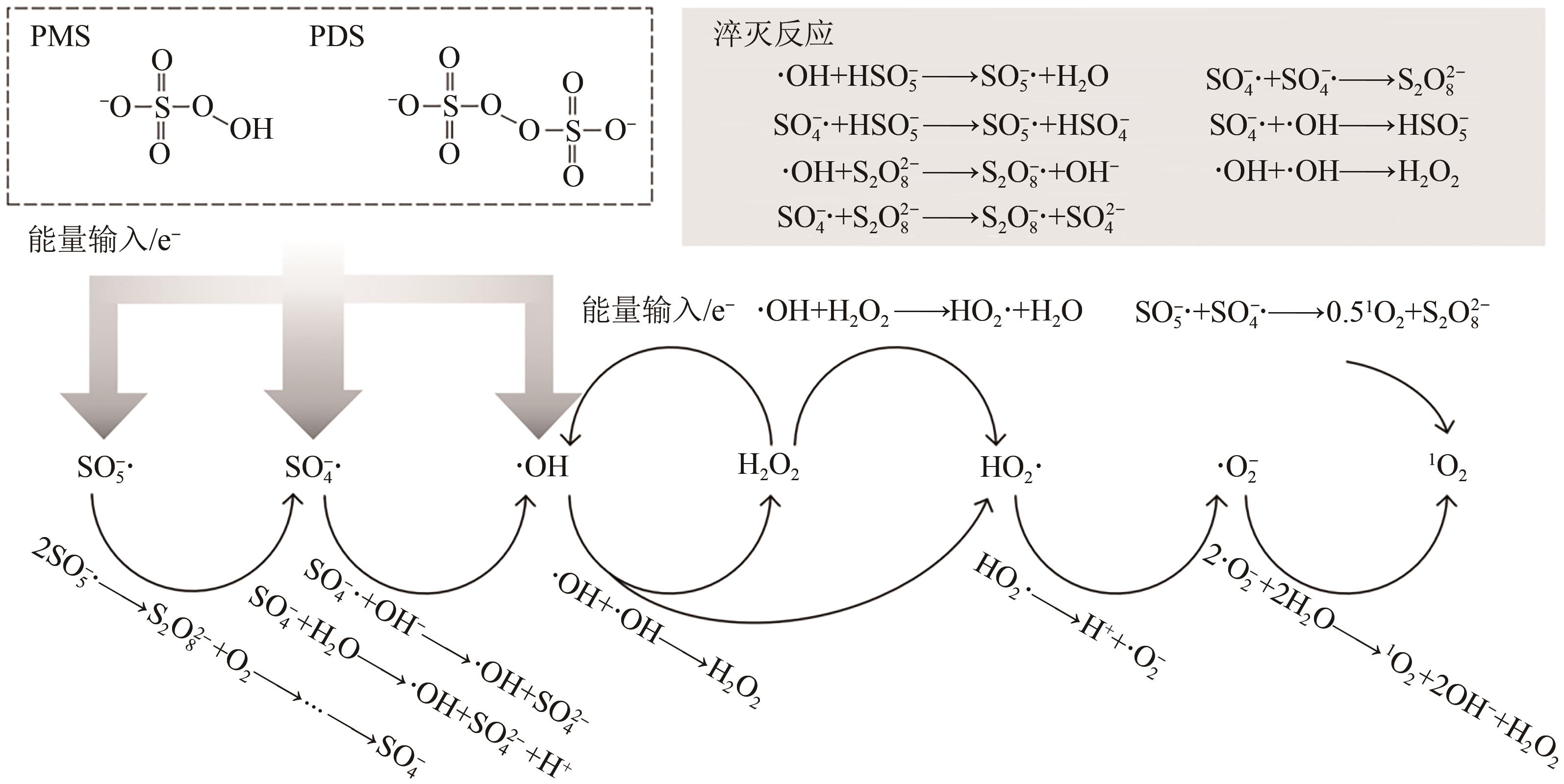
图1 ROS转化途径与淬灭反应[66]
| 活化技术 | 优点 | 缺点 | 参考文献 |
|---|---|---|---|
| 热活化 | 工艺简单;操作简便;热能环保清洁;pH条件范围广;无金属离子浸出;无须考虑催化剂分散、回收、结垢失活问题;活化过程均匀温和,不会对土壤理化性质造成严重损害;催化性能良好;多应于现场工程项目 | 活化能耗较高;单一热活化对土壤中EEDs的去除效果仍有限 | [ |
| 过渡金属离子活化 | 经济节能、操作简便;在常温、常压下即可进行,无须外加能量;催化剂用量少;环境适应性好;反应选择性高、反应时间短;催化性能良好 | 过渡金属离子浸出,存在二次污染可能;受土壤体系pH限制 | [ |
| 碳材料活化 | 在常温、常压下即可进行;无须外加能量和过渡金属离子参与;选择性高;环境风险低;可通过调控表面结构、功能基团、持久性自由基,实现对PS的有效活化 | 部分碳材料价格昂贵;催化性能较低;回收较为困难 | [ |
表2 典型PS活化技术的优缺点
| 活化技术 | 优点 | 缺点 | 参考文献 |
|---|---|---|---|
| 热活化 | 工艺简单;操作简便;热能环保清洁;pH条件范围广;无金属离子浸出;无须考虑催化剂分散、回收、结垢失活问题;活化过程均匀温和,不会对土壤理化性质造成严重损害;催化性能良好;多应于现场工程项目 | 活化能耗较高;单一热活化对土壤中EEDs的去除效果仍有限 | [ |
| 过渡金属离子活化 | 经济节能、操作简便;在常温、常压下即可进行,无须外加能量;催化剂用量少;环境适应性好;反应选择性高、反应时间短;催化性能良好 | 过渡金属离子浸出,存在二次污染可能;受土壤体系pH限制 | [ |
| 碳材料活化 | 在常温、常压下即可进行;无须外加能量和过渡金属离子参与;选择性高;环境风险低;可通过调控表面结构、功能基团、持久性自由基,实现对PS的有效活化 | 部分碳材料价格昂贵;催化性能较低;回收较为困难 | [ |
| EEDs | 活化技术 | 反应条件 | 降解过程 | 参考文献 |
|---|---|---|---|---|
| PHE | 热+十二烷基 磺酸钠(SDBS) | T=328K,CSDBS=5g/L,CPS=50mmol,t=5d | DR=98.56%,k=0.0715h-1;PHE的降解率随PS浓度增加而增大;降解途径:羟基化、酮化、开环 | [ |
| ATZ | 热 | T=353K,CATZ=50mg/kg,CSDBS=5g/L,CPS=24mmol/L,t=60min | DR=100%,k=0.0535min-1;ATZ的降解率随ATZ浓度增加而减小,随PS浓度增加先增大后减小,随温度的增高而增大;降解途径为脱烷基化、脱氯羟基化 | [ |
| Naph | 热 | T=353K,CPS=1.0mol/L,t=60min | DR=96.5%,Ea=14.85kJ/mol,k=0.0523min-1;Naph的降解率随PS浓度增加、辐照时间增长、微波温度升高而增加;降解途径为加成、苯环断裂、开环 | [ |
| PNP | 热 | T=333K,CPNP=93mg/kg,CPS=60mmol/kg,t=240min,水土比=1∶1 | DR=100%,Ea=137.29kJ/mol,k=0.01419min-1;PNP的降解率随温度、PS浓度增加而增大 | [ |
| TBBPA | 热+Fe2+ | T=328K,CTBBPA=20mg/kg,CPS=50mmol/L, | DR=100%,k=0.370h-1;TBBPA的降解率随温度、PS浓度增加而增大 | [ |
| ATZ | 热 | T=323K,CATZ=50mg/kg,CPS=16.6mmol,t=24h | DR=84%,Ea=102kJ/mol,k=0.370h-1;ATZ的降解率随温度、PS浓度增加而增大,随ATZ浓度增加先增大后减小;降解途径为烷基链氧化、脱烷基化、脱氯、羟基化 | [ |
| BaP | 热 | T=333K,CBaP=100mg/kg,CPS=0.2mol/L,t=2h | DR=48.4%;BaP的降解率随温度、PS浓度增高而增大 | [ |
| TCS | 热 | T=323K,CTCS=50mg/kg,CPS=18.8mmol,t=360min | DR=80%,Ea=74.3kJ/mol,k=0.370h-1;TCS的降解率随温度、PS浓度增加而增大;降解途径为羟基化 | [ |
| PFOA | 热 | T=373K,CBaP=200μg/kg,CPS=100g/kg,t=9h | DR=87.3%;PFOA的降解率随PS浓度增加而增大;降解途径为脱羧、氧化 | [ |
| DDT | 热 | T=323K,CDDT=199mg/kg,CPS=100mmol,t=7d | DR=92%~94%(厌氧),DR=69%~78%(好氧) | [ |
表3 热活化PS降解土壤中典型EEDs
| EEDs | 活化技术 | 反应条件 | 降解过程 | 参考文献 |
|---|---|---|---|---|
| PHE | 热+十二烷基 磺酸钠(SDBS) | T=328K,CSDBS=5g/L,CPS=50mmol,t=5d | DR=98.56%,k=0.0715h-1;PHE的降解率随PS浓度增加而增大;降解途径:羟基化、酮化、开环 | [ |
| ATZ | 热 | T=353K,CATZ=50mg/kg,CSDBS=5g/L,CPS=24mmol/L,t=60min | DR=100%,k=0.0535min-1;ATZ的降解率随ATZ浓度增加而减小,随PS浓度增加先增大后减小,随温度的增高而增大;降解途径为脱烷基化、脱氯羟基化 | [ |
| Naph | 热 | T=353K,CPS=1.0mol/L,t=60min | DR=96.5%,Ea=14.85kJ/mol,k=0.0523min-1;Naph的降解率随PS浓度增加、辐照时间增长、微波温度升高而增加;降解途径为加成、苯环断裂、开环 | [ |
| PNP | 热 | T=333K,CPNP=93mg/kg,CPS=60mmol/kg,t=240min,水土比=1∶1 | DR=100%,Ea=137.29kJ/mol,k=0.01419min-1;PNP的降解率随温度、PS浓度增加而增大 | [ |
| TBBPA | 热+Fe2+ | T=328K,CTBBPA=20mg/kg,CPS=50mmol/L, | DR=100%,k=0.370h-1;TBBPA的降解率随温度、PS浓度增加而增大 | [ |
| ATZ | 热 | T=323K,CATZ=50mg/kg,CPS=16.6mmol,t=24h | DR=84%,Ea=102kJ/mol,k=0.370h-1;ATZ的降解率随温度、PS浓度增加而增大,随ATZ浓度增加先增大后减小;降解途径为烷基链氧化、脱烷基化、脱氯、羟基化 | [ |
| BaP | 热 | T=333K,CBaP=100mg/kg,CPS=0.2mol/L,t=2h | DR=48.4%;BaP的降解率随温度、PS浓度增高而增大 | [ |
| TCS | 热 | T=323K,CTCS=50mg/kg,CPS=18.8mmol,t=360min | DR=80%,Ea=74.3kJ/mol,k=0.370h-1;TCS的降解率随温度、PS浓度增加而增大;降解途径为羟基化 | [ |
| PFOA | 热 | T=373K,CBaP=200μg/kg,CPS=100g/kg,t=9h | DR=87.3%;PFOA的降解率随PS浓度增加而增大;降解途径为脱羧、氧化 | [ |
| DDT | 热 | T=323K,CDDT=199mg/kg,CPS=100mmol,t=7d | DR=92%~94%(厌氧),DR=69%~78%(好氧) | [ |
| EEDs | 活化技术 | 反应条件 | 降解过程 | 参考文献 |
|---|---|---|---|---|
| ATZ | Fe2++CA | T=298K,CATZ=50mg/kg,CPS=10g/L, | DR=73.6%;TBBPA的降解率随活化剂预加入时间增加先增大后减小,随PS浓度增加而增大 | [ |
| PCP | Fe2+/Fe0 | T=298K,CPCP=9.91mg/kg,CPS=0.3mol/kg, | [ | |
Naph PHE FLA BaP | Fe0 | T=333K,CNaph=77.85mg/kg,CPHE=80.09mg/kg,CFLA=79.96mg/kg,CBaP=53.46mg/kg,CPS=1mol/L, | DRNaph=98.15%,DRPHE=78.41%,DRFLA=93.47%,DRBaP=97.64%,kNaph=0.0231h-1,kPHE=0.0214h-1,kFLA=0.0269h-1,kBaP=0.0386h-1;PCP的降解率随PS、Fe0浓度增加先增大后减小 | [ |
| 低环/中环/高环PAHs | Fe2++HA Fe2++CA | T=298K,CPAHs=196.34mg/kg,CPS=0.5mmol/g, | DRPAHs=79.89%(Fe2++HA);DRPAHs=70.92%(Fe2++CA);DRL-PAHs=90%,DRM-PAHs=71.88%,DRH-PAHs=71.96%(Fe2++HA);PAHs降解效果呈现低环>中环>高环趋势 | [ |
| Pry | Fe2+ Co2+ Ag+ | T=303K,CPry=76.4mg/kg,CPS=2.5mmol/g, | [ | |
p,p'-DDT o,p'-DDT | Fe2+ | T=298K,Cp,p'-DDT=29.56mg/kg,Co,p'-DDT=5.02mg/kg,CPS=0.16mol/L, | DRDDT=90%;DDT的降解率随PS浓度增加而增大,随Fe2+浓度增加先增大后减小 | [ |
| BDE-209 | Fe0 S-Fe0 K@S-Fe0 | T=303K,CBDE-209=10mg/kg,CPS=0.2mol/L, | [ | |
BaP Pry PHE Naph | Fe0 BC800 Fe0@BC800 | T=298K,CBaP=26.99mg/kg,CPS=0.5g/L, | [ | |
| ATZ | FeNPs@BC | T=298K,CATZ=20.55mg/kg,CAME=21.76mg/kg,CTEA=22.56mg/kg,CSIM=20.28mg/kg,CPS=3mmol/L,CFeNPs@BC=5g/L,t=10min | DRATZ=100%,kATZ=0.19023min-1,DRSIM>DRTEA>DRATZ>DRAME;ATZ的降解率随PS浓度增加而增大,随FeNPs@BC浓度增大先增大后减小;降解途径为脱乙基化、亲电亲核攻击 | [ |
| TBBPA | Fe0 | T=298K,CTBBPA=5mg/kg,CPS=25mmol, | DRTBBPA=78.32%;TBBPA的降解率随PS浓度增加而增大,随着催化剂浓度增加先增加后减小;降解途径为脱溴、异丙基与苯环发生断裂 | [ |
表4 过渡金属离子活化PS降解土壤中典型EEDs
| EEDs | 活化技术 | 反应条件 | 降解过程 | 参考文献 |
|---|---|---|---|---|
| ATZ | Fe2++CA | T=298K,CATZ=50mg/kg,CPS=10g/L, | DR=73.6%;TBBPA的降解率随活化剂预加入时间增加先增大后减小,随PS浓度增加而增大 | [ |
| PCP | Fe2+/Fe0 | T=298K,CPCP=9.91mg/kg,CPS=0.3mol/kg, | [ | |
Naph PHE FLA BaP | Fe0 | T=333K,CNaph=77.85mg/kg,CPHE=80.09mg/kg,CFLA=79.96mg/kg,CBaP=53.46mg/kg,CPS=1mol/L, | DRNaph=98.15%,DRPHE=78.41%,DRFLA=93.47%,DRBaP=97.64%,kNaph=0.0231h-1,kPHE=0.0214h-1,kFLA=0.0269h-1,kBaP=0.0386h-1;PCP的降解率随PS、Fe0浓度增加先增大后减小 | [ |
| 低环/中环/高环PAHs | Fe2++HA Fe2++CA | T=298K,CPAHs=196.34mg/kg,CPS=0.5mmol/g, | DRPAHs=79.89%(Fe2++HA);DRPAHs=70.92%(Fe2++CA);DRL-PAHs=90%,DRM-PAHs=71.88%,DRH-PAHs=71.96%(Fe2++HA);PAHs降解效果呈现低环>中环>高环趋势 | [ |
| Pry | Fe2+ Co2+ Ag+ | T=303K,CPry=76.4mg/kg,CPS=2.5mmol/g, | [ | |
p,p'-DDT o,p'-DDT | Fe2+ | T=298K,Cp,p'-DDT=29.56mg/kg,Co,p'-DDT=5.02mg/kg,CPS=0.16mol/L, | DRDDT=90%;DDT的降解率随PS浓度增加而增大,随Fe2+浓度增加先增大后减小 | [ |
| BDE-209 | Fe0 S-Fe0 K@S-Fe0 | T=303K,CBDE-209=10mg/kg,CPS=0.2mol/L, | [ | |
BaP Pry PHE Naph | Fe0 BC800 Fe0@BC800 | T=298K,CBaP=26.99mg/kg,CPS=0.5g/L, | [ | |
| ATZ | FeNPs@BC | T=298K,CATZ=20.55mg/kg,CAME=21.76mg/kg,CTEA=22.56mg/kg,CSIM=20.28mg/kg,CPS=3mmol/L,CFeNPs@BC=5g/L,t=10min | DRATZ=100%,kATZ=0.19023min-1,DRSIM>DRTEA>DRATZ>DRAME;ATZ的降解率随PS浓度增加而增大,随FeNPs@BC浓度增大先增大后减小;降解途径为脱乙基化、亲电亲核攻击 | [ |
| TBBPA | Fe0 | T=298K,CTBBPA=5mg/kg,CPS=25mmol, | DRTBBPA=78.32%;TBBPA的降解率随PS浓度增加而增大,随着催化剂浓度增加先增加后减小;降解途径为脱溴、异丙基与苯环发生断裂 | [ |
| EEDs | 活化技术 | 反应条件 | 降解过程 | 参考文献 |
|---|---|---|---|---|
| 中环/高环PAHs | Fe2++GLU(单聚糖) Fe2++SUC(双聚糖) Fe2++Starch(多聚糖) | T=298K,CPAHs=196.34mg/kg, | DRPAHs=56.76%(Fe2++GLU);DRPAHs=65.05%(Fe2++SUC);DRPAHs=77.94%(Fe2++Starch);DRM-PAHs=69.94%,DRH-PAHs=84.37%(Fe2++Starch) | [ |
| SMX | BC400/700 石墨(GP) | T=298K,CSMX=20mg/kg,CBC=5g/kg,CPS=4.8g/kg,t=2h,水土比=1∶1 | [ | |
| 17β-E2 | 氧化钒改性碳纳米管(VO X -CNT) | T=303K,CSMX=20mg/kg, | DR=86.06%;17β-E2的降解率随催化剂浓度、PS浓度的增大而增大;降解途径为羟基氧化、六元环碳碳键断裂 | [ |
| BPA | BC | T=298K,CBPA=31.93mg/kg,CBC=4g/kg,CPS=18.4g/L,t=160min | DR=98.4%;BPA的降解率随BC浓度增大先增加后减小,随PS浓度增大而增大 | [ |
| PhOH | 球磨胶体活性炭(CACBM) | T=298K,CPhOH=5.63mmol/kg,CCACBM=2.5mg/g,CPS=5mmol,t=24h,水土比=5∶1 | DR=91.4%;PhOH的降解率随CACBM浓度增加而增大,随PS浓度增加先增大后减小 | [ |
| ATZ | BC | CATZ=100mg/kg,CBC=0.25g/g,CPS=0.15g/g,t=2d,水土比=4∶5 | DR=82.52%,k=0.04h-1;ATZ的降解率随PS浓度增加而增大 | [ |
| BaP | BC | T=298K,CBaP=42.6mg/kg,CBC=0.15g/g,CPS=9g/L,t=60min | DR=93.2%,k=0.04h-1;BaP的降解率随BC剂量增加先增大后减小,随PS浓度增加而增大 | [ |
表5 碳材料活化PS降解土壤中典型EEDs
| EEDs | 活化技术 | 反应条件 | 降解过程 | 参考文献 |
|---|---|---|---|---|
| 中环/高环PAHs | Fe2++GLU(单聚糖) Fe2++SUC(双聚糖) Fe2++Starch(多聚糖) | T=298K,CPAHs=196.34mg/kg, | DRPAHs=56.76%(Fe2++GLU);DRPAHs=65.05%(Fe2++SUC);DRPAHs=77.94%(Fe2++Starch);DRM-PAHs=69.94%,DRH-PAHs=84.37%(Fe2++Starch) | [ |
| SMX | BC400/700 石墨(GP) | T=298K,CSMX=20mg/kg,CBC=5g/kg,CPS=4.8g/kg,t=2h,水土比=1∶1 | [ | |
| 17β-E2 | 氧化钒改性碳纳米管(VO X -CNT) | T=303K,CSMX=20mg/kg, | DR=86.06%;17β-E2的降解率随催化剂浓度、PS浓度的增大而增大;降解途径为羟基氧化、六元环碳碳键断裂 | [ |
| BPA | BC | T=298K,CBPA=31.93mg/kg,CBC=4g/kg,CPS=18.4g/L,t=160min | DR=98.4%;BPA的降解率随BC浓度增大先增加后减小,随PS浓度增大而增大 | [ |
| PhOH | 球磨胶体活性炭(CACBM) | T=298K,CPhOH=5.63mmol/kg,CCACBM=2.5mg/g,CPS=5mmol,t=24h,水土比=5∶1 | DR=91.4%;PhOH的降解率随CACBM浓度增加而增大,随PS浓度增加先增大后减小 | [ |
| ATZ | BC | CATZ=100mg/kg,CBC=0.25g/g,CPS=0.15g/g,t=2d,水土比=4∶5 | DR=82.52%,k=0.04h-1;ATZ的降解率随PS浓度增加而增大 | [ |
| BaP | BC | T=298K,CBaP=42.6mg/kg,CBC=0.15g/g,CPS=9g/L,t=60min | DR=93.2%,k=0.04h-1;BaP的降解率随BC剂量增加先增大后减小,随PS浓度增加而增大 | [ |
| 1 | Mira PETROVIĆ, GONZALEZ Susana, Damià BARCELÓ. Analysis and removal of emerging contaminants in wastewater and drinking water[J]. TrAC Trends in Analytical Chemistry, 2003, 22(10): 685-696. |
| 2 | COLBORN Theo, DUMANOSKI Dianne, MYERS John Peterson. Our stolen future[M]. New York: Dutton Books, 1996: 306. |
| 3 | KABIR Eva Rahman, RAHMAN Monica Sharfin, RAHMAN Imon. A review on endocrine disruptors and their possible impacts on human health[J]. Environmental Toxicology and Pharmacology, 2015, 40(1): 241-258. |
| 4 | PURI M, GANDHI K, SURESH KUMAR M. A global overview of endocrine disrupting chemicals in the environment: Occurrence, effects, and treatment methods[J]. International Journal of Environmental Science and Technology, 2023, 20(11): 12875-12902. |
| 5 | SUN Jianteng, PAN Lili, TSANG Daniel C W, et al. Organic contamination and remediation in the agricultural soils of China: A critical review[J]. Science of the Total Environment, 2018, 615: 724-740. |
| 6 | KIBBLEWHITE M G, RITZ K, SWIFT M J. Soil health in agricultural systems[J]. Philosophical Transactions of the Royal Society B: Biological Sciences, 2008, 363(1492): 685-701. |
| 7 | NAIDU Ravi, BISWAS Bhabananda, WILLETT Ian R, et al. Chemical pollution: A growing peril and potential catastrophic risk to humanity[J]. Environment International, 2021, 156: 106616. |
| 8 | BACIOCCHI Renato. Principles, developments and design criteria of in situ chemical oxidation[J]. Water, Air, & Soil Pollution, 2013, 224(12): 1717. |
| 9 | 齐亚兵. 活化过硫酸盐高级氧化法降解抗生素的研究进展[J]. 化工进展, 2022, 41(12): 6627-6643. |
| QI Yabing. Research progress on degradation of antibiotics by activated persulfate oxidation[J]. Chemical Industry and Engineering Progress, 2022, 41(12): 6627-6643. | |
| 10 | 齐亚兵. 活化过硫酸盐氧化法降解酚类污染物的研究进展[J]. 化工进展, 2022, 41(11): 6068-6079. |
| QI Yabing, Research progress on degradation of phenolic pollutants by activated persulfate oxidation[J]. Chemical Industry and Engineering Progress, 2022, 41(11): 6068-6079. | |
| 11 | ZHOU Yaoyu, XIANG Yujia, HE Yangzhuo, et al. Applications and factors influencing of the persulfate-based advanced oxidation processes for the remediation of groundwater and soil contaminated with organic compounds[J]. Journal of Hazardous Materials, 2018, 359: 396-407. |
| 12 | ZHOU Zhou, LIU Xitao, SUN Ke, et al. Persulfate-based advanced oxidation processes (AOPs) for organic-contaminated soil remediation: A review[J]. Chemical Engineering Journal, 2019, 372: 836-851. |
| 13 | COMBARNOUS Yves, NGUYEN Thi Mong Diep. Comparative overview of the mechanisms of action of hormones and endocrine disruptor compounds[J]. Toxics, 2019, 7(1): 5. |
| 14 | KUMAR Manoj, SARMA Derojit Kumar, SHUBHAM Swasti, et al. Environmental endocrine-disrupting chemical exposure: Role in non-communicable diseases[J]. Frontiers in Public Health, 2020, 24(8): 553850. |
| 15 | AYENI Kolawole I, JAMNIK Thomas, FAREED Yasmin, et al. The Austrian children’s biomonitoring survey 2020 Part B: Mycotoxins, phytotoxins, phytoestrogens and food processing contaminants[J]. Food and Chemical Toxicology, 2023, 182: 114173. |
| 16 | SYED Jabir Hussain, IQBAL Mehreen, ZHONG Guangcai, et al. Polycyclic aromatic hydrocarbons (PAHs) in Chinese forest soils: Profile composition, spatial variations and source apportionment[J]. Scientific Reports, 2017, 7(1): 2692. |
| 17 | GAO Peng, LI Hongbo, WILSON Chris P, et al. Source identification of PAHs in soils based on stable carbon isotopic signatures[J]. Critical Reviews in Environmental Science and Technology, 2018, 48: (13/14/15): 923-948. |
| 18 | HINDERSMANN Benjamin, ACHTEN Christine. Urban soils impacted by tailings from coal mining: PAH source identification by 59 PAHs, BPCA and alkylated PAHs[J]. Environmental Pollution, 2018, 242: 1217-1225. |
| 19 | ZHANG Minna, TANG Zhenwu, YIN Hongmin, et al. Concentrations, distribution and risk of polycyclic aromatic hydrocarbons in sediments from seven major river basins in China over the past 20 years[J]. Journal of Environmental Management, 2021, 280: 111717. |
| 20 | XING Leyao, MENG Guanhan, YANG Jixian, et al. PAHs removal by soil washing with thiacalix[4]arene tetrasulfonate[J]. Environmental Science and Ecotechnology, 2024, 21: 100422. |
| 21 | OUYANG Wei, HUANG Weijia, WEI Peng, et al. Optimization of typical diffuse herbicide pollution control by soil amendment configurations under four levels of rainfall intensities[J]. Journal of Environmental Management, 2016, 175: 1-8. |
| 22 | CHEN Yukun, JIANG Zhao, WU Dan, et al. Development of a novel bio-organic fertilizer for the removal of atrazine in soil[J]. Journal of Environmental Management, 2019, 233: 553-560. |
| 23 | FENG Chengyang, OUYANG Xilian, DENG Yaocheng, et al. A novel g-C3N4/g-C3N4-x homojunction with efficient interfacial charge transfer for photocatalytic degradation of atrazine and tetracycline[J]. Journal of Hazardous Materials, 2023, 441: 129845. |
| 24 | CHEN Xiaoqing, MURUGANANTHAN Muthu, ZHANG Yanrong. Degradation of p-nitrophenol by thermally activated persulfate in soil system[J]. Chemical Engineering Journal, 2016, 283: 1357-1365. |
| 25 | LI Shuang, TANG Yichao, TANG Lingran, et al. Preliminary study on the effect of catabolite repression gene knockout on p-nitrophenol degradation in Pseudomonas putida DLL-E4[J]. PLoS One, 2022, 17(12): e0278503. |
| 26 | MALKOSKE Tyler, TANG Yulin, XU Wenying, et al. A review of the environmental distribution, fate, and control of tetrabromobisphenol A released from sources[J]. Science of the Total Environment, 2016, 569: 1608-1617. |
| 27 | 张丹丹, 于鑫, 何士龙. 臭氧氧化四溴双酚A过程中溴离子和溴酸盐生成的影响因素[J]. 化工进展, 2012, 31(6): 1368-1372. |
| ZHANG Dandan, Yu Xin, He Shilong. Effect of different influence factors on Br- and BrO 3 - generation during ozonation of TBBPA[J]. Chemical Industry and Engineering Progress, 2012, 31(6): 1368-1372. | |
| 28 | SUN Chen, ZHANG Ting, ZHOU Yu, et al. Triclosan and related compounds in the environment: Recent updates on sources, fates, distribution, analytical extraction, analysis, and removal techniques[J]. Science of the Total Environment, 2023, 870: 161885. |
| 29 | SUN Xian, GUO Yongwei, LUO Dingyu, et al. Tradeoffs between hygiene behaviors and triclosan loads from rivers to coastal seas in the post COVID-19 era[J]. Marine Pollution Bulletin, 2024, 203: 116507. |
| 30 | LIU Baolin, ZHANG Hong, YU Yong, et al. Perfluorinated compounds (PFCs) in soil of the pearl river delta, China: Spatial distribution, sources, and ecological risk assessment[J]. Archives of Environmental Contamination and Toxicology, 2020, 78(2): 182-189. |
| 31 | 许端平, 姚旺, 薛杨, 等. 黑土腐殖酸对全氟辛酸的吸附特征研究[J]. 安全与环境学报, 2024, 24(6): 2390-2398. |
| XU Duanping, YAO Wang, XUE Yang, et al. Adsorption of perfluorooctanoic acid on humic acid from black soil[J]. Journal of Safety and Environment, 2024, 24(6): 2390-2398. | |
| 32 | ZHANG Chong, LIU Li, MA Yan, et al. Using isomeric and metabolic ratios of DDT to identify the sources and fate of DDT in Chinese agricultural topsoil[J]. Environmental Science & Technology, 2018, 52(4): 1990-1996. |
| 33 | WANG Shengming, SUN Fanghan, WANG Xiujun, et al. Atmospheric oxidation of dichlorodiphenyltrichloroethane (DDT) initiated by OH and NO3 radicals: A quantum chemical investigation[J]. Chemical Physics Letters, 2022, 787: 139225. |
| 34 | Eglantina LOPEZ-ECHARTEA, MACEK Tomas, DEMNEROVA Katerina, et al. Bacterial biotransformation of pentachlorophenol and micropollutants formed during its production process[J]. International Journal of Environmental Research and Public Health, 2016, 13(11): 1146. |
| 35 | CHEN Yuan, LI Jinhui, TAN Quanyin. Trends of production, consumption and environmental emissions of decabromodiphenyl ether in mainland China[J]. Environmental Pollution, 2020, 260: 114022. |
| 36 | 孙晶, 杭太俊, 谭力, 等. GC-NCI-MS法同时测定地龙中30个溴代阻燃剂的残留量[J]. 药物分析杂志, 2020, 40(8): 1425-1436. |
| SUN Jing, HANG Taijun, TAN Li, et al. Simultaneous determination of 30 brominated flame retardants residues in dilong by GC-NCI-MS[J]. Chinese Journal of Pharmaceutical Analysis, 2020, 40(8): 1425-1436. | |
| 37 | ZHANG Yue, ZHENG Xianqing, XU Xiaoyun, et al. Straw return promoted the simultaneous elimination of sulfamethoxazole and related antibiotic resistance genes in the paddy soil[J]. Science of the Total Environment, 2022, 806: 150525. |
| 38 | XIANG Liangrui, XIE Zhehao, GUO He, et al. Efficient removal of emerging contaminant sulfamethoxazole in water by ozone coupled with calcium peroxide: Mechanism and toxicity assessment[J]. Chemosphere, 2021, 283: 131156. |
| 39 | CARON E, FARENHORST A, MCQUEEN R, et al. Mineralization of 17β-estradiol in 36 surface soils from Alberta, Canada[J]. Agriculture, Ecosystems & Environment, 2010, 139(4): 534-545. |
| 40 | HARNSOONGNOEN Supakorn, LOUTCHANWOOT Panida, SRIVILAI Prayook. Sensing high 17β-estradiol concentrations using a planar microwave sensor integrated with a microfluidic channel[J]. Biosensors, 2023, 13(5): 541. |
| 41 | HUANG Y Q, WONG C K C, ZHENG J S, et al. Bisphenol A (BPA) in China: A review of sources, environmental levels, and potential human health impacts[J]. Environmental International, 2012, 42: 91-99. |
| 42 | 黄建雄, 郭英明, 杨靖, 等. 铁锰复合氧化膜对水中双酚A的去除及影响因素[J]. 化工进展, 2021, 40(3): 1551-1557. |
| HUANG Xiongjian, GUO Yingming, YANG Jing, et al. Removal of bisphenol A in water by iron-manganese co-oxide film and its influencing factors[J]. Chemical Industry and Engineering Progress, 2021, 40(3): 1551-1557. | |
| 43 | LIU Yifan, WANG Weiwei, SHAH Syed Bilal, et al. Phenol biodegradation by acinetobacter radioresistens APH1 and its application in soil bioremediation[J]. Applied Microbiology and Biotechnology, 2020, 104(1): 427-437. |
| 44 | GRACE PAVITHRA Kirubanandam, SUNDAR RAJAN Panneerselvam, ARUN Jayaseelan, et al. A review on recent advancements in extraction, removal and recovery of phenols from phenolic wastewater: Challenges and future outlook[J]. Environmental Research, 2023, 237: 117005. |
| 45 | LIU Zhibo, REN Xin, DUAN Xiaoyue, et al. Remediation of environmentally persistent organic pollutants (POPs) by persulfates oxidation system (PS): A review[J]. Science of the Total Environment, 2023, 863: 160818. |
| 46 | GIANNAKIS Stefanos, SAMOILI Sofia, Jorge RODRÍGUEZ-CHUECA. A meta-analysis of the scientific literature on (photo) Fenton and persulfate advanced oxidation processes: Where do we stand and where are we heading to?[J]. Current Opinion in Green and Sustainable Chemistry, 2021, 29: 100456. |
| 47 | GIANNAKIS Stefanos, LIN Kun Yi Andrew, GHANBARI Farshid. A review of the recent advances on the treatment of industrial wastewaters by sulfate radical-based advanced oxidation processes (SR-AOPs)[J]. Chemical Engineering Journal, 2021, 406: 127083. |
| 48 | KIEJZA Dariusz, KOTOWSKA Urszula, Weronika POLIŃSKA, et al. Peracids—New oxidants in advanced oxidation processes: The use of peracetic acid, peroxymonosulfate, and persulfate salts in the removal of organic micropollutants of emerging concern—A review[J]. Science of the Total Environment, 2021, 790: 148195. |
| 49 | ZHI Dan, LIN Yinghui, JIANG Li, et al. Remediation of persistent organic pollutants in aqueous systems by electrochemical activation of persulfates: A review[J]. Journal of Environmental Management, 2020, 260: 110125. |
| 50 | LI Bo, WANG Yunfei, ZHANG Lu, et al. Enhancement strategies for efficient activation of persulfate by heterogeneous cobalt-containing catalysts: A review[J]. Chemosphere, 2022, 291: 132954. |
| 51 | PENG Wenya, DONG Yongxia, FU Yu, et al. Non-radical reactions in persulfate-based homogeneous degradation processes: A review[J]. Chemical Engineering Journal, 2021, 421: 127818. |
| 52 | WANG Jianlong, WANG Shizong. Activation of persulfate (PS) and peroxymonosulfate (PMS) and application for the degradation of emerging contaminants[J]. Chemical Engineering Journal, 2018, 334: 1502-1517. |
| 53 | DIAO Zenghui, YAN Liu, DONG Fuxin, et al. Degradation of 2,4-dichlorophenol by a novel iron based system and its synergism with Cd(Ⅱ) immobilization in a contaminated soil[J]. Chemical Engineering Journal, 2020, 379: 122313. |
| 54 | CHEN Yabing, YAN Caixia, ZHANG Yue, et al. Natural soil as the peroxymonosulfate activator for efficient remediation and detoxification of bisphenol A: Nonradical-dominated mechanism and the change of soil properties[J]. Chemical Engineering Journal, 2024, 491: 152043. |
| 55 | DIAO Zenghui, XU Xiangrong, JIANG Dan, et al. Bentonite-supported nanoscale zero-valent iron/persulfate system for the simultaneous removal of Cr(Ⅵ) and phenol from aqueous solutions[J]. Chemical Engineering Journal, 2016, 302: 213-222. |
| 56 | DIAO Zenghui, XU Xiangrong, CHEN Hui, et al. Simultaneous removal of Cr(Ⅵ) and phenol by persulfate activated with bentonite-supported nanoscale zero-valent iron: Reactivity and mechanism[J]. Journal of Hazardous Materials, 2016, 316: 186-193. |
| 57 | DONG Haoran, HE Qi, ZENG Guangming, et al. Degradation of trichloroethene by nanoscale zero-valent iron (nZVI) and nZVI activated persulfate in the absence and presence of EDTA[J]. Chemical Engineering Journal, 2017, 316: 410-418. |
| 58 | HUANG Wuqi, XIAO Sa, ZHONG Hua, et al. Activation of persulfates by carbonaceous materials: A review[J]. Chemical Engineering Journal, 2021, 418: 129297. |
| 59 | LEE Hongshin, KIM Hyoung-Il, WEON Seunghyun, et al. Activation of persulfates by graphitized nanodiamonds for removal of organic compounds[J]. Environmental Science & Technology, 2016, 50(18): 10134-10142. |
| 60 | DUAN Xiaoguang, SUN Hongqi, KANG Jian, et al. Insights into heterogeneous catalysis of persulfate activation on dimensional-structured nanocarbons[J]. ACS Catalysis, 2015, 5(8): 4629-4636. |
| 61 | WANG Yuxian, AO Zhimin, SUN Hongqi, et al. Activation of peroxymonosulfate by carbonaceous oxygen groups: Experimental and density functional theory calculations[J]. Applied Catalysis B: Environmental, 2016, 198: 295-302. |
| 62 | YU Jiangfang, TANG Lin, PANG Ya, et al. Hierarchical porous biochar from shrimp shell for persulfate activation: A two-electron transfer path and key impact factors[J]. Applied Catalysis B: Environmental, 2020, 260: 118160. |
| 63 | DUAN Xiaoguang, AO Zhimin, ZHOU Li, et al. Occurrence of radical and nonradical pathways from carbocatalysts for aqueous and nonaqueous catalytic oxidation[J]. Applied Catalysis B: Environmental, 2016, 188: 98-105. |
| 64 | WANG Xiaobo, QIN Yanlei, ZHU Lihua, et al. Nitrogen-doped reduced graphene oxide as a bifunctional material for removing bisphenols: Synergistic effect between adsorption and catalysis[J]. Environmental Science & Technology, 2015, 49(11): 6855-6864. |
| 65 | CHENG Xin, GUO Hongguang, ZHANG Yongli, et al. Non-photochemical production of singlet oxygen via activation of persulfate by carbon nanotubes[J]. Water Research, 2017, 113: 80-88. |
| 66 | GUO Ruonan, XI Beidou, GUO Changsheng, et al. Comprehensive insight into heterogeneous persulfate activation for environmental pollutants degradation: Approaches and mechanism[J]. Environmental Functional Materials, 2022, 1(3): 239-252. |
| 67 | ZOU Ziyu, HUANG Xin, GUO Xingle, et al. Efficient degradation of imidacloprid in soil by thermally activated persulfate process: Performance, kinetics, and mechanisms[J]. Ecotoxicology and Environmental Safety, 2022, 241: 113815. |
| 68 | ZHU Changyin, WANG Dixiang, ZHU Fengxiao, et al. Rapid DDTs degradation by thermally activated persulfate in soil under aerobic and anaerobic conditions: Reductive radicals vs. oxidative radicals[J]. Journal of Hazardous Materials, 2021, 402: 123557. |
| 69 | LI Tingting, LU Song, LIN Wenwen, et al. Heat-activated persulfate oxidative degradation of ofloxacin: Kinetics, mechanisms, and toxicity assessment[J]. Chemical Engineering Journal, 2022, 433: 133801. |
| 70 | YUAN Xuehong, LI Taolue, HE Yangyang, et al. Degradation of TBBPA by nZVI activated persulfate in soil systems[J]. Chemosphere, 2021, 284: 131166. |
| 71 | SANG Wenjiao, XU Xinyang, ZHAN Cheng, et al. Recent advances of antibiotics degradation in different environment by iron-based catalysts activated persulfate: A review[J]. Journal of Water Process Engineering, 2022, 49: 103075. |
| 72 | KARIM Ansaf V, JIAO Yongli, ZHOU Minghua, et al. Iron-based persulfate activation process for environmental decontamination in water and soil[J]. Chemosphere, 2021, 265: 129057. |
| 73 | LIU Tianhao, YAO Bin, LUO Zirui, et al. Applications and influencing factors of the biochar-persulfate based advanced oxidation processes for the remediation of groundwater and soil contaminated with organic compounds[J]. Science of the Total Environment, 2022, 836: 155421. |
| 74 | GUO Junyuan, WEN Xiaoying, YANG Jiawei, et al. Removal of benzo(a)pyrene in polluted aqueous solution and soil using persulfate activated by corn straw biochar[J]. Journal of Environmental Management, 2020, 272: 111058. |
| 75 | LUO Kun, PANG Ya, WANG Dongbo, et al. A critical review on the application of biochar in environmental pollution remediation: Role of persistent free radicals (PFRs)[J]. Journal of Environmental Sciences, 2021, 108: 201-216. |
| 76 | ZHANG Wei, WU Wenjie, WU Jianfei, et al. Surfactant enhanced thermally activated persulfate remediating PAHs-contaminated soil: Insight into compatibility, degradation processes and mechanisms[J]. Chemosphere, 2023, 335: 139086. |
| 77 | QU Jianhua, LIU Ruixin, BI Xuewei, et al. Remediation of atrazine contaminated soil by microwave activated persulfate system: Performance, mechanism and DFT calculation[J]. Journal of Cleaner Production, 2023, 399: 136546. |
| 78 | 袁京周, 韩梦非, 张阳, 等. 微波诱导过硫酸盐修复萘污染土壤的模拟优化[J]. 环境工程学报, 2023, 17(3): 909-919. |
| HAN Mengfei, ZHANG Yang, ZHANG Yang, et al. Simulation and optimization of naphthalene polluted soil remediation by microwave induced persulfate[J]. Chinese Journal of Environmental Engineering, 2023, 17(3): 909-919. | |
| 79 | 李韬略, 袁雪红, 陈传胜, 等. Fe2+耦合热活化过硫酸盐降解土壤中四溴双酚A[J]. 环境化学, 2023, 42(8): 2730-2739. |
| LI Taolve, YUAN Xuehong, CHEN Chuansheng, et al. Degradation of tetrabromobisphenol A by ferrous coupling thermally activated persulfate in soil[J]. Environmental Chemistry, 2023, 42(8): 2730-2739. | |
| 80 | JIANG Canlan, YANG Ying, ZHANG Lei, et al. Degradation of atrazine, simazine and ametryn in an arable soil using thermal-activated persulfate oxidation process: Optimization, kinetics, and degradation pathway[J]. Journal of Hazardous Materials, 2020, 400: 123201. |
| 81 | 姜文超. 热脱附耦合过硫酸盐对土壤苯并[a]芘去除效果研究[J]. 安全与环境学报, 2022, 22: 1518-1524. |
| JIANG Wenchao. Study of thermal desorption coupled persulfate on removal of benzo[a]pyrene in soil[J]. Journal of Safety and Environment, 2022, 22: 1518-1524. | |
| 82 | CHEN Liwei, HU Xiaoxin, CAI Tianming, et al. Degradation of triclosan in soils by thermally activated persulfate under conditions representative of in situ chemical oxidation (ISCO)[J]. Chemical Engineering Journal, 2019, 369: 344-352. |
| 83 | ZHAN Mingxiu, WU Liutao, XU Xu, et al. Synergetic degradation of perfluorooctanoic acid (PFOA) in soil using electrical resistance heating induced persulfate activation[J]. Science of The Total Environment, 2023, 900: 165497. |
| 84 | LIU Yankun, WANG Shiyong, WU Yanlin, et al. Degradation of ibuprofen by thermally activated persulfate in soil systems[J]. Chemical Engineering Journal, 2019, 356: 799-810. |
| 85 | PENG Libin, DENG Dayi, YE Fangting. Efficient oxidation of high levels of soil-sorbed phenanthrene by microwave-activated persulfate: Implication for in situ subsurface remediation engineering[J]. Journal of Soils and Sediments, 2016, 16(1): 28-37. |
| 86 | 张慧, 张成武, 付玉丰, 等. 十二烷基硫酸钠对热活化过硫酸盐降解萘的影响[J]. 中国环境科学, 2023, 43: 2864-2873. |
| ZHANG Hui, ZHANG Chengwu, FU Yufeng, et al. Effect of sodium dodecyl sulfate on naphthalene degradation by thermally activated persulfate[J]. China Environmental Science, 2023, 43: 2864-2873. | |
| 87 | 邬刘涛, 詹明秀, 付建英, 等. 电阻加热活化过硫酸盐修复全氟辛酸污染土壤[J]. 浙江大学学报(工学版), 2023, 57(6): 1257-1266. |
| WU Liutao, ZHAN Mingxiu, FU Jianying, et al. Electrical resistance heating activated persulfate for remediation of perfluorooctanoic acid-contaminated soil[J]. Journal of Zhejiang University (Engineering Science), 2023, 57(6): 1257-1266. | |
| 88 | MONTEAGUDO J M, EL-TALIAWY H, DURÁN A, et al. Sono-activated persulfate oxidation of diclofenac: Degradation, kinetics, pathway and contribution of the different radicals involved[J]. Journal of Hazardous Materials, 2018, 357: 457-465. |
| 89 | FERKOUS Hamza, MEROUANI Slimane, HAMDAOUI Oualid, et al. Persulfate-enhanced sonochemical degradation of naphthol blue black in water: Evidence of sulfate radical formation[J]. Ultrasonics Sonochemistry, 2017, 34: 580-587. |
| 90 | SONAWANE Shirish, RAYAROTH Manoj P, LANDGE Vividha K, et al. Thermally activated persulfate-based advanced oxidation processes—Recent progress and challenges in mineralization of persistent organic chemicals: A review[J]. Current Opinion in Chemical Engineering, 2022, 37: 100839. |
| 91 | 柴旭辉, 景旭东, 王亚玲, 等. 预加入柠檬酸螯合亚铁对过硫酸盐降解土壤中农药的影响[J]. 环境科学研究, 2023, 36: 100-108. |
| CHAI Xuhui, JING Xudong, WANG Yaling, et al. Effects of pre-addition of citric acid-Fe2+ activator on degradation of pesticides in soils by Fe2+-citric acid/persulfates[J]. Research of Environmental Sciences, 2023, 36: 100-108. | |
| 92 | 赵颖, 刘萍, 徐文杰, 等. 零价铁和铁盐活化过硫酸盐氧化土壤中五氯酚[J]. 环境科学与技术, 2022, 45(5): 193-197. |
| ZHAO Ying, LIU Ping, XU Wenjie, et al. Oxidation of PCP in soil by persulfate activated by use of zero-valent iron and ferrous salt[J]. Environmental Science & Technology, 2022, 45(5): 193-197. | |
| 93 | 张羽, 高春阳, 陈昌照, 等. 零价铁活化过硫酸钠体系降解污染土壤中的多环芳烃[J]. 环境工程学报, 2019, 13(4): 955-962. |
| ZHANG Yu, GAO Chunyang, CHEN Changzhao, et al. Degradation of PAHs in contaminated soil by zero valent iron activated sodium persulfate system[J]. Chinese Journal of Environmental Engineering, 2019, 13(4): 955-962. | |
| 94 | 刘琼枝, 廖晓勇, 李尤, 等. 天然有机物活化过硫酸盐降解土壤有机污染物效果[J]. 环境科学, 2018, 39(10): 4752-4758. |
| LIU Qiongzhi, LIAO Xiaoyong, LI You, et al. Persulfate oxidation effect of soil organic pollutants by natural organic matters[J]. Environmental Science, 2018, 39(10): 4752-4758. | |
| 95 | 张宏玲, 李森, 张杨, 等. 过渡金属离子活化过硫酸盐去除土壤中的芘[J]. 环境工程学报, 2016, 10(10): 6009-6014. |
| ZHANG Hongling, LI Sen, ZHANG Yang, et al. Removal of pyrene in contaminated soil by transition metal ions activated persulfate[J]. Chinese Journal of Environmental Engineering, 2016, 10(10): 6009-6014. | |
| 96 | 魏海江, 杨兴伦, 叶茂, 等. 活化过硫酸钠氧化法修复DDTs污染场地土壤研究[J]. 土壤, 2014, 46(3): 504-511. |
| WEI Haijiang, YANG Xinglun, YE Mao, et al. Application of activated persulfate oxidation method in degradating DDT in field contaminated soil[J]. Soils, 2014, 46(3): 504-511. | |
| 97 | ZHU Fang, LU Huijie, LI Ting, et al. Degradation on BDE209 in the soil by kaolin-supported sulfurized nano-zero-valent iron activated persulfate system: Insights mechanism and DFT calculations[J]. Journal of Environmental Chemical Engineering, 2024, 12(1): 111882. |
| 98 | QU Jianhua, XUE Jiaqi, SUN Mingze, et al. Superefficient non-radical degradation of benzo[a]pyrene in soil by Fe-biochar composites activating persulfate[J]. Chemical Engineering Journal, 2024, 481: 148585. |
| 99 | LI Ruizhen, SHEN Xiaoqing, ZHANG Jiaxing, et al. Tailoring biochar supported iron nanoparticles to activate persulfate for atrazine degradation in soil[J]. Journal of Environmental Chemical Engineering, 2024, 12(2): 111967. |
| 100 | LIANG Chenju, BRUELL Clifford J, MARLEY Michael C, et al. Persulfate oxidation for in situ remediation of TCE. Ⅰ. Activated by ferrous ion with and without a persulfate-thiosulfate redox couple[J]. Chemosphere, 2004, 55(9): 1213-1223. |
| 101 | PENG Hongjiang, ZHANG Wei, LIU Lin, et al. Degradation performance and mechanism of decabromodiphenyl ether (BDE209) by ferrous-activated persulfate in spiked soil[J]. Chemical Engineering Journal, 2017, 307: 750-755. |
| 102 | CHEN Kexin, LIANG Jun, XU Xiaoyun, et al. Roles of soil active constituents in the degradation of sulfamethoxazole by biochar/persulfate: Contrasting effects of iron minerals and organic matter[J]. Science of the Total Environment, 2022, 853: 158532. |
| 103 | ZHOU Zhou, LIU Xitao, MA Jun, et al. Activation of persulfate by vanadium oxide modified carbon nanotube for 17β-estradiol degradation in soil: Mechanism, application and ecotoxicity assessment[J]. Science of the Total Environment, 2023, 858: 159760. |
| 104 | LIU Junguang, JIANG Shaojun, CHEN Dongdong, et al. Activation of persulfate with biochar for degradation of bisphenol A in soil[J]. Chemical Engineering Journal, 2020, 381: 122637. |
| 105 | ANNAMALAI Sivasankar, SEPTIAN Ardie, CHOI Jiyeon, et al. Remediation of phenol contaminated soil using persulfate activated by ball-milled colloidal activated carbon[J]. Journal of Environmental Management, 2022, 310: 114709. |
| 106 | XUE Gang, ZHANG Liangliang, FAN Xinyun, et al. Responses of soil fertility and microbiomes of atrazine contaminated soil to remediation by hydrochar and persulfate[J]. Journal of Hazardous Materials, 2022, 435: 128944. |
| 107 | HUIE Robert E, CLIFTON Carol L. Rate constants for hydrogen abstraction reactions of the sulfate radical, SO4 -. Alkanes and ethers[J]. International Journal of Chemical Kinetics, 1989, 21(8): 611-619. |
| 108 | LIU Yang, GUO Hongguang, ZHANG Yongli, et al. Highly efficient removal of trimethoprim based on peroxymonosulfate activation by carbonized resin with Co doping: Performance, mechanism and degradation pathway[J]. Chemical Engineering Journal, 2019, 356: 717-726. |
| 109 | KIEM Rita, Ingrid KÖGEL-KNABNER. Refractory organic carbon in particle-size fractions of arable soils Ⅱ: Organic carbon in relation to mineral surface area and iron oxides in fractions<6μm[J]. Organic Geochemistry, 2002, 33(12): 1699-1713. |
| 110 | USMAN M, FAURE P, RUBY C, et al. Application of magnetite-activated persulfate oxidation for the degradation of PAHs in contaminated soils[J]. Chemosphere, 2012, 87(3): 234-240. |
| 111 | CHEN Yushuang, SHI Rui, HU Yafei, et al. Alkali-thermal activated persulfate treatment of tetrabromobisphenol A in soil: Parameter optimization, mechanism, degradation pathway and toxicity evaluation[J]. Science of the Total Environment, 2023, 903: 166477. |
| 112 | STEVENSON F J. Humus chemistry: Genesis, composition, reactions[J]. The Journal of Geology, 1983, 135(2): 129-130. |
| 113 | DISNAR J R, GUILLET B, KERAVIS D, et al. Soil organic matter (SOM) characterization by Rock-Eval pyrolysis: Scope and limitations[J]. Organic Geochemistry, 2003, 34(3): 327-343. |
| [1] | 张佩, 高莉宁, 丁思晴, 李立, 祝锡爇, 何锐. g-C3N4/TiO2异质结光催化剂的制备及其对NO的降解性能[J]. 化工进展, 2025, 44(4): 2045-2056. |
| [2] | 张绎如, 韩东梅, 马伟芳. 铁基复合卤氧化铋磁性材料强化可见光催化处理难降解有机废水研究进展[J]. 化工进展, 2025, 44(4): 2258-2273. |
| [3] | 单雪影, 李玲玉, 张濛, 张家傅, 李锦春. 阻燃环氧树脂/低分子聚苯醚材料的制备及性能[J]. 化工进展, 2025, 44(3): 1533-1541. |
| [4] | 李洪慧, 李青云, 李梅, 方艺燕, 沈慧婷, 林宏飞. 生物法处理典型难降解铁氰络合物[J]. 化工进展, 2025, 44(2): 1163-1169. |
| [5] | 游小银, 汪楚乔, 刘才华, 彭小明. Z型CN/NGBO/BV催化剂体系的构筑及光类芬顿降解四环素性能[J]. 化工进展, 2025, 44(1): 286-296. |
| [6] | 刘炜, 张敏, 朱照琪, 王毅, 梁卫东, 孙寒雪. 黑色二氧化钛纳米材料的构筑及其应用现状[J]. 化工进展, 2025, 44(1): 341-353. |
| [7] | 何子晗, 李文譞, 李彦宇, 王雪超, 杨始蓉, 谢慧娜, 李杰. 水环境中抗生素抗性基因研究进展[J]. 化工进展, 2024, 43(S1): 533-544. |
| [8] | 张政, 刘琳, 李子晨, 王梦琦, 黄春燕, 葛圆圆. 载铜地质聚合物微球的制备及其催化降解双酚S的性能[J]. 化工进展, 2024, 43(9): 5290-5301. |
| [9] | 孙燕, 谢晓阳, 冯倩颖, 郑璐, 何皎洁, 杨利伟, 白波. 基于单宁酸-铁(Ⅲ)改性正渗透膜制备及抗污染性能[J]. 化工进展, 2024, 43(9): 5309-5319. |
| [10] | 付涛, 李立, 高莉宁, 朱富维, 曹炜烨, 陈华鑫. 水泥基硼掺杂石墨相氮化碳降解NO[J]. 化工进展, 2024, 43(8): 4403-4410. |
| [11] | 张茜, 李皓芯, 张天阳, 李子富, 孙文俊, 敖秀玮. 基于紫外线的高级氧化或高级还原技术降解水中全氟或多氟烷基化合物[J]. 化工进展, 2024, 43(8): 4587-4600. |
| [12] | 宋占龙, 汤涛, 潘蔚, 赵希强, 孙静, 毛岩鹏, 王文龙. 微纳米气泡强化臭氧氧化降解含酚废水[J]. 化工进展, 2024, 43(8): 4614-4623. |
| [13] | 黄鸿, 欧阳浩民, 杨依静, 李昌霖, 陈烁娜. 硫化零价铁-微生物复合吸附剂对磷酸三(2-氯乙基)酯的吸附-降解机制[J]. 化工进展, 2024, 43(8): 4704-4713. |
| [14] | 张世蕊, 范朕连, 宋慧平, 张丽娜, 高宏宇, 程淑艳, 程芳琴. 粉煤灰负载光催化材料的研究进展[J]. 化工进展, 2024, 43(7): 4043-4058. |
| [15] | 刘君, 胥志祥, 朱春游, 岳中秋, 潘学军. 典型环境微塑料的微生物降解途径及分子机制[J]. 化工进展, 2024, 43(7): 4059-4071. |
| 阅读次数 | ||||||
|
全文 |
|
|||||
|
摘要 |
|
|||||