Chemical Industry and Engineering Progress ›› 2025, Vol. 44 ›› Issue (3): 1378-1386.DOI: 10.16085/j.issn.1000-6613.2024-0434
• Industrial catalysis • Previous Articles Next Articles
Anti-SO2 poisoning performance of Mo-modified MnCe/SiC in low-temperature SCR denitrification
ZHANG Maorun( ), SUN Weiru, MA Tianlin, XIN Zhiling()
- School of Environmental and Chemical Engineering, Shanghai University of Electric Power, Shanghai 201306, China
-
Received:2024-03-15Revised:2024-05-25Online:2025-04-16Published:2025-03-25 -
Contact:XIN Zhiling
Mo改性MnCe/SiC低温SCR脱硝催化剂抗SO2中毒性能
张茂润(), 孙伟如, 马天麟, 辛志玲()
- 上海电力大学环境与化学工程学院,上海 201306
-
通讯作者:辛志玲 -
作者简介:张茂润(1998—),男,硕士研究生,研究方向为大气污染控制。E-mail:2684454794@qq.com。

CLC Number:
Cite this article
ZHANG Maorun, SUN Weiru, MA Tianlin, XIN Zhiling. Anti-SO2 poisoning performance of Mo-modified MnCe/SiC in low-temperature SCR denitrification[J]. Chemical Industry and Engineering Progress, 2025, 44(3): 1378-1386.
张茂润, 孙伟如, 马天麟, 辛志玲. Mo改性MnCe/SiC低温SCR脱硝催化剂抗SO2中毒性能[J]. 化工进展, 2025, 44(3): 1378-1386.
share this article
Add to citation manager EndNote|Ris|BibTeX
URL: https://hgjz.cip.com.cn/EN/10.16085/j.issn.1000-6613.2024-0434
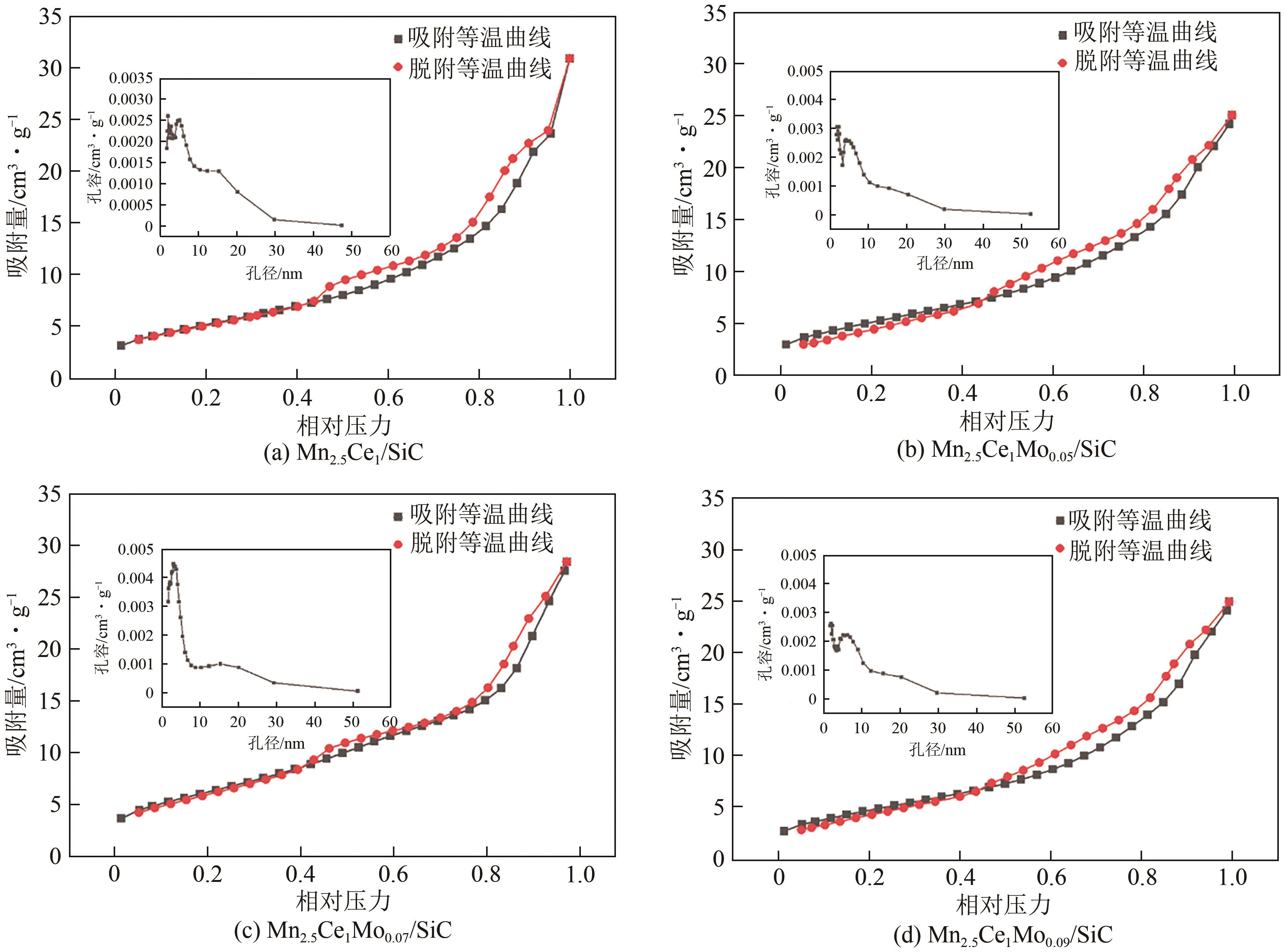
| 样品 | 比表面积/ m²·g-1 | 粒径/nm | 孔体积/cm³·g-1 |
|---|---|---|---|
| Mn2.5Ce1/SiC | 19.45 | 8.69 | 0.05 |
| Mn2.5Ce1Mo0.05/SiC | 19.35 | 6.85 | 0.04 |
| Mn2.5Ce1Mo0.07/SiC | 22.88 | 6.93 | 0.04 |
| Mn2.5Ce1Mo0.09/SiC | 17.84 | 6.77 | 0.04 |
| 样品 | 比表面积/ m²·g-1 | 粒径/nm | 孔体积/cm³·g-1 |
|---|---|---|---|
| Mn2.5Ce1/SiC | 19.45 | 8.69 | 0.05 |
| Mn2.5Ce1Mo0.05/SiC | 19.35 | 6.85 | 0.04 |
| Mn2.5Ce1Mo0.07/SiC | 22.88 | 6.93 | 0.04 |
| Mn2.5Ce1Mo0.09/SiC | 17.84 | 6.77 | 0.04 |
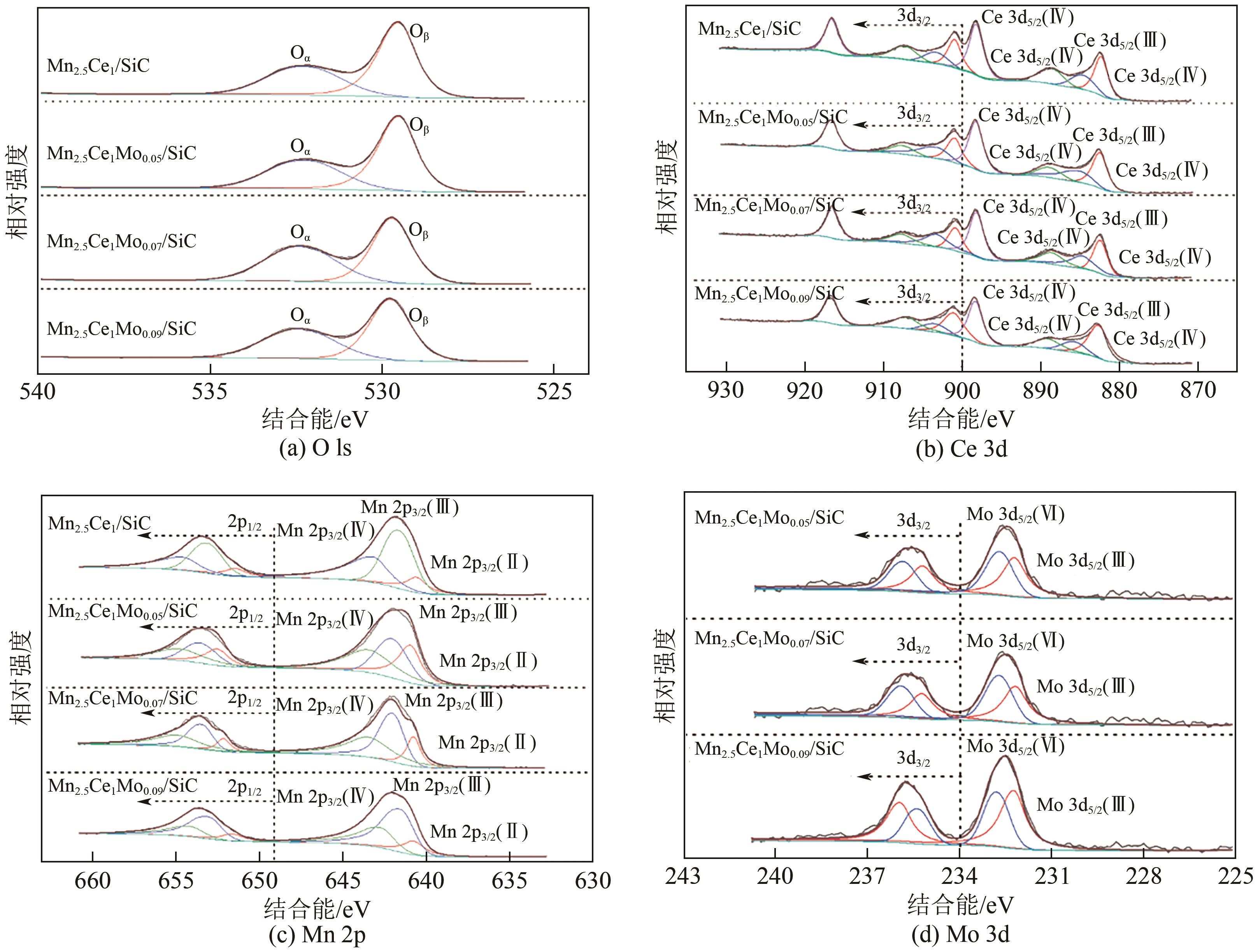
| 样品 | 相对浓度/% | |||
|---|---|---|---|---|
| Oα/(Oα+Oβ) | Mn4+/(Mn2++Mn3++Mn4+) | Ce3+/(Ce3++Ce4+) | Mo5+/(Mo5++Mo6+) | |
| Mn2.5Ce1/SiC | 46.75 | 38.97 | 23.77 | — |
| Mn2.5Ce1Mo0.05/SiC | 46.10 | 38.07 | 23.18 | 51.92 |
| Mn2.5Ce1Mo0.07/SiC | 48.00 | 39.38 | 23.70 | 54.24 |
| Mn2.5Ce1Mo0.09/SiC | 42.89 | 30.32 | 14.24 | 39.04 |
| 样品 | 相对浓度/% | |||
|---|---|---|---|---|
| Oα/(Oα+Oβ) | Mn4+/(Mn2++Mn3++Mn4+) | Ce3+/(Ce3++Ce4+) | Mo5+/(Mo5++Mo6+) | |
| Mn2.5Ce1/SiC | 46.75 | 38.97 | 23.77 | — |
| Mn2.5Ce1Mo0.05/SiC | 46.10 | 38.07 | 23.18 | 51.92 |
| Mn2.5Ce1Mo0.07/SiC | 48.00 | 39.38 | 23.70 | 54.24 |
| Mn2.5Ce1Mo0.09/SiC | 42.89 | 30.32 | 14.24 | 39.04 |
| 1 | BARAN R, VALENTIN L, J-M KRAFFT, et al. Influence of the nature and environment of manganese in Mn-BEA zeolites on NO conversion in selective catalytic reduction with ammonia[J]. Physical Chemistry Chemical Physics, 2017, 19(21): 13553-13561. |
| 2 | GUO Ruitang, ZHEN Wenlong, PAN Weiguo, et al. Effect of Cu doping on the SCR activity of CeO2 catalyst prepared by citric acid method[J]. Journal of Industrial and Engineering Chemistry, 2014, 20(4): 1577-1580. |
| 3 | ARFAOUI Jihene, GHORBEL Abdelhamid, PETITTO Carolina, et al. Novel V2O5-CeO2-TiO2-SO 4 2 - nanostructured aerogel catalyst for the low temperature selective catalytic reduction of NO by NH3 in excess O2 [J]. Applied Catalysis B: Environmental, 2018, 224: 264-275. |
| 4 | YADAV Deepak, SINGH Pratichi, PRASAD Ram. MnCo2O4 spinel catalysts synthesized by nanocasting method followed by different calcination routes for low-temperature reduction of NO x using various reductants[J]. International Journal of Hydrogen Energy, 2018, 43(10): 5346-5357. |
| 5 | RESITOGLU Ibrahim Aslan, KESKIN Ali. Hydrogen applications in selective catalytic reduction of NO x emissions from diesel engines[J]. International Journal of Hydrogen Energy, 2017, 42(36): 23389-23394. |
| 6 | THIRUPATHI Boningari, SMIRNIOTIS Panagiotis G. Nickel-doped Mn/TiO2 as an efficient catalyst for the low-temperature SCR of NO with NH3: Catalytic evaluation and characterizations[J]. Journal of Catalysis, 2012, 288: 74-83. |
| 7 | JIANG Ye, GAO Xiang, ZHANG Yongxin, et al. Effects of PbCl2 on selective catalytic reduction of NO with NH3 over vanadia-based catalysts[J]. Journal of Hazardous Materials, 2014, 274: 270-278. |
| 8 | WANG Xiangmin, DU Xuesen, ZHANG Li, et al. Promotion of NH4HSO4 decomposition in NO/NO2 contained atmosphere at low temperature over V2O5-WO3/TiO2 catalyst for NO reduction[J]. Applied Catalysis A: General, 2018, 559: 112-121. |
| 9 | PAN Weiguo, HONG Jienan, GUO Ruitang, et al. Effect of support on the performance of Mn-Cu oxides for low temperature selective catalytic reduction of NO with NH3 [J]. Journal of Industrial and Engineering Chemistry, 2014, 20(4): 2224-2227. |
| 10 | KWON Dong Wook, PARK Kwang Hee, HONG Sung Chang. Enhancement of SCR activity and SO2 resistance on VO x /TiO2 catalyst by addition of molybdenum[J]. Chemical Engineering Journal, 2016, 284: 315-324. |
| 11 | LI Qichao, CHEN Sifan, LIU Zhenyu, et al. Combined effect of KCl and SO2 on the selective catalytic reduction of NO by NH3 over V2O5/TiO2 catalyst[J]. Applied Catalysis B: Environmental, 2015, 164: 475-482. |
| 12 | DU Xuesen, XUE Jingyu, WANG Xiangmin, et al. Oxidation of sulfur dioxide over V2O5/TiO2 catalyst with low vanadium loading: A theoretical study[J]. The Journal of Physical Chemistry C, 2018, 122(8): 4517-4523. |
| 13 | WALLIN Mikaela, FORSER Stefan, Peter THORMÄHLEN, et al. Screening of TiO2-supported catalysts for selective NO x reduction with ammonia[J]. Industrial & Engineering Chemistry Research, 2004, 43(24): 7723-7731. |
| 14 | LIU Chang, SHI Jianwen, GAO Chen, et al. Manganese oxide-based catalysts for low-temperature selective catalytic reduction of NO x with NH3: A review[J]. Applied Catalysis A: General, 2016, 522: 54-69. |
| 15 | QI Gongshin, YANG Ralph T. Low-temperature selective catalytic reduction of NO with NH3 over iron and manganese oxides supported on titania[J]. Applied Catalysis B: Environmental, 2003, 44(3): 217-225. |
| 16 | JIN Ruiben, LIU Yue, WANG Yan, et al. The role of cerium in the improved SO2 tolerance for NO reduction with NH3 over Mn-Ce/TiO2 catalyst at low temperature[J]. Applied Catalysis B: Environmental, 2014, 148: 582-588. |
| 17 | THIRUPATHI Boningari, SMIRNIOTIS Panagiotis G. Co-doping a metal (Cr, Fe, Co, Ni, Cu, Zn, Ce, and Zr) on Mn/TiO2 catalyst and its effect on the selective reduction of NO with NH3 at low-temperatures[J]. Applied Catalysis B: Environmental, 2011, 110: 195-206. |
| 18 | QI Gongshin, YANG Ralph T, CHANG Ramsay. MnO x -CeO2 mixed oxides prepared by co-precipitation for selective catalytic reduction of NO with NH3 at low temperatures[J]. Applied Catalysis B: Environmental, 2004, 51(2): 93-106. |
| 19 | GAO Chen, SHI Jian-Wen, FAN Zhaoyang, et al. Eu-Mn-Ti mixed oxides for the SCR of NO x with NH3: The effects of Eu-modification on catalytic performance and mechanism[J]. Fuel Processing Technology, 2017, 167: 322-333. |
| 20 | LIU Jie, LI Xinyong, LI Ruoyun, et al. Facile synthesis of tube-shaped Mn-Ni-Ti solid solution and preferable Langmuir-Hinshelwood mechanism for selective catalytic reduction of NO x by NH3 [J]. Applied Catalysis A: General, 2018, 549: 289-301. |
| 21 | LIU Zhiming, ZHU Junzhi, LI Junhua, et al. Novel Mn-Ce-Ti mixed-oxide catalyst for the selective catalytic reduction of NO x with NH3 [J]. ACS Applied Materials & Interfaces, 2014, 6(16): 14500-14508. |
| 22 | BUSCA Guido, LIETTI Luca, RAMIS Gianguido, et al. Chemical and mechanistic aspects of the selective catalytic reduction of NO x by ammonia over oxide catalysts: A review[J]. Applied Catalysis B: Environmental, 1998, 18(1/2): 1-36. |
| 23 | LIETTI Luca, NOVA Isabella, FORZATTI Pio. Selective catalytic reduction (SCR) of NO by NH3 over TiO2-supported V2O5-WO3 and V2O5-MoO3 catalysts[J]. Topics in Catalysis, 2000, 11(1): 111-122. |
| 24 | MAQBOOL Muhammad Salman, PULLUR Anil Kumar, Heon Phil HA. Novel sulfation effect on low-temperature activity enhancement of CeO2-added Sb-V2O5/TiO2 catalyst for NH3-SCR[J]. Applied Catalysis B: Environmental, 2014, 152: 28-37. |
| 25 | LIU Zhiming, ZHANG Shaoxuan, LI Junhua, et al. Promoting effect of MoO3 on the NO x reduction by NH3 over CeO2/TiO2 catalyst studied with in situ DRIFTS[J]. Applied Catalysis B: Environmental, 2014, 144: 90-95. |
| 26 | GUO Ruitang, LI Mingyuan, SUN Peng, et al. The enhanced resistance to P species of an Mn-Ti catalyst for selective catalytic reduction of NO x with NH3 by the modification with Mo[J]. RSC Advances, 2017, 7(32): 19912-19923. |
| 27 | HARLIN M E, KRAUSE A O I, HEINRICH B, et al. Part II. Dehydrogenation of n-butane over carbon modified MoO3 supported on SiC[J]. Applied Catalysis A: General, 1999, 185(2): 311-322. |
| 28 | ZHAO Liang, KONG Liping, LIU Chunze, et al. AgCu/SiC-powder: A highly stable and active catalyst for gas-phase selective oxidation of alcohols[J]. Catalysis Communications, 2017, 98: 1-4. |
| 29 | ZHENG Ying, ZHENG Yong, LI Zhaohui, et al. Preparations of C/SiC composites and their use as supports for Ru catalyst in ammonia synthesis[J]. Journal of Molecular Catalysis A: Chemical, 2009, 301(1/2): 79-83. |
| 30 | YU Liangsong, LIU Xiaohao, FANG Yueying, et al. Highly active Co/SiC catalysts with controllable dispersion and reducibility for Fischer-Tropsch synthesis[J]. Fuel, 2013, 112: 483-488. |
| 31 | KIM Young A, CHOI Joo H, SCOTT J, et al. Preparation of high porous Pt-V2O5-WO3/TiO2/SiC filter for simultaneous removal of NO and particulates[J]. Powder Technology, 2008, 180(1/2): 79-85. |
| 32 | ZHOU Tiaoyun, YUAN Qing, PAN Xiulian, et al. Growth of Cu/SSZ-13 on SiC for selective catalytic reduction of NO with NH3 [J]. Chinese Journal of Catalysis, 2018, 39(1): 71-78. |
| 33 | XU Wenqing, YU Yunbo, ZHANG Changbin, et al. Selective catalytic reduction of NO by NH3 over a Ce/TiO2 catalyst[J]. Catalysis Communications, 2008, 9(6): 1453-1457. |
| 34 | LI Ping, XIN Ying, LI Qian, et al. Ce-Ti amorphous oxides for selective catalytic reduction of NO with NH3: Confirmation of Ce-O-Ti active sites[J]. Environmental Science & Technology, 2012, 46(17): 9600-9605. |
| 35 | JIANG Boqiong, LI Zhiguo, LEE Shuncheng. Mechanism study of the promotional effect of O2 on low-temperature SCR reaction on Fe-Mn/TiO2 by DRIFT[J]. Chemical Engineering Journal, 2013, 225: 52-58. |
| 36 | 朱传强, 茹晋波, 孙亭亭, 等. 固体高分子脱硝剂选择性非催化还原NO x 特性[J]. 化工进展, 2023, 42(9): 4939-4946. |
| ZHU Chuanqiang, RU Jinbo, SUN Tingting, et al. Characteristics of selective non-catalytic reduction of NO x with solid polymer denitration agent[J]. Chemical Industry and Engineering Progress, 2023, 42(9): 4939-4946. | |
| 37 | 焦金珍, 李时卉, 黄碧纯. 石墨烯负载MnO x 催化剂的制备及其低温NH3-SCR活性[J]. 物理化学学报, 2015, 31(7): 1383-1390. |
| JIAO Jinzhen, LI Shihui, HUANG Bichun. Preparation of manganese oxides supported on graphene catalysts and their activity in low-temperature NH3-SCR[J]. Acta Physico-Chimica Sinica, 2015, 31(7): 1383-1390. | |
| 38 | XU Ziqiang, IMPENG Sarawoot, JIA Xinyu, et al. SO2-Tolerant catalytic reduction of NO x by confining active species in TiO2 nanotubes[J]. Environmental Science: Nano, 2022, 9(6): 2121-2133. |
| 39 | DENG Jianlin, LIU Jixing, SONG Weiyu, et al. Selective catalytic reduction of NO with NH3 over Mo-Fe/beta catalysts: The effect of Mo loading amounts[J]. RSC Advances, 2017, 7(12): 7130-7139. |
| 40 | WANG Weichao, MCCOOL Geoffrey, KAPUR Neeti, et al. Mixed-phase oxide catalyst based on Mn-mullite (Sm, Gd)Mn2O5 for NO oxidation in diesel exhaust[J]. Science, 2012, 337(6096): 832-835. |
| 41 | CHEN Zhihang, WANG Furong, LI Hua, et al. Low-temperature selective catalytic reduction of NO x with NH3 over Fe-Mn mixed-oxide catalysts containing Fe3Mn3O8 phase[J]. Industrial & Engineering Chemistry Research, 2012, 51(1): 202-212. |
| 42 | ZENG Yiqing, ZHANG Shule, WANG Yanan, et al. CeO2 supported on reduced TiO2 for selective catalytic reduction of NO by NH3 [J]. Journal of Colloid and Interface Science, 2017, 496: 487-495. |
| 43 | LIU Zhiming, LIU Yuxian, LI Yuan, et al. WO3 promoted Mn-Zr mixed oxide catalyst for the selective catalytic reduction of NO x with NH3 [J]. Chemical Engineering Journal, 2016, 283: 1044-1050. |
| 44 | YAO Xiaojiang, KONG Tingting, CHEN Li, et al. Enhanced low-temperature NH3-SCR performance of MnO x /CeO2 catalysts by optimal solvent effect[J]. Applied Surface Science, 2017, 420: 407-415. |
| 45 | GONG Pijun, XIE Junlin, FANG De, et al. Effects of surface physicochemical properties on NH3-SCR activity of MnO2 catalysts with different crystal structures[J]. Chinese Journal of Catalysis, 2017, 38(11): 1925-1934. |
| 46 | JIANG Lijun, LIU Qingcai, RAN Guangjing, et al. V2O5-modified Mn-Ce/AC catalyst with high SO2 tolerance for low-temperature NH3-SCR of NO[J]. Chemical Engineering Journal, 2019, 370: 810-821. |
| 47 | NI Shuquan, TANG Xiaolong, YI Honghong, et al. Novel Mn-Ce bi-oxides loaded on 3D monolithic nickel foam for low-temperature NH3-SCR de-NO x : Preparation optimization and reaction mechanism[J]. Journal of Rare Earths, 2022, 40(2): 268-278. |
| 48 | LIU Lijun, SU Sheng, CHEN Dezhi, et al. Highly efficient NH3-SCR of NO x over MnFeW/Ti catalyst at low temperature: SO2 tolerance and reaction mechanism[J]. Fuel, 2022, 307: 121805. |
| 49 | SUN Chuanzhi, LIU Hao, CHEN Wei, et al. Insights into the Sm/Zr co-doping effects on N2 selectivity and SO2 resistance of a MnO x -TiO2 catalyst for the NH3-SCR reaction[J]. Chemical Engineering Journal, 2018, 347: 27-40. |
| 50 | YU Yanke, CHEN Changwei, MA Mudi, et al. SO2 promoted in situ recovery of thermally deactivated Fe2(SO4)3/TiO2 NH3-SCR catalysts: From experimental work to theoretical study[J]. Chemical Engineering Journal, 2019, 361: 820-829. |
| [1] | CHEN Yuhang, LI Qiaoyan, LIANG Meisheng, SONG Tianyuan, WANG Yue, LI Simeng, ZHOU Yuxuan. Role of the Sn dopant on Cu/CeZrO2/γ-Al2O3 three-way catalyst: Enhancement of low-temperature activity and sulfur resistance [J]. Chemical Industry and Engineering Progress, 2025, 44(3): 1368-1377. |
| [2] | ZHANG Xin’er, PEI Liujun, ZHOU Yudie, JIN Kaili, WANG Jiping. Progress of TiO2-based photocatalysts for hydrogen production by water splitting with solar energy [J]. Chemical Industry and Engineering Progress, 2025, 44(3): 1298-1308. |
| [3] | LIU Junjie, WU Jianmin, SUN Qiwen, WANG Jiancheng, SUN Yan. Research of metallocene catalysts for linear α-olefins polymerization to obtain high molecular weight products [J]. Chemical Industry and Engineering Progress, 2025, 44(3): 1309-1322. |
| [4] | ZHU Guoyu, GE Qi, FU Mingli. Durability testing and life prediction of methanol reforming catalysts for hydrogen production [J]. Chemical Industry and Engineering Progress, 2025, 44(3): 1338-1346. |
| [5] | ZUO Ji, LUO Li, XIE Yongkai, CHEN Wenyao, QIAN Gang, ZHOU Xinggui, DUAN Xuezhi. Effect of Cu catalyst particle size on methanol nonoxidative dehydrogenation to formaldehyde [J]. Chemical Industry and Engineering Progress, 2025, 44(3): 1347-1354. |
| [6] | BI Wentao, WANG Xuelin, QU Wei, WANG Congxin, TIAN Zhijian. Effect of Mg-modification on the catalytic performance of Pt/ZSM-22 with low Pt content in n-alkane hydroisomerization [J]. Chemical Industry and Engineering Progress, 2025, 44(3): 1355-1367. |
| [7] | ZHANG Qi, WANG Tao, ZHANG Xuebing, LI Weizhen, CHENG Meng, ZHANG Kui, LYU Yijun, MEN Zhuowu. Advances in Fe-based catalysts for conversion of syngas/CO2 to higher alcohols [J]. Chemical Industry and Engineering Progress, 2025, 44(3): 1323-1337. |
| [8] | TAO Jinquan, JIA Yijing, BAI Tianyu, YAO Rongpeng, HUANG Wenbin, CUI Yan, ZHOU Yasong, WEI Qiang. Synthesis and catalytic MTP performance of Silicalite-1 zeolite with low cost [J]. Chemical Industry and Engineering Progress, 2025, 44(3): 1550-1558. |
| [9] | ZHU Shiyu, HE Yongjin, WANG Mingzi, CHEN Bilian. Research progress on microalgae to fix CO2 in flue gas from coal-fired power plants [J]. Chemical Industry and Engineering Progress, 2025, 44(3): 1666-1682. |
| [10] | ZHANG Qi, WANG Tao, ZHANG Xuebing, LI Weizhen, FENG Bo, JIANG Zhihui, LYU Yijun, MEN Zhuowu. Advances in Co-based catalysts for syngas to higher alcohol [J]. Chemical Industry and Engineering Progress, 2025, 44(2): 773-787. |
| [11] | JIA Yijing, TAO Jinquan, HUANG Wenbin, LIU Haoran, LI Rongrong, YAO Rongpeng, BAI Tianyu, WEI Qiang, ZHOU Yasong. Research progress on iron-based catalysts for CO2 hydrogenation to low carbon olefins [J]. Chemical Industry and Engineering Progress, 2025, 44(2): 820-833. |
| [12] | LIAO Xu, WANG Wei, HUANG Wenting, XIONG Wentao, WANG Zeyu, QIN Zuodong, LIN Jinqing. Research progress in biomass-based catalysts in the conversion of carbon dioxide into cyclic carbonates [J]. Chemical Industry and Engineering Progress, 2025, 44(2): 834-846. |
| [13] | LI Zhangliang, YANG Yuezhu, WU Chuantian, LYU Yuancai. Degradation of bisphenol A by N-TiO2/MoS2/N-TiO2 immobilized laccase on activated carbon fiber felt [J]. Chemical Industry and Engineering Progress, 2025, 44(2): 887-898. |
| [14] | SU Liangjian, XIAO Junyan, ZHANG Chunguang, ZHAO Yuansheng, YANG Xu. Deep regeneration of fixed-bed HDCCR catalyst [J]. Chemical Industry and Engineering Progress, 2025, 44(2): 728-734. |
| [15] | LI Zhuoyu, YU Meiqi, CHEN Xiaoyan, HU Ruohui, WANG Qinghong, CHEN Chunmao, ZHAN Yali. Effects and mechanism on the removal of nitrobenzene from water by adsorption of refining waste catalysts [J]. Chemical Industry and Engineering Progress, 2025, 44(2): 1076-1087. |
| Viewed | ||||||
|
Full text |
|
|||||
|
Abstract |
|
|||||