化工进展 ›› 2025, Vol. 44 ›› Issue (5): 2394-2406.DOI: 10.16085/j.issn.1000-6613.2025-0090
• 合成生物制造 • 上一篇
基于微生物发酵构建生物基材料及单体模块
王良玉1,2,3( ), 曹辉1,2,3, 谭天伟1,2,3()
- 1.绿色生物制造全国重点实验室,北京 100029
2.北京化工大学国家能源生物炼制研发中心,北京 100029
3.北京化工大学教育部生物炼制工程研究中心,北京 100029
-
收稿日期:2025-01-14修回日期:2025-04-19出版日期:2025-05-25发布日期:2025-05-20 -
通讯作者:谭天伟 -
作者简介:王良玉(1996—),男,博士,研究方向为生物基材料。E-mail:wangliangyu@mail.buct.edu.cn。 -
基金资助:国家自然科学基金(U21B2098)
Constructing bio-based materials and monomer modules based on microbial fermentation
WANG Liangyu1,2,3(), CAO Hui1,2,3, TAN Tianwei1,2,3()
- 1.State Key Laboratory of Green Biomanufacturing, Beijing 100029, China
2.National Energy R&D Center for Biorefinery, Beijing University of Chemical Technology, Beijing 100029, China
3.Biorefinery Engineering Research Center of the Ministry of Education, Beijing University of Chemical Technology, Beijing 100029, China
-
Received:2025-01-14Revised:2025-04-19Online:2025-05-25Published:2025-05-20 -
Contact:TAN Tianwei

摘要:
生物基材料是推动化工新材料领域产业升级转型的重要支撑,本文以发酵法为核心,系统总结了生物基材料及单体模块原料端、过程端、产品端的相关进展;概括了生物制造产业背景下第二代、第三代碳源迭代更新的技术壁垒和挑战,提出构建多维生物质碳源供给体系和保障机制,以突破第一代碳源供给的局限性;围绕生物基塑料、生物基橡胶、生物基尼龙、生物基多糖材料四个模块,阐述了乙二醇、1,3-丙二醇、1,4-丁二醇、丁二酸、己二酸、对苯二甲酸等聚合物单体以及聚乳酸、聚羟基烷酸酯、透明质酸、细菌纤维素等聚合物材料的发酵工艺技术。本文还提出了完善发酵法生物基材料的产品体系,以实现石化材料的逐步替代,进而推动化工新材料领域的可持续发展。
中图分类号:
引用本文
王良玉, 曹辉, 谭天伟. 基于微生物发酵构建生物基材料及单体模块[J]. 化工进展, 2025, 44(5): 2394-2406.
WANG Liangyu, CAO Hui, TAN Tianwei. Constructing bio-based materials and monomer modules based on microbial fermentation[J]. Chemical Industry and Engineering Progress, 2025, 44(5): 2394-2406.

图1 生物质多维碳源供给体系下的代表性生物基单体和聚合物材料
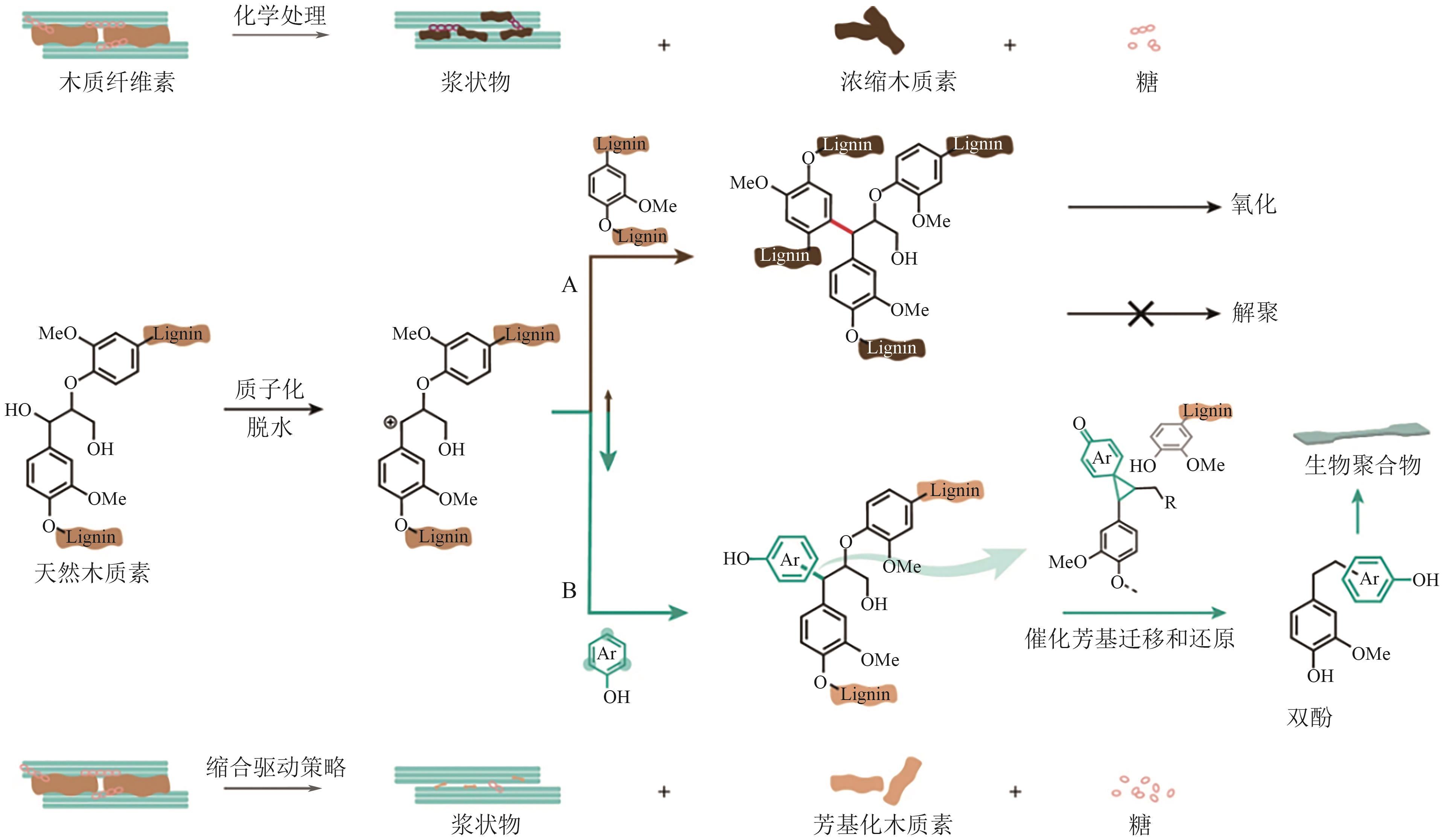
图2 以缩合反应驱动的双酚合成策略[17]
| 单体模块 | 底物 | 菌种 | 滴度/g·L-1 | 得率/g·g-1 | 生产速率/g·L-1·h-1 | 参考文献 |
|---|---|---|---|---|---|---|
| 乙二醇 | 木糖 | E. coli W3110 | 108.2 | 0.3600 | 2.250 | [ |
| 1,3-丙二醇 | 甘油 | K. pneumoniae LDH526 | 102.1 | 0.5200 | 2.130 | [ |
| 葡萄糖 | E. coli | 135.0 | 1.200 | 3.500 | [ | |
| 葡萄糖 | C. glutamicum MBP14 | 110.4 | 0.4200 | 2.300 | [ | |
| 1,4-丁二醇 | 葡萄糖 | E. coli | 125.0 | 0.4000 | 0.3500 | [ |
| 对苯二甲酸 | 对二甲苯 | E. coli DH5α | 6.700 | 0.6200 | 0.2800 | [ |
| 对二甲苯 | P. putida KT2440 | 38.25 | 0.6400 | — | [ | |
| 丁二酸 | 甘蔗汁 | I. orientalis SD108 | 63.10 | 0.5000 | 0.6600 | [ |
| 葡萄糖 | Y. lipolytica Hi-SA2 | 111.9 | 0.7900 | 1.790 | [ | |
| 己二酸 | 葡萄糖和甘油 | E. coli Mad123146 | 68.00 | 0.3800 | 0.8100 | [ |
| 黏康酸 | 葡萄糖 | C. glutamicum MA8 | 88.20 | 0.3000 | — | [ |
| 木质纤维素水解液 | C. glutamicum EMA1 | 19.90 | 0.3300 | — | ||
| 苯乙烯 | 葡萄糖 | E. coli YHP05 | 5.300 | — | 0.09000 | [ |
| 丁二烯 | 葡萄糖 | E. coli CFB22 | 2.130 | — | — | [ |
表1 发酵法合成单体模块的重要指标
| 单体模块 | 底物 | 菌种 | 滴度/g·L-1 | 得率/g·g-1 | 生产速率/g·L-1·h-1 | 参考文献 |
|---|---|---|---|---|---|---|
| 乙二醇 | 木糖 | E. coli W3110 | 108.2 | 0.3600 | 2.250 | [ |
| 1,3-丙二醇 | 甘油 | K. pneumoniae LDH526 | 102.1 | 0.5200 | 2.130 | [ |
| 葡萄糖 | E. coli | 135.0 | 1.200 | 3.500 | [ | |
| 葡萄糖 | C. glutamicum MBP14 | 110.4 | 0.4200 | 2.300 | [ | |
| 1,4-丁二醇 | 葡萄糖 | E. coli | 125.0 | 0.4000 | 0.3500 | [ |
| 对苯二甲酸 | 对二甲苯 | E. coli DH5α | 6.700 | 0.6200 | 0.2800 | [ |
| 对二甲苯 | P. putida KT2440 | 38.25 | 0.6400 | — | [ | |
| 丁二酸 | 甘蔗汁 | I. orientalis SD108 | 63.10 | 0.5000 | 0.6600 | [ |
| 葡萄糖 | Y. lipolytica Hi-SA2 | 111.9 | 0.7900 | 1.790 | [ | |
| 己二酸 | 葡萄糖和甘油 | E. coli Mad123146 | 68.00 | 0.3800 | 0.8100 | [ |
| 黏康酸 | 葡萄糖 | C. glutamicum MA8 | 88.20 | 0.3000 | — | [ |
| 木质纤维素水解液 | C. glutamicum EMA1 | 19.90 | 0.3300 | — | ||
| 苯乙烯 | 葡萄糖 | E. coli YHP05 | 5.300 | — | 0.09000 | [ |
| 丁二烯 | 葡萄糖 | E. coli CFB22 | 2.130 | — | — | [ |
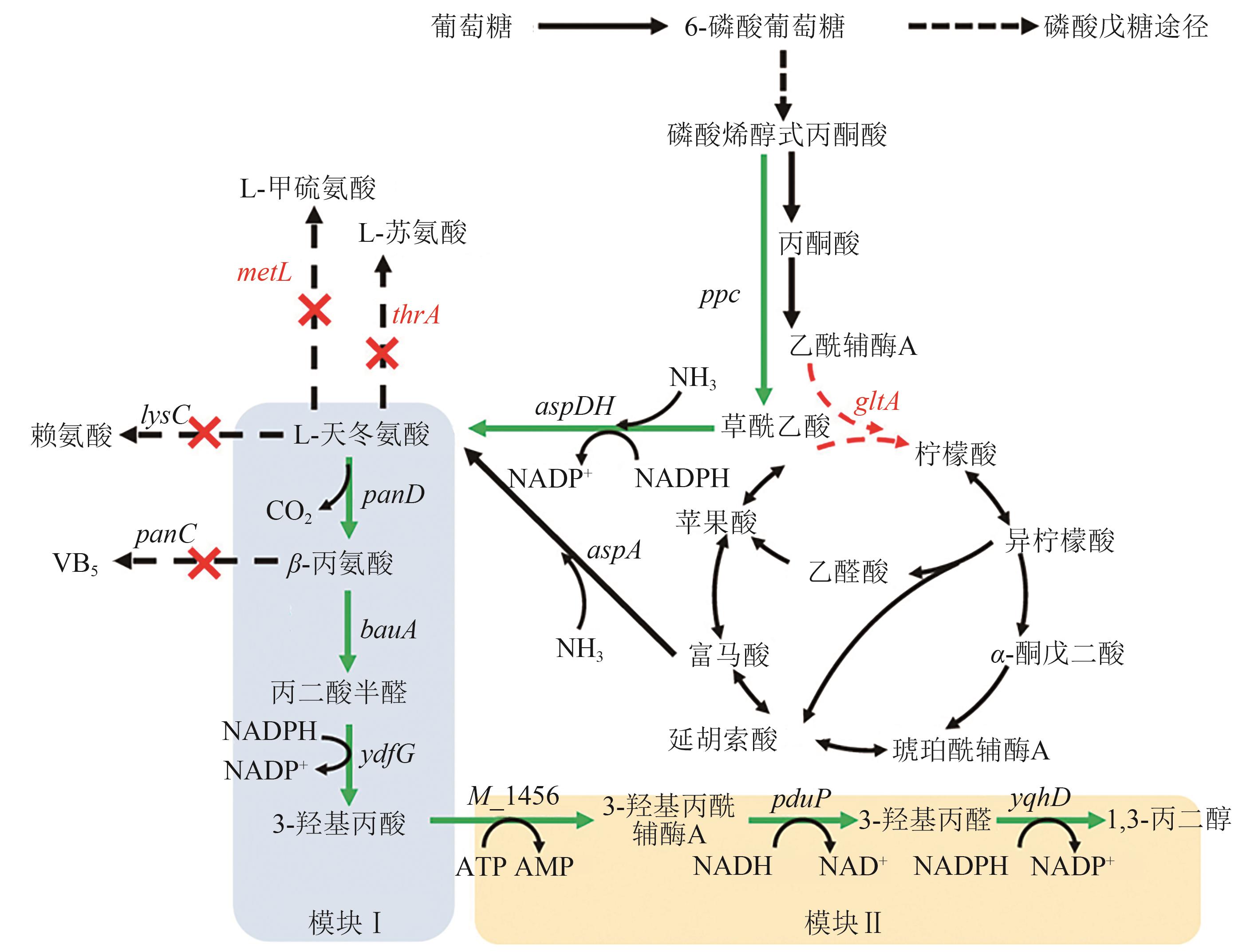
图3 以葡萄糖为原料从头生产1,3-丙二醇的生物合成路线[40]ppc—磷酸烯醇式丙酮酸羧化酶;gltA—柠檬酸合酶;aspDH—天冬氨酸脱氢酶;aspA—天冬氨酸氨裂合酶;panD—天冬氨酸脱羧酶;bauA—β-丙氨酸丙酮酸氨基转移酶;ydfG—3-羟基酸脱氢酶;M_1456(Msed_1456)—3-羟基丙酰辅酶A合成酶;pduP—醛脱氢酶;yqhD—乙醇脱氢酶;thrA—天冬氨酸激酶/高丝氨酸脱氢酶1;metL—天冬氨酸激酶/高丝氨酸脱氢酶2;lysC—赖氨酸敏感天冬氨酸激酶3;panC—泛酸合成酶
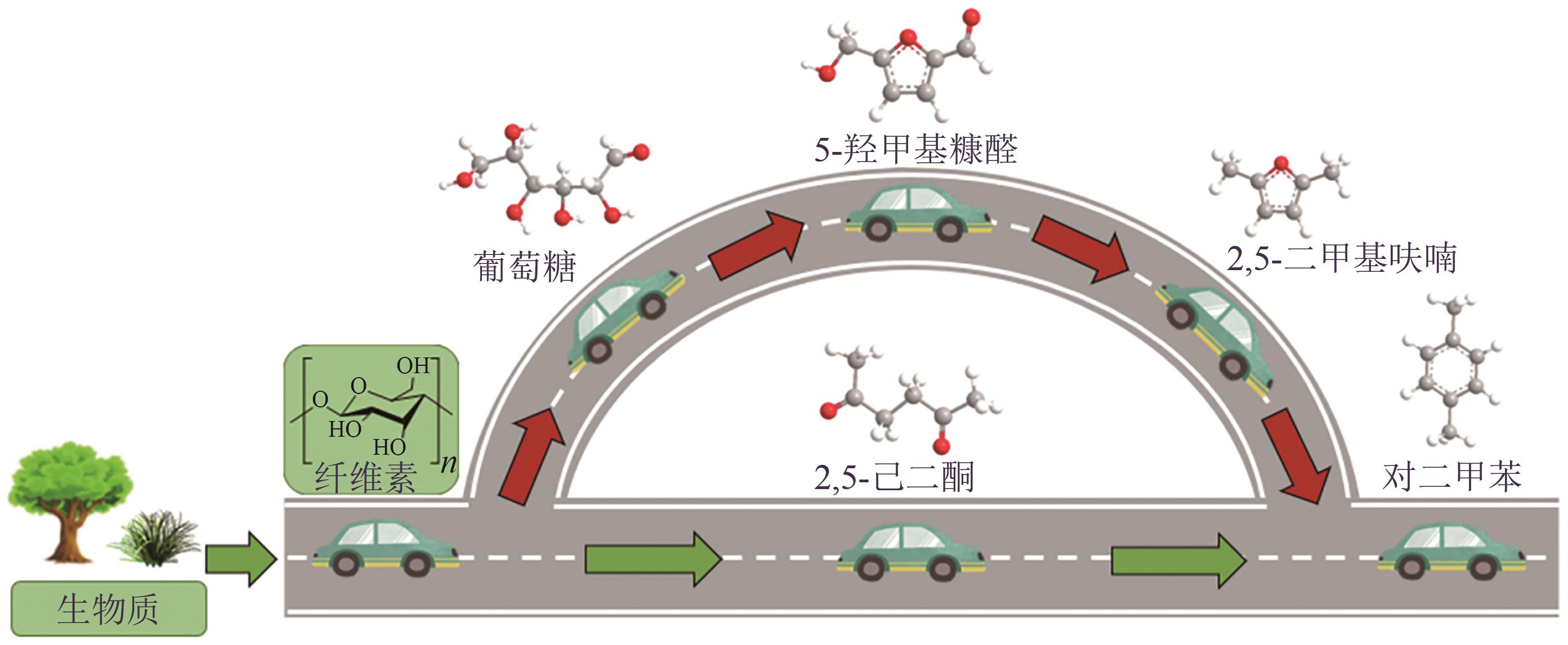
图4 两步法合成对二甲苯[46]
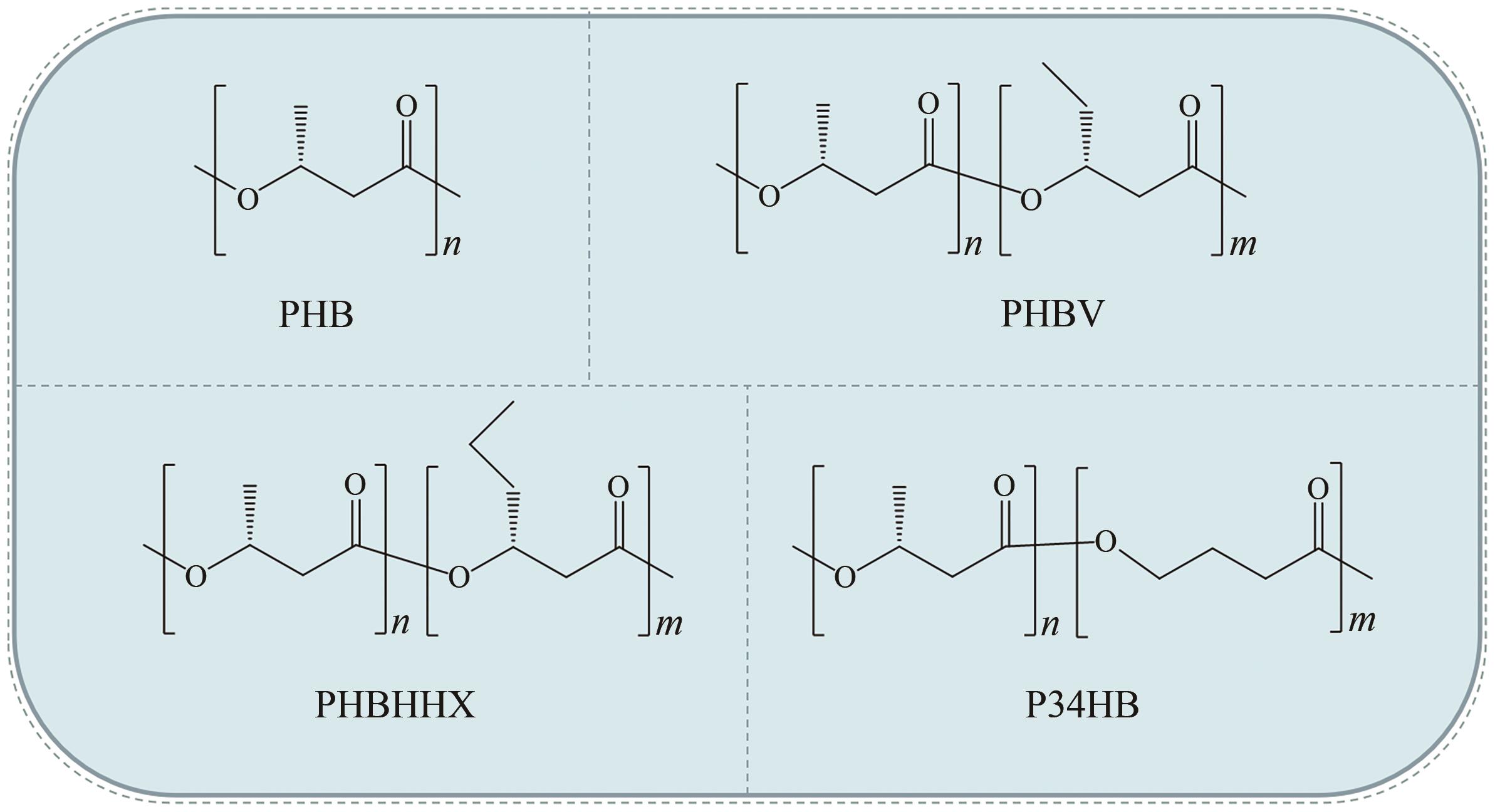
图5 聚羟基脂肪酸酯的代表性种类及其结构PHB—聚羟基丁酸酯;PHBV—聚(3-羟基丁酸酯-co-3-羟基戊酸酯)的共聚物;PHBHHX—聚(3-羟基丁酸酯-co-3-羟基己酸酯);P34HB—聚-3-羟基丁酸酯-4-羟基丁酸酯
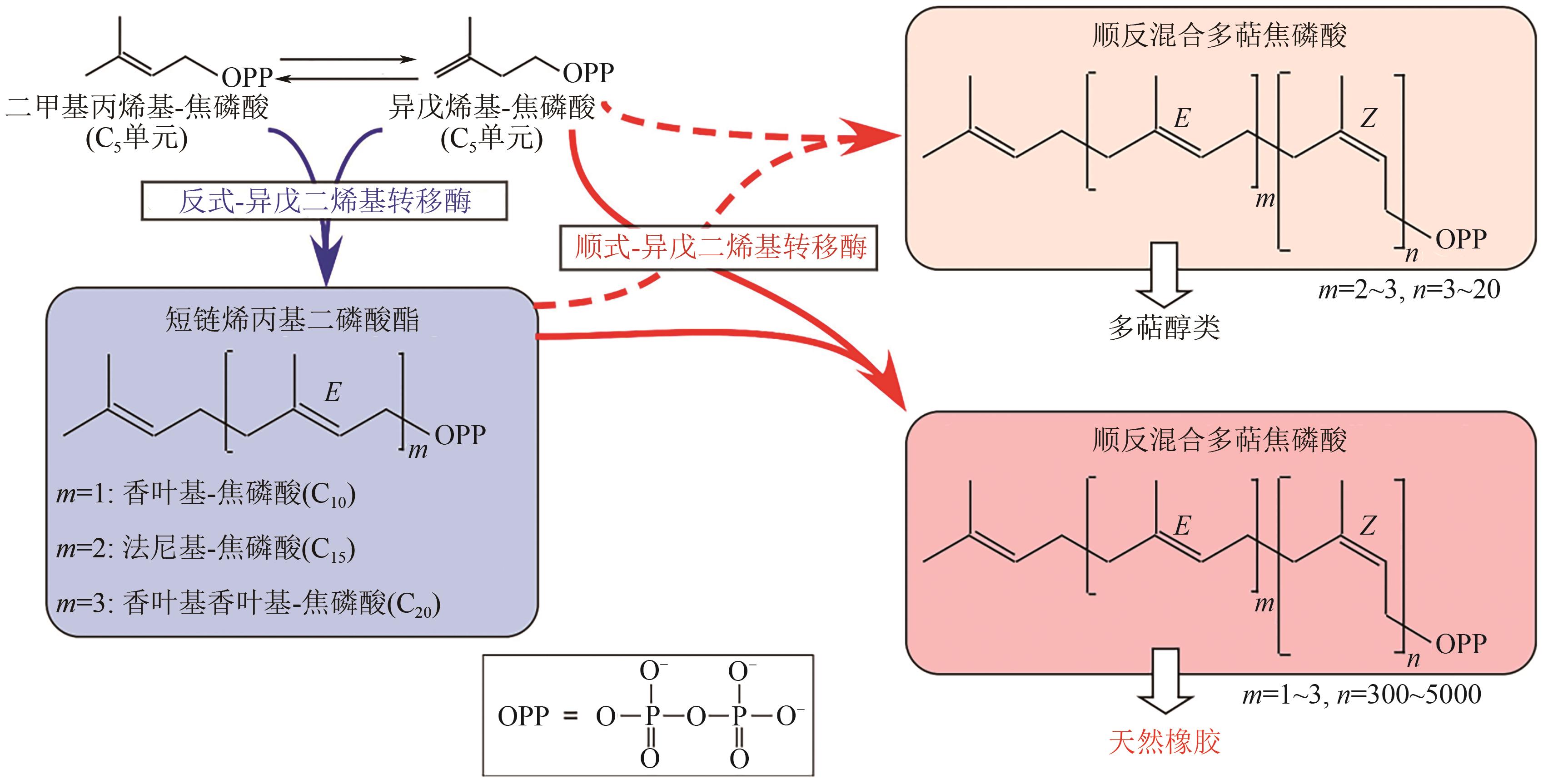
图6 顺式、反式混合聚异戊二烯和天然橡胶骨架结构的生物合成途径[61]
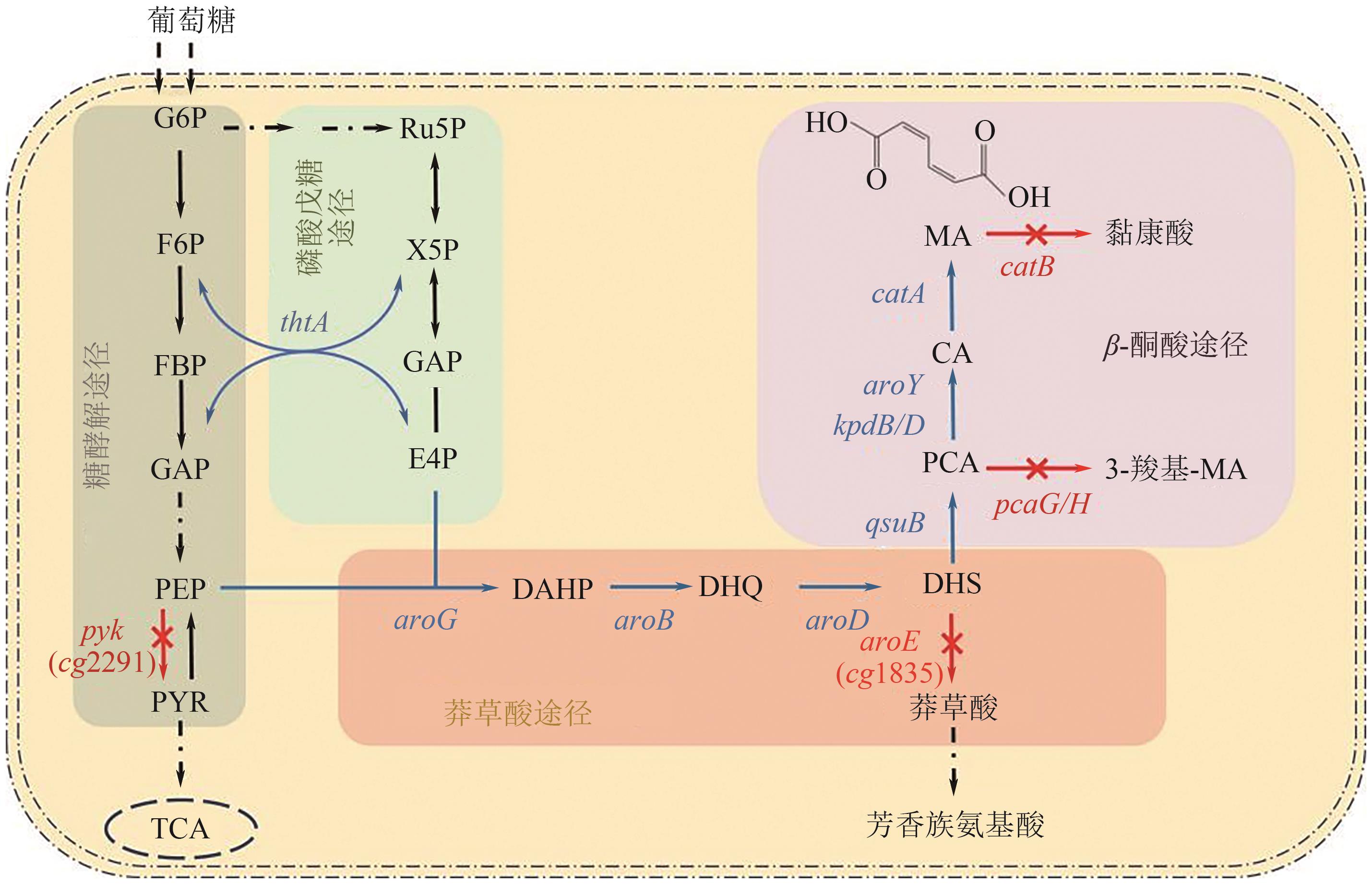
图7 谷氨酸棒杆菌中酸生产黏康酸的代谢途径[76]G6P—6-磷酸葡萄糖;F6P—6-磷酸果糖;FBP—果糖-1,6-二磷酸;GAP—甘油醛-3-磷酸;PEP—磷酸烯醇丙酮酸;PYR—丙酮酸;Ru5P—核酮-5-磷酸;X5P—木酮糖-5-磷酸;GAP—甘油醛-3-磷酸;E4P—D-赤藓糖4-磷酸;DAHP—3-脱氧-D-阿拉伯庚烯酸-7-磷酸酯;DHQ—3-脱氢奎尼酸酯;DHS—3-脱氢莽草酸;PCA—原儿茶酸酯;CA—儿茶酚;MA—顺式,顺式黏康酸;tktA—转酮醇酶Ⅰ;pyk—丙酮酸激酶;aroG—磷酸-2-脱氢-3-脱氧庚酸醛缩酶;aroB—DHQ合成酶;aroD—DHQ脱水酶;aroE—莽草酸5-脱氢酶;qsuB—磷酸异构酶;pcaG/H—PCA脱氧原酶α/β亚基;aroY, kpdB/D—PCA脱羧酶及其亚基;catA—CA 1,2-双加氧酶;catB—氯甲酸环异构酶
| 1 | ZHANG Yiwen, YANG Junjie, QIAN Fenghui, et al. Engineering a xylose fermenting yeast for lignocellulosic ethanol production[J]. Nature Chemical Biology, 2025, 21(3): 443-450. |
| 2 | HUANG Jiacheng, LI Chade-Deng, ZHAO Haodong, et al. Artificial intelligence system for enhanced automated 1,3-propanediol green biosynthesis[J]. Green Chemistry, 2023, 25(22): 9175-9186. |
| 3 | NI Ping, GAO Cong, WU Jing, et al. Production of 1,4-butanediol from succinic acid using Escherichia coli whole-cell catalysis[J]. ChemBioChem, 2024, 25(11): e202400142. |
| 4 | LIU Huan, LIU Shuang, NING Yuchen, et al. Metabolic engineering of Escherichia coli for efficient production of 1,4-butanediol from crude glycerol[J]. Journal of Environmental Chemical Engineering, 2024, 12(1): 111660. |
| 5 | CUI Zhiyong, ZHONG Yutao, SUN Zhijie, et al. Reconfiguration of the reductive TCA cycle enables high-level succinic acid production by Yarrowia lipolytica [J]. Nature Communications, 2023, 14(1): 8480. |
| 6 | YAN Xiongying, BAO Weiwei, WU Yalun, et al. Paradigm of engineering recalcitrant non-model microorganism with dominant metabolic pathway as a biorefinery chassis[J]. Nature Communications, 2024, 15(1): 10441. |
| 7 | CHOI So Young, LEE Youngjoon, YU Hye Eun, et al. Sustainable production and degradation of plastics using microbes[J]. Nature Microbiology, 2023, 8(12): 2253-2276. |
| 8 | ZHOU Li, ZHANG Zhen, SHI Changxia, et al. Chemically circular, mechanically tough, and melt-processable polyhydroxyalkanoates[J]. Science, 2023, 380(6640): 64-69. |
| 9 | WANG Xuan, HAN Jianing, ZHANG Xu, et al. Reversible thermal regulation for bifunctional dynamic control of gene expression in Escherichia coli [J]. Nature Communications, 2021, 12(1): 1411. |
| 10 | WANG Yang, HU Litao, HUANG Hao, et al. Eliminating the capsule-like layer to promote glucose uptake for hyaluronan production by engineered Corynebacterium glutamicum [J]. Nature Communications, 2020, 11(1): 3120. |
| 11 | CYWAR Robin M, RORRER Nicholas A, HOYT Caroline B, et al. Bio-based polymers with performance-advantaged properties[J]. Nature Reviews Materials, 2021, 7(2): 83-103. |
| 12 | KAMRAN Muhammad, Andrew KAY, DAVIDSON Matthew G. Facile synthesis of a novel furanic monomer and its ADMET polymerization toward fully renewable functional polymers[J]. ACS Sustainable Chemistry & Engineering, 2024, 12(37): 13798-13809. |
| 13 | MANKER Lorenz P, DICK Graham R, DEMONGEOT Adrien, et al. Sustainable polyesters via direct functionalization of lignocellulosic sugars[J]. Nature Chemistry, 2022, 14(9): 976-984. |
| 14 | 周文娟, 付刚, 齐显尼, 等. 发酵工业菌种的迭代创制[J]. 生物工程学报, 2022, 38(11): 4200-4218. |
| ZHOU Wenjuan, FU Gang, QI Xianni, et al. Upgrading microbial strains for fermentation industry[J]. Chinese Journal of Biotechnology, 2022, 38(11): 4200-4218. | |
| 15 | DHARMARAJA Jeyaprakash, SHOBANA Sutha, ARVINDNARAYAN Sundaram, et al. Lignocellulosic biomass conversion via greener pretreatment methods towards biorefinery applications[J]. Bioresource Technology, 2023, 369: 128328. |
| 16 | MADADI Meysam, SONG Guojie, GUPTA Vijai Kumar, et al. Non-catalytic proteins as promising detoxifiers in lignocellulosic biomass pretreatment: Unveiling the mechanism for enhanced enzymatic hydrolysis[J]. Green Chemistry, 2023, 25(18): 7141-7156. |
| 17 | LI Ning, YAN Kexin, RUKKIJAKAN Thanya, et al. Selective lignin arylation for biomass fractionation and benign bisphenols[J]. Nature, 2024, 630(8016): 381-386. |
| 18 | LUO Zhicheng, LIU Chong, RADU Alexandra, et al. Carbon-carbon bond cleavage for a lignin refinery[J]. Nature Chemical Engineering, 2024, 1(1): 61-72. |
| 19 | LIU Xuan, ZHANG Huijie, XI Shuangshuang, et al. Lignin-based ultrathin hydrogel coatings with strong substrate adhesion enabled by hydrophobic association[J]. Advanced Functional Materials, 2025, 35(3): 2413464. |
| 20 | YANG Guangxu, GONG Zhenggang, LUO Xiaolin, et al. Bonding wood with uncondensed lignins as adhesives[J]. Nature, 2023, 621(7979): 511-515. |
| 21 | LIU Zihe, WANG Kai, CHEN Yun, et al. Third-generation biorefineries as the means to produce fuels and chemicals from CO2 [J]. Nature Catalysis, 2020, 3(3): 274-288. |
| 22 | SULLIVAN Ian, GORYACHEV Andrey, DIGDAYA Ibadillah A, et al. Coupling electrochemical CO2 conversion with CO2 capture[J]. Nature Catalysis, 2021, 4(11): 952-958. |
| 23 | YU Sunmoon, YAMAUCHI Hiroki, WANG Shuo, et al. CO2-to-methanol electroconversion on a molecular cobalt catalyst facilitated by acidic cations[J]. Nature Catalysis, 2024, 7(9): 1000-1009. |
| 24 | BI Haoran, WANG Kai, XU Chenchen, et al. Biofuel synthesis from carbon dioxide via a bio-electrocatalysis system[J]. Chem Catalysis, 2023, 3(3): 100557. |
| 25 | 王凯, 刘子鹤, 陈必强, 等. 微生物利用二氧化碳合成燃料及化学品——第三代生物炼制[J]. 合成生物学, 2020, 1(1): 60-70. |
| WANG Kai, LIU Zihe, CHEN Biqiang, et al. Microbial utilization of carbon dioxide to synthesize fuels and chemicals—third-generation biorefineries[J]. Synthetic Biology Journal, 2020, 1(1): 60-70. | |
| 26 | JIANG Jing, LI Xinwei, YANG Kaiguang, et al. Photosynthetic cultivation of Chlamydomonas reinhardtii with formate as a novel carbon source to the protein production[J]. Chemical Engineering Journal, 2024, 493: 152518. |
| 27 | LAI Martin J, TSAI Jemmy C, LAN Ethan I. CRISPRi-enhanced direct photosynthetic conversion of carbon dioxide to succinic acid by metabolically engineered cyanobacteria[J]. Bioresource Technology, 2022, 366: 128131. |
| 28 | 肖璐, 李寅. 生物固碳: 从自然生物到人工合成[J]. 合成生物学, 2022, 3(5): 833-846. |
| XIAO Lu, LI Yin. Biological carbon fixation: From natural to synthetic[J]. Synthetic Biology Journal, 2022, 3(5): 833-846. | |
| 29 | GRUTER Gert-Jan M. Using carbon above the ground as feedstock to produce our future polymers[J]. Current Opinion in Green and Sustainable Chemistry, 2023, 40: 100743. |
| 30 | Chenlong NAN, PANG Tong, ZHAO Jiaxing, et al. Novel photoresponsive dinuclear nickel catalysts for ethylene (co)polymerization[J]. Science China Chemistry, 2025, 68(2): 714-722. |
| 31 | SYRANIDOU Evdokia, KARKANORACHAKI Katerina, BAROUTA Despoina, et al. Relationship between the carbonyl index (CI) and fragmentation of polyolefin plastics during aging[J]. Environmental Science & Technology, 2023, 57(21): 8130-8138. |
| 32 | ZHANG Shuai, XIA Bingquan, QU Yang, et al. Photocatalytic production of ethylene and propionic acid from plastic waste by titania-supported atomically dispersed Pd species[J]. Science Advances, 2023, 9(49): eadk2407. |
| 33 | MCKENNA Rebekah, NIELSEN David R. Styrene biosynthesis from glucose by engineered E. coli [J]. Metabolic Engineering, 2011, 13(5): 544-554. |
| 34 | LEE Kyungsoo, BANG Hyun Bae, LEE Yoon Hyeok, et al. Enhanced production of styrene by engineered Escherichia coli and in situ product recovery (ISPR) with an organic solvent[J]. Microbial Cell Factories, 2019, 18(1): 79. |
| 35 | JI Lei, MENG Jiaolong, LI Chengliang, et al. From polyester plastics to diverse monomers via low-energy upcycling[J]. Advanced Science, 2024, 11(25): 2403002. |
| 36 | CHEN Junliang, ZHANG Fangzhou, KUANG Min, et al. Unveiling synergy of strain and ligand effects in metallic aerogel for electrocatalytic polyethylene terephthalate upcycling[J]. Proceedings of the National Academy of Sciences of the United States of America, 2024, 121(17): e2318853121. |
| 37 | CHAE Tong Un, CHOI So Young, Jae Yong RYU, et al. Production of ethylene glycol from xylose by metabolically engineered Escherichia coli [J]. AIChE Journal, 2018, 64(12): 4193-4200. |
| 38 | 刘建明, 张炽坚, 张冰, 等. 巴氏梭菌作为工业底盘细胞高效生产1,3-丙二醇——从代谢工程和菌种进化到过程工程和产品分离[J]. 合成生物学, 2024, 5(6): 1386-1403. |
| LIU Jianming, ZHANG Chijian, ZHANG Bing, et al. Clostridium pasteurianum as an industrial chassis for efficient production of 1,3-propanediol: From metabolic engineering to fermentation and product separation[J]. Synthetic Biology Journal, 2024, 5(6): 1386-1403. | |
| 39 | LI Zihua, DONG Yufei, LIU Yu, et al. Systems metabolic engineering of Corynebacterium glutamicum for high-level production of 1,3-propanediol from glucose and xylose[J]. Metabolic Engineering, 2022, 70: 79-88. |
| 40 | LI Mingda, ZHANG Yang, LI Jingchuan, et al. Biosynthesis of 1,3-propanediol via a new pathway from glucose in Escherichia coli [J]. ACS Synthetic Biology, 2023, 12(7): 2083-2093. |
| 41 | ZHOU Bo, SHI Kai, TENG Xue, et al. Membrane-free electrocatalytic co-conversions of PBS waste plastics and maleic acid into high-purity succinic acid solid[J]. Angewandte Chemie International Edition, 2024, 63(44): e202411502. |
| 42 | TRAN Vinh G, MISHRA Somesh, BHAGWAT Sarang S, et al. An end-to-end pipeline for succinic acid production at an industrially relevant scale using Issatchenkia orientalis [J]. Nature Communications, 2023, 14(1): 6152. |
| 43 | YU Yong, ZHU Xinna, XU Hongtao, et al. Construction of an energy-conserving glycerol utilization pathways for improving anaerobic succinate production in Escherichia coli [J]. Metabolic Engineering, 2019, 56: 181-189. |
| 44 | LUO Zi Wei, LEE Sang Yup. Biotransformation of p-xylene into terephthalic acid by engineered Escherichia coli [J]. Nature Communications, 2017, 8(1): 15689. |
| 45 | LUO Zi Wei, CHOI Kyeong Rok, LEE Sang Yup. Improved terephthalic acid production from p-xylene using metabolically engineered Pseudomonas putida [J]. Metabolic Engineering, 2023, 76: 75-86. |
| 46 | CHU Haodong, FENG Xinqiang, WU Xue, et al. 2,5-hexanedione: The bridge for p-xylene production from lignocellulosic biomass via a brand new two-step route[J]. ACS Sustainable Chemistry & Engineering, 2023, 11(1): 177-186. |
| 47 | BALLA Evangelia D, PAPADOPOULOS Lazaros, AINALI Nina Maria, et al. Poly(ethylene furanoate-co-ethylene vanillate) biobased copolymers: Impact of the incorporation of vanillic acid units in poly(ethylene furanoate)[J]. European Polymer Journal, 2022, 176: 111429. |
| 48 | PAPAGEORGIOU George Z, NIKOLAIDIS George N, IOANNIDIS Rafael O, et al. A step forward in thermoplastic polyesters: Understanding the crystallization and melting of biobased poly(ethylene 2,5-furandicarboxylate) (PEF)[J]. ACS Sustainable Chemistry & Engineering, 2022, 10(21): 7050-7064. |
| 49 | MA Jianwen, ZENG Furong, LIN Xincen, et al. A photoluminescent hydrogen-bonded biomass aerogel for sustainable radiative cooling[J]. Science, 2024, 385(6704): 68-74. |
| 50 | YANG Yuhe, SUO Di, XU Tianpeng, et al. Sprayable biomimetic double mask with rapid autophasing and hierarchical programming for scarless wound healing[J]. Science Advances, 2024, 10(33): eado9479. |
| 51 | YIN Jing, XU Lan, AHMED Adnan. Batch preparation and characterization of electrospun porous polylactic acid-based nanofiber membranes for antibacterial wound dressing[J]. Advanced Fiber Materials, 2022, 4(4): 832-844. |
| 52 | TAN Chunlin, TAO Fei, XU Ping. Direct carbon capture for the production of high-performance biodegradable plastics by cyanobacterial cell factories[J]. Green Chemistry, 2022, 24(11): 4470-4483. |
| 53 | YU Linping, YAN Xu, ZHANG Xu, et al. Biosynthesis of functional polyhydroxyalkanoates by engineered Halomonas bluephagenesis[J]. Metabolic Engineering, 2020, 59: 119-130. |
| 54 | CYWAR Robin M, LING Chen, CLARKE Ryan W, et al. Elastomeric vitrimers from designer polyhydroxyalkanoates with recyclability and biodegradability[J]. Science Advances, 2023, 9(47): eadi1735. |
| 55 | MORI Yutaro, NODA Shuhei, SHIRAI Tomokazu, et al. Direct 1,3-butadiene biosynthesis in Escherichia coli via a tailored ferulic acid decarboxylase mutant[J]. Nature Communications, 2021, 12(1): 2195. |
| 56 | Xiaomei LYU, GU Jiali, WANG Fan, et al. Combinatorial pathway optimization in Escherichia coli by directed co-evolution of rate-limiting enzymes and modular pathway engineering[J]. Biotechnology and Bioengineering, 2016, 113(12): 2661-2669. |
| 57 | LIN Jiaxi, YAO Zhen, Xiaomei LYU, et al. Development of a dual temperature control system for isoprene biosynthesis in Saccharomyces cerevisiae [J]. Frontiers of Chemical Science and Engineering, 2022, 16(7): 1079-1089. |
| 58 | Xiaomei LYU, WANG Fan, ZHOU Pingping, et al. Dual regulation of cytoplasmic and mitochondrial acetyl-CoA utilization for improved isoprene production in Saccharomyces cerevisiae [J]. Nature Communications, 2016, 7(1): 12851. |
| 59 | SHAIKH Kurshedaktar M, ODANETH Annamma A. Metabolic engineering of Yarrowia lipolytica for the production of isoprene[J]. Biotechnology Progress, 2021, 37(6): e3201. |
| 60 | HUANG Shaoqi, ZHANG Junqi, KONG Lingmin, et al. Fully biosourced, vulcanization-free, and thermal-responsive natural rubber material[J]. Macromolecules, 2024, 57(4): 1642-1652. |
| 61 | YAMASHITA Satoshi, YAMAGUCHI Haruhiko, WAKI Toshiyuki, et al. Identification and reconstitution of the rubber biosynthetic machinery on rubber particles from Hevea brasiliensis [J]. eLife, 2016, 5: e19022. |
| 62 | YAMASHITA Satoshi, TAKAHASHI Seiji. Molecular mechanisms of natural rubber biosynthesis[J]. Annual Review of Biochemistry, 2020, 89: 821-851. |
| 63 | CHERIAN Sam, Stephen Beungtae RYU, CORNISH Katrina. Natural rubber biosynthesis in plants, the rubber transferase complex, and metabolic engineering progress and prospects[J]. Plant Biotechnology Journal, 2019, 17(11): 2041-2061. |
| 64 | YANG Kaixin, QIAO Yangge, LI Fei, et al. Subcellular engineering of lipase dependent pathways directed towards lipid related organelles for highly effectively compartmentalized biosynthesis of triacylglycerol derived products in Yarrowia lipolytica[J]. Metabolic Engineering, 2019, 55: 231-238. |
| 65 | MA Yongshuo, LI Jingbo, HUANG Sanwen, et al. Targeting pathway expression to subcellular organelles improves astaxanthin synthesis in Yarrowia lipolytica [J]. Metabolic Engineering, 2021, 68: 152-161. |
| 66 | YANG Ji, LIU Jiawang, NEUMANN Helfried, et al. Direct synthesis of adipic acid esters via palladium-catalyzed carbonylation of 1,3-dienes[J]. Science, 2019, 366(6472): 1514-1517. |
| 67 | ZHANG Xu, CHEN Yong, YE Mengting, et al. Biodegradable copolyesters with unexpected highly blocky microstructures and enhanced thermal properties[J]. ACS Sustainable Chemistry & Engineering, 2022, 10(14): 4438-4450. |
| 68 | VERNEKAR Dnyanesh, DAYYAN Mohammad, RATHA Satyajit, et al. Direct oxidation of cyclohexane to adipic acid by a WFeCoO(OH) catalyst: Role of Brønsted acidity and oxygen vacancies[J]. ACS Catalysis, 2021, 11(17): 10754-10766. |
| 69 | WANG Xiao, BIAN Wenyi, MA Yurong, et al. Hydroxyl-terminated carbon dots for efficient conversion of cyclohexane to adipic acid[J]. Journal of Colloid and Interface Science, 2021, 591: 281-289. |
| 70 | ZHAO Mei, HUANG Dixuan, ZHANG Xiaojuan, et al. Metabolic engineering of Escherichia coli for producing adipic acid through the reverse adipate-degradation pathway[J]. Metabolic Engineering, 2018, 47: 254-262. |
| 71 | ZHOU Yu, ZHAO Mei, ZHOU Shenghu, et al. Biosynthesis of adipic acid by a highly efficient induction-free system in Escherichia coli [J]. Journal of Biotechnology, 2020, 314/315: 8-13. |
| 72 | CACHERA Paul, KURT Nikolaj Can, Andreas RØPKE, et al. Genome-wide host-pathway interactions affecting cis-cis-muconic acid production in yeast[J]. Metabolic Engineering, 2024, 83: 75-85. |
| 73 | PYNE Michael E BAGLEY James A, NARCROSS Lauren, et al. Screening non-conventional yeasts for acid tolerance and engineering Pichia occidentalis for production of muconic acid[J]. Nature Communications, 2023, 14(1): 5294. |
| 74 | JOHNSON Christopher W, Davinia SALVACHÚA, KHANNA Payal, et al. Enhancing muconic acid production from glucose and lignin-derived aromatic compounds via increased protocatechuate decarboxylase activity[J]. Metabolic Engineering Communications, 2016, 3: 111-119. |
| 75 | MOKWATLO Sekgetho C, KLEIN Bruno C, BENAVIDES Pahola Thathiana, et al. Bioprocess development and scale-up for cis,cis-muconic acid production from glucose and xylose by Pseudomonas putida [J]. Green Chemistry, 2024, 26(19): 10152-10167. |
| 76 | LI Menglei, CHEN Jiayao, HE Keqin, et al. Corynebacterium glutamicum cell factory design for the efficient production of cis,cis-muconic acid[J]. Metabolic Engineering, 2024, 82: 225-237. |
| 77 | ZHANG Shiding, LI Qinrou, HE Keqin, et al. Computational redesign of an enoate reductase for the in vivo production of adipic acid from muconic acid[J]. Chem Catalysis, 2024, 4(8): 101042. |
| 78 | TAN Zan, XIAO Longyou, MA Junwu, et al. Integrating hydrogels manipulate ECM deposition after spinal cord injury for specific neural reconnections via neuronal relays[J]. Science Advances, 10(27): eado9120. |
| 79 | LI Shangzhi, KE Zhiqiang, PENG Xiaotong, et al. Injectable and fast gelling hyaluronate hydrogels with rapid self-healing ability for spinal cord injury repair[J]. Carbohydrate Polymers, 2022, 298: 120081. |
| 80 | XING Hui, PAN Xiangjun, HU Yihan, et al. High molecular weight hyaluronic acid-liposome delivery system for efficient transdermal treatment of acute and chronic skin photodamage[J]. Acta Biomaterialia, 2024, 182: 171-187. |
| 81 | Carmine D'AMICO, FUSCIELLO Manlio, HAMDAN Firas, et al. Transdermal delivery of PeptiCRAd cancer vaccine using microneedle patches[J]. Bioactive Materials, 2025, 45: 115-127. |
| 82 | LU Yi, MEHLING Marina, HUAN Siqi, et al. Biofabrication with microbial cellulose: From bioadaptive designs to living materials[J]. Chemical Society Reviews, 2024, 53(14): 7363-7391. |
| 83 | ZHAO Xueqing, SHI Yucheng, NIU Shaofang, et al. Enhancing wound healing and bactericidal efficacy: A hydrogel membrane of bacterial cellulose and sanxan gel for accelerating the healing of infected wounds[J]. Advanced Healthcare Materials, 2024, 13(8): e2303216. |
| 84 | LIU Xingang, WU Min, WANG Meng, et al. Direct synthesis of photosensitizable bacterial cellulose as engineered living material for skin wound repair[J]. Advanced Materials, 2022, 34(13): e2109010. |
| 85 | GAO Chong, LIU Yingcun, GU Zongxue, et al. Hierarchical structured fabrics with enhanced pressure sensing performance based on orientated growth of functional bacterial cellulose[J]. Advanced Fiber Materials, 2024, 6(5): 1554-1568. |
| 86 | 王蕾. 细菌纤维素抗菌敷料的制备及性能研究[D]. 上海: 东华大学, 2016. |
| WANG Lei. Preparation and properties of bacterial cellulose antibacterial dressing[D]. Shanghai: Donghua University, 2016. | |
| 87 | GAO Minghong, LI Juan, BAO Zixian, et al. A natural in situ fabrication method of functional bacterial cellulose using a microorganism[J]. Nature Communications, 2019, 10(1): 437. |
| 88 | WALKER Kenneth T, LI Ivy S, KEANE Jennifer, et al. Self-pigmenting textiles grown from cellulose-producing bacteria with engineered tyrosinase expression[J]. Nature Biotechnology, 2025, 43(3): 345-354. |
| [1] | 曹湘洪, 周峰, 姜睿, 刘诗哲, 方向晨, 亢万忠, 乔金樑, 聂红. 加快我国生物基材料产业发展的对策[J]. 化工进展, 2025, 44(5): 2385-2393. |
| [2] | 张东旭, 么强, 黑树楠, 李卫东, 刘成, 李志军, 宋乐春, 韩照明. 废塑料改性沥青相容性及性能分析研究进展[J]. 化工进展, 2025, 44(3): 1651-1665. |
| [3] | 郑钧译, 李明, 朱倍弘, 苏畅, 郭思含, 于麒麟, 张耀斌. 餐厨垃圾体系下的丁酸发酵强化[J]. 化工进展, 2024, 43(S1): 597-603. |
| [4] | 张锐, 江静, 徐鸿飞, 杨盛凯, 李亚红, 周靖原, 曾坚贤, 黄小平, 刘鹏飞, 张明明, 李志强. 陶瓷膜分离技术及其在生物制造领域的应用进展[J]. 化工进展, 2024, 43(8): 4550-4561. |
| [5] | 黄思晗, 凌玲, 李佳彬, 李秀芬. 菌剂添加条件下通风量对食品废弃物好氧发酵过程的影响[J]. 化工进展, 2024, 43(7): 4128-4137. |
| [6] | 刘君, 胥志祥, 朱春游, 岳中秋, 潘学军. 典型环境微塑料的微生物降解途径及分子机制[J]. 化工进展, 2024, 43(7): 4059-4071. |
| [7] | 屈超, 刘俊红, 贾彬, 黄勇. 水性丙烯酸树脂对PBAT/淀粉复合材料性能影响[J]. 化工进展, 2024, 43(6): 3268-3276. |
| [8] | 赵培涛, 傅彬彬, 赵泉, 左武, 周海云, 韩东太. 溶剂低压过热蒸汽热裂解塑料制油过程特性[J]. 化工进展, 2024, 43(6): 3420-3429. |
| [9] | 孟卫波, 邢宝林, 程松, 冯来宏, 施凤, 曾会会, 雷思乐, 王雪, 赵赛丹, 曾祥旺. 废塑料催化热解制备碳纳米管及其生长机理[J]. 化工进展, 2024, 43(6): 3468-3478. |
| [10] | 黄超, 任晓洁, 裴疆森, 赵新河, 赵玉斌, 王灵云, 荆宇航. 高产琥珀酸工程菌株E.coli SUC37的代谢途径优化及分析[J]. 化工进展, 2024, 43(12): 6883-6895. |
| [11] | 彭鑫鑫. 烯烃氢甲酰化的电化学策略[J]. 化工进展, 2024, 43(12): 6589-6591. |
| [12] | 徐燕红, 陈钰, 袁向前, 刘纪昌, 赵基钢. 基于Monte Carlo法的苯乙烯-丙烯腈单链模拟[J]. 化工进展, 2024, 43(11): 6068-6076. |
| [13] | 方崇, 刘云云, 徐惠娟, 周雨, 邱雨心, 巨苗苗. 低碳合成气生物转化及产乙醇发酵工艺探索[J]. 化工进展, 2024, 43(11): 6111-6118. |
| [14] | 尚高原, 余金鹏, 崔凯, 郭坤. 外加电位对高浓度马铃薯淀粉废水电发酵产甲烷系统的影响[J]. 化工进展, 2024, 43(11): 6533-6542. |
| [15] | 全翠, 陈常祥, 高宁博, 陆丽芳. 表面活性剂及聚乳酸塑料对餐厨垃圾发酵产酸特性影响[J]. 化工进展, 2024, 43(10): 5791-5804. |
| 阅读次数 | ||||||
|
全文 |
|
|||||
|
摘要 |
|
|||||