化工进展 ›› 2025, Vol. 44 ›› Issue (10): 6115-6126.DOI: 10.16085/j.issn.1000-6613.2024-1303
• 化工园区 • 上一篇
化工园区安全屏障研究综述与展望:概念、评估与管理
曾涛1,2( ), 魏利军1,2(), 陈国华3, 多英全1,2, 江赛华3, 苏明清1,2, 陈超1,4
- 1.中国安全生产科学研究院,北京 100012
2.重大危险源与化工园区系统安全应急管理部重点实验室,北京 100012
3.华南理工大学安全科学与工程研究所,广东 广州 510640
4.西南石油大学石油与天然气工程学院,四川 成都 610500
-
收稿日期:2024-08-09修回日期:2024-12-09出版日期:2025-10-25发布日期:2025-11-10 -
通讯作者:魏利军 -
作者简介:曾涛(1995—),男,博士,工程师,研究方向为化工安全与风险评价技术。E-mail:taozeng1995@163.com。 -
基金资助:国家重点研发计划(2023YFC3008800);国家自然科学基金面上项目(22478128);应急管理部重点科技计划(2024EMST060602)
Review and prospect of safety barrier research in chemical industrial parks: Concept, assessment and management
ZENG Tao1,2(), WEI Lijun1,2(), CHEN Guohua3, DUO Yingquan1,2, JIANG Saihua3, SU Mingqing1,2, CHEN Chao1,4
- 1.China Academy of Safety Science and Technology, Beijing 100012, China
2.Key Laboratory of Major Hazard and Chemical Industry Park System Safety, Ministry of Emergency Management, Beijing 100012, China
3.Institute of Safety Science & Engineering, South China University of Technology, Guangzhou 510640, Guangdong, China
4.School of Petroleum Engineering, Southwest Petroleum University, Chengdu 610500, Sichuan, China
-
Received:2024-08-09Revised:2024-12-09Online:2025-10-25Published:2025-11-10 -
Contact:WEI Lijun

摘要:
安全屏障是化工园区工业事故防控的主要技术手段,其功能实现的基础理论与屏障管理的相关研究受到了学界的广泛关注。然而,不同研究中安全屏障概念、屏障性能表征参数、屏障效果评估方法、屏障管理准则等存在一定的差异,导致难以进一步推进其理论研究与工程实践。本文回顾了安全屏障概念的发展历程,厘清安全屏障类型与分类依据,结合风险与韧性视角深入剖析屏障功能实现的基本原理,归纳总结安全屏障性能表征的常用参数与模型方法,指出基于不确定性的安全屏障效果量化是当前研究的核心难点。对比基于风险削减目标的常规屏障管理思路与基于韧性增强过程的新型屏障管理理念的优缺点,并从屏障系统构建、监测与维护、应急响应支持、屏障系统灾后优化等方面对化工园区屏障管理体系进行探讨。最后,指出后续安全屏障研究的关键突破方向,旨在设计高效屏障系统,保障化工园区安全发展。
中图分类号:
引用本文
曾涛, 魏利军, 陈国华, 多英全, 江赛华, 苏明清, 陈超. 化工园区安全屏障研究综述与展望:概念、评估与管理[J]. 化工进展, 2025, 44(10): 6115-6126.
ZENG Tao, WEI Lijun, CHEN Guohua, DUO Yingquan, JIANG Saihua, SU Mingqing, CHEN Chao. Review and prospect of safety barrier research in chemical industrial parks: Concept, assessment and management[J]. Chemical Industry and Engineering Progress, 2025, 44(10): 6115-6126.
| 作者与文献 | 年份 | 安全屏障定义 |
|---|---|---|
| de Dianous和Fiévez[ | 2006 | 直接提供安全功能的物理与工程系统或由特定程序及行政指挥下的人类行为 |
| Sklet[ | 2006 | 计划用于防止、控制或缓解非预期事件或事故的物理性和/或非物理性措施 |
| Hollnagel[ | 2008 | 面向不受控的物质、能量或信息流动并执行防御或保护屏障功能的措施 |
| Rathnayaka等[ | 2011 | 用于防止、控制或缓解某一事故过程相关后果的安全措施 |
| 周宁等[ | 2015 | 降低化工园区潜在危险事件发生频率和严重程度的针对性措施 |
| Landucci等[ | 2015 | 降低多米诺效应概率的保护系统 |
| Johansen和Rausand[ | 2015 | 设计用来防止或缓解某个危险性事故后果的系统,可展现单一或多个屏障功能 |
| Moller等[ | 2017 | 防止事故发生和/或降低其后果的措施 |
| 王文红[ | 2017 | 化工园区相关的对环境、秩序、安全等有害因素有阻碍、缓冲或防护作用的事物总称 |
| Chen等[ | 2019 | 能够降低潜在事故后果及化工园区对蓄意攻击(相关攻击旨在造成最大化损失)吸引力的系列安全措施 |
| 丁洁[ | 2019 | 化工园区相关的物理和工程系统或人在特定的过程或管理控制过程中的行为,是为了实现避免、预防、控制或者降低(限制、缓解)不期望的事件或事故发生概率的目的而采取的物理性或非物理性手段 |
| Misuri等[ | 2021 | 旨在防止、缓解或控制研究对象危险波动或事故的物理性或非物理性措施 |
| Yuan等[ | 2022 | 计划用于防止、控制或缓解非预期事件后果及其升级可能性的物理性或非物理性工具 |
| Zeng等[ | 2022 | 防止或缓解化工区域Natech事件中事故及潜在升级物理性与非物理性措施 |
| 黄孔星[ | 2022 | 化工园区内或周边保护设备单元免受或降低外部扰动造成危害的各类预防、控制或减缓措施和机制 |
| Wang等[ | 2024 | 由化工园区管委会指导危险化学品生产企业采取的防止多米诺效应的措施 |
| Zhou等[ | 2024 | 防止危险性事故发生或降低事故发生概率或缓解事故后果的安全措施 |
表1 典型安全屏障定义
| 作者与文献 | 年份 | 安全屏障定义 |
|---|---|---|
| de Dianous和Fiévez[ | 2006 | 直接提供安全功能的物理与工程系统或由特定程序及行政指挥下的人类行为 |
| Sklet[ | 2006 | 计划用于防止、控制或缓解非预期事件或事故的物理性和/或非物理性措施 |
| Hollnagel[ | 2008 | 面向不受控的物质、能量或信息流动并执行防御或保护屏障功能的措施 |
| Rathnayaka等[ | 2011 | 用于防止、控制或缓解某一事故过程相关后果的安全措施 |
| 周宁等[ | 2015 | 降低化工园区潜在危险事件发生频率和严重程度的针对性措施 |
| Landucci等[ | 2015 | 降低多米诺效应概率的保护系统 |
| Johansen和Rausand[ | 2015 | 设计用来防止或缓解某个危险性事故后果的系统,可展现单一或多个屏障功能 |
| Moller等[ | 2017 | 防止事故发生和/或降低其后果的措施 |
| 王文红[ | 2017 | 化工园区相关的对环境、秩序、安全等有害因素有阻碍、缓冲或防护作用的事物总称 |
| Chen等[ | 2019 | 能够降低潜在事故后果及化工园区对蓄意攻击(相关攻击旨在造成最大化损失)吸引力的系列安全措施 |
| 丁洁[ | 2019 | 化工园区相关的物理和工程系统或人在特定的过程或管理控制过程中的行为,是为了实现避免、预防、控制或者降低(限制、缓解)不期望的事件或事故发生概率的目的而采取的物理性或非物理性手段 |
| Misuri等[ | 2021 | 旨在防止、缓解或控制研究对象危险波动或事故的物理性或非物理性措施 |
| Yuan等[ | 2022 | 计划用于防止、控制或缓解非预期事件后果及其升级可能性的物理性或非物理性工具 |
| Zeng等[ | 2022 | 防止或缓解化工区域Natech事件中事故及潜在升级物理性与非物理性措施 |
| 黄孔星[ | 2022 | 化工园区内或周边保护设备单元免受或降低外部扰动造成危害的各类预防、控制或减缓措施和机制 |
| Wang等[ | 2024 | 由化工园区管委会指导危险化学品生产企业采取的防止多米诺效应的措施 |
| Zhou等[ | 2024 | 防止危险性事故发生或降低事故发生概率或缓解事故后果的安全措施 |
| 作者及文献年份 | 分类依据 | 安全屏障类型 |
|---|---|---|
| Svenson(1991)[ | S | 物理性安全屏障、技术类安全屏障、管理类安全屏障 |
| Holland(1997)[ | S | 静态安全屏障、动态安全屏障 |
| de Dianous和Fiévez(2006)[ | R | 主动安全屏障、被动安全屏障、人员活动、符号性安全屏障 |
| Kjellén(2007)[ | F | 本质安全设计、附加安全屏障 |
| Sklet(2006)[ | R | 主动安全屏障、被动安全屏障 |
| Rathnayaka等(2011,2012)[ | S+F | 管理与组织性安全屏障、人员因素安全屏障、泄漏预防安全屏障、逸散预防安全屏障、点火预防安全屏障、升级预防安全屏障、损失控制与应急管理安全屏障 |
| 孙爱军(2011)[ | S | 材料屏障、功能性屏障、标识屏障、非实质性屏障 |
| 周宁等(2011)[ | R+F | 重大危险源本质安全设计、企业监测预警、重大危险源安全设施、企业级应急响应、园区级应急响应、区域级应急响应 |
| Landucci等(2015)[ | R | 主动安全屏障、被动安全屏障、程序性安全屏障 |
| Johansen和Rausand(2015)[ | F | 应对性安全屏障、响应性安全屏障 |
| Reniers等(2018)[ | F | 预防性安全屏障、缓解性安全屏障 |
| Khakzad等(2017)[ | R+F | 本质安全设计、主动安全屏障、被动安全屏障、应急与响应措施 |
| Chen等(2019)[ | R+F | 安保措施、被动安全屏障、主动安全屏障、应急响应 |
| 丁洁(2019)[ | S | 人员操作系统、设备控制系统 |
| Van Nunen等(2019)[ | S | 技术安全屏障、非技术安全屏障、管理交互系统 |
| Yuan等(2022)[ | S+F | 技术安全屏障、非技术可观测安全屏障、非技术不可观测安全屏障 |
| 黄孔星(2022)[ | R+F | 设备本质安全屏障、灾害预警屏障、生产过程控制屏障、物理保护屏障、事故应急响应屏障 |
表2 安全屏障分类
| 作者及文献年份 | 分类依据 | 安全屏障类型 |
|---|---|---|
| Svenson(1991)[ | S | 物理性安全屏障、技术类安全屏障、管理类安全屏障 |
| Holland(1997)[ | S | 静态安全屏障、动态安全屏障 |
| de Dianous和Fiévez(2006)[ | R | 主动安全屏障、被动安全屏障、人员活动、符号性安全屏障 |
| Kjellén(2007)[ | F | 本质安全设计、附加安全屏障 |
| Sklet(2006)[ | R | 主动安全屏障、被动安全屏障 |
| Rathnayaka等(2011,2012)[ | S+F | 管理与组织性安全屏障、人员因素安全屏障、泄漏预防安全屏障、逸散预防安全屏障、点火预防安全屏障、升级预防安全屏障、损失控制与应急管理安全屏障 |
| 孙爱军(2011)[ | S | 材料屏障、功能性屏障、标识屏障、非实质性屏障 |
| 周宁等(2011)[ | R+F | 重大危险源本质安全设计、企业监测预警、重大危险源安全设施、企业级应急响应、园区级应急响应、区域级应急响应 |
| Landucci等(2015)[ | R | 主动安全屏障、被动安全屏障、程序性安全屏障 |
| Johansen和Rausand(2015)[ | F | 应对性安全屏障、响应性安全屏障 |
| Reniers等(2018)[ | F | 预防性安全屏障、缓解性安全屏障 |
| Khakzad等(2017)[ | R+F | 本质安全设计、主动安全屏障、被动安全屏障、应急与响应措施 |
| Chen等(2019)[ | R+F | 安保措施、被动安全屏障、主动安全屏障、应急响应 |
| 丁洁(2019)[ | S | 人员操作系统、设备控制系统 |
| Van Nunen等(2019)[ | S | 技术安全屏障、非技术安全屏障、管理交互系统 |
| Yuan等(2022)[ | S+F | 技术安全屏障、非技术可观测安全屏障、非技术不可观测安全屏障 |
| 黄孔星(2022)[ | R+F | 设备本质安全屏障、灾害预警屏障、生产过程控制屏障、物理保护屏障、事故应急响应屏障 |
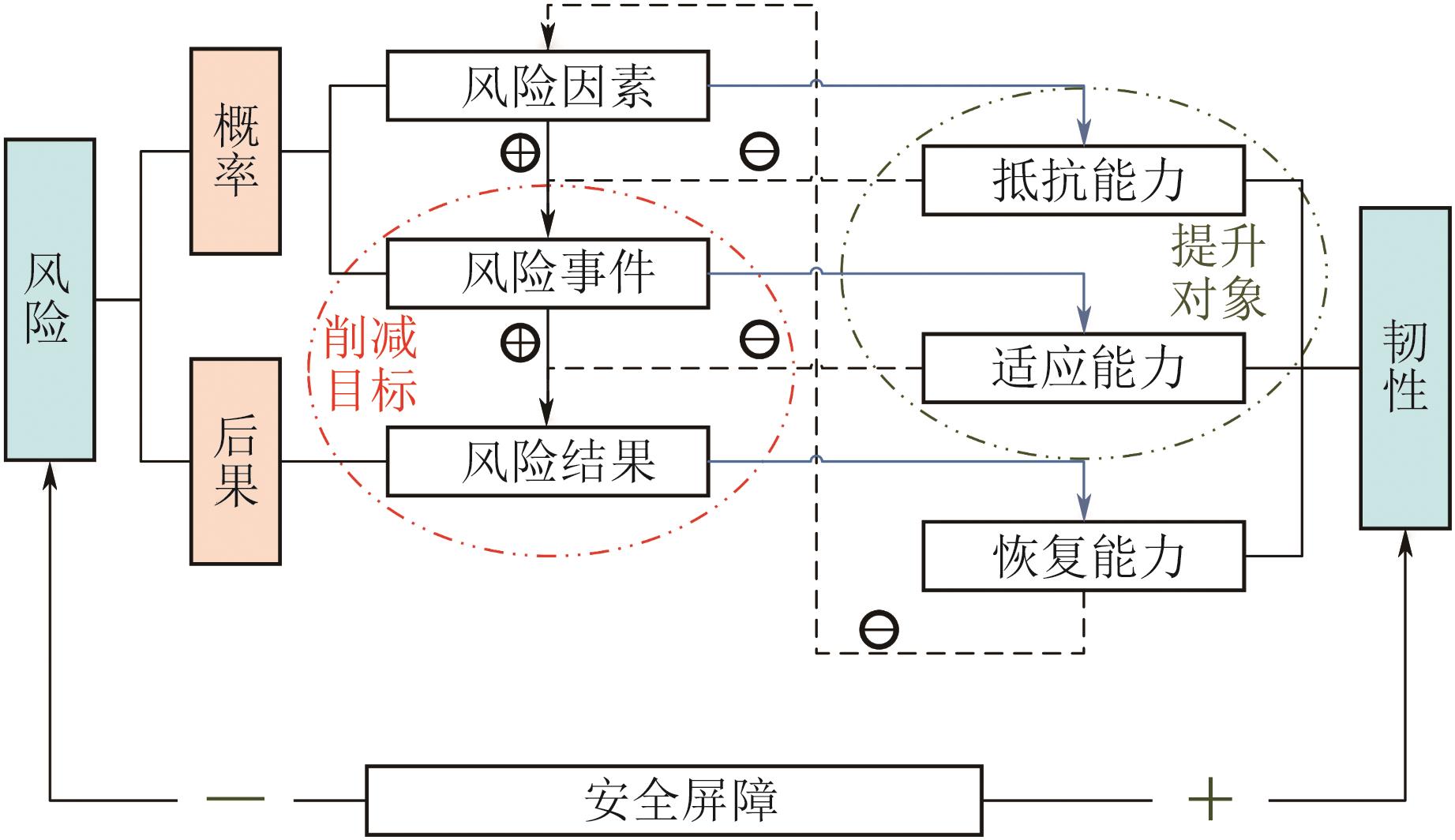
图1 安全屏障与风险、韧性的关系
| 作者 | 屏障对象 | 灾害情景 | 性能修正模型 |
|---|---|---|---|
| Misuri等[ | 主动屏障+被动屏障 | 自然灾害 | 主动屏障: 被动屏障: |
| Davatgar等[ | 主动屏障+被动屏障+程序性屏障 | 运营及管理缺陷 | LCMF=f (TMF, MMF) 依据LCMF计算值选取修正系数,更新安全屏障性能置信等级 |
| 黄孔星[ | 程序性屏障 | 自然灾害 | tton=tto0+ ttod,ttmn=ttm0+ ttmd |
表3 复杂情景下屏障性能修正模型
| 作者 | 屏障对象 | 灾害情景 | 性能修正模型 |
|---|---|---|---|
| Misuri等[ | 主动屏障+被动屏障 | 自然灾害 | 主动屏障: 被动屏障: |
| Davatgar等[ | 主动屏障+被动屏障+程序性屏障 | 运营及管理缺陷 | LCMF=f (TMF, MMF) 依据LCMF计算值选取修正系数,更新安全屏障性能置信等级 |
| 黄孔星[ | 程序性屏障 | 自然灾害 | tton=tto0+ ttod,ttmn=ttm0+ ttmd |
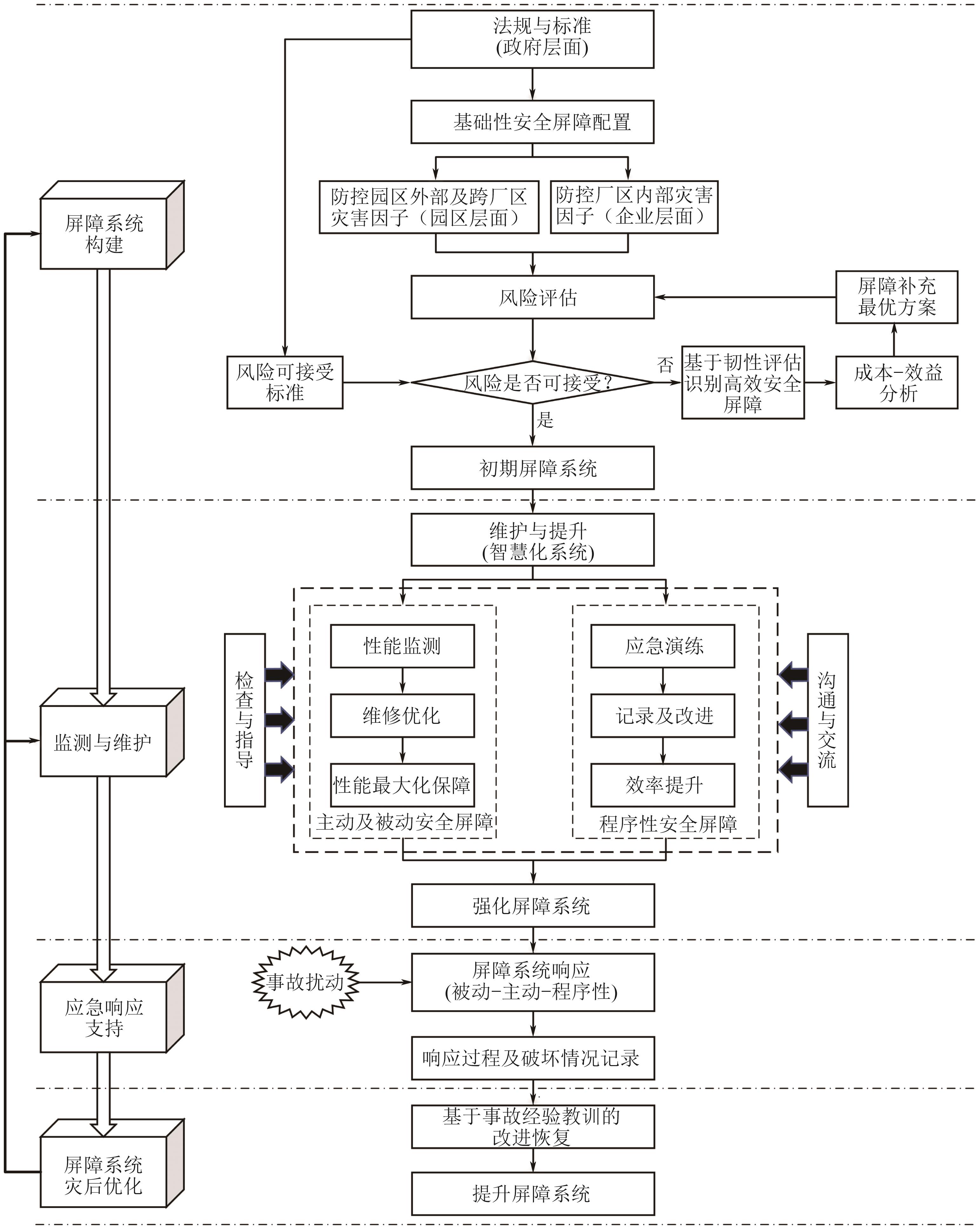
图2 化工园区屏障管理体系
| [1] | 贾梅生, 陈国华, 胡昆. 化工园区多米诺事故风险评价与防控技术综述[J]. 化工进展, 2017, 36(4): 1534-1543. |
| JIA Meisheng, CHEN Guohua, HU Kun. Review of risk assessment and pre-control of domino effect in chemical industry park[J]. Chemical Industry and Engineering Progress, 2017, 36(4): 1534-1543. | |
| [2] | ZHANG Muchen, LI Zelin, HOU Shuya, et al. Optimizing safety barrier allocation to prevent domino effects in large-scale chemical clusters using graph theory and optimization algorithms[J]. Process Safety and Environmental Protection, 2024, 184: 1192-1205. |
| [3] | 陈国华, 邹梦婷, 黄孔星, 等. 化工园区多灾种耦合脆弱性方法探究与前沿综述[J]. 化工进展, 2019, 38(5): 2527-2535. |
| CHEN Guohua, ZOU Mengting, Huang Kongxing, et al. Methods analysis and frontiers review of vulnerability for coupled multi-hazard in chemical industry park[J]. Chemical Industry and Engineering Progress, 2019, 38(5): 2527-2535. | |
| [4] | 江文彬, 陈颙, 彭菲. 2019年3月江苏响水化工厂爆炸当量的估计[J]. 地球物理学报, 2020, 63(2): 541-550. |
| JIANG Wenbin, CHEN Yong, PENG Fei. The yield estimation of the explosion at the Xiangshui, Jiangsu chemical plant in March 2019[J]. Chinese Journal of Geophysics, 2020, 63(2): 541-550. | |
| [5] | WANG Haishun, WEI Lijun, WANG Kai, et al. Exploring human factors of major chemical accidents in China: Evidence from 160 accidents during 2011—2022[J]. Journal of Loss Prevention in the Process Industries, 2024, 89: 105279. |
| [6] | SWUSTE Paul, VAN NUNEN Karolien, RENIERS Genserik, et al. Domino effects in chemical factories and clusters: An historical perspective and discussion[J]. Process Safety and Environmental Protection, 2019, 124: 18-30. |
| [7] | 黄孔星. 面向化工园区的NaTech事件高阶多米诺效应扩展概率预测与防控研究[D]. 广州: 华南理工大学, 2022. |
| HUANG Kongxing. Escalation probability prediction and pre-control research on high-level domino effect of NaTech events in chemical industrial park[D]. Guangzhou: South China University of Technology, 2022. | |
| [8] | HADDON William. Energy damage and the ten countermeasure strategies[J]. Human Factors, 1973, 15(4): 355-366. |
| [9] | DE DIANOUS Valérie, Cécile FIÉVEZ. ARAMIS project: A more explicit demonstration of risk control through the use of bow-tie diagrams and the evaluation of safety barrier performance[J]. Journal of Hazardous Materials, 2006, 130: 220-233. |
| [10] | DUIJM Nijs Jan, GOOSSENS Louis. Quantifying the influence of safety management on the reliability of safety barriers[J]. Journal of Hazardous Materials, 2006, 130: 284-292. |
| [11] | YUAN Shuaiqi, YANG Ming, RENIERS Genserik, et al. Safety barriers in the chemical process industries: A state-of-the-art review on their classification, assessment, and management[J]. Safety Science, 2022, 148: 105647. |
| [12] | SKLET Snorre. Safety barriers: Definition, classification, and performance[J]. Journal of Loss Prevention in the Process Industries, 2006, 19(5): 494-506. |
| [13] | Petroleum Safety Authority (PSA) Norway. Principles for barrier management in the petroleum industry[EB/OL]. (2013-01-29) [2024-7-29] . |
| [14] | LANDUCCI Gabriele, ARGENTI Francesca, TUGNOLI Alessandro, et al. Quantitative assessment of safety barrier performance in the prevention of domino scenarios triggered by fire[J]. Reliability Engineering & System Safety, 2015, 143: 30-43. |
| [15] | 伍壮, 侯磊, 伍星光, 等. 安全防护对原油罐区多米诺火灾事故发生概率的影响[J]. 安全与环境工程, 2020, 27(1): 166-172. |
| WU Zhuang, HOU Lei, WU Xingguang, et al. The influence of safety protection on the probability of domino accident in tank area[J]. Safety and Environmental Engineering, 2020, 27(1): 166-172. | |
| [16] | 闫放, 张舒, 许开立. 化工危险源定量保护层分析[J]. 中国安全科学学报, 2019, 29(1): 100-105. |
| YAN Fang, ZHANG Shu, XU Kaili. Research on quantitative layer of protection analysis for chemical industry hazards[J]. China Safety Science Journal, 2019, 29(1): 100-105. | |
| [17] | HOLLNAGEL Erik. Risk+barriers=safety?[J]. Safety Science, 2008, 46(2): 221-229. |
| [18] | RATHNAYAKA Samith, KHAN Faisal, AMYOTTE Paul. SHIPP methodology: Predictive accident modeling approach. Part Ⅱ. Validation with case study[J]. Process Safety and Environmental Protection, 2011, 89(2): 75-88. |
| [19] | 周宁, 孙权, 魏钰人, 等. 保护层分析在化工园区重大危险源事故风险分析中的应用[J]. 安全与环境工程, 2015, 22(3): 126-129. |
| ZHOU Ning, SUN Quan, WEI Yuren, et al. Application of the layer of protection analysis in the analysis of major hazard sources accident in chemical industry park[J]. Safety and Environmental Engineering, 2015, 22(3): 126-129. | |
| [20] | JOHANSEN Inger Lise, RAUSAND Marvin. Barrier management in the offshore oil and gas industry[J]. Journal of Loss Prevention in the Process Industries, 2015, 34: 49-55. |
| [21] | MOLLER Niklas, HANSSON Sven Ove, HOLMBERG Jan-Erik, et al. Handbook of safety principles[M]. USA: John Wiley and Sons, Inc., 2017: 63-86. |
| [22] | 王文红. 化工园区爆炸碎片影响评估与伤害防御研究[D]. 北京: 中国石油大学(北京), 2017. |
| Wang Wenhong. Impact assessment and damage defense study on explosive debris in chemical industry park[D]. Beijing: China University of Petroleum(Beijing), 2017. | |
| [23] | CHEN Chao, RENIERS Genserik, KHAKZAD Nima. Integrating safety and security resources to protect chemical industrial parks from man-made domino effects: A dynamic graph approach[J]. Reliability Engineering and System Safety, 2019, 191: 106470. |
| [24] | 丁洁. 不完全信息条件下的化工园区安全风险评价研究[D]. 西安: 西安建筑科技大学, 2019. |
| Ding Jie. Research on risk assessment of chemical industrial park safety based on scarce information[D]. Xi’an: Xi’an University of Architecture and Technology, 2019. | |
| [25] | MISURI Alessio, LANDUCCI Gabriele, COZZANI Valerio. Assessment of safety barrier performance in the mitigation of domino scenarios caused by Natech events[J]. Reliability Engineering & System Safety, 2021, 205: 107278. |
| [26] | ZENG Tao, CHEN Guohua, RENIERS Genserik, et al. Developing a barrier management framework for dealing with Natech domino effects and increasing chemical cluster resilience[J]. Process Safety and Environmental Protection, 2022, 168: 778-791. |
| [27] | WANG Haishun, WEI Lijun, WANG Kai, et al. Current status, challenges, and future pathways of chemical industrial park safety in China[J]. Journal of Loss Prevention in the Process Industries, 2024, 87: 105233. |
| [28] | ZHOU Lixing, CHEN Guohua, ZHENG Mianbin, et al. Agent-based modeling methodology and temporal simulation for Natech events in chemical clusters[J]. Reliability Engineering & System Safety, 2024, 243: 109888. |
| [29] | SVENSON O. The accident evolution and barrier function (AEB) model applied to incident analysis in the processing industries[J]. Risk Analysis, 1991, 11(3): 499-507. |
| [30] | HOLLAND Per. Offshore blowouts: Causes and control[M]. Houston: Elsevier, 1997:17-25. |
| [31] | PITBLADO R, FISHER M, NELSON B, et al. Concepts for dynamic barrier management[J]. Journal of Loss Prevention in the Process Industries, 2016, 43: 741-746. |
| [32] | Urban KJELLÉN. Safety in the design of offshore platforms: Integrated safety versus safety as an add-on characteristic[J]. Safety Science. 2007, 45(1/2): 107-127. |
| [33] | RATHNAYAKA Samith, KHAN Faisal, AMYOTTE Paul. Accident modeling approach for safety assessment in an LNG processing facility[J]. Journal of Loss Prevention in the Process Industries, 2012, 25(2): 414-423. |
| [34] | SUN Hao, WANG Haiqing, YANG Ming, et al. Resilience-based approach to safety barrier performance assessment in process facilities[J]. Journal of Loss Prevention in the Process Industries, 2021, 73: 104599. |
| [35] | 孙爱军. 工业园区事故风险评价研究[D]. 天津: 南开大学, 2011. |
| SUN Aijun. Study on the accidental risk assessment methodology for industrial parks[D]. Tianjin: Nankai University, 2011. | |
| [36] | ZENG Tao, CHEN Guohua, YANG Yunfeng, et al. Developing an advanced dynamic risk analysis method for fire-related domino effects[J]. Process Safety and Environmental Protection, 2020, 134: 149-160. |
| [37] | RENIERS Genserik, KHAKZAD Nima, COZZANI Valerio, et al. The impact of nature on chemical industrial facilities: Dealing with challenges for creating resilient chemical industrial parks[J]. Journal of Loss Prevention in the Process Industries, 2018, 56: 378-385. |
| [38] | KHAKZAD Nima, LANDUCCI Gabriele, RENIERS Genserik. Application of dynamic Bayesian network to performance assessment of fire protection systems during domino effects[J]. Reliability Engineering & System Safety, 2017, 167: 232-247. |
| [39] | 吴守志, 侯磊, 伍星光, 等. 安全屏障对储油罐区池火灾多米诺效应概率的影响[J]. 油气储运, 2022, 41(2): 165-176. |
| WU Shouzhi, HOU Lei, WU Xingguang, et al. Influence of safety barriers on probability of domino effect triggered by pool fire in tank farm[J]. Oil & Gas Storage and Transportation, 2022, 41(2): 165-176. | |
| [40] | VAN NUNEN Karolien, SWUSTE Paul, RENIERS Genserik, et al. Developing leading safety indicators for occupational safety based on the bow-tie method[J]. Chemical Engineering Transactions, 2019, 77: 49-54. |
| [41] | LIU Yiliu. Safety barriers: Research advances and new thoughts on theory, engineering and management[J]. Journal of Loss Prevention in the Process Industries, 2020, 67: 104260. |
| [42] | 刘美晨, 刘鹏, 王海清, 等. 基于简化Bow-tie模型的LOPA场景辨识与筛选方法[J]. 化工进展, 2021, 40(11): 5988-5997. |
| LIU Meichen, LIU Peng, WANG Haiqing, et al. Research on LOPA scenarios identification and screening based on simplified Bow-tie model[J]. Chemical Industry and Engineering Progress, 2021, 40(11): 5988-5997. | |
| [43] | AVEN Terje. Risk assessment and risk management: Review of recent advances on their foundation[J]. European Journal of Operational Research, 2016, 253(1): 1-13. |
| [44] | SUN Hao, YANG Ming, Enrico ZIO, et al. A simulation-based approach for resilience assessment of process system: A case of LNG terminal system[J]. Reliability Engineering & System Safety, 2024, 249: 110207. |
| [45] | CHRISANDINA Natasha J, VEDANT Shivam, IAKOVOU Eleftherios, et al. Metrics and methods for resilience-aware design of process systems: Advances and challenges[J]. Current Opinion in Chemical Engineering, 2024, 43: 100984. |
| [46] | LOGAN Tom Mcleod, AVEN Terje, GUIKEMA Seth David, et al. Risk science offers an integrated approach to resilience[J]. Nature Sustainability, 2022, 5(9): 741-748. |
| [47] | PAWAR Bhushan, PARK Sunhwa, HU Pingfan, et al. Applications of resilience engineering principles in different fields with a focus on industrial systems: A literature review[J]. Journal of Loss Prevention in the Process Industries, 2021, 69: 104366. |
| [48] | ZENG Tao, CHEN Guohua, RENIERS Genserik, et al. Resilience assessment of chemical industrial areas during Natech-related cascading multi-hazards[J]. Journal of Loss Prevention in the Process Industries, 2023, 81: 104967. |
| [49] | MISURI Alessio, COZZANI Valerio. A paradigm shift in the assessment of Natech scenarios in chemical and process facilities[J]. Process Safety and Environmental Protection, 2021, 152: 338-351. |
| [50] | PRASHANTH Ignatius, FERNANDEZ Geo J, SUNDER Raju G, et al. Factors influencing safety barrier performance for onshore gas drilling operations[J]. Journal of Loss Prevention in the Process Industries, 2017, 49: 291-298. |
| [51] | LANDUCCI Gabriele, ARGENTI Francesca, SPADONI Gigliola, et al. Domino effect frequency assessment: The role of safety barriers[J]. Journal of Loss Prevention in the Process Industries, 2016, 44: 706-717. |
| [52] | LANDUCCI Gabriele, NECCI Amos, ANTONIONI Giacomo, et al. Risk assessment of mitigated domino scenarios in process facilities[J]. Reliability Engineering & System Safety, 2017, 160: 37-53. |
| [53] | MISURI Alessio, LANDUCCI Gabriele, COZZANI Valerio. Assessment of safety barrier performance in Natech scenarios[J]. Reliability Engineering & System Safety, 2020, 193: 106597. |
| [54] | MISURI Alessio, RICCI Federica, SORICHETTI Riccardo, et al. The effect of safety barrier degradation on the severity of primary Natech scenarios[J]. Reliability Engineering & System Safety, 2023, 235: 109272. |
| [55] | DAVATGAR Behnaz Hosseinnia, PALTRINIERI Nicola, BUBBICO Roberto. Safety barrier management: Risk-based approach for the oil and gas sector[J]. Journal of Marine Science and Engineering, 2021, 9: 722. |
| [56] | DI MAIO Francesco, MARCHETTI Stefano, Enrico ZIO. A framework of sensitivity analysis for the performance assessment of safety barriers impacted by NaTech accidents[J]. Process Safety and Environmental Protection, 2023, 171: 1022-1030. |
| [57] | KHAKZAD Nima, LANDUCCI Gabriele, COZZANI Valerio, et al. Cost-effective fire protection of chemical plants against domino effects[J]. Reliability Engineering & System Safety, 2018, 169: 412-421. |
| [58] | MISURI Alessio, LANDUCCI Gabriele, COZZANI Valerio. Assessment of risk modification due to safety barrier performance degradation in Natech events[J]. Reliability Engineering & System Safety, 2021, 212: 107634. |
| [59] | YUAN Shuaiqi, CAI Jitao, RENIERS Genserik, et al. Safety barrier performance assessment by integrating computational fluid dynamics and evacuation modeling for toxic gas leakage scenarios[J]. Reliability Engineering & System Safety, 2022, 226: 108719. |
| [60] | CINCOTTA Salvatore, KHAKZAD Nima, COZZANI Valerio, et al. Resilience-based optimal firefighting to prevent domino effects in process plants[J]. Journal of Loss Prevention in the Process Industries, 2019, 58: 82-89. |
| [61] | 张心语. 化工罐区两池火耦合作用机理及增韧原理[D]. 广州: 华南理工大学, 2020. |
| ZHANG Xinyu. The coupling mechanism and resilience enhancing theory of double pool fires in chemical tank farm[D]. Guangzhou: South China University of Technology, 2020. | |
| [62] | CHEN Chao, YANG Ming, RENIERS Genserik. A dynamic stochastic methodology for quantifying HAZMAT storage resilience[J]. Reliability Engineering & System Safety, 2021, 215: 107909. |
| [63] | DU Yongjian, SUN Jinhua, DUAN Qianglin, et al. Optimal assignments of allocating and scheduling emergency resources to accidents in chemical industrial parks[J]. Journal of Loss Prevention in the Process Industries, 2020, 65: 104148. |
| [64] | Martin FOLCH-CALVO, Francisco BROCAL-FERNÁNDEZ, Cristina GONZÁLEZ-GAYA, et al. Analysis and characterization of risk methodologies applied to industrial parks[J]. Sustainability, 2020, 12(18): 7294. |
| [65] | RATHNAYAKA Samith, KHAN Faisal, AMYOTTE Paul. SHIPP methodology: Predictive accident modeling approach. Part Ⅰ: Methodology and model description[J]. Process Safety and Environmental Protection, 2011, 89(3): 151-164. |
| [66] | GULDENMUND Frank, HALE Andrew, GOOSSENS Louis, et al. The development of an audit technique to assess the quality of safety barrier management[J]. Journal of Hazardous Materials, 2006, 130(3): 234-241. |
| [67] | JANSSENS Jachen, TALARICO Luca, RENIERS Genserik, et al. A decision model to allocate protective safety barriers and mitigate domino effects[J]. Reliability Engineering & System Safety, 2015, 143: 44-52. |
| [68] | Stein Hauge, Knut Øien. Guidance for barrier management in the petroleum industry[EB/OL]. (2016-09-23) [2024-7-23]. . |
| [69] | ZHEN Xingwei, HAN Yue, HUANG Yi. Optimization of preventive maintenance intervals integrating risk and cost for safety critical barriers on offshore petroleum installations[J]. Process Safety and Environmental Protection, 2021, 152: 230-239. |
| [70] | YUAN Shuaiqi, RENIERS Genserik, YANG Ming. Dynamic-risk-informed safety barrier management: An application to cost-effective barrier optimization based on data from multiple sources[J]. Journal of Loss Prevention in the Process Industries, 2023, 83: 105034. |
| [71] | JAIN Prerna, PASMAN Hans J, WALDRAM Simon, et al. Process resilience analysis framework (PRAF): A systems approach for improved risk and safety management[J]. Journal of Loss Prevention in the Process Industries, 2018, 53: 61-73. |
| [72] | JAIN Prerna, PISTIKOPOULOS Efstratios N, Sam MANNAN M. Process resilience analysis based data-driven maintenance optimization: Application to cooling tower operations[J]. Computers & Chemical Engineering, 2019, 121: 27-45. |
| [73] | BAI Yiping, WU Jiansong, YUAN Shuaiqi, et al. Dynamic resilience assessment and emergency strategy optimization of natural gas compartments in utility tunnels[J]. Process Safety and Environmental Protection, 2022, 165: 114-125. |
| [74] | MA Jiajun, CHEN Guohua, ZENG Tao, et al. Methodology for resilience assessment of oil pipeline network system exposed to earthquake[J]. Sustainability, 2023, 15(2): 972. |
| [75] | ZHANG Yan, ZHENG Hongmei, YANG Zhifeng, et al. Analysis of the industrial metabolic processes for sulfur in the Lubei (Shandong Province, China) eco-industrial park[J]. Journal of Cleaner Production, 2015, 96: 126-138. |
| [76] | 康德礼, 刘利民, 纪红兵. 石化园区应急救援体系的构建[J]. 化工进展, 2016, 35(3): 963-969. |
| KANG Deli, LIU Limin, JI Hongbing. Construction of emergency rescue system for petrochemical industry park[J]. Chemical Industry and Engineering Progress, 2016, 35(3): 963-969. | |
| [77] | 陈培珠, 陈国华, 门金坤. 化工园区应急响应阶段应急救援与疏散双向路径规划[J]. 化工进展, 2022, 41(1): 503-512. |
| CHEN Peizhu, CHEN Guohua, Jinkun MEN. Two-way route planning for emergency rescue and evacuation in emergency response stage of chemical industrial park[J]. Chemical Industry and Engineering Progress, 2022, 41(1): 503-512. | |
| [78] | RENIERS Genserik. An external domino effects investment approach to improve cross-plant safety within chemical clusters[J]. Journal of Hazardous Materials, 2010, 177(1/2/3): 167-174. |
| [79] | HOSSEINNIA Behnaz, KHAKZAD Nima, RENIERS Genserik. Multi-plant emergency response for tackling major accidents in chemical industrial areas[J]. Safety Science, 2018, 102: 275-289. |
| [80] | BLUFF Elizabeth. How SMEs respond to legal requirements to provide information, training, instruction and supervision to workers about work health and safety matters[J]. Safety Science, 2019, 116: 45-57. |
| [81] | YANG Yunfeng, CHEN Guohua, ZHAO Yuanfei. A quantitative framework for propagation paths of Natech domino effects in chemical industrial parks: Part Ⅱ—Risk assessment and mitigation system[J]. Sustainability, 2023, 15(10): 8306. |
| [82] | 杨挺. 中国化工园区建设管理的“六个一体化”[J]. 化工进展, 2021, 40(10): 5845-5853. |
| YANG Ting. “Six Integrations” of establishing and managing chemical parks in China[J]. Chemical Industry and Engineering Progress, 2021, 40(10): 5845-5853. |
| [1] | 陈思铭, 刘景超, 钟志轩, 张新柱, 祝天浩, 彭毅勍, 游赛, 王一凯, 袁嘉骏, 张永春. 低共熔溶剂在二氧化碳捕集中的发展与应用[J]. 化工进展, 2025, 44(9): 5377-5390. |
| [2] | 齐妍, 常昊, 张磊. 基于分子动力学模拟的结构性产品配方设计方法[J]. 化工进展, 2025, 44(8): 4341-4351. |
| [3] | 杨傲, 邓苇, 黎勇, 罗婧, 王梓霖, 张俊, 申威峰. 基于热力学拓扑理论的三塔变压精馏分离四氢呋喃/甲醇/乙醇多目标优化设计[J]. 化工进展, 2025, 44(8): 4582-4593. |
| [4] | 贾子葶, 崔子元, 王彧斐. 规整化柔性厂区布局优化策略[J]. 化工进展, 2025, 44(8): 4669-4679. |
| [5] | 陈嵩嵩, 鲍艾丽, 霍锋, 侯亚慧, 崔改静, 张军平. 人工智能(AI)在复杂化工过程设计中的应用:现状、挑战与展望[J]. 化工进展, 2025, 44(8): 4821-4837. |
| [6] | 姚如伟, 宋乐音, 牛琴琴, 李聪明. Na-S双助剂修饰铁基催化剂催化CO2加氢制C2+醇[J]. 化工进展, 2025, 44(6): 3154-3162. |
| [7] | 吴展华, 孔德宝, 田均均, 梁汝军, 卢朋慧, 盛敏. “1+N”模式的反应安全技术体系探讨[J]. 化工进展, 2025, 44(6): 3199-3207. |
| [8] | 贺逸健, 刘祥坤, 施尧, 段学志. 乙烷氧化脱氢制乙烯催化剂颗粒外形设计[J]. 化工进展, 2025, 44(6): 3497-3508. |
| [9] | 单灵海, 段欢欢, 郑旭铭, 黄晓璜, 崔国民. 一种新的换热单元竞争强化策略优化换热网络[J]. 化工进展, 2025, 44(6): 3393-3404. |
| [10] | 谢静雯, 孟仪方, 叶文杰, 王华磊, 魏东芝. 半理性设计提高短链醇脱氢酶在(S)-1-(4-氟苯基)乙醇合成中的应用[J]. 化工进展, 2025, 44(5): 2515-2523. |
| [11] | 陈诺恒, 王胜南, 孔明. 基于多频电容的气固相含率在线检测电路设计[J]. 化工进展, 2025, 44(4): 1806-1814. |
| [12] | 宋慈, 李海燕, 张世珍, 刘洪伟, 张建英, 邱家浩, 曹仁伟, 孙坤, 秦颖, 朱明绪, 高梦岩. 自修复防腐蚀涂层的类型及应用现状[J]. 化工进展, 2025, 44(3): 1466-1484. |
| [13] | 李雪静, 崔哲, 刘彬, 李传坤, 田文德. 乙烯装置碳二加氢和脱乙烷塔系统智能风险分析与预测[J]. 化工进展, 2025, 44(2): 717-727. |
| [14] | 罗小平, 贾梦帆, 李世珍. 电场和改性PVDF膜相分离结构协同作用下逆流微细通道压降特性[J]. 化工进展, 2025, 44(2): 646-659. |
| [15] | 赵珂, 张恒, 翟倩, 甄琪, 苏天阳, 崔景强. PLA/PEG@SDS超细纤维水蒸发器的复合结构设计及其液体传输行为[J]. 化工进展, 2025, 44(2): 1014-1024. |
| 阅读次数 | ||||||
|
全文 |
|
|||||
|
摘要 |
|
|||||