化工进展 ›› 2025, Vol. 44 ›› Issue (5): 2767-2776.DOI: 10.16085/j.issn.1000-6613.2024-1842
• 合成材料利用 • 上一篇
能源材料替代与转型中的机器学习方法
王笑楠1( ), 傅思维1(), 刘宽1, 林琮盛1, 林晓风2
- 1.清华大学化学工程系,北京 100084
2.清华大学航天航空学院,北京 100084
-
收稿日期:2024-11-11修回日期:2025-01-16出版日期:2025-05-25发布日期:2025-05-20 -
通讯作者:王笑楠 -
作者简介:王笑楠(1990—),女,长聘副教授,博士生导师,研究方向为低碳智慧能源化工。E-mail:wangxiaonan@tsinghua.edu.cn
傅思维(2004—),男,本科生,研究方向为人工智能与化学化工。E-mail:fsw22@mails.tsinghua.edu.cn。 -
基金资助:新一代人工智能国家科技重大专项(2022ZD0117501);清华大学自主科研计划(20247020006)
Machine learning methods for sustainable alternatives and transition of energy materials
WANG Xiaonan1(), FU Siwei1(), LIU Kuan1, LIN Congsheng1, LIN Xiaofeng2
- 1.Department of Chemical Engineering, Tsinghua University, Beijing 100084, China
2.School of Aerospace Engineering, Tsinghua University, Beijing 100084, China
-
Received:2024-11-11Revised:2025-01-16Online:2025-05-25Published:2025-05-20 -
Contact:WANG Xiaonan

摘要:
能源材料低碳替代与绿色转型是实现碳达峰、碳中和的重要途径。传统基于实验的能源材料开发流程具有高可靠性和可直观评估等优点,但存在时间和资源成本高、探索范围有限、依赖知识和经验等问题。本文介绍了能源材料替代与转型中的机器学习方法,回顾了机器学习技术在能源材料研发中的已有应用和可用在能源材料开发中的机器学习算法,分析了机器学习方法在能源材料开发和替代方面的原理、应用、优势与挑战。根据对机器学习方法在能源材料替代与转型中的应用优势和局限性进行系统综述和分析,从数据、模型及应用等方面提出了构建高质量数据集、开发高适配性机器学习算法及拓展高效能源技术和系统的思考与展望。分析表明,机器学习方法在模型适配程度、应用广泛程度等方面都有十分广阔的提升空间,在能源材料替代与转型领域应用机器学习方法具有显著价值和广阔前景。
中图分类号:
引用本文
王笑楠, 傅思维, 刘宽, 林琮盛, 林晓风. 能源材料替代与转型中的机器学习方法[J]. 化工进展, 2025, 44(5): 2767-2776.
WANG Xiaonan, FU Siwei, LIU Kuan, LIN Congsheng, LIN Xiaofeng. Machine learning methods for sustainable alternatives and transition of energy materials[J]. Chemical Industry and Engineering Progress, 2025, 44(5): 2767-2776.
| 算法 | 分类 | 实现原理 | 优劣 |
|---|---|---|---|
| 线性回归 | 监督学习 | 基于最小二乘法,拟合线性函数预测连续值 | 简单快速,但对非线性数据和异常数据敏感 |
| Logistic回归 | 监督学习 | 基于Sigmoid函数,输出概率并用于分类问题 | 十分适用于二分类问题,但对非线性数据表现欠佳 |
| 朴素贝叶斯 | 监督学习 | 基于条件概率和贝叶斯定理,假设特征独立 | 效率高,但特征独立的假设限制了准确性 |
| 支持向量机 | 监督学习 | 通过构建高维超平面进行分类,使用核函数处理非线性数据 | 处理高维数据和非线性数据能力强,但是对较大数据和异常数据表现欠佳 |
| 随机森林 | 监督学习 | 通过决策树的集成学习 | 可出色地防止过拟合,擅长处理高维数据和非线性数据,但复杂度较高 |
| 人工神经网络 | 监督学习 | 模拟人脑神经元,通过多层非线性变换逼近复杂函数关系 | 具备强大的函数拟合能力,但对数据量和准确度要求较为苛刻 |
| K-means算法 | 无监督学习 | 基于样本间距离,将数据聚类成k个簇,最小化簇内差异 | 可简单快速地实现聚类,但需要人工指定聚类数目 |
| 主成分分析 | 无监督学习 | 通过特征协方差矩阵特征值分解,实现降维和数据压缩 | 降维效果显著,但可解释性较低 |
| 自训练算法 | 半监督学习 | 基于初始有标签数据训练模型,预测未标注数据并将置信度高的结果加入训练集进行迭代优化 | 适用于半监督学习场景,原理简单,容易实现,但伪标签可能引入噪声,错误的标签会被模型放大 |
| Q-learning方法 | 强化学习 | 基于强化学习框架,学习智能体的最优策略以最大化奖励 | 决策性和交互性强,但复杂度高 |
表1 部分机器学习算法的原理和比较
| 算法 | 分类 | 实现原理 | 优劣 |
|---|---|---|---|
| 线性回归 | 监督学习 | 基于最小二乘法,拟合线性函数预测连续值 | 简单快速,但对非线性数据和异常数据敏感 |
| Logistic回归 | 监督学习 | 基于Sigmoid函数,输出概率并用于分类问题 | 十分适用于二分类问题,但对非线性数据表现欠佳 |
| 朴素贝叶斯 | 监督学习 | 基于条件概率和贝叶斯定理,假设特征独立 | 效率高,但特征独立的假设限制了准确性 |
| 支持向量机 | 监督学习 | 通过构建高维超平面进行分类,使用核函数处理非线性数据 | 处理高维数据和非线性数据能力强,但是对较大数据和异常数据表现欠佳 |
| 随机森林 | 监督学习 | 通过决策树的集成学习 | 可出色地防止过拟合,擅长处理高维数据和非线性数据,但复杂度较高 |
| 人工神经网络 | 监督学习 | 模拟人脑神经元,通过多层非线性变换逼近复杂函数关系 | 具备强大的函数拟合能力,但对数据量和准确度要求较为苛刻 |
| K-means算法 | 无监督学习 | 基于样本间距离,将数据聚类成k个簇,最小化簇内差异 | 可简单快速地实现聚类,但需要人工指定聚类数目 |
| 主成分分析 | 无监督学习 | 通过特征协方差矩阵特征值分解,实现降维和数据压缩 | 降维效果显著,但可解释性较低 |
| 自训练算法 | 半监督学习 | 基于初始有标签数据训练模型,预测未标注数据并将置信度高的结果加入训练集进行迭代优化 | 适用于半监督学习场景,原理简单,容易实现,但伪标签可能引入噪声,错误的标签会被模型放大 |
| Q-learning方法 | 强化学习 | 基于强化学习框架,学习智能体的最优策略以最大化奖励 | 决策性和交互性强,但复杂度高 |

图1 目标材料的多尺度信息
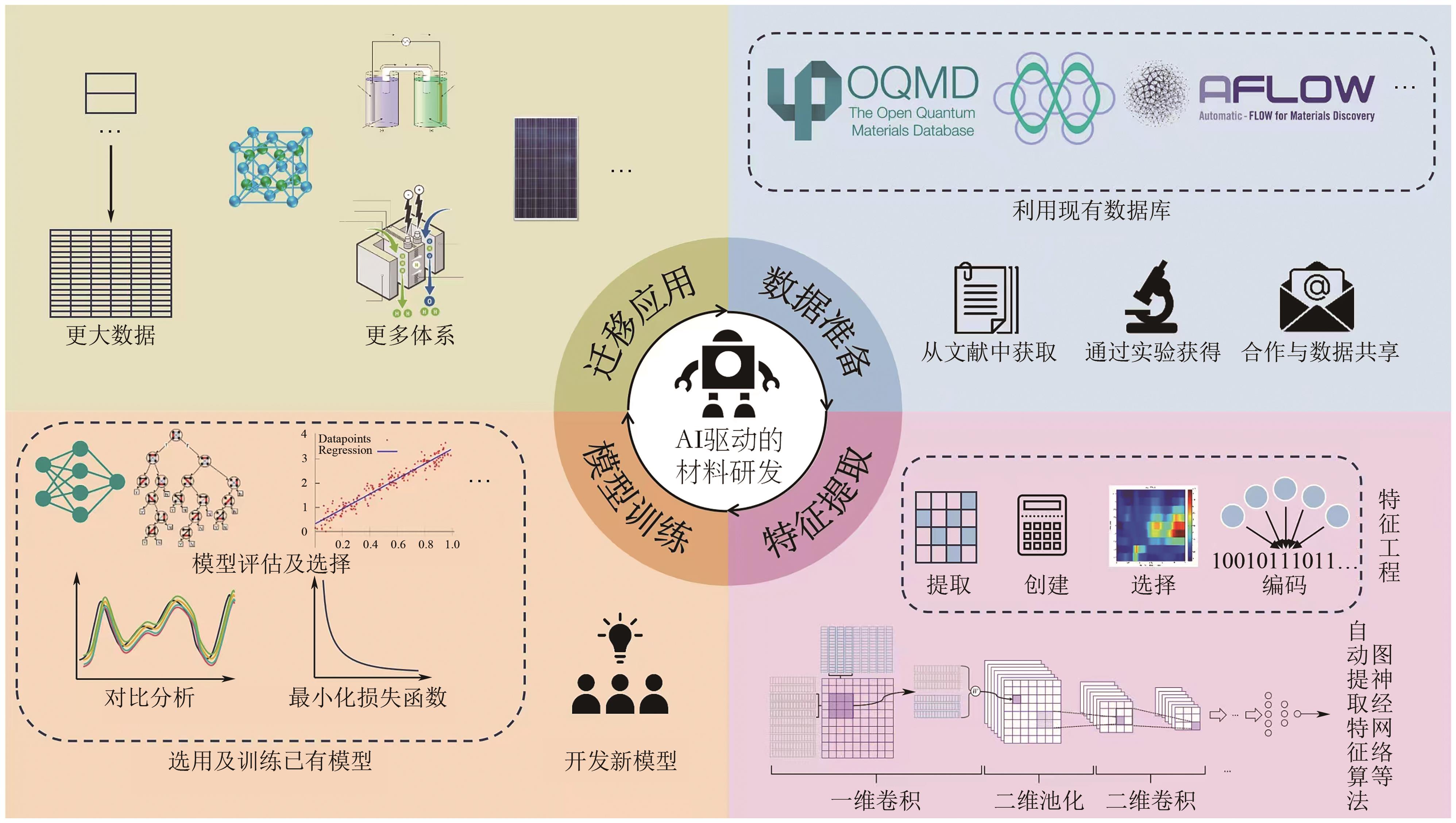
图2 AI驱动的材料研发流程
| 数据库 | 当前状态描述 | 关键信息 |
|---|---|---|
| AFLOW | 提供约3530330种材料和约734308640种计算数据 | 各类物化特性 |
| OQMD | 由DFT计算得到1226781个材料的热力学和结构性质 | 热力学、结构信息 |
| ChemSpider | 提供超过1.2亿种结构以及属性和相关信息 | 结构信息 |
| Crystallography Open Database (COD) | 提供518892条有机、无机、金属有机化合物和矿物的晶体结构数据 | 晶体结构 |
| Materials Project | 提供153235个无机材料的数十种属性信息和数据分析工具 | 无机材料 |
| National Renewable Energy Laboratory Materials Database (NREL MatDB) | 侧重提供可再生能源材料的计算数据 | 可再生能源材料 |
| NIMS Materials Database (MatNavi) | 提供高分子材料、无机材料、金属材料的属性数据和计算电子结构数据 | 高分子材料、无机材料和金属材料 |
表2 能源材料领域内已有的部分数据库
| 数据库 | 当前状态描述 | 关键信息 |
|---|---|---|
| AFLOW | 提供约3530330种材料和约734308640种计算数据 | 各类物化特性 |
| OQMD | 由DFT计算得到1226781个材料的热力学和结构性质 | 热力学、结构信息 |
| ChemSpider | 提供超过1.2亿种结构以及属性和相关信息 | 结构信息 |
| Crystallography Open Database (COD) | 提供518892条有机、无机、金属有机化合物和矿物的晶体结构数据 | 晶体结构 |
| Materials Project | 提供153235个无机材料的数十种属性信息和数据分析工具 | 无机材料 |
| National Renewable Energy Laboratory Materials Database (NREL MatDB) | 侧重提供可再生能源材料的计算数据 | 可再生能源材料 |
| NIMS Materials Database (MatNavi) | 提供高分子材料、无机材料、金属材料的属性数据和计算电子结构数据 | 高分子材料、无机材料和金属材料 |
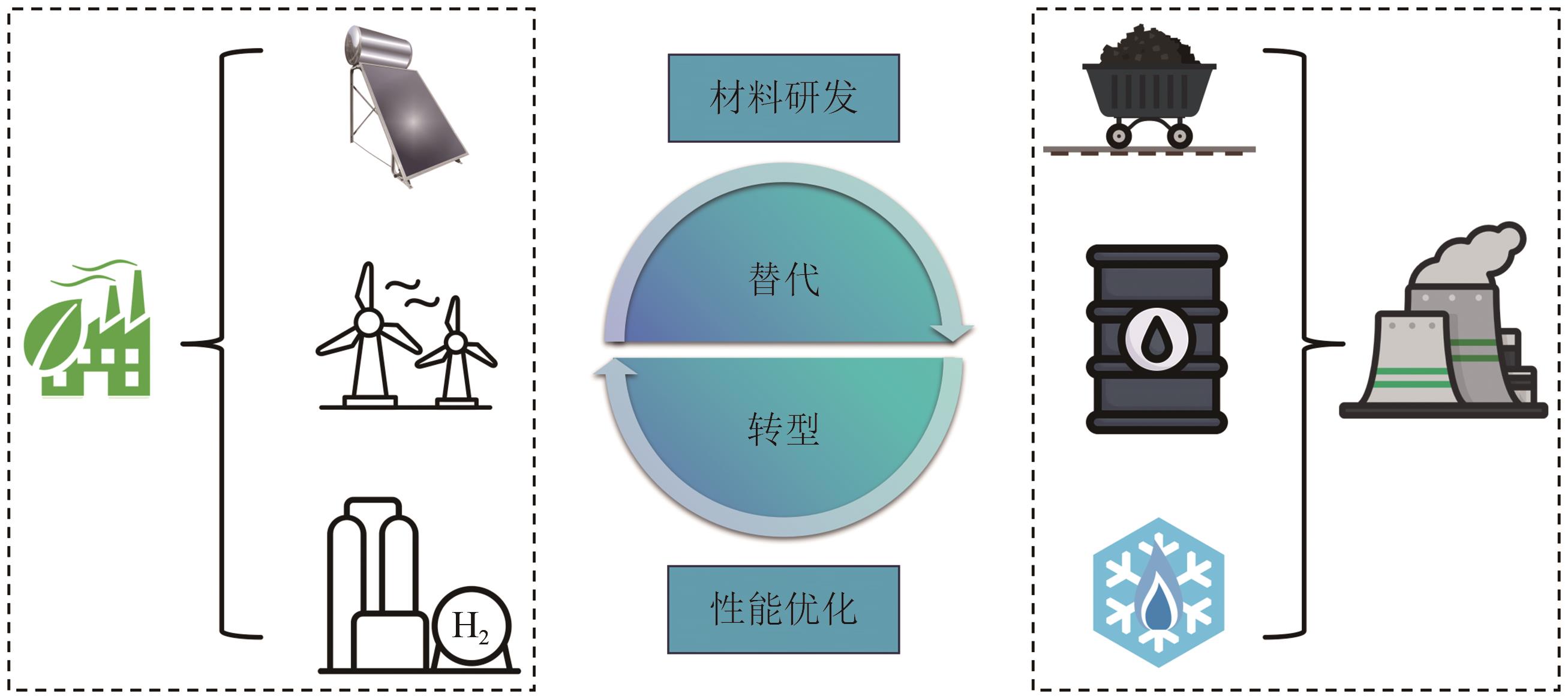
图3 能源材料的替代和转型
| 1 | JORDAN M I, MITCHELL T M. Machine learning: trends, perspectives, and prospects[J]. Science, 2015, 349(6245): 255-260. |
| 2 | CHEN Chi, ZUO Yunxing, YE Weike, et al. A critical review of machine learning of energy materials[J]. Advanced Energy Materials, 2020, 10(8): 1903242. |
| 3 | LIU Yun, ESAN Oladapo Christopher, PAN Zhefei, et al. Machine learning for advanced energy materials[J]. Energy and AI, 2021, 3: 100049. |
| 4 | SAMADI Seyed Hashem, GHOBADIAN Barat, NOSRATI Mohsen. Prediction of higher heating value of biomass materials based on proximate analysis using gradient boosted regression trees method[J]. Energy Sources, Part A: Recovery, Utilization, and Environmental Effects, 2021, 43(6): 672-681. |
| 5 | SODEYAMA Keitaro, IGARASHI Yasuhiko, NAKAYAMA Tomofumi, et al. Liquid electrolyte informatics using an exhaustive search with linear regression[J]. Physical Chemistry Chemical Physics, 2018, 20(35): 22585-22591. |
| 6 | QI Siyun, LI Chuanchuan, CHEN Gang, et al. Single-atom catalysts supported on graphene/electride heterostructures for the enhanced sulfur reduction reaction in lithium-sulfur batteries[J]. Journal of Energy Chemistry, 2024, 97: 738-746. |
| 7 | SENDEK Austin D, YANG Qian, CUBUK Ekin D, et al. Holistic computational structure screening of more than 12000 candidates for solid lithium-ion conductor materials[J]. Energy & Environmental Science, 2017, 10(1): 306-320. |
| 8 | MAHMOOD Asif, IRFAN Ahmad, WANG Jinliang. Machine learning and molecular dynamics simulation-assisted evolutionary design and discovery pipeline to screen efficient small molecule acceptors for PTB7-Th-based organic solar cells with over 15% efficiency[J]. Journal of Materials Chemistry A, 2022, 10(8): 4170-4180. |
| 9 | Longfei LYU, ZHANG Cairong, CAO Rui, et al. Design and virtual screening of donor and non-fullerene acceptor for organic solar cells using long short-term memory model[J]. Journal of Materials Chemistry A, 2024, 12(35): 23859-23871. |
| 10 | NAKAYAMA Prof Dr Masanobu, KANAMORI Kenta, NAKANO Koki, et al. Data-driven materials exploration for Li-ion conductive ceramics by exhaustive and informatics-aided computations[J]. The Chemical Record, 2019, 19(4): 771-778. |
| 11 | HEARST M A, DUMAIS S T, OSUNA E, et al. Support vector machines[J]. IEEE Intelligent Systems and Their Applications, 1998, 13(4): 18-28. |
| 12 | ABDIANSAH Abdiansah, WARDOYO Retantyo. Time complexity analysis of support vector machines (SVM) in LibSVM[J]. International Journal of Computer Applications, 2015, 128(3): 28-34. |
| 13 | HAN In-Su, CHUNG Chang-Bock. Performance prediction and analysis of a PEM fuel cell operating on pure oxygen using data-driven models: A comparison of artificial neural network and support vector machine[J]. International Journal of Hydrogen Energy, 2016, 41(24): 10202-10211. |
| 14 | 张金喜, 郭旺达, 宋波, 等. 基于随机森林的沥青路面性能预测[J]. 北京工业大学学报, 2021, 47(11): 1256-1263. |
| ZHANG Jinxi, GUO Wangda, SONG Bo, et al. Performance prediction of asphalt pavement based on random forest[J]. Journal of Beijing University of Technology, 2021, 47(11): 1256-1263. | |
| 15 | 曾思颖, 杨敏博, 冯霄. 基于机器学习的煤层气组成预测及液化过程的实时优化[J]. 化工进展, 2023, 42(10): 5059-5066. |
| ZENG Siying, YANG Minbo, FENG Xiao. Machine learning-based prediction of coalbed methane composition and real-time optimization of liquefaction process[J]. Chemical Industry and Engineering Progress, 2023, 42(10): 5059-5066. | |
| 16 | MAHMOOD Asif, WANG Jinliang. A time and resource efficient machine learning assisted design of non-fullerene small molecule acceptors for P3HT-based organic solar cells and green solvent selection[J]. Journal of Materials Chemistry A, 2021, 9(28): 15684-15695. |
| 17 | SUTHAR R, ABHIJITH T, KARAK S Machine-learning-guided prediction of photovoltaic performance of non-fullerene organic solar cells using novel molecular and structural descriptors[J]. Journal of Materials Chemistry A, 2023, 11(41): 22248-22258. |
| 18 | PATRA Jagdish Chandra, MODANESE Chiara, ACCIARRI Maurizio. Artificial neural network-based modelling of compensated multi-crystalline solar-grade silicon under wide temperature variations[J]. IET Renewable Power Generation, 2016, 10(7): 1010-1016. |
| 19 | KAJITA Seiji, OHBA Nobuko, JINNOUCHI Ryosuke, et al. A universal 3D voxel descriptor for solid-state material informatics with deep convolutional neural networks[J]. Scientific Reports, 2017, 7(1): 16991. |
| 20 | ASCHER Simon, WATSON Ian, YOU Siming. Machine learning methods for modelling the gasification and pyrolysis of biomass and waste[J]. Renewable and Sustainable Energy Reviews, 2022, 155: 111902. |
| 21 | YAN Jun, SUI Qianqian, FAN Zhirui, et al. Clustering-based multiscale topology optimization of thermo-elastic lattice structures[J]. Computational Mechanics, 2020, 66(4): 979-1002. |
| 22 | ELMAZ Furkan, Özgün YÜCEL, MUTLU Ali Yener. Predictive modeling of biomass gasification with machine learning-based regression methods[J]. Energy, 2020, 191: 116541. |
| 23 | VAN ENGELEN Jesper E, HOOS Holger H. A survey on semi-supervised learning[J]. Machine Learning, 2020, 109(2): 373-440. |
| 24 | TANG Yiyin, WANG Yalin, LIU Chenliang, et al. Semi-supervised LSTM with historical feature fusion attention for temporal sequence dynamic modeling in industrial processes[J]. Engineering Applications of Artificial Intelligence, 2023, 117: 105547. |
| 25 | YANG Xiangli, SONG Zixing, KING Irwin, et al. A survey on deep semi-supervised learning[J]. IEEE Transactions on Knowledge and Data Engineering, 2023, 35(9): 8934-8954. |
| 26 | GAO Shida, BO Cuimei, JIANG Chao, et al. Hybrid modeling for carbon monoxide gas-phase catalytic coupling to synthesize dimethyl oxalate process[J]. Chinese Journal of Chemical Engineering, 2024, 70: 234-250. |
| 27 | WANG Xu, WANG Sen, LIANG Xingxing, et al. Deep reinforcement learning: A survey[J]. IEEE Transactions on Neural Networks and Learning Systems, 2024, 35(4): 5064-5078. |
| 28 | ROIJERS Diederik M, VAMPLEW Peter, WHITESON Shimon, et al. A survey of multi-objective sequential decision-making[J]. Journal of Artificial Intelligence Research, 2013, 48(1): 67-113. |
| 29 | ABEDI Sara, YOON Sang Won, KWON Soongeol. Battery energy storage control using a reinforcement learning approach with cyclic time-dependent Markov process[J]. International Journal of Electrical Power & Energy Systems, 2022, 134: 107368. |
| 30 | 吴正浩, 周天航, 蓝兴英, 等. 人工智能驱动化学品创新设计的实践与展望[J]. 化工进展, 2023, 42(8): 3910-3916. |
| WU Zhenghao, ZHOU Tianhang, LAN Xingying, et al. AI-driven innovative design of chemicals in practice and perspective[J]. Chemical Industry and Engineering Progress, 2023, 42(8): 3910-3916. | |
| 31 | ZHAO Yujing, LIU Qilei, DU Jian, et al. Machine learning methods for developments of binding kinetic models in predicting protein-ligand dissociation rate constants[J]. Smart Molecules, 2023, 1(3): e20230012. |
| 32 | PEREIRA Florbela, XIAO Kaixia, LATINO Diogo A R S, et al. Machine learning methods to predict density functional theory B3LYP energies of HOMO and LUMO orbitals[J]. Journal of Chemical Information and Modeling, 2017, 57(1): 11-21. |
| 33 | WANG Teng, ZHANG Kefei, Jesse THÉ, et al. Accurate prediction of band gap of materials using stacking machine learning model[J]. Computational Materials Science, 2022, 201: 110899. |
| 34 | MA Xingyu, LEWIS James P, YAN Qingbo, et al. Accelerated discovery of two-dimensional optoelectronic octahedral oxyhalides via high-throughput ab initio calculations and machine learning[J]. The Journal of Physical Chemistry Letters, 2019, 10(21): 6734-6740. |
| 35 | ZHANG Hongtao, FU Huadong, ZHU Shuaicheng, et al. Machine learning assisted composition effective design for precipitation strengthened copper alloys[J]. Acta Materialia, 2021, 215: 117118. |
| 36 | Mikkel JØRGENSEN, NORRMAN Kion, GEVORGYAN Suren A, et al. Stability of polymer solar cells[J]. Advanced Materials, 2012, 24(5): 580-612. |
| 37 | WANG Dian, WRIGHT Matthew, ELUMALAI Naveen Kumar, et al. Stability of perovskite solar cells[J]. Solar Energy Materials and Solar Cells, 2016, 147: 255-275. |
| 38 | Çağla ODABAŞı, Ramazan YıLDıRıM. Machine learning analysis on stability of perovskite solar cells[J]. Solar Energy Materials and Solar Cells, 2020, 205: 110284. |
| 39 | VENKATRAMAN Vishwesh, FOSCATO Marco, JENSEN Vidar R, et al. Evolutionary de novo design of phenothiazine derivatives for dye-sensitized solar cells[J]. Journal of Materials Chemistry A, 2015, 3(18): 9851-9860. |
| 40 | SAHU Harikrishna, MA Haibo. Unraveling correlations between molecular properties and device parameters of organic solar cells using machine learning[J]. The Journal of Physical Chemistry Letters, 2019, 10(22): 7277-7284.. |
| 41 | CHOUDHARY Kamal, BERCX Marnik, JIANG Jie, et al. Accelerated discovery of efficient solar-cell materials using quantum and machine-learning methods[J]. Chemistry of Materials, 2019, 31(15): 5900-5908. |
| 42 | KAYA Mine, HAJIMIRZA Shima, Rapid optimization of external quantum efficiency of thin film solar cells using surrogate modeling of absorptivity[J]. Scientific Reports, 2018, 8: 8170. |
| 43 | REN Qiyan, ZHOU Yan, HU Lechuan, et al. Evaluation and design of photothermal conversion performance for multiple“complex- morphology” nanofluids via bidirectional deep neural network[J]. Applied Thermal Engineering, 2024, 238: 121954. |
| 44 | LIU Zhihang, SUN Yi, LI Yutian, et al. Lithium-ion battery health prognosis via electrochemical impedance spectroscopy using CNN-BiLSTM model[J]. Journal of Materials Informatics, 2024, 4(2): 9. |
| 45 | KHALA Mohamed, YANBOIY Naima EL, ELABBASSI Ismail, et al. Improving solar energy monitoring: Advanced deep learning predictive model for photovoltaic power generation[C]//2024 International Conference on Circuit, Systems and Communication (ICCSC). Fes, Morocco: Institude of Electical and Electronics Engineers, 2024: 1-6. |
| 46 | ABUMOHSEN Mobarak, OWDA Amani Yousef, OWDA Majdi, et al. Hybrid machine learning model combining of CNN-LSTM-RF for time series forecasting of solar power generation[J]. e-Prime-Advances in Electrical Engineering, Electronics and Energy, 2024, 9: 100636. |
| 47 | CHANG Jinho, YE Jong Chul. Bidirectional generation of structure and properties through a single molecular foundation model[J]. Nature Communications, 2024, 15(1): 2323. |
| 48 | XIONG Shuling, WANG Luohan. Research progress and development trends of materials genome technology[J]. Advances in Materials Science and Engineering, 2020, 2020(1): 5903457. |
| 49 | DE PABLO Juan J, JACKSON Nicholas E, WEBB Michael A, et al. New frontiers for the materials genome initiative[J]. NPJ Computational Materials, 2019, 5: 41. |
| 50 | KHALID Samina, KHALIL Tehmina, NASREEN Shamila. A survey of feature selection and feature extraction techniques in machine learning[C]//2014 Science and Information Conference. New York: Institude of Electical and Electronics Engineers, 2014: 372-378. |
| 51 | 王于华, 周雪, 谷传涛. 用于高性能全聚合物太阳能电池的区域规整的聚小分子受体研究进展[J]. 化工进展, 2024, 43(S1): 391-402. |
| WANG Yuhua, ZHOU Xue, GU Chuantao. Recent advances in regioregular polymerized small-molecule acceptors for high-performance all-polymer solar cells[J]. Chemical Industry and Engineering Progress, 2024, 43(S1): 391-402. |
| [1] | 王婉泽, 丁军, 闫煦, 陈国强. 基于嗜盐底盘的可再生资源利用与生物制造[J]. 化工进展, 2025, 44(5): 2421-2428. |
| [2] | 孙俭, 张海勇, 王成秀, 孙泽能, 蓝兴英, 高金森, 祝京旭. 基于k-means机器学习方法的气固循环流化床颗粒聚团特性[J]. 化工进展, 2025, 44(2): 625-634. |
| [3] | 邵翔宇, 曹天豪, 熊言义, 蒲亮, 雷刚, 高建良. 近30年(1994—2023)中国液氢领域研究热点、前沿及演进[J]. 化工进展, 2025, 44(1): 212-227. |
| [4] | 王月, 张学瑞, 宋玺文, 陈渤燕, 李庆勋, 钟海军, 胡孝伟, 何帅. 电解制氢合成氨技术综述与展望[J]. 化工进展, 2024, 43(S1): 180-188. |
| [5] | 戴征舒, 左元浩, 陈孝罗, 张犁, 赵根, 张学军, 张华. 机器学习在喷射器研究中的应用进展[J]. 化工进展, 2024, 43(S1): 1-12. |
| [6] | 殷晨阳, 刘永峰, 陈睿哲, 张璐, 宋金瓯, 刘海峰. 基于量子化学计算的正己烷热解反应动力学模拟[J]. 化工进展, 2024, 43(8): 4273-4282. |
| [7] | 张子杭, 王树荣. 生物质热解转化与产物低碳利用研究进展[J]. 化工进展, 2024, 43(7): 3692-3708. |
| [8] | 吴晨赫, 刘彧旻, 杨昕旻, 崔记伟, 姜韶堃, 叶金花, 刘乐全. 粉体光催化全水分解技术研究进展[J]. 化工进展, 2024, 43(4): 1810-1822. |
| [9] | 何林, 贺常晴, 隋红. 人工智能驱动新型界面分离材料的创制[J]. 化工进展, 2024, 43(4): 1649-1654. |
| [10] | 黄致新, 王珺瑶, 袁湘洲, 邓帅, 赵洁, 张欣懿. 有机固废高值化为CO2吸附剂研究进展:交叉研究综述[J]. 化工进展, 2024, 43(10): 5748-5764. |
| [11] | 冯凯, 孟浩, 杨宇森, 卫敏. 甲醇水蒸气重整制氢催化剂的研究进展[J]. 化工进展, 2024, 43(10): 5498-5516. |
| [12] | 曾悦, 王月, 张学瑞, 宋玺文, 夏博文, 陈梓颀. 可再生能源合成绿氨研究进展及氢-氨储运经济性分析[J]. 化工进展, 2024, 43(1): 376-389. |
| [13] | 吴正浩, 周天航, 蓝兴英, 徐春明. 人工智能驱动化学品创新设计的实践与展望[J]. 化工进展, 2023, 42(8): 3910-3916. |
| [14] | 李蓝宇, 黄新烨, 王笑楠, 邱彤. 化工科研范式智能化转型的思考与展望[J]. 化工进展, 2023, 42(7): 3325-3330. |
| [15] | 张巍, 王锐, 缪平, 田戈. 全球可再生能源电转甲烷的应用[J]. 化工进展, 2023, 42(3): 1257-1269. |
| 阅读次数 | ||||||
|
全文 |
|
|||||
|
摘要 |
|
|||||