化工进展 ›› 2025, Vol. 44 ›› Issue (3): 1651-1665.DOI: 10.16085/j.issn.1000-6613.2024-0318
废塑料改性沥青相容性及性能分析研究进展
张东旭1( ), 么强1, 黑树楠2, 李卫东3, 刘成1, 李志军1, 宋乐春1, 韩照明1
- 1.中石化(大连)石油化工研究院有限公司,辽宁 大连 116045
2.中国石油天然气股份有限公司生产经营管理部,北京 100011
3.福州大学石油化工学院,福建 福州 350108
-
收稿日期:2024-02-26修回日期:2024-05-10出版日期:2025-03-25发布日期:2025-04-15 -
通讯作者:张东旭 -
作者简介:张东旭(1994—),男,博士,工程师,研究方向为沥青材料研发及储运安全。E-mail:Dongxu_Henry_Zhang@163.com。 -
基金资助:国家自然科学基金(52104066);大连市科技人才创新支持政策项目(2023RQ027);中国石化青年博士支持计划(124018);新疆兵团科技计划(2024YD002)
Compatibility and performance analysis of waste plastic modified asphalts: A review
ZHANG Dongxu1(), YAO Qiang1, HEI Shunan2, LI Weidong3, LIU Cheng1, LI Zhijun1, SONG Lechun1, HAN Zhaoming1
- 1.SINOPEC (Dalian) Research Institute of Petroleum and Petrochemical Company Limited, Dalian 116045, Liaoning, China
2.Production and Operation Management Department of PetroChina Company Limited, Beijing 100011, China
3.College of Chemical Engineering, Fuzhou University, Fuzhou 350108, Fujian, China
-
Received:2024-02-26Revised:2024-05-10Online:2025-03-25Published:2025-04-15 -
Contact:ZHANG Dongxu

摘要:
回收废塑料用于沥青改性对实现废塑料资源化利用和提升基质沥青性能具有重要意义,因而受到废塑料处理和道路沥青领域研究人员的广泛关注。本文着眼于废塑料与基质沥青的相容性问题和废塑料改性沥青的性能变化,系统阐述了废塑料的回收利用现状及其在沥青领域的应用成果,归纳总结了废塑料改性沥青相容性的表征方法和性能提升方式,梳理和分析了废塑料湿法改性沥青的高低温性能、流变特性、抗疲劳性能和抗老化特性等的研究成果。综合沥青性能和研究现状提出了废塑料改性沥青的研究建议:通过多尺度研究明确废塑料对沥青改性的作用机理,探究废塑料结构与改性沥青性能间的构效关系,确定提升废塑料改性沥青相容性和低温性能的低成本方式,结合废塑料改性沥青相容性及抗老化性等特点丰富其性能评价体系。
中图分类号:
引用本文
张东旭, 么强, 黑树楠, 李卫东, 刘成, 李志军, 宋乐春, 韩照明. 废塑料改性沥青相容性及性能分析研究进展[J]. 化工进展, 2025, 44(3): 1651-1665.
ZHANG Dongxu, YAO Qiang, HEI Shunan, LI Weidong, LIU Cheng, LI Zhijun, SONG Lechun, HAN Zhaoming. Compatibility and performance analysis of waste plastic modified asphalts: A review[J]. Chemical Industry and Engineering Progress, 2025, 44(3): 1651-1665.
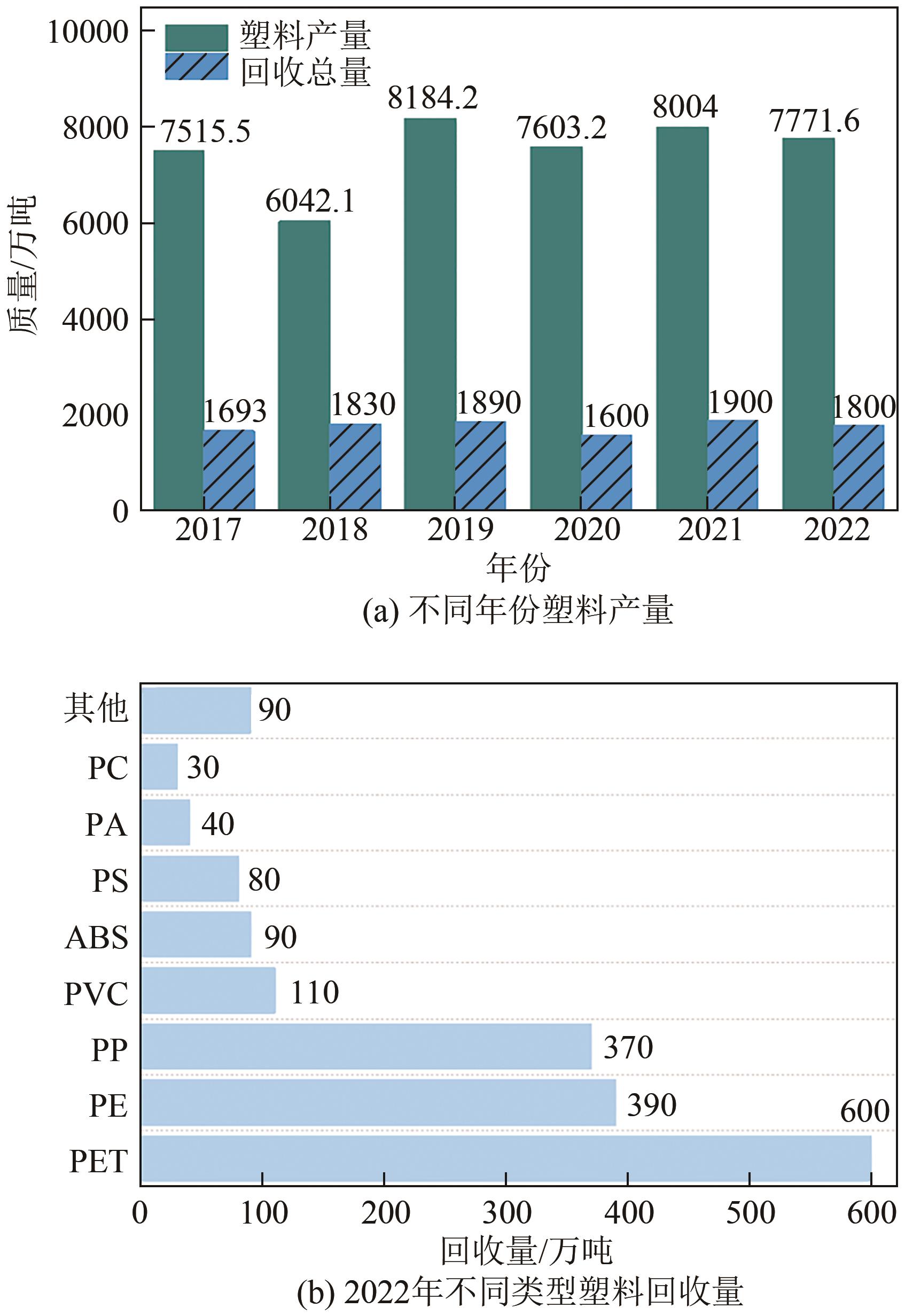
图1 中国塑料年产量和回收量概况[3]
| 塑料种类 | 熔点/℃ | 分类 | 主要应用 |
|---|---|---|---|
| 聚对苯二甲酸乙二醇酯(PET) | 250~280 | 工程塑料 | 塑料瓶、食品包装 |
| 低密度聚乙烯(LDPE) | 100~130 | 通用塑料 | 塑料袋、农用薄膜、医用包装 |
| 高密度聚乙烯(HDPE) | 120~150 | 通用塑料 | 瓶盖、玩具、家居用品、管材 |
| 聚丙烯(PP) | 145~180 | 通用塑料 | 薄膜、编织袋、打包带、注塑制品 |
| 聚氯乙烯(PVC) | 100~260 | 通用塑料 | 电线外皮、管材、鞋类、广告牌 |
| 丙烯腈-丁二烯-苯乙烯聚合物(ABS) | 160~240 | 工程塑料 | 电源外壳及部件、机器零件、汽车部件 |
| 聚苯乙烯(PS) | 160~250 | 通用塑料 | 仪表外壳、灯罩、电器部件、光学仪器 |
| 聚碳酸酯(PC) | 225~250 | 工程塑料 | 防护玻璃、电器部件、光学及照明部件 |
表1 常见回收塑料性质和应用[10-12]
| 塑料种类 | 熔点/℃ | 分类 | 主要应用 |
|---|---|---|---|
| 聚对苯二甲酸乙二醇酯(PET) | 250~280 | 工程塑料 | 塑料瓶、食品包装 |
| 低密度聚乙烯(LDPE) | 100~130 | 通用塑料 | 塑料袋、农用薄膜、医用包装 |
| 高密度聚乙烯(HDPE) | 120~150 | 通用塑料 | 瓶盖、玩具、家居用品、管材 |
| 聚丙烯(PP) | 145~180 | 通用塑料 | 薄膜、编织袋、打包带、注塑制品 |
| 聚氯乙烯(PVC) | 100~260 | 通用塑料 | 电线外皮、管材、鞋类、广告牌 |
| 丙烯腈-丁二烯-苯乙烯聚合物(ABS) | 160~240 | 工程塑料 | 电源外壳及部件、机器零件、汽车部件 |
| 聚苯乙烯(PS) | 160~250 | 通用塑料 | 仪表外壳、灯罩、电器部件、光学仪器 |
| 聚碳酸酯(PC) | 225~250 | 工程塑料 | 防护玻璃、电器部件、光学及照明部件 |
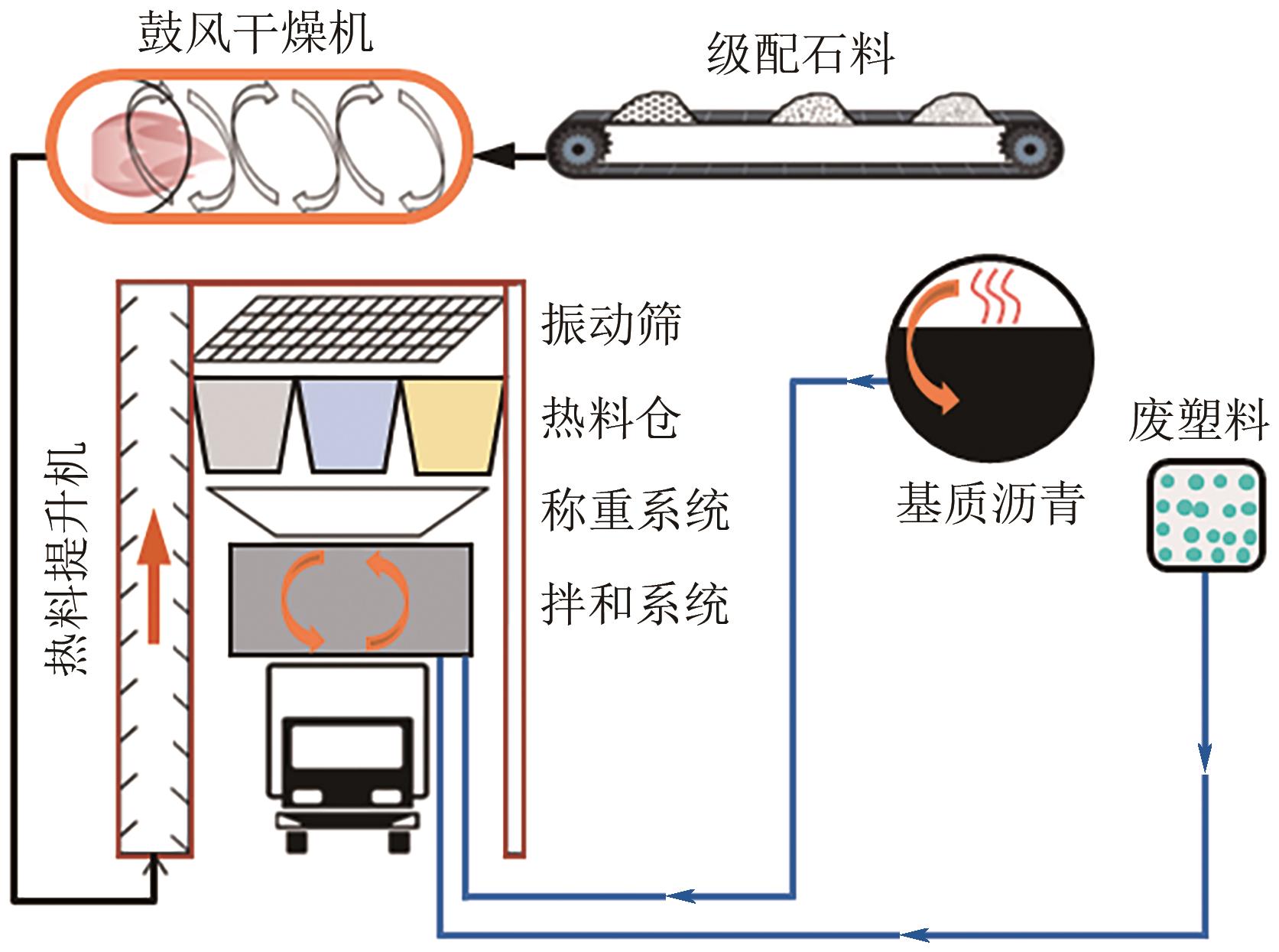
图2 废塑料干法应用示意图
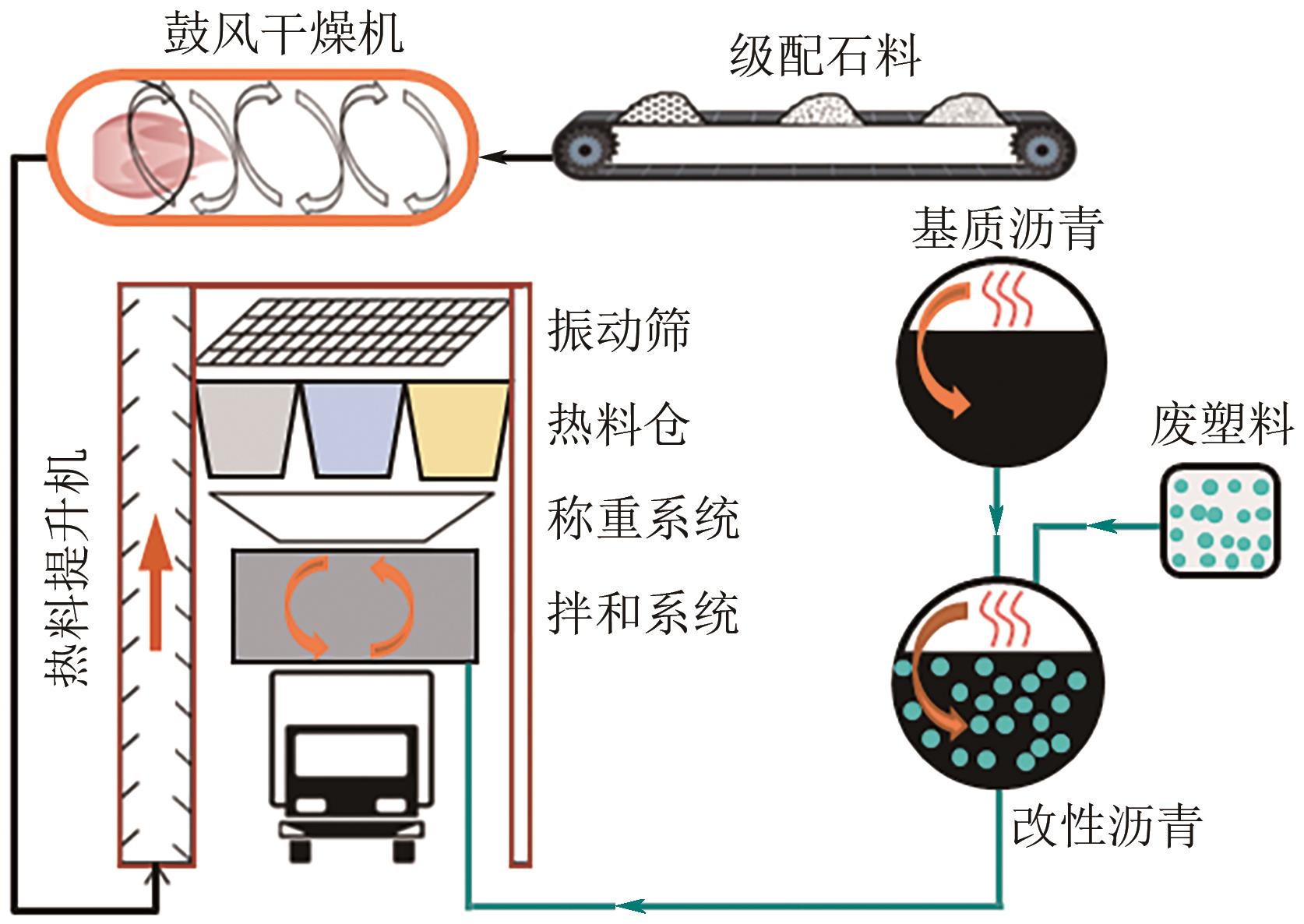
图3 湿法改性应用示意图
| 年份 | 废塑料种类 | 添加方式 | 添加量 | 作用效果/主要结论 | 参考文献 |
|---|---|---|---|---|---|
| 2006 | PE蜡/LDPE | 熔融混合 | 质量分数0.5%~4% | 改性沥青性能受其分子量影响,LDPE改性沥青出现相分离问题 | [ |
| 2007 | PE | 碎片熔融 | 质量分数3%~7% | 提高沥青高温性能 | [ |
| 2009 | LDPE | 热解混合 | 质量分数2%~8% | 提高沥青软化点,降低针入度和延度 | [ |
| 2011 | LDPE | 碎片熔融 | 质量分数5% | 降低沥青针入度、延度和闪点,提高软化点和弹性回复能力 | [ |
| 2011 | HDPE | 颗粒熔融 | 质量分数1%~7% | 提高沥青软化点,降低针入度和延度 | [ |
| 2014 | PVC | 改性后加入 | 质量分数3%、5% | 提高沥青抗车辙性能和复数模量 | [ |
| 2014 | PVC | 颗粒熔融 | 质量分数6% | 蒙脱土可提高PVC改性沥青性能 | [ |
| 2014 | PVC | 粉末混合 | 质量分数1%~5% | 提高沥青高温性能 | [ |
| 2015 | 回收塑料 | 颗粒熔融 | 质量分数4.5%~6.5% | 提高软化点,降低针入度和延度 | [ |
| 2016 | PET | 颗粒混合 | 质量分数5%~15% | 改善沥青抗车辙和抗疲劳性能 | [ |
| 2017 | PE/PP/混合 | 颗粒熔融/裂解处理 | 质量分数6%、8% | 提高沥青软化点和黏度,易老化 | [ |
| 2018 | PET | 氨解混合 | 质量分数3%~7% | PET降解物提高橡胶改性沥青黏度和车辙因子 | [ |
| 2021 | 中密度聚乙烯 (HDPE/MDPE)/ 线性低密度聚乙烯 (LDPE/LLDPE) | 颗粒熔融 | 质量分数5% | PE改性沥青效果与其种类相关,LDPE与基质沥青的相容性优于HDPE和MDPE | [ |
| 2019 | HDPE | 粉末熔融 | 质量分数5% | HDPE改性沥青存在明显相分离现象 | [ |
| 2020 | PE | 颗粒熔融 | 质量分数2%~6% | 提高沥青黏弹特性和抗疲劳性能,降低沥青低温性能 | [ |
| 2020 | PET | 氨解混合 | 质量分数5% | 提高高温性能,降低抗疲劳开裂能力 | [ |
| 2021 | HDPE/LDPE | 颗粒熔融 | 质量分数2%~8% | 拓宽基质沥青黏弹域 | [ |
| 2021 | PET | 粉化混合 | 质量分数5%~20% | 提高沥青动力黏度和抗车辙能力 | [ |
| 2021 | LDPE | 颗粒熔融 | 质量分数4%~10% | 温度和时间影响改性沥青性能 | [ |
| 2021 | PET | 研磨混合 | 质量分数4%~8% | 提高车辙因子和抗老化特性,降低疲劳因子 | [ |
| 2021 | LDPE | 颗粒熔融 | 质量分数2%、4% | 增加沥青高温黏度,离析实验软化点差大于50℃ | [ |
| 2022 | LDPE | 颗粒熔融 | 质量分数2%、4% | 苯乙烯-丁二烯-苯乙烯嵌段聚合物(SBS)可进一步改善LDPE改性沥青性能 | [ |
| 2023 | PE/PP | 颗粒熔融/液相加入 | 质量分数2%~10% | 塑料熔融后加入沥青的改性效果优于直接固相投入 | [ |
| 2023 | PP | 颗粒熔融 | 质量分数4%~8% | 废PP与橡胶、弹性体或纤维共混可提高改性沥青低温韧性 | [ |
| 2023 | PE | 热解混合 | 质量分数2%~4% | 提高沥青车辙因子和弹性回复能力 | [ |
表2 废塑料改性沥青的代表性成果
| 年份 | 废塑料种类 | 添加方式 | 添加量 | 作用效果/主要结论 | 参考文献 |
|---|---|---|---|---|---|
| 2006 | PE蜡/LDPE | 熔融混合 | 质量分数0.5%~4% | 改性沥青性能受其分子量影响,LDPE改性沥青出现相分离问题 | [ |
| 2007 | PE | 碎片熔融 | 质量分数3%~7% | 提高沥青高温性能 | [ |
| 2009 | LDPE | 热解混合 | 质量分数2%~8% | 提高沥青软化点,降低针入度和延度 | [ |
| 2011 | LDPE | 碎片熔融 | 质量分数5% | 降低沥青针入度、延度和闪点,提高软化点和弹性回复能力 | [ |
| 2011 | HDPE | 颗粒熔融 | 质量分数1%~7% | 提高沥青软化点,降低针入度和延度 | [ |
| 2014 | PVC | 改性后加入 | 质量分数3%、5% | 提高沥青抗车辙性能和复数模量 | [ |
| 2014 | PVC | 颗粒熔融 | 质量分数6% | 蒙脱土可提高PVC改性沥青性能 | [ |
| 2014 | PVC | 粉末混合 | 质量分数1%~5% | 提高沥青高温性能 | [ |
| 2015 | 回收塑料 | 颗粒熔融 | 质量分数4.5%~6.5% | 提高软化点,降低针入度和延度 | [ |
| 2016 | PET | 颗粒混合 | 质量分数5%~15% | 改善沥青抗车辙和抗疲劳性能 | [ |
| 2017 | PE/PP/混合 | 颗粒熔融/裂解处理 | 质量分数6%、8% | 提高沥青软化点和黏度,易老化 | [ |
| 2018 | PET | 氨解混合 | 质量分数3%~7% | PET降解物提高橡胶改性沥青黏度和车辙因子 | [ |
| 2021 | 中密度聚乙烯 (HDPE/MDPE)/ 线性低密度聚乙烯 (LDPE/LLDPE) | 颗粒熔融 | 质量分数5% | PE改性沥青效果与其种类相关,LDPE与基质沥青的相容性优于HDPE和MDPE | [ |
| 2019 | HDPE | 粉末熔融 | 质量分数5% | HDPE改性沥青存在明显相分离现象 | [ |
| 2020 | PE | 颗粒熔融 | 质量分数2%~6% | 提高沥青黏弹特性和抗疲劳性能,降低沥青低温性能 | [ |
| 2020 | PET | 氨解混合 | 质量分数5% | 提高高温性能,降低抗疲劳开裂能力 | [ |
| 2021 | HDPE/LDPE | 颗粒熔融 | 质量分数2%~8% | 拓宽基质沥青黏弹域 | [ |
| 2021 | PET | 粉化混合 | 质量分数5%~20% | 提高沥青动力黏度和抗车辙能力 | [ |
| 2021 | LDPE | 颗粒熔融 | 质量分数4%~10% | 温度和时间影响改性沥青性能 | [ |
| 2021 | PET | 研磨混合 | 质量分数4%~8% | 提高车辙因子和抗老化特性,降低疲劳因子 | [ |
| 2021 | LDPE | 颗粒熔融 | 质量分数2%、4% | 增加沥青高温黏度,离析实验软化点差大于50℃ | [ |
| 2022 | LDPE | 颗粒熔融 | 质量分数2%、4% | 苯乙烯-丁二烯-苯乙烯嵌段聚合物(SBS)可进一步改善LDPE改性沥青性能 | [ |
| 2023 | PE/PP | 颗粒熔融/液相加入 | 质量分数2%~10% | 塑料熔融后加入沥青的改性效果优于直接固相投入 | [ |
| 2023 | PP | 颗粒熔融 | 质量分数4%~8% | 废PP与橡胶、弹性体或纤维共混可提高改性沥青低温韧性 | [ |
| 2023 | PE | 热解混合 | 质量分数2%~4% | 提高沥青车辙因子和弹性回复能力 | [ |
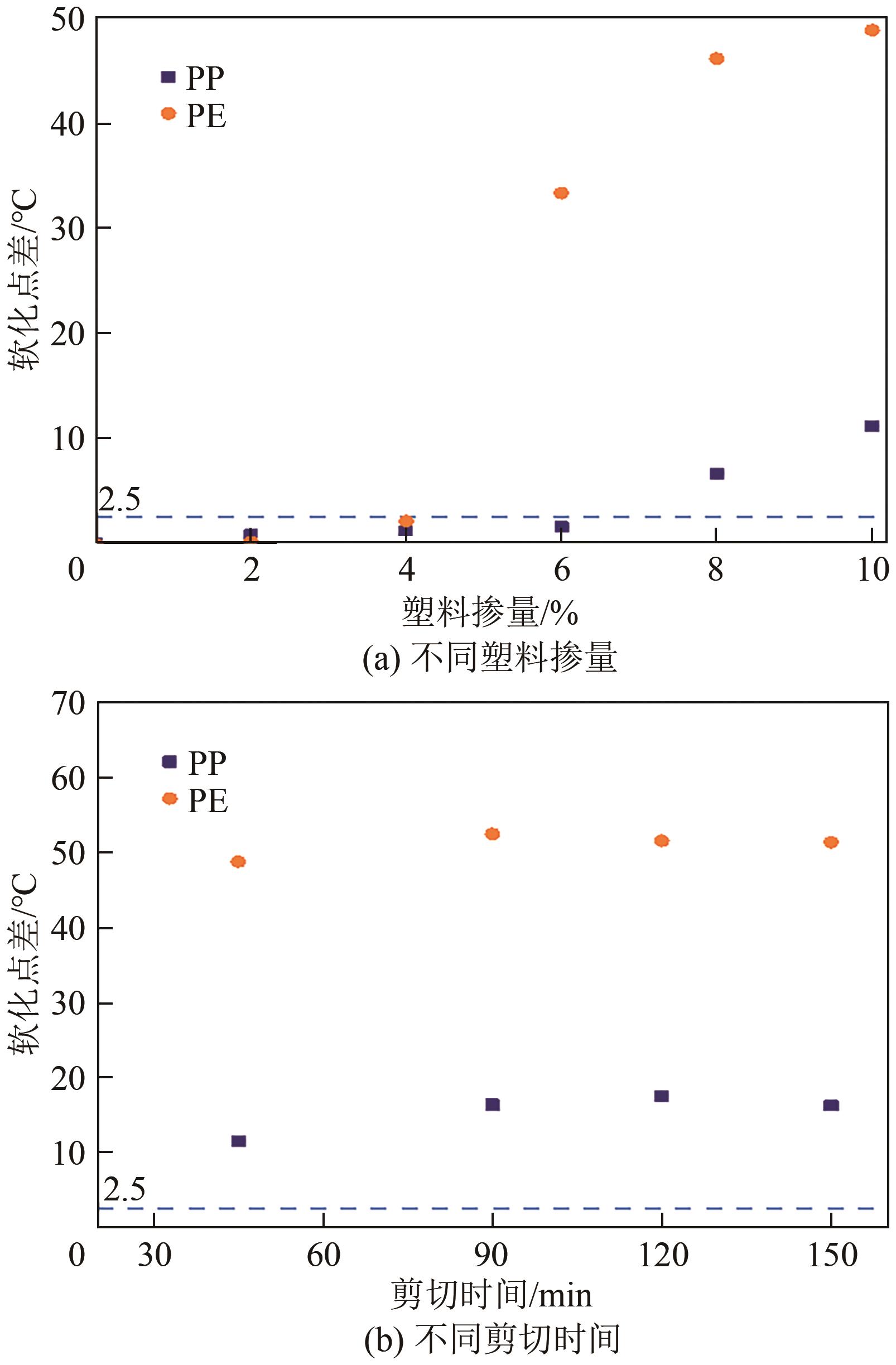
图4 PP和PE回收塑料改性沥青离析试验软化点差[59]
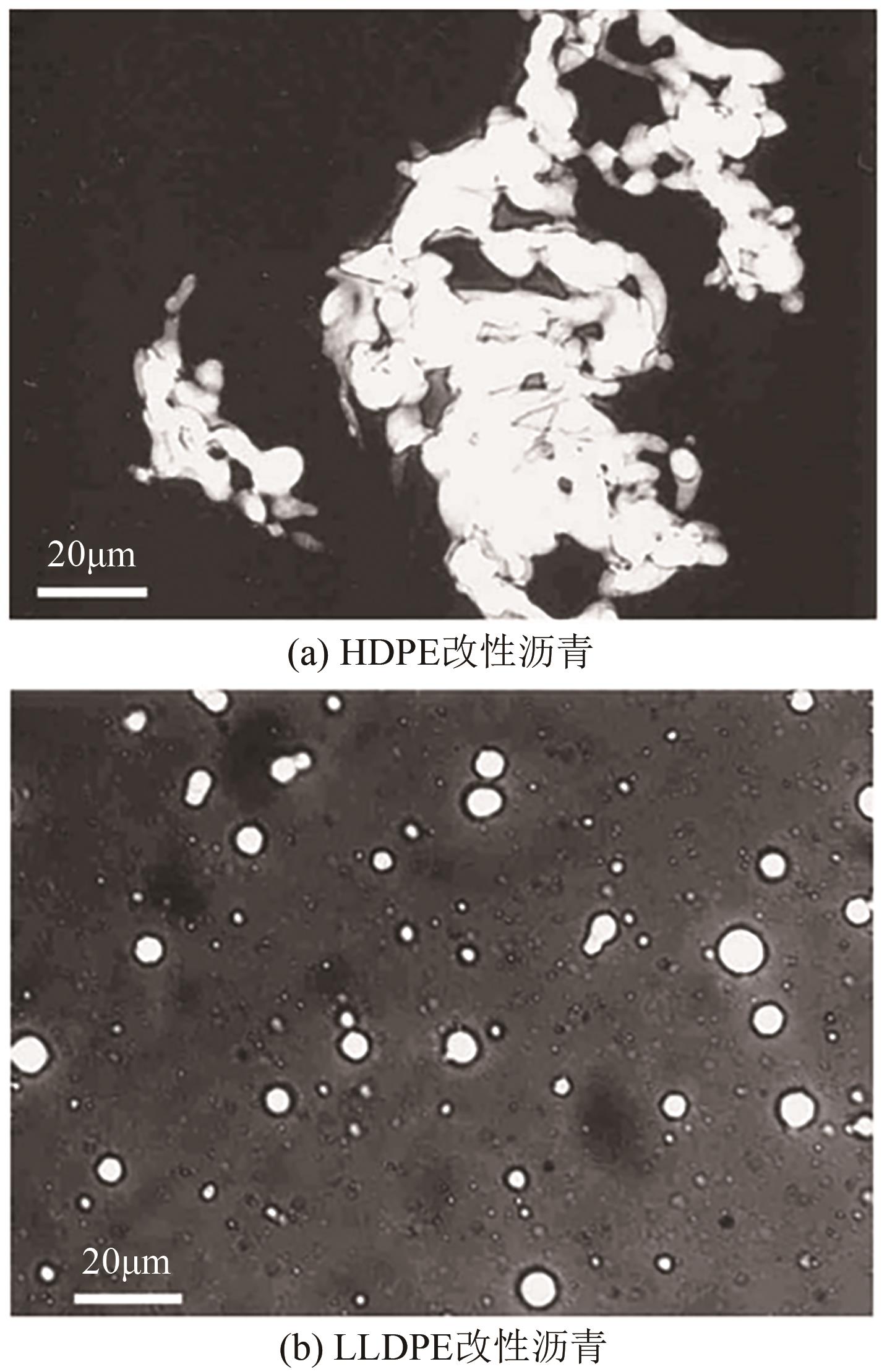
图5 废塑料改性沥青显微图片[65]
| 塑料种类 | 塑料添加量(质量分数)/% | 提升方法 | 主要结论 | 参考文献 |
|---|---|---|---|---|
| PE | 4 | 复配橡胶 | 橡胶颗粒掺入降低废塑料改性沥青的分离指数 | [ |
| HDPE | 4.5~10.5 | 复配橡胶+增容剂 | 橡塑改性沥青在增容剂的作用下储存稳定性增强 | [ |
| PE/PP | 2~12 | 复配SBS/丁苯橡胶(SBR) | SBS和SBR的加入有效防止了PE和PP颗粒的聚集 | [ |
| HDPE | 4 | 复配SBS+LLDPE-g-MAH | 改性沥青离析软化点差随着LLDPE-g-MAH含量增加而减小 | [ |
| LDPE/LLDPE/HDPE | 4 | 加入马来酸酐 | 马来酸酐可提高塑料与基质沥青的相容性 | [ |
| PVC | 6 | 添加有机蒙脱土 | 蒙脱土的加入促进PVC分散 | [ |
| LLDPE/LDPE | 4 | 添加有机蒙脱土 | 有机蒙脱土的加入提高废塑料改性沥青的稳定性 | [ |
| PE | 6 | 添加有机蒙脱土 | 有机蒙脱土的加入减小PE改性沥青离析软化点差 | [ |
| LDPE | 3~5 | 添加硫黄 | 沥青离析软化点差随着硫黄含量增加而减小 | [ |
| PE | 2.25~4.5 | 添加交联剂和SBS | 化学交联剂加入可降低改性沥青分离比 | [ |
| PE | 5 | 添加多聚磷酸(PPA) | PPA减小改性沥青的离析软化点差 | [ |
| LDPE/HDPE | 2~5 | 添加PPA | PPA提高塑料改性沥青的热储存稳定性 | [ |
| PE | 4 | 接枝马来酸酐 | 接枝马来酸酐可减小HDPE和LDPE改性沥青的离析软化点差和分离指数 | [ |
| LDPE | 5 | 接枝甲基丙烯酸缩水甘油酯(GMA) | 接枝GMA可显著减小LDPE改性沥青的离析软化点差 | [ |
| PET | 3~6 | 水解单体+橡胶复配 | 橡胶含量的增加可提高改性沥青稳定性 | [ |
| PE | 4 | 热裂解PE | 热解PE蜡可提高改性沥青的高温稳定性 | [ |
| PE/PP/混合 | 6、8 | 热裂解 | 裂解废塑料改性沥青离析软化点差小于2.5℃ | [ |
| PET | 15 | 生物油处理 | 微波环境下生物油处理的PET改性沥青不易相分离 | [ |
| PET | 15 | 生物油处理/石墨烯纳米颗粒 | 生物油处理和其与石墨烯纳米颗粒的复合处理可提高改性沥青稳定性 | [ |
表3 常用废塑料改性沥青相容性提升方法
| 塑料种类 | 塑料添加量(质量分数)/% | 提升方法 | 主要结论 | 参考文献 |
|---|---|---|---|---|
| PE | 4 | 复配橡胶 | 橡胶颗粒掺入降低废塑料改性沥青的分离指数 | [ |
| HDPE | 4.5~10.5 | 复配橡胶+增容剂 | 橡塑改性沥青在增容剂的作用下储存稳定性增强 | [ |
| PE/PP | 2~12 | 复配SBS/丁苯橡胶(SBR) | SBS和SBR的加入有效防止了PE和PP颗粒的聚集 | [ |
| HDPE | 4 | 复配SBS+LLDPE-g-MAH | 改性沥青离析软化点差随着LLDPE-g-MAH含量增加而减小 | [ |
| LDPE/LLDPE/HDPE | 4 | 加入马来酸酐 | 马来酸酐可提高塑料与基质沥青的相容性 | [ |
| PVC | 6 | 添加有机蒙脱土 | 蒙脱土的加入促进PVC分散 | [ |
| LLDPE/LDPE | 4 | 添加有机蒙脱土 | 有机蒙脱土的加入提高废塑料改性沥青的稳定性 | [ |
| PE | 6 | 添加有机蒙脱土 | 有机蒙脱土的加入减小PE改性沥青离析软化点差 | [ |
| LDPE | 3~5 | 添加硫黄 | 沥青离析软化点差随着硫黄含量增加而减小 | [ |
| PE | 2.25~4.5 | 添加交联剂和SBS | 化学交联剂加入可降低改性沥青分离比 | [ |
| PE | 5 | 添加多聚磷酸(PPA) | PPA减小改性沥青的离析软化点差 | [ |
| LDPE/HDPE | 2~5 | 添加PPA | PPA提高塑料改性沥青的热储存稳定性 | [ |
| PE | 4 | 接枝马来酸酐 | 接枝马来酸酐可减小HDPE和LDPE改性沥青的离析软化点差和分离指数 | [ |
| LDPE | 5 | 接枝甲基丙烯酸缩水甘油酯(GMA) | 接枝GMA可显著减小LDPE改性沥青的离析软化点差 | [ |
| PET | 3~6 | 水解单体+橡胶复配 | 橡胶含量的增加可提高改性沥青稳定性 | [ |
| PE | 4 | 热裂解PE | 热解PE蜡可提高改性沥青的高温稳定性 | [ |
| PE/PP/混合 | 6、8 | 热裂解 | 裂解废塑料改性沥青离析软化点差小于2.5℃ | [ |
| PET | 15 | 生物油处理 | 微波环境下生物油处理的PET改性沥青不易相分离 | [ |
| PET | 15 | 生物油处理/石墨烯纳米颗粒 | 生物油处理和其与石墨烯纳米颗粒的复合处理可提高改性沥青稳定性 | [ |
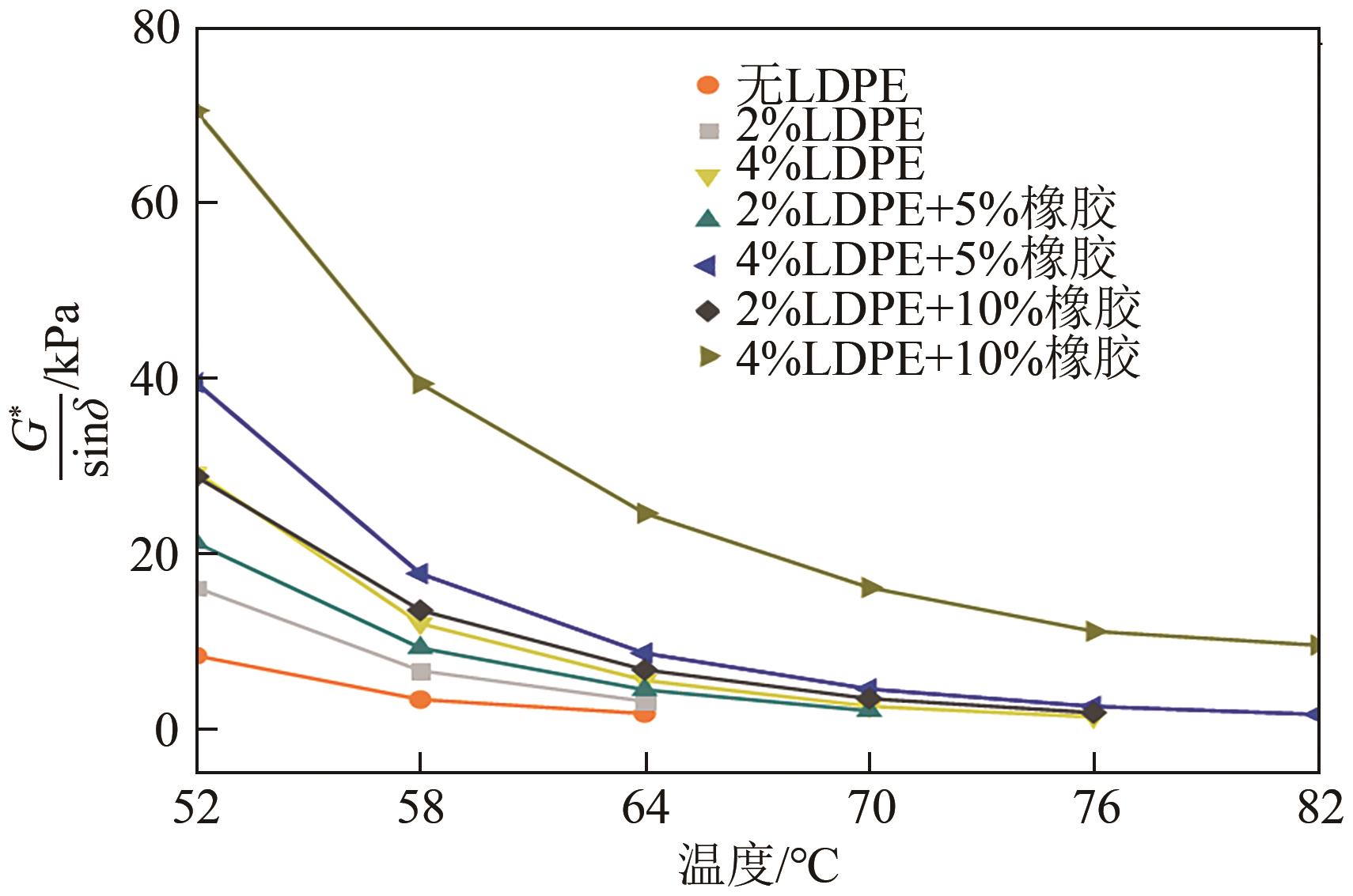
图6 LDPE及其与橡胶复配改性沥青的车辙因子[57]
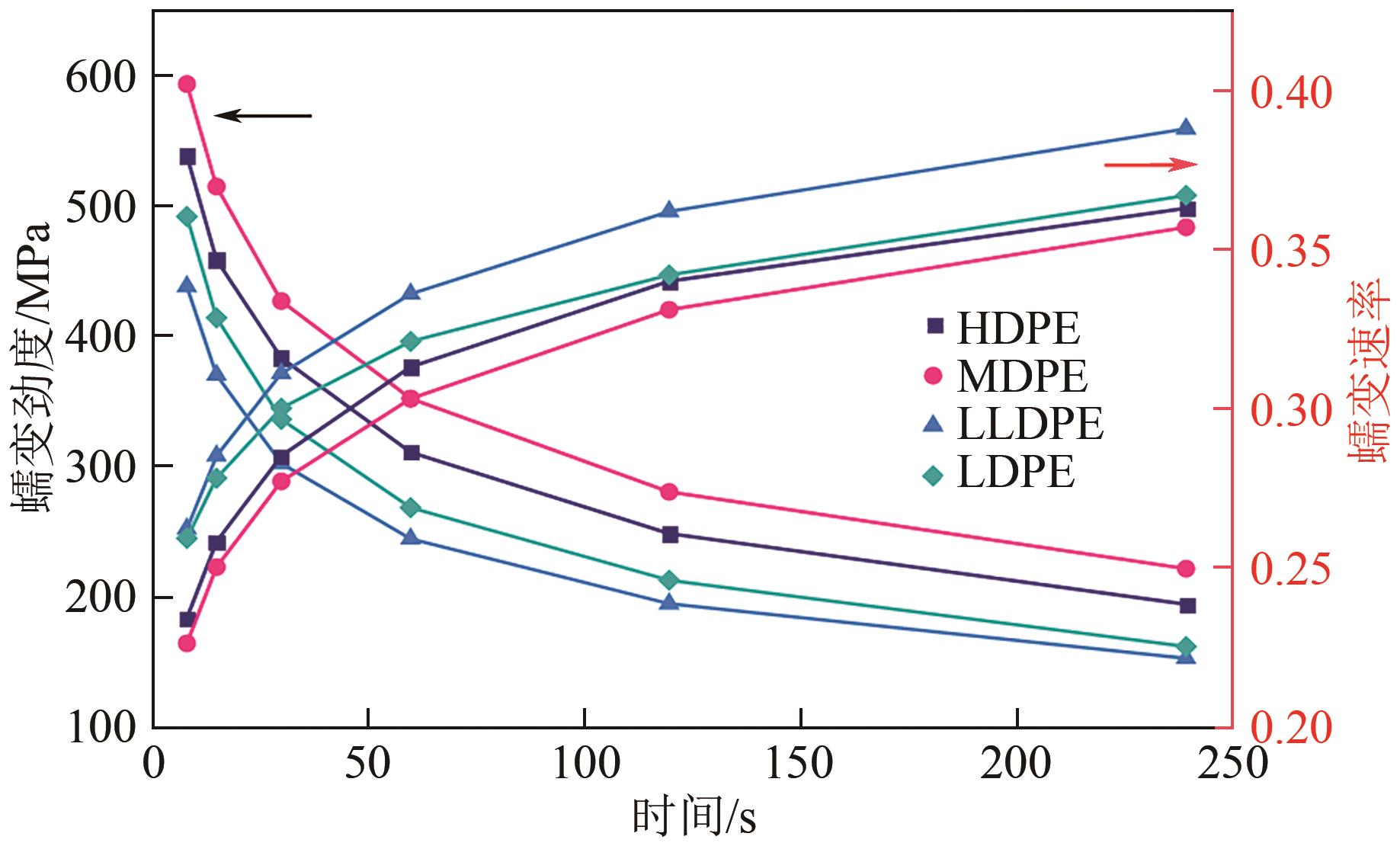
图7 不同种类PE改性沥青的蠕变劲度和蠕变速率[49]
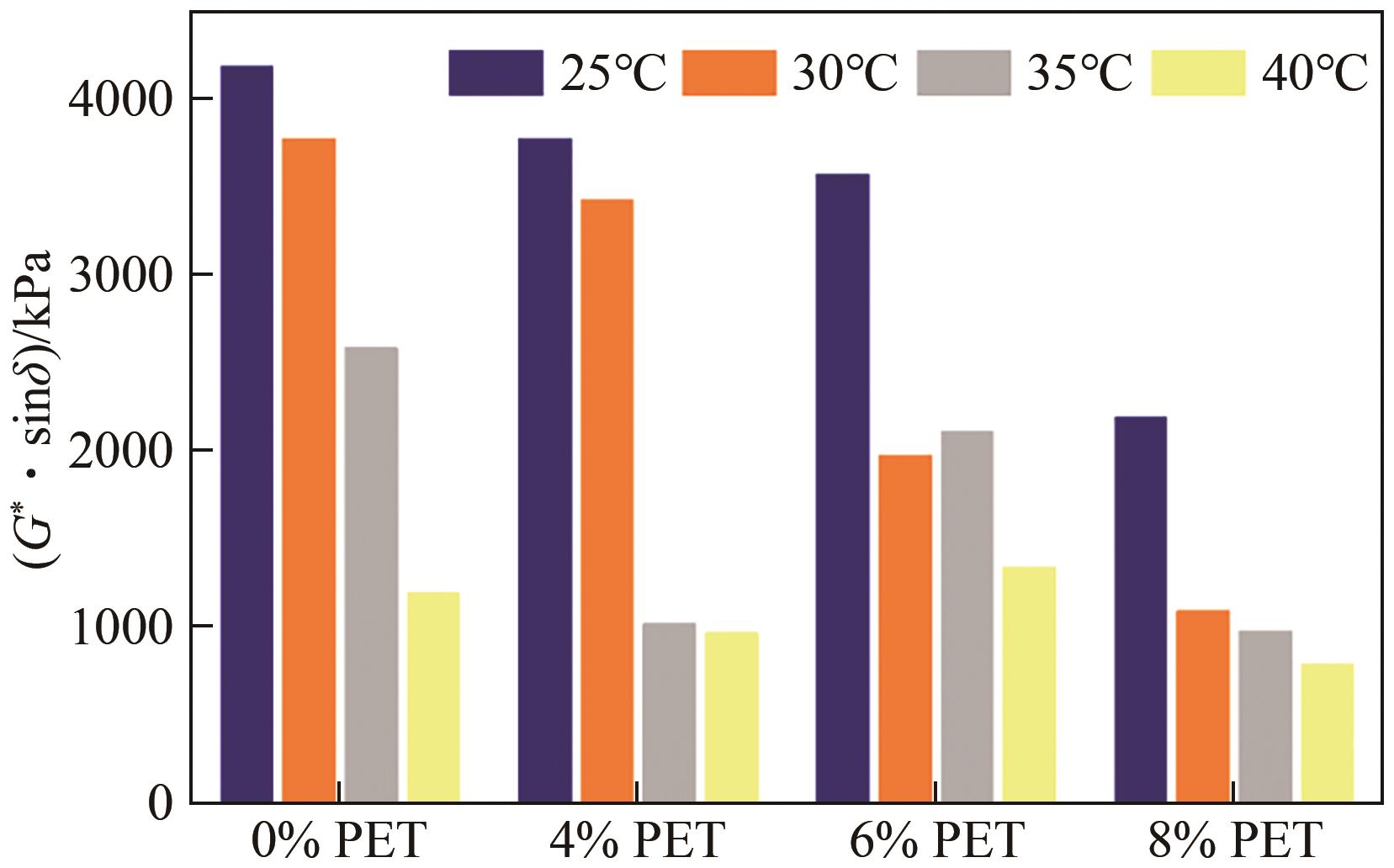
图8 不同温度下PET含量对改性沥青疲劳因子的影响[56]
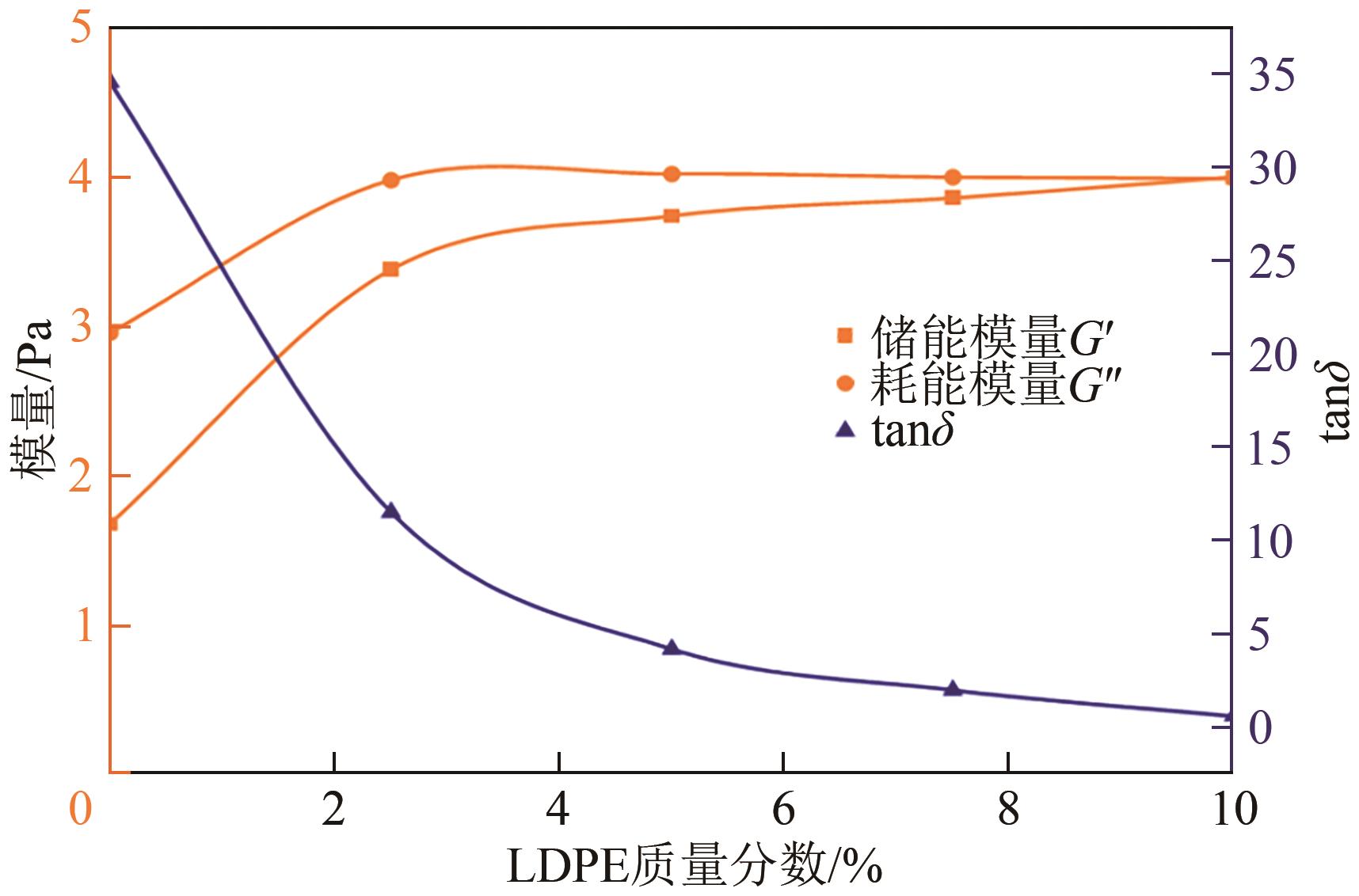
图9 LDPE改性沥青的流变学性质[37]
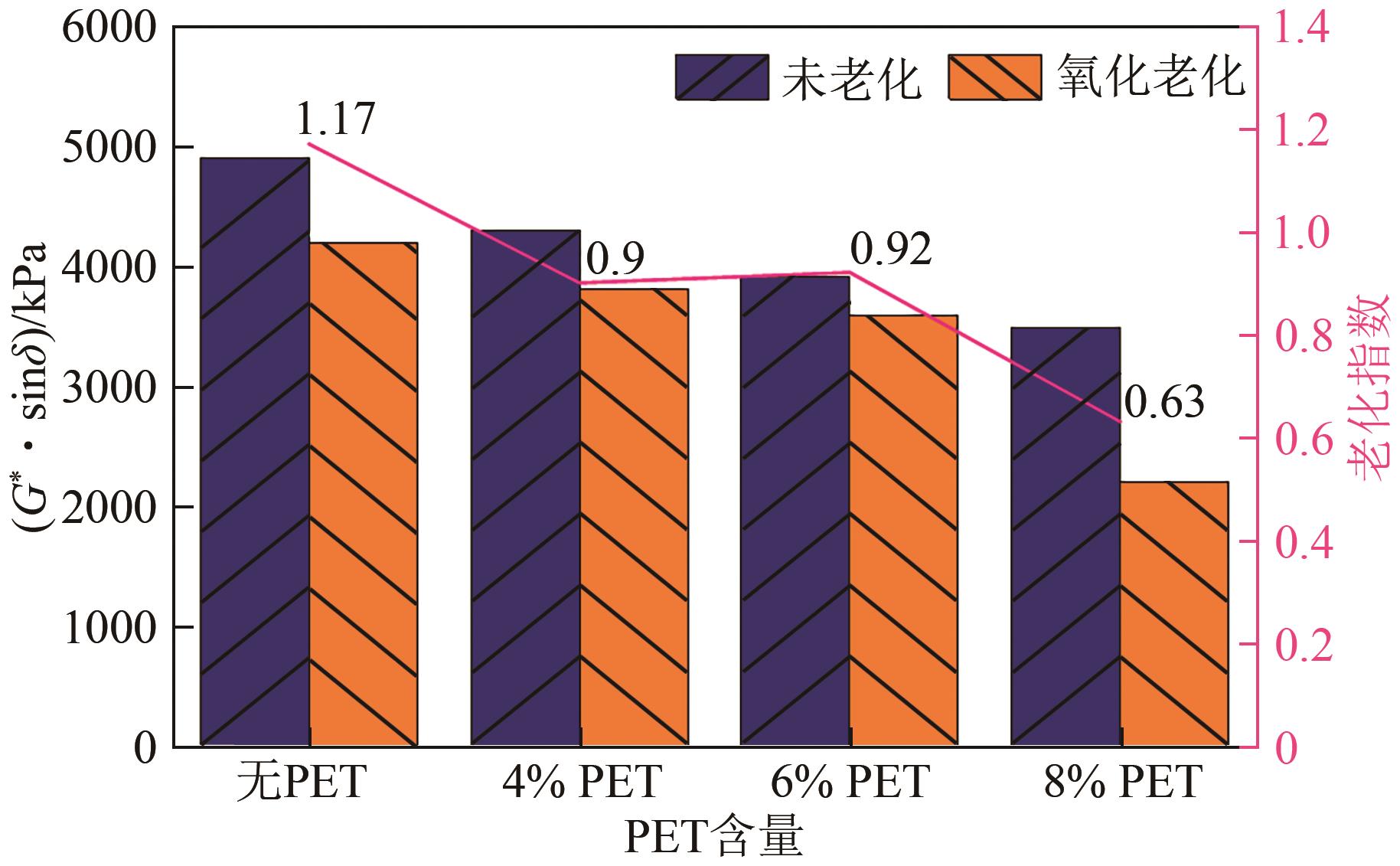
图10 不同含量PET改性沥青老化前后疲劳因子和老化指数[56]
| 71 | LI Jun, ZHANG Yuxia, ZHANG Yuzhen. The research of GMA-g-LDPE modified Qinhuangdao bitumen[J]. Construction and Building Materials, 2008, 22(6): 1067-1073. |
| 72 | PADHAN Rabindra Kumar, LENG Zhen, SREERAM Anand, et al. Compound modification of asphalt with styrene-butadiene-styrene and waste polyethylene terephthalate functionalized additives[J]. Journal of Cleaner Production, 2020, 277: 124286. |
| 73 | PADHAN Rabindra Kumar, SREERAM Anand. Enhancement of storage stability and rheological properties of polyethylene (PE) modified asphalt using cross linking and reactive polymer based additives[J]. Construction and Building Materials, 2018, 188: 772-780. |
| 74 | NAVARRO F J, PARTAL P, GARCÍA-MORALES M, et al. Bitumen modification with reactive and non-reactive (virgin and recycled) polymers: A comparative analysis[J]. Journal of Industrial and Engineering Chemistry, 2009, 15(4): 458-464. |
| 75 | PÉREZ-LEPE A, MARTÍNEZ-BOZA F J, GALLEGOS C. High temperature stability of different polymer—modified bitumens: A rheological evaluation[J]. Journal of Applied Polymer Science, 2007, 103(2): 1166-1174. |
| 76 | NASR Danial, PAKSHIR Amir Hossein. Rheology and storage stability of modified binders with waste polymers composites[J]. Road Materials and Pavement Design, 2019, 20(4): 773-792. |
| 77 | MA Yuetan, WANG Shifeng, ZHOU Hongyu, et al. Compatibility and rheological characterization of asphalt modified with recycled rubber-plastic blends[J]. Construction and Building Materials, 2021, 270: 121416. |
| 78 | FAISAL KABIR Sk, SUKUMARAN Suja, MOGHTADERNEJAD Sara, et al. End of life plastics to enhance sustainability of pavement construction utilizing a hybrid treatment of bio-oil and carbon coating[J]. Construction and Building Materials, 2021, 278: 122444. |
| 79 | VARGAS María A, VARGAS Miguel A, Antonio SÁNCHEZ-SÓLIS, et al. Asphalt/polyethylene blends: Rheological properties, microstructure and viscosity modeling[J]. Construction and Building Materials, 2013, 45: 243-250. |
| 80 | HAJIKARIMI Pouria, SADAT HOSSEINI Alireza, FINI Elham H. Evaluation of the compatibility of waste plastics and bitumen using micromechanical modeling[J]. Construction and Building Materials, 2022, 317: 126107. |
| 81 | NOUALI Mohammed, GHORBEL Elhem, DERRICHE Zohra. Phase separation and thermal degradation of plastic bag waste modified bitumen during high temperature storage[J]. Construction and Building Materials, 2020, 239: 117872. |
| 82 | FANG Changqing, LIU Pei, YU Ruien, et al. Preparation process to affect stability in waste polyethylene-modified bitumen[J]. Construction and Building Materials, 2014, 54: 320-325. |
| 83 | WANG Shifeng, YUAN Conghui, DENG Jiaxi. Crumb tire rubber and polyethylene mutually stabilized in asphalt by screw extrusion[J]. Journal of Applied Polymer Science, 2014, 131(23): 41189. |
| 84 | ZHANG Haiyan, WU Xiaowei, CAO Dongwei, et al. Effect of linear low density-polyethylene grafted with maleic anhydride (LLDPE-g-MAH) on properties of high density-polyethylene/styrene-butadiene-styrene (HDPE/SBS) modified asphalt[J]. Construction and Building Materials, 2013, 47: 192-198. |
| 85 | CHEN Siyu, CHE Tiankai, MOHSENI Alaeddin, et al. Preliminary study of modified asphalt binders with thermoplastics: The rheology properties and interfacial adhesion between thermoplastics and asphalt binder[J]. Construction and Building Materials, 2021, 301:124373. |
| 86 | YU Ruien, FANG Changqing, LIU Pei, et al. Storage stability and rheological properties of asphalt modified with waste packaging polyethylene and organic montmorillonite[J]. Applied Clay Science, 2015, 104: 1-7. |
| 87 | FANG Changqing, ZHANG Ying, YU Ruien, et al. Effect of organic montmorillonite on the hot storage stability of asphalt modified by waste packaging polyethylene[J]. Journal of Vinyl and Additive Technology, 2015, 21(2): 89-93. |
| 88 | CASEY Donnchadh, MCNALLY Ciaran, GIBNEY Amanda, et al. Development of a recycled polymer modified binder for use in stone mastic asphalt[J]. Resources, Conservation and Recycling, 2008, 52(10): 1167-1174. |
| 89 | GE Dongdong, YAN Kezhen, YOU Zhanping, et al. Modification mechanism of asphalt binder with waste tire rubber and recycled polyethylene[J]. Construction and Building Materials, 2016, 126: 66-76. |
| 90 | TIAN Weiwei, GAO Yingli, LI Yuelin, et al. Molecular dynamics study on the effect of rheological performance of asphalt with different plasticizers[J]. Construction and Building Materials, 2023, 400: 132791. |
| 91 | 单丽岩, 谭忆秋, 李晓琳. 沥青疲劳特性的研究[J]. 武汉理工大学学报(交通科学与工程版), 2011, 35(1): 190-193. |
| SHAN Liyan, TAN Yiqiu, LI Xiaolin. Fatigue characteristic of asphalt[J]. Journal of Wuhan University of Technology (Transportation Science & Engineering), 2011, 35(1): 190-193. | |
| 92 | LI Rui, LENG Zhen, YANG Jun, et al. Innovative application of waste polyethylene terephthalate (PET) derived additive as an antistripping agent for asphalt mixture: Experimental investigation and molecular dynamics simulation[J]. Fuel, 2021, 300: 121015. |
| 93 | Hüseyin KÖSE, ÇELIK Osman Nuri, ARSLAN Deniz. A novel approach to warm mix asphalt additive production from polypropylene waste plastic via pyrolysis[J]. Construction and Building Materials, 2024, 411: 134151. |
| 1 | LIU Sibao, KOTS Pavel A, VANCE Brandon C, et al. Plastic waste to fuels by hydrocracking at mild conditions[J]. Science Advances, 2021, 7(17): eabf8283. |
| 2 | KULAS Daniel G, ZOLGHADR Ali, CHAUDHARI Utkarsh S, et al. Economic and environmental analysis of plastics pyrolysis after secondary sortation of mixed plastic waste[J]. Journal of Cleaner Production, 2023, 384: 135542. |
| 3 | 中国物资再生协会再生塑料分会. 中国再生塑料行业发展报告(2022年度)[R/OL]. (2023-04-13) [2023-11-06]. . |
| Plastic Recycling Association of National Resources Recycling Association. Development report of China Plastic Recycling Industry[R/OL]. (2023-04-13) [2023-11-06]. . | |
| 4 | 肖皓宇, 杨海平, 张雄, 等. 塑料催化热解制备高附加值产品的研究进展[J]. 化工学报, 2022, 73(8): 3461-3471. |
| XIAO Haoyu, YANG Haiping, ZHANG Xiong, et al. Recent progress of catalytic pyrolysis of plastics to produce high value-added products[J]. CIESC Journal, 2022, 73(8): 3461-3471. | |
| 5 | BEHL Ambika, SHARMA Girish, KUMAR Gajendra. A sustainable approach: Utilization of waste PVC in asphalting of roads[J]. Construction and Building Materials, 2014, 54: 113-117. |
| 6 | 孙锴, 王琬丽, 黄群星. 典型杂质掺混对废塑料热解油特性的影响[J]. 化工进展, 2021, 40(6): 3499-3506. |
| SUN Kai, WANG Wanli, HUANG Qunxing. Effect of typical impurities on the pyrolysis oil of waste plastics[J]. Chemical Industry and Engineering Progress, 2021, 40(6): 3499-3506. | |
| 7 | DUARTE Gabriel Macêdo, FAXINA Adalberto Leandro. Asphalt concrete mixtures modified with polymeric waste by the wet and dry processes: A literature review[J]. Construction and Building Materials, 2021, 312: 125408. |
| 8 | LU Daixuan, ENFRIN Marie, BOOM Yeong Jia, et al. Future recyclability of hot mix asphalt containing recycled plastics[J]. Construction and Building Materials, 2023, 368: 130396. |
| 9 | ASHISH Prabin Kumar, SREERAM Anand, XU Xiong, et al. Closing the Loop: Harnessing waste plastics for sustainable asphalt mixtures—A comprehensive review[J]. Construction and Building Materials, 2023, 400: 132858. |
| 10 | MA Yuetan, ZHOU Hongyu, JIANG Xi, et al. The utilization of waste plastics in asphalt pavements: A review[J]. Cleaner Materials, 2021, 2: 100031. |
| 11 | YOU Lingyun, LONG Zhengwu, YOU Zhanping, et al. Review of recycling waste plastics in asphalt paving materials[J]. Journal of Traffic and Transportation Engineering (English Edition), 2022, 9(5): 742-764. |
| 12 | HAO Gengren, HE Meibo, Sin Mei LIM, et al. Recycling of plastic waste in porous asphalt pavement: Engineering, environmental, and economic implications[J]. Journal of Cleaner Production, 2024, 440: 140865. |
| 13 | ZUNITA Megawati, WINOTO Haryo Pandu, M Fikar Kamil FAUZAN, et al. Recent advances in plastics waste degradation using ionic liquid-based process[J]. Polymer Degradation and Stability, 2023, 211: 110320. |
| 14 | GUO Zhiliang, HE Qianheng, WANG Helin, et al. Chemical recycling of various PET plastic waste under alkaline hydrolysis via the LSR method[J]. Inorganic Chemistry Communications, 2024, 159: 111744. |
| 15 | JIA Zixian, GAO Lin, QIN Lijiao, et al. Chemical recycling of PET to value-added products[J]. RSC Sustainability, 2023, 1(9): 2135-2147. |
| 16 | BHANDERI Khodidas K, JOSHI Jeimin R, PATEL Jigar V. Recycling of polyethylene terephthalate (PET or PETE) plastics—An alternative to obtain value added products: A review[J]. Journal of the Indian Chemical Society, 2023, 100(1): 100843. |
| 17 | LEE Johnathan Joo Cheng, HAYAT Nur Nawwarah Ainul, Xiang Yun Debbie SOO, et al. Upcycling of PET plastics into diethyl terephthalate for applications as phase change materials in energy harvesting[J]. Journal of Energy Storage, 2023, 73: 109084. |
| 18 | 范思强, 彭绍忠, 彭冲, 等. 废塑料高附加值利用技术研究进展[J]. 化工进展, 2023, 42(2): 1020-1027. |
| FAN Siqiang, PENG Shaozhong, PENG Chong, et al. Research progress in high value-added utilization technology of waste plastics[J]. Chemical Industry and Engineering Progress, 2023, 42(2): 1020-1027. | |
| 19 | FAISAL F, RASUL M G, JAHIRUL M I, et al. Waste plastics pyrolytic oil is a source of diesel fuel: A recent review on diesel engine performance, emissions, and combustion characteristics[J]. Science of the Total Environment, 2023, 886: 163756. |
| 20 | SHAN Tilun, BIAN Huiguang, WANG Kongshuo, et al. Study on pyrolysis characteristics and kinetics of mixed waste plastics under different atmospheres[J]. Thermochimica Acta, 2023, 722: 179467. |
| 21 | 刘明星, 章群丹, 刘泽龙, 等. 废塑料热解油性质及组成的研究现状[J]. 石油炼制与化工, 2023, 54(4): 133-144. |
| 94 | MA Yuetan, WANG Shifeng, ZHANG Miaomiao, et al. Weather aging effects on modified asphalt with rubber-polyethylene composites[J]. Science of the Total Environment, 2023, 865: 161089. |
| 21 | LIU Mingxing, ZHANG Qundan, LIU Zelong, et al. Research status of properties and composition of pyrolysis oil from waste plastics[J]. Petroleum Processing and Petrochemicals, 2023, 54(4): 133-144. |
| 22 | 周梅, 李思佳, 徐玮峰, 等. 对苯二甲酸乙二醇酯二聚体水/醇/氨解机理的理论研究[J]. 中国塑料, 2023, 37(1): 90-98. |
| ZHOU Mei, LI Sijia, XU Weifeng, et al. Theoretical study on hydrolysis/alcoholysis/ammonolysis mechanisms of ethylene terephthalate dimer[J]. China Plastics, 2023, 37(1): 90-98. | |
| 23 | HOANG Cuong N, DANG Yen H. Aminolysis of poly(ethylene terephthalate) waste with ethylenediamine and characterization of α,ω-diamine products[J]. Polymer Degradation and Stability, 2013, 98(3): 697-708. |
| 24 | LU Hongyuan, DIAZ Daniel J, CZARNECKI Natalie J, et al. Machine learning-aided engineering of hydrolases for PET depolymerization[J]. Nature, 2022, 604(7907): 662-667. |
| 25 | THACHNATHAREN N, SHAHABUDDIN S, SRIDEWI N. The waste management of polyethylene terephthalate (PET) plastic waste: A review[J]. IOP Conference Series: Materials Science and Engineering, 2021, 1127(1): 012002. |
| 26 | YOSHIOKA Toshiaki, MOTOKI Tsutomu, OKUWAKI Akitsugu. Kinetics of hydrolysis of poly(ethylene terephthalate) powder in sulfuric acid by a modified shrinking-core model[J]. Industrial & Engineering Chemistry Research, 2001, 40(1): 75-79. |
| 27 | XU Xiong, LENG Zhen, LAN Jingting, et al. Sustainable practice in pavement engineering through value-added collective recycling of waste plastic and waste tyre rubber[J]. Engineering, 2021, 7(6): 857-867. |
| 28 | MOVILLA-QUESADA D, RAPOSEIRAS A C, SILVA-KLEIN L T, et al. Use of plastic scrap in asphalt mixtures added by dry method as a partial substitute for bitumen[J]. Waste Management, 2019, 87: 751-760. |
| 29 | RAHMAN Wan Mohd Nazmi Wan Abdul, WAHAB Achmad Fauzi Abdul. Green pavement using recycled polyethylene terephthalate (PET) as partial fine aggregate replacement in modified asphalt[J]. Procedia Engineering, 2013, 53: 124-128. |
| 30 | BAGHAEE MOGHADDAM Taher, SOLTANI Mehrtash, KARIM Mohamed Rehan. Experimental characterization of rutting performance of polyethylene terephthalate modified asphalt mixtures under static and dynamic loads[J]. Construction and Building Materials, 2014, 65: 487-494. |
| 31 | MOVILLA-QUESADA D, RAPOSEIRAS A C, OLAVARRÍA J. Effects of recycled polyethylene terephthalate (PET) on stiffness of hot asphalt mixtures[J]. Advances in Civil Engineering, 2019, 2019(1): 6969826. |
| 32 | ALMEIDA Arminda, Silvino CAPITÃO, BANDEIRA Rita, et al. Performance of AC mixtures containing flakes of LDPE plastic film collected from urban waste considering ageing[J]. Construction and Building Materials, 2020, 232: 117253. |
| 33 | HAIDER Safeer, HAFEEZ Imran, JAMAL, et al. Sustainable use of waste plastic modifiers to strengthen the adhesion properties of asphalt mixtures[J]. Construction and Building Materials, 2020, 235: 117496. |
| 34 | 刘少鹏, 黄卫东, 纪淑贞. PE对沥青及沥青混合料性能影响研究[J]. 公路工程, 2016, 41(1): 28-32, 50. |
| LIU Shaopeng, HUANG Weidong, JI Shuzhen. Influence on the performance of asphalt and asphalt mixture adding PE[J]. Highway Engineering, 2016, 41(1): 28-32, 50. | |
| 35 | MODARRES Amir, HAMEDI Hamidreza. Effect of waste plastic bottles on the stiffness and fatigue properties of modified asphalt mixes[J]. Materials & Design, 2014, 61: 8-15. |
| 36 | AHMADINIA Esmaeil, ZARGAR Majid, KARIM Mohamed Rehan, et al. Performance evaluation of utilization of waste polyethylene terephthalate (PET) in stone mastic asphalt[J]. Construction and Building Materials, 2012, 36: 984-989. |
| 37 | PUNITH V S, VEERARAGAVAN A. Behavior of reclaimed polyethylene modified asphalt cement for paving purposes[J]. Journal of Materials in Civil Engineering, 2011, 23(6): 833-845. |
| 38 | FANG Changqing, LI Tiehu, ZHANG Zengping, et al. Combined modification of asphalt by waste PE and rubber[J]. Polymer Composites, 2008, 29(10): 1183-1187. |
| 39 | Susanna HO, CHURCH Ronaca, KLASSEN Kristel, et al. Study of recycled polyethylene materials as asphalt modifiers[J]. Canadian Journal of Civil Engineering, 2006, 33(8): 968-981. |
| 40 | 周研, 于永生, 张国强, 等. 废塑料改性沥青的性能研究[J]. 石油沥青, 2007, 21(4): 6-9. |
| ZHOU Yan, YU Yongsheng, ZHANG Guoqiang, et al. Performance study of modifying asphalt by the waste-PE[J]. Petroleum Asphalt, 2007, 21(4): 6-9. | |
| 41 | AL-HADIDY A I, TAN Yiqiu. Effect of polyethylene on life of flexible pavements[J]. Construction and Building Materials, 2009, 23(3): 1456-1464. |
| 42 | ATTAELMANAN Moatasim, FENG Chengpei, AI Al-Hadidy Laboratory evaluation of HMA with high density polyethylene as a modifier[J]. Construction and Building Materials, 2011, 25(5): 2764-2770. |
| 43 | FANG Changqing, LIU Xiaolong, YU Ruien, et al. Preparation and properties of asphalt modified with a composite composed of waste package poly(vinyl chloride) and organic montmorillonite[J]. Journal of Materials Science & Technology, 2014, 30(12): 1304-1310. |
| 44 | Sevil KÖFTECI, AHMEDZADE Perviz, KULTAYEV Baurzhan. Performance evaluation of bitumen modified by various types of waste plastics[J]. Construction and Building Materials, 2014, 73: 592-602. |
| 45 | 李春歌, 王嵩, 巫从亮. 生活废旧塑料改性沥青性能试验研究[J]. 公路, 2015, 60(11): 194-196. |
| LI Chunge, WANG Song, WU Congliang. Experimental research on performance of asphalt modified with waste plastic[J]. Highway, 2015, 60(11): 194-196. | |
| 46 | AMERI Mahmoud, NASR Danial. Properties of asphalt modified with devulcanized polyethylene terephthalate[J]. Petroleum Science and Technology, 2016, 34(16): 1424-1430. |
| 47 | 杨锡武, 刘克, 冯梅, 等. 生活废旧塑料改性沥青性能及机理研究[J]. 重庆交通大学学报(自然科学版), 2017, 36(1): 30-35, 109. |
| YANG Xiwu, LIU Ke, FENG Mei, et al. Performance and mechanism investigation of recycled plastic modified asphalts[J]. Journal of Chongqing Jiaotong University (Natural Science), 2017, 36(1): 30-35, 109. | |
| 48 | LENG Zhen, PADHAN Rabindra Kumar, SREERAM Anand. Production of a sustainable paving material through chemical recycling of waste PET into crumb rubber modified asphalt[J]. Journal of Cleaner Production, 2018, 180: 682-688. |
| 49 | LIANG Ming, XIN Xue, FAN Weiyu, et al. Comparison of rheological properties and compatibility of asphalt modified with various polyethylene[J]. International Journal of Pavement Engineering, 2021, 22(1): 11-20. |
| 50 | COSTA Liliana M B, SILVA Hugo M R D, PERALTA Joana, et al. Using waste polymers as a reliable alternative for asphalt binder modification—Performance and morphological assessment[J]. Construction and Building Materials, 2019, 198: 237-244. |
| 51 | YE Qunshan, AMIRKHANIAN Serji, LI Jin, et al. Effects of waste polyethylene on the rheological properties of asphalt binder[J]. Journal of Testing and Evaluation, 2020, 48(3): 1893-1904. |
| 52 | MERKEL Daniel R, KUANG Wenbin, MALHOTRA Deepika, et al. Waste PET chemical processing to terephthalic amides and their effect on asphalt performance[J]. ACS Sustainable Chemistry & Engineering, 2020, 8(14): 5615-5625. |
| 53 | ALGHRAFY Yasser M, EL-BADAWY Sherif M, ALLA El-Sayed M ABD. Rheological and environmental evaluation of sulfur extended asphalt binders modified by high- and low-density polyethylene recycled waste[J]. Construction and Building Materials, 2021, 307: 125008. |
| 54 | GHABCHI Rouzbeh, DHARMARATHNA Chamika Prashan, MIHANDOUST Maryam. Feasibility of using micronized recycled polyethylene terephthalate (PET) as an asphalt binder additive: A laboratory study[J]. Construction and Building Materials, 2021, 292: 123377. |
| 55 | GENET Melkamu Birlie, SENDEKIE Zenamarkos Bantie, JEMBERE Addis Lemessa. Investigation and optimization of waste LDPE plastic as a modifier of asphalt mix for highway asphalt: Case of Ethiopian roads[J]. Case Studies in Chemical and Environmental Engineering, 2021, 4: 100150. |
| 56 | MASHAAN Nuha S, CHEGENIZADEH Amin, NIKRAZ Hamid, et al. Investigating the engineering properties of asphalt binder modified with waste plastic polymer[J]. Ain Shams Engineering Journal, 2021, 12(2): 1569-1574. |
| 57 | DUARTE Gabriel Macêdo, FAXINA Adalberto Leandro. High-temperature rheological properties of asphalt binders modified with recycled low-density polyethylene and crumb rubber[J]. Construction and Building Materials, 2021, 298: 123852. |
| 58 | HONG Zhe, YAN Kezhen, GE Dongdong, et al. Effect of styrene-butadiene-styrene (SBS) on laboratory properties of low-density polyethylene (LDPE)/ethylene-vinyl acetate (EVA) compound modified asphalt[J]. Journal of Cleaner Production, 2022, 338: 130677. |
| 59 | 李琳, 潘攀, 胡小弟, 等. 生活废塑料改性沥青制备参数及性能研究[J]. 广西大学学报(自然科学版), 2023, 48(4): 811-820. |
| LI Lin, PAN Pan, HU Xiaodi, et al. Preparation parameters and properties of domestic waste plastics modified asphalt[J]. Journal of Guangxi University (Natural Science Edition), 2023, 48(4): 811-820. | |
| 60 | LI Fan, ZHANG Xiao, ZHANG Kaifeng, et al. Exploring the effect of different waste polypropylene matrix composites on service performance of modified asphalt using analytic hierarchy process[J]. Construction and Building Materials, 2023, 405: 133292. |
| 61 | DUAN Pengpeng, HAN Yongfeng, CAO Weiwei, et al. Catalytic cracking of waste polyethylene into wax-based warm-mix agent for optimizing rheological and mechanical properties of asphalt composites[J]. Construction and Building Materials, 2023, 370: 130732. |
| 62 | BEHNOOD Ali, MODIRI GHAREHVERAN Mahsa. Morphology, rheology, and physical properties of polymer-modified asphalt binders[J]. European Polymer Journal, 2019, 112: 766-791. |
| 63 | 郑直, 郭乃胜, 尤占平, 等. 废木油与石油沥青相容机制的分子动力学研究[J]. 化工学报, 2023, 74(10): 4037-4050. |
| ZHENG Zhi, GUO Naisheng, YOU Zhanping, et al. Research on compatibility mechanisms between waste wood oil and petroleum asphalt through molecular dynamics[J]. CIESC Journal, 2023, 74(10): 4037-4050. | |
| 64 | MA Dechong, ZHAO Duijia, ZHAO Jingzhe, et al. Functionalization of reclaimed polyethylene with maleic anhydride and its application in improving the high temperature stability of asphalt mixtures[J]. Construction and Building Materials, 2016, 113: 596-602. |
| 65 | GONZÁLEZ O, MUÑOZ M E, SANTAMARÍA A. Bitumen/polyethylene blends: Using m-LLDPEs to improve stability and viscoelastic properties[J]. Rheologica Acta, 2006, 45(5): 603-610. |
| 66 | 王涛. 废旧塑料改性沥青相容性研究[D]. 青岛: 中国石油大学(华东), 2010. |
| WANG Tao. Study on compatibility of waste plastic-modified asphalt[D]. Qingdao: China University of Petroleum (East China), 2010. | |
| 67 | SREERAM Anand, FILONZI Angelo, KOMARAGIRI Satyavati, et al. Assessing impact of chemical compatibility of additives used in asphalt binders: A case study using plastics[J]. Construction and Building Materials, 2022, 359: 129349. |
| 68 | 王勇, 蒋博, 张福友, 等. PPA对废旧塑料改性沥青及其混合料路用性能影响研究[J]. 化工新型材料, 2022, 50(7): 229-234, 240. |
| WANG Yong, JIANG Bo, ZHANG Fuyou, et al. Influence of PPA on pavement performance of waste plastic modified asphalt and its mixture[J]. New Chemical Materials, 2022, 50(7): 229-234, 240. | |
| 69 | LIANG Ming, XIN Xue, FAN Weiyu, et al. Phase behavior and hot storage characteristics of asphalt modified with various polyethylene: Experimental and numerical characterizations[J]. Construction and Building Materials, 2019, 203: 608-620. |
| 70 | FU Haiying, XIE Leidong, DOU Daying, et al. Storage stability and compatibility of asphalt binder modified by SBS graft copolymer[J]. Construction and Building Materials, 2007, 21(7): 1528-1533. |
| [1] | 乔磊, 张亚新, 魏博, 冉文燊, 马金荣, 王峰. 氧热法气流床电石反应器烧嘴布置参数及操作参数优化[J]. 化工进展, 2025, 44(1): 145-157. |
| [2] | 李晟, 陈亚舟, 姜威, 彭杰, 樊采薇, 邵孟. 质子交换膜燃料电池浆料混合过程数值模拟[J]. 化工进展, 2024, 43(9): 4800-4809. |
| [3] | 孟卫波, 邢宝林, 程松, 冯来宏, 施凤, 曾会会, 雷思乐, 王雪, 赵赛丹, 曾祥旺. 废塑料催化热解制备碳纳米管及其生长机理[J]. 化工进展, 2024, 43(6): 3468-3478. |
| [4] | 王超, 曹辉, 马国纪, 叶佳敏, 纪学玲. 基于EMD的螺旋输送机叶片运动速度静电检测方法[J]. 化工进展, 2024, 43(2): 752-759. |
| [5] | 周英贵, 高信, 白鹏博, 凡凤仙. 基于离散元方法的U形管中颗粒不稳定性[J]. 化工进展, 2024, 43(11): 6083-6090. |
| [6] | 赵健, 卓泽文, 董航, 高文健. 含蜡原油及其乳状液体系微观结构观测的新方法[J]. 化工进展, 2023, 42(8): 4372-4384. |
| [7] | 范思强, 彭绍忠, 彭冲, 胡永康. 废塑料高附加值利用技术研究进展[J]. 化工进展, 2023, 42(2): 1020-1027. |
| [8] | 田晓录, 易义坤, 海峰, 吴振迪, 郑申拓, 郭靖宇, 李明涛. 剪切增稠流体在锂离子电池电解质方面的研究进展[J]. 化工进展, 2023, 42(11): 5786-5800. |
| [9] | 王月, 赵秦峰, 张占全, 雷俊伟, 侯远东. 碳中和背景下国内外废塑料裂解法回收进展[J]. 化工进展, 2022, 41(3): 1470-1478. |
| [10] | 陈欢, 万坤, 牛波, 张亚运, 龙东辉. 废弃塑料化学回收及升级再造研究进展[J]. 化工进展, 2022, 41(3): 1453-1469. |
| [11] | 杨永斌, 董寅瑞, 钟强, 李骞, 王林, 姜涛. 高温煤焦油沥青黏结剂碳化固结作用在炭质型材中的应用与研究进展[J]. 化工进展, 2022, 41(12): 6419-6429. |
| [12] | 崔崑, 黄晋, 赵巧玲, 马志. 高熔体强度聚丙烯中长支链结构的分析与表征方法新进展[J]. 化工进展, 2022, 41(10): 5425-5440. |
| [13] | 封江辉, 胡苗苗, 赵佳琪, 熊祥宇, 郭锦棠. 高分散性丁苯胶乳的制备及其对水泥的改性[J]. 化工进展, 2022, 41(1): 359-364. |
| [14] | 杨晓芳, 魏铭, 孙力. 聚丙烯酰胺/碳量子点/氧化石墨烯复合水凝胶制备及其性能分析[J]. 化工进展, 2021, 40(S2): 301-308. |
| [15] | 范开峰, 李思, 黄启玉, 万宇飞. 原油管道蜡沉积物径向性质研究进展[J]. 化工进展, 2021, 40(7): 3679-3692. |
| 阅读次数 | ||||||
|
全文 |
|
|||||
|
摘要 |
|
|||||