化工进展 ›› 2025, Vol. 44 ›› Issue (S1): 504-517.DOI: 10.16085/j.issn.1000-6613.2025-0423
• 资源与环境化工 • 上一篇
铁基自养生物脱氮技术研究进展
薛佳琳1( ), 李文譞2,3, 武欣童1, 王雪超1, 王可馨4, 谢慧娜1, 李杰1()
- 1.兰州交通大学环境与市政工程学院,甘肃 兰州 730070
2.北京林业大学环境科学与工程学院,北京市 水污染源控制技术重点实验室,北京 100083
3.中国环境科学研究院环境基准与风险评估国家重点实验室,北京 100012
4.西安建筑科技大学环境与市政工程学院,陕西 西安 710055
-
收稿日期:2025-03-20修回日期:2025-07-05出版日期:2025-10-25发布日期:2025-11-24 -
通讯作者:李杰 -
作者简介:薛佳琳(2002—),女,硕士研究生,研究方向为水污染控制。E-mail:xxmimiya@163.com。 -
基金资助:甘肃省青年科技基金(23JRRA888)
Research progress on iron-based autotrophic biological denitrification technology
XUE Jialin1(), LI Wenxuan2,3, WU Xintong1, WANG Xuechao1, WANG Kexin4, XIE Huina1, LI Jie1()
- 1.School of Environmental and Municipal Engineering, Lanzhou Jiaotong University, Lanzhou 730070, Gansu, China
2.Beijing Key Laboratory of Water Pollution Source Control Technology, School of Environmental Science and Engineering, Beijing Forestry University, Beijing 100083, China
3.State Key Laboratory of Environmental Criteria and Risk Assessment, Chinese Academy of Environmental Sciences, Beijing 100012, China
4.School of Environment and Municipal Engineering, Xi’an University of Architecture and Technology, Xi’an 710055, Shaanxi, China
-
Received:2025-03-20Revised:2025-07-05Online:2025-10-25Published:2025-11-24 -
Contact:LI Jie

摘要:
铁基自养生物脱氮技术是一种新兴的废水处理策略,在低碳氮比环境下展现出良好的脱氮潜力。本文系统综述硝酸盐依赖亚铁氧化(NDFO)与铁氨氧化(Feammox)的核心研究进展:NDFO过程以Fe(Ⅱ)为电子供体还原硝酸盐,具备低污泥产量、无二次污染优势;其功能微生物以自养型和混合营养型菌群为主,但铁化合物沉淀引发的微生物活性抑制制约系统长期稳定性。Feammox过程以Fe(Ⅲ)为电子受体直接氧化氨氮,依赖铁还原菌驱动反应,然而脱氮效率受限与Fe(Ⅲ)再生不足亟待突破。协同脱氮体系通过Fe(Ⅱ)/Fe(Ⅲ)循环实现NDFO与Feammox耦合:Feammox生成的亚铁供NDFO还原硝酸盐,NDFO再生的三价铁回用于氨氧化,会形成脱氮循环并降低对外源铁依赖;进一步耦合厌氧氨氧化(Anammox)构建复合工艺,可协同处理氨氮、硝酸盐等多形态污染物,拓展复杂水质适应能力。当前问题仍集中于铁循环可持续性失衡、铁沉淀对微生物的活性抑制。未来需要深入解析功能菌群互作网络和电子传递机制,开发铁沉淀控制策略,优化系统运行参数,并推进工程化验证以加速技术应用。
中图分类号:
引用本文
薛佳琳, 李文譞, 武欣童, 王雪超, 王可馨, 谢慧娜, 李杰. 铁基自养生物脱氮技术研究进展[J]. 化工进展, 2025, 44(S1): 504-517.
XUE Jialin, LI Wenxuan, WU Xintong, WANG Xuechao, WANG Kexin, XIE Huina, LI Jie. Research progress on iron-based autotrophic biological denitrification technology[J]. Chemical Industry and Engineering Progress, 2025, 44(S1): 504-517.
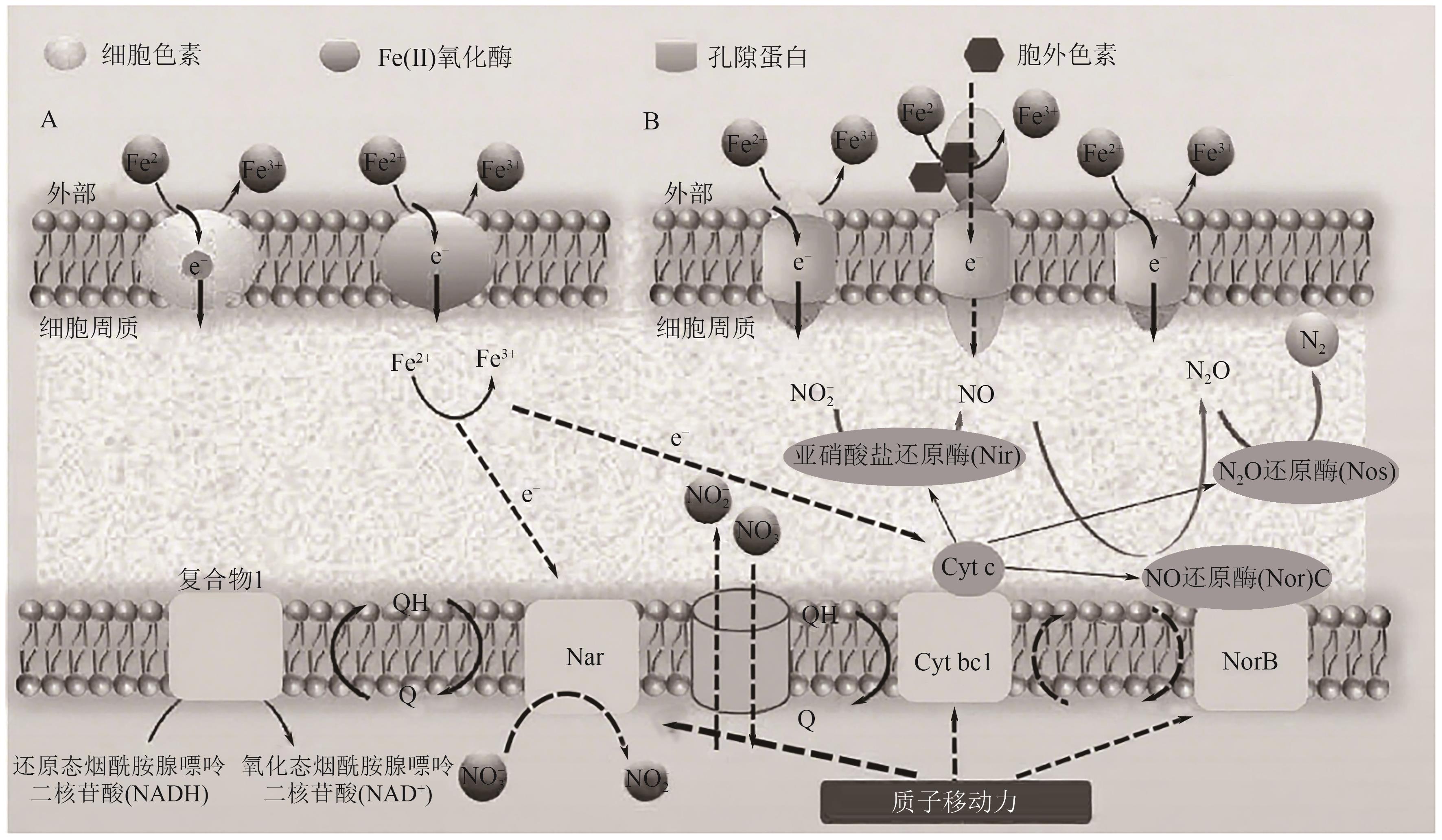
图1 电子转移机制
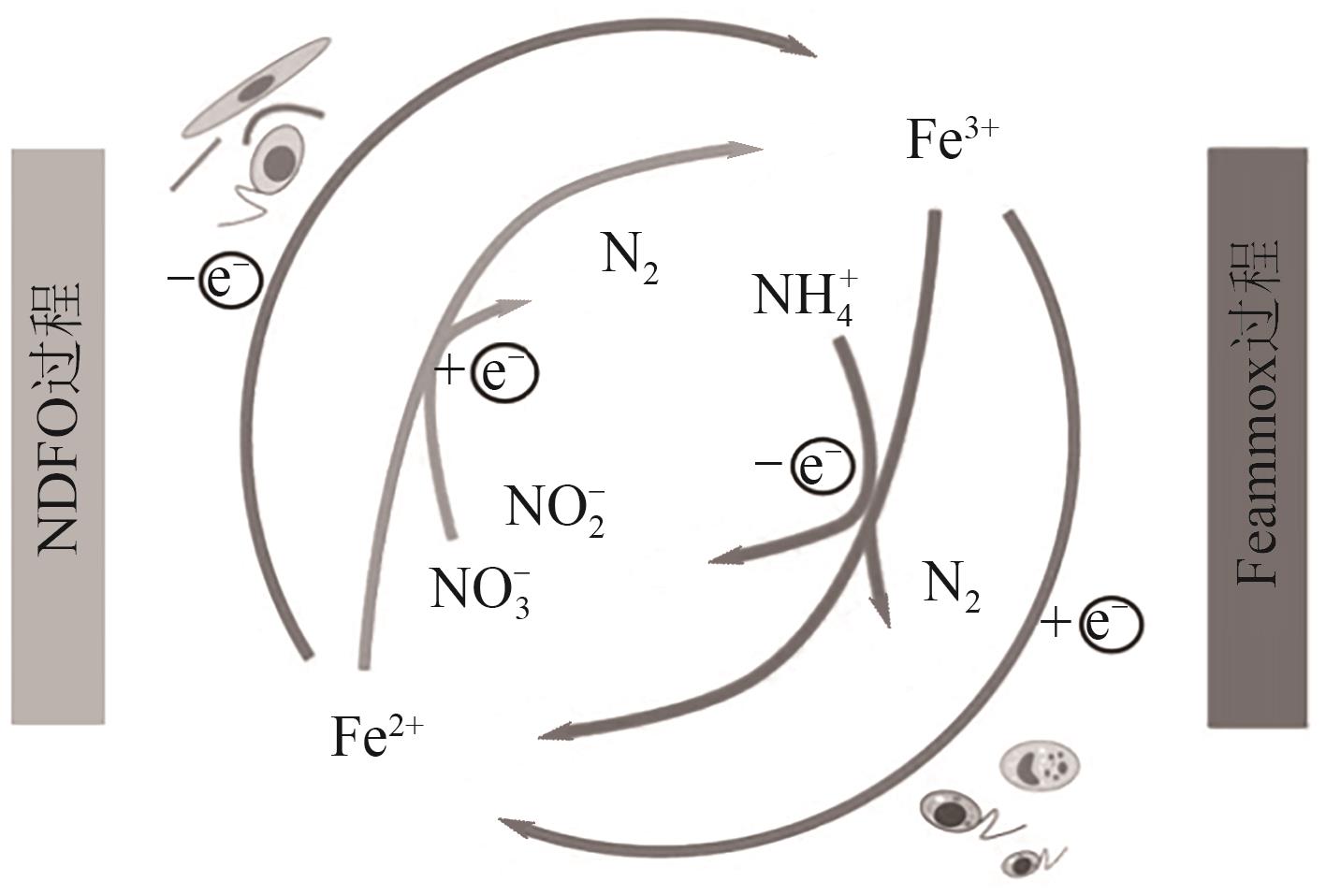
图2 Feammox与NDFO耦合电子传递机理
| 类型 | 电子受体/供体 | 产物或中间产物 | 特点 | 参考文献 |
|---|---|---|---|---|
| NDFO | Fe(Ⅱ) | N2、 | 成本低廉、处理效能高、反应产物多效,但Fe形态变化易影响效能 | [ |
| Feammox | Fe(Ⅲ) | 成本低、温室气体少,但脱氮效率不高 | [ | |
| NDFO与Feammox耦合 | Fe(Ⅱ)和Fe(Ⅲ) | N₂ | 较低的Fe需求、持续稳定脱氮,但Fe的形式和氧化还原速率、氮比例控制影响脱氮效果 | [ |
表1 不同脱氮技术之间的比较
| 类型 | 电子受体/供体 | 产物或中间产物 | 特点 | 参考文献 |
|---|---|---|---|---|
| NDFO | Fe(Ⅱ) | N2、 | 成本低廉、处理效能高、反应产物多效,但Fe形态变化易影响效能 | [ |
| Feammox | Fe(Ⅲ) | 成本低、温室气体少,但脱氮效率不高 | [ | |
| NDFO与Feammox耦合 | Fe(Ⅱ)和Fe(Ⅲ) | N₂ | 较低的Fe需求、持续稳定脱氮,但Fe的形式和氧化还原速率、氮比例控制影响脱氮效果 | [ |
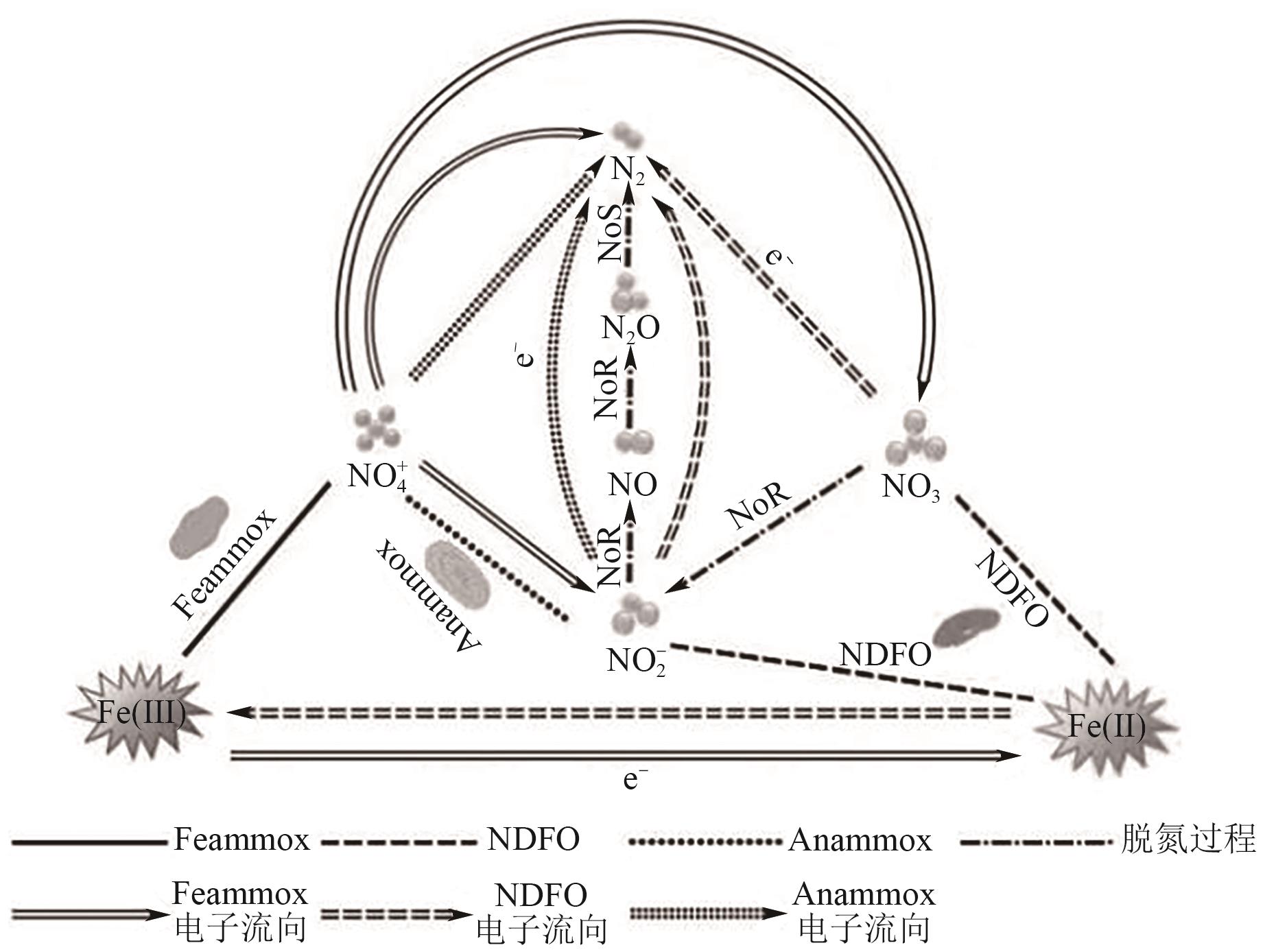
图3 Feammox、NDFO与Anammox耦合电子传递机理
| [1] | MISHRA Saurabh, SINGH Virender, CHENG Liu, et al. Nitrogen removal from wastewater: A comprehensive review of biological nitrogen removal processes, critical operation parameters and bioreactor design[J]. Journal of Environmental Chemical Engineering, 2022, 10(3): 107387. |
| [2] | HU Kaiyao, LI Wenxuan, WANG Yaning, et al. Novel biological nitrogen removal process for the treatment of wastewater with low carbon to nitrogen ratio: A review[J]. Journal of Water Process Engineering, 2023, 53: 103673. |
| [3] | LI Wenwei, YU Hanqing, RITTMANN Bruce E. Chemistry: Reuse water pollutants[J]. Nature, 2015, 528(7580): 29-31. |
| [4] | WANG Lisheng, GU Wancong, LIU Yanchen, et al. Challenges, solutions and prospects of mainstream anammox-based process for municipal wastewater treatment[J]. Science of the Total Environment, 2022, 820: 153351. |
| [5] | STRAUB K L, BENZ M, SCHINK B, et al. Anaerobic, nitrate-dependent microbial oxidation of ferrous iron[J]. Applied and Environmental Microbiology, 1996, 62(4): 1458-1460. |
| [6] | WEBER Karrie A, ACHENBACH Laurie A, COATES John D. Microorganisms pumping iron: Anaerobic microbial iron oxidation and reduction[J]. Nature Reviews Microbiology, 2006, 4(10): 752-764. |
| [7] | SI Zhihao, SONG Xinshan, WANG Yuhui, et al. Untangling the nitrate removal pathways for a constructed wetland- sponge iron coupled system and the impacts of sponge iron on a wetland ecosystem[J]. Journal of Hazardous Materials, 2020, 393: 122407. |
| [8] | HU Min, CHEN Pengcheng, SUN Weimin, et al. Physiological and genomic characterization of a nitrate-reducing Fe(Ⅱ)-oxidizing bacterium isolated from paddy soil[J]. Geomicrobiology Journal, 2019, 36(5): 433-442. |
| [9] | TIAN Tian, ZHOU Ke, XUAN Liang, et al. Exclusive microbially driven autotrophic iron-dependent denitrification in a reactor inoculated with activated sludge[J]. Water Research, 2020, 170: 115300. |
| [10] | ZHANG Liangying, SUN Haohao, ZHANG Xuxiang, et al. High diversity of potential nitrate-reducing Fe(Ⅱ)-oxidizing bacteria enriched from activated sludge[J]. Applied Microbiology and Biotechnology, 2018, 102(11): 4975-4985. |
| [11] | FENG Li, LI Jin, MA Haoran, et al. Effect of Fe(Ⅱ) on simultaneous marine anammox and Feammox treating nitrogen-laden saline wastewater under low temperature: Enhanced performance and kinetics[J]. Desalination, 2020, 478: 114287. |
| [12] | LI Xiang, HUANG Yong, LIU Hengwei, et al. Simultaneous Fe(Ⅲ) reduction and ammonia oxidation process in Anammox sludge[J]. Journal of Environmental Sciences, 2018, 64: 42-50. |
| [13] | LI Jianmin, ZENG Wei, LIU Hong, et al. Achieving deep autotrophic nitrogen removal from low strength ammonia nitrogen wastewater in aeration sponge iron biofilter: Simultaneous nitrification, Feammox, NDFO and Anammox[J]. Chemical Engineering Journal, 2023, 460: 141755. |
| [14] | LUEF Birgit, FAKRA Sirine C, CSENCSITS Roseann, et al. Iron-reducing bacteria accumulate ferric oxyhydroxide nanoparticle aggregates that may support planktonic growth[J]. The ISME Journal, 2013, 7(2): 338-350. |
| [15] | 姚海楠, 张立秋, 李淑更, 等. 厌氧铁氨氧化处理模拟垃圾渗滤液的影响因素研究[J]. 环境科学学报, 2019, 39(9): 2953-2963. |
| YAO Hainan, ZHANG Liqiu, LI Shugeng, et al. Study on the factors affecting simulated landfill leachate treatment by anaerobic ferric ammonia oxidation[J]. Acta Scientiae Circumstantiae, 2019, 39(9): 2953-2963. | |
| [16] | YANG Yafei, XIAO Cancan, YU Qing, et al. Using Fe(Ⅱ)/Fe(Ⅲ) as catalyst to drive a novel anammox process with no need of anammox bacteria[J]. Water Research, 2021, 189: 116626. |
| [17] | YANG Yafei, ZHAO Zhiqiang, ZHANG Yaobin. Anaerobic ammonium removal pathway driven by the Fe(Ⅱ)/Fe(Ⅲ) cycle through intermittent aeration[J]. Environmental Science & Technology, 2021, 55(11): 7615-7623. |
| [18] | YANG Wendy H, WEBER Karrie A, SILVER Whendee L. Nitrogen loss from soil through anaerobic ammonium oxidation coupled to iron reduction[J]. Nature Geoscience, 2012, 5(8): 538-541. |
| [19] | LI Xiang, YUAN Yan, HUANG Yong. Enhancing the nitrogen removal efficiency of a new autotrophic biological nitrogen-removal process based on the iron cycle: Feasibility, progress, and existing problems[J]. Journal of Cleaner Production, 2021, 317: 128499. |
| [20] | ZHANG Qianqian, FENG Zetong, ZHOU Jiamin, et al. Roles of Fe(Ⅱ), Fe(Ⅲ) and Fe0 in denitrification and anammox process: Mechanisms, advances and perspectives[J]. Journal of Water Process Engineering, 2023, 53: 103746. |
| [21] | LIU Hongbo, CHEN Zihua, GUAN Yongnian, et al. Role and application of iron in water treatment for nitrogen removal: A review[J]. Chemosphere, 2018, 204: 51-62. |
| [22] | 陈丹丹. 硝酸盐依赖亚铁氧化的生物和非生物过程研究[D]. 广州: 中国科学院广州地球化学研究所, 2016. |
| CHEN Dandan. The study of biotic and abiotic processes in a nitrate-dependent Fe(Ⅱ) oxidation system[D]. Guangzhou: Guangzhou Institute of Geochemistry, Chinese Academy of Sciences, 2016. | |
| [23] | ZHANG Lihong, LI Wenxuan, LI Jie, et al. A novel iron-mediated nitrogen removal technology of ammonium oxidation coupled to nitrate/nitrite reduction: Recent advances[J]. Journal of Environmental Management, 2022, 319: 115779. |
| [24] | JAMIESON James, PROMMER Henning, KAKSONEN Anna H, et al. Identifying and quantifying the intermediate processes during nitrate-dependent iron(Ⅱ) oxidation[J]. Environmental Science & Technology, 2018, 52(10): 5771-5781. |
| [25] | KLUEGLEIN N, KAPPLER A. Abiotic oxidation of Fe(Ⅱ) by reactive nitrogen species in cultures of the nitrate-reducing Fe(Ⅱ) oxidizer Acidovorax sp. BoFeN1—questioning the existence of enzymatic Fe(Ⅱ) oxidation[J]. Geobiology, 2013, 11(2): 180-190. |
| [26] | WANG Yaning, REN Shuang, WANG Peng, et al. Autotrophic denitrification using Fe(Ⅱ) as an electron donor: A novel prospective denitrification process[J]. Science of the Total Environment, 2023, 858: 159721. |
| [27] | PEDUZZI Sandro, STORELLI Nicola, WELSH Allana, et al. Candidatus “Thiodictyon syntrophicum”, sp. nov., a new purple sulfur bacterium isolated from the chemocline of Lake Cadagno forming aggregates and specific associations with Desulfocapsa sp.[J]. Systematic and Applied Microbiology, 2012, 35(3): 139-144. |
| [28] | BRYCE Casey, BLACKWELL Nia, SCHMIDT Caroline, et al. Microbial anaerobic Fe(Ⅱ) oxidation—Ecology, mechanisms and environmental implications[J]. Environmental Microbiology, 2018, 20(10): 3462-3483. |
| [29] | LIU Tongxu, CHEN Dandan, LUO Xiaobo, et al. Microbially mediated nitrate-reducing Fe(Ⅱ) oxidation: Quantification of chemodenitrification and biological reactions[J]. Geochimica et Cosmochimica Acta, 2019, 256: 97-115. |
| [30] | FINNERAN Kevin T, HOUSEWRIGHT Meghan E, LOVLEY Derek R. Multiple influences of nitrate on uranium solubility during bioremediation of uranium-contaminated subsurface sediments[J]. Environmental Microbiology, 2002, 4(9): 510-516. |
| [31] | SUN Wenjie, Reyes SIERRA-ALVAREZ, MILNER Lily, et al. Arsenite and ferrous iron oxidation linked to chemolithotrophic denitrification for the immobilization of arsenic in anoxic environments[J]. Environmental Science & Technology, 2009, 43(17): 6585-6591. |
| [32] | YANG Lili, LI Wenxuan, LIU Jie, et al. Nitrate-dependent ferrous oxidation: Feasibility, mechanism, and application prospects for wastewater treatment[J]. Journal of Water Process Engineering, 2024, 60: 105226. |
| [33] | WANG Peng, LI Wenxuan, REN Shuang, et al. Use of sponge iron as an indirect electron donor to provide ferrous iron for nitrate-dependent ferrous oxidation processes: Denitrification performance and mechanism[J]. Bioresource Technology, 2022, 357: 127318. |
| [34] | SU Junfeng, SHAO Sicheng, HUANG Tinglin, et al. Anaerobic nitrate-dependent iron(Ⅱ) oxidation by a novel autotrophic bacterium, Pseudomonas sp. SZF15[J]. Journal of Environmental Chemical Engineering, 2015, 3(3): 2187-2193. |
| [35] | ZHANG Huining, WANG Hongyu, YANG Kai, et al. Nitrate removal by a novel autotrophic denitrifier (Microbacterium sp.) using Fe(Ⅱ) as electron donor[J]. Annals of Microbiology, 2015, 65(2): 1069-1078. |
| [36] | ZHANG Meng, ZHENG Ping, ZENG Zhuo, et al. Physicochemical characteristics and microbial community of cultivated sludge for nitrate-dependent anaerobic ferrous-oxidizing (NAFO) process[J]. Separation and Purification Technology, 2016, 169: 296-303. |
| [37] | KANAPARTHI Dheeraj, CONRAD Ralf. Role of humic substances in promoting autotrophic growth in nitrate-dependent iron-oxidizing bacteria[J]. Systematic and Applied Microbiology, 2015, 38(3): 184-188. |
| [38] | ZHANG Xiaoxin, LI Ang, SZEWZYK Ulrich, et al. Improvement of biological nitrogen removal with nitrate-dependent Fe(Ⅱ) oxidation bacterium Aquabacterium parvum B6 in an up-flow bioreactor for wastewater treatment[J]. Bioresource Technology, 2016, 219: 624-631. |
| [39] | DENG Shihai, PENG Shuai, Huu Hao NGO, et al. Characterization of nitrous oxide and nitrite accumulation during iron (Fe(0))-and ferrous iron (Fe(Ⅱ))-driven autotrophic denitrification: Mechanisms, environmental impact factors and molecular microbial characterization[J]. Chemical Engineering Journal, 2022, 438: 135627. |
| [40] | WU Peng, CHEN Junjiang, GARLAPATI Vijay Kumar, et al. Novel insights into Anammox-based processes: A critical review[J]. Chemical Engineering Journal, 2022, 444: 136534. |
| [41] | 陈瑶. 铁对厌氧氨氧化菌群的作用机制与系统铁氮耦合代谢研究[D]. 北京: 北京交通大学, 2024. |
| CHEN Yao. Study on the mechanism of iron on anaerobic ammonia oxidizing bacteria and the coupling metabolism of iron and nitrogen in the system[D]. Beijing: Beijing Jiaotong University, 2024. | |
| [42] | LI Shengjie, DIAO Muhe, LIAO Yinhao, et al. Performance, microbial growth and community interactions of iron-dependent denitrification in freshwaters[J]. Environment International, 2023, 178: 108124. |
| [43] | WANG Ru, XU Shaoyi, ZHANG Meng, et al. Iron as electron donor for denitrification: The efficiency, toxicity and mechanism[J]. Ecotoxicology and Environmental Safety, 2020, 194: 110343. |
| [44] | ZHANG Xiaoxin, SZEWZYK Ulrich, MA Fang. Characterization of Aquabacterium parvum sp. strain B6 during nitrate-dependent Fe(Ⅱ) oxidation batch cultivation with various impact factors[J]. Transactions of Tianjin University, 2017, 23(4): 315-324. |
| [45] | SCHMID G, ZEITVOGEL F, HAO L, et al. 3-D analysis of bacterial cell-(iron)mineral aggregates formed during Fe(Ⅱ) oxidation by the nitrate-reducing Acidovorax sp. strain BoFeN1 using complementary microscopy tomography approaches[J]. Geobiology, 2014, 12(4): 340-361. |
| [46] | ZHANG Meng, ZHANGZHU Gucheng, WEN Shuxian, et al. Chemolithotrophic denitrification by nitrate-dependent anaerobic iron oxidizing (NAIO) process: Insights into the evaluation of seeding sludge[J]. Chemical Engineering Journal, 2018, 345: 345-352. |
| [47] | WANG Ru, YANG Cheng, WANG Wenyan, et al. An efficient way to achieve stable and high-rate ferrous ion-dependent nitrate removal (FeNiR): Batch sludge replacement[J]. Science of the Total Environment, 2020, 738: 139396. |
| [48] | WANG Yujia, FU Zicheng, SHI Chao, et al. Improvement of nitrate-dependent anaerobic ferrous oxidation by EDTA-2Na addition: An effective way for dealing with iron crusts[J]. Journal of Water Process Engineering, 2023, 53: 103813. |
| [49] | LIU Nan, LI Yingying, OUYANG Dujuan, et al. Performance and microbial community analysis of an electrobiofilm reactor enhanced by ferrous-EDTA[J]. ACS Omega, 2021, 6(28): 17766-17775. |
| [50] | WANG Ru, WANG Wenyan, LIU Mengyu, et al. Improvement of ferrous ion-dependent nitrate removal (FeNiR) process with chelating ferrous ion as substrate[J]. Journal of Environmental Management, 2020, 271: 110841. |
| [51] | DAVEREY Achlesh, CHEN Yi-Chian, SUNG Shihwu, et al. Effect of zinc on anammox activity and performance of simultaneous partial nitrification, anammox and denitrification (SNAD) process[J]. Bioresource Technology, 2014, 165: 105-110. |
| [52] | JIN Rencun, YANG Guangfeng, YU Jinjin, et al. The inhibition of the Anammox process: A review[J]. Chemical Engineering Journal, 2012, 197: 67-79. |
| [53] | WERALUPITIYA Chanusha, WANIGATUNGE Rasika, JOSEPH Sarangi, et al. Anammox bacteria in treating ammonium rich wastewater: Recent perspective and appraisal[J]. Bioresource Technology, 2021, 334: 125240. |
| [54] | MA Bin, WANG Shanyun, CAO Shenbin, et al. Biological nitrogen removal from sewage via anammox: Recent advances[J]. Bioresource Technology, 2016, 200: 981-990. |
| [55] | FENG Yan, WANG Shuying, PENG Yongzhen. Stable nitrogen removal in the novel continuous flow anammox system under deteriorated partial nitrification: Significance and superiority of the anaerobic-oxic-anoxic-oxic operation mode[J]. Bioresource Technology, 2022, 361: 127693. |
| [56] | LI Jin, FENG Li, BISWAL Basanta Kumar, et al. Bioaugmentation of marine anammox bacteria (MAB)-based anaerobic ammonia oxidation by adding Fe(Ⅲ) in saline wastewater treatment under low temperature[J]. Bioresource Technology, 2020, 295: 122292. |
| [57] | SAWAYAMA Shigeki. Possibility of anoxic ferric ammonium oxidation[J]. Journal of Bioscience and Bioengineering, 2006, 101(1): 70-72. |
| [58] | XIA Qing, AI Ziyin, HUANG Wenli, et al. Recent progress in applications of Feammox technology for nitrogen removal from wastewaters: A review[J]. Bioresource Technology, 2022, 362: 127868. |
| [59] | SHRESTHA Junu, RICH Jeremy J, EHRENFELD Joan G, et al. Oxidation of ammonium to nitrite under iron-reducing conditions in wetland soils: Laboratory, field demonstrations, and push-pull rate determination[J]. Soil Science, 2009, 174(3): 156-164. |
| [60] | 胡凯耀, 王亚娥, 李杰, 等. 铁氨氧化研究进展及在污水脱氮中的应用探索[J]. 环境化学, 2023, 42(1): 264-276. |
| HU Kaiyao, WANG Yae, LI Jie, et al. Research progress of Feammox and its application in wastewater denitrification[J]. Environmental Chemistry, 2023, 42(1): 264-276. | |
| [61] | 杨莉莉, 李文譞, 彭钰卓, 等. 铁氨氧化技术在废水脱氮中的应用研究进展[J]. 中国环境科学, 2023, 43(6): 2948-2959. |
| YANG Lili, LI Wenxuan, PENG Yuzhuo, et al. Research progress on the application of Feammox for nitrogen removal from wastewaters[J]. China Environmental Science, 2023, 43(6): 2948-2959. | |
| [62] | HUANG Shan, JAFFÉ Peter R. Isolation and characterization of an ammonium-oxidizing iron reducer: Acidimicrobiaceae sp. A6[J]. PLoS One, 2018, 13(4): e0194007. |
| [63] | REN Yi, HAO NGO Huu, GUO Wenshan, et al. New perspectives on microbial communities and biological nitrogen removal processes in wastewater treatment systems[J]. Bioresource Technology, 2020, 297: 122491. |
| [64] | GE Jinyi, HUANG Shan, HAN Il, et al. Degradation of tetra- and trichloroethylene under iron reducing conditions by Acidimicrobiaceae sp. A6[J]. Environmental Pollution, 2019, 247: 248-255. |
| [65] | YANG Yafei, PENG Hong, NIU Junfeng, et al. Promoting nitrogen removal during Fe(Ⅲ) reduction coupled to anaerobic ammonium oxidation (Feammox) by adding anthraquinone-2,6-disulfonate (AQDS)[J]. Environmental Pollution, 2019, 247: 973-979. |
| [66] | SUN Shanshan, ZHANG Manping, GU Xushun, et al. New insight and enhancement mechanisms for Feammox process by electron shuttles in wastewater treatment—A systematic review[J]. Bioresource Technology, 2023, 369: 128495. |
| [67] | WANG Zhenxin, WANG Xuepeng, SUN Ye, et al. Fe(OH)3 induced the Anammox system to perform extracellular electron transfer for enhancement of NH 4 + removal[J]. Chemical Engineering Journal, 2023, 460: 141768. |
| [68] | 罗珺月, 冯杰, 罗阳, 等. 微生物厌氧氨氧化耦合铁还原的研究进展及展望[J]. 微生物学报, 2023, 63(6): 2031-2046. |
| LUO Junyue, FENG Jie, LUO Yang, et al. Research progress and prospect of microbial ammonium oxidation coupled to Fe(Ⅲ) reduction[J]. Acta Microbiologica Sinica, 2023, 63(6): 2031-2046. | |
| [69] | WAN Liuyang, LIU Hong, WANG Xingzu. Anaerobic ammonium oxidation coupled to Fe(Ⅲ) reduction: Discovery, mechanism and application prospects in wastewater treatment[J]. Science of the Total Environment, 2022, 818: 151687. |
| [70] | PARK Wooshin, Youn-Ku NAM, LEE Myun-Joo, et al. Anaerobic ammonia-oxidation coupled with Fe3+ reduction by an anaerobic culture from a piggery wastewater acclimated to NH 4 + /Fe3+ medium[J]. Biotechnology and Bioprocess Engineering, 2009, 14(5): 680-685. |
| [71] | ZHOU Guowei, YANG Xiaoru, LI Hu, et al. Electron shuttles enhance anaerobic ammonium oxidation coupled to iron(Ⅲ) reduction[J]. Environmental Science & Technology, 2016, 50(17): 9298-9307. |
| [72] | KAPPLER Andreas, BENZ Marcus, SCHINK Bernhard, et al. Electron shuttling via humic acids in microbial iron(Ⅲ) reduction in a freshwater sediment[J]. FEMS Microbiology Ecology, 2004, 47(1): 85-92. |
| [73] | LI F B, LI X M, ZHOU S G, et al. Enhanced reductive dechlorination of DDT in an anaerobic system of dissimilatory iron-reducing bacteria and iron oxide[J]. Environmental Pollution, 2010, 158(5): 1733-1740. |
| [74] | ZHU Tingting, ZHANG Yaobin, LIU Yiwen, et al. Electrostimulation enhanced ammonium removal during Fe(Ⅲ) reduction coupled with anaerobic ammonium oxidation (Feammox) process[J]. Science of the Total Environment, 2021, 751: 141703. |
| [75] | CAO Jie, LI Ning, JIANG Jin, et al. Activated carbon as an insoluble electron shuttle to enhance the anaerobic ammonium oxidation coupled with Fe(Ⅲ) reduction process[J]. Environmental Research, 2022, 204: 111972. |
| [76] | Macarena GONZÁLEZ, Ámbar CERDA, Carolina RODRÍGUEZ, et al. Coupling of the Feammox-Anammox pathways by using a sequential discontinuous bioreactor[J]. Bioresource Technology, 2024, 395: 130334. |
| [77] | 张莉红. 基于生物铁泥的厌氧NH 4 + -N氧化耦合NO x - -N还原脱氮研究[D]. 兰州: 兰州交通大学, 2023. |
| ZHANG Lihong. Study on denitrification by anaerobic NH 4 + -N oxidation coupled with NO x - -N based on biological iron sludge[D]. Lanzhou: Lanzhou Jiatong University, 2023. | |
| [78] | WANG Wei, DING Bangjing, HU Youyou, et al. Evidence for the occurrence of Feammox coupled with nitrate-dependent Fe(Ⅱ) oxidation in natural enrichment cultures[J]. Chemosphere, 2022, 303: 134903. |
| [79] | LI Jianmin, ZENG Wei, LIU Hong, et al. Achieving deep autotrophic nitrogen removal in aerated biofilter driven by sponge iron: Performance and mechanism[J]. Environmental Research, 2022, 213: 113653. |
| [80] | 于妍, 刘宁, 廖祖刚, 等. 铁型反硝化脱氮技术研究进展[J]. 中国环境科学, 2022, 42(1): 83-91. |
| YU Yan, LIU Ning, LIAO Zugang, et al. Research progress of iron-type denitrification removal technology[J]. China Environmental Science, 2022, 42(1): 83-91. | |
| [81] | SHU Duntao, HE Yanling, YUE Hong, et al. Metagenomic and quantitative insights into microbial communities and functional genes of nitrogen and iron cycling in twelve wastewater treatment systems[J]. Chemical Engineering Journal, 2016, 290: 21-30. |
| [82] | SHUAI Weitao, JAFFÉ Peter R. Anaerobic ammonium oxidation coupled to iron reduction in constructed wetland mesocosms[J]. Science of the Total Environment, 2019, 648: 984-992. |
| [83] | LI Xiang, YUAN Yan, HUANG Yong, et al. A novel method of simultaneous NH 4 + and NO 3 - removal using Fe cycling as a catalyst: Feammox coupled with NAFO[J]. Science of the Total Environment, 2018, 631/632: 153-157. |
| [84] | YANG Yafei, XIAO Cancan, LU Jianhui, et al. Fe(Ⅲ)/Fe(Ⅱ) forwarding a new anammox-like process to remove high-concentration ammonium using nitrate as terminal electron acceptor[J]. Water Research, 2020, 172: 115528. |
| [85] | WANG Wei, HU Youyou, QI Xin, et al. Endogenous mechanism of microbial functional gene and exogenous nitrogen removal factors driven by sustainable iron-nitrogen cycling[J]. Journal of Cleaner Production, 2023, 391: 136043. |
| [86] | Chengkun KAO, ZHANG Qiong, LI Jianwei, et al. Simultaneous nitrogen and phosphorus removal from municipal wastewater by Fe(Ⅲ)/Fe(Ⅱ) cycling mediated partial-denitrification/anammox[J]. Bioresource Technology, 2022, 363: 127997. |
| [87] | HAO Xiaojing, ZENG Wei, LI Jianmin, et al. High-efficient nitrogen removal with low demand of Fe source and mechanism analysis driven by Fe(Ⅱ)/Fe(Ⅲ) cycle[J]. Chemical Engineering Journal, 2024, 481: 148702. |
| [88] | JI Luomiao, ZHANG Xiaonong, ZHU Xurui, et al. Novel insights into Feammox coupled with the NDFO: A critical review[J]. Science of the Total Environment, 2024, 951: 175721. |
| [89] | 薛佳慧, 李彦宇, 邱旭, 等. 硝酸盐依赖性亚铁氧化脱氮技术研究进展[J]. 中国环境科学, 2024, 44(12): 6668-6680. |
| XUE Jiahui, LI Yanyu, QIU Xu, et al. Research progress of nitrate-dependent ferrous oxidation denitrification technology[J]. China Environmental Science, 2024, 44(12): 6668-6680. | |
| [90] | 胡劲涛, 信欣. 电化学系统内Feammox/NDFO耦合工艺脱氮效能和机理[J]. 中国环境科学, 2024, 44(9): 4958-4967. |
| HU Jintao, XIN Xin. Nitrogen removal efficiency and mechanism of Feammox/NDFO coupling process in electrochemical system[J]. China Environmental Science, 2024, 44(9): 4958-4967. | |
| [91] | DING Jing, SEOW Wanyi, ZHOU Jizhong, et al. Effects of Fe(Ⅱ) on anammox community activity and physiologic response[J]. Frontiers of Environmental Science & Engineering, 2020, 15(1): 7. |
| [92] | SHU Duntao, HE Yanling, YUE Hong, et al. Effects of Fe(Ⅱ) on microbial communities, nitrogen transformation pathways and iron cycling in the anammox process: Kinetics, quantitative molecular mechanism and metagenomic analysis[J]. RSC Advances, 2016, 6(72): 68005-68016. |
| [93] | ZHANG Miao, GUAN Zhongkuo, LI Biao, et al. Denitrification enhancement, kinetic simulation and microbial assessment in the sponge iron-mediated anammox process: A method for low-strength nitrogen wastewater treatment[J]. Journal of Water Process Engineering, 2025, 72: 107550. |
| [94] | XIE Fei, MA Xiao, ZHAO Bowei, et al. Promoting the nitrogen removal of anammox process by Fe-C micro-electrolysis[J]. Bioresource Technology, 2020, 297: 122429. |
| [95] | YAO Zongbao, WANG Fang, WANG Chunliu, et al. Anaerobic ammonium oxidation coupled to ferric iron reduction in the sediment of a eutrophic lake[J]. Environmental Science and Pollution Research, 2019, 26(15): 15084-15094. |
| [96] | BENNETT B D, GRALNICK J A. Mechanisms of toxicity by and resistance to ferrous iron in anaerobic systems[J]. Free Radical Biology and Medicine, 2019, 140: 167-171. |
| [97] | LI Zhixing, PENG Yongzhen, GAO Haijing. A novel strategy for accelerating the recovery of a Fe(Ⅱ)-inhibited anammox reactor by intermittent addition of betaine: Performance, kinetics and statistical analysis[J]. Chemosphere, 2020, 251: 126362. |
| [98] | KAMPSCHREUR Marlies J, KLEEREBEZEM Robbert, DE VET Weren W J M, et al. Reduced iron induced nitric oxide and nitrous oxide emission[J]. Water Research, 2011, 45(18): 5945-5952. |
| [99] | Nicole WRAGE-MÖNNIG, HORN Marcus A, WELL Reinhard, et al. The role of nitrifier denitrification in the production of nitrous oxide revisited[J]. Soil Biology and Biochemistry, 2018, 123: A3-A16. |
| [1] | 雷雪艳, 朱易春, 张超, 郝宛婷, 陈仔龙, 宋贤威, 黄书昌, 董姗燕. 零价铁耦合厌氧氨氧化系统高效同步脱氮除磷[J]. 化工进展, 2025, 44(6): 3132-3143. |
| [2] | 高峰, 王重阳, 高升, 张雅泓, 陈涛, 年正. Anammox系统的氧化亚氮产生途径及调控[J]. 化工进展, 2025, 44(6): 3579-3591. |
| [3] | 何子晗, 李文譞, 李彦宇, 王雪超, 杨始蓉, 谢慧娜, 李杰. 水环境中抗生素抗性基因研究进展[J]. 化工进展, 2024, 43(S1): 533-544. |
| [4] | 孙燕, 谢晓阳, 冯倩颖, 郑璐, 何皎洁, 杨利伟, 白波. 基于单宁酸-铁(Ⅲ)改性正渗透膜制备及抗污染性能[J]. 化工进展, 2024, 43(9): 5309-5319. |
| [5] | 赵星程, 贾方旭, 刘晨雨, 韩宝红, 梅宁, 姚宏. 实际规模PN/A工艺载体挂膜性能与微生物群落[J]. 化工进展, 2024, 43(9): 5242-5249. |
| [6] | 海岩, 周鑫, 李艳. 单级固定床生物膜反应器主流厌氧氨氧化快速启动性能[J]. 化工进展, 2024, 43(4): 2201-2209. |
| [7] | 赵瑞强, 周鑫, 牛冰心. 废水处理硝酸盐异化还原与厌氧氨氧化/反硝化耦合工艺构建[J]. 化工进展, 2024, 43(3): 1593-1605. |
| [8] | 杨杰源, 朱易春, 赖雅芬, 张超, 田帅, 谢颖. 低强度超声波对高负荷厌氧氨氧化EGSB反应器运行性能的影响[J]. 化工进展, 2024, 43(2): 1098-1108. |
| [9] | 王莹, 韩云平, 李琳, 李衍博, 李慧丽, 颜昌仁, 李彩侠. 城市污水厂病毒气溶胶逸散特征研究现状与未来展望[J]. 化工进展, 2023, 42(S1): 439-446. |
| [10] | 史天茜, 石永辉, 武新颖, 张益豪, 秦哲, 赵春霞, 路达. Fe2+对厌氧氨氧化EGSB反应器运行性能的影响[J]. 化工进展, 2023, 42(9): 5003-5010. |
| [11] | 李白雪, 信欣, 朱羽蒙, 刘琴, 刘鑫. SASD-A体系构建及进水不同S/N对脱氮工艺的影响机制[J]. 化工进展, 2023, 42(6): 3261-3271. |
| [12] | 李华华, 李逸航, 金北辰, 李隆昕, 成少安. 厌氧氨氧化-生物电化学耦合废水处理系统的研究进展[J]. 化工进展, 2023, 42(5): 2678-2690. |
| [13] | 朱紫旋, 陈俊江, 张星星, 李祥, 刘文如, 吴鹏. 基于短程反硝化厌氧氨氧化新型污水生物脱氮工艺的研究进展[J]. 化工进展, 2023, 42(4): 2091-2100. |
| [14] | 赵星程, 贾方旭, 蒋伟彧, 陈佳熠, 刘晨雨, 姚宏. 氧化还原介体介导厌氧氨氧化生物脱氮的研究进展[J]. 化工进展, 2023, 42(3): 1606-1617. |
| [15] | 张涵, 张肖静, 马冰冰, 佴灿, 刘烁烁, 马永鹏, 宋亚丽. 以城市废弃污泥为种泥启动厌氧氨氧化工艺的可行性[J]. 化工进展, 2023, 42(2): 1080-1088. |
| 阅读次数 | ||||||
|
全文 |
|
|||||
|
摘要 |
|
|||||