化工进展 ›› 2025, Vol. 44 ›› Issue (4): 2202-2214.DOI: 10.16085/j.issn.1000-6613.2024-0495
TiO2纳米颗粒烧结机制分子动力学模拟
戴月明( ), 周梅芳, 沈建华, 姜海波(), 李春忠
- 华东理工大学材料科学与工程学院,超细材料制备与应用教育部重点实验室,上海 200237
-
收稿日期:2024-03-25修回日期:2024-06-03出版日期:2025-04-25发布日期:2025-05-07 -
通讯作者:姜海波 -
作者简介:戴月明(1999—),女,硕士研究生,研究方向为二氧化钛的分子动力学模拟。E-mail:y82210242@mail.ecust.edu.cn。 -
基金资助:国家自然科学基金(22178106)
Molecular dynamics simulation of sintering mechanism of TiO2 nanoparticles
DAI Yueming(), ZHOU Meifang, SHEN Jianhua, JIANG Haibo(), LI Chunzhong
- The Key Laboratory for Ultrafine Materials of the Ministry of Education, College of Materials Science and Engineering, East China University of Science and Technology, Shanghai 200237, China
-
Received:2024-03-25Revised:2024-06-03Online:2025-04-25Published:2025-05-07 -
Contact:JIANG Haibo

摘要:
氯化钛白是化工、储能等领域重要的无机原料,其性能受到烧结热处理等多因素控制。传统实验手段难以准确量化烧结过程,而分子动力学模拟能从原子尺度准确评估烧结的动态演化过程,但现有研究对诸如温度、粒度、排列方式等因素的机理阐释比较单一局限。本文引入非等径多颗粒模型、烧结颈尺寸、Lindemann指数和表观活化能等有效表征参数,通过分子动力学模拟系统研究了温度、粒度及排列方式对TiO2纳米颗粒的烧结行为的影响。结果表明,升高温度有利于激发剧烈的原子迁移扩散,加速烧结体的致密化进程。温度相同时,较小粒径的TiO2纳米颗粒烧结速率更快,但易被较大粒径颗粒吸收融合。此外,颗粒排列方式也会影响烧结行为,堆垛排列比线性排列有更明显的烧结优势。烧结初期主要通过表面扩散生长,而后期通过晶界扩散致密化。研究结果对优化工业烧结参数、制备高性能纳米材料具有指导意义。
中图分类号:
引用本文
戴月明, 周梅芳, 沈建华, 姜海波, 李春忠. TiO2纳米颗粒烧结机制分子动力学模拟[J]. 化工进展, 2025, 44(4): 2202-2214.
DAI Yueming, ZHOU Meifang, SHEN Jianhua, JIANG Haibo, LI Chunzhong. Molecular dynamics simulation of sintering mechanism of TiO2 nanoparticles[J]. Chemical Industry and Engineering Progress, 2025, 44(4): 2202-2214.
| 相互作用 | Aij /kcal·mol-1 | Cij /kcal·mol-1 ·Å-6 | |
|---|---|---|---|
| Ti-Ti | 717654 | 0.154 | 120.997 |
| Ti-O | 391053 | 0.194 | 290.392 |
| O-O | 271719 | 0.234 | 696.941 |
表1 MA势相互作用参数
| 相互作用 | Aij /kcal·mol-1 | Cij /kcal·mol-1 ·Å-6 | |
|---|---|---|---|
| Ti-Ti | 717654 | 0.154 | 120.997 |
| Ti-O | 391053 | 0.194 | 290.392 |
| O-O | 271719 | 0.234 | 696.941 |
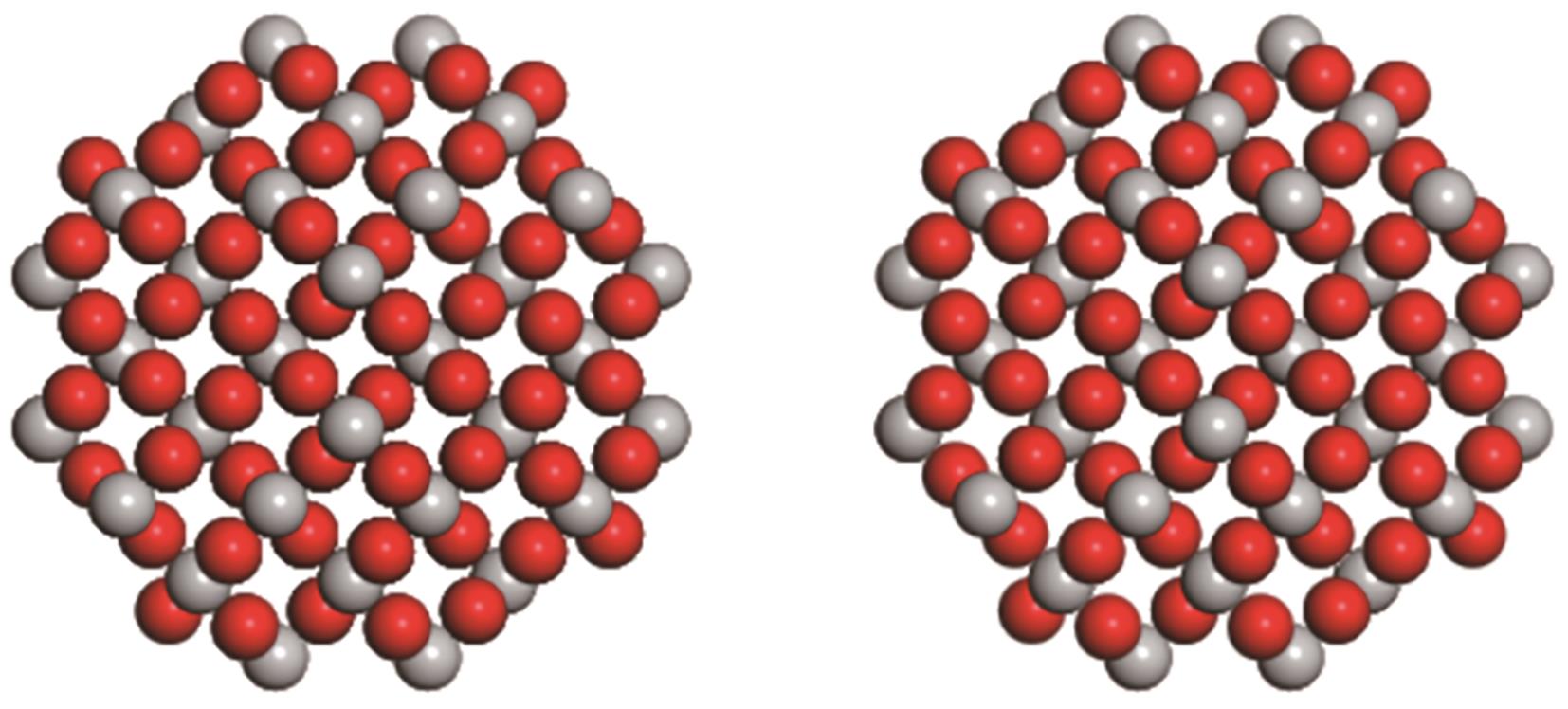
图1 粒径为2nm的金红石型TiO2团簇结构
| 模拟编号 | 颗粒数 | 粒径/nm | 温度/K | 排列方式 | 原子数 |
|---|---|---|---|---|---|
| 1~5 | 2 | 2-2 | 800、1200、1500、 1800、2000 | 线性 | 804 |
| 6 | 2 | 2-6 | 2000 | 线性 | 11307 |
| 7 | 2 | 6-6 | 2000 | 线性 | 21810 |
| 8 | 3 | 2-2-2 | 1800 | 线性 | 1206 |
| 9 | 3 | 2-2-2 | 1800 | 堆垛 | 1206 |
表2 模型初始结构参数配置
| 模拟编号 | 颗粒数 | 粒径/nm | 温度/K | 排列方式 | 原子数 |
|---|---|---|---|---|---|
| 1~5 | 2 | 2-2 | 800、1200、1500、 1800、2000 | 线性 | 804 |
| 6 | 2 | 2-6 | 2000 | 线性 | 11307 |
| 7 | 2 | 6-6 | 2000 | 线性 | 21810 |
| 8 | 3 | 2-2-2 | 1800 | 线性 | 1206 |
| 9 | 3 | 2-2-2 | 1800 | 堆垛 | 1206 |
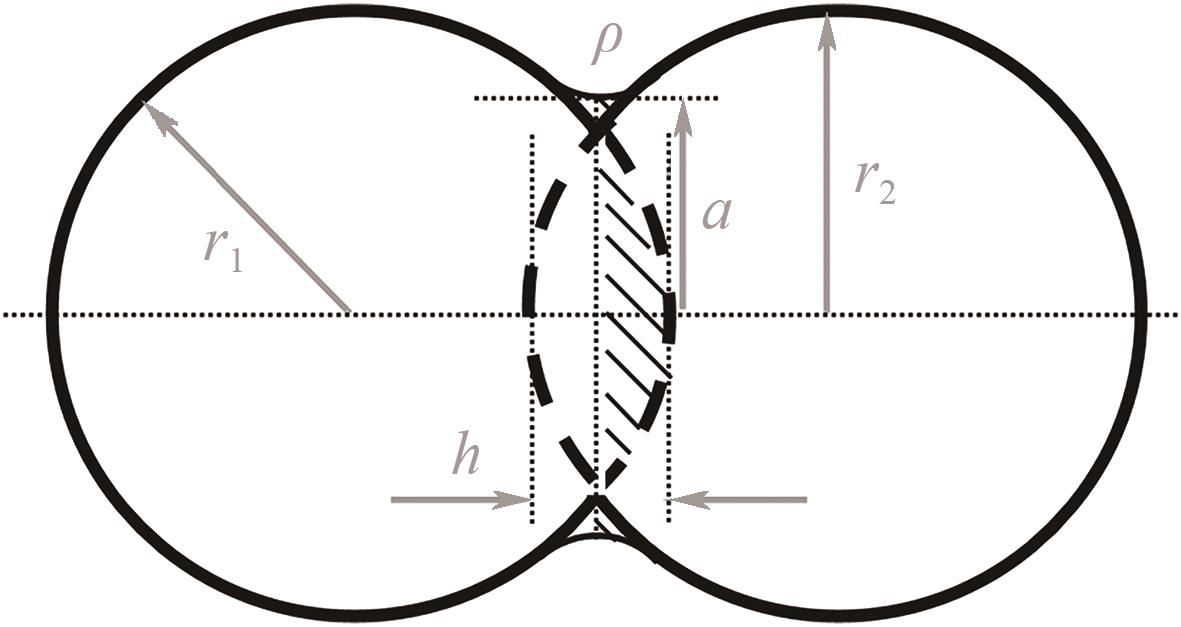
图2 Coble双颗粒烧结模型[42]
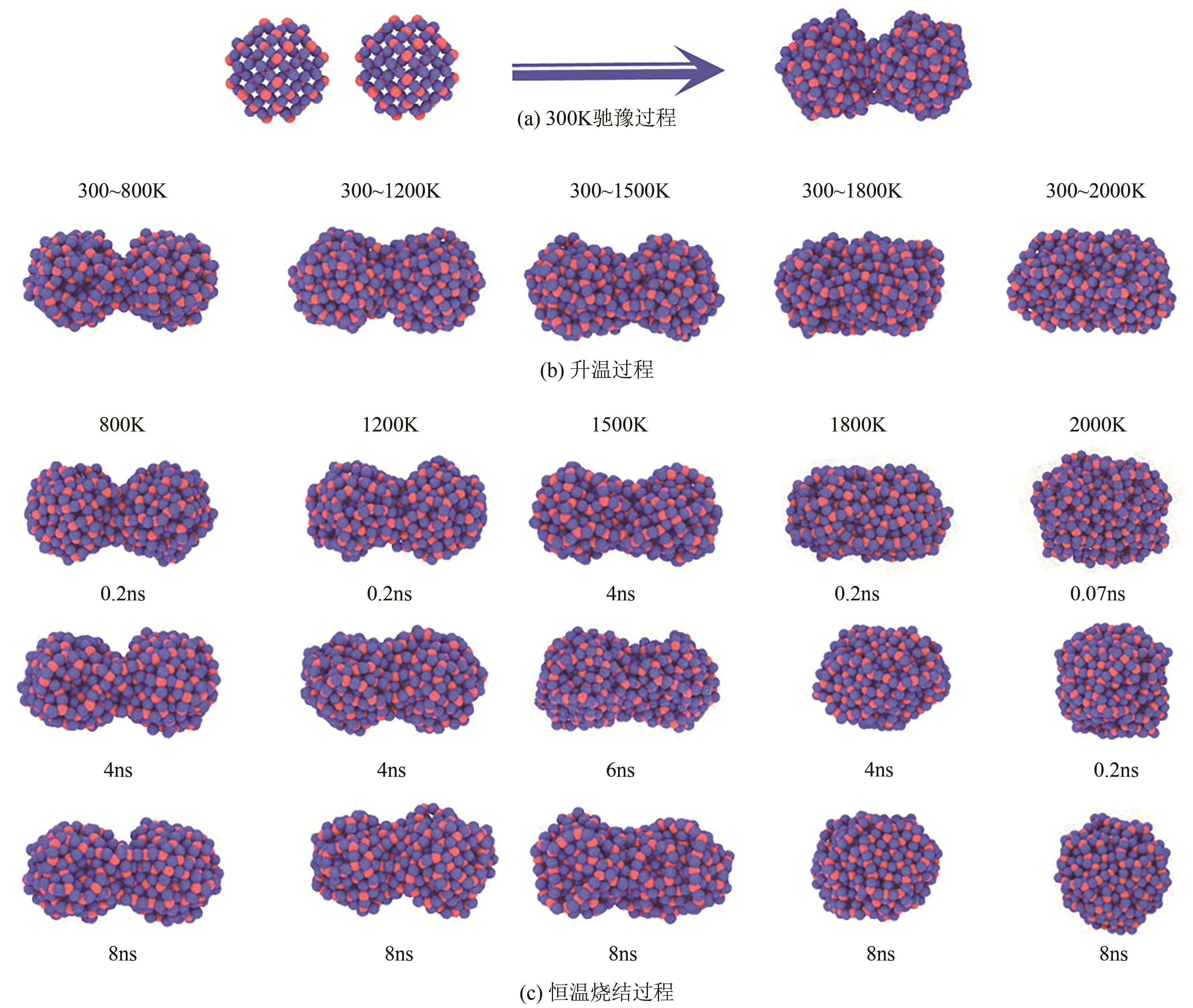
图3 不同烧结温度原子运动示意图
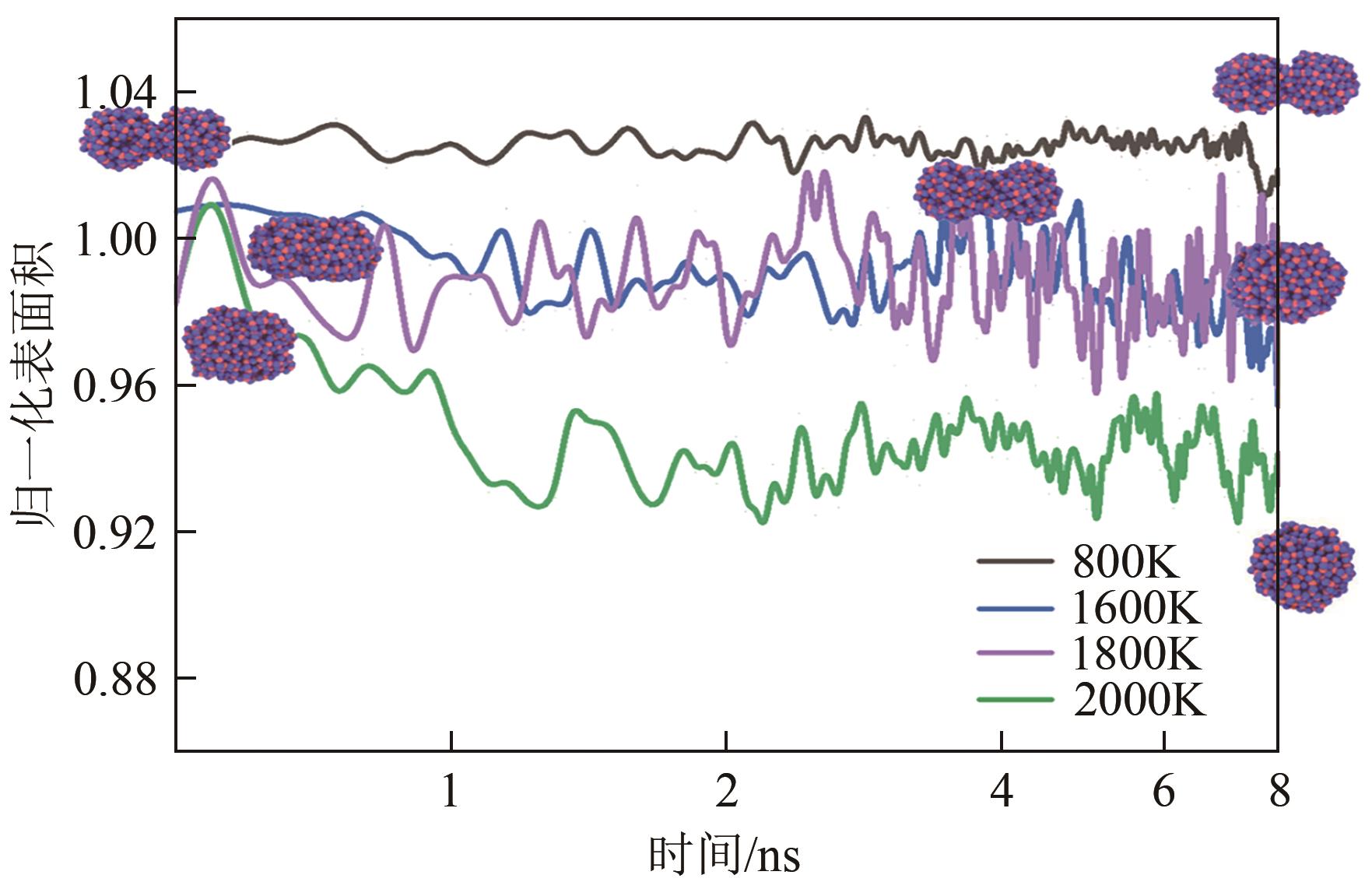
图4 TiO2纳米颗粒烧结过程归一化表面积的演变

图5 温度、系统势能、收缩率及烧结颈尺寸随时间的变化
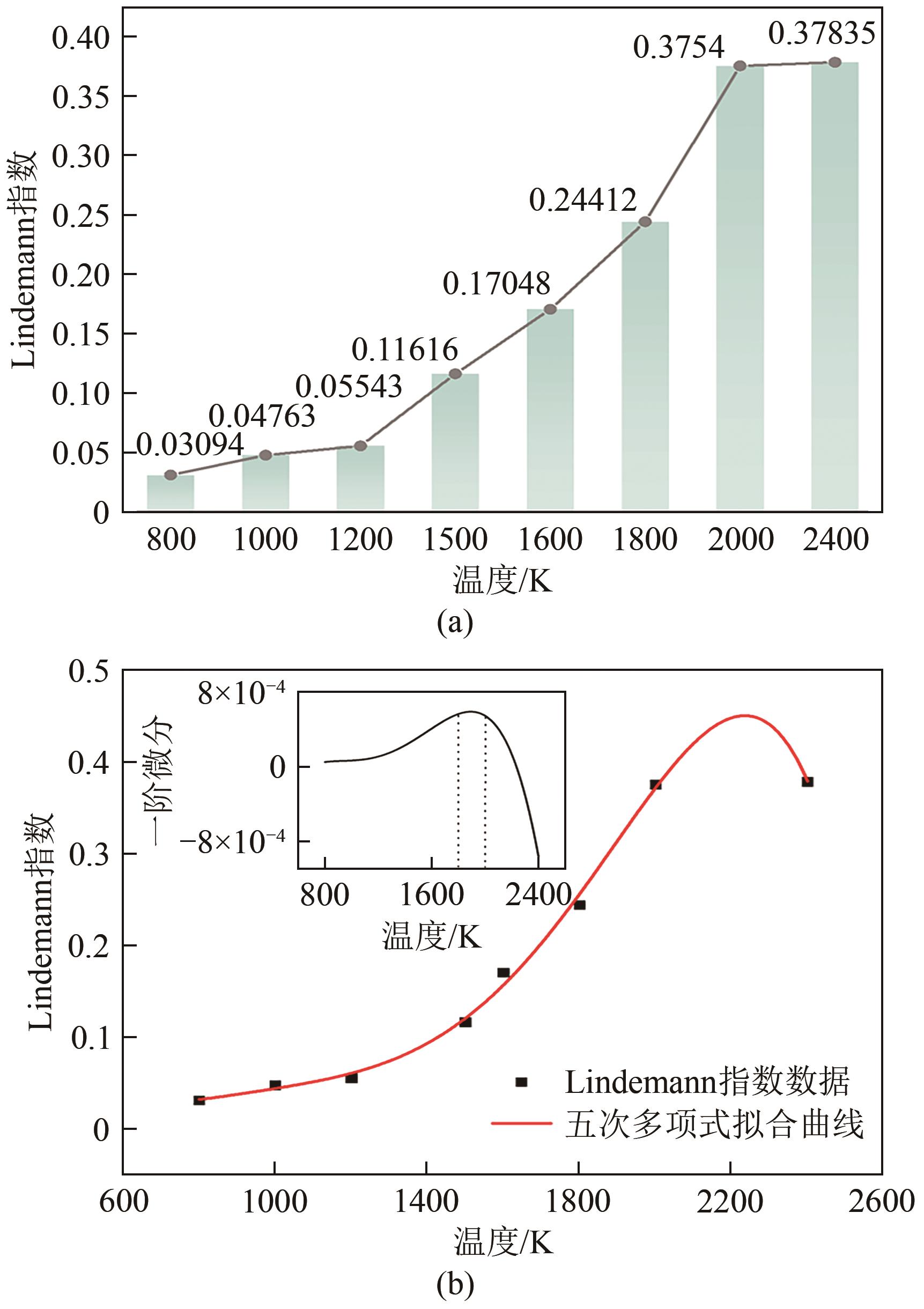
图6 Lindemann指数随温度的演变
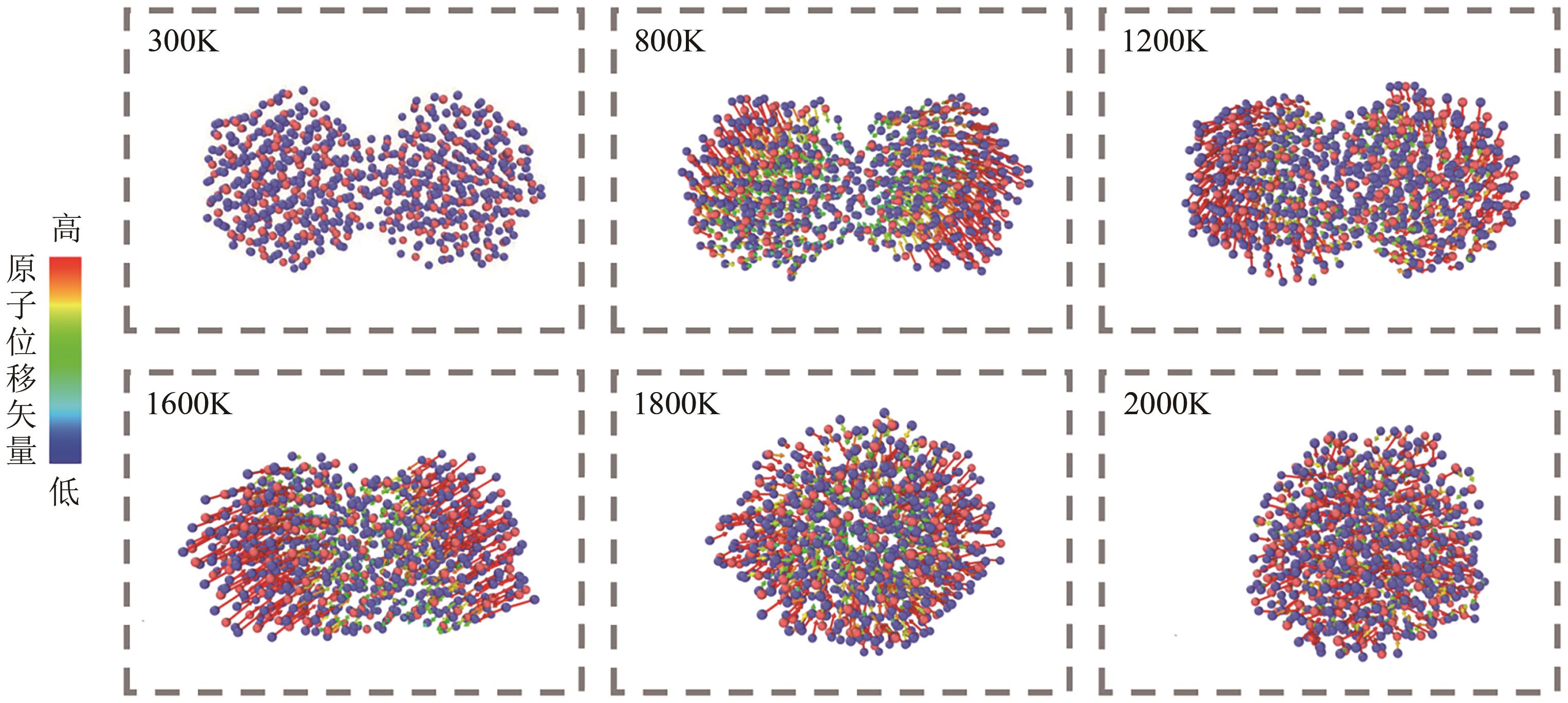
图7 原子位移矢量云图
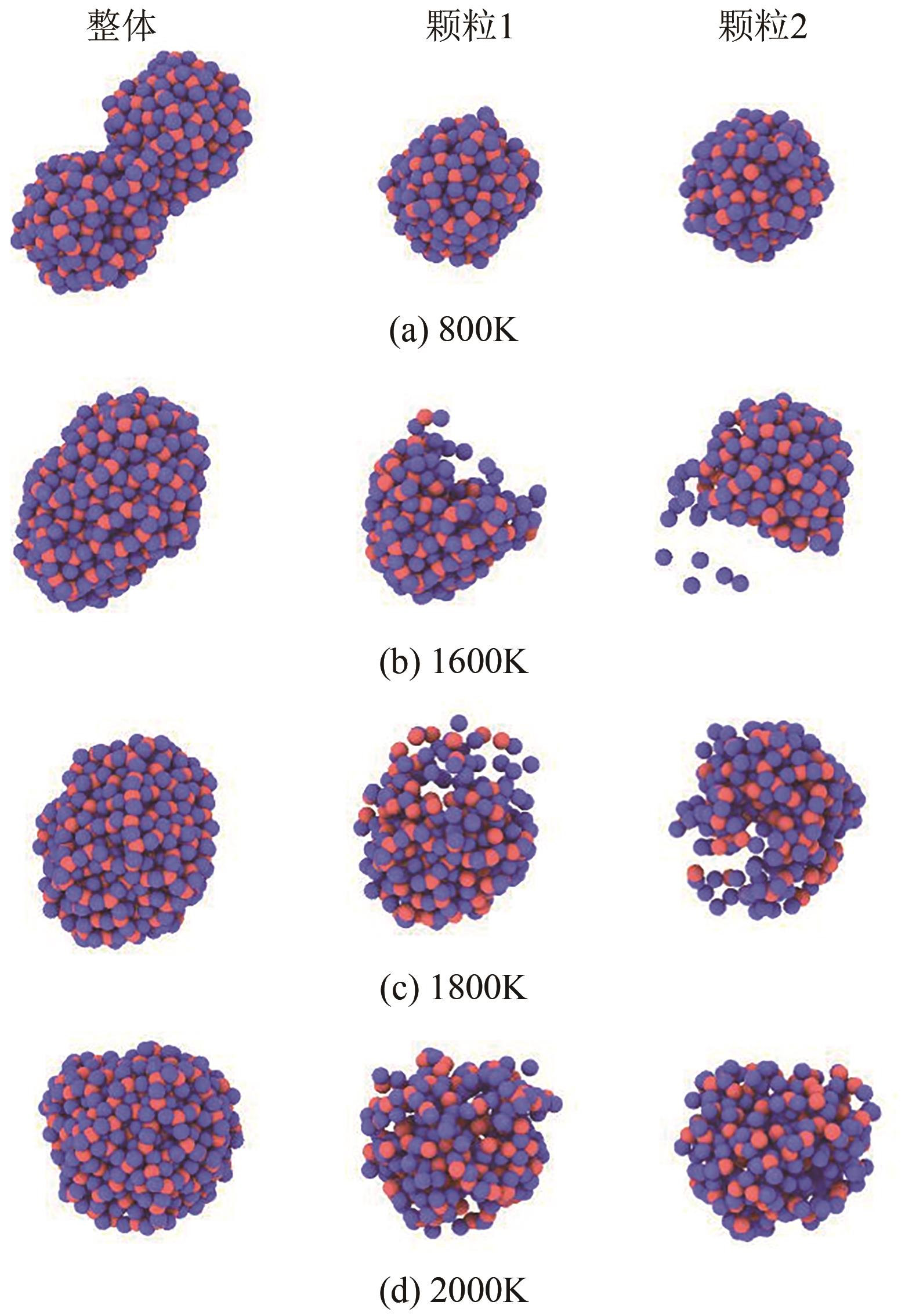
图8 不同温度下两颗粒的融合行为
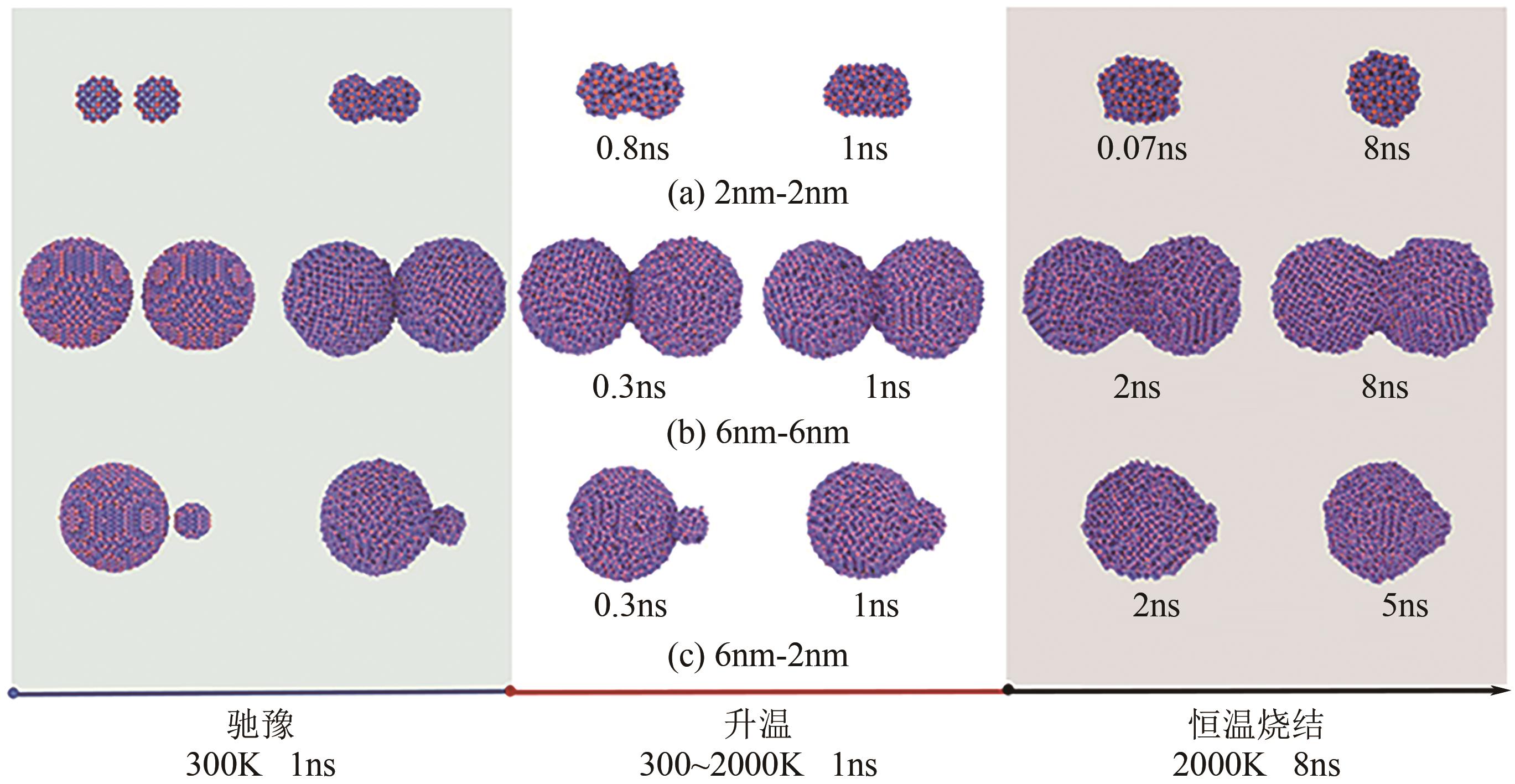
图9 不同粒径比的烧结过程
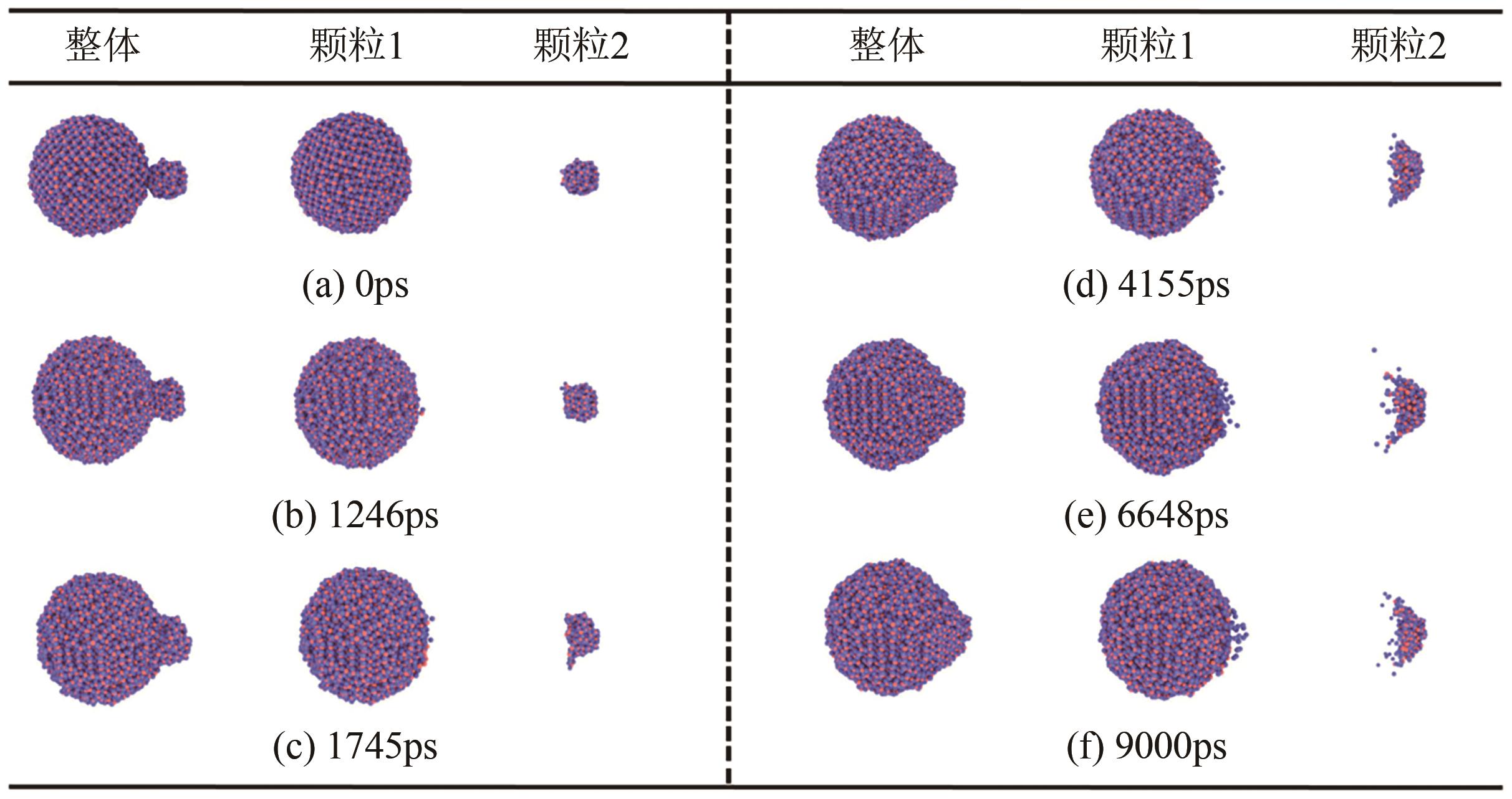
图10 非等径双颗粒的融合行为
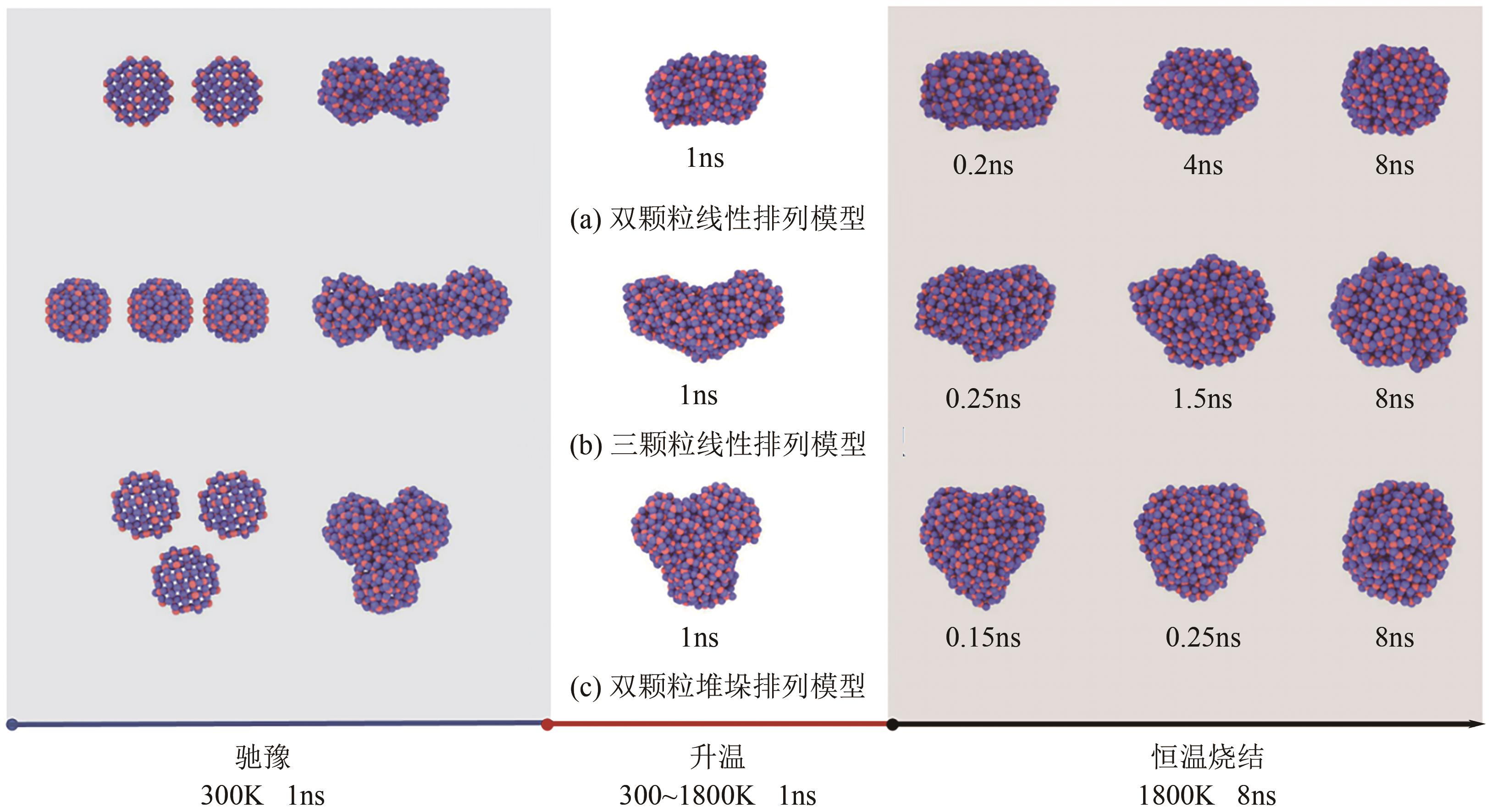
图11 不同颗粒排列方式的烧结过程
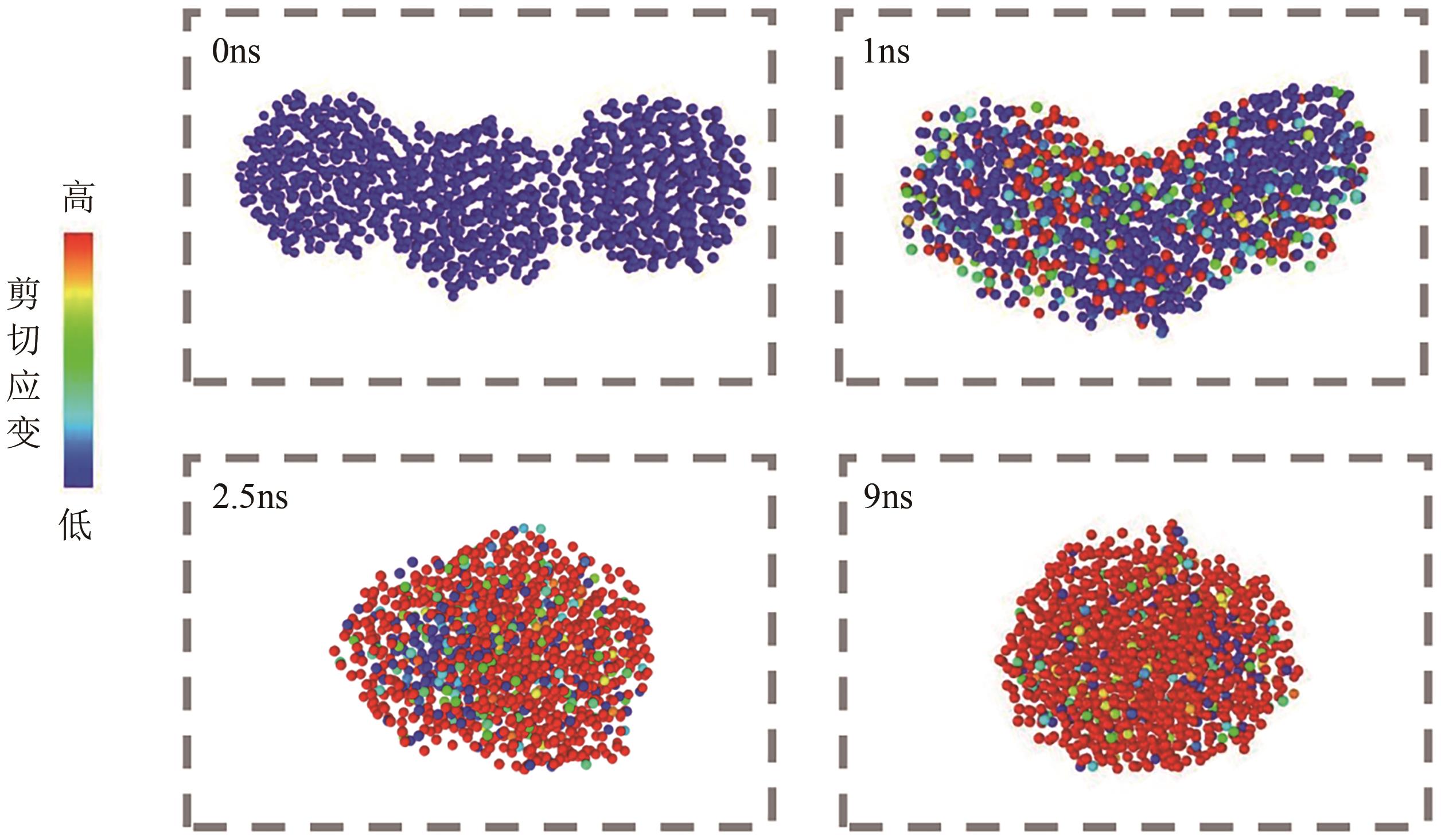
图12 线性排列三颗粒模型的烧结过程剪切应变
| 烧结机理 | Q/kJ·mol-1 | |
|---|---|---|
| 0~0.83ns | 0.83~8ns | |
| 黏性流动 | 19.887 | 32.726 |
| 蒸发与凝聚 | 26.627 | 41.561 |
| 体积扩散 | 40.244 | 59.233 |
| 晶界扩散 | 46.244 | 68.357 |
| 表面扩散 | 53.228 | 77.126 |
表4 各烧结模型的活化能
| 烧结机理 | Q/kJ·mol-1 | |
|---|---|---|
| 0~0.83ns | 0.83~8ns | |
| 黏性流动 | 19.887 | 32.726 |
| 蒸发与凝聚 | 26.627 | 41.561 |
| 体积扩散 | 40.244 | 59.233 |
| 晶界扩散 | 46.244 | 68.357 |
| 表面扩散 | 53.228 | 77.126 |
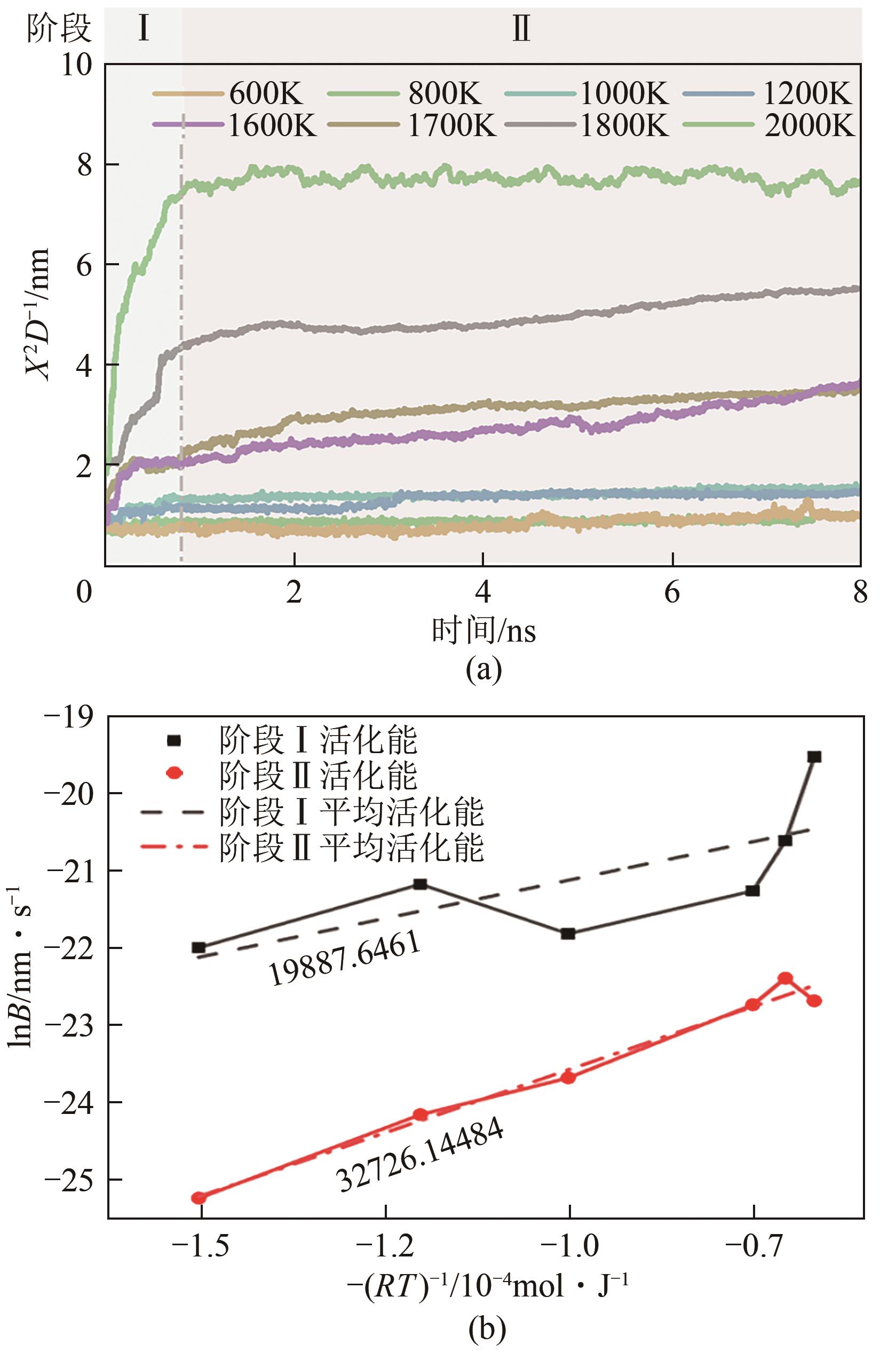
图13 不同温度的黏性流动机制表观活化能
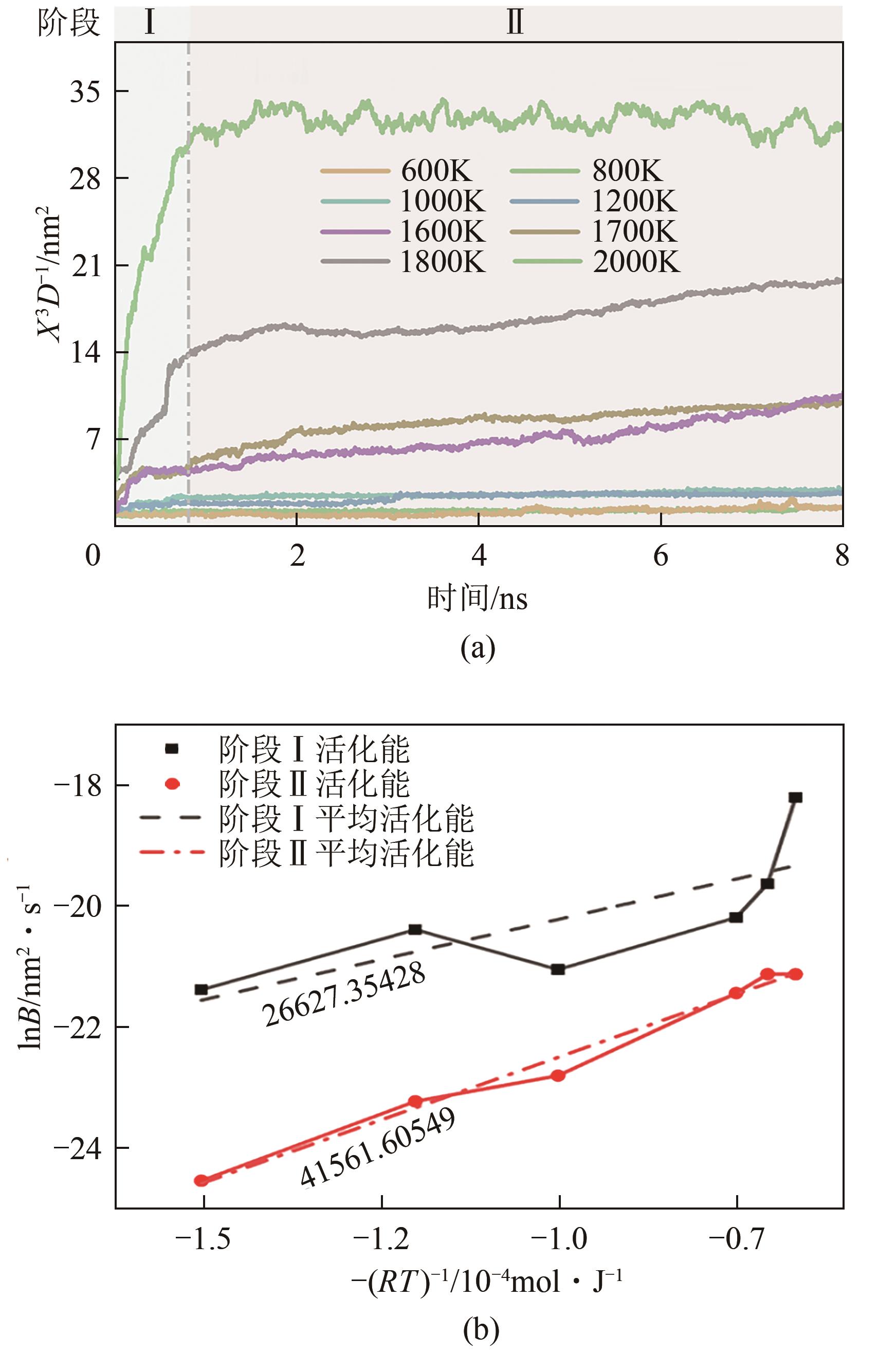
图14 不同温度的蒸发与凝聚机制表观活化能
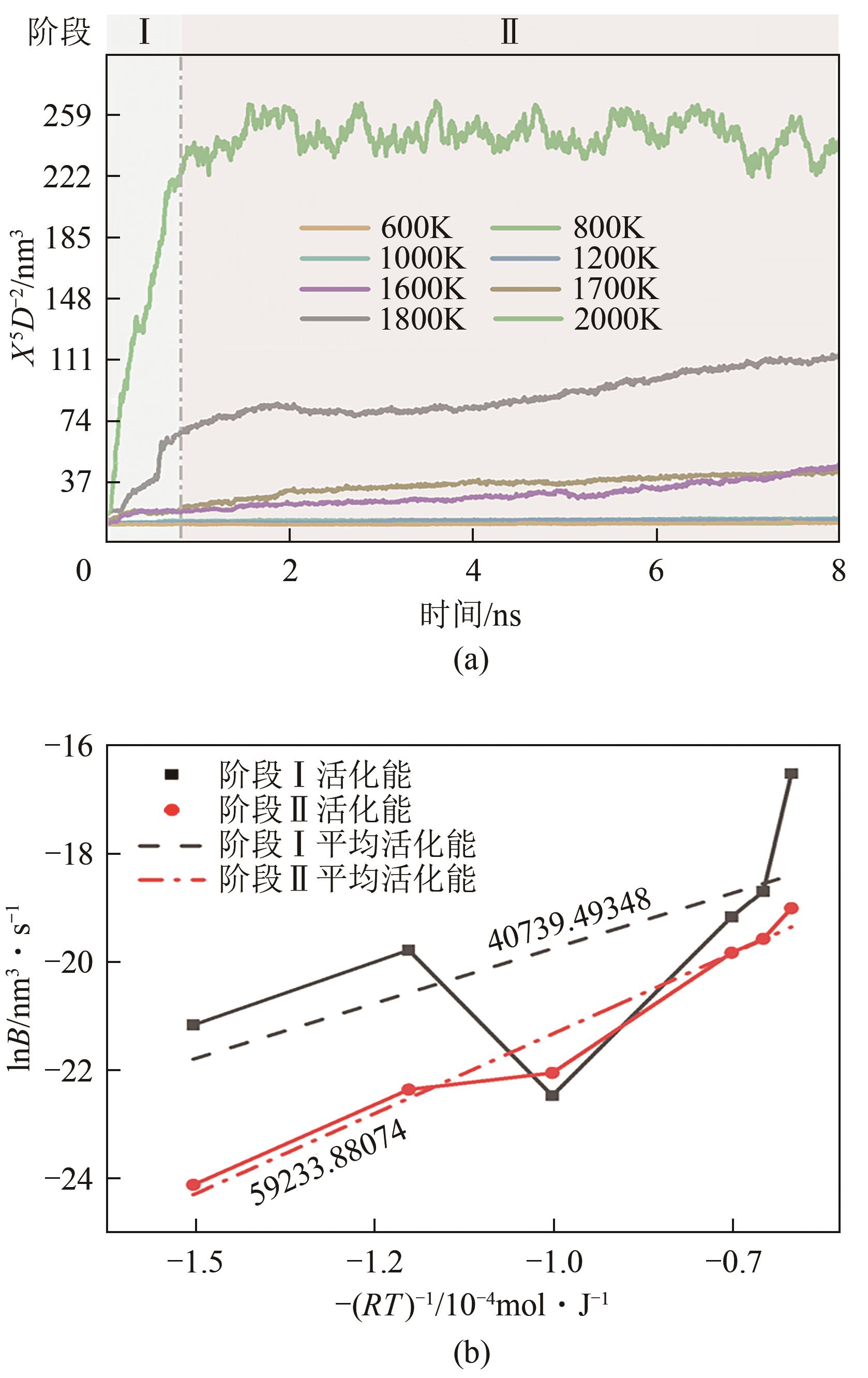
图15 不同温度的体积扩散机制表观活化能
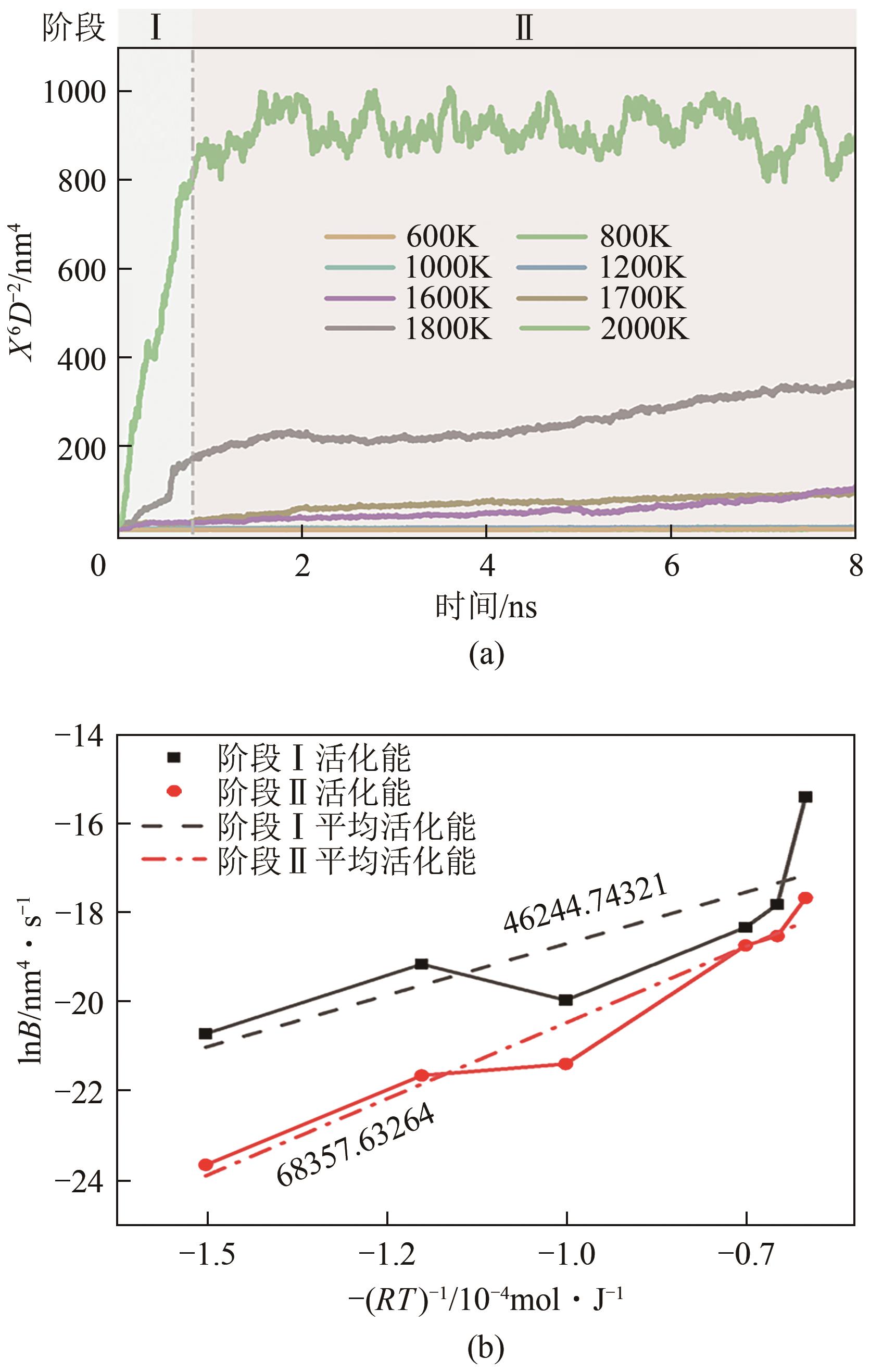
图16 不同温度的晶界扩散机制表观活化能
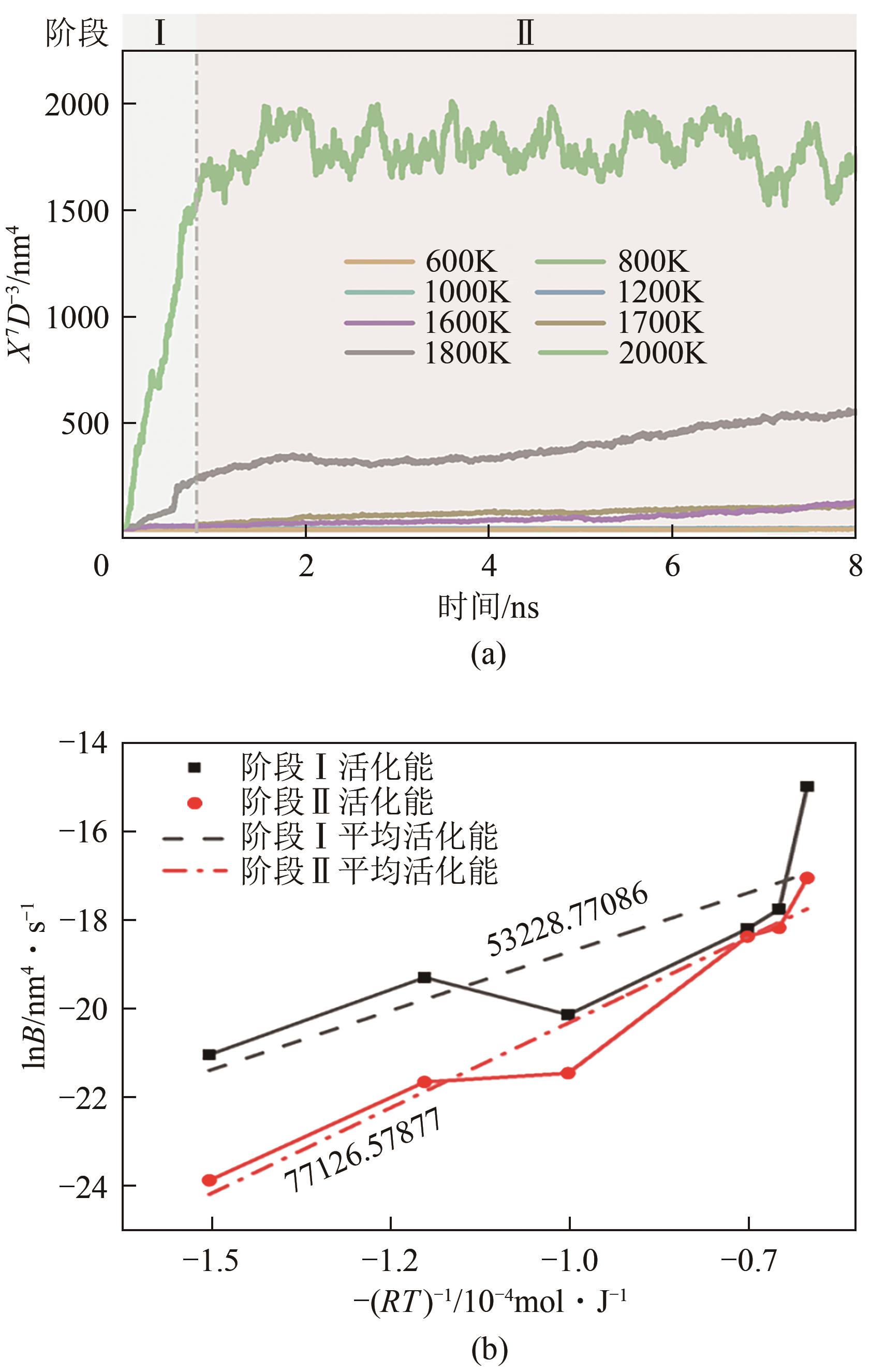
图17 不同温度的表面扩散机制表观活化能
| 1 | Marye Anne FOX, DULAY Maria T. Heterogeneous photocatalysis[J]. Chemical Reviews, 1993, 93(1):341-357. |
| 2 | 廖鑫, 杨绍利, 马兰, 等. 钛白粉制备技术的研究及发展[J]. 粉末冶金技术, 2019, 37(2): 147-152. |
| LIAO Xin, YANG Shaoli, MA Lan, et al. Research and development of titanium dioxide preparation[J]. Powder Metallurgy Technology, 2019, 37(2): 147-152. | |
| 3 | 施利毅, 李春忠, 房鼎业. 气相氧化法制备超细TiO2粒子的研究进展[J]. 材料导报, 1998, 12(6): 23-26. |
| SHI Liyi, LI Chunzhong, FANG Dingye. Research advance in vapor-phase synthesis of ultrafine titania particles[J]. Materials Reports, 1998, 12(6): 23-26. | |
| 4 | 齐满富. 氯化法钛白粉生产工艺及产污环节研究[J]. 当代化工研究, 2022, 22(12): 143-145. |
| QI Manfu. Research on production process and pollution links of chloride titanium dioxide[J]. Modern Chemical Research, 2022, 22(12):143-145. | |
| 5 | GERMAN R. Sintering of advanced materials[M]. Oxford: Woodhead. 2010: 3-32. |
| 6 | 果世驹. 粉末烧结理论[M]. 北京: 冶金工业出版社, 1998. |
| GUO Shiju. Powder sintering theory[M]. Beijing: Metallurgical Industry Press, 1998. | |
| 7 | DJURIC Zorka Z, ALEKSIC Obrad S, NIKOLIC Maria V, et al. Structural and electrical properties of sintered Fe2O3/TiO2 nanopowder mixtures[J]. Ceramics International, 2014, 40(9): 15131-15141. |
| 8 | YUAN Wentao, ZHANG Dawei, Yang OU, et al. Direct in situ TEM visualization and insight into the facet-dependent sintering behaviors of gold on TiO2 [J]. Angewandte Chemie International Edition, 2018, 57(51): 16827-16831. |
| 9 | ZHAO Enda, HAO Jianyu, XUE Xian, et al. Rutile TiO2 microwave dielectric ceramics prepared via cold sintering assisted two step sintering[J]. Journal of the European Ceramic Society, 2021, 41(6): 3459-3465. |
| 10 | KONYAR Mehmet, Cengiz YATMAZ H, Koray ÖZTÜRK. Sintering temperature effect on photocatalytic efficiencies of ZnO/TiO2 composite plates[J]. Applied Surface Science, 2012, 258(19): 7440-7447. |
| 11 | PRAKASH Ved, PRADHAN Subhrajit, ACHARYA S K, et al. Effect of drying route and sintering temperature on zirconia nanoparticle synthesis for filler application in polymer composites[J]. Transactions of the Indian Institute of Metals, 2023, 76(6): 1475-1486. |
| 12 | ROSENBERGER T, SKENDEROVIĆ I, SELLMANN J, et al. Determining the sintering kinetics of Fe and Fe x O y -nanoparticles in a well-defined model flow reactor[J]. Aerosol Science and Technology, 2022, 56(9): 833-846. |
| 13 | LEMAHIEU Guillaume, SENTIS Matthias P L, BRAMBILLA Giovanni, et al. Coupling static multiple light scattering (SMLS) analysis with the Hansen approach for the rationalization of the dispersibility and colloidal stability of TiO2 particle dispersions[J]. Colloids and Surfaces A: Physicochemical and Engineering Aspects, 2024, 688: 133630. |
| 14 | KRZOSA Radosław, Łukasz MAKOWSKI, ORCIUCH Wojciech, et al. Characterization of structures and properties of TiO2 powders[J]. Powder Technology, 2023, 421: 118437. |
| 15 | GAO Wenwu, ZHANG Bo, XIANG Feng. Effect of sintering atmosphere and annealing temperature on electrical and optical properties of TiO2 ceramic[J]. Journal of Materials Science: Materials in Electronics, 2020, 31(16): 13857-13861. |
| 16 | REN Yihua, ZHANG Yiyang, MAO Qian, et al. Amorphous-to-crystalline transition during sintering of nascent TiO2 nanoparticles in gas-phase synthesis: A molecular dynamics study[J]. The Journal of Physical Chemistry C, 2020, 124(50): 27763-27771. |
| 17 | XIA Yana, MOU Jun, DENG Guanyu, et al. Sintered ZrO2-TiO2 ceramic composite and its mechanical appraisal[J]. Ceramics International, 2020, 46(1): 775-785. |
| 18 | WANG Junwei, MISHRA Ashish Kumar, ZHAO Qing, et al. Size effect on thermal stability of nanocrystalline anatase TiO2 [J]. Journal of Physics D: Applied Physics, 2013, 46(25): 255303. |
| 19 | MULYADI, RAMLAN, NUR’ AINI Siti, et al. Effect of various sintering temperature of ceramic TiO2 on physical properties and crystall structure[J]. Journal of Physics: Conference Series, 2019, 1282(1): 012049. |
| 20 | EGERTON T A, TOOLEY I R. Physical characterization of titanium dioxide nanoparticles[J]. International Journal of Cosmetic Science, 2014, 36(3): 195-206. |
| 21 | BINDER K. Theory of first-order phase transitions[J]. Reports on Progress in Physics, 1987, 50(7): 783-859. |
| 22 | 张文佳. 二氧化钛纳米颗粒的毒理学及生物学效应研究[D]. 天津: 天津理工大学, 2009. |
| ZHANG Wenjia. Study on toxicology and biological activity of nano-TiO2 [D]. Tianjin: Tianjin University of Technology, 2009. | |
| 23 | SEO Won-Gap, TSUKIHASHI Fumitaka. Thermodynamic and structural properties for the FeO-SiO2 system by using molecular dynamics calculation[J]. Materials Transactions, 2005, 46(6): 1240-1247. |
| 24 | MATSUI Masanori, AKAOGI Masaki. Molecular dynamics simulation of the structural and physical properties of the four polymorphs of TiO2 [J]. Molecular Simulation, 1991, 6(4/5/6): 239-244. |
| 25 | COLLINS David, SMITH William, HARRISON Nicholas M, et al. Molecular dynamics study of the high temperature fusion of TiO2 nanoclusters[J]. Journal of Materials Chemistry, 1997, 7(12): 2543-2546. |
| 26 | BUESSER B, GRÖHN A J, PRATSINIS S E. Sintering rate and mechanism of TiO2 nanoparticles by molecular dynamics[J]. The Journal of Physical Chemistry C, 2011, 115(22): 11030-11035. |
| 27 | MALTI Abolfazl, KARDANI Arash, MONTAZERI Abbas. An insight into the temperature-dependent sintering mechanisms of metal nanoparticles through MD-based microstructural analysis[J]. Powder Technology, 2021, 386: 30-39. |
| 28 | ABEDINI A, MALTI A, KARDANI A, et al. Probing neck growth mechanisms and tensile properties of sintered multi-nanoparticle Al-Cu systems via MD simulation[J]. Advanced Powder Technology, 2023, 34(8): 104084. |
| 29 | NAKAO Kazuhide, ISHIMOTO Takayoshi, KOYAMA Michihisa. Sintering simulation for porous material by integrating molecular dynamics and master sintering curve[J]. The Journal of Physical Chemistry C, 2014, 118(29): 15766-15772. |
| 30 | WANG Chao, CHEN Shaohua. Factors influencing particle agglomeration during solid-state sintering[J]. Acta Mechanica Sinica, 2012, 28(3): 711-719. |
| 31 | NANDY Jyotirmoy, SAHOO Seshadev, YEDLA Natraj, et al. Molecular dynamics simulation of coalescence kinetics and neck growth in laser additive manufacturing of aluminum alloy nanoparticles[J]. Journal of Molecular Modeling, 2020, 26(6): 125-139. |
| 32 | YANG Shipeng, LIU Lang, LIU Yu, et al. A molecular simulation study on the sintering mechanism of TiO2 [J]. Journal of the American Ceramic Society, 2023, 106(7): 4488-4498. |
| 33 | CH’NG H N, PAN Jingzhe. Sintering of particles of different sizes[J]. Acta Materialia, 2007, 55(3): 813-824. |
| 34 | MAO Qian, LUO Kaihong. Molecular dynamics simulation of sintering dynamics of many TiO2 nanoparticles[J]. Journal of Statistical Physics, 2015, 160(6): 1696-1708. |
| 35 | WAKAI Fumihiro, YOSHIDA Michiyuki, KASHYAP Bhagwati P. Influence of particle arrangement on coarsening during sintering of three spherical particles[J]. Journal of the Ceramic Society of Japan, 2006, 114(1335): 974-978. |
| 36 | FRENKEL J. Viscous flow of crystalline bodies under the action of surface tension[J]. Journal of Physics USSR, 1945, 9(5): 501-559. |
| 37 | SWAMY Varghese, GALE Julian D. Transferable variable-charge interatomic potential for atomistic simulation of titanium oxides[J]. Physical Review B, 2000, 62(9): 5406-5412. |
| 38 | PLIMPTON Steve. Fast parallel algorithms for short-range molecular dynamics[J]. Journal of Computational Physics, 1995, 117(1): 1-19. |
| 39 | HOOVER William G. Canonical dynamics: Equilibrium phase-space distributions[J]. Physical Review A, 1985, 31(3): 1695-1697. |
| 40 | 宗燕兵, 张学东, 马晴雨, 等. 不同镁含量钢渣陶瓷的致密化机制[J]. 工程科学学报, 2018, 40(10): 1237-1243. |
| ZONG Yanbing, ZHANG Xuedong, MA Qingyu, et al. Densification mechanism of slag ceramics with different magnesium contents[J]. Chinese Journal of Engineering, 2018, 40(10): 1237-1243. | |
| 41 | COBLE R L. Initial sintering of alumina and hematite[J]. Journal of the American Ceramic Society, 1958, 41(2): 55-62. |
| 42 | ROJEK J, KASZTELAN R, THARMARAJ R. Discrete element thermal conductance model for sintered particles[J]. Powder Technology, 2022, 405: 117521. |
| 43 | SEONG Yujin, HWANG Sungwon, KIM See Jo, et al. Atomistic simulation of sintering mechanism for copper nano-powders[J]. Journal of Korean Powder Metallurgy Institute, 2015, 22(4): 247-253. |
| 44 | ZHANG Kaiwang, Malcolm STOCKS G, ZHONG Jianxin. Melting and premelting of carbon nanotubes[J]. Nanotechnology, 2007, 18(28): 285703. |
| [1] | 喻喜华, 何楚琪, 许福春, 石贞香, 刘振宇, 肖美添. Zn2+-Ca2+二元离子调控HPMC肠溶空心胶囊性能[J]. 化工进展, 2025, 44(4): 2250-2257. |
| [2] | 郭伟, 刘传平, 童莉葛, 王立. 新型热扩散式测量技术助力气液多相流监测[J]. 化工进展, 2025, 44(4): 1781-1785. |
| [3] | 张佩, 高莉宁, 丁思晴, 李立, 祝锡爇, 何锐. g-C3N4/TiO2异质结光催化剂的制备及其对NO的降解性能[J]. 化工进展, 2025, 44(4): 2045-2056. |
| [4] | 岳磊, 栗培龙, 丁湛, 夏雷, 安琳玉. 沥青再生剂扩散行为表征方法研究进展[J]. 化工进展, 2025, 44(4): 2068-2080. |
| [5] | 冯鹏, 徐东海, 何冰, 刘欢腾, 杨立杰, 王攀, 刘青山. 亚/超临界水中典型硫酸盐Na2SO4和K2SO4的溶解特性及机理[J]. 化工进展, 2025, 44(3): 1706-1715. |
| [6] | 张馨儿, 裴刘军, 周雨蝶, 靳凯丽, 王际平. 基于TiO2的光催化剂利用太阳能裂解水制氢研究进展[J]. 化工进展, 2025, 44(3): 1298-1308. |
| [7] | 程崇律, 单聪慧, 张孟凡, WEN X Jennifer, 徐宝鹏. 氢安全建模研究进展[J]. 化工进展, 2025, 44(3): 1285-1297. |
| [8] | 张喆, 纪献兵, 杨聿昊, 刘家璇, 姚泊丞. 多尺度结构烧结沟槽表面沸腾传热性能[J]. 化工进展, 2025, 44(2): 669-676. |
| [9] | 李章良, 杨月珠, 伍传田, 吕源财. 活性炭纤维毡负载N-TiO2/MoS2/N-TiO2固定化漆酶降解双酚A[J]. 化工进展, 2025, 44(2): 887-898. |
| [10] | 刘炜, 张敏, 朱照琪, 王毅, 梁卫东, 孙寒雪. 黑色二氧化钛纳米材料的构筑及其应用现状[J]. 化工进展, 2025, 44(1): 341-353. |
| [11] | 焦芮, 周涛, 孙寒雪, 李吉焱, 朱照琪, 李安. 多孔材料用于废水中放射性核素吸附的研究进展[J]. 化工进展, 2025, 44(1): 354-366. |
| [12] | 孙诗婉, 李欣, 周涵. 辐射冷却涂料及其在能源环境领域的应用[J]. 化工进展, 2024, 43(9): 4961-4969. |
| [13] | 马广鑫, 李伟曼, 周欣, 陈运法. 湿气发电技术研究进展[J]. 化工进展, 2024, 43(8): 4490-4505. |
| [14] | 韩丹, 章健, 罗皓鸣, 刘鹏, 王士维. 反应烧结制备镁铝尖晶石透明陶瓷研究新进展[J]. 化工进展, 2024, 43(7): 3637-3646. |
| [15] | 闻桂叶, 焦凤, 何永清. 磁场下微通道中磁-非磁液界面不稳定性分析[J]. 化工进展, 2024, 43(7): 3787-3797. |
| 阅读次数 | ||||||
|
全文 |
|
|||||
|
摘要 |
|
|||||