化工进展 ›› 2025, Vol. 44 ›› Issue (8): 4288-4301.DOI: 10.16085/j.issn.1000-6613.2025-0189
• 微介观过程与材料的模拟与仿真 • 上一篇
机器学习加速多孔吸附剂筛选发现的研究进展
杨证禄1( ), 杨立峰1, 路晓飞1,2, 锁显1,2, 张安运1, 崔希利1,2(), 邢华斌1,2
- 1.浙江大学化学与生物工程学院,浙江 杭州 310058
2.浙江大学杭州国际科创中心,浙江 杭州 311215
-
收稿日期:2025-02-10修回日期:2025-04-15出版日期:2025-08-25发布日期:2025-09-08 -
通讯作者:崔希利 -
作者简介:杨证禄(1998—),男,博士研究生,研究方向为分离工程与高纯化学品制备。E-mail:yangzl@zju.edu.cn。 -
基金资助:国家自然科学基金(22227812);国家自然科学基金(22438011);浙江省自然科学基金(LD24B010001)
Advances in machine learning accelerating the screening and discovery of porous adsorbents
YANG Zhenglu1(), YANG Lifeng1, LU Xiaofei1,2, SUO Xian1,2, ZHANG Anyun1, CUI Xili1,2(), XING Huabin1,2
- 1.College of Chemical and Biological Engineering, Zhejiang University, Hangzhou 310058, Zhejiang, China
2.Hangzhou Global Scientific and Technological Innovation Center, Zhejiang University, Hangzhou 311215, Zhejiang, China
-
Received:2025-02-10Revised:2025-04-15Online:2025-08-25Published:2025-09-08 -
Contact:CUI Xili

摘要:
吸附剂研究是吸附分离研究的核心,加速新型吸附分离技术发展的关键在于多孔吸附剂的筛选。金属有机框架等新型多孔材料在吸附分离领域受到了广泛关注,近年其数量呈爆炸式增长,但这也给吸附剂筛选带来了压力。机器学习引领了多孔材料在发现、设计和应用上的创新突破,正推动多孔吸附剂研究进入数据驱动的全新范式。本文介绍了近年来机器学习在多孔吸附剂领域的研究现状,通过关键案例研究梳理了多孔材料数据库、吸附性能预测及其他相关机器学习任务上的进展,分析了在多孔材料机器学习中模型输入的原理和特点。最后总结出标准化数据库、促进知识迁移、弥合实验与模拟数据的差异及可解释模型是未来多孔吸附剂机器学习研究的发展方向。本文为使用机器学习开发新型多孔吸附剂的研究者提供了简明的资源。
中图分类号:
引用本文
杨证禄, 杨立峰, 路晓飞, 锁显, 张安运, 崔希利, 邢华斌. 机器学习加速多孔吸附剂筛选发现的研究进展[J]. 化工进展, 2025, 44(8): 4288-4301.
YANG Zhenglu, YANG Lifeng, LU Xiaofei, SUO Xian, ZHANG Anyun, CUI Xili, XING Huabin. Advances in machine learning accelerating the screening and discovery of porous adsorbents[J]. Chemical Industry and Engineering Progress, 2025, 44(8): 4288-4301.
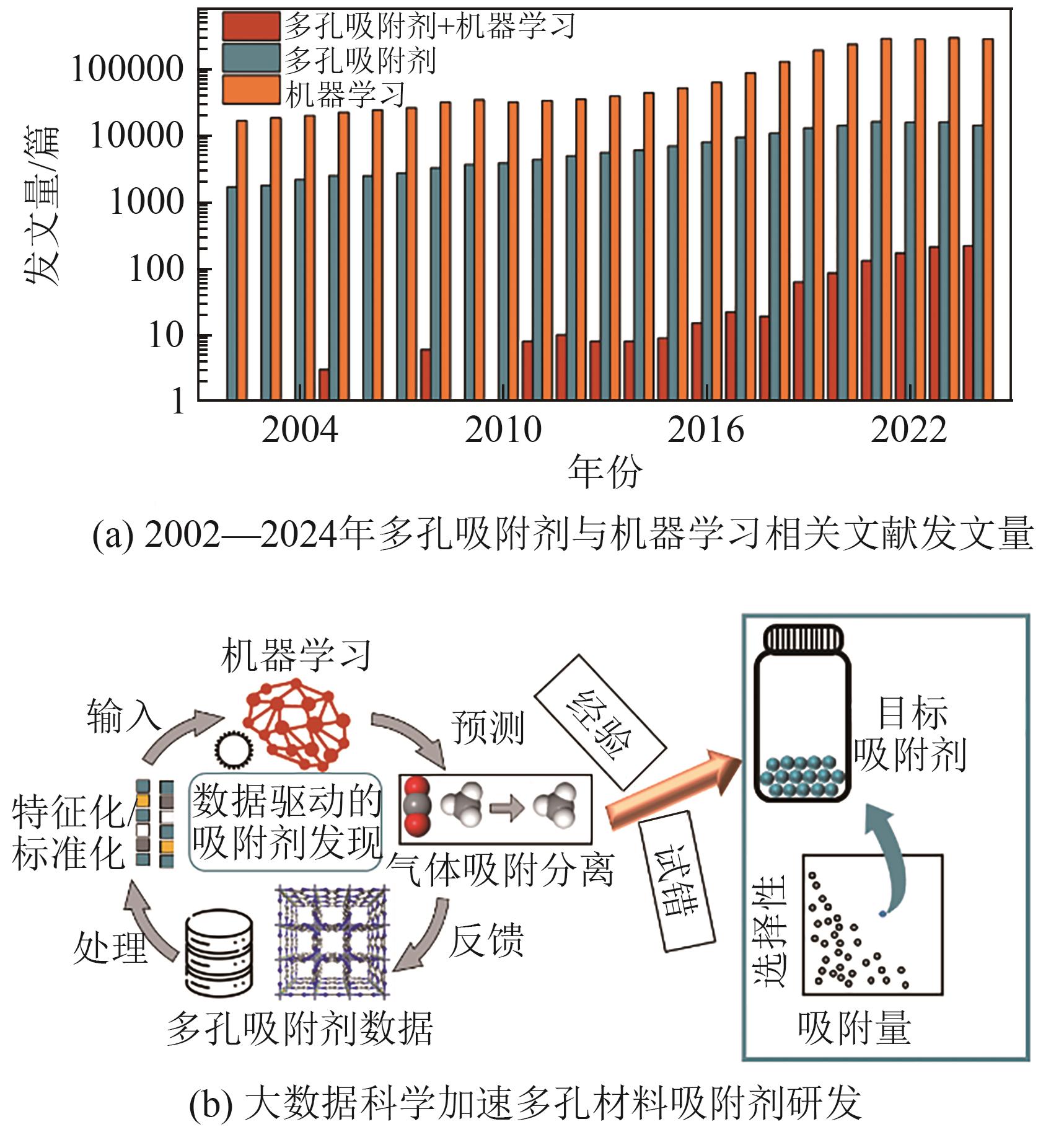
图1 数据驱动的多孔吸附剂研究范式
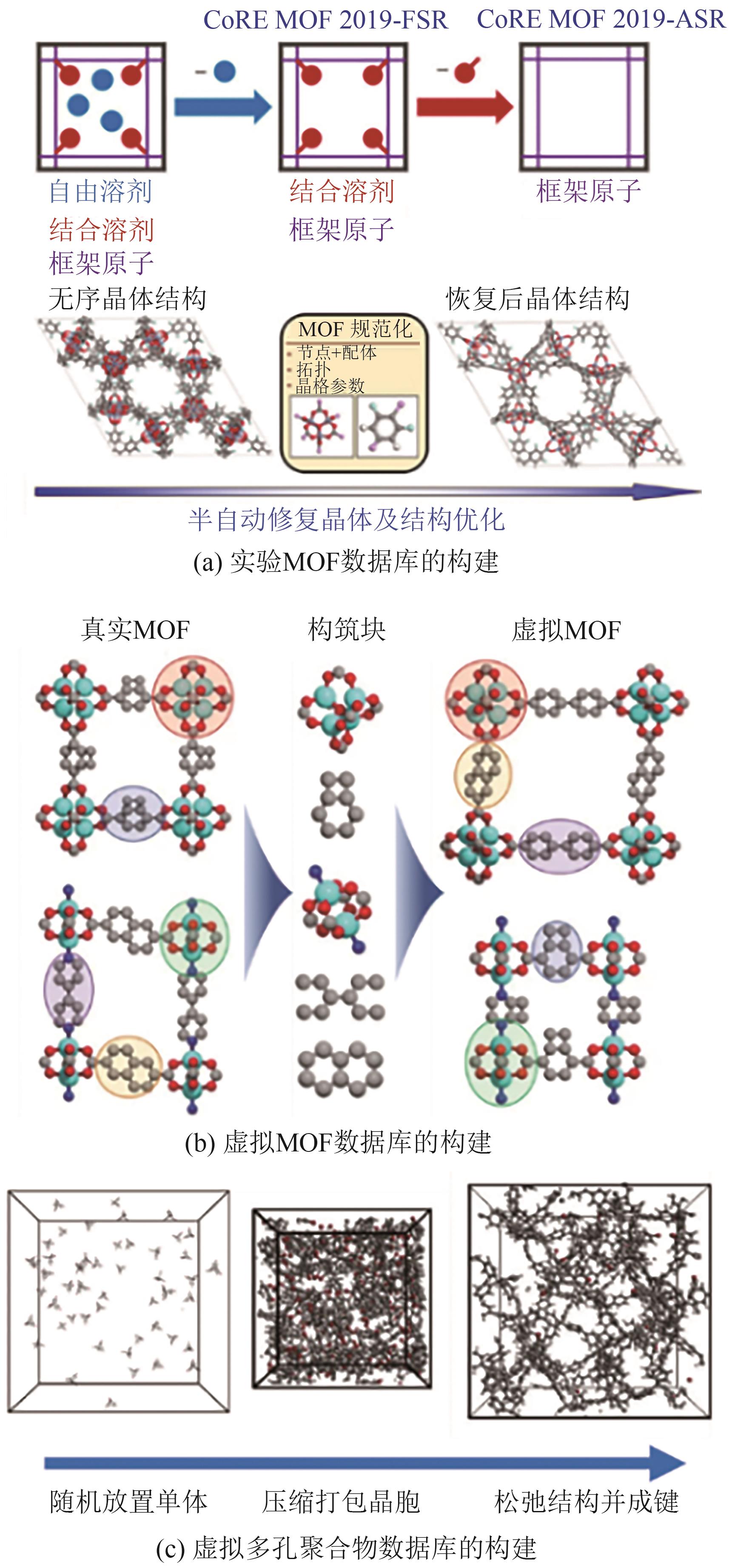
图2 不同多孔材料代表性的结构数据库构建方法[7-8,16]
| 名称 | 材料种类 | 数据来源 | 样本量 | 包含信息 |
|---|---|---|---|---|
| CoRE MOF 2019 | MOF | 实验 | 14142 | 结构文件,几何结构特征 |
| hMOF | MOF | 计算机模拟 | 137953 | 结构文件,几何结构特征,35bar(1bar=0.1MPa)和298K下的模拟甲烷吸附量 |
| CoRE COF | COF | 实验 | 187 | 结构文件 |
| CURATED COF | COF | 实验 | 324 | 经过DFT计算和赋予电荷的结构文件 |
| ReDD-COFFEE | COF | 计算机模拟 | 268687 | 结构文件 |
| IZA结构数据库 | 沸石 | 实验 | 258以上① | 结构文件,几何结构特征,XRD,核磁共振(NMR) |
| 虚拟沸石数据库② | 沸石 | 计算机模拟 | 260万以上 | 结构文件 |
| 虚拟ABC-6沸石数据库② | 沸石 | 计算机模拟 | 84292 | 结构文件 |
| PCM的H2吸附数据库② | 多孔碳 | 实验 | 2072 | 68种多孔碳的材料特征以及在不同温度压力下的氢吸附数据 |
| PPN模拟建模结构数据库② | 多孔聚合物 | 计算机模拟 | 10237 | 结构文件 |
| DigiMOF | MOF | 实验 | 52680 | MOF的合成方法条件 |
| SynMOF | MOF | 实验 | 983 | 结构文件,MOF的合成方法条件 |
表1 不同多孔材料数据库的特点
| 名称 | 材料种类 | 数据来源 | 样本量 | 包含信息 |
|---|---|---|---|---|
| CoRE MOF 2019 | MOF | 实验 | 14142 | 结构文件,几何结构特征 |
| hMOF | MOF | 计算机模拟 | 137953 | 结构文件,几何结构特征,35bar(1bar=0.1MPa)和298K下的模拟甲烷吸附量 |
| CoRE COF | COF | 实验 | 187 | 结构文件 |
| CURATED COF | COF | 实验 | 324 | 经过DFT计算和赋予电荷的结构文件 |
| ReDD-COFFEE | COF | 计算机模拟 | 268687 | 结构文件 |
| IZA结构数据库 | 沸石 | 实验 | 258以上① | 结构文件,几何结构特征,XRD,核磁共振(NMR) |
| 虚拟沸石数据库② | 沸石 | 计算机模拟 | 260万以上 | 结构文件 |
| 虚拟ABC-6沸石数据库② | 沸石 | 计算机模拟 | 84292 | 结构文件 |
| PCM的H2吸附数据库② | 多孔碳 | 实验 | 2072 | 68种多孔碳的材料特征以及在不同温度压力下的氢吸附数据 |
| PPN模拟建模结构数据库② | 多孔聚合物 | 计算机模拟 | 10237 | 结构文件 |
| DigiMOF | MOF | 实验 | 52680 | MOF的合成方法条件 |
| SynMOF | MOF | 实验 | 983 | 结构文件,MOF的合成方法条件 |
| 算法 | 特点 | 优点 | 缺点 | 适用范围 |
|---|---|---|---|---|
| 支持向量机 | 通过核技巧(kernel trick)处理非线性问题 | 适合小样本高维数据,对噪声和过拟合的抗干扰能力强 | 计算复杂度高,不适合大规模数据 | 处理中小规模的高维特征数据或非线性边界问题 |
| 随机森林 | 通过构建多个决策树来拟合目标变量与特征 | 抗过拟合、噪声和缺失值能力强,支持并行训练 | 性能对参数敏感但依赖调参,模型可解释性差 | 处理中大规模高维特征的数据 |
| 多元线性回归 | 通过最小二乘法拟合目标变量与特征的线性关系 | 模型简单,计算效率高,可拓展性和解释性强 | 无法处理非线性关系 | 处理低维且特征间独立性较强的非线性关系数据 |
| 人工神经网络 | 基于多层非线性计算节点的映射结构,实现对高维度非线性关系的建模 | 模型拟合上限高,自动学习特征且不需要特征工程 | 计算及数据耗费高、调参复杂、可解释较差 | 处理大规模数据的复杂非线性问题和端到端问题 |
| 梯度增强回归 | 通过集成多棵弱决策树来预测,通过梯度下降减小误差 | 预测精度高,可处理混合类型特征和缺失值 | 训练速度慢,难以并行化;易过拟合 | 对中小规模数据的复杂非线性关系进行预测 |
| 极限梯度提升(XGBoost) | 梯度增强算法的优化实现,集成正则化项防过拟合、支持多线程计算并自带缺失值自处理机制 | 计算效率高,支持分布式训练 | 内存占用较大,因此不适合超大规模数据 | 对特征维度较高但样本量适中的数据进行预测 |
| 轻量级梯度提升机器学习(LGBM) | 使用直方图算法的梯度提升决策树框架 | 训练速度快且内存占用小,支持分布式训练和图形处理器(GPU)加速 | 小数据易过拟合,对噪声和稀疏数据敏感,可解释性差 | 对特征维度较高且样本量较大的数据进行快速预测 |
| 最小绝对值收缩和选择算子(LASSO)回归 | 在线性回归中加入L1正则化项来实现特征选择 | 可自动筛选重要特征,模型训练速度快 | 限于线性或类线性关系,对高相关特征的选择稳定性差 | 高维并且需要特征选择的稀疏数据 |
| 核岭回归 | 岭回归与核方法的结合,通过L2正则化减轻过拟合 | 可处理非线性关系,避免显式高维计算,抗过拟合 | 存储和计算复杂度高,不适合大规模数据 | 中小规模数据的非线性回归问题 |
| 高斯过程分类 | 基于贝叶斯框架,假设数据服从高斯过程,输出预测概率 | 不需要复杂的特征工程,可给出预测不确定性 | 计算复杂度高,不适合大规模数据 | 中小规模数据的非线性回归问题或需概率解释的场景 |
表2 不同机器学习算法的特点和适用范围
| 算法 | 特点 | 优点 | 缺点 | 适用范围 |
|---|---|---|---|---|
| 支持向量机 | 通过核技巧(kernel trick)处理非线性问题 | 适合小样本高维数据,对噪声和过拟合的抗干扰能力强 | 计算复杂度高,不适合大规模数据 | 处理中小规模的高维特征数据或非线性边界问题 |
| 随机森林 | 通过构建多个决策树来拟合目标变量与特征 | 抗过拟合、噪声和缺失值能力强,支持并行训练 | 性能对参数敏感但依赖调参,模型可解释性差 | 处理中大规模高维特征的数据 |
| 多元线性回归 | 通过最小二乘法拟合目标变量与特征的线性关系 | 模型简单,计算效率高,可拓展性和解释性强 | 无法处理非线性关系 | 处理低维且特征间独立性较强的非线性关系数据 |
| 人工神经网络 | 基于多层非线性计算节点的映射结构,实现对高维度非线性关系的建模 | 模型拟合上限高,自动学习特征且不需要特征工程 | 计算及数据耗费高、调参复杂、可解释较差 | 处理大规模数据的复杂非线性问题和端到端问题 |
| 梯度增强回归 | 通过集成多棵弱决策树来预测,通过梯度下降减小误差 | 预测精度高,可处理混合类型特征和缺失值 | 训练速度慢,难以并行化;易过拟合 | 对中小规模数据的复杂非线性关系进行预测 |
| 极限梯度提升(XGBoost) | 梯度增强算法的优化实现,集成正则化项防过拟合、支持多线程计算并自带缺失值自处理机制 | 计算效率高,支持分布式训练 | 内存占用较大,因此不适合超大规模数据 | 对特征维度较高但样本量适中的数据进行预测 |
| 轻量级梯度提升机器学习(LGBM) | 使用直方图算法的梯度提升决策树框架 | 训练速度快且内存占用小,支持分布式训练和图形处理器(GPU)加速 | 小数据易过拟合,对噪声和稀疏数据敏感,可解释性差 | 对特征维度较高且样本量较大的数据进行快速预测 |
| 最小绝对值收缩和选择算子(LASSO)回归 | 在线性回归中加入L1正则化项来实现特征选择 | 可自动筛选重要特征,模型训练速度快 | 限于线性或类线性关系,对高相关特征的选择稳定性差 | 高维并且需要特征选择的稀疏数据 |
| 核岭回归 | 岭回归与核方法的结合,通过L2正则化减轻过拟合 | 可处理非线性关系,避免显式高维计算,抗过拟合 | 存储和计算复杂度高,不适合大规模数据 | 中小规模数据的非线性回归问题 |
| 高斯过程分类 | 基于贝叶斯框架,假设数据服从高斯过程,输出预测概率 | 不需要复杂的特征工程,可给出预测不确定性 | 计算复杂度高,不适合大规模数据 | 中小规模数据的非线性回归问题或需概率解释的场景 |
| 参数 | 评估对象 | 定义 | 特征 |
|---|---|---|---|
| 决定系数(R2),交叉验证中与交叉验证决定系数(Q2)等效 | 回归任务 | 表示模型对数据的拟合程度 | 取值范围是[0,1],越大预测越准;量纲为1指标;对异常值敏感 |
| 均方误差(MSE) | 回归任务 | 预测与真实值的平均平方差 | 数值越小预测越准,量纲为原数据量纲平方,对异常值敏感 |
| 均方根误差(RMSE) | 回归任务 | MSE的算术平方根 | 量纲与原数据一致,对异常值敏感 |
| 平均绝对误差(MAE) | 回归任务 | 预测值与真实值绝对差的平均值 | 量纲与原数据一致,对异常数据不敏感 |
| 准确率(ACC) | 分类任务 | 分类正确的样本数占比 | 取值范围是[0,1],越大预测越准;无法反映少数类的预测准确性 |
| F1分数(F1 score) | 分类任务 | 精确率和召回率的调和平均 | 取值范围是[0,1],值越高模型越准确;对类别不平衡敏感 |
表3 不同机器学习评价指标的定义和特点
| 参数 | 评估对象 | 定义 | 特征 |
|---|---|---|---|
| 决定系数(R2),交叉验证中与交叉验证决定系数(Q2)等效 | 回归任务 | 表示模型对数据的拟合程度 | 取值范围是[0,1],越大预测越准;量纲为1指标;对异常值敏感 |
| 均方误差(MSE) | 回归任务 | 预测与真实值的平均平方差 | 数值越小预测越准,量纲为原数据量纲平方,对异常值敏感 |
| 均方根误差(RMSE) | 回归任务 | MSE的算术平方根 | 量纲与原数据一致,对异常值敏感 |
| 平均绝对误差(MAE) | 回归任务 | 预测值与真实值绝对差的平均值 | 量纲与原数据一致,对异常数据不敏感 |
| 准确率(ACC) | 分类任务 | 分类正确的样本数占比 | 取值范围是[0,1],越大预测越准;无法反映少数类的预测准确性 |
| F1分数(F1 score) | 分类任务 | 精确率和召回率的调和平均 | 取值范围是[0,1],值越高模型越准确;对类别不平衡敏感 |
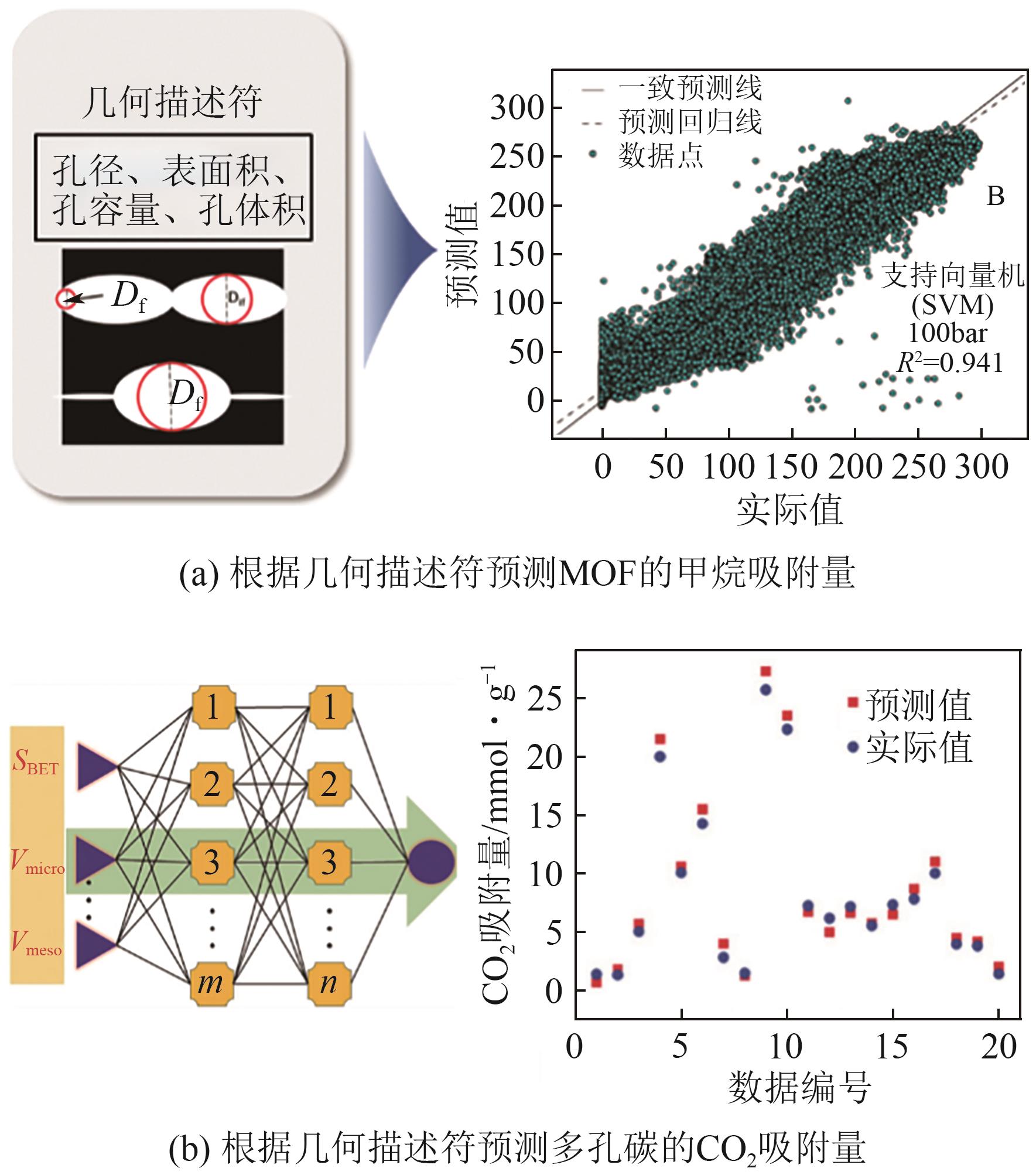
图3 输入几何描述符的多孔材料吸附预测[19,23]
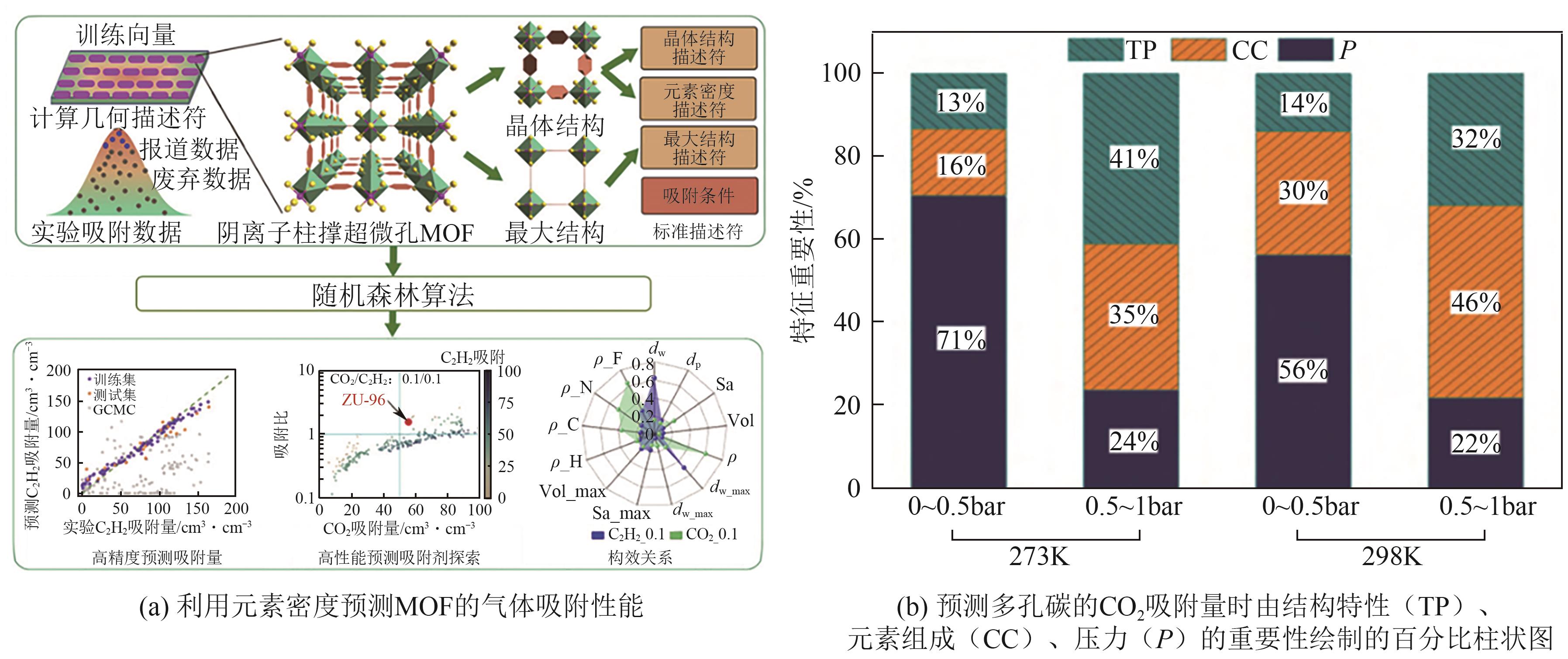
图4 利用化学描述符预测气体吸附[24,28]
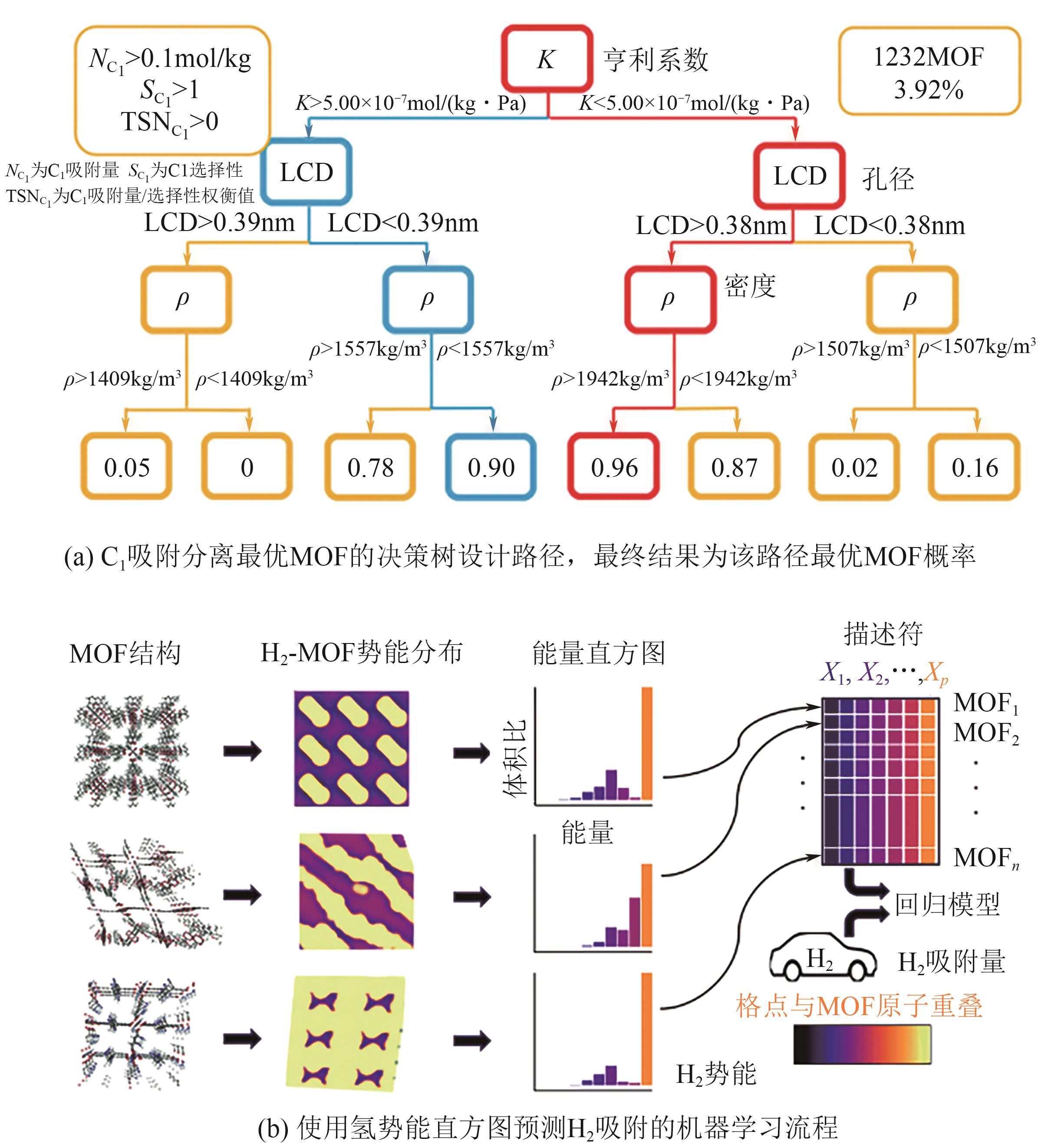
图5 利用能量描述符预测气体吸附[31,34]
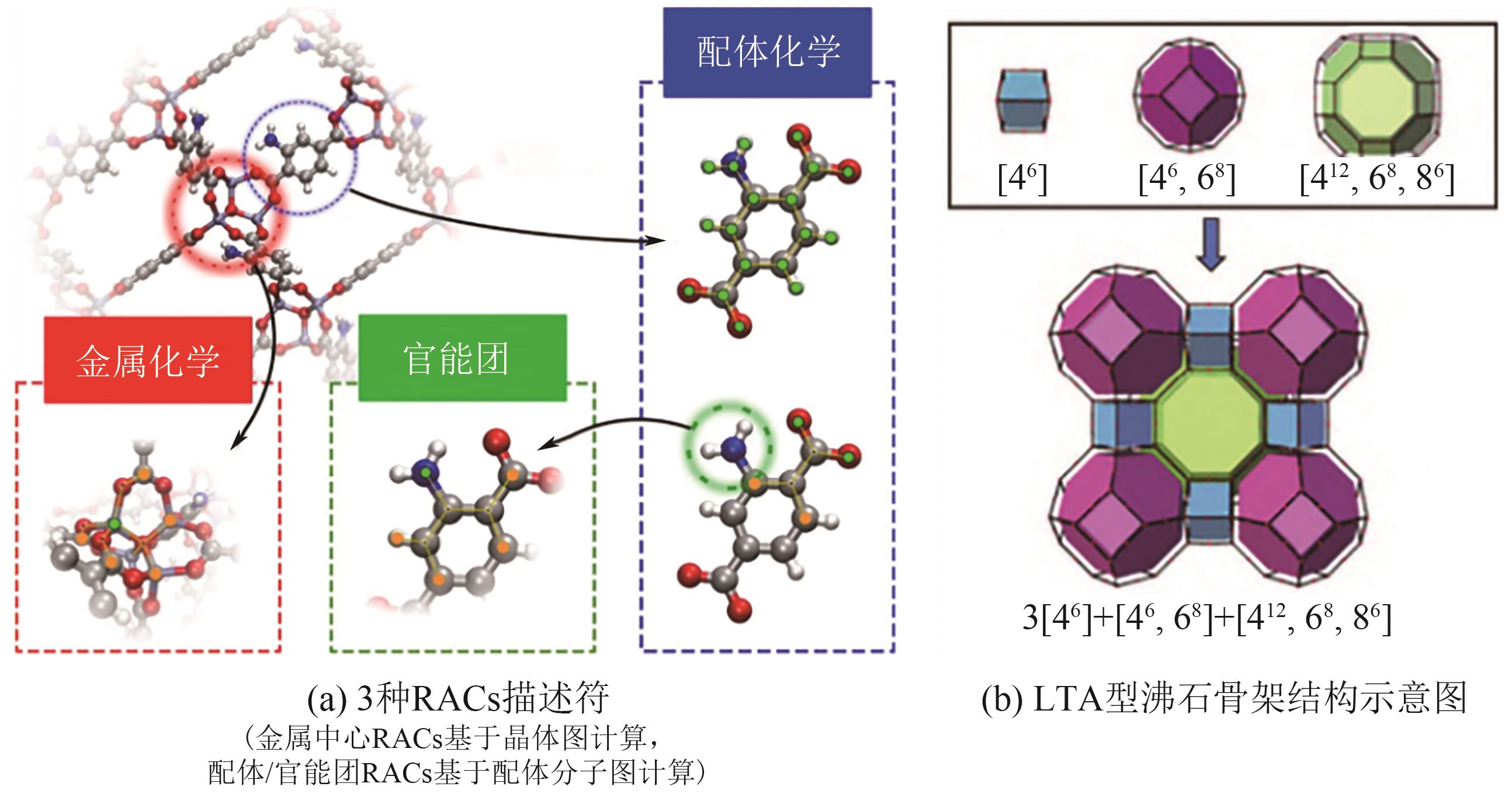
图6 MOF和沸石从晶体结构衍生的描述符[36,38]
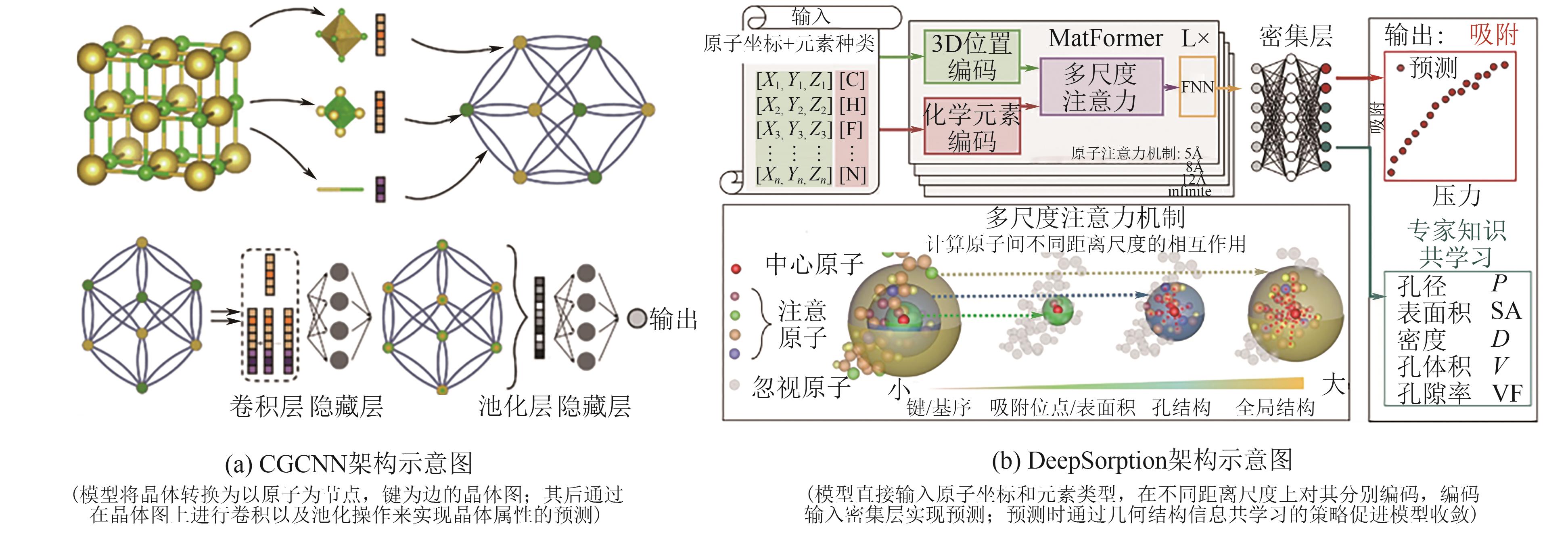
图7 直接输入结构的吸附预测[40,42]
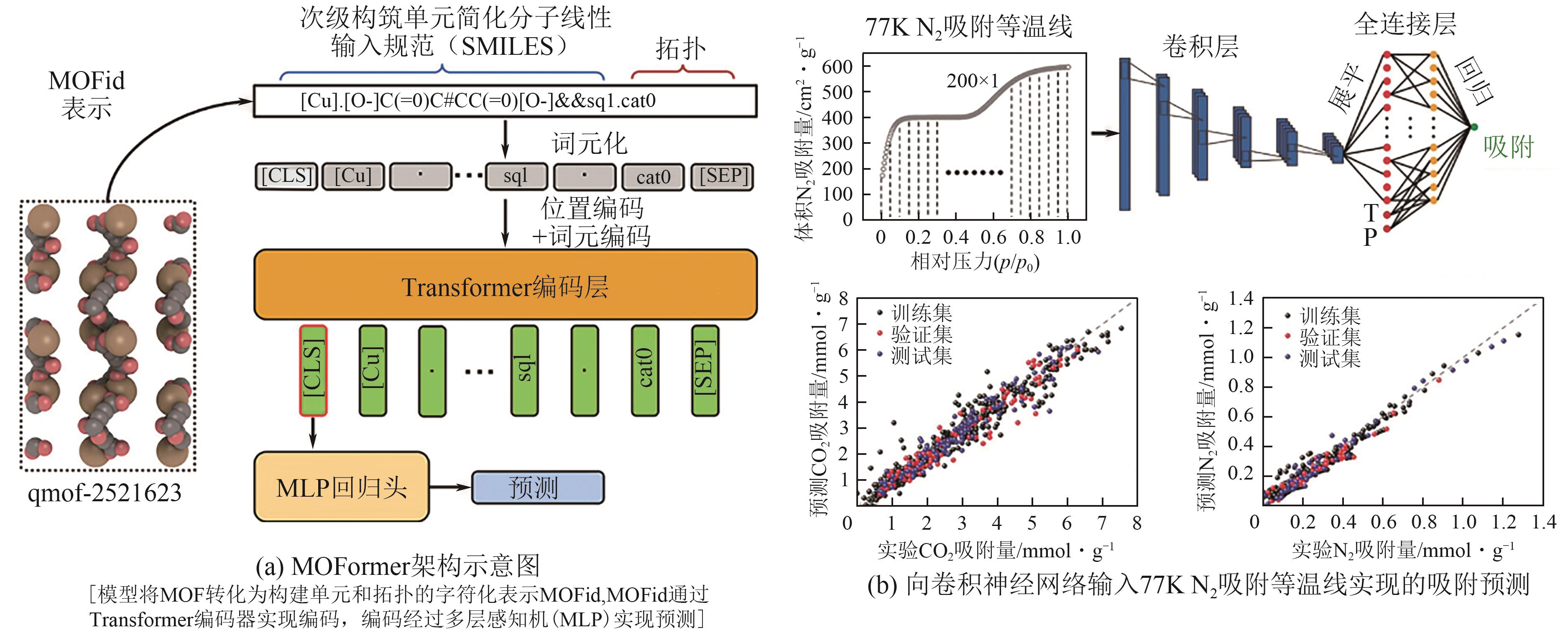
图8 输入MOFid和77K N2吸附等温线的吸附预测[44-45]
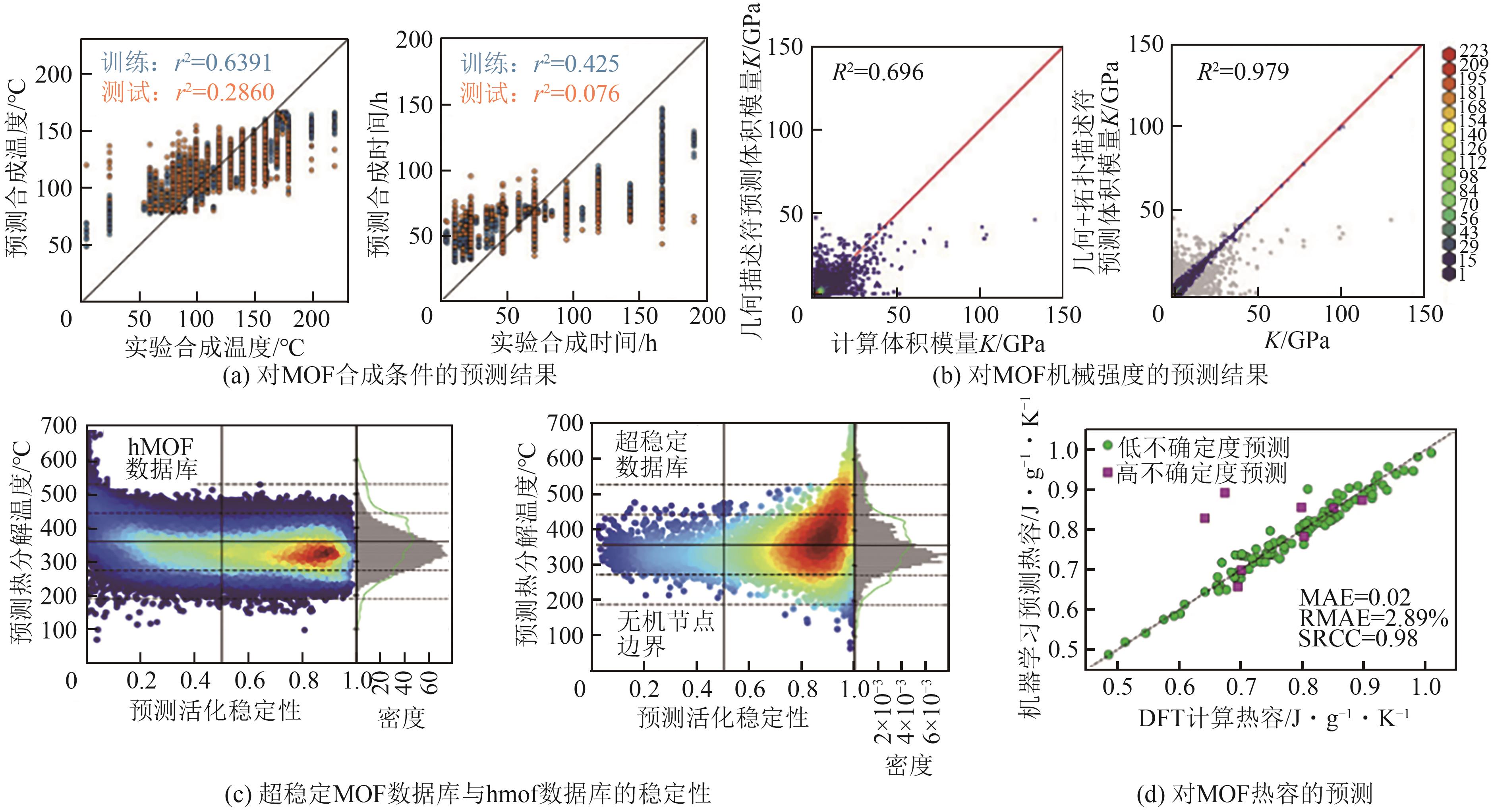
图9 对MOF合成条件、机械强度、稳定性和热容的预测[18,48,50,52]
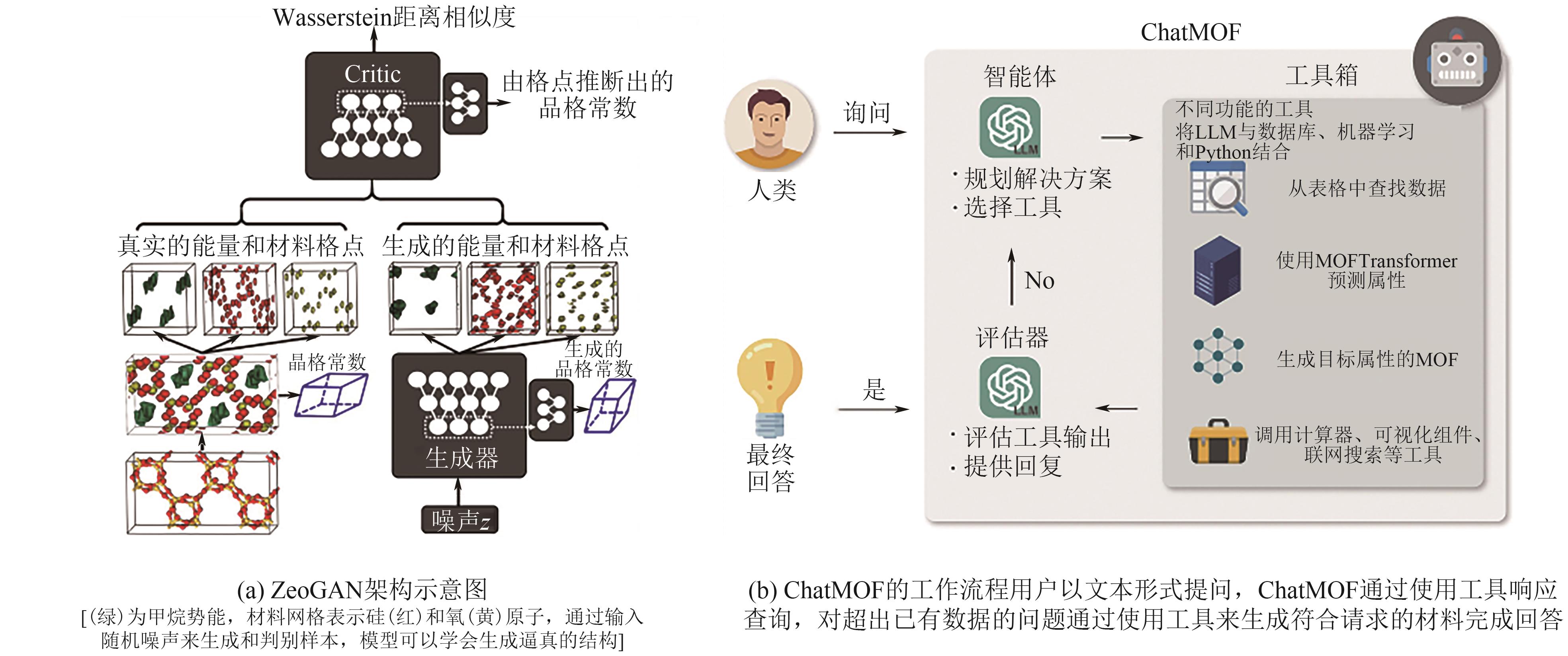
图10 ZeoGAN和ChatMOF的运行概念图[53,55]
| [1] | 陈森, 殷鹏远, 杨证禄, 等. 功能固体材料智能合成研究进展[J]. 化工进展, 2023, 42(7): 3340-3348. |
| CHEN Sen, YIN Pengyuan, YANG Zhenglu, et al. Advances in the intelligent synthesis of functional solid materials[J]. Chemical Industry and Engineering Progress, 2023, 42(7): 3340-3348. | |
| [2] | 傅思维, 刘宽, 林琮盛, 等. 能源材料替代与转型中的机器学习方法 [J]. (2025-01-23) [2025-03-27]. 化工进展, . |
| FU Siwei, LIU Kuan, LINCongsheng, et al. Machine learning methods for sustainable alternatives and transition of energy materials[J]. (2025-01-23) [2025-03-27].Chemical Industry and Engineering Progress, . | |
| [3] | 何林, 贺常晴, 隋红. 人工智能驱动新型界面分离材料的创制[J]. 化工进展, 2024, 43(4): 1649-1654. |
| HE Lin, HE Changqing, SUI Hong. Prospects for the creation of novel interfacial separation materials driven by artificial intelligence[J]. Chemical Industry and Engineering Progress, 2024, 43(4): 1649-1654. | |
| [4] | 李蓝宇, 黄新烨, 王笑楠, 等. 化工科研范式智能化转型的思考与展望[J]. 化工进展, 2023, 42(7): 3325-3330. |
| LI Lanyu, HUANG Xinye, WANG Xiaonan, et al. Reflection and prospects on the intelligent transformation of chemical engineering research[J]. Chemical Industry and Engineering Progress, 2023, 42(7): 3325-3330. | |
| [5] | 李炜, 梁添贵, 林元创, 等. 机器学习辅助高通量筛选金属有机骨架材料[J]. 化学进展, 2022, 34(12): 2619-2637. |
| LI Wei, LIANG Tiangui, LIN Yuanchuang, et al. Machine learning accelerated high-throughput computational screening of metal-organic frameworks[J]. Progress in Chemistry, 2022, 34(12): 2619-2637. | |
| [6] | CHUNG Yongchul G, CAMP Jeffrey, HARANCZYK Maciej, et al. Computation-ready, experimental metal-organic frameworks: A tool to enable high-throughput screening of nanoporous crystals[J]. Chemistry of Materials, 2014, 26(21): 6185-6192. |
| [7] | CHUNG Yongchul G, HALDOUPIS Emmanuel, BUCIOR Benjamin J, et al. Advances, updates, and analytics for the computation-ready, experimental metal-organic framework database: CoRE MOF 2019[J]. Journal of Chemical & Engineering Data, 2019, 64(12): 5985-5998. |
| [8] | WILMER Christopher E, LEAF Michael, LEE Chang Yeon, et al. Large-scale screening of hypothetical metal-organic frameworks[J]. Nature Chemistry, 2011, 4(2): 83-89. |
| [9] | TONG Minman, LAN Youshi, YANG Qingyuan, et al. Exploring the structure-property relationships of covalent organic frameworks for noble gas separations[J]. Chemical Engineering Science, 2017, 168: 456-464. |
| [10] | ONGARI Daniele, YAKUTOVICH Aliaksandr V, TALIRZ Leopold, et al. Building a consistent and reproducible database for adsorption evaluation in covalent-organic frameworks[J]. ACS Central Science, 2019, 5(10): 1663-1675. |
| [11] | DE VOS Juul S, BORGMANS Sander, VAN DER VOORT Pascal, et al. ReDD-COFFEE: A ready-to-use database of covalent organic framework structures and accurate force fields to enable high-throughput screenings[J]. Journal of Materials Chemistry A, 2023, 11(14): 7468-7487. |
| [12] | The structure commission of the international zeolite association. Database of zeolite structures[DB/OL]. (2024-08-24) [2025-03-27]. . |
| [13] | POPHALE Ramdas, CHEESEMAN Phillip A, DEEM Michael W. A database of new zeolite-like materials[J]. Physical Chemistry Chemical Physics, 2011, 13(27): 12407-12412. |
| [14] | LI Yi, LI Xu, LIU Jiancong, et al. In silico prediction and screening of modular crystal structures via a high-throughput genomic approach[J]. Nature Communications, 2015, 6: 8328. |
| [15] | DAVOODI Shadfar, THANH Hung VO, WOOD David A, et al. Machine-learning models to predict hydrogen uptake of porous carbon materials from influential variables[J]. Separation and Purification Technology, 2023, 316: 123807. |
| [16] | PARK Junkil, LEE Wonseok, KIM Jihan. Large-scale construction and analysis of amorphous porous polymer network materials[J]. ACS Applied Materials & Interfaces, 2024, 16(42): 57190-57199. |
| [17] | GLASBY Lawson T, GUBSCH Kristian, BENCE Rosalee, et al. DigiMOF: A database of metal-organic framework synthesis information generated via text mining[J]. Chemistry of Materials, 2023, 35(11): 4510-4524. |
| [18] | LUO Yi, Saientan BAG, ZAREMBA Orysia, et al. MOF synthesis prediction enabled by automatic data mining and machine learning[J]. Angewandte Chemie International Edition, 2022, 61(19): e202200242. |
| [19] | FERNANDEZ Michael, Tom K WOO, WILMER Christopher E, et al. Large-scale quantitative structure-property relationship (QSPR) analysis of methane storage in metal-organic frameworks[J]. The Journal of Physical Chemistry C, 2013, 117(15): 7681-7689. |
| [20] | OKELLO Felix Otieno, TIZHE FIDELIS Timothy, AGUMBA John, et al. Towards estimation and mechanism of CO2 adsorption on zeolite adsorbents using molecular simulations and machine learning[J]. Materials Today Communications, 2023, 36: 106594. |
| [21] | 陈佳丽, 赵国祥, 颜亚玉, 等. 机器学习探究电子气体在沸石分子筛上的吸附[J]. 无机化学学报, 2025, 41(1): 155-164. |
| CHEN Jiali, ZHAO Guoxiang, YAN Yayu, et al. Machine learning exploring the adsorption of electronic gases on zeolite molecular sieves[J]. Chinese Journal of Inorganic Chemistry, 2025, 41(1): 155-164. | |
| [22] | LIANG Heng, JIANG Kun, YAN Tongan, et al. XGBoost: An optimal machine learning model with just structural features to discover MOF adsorbents of Xe/Kr[J]. ACS Omega, 2021, 6(13): 9066-9076. |
| [23] | ZHANG Zihao, SCHOTT Jennifer A, LIU Miaomiao, et al. Prediction of carbon dioxide adsorption via deep learning[J]. Angewandte Chemie International Edition, 2019, 58(1): 259-263. |
| [24] | HU Jianbo, CUI Jiyu, GAO Bin, et al. Machine-learning-assisted exploration of anion-pillared metal organic frameworks for gas separation[J]. Matter, 2022, 5(11): 3901-3911. |
| [25] | FANOURGAKIS George S, GKAGKAS Konstantinos, TYLIANAKIS Emmanuel, et al. A universal machine learning algorithm for large-scale screening of materials[J]. Journal of the American Chemical Society, 2020, 142(8): 3814-3822. |
| [26] | 韩荣美, 韩琪, 张政清, 等. 耦合机器学习与高通量计算研究疏水MOFs在CO2/C2H2膜分离中的构效关系[J/OL]. (2025-02-24) [2025-03-27]. . . |
| HAN Rongmei, HAN Qi, ZHANG Zhengqing, et al. Coupling machine learning and high-throughput computing to study the structure-activity relationship of hydrophobic MOFs in CO2/C2H2 membrane separation[J/OL]. (2025-02-24) [2025-03-27]. . . | |
| [27] | PARDAKHTI Maryam, MOHARRERI Ehsan, WANIK David, et al. Machine learning using combined structural and chemical descriptors for prediction of methane adsorption performance of metal organic frameworks (MOFs)[J]. ACS Combinatorial Science, 2017, 19(10): 640-645. |
| [28] | 许大伟, 杨榛. 基于机器学习的多孔碳材料吸附CO2的关键因素[J]. 环境化学, 2024, 43(8): 2646-2657. |
| XU Dawei, YANG Zhen. Study on the key factors of CO2 adsorption by porous carbon materials based on machine learning[J]. Environmental Chemistry, 2024, 43(8): 2646-2657. | |
| [29] | 陈一飞, 张晓晴, 谭康豪, 等. 基于机器学习的多孔生物炭吸附CO2性能预测[J/OL]. (2023-06-14) [2025-03-27]. . . |
| CHEN Yifei, ZHANG Xiaoqing, TAN Kanghao, et al.Prediction of CO2 adsorption performance in porous biochar based on machine learning[J/OL]. (2023-06-14) [2025-03-27]. . . | |
| [30] | 周志斌, 张智渊, 邱雨晴, 等. 机器学习解析直接空气捕集用固体胺吸附剂的构效关系[J/OL]. (2024-06-19) [2025-03-27]. 工程科学与技术, . |
| ZHOU Zhibin, ZHANG Zhiyuan, QIU Yuqing, et al. Machine learning analysis of the structure-activity relationship of solid amine adsorbents for direct air capture[J/OL]. (2024-06-19) [2025-03-27]. . . | |
| [31] | 蔡铖智, 李丽凤, 邓小梅, 等. 基于机器学习和高通量计算筛选金属有机框架的甲烷/乙烷/丙烷分离性能[J]. 化学学报, 2020, 78(5): 427-436. |
| CAI Chengzhi, LI Lifeng, DENG Xiaome, et al. Machine learning and high-throughput computational screening of metal-organic framework for separation of methane/ethane/propane[J]. Acta Chimica Sinica, 2020, 78(5): 427-436. | |
| [32] | 王诗慧, 薛小雨, 程敏, 等. 机器学习与分子模拟协同的CH4/H2分离金属有机框架高通量计算筛选[J]. 化学学报, 2022, 80(5): 614-640. |
| WANG Shihui, XUE Xiaoyu, CHENG Min, et al. High-throughput computational screening of metal-organic frameworks for CH4/H2 separation by synergizing machine learning and molecular simulation[J]. Acta Chimica Sinica, 2022, 80(5): 614-640. | |
| [33] | 周印洁, 吉思蓓, 何松阳, 等. 机器学习辅助高通量筛选金属有机骨架用于富碳天然气中分离CO2 [J]. 化工学报, 2025, 76(3): 1093-1101. |
| ZHOU Yinjie, JI Sibei, HE Songyang, et al. Machine learning-assisted high-throughput screening approach for CO2 separation from CO2-rich natural gas using metal-organic frameworks[J]. CIESC Journal: 2025, 76(3): 1093-1101. | |
| [34] | BUCIOR Benjamin J, Scott BOBBITT N, ISLAMOGLU Timur, et al. Energy-based descriptors to rapidly predict hydrogen storage in metal-organic frameworks[J]. Molecular Systems Design & Engineering, 2019, 4(1): 162-174. |
| [35] | SHI Kaihang, LI Zhao, ANSTINE Dylan M, et al. Two-dimensional energy histograms as features for machine learning to predict adsorption in diverse nanoporous materials[J]. Journal of Chemical Theory and Computation, 2023, 19(14): 4568-4583. |
| [36] | MOOSAVI Seyed Mohamad, NANDY Aditya, JABLONKA Kevin Maik, et al. Understanding the diversity of the metal-organic framework ecosystem[J]. Nature Communications, 2020, 11(1): 4068. |
| [37] | FERNANDEZ Michael, TREFIAK Nicholas R, Tom K WOO. Atomic property weighted radial distribution functions descriptors of metal-organic frameworks for the prediction of gas uptake capacity[J]. The Journal of Physical Chemistry C, 2013, 117(27): 14095-14105. |
| [38] | 王璐, 张磊, 都健. 机器学习高效筛选用于CO2/N2选择性吸附分离的沸石材料[J]. 化工进展, 2023, 42(1): 148-158. |
| WANG Lu, ZHANG Lei, DU Jian. High-throughput screening of zeolite materials for CO2/N2 selective adsorption separation by machine learning[J]. Chemical Industry and Engineering Progress, 2023, 42(1): 148-158. | |
| [39] | WANG Ruihan, ZHONG Yeshuang, BI Leming, et al. Accelerating discovery of metal-organic frameworks for methane adsorption with hierarchical screening and deep learning[J]. ACS Applied Materials & Interfaces, 2020, 12(47): 52797-52807. |
| [40] | XIE Tian, GROSSMAN Jeffrey C. Crystal graph convolutional neural networks for an accurate and interpretable prediction of material properties[J]. Physical Review Letters, 2018, 120(14): 145301. |
| [41] | WANG Ruihan, ZOU Yurong, ZHANG Chunchun, et al. Combining crystal graphs and domain knowledge in machine learning to predict metal-organic frameworks performance in methane adsorption[J]. Microporous and Mesoporous Materials, 2022, 331: 111666. |
| [42] | CUI Jiyu, WU Fang, ZHANG Wen, et al. Direct prediction of gas adsorption via spatial atom interaction learning[J]. Nature Communications, 2023, 14(1): 7043. |
| [43] | WANG Jingqi, LIU Jiapeng, WANG Hongshuai, et al. A comprehensive transformer-based approach for high-accuracy gas adsorption predictions in metal-organic frameworks[J]. Nature Communications, 2024, 15(1): 1904. |
| [44] | CAO Zhonglin, MAGAR Rishikesh, WANG Yuyang, et al. MOFormer: Self-supervised transformer model for metal-organic framework property prediction[J]. Journal of the American Chemical Society, 2023, 145(5): 2958-2967. |
| [45] | WANG Song, LI Yi, DAI Sheng, et al. Prediction by convolutional neural networks of CO2/N2 selectivity in porous carbons from N2 adsorption isotherm at 77K[J]. Angewandte Chemie International Edition, 2020, 59(44): 19645-19648. |
| [46] | LI Xinyu, HAN He, EVANGELOU Nikolaos, et al. Machine learning-assisted crystal engineering of a zeolite[J]. Nature Communications, 2023, 14(1): 3152. |
| [47] | EVANS Jack D, COUDERT François-Xavier. Predicting the mechanical properties of zeolite frameworks by machine learning[J]. Chemistry of Materials, 2017, 29(18): 7833-7839. |
| [48] | MOGHADAM Peyman Z, ROGGE Sven M J, LI Aurelia, et al. Structure-mechanical stability relations of metal-organic frameworks via machine learning[J]. Matter, 2019, 1(1): 219-234. |
| [49] | NANDY Aditya, TERRONES Gianmarco, ARUNACHALAM Naveen, et al. MOFSimplify, machine learning models with extracted stability data of three thousand metal-organic frameworks[J]. Scientific Data, 2022, 9(1): 74. |
| [50] | NANDY Aditya, YUE Shuwen, Changhwan OH, et al. A database of ultrastable MOFs reassembled from stable fragments with machine learning models[J]. Matter, 2023, 6(5): 1585-1603. |
| [51] | TERRONES Gianmarco G, HUANG Shih-Peng, RIVERA Matthew P, et al. Metal-organic framework stability in water and harsh environments from data-driven models trained on the diverse WS24 data set[J]. Journal of the American Chemical Society, 2024, 146(29): 20333-20348. |
| [52] | MOOSAVI Seyed Mohamad, NOVOTNY Balázs Álmos, ONGARI Daniele, et al. A data-science approach to predict the heat capacity of nanoporous materials[J]. Nature Materials, 2022, 21(12): 1419-1425. |
| [53] | KIM Baekjun, LEE Sangwon, KIM Jihan. Inverse design of porous materials using artificial neural networks[J]. Science Advances, 2020, 6(1): eaax9324. |
| [54] | YAO Zhenpeng, Benjamín SÁNCHEZ-LENGELING, Scott BOBBITT N, et al. Inverse design of nanoporous crystalline reticular materials with deep generative models[J]. Nature Machine Intelligence, 2021, 3(1): 76-86. |
| [55] | KANG Yeonghun, KIM Jihan. ChatMOF: An artificial intelligence system for predicting and generating metal-organic frameworks using large language models[J]. Nature Communications, 2024, 15(1): 4705. |
| [1] | 吴邦华, 王德武, 王若瑾, 刘燕, 徐荣升, 张少峰. 气固摆动流化床的起始流化特性[J]. 化工进展, 2025, 44(7): 3770-3780. |
| [2] | 唐轩, 白晓炜, 张飞飞, 李晋平, 杨江峰. 沸石分子筛用于CO2-N2-CH4筛分分离的研究进展[J]. 化工进展, 2025, 44(7): 3938-3949. |
| [3] | 梁书玮, 俞杰, 谢钟音, 裴鉴禄, 林中鑫, 陈泽翔. 共价有机框架吸附放射性气态碘的研究进展[J]. 化工进展, 2025, 44(7): 3965-3975. |
| [4] | 陈倩, 仝坤, 谢加才, 邵志国, 聂凡, 李成涛. 含聚油泥处理技术研究进展[J]. 化工进展, 2025, 44(7): 4158-4168. |
| [5] | 马丙瑞, 段学斌, 陈澄, 王松雪, 陈琳, 王守成, 李金成, 武桂芝, 闫博引. UV-氯联用降解卡马西平动力学及活性氯物种的功能[J]. 化工进展, 2025, 44(7): 4212-4222. |
| [6] | 付江, 孙姣霞, 付俊杰, 朱敏, 宋品学, 周怡宁, 樊建新. 疏水改性聚酯纤维织物的自清洁作用及油水分离性能[J]. 化工进展, 2025, 44(6): 3121-3131. |
| [7] | 李明, 周依, 南兰, 叶晓生. 自动优化连续合成研究进展[J]. 化工进展, 2025, 44(6): 3190-3198. |
| [8] | 王恒, 卢春喜. 3.6Mt/a催化裂化旋风分离装置结构优选及运行效果分析[J]. 化工进展, 2025, 44(6): 3238-3246. |
| [9] | 张磊, 张新儒, 王永洪, 李晋平, 刘春波. 二维纳米材料混合基质膜在渗透汽化有机物分离的研究进展[J]. 化工进展, 2025, 44(6): 3324-3335. |
| [10] | 李想, 李佳莹, 倪恒, 孙浩然, 曹家伟, 陈宇轩, 刘凤娇. 氢原子转移反应活化能垒预测研究进展[J]. 化工进展, 2025, 44(6): 3336-3344. |
| [11] | 李佩燚, 孙波龙, 刘瑞岩, 周歆尧, 刘瑞林, 胡园园, 徐功涛, 李新平. 海藻酸钠/二氧化钛复合多孔材料的制备及油水分离应用[J]. 化工进展, 2025, 44(6): 3053-3061. |
| [12] | 柳永兵, 王亚军, 谷平, 张永民, 郭怀勇, 刘凯. 浆态床反应器中多相分离研究进展[J]. 化工进展, 2025, 44(6): 3345-3363. |
| [13] | 单灵海, 段欢欢, 郑旭铭, 黄晓璜, 崔国民. 一种新的换热单元竞争强化策略优化换热网络[J]. 化工进展, 2025, 44(6): 3393-3404. |
| [14] | 韩沛, 李金键, 柯天, 张治国, 鲍宗必, 任其龙, 杨启炜. 新型多孔材料吸附分离六氟化硫/氮气研究进展[J]. 化工进展, 2025, 44(6): 3592-3617. |
| [15] | 武敏, 廖亚龙, 贾小宝, 杨双宇. 强化黄铜矿细菌浸出的研究进展[J]. 化工进展, 2025, 44(6): 3618-3629. |
| 阅读次数 | ||||||
|
全文 |
|
|||||
|
摘要 |
|
|||||