化工进展 ›› 2025, Vol. 44 ›› Issue (6): 3121-3131.DOI: 10.16085/j.issn.1000-6613.2024-1531
• 专栏:化工生态环境前沿交叉新技术 • 上一篇
疏水改性聚酯纤维织物的自清洁作用及油水分离性能
付江( ), 孙姣霞(), 付俊杰, 朱敏, 宋品学, 周怡宁, 樊建新
- 重庆交通大学河海学院,重庆 400074
-
收稿日期:2024-09-20修回日期:2024-10-21出版日期:2025-06-25发布日期:2025-07-08 -
通讯作者:孙姣霞 -
作者简介:付江(1999—),男,硕士研究生,研究方向为水文与水资源。E-mail:834030308@qq.com。 -
基金资助:重庆市自然科学基金面上(CSTB2024NSCQ-MSX0681);重庆市大学生创新创业项目(X202410618022)
Self-cleaning effect and oil-water separation performance of hydrophobic modified polyester fiber fabric
FU Jiang(), SUN Jiaoxia(), FU Junjie, ZHU Min, SONG Pinxue, ZHOU Yining, FAN Jianxin
- School of River and Ocean Engineering, Chongqing Jiaotong University, Chongqing 400074, China
-
Received:2024-09-20Revised:2024-10-21Online:2025-06-25Published:2025-07-08 -
Contact:SUN Jiaoxia

摘要:
各行各业产生的含油废水严重威胁水生环境和人类健康,同时合成聚酯纤维的广泛使用,产生了大量的废弃纤维,其造成的环境污染也不容忽视。为了开发再利用废弃纤维织物,采用简单的浸渍法,将聚二甲基硅氧烷(PDMS)和纳米二氧化钛(TiO2)有效负载在聚酯(PET)纤维织物的表面,制备了疏水改性的PET纤维织物,并将其用于油水混合物的分离,达到了以废治废的目的。本研究采用扫描电镜、接触角测试仪、傅里叶红外光谱仪和X射线光电子能谱仪对疏水改性PET织物进行了理化性质表征,进一步测试了疏水改性PET织物的防污性能、化学稳定性和油水分离性能。结果表明:改性后PDMS和TiO2纳米颗粒成功负载在PET纤维织物表面,其水接触角可达142°,具有防污自清洁性能以及良好的化学稳定性。此外,用体积比为1∶1的氯仿和水的混合物进行分离时,其分离效率可达98.3%,通量可达(16997.27±1499.46)L/(m2·h),并且经过10次重复分离后,分离效率仍能达到95.7%以上,通量仍可稳定在(16551.41±1725.66)L/(m2·h)以上。综上所述,该疏水PET纤维织物具有良好的自清洁作用、较高的通量以及良好的油水分离性能,为废弃纤维织物的再生利用提供了新的思路。
中图分类号:
引用本文
付江, 孙姣霞, 付俊杰, 朱敏, 宋品学, 周怡宁, 樊建新. 疏水改性聚酯纤维织物的自清洁作用及油水分离性能[J]. 化工进展, 2025, 44(6): 3121-3131.
FU Jiang, SUN Jiaoxia, FU Junjie, ZHU Min, SONG Pinxue, ZHOU Yining, FAN Jianxin. Self-cleaning effect and oil-water separation performance of hydrophobic modified polyester fiber fabric[J]. Chemical Industry and Engineering Progress, 2025, 44(6): 3121-3131.
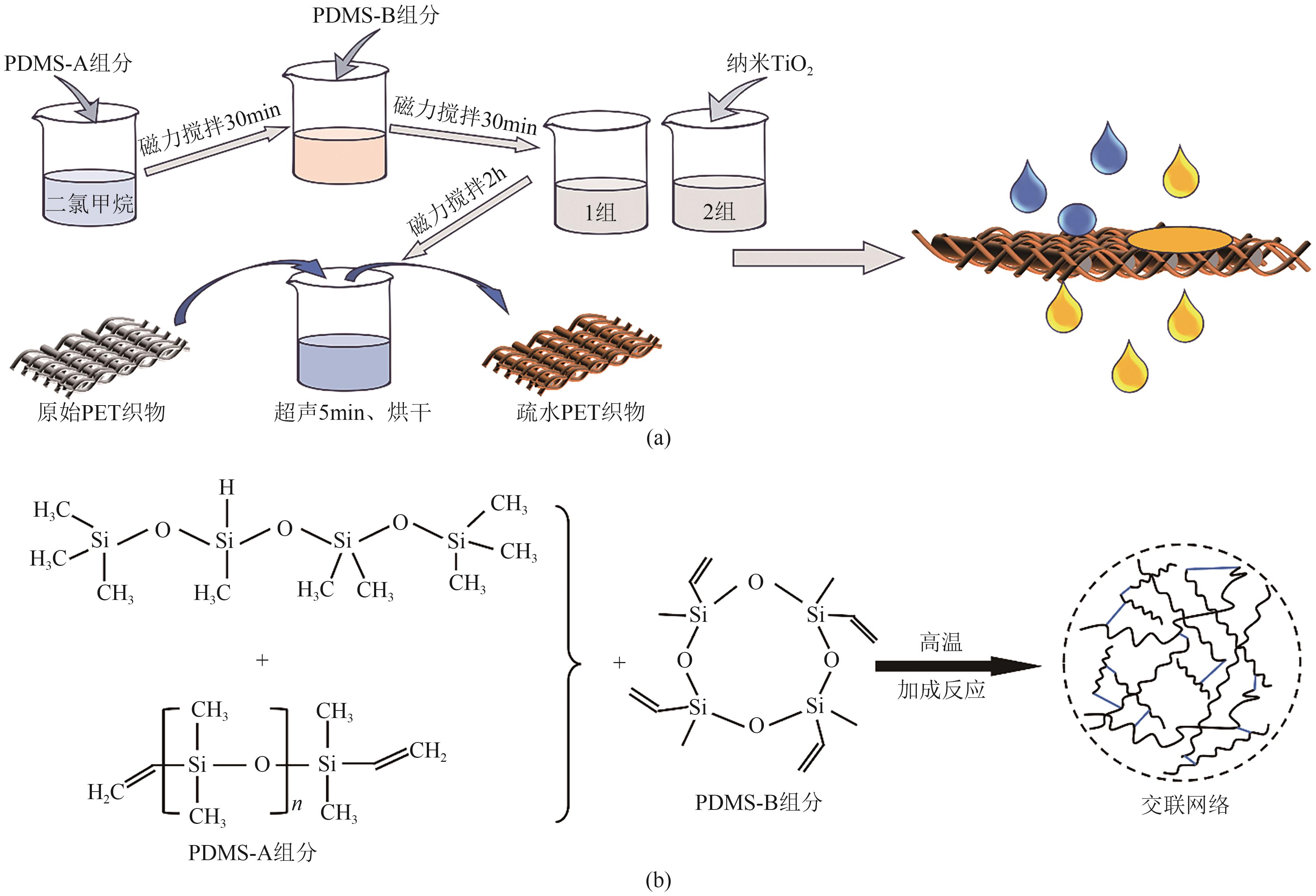
图1 疏水聚酯织物的制备及PDMS固化机理
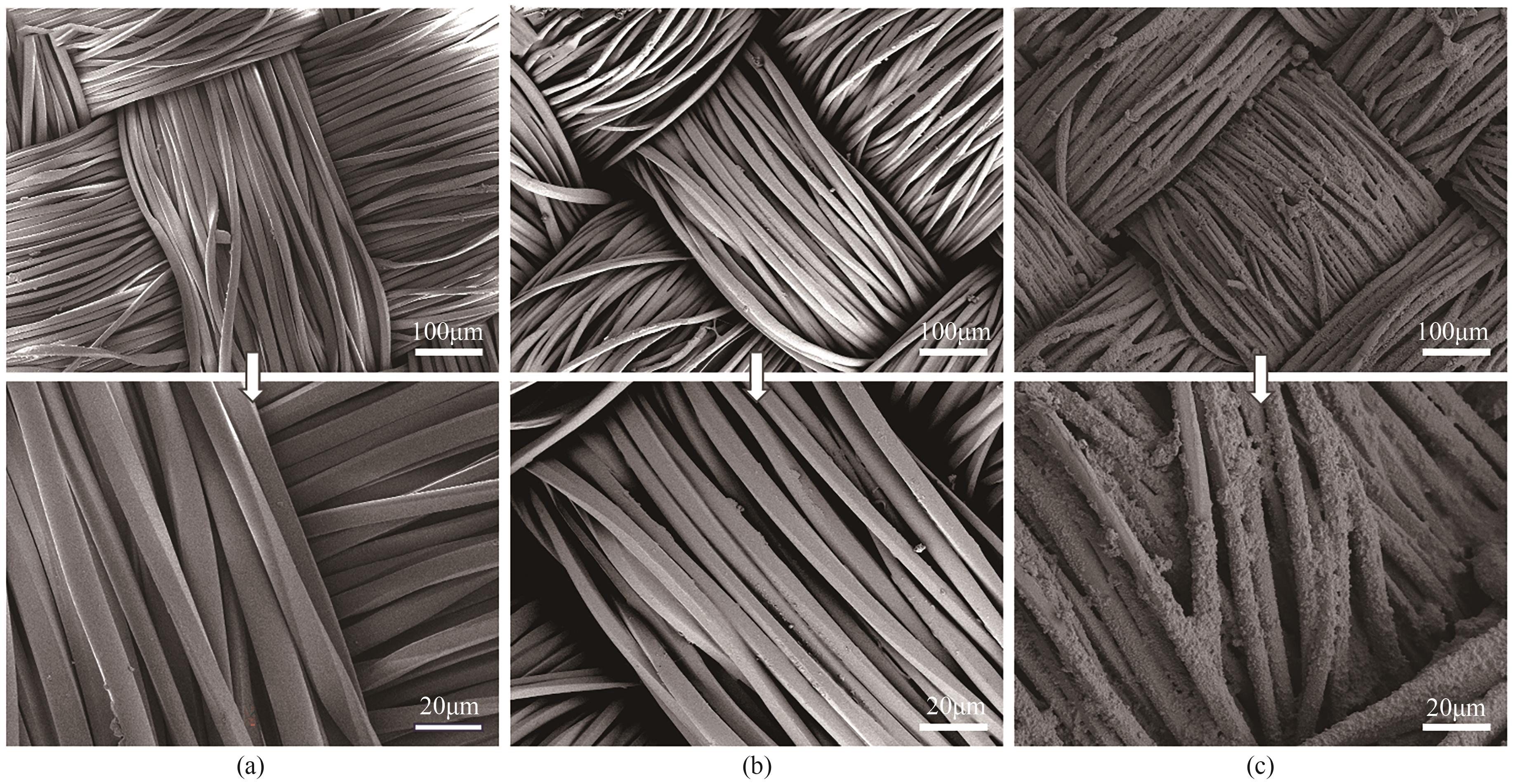
图2 改性前后聚酯纤维织物扫描电子显微镜图像
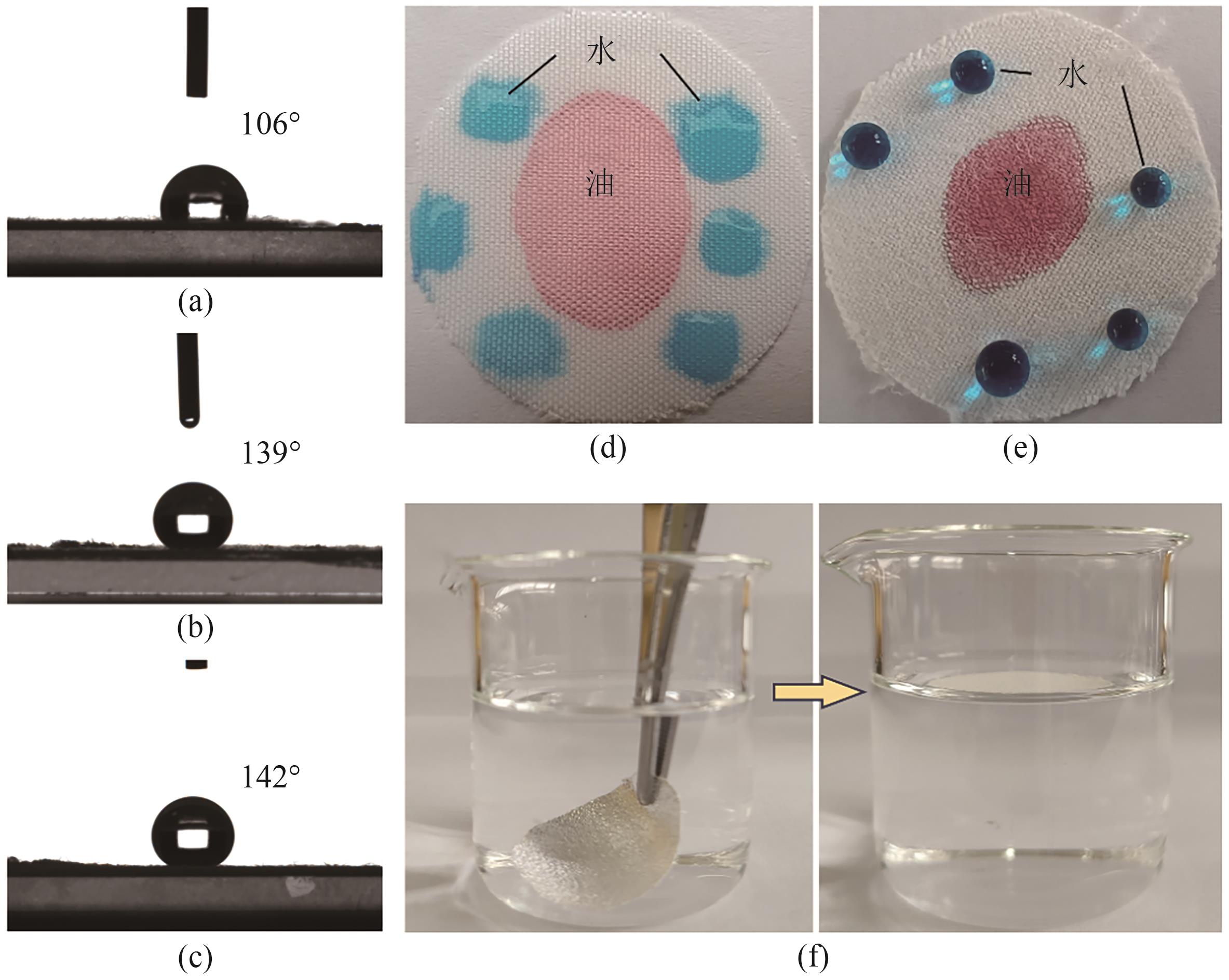
图3 聚酯纤维织物改性前后的接触角变化情况及水和油在织物表面产生的宏观现象
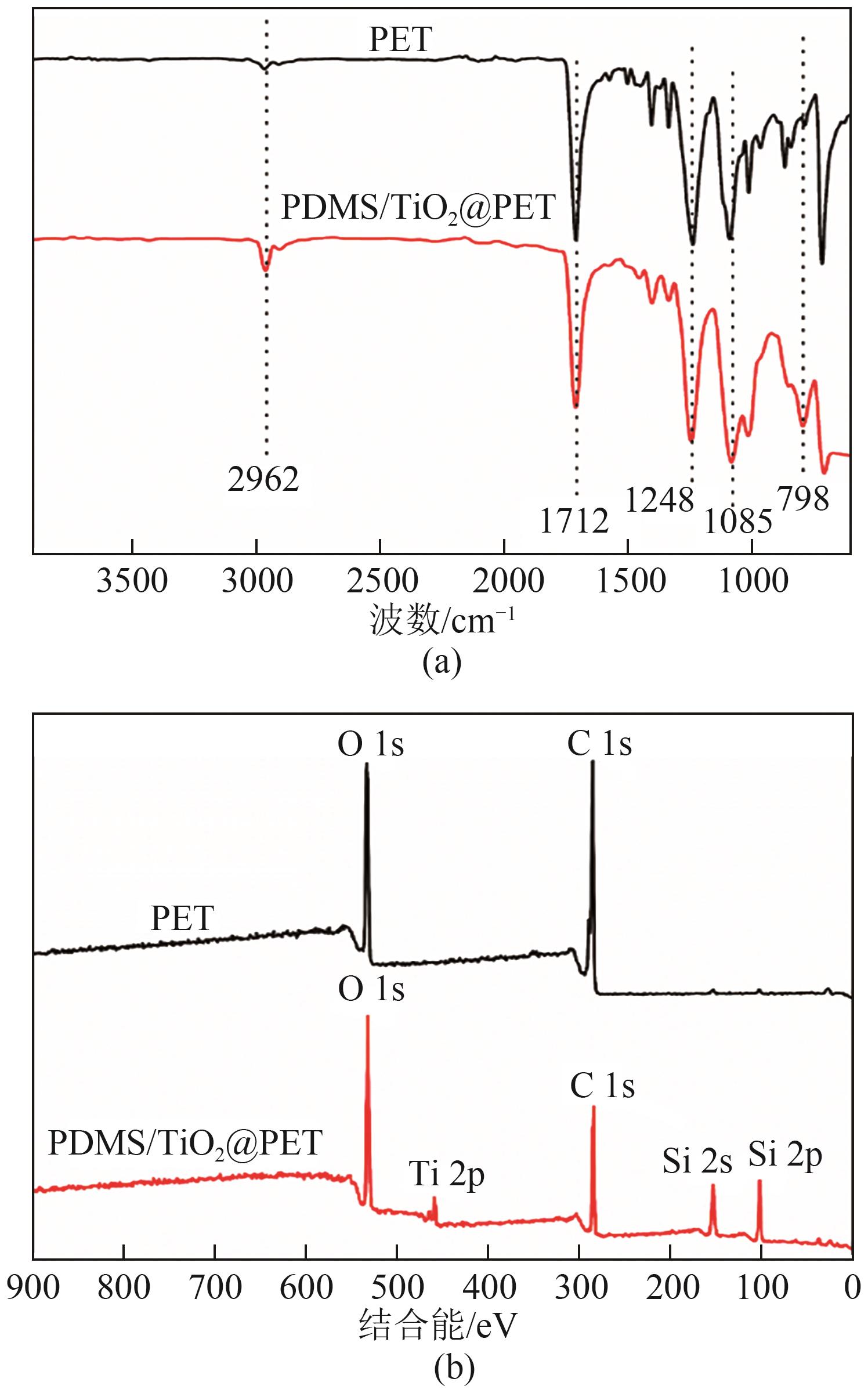
图4 原始PET纤维织物与PDMS/TiO2改性后PET纤维织物的红外光谱图和XPS图谱
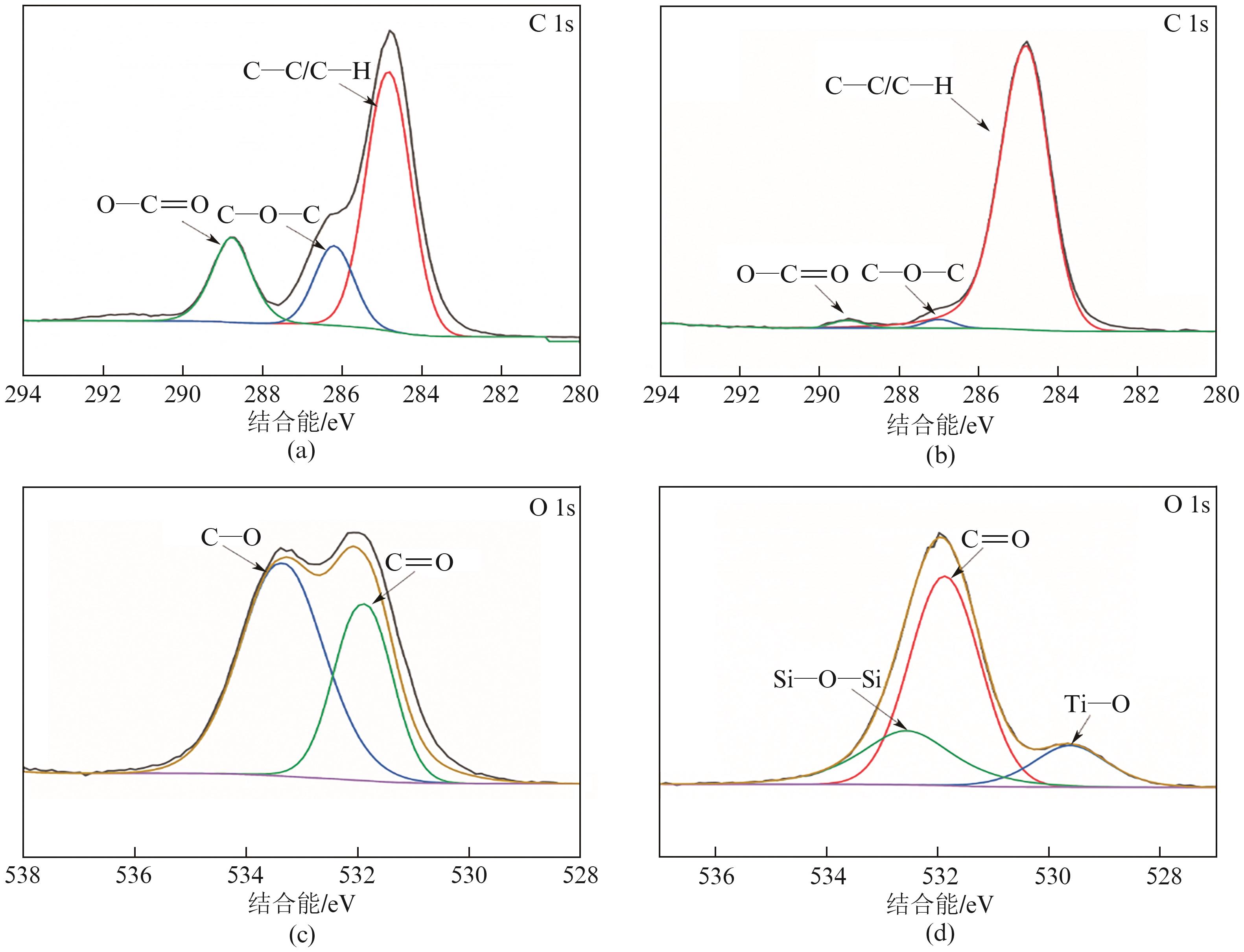
图5 原始PET纤维织物与PDMS/TiO2改性后PET纤维织物的C 1s和O 1s精细图谱
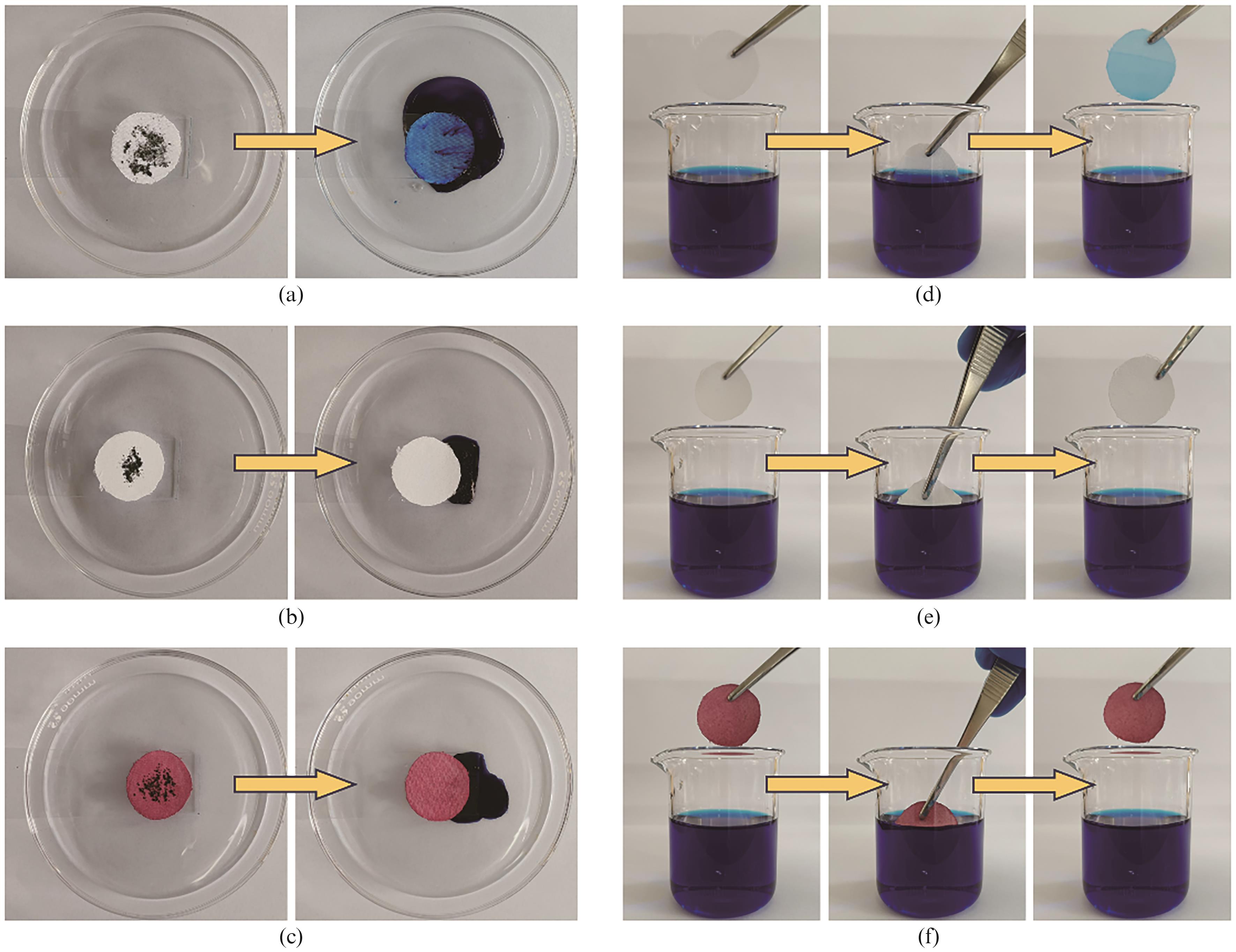
图6 原始PET纤维织物与PDMS/TiO2改性后PET纤维织物表面的自清洁性及防污性能测试
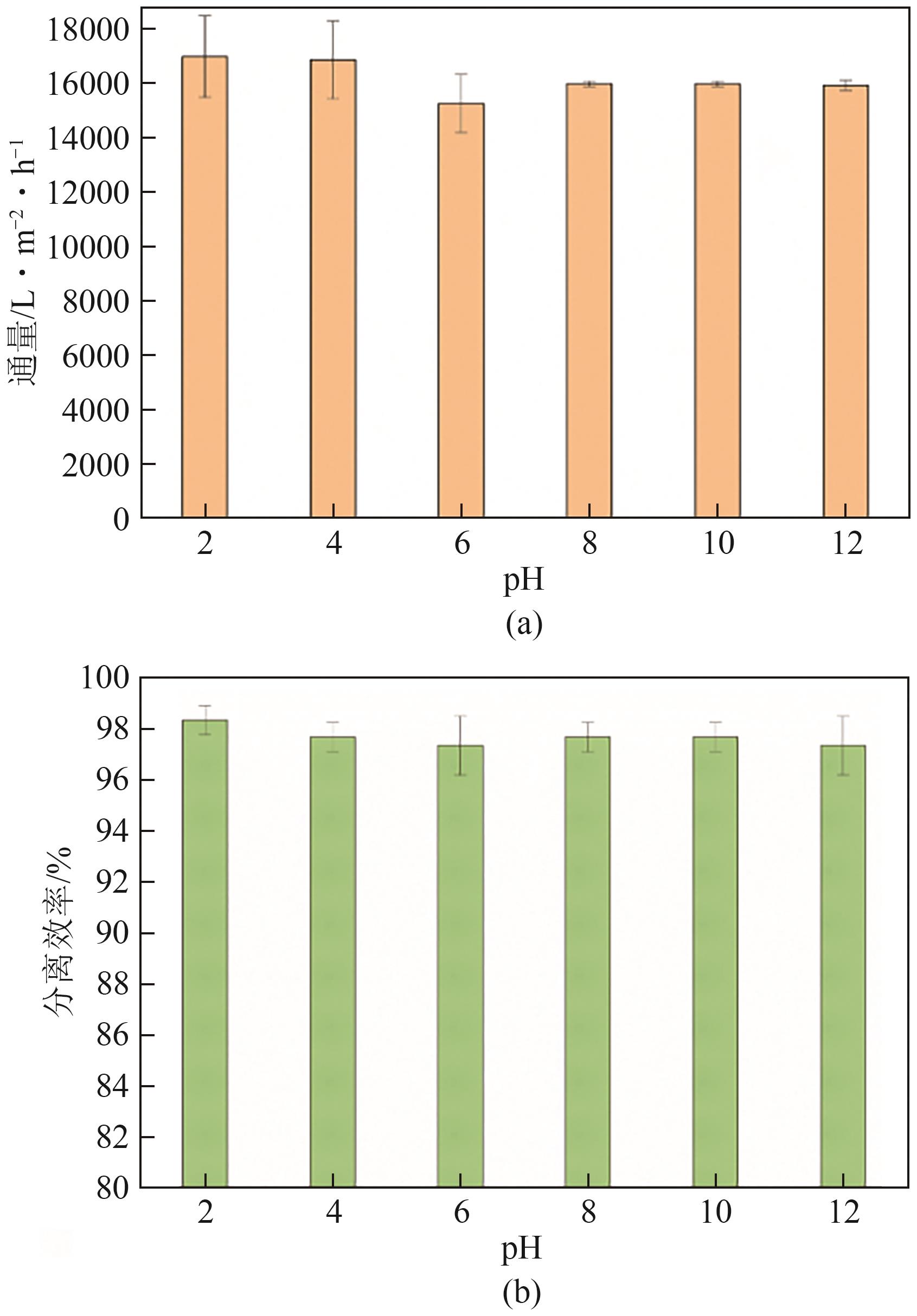
图7 PDMS/TiO2改性PET纤维织物在不同pH溶液中浸泡后的分离通量和效率
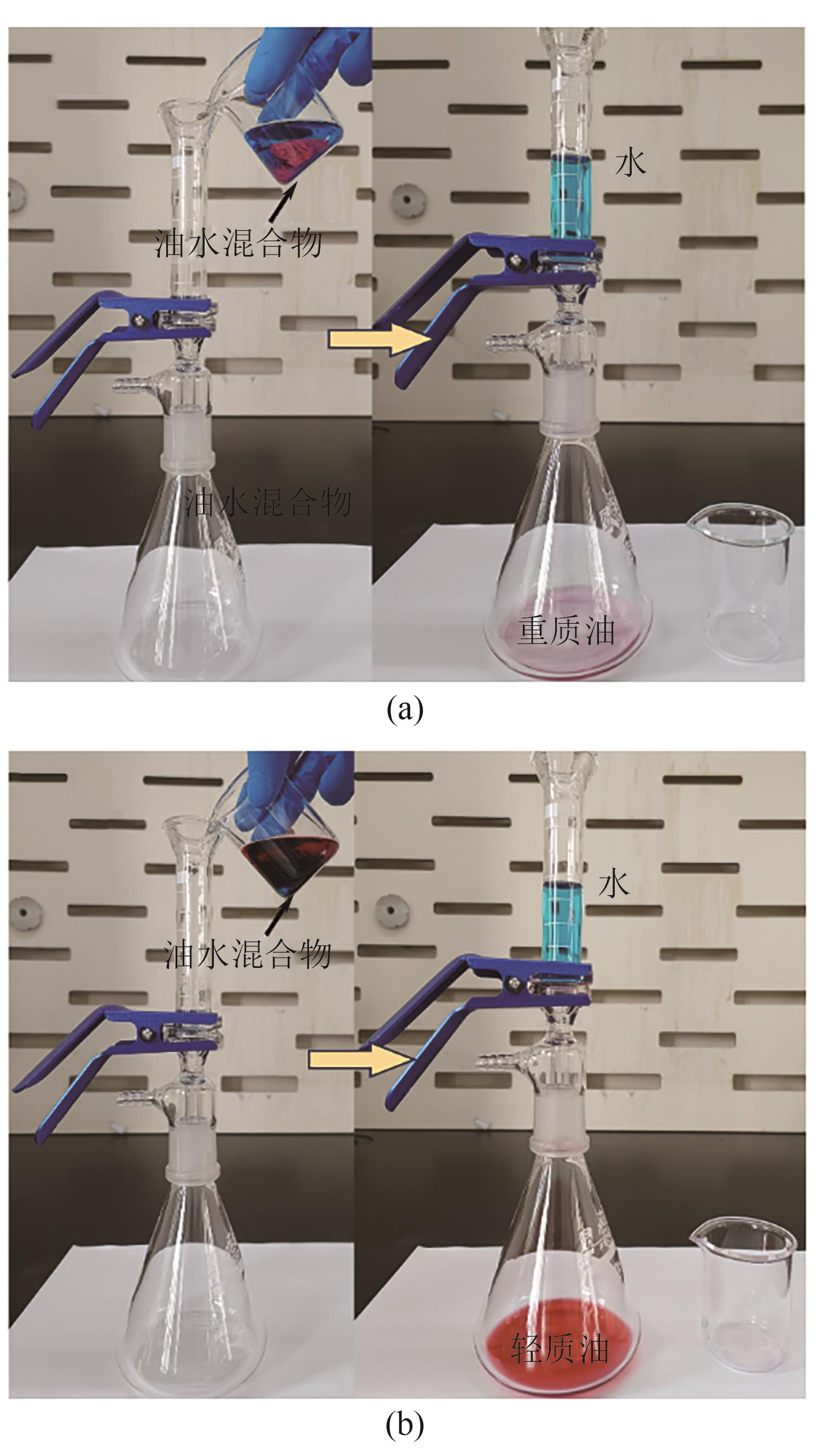
图8 重质油和轻质油的油水分离过程
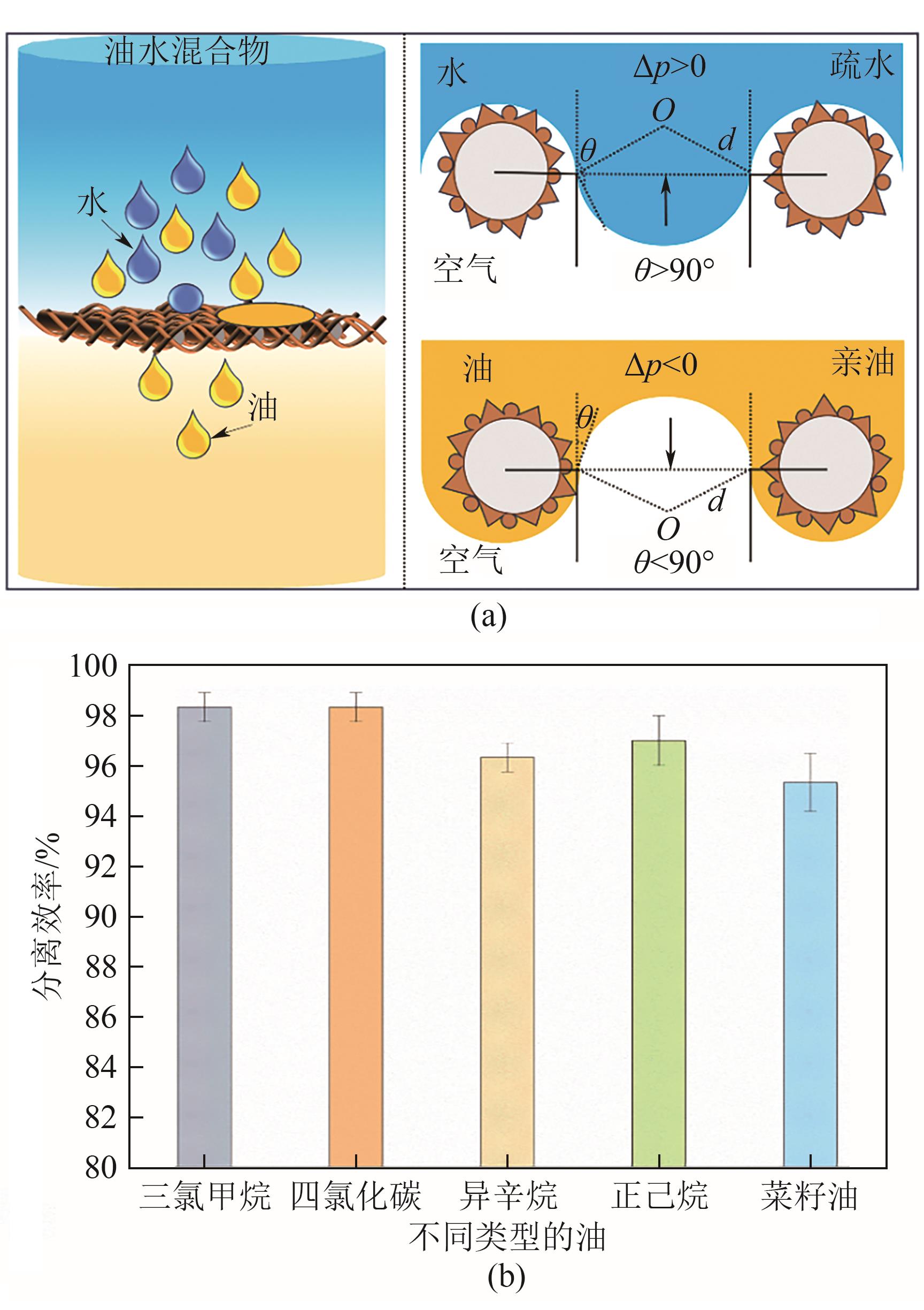
图9 油水混合物重力分离的基本原理与PDMS/TiO2@PET纤维织物对不同种类油的分离效率
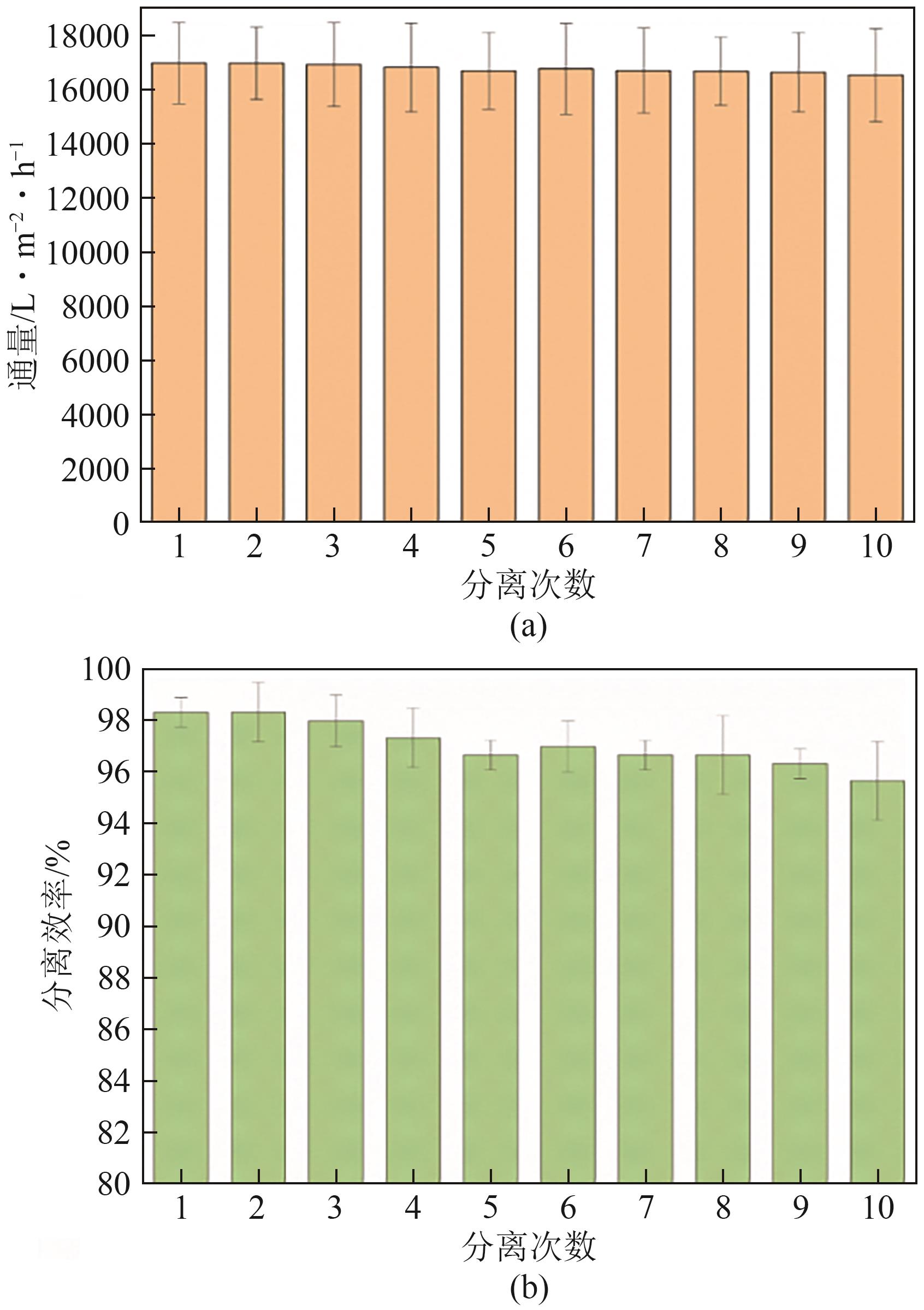
图10 PDMS/TiO2@PET纤维织物循环分离10次后的分离通量和效率
| 材料 | 油水混合物类型 | 分离效率/% | 分离通量/L·m-2·h-1 | 参考文献 |
|---|---|---|---|---|
| DCT-OCPOSS@PET | 三氯甲烷和水 | >99% | — | [ |
| PDMS/SiO2@PET | 柴油和水 | 95% | — | [ |
| CSS复合涂层尼龙膜 | 正己烷和水 | 99.8% | 31847 | [ |
| rPET@PDMS | 四氯化碳和水 | 98.5% | ≤20000 | [ |
| HDTMS/HTPDMS/PMHS@PET | 二氯甲烷和水 | 99.8% | 20473±928 | [ |
| 本研究(PDMS/TiO2@PET) | 三氯甲烷和水 | 98.3% | 16997.27±1499.46 | — |
表1 各种废弃材料分离油水混合物的效率和通量
| 材料 | 油水混合物类型 | 分离效率/% | 分离通量/L·m-2·h-1 | 参考文献 |
|---|---|---|---|---|
| DCT-OCPOSS@PET | 三氯甲烷和水 | >99% | — | [ |
| PDMS/SiO2@PET | 柴油和水 | 95% | — | [ |
| CSS复合涂层尼龙膜 | 正己烷和水 | 99.8% | 31847 | [ |
| rPET@PDMS | 四氯化碳和水 | 98.5% | ≤20000 | [ |
| HDTMS/HTPDMS/PMHS@PET | 二氯甲烷和水 | 99.8% | 20473±928 | [ |
| 本研究(PDMS/TiO2@PET) | 三氯甲烷和水 | 98.3% | 16997.27±1499.46 | — |
| [1] | ZHEN Xingwei, VINNEM Jan Erik, HAN Yue, et al. Development and prospects of major accident indicators in the offshore petroleum sector[J]. Process Safety and Environmental Protection, 2022, 160: 551-562. |
| [2] | YANG Haocheng, XIE Yunsong, CHAN Henry, et al. Crude-oil-repellent membranes by atomic layer deposition: Oxide interface engineering[J]. ACS Nano, 2018, 12(8): 8678-8685. |
| [3] | HANAFY M, NABIH H I. Treatment of oily wastewater using dissolved air flotation technique[J]. Energy Sources, Part A: Recovery, Utilization, and Environmental Effects, 2007, 29(2): 143-159. |
| [4] | LI Jiatu, TENJIMBAYASHI Mizuki, ZACHARIA Nicole S, et al. One-step dipping fabrication of Fe3O4/PVDF-HFP composite 3D porous sponge for magnetically controllable oil-water separation[J]. ACS Sustainable Chemistry & Engineering, 2018, 6(8): 10706-10713. |
| [5] | 胡晓林, 刘红兵. 几种油水分离技术介绍[J]. 热力发电, 2008, 37(3): 91-92. |
| HU Xiaolin, LIU Hongbing. Presentation of several technologies for oil and water separation[J]. Thermal Power Generation, 2008, 37(3): 91-92. | |
| [6] | HOSSEINZADEH Hossein, MOHAMMADI Sina. Synthesis of a novel hydrogel nanocomposite coated on cotton fabric for water-oil separation[J]. Water, Air, & Soil Pollution, 2014, 225(9): 2115. |
| [7] | 申权. 基于逐层连续梯度结构的油水分离纤维膜的构建及其应用研究[D]. 贵阳: 贵州大学, 2022. |
| SHEN Quan. Construction and application of fiber membrane for oil-water separation based on layer-by-layer continuous gradient structure[D]. Guiyang: Guizhou University, 2022. | |
| [8] | JIN Yangxin, JIANG Peng, KE Qingping, et al. Superhydrophobic and superoleophilic polydimethylsiloxane-coated cotton for oil-water separation process: An evidence of the relationship between its loading capacity and oil absorption ability[J]. Journal of Hazardous Materials, 2015, 300: 175-181. |
| [9] | KIM Ho Jong, HAN Sang Wook, KIM Ju Hwan, et al. Oil absorption capacity of bare and PDMS-coated PET non-woven fabric; dependency of fiber strand thickness and oil viscosity[J]. Current Applied Physics, 2018, 18(4): 369-376. |
| [10] | Jana ŠTEFELOVÁ, Václav SLOVÁK, SIQUEIRA Gilberto, et al. Drying and pyrolysis of cellulose nanofibers from wood, bacteria, and algae for char application in oil absorption and dye adsorption[J]. ACS Sustainable Chemistry & Engineering, 2017, 5(3): 2679-2692. |
| [11] | STOLZ Aude, LE FLOCH Sylvie, REINERT Laurence, et al. Melamine-derived carbon sponges for oil-water separation[J]. Carbon, 2016, 107: 198-208. |
| [12] | SIDDIQUI Abdul Rahim, MAURYA Rita, BALANI Kantesh. Superhydrophobic self-floating carbon nanofiber coating for efficient gravity-directed oil/water separation[J]. Journal of Materials Chemistry A, 2017, 5(6): 2936-2946. |
| [13] | LIU Huijie, ALAM Md Kowsar, HE Mantang, et al. Sustainable cellulose aerogel from waste cotton fabric for high-performance solar steam generation[J]. ACS Applied Materials & Interfaces, 2021, 13(42): 49860-49867. |
| [14] | LI Yong, LI Hao, WU Jun, et al. Facile recycling of waste fabrics for preparing multifunctional photothermal protective materials[J]. ACS Sustainable Chemistry & Engineering, 2023, 11(28): 10566-10577. |
| [15] | JIANG Xiangyang, TANG Chuchu, ZHAO Ziyi, et al. Cationic waste cotton fabric for the adsorptive colorimetric detection of chromium ion traces[J]. ACS Sustainable Chemistry & Engineering, 2023, 11(17): 6610-6618. |
| [16] | Pradeep Kumar SOW, ISHITA, SINGHAL Richa. Sustainable approach to recycle waste polystyrene to high-value submicron fibers using solution blow spinning and application towards oil-water separation[J]. Journal of Environmental Chemical Engineering, 2020, 8(2): 102786. |
| [17] | LIU Weimin, CUI Mengke, SHEN Yongqian, et al. Waste cigarette filter as nanofibrous membranes for on-demand immiscible oil/water mixtures and emulsions separation[J]. Journal of Colloid and Interface Science, 2019, 549: 114-122. |
| [18] | GUO Wenwen, WANG Xin, HUANG Jiali, et al. Construction of durable flame-retardant and robust superhydrophobic coatings on cotton fabrics for water-oil separation application[J]. Chemical Engineering Journal, 2020, 398: 125661. |
| [19] | HUANG J Y, LI S H, GE M Z, et al. Robust superhydrophobic TiO2@fabrics for UV shielding, self-cleaning and oil-water separation[J]. Journal of Materials Chemistry A, 2015, 3(6): 2825-2832. |
| [20] | CAO Chunyan, GE Mingzheng, HUANG Jianying, et al. Robust fluorine-free superhydrophobic PDMS-ormosil@fabrics for highly effective self-cleaning and efficient oil-water separation[J]. Journal of Materials Chemistry A, 2016, 4(31): 12179-12187. |
| [21] | 吕栋, 李晓君, 王敏, 等. 木材表面耐久性超疏水涂层的制备及性能研究[J]. 木材科学与技术, 2023, 37(5): 38-46. |
| Dong LYU, LI Xiaojun, WANG Min, et al. Preparation and properties of durable superhydrophobic coatings for wood surfaces[J]. Chinese Journal of Wood Science and Technology, 2023, 37(5): 38-46. | |
| [22] | CHEN Shiguo, ZHANG Shaobo, GALLUZZI Massimiliano, et al. Insight into multifunctional polyester fabrics finished by one-step eco-friendly strategy[J]. Chemical Engineering Journal, 2019, 358: 634-642. |
| [23] | ZHANG Tao, FANG Lanlan, LIN Nan, et al. Highly transparent, healable, and durable anti-fogging coating by combining hydrophilic pectin and tannic acid with poly(ethylene terephthalate)[J]. Green Chemistry, 2019, 21(19): 5405-5413. |
| [24] | BIAN Xueyan, XIA Gang, XIN John H, et al. Applications of waste polyethylene terephthalate (PET) based nanostructured materials: A review[J]. Chemosphere, 2024, 350: 141076. |
| [25] | WANG Chenxiang, ZHANG Xuefen. A non-particle and fluorine-free superhydrophobic surface based on one-step electrodeposition of dodecyltrimethoxysilane on mild steel for corrosion protection[J]. Corrosion Science, 2020, 163: 108284. |
| [26] | WANG Lizhong, TIAN Ze, JIANG Guochen, et al. Spontaneous dewetting transitions of droplets during icing & melting cycle[J]. Nature Communications, 2022, 13(1): 378. |
| [27] | SONG Ru, ZHANG Ningshuang, DONG Hong, et al. Three-dimensional biomimetic superhydrophobic nickel sponge without chemical modifications for efficient oil/water separation[J]. Separation and Purification Technology, 2022, 289: 120723. |
| [28] | Lía VÁSQUEZ, DAVIS Alexander, GATTO Francesca, et al. Multifunctional PDMS polyHIPE filters for oil-water separation and antibacterial activity[J]. Separation and Purification Technology, 2021, 255: 117748. |
| [29] | WENZEL Robert N. Resistance of solid surfaces to wetting by water[J]. Industrial & Engineering Chemistry, 1936, 28(8): 988-994. |
| [30] | LIU Gaoyang, WANG Jiajun, WANG Wei, et al. A novel PET fabric with durable anti-fouling performance for reusable and efficient oil-water separation[J]. Colloids and Surfaces A: Physicochemical and Engineering Aspects, 2019, 583: 123941. |
| [31] | SHEN Keke, YU Miao, LI Qianqian, et al. Synthesis of a fluorine-free polymeric water-repellent agent for creation of superhydrophobic fabrics[J]. Applied Surface Science, 2017, 426: 694-703. |
| [32] | XIE Atian, CUI Jiuyun, CHEN Yangyang, et al. One-step facile fabrication of sustainable cellulose membrane with superhydrophobicity via a sol-gel strategy for efficient oil/water separation[J]. Surface and Coatings Technology, 2019, 361: 19-26. |
| [33] | HAN Sang Wook, KIM Kwang-Dae, SEO Hyun Ook, et al. Oil-water separation using superhydrophobic PET membranes fabricated via simple dip-coating of PDMS-SiO2 nanoparticles[J]. Macromolecular Materials and Engineering, 2017, 302(11): 1700218. |
| [34] | DOAN Hoan Ngoc, PHONG VO Phu, HAYASHI Kohei, et al. Recycled PET as a PDMS-functionalized electrospun fibrous membrane for oil-water separation[J]. Journal of Environmental Chemical Engineering, 2020, 8(4): 103921. |
| [35] | MAO Yun, ZHU Meifang, WANG Wei, et al. Well-defined silver conductive pattern fabricated on polyester fabric by screen printing a dopamine surface modifier followed by electroless plating[J]. Soft Matter, 2018, 14(7): 1260-1269. |
| [36] | CHEN Hong, ZHOU Anqi, ZHANG Yifan, et al. Carbonaceous nanofibrous membranes with enhanced superhydrophilicity and underwater superoleophobicity for effective purification of emulsified oily wastewater[J]. Chemical Engineering Journal, 2023, 468: 143602. |
| [37] | ZHANG Qin, LI Keran, LI Jing, et al. Fabrication of hierarchically porous superhydrophobic polystyrene foam for self-cleaning, oil absorbent, highly efficient oil-water separation[J]. Chemical Engineering Journal, 2024, 483: 149338. |
| [38] | YANG Sudong, LI Hongyi, LIU Shuai, et al. Wodyetia bifurcate structured carbon fabrics with durable superhydrophobicity for high-efficiency oil-water separation[J]. Journal of Hazardous Materials, 2022, 439: 129688. |
| [39] | LONG Cai, LONG Xiao, CAI Yang, et al. Long-lived nanoparticle-embedded superhydrophobic membranes with rapid photocatalytic properties and continuous oil-water separation[J]. Chemical Engineering Journal, 2024, 482: 148743. |
| [40] | ZHANG Xinying, WANG Chaoqun, LIU Xiaoyan, et al. A durable and high-flux composite coating nylon membrane for oil-water separation[J]. Journal of Cleaner Production, 2018, 193: 702-708. |
| [41] | HUANG Gang, HUO Liang, JIN Yikai, et al. Fluorine-free superhydrophobic PET fabric with high oil flux for oil-water separation[J]. Progress in Organic Coatings, 2022, 163: 106671. |
| [1] | 李佩燚, 孙波龙, 刘瑞岩, 周歆尧, 刘瑞林, 胡园园, 徐功涛, 李新平. 海藻酸钠/二氧化钛复合多孔材料的制备及油水分离应用[J]. 化工进展, 2025, 44(6): 3053-3061. |
| [2] | 李杰, 王宇科, 石文天, 郭云杰, 陆彦宁, 付硕, 路祎祎. 激光构建超疏水表面的研究进展[J]. 化工进展, 2025, 44(3): 1432-1444. |
| [3] | 王文, 金央, 李军, 陈建钧, 陈明, 孟昕. 基于FeOOH原位生长制备用于CO2吸收的超疏水PVDF膜[J]. 化工进展, 2025, 44(3): 1570-1577. |
| [4] | 李章良, 杨月珠, 伍传田, 吕源财. 活性炭纤维毡负载N-TiO2/MoS2/N-TiO2固定化漆酶降解双酚A[J]. 化工进展, 2025, 44(2): 887-898. |
| [5] | 欧红香, 闵政, 薛洪来, 曹海珍, 毕海普, 王钧奇. 疏水改性纳米氧化镁对短氟碳链泡沫性能影响[J]. 化工进展, 2024, 43(9): 5177-5184. |
| [6] | 王文刚, 钱裕洁, 皮秋月, 王艳红, 侯秀良, 徐荷澜. 聚合松香辅助制备聚丙烯熔喷纤维膜及耐久超疏水改性[J]. 化工进展, 2024, 43(9): 5123-5132. |
| [7] | 阳梦萍, 孙军军, 张晨曦, 薛昊龙, 肖长发. 聚丙烯/聚硅氧烷-二氧化硅中空纤维膜的制备与性能分析[J]. 化工进展, 2024, 43(9): 5106-5112. |
| [8] | 任国瑜, 妥云, 郑文杰, 谯泽庭, 任壮壮, 赵娅莉, 尚军飞, 陈晓东, 高祥虎. 超疏水纳米涂层技术研究进展及应用[J]. 化工进展, 2024, 43(8): 4450-4463. |
| [9] | 李莉, 蔡鑫宇, 陈寅杰, 张文启, 李光辉, 饶品华. 超疏水-高疏油SiC膜的制备及性能[J]. 化工进展, 2024, 43(8): 4516-4522. |
| [10] | 石佳博, 张宇轩, 陈雪峰, 谭蕉君. 单宁酸-纳米协同改性胶原纤维多孔材料的制备及其油水分离性能[J]. 化工进展, 2024, 43(8): 4624-4629. |
| [11] | 曹海珍, 王尚彬, 欧红香, 薛洪来, 毕海普, 王钧奇. 疏水改性纳米二氧化硅对无氟泡沫灭火剂性能影响[J]. 化工进展, 2024, 43(6): 3301-3309. |
| [12] | 龚雪梅, 蒋军, 王超, 梅长彤. 纳米纤维素疏水改性及其功能化应用研究进展[J]. 化工进展, 2024, 43(6): 3187-3198. |
| [13] | 姚福春, 毕莹莹, 唐晨, 杜明辉, 李泽莹, 张耀宗, 孙晓明. 中空纤维膜臭氧接触式反应器传质机理分析[J]. 化工进展, 2024, 43(2): 1089-1097. |
| [14] | 何兰, 高助威, 亓欣雨, 李成欣, 王世豪, 刘钟馨. 三聚氰胺海绵疏水改性及在油水分离领域的研究进展[J]. 化工进展, 2024, 43(2): 984-1000. |
| [15] | 梁博, 王锦涛, 薛敏. 单向冰晶模板法制备有序高稳定性介孔PVA气凝胶[J]. 化工进展, 2024, 43(12): 6804-6810. |
| 阅读次数 | ||||||
|
全文 |
|
|||||
|
摘要 |
|
|||||