化工进展 ›› 2025, Vol. 44 ›› Issue (3): 1298-1308.DOI: 10.16085/j.issn.1000-6613.2024-0376
基于TiO2的光催化剂利用太阳能裂解水制氢研究进展
张馨儿1,2( ), 裴刘军1,2, 周雨蝶1,2, 靳凯丽2, 王际平1,2()
- 1.上海工程技术大学纺织服装学院,上海 201620
2.上海工程技术大学纺织化学清洁生产工程技术研究中心,上海 201620
-
收稿日期:2024-03-07修回日期:2024-04-09出版日期:2025-03-25发布日期:2025-04-16 -
通讯作者:王际平 -
作者简介:张馨儿(2000—),女,硕士研究生,研究方向为TiO2催化剂、油水分离。E-mail:1476825117@qq.com。 -
基金资助:国家自然科学基金(22072089);安徽省重点研发项目(2023t07020001);海宁市科技计划工业、农业项目(2021003);松江区科学技术攻关项目(23SJJBGS2);浙江省清洁染整技术研究重点实验室开放基金(QJRZ2301)
Progress of TiO2-based photocatalysts for hydrogen production by water splitting with solar energy
ZHANG Xin’er1,2(), PEI Liujun1,2, ZHOU Yudie1,2, JIN Kaili2, WANG Jiping1,2()
- 1.School of Textiles and Fashion Engineering, Shanghai University of Engineering Science, Shanghai 201620, China
2.Engineering Research Center of Textile Chemistry and Clean Production, Shanghai University of Engineering Science, Shanghai 201620, China
-
Received:2024-03-07Revised:2024-04-09Online:2025-03-25Published:2025-04-16 -
Contact:WANG Jiping

摘要:
太阳能裂解水制氢是储存太阳能的有效方法,可将光子转化为化学能。TiO2是太阳能驱动氢演化的最佳材料之一,但电子空穴对分离不良会限制其活性,而TiO2光催化剂与助催化剂结合可提高析氢性能。因此,本文详细回顾了金属类助催化剂对TiO2光催化制氢效果提升的相关研究,着重介绍了贵金属基助催化剂、非贵金属基助催化剂、金属硫化物和金属磷化物助催化剂、双金属基助催化剂。这些研究揭示了各种助催化剂对提升TiO2光催化效率的关键作用,展示了太阳能裂解水产氢技术的广阔应用前景。此外,为了更全面地理解这项技术,本文还深入介绍了半导体光催化制氢的详细演化机理:包括反应物的吸附、光激发过程、电子和空穴的迁移以及还原/氧化反应。通过深入剖析这些反应步骤,有望为科研人员提供一个清晰的理论框架,以便更好地制备和优化TiO2光催化中的助催化剂,同时深刻理解氢气演化的内在机制。最后对TiO2基光催化剂进行了总结与展望:即对不同种类的助催化剂的优劣势对比分析,并为光诱导析氢催化剂中的TiO2负载活性位点的定制提供丰富的思路。
中图分类号:
引用本文
张馨儿, 裴刘军, 周雨蝶, 靳凯丽, 王际平. 基于TiO2的光催化剂利用太阳能裂解水制氢研究进展[J]. 化工进展, 2025, 44(3): 1298-1308.
ZHANG Xin’er, PEI Liujun, ZHOU Yudie, JIN Kaili, WANG Jiping. Progress of TiO2-based photocatalysts for hydrogen production by water splitting with solar energy[J]. Chemical Industry and Engineering Progress, 2025, 44(3): 1298-1308.
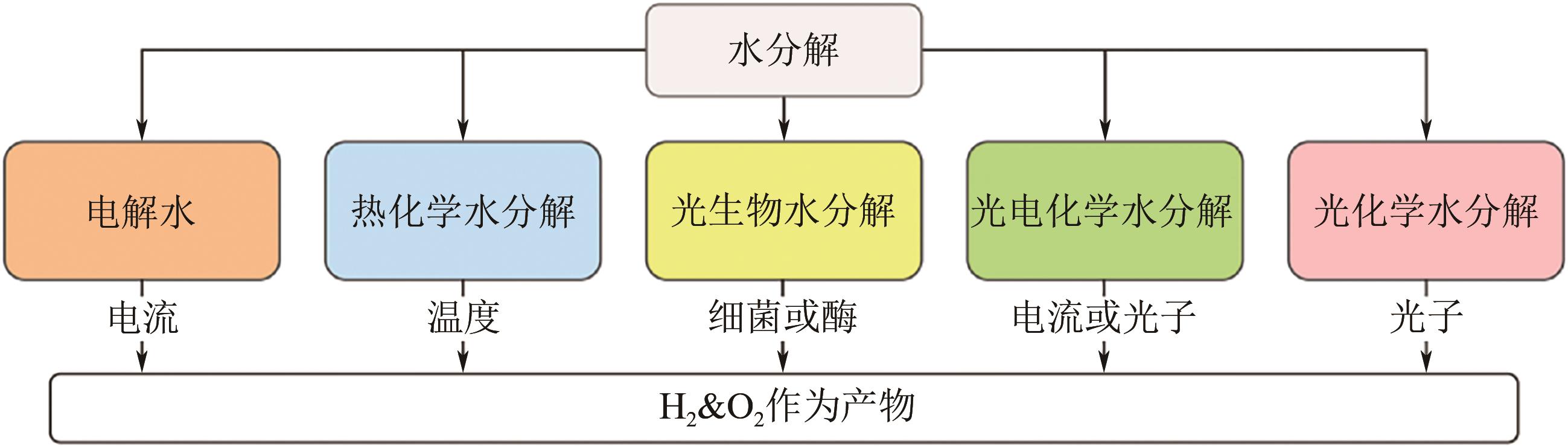
图1 不同类型的水分解过程产生氢气和氧气[26]
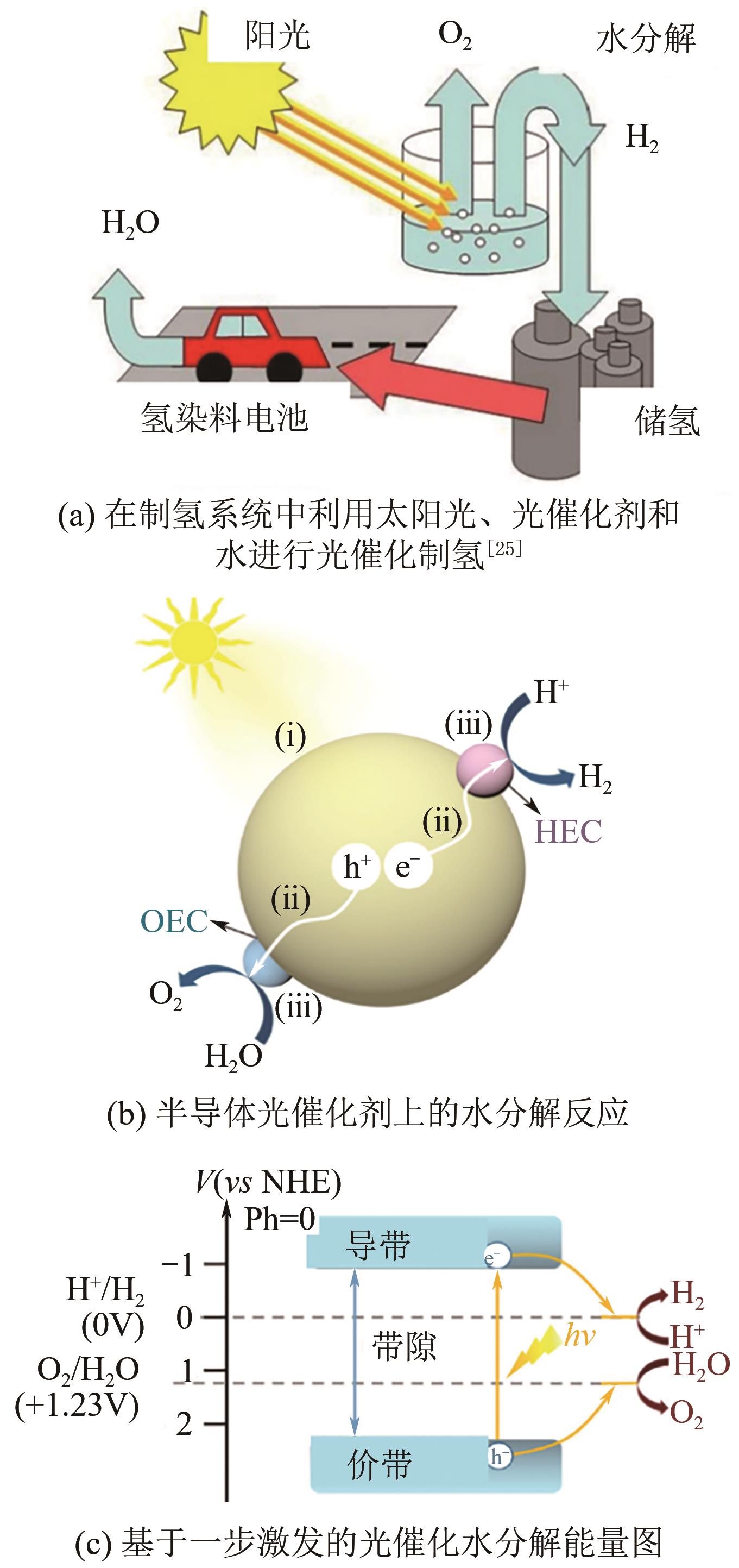
图2 光催化水分解制氢
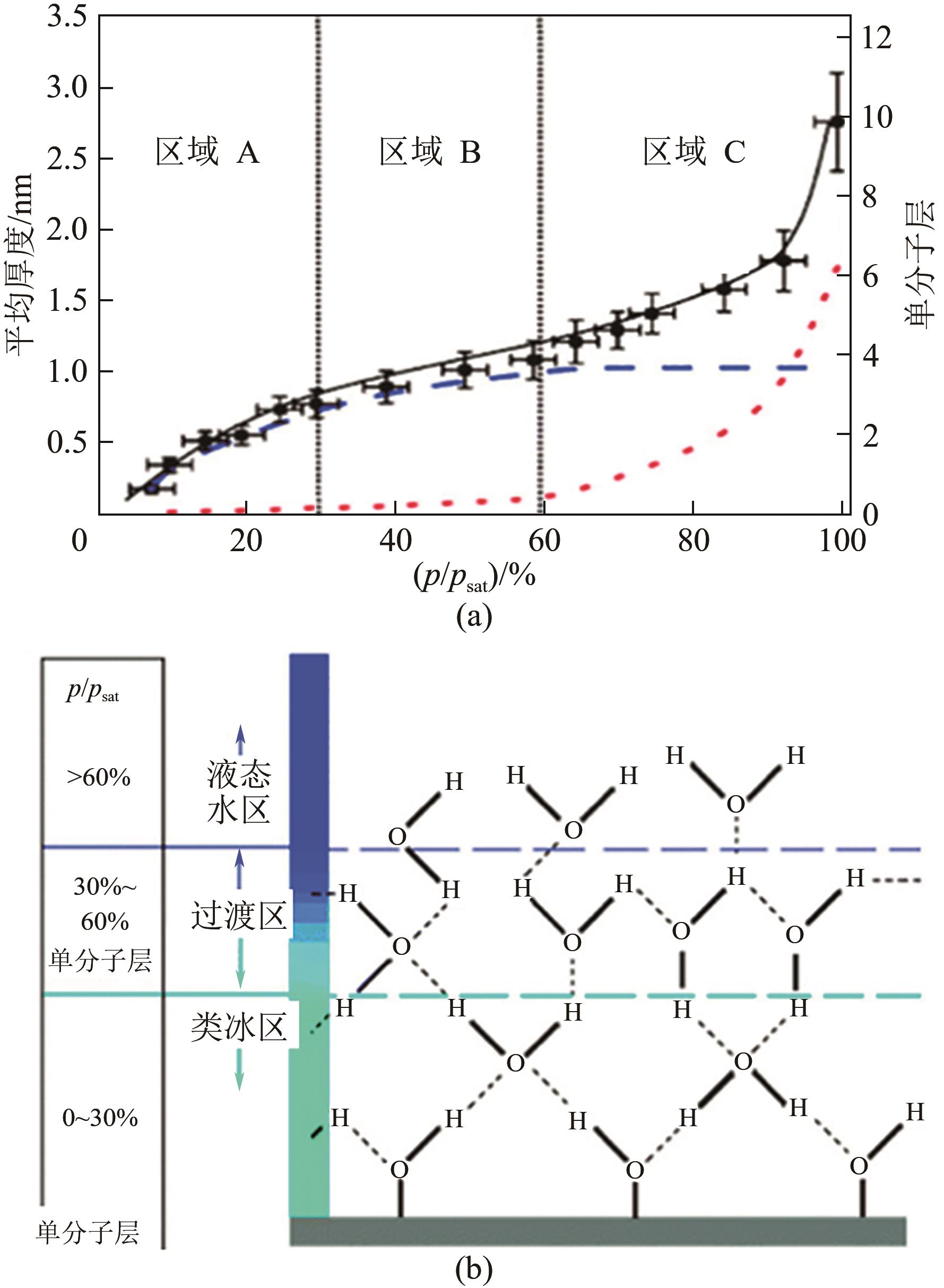
图3 TiO2(Ⅱ型)上吸附水的吸附等温线及随着吸附层厚度和相对湿度增加水分子结构演变示意图
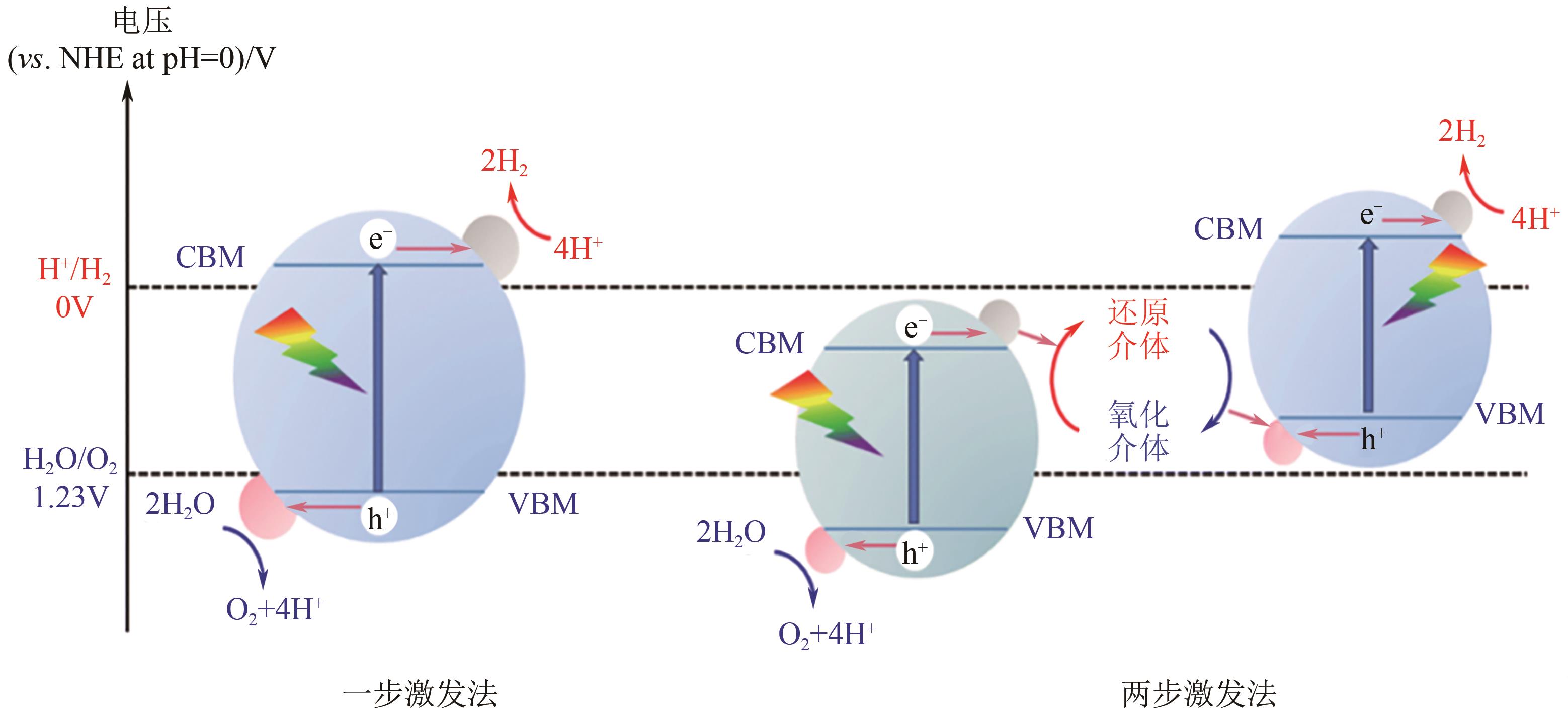
图4 一步式光激发系统和两步式光激发系统(Z方案)[40]
| 催化剂 | 助催化剂修饰方法 | 测试条件 | 产氢率 | 参考文献 |
|---|---|---|---|---|
| TiO2/RuO2/CuO | 一步溶胶-凝胶工艺 | 450W高压汞灯照射 | 20.7mmol/(h·g) | [ |
| Pt@TiO2 | 原位水热反应 | 300W Xe灯为光源的斩波光照射 | 4.389mmol/(h·g) | [ |
| Au/WO3/TiO2 | 溶胶-凝胶辅助光沉积法 | 紫外可见光照射 | 17.2mmol/(h·g) | [ |
| CdTe/Ag/TiO2 | 水热法 | 紫外可见光照射 | 53.0μmol/(h·cm2) | [ |
| Ni/C/TiO2 | 水解-煅烧法 | 300W Xe灯为光源的斩波光照射 | 1745.0μmol/(h·g) | [ |
| CaTiO3/Cu/TiO2 | 两步水热法 | 模拟太阳光照射 | 0.253mmol/(h·g) | [ |
| TiO2/MoC@C | 超声辅助沉积法 | 紫外可见光照射 | 504μmol/(h·g) | [ |
| Ti3CN@TiO2/CdS | 原位生长法 | 420nm滤光片的300W氙灯照射 | 3393.4μmol/(h·g) | [ |
| CdS/TiO2 | 水热法 | 紫外可见光照射 | 5791mL/(h·g) | [ |
| Au-BaO@TiO2/CdS | 水热法 | 100W氙灯为光源照射 | 13.54μmol/(h·g) | [ |
| Co2P/P-TiO2/2H-1T MoS2 | 水热法和磷化法 | 紫外可见光照射 | 4156μmol/(h·g) | [ |
| TiO2@CuS | 水热法 | 全光谱/近红外光照射 | 2467/173μmol/(h·g) | [ |
| CoP/Co2P@TiO2 | 低温磷化法 | 模拟太阳光的照射 | 824.5μmol/(h·g) | [ |
| Ni2P/TiO2 | 溶胶-凝胶法 | 紫外可见光照射 | 1300μmol/(h·g) | [ |
| Ni-P@CeO2-TiO2 | 热分解和沉积/还原法 | 太阳光和太阳模拟器的照射 | 1300μmol/(h·g) | [ |
| MoS x -rGO/TiO2 | 两步光催化还原法 | 紫外可见光照射 | 150.1μmol/(h·g) | [ |
| 1PtAu-TiO2 | 两步沉积-沉淀法 | 模拟太阳光照射 | 61.3μmol/(h·g) | [ |
| TiO2@RuO2 | 一步静电纺丝和高温煅烧法 | 300W氙灯作为全光谱范围内的光源 | 1489.3μmol/(h·g) | [ |
表1 各种助催化剂集成TiO2 的光催化性能
| 催化剂 | 助催化剂修饰方法 | 测试条件 | 产氢率 | 参考文献 |
|---|---|---|---|---|
| TiO2/RuO2/CuO | 一步溶胶-凝胶工艺 | 450W高压汞灯照射 | 20.7mmol/(h·g) | [ |
| Pt@TiO2 | 原位水热反应 | 300W Xe灯为光源的斩波光照射 | 4.389mmol/(h·g) | [ |
| Au/WO3/TiO2 | 溶胶-凝胶辅助光沉积法 | 紫外可见光照射 | 17.2mmol/(h·g) | [ |
| CdTe/Ag/TiO2 | 水热法 | 紫外可见光照射 | 53.0μmol/(h·cm2) | [ |
| Ni/C/TiO2 | 水解-煅烧法 | 300W Xe灯为光源的斩波光照射 | 1745.0μmol/(h·g) | [ |
| CaTiO3/Cu/TiO2 | 两步水热法 | 模拟太阳光照射 | 0.253mmol/(h·g) | [ |
| TiO2/MoC@C | 超声辅助沉积法 | 紫外可见光照射 | 504μmol/(h·g) | [ |
| Ti3CN@TiO2/CdS | 原位生长法 | 420nm滤光片的300W氙灯照射 | 3393.4μmol/(h·g) | [ |
| CdS/TiO2 | 水热法 | 紫外可见光照射 | 5791mL/(h·g) | [ |
| Au-BaO@TiO2/CdS | 水热法 | 100W氙灯为光源照射 | 13.54μmol/(h·g) | [ |
| Co2P/P-TiO2/2H-1T MoS2 | 水热法和磷化法 | 紫外可见光照射 | 4156μmol/(h·g) | [ |
| TiO2@CuS | 水热法 | 全光谱/近红外光照射 | 2467/173μmol/(h·g) | [ |
| CoP/Co2P@TiO2 | 低温磷化法 | 模拟太阳光的照射 | 824.5μmol/(h·g) | [ |
| Ni2P/TiO2 | 溶胶-凝胶法 | 紫外可见光照射 | 1300μmol/(h·g) | [ |
| Ni-P@CeO2-TiO2 | 热分解和沉积/还原法 | 太阳光和太阳模拟器的照射 | 1300μmol/(h·g) | [ |
| MoS x -rGO/TiO2 | 两步光催化还原法 | 紫外可见光照射 | 150.1μmol/(h·g) | [ |
| 1PtAu-TiO2 | 两步沉积-沉淀法 | 模拟太阳光照射 | 61.3μmol/(h·g) | [ |
| TiO2@RuO2 | 一步静电纺丝和高温煅烧法 | 300W氙灯作为全光谱范围内的光源 | 1489.3μmol/(h·g) | [ |
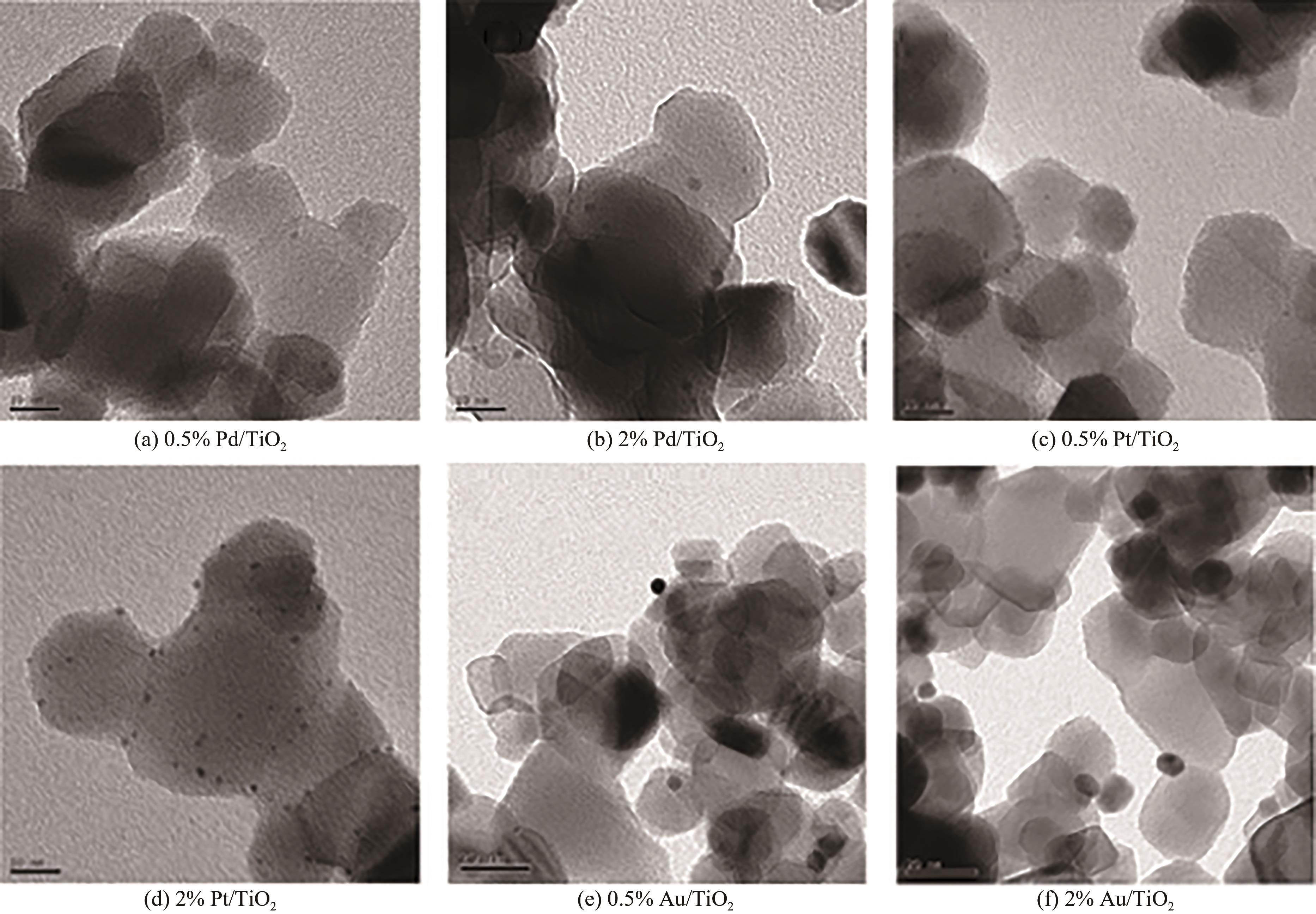
图5 光催化剂的TEM图像[74](图中百分数均为质量分数)
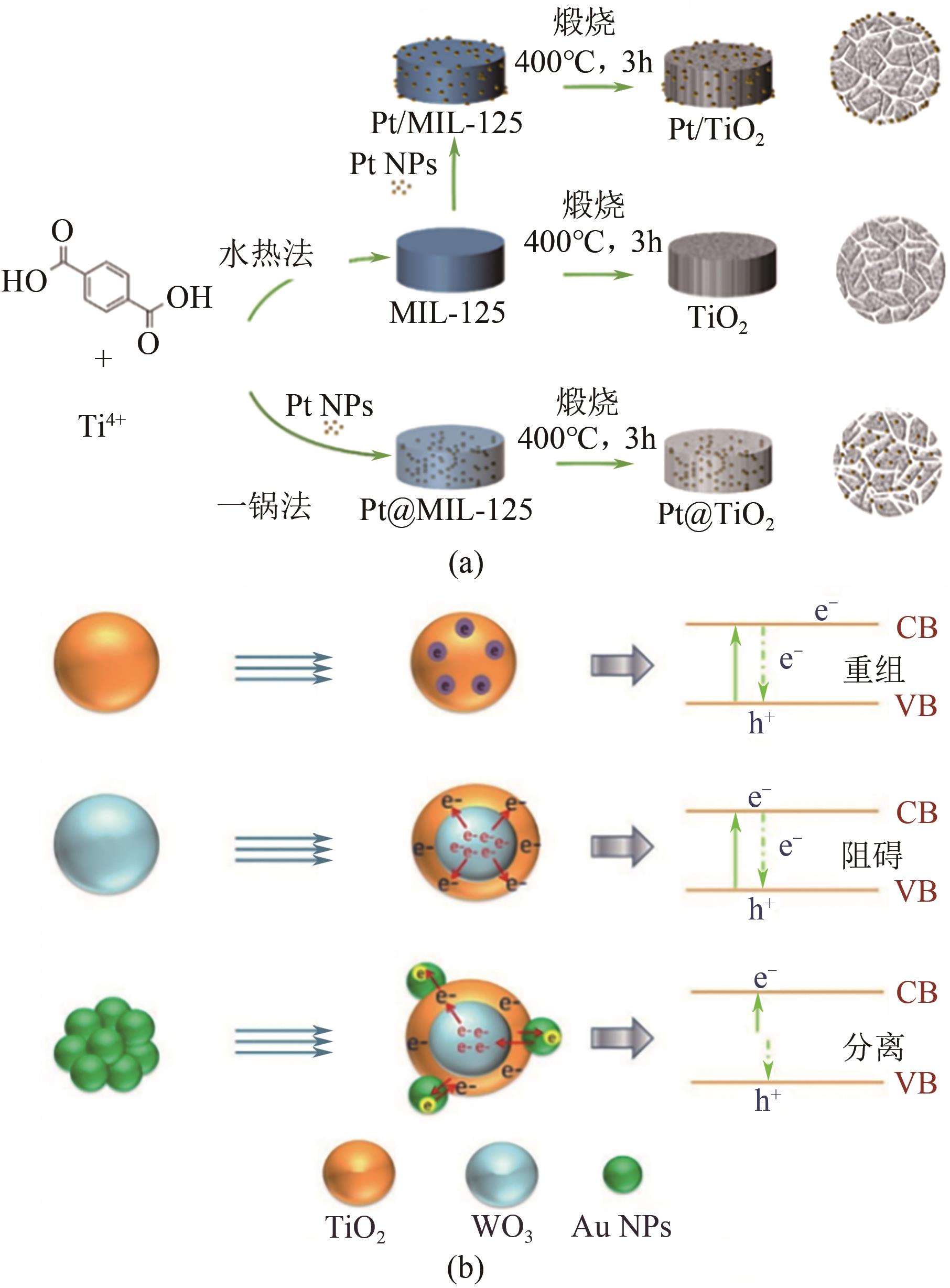
图6 光催化剂制备过程[55]及Au/WO3对增强TiO2生成H2的光活性的协同效应方案[56]
| 1 | ISHAQ Haris, DINCER Ibrahim, CRAWFORD Curran. A review on hydrogen production and utilization: Challenges and opportunities[J]. International Journal of Hydrogen Energy, 2022, 47(62): 26238-26264. |
| 2 | ZHANG Jinxu, LING Bo, HE Yong, et al. Life cycle assessment of three types of hydrogen production methods using solar energy[J]. International Journal of Hydrogen Energy, 2022, 47(30): 14158-14168. |
| 3 | LEE Jung Eun, SHAFIQ Iqrash, HUSSAIN Murid, et al. A review on integrated thermochemical hydrogen production from water[J]. International Journal of Hydrogen Energy, 2022, 47(7): 4346-4356. |
| 4 | FU Xianbiao, PEDERSEN Jakob, ZHOU Yuanyuan, et al. Continuous-flow electrosynthesis of ammonia by nitrogen reduction and hydrogen oxidation[J]. Science, 2023, 379(6633): 707-712. |
| 5 | THANDA Vamshi Krishna, FEND Thomas, LAABER Dmitrij, et al. Experimental investigation of the applicability of a 250kW ceria receiver/reactor for solar thermochemical hydrogen generation[J]. Renewable Energy, 2022, 198: 389-398. |
| 6 | HOTA Poulami, Aranya DAS, MAITI Dilip K. A short review on generation of green fuel hydrogen through water splitting[J]. International Journal of Hydrogen Energy, 2023, 48(2): 523-541. |
| 7 | HAN Xiao, LIU Pengyun, RAN Ran, et al. Non-metal fluorine doping in Ruddlesden-Popper perovskite oxide enables high-efficiency photocatalytic water splitting for hydrogen production[J]. Materials Today Energy, 2022, 23: 100896. |
| 8 | CHEN Wei-Hsin, LEE Jung Eun, JANG Seong-Ho, et al. A review on the visible light active modified photocatalysts for water splitting for hydrogen production[J]. International Journal of Energy Research, 2022, 46(5): 5467-5477. |
| 9 | LIU Yuan, YONG Xue, LIU Zhongyi, et al. Unified catalyst for efficient and stable hydrogen production by both the electrolysis of water and the hydrolysis of ammonia borane[J]. Advanced Sustainable Systems, 2019, 3(5): 1800161. |
| 10 | TEMIZ Mert, DINCER Ibrahim. Concentrated solar driven thermochemical hydrogen production plant with thermal energy storage and geothermal systems[J]. Energy, 2021, 219: 119554. |
| 11 | SONG Hui, LUO Shunqin, HUANG Hengming, et al. Solar-driven hydrogen production: Recent advances, challenges, and future perspectives[J]. ACS Energy Letters, 2022, 7(3): 1043-1065. |
| 12 | HUANG Haowei, PRADHAN Bapi, HOFKENS Johan, et al. Solar-driven metal halide perovskite photocatalysis: Design, stability, and performance[J]. ACS Energy Letters, 2020, 5(4): 1107-1123. |
| 13 | XIA Changlei, NGUYEN Thi Hong Chuong, NGUYEN Xuan Cuong, et al. Emerging cocatalysts in TiO2-based photocatalysts for light-driven catalytic hydrogen evolution: Progress and perspectives[J]. Fuel, 2022, 307: 121745. |
| 14 | BAKBOLAT Baglan, DAULBAYEV Chingis, SULTANOV Fail, et al. Recent developments of TiO2-based photocatalysis in the hydrogen evolution and photodegradation: A review[J]. Nanomaterials, 2020, 10(9): 1790. |
| 15 | LIANG Ying, HUANG Guohe, XIN Xiaying, et al. Black titanium dioxide nanomaterials for photocatalytic removal of pollutants: A review[J]. Journal of Materials Science & Technology, 2022, 112: 239-262. |
| 16 | WU Qiang, GUO Jie, SUN Rui, et al. Slot-die printed non-fullerene organic solar cells with the highest efficiency of 12.9% for low-cost PV-driven water splitting[J]. Nano Energy, 2019, 61: 559-566. |
| 17 | GE Mingzheng, LI Qingsong, CAO Chunyan, et al. One-dimensional TiO2 nanotube photocatalysts for solar water splitting[J]. Advanced Science, 2017, 4(1): 1600152. |
| 18 | ALIZADEH SANI Mahmood, MALEKI Mohammad, Hadi EGHBALJOO-GHAREHGHESHLAGHI, et al. Titanium dioxide nanoparticles as multifunctional surface-active materials for smart/active nanocomposite packaging films[J]. Advances in Colloid and Interface Science, 2022, 300: 102593. |
| 19 | RAHUL Theyyathum Kavil, MOHAN Minu, SANDHYARANI Neelakandapillai. Enhanced solar hydrogen evolution over in situ gold-platinum bimetallic nanoparticle-loaded Ti3+ self-doped titania photocatalysts[J]. ACS Sustainable Chemistry & Engineering, 2018, 6(3): 3049-3059. |
| 20 | GOGOI Devipriya, NAMDEO Ashutosh, GOLDER Animes Kumar, et al. Ag-doped TiO2 photocatalysts with effective charge transfer for highly efficient hydrogen production through water splitting[J]. International Journal of Hydrogen Energy, 2020, 45(4): 2729-2744. |
| 21 | Wei OU, PAN Jiaqi, LIU Yanyan, et al. Two-dimensional ultrathin MoS2-modified black Ti3+-TiO2 nanotubes for enhanced photocatalytic water splitting hydrogen production[J]. Journal of Energy Chemistry, 2020, 43: 188-194. |
| 22 | Alejandro PÉREZ-LARIOS, Rosendo LÓPEZ, Agileo HERNÁNDEZ-GORDILLO, et al. Improved hydrogen production from water splitting using TiO2-ZnO mixed oxides photocatalysts[J]. Fuel, 2012, 100: 139-143. |
| 23 | WEI Ping, LIU Jiawen, LI Zhonghua. Effect of Pt loading and calcination temperature on the photocatalytic hydrogen production activity of TiO2 microspheres[J]. Ceramics International, 2013, 39(5): 5387-5391. |
| 24 | TAN Yu, ZHANG Shenghan, SHI Rongxue, et al. Visible light active Ce/Ce2O/CeO2/TiO2 nanotube arrays for efficient hydrogen production by photoelectrochemical water splitting[J]. International Journal of Hydrogen Energy, 2016, 41(12): 5437-5444. |
| 25 | ISMAEL Mohammed. Latest progress on the key operating parameters affecting the photocatalytic activity of TiO2-based photocatalysts for hydrogen fuel production: A comprehensive review[J]. Fuel, 2021, 303: 121207. |
| 26 | GUPTA Aayush, LIKOZAR Blaž, JANA Runia, et al. A review of hydrogen production processes by photocatalytic water splitting-From atomistic catalysis design to optimal reactor engineering[J]. International Journal of Hydrogen Energy, 2022, 47(78): 33282-33307. |
| 27 | YOU Bo, SUN Yujie. Innovative strategies for electrocatalytic water splitting[J]. Accounts of Chemical Research, 2018, 51(7): 1571-1580. |
| 28 | YAN Yong, CHENG Xing, ZHANG Wanwan, et al. Plasma hydrogenated TiO2/nickel foam as an efficient bifunctional electrocatalyst for overall water splitting[J]. ACS Sustainable Chemistry & Engineering, 2019, 7(1): 885-894. |
| 29 | Valerie Bei-Yuan OH, Sue-Faye NG, Wee-Jun ONG. Is photocatalytic hydrogen production sustainable?-Assessing the potential environmental enhancement of photocatalytic technology against steam methane reforming and electrocatalysis[J]. Journal of Cleaner Production, 2022, 379: 134673. |
| 30 | DHARANI Shanmugapriya, VADIVEL Sethumathavan, GNANASEKARAN Lalitha, et al. S-scheme heterojunction photocatalysts for hydrogen production: Current progress and future prospects[J]. Fuel, 2023, 349: 128688. |
| 31 | ABANADES Stéphane. Metal oxides applied to thermochemical water-splitting for hydrogen production using concentrated solar energy[J]. Chemical Engineering Journal, 2019, 3(3): 63. |
| 32 | SAFARI Farid, DINCER Ibrahim. A review and comparative evaluation of thermochemical water splitting cycles for hydrogen production[J]. Energy Conversion and Management, 2020, 205: 112182. |
| 33 | HAMUKWAYA Shindume Lomboleni, ZHAO Zengying, HAO Huiying, et al. Enhanced photocatalytic performance for hydrogen production and carbon dioxide reduction by a mesoporous single-crystal-like TiO2 composite catalyst[J]. Advanced Composites and Hybrid Materials, 2022, 5(3): 2620-2630. |
| 34 | MOAKHAR Roozbeh Siavash, HOSSEINI-HOSSEINABAD Seyed Morteza, Saeid MASUDY-PANAH, et al. Photoelectrochemical water-splitting using CuO-based electrodes for hydrogen production: A review[J]. Advanced Materials, 2021, 33(33): 2007285. |
| 35 | GOPINATH Chinnakonda S, NALAJALA Naresh. A scalable and thin film approach for solar hydrogen generation: A review on enhanced photocatalytic water splitting[J]. Journal of Materials Chemistry A, 2021, 9(3): 1353-1371. |
| 36 | LI Weiming, ZHUANG Chunqiang, LI Yuanli, et al. Anchoring ultra-small TiO2 quantum dots onto ultra-thin and large-sized Mxene nanosheets for highly efficient photocatalytic water splitting[J]. Ceramics International, 2021, 47(15): 21769-21776. |
| 37 | SINGLA Shelly, SHARMA Surbhi, BASU Soumen, et al. Photocatalytic water splitting hydrogen production via environmental benign carbon based nanomaterials[J]. International Journal of Hydrogen Energy, 2021, 46(68): 33696-33717. |
| 38 | WANG Qian, DOMEN Kazunari. Particulate photocatalysts for light-driven water splitting: Mechanisms, challenges, and design strategies[J]. Chemical Reviews, 2020, 120(2): 919-985. |
| 39 | LANG Xiaoling, GOPALAN Saianand, FU Wanlin, et al. Photocatalytic water splitting utilizing electrospun semiconductors for solar hydrogen generation: Fabrication, modification and performance[J]. Bulletin of the Chemical Society of Japan, 2021, 94(1): 8-20. |
| 40 | CENTURION Higor A, MELO Mauricio A, RABELO Lucas G, et al. Emerging trends of pseudobrookite Fe2TiO5 photocatalyst: A versatile material for solar water splitting systems[J]. Journal of Alloys and Compounds, 2023, 933: 167710. |
| 41 | MA Yiwen, LIN Lihua, TAKATA Tsuyoshi, et al. A perspective on two pathways of photocatalytic water splitting and their practical application systems[J]. Physical Chemistry Chemical Physics, 2023, 25(9): 6586-6601. |
| 42 | ZHANG Xia, WANG Daolei, MAN Xiaokun, et al. Influence of BiOIO3 morphology on the photocatalytic efficiency of Z-scheme BiOIO3/g-C3N4 heterojunctioned composite for Hg0 removal[J]. Journal of Colloid and Interface Science, 2020, 558: 123-136. |
| 43 | KIM Taehoon, LEE Tae Hyung, PARK Seo Yun, et al. Drastic gas sensing selectivity in 2-dimensional MoS2 nanoflakes by noble metal decoration[J]. ACS Nano, 2023, 17(5): 4404-4413. |
| 44 | LI Meng, WANG Shuli, WANG Xinzhong, et al. Structure evolution from Fe2Ni MIL MOF to carbon confined O-doped FeNi/FeF2 via partial fluorination for improved oxygen evolution reaction[J]. Chemical Engineering Journal, 2022, 442: 136165. |
| 45 | HUANG Hao, LI Yuxuan, WANG Huilong, et al. In situ fabrication of ultrathin-g-C3N4/AgI heterojunctions with improved catalytic performance for photodegrading rhodamine B solution[J]. Applied Surface Science, 2021, 538: 148132. |
| 46 | ZHAO Xiaohan, ZHOU Yuting, LIANG Qian, et al. Coupling MOF-derived titanium oxide with CdIn2S4 formed 2D/3D core-shell heterojunctions with enhanced photocatalytic performance[J]. Separation and Purification Technology, 2021, 279: 119765. |
| 47 | PATTANAYAK Prasanta, SINGH Paulomi, BANSAL Nitin Kumar, et al. Recent progress in perovskite transition metal oxide-based photocatalyst and photoelectrode materials for solar-driven water splitting[J]. Journal of Environmental Chemical Engineering, 2022, 10(5): 108429. |
| 48 | FUJISHIMA Akira, HONDA Kenichi. Electrochemical photolysis of water at a semiconductor electrode[J]. Nature, 1972, 238(5358): 37-38. |
| 49 | DU Mengmeng, QIU Bocheng, ZHU Qiaohong, et al. Fluorine doped TiO2/mesocellular foams with an efficient photocatalytic activity[J]. Catalysis Today, 2019, 327: 340-346. |
| 50 | LEUNG Dennis, FU Xianliang, WANG Cuifang, et al. Hydrogen production over titania-based photocatalysts[J]. Chemistry Sustainability Energy Materials, 2010, 3(6): 681-694. |
| 51 | GUO Dawei, FENG Dongdong, ZHANG Yu, et al. Carbon material-TiO2 for photocatalytic reduction of CO2 and degradation of VOCs: A critical review[J]. Fuel Processing Technology, 2022, 231: 107261. |
| 52 | QIN Lan, REN Ran, HUANG Xiaoxue, et al. Photocatalytic activity of an Anderson-type polyoxometalate with mixed copper(Ⅰ)/copper(Ⅱ) ions for visible-light enhancing heterogeneous catalysis[J]. Journal of Solid State Chemistry, 2022, 310: 123052. |
| 53 | CHEN Jing, ABAZARI Reza, ADEGOKE Kayode Adesina, et al. Metal-organic frameworks and derived materials as photocatalysts for water splitting and carbon dioxide reduction[J]. Coordination Chemistry Reviews, 2022, 469: 214664. |
| 54 | JULIYA Assoc P, V M Abdul MUJEEB, Parayil SREENIVASAN K, et al. Enhanced H2 evolution via photocatalytic water splitting using mesoporous TiO2/RuO2/CuO ternary nanomaterial[J]. Journal of Photochemistry and Photobiology, 2021, 8: 100076. |
| 55 | YIN Zhiguang, SONG Tingting, ZHOU Wenting, et al. Highly isolated Pt NPs embedded in porous TiO2 derived from MIL-125 with enhanced photocatalytic hydrogen production activity[J]. Journal of Catalysis, 2021, 402: 289-299. |
| 56 | TAHIR Muhammad, SIRAJ Mohammad, TAHIR Beenish, et al. Au-NPs embedded Z-scheme WO3/TiO2 nanocomposite for plasmon-assisted photocatalytic glycerol-water reforming towards enhanced H2 evolution[J]. Applied Surface Science, 2020, 503 : 144344. |
| 57 | ZHU Shuxu, WANG Qingyao, CAO Dandan, et al. CdTe and Ag nanoparticles co-modified TiO2 nanotube arrays for the enhanced wastewater treatment and hydrogen production[J]. Journal of Environmental Chemical Engineering, 2022, 10(2): 107207. |
| 58 | ZHAO Xueying, XIE Wenyu, SHAO Xueqing, et al. An effective Ni/C co-catalyst for promoting photocatalytic hydrogen evolution over TiO2 nanospheres[J]. Materials Science in Semiconductor Processing, 2022, 148: 106775. |
| 59 | YANG Junfeng, SHI Chenyang, DONG Yanhui, et al. Efficient hydrogen generation of vector Z-scheme CaTiO3/Cu/TiO2 photocatalyst assisted by cocatalyst Cu nanoparticles[J]. Journal of Colloid and Interface Science, 2022, 605: 373-384. |
| 60 | LIU Jinfeng, WANG Ping, FAN Jiajie, et al. Carbon-coated cubic-phase molybdenum carbide nanoparticle for enhanced photocatalytic H2-evolution performance of TiO2 [J]. Journal of Energy Chemistry, 2020, 51: 253-261. |
| 61 | LI Dingyu, YANG Chengwu, RAJENDRAN Saravanan, et al. Nanoflower-like Ti3CN@TiO2/CdS heterojunction photocatalyst for efficient photocatalytic water splitting[J]. International Journal of Hydrogen Energy, 2022, 47(45): 19580-19589. |
| 62 | RAO Vempuluru Navakoteswara, Lakshmana REDDY N, KUMARI Murikinati Mamatha,et al. Synthesis of titania wrapped cadmium sulfide nanorods for photocatalytic hydrogen generation[J]. Materials Research Bulletin, 2018, 103: 122-132. |
| 63 | DING Shangjun, YIN Xin, Xujie LYU, et al. One-step high-temperature solvothermal synthesis of TiO2/sulfide nanocomposite spheres and their solar visible-light applications[J]. ACS Applied Materials & Interfaces, 2012, 4(1): 306-311. |
| 64 | MANDARI Kotesh Kumar, KANG Misook. Highly active Co2P/2H-1T MoS2 cocatalyst with fast charge transfer and H2 production reaction toward effective photocatalytic activity of P-TiO2 [J]. Materials Today Sustainability, 2023, 23: 100444. |
| 65 | YU Bo, MENG Fanming, ZHOU Ting, et al. Construction of hollow TiO2/CuS nanoboxes for boosting full-spectrum driven photocatalytic hydrogen evolution and environmental remediation[J]. Ceramics International, 2021, 47(7): 8849-8858. |
| 66 | LIANG Rong, WANG Yanwen, QIN Chao, et al. P-type cobalt phosphide composites (CoP-Co2P) decorated on titanium oxide for enhanced noble-metal-free photocatalytic H2 evolution activity[J]. Langmuir, 2021, 37(11): 3321-3330. |
| 67 | TASLEEM Sehar, TAHIR Muhammad. Constructing MAX dispersed Ni2P/TiO2 nanocomposite with investigating influential effect of parameters through design expert and kinetic study for photocatalytic H2 evolution[J]. Advanced Powder Technology, 2023, 34(7): 104074. |
| 68 | AMEEN SHA Mashood, CHANDRASEKHARAN MEENU Preetha, SASIDHARAN SUMI Vijayakumari, et al. Tuning of electron transfer by Ni-P decoration on CeO2-TiO2 heterojunction for enhancement in photocatalytic hydrogen generation[J]. Materials Science in Semiconductor Processing, 2020, 105: 104742. |
| 69 | ZHAO Huaqing, ZHANG Yan, LIU Qing, et al. WSe2-loaded co-catalysts Cu3P and CNTs: Improving photocatalytic hydrogen precipitation and photocatalytic memory performance[J]. Journal of Colloid and Interface Science, 2023, 629: 937-947. |
| 70 | WEI Tingcha, DING Peijia, WANG Tao, et al. Facet-regulating local coordination of dual-atom cocatalyzed TiO2 for photocatalytic water splitting[J]. ACS Catalysis, 2021, 11(23): 14669-14676. |
| 71 | LI Hongying, ZHU Bicheng, SUN Jian, et al. Photocatalytic hydrogen production from seawater by TiO2/RuO2 hybrid nanofiber with enhanced light absorption[J]. Journal of Colloid and Interface Science, 2024, 654: 1010-1019. |
| 72 | PAN Yong, WEN Ming. Noble metals enhanced catalytic activity of anatase TiO2 for hydrogen evolution reaction[J]. International Journal of Hydrogen Energy, 2018, 43(49): 22055-22063. |
| 73 | LI Mengyan, LIU Hui, SONG Yanghang, et al. TiO2 homojunction with Au nanoparticles decorating as an efficient and stable electrocatalyst for hydrogen evolution reaction[J]. Materials Characterization, 2019, 151: 286-291. |
| 74 | AL-AZRI Z H N, ALOUFI Maher, CHAN Andrew, et al. Metal particle size effects on the photocatalytic hydrogen ion reduction[J]. ACS Catalysis, 2019, 9(5): 3946-3958. |
| 75 | LIU Jing, XU Mingze, ZHANG Tingsong, et al. Al/TiO2 composite as a photocatalyst for the degradation of organic pollutants[J]. Environmental Science and Pollution Research, 2023, 30(4): 9738-9748. |
| 76 | SABIR Mamoona, RAFIQ Khezina, ABID Muhammad Zeeshan, et al. Growth of tunable Au-BaO@TiO2/CdS heterostructures: Acceleration of hydrogen evolution from water splitting[J]. Fuel, 2023, 353: 129196. |
| 77 | ARUNACHALAM Prabhakarn, ALORAIJ Haneen A, AMER Mabrook S, et al. Activation effect of nickel phosphate co-catalysts on the photoelectrochemical water oxidation performance of TiO2 nanotubes[J]. Journal of Saudi Chemical Society, 2022, 26(4): 101484. |
| 78 | XU Ying, LI Yongan, WANG Ping, et al. Highly efficient dual cocatalyst-modified TiO2 photocatalyst: RGO as electron-transfer mediator and MoS x as H2-evolution active site[J]. Applied Surface Science, 2018, 430: 176-183. |
| 79 | PANCHAL Deepak, SHARMA Abhishek, MONDAL Prasenjit, et al. Heterolayered TiO2@layered double hydroxide-MoS2 nanostructure for simultaneous adsorption-photocatalysis of co-existing water contaminants[J]. Applied Surface Science, 2021, 553: 149577. |
| 80 | LI Yujie, DENG Xiaotong, TIAN Jian, et al. Ti3C2 MXene-derived Ti3C2/TiO2 nanoflowers for noble-metal-free photocatalytic overall water splitting[J]. Applied Materials Today, 2018, 13: 217-227. |
| [1] | 王月, 张学瑞, 宋玺文, 陈渤燕, 李庆勋, 钟海军, 胡孝伟, 何帅. 电解制氢合成氨技术综述与展望[J]. 化工进展, 2024, 43(S1): 180-188. |
| [2] | 向浩寅, 陈良勇. Ni、Ce、Zn和Cu修饰Fe2O3/Al2O3载氧体的甲烷化学链制氢特性[J]. 化工进展, 2024, 43(8): 4320-4332. |
| [3] | 龚德成, 沈倩, 朱贤青, 黄云, 夏奡, 张敬苗, 朱恂, 廖强. 微藻超临界水气化制取富氢合成气的研究进展[J]. 化工进展, 2024, 43(7): 3709-3728. |
| [4] | 陈良, 罗冬梅, 王正豪, 钟山, 唐思扬, 梁斌. 工业副产气化学链回收氢气技术研究进展[J]. 化工进展, 2024, 43(7): 3729-3746. |
| [5] | 万成凤, 李志达, 张春月, 路璐. MXene负载CoP纳米棒高效电催化分解水制氢[J]. 化工进展, 2024, 43(6): 3232-3239. |
| [6] | 张金鹏, 屈婷, 荆洁颖, 李文英. 吸附强化水气变换制氢复合催化剂研究进展[J]. 化工进展, 2024, 43(5): 2629-2644. |
| [7] | 周安宁, 江雨寒, 刘墨宣, 赵伟, 李振. 电解煤浆制氢过程中煤阶及矿物的影响与煤结构演化研究进展[J]. 化工进展, 2024, 43(5): 2294-2310. |
| [8] | 吴晨赫, 刘彧旻, 杨昕旻, 崔记伟, 姜韶堃, 叶金花, 刘乐全. 粉体光催化全水分解技术研究进展[J]. 化工进展, 2024, 43(4): 1810-1822. |
| [9] | 赵文潇, 裴刘军, 贾伟科, 王际平. TiO2基两相复合材料的制备及其电催化析氢性能[J]. 化工进展, 2024, 43(12): 6760-6768. |
| [10] | 张文韬, 周家辉, 张润之, 王珞珈, 徐钢. 计及能耗特性的风光制氢碱性电解槽集群优化策略[J]. 化工进展, 2024, 43(11): 6119-6128. |
| [11] | 冯凯, 孟浩, 杨宇森, 卫敏. 甲醇水蒸气重整制氢催化剂的研究进展[J]. 化工进展, 2024, 43(10): 5498-5516. |
| [12] | 马艳, 高宁博, 孙安邦, 全翠. 塑料热解耦合等离子体催化重整制氢[J]. 化工进展, 2024, 43(10): 5901-5912. |
| [13] | 谢璐垚, 陈崧哲, 王来军, 张平. 用于SO2去极化电解制氢的铂基催化剂[J]. 化工进展, 2023, 42(S1): 299-309. |
| [14] | 张亚娟, 徐惠, 胡贝, 史星伟. 化学镀法制备NiCoP/rGO/NF高效电解水析氢催化剂[J]. 化工进展, 2023, 42(8): 4275-4282. |
| [15] | 王蕴青, 杨国锐, 延卫. 过渡金属磷化物的改性方法及其在电化学析氢中的应用[J]. 化工进展, 2023, 42(7): 3532-3549. |
| 阅读次数 | ||||||
|
全文 |
|
|||||
|
摘要 |
|
|||||