化工进展 ›› 2025, Vol. 44 ›› Issue (6): 3579-3591.DOI: 10.16085/j.issn.1000-6613.2024-0638
• 资源与环境化工 • 上一篇
Anammox系统的氧化亚氮产生途径及调控
高峰( ), 王重阳(), 高升(), 张雅泓, 陈涛, 年正
- 中国电建集团昆明勘测设计研究院有限公司,云南 昆明 650000
-
收稿日期:2024-04-16修回日期:2024-05-21出版日期:2025-06-25发布日期:2025-07-08 -
通讯作者:王重阳,高升 -
作者简介:高峰(1984-),博士,高级工程师,研究方向为污水生物脱氮过程模拟与强化。E-mail: xiaogao0859@126.com。 -
基金资助:中国博士后科学基金(2023MD744263);云南省基础研究计划专项面上(202301AT070457);云南省“彩云博士后计划”博士后创新项目(三等资助);中国电建集团昆明勘测设计研究院有限公司科技创新计划(KD-ZDYF2022-003)
Nitrous oxide production pathway and its regulation strategy in Anammox system
GAO Feng(), WANG Chongyang(), GAO Sheng(), ZHANG Yahong, CHEN Tao, NIAN Zheng
- PowerChina Kunming Survey, Design and Research Institute Company Limited, Kunming 650051, Yunnan, China
-
Received:2024-04-16Revised:2024-05-21Online:2025-06-25Published:2025-07-08 -
Contact:WANG Chongyang, GAO Sheng

摘要:
厌氧氨氧化系统(Anammox system)凭借其高效低耗的脱氮功能,被认为是较具应用潜力的低C/N污水处理技术之一。随着全球气候变暖趋势的加重和国家“双碳”战略的提出,Anammox系统在脱氮过程中释放的大量强温室气体(N2O)问题,逐渐成为限制该系统在污水深度脱氮领域应用的瓶颈。基于现有的研究成果,首先对Anammox系统的N2O产生途径进行梳理,并综合论述了影响因素和调控策略对潜在产生N2O的酶、菌种及其产量的影响,发现虽然现有的方法能够控制Anammox系统的N2O产量,但是容易导致脱氮功能失稳,甚至引发二次污染问题。考虑到Anammox系统的菌落结构分布特征是直接影响N2O产量和脱氮效果的内因,提出采用同时包埋了AnAOB菌和“杂菌”抑制剂的固定化技术与Anammox系统耦合的工艺,并建议借助活性污泥数学模型的仿真功能和现代分子生物学手段以深入认识耦合技术的N2O生成过程的动力学变化和潜在产生N2O的菌种演替的规律,为构建适用于碳减排的高效型Anammox脱氮工艺提供科学的指导依据。
中图分类号:
引用本文
高峰, 王重阳, 高升, 张雅泓, 陈涛, 年正. Anammox系统的氧化亚氮产生途径及调控[J]. 化工进展, 2025, 44(6): 3579-3591.
GAO Feng, WANG Chongyang, GAO Sheng, ZHANG Yahong, CHEN Tao, NIAN Zheng. Nitrous oxide production pathway and its regulation strategy in Anammox system[J]. Chemical Industry and Engineering Progress, 2025, 44(6): 3579-3591.
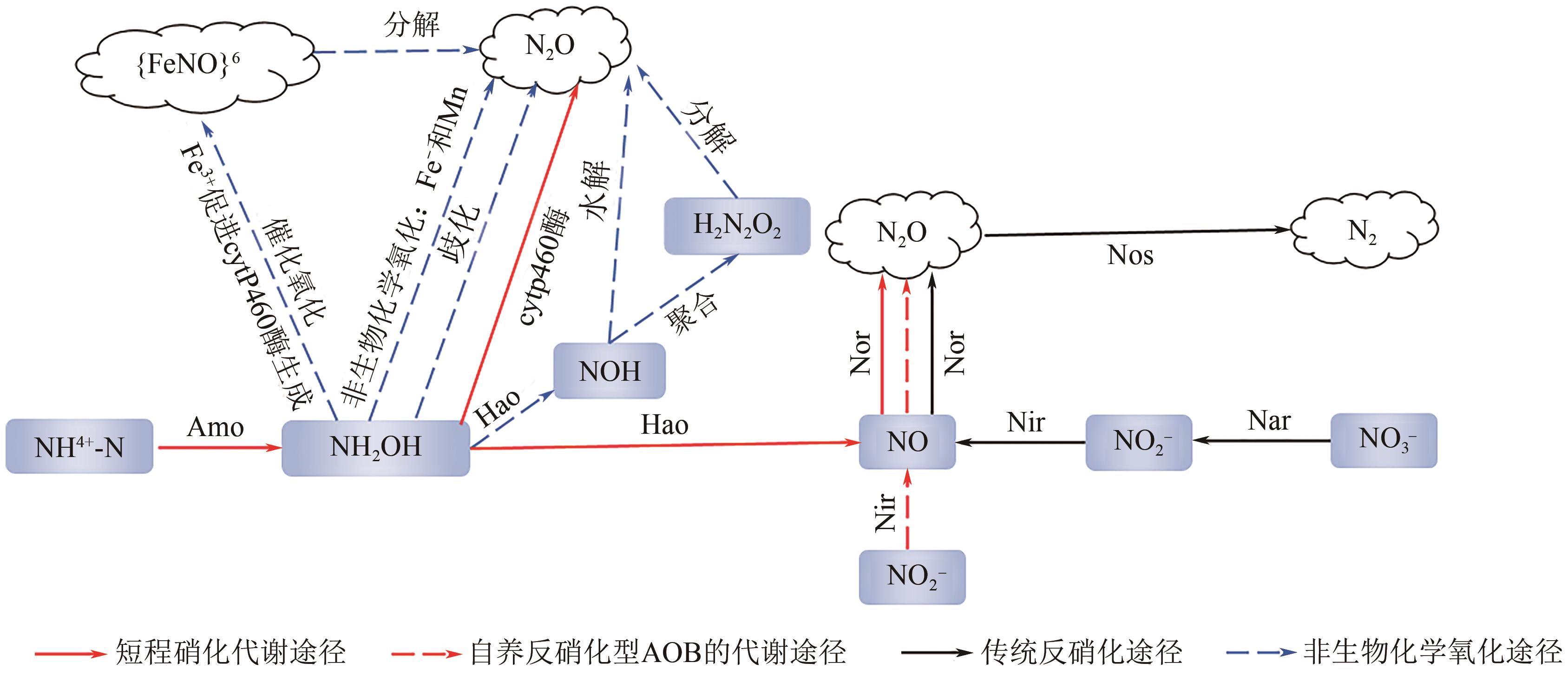
图1 Anammox系统的N2O形成与降解途径Nar—硝酸盐还原酶;Nir—亚硝酸盐还原酶;Nor—NO还原酶;Nos—N2O还原酶;Amo—氨氮的加氧酶;Hao—羟胺氧化还原酶;cytP460—AOB的c型细胞色素酶;{FeNO}6—亚硝酰亚铁聚合物;NOH—硝酰基;H2N2O2 —连二次硝酸
| 温度/℃ | 进水TN浓度/mg·L-1 | N2O浓度/mg·L-1 | N2O积累速率/mg·L-1·min-1 | (N2O/ΔTN)/% |
|---|---|---|---|---|
| 20 | 80 | 0.380 | 0.002 | 0.46 |
| 120 | 0.811 | 0.003 | 0.68 | |
| 240 | 1.086 | 0.003 | 0.95 | |
| 25 | 80 | 0.444 | 0.003 | 0.59 |
| 120 | 0.854 | 0.004 | 0.91 | |
| 240 | 1.584 | 0.005 | 1.11 | |
| 35 | 80 | 0.500 | 0.012 | 0.85 |
| 120 | 1.563 | 0.019 | 1.43 | |
| 240 | 2.424 | 0.026 | 1.42 |
表1 温度对Anammox系统的N2O产量影响[17]
| 温度/℃ | 进水TN浓度/mg·L-1 | N2O浓度/mg·L-1 | N2O积累速率/mg·L-1·min-1 | (N2O/ΔTN)/% |
|---|---|---|---|---|
| 20 | 80 | 0.380 | 0.002 | 0.46 |
| 120 | 0.811 | 0.003 | 0.68 | |
| 240 | 1.086 | 0.003 | 0.95 | |
| 25 | 80 | 0.444 | 0.003 | 0.59 |
| 120 | 0.854 | 0.004 | 0.91 | |
| 240 | 1.584 | 0.005 | 1.11 | |
| 35 | 80 | 0.500 | 0.012 | 0.85 |
| 120 | 1.563 | 0.019 | 1.43 | |
| 240 | 2.424 | 0.026 | 1.42 |
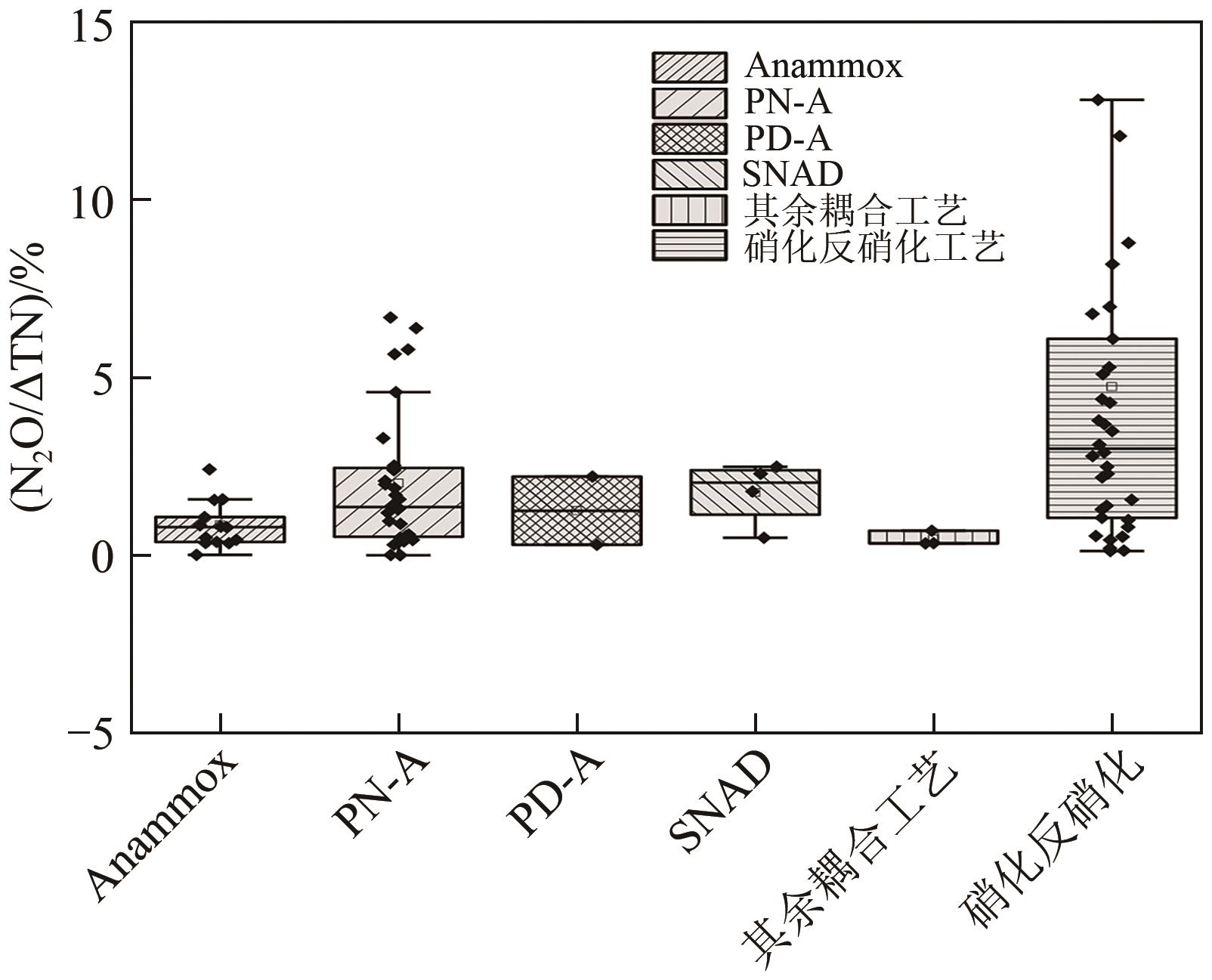
图2 不同Anammox耦合工艺的N2O释放因子[5-6,9,14,17-18,26,33,35-43]
| 工艺类型 | 曝气速率/mL·min-1 | N2O产量控制策略 | N2O产生速率 | (N2O/TN)/% | 参考文献 |
|---|---|---|---|---|---|
| PN-A-UASB | — | 以出水水质为约束条件,采用连续曝气法,曝气时间不大于60min | 0.050g/(L·d) (在高曝气强度下) | 2.5 | [ |
0.029g/(L·d) (在低曝气强度下) | 1.0 | ||||
| PN-A-SBR | — | 缩短每周期工艺运行时间,将时间由480min减少至160min,并调节曝气装置启停为每周期2次 | 0.23mg/(g·h) | 1.1 | [ |
| 从1250降低至417 | 在不影响氨氧化反应的同时,将短程硝化的DO浓度控制在1.2mg/L以下,以抑制NOB活性 | — | 0.016~0.44 | [ | |
| 从1500降低至300 | 为处理厌氧消化液,将曝气时间控制在10~30min | — | 0.95 | [ | |
| 从50降低至30 | 采用高效的曝气装置,以增大曝气扩散系数,使其系数值不低于11.4h-1 | 0.003g/(L·d) | 0.39~0.59 | [ | |
| 150 | 联用低曝气速率(150mL/min)和间歇式投加NO2-,以提高AnAOB活性 | 0.98 | [ | ||
| 段式PN-A | 从650降低至100 | 联用低曝气速率和低进水氮负荷 | — | 4.0(PN段),0.1(A段) | [ |
表2 基于DO浓度调节的Anammox系统衍生工艺对N2O产量控制的研究成果
| 工艺类型 | 曝气速率/mL·min-1 | N2O产量控制策略 | N2O产生速率 | (N2O/TN)/% | 参考文献 |
|---|---|---|---|---|---|
| PN-A-UASB | — | 以出水水质为约束条件,采用连续曝气法,曝气时间不大于60min | 0.050g/(L·d) (在高曝气强度下) | 2.5 | [ |
0.029g/(L·d) (在低曝气强度下) | 1.0 | ||||
| PN-A-SBR | — | 缩短每周期工艺运行时间,将时间由480min减少至160min,并调节曝气装置启停为每周期2次 | 0.23mg/(g·h) | 1.1 | [ |
| 从1250降低至417 | 在不影响氨氧化反应的同时,将短程硝化的DO浓度控制在1.2mg/L以下,以抑制NOB活性 | — | 0.016~0.44 | [ | |
| 从1500降低至300 | 为处理厌氧消化液,将曝气时间控制在10~30min | — | 0.95 | [ | |
| 从50降低至30 | 采用高效的曝气装置,以增大曝气扩散系数,使其系数值不低于11.4h-1 | 0.003g/(L·d) | 0.39~0.59 | [ | |
| 150 | 联用低曝气速率(150mL/min)和间歇式投加NO2-,以提高AnAOB活性 | 0.98 | [ | ||
| 段式PN-A | 从650降低至100 | 联用低曝气速率和低进水氮负荷 | — | 4.0(PN段),0.1(A段) | [ |
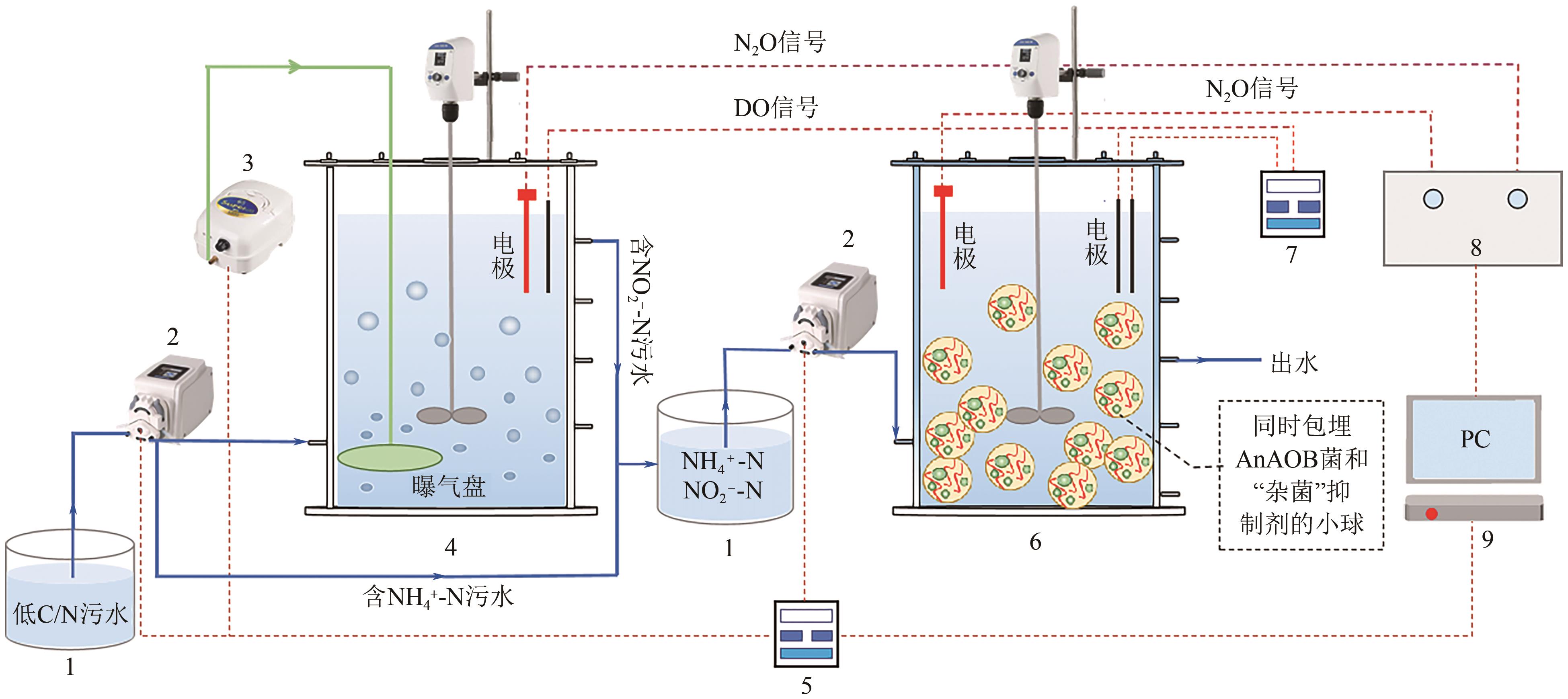
图3 固定化技术与Anammox系统耦合工艺1—贮水池;2—蠕动泵;3—曝气泵;4—短程硝化区;5—泵控制器;6—含有包埋小球的厌氧区;7—pH和DO测定仪;8—N2O浓度测定仪;9—工艺自控系统
| 反应过程动力学 | 反应速率方程 |
|---|---|
| 包含NH2OH的自养菌好氧生长 | |
| 自养反硝化型AOB生长 | |
| 内源性反硝化型异养菌生长 | |
| 反硝化中N2O还原为N2过程 |
表3 新增的与N2O产生相关的反应过程速率方程组
| 反应过程动力学 | 反应速率方程 |
|---|---|
| 包含NH2OH的自养菌好氧生长 | |
| 自养反硝化型AOB生长 | |
| 内源性反硝化型异养菌生长 | |
| 反硝化中N2O还原为N2过程 |
| [1] | RAVISHANKARA A R, DANIEL John S, PORTMANN Robert W. Nitrous oxide (N2O): The dominant ozone-depleting substance emitted in the 21st century[J]. Science, 2009, 326(5949): 123-125. |
| [2] | VALKOVA Tanya, PARRAVICINI Vanessa, SARACEVIC Ernis, et al. A method to estimate the direct nitrous oxide emissions of municipal wastewater treatment plants based on the degree of nitrogen removal[J]. Journal of Environmental Management, 2021, 279: 111563. |
| [3] | 郝晓地, 杨振理, 于文波, 等. 污水处理过程N2O排放: 过程机制与控制策略[J]. 环境科学, 2023, 44(2): 1163-1173. |
| HAO Xiaodi, YANG Zhenli, YU Wenbo, et al. N2O emission from the processes of wastewater treatment: Mechanisms and control strategies[J]. Environmental Science, 2023, 44(2): 1163-1173. | |
| [4] | Muhammad ALI, RATHNAYAKE Rathnayake M L D, ZHANG Lei, et al. Source identification of nitrous oxide emission pathways from a single-stage nitritation-anammox granular reactor[J]. Water Research, 2016, 102: 147-157. |
| [5] | WANG Sike, YU Heng, SU Qingxian, et al. Exploring the role of heterotrophs in partial nitritation-anammox process treating thermal hydrolysis process-anaerobic digestion reject water[J]. Bioresource Technology, 2021, 341: 125762. |
| [6] | HE Yingying, MAO Hongyu, MAKINIA Jacek, et al. Impact of soluble organic matter and particulate organic matter on anammox system: Performance, microbial community and N2O production[J]. Journal of Environmental Sciences (China), 2023, 124: 146-155. |
| [7] | LU Xi, PEREIRA Tiago D S, AL-HAZMI Hussein E, et al. Model-based evaluation of N2O production pathways in the anammox-enriched granular sludge cultivated in a sequencing batch reactor[J]. Environmental Science & Technology, 2018, 52(5): 2800-2809. |
| [8] | LANG Longqi, SEBILO Mathieu, BOUNOUBA Mansour, et al. Long term analysis of N2O emission from partial nitritation anammox process under oxygen limitation[J]. Bioresource Technology Reports, 2022, 20: 101224. |
| [9] | QIU Songkai, LI Zebing, HU Yuansheng, et al. N2O generation via nitritation at different volumetric oxygen transfer levels in partial nitritation-anammox process[J]. Journal of Cleaner Production, 2021, 293: 126104. |
| [10] | Yingyu LAW, YE Liu, PAN Yuting, et al. Nitrous oxide emissions from wastewater treatment processes[J]. Philosophical Transactions of the Royal Society of London Series B, Biological Sciences, 2012, 367(1593): 1265-1277. |
| [11] | PENG Lai, NI Bingjie, YE Liu, et al. The combined effect of dissolved oxygen and nitrite on N2O production by ammonia oxidizing bacteria in an enriched nitrifying sludge[J]. Water Research, 2015, 73: 29-36. |
| [12] | LI Li, LING Yu, WANG Haiyan, et al. N2O emission in partial nitritation-anammox process[J]. Chinese Chemical Letters, 2020, 31(1): 28-38. |
| [13] | ZHU Guibing, WANG Shanyun, MA Bin, et al. Anammox granular sludge in low-ammonium sewage treatment: Not bigger size driving better performance[J]. Water Research, 2018, 142: 147-158. |
| [14] | OKABE Satoshi, OSHIKI Mamoru, TAKAHASHI Yoshitaka, et al. N2O emission from a partial nitrification-anammox process and identification of a key biological process of N2O emission from anammox granules[J]. Water Research, 2011, 45(19): 6461-6470. |
| [15] | HOU Zilong, DONG Wenyi, WANG Hongjie, et al. Response of nitrite accumulation to elevated C/NO3-N ratio during partial denitrification process: Insights of extracellular polymeric substance, microbial community and metabolic function[J]. Bioresource Technology, 2023, 384: 129269. |
| [16] | CHEN Hongbo, ZENG Long, WANG Dongbo, et al. Recent advances in nitrous oxide production and mitigation in wastewater treatment[J]. Water Research, 2020, 184: 116168. |
| [17] | 王丝可, 于恒, 左剑恶. 温度和基质浓度对厌氧氨氧化工艺中N2O释放的影响[J]. 环境科学, 2020, 41(11): 5082-5088. |
| WANG Sike, YU Heng, ZUO Jian’e. Effects of temperature and substrate concentration on N2O release of ANAMMOX process[J]. Environmental Science, 2020, 41(11): 5082-5088. | |
| [18] | QIAN Jin, ZHANG Mingkuan, PEI Xiangjun, et al. A novel integrated thiosulfate-driven denitritation (TDD) and anaerobic ammonia oxidation (anammox) process for biological nitrogen removal[J]. Biochemical Engineering Journal, 2018, 139: 68-73. |
| [19] | REINO Clara, VAN LOOSDRECHT Mark C M, CARRERA Julián, et al. Effect of temperature on N2O emissions from a highly enriched nitrifying granular sludge performing partial nitritation of a low-strength wastewater[J]. Chemosphere, 2017, 185: 336-343. |
| [20] | GABARRÓ J, GANIGUÉ R, GICH F, et al. Effect of temperature on AOB activity of a partial nitritation SBR treating landfill leachate with extremely high nitrogen concentration[J]. Bioresource Technology, 2012, 126: 283-289. |
| [21] | 韩雪恪, 王峥嵘, 彭永臻, 等. 几种重要因素对厌氧氨氧化过程的影响综述[J]. 中国环境科学, 2023, 43(5): 2220-2227. |
| HAN Xueke, WANG Zhengrong, PENG Yongzhen, et al. A review of several important factors influencing the Anammox process[J]. China Environmental Science, 2023, 43(5): 2220-2227. | |
| [22] | DE COCKER P, BESSIERE Y, HERNANDEZ-RAQUET G, et al. Enrichment and adaptation yield high anammox conversion rates under low temperatures[J]. Bioresource Technology, 2018, 250: 505-512. |
| [23] | SU Qingxian, Carlos DOMINGO-FÉLEZ, ZHANG Zhen, et al. The effect of pH on N2O production in intermittently-fed nitritation reactors[J]. Water Research, 2019, 156: 223-231. |
| [24] | Yongtao LYU, JU Kai, WANG Lei, et al. Effect of pH on nitrous oxide production and emissions from a partial nitritation reactor under oxygen-limited conditions[J]. Process Biochemistry, 2016, 51(6): 765-771. |
| [25] | 黎秋华, 李平, 朱萍萍, 等. SBR工艺中pH值与DO对硝化过程中N2O释放的影响[J]. 水处理技术, 2008, 34(4): 52-55. |
| LI Qiuhua, LI Ping, ZHU Pingping, et al. The effect of pH and DO on N2O emission during the nitrification process in a SBR[J]. Technology of Water Treatment, 2008, 34(4): 52-55. | |
| [26] | ZHOU Xin, SONG Jingjing, WANG Gonglei, et al. Unravelling nitrogen removal and nitrous oxide emission from mainstream integrated nitrification-partial denitrification-anammox for low carbon/nitrogen domestic wastewater[J]. Journal of Environmental Management, 2020, 270: 110872. |
| [27] | JACOBSON Frida, PISTORIUS Arthur, FARKAS Daniel, et al. pH dependence of copper geometry, reduction potential, and nitrite affinity in nitrite reductase[J]. Journal of Biological Chemistry, 2007, 282(9): 6347-6355. |
| [28] | 徐帆, 丁祥中, 吕娇, 等. pH对Anammox-DAMO同步除碳脱氮系统N2O产消影响及模型研究[J]. 环境科学学报, 2023, 43(5): 174-183. |
| XU Fan, DING Xiangzhong, Jiao LÜ, et al. Effect of pH on N2O production and consumption in an Anammox-DAMO system and its modeling[J]. Acta Scientiae Circumstantiae, 2023, 43(5): 174-183. | |
| [29] | 吕永涛, 王重阳, 鞠恺, 等. 厌氧氨氧化颗粒污泥内部原位生物活性与N2O产生特性[J]. 中国环境科学, 2023, 43(4): 1582-1589. |
| Yongtao LYU, WANG Chongyang, JU Kai, et al. In situ biological activity and N2O production characteristics inside Anammox granular sludge[J]. China Environmental Science, 2023, 43(4): 1582-1589. | |
| [30] | WANG Qilin, JIANG Guangming, YE Liu, et al. Heterotrophic denitrification plays an important role in N2O production from nitritation reactors treating anaerobic sludge digestion liquor[J]. Water Research, 2014, 62: 202-210. |
| [31] | 李泽兵, 李军, 李妍, 等. 短程硝化反硝化技术研究进展[J]. 给水排水, 2011, 47(9): 163-168. |
| LI Zebing, LI Jun, LI Yan, et al. Research of shortcut nitrification and denitrification technology development[J]. Water & Wastewater Engineering, 2011, 47(9): 163-168. | |
| [32] | PEREIRA T D S, SPINDOLA R H, RABELO C A B S, et al. A predictive model for N2O production in anammox-granular sludge reactors: Combined effects of nitrite/ammonium ratio and organic matter concentration[J]. Journal of Environmental Management, 2021, 297: 113295. |
| [33] | PENG Lai, Huu Hao NGO, SONG Shaoxian, et al. Heterotrophic denitrifiers growing on soluble microbial products contribute to nitrous oxide production in anammox biofilm: Model evaluation[J]. Journal of Environmental Management, 2019, 242: 309-314. |
| [34] | CAO Shenbin, DU Rui, PENG Yongzhen, et al. Novel two stage partial denitrification (PD)-Anammox process for tertiary nitrogen removal from low carbon/nitrogen (C/N) municipal sewage[J]. Chemical Engineering Journal, 2019, 362: 107-115. |
| [35] | LIU Tao, HU Shihu, YUAN Zhiguo, et al. High-level nitrogen removal by simultaneous partial nitritation, anammox and nitrite/nitrate-dependent anaerobic methane oxidation[J]. Water Research, 2019, 166: 115057. |
| [36] | Trairat MUANGTHONG-ON, WANTAWIN Chalermraj. Evaluation of N2O production from anaerobic ammonium oxidation (anammox) at different influent ammonia to nitrite ratios[J]. Energy Procedia, 2011, 9: 7-14. |
| [37] | CASTRO-BARROS C M, DAELMAN M R J, MAMPAEY K E, et al. Effect of aeration regime on N2O emission from partial nitritation-anammox in a full-scale granular sludge reactor[J]. Water Research, 2015, 68: 793-803. |
| [38] | MA Yiwei, SUNDAR Suneethi, PARK Hongkeun, et al. The effect of inorganic carbon on microbial interactions in a biofilm nitritation-anammox process[J]. Water Research, 2015, 70: 246-254. |
| [39] | CHEN Guangjiao, ZHANG Yanlong, WANG Xingfa, et al. Optimizing of operation strategies of the single-stage partial nitrification-anammox process[J]. Journal of Cleaner Production, 2020, 256: 120667. |
| [40] | YAN Jia, WANG Siji, WU Lingyao, et al. Long-term ammonia gas biofiltration through simultaneous nitrification, anammox and denitrification process with limited N2O emission and negligible leachate production[J]. Journal of Cleaner Production, 2020, 270: 122406. |
| [41] | HU Ziye, LOTTI Tommaso, DE KREUK Merle, et al. Nitrogen removal by a nitritation-anammox bioreactor at low temperature[J]. Applied and Environmental Microbiology, 2013, 79(8): 2807-2812. |
| [42] | LI Jianmin, ZENG Wei, LIU Hong, et al. Achieving deep autotrophic nitrogen removal from low strength ammonia nitrogen wastewater in aeration sponge iron biofilter: Simultaneous nitrification, Feammox, NDFO and Anammox[J]. Chemical Engineering Journal, 2023, 460: 141755. |
| [43] | MASSARA Theoni Maria, MALAMIS Simos, GUISASOLA Albert, et al. A review on nitrous oxide (N2O) emissions during biological nutrient removal from municipal wastewater and sludge reject water[J]. Science of the Total Environment, 2017, 596/597: 106-123. |
| [44] | CONNAN Romain, DABERT Patrick, Marina MOYA-ESPINOSA, et al. Coupling of partial nitritation and anammox in two- and one-stage systems: Process operation, N2O emission and microbial community[J]. Journal of Cleaner Production, 2018, 203: 559-573. |
| [45] | JONES Alex R, SCRUTTON Nigel S, WOODWARD Jonathan R. Magnetic field effects and radical pair mechanisms in enzymes: A reappraisal of the horseradish peroxidase system[J]. Journal of the American Chemical Society, 2006, 128(26): 8408-8409. |
| [46] | ROSEN Arthur D. Effect of a 125mT static magnetic field on the kinetics of voltage activated Na+ channels in GH3 cells[J]. Bioelectromagnetics, 2003, 24(7): 517-523. |
| [47] | AHMAD Hafiz Adeel, AHMAD Shakeel, GAO Linjie, et al. Multi-omics analysis revealed the selective enrichment of partial denitrifying bacteria for the stable coupling of partial-denitrification and anammox process under the influence of low strength magnetic field[J]. Water Research, 2023, 245: 120619. |
| [48] | 陈辉, 周慧剑, 徐卫敏. 磁场强度对低温污水生物脱氮过程中N2O产生特征的影响[J]. 环境污染与防治, 2022, 44(11): 1434-1439. |
| CHEN Hui, ZHOU Huijian, XU Weimin. Effect of magnetic field intensity on N2O production characteristics in sewage biological denitrogenation at low temperature[J]. Environmental Pollution & Control, 2022, 44(11): 1434-1439. | |
| [49] | YU Jinjin, CHEN Hui, ZHANG Jue, et al. Enhancement of ANAMMOX activity by low-intensity ultrasound irradiation at ambient temperature[J]. Bioresource Technology, 2013, 142: 693-696. |
| [50] | ZHENG Min, WU Shuang, DONG Qian, et al. Achieving mainstream nitrogen removal via the nitrite pathway from real municipal wastewater using intermittent ultrasonic treatment[J]. Ultrasonics Sonochemistry, 2019, 51: 406-411. |
| [51] | MANCONI Isabella, VAN DER MAAS Peter, LENS Piet. Effect of copper dosing on sulfide inhibited reduction of nitric and nitrous oxide[J]. Nitric Oxide: Biology and Chemistry, 2006, 15(4): 400-407. |
| [52] | Daniel J ARP, SAYAVEDRA-SOTO Luis A, HOMMES Norman G. Molecular biology and biochemistry of ammonia oxidation by Nitrosomonas europaea [J]. Archives of Microbiology, 2002, 178(4): 250-255. |
| [53] | ZHANG Xiaojing, CHEN Zhao, ZHOU Yue, et al. Impacts of the heavy metals Cu(Ⅱ), Zn(Ⅱ) and Fe(Ⅱ) on an Anammox system treating synthetic wastewater in low ammonia nitrogen and low temperature: Fe(Ⅱ) makes a difference[J]. The Science of the Total Environment, 2019, 648: 798-804. |
| [54] | WEN Haiting, CHENG Dongle, CHEN Yanlin, et al. Review on ultrasonic technology enhanced biological treatment of wastewater[J]. The Science of the Total Environment, 2024, 925: 171260. |
| [55] | WAN Xinyu, BAETEN Janis E, LAURENI Michele, et al. Ammonium-based aeration control improves nitrogen removal efficiency and reduces N2O emissions for partial nitritation-anammox reactors[J]. Chemosphere, 2021, 274: 129720. |
| [56] | PODDER Aditi, REINHART Debra, GOEL Ramesh. Nitrogen management in landfill leachate using single-stage anammox process-illustrating key nitrogen pathways under an ecogenomics framework[J]. Bioresource Technology, 2020, 312: 123578. |
| [57] | BLUM Jan-Michael, JENSEN Marlene Mark, SMETS Barth F. Nitrous oxide production in intermittently aerated partial nitritation-Anammox reactor: Oxic N2O production dominates and relates with ammonia removal rate[J]. Chemical Engineering Journal, 2018, 335: 458-466. |
| [58] | WAN Xinyu, LAURENI Michele, JIA Mingsheng, et al. Impact of organics, aeration and flocs on N2O emissions during granular-based partial nitritation-anammox[J]. The Science of the Total Environment, 2021, 797: 149092. |
| [59] | KANG Da, WAN Xinyu, ZHANG Meng, et al. Medium-sized anammox granules achieve the optimal synergism between AnAOB and HDB via nitrite cycle[J]. Journal of Cleaner Production, 2023, 426: 139103. |
| [60] | FAN Jiarui, DU Rui, LIU Qingtao, et al. Insight into the microbial interactions of Anammox and heterotrophic bacteria in different granular sludge systems: Effect of size distribution and available organic carbon source[J]. Bioresource Technology, 2022, 364: 128055. |
| [61] | YUAN Quan, WANG Kaijun, HE Beiping, et al. Spontaneous mainstream anammox in a full-scale wastewater treatment plant with hybrid sludge retention time in a temperate zone of China[J]. Water Environment Research: a Research Publication of the Water Environment Federation, 2021, 93(6): 854-864. |
| [62] | YANG Shenhua, PENG Yongzhen, ZHANG Shujun, et al. Carrier type induces anammox biofilm structure and the nitrogen removal pathway: Demonstration in a full-scale partial nitritation/anammox process[J]. Bioresource Technology, 2021, 334: 125249. |
| [63] | LU Xinxin, WANG Yi, WANG Wenhuai, et al. Characteristics of rapid-biofiltering anammox reactor (RBAR) for low nitrogen wastewater treatment[J]. Bioresource Technology, 2020, 318: 124066. |
| [64] | 杨余涤非, 沈雁文, 朱南文. Fe2+与Fe3+对anammox体系中N2O排放的影响[J]. 环境科学与技术, 2023, 46(11): 11-19. |
| YANG Yudifei, SHEN Yanwen, ZHU Nanwen. Effect of Fe2+ and Fe3+ on N2O emission of anammox system[J]. Environmental Science & Technology, 2023, 46(11): 11-19. | |
| [65] | LIU Songqi, WANG Chao, HOU Jun, et al. Effects of Ag and Ag2S nanoparticles on denitrification in sediments[J]. Water Research, 2018, 137: 28-36. |
| [66] | 王朝旭, 李元坤, 刘勇超. 生物炭对筛选菌株去除水中硝酸盐和N2O排放的影响[J]. 中国环境科学, 2023, 43(11): 5728-5736. |
| WANG Chaoxu, LI Yuankun, LIU Yongchao. Effect of biochar on the removal of nitrate and N2O emission from water by a screened denitrifying bacterium[J]. China Environmental Science, 2023, 43(11): 5728-5736. | |
| [67] | CHEN Jianwei, STROUS Marc. Denitrification and aerobic respiration, hybrid electron transport chains and co-evolution[J]. Biochimica et Biophysica Acta, 2013, 1827(2): 136-144. |
| [68] | 赵丽君, 马志远, 郭延凯, 等. 氧化还原介体调控亚硝酸盐反硝化特性研究[J]. 环境科学, 2013, 34(9): 3520-3525. |
| ZHAO Lijun, MA Zhiyuan, GUO Yankai, et al. Nitrite denitrification characteristics with redox mediator[J]. Environmental Science, 2013, 34(9): 3520-3525. |
| [1] | 孙巾茹, 宋傲磊, 赵明新, 赵田田, 王虹, 柯明. 沉淀剂对Co3O4催化分解N2O的性能影响[J]. 化工进展, 2024, 43(4): 1823-1831. |
| [2] | 陈娜, 张肖静, 张楠, 马冰冰, 张涵, 杨浩洁, 张宏忠. 淬灭酶对亚硝化-混合自养脱氮系统的影响[J]. 化工进展, 2023, 42(7): 3816-3823. |
| [3] | 赵星程, 贾方旭, 蒋伟彧, 陈佳熠, 刘晨雨, 姚宏. 氧化还原介体介导厌氧氨氧化生物脱氮的研究进展[J]. 化工进展, 2023, 42(3): 1606-1617. |
| [4] | 宋慧赟, 王莹, 陈虎, 吕永康. 盐度对新型生物脱氮技术影响的研究进展[J]. 化工进展, 2021, 40(4): 2298-2307. |
| [5] | 吕冉,李彬,肖盈,张靖雯,麦裕良. 铁对废水微生物脱氮的影响研究进展[J]. 化工进展, 2020, 39(2): 709-719. |
| [6] | 陆浩良, 田晴, 朱艳彬, 张健, 焦彭博, 林欢. 耐低温生物脱氮机制与对策研究进展[J]. 化工进展, 2020, 39(1): 372-379. |
| [7] | 周晨, 潘玉婷, 刘敏, 陈滢. 反硝化过程中氧化亚氮释放机理研究进展[J]. 化工进展, 2017, 36(08): 3074-3084. |
| [8] | 陈虎, 王莹, 吕永康. 污水微生物脱氮过程中N2O产生机理及影响因素研究进展[J]. 化工进展, 2016, 35(12): 4020-4025. |
| [9] | 丁林, 曹雨来, 宋永吉, 李翠清, 任晓光, 王虹. Co-Cu-M(M=Fe,Mn,Ni,Zn,Ce)催化剂催化分解N2O性能[J]. 化工进展, 2016, 35(11): 3519-3523. |
| [10] | 赵慧敏, 李晓玲, 赵剑强. 微生物燃料电池在污水生物脱氮中的研究进展[J]. 化工进展, 2016, 35(04): 1216-1222. |
| [11] | 胡晓娜, 戴晓虎, 曹达文, 陈文静, 杨殿海. 限氧条件下亚硝化的稳定运行及动力学[J]. 化工进展, 2015, 34(12): 4198-4202. |
| [12] | 张宗和, 郑平, 厉巍, 张萌. 一体化生物脱氮技术研究进展[J]. 化工进展, 2015, 34(10): 3762-3768. |
| [13] | 崔剑虹, 李祥, 黄勇. 部分亚硝化-厌氧氨氧化工艺联合形式、应用及脱氮效能评析[J]. 化工进展, 2015, 34(08): 3142-3146. |
| [14] | 张正哲, 金仁村, 程雅菲, 周煜璜, 布阿依·谢姆古丽. 厌氧氨氧化工艺的应用进展[J]. 化工进展, 2015, 34(05): 1444-1452,1458. |
| [15] | 郭琼,金仁村. 厌氧氨氧化(Anammox)工艺的强化方法研究进展[J]. 化工进展, 2014, 33(11): 3075-3081. |
| 阅读次数 | ||||||
|
全文 |
|
|||||
|
摘要 |
|
|||||