化工进展 ›› 2025, Vol. 44 ›› Issue (6): 3175-3189.DOI: 10.16085/j.issn.1000-6613.2024-1375
• 专栏:化工过程强化 • 上一篇
介质阻挡放电等离子体催化反应器研究进展及应用展望
陈少伟1,2( ), 陈奕1,2, 牛江奇1,3(), 刘天奇1, 黄建国1,4, 陈焕浩2(), 范晓雷1,5()
- 1.浙江大学温州研究院,浙江 温州 325000
2.南京工业大学化工学院,材料化学工程全国重点实验室,江苏 南京 211816
3.名古屋大学工学院化学工程系,日本 名古屋 464-8601
4.锌芯碳和(长治)科技有限公司,浙江 杭州 310011
5.曼彻斯特大学工学院化学工程系,英国 曼彻斯特 M13 9PL
-
收稿日期:2024-08-21修回日期:2024-10-10出版日期:2025-06-25发布日期:2025-07-08 -
通讯作者:牛江奇,陈焕浩,范晓雷 -
作者简介:陈少伟(1999—),男,博士研究生,研究方向为低温等离子体催化。E-mail:202462203055@njtech.edu.cn。 -
基金资助:浙江大学温州研究院创新项目(XMGL-KJZX-202204);温州市基础性工艺科研项目(G20240001);温州市基础性工艺科研项目(G20240011);江苏科技厅重点国别国际合作项目(BZ2022040);国家自然科学基金青年和面上项目(22008109);国家自然科学基金青年和面上项目(22278204)
Research progress and application prospects of dielectric barrier discharge plasma catalytic reactors
CHEN Shaowei1,2(), CHEN Yi1,2, NIU Jiangqi1,3(), LIU Tianqi1, HUANG Jianguo1,4, CHEN Huanhao2(), FAN Xiaolei1,5()
- 1.Institute of Wenzhou, Zhejiang University, Wenzhou 325000, Zhejiang, China
2.State Key Laboratory of Materials-Oriented Chemical Engineering, College of Chemical Engineering, Nanjing Tech University, Nanjing 211816, Jiangsu, China
3.Department of Chemical Engineering, Nagoya University, Nagoya 464-8603, Japan
4.Xin Xin CN (Changzhi) Technology Co. , Hangzhou 310011, Zhejiang, China
5.Department of Chemical Engineering, The University of Manchester, Machester M13 9PL, United Kingdom
-
Received:2024-08-21Revised:2024-10-10Online:2025-06-25Published:2025-07-08 -
Contact:NIU Jiangqi, CHEN Huanhao, FAN Xiaolei

摘要:
随着能源和环境问题的日益加剧,高效、环保的催化技术已成为研究的焦点。作为一种高效的反应强化手段,等离子体技术在能源与环境催化领域展现出巨大应用潜力。本文全面综述了介质阻挡放电(dielectric barrier discharge,DBD)等离子体催化反应器的研究进展,重点探讨了其在提升催化效率与产物选择性以及反应强化方面的独特贡献。通过分析常规DBD反应器、等离子体耦合结构化催化剂、分离过程、流化床以及其他新型反应器的设计原理与应用案例,本文揭示了DBD等离子体技术在降低反应活化能、开辟新反应路径及促进复杂化学反应中的关键作用。现有文献中的结果表明,结构化催化剂显著增强了反应器内传质及传热作用,等离子体耦合分离实现了高效的产物分离与反应强化,而等离子体耦合流化床反应器在特定反应中展现了卓越的处理能力。本文还指出了DBD反应器在放电不均匀、催化剂相互作用机制不明等方面的问题,并提出通过向材料科学、多尺度模拟和智能控制技术的方向发展,以进一步提升反应器性能,推动绿色、可持续化学反应的实现。
中图分类号:
引用本文
陈少伟, 陈奕, 牛江奇, 刘天奇, 黄建国, 陈焕浩, 范晓雷. 介质阻挡放电等离子体催化反应器研究进展及应用展望[J]. 化工进展, 2025, 44(6): 3175-3189.
CHEN Shaowei, CHEN Yi, NIU Jiangqi, LIU Tianqi, HUANG Jianguo, CHEN Huanhao, FAN Xiaolei. Research progress and application prospects of dielectric barrier discharge plasma catalytic reactors[J]. Chemical Industry and Engineering Progress, 2025, 44(6): 3175-3189.
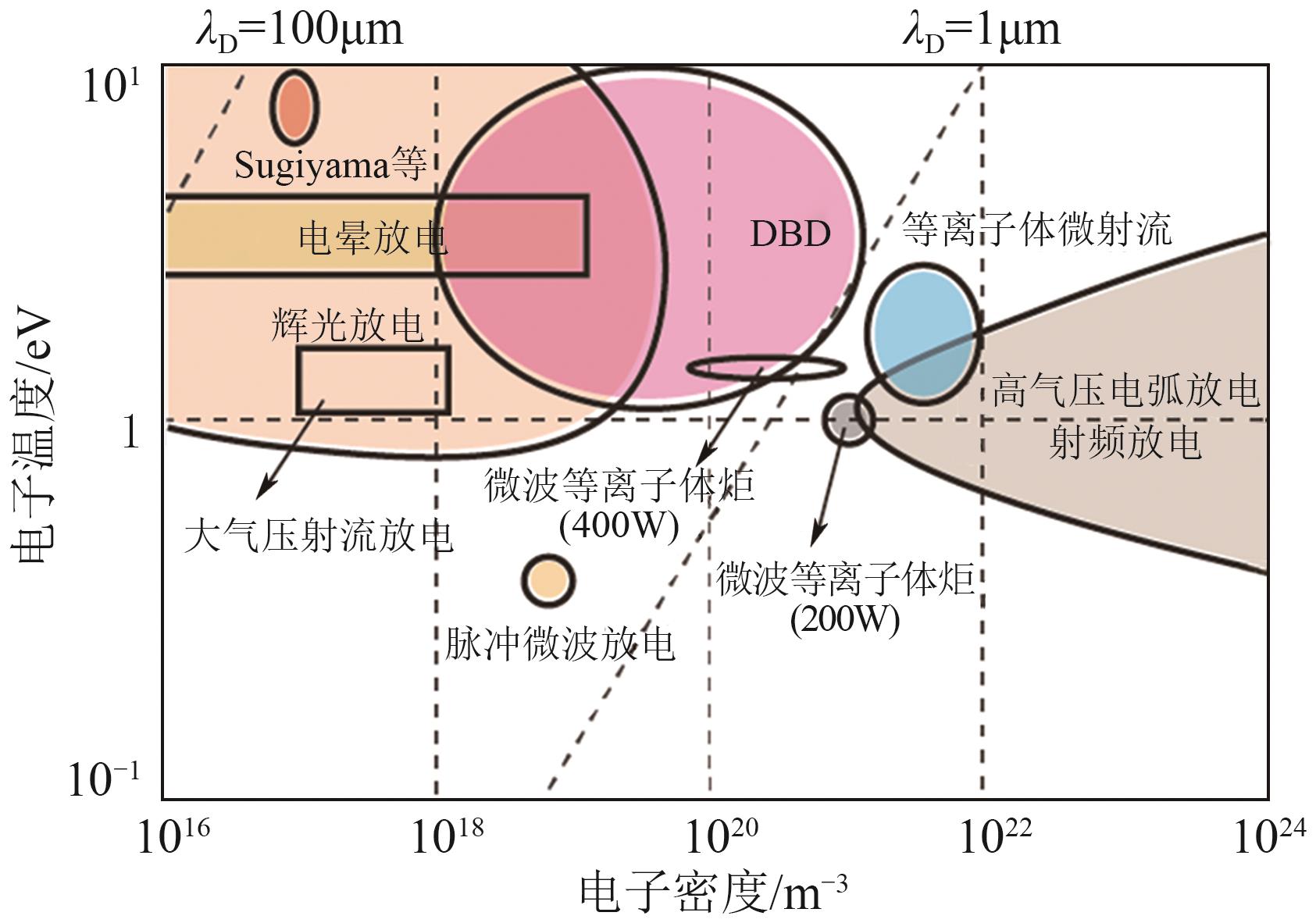
图1 大气压等离子体源的分类
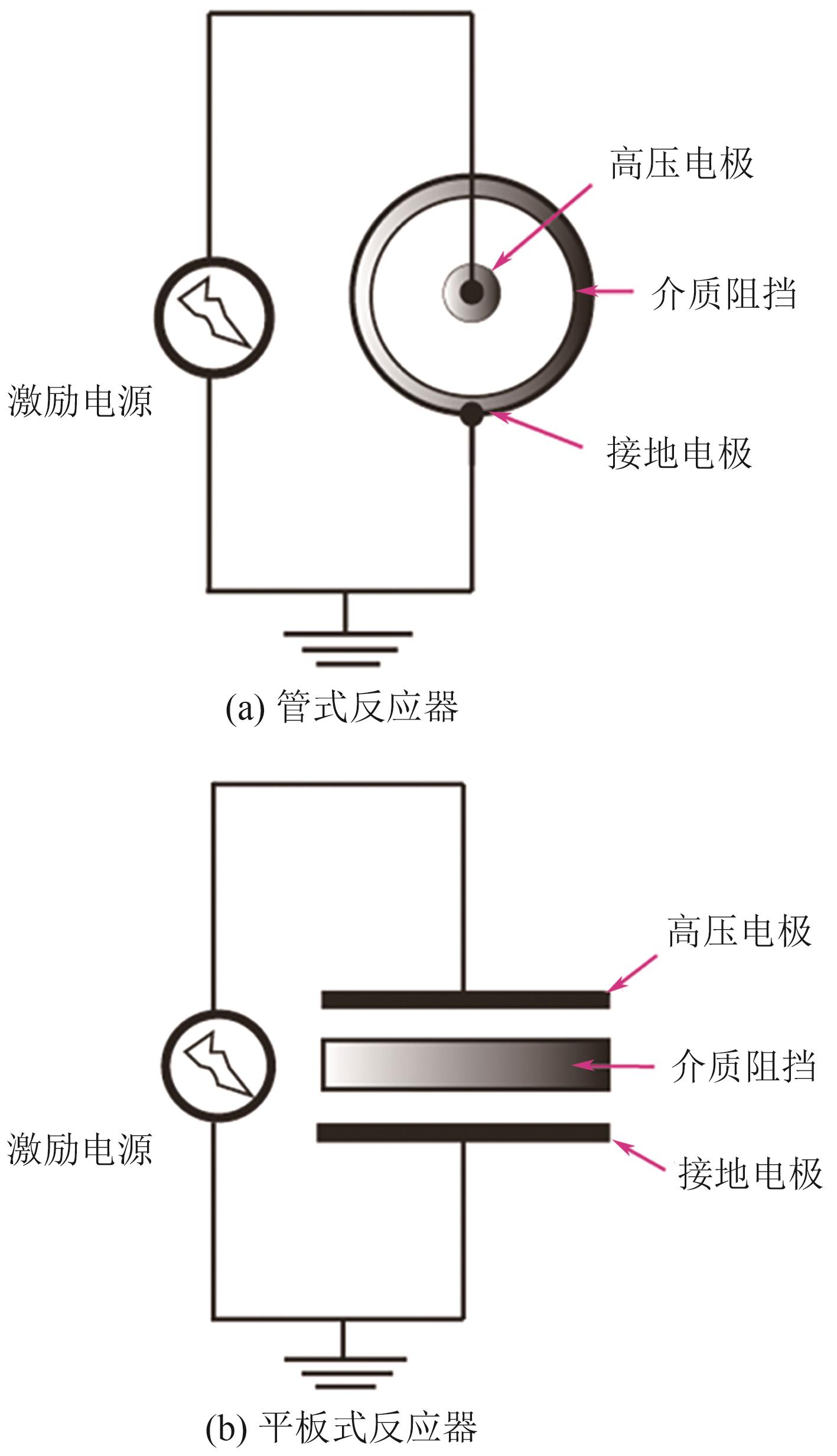
图2 DBD反应器的典型结构
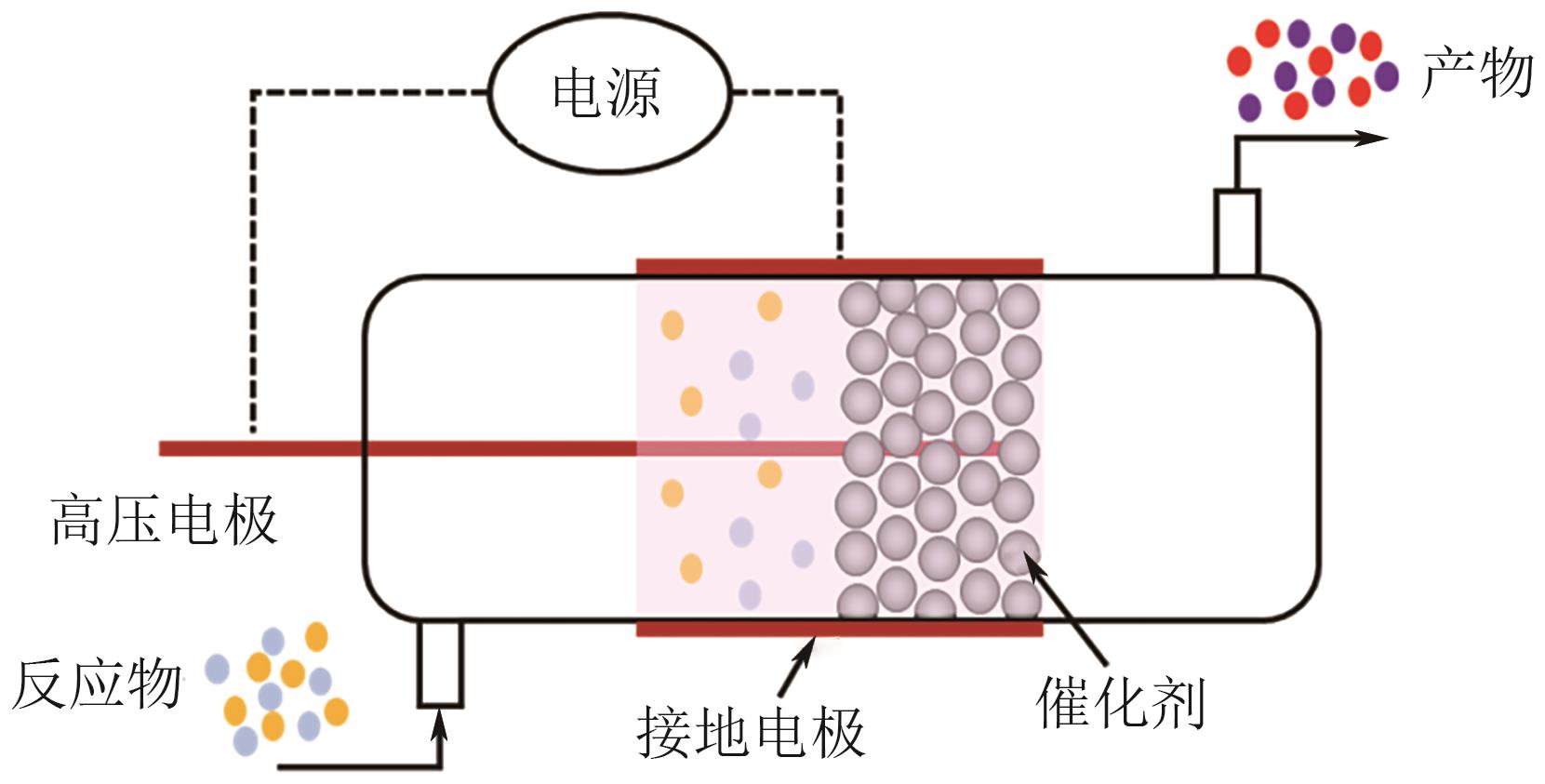
图3 常规填充床DBD反应器的示意图
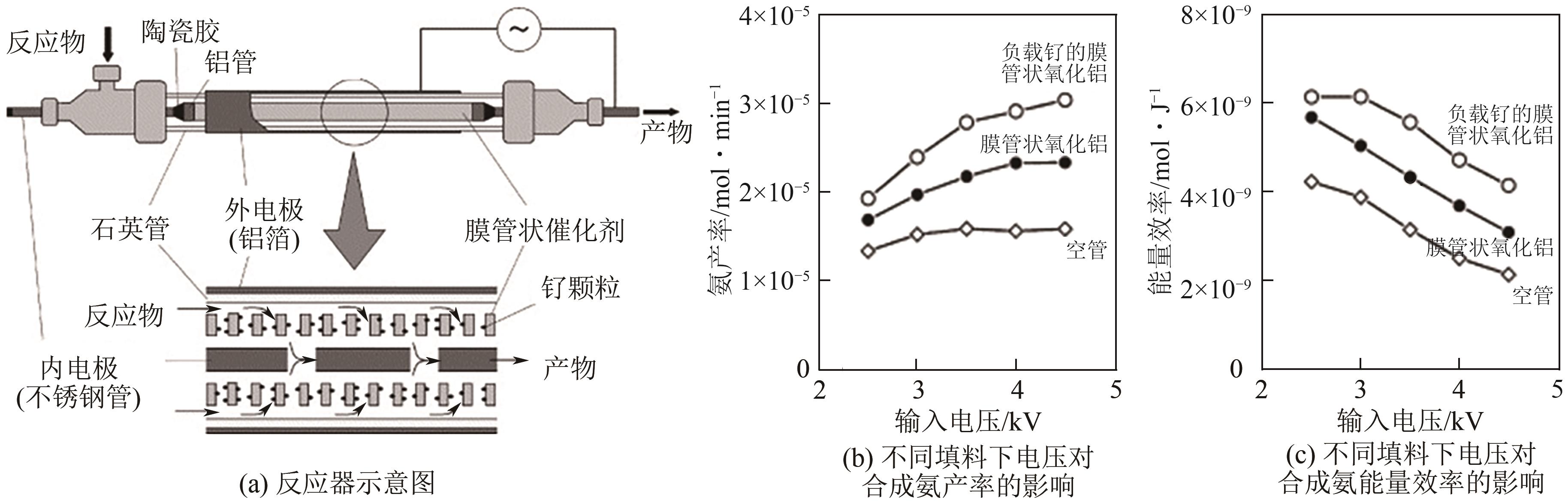
图4 DBD反应器耦合膜管状催化剂合成氨[39]
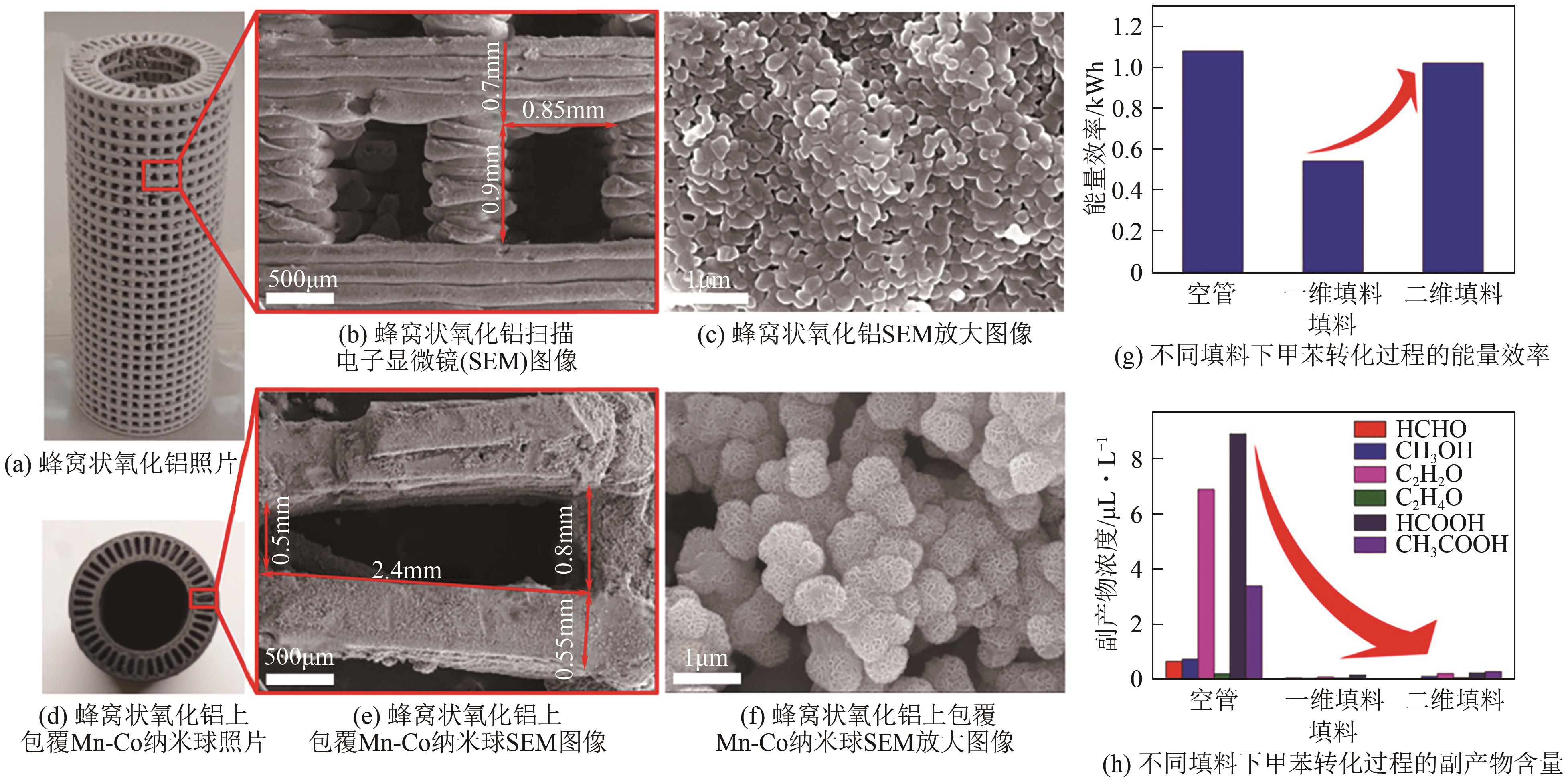
图5 蜂窝状催化剂结构及性能[40]
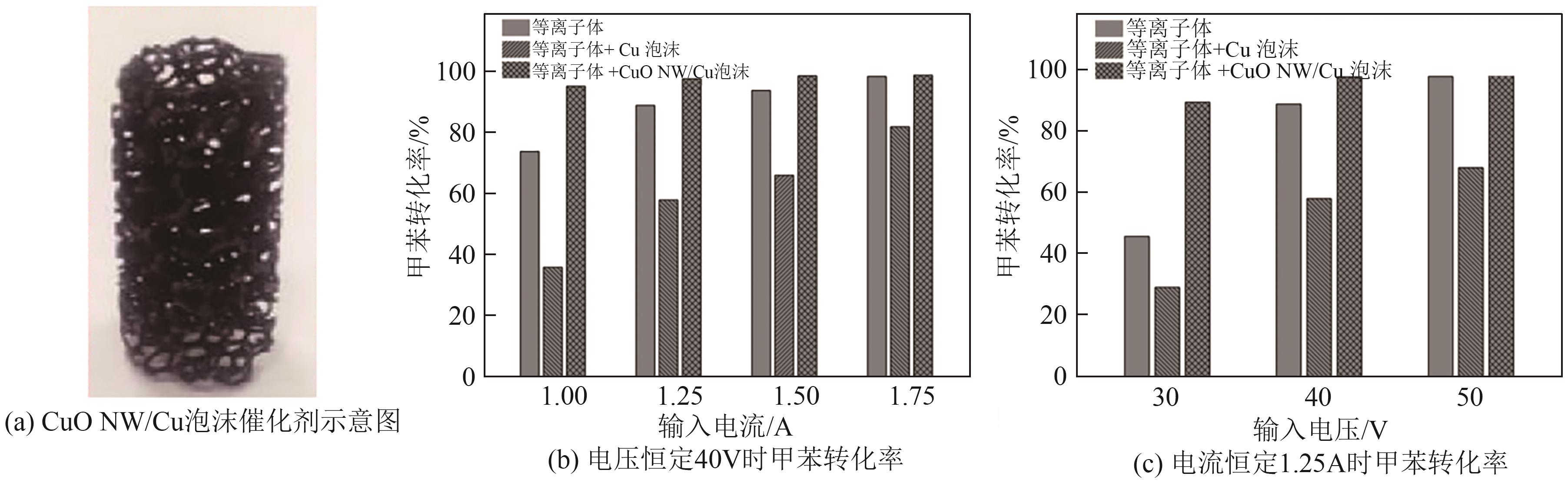
图6 泡沫状催化剂结构及性能[41]
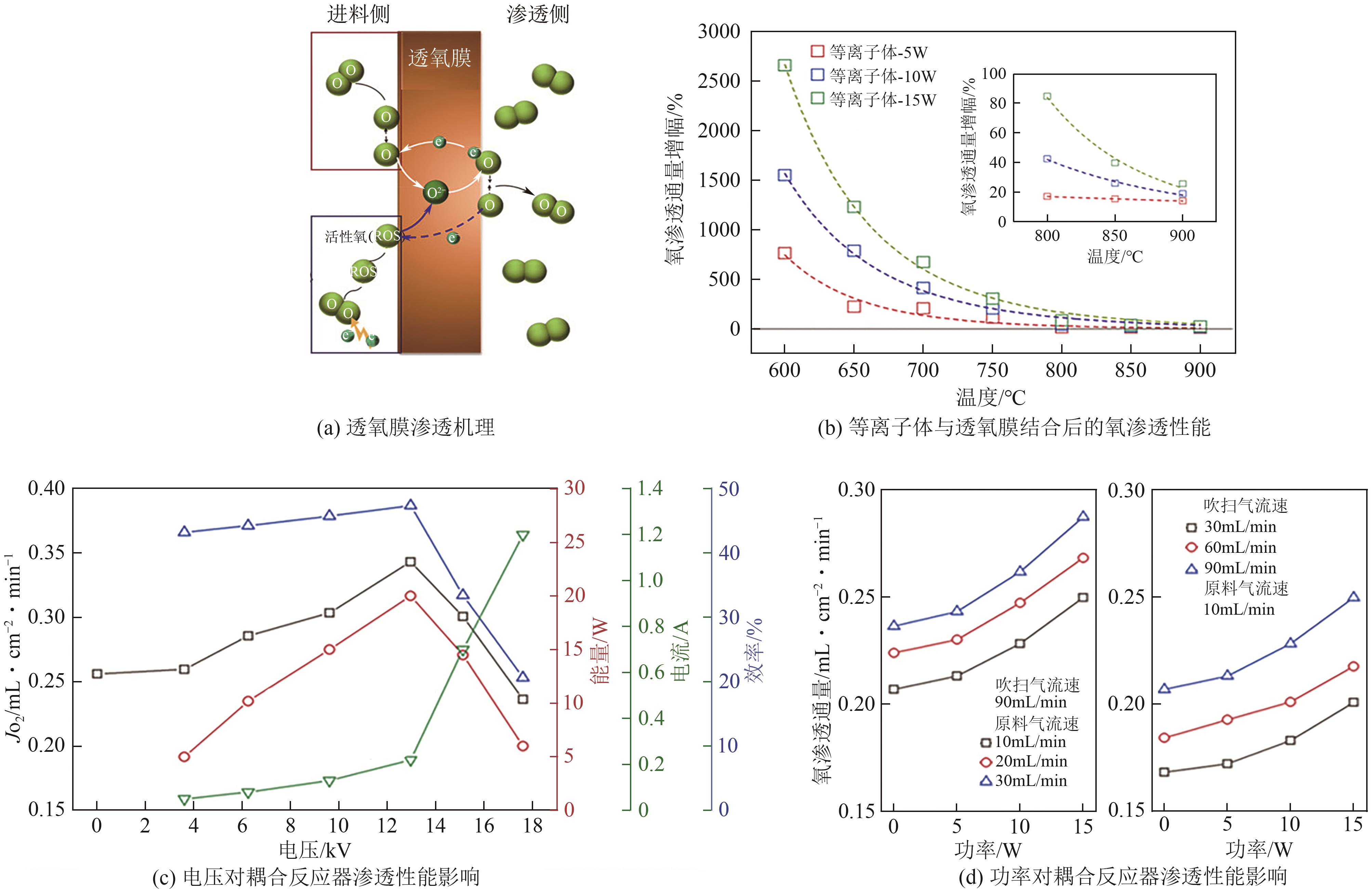
图7 DBD等离子体耦合钙钛矿膜反应器机理及性能[47]
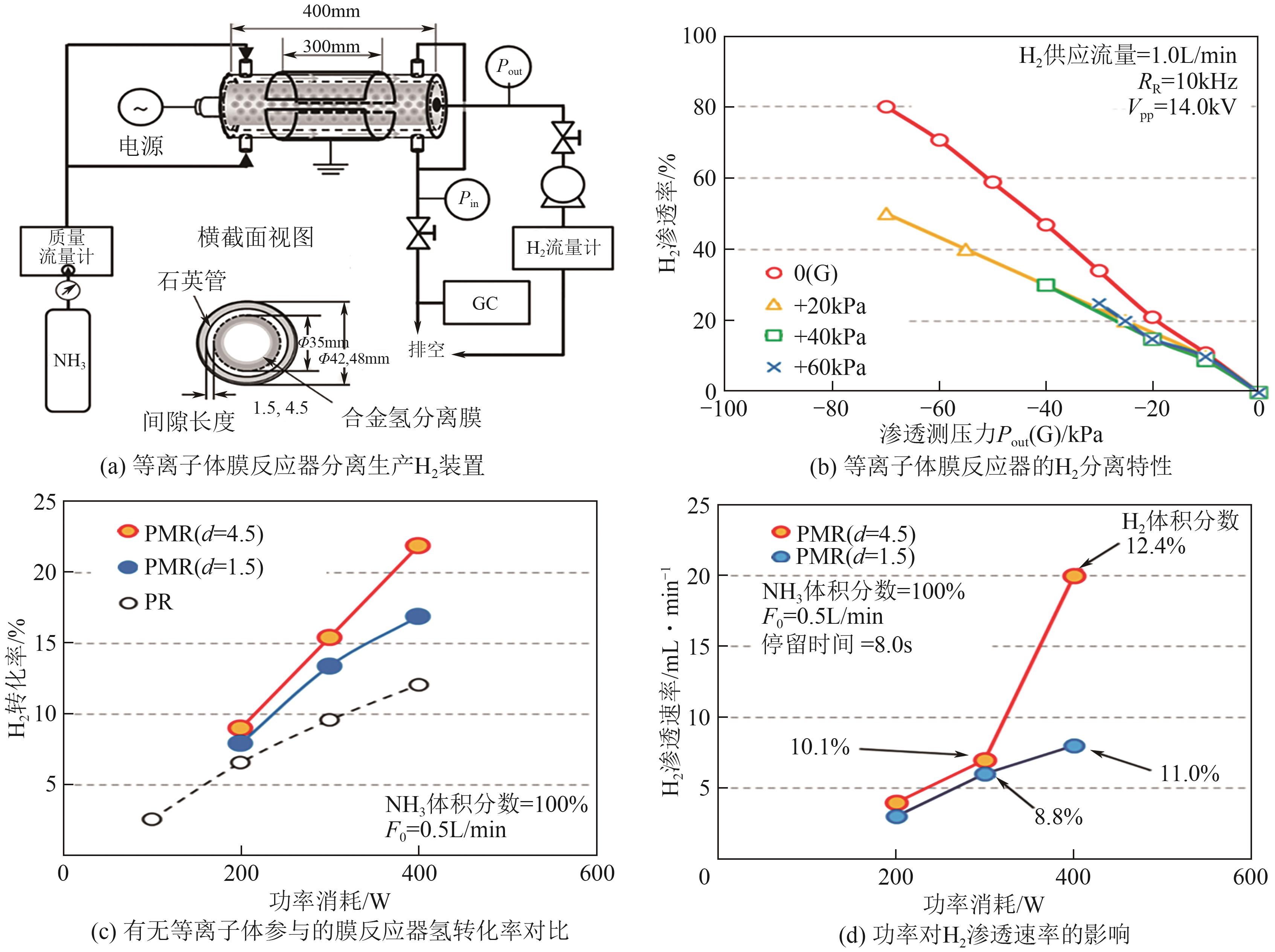
图8 DBD等离子体耦合合金膜反应器机理及性能[48]PMR(d=4.5)—间隙长度4.5mm的等离子体膜反应器;PMR(d=1.5)—间隙长度1.5mm的等离子体膜反应器;PR为—离子反应器
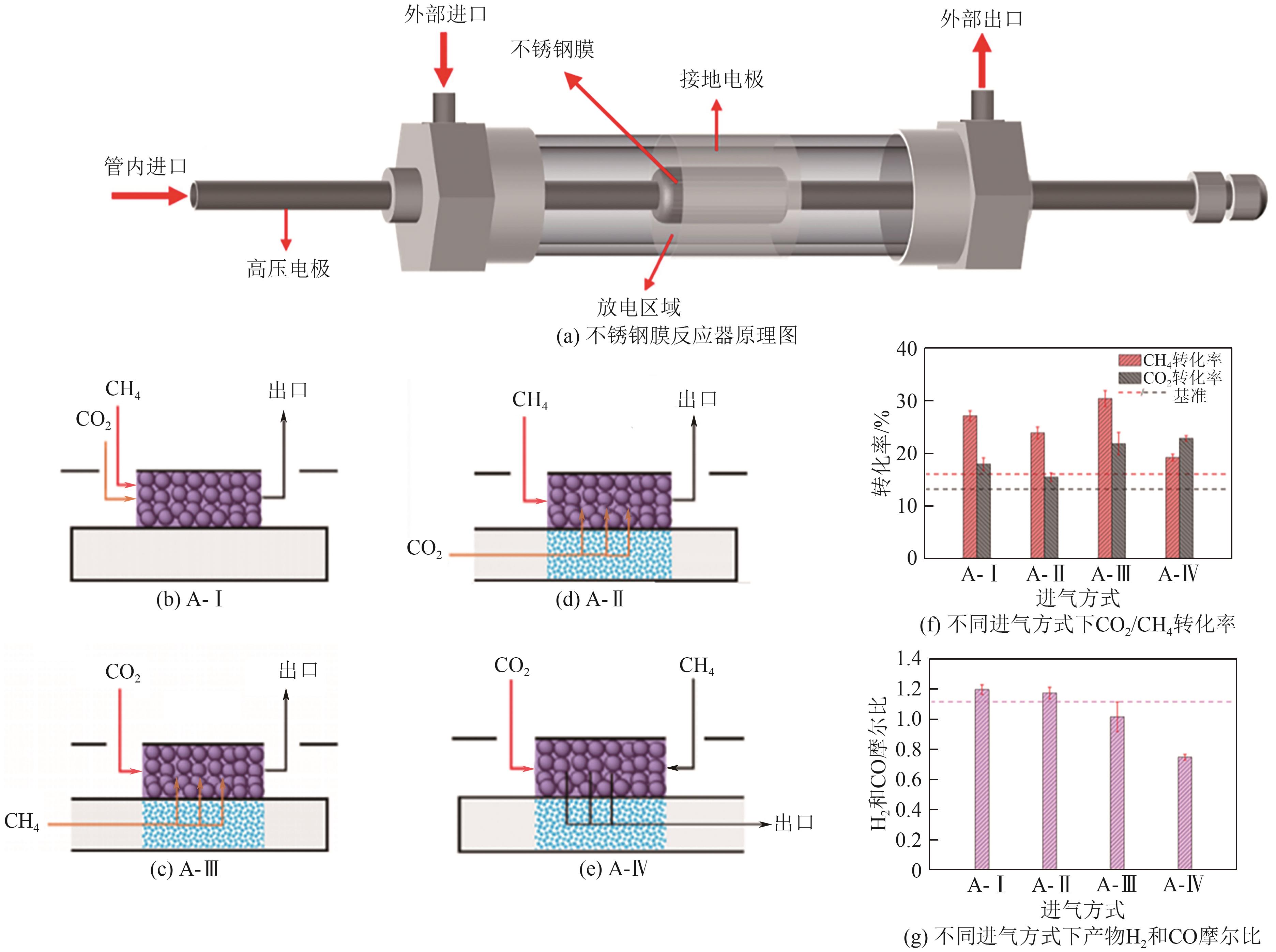
图9 DBD等离子体耦合分布式不锈钢膜反应器机理及性能[51]
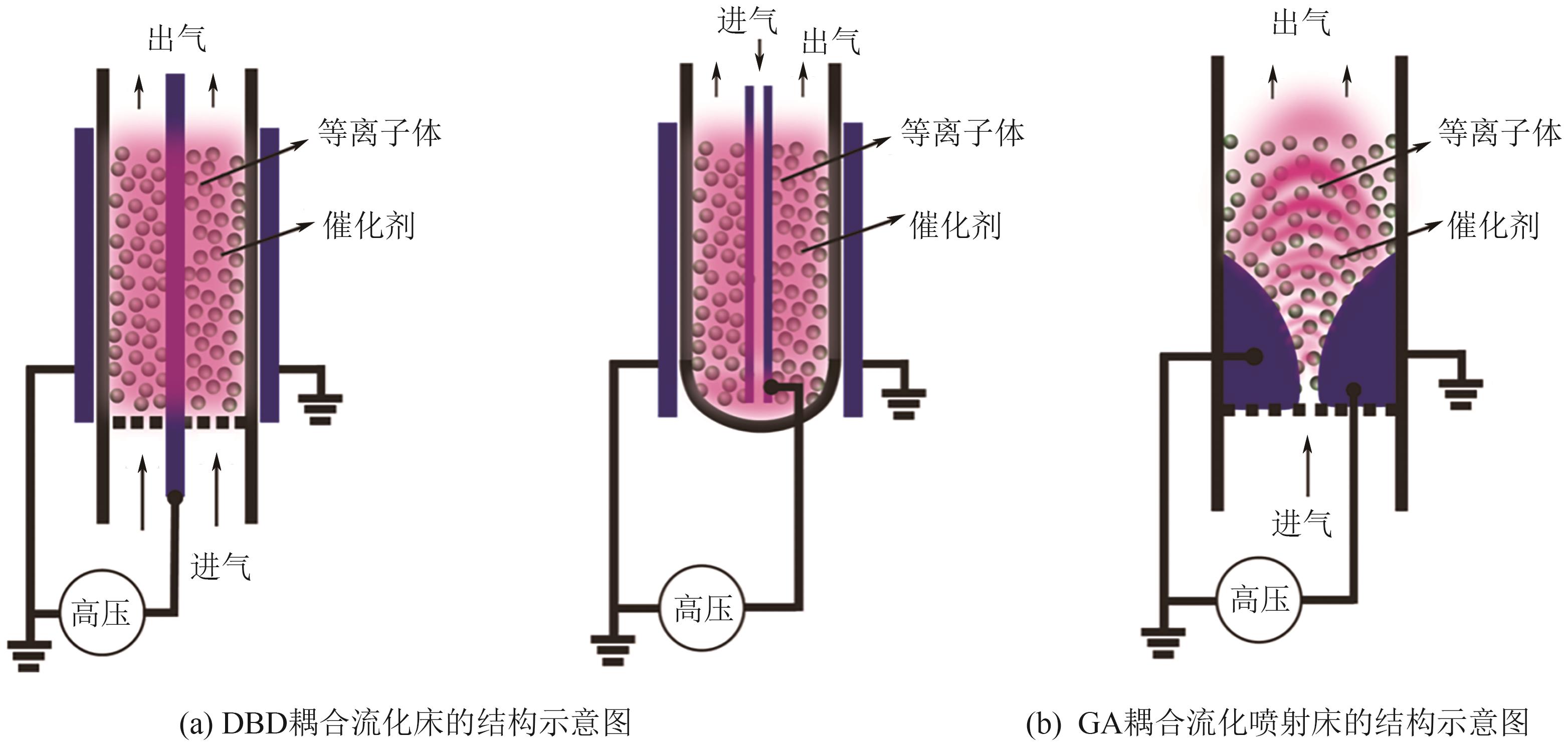
图10 DBD和GA耦合流化床示意图
| 化学反应 | 系统 | 催化剂 | 载气 | 甲烷转化率/% | 二氧化碳转化率/% | 特定能量输入/eV·分子-1 | 文献 |
|---|---|---|---|---|---|---|---|
| RWGS | FB-DBD | Pd2Ga/SiO2 | — | — | 60 | 2.2 | [ |
| La-Ni/Al2O3 | — | 10~50 | 10~40 | 1.52 | [ | ||
| DMR | FB-DBD | Ni/γ-Al2O3 | 83.7% Ar | 14.0~21.0 | 15.0~21.2 | 0.2~0.5 | [ |
| 5.5~36.5 | 5.6~36.5 | 0.4 | |||||
| 13.0~47.0 | 13.0~40.0 | 0.4 | |||||
| FB-DBD | γ-Al2O3 | 75.0% He | 9.1~12.0 | 4.5~6.1 | 1.5 | [ | |
| FB-DBD | Cu/Al2O3 | 95.0% He | 18.0~18.6 | 13.5~10.8 | 3.8 | [ | |
| Pd/Al2O3 | 17.4~16.2 | 11.2~8.8 | |||||
| FB-DBD | Pd/Al2O3 | 95.0% He | 8.8~35.8 | 5.0~23.3 | 2.3~7.6 | [ | |
| FSB-GAD | Ni/Al2O3 | 72.5% Ar | 11.8 | 11.2 | 0.6 | [ | |
| Ni/SiO2 | 10.2 | 9 | 0.2 | ||||
| 甲烷无氧偶联(NOCM) | 喷射床耦合滑动弧放电(SB-GAD) | Pt/Al2O3 | 96.2% Ar | 47~40 | — | 0.4~0.3 | [ |
| Al/Al2O3 | 54~48 | ||||||
SB-GAD (单相) | Pt/Al2O3 | 60.0% H2 | 12~24 | 0.6~1.3 | [ | ||
| Pd/Al2O3 | 12~17 | 0.6~1.0 | |||||
| Al2O3 | 4~19 | 0.5~0.7 | |||||
SB-GAD (三相) | Pt/Al2O3 | 7~15 | 0.3~0.8 | ||||
| Pd/Al2O3 | 6~16 | 0.3~1.0 | |||||
| Al2O3 | 11~21 | 0.4~1.0 | |||||
SB-GAD (单相) | Cu/Al2O3 | 60.0% H2 | 20 | 0.9 | [ | ||
| Ni/Al2O3 | 15 | ||||||
| Ag/Al2O3 | 19 | ||||||
| Pt/Al2O3 | 19 | ||||||
| Al2O3 | 19 | ||||||
SB-GAD (三相) | Pt/Al2O3 | 60.0% H2 | 7~15 | 0.3~0.8 | [ | ||
| Pd/Al2O3 | 6~16 | 0.3~1.0 | |||||
| Al2O3 | 12~21 | 0.4~1.0 |
表1 DBD及GA等离子体耦合流化床催化反应对比
| 化学反应 | 系统 | 催化剂 | 载气 | 甲烷转化率/% | 二氧化碳转化率/% | 特定能量输入/eV·分子-1 | 文献 |
|---|---|---|---|---|---|---|---|
| RWGS | FB-DBD | Pd2Ga/SiO2 | — | — | 60 | 2.2 | [ |
| La-Ni/Al2O3 | — | 10~50 | 10~40 | 1.52 | [ | ||
| DMR | FB-DBD | Ni/γ-Al2O3 | 83.7% Ar | 14.0~21.0 | 15.0~21.2 | 0.2~0.5 | [ |
| 5.5~36.5 | 5.6~36.5 | 0.4 | |||||
| 13.0~47.0 | 13.0~40.0 | 0.4 | |||||
| FB-DBD | γ-Al2O3 | 75.0% He | 9.1~12.0 | 4.5~6.1 | 1.5 | [ | |
| FB-DBD | Cu/Al2O3 | 95.0% He | 18.0~18.6 | 13.5~10.8 | 3.8 | [ | |
| Pd/Al2O3 | 17.4~16.2 | 11.2~8.8 | |||||
| FB-DBD | Pd/Al2O3 | 95.0% He | 8.8~35.8 | 5.0~23.3 | 2.3~7.6 | [ | |
| FSB-GAD | Ni/Al2O3 | 72.5% Ar | 11.8 | 11.2 | 0.6 | [ | |
| Ni/SiO2 | 10.2 | 9 | 0.2 | ||||
| 甲烷无氧偶联(NOCM) | 喷射床耦合滑动弧放电(SB-GAD) | Pt/Al2O3 | 96.2% Ar | 47~40 | — | 0.4~0.3 | [ |
| Al/Al2O3 | 54~48 | ||||||
SB-GAD (单相) | Pt/Al2O3 | 60.0% H2 | 12~24 | 0.6~1.3 | [ | ||
| Pd/Al2O3 | 12~17 | 0.6~1.0 | |||||
| Al2O3 | 4~19 | 0.5~0.7 | |||||
SB-GAD (三相) | Pt/Al2O3 | 7~15 | 0.3~0.8 | ||||
| Pd/Al2O3 | 6~16 | 0.3~1.0 | |||||
| Al2O3 | 11~21 | 0.4~1.0 | |||||
SB-GAD (单相) | Cu/Al2O3 | 60.0% H2 | 20 | 0.9 | [ | ||
| Ni/Al2O3 | 15 | ||||||
| Ag/Al2O3 | 19 | ||||||
| Pt/Al2O3 | 19 | ||||||
| Al2O3 | 19 | ||||||
SB-GAD (三相) | Pt/Al2O3 | 60.0% H2 | 7~15 | 0.3~0.8 | [ | ||
| Pd/Al2O3 | 6~16 | 0.3~1.0 | |||||
| Al2O3 | 12~21 | 0.4~1.0 |
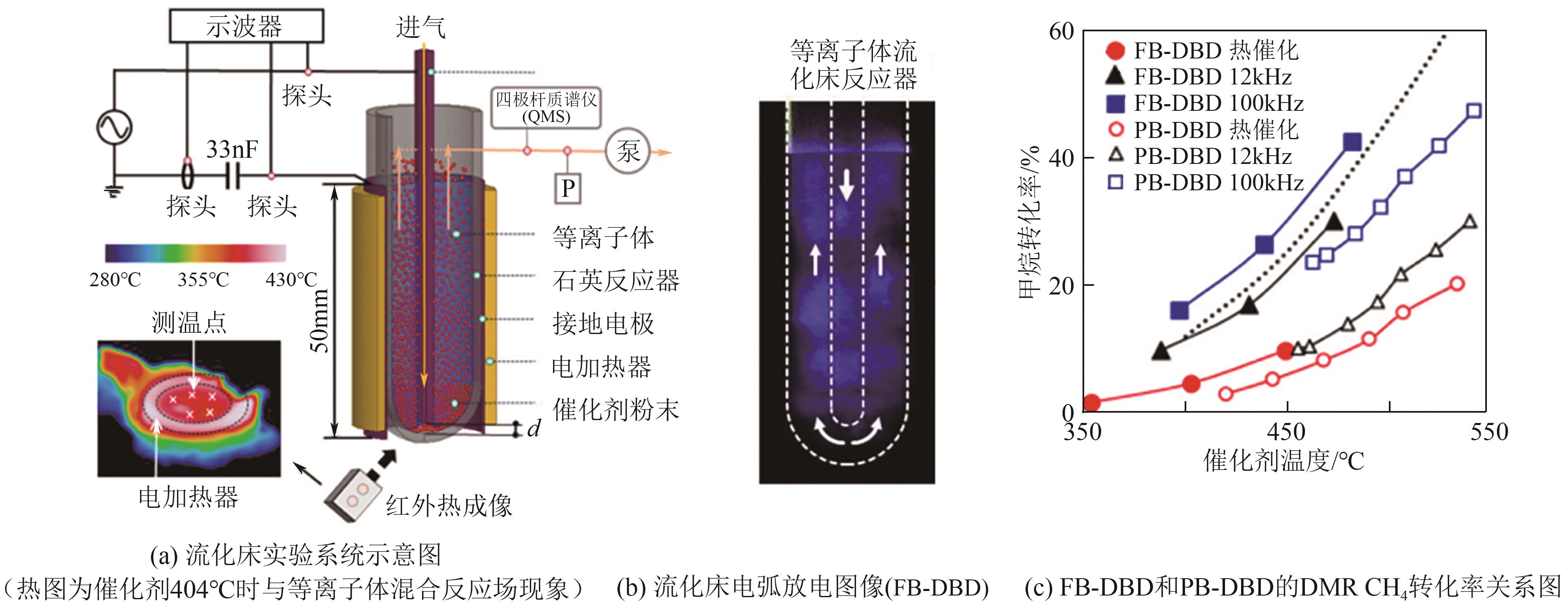
图11 DBD等离子体耦合流化床催化甲烷干重整反应技术[20]
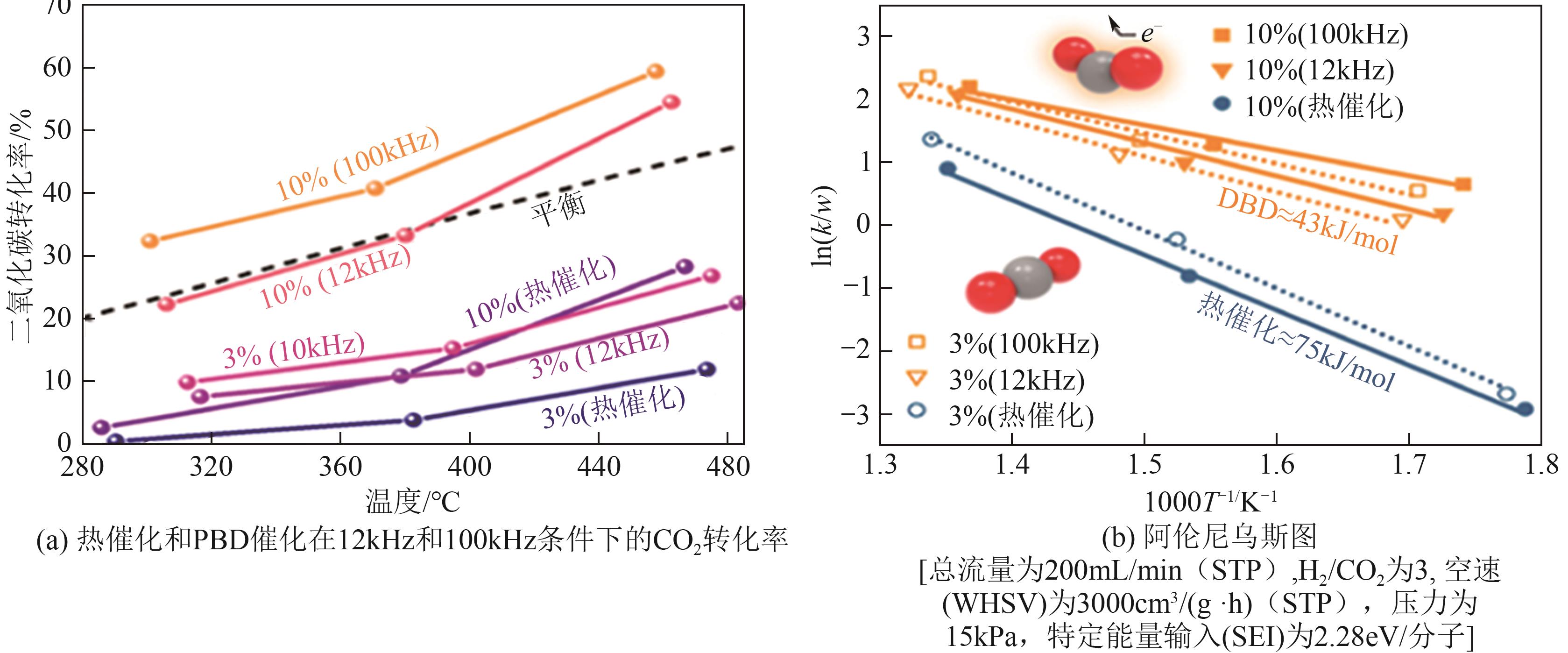
图12 FB-DBD反应器在10%和3%(质量分数)Pd2Ga/SiO2上进行CO2加氢动力学[19]
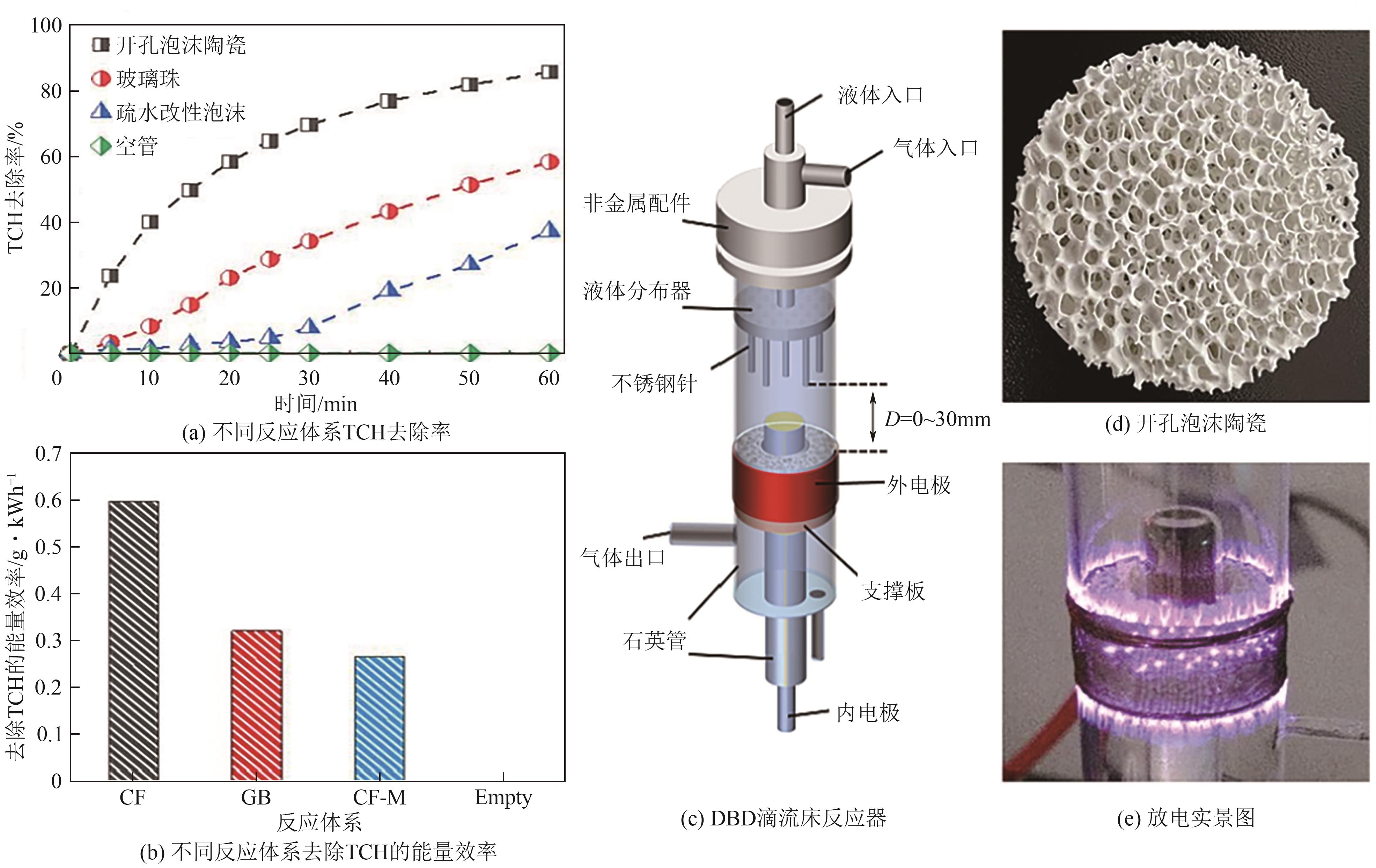
图13 滴流床反应器与等离子体技术结合对废水中污染物的降解与其结构[23]
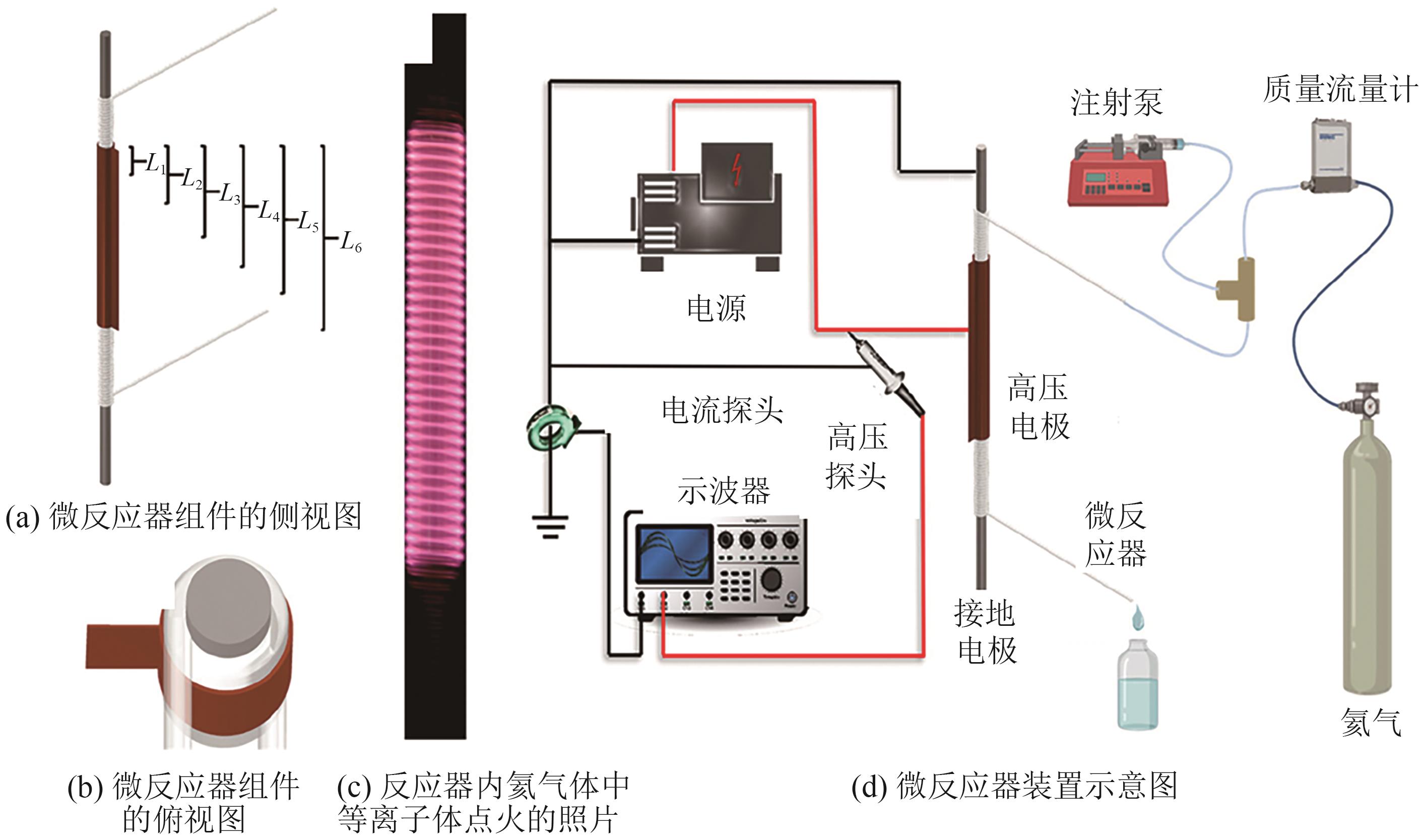
图14 DBD配置的螺旋双相等离子体微反应器[62]
| [1] | XIAO Dengming. Fundamental theory of streamer and leader discharge[M]//Gas Discharge and gas insulation. Berlin: Springer, 2016: 89-121. |
| [2] | 程易, 刘昌俊. 低温等离子体化工[M]. 北京: 化学工业出版社, 2020. |
| CHENG Yi, LIU Changjun. Low temperature plasma chemical engineering[M]. Beijing: Chemical Industry Press, 2020. | |
| [3] | NEYTS Erik C. Plasma-surface interactions in plasma catalysis[J]. Plasma Chemistry and Plasma Processing, 2016, 36(1): 185-212. |
| [4] | LIU Wenzheng, MA Chuanlong, ZHAO Shuai, et al. Exploration to generate atmospheric pressure glow discharge plasma in air[J]. Plasma Science and Technology, 2018, 20(3): 035401. |
| [5] | LIU Wenzheng, NIU Jiangqi, ZHAO Shuai, et al. Study on atmospheric pressure glow discharge based on AC-DC coupled electric field[J]. Journal of Applied Physics, 2018, 123(2): 023303. |
| [6] | GO David B, POHLMAN Daniel A. A mathematical model of the modified Paschen’s curve for breakdown in microscale gaps[J]. Journal of Applied Physics, 2010, 107(10): 103303. |
| [7] | Paweł MIERCZYŃSKI, Agnieszka MIERCZYNSKA-VASILEV, SZYNKOWSKA-JÓŹWIK Małgorzata I, et al. Plasma-assisted catalysis for CH4 and CO2 conversion[J]. Catalysis Communications, 2023, 180: 106709. |
| [8] | PIETANZA Lucia Daniela, GUAITELLA Olivier, AQUILANTI Vincenzo, et al. Advances in non-equilibrium CO2 plasma kinetics: A theoretical and experimental review[J]. The European Physical Journal D, 2021, 75(9): 237. |
| [9] | 陈金飞, 杜学森, 苏小军, 等. 基于负载型SBA-15催化剂的等离子体协同催化合成氨研究[J]. 能源环境保护, DOI:10.20078/j.eep.20240602 . |
| CHEN Jinfei, DU Xuesen, SU Xiaojun, et al. Research on plasma-synergized catalytic ammonia synthesis based on supported SBA-15 catalysts[J]. Energy Environmental Protection, DOI:10.20078/j.eep.20240602 . | |
| [10] | 许志成, 高宁博, 全翠, 等. 低温等离子体协同催化转化生物质气化焦油研究进展[J]. 化工进展, 2025, 44(6): 3432-3442. |
| XU Zhicheng, GAO Ningbo, QUAN Cui, et al. Research progress on synergistic catalytic conversion of biomass gasification tar by non-thermal plasma[J]. Chemical Industry and Engineering Progress, 2025, 44(6): 3432-3442. | |
| [11] | TENDERO Claire, TIXIER Christelle, TRISTANT Pascal, et al. Atmospheric pressure plasmas: A review[J]. Spectrochimica Acta Part B: Atomic Spectroscopy, 2006, 61(1): 2-30. |
| [12] | 程鹤, 雷孝廷, 张文超, 等. 低温等离子体转化CO2及分解机理研究[J]. 高电压技术, 2024, 50(11): 5206-5218. |
| CHEN He, LEI Xiaoting, ZHANG Wenchao, et al. Study on the low-temperature plasma conversion of CO2 and decomposition mechanism[J]. High Voltage Technology, 2024, 50(11): 5206-5218. | |
| [13] | CHIROKOV A, GUTSOL A, FRIDMAN A. Atmospheric pressure plasma of dielectric barrier discharges[J]. Pure and Applied Chemistry, 2005, 77(2): 487-495. |
| [14] | MIAO Yu, YOKOCHI Alexandre, JOVANOVIC Goran, et al. Application-oriented non-thermal plasma in chemical reaction engineering: A review[J]. Green Energy and Resources, 2023, 1(1): 100004. |
| [15] | BUTTERWORTH T, ELDER R, ALLEN R. Effects of particle size on CO2 reduction and discharge characteristics in a packed bed plasma reactor[J]. Chemical Engineering Journal, 2016, 293: 55-67. |
| [16] | CHEN Guoxing, GODFROID Thomas, BRITUN Nikolay, et al. Plasma-catalytic conversion of CO2 and CO2/H2O in a surface-wave sustained microwave discharge[J]. Applied Catalysis B: Environmental, 2017, 214: 114-125. |
| [17] | ZENG Yuxuan, TU Xin. Plasma-catalytic hydrogenation of CO2 for the cogeneration of CO and CH4 in a dielectric barrier discharge reactor: Effect of argon addition[J]. Journal of Physics D: Applied Physics, 2017, 50(18): 184004. |
| [18] | MA Xintong, LI Sirui, Maria RONDA-LLORET, et al. Plasma assisted catalytic conversion of CO2 and H2O over Ni/Al2O3 in a DBD Reactor[J]. Plasma Chemistry and Plasma Processing, 2019, 39(1): 109-124. |
| [19] | KIM Dae-Yeong, Hyungwon HAM, CHEN Xiaozhong, et al. Cooperative catalysis of vibrationally excited CO2 and alloy catalyst breaks the thermodynamic equilibrium limitation[J]. Journal of the American Chemical Society, 2022, 144(31): 14140-14149. |
| [20] | CHEN Xiaozhong, SHENG Zunrong, MURATA Sho, et al. CH4 dry reforming in fluidized-bed plasma reactor enabling enhanced plasma-catalyst coupling[J]. Journal of CO2 Utilization, 2021, 54: 101771. |
| [21] | CHEN Xiaozhong, KIM Hyun-Ha, NOZAKI Tomohiro. Plasma catalytic technology for CH4 and CO2 conversion: A review highlighting fluidized-bed plasma reactor[J]. Plasma Processes and Polymers, 2023, 21(1): 2200207. |
| [22] | MANOJ KUMAR REDDY P, MAHAMMADUNNISA Sk, SUBRAHMANYAM Ch. Catalytic non-thermal plasma reactor for mineralization of endosulfan in aqueous medium: A green approach for the treatment of pesticide contaminated water[J]. Chemical Engineering Journal, 2014, 238: 157-163. |
| [23] | SHAO Yan, GUO Hongwei, JI Zhaoqi, et al. Cellular foam-based trickle-bed DBD reactor for plasma-assisted degradation of tetracycline hydrochloride[J]. Separation and Purification Technology, 2023, 311: 123317. |
| [24] | ZHAO Xuesong, YANG Yinhai, CHEN Qi, et al. Insights into catalyst-free, highly effective degradation of pharmaceutical contaminant in aqueous solution by a dielectric barrier discharge system[J]. Separation and Purification Technology, 2023, 320: 124211. |
| [25] | ZHANG Longhui, ZHANG Zhen, ZHANG Dongxuan, et al. Hydrophilic surface modification of polypropylene by AC-DBD and NS-DBD[J]. Surfaces and Interfaces, 2024, 46: 104093. |
| [26] | LI Jiaxin, YAO Jianxiong, HE Feng, et al. Comparison of ozone production in planar DBD of different modes[J]. Plasma Chemistry and Plasma Processing, 2024, 44(2): 891-905. |
| [27] | Mária DOMONKOS, Petra TICHÁ, TREJBAL Jan, et al. Applications of cold atmospheric pressure plasma technology in medicine, agriculture and food industry[J]. Applied Sciences, 2021, 11(11): 4809. |
| [28] | UYTDENHOUWEN Y, VAN ALPHEN S, MICHIELSEN I, et al. A packed-bed DBD micro plasma reactor for CO2 dissociation: Does size matter?[J]. Chemical Engineering Journal, 2018, 348: 557-568. |
| [29] | OZKAN A, DUFOUR T, SILVA T, et al. The influence of power and frequency on the filamentary behavior of a flowing DBD—Application to the splitting of CO2 [J]. Plasma Sources Science and Technology, 2016, 25(2): 025013. |
| [30] | BOGAERTS A, TU X, WHITEHEAD J C, et al. The 2020 plasma catalysis roadmap[J]. Journal of Physics D:Applied Physics, 2020, 53: 443001. |
| [31] | GEORGE Adwek, SHEN Boxiong, CRAVEN Michael, et al. A review of non-thermal plasma technology: A novel solution for CO2 conversion and utilization[J]. Renewable & Sustainable Energy Reviews, 2021, 135: 109702. |
| [32] | VANDENBROUCKE Arne M, MORENT Rino, De GEYTER Nathalie, et al. Non-thermal plasmas for non-catalytic and catalytic VOC abatement[J]. Journal of Hazardous Materials, 2011, 195: 30-54. |
| [33] | CHEN Shaowei, LIU Tianqi, NIU Jiangqi, et al. Plasma-catalytic CO2 methanation over Ni supported on MCM-41 catalysts: Effect of metal dispersion and process optimization[J]. Carbon Capture Science & Technology, 2024, 11: 100194. |
| [34] | TU X, WHITEHEAD J C. Plasma-catalytic dry reforming of methane in an atmospheric dielectric barrier discharge: Understanding the synergistic effect at low temperature[J]. Applied Catalysis B: Environmental, 2012, 125: 439-448. |
| [35] | Nuria GARCÍA-MONCADA, VAN ROOIJ Gerard, CENTS Toine, et al. Catalyst-assisted DBD plasma for coupling of methane: Minimizing carbon-deposits by structured reactors[J]. Catalysis Today, 2021, 369:210-220. |
| [36] | KANG Woo Seok, LEE Dae Hoon, LEE Jae-Ok, et al. Combination of plasma with a honeycomb-structured catalyst for automobile exhaust treatment[J]. Environmental Science & Technology, 2013, 47(19): 11358-11362. |
| [37] | TOAN NGUYEN Van, KHOE DINH Duy, MCHP LAN Nguyen, et al. Critical role of reactive species in the degradation of VOC in a plasma honeycomb catalyst reactor[J]. Chemical Engineering Science, 2023, 276: 118830. |
| [38] | NGUYEN Duc Ba, SHIRJANA Saud, HOSSAIN Md Mokter, et al. Effective generation of atmospheric pressure plasma in a sandwich-type honeycomb monolith reactor by humidity control[J]. Chemical Engineering Journal, 2020, 401: 125970. |
| [39] | MIZUSHIMA Takanori, MATSUMOTO Kazumi, SUGOH Jun-ichi, et al. Tubular membrane-like catalyst for reactor with dielectric-barrier-discharge plasma and its performance in ammonia synthesis[J]. Applied Catalysis A: General, 2004, 265(1): 53-59. |
| [40] | LI Ting, Joamin GONZALEZ-GUTIERREZ, Ivan RAGUŽ, et al. Material extrusion additively manufactured alumina monolithic structures to improve the efficiency of plasma-catalytic oxidation of toluene[J]. Additive Manufacturing, 2021, 37: 101700. |
| [41] | ZHENG Minfang, YU Dongqi, DUAN Lianjie, et al. In-situ fabricated CuO nanowires/Cu foam as a monolithic catalyst for plasma-catalytic oxidation of toluene[J]. Catalysis Communications, 2017, 100: 187-190. |
| [42] | LI Juexiu, ZHANG Hongbo, YING Diwen, et al. In plasma catalytic oxidation of toluene using monolith CuO foam as a catalyst in a wedged high voltage electrode dielectric barrier discharge reactor: Influence of reaction parameters and byproduct control[J]. International Journal of Environmental Research and Public Health, 2019, 16(5): 711. |
| [43] | VENG Visal, TABU Benard, SIMASIKU Ephraim, et al. Design and characterization of a membrane dielectric-barrier discharge reactor for ammonia synthesis[J]. Plasma Chemistry and Plasma Processing, 2023, 43(6): 1921-1940. |
| [44] | LI Claudia, LI Wenping, CHEW Jiuan Jing, et al. Oxygen permeation through single-phase perovskite membrane: Modeling study and comparison with the dual-phase membrane[J]. Separation and Purification Technology, 2020, 235: 116224. |
| [45] | ZHANG Junxing, ZHANG Zhenbao, CHEN Yubo, et al. Materials design for ceramic oxygen permeation membranes: Single perovskite vs. single/double perovskite composite, a case study of tungsten-doped barium strontium cobalt ferrite[J]. Journal of Membrane Science, 2018, 566: 278-287. |
| [46] | HAN Ning, ZHANG Wei, GUO Wei, et al. Novel oxygen permeable hollow fiber perovskite membrane with surface wrinkles[J]. Separation and Purification Technology, 2021, 261: 118295. |
| [47] | ZHENG Qiankun, XIE Yaqiong, TAN Jinkun, et al. Coupling of dielectric barrier discharge plasma with oxygen permeable membrane for highly efficient low-temperature permeation[J]. Journal of Membrane Science, 2022, 641:119896. |
| [48] | HAYAKAWA Yukio, MIURA Tomonori, SHIZUYA Kota, et al. Hydrogen production system combined with a catalytic reactor and a plasma membrane reactor from ammonia[J]. International Journal of Hydrogen Energy, 2019, 44(20): 9987-9993. |
| [49] | KAMBARA Shinji, HAYAKAWA Yukio, INOUE Yu, et al. Hydrogen production from ammonia using a plasma membrane reactor[J]. Journal of Sustainable Development of Energy, Water and Environment Systems, 2016, 4(2): 193-202. |
| [50] | Mostafa EL-SHAFIE. Hydrogen separation using palladium-based membranes: Assessment of H2 separation in a catalytic plasma membrane reactor[J]. International Journal of Energy Research, 2021, 46(3): 3572-3587. |
| [51] | WANG Xinrui, GUO Weisi, XU Shanshan, et al. Stainless steel membrane distributor-type dielectric barrier discharge plasma reactor for co-conversion of CH4/CO2 [J]. AICHE Journal, 2023, 69(7): e18059. |
| [52] | 杜长明, 孟凡刚, 韦献革. 等离子体流化床[M]. 杭州: 浙江大学出版社, 2021. |
| DU Changming, MENG Fangang, WEI Xiange. Plasma fluidized bed[M]. Hangzhou: Zhejiang University Press, 2021. | |
| [53] | WANG Qi, CHENG Yi, JIN Yong. Dry reforming of methane in an atmospheric pressure plasma fluidized bed with Ni/γ-Al2O3 catalyst[J]. Catalysis Today, 2009, 148(3/4): 275-282. |
| [54] | BOUCHOUL Nassim, TOUATI Houcine, Elodie FOURRÉ, et al. Efficient plasma-catalysis coupling for CH4 and CO2 transformation in a fluidized bed reactor: Comparison with a fixed bed reactor[J]. Fuel, 2021, 288: 119575. |
| [55] | KROKER Thorsten, KOLB Torsten, SCHENK Andreas, et al. Catalytic conversion of simulated biogas mixtures to synthesis gas in a fluidized bed reactor supported by a DBD[J]. Plasma Chemistry and Plasma Processing, 2012, 32(3): 565-582. |
| [56] | THORSTEN Kroker, TORSTEN Kolb, KRZYSZTOF Krawczyk, et al. Catalytic conversion of biogas in a fluidized bed reactor supported by a DBD[J]. Frontier of Applied Plasma Technology, 2010, 3(2):1-5. |
| [57] | Jennifer MARTIN-DEL-CAMPO, UCEDA Marianna, COULOMBE Sylvain, et al. Plasma-catalytic dry reforming of methane over Ni-supported catalysts in a rotating gliding arc—Spouted bed reactor[J]. Journal of CO2 Utilization, 2021, 46: 101474. |
| [58] | LEE H, SEKIGUCHI H. Plasma-catalytic hybrid system using spouted bed with a gliding arc discharge: CH4 reforming as a model reaction[J]. Journal of Physics D:Applied Physics, 2011, 44(27):274008. |
| [59] | MŁOTEK M, SENTEK J, KRAWCZYK K, et al. The hybrid plasma-catalytic process for non-oxidative methane coupling to ethylene and ethane[J]. Applied Catalysis A: General, 2009, 366(2): 232-241. |
| [60] | Krzysztof SCHMIDT-SZAŁOWSKI, KRAWCZYK Krzysztof, Michat MŁOTEK. Catalytic effects of metals on the conversion of methane in gliding discharges[J]. Plasma Processes and Polymers, 2007, 4(7/8): 728-736. |
| [61] | Krzysztof SCHMIDT-SZAŁOWSKI, KRAWCZYK Krzysztof, SENTEK Jan, et al. Hybrid plasma-catalytic systems for converting substances of high stability, greenhouse gases and VOC[J]. Chemical Engineering Research & Design, 2011, 89(12): 2643-2651. |
| [62] | CAMELI Fabio, DIMITRAKELLIS Panagiotis, CHEN Taiying, et al. Modular plasma microreactor for intensified hydrogen peroxide production[J]. ACS Sustainable Chemistry & Engineering, 2022, 10(5): 1829-1838. |
| [1] | 冯勇强, 王洁茹, 王超娴, 李芳, 苏婉婷, 孙宇, 赵彬然. γ-Al2O3 负载的Ni、Fe、Cu对介质阻挡放电等离子体转化CO2/CH4的影响[J]. 化工进展, 2024, 43(5): 2705-2713. |
| [2] | 董冰岩, 李贞栋, 王佩祥, 涂文娟, 谭艳雯, 张芹. DBD等离子体耦合BiOI催化材料降解苯甲羟肟酸的特性与机制[J]. 化工进展, 2024, 43(3): 1565-1575. |
| [3] | 张维, 汪宗御, 郭玉, 杨孟飞, 李政楷, 常超, 张继锋, 纪玉龙. 大气压介质阻挡放电及协同催化剂脱硝研究进展[J]. 化工进展, 2022, 41(12): 6644-6655. |
| [4] | 谭潇, 齐随涛, 周一鸣, 石利斌, 程光旭, 伊春海, 杨伯伦. 非热等离子体协同锰铁双金属催化剂直接催化还原NO[J]. 化工进展, 2022, 41(11): 5850-5857. |
| [5] | 毕文菲, 代成义, 李雪梅, 贺建勋, 赵彬然, 马晓迅. 等离子体与Cu-Pd/S-1催化剂协同催化甲烷转化制低碳烯烃[J]. 化工进展, 2022, 41(1): 227-236. |
| [6] | 陈焕浩, 范晓雷. 非热等离子体催化转化C1分子及其催化剂研究进展[J]. 化工进展, 2021, 40(6): 3034-3045. |
| [7] | 代辉祥, 陆文静, 李超, 王前. 双介质阻挡放电低温等离子体对模拟堆肥气体中氨气的去除[J]. 化工进展, 2020, 39(9): 3801-3809. |
| [8] | 李超. 介质阻挡放电技术处理挥发性有机物的研究进展[J]. 化工进展, 2020, 39(5): 1964-1973. |
| [9] | 汪宗御,邝海浪,张继锋,褚李林,纪玉龙. 低温等离子体用于柴油机尾气脱硝的实验[J]. 化工进展, 2019, 38(10): 4755-4766. |
| [10] | 刘丹, 张连成, 黄逸凡, 朱安娜, 刘振, 闫克平. 双杆介质阻挡放电降解酸性红73废水[J]. 化工进展, 2018, 37(09): 3640-3648. |
| [11] | 鲁美娟, 杨文亭, 喻成龙, 吴军良, 叶代启. 等离子体协同催化降解VOCs过程中O3的作用机理[J]. 化工进展, 2018, 37(07): 2649-2654. |
| [12] | 冯嘉予, 宁平, 孙鑫, 王驰, 李坤林, 李凯. 等离子体合成氨技术研究进展[J]. 化工进展, 2018, 37(05): 1968-1977. |
| [13] | 梁佳男, 赵耀华, 全贞花, 叶欣, 迟远英. 基于微热管阵列锂电池的低温加热性能[J]. 化工进展, 2017, 36(11): 4030-4036. |
| [14] | 余芳, 陈元涛, 张炜, 赫文芳, 王雲生, 刘晨. TiO2-HNTs催化剂协同介质阻挡放电等离子体降解亚甲基蓝废水[J]. 化工进展, 2016, 35(12): 4076-4081. |
| [15] | 范明阳, 郝小龙, 韩秀茹. 大气压等离子体射流气源组分研究进展[J]. 化工进展, 2015, 34(12): 4158-4164. |
| 阅读次数 | ||||||
|
全文 |
|
|||||
|
摘要 |
|
|||||