化工进展 ›› 2025, Vol. 44 ›› Issue (7): 4241-4250.DOI: 10.16085/j.issn.1000-6613.2024-0886
• 资源与环境化工 • 上一篇
热预处理对餐厨垃圾与垃圾渗滤液厌氧发酵产乳酸的影响
张文娟1( ), 石佳欣1, 徐先宝2, 李响2
- 1.上海工程技术大学化学化工学院,上海 201620
2.东华大学环境科学与工程学院,上海 201620
-
收稿日期:2024-05-31修回日期:2024-07-12出版日期:2025-07-25发布日期:2025-08-04 -
通讯作者:张文娟 -
作者简介:张文娟(1991—),女,实验师,硕士生导师,主要研究方向为固废处理与资源化。E-mail:zhwenjuan@sues.edu.cn。 -
基金资助:上海市青年科技英才扬帆计划(21YF1415600)
Effect of thermal pre-treatment on lactic acid production from the anaerobic fermentation of food waste and landfill leachate
ZHANG Wenjuan1(), SHI Jiaxin1, XU Xianbao2, LI Xiang2
- 1.College of Chemistry and Chemical Engineering, Shanghai University of Engineering Science, Shanghai 201620, China
2.College of Environmental Science and Engineering, Donghua University, Shanghai 201620, China
-
Received:2024-05-31Revised:2024-07-12Online:2025-07-25Published:2025-08-04 -
Contact:ZHANG Wenjuan

摘要:
餐厨垃圾厌氧发酵产生手性乳酸不仅实现了餐厨垃圾的高值资源化,同时是循环经济的重要组成。然而,餐厨垃圾厌氧发酵过程中存在pH不稳定和营养元素缺失等问题。垃圾渗滤液中包含大量氨氮可作为缓冲体系维持稳定的pH,同时存在大量微量元素可有效促进发酵菌群生长。本文以餐厨垃圾和垃圾渗滤液为底物,利用热预处理解除发酵底物溶出水解效率的限制,同时改变微生物群落组成及其功能活性,深入探讨了联合发酵产乳酸的效能及机制。结果表明,与35℃热预处理组相比[(36.37±2.66)g COD/L,55.85%,COD为化学需氧量],45℃热预处理组中L-乳酸产量和光学活性可达(40.16±0.75)g COD/L和93.17%,分别提高了10%和67%。高温条件下(65℃和75℃)L-乳酸产量较低与较强的烟酰胺腺嘌呤二核苷酸(NAD)-非依赖型乳酸脱氢酶(i-LDH)活性相关(乳酸消耗)。此外,热预处理温度的增加会抑制D-乳酸生成。机理研究表明,热预处理能够加快底物溶出和水解进程,加速碳水化合物利用及其代谢进程,同时富集产乳酸微生物,肠球菌属(Enterococcus)、克雷伯菌属(Klebsiella)、链球菌属(Streptococcus)、巴伐利亚球菌属(Bavariicoccus)等产乳酸微生物45℃和55℃热预处理组总相对丰度分别达到86.35%和80.19%。功能分析发现,热预处理能够显著提高与乳酸生成相关的碳水化合物代谢通路丰度,与35℃热预处理组相比(15.9%),45℃和55℃热预处理组的碳水化合物代谢通路相对丰度提高到16.87%和17.74%。本文为餐厨垃圾与垃圾渗滤液资源化提供了新途径。
中图分类号:
引用本文
张文娟, 石佳欣, 徐先宝, 李响. 热预处理对餐厨垃圾与垃圾渗滤液厌氧发酵产乳酸的影响[J]. 化工进展, 2025, 44(7): 4241-4250.
ZHANG Wenjuan, SHI Jiaxin, XU Xianbao, LI Xiang. Effect of thermal pre-treatment on lactic acid production from the anaerobic fermentation of food waste and landfill leachate[J]. Chemical Industry and Engineering Progress, 2025, 44(7): 4241-4250.
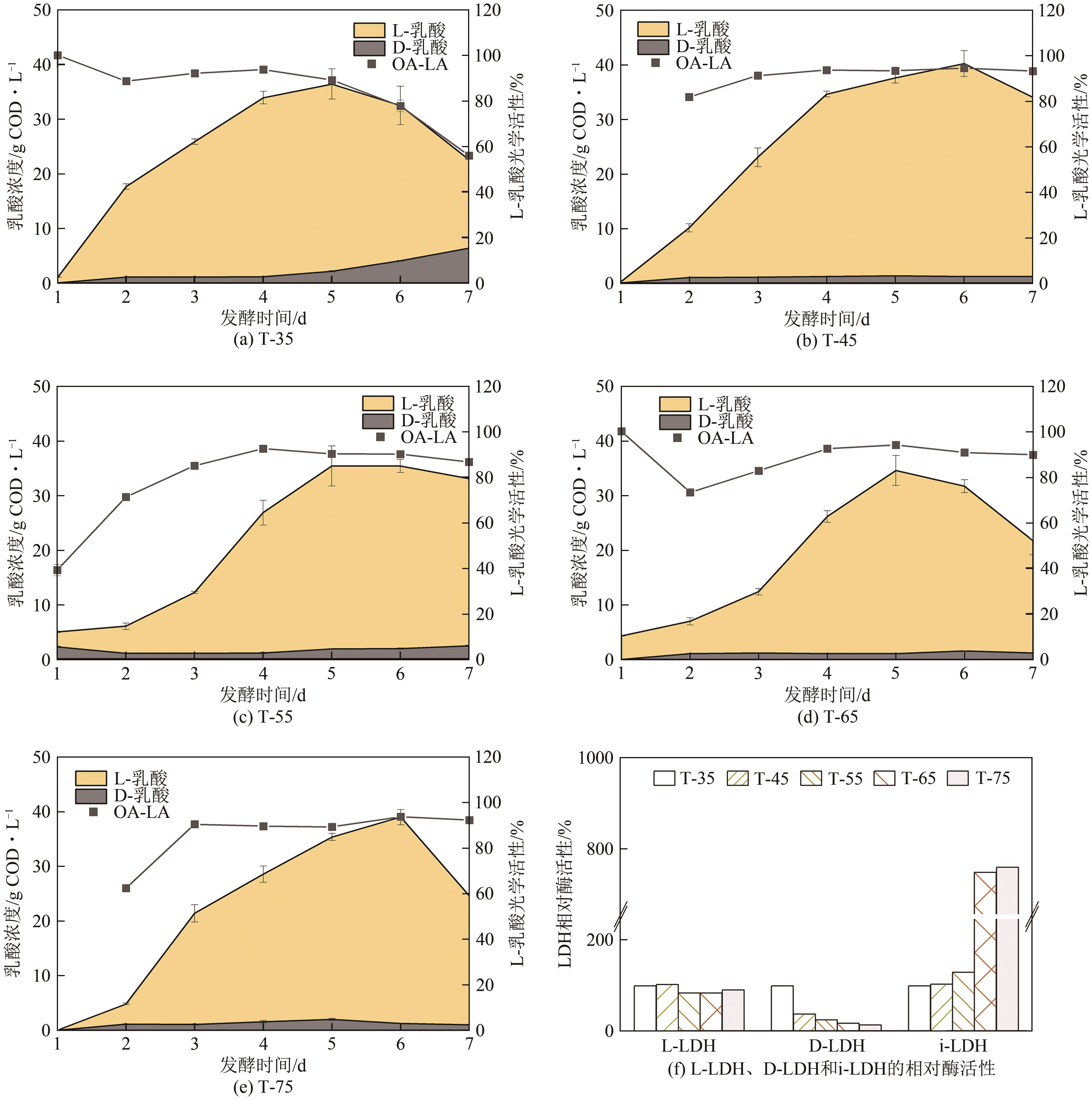
图1 发酵过程中L-乳酸和D-乳酸浓度及L-乳酸光学活性及发酵第7天L-LDH、D-LDH和i-LDH的相对酶活性

图2 发酵过程中碳水化合物和蛋白质浓度及发酵前3天氨氮浓度和α-葡萄糖苷酶、淀粉酶、蛋白酶相对活性
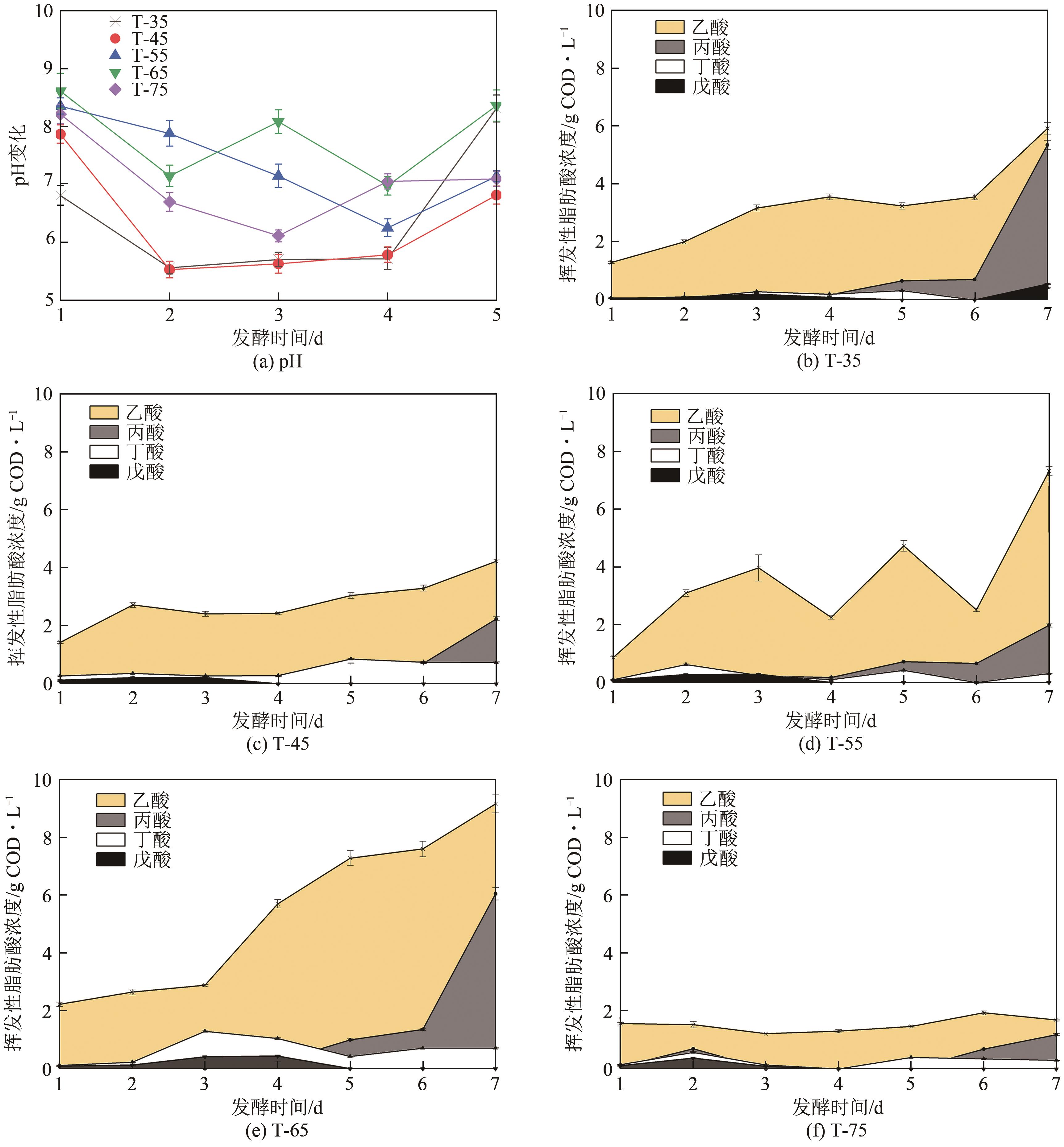
图3 发酵过程中pH变化及VFAs浓度和组成

图4 微生物群落结构组成

图5 代谢通路相对丰度

图6 功能基因相对丰度
| [1] | PRADHAN Nirakar, Giuliana D’IPPOLITO, DIPASQUALE Laura, et al. Kinetic modeling of hydrogen and L-lactic acid production by Thermotoga neapolitana via capnophilic lactic fermentation of starch[J]. Bioresource Technology, 2021, 332: 125127. |
| [2] | 潘健敏. 餐厨垃圾的微生物处理技术的研究与应用进展[J]. 清洗世界, 2024, 40(2): 144-146. |
| PAN Jianmin. Research and application progress of microbial treatment technology for kitchen waste[J]. Cleaning World, 2024, 40(2): 144-146. | |
| [3] | Gunasekera DON. Cut food waste to help feed world[J]. Nature, 2015, 524: 415. |
| [4] | 秦学. 餐厨垃圾发酵产L-乳酸工艺优化研究[D]. 石家庄: 河北科技大学, 2016. |
| QIN Xue. Process optimization for L-lactic acid production from food waste[D]. Shijiazhuang: Hebei University of Science and Technology, 2016. | |
| [5] | 周小平. 广州市厨余垃圾资源化利用现状及建议[J]. 再生资源与循环经济, 2023, 16(12): 30-32. |
| ZHOU Xiaoping. Current situation and suggestions of kitchen waste recycling in Guangzhou[J]. Recyclable Resources and Circular Economy, 2023, 16(12): 30-32. | |
| [6] | 靳晨曦, 孙士强, 盛维杰, 等. 中国厨余垃圾处理技术及资源化方案选择[J]. 中国环境科学, 2022, 42(3): 1240-1251. |
| JIN Chenxi, SUN Shiqiang, SHENG Weijie, et al. Food waste treatment technology and resource solution options in China[J]. China Environmental Science, 2022, 42(3): 1240-1251. | |
| [7] | NIESPOREK Kamil, Oliwia BASZCZEŃSKA, Mateusz BRZĘCZEK. Hydrogen vs. methane: A comparative study of modern combined cycle power plants[J]. Energy, 2024, 291: 130343. |
| [8] | Keerthana DEVI M, MANIKANDAN S, Senthil KUMAR P, et al. A comprehensive review on current trends and development of biomethane production from food waste: Circular economy and techno economic analysis[J]. Fuel, 2023, 351: 128963. |
| [9] | HELENAS PERIN Jessica Klarosk, BIESDORF BORTH Priscila Liane, TORRECILHAS Arthur Ribeiro, et al. Optimization of methane production parameters during anaerobic co-digestion of food waste and garden waste[J]. Journal of Cleaner Production, 2020, 272: 123130. |
| [10] | Natalia SOBUŚ, CZEKAJ Izabela. Lactic acid conversion into acrylic acid and other products over natural and synthetic zeolite catalysts: Theoretical and experimental studies[J]. Catalysis Today, 2022, 387: 172-185. |
| [11] | NWAMBA Marknoah Chinenye, SUN Fubao, MUKASEKURU Marie Rose, et al. Trends and hassles in the microbial production of lactic acid from lignocellulosic biomass[J]. Environmental Technology & Innovation, 2021, 21: 101337. |
| [12] | HUANG Shiyong, XUE Yanfen, YU Bo, et al. A review of the recent developments in the bioproduction of polylactic acid and its precursors optically pure lactic acids[J]. Molecules, 2021, 26(21): 6446. |
| [13] | ZHANG Wenjuan, LI Xiang, HE Ya, et al. Ammonia amendment promotes high rate lactate production and recovery from semi-continuous food waste fermentation[J]. Bioresource Technology, 2020, 302: 122881. |
| [14] | DRENNAN Margaret F, DISTEFANO Thomas D. High solids co-digestion of food and landscape waste and the potential for ammonia toxicity[J]. Waste Management, 2014, 34(7): 1289-1298. |
| [15] | CHENG Jun, HUA Junjie, KANG Ting, et al. Nanoscale zero-valent iron improved lactic acid degradation to produce methane through anaerobic digestion[J]. Bioresource Technology, 2020, 317: 124013. |
| [16] | Yuanyuan LYU, CHANG Ning, LI Yuyou, et al. Anaerobic co-digestion of food waste with municipal solid waste leachate: A review and prospective application with more benefits[J]. Resources, Conservation and Recycling, 2021, 174: 105832. |
| [17] | GENG Hui, XU Ying, DAI Xiaohu, et al. Abiotic and biotic roles of metals in the anaerobic digestion of sewage sludge: A review[J]. Science of the Total Environment, 2024, 912: 169313. |
| [18] | GAO Meng, LI Siqi, ZOU Huijing, et al. Aged landfill leachate enhances anaerobic digestion of waste activated sludge[J]. Journal of Environmental Management, 2021, 293: 112853. |
| [19] | SONG Zi, LIAO Runfeng, ZHANG Xinbo, et al. Simultaneous methanogenesis and denitrification in an anaerobic moving bed biofilm reactor for landfill leachate treatment: Ameliorative effect of rhamnolipids[J]. Water Research, 2023, 245: 120646. |
| [20] | LEI Yuqing, SUN Dezhi, DANG Yan, et al. Metagenomic analysis reveals that activated carbon aids anaerobic digestion of raw incineration leachate by promoting direct interspecies electron transfer[J]. Water Research, 2019, 161: 570-580. |
| [21] | 廖筱锋. 餐厨垃圾与渗滤液联合厌氧消化协同增效机制研究[D]. 武汉: 华中科技大学, 2017. |
| LIAO Xiaofeng. The research on anaerobic co-digestion of food waste and landfill leachate[D]. Wuhan: Huazhong University of Science and Technology, 2017. | |
| [22] | 周志颖. 生物质垃圾与渗滤液联合厌氧消化实验研究[D]. 武汉: 华中科技大学, 2011. |
| ZHOU Zhiying. The research on the anaerobic co-digestion of the biomass and landfill leachate[D]. Wuhan: Huazhong University of Science and Technology, 2011. | |
| [23] | REN Yuanyuan, YU Miao, WU Chuanfu, et al. A comprehensive review on food waste anaerobic digestion: Research updates and tendencies[J]. Bioresource Technology, 2018, 247: 1069-1076. |
| [24] | ISMAIL Amr, KAKAR Farokh Laqa, ELBESHBISHY Elsayed, et al. Combined thermal hydrolysis pretreatment and anaerobic co-digestion of waste activated sludge and food waste[J]. Renewable Energy, 2022, 195: 528-539. |
| [25] | POLICASTRO Grazia, CARRATURO Federica, COMPAGNONE Mariacristina, et al. A preliminary study on a novel bioaugmentation technique enhancing lactic acid production by mixed cultures fermentation[J]. Bioresource Technology, 2021, 340: 125595. |
| [26] | ZHANG Wenjuan, LI Xiang, ZHANG Ting, et al. High-rate lactic acid production from food waste and waste activated sludge via interactive control of pH adjustment and fermentation temperature[J]. Chemical Engineering Journal, 2017, 328: 197-206. |
| [27] | MALLICK Synthia P, PATEL Harsh V, GAWANDE Sailee, et al. Using landfill leachate to indicate the chemical and biochemical activities in elevated temperature landfills[J]. Journal of Environmental Management, 2024, 351: 119719. |
| [28] | MATTHEWS Richard, WINSON Michael, SCULLION John. Treating landfill leachate using passive aeration trickling filters; effects of leachate characteristics and temperature on rates and process dynamics[J]. Science of the Total Environment, 2009, 407(8): 2557-2564. |
| [29] | Wajid ALI, Hazrat ALI, GILLANI Sayed, et al. Polylactic acid synthesis, biodegradability, conversion to microplastics and toxicity: A review[J]. Environmental Chemistry Letters, 2023, 21(3): 1761-1786. |
| [30] | SUN Ce, WEI Shuangying, TAN Haiyan, et al. Progress in upcycling polylactic acid waste as an alternative carbon source: A review[J]. Chemical Engineering Journal, 2022, 446: 136881. |
| [31] | EITEMAN Mark A, RAMALINGAM Subramanian. Microbial production of lactic acid[J]. Biotechnology Letters, 2015, 37(5): 955-972. |
| [32] | LI Xiang, SADIQ Safeena, ZHANG Wenjuan, et al. Salinity enhances high optically active L-lactate production from co-fermentation of food waste and waste activated sludge: Unveiling the response of microbial community shift and functional profiling[J]. Bioresource Technology, 2021, 319: 124124. |
| [33] | LUO Jingyang, HUANG Wenxuan, GUO Wen, et al. Novel strategy to stimulate the food wastes anaerobic fermentation performance by eggshell wastes conditioning and the underlying mechanisms[J]. Chemical Engineering Journal, 2020, 398: 125560. |
| [34] | LUO Jingyang, ZHU Ying, ZHANG Qin, et al. Promotion of short-chain fatty acids production and fermented sludge properties via persulfate treatments with different activators: Performance and mechanisms[J]. Bioresource Technology, 2020, 295: 122278. |
| [35] | CHEN Yinguang, CHEN Yinsheng, XU Qing, et al. Comparison between acclimated and unacclimated biomass affecting anaerobic-aerobic transformations in the biological removal of phosphorus[J]. Process Biochemistry, 2005, 40(2): 723-732. |
| [36] | ZHANG Chang, QIN Yuge, XU Qiuxiang, et al. Free ammonia-based pretreatment promotes short-chain fatty acid production from waste activated sludge[J]. ACS Sustainable Chemistry & Engineering, 2018, 6(7): 9120-9129. |
| [37] | LI Xiang, CHEN Yinguang, ZHAO Shu, et al. Efficient production of optically pure L-lactic acid from food waste at ambient temperature by regulating key enzyme activity[J]. Water Research, 2015, 70: 148-157. |
| [38] | ZHOU Miaomiao, YAN Binghua, WONG Jonathan W C, et al. Enhanced volatile fatty acids production from anaerobic fermentation of food waste: A mini-review focusing on acidogenic metabolic pathways[J]. Bioresource Technology, 2018, 248: 68-78. |
| [39] | WU Yang, CAO Jiashun, ZHANG Qin, et al. Continuous waste activated sludge and food waste co-fermentation for synchronously recovering vivianite and volatile fatty acids at different sludge retention times: Performance and microbial response[J]. Bioresource Technology, 2020, 313: 123610. |
| [40] | YANG Luxin, CHEN Liang, LI Huan, et al. Lactic acid production from mesophilic and thermophilic fermentation of food waste at different pH[J]. Journal of Environmental Management, 2022, 304: 114312. |
| [41] | PARTHIBA KARTHIKEYAN Obulisamy, TRABLY Eric, MEHARIYA Sanjeet, et al. Pretreatment of food waste for methane and hydrogen recovery: A review[J]. Bioresource Technology, 2018, 249: 1025-1039. |
| [42] | XUE Gang, LAI Sizhou, LI Xiang, et al. Efficient bioconversion of organic wastes to high optical activity of L-lactic acid stimulated by cathode in mixed microbial consortium[J]. Water Research, 2018, 131: 1-10. |
| [43] | LI Jun, ZHANG Wenjuan, LI Xiang, et al. Production of lactic acid from thermal pretreated food waste through the fermentation of waste activated sludge: Effects of substrate and thermal pretreatment temperature[J]. Bioresource Technology, 2018, 247: 890-896. |
| [44] | BAGHCHEHSARAEE Bita, NAKHLA George, KARAMANEV Dimitre, et al. The effect of heat pretreatment temperature on fermentative hydrogen production using mixed cultures[J]. International Journal of Hydrogen Energy, 2008, 33(15): 4064-4073. |
| [45] | ZHANG Mingjiang, WANG Xiaomeng, YANG Jiawei, et al. Nitrogen removal performance of high ammonium and high salt wastewater by adding carbon source from food waste fermentation with different acidogenic metabolic pathways[J]. Chemosphere, 2022, 292: 133512. |
| [46] | LI Xiaofei, HOU Lijun, LIU Min, et al. Primary effects of extracellular enzyme activity and microbial community on carbon and nitrogen mineralization in estuarine and tidal wetlands[J]. Applied Microbiology and Biotechnology, 2015, 99(6): 2895-2909. |
| [47] | Yuki DOI. L-lactate production from biodiesel-derived crude glycerol by metabolically engineered Enterococcus faecalis: Cytotoxic evaluation of biodiesel waste and development of a glycerol-inducible gene expression system[J]. Applied and Environmental Microbiology, 2015, 81(6): 2082-2089. |
| [48] | BARROSO Raissa G M R, LIMA Jamille R C, FÁVARO Léia C L, et al. Bioconversion of glycerol into lactic acid by a new bacterial strain from the Brazilian cerrado soil[J]. Fermentation, 2022, 8(10): 477. |
| [49] | CRUCIATA Margherita, SANNINO Ciro, ERCOLINI Danilo, et al. Animal rennets as sources of dairy lactic acid bacteria[J]. Applied and Environmental Microbiology, 2014, 80(7): 2050-2061. |
| [50] | ZHANG Wenjuan, XU Xianbao, YU Pingfeng, et al. Ammonium enhances food waste fermentation to high-value optically active L-lactic acid[J]. ACS Sustainable Chemistry & Engineering, 2020, 8(1): 669-677. |
| [51] | YE Tingting, LI Xiang, ZHANG Ting, et al. Copper (Ⅱ) addition to accelerate lactic acid production from co-fermentation of food waste and waste activated sludge: Understanding of the corresponding metabolisms, microbial community and predictive functional profiling[J]. Waste Management, 2018, 76: 414-422. |
| [52] | WU Chongde, ZHANG Juan, CHEN Wei, et al. A combined physiological and proteomic approach to reveal lactic-acid-induced alterations in Lactobacillus casei Zhang and its mutant with enhanced lactic acid tolerance[J]. Applied Microbiology and Biotechnology, 2012, 93(2): 707-722. |
| [53] | JOJIMA Toru, OMUMASABA Crispinus A, INUI Masayuki, et al. Sugar transporters in efficient utilization of mixed sugar substrates: Current knowledge and outlook[J]. Applied Microbiology and Biotechnology, 2010, 85(3): 471-480. |
| [54] | QIN Jiayang, WANG Xiuwen, WANG Landong, et al. Comparative transcriptome analysis reveals different molecular mechanisms of Bacillus coagulans 2-6 response to sodium lactate and calcium lactate during lactic acid production[J]. PLOS One, 2015, 10(4): e0124316. |
| [55] | SINGLETON Ian. Microbial metabolism of xenobiotics: Fundamental and applied research[J]. Journal of Chemical Technology & Biotechnology, 1994, 59(1): 9-23. |
| [56] | PUDLIK Agata M, LOLKEMA Juke S. Uptake of α-ketoglutarate by citrate transporter CitP drives transamination in Lactococcus lactis [J]. Applied and Environmental Microbiology, 2013, 79(4): 1095-1101. |
| [57] | ZHENG Zhaojuan, SHENG Binbin, MA Cuiqing, et al. Relative catalytic efficiency of ldhL- and ldhD-encoded products is crucial for optical purity of lactic acid produced by Lactobacillus strains[J]. Applied and Environmental Microbiology, 2012, 78(9): 3480-3483. |
| [1] | 高君, 孙晓杰, 董滨. 不同氮源基质厌氧消化过程中氮转化及微生态的差异揭示污泥蛋白类物质的降解瓶颈[J]. 化工进展, 2025, 44(7): 4190-4201. |
| [2] | 雷雪艳, 朱易春, 张超, 郝宛婷, 陈仔龙, 宋贤威, 黄书昌, 董姗燕. 零价铁耦合厌氧氨氧化系统高效同步脱氮除磷[J]. 化工进展, 2025, 44(6): 3132-3143. |
| [3] | 高峰, 王重阳, 高升, 张雅泓, 陈涛, 年正. Anammox系统的氧化亚氮产生途径及调控[J]. 化工进展, 2025, 44(6): 3579-3591. |
| [4] | 王良玉, 曹辉, 谭天伟. 基于微生物发酵构建生物基材料及单体模块[J]. 化工进展, 2025, 44(5): 2394-2406. |
| [5] | 王媛媛, 张翀, 韩双艳, 邢新会. 毕赤酵母利用甲醇生产重组蛋白技术的研究进展[J]. 化工进展, 2025, 44(5): 2441-2450. |
| [6] | 盛华康, 张博, 申晓林, 孙新晓, 王佳, 袁其朋. 微生物合成白藜芦醇及其衍生物[J]. 化工进展, 2025, 44(5): 2463-2474. |
| [7] | 倪新, 高教琪, 周雍进. 酵母细胞工厂用于木质纤维素生物转化研究进展[J]. 化工进展, 2025, 44(5): 2475-2488. |
| [8] | 唐永圣, 顾子蕴, 陈修来. 微生物细胞活力调控生产丁二酸[J]. 化工进展, 2025, 44(5): 2489-2504. |
| [9] | 陈彦君, 戴杰, 单军强, 张思欣, 计磊, 朱晨杰, 应汉杰. 我国纤维素乙醇的研究进展和发展趋势[J]. 化工进展, 2025, 44(5): 2541-2562. |
| [10] | 魏志强, 孙丽丽. 工业富碳气体发酵制备燃料乙醇技术现状与挑战[J]. 化工进展, 2025, 44(5): 2563-2576. |
| [11] | 杜心悦, 陈圣春, 钱俊峰, 何明阳, 陈群. 废弃对苯二甲酸升级再造MOF材料及其阻燃应用[J]. 化工进展, 2025, 44(5): 2777-2787. |
| [12] | 李煜真, 贺铭敬, 王皓明, 马小清, 刘立成, 李福利. 以CO2为原料的第三代生物炼制现状[J]. 化工进展, 2025, 44(5): 2811-2824. |
| [13] | 喻喜华, 何楚琪, 许福春, 石贞香, 刘振宇, 肖美添. Zn2+-Ca2+二元离子调控HPMC肠溶空心胶囊性能[J]. 化工进展, 2025, 44(4): 2250-2257. |
| [14] | 胡盼盼, 肖梦瑶, 王娜, 史吉平, 刘莉. 多酶协同预处理厨余垃圾技术优化[J]. 化工进展, 2025, 44(2): 1138-1146. |
| [15] | 郑钧译, 李明, 朱倍弘, 苏畅, 郭思含, 于麒麟, 张耀斌. 餐厨垃圾体系下的丁酸发酵强化[J]. 化工进展, 2024, 43(S1): 597-603. |
| 阅读次数 | ||||||
|
全文 |
|
|||||
|
摘要 |
|
|||||