Chemical Industry and Engineering Progress ›› 2025, Vol. 44 ›› Issue (9): 5406-5415.DOI: 10.16085/j.issn.1000-6613.2024-1060
• Resources and environmental engineering • Previous Articles
Preparation of iron-nitrogen doped carbon microspheres and their activation for PS degradation of rhodamine B
CAO Jiangfei1,2( ), LEI Xiaotong1, HUANG Zhiyi1, HUANG Jiankai3, CHEN Fan1, YANG Pianpian1, XIE Chunsheng1,2()
- 1.School of Environmental and Chemical engineering, Zhaoqing University, Zhaoqing 526061, Guangdong, China
2.Provincial Key Laboratory of Environmental Health and Land Resource, Zhaoqing University, Zhaoqing 526061, Guangdong, China
3.Guangdong Tianze Environmental Protection Technology Co. , Dongguan 523073, Guangdong, China
-
Received:2024-07-01Revised:2024-08-30Online:2025-09-30Published:2025-09-25 -
Contact:XIE Chunsheng
铁氮掺杂碳微球的制备及其活化PS降解罗丹明B
操江飞1,2(), 雷晓彤1, 黄芷怡1, 黄建凯3, 陈凡1, 杨翩翩1, 谢春生1,2()
- 1.肇庆学院环境与化学工程学院,广东 肇庆 526061
2.广东省环境健康与资源利用重点实验室,广东 肇庆 526061
3.广东天泽环保科技有限公司,广东 东莞 523073
-
通讯作者:谢春生 -
作者简介:操江飞(1989—),男,实验师,硕士,研究方向为新材料和高级氧化技术。E-mail:594247917@qq.com。 -
基金资助:肇庆市创新指导项目(2023040301007);广东省教育厅重点领域专项创新项目(2023ZDZX4062);肇庆学院创新科研团队(TD202411);创新训练项目(X202410580132)

CLC Number:
Cite this article
CAO Jiangfei, LEI Xiaotong, HUANG Zhiyi, HUANG Jiankai, CHEN Fan, YANG Pianpian, XIE Chunsheng. Preparation of iron-nitrogen doped carbon microspheres and their activation for PS degradation of rhodamine B[J]. Chemical Industry and Engineering Progress, 2025, 44(9): 5406-5415.
操江飞, 雷晓彤, 黄芷怡, 黄建凯, 陈凡, 杨翩翩, 谢春生. 铁氮掺杂碳微球的制备及其活化PS降解罗丹明B[J]. 化工进展, 2025, 44(9): 5406-5415.
share this article
Add to citation manager EndNote|Ris|BibTeX
URL: https://hgjz.cip.com.cn/EN/10.16085/j.issn.1000-6613.2024-1060
| 材料 | C | H | N | Fe |
|---|---|---|---|---|
| CMSs | 877.2 | 28.7 | 1.4 | 0 |
| N@CMSs | 867.3 | 27.1 | 44.4 | 0 |
| Fe@CMSs | 739.1 | 22.1 | 1.7 | 58.53 |
| Fe-N@CMSs | 735.4 | 22.1 | 41.3 | 57.17 |
| 材料 | C | H | N | Fe |
|---|---|---|---|---|
| CMSs | 877.2 | 28.7 | 1.4 | 0 |
| N@CMSs | 867.3 | 27.1 | 44.4 | 0 |
| Fe@CMSs | 739.1 | 22.1 | 1.7 | 58.53 |
| Fe-N@CMSs | 735.4 | 22.1 | 41.3 | 57.17 |
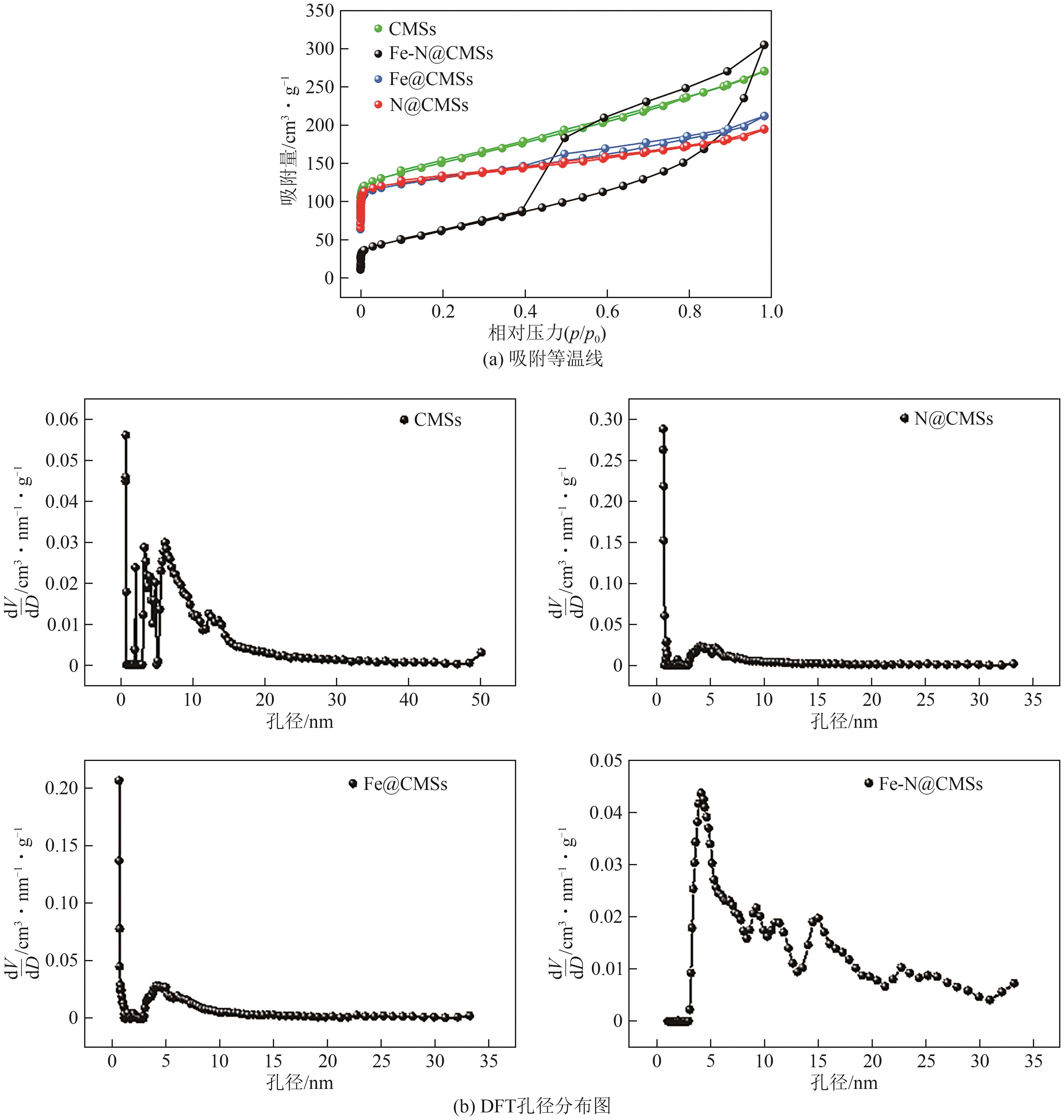
| 样品 | 比表面积(BET)/m2‧g-1 | 总孔体积/cm3‧g-1 | 微孔体积/cm3‧g-1 | 平均孔径/nm |
|---|---|---|---|---|
| CMSs | 536.257 | 0.4186 | 0.108 | 0.666 |
| N@CMSs | 495.045 | 0.3007 | 0.144 | 0.640 |
| Fe@CMSs | 483.223 | 0.3273 | 0.129 | 0.640 |
| Fe-N@CMSs | 234.978 | 0.4718 | 0 | 4.220 |
| 样品 | 比表面积(BET)/m2‧g-1 | 总孔体积/cm3‧g-1 | 微孔体积/cm3‧g-1 | 平均孔径/nm |
|---|---|---|---|---|
| CMSs | 536.257 | 0.4186 | 0.108 | 0.666 |
| N@CMSs | 495.045 | 0.3007 | 0.144 | 0.640 |
| Fe@CMSs | 483.223 | 0.3273 | 0.129 | 0.640 |
| Fe-N@CMSs | 234.978 | 0.4718 | 0 | 4.220 |
| [1] | 徐啸, 刘杰, YUN Jiayin, 等. Mn3O4-MnOOH复合材料催化过硫酸氢钾降解罗丹明B[J]. 工业水处理, 2023, 43(3): 124-131. |
| XU Xiao, LIU Jie, YUN Jiayin, et al. Degradation of Rhodamine B using potassium peroxymonosulfate catalyzed by Mn3O4-MnOOH binary composites[J]. Industrial Water Treatment, 2023, 43(3): 124-131. | |
| [2] | 徐冬莹, 余静, 郑婉懿, 等. 磁性纳米复合物非均相类Fenton反应催化降解罗丹明B[J]. 环境科学学报, 2018, 38(9): 3614-3621. |
| XU Dongying, YU Jing, ZHENG Wanyi, et al. Magnetic nanoscaled Si-Fe-MNCs as an efficient Fenton-like heterogeneous catalyst for degradation of rhodamine B[J]. Acta Scientiae Circumstantiae, 2018, 38(9): 3614-3621. | |
| [3] | WEI Mingyu, GAO Long, LI Jun, et al. Activation of peroxymonosulfate by graphitic carbon nitride loaded on activated carbon for organic pollutants degradation[J]. Journal of Hazardous Materials, 2016, 316: 60-68. |
| [4] | LIN Chia-Chang, HSIAO Hsu-Heng. Degradation of rhodamine B in water by heat/persulfate process[J]. Journal of the Taiwan Institute of Chemical Engineers, 2022, 132: 104190. |
| [5] | LI Ning, WU Shuang, DAI Haoxi, et al. Thermal activation of persulfates for organic wastewater purification: Heating modes, mechanism and influencing factors[J]. Chemical Engineering Journal, 2022, 450: 137976. |
| [6] | KAKAVANDI Babak, ALAVI Saba, GHANBARI Farshid, et al. Bisphenol A degradation by peroxymonosulfate photo-activation coupled with carbon-based cobalt ferrite nanocomposite: Performance, upgrading synergy and mechanistic pathway[J]. Chemosphere, 2022, 287: 132024. |
| [7] | HOSSEIN PANAHI A, MESHKINIAN A, ASHRAFI S D, et al. Survey of sono-activated persulfate process for treatment of real dairy wastewater[J]. International Journal of Environmental Science and Technology, 2020, 17(1): 93-98. |
| [8] | 黎素, 张博, 谢春生, 等. Bi-FeC2O4复合催化剂活化过硫酸盐降解罗丹明B[J]. 环境科学学报, 2021, 41(7): 2796-2805. |
| LI Su, ZHANG Bo, XIE Chunsheng, et al. Catalytic degradation of rhodamine B by Bi-FeC2O4 composite activated persulfate[J]. Acta Scientiae Circumstantiae, 2021, 41(7): 2796-2805. | |
| [9] | MEI Yanglu, XU Jin, ZHANG Yin, et al. Effect of Fe-N modification on the properties of biochars and their adsorption behavior on tetracycline removal from aqueous solution[J]. Bioresource Technology, 2021, 325: 124732. |
| [10] | XI Mufan, CUI Kangping, CUI Minshu, et al. Enhanced norfloxacin degradation by iron and nitrogen co-doped biochar: Revealing the radical and nonradical co-dominant mechanism of persulfate activation[J]. Chemical Engineering Journal, 2021, 420: 129902. |
| [11] | GUO Yaoping, ZENG Zequan, LI Yulin, et al. Catalytic oxidation of 4-chlorophenol on in situ sulfur-doped activated carbon with sulfate radicals[J]. Separation and Purification Technology, 2017, 179: 257-264. |
| [12] | CHENG Xin, GUO Hongguang, ZHANG Yongli, et al. Insights into the mechanism of nonradical reactions of persulfate activated by carbon nanotubes: Activation performance and structure-function relationship[J]. Water Research, 2019, 157: 406-414. |
| [13] | HE Juan, XIAO Yao, TANG Jingchun, et al. Persulfate activation with sawdust biochar in aqueous solution by enhanced electron donor-transfer effect[J]. Science of the Total Environment, 2019, 690: 768-777. |
| [14] | Tugba OLMEZ-HANCI, Idil ARSLAN-ALATON, GURMEN Sebahattin, et al. Oxidative degradation of bisphenol A by carbocatalytic activation of persulfate and peroxymonosulfate with reduced graphene oxide[J]. Journal of Hazardous Materials, 2018, 360: 141-149. |
| [15] | LI Bing, MA Junjun, ZHOU Lincheng, et al. Magnetic microsphere to remove tetracycline from water: Adsorption, H2O2 oxidation and regeneration[J]. Chemical Engineering Journal, 2017, 330: 191-201. |
| [16] | ZHANG Tao, ASEFA Tewodros. Heteroatom-doped carbon materials for hydrazine oxidation[J]. Advanced Materials, 2019, 31(13): e1804394. |
| [17] | LIU Wei, WANG Chao, HEROLD Felix, et al. Oxidative dehydrogenation on nanocarbon: Effect of heteroatom doping[J]. Applied Catalysis B: Environmental, 2019, 258: 117982. |
| [18] | QU Guojuan, JIA Peng, ZHANG Tao, et al. Synergistic activation of peroxymonosulfate by intrinsic defect and graphitic N of N,P co-doped carbon microspheres for BPA degradation[J]. Chemical Engineering Journal, 2023, 475: 145888. |
| [19] | ZHOU Yushun, CAI Taimei, LIU Shuai, et al. N-doped magnetic three-dimensional carbon microspheres@TiO2 with a porous architecture for enhanced degradation of tetracycline and methyl orange via adsorption/photocatalysis synergy[J]. Chemical Engineering Journal, 2021, 411: 128615. |
| [20] | LI Xiang, JIA Yan, ZHOU Minghua, et al. High-efficiency degradation of organic pollutants with Fe,N co-doped biochar catalysts via persulfate activation[J]. Journal of Hazardous Materials, 2020, 397: 122764. |
| [21] | ZENG Tao, LI Shuqi, HUA Jianan, et al. Synergistically enhancing Fenton-like degradation of organics by in situ transformation from Fe3O4 microspheres to mesoporous Fe,N-dual doped carbon[J]. Science of the Total Environment, 2018, 645: 550-559. |
| [22] | ZHAO Ling, CAO Xinde, Ondřej MAŠEK, et al. Heterogeneity of biochar properties as a function of feedstock sources and production temperatures[J]. Journal of Hazardous Materials, 2013, 256: 1-9. |
| [23] | XIAO Xin, CHEN Baoliang, ZHU Lizhong. Transformation, morphology, and dissolution of silicon and carbon in rice straw-derived biochars under different pyrolytic temperatures[J]. Environmental Science & Technology, 2014, 48(6): 3411-3419. |
| [24] | TAN Dominique Jan Bacalso, PAJARITO Bryan B. Effect of particle size and chitosan loading on post-combustion carbon dioxide capture of chitosan-coated natural zeolite adsorbent[J]. Materials Science Forum, 2018, 917: 185-189. |
| [25] | ZHU Ke, Qiong BIN, SHEN Yaqian, et al. In-situ formed N-doped bamboo-like carbon nanotubes encapsulated with Fe nanoparticles supported by biochar as highly efficient catalyst for activation of persulfate (PS) toward degradation of organic pollutants[J]. Chemical Engineering Journal, 2020, 402: 126090. |
| [26] | Yen Pin YEW, SHAMELI Kamyar, MIYAKE Mikio, et al. Green synthesis of magnetite (Fe3O4) nanoparticles using seaweed (Kappaphycus alvarezii) extract[J]. Nanoscale Research Letters, 2016, 11(1): 276. |
| [27] | LI Kaixu, CHEN Wei, YANG Haiping, et al. Mechanism of biomass activation and ammonia modification for nitrogen-doped porous carbon materials[J]. Bioresource Technology, 2019, 280: 260-268. |
| [28] | AI Tian, JIANG Xiaojun, LIU Qingyu, et al. Single-component and competitive adsorption of tetracycline and Zn(Ⅱ) on an NH4Cl-induced magnetic ultra-fine buckwheat peel powder biochar from water: Studies on the kinetics, isotherms, and mechanism[J]. RSC Advances, 2020, 10(35): 20427-20437. |
| [29] | SHENG Zhenhuan, SHAO Lin, CHEN Jingjing, et al. Catalyst-free synthesis of nitrogen-doped graphene via thermal annealing graphite oxide with melamine and its excellent electrocatalysis[J]. ACS Nano, 2011, 5(6): 4350-4358. |
| [30] | LI Xiaowan, LIU Xitao, LIN Chunye, et al. Catalytic oxidation of contaminants by Fe0 activated peroxymonosulfate process: Fe(Ⅳ) involvement, degradation intermediates and toxicity evaluation[J]. Chemical Engineering Journal, 2020, 382: 123013. |
| [31] | LI Junjing, GUO Ruonan, MA Qiuling, et al. Efficient removal of organic contaminant via activation of potassium persulfate by γ-Fe2O3/α-MnO2 nanocomposite[J]. Separation and Purification Technology, 2019, 227: 115669. |
| [32] | CHENG Xin, GUO Hongguang, ZHANG Yongli, et al. Oxidation of 2,4-dichlorophenol by non-radical mechanism using persulfate activated by Fe/S modified carbon nanotubes[J]. Journal of Colloid and Interface Science, 2016, 469: 277-286. |
| [33] | LIN Kun-Yi Andrew, LIN Jyun-Ting, LU Xiaoyu, et al. Electrospun magnetic cobalt-embedded carbon nanofiber as a heterogeneous catalyst for activation of oxone for degradation of Amaranth dye[J]. Journal of Colloid and Interface Science, 2017, 505: 728-735. |
| [34] | LEE Jaesang, VON GUNTEN Urs, KIM Jae-Hong. Persulfate-based advanced oxidation: Critical assessment of opportunities and roadblocks[J]. Environmental Science & Technology, 2020, 54(6): 3064-3081. |
| [1] | WANG Ying, TANG Mengfei, WANG Ying, ZHANG Chuanfang, ZHANG Guojie, LIU Jun, ZHAO Yuqiong. Preparation of CNT composites from coal pyrolysis catalyzed by different alkali metals for adsorption of Rhodamine B [J]. Chemical Industry and Engineering Progress, 2025, 44(7): 3985-3996. |
| [2] | YE Xiaosheng, YUAN Ting, JIA Xin, REN Qingxia. Research progress on the removal of microcystin-LR by multicomponent composite nanomaterials [J]. Chemical Industry and Engineering Progress, 2025, 44(7): 4144-4157. |
| [3] | LUO Siling, AI Jianping, LI Wenkui, WANG Yi, CHENG Lihong, WAN Yun, HUANG Long, LI Xibao. Research progress on degradation of typical antibiotics by advanced oxidation processes [J]. Chemical Industry and Engineering Progress, 2025, 44(7): 4169-4189. |
| [4] | GAO Jun, SUN Xiaojie, DONG Bin. Differences in nitrogen conversion and microecology during anaerobic digestion of different nitrogen-source substrates reveal the degradation bottleneck of sludge protein substances [J]. Chemical Industry and Engineering Progress, 2025, 44(7): 4190-4201. |
| [5] | WANG Shuai, QIAN Xiangchen, ZHANG Leiqi, WU Qiliang, LIU Min. Degradation mechanism of key components in proton exchange membrane fuel cells and proton exchange membrane electrolysis cells [J]. Chemical Industry and Engineering Progress, 2025, 44(7): 3804-3815. |
| [6] | ZHOU Meimei, HE Jiahui, XIANG Wanting, SHANG Jiaxin, WEI Xinyu, SUN Mimi, ZOU Wei, LUO Pingping. Electrospun PVA/SiO2 nanofibers loaded with A-TiO2/BiOBr for enhanced visible light photocatalytic activity [J]. Chemical Industry and Engineering Progress, 2025, 44(6): 3084-3092. |
| [7] | FU Donglong, FENG Guanqing, XU Xinquan, LU Zhenpu, PEI Chunlei, GONG Jinlong. Recent advances in catalytic conversion of waste plastics [J]. Chemical Industry and Engineering Progress, 2025, 44(5): 2758-2766. |
| [8] | ZHANG Pei, GAO Lining, DING Siqing, LI Li, ZHU Xiruo, HE Rui. Preparation of g-C3N4/TiO2 heterojunction catalyst and its photocatalytic NO degradation performance [J]. Chemical Industry and Engineering Progress, 2025, 44(4): 2045-2056. |
| [9] | ZHANG Yiru, HAN Dongmei, MA Weifang. Research progress on iron-based composite bismuth oxyhalide magnetic materials for enhanced visible light catalytic treatment of refractory organic wastewater [J]. Chemical Industry and Engineering Progress, 2025, 44(4): 2258-2273. |
| [10] | NIU Jingwei, CHEN Xiaoyang, ZHANG Jian, ZHOU Yuzhi, CHEN Min. Activated persulfate-induced degradation of typical environmental endocrine disruptors in soil [J]. Chemical Industry and Engineering Progress, 2025, 44(4): 2285-2296. |
| [11] | SHAN Xueying, LI Lingyu, ZHANG Meng, ZHANG Jiafu, LI Jinchun. Preparation and properties of flame retardant epoxy resin/low molecular weight polyphenylene ether materials [J]. Chemical Industry and Engineering Progress, 2025, 44(3): 1533-1541. |
| [12] | LI Honghui, LI Qingyun, LI Mei, FANG Yiyan, SHEN Huiting, LIN Hongfei. Biodegradation of typical refractory metal cyanide complexes: iron cyanide complexes [J]. Chemical Industry and Engineering Progress, 2025, 44(2): 1163-1169. |
| [13] | LIU Wei, ZHANG Min, ZHU Zhaoqi, WANG Yi, LIANG Weidong, SUN Hanxue. Preparation and current applications of black titanium dioxide nanomaterials [J]. Chemical Industry and Engineering Progress, 2025, 44(1): 341-353. |
| [14] | YOU Xiaoyin, WANG Chuqiao, LIU Caihua, PENG Xiaoming. Z-scheme CN/NGBO/BV catalytic system and its photo-like Fenton degradation performance of tetracycline [J]. Chemical Industry and Engineering Progress, 2025, 44(1): 286-296. |
| [15] | ZHANG Zheng, LIU Lin, LI Zichen, WANG Mengqi, HUANG Chunyan, GE Yuanyuan. Preparation of copper-loaded geopolymer microspheres and their catalytic degradation of bisphenol S [J]. Chemical Industry and Engineering Progress, 2024, 43(9): 5290-5301. |
| Viewed | ||||||
|
Full text |
|
|||||
|
Abstract |
|
|||||