Chemical Industry and Engineering Progress ›› 2025, Vol. 44 ›› Issue (6): 3041-3052.DOI: 10.16085/j.issn.1000-6613.2024-1146
• Special column: Frontiers of interdisciplinary technologies in chemical engineering and environmental sciences • Previous Articles
Nanotubular Co-N-C activated percarbonate for tetracycline degradation
SHI Xiuding1,2( ), WANG Yongquan3, ZENG Jing3, SU Chang3, HONG Junming1,2()
- 1.College of Chemical Engineering, Huaqiao University, Xiamen 361021, Fujian, China
2.Fujian Province Engineering Research Center of Industrial Wastewater Biochemical Treatment, Xiamen 361021, Fujian, China
3.Xiamen Tobacco Industrial Company Limited, Xiamen 361021, Fujian, China
-
Received:2024-07-17Revised:2025-01-15Online:2025-07-08Published:2025-06-25 -
Contact:HONG Junming
纳米管状Co-N-C活化过碳酸盐降解四环素
石秀顶1,2(), 王永全3, 曾静3, 苏畅3, 洪俊明1,2()
- 1.华侨大学化工学院,福建 厦门 361021
2.福建省工业废水生化处理工程技术研究中心,福建 厦门 361021
3.厦门烟草工业有限责任公司,福建 厦门 361021
-
通讯作者:洪俊明 -
作者简介:石秀顶(1996—),男,博士研究生,研究方向为水污染处理工程。E-mail:2429462654@qq.com。 -
基金资助:国家自然科学基金(51978291);福建省科技项目基金(2021J01311);福建省科技项目基金(2022I0030)

CLC Number:
Cite this article
SHI Xiuding, WANG Yongquan, ZENG Jing, SU Chang, HONG Junming. Nanotubular Co-N-C activated percarbonate for tetracycline degradation[J]. Chemical Industry and Engineering Progress, 2025, 44(6): 3041-3052.
石秀顶, 王永全, 曾静, 苏畅, 洪俊明. 纳米管状Co-N-C活化过碳酸盐降解四环素[J]. 化工进展, 2025, 44(6): 3041-3052.
share this article
Add to citation manager EndNote|Ris|BibTeX
URL: https://hgjz.cip.com.cn/EN/10.16085/j.issn.1000-6613.2024-1146
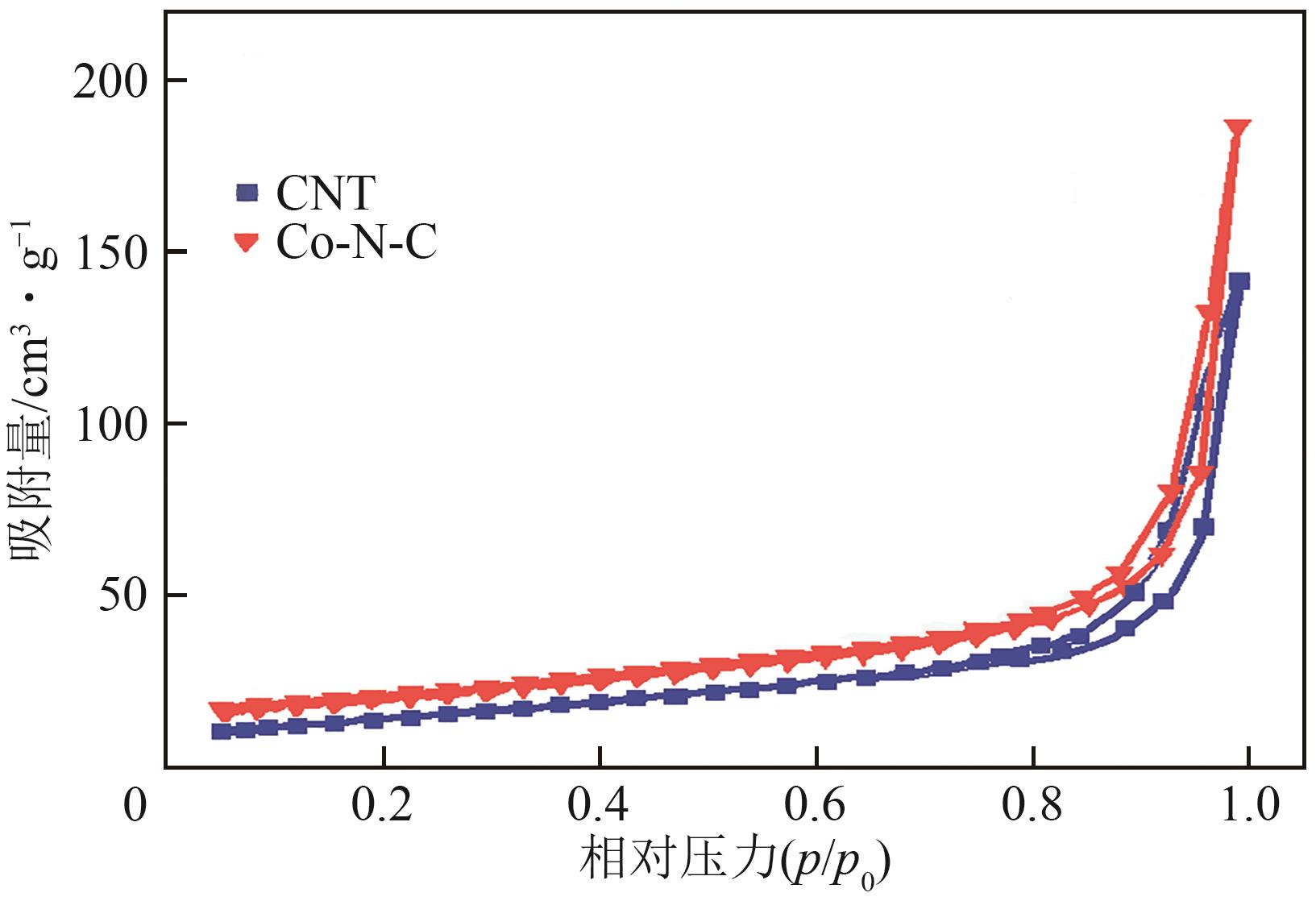
| 样品 | 比表面积/m2·g-1 | 孔容/cm3·g-1 | 孔径/nm |
|---|---|---|---|
| CNT | 50.14 | 0.13 | 5.50 |
| Co-N-C | 68.52 | 0.18 | 5.35 |
| 样品 | 比表面积/m2·g-1 | 孔容/cm3·g-1 | 孔径/nm |
|---|---|---|---|
| CNT | 50.14 | 0.13 | 5.50 |
| Co-N-C | 68.52 | 0.18 | 5.35 |
| 催化剂 | 污染物 | 氧化剂 | 实验条件 | 反应时间/min | 去除率/% | 参考文献 |
|---|---|---|---|---|---|---|
| Fe3O4@α-MnO2 | RBK5 | PMS | Cat.=1.2g/L;PMS=4mmol/L;pH=7;RBK5=30mg/L | 60 | 91 | [ |
| Mn2O3@α-Fe3O4 | RBK5 | SPC | Cat.=0.3g/L;SPC=1mmol/L;pH=3;RBK5=10mg/L | 90 | 88 | [ |
| FeS2 | TC | SPC | Cat.=0.5g/L;SPC=8mmol/L;pH=5;TC=10mg/L | 60 | 78.86 | [ |
| Cu3(MoO4)2(OH)2 | OTC | SPC | Cat.=0.25g/L;SPC=0.2g/L;pH=3;TC=20mg/L | 40 | 80.01 | [ |
| CuCoFe-LDHs | CIP | SPC | Cat.=0.5g/L;SPC=0.3mmol/L;pH=5;CIP=20mg/L | 60 | 66 | [ |
| Co-N-C | TC | SPC | Cat.=0.2g/L;SPC=0.2mmol/L;pH=7;TC=10mg/L | 20 | 99.7 | 本文 |
| 催化剂 | 污染物 | 氧化剂 | 实验条件 | 反应时间/min | 去除率/% | 参考文献 |
|---|---|---|---|---|---|---|
| Fe3O4@α-MnO2 | RBK5 | PMS | Cat.=1.2g/L;PMS=4mmol/L;pH=7;RBK5=30mg/L | 60 | 91 | [ |
| Mn2O3@α-Fe3O4 | RBK5 | SPC | Cat.=0.3g/L;SPC=1mmol/L;pH=3;RBK5=10mg/L | 90 | 88 | [ |
| FeS2 | TC | SPC | Cat.=0.5g/L;SPC=8mmol/L;pH=5;TC=10mg/L | 60 | 78.86 | [ |
| Cu3(MoO4)2(OH)2 | OTC | SPC | Cat.=0.25g/L;SPC=0.2g/L;pH=3;TC=20mg/L | 40 | 80.01 | [ |
| CuCoFe-LDHs | CIP | SPC | Cat.=0.5g/L;SPC=0.3mmol/L;pH=5;CIP=20mg/L | 60 | 66 | [ |
| Co-N-C | TC | SPC | Cat.=0.2g/L;SPC=0.2mmol/L;pH=7;TC=10mg/L | 20 | 99.7 | 本文 |
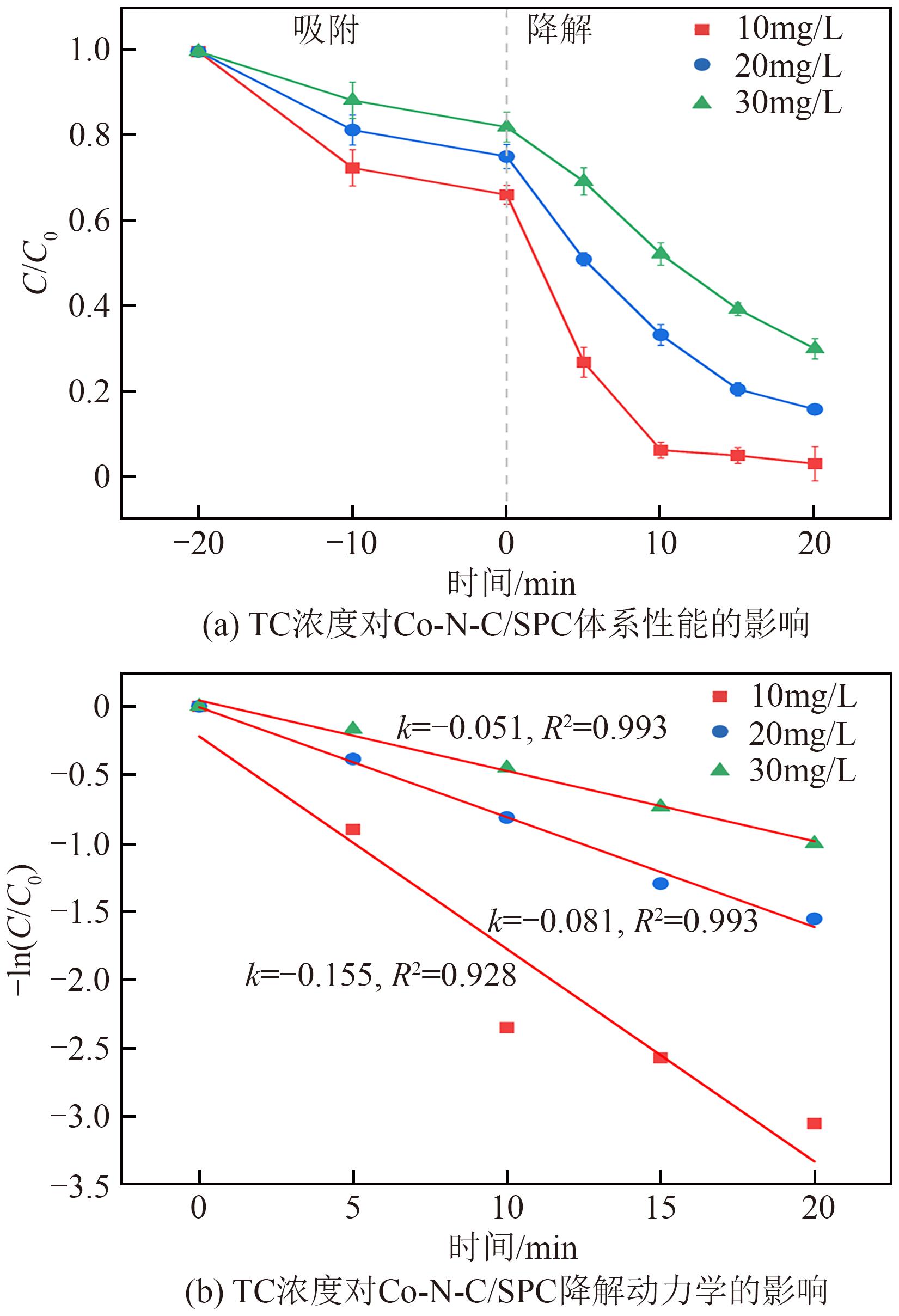
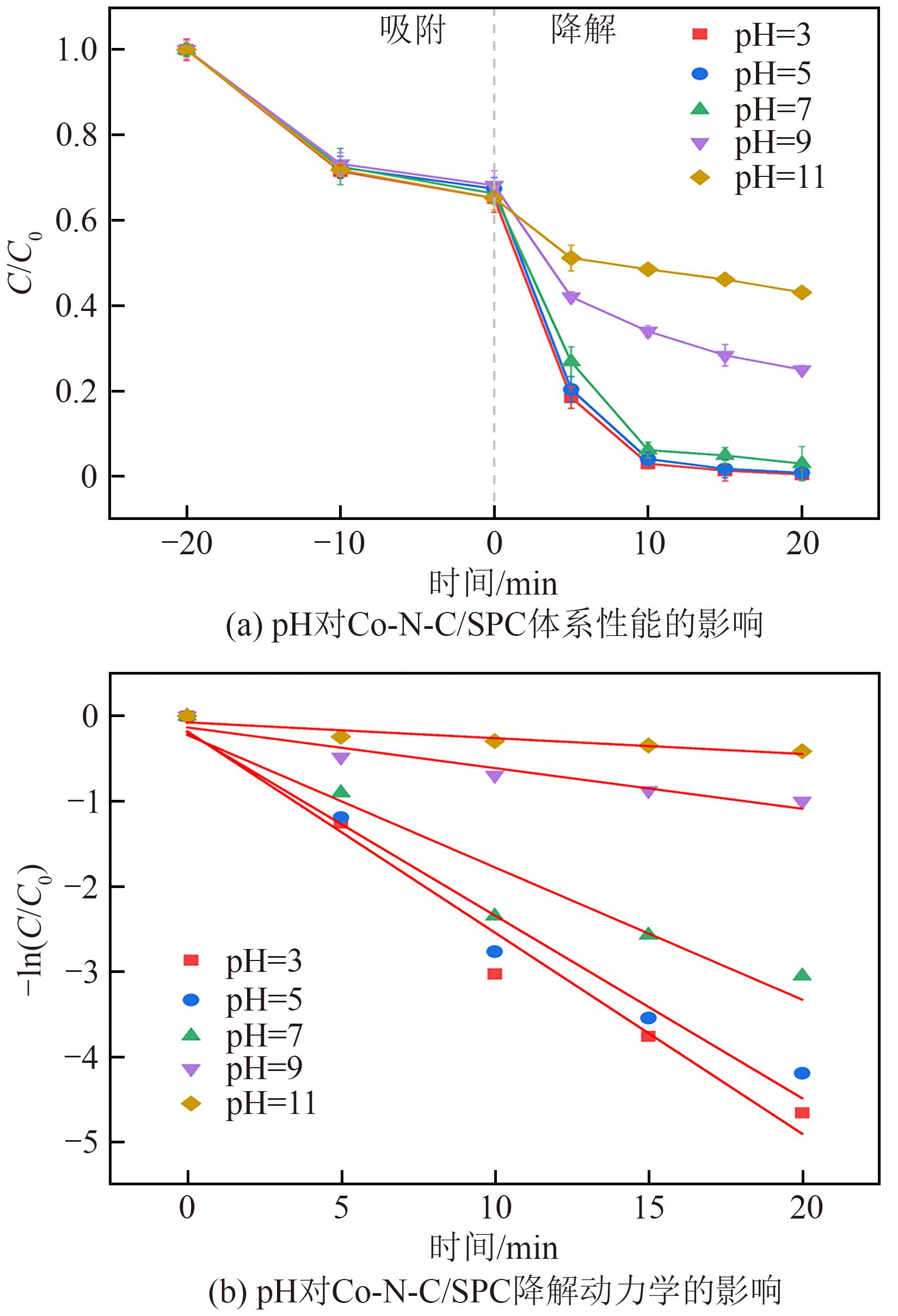
| pH | k/min-1 | R2 |
|---|---|---|
| 3 | 0.236 | 0.976 |
| 5 | 0.214 | 0.972 |
| 7 | 0.155 | 0.928 |
| 9 | 0.132 | 0.926 |
| 11 | 0.018 | 0.865 |
| pH | k/min-1 | R2 |
|---|---|---|
| 3 | 0.236 | 0.976 |
| 5 | 0.214 | 0.972 |
| 7 | 0.155 | 0.928 |
| 9 | 0.132 | 0.926 |
| 11 | 0.018 | 0.865 |
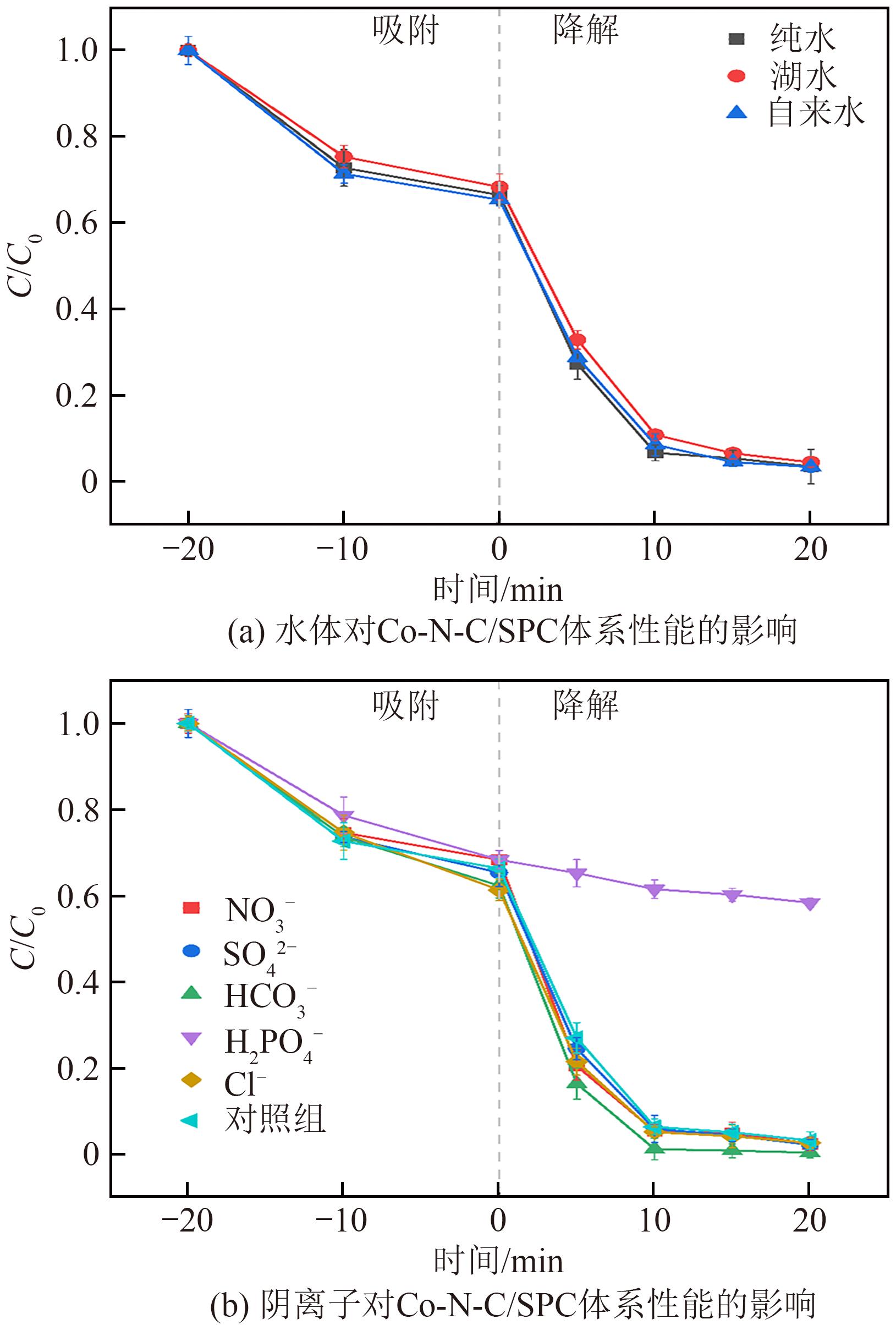
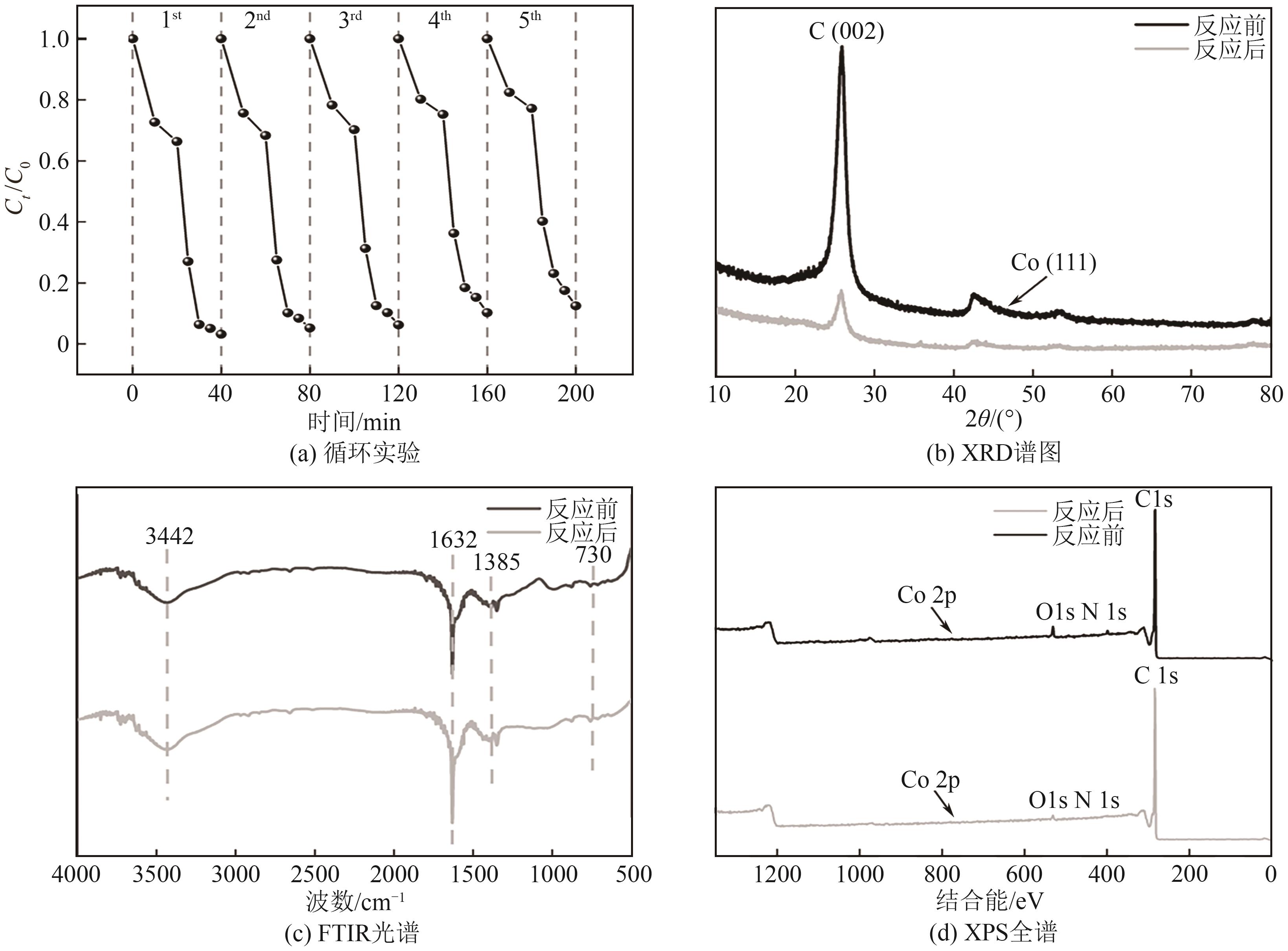
| 时间/min | Co2+浸出/mg·L-1 |
|---|---|
| 3 | 0.046 |
| 5 | 0.078 |
| 10 | 0.083 |
| 15 | 0.097 |
| 20 | 0.103 |
| 时间/min | Co2+浸出/mg·L-1 |
|---|---|
| 3 | 0.046 |
| 5 | 0.078 |
| 10 | 0.083 |
| 15 | 0.097 |
| 20 | 0.103 |
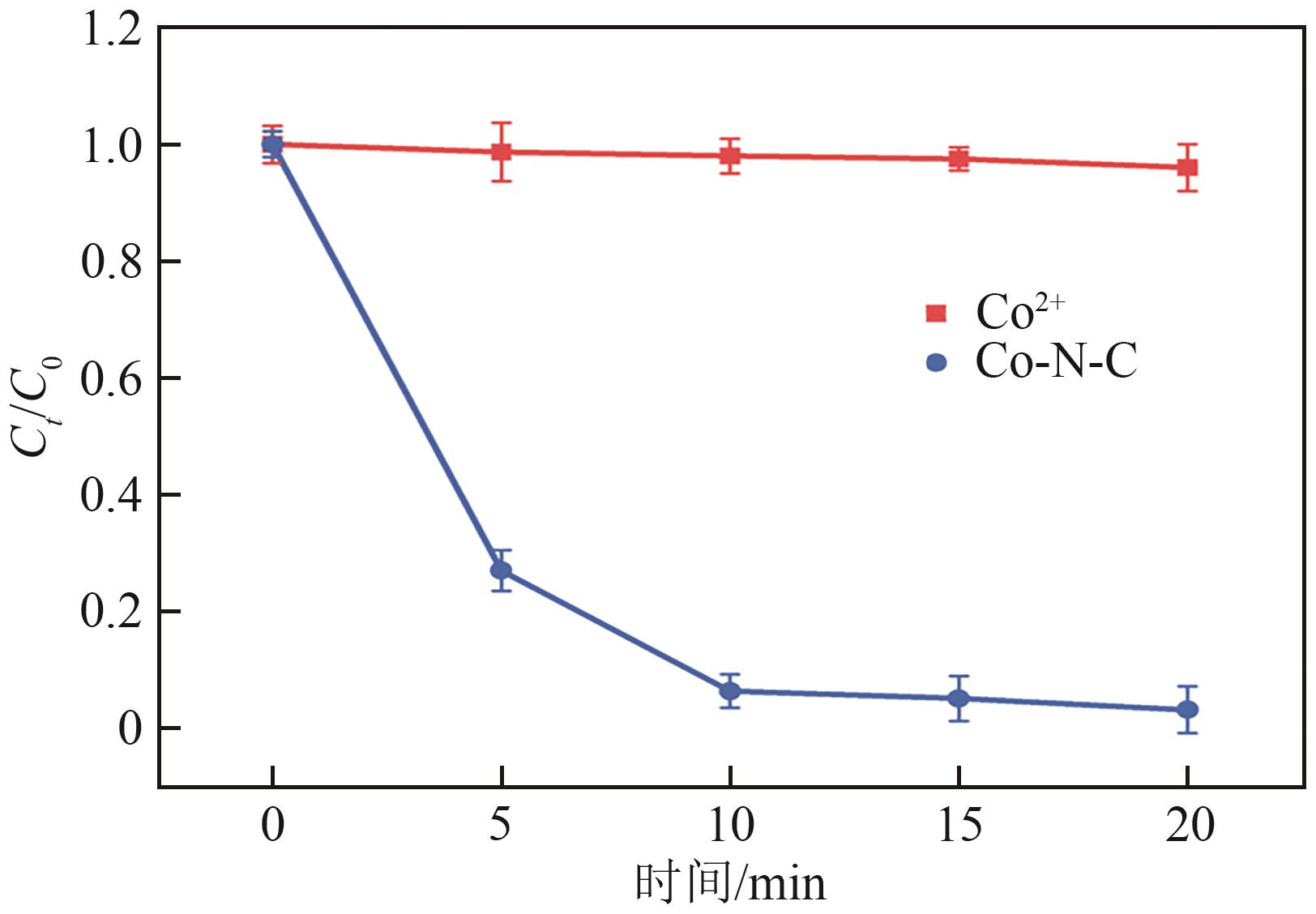
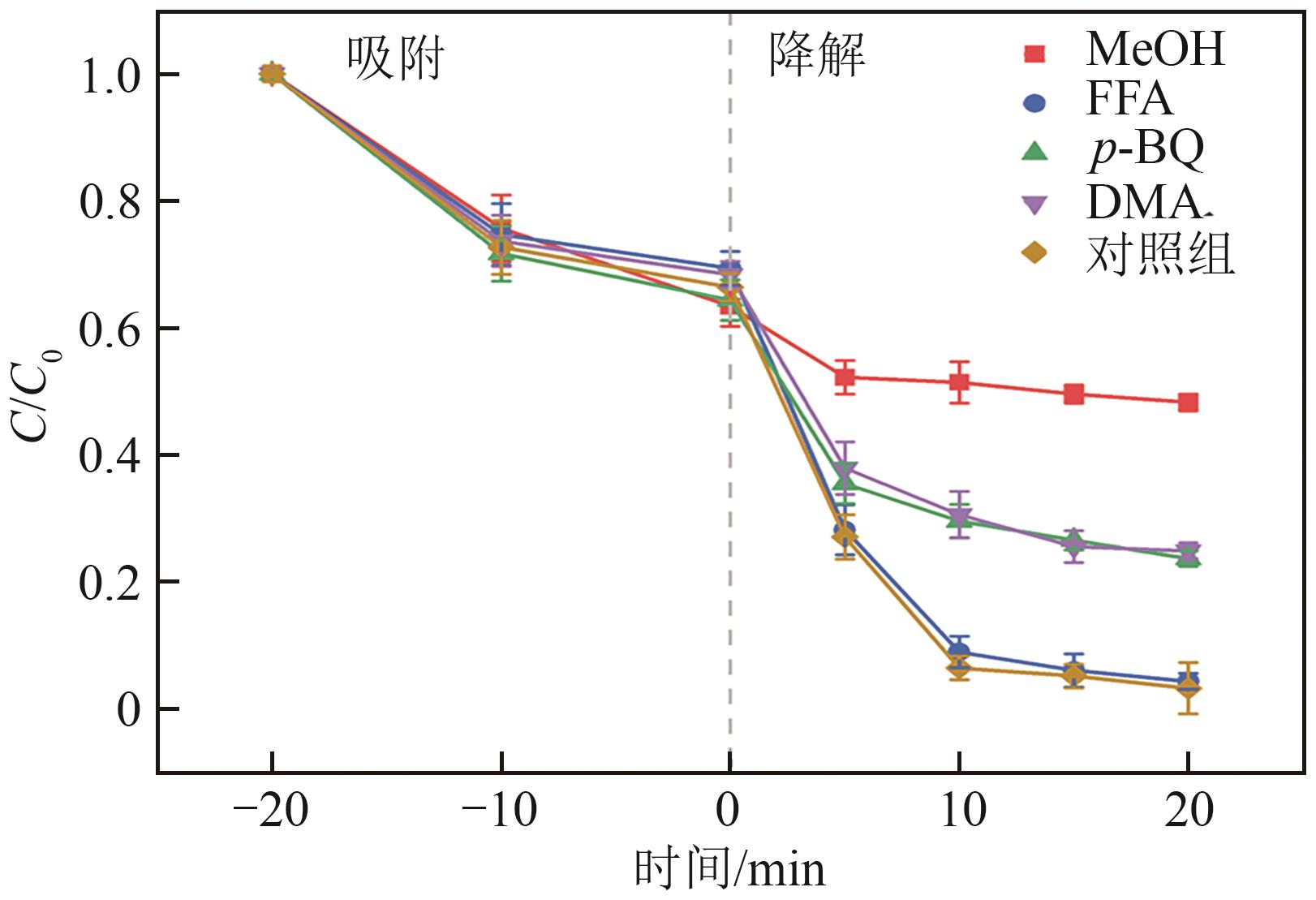
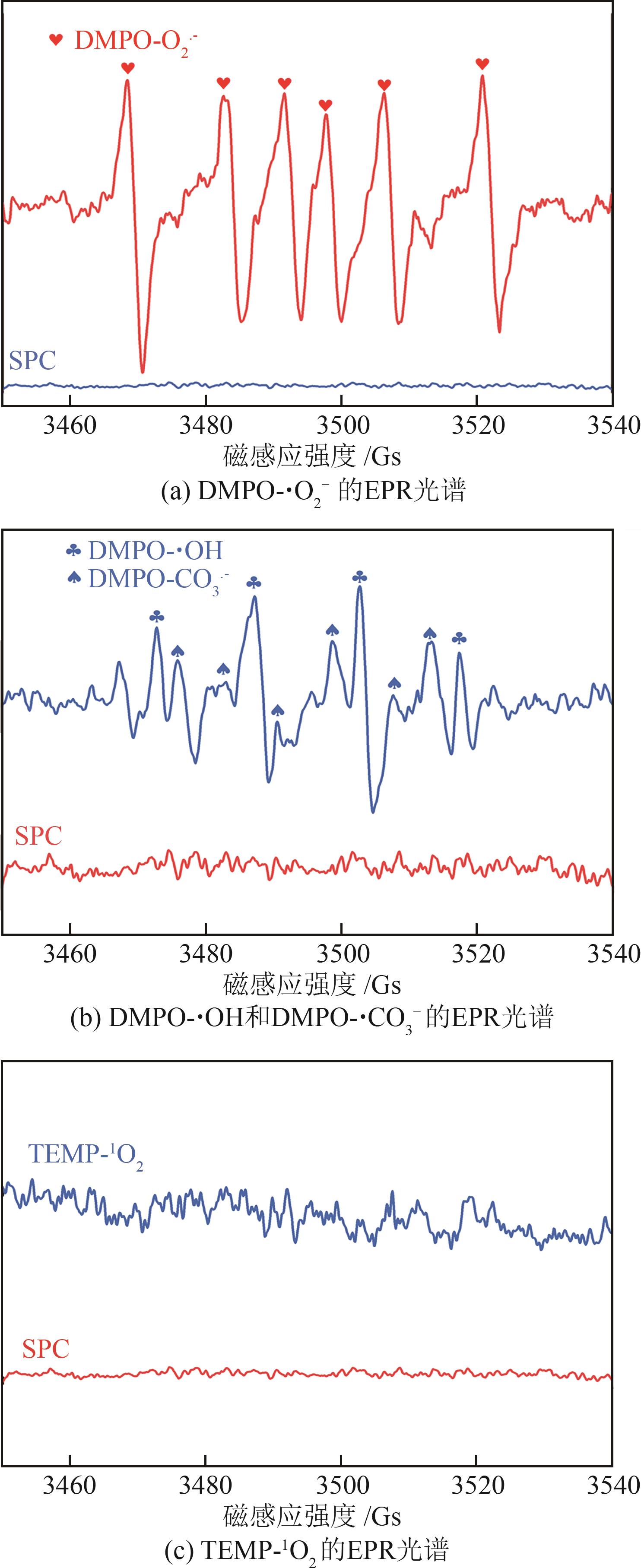
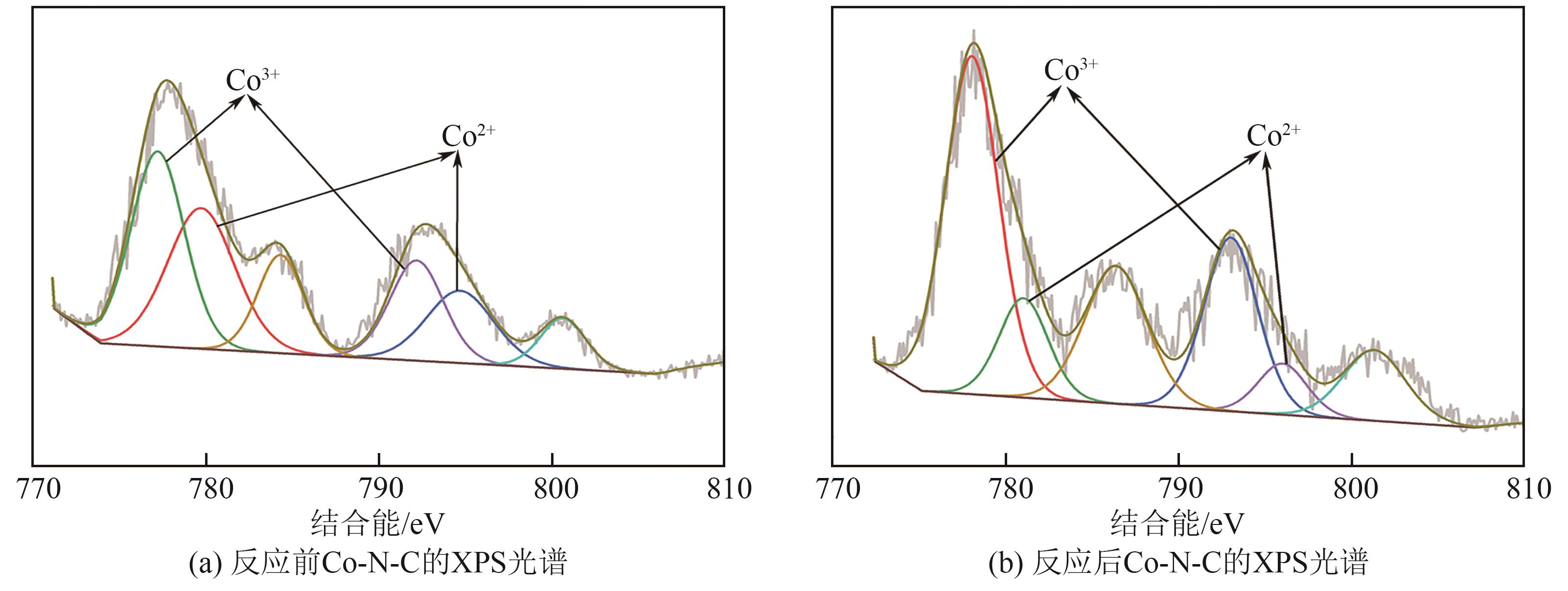
| [1] | LIN Zhong, CHEN Yijie, LI Gaoyang, et al. Change of tetracycline speciation and its impacts on tetracycline removal efficiency in vermicomposting with epigeic and endogeic earthworms[J]. Science of the Total Environment, 2023, 881: 163410. |
| [2] | YU Kan, LI Xiaoyong, QIU Yushu, et al. Low-dose effects on thyroid disruption in zebrafish by long-term exposure to oxytetracycline[J]. Aquatic Toxicology, 2020, 227: 105608. |
| [3] | HAN Chee-Hun, PARK Hee-Deung, KIM Song-Bae, et al. Oxidation of tetracycline and oxytetracycline for the photo-Fenton process: Their transformation products and toxicity assessment[J]. Water Research, 2020, 172: 115514. |
| [4] | HAN Q F, ZHAO S, ZHANG X R, et al. Distribution, combined pollution and risk assessment of antibiotics in typical marine aquaculture farms surrounding the Yellow Sea, North China[J]. Environment International, 2020, 138: 105551. |
| [5] | LIU Xiaohui, LIU Ying, LU Shaoyong, et al. Occurrence of typical antibiotics and source analysis based on PCA-MLR model in the East Dongting Lake, China[J]. Ecotoxicology and Environmental Safety, 2018, 163: 145-152. |
| [6] | YU Xiaolong, JIN Xu, LI Meng, et al. Mechanism and security of UV driven sodium percarbonate for sulfamethoxazole degradation using DFT and metabolomic analysis[J]. Environmental Pollution, 2023, 323: 121352. |
| [7] | QI Juanjuan, LIU Juzhe, SUN Fengbin, et al. High active amorphous Co(OH)2 nanocages as peroxymonosulfate activator for boosting acetaminophen degradation and DFT calculation[J]. Chinese Chemical Letters, 2021, 32(5): 1814-1818. |
| [8] | CHEN Haoyun, YUAN Xingzhong, JIANG Longbo, et al. Intramolecular modulation of iron-based metal organic framework with energy level adjusting for efficient photocatalytic activity[J]. Applied Catalysis B: Environmental, 2022, 302: 120823. |
| [9] | Kwasi KYERE-YEBOAH, QIAO Xiuchen. Non-thermal plasma activated peroxide and percarbonate for tetracycline and oxytetracycline degradation: Synergistic performance, degradation pathways, and toxicity evaluation[J]. Chemosphere, 2023, 336: 139246. |
| [10] | XU Ximeng, ZHOU Yuhui, LI Shasha, et al. Activation of sodium percarbonate with Fe3O4@MXene composite for the efficient removal of bisphenol A[J]. Journal of Environmental Chemical Engineering, 2022, 10(6): 108702. |
| [11] | MOHAMMADI Samira, MOUSSAVI Gholamreza, YAGHMAEIAN Kamyar, et al. Development of a percarbonate-enhanced vacuum UV process for simultaneous fluoroquinolone antibiotics removal and fecal bacteria inactivation under a continuous flow mode of operation[J]. Chemical Engineering Journal, 2022, 431: 134064. |
| [12] | LI Yangju, DONG Haoran, LI Long, et al. Efficient degradation of sulfamethazine via activation of percarbonate by chalcopyrite[J]. Water Research, 2021, 202: 117451. |
| [13] | LIAO Gaozu, QING Xiaojiao, XU Peng, et al. Synthesis of single atom cobalt dispersed on 2D carbon nanoplate and degradation of acetaminophen by peroxymonosulfate activation[J]. Chemical Engineering Journal, 2022, 427: 132027. |
| [14] | 张廷, 曾静, 叶校圳, 等. 纳米立方体PBA-Fe1Mn2活化过一硫酸盐降解偶氮有机物[J]. 中国环境科学, 2023, 43(7): 3533-3544. |
| ZHANG Ting, ZENG Jing, YE Xiaozhen, et al. Nanoscale PBA-Fe1Mn2 activated peroxymonosulfate for degradation of azo organic[J]. China Environmental Science, 2023, 43(7): 3533-3544. | |
| [15] | CHEN Shaona, LIANG Yanhua, LI Bo, et al. Facile synthesis of graphene oxide-supported CoO x nanoparticles for efficient degradation of antibiotics via percarbonate activation: Performance, degradation pathway and mechanism[J]. Colloids and Surfaces A: Physicochemical and Engineering Aspects, 2023, 675: 131996. |
| [16] | YANG Zhao, WANG Zhaowei, LIANG Guiwei, et al. Catalyst bridging-mediated electron transfer for nonradical degradation of bisphenol A via natural manganese ore-cornstalk biochar composite activated peroxymonosulfate[J]. Chemical Engineering Journal, 2021, 426: 131777. |
| [17] | XU Baokang, ZHANG Xiao, ZHANG Yue, et al. Enhanced electron transfer-based nonradical activation of peroxymonosulfate by CoN x sites anchored on carbon nitride nanotubes for the removal of organic pollutants[J]. Chemical Engineering Journal, 2023, 466: 143155. |
| [18] | XU Haodan, JIANG Ning, WANG Da, et al. Improving PMS oxidation of organic pollutants by single cobalt atom catalyst through hybrid radical and non-radical pathways[J]. Applied Catalysis B: Environmental, 2020, 263: 118350. |
| [19] | GUO Xu, ZHANG Qicheng, HE Hongwei, et al. Wastewater flocculation substrate derived three-dimensional ordered macroporous Co single-atom catalyst for singlet oxygen-dominated peroxymonosulfate activation[J]. Applied Catalysis B: Environmental, 2023, 335: 122886. |
| [20] | XU Zhenyang, ZHANG Yimei, WANG Fei, et al. Co single-atom confined in N-doped hollow carbon sphere with superb stability for rapid degradation of organic pollutants[J]. Chemical Engineering Journal, 2023, 452: 139229. |
| [21] | 董正玉, 吴丽颖, 王霁, 等. 新型Fe3O4@α-MnO2活化过一硫酸盐降解水中偶氮染料[J]. 中国环境科学, 2018, 38(8): 3003-3010. |
| DONG Zhengyu, WU Liying, WANG Ji, et al. Novel Fe3O4@α-MnO2 activated peroxymonosulfate degradation of azo dyes in aqueous solution[J]. China Environmental Science, 2018, 38(8): 3003-3010. | |
| [22] | 徐铭骏, 郭兆春, 李立, 等. 纳米片状Mn2O3@α-Fe3O4活化过碳酸盐降解偶氮染料[J]. 化工进展, 2022, 41(2): 1043-1053. |
| XU Mingjun, GUO Zhaochun, LI Li, et al. Degradation of azo dyes by sodium percarbonate activated with nanosheet Mn2O3@α-Fe3O4 [J]. Chemical Industry and Engineering Progress, 2022, 41(2): 1043-1053. | |
| [23] | GUO Liu, NIE Ziqiu, WEN Lijia, et al. Insights into the effects of natural pyrite-activated sodium percarbonate on tetracycline removal from groundwater: Mechanism, pathways, and column studies[J]. Science of the Total Environment, 2023, 902: 165883. |
| [24] | JIN Xiaotao, WANG Yanlan, HUANG Yingping, et al. Percarbonate activation catalyzed by nanoblocks of basic copper molybdate for antibiotics degradation: High performance, degradation pathways and mechanism[J]. Chinese Chemical Letters, 2024, 35(10): 109499. |
| [25] | CHEN Kang, LI Ting, ZHANG Xue, et al. CuCoFe-LDHs activated sodium percarbonate (SPC) for the degradation of ciprofloxacin[J]. Journal of Environmental Chemical Engineering, 2023, 11(5): 110651. |
| [26] | WU Liying, ZHANG Qian, HONG Junming, et al. Degradation of bisphenol A by persulfate activation via oxygen vacancy-rich CoFe2O4- x [J]. Chemosphere, 2019, 221: 412-422. |
| [27] | DUAN Xiaoguang, SU Chao, ZHOU Li, et al. Surface controlled generation of reactive radicals from persulfate by carbocatalysis on nanodiamonds[J]. Applied Catalysis B: Environmental, 2016, 194: 7-15. |
| [28] | LIN Kun-Yi Andrew, LIN Jyun-Ting, LIN Yifeng. Heterogeneous catalytic activation of percarbonate by ferrocene for degradation of toxic amaranth dye in water[J]. Journal of the Taiwan Institute of Chemical Engineers, 2017, 78: 144-149. |
| [29] | BAI Rui, YAN Weifu, XIAO Yong, et al. Acceleration of peroxymonosulfate decomposition by a magnetic MoS2/CuFe2O4 heterogeneous catalyst for rapid degradation of fluoxetine[J]. Chemical Engineering Journal, 2020, 397: 125501. |
| [30] | SHAH Noor S, KHAN Javed Ali, SAYED Murtaza, et al. Hydroxyl and sulfate radical mediated degradation of ciprofloxacin using nano zerovalent manganese catalyzed S2O8 2- [J]. Chemical Engineering Journal, 2019, 356: 199-209. |
| [31] | WANG Jianlong, WANG Shizong. Effect of inorganic anions on the performance of advanced oxidation processes for degradation of organic contaminants[J]. Chemical Engineering Journal, 2021, 411: 128392. |
| [32] | 廖兵, 胥雯, 叶秋月. 活化过碳酸盐及过氧碳酸氢盐在水处理领域中的研究进展[J]. 化工进展, 2022, 41(6): 3235-3248. |
| LIAO Bing, XU Wen, YE Qiuyue. A review of activated percarbonate and peroxymonocarbonate in the field of water treatment[J]. Chemical Industry and Engineering Progress, 2022, 41(6): 3235-3248 | |
| [33] | MO Zhihua, TAN Zexing, LIANG Jialin, et al. Iron-rich sludge biochar triggers sodium percarbonate activation for robust sulfamethoxazole removal: Collaborative roles of reactive oxygen species and electron transfer[J]. Chemical Engineering Journal, 2023, 457: 141150. |
| [34] | LI Li, GUO Ruoning, ZHANG Sai, et al. Sustainable and effective degradation of aniline by sodium percarbonate activated with UV in aqueous solution: Kinetics, mechanism and identification of reactive species[J]. Environmental Research, 2022, 207: 112176. |
| [35] | ASIF Abdul Hannan, RAFIQUE Nasir, HIRANI Rajan Arjan Kalyan, et al. Heterogeneous activation of peroxymonosulfate by Co-doped Fe2O3 nanospheres for degradation of p-hydroxybenzoic acid[J]. Journal of Colloid and Interface Science, 2021, 604: 390-401. |
| [36] | SHE Yuecheng, WEI Wenxuan, AI Xiaohuan, et al. Synergistic pretreatment of CaO and freezing/thawing to enhance volatile fatty acids recycling and dewaterability of waste activated sludge via anaerobic fermentation[J]. Chemosphere, 2021, 280: 130939. |
| [1] | WANG Peigan, LI Leli, XIE Songzhuan, SONG Bingbing, KONG Qiaoping, LIU Gaige, MA Weiwei, SHI Xueqing. Phosphate adsorption mechanism of sludge-based FeCa-ALE composite material [J]. Chemical Industry and Engineering Progress, 2025, 44(4): 2365-2373. |
| [2] | JIN Zhihao, WANG Yunfan, TIAN Zhenyu. Strategies for combustion kinetics of afterburning in rocket engine exhaust plumes [J]. Chemical Industry and Engineering Progress, 2025, 44(3): 1776-1780. |
| [3] | ZUO Ji, LUO Li, XIE Yongkai, CHEN Wenyao, QIAN Gang, ZHOU Xinggui, DUAN Xuezhi. Effect of Cu catalyst particle size on methanol nonoxidative dehydrogenation to formaldehyde [J]. Chemical Industry and Engineering Progress, 2025, 44(3): 1347-1354. |
| [4] | LI Zhuoyu, YU Meiqi, CHEN Xiaoyan, HU Ruohui, WANG Qinghong, CHEN Chunmao, ZHAN Yali. Effects and mechanism on the removal of nitrobenzene from water by adsorption of refining waste catalysts [J]. Chemical Industry and Engineering Progress, 2025, 44(2): 1076-1087. |
| [5] | YOU Xiaoyin, WANG Chuqiao, LIU Caihua, PENG Xiaoming. Z-scheme CN/NGBO/BV catalytic system and its photo-like Fenton degradation performance of tetracycline [J]. Chemical Industry and Engineering Progress, 2025, 44(1): 286-296. |
| [6] | ZHANG Qiang, SUN Nan, ZHENG Junjie, WU Qiang, LIU Chuanhai, LI Yuanji. Effect of mixed thermodynamic promoters on kinetic and recovery study of hydration separation coal mine gas [J]. Chemical Industry and Engineering Progress, 2025, 44(1): 192-201. |
| [7] | ZHAO Liyang, LI Qian, HE Peixi, PAN Honghui, LIU Yan, LIU Xixiang. Tetracycline adsorption properties of sludge-based biochar ball-milled co-modified by phosphomolybdic acid-Fe3O4 [J]. Chemical Industry and Engineering Progress, 2025, 44(1): 583-595. |
| [8] | HE Haixia, WAN Yameng, LI Fanfan, NIU Xinyu, ZHANG Jingwen, LI Tao, REN Baozeng. Kinetics and crystallization process of naphazoline hydrochloride in methanol-ethyl acetate system [J]. Chemical Industry and Engineering Progress, 2024, 43(8): 4230-4245. |
| [9] | YIN Chenyang, LIU Yongfeng, CHEN Ruizhe, ZHANG Lu, SONG Jin’ou, LIU Haifeng. Kinetic simulation of n-hexane pyrolysis reaction based on quantitative calculations [J]. Chemical Industry and Engineering Progress, 2024, 43(8): 4273-4282. |
| [10] | LIU Yucan, GAO Zhonglu, XU Xinyi, JI Xianguo, ZHANG Yan, SUN Hongwei, WANG Gang. Adsorption performance and mechanism of diuron from water by calcium-modified water hyacinth-based biochar [J]. Chemical Industry and Engineering Progress, 2024, 43(8): 4630-4641. |
| [11] | ZENG Wuqing, WANG Yu, BU Qingguo, MA Shuo, BAI Dongming, ZHANG Zongjian, ZHANG Peng, MA Dandan, WANG Shengbo, WANG Runqi, WU Liwen, LIU Chen, MA Hongting. Influence of mixed burning of aged refuse on the incineration characteristics of waste furnace [J]. Chemical Industry and Engineering Progress, 2024, 43(8): 4642-4653. |
| [12] | CAO Jingpei, YAO Naiyu, PANG Xinbo, ZHAO Xiaoyan, ZHAO Jingping, CAI Shijie, XU Min, FENG Xiaobo, YI Fengjiao. Research progress and development history of coal pyrolysis [J]. Chemical Industry and Engineering Progress, 2024, 43(7): 3620-3636. |
| [13] | GU Songqi, SUN Fanfei, WEI Yao, SONG Xingfei, NAN Bing, LI Lina, HUANG Yuying. Time-resolved thermochemical in-situ XAFS methodology [J]. Chemical Industry and Engineering Progress, 2024, 43(7): 3747-3755. |
| [14] | MA Dong, XIE Guilin, TIAN Zhihua, WANG Qinhui, ZHANG Jianguo, SONG Huilin, ZHONG Jin. Analysis of high temperature reduction process of phosphogypsum by coal gasification fine slag in fluidized bed [J]. Chemical Industry and Engineering Progress, 2024, 43(6): 3479-3491. |
| [15] | LIU Mengfan, WANG Huawei, WANG Yanan, ZHANG Yanru, JIANG Xutong, SUN Yingjie. Efficiency and mechanism of Bio-FeMnCeO x activated PMS for degradation of tetracycline [J]. Chemical Industry and Engineering Progress, 2024, 43(6): 3492-3502. |
| Viewed | ||||||
|
Full text |
|
|||||
|
Abstract |
|
|||||