化工进展 ›› 2025, Vol. 44 ›› Issue (5): 2683-2693.DOI: 10.16085/j.issn.1000-6613.2024-1855
• 可再生能源利用 • 上一篇
“木质素优先”还原催化分馏工艺与模拟研究进展
艾佳臻1( ), 张振磊1(), 詹国雄2, 马龙巍1, 史国靖1, 尹海川1, 张香平1,2()
- 1.中国石油大学(北京),重质油全国重点实验室,北京 102249
2.中国科学院过程工程研究所,离子液体清洁过程北京市重点实验室,北京 100190
-
收稿日期:2024-11-12修回日期:2025-04-02出版日期:2025-05-25发布日期:2025-05-20 -
通讯作者:张振磊,张香平 -
作者简介:艾佳臻(1994—),女,博士研究生,研究方向为绿色系统集成。E-mail:2023310255@student.cup.edu.cn。 -
基金资助:国家自然科学基金(22408397);中央高校基本科研业务费专项资金(2462024BJRC001)
Advances in "lignin-first" reductive catalytic fractionation process and simulation
AI Jiazhen1(), ZHANG Zhenlei1(), ZHAN Guoxiong2, MA Longwei1, SHI Guojing1, YIN Haichuan1, ZHANG Xiangping1,2()
- 1.State Key Laboratory of Heavy Oil Processing, China University of Petroleum (Beijing), Beijing 102249, China
2.Beijing Key Laboratory of Ionic Liquids Clean Process, Institute of Process Engineering, Chinese Academy of Sciences, Beijing 100190, China
-
Received:2024-11-12Revised:2025-04-02Online:2025-05-25Published:2025-05-20 -
Contact:ZHANG Zhenlei, ZHANG Xiangping

摘要:
“木质素优先”策略通过优先提取木质素并将其原位转化为高附加值化学品,为生物精炼技术的发展开辟了新路径。本文聚焦还原催化分馏(RCF)工艺的研究进展与工业化挑战,重点分析了原料结构、催化体系及溶剂特性对木质素解聚效率与产物选择性的影响规律。结合过程模拟、技术经济分析(TEA)与生命周期评估(LCA),量化揭示了溶剂循环优化、多因素协同调控等策略对工艺经济性与环境效益的影响。未来研究需突破下游转化模拟研究不足、评价体系单一等局限,开发多原料适配的智能工艺模型,构建机器学习与多目标优化工具;深化不同“木质素优先”工艺的系统对比与协同设计;推动木质素油向航空燃料、生物质基材料等高附加值产品转化,助力生物质资源的高值化利用。
中图分类号:
引用本文
艾佳臻, 张振磊, 詹国雄, 马龙巍, 史国靖, 尹海川, 张香平. “木质素优先”还原催化分馏工艺与模拟研究进展[J]. 化工进展, 2025, 44(5): 2683-2693.
AI Jiazhen, ZHANG Zhenlei, ZHAN Guoxiong, MA Longwei, SHI Guojing, YIN Haichuan, ZHANG Xiangping. Advances in "lignin-first" reductive catalytic fractionation process and simulation[J]. Chemical Industry and Engineering Progress, 2025, 44(5): 2683-2693.
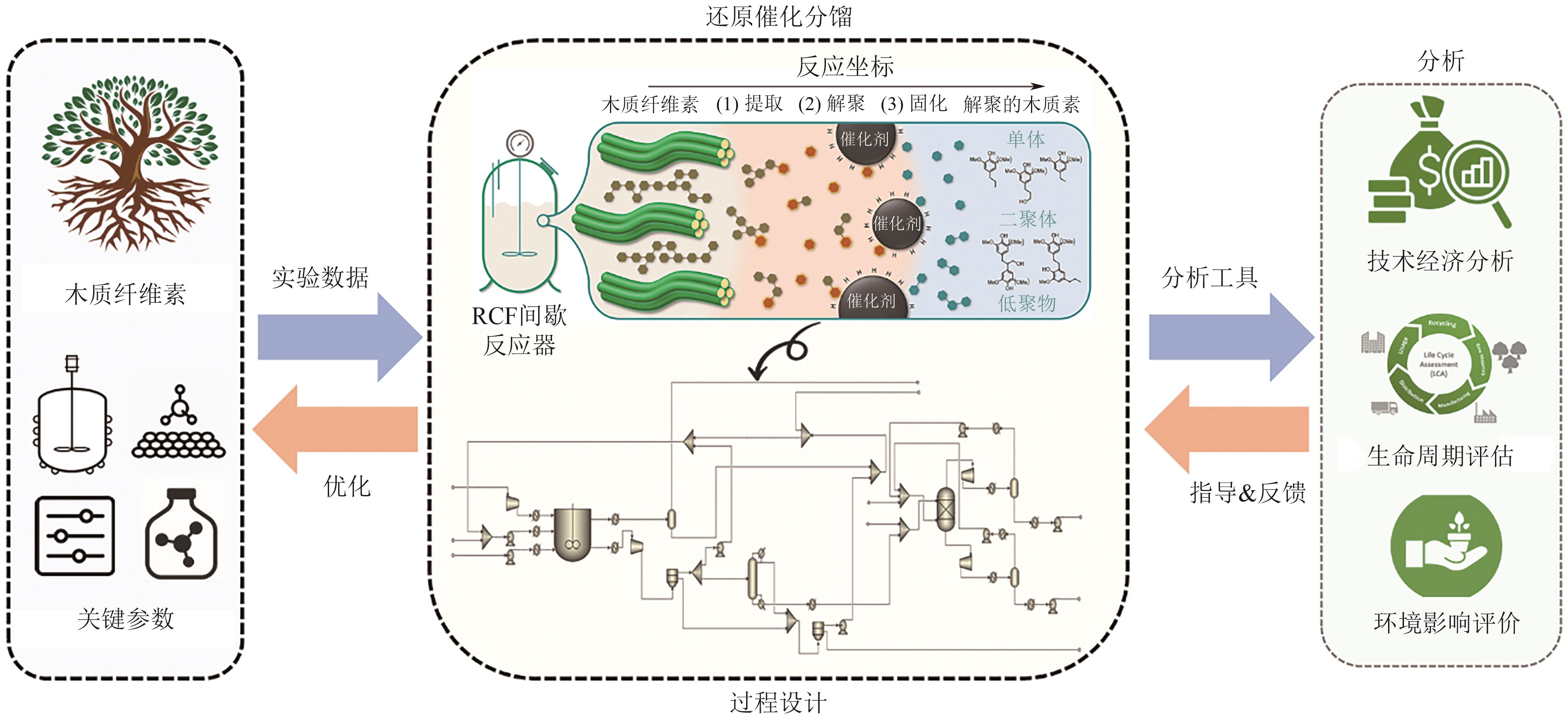
图1 生物精炼工艺过程的评估
| 原料 | 溶剂 | 催化剂 | 反应条件 | 单体产率/% | 参考文献 |
|---|---|---|---|---|---|
| 桦木 | 甲醇 | Ru/C | 250℃,30bar H2,3h | 52.0 | [ |
| 白桦树 | γ-戊内酯/水/甲醛 | Pd/Ru | 120℃,2bar H2,2h | 50.0 | [ |
| 杨木 | 异丙醇/水 | Raney Ni | 220℃,无氢气,3h | 26.0 | [ |
| 杨木 | 草酸/乙二醇/氯化胆碱 | Ru/C | 180℃,无氢气,3h | 13.8 | [ |
| 杨木 | 乙二醇 | Ru/C | 230℃,30bar H2,3h | 11.8 | [ |
| 桦木 | 乙醇/水/甲酸/甲酸钠 | Co-phen/C | 200℃,无氢气,4h | 34.0 | [ |
| 松树 | 1,3-二甲氧基丙-2-醇/乙酸/水 | Pt/C | 200℃,无氢气,4h | 24.9 | [ |
| 油茶花壳 | 乙醇/水 | Pd/C | 260℃,20bar H2,3h | 17.0 | [ |
| 桉木 | 水 | MoO x /SBA-15 | 260℃,30bar H2,4h | 2.4 | [ |
表1 不同溶剂体系下还原催化分馏工艺汇总
| 原料 | 溶剂 | 催化剂 | 反应条件 | 单体产率/% | 参考文献 |
|---|---|---|---|---|---|
| 桦木 | 甲醇 | Ru/C | 250℃,30bar H2,3h | 52.0 | [ |
| 白桦树 | γ-戊内酯/水/甲醛 | Pd/Ru | 120℃,2bar H2,2h | 50.0 | [ |
| 杨木 | 异丙醇/水 | Raney Ni | 220℃,无氢气,3h | 26.0 | [ |
| 杨木 | 草酸/乙二醇/氯化胆碱 | Ru/C | 180℃,无氢气,3h | 13.8 | [ |
| 杨木 | 乙二醇 | Ru/C | 230℃,30bar H2,3h | 11.8 | [ |
| 桦木 | 乙醇/水/甲酸/甲酸钠 | Co-phen/C | 200℃,无氢气,4h | 34.0 | [ |
| 松树 | 1,3-二甲氧基丙-2-醇/乙酸/水 | Pt/C | 200℃,无氢气,4h | 24.9 | [ |
| 油茶花壳 | 乙醇/水 | Pd/C | 260℃,20bar H2,3h | 17.0 | [ |
| 桉木 | 水 | MoO x /SBA-15 | 260℃,30bar H2,4h | 2.4 | [ |
| 项目 | 甲醇 | 乙醇 | 无氢 | 乙二醇 |
|---|---|---|---|---|
| 粗RCF油最低销售价格/USD | 1.12 | 1.18 | 0.76 | 0.98 |
| 木质素部分最低销售价格/USD | 1.74 | 1.88 | 1.34 | 1.51 |
| 单体部分最低销售价格/USD | 3.63 | 3.76 | 7.58 | 3.07 |
| 木质素部分全球变暖潜能值 /kg CO2·kg-1 | 0.079 | -0.175 | -0.018 | 0.392 |
| 木质素部分累积能源需求/MJ | 74.03 | 77.47 | 75.36 | 77.93 |
表2 使用不同溶剂时,生物质还原催化分馏产品最低销售价格、全球变暖潜能当量值、能源需求量[50]
| 项目 | 甲醇 | 乙醇 | 无氢 | 乙二醇 |
|---|---|---|---|---|
| 粗RCF油最低销售价格/USD | 1.12 | 1.18 | 0.76 | 0.98 |
| 木质素部分最低销售价格/USD | 1.74 | 1.88 | 1.34 | 1.51 |
| 单体部分最低销售价格/USD | 3.63 | 3.76 | 7.58 | 3.07 |
| 木质素部分全球变暖潜能值 /kg CO2·kg-1 | 0.079 | -0.175 | -0.018 | 0.392 |
| 木质素部分累积能源需求/MJ | 74.03 | 77.47 | 75.36 | 77.93 |
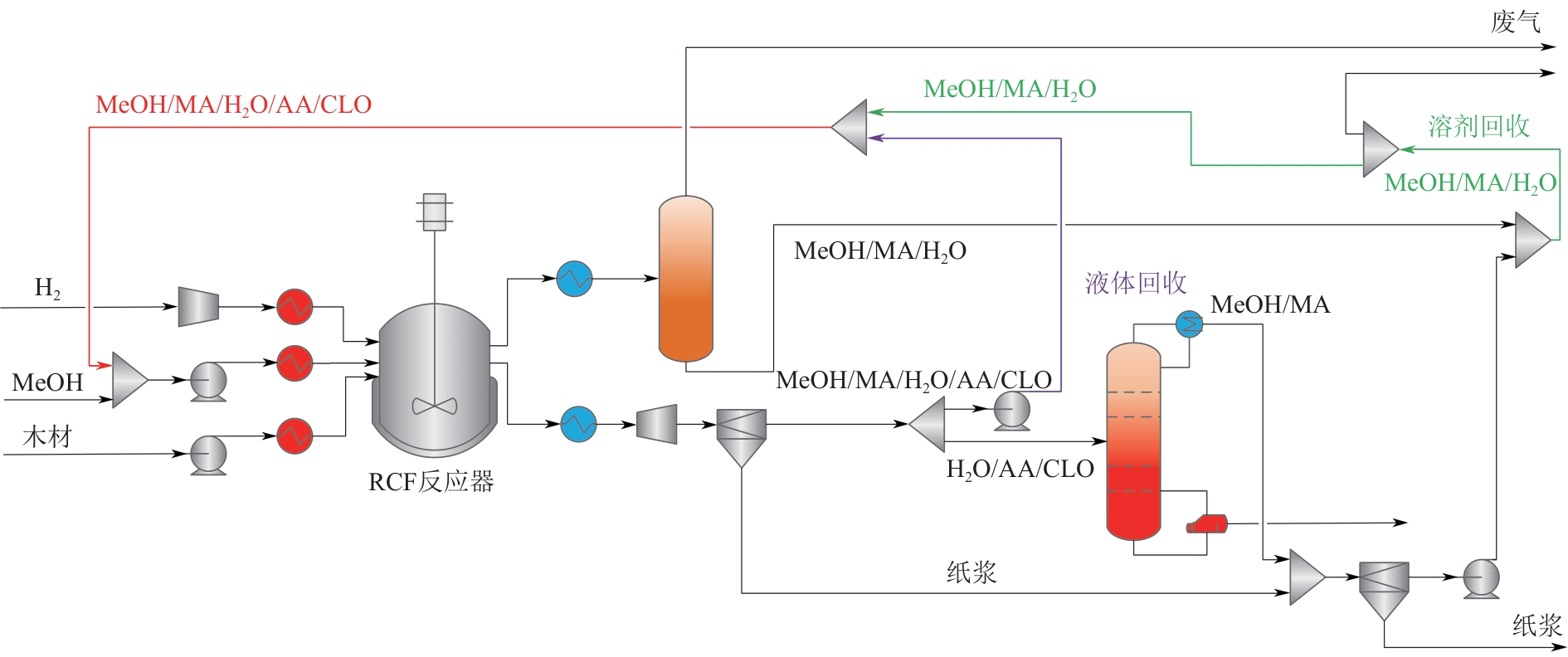
图2 基于料液循环的生物精炼工艺流程MeOH—甲醇;MA—乙酸甲酯;AA—乙酸;CLO—粗木质素油;EtOAc—乙酸乙酯

图3 基于木材的木基化学品生产综合生物炼制工艺流程[65]
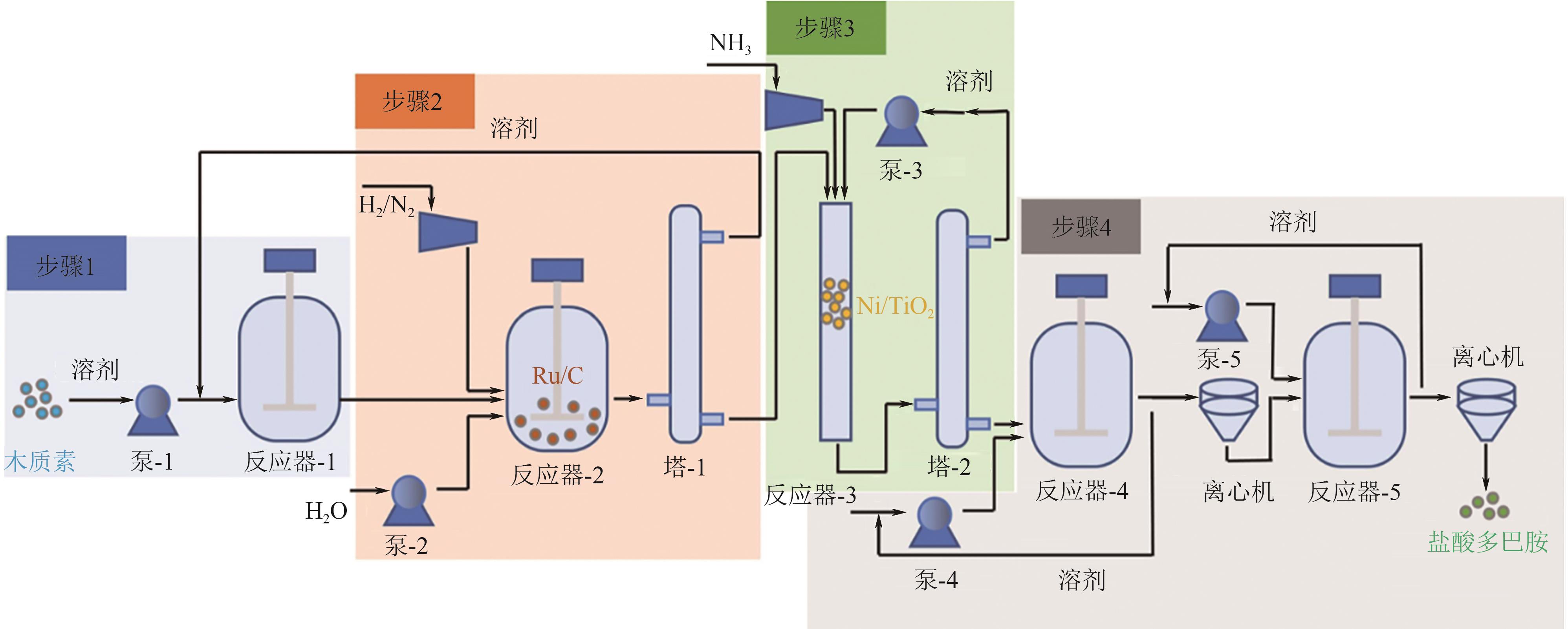
图4 软木木质素合成盐酸多巴胺的工艺流程[66-67]
| 1 | ZHOU Min, Meiqi LYU, CAI Sulin, et al. Effects of enzymatic hydrolysis and physicochemical properties of lignocellulose waste through different choline based deep eutectic solvents (DESs) pretreatment[J]. Industrial Crops and Products, 2023, 195: 116435. |
| 2 | ZHOU Min, TIAN Xingjun. Development of different pretreatments and related technologies for efficient biomass conversion of lignocellulose[J]. International Journal of Biological Macromolecules, 2022, 202: 256-268. |
| 3 | TUCK Christopher O, Eduardo PÉREZ, HORVÁTH István T, et al. Valorization of biomass: Deriving more value from waste[J]. Science, 2012, 337(6095): 695-699. |
| 4 | SOMERVILLE Chris, YOUNGS Heather, TAYLOR Caroline, et al. Feedstocks for lignocellulosic biofuels[J]. Science, 2010, 329(5993): 790-792. |
| 5 | SCHUTYSER W, RENDERS T, VAN DEN BOSCH S, et al. Chemicals from lignin: An interplay of lignocellulose fractionation, depolymerisation, and upgrading[J]. Chemical Society Reviews, 2018, 47(3): 852-908. |
| 6 | GALKIN Maxim V, SAMEC Joseph S M. Lignin valorization through catalytic lignocellulose fractionation: A fundamental platform for the puture biorefinery[J]. ChemSusChem, 2016, 9(13): 1544-1558. |
| 7 | ABU-OMAR Mahdi M, BARTA Katalin, BECKHAM Gregg T, et al. Guidelines for performing lignin-first biorefining[J]. Energy & Environmental Science, 2021, 14(1): 262-292. |
| 8 | VAN DEN BOSCH S, SCHUTYSER W, VANHOLME R, et al. Reductive lignocellulose fractionation into soluble lignin-derived phenolic monomers and dimers and processable carbohydrate pulps[J]. Energy & Environmental Science, 2015, 8(6): 1748-1763. |
| 9 | DU Xu, TRICKER Andrew W, YANG Weisheng, et al. Oxidative catalytic fractionation and depolymerization of lignin in a one-pot single-catalyst system[J]. ACS Sustainable Chemistry & Engineering, 2021, 9(23): 7719-7727. |
| 10 | BERTELLA Stefania, LUTERBACHER Jeremy S. Simultaneous extraction and controlled chemical functionalization of hardwood lignin for improved phenolation[J]. Green Chemistry, 2021, 23(9): 3459-3467. |
| 11 | DE SANTI Alessandra, GALKIN Maxim V, LAHIVE Ciaran W, et al. Lignin-first fractionation of softwood lignocellulose using a mild dimethyl carbonate and ethylene glycol organosolv process[J]. ChemSusChem, 2020, 13(17): 4468-4477. |
| 12 | LI Xi, XU Ying, ALORKU Kingdom, et al. A review of lignin-first reductive catalytic fractionation of lignocellulose[J]. Molecular Catalysis, 2023, 550: 113551. |
| 13 | SAGUES William J, BAO Hanxi, NEMENYI John L, et al. Lignin-first approach to biorefining: Utilizing fenton’s reagent and supercritical ethanol for the production of phenolics and sugars[J]. ACS Sustainable Chemistry & Engineering, 2018, 6(4): 4958-4965. |
| 14 | RINALDI Roberto, WOODWARD Robert T, FERRINI Paola, et al. Lignin-first biorefining of lignocellulose: The impact of process severity on the uniformity of lignin oil composition[J]. Journal of the Brazilian Chemical Society, 2019, 30(3): 479-491. |
| 15 | SAINI Rahul, OSORIO-GONZALEZ Carlos Saul, HEGDE Krishnamoorthy, et al. Lignocellulosic biomass-based biorefinery: An insight into commercialization and economic standout[J]. Current Sustainable/Renewable Energy Reports, 2020, 7(4): 122-136. |
| 16 | 宋国勇. “木质素优先”策略下林木生物质组分催化分离与转化研究进展[J]. 林业工程学报, 2019, 4(5): 1-10. |
| SONG Guoyong. The development of catalytic fractionation and conversion of lignocellulosic biomass under lignin-first strategy[J]. Journal of Forestry Engineering, 2019, 4(5): 1-10. | |
| 17 | KORÁNYI Tamás I, Bálint FRIDRICH, PINEDA Antonio, et al. Development of ‘lignin-first’ approaches for the valorization of lignocellulosic biomass[J]. Molecules, 2020, 25(12): 2815. |
| 18 | 薛泓坤, 胡晓虹, 张琦, 等. 不同组分优先策略下的生物质三大素分离研究进展[J]. 林产化学与工业, 2024, 44(4): 149-162. |
| XUE Hongkun, HU Xiaohong, ZHANG Qi, et al. Advances in separation of cellulose, hemicellulose and lignin from biomass under different component prioritization strategies[J]. Chemistry and Industry of Forest Products, 2024, 44(4): 149-162. | |
| 19 | 杨旭, 骆治成, 肖睿, 等. “木质素优先”策略下生物质还原催化分离技术研究进展[J]. 能源环境保护, 2023, 37(3): 64-74. |
| YANG Xu, LUO Zhicheng, XIAO Rui, et al. Progress of reductive catalytic fractionation of lignocellulosic biomass based on the lignin-first strategy[J]. Energy Environmental Protection, 2023, 37(3): 64-74. | |
| 20 | 李治宇, 逯炀炀, 王文文, 等. “木质素优先解聚”策略下生物质定向解聚研究进展[J]. 农业工程学报, 2024, 40(1): 129-141. |
| LI Zhiyu, LU Yangyang, WANG Wenwen, et al. Progress in directed biomass depolymerisation under the “lignin-first depolymerisation” strategy[J]. Transactions of the Chinese Society of Agricultural Engineering, 2024, 40(1): 129-141. | |
| 21 | RINALDI Roberto, JASTRZEBSKI Robin, CLOUGH Matthew T, et al. Paving the way for lignin valorisation: Recent advances in bioengineering, biorefining and catalysis[J]. Angewandte Chemie International Edition, 2016, 55(29): 8164-8215. |
| 22 | GALKIN Maxim V, SMIT Arjan T, SUBBOTINA Elena, et al. Hydrogen-free catalytic fractionation of woody biomass[J]. ChemSusChem, 2016, 9(23): 3280-3287. |
| 23 | DEL RÍO José C, RENCORET Jorge, MARQUES Gisela, et al. Structural characterization of the lignin from jute (Corchorus capsularis) fibers[J]. Journal of Agricultural and Food Chemistry, 2009, 57(21): 10271-10281. |
| 24 | DEL RÍO José C, RENCORET Jorge, PRINSEN Pepijin, et al. structural characterization of wheat straw lignin as revealed by analytical pyrolysis, 2D-NMR, and reductive cleavage methods[J]. Journal of Agricultural and Food Chemistry, 2012, 60(23): 5922-5935. |
| 25 | DEL RÍO José C, LINO Alessandro G, COLODETTE Jorge L, et al. Differences in the chemical structure of the lignins from sugarcane bagasse and straw[J]. Biomass and Bioenergy, 2015, 81: 322-338. |
| 26 | PARSELL Trenton, YOHE Sara, DEGENSTEIN John, et al. A synergistic biorefinery based on catalytic conversion of lignin prior to cellulose starting from lignocellulosic biomass[J]. Green Chemistry, 2015, 17(3): 1492-1499. |
| 27 | EBIKADE Elvis Osamudiamhen, SAMULEWICZ Nicholas, XUAN Shuangqing, et al. Reductive catalytic fractionation of agricultural residue and energy crop lignin and application of lignin oil in antimicrobials[J]. Green Chemistry, 2020, 22(21): 7435-7447. |
| 28 | HUANG Xiaoming, MORALES GONZALEZ Olivia M, ZHU Jiadong, et al. Reductive fractionation of woody biomass into lignin monomers and cellulose by tandem metal triflate and Pd/C catalysis[J]. Green Chemistry, 2017, 19(1): 175-187. |
| 29 | SU Shihao, XIAO Lingping, CHEN Xue, et al. Lignin-first depolymerization of lignocellulose into monophenols over carbon nanotube-supported ruthenium: Impact of lignin sources[J]. ChemSusChem, 2022, 15(12): e202200365. |
| 30 | VAN DEN BOSCH S, SCHUTYSER W, KOELEWIJN S F, et al. Tuning the lignin oil OH-content with Ru and Pd catalysts during lignin hydrogenolysis on birch wood[J]. Chemical Communications, 2015, 51(67): 13158-13161. |
| 31 | CHEN Jiazhi, LU Fang, SI Xiaoqin, et al. High yield production of natural phenolic alcohols from woody biomass using a nickel-based catalyst[J]. ChemSusChem, 2016, 9(23): 3353-3360. |
| 32 | LIU Xue, LI Helong, XIAO Lingping, et al. Chemodivergent hydrogenolysis of eucalyptus lignin with Ni@ZIF-8 catalyst[J]. Green Chemistry, 2019, 21(6): 1498-1504. |
| 33 | RENDERS Tom, SCHUTYSER Wouter, VAN DEN BOSCH S, et al. Influence of acidic (H3PO4) and alkaline (NaOH) additives on the catalytic reductive fractionation of lignocellulose[J]. ACS Catalysis, 2016, 6(3): 2055-2066. |
| 34 | YE Ke, LIU Ying, WU Shubin, et al. A review for lignin valorization: Challenges and perspectives in catalytic hydrogenolysis[J]. Industrial Crops and Products, 2021, 172: 114008. |
| 35 | SHUAI Li, LUTERBACHER Jeremy. Organic solvent effects in biomass conversion reactions[J]. ChemSusChem, 2016, 9(2): 133-155. |
| 36 | PATEROMICHELAKIS Antreas, PSYCHA Melina, PYRGAKIS Konstantinos, et al. The use of GVL for holistic valorization of biomass[J]. Computers & Chemical Engineering, 2022, 164: 107849. |
| 37 | FERRINI Paola, RINALDI Roberto. Catalytic biorefining of plant biomass to non-pyrolytic lignin bio-oil and carbohydrates through hydrogen transfer reactions[J]. Angewandte Chemie International Edition, 2014, 53(33): 8634-8639. |
| 38 | ZHAI Qiaolong, LI Jie, MIAO Kangze, et al. Atmospheric one-pot fractionation and catalytic conversion of lignocellulose in multifunctional deep eutectic solvent system[J]. International Journal of Biological Macromolecules, 2025, 290: 138736. |
| 39 | REN Tianyu, YOU Shengping, ZHANG Zhaofeng, et al. Highly selective reductive catalytic fractionation at atmospheric pressure without hydrogen[J]. Green Chemistry, 2021, 23(4): 1648-1657. |
| 40 | RAUTIAINEN Sari, FRANCESCO Davide Di, KATEA Sarmad Naim, et al. Lignin valorization by cobalt-catalyzed fractionation of lignocellulose to yield monophenolic compounds[J]. ChemSusChem, 2019, 12(2): 404-408. |
| 41 | EKEOMA Bernard C, BARA Jason E, SHEEHAN James D. Glycerol-derived ethers enable hydrogen-free reductive catalytic fractionation of softwood lignin into functionalized aromatic monomers[J]. RSC Sustainability, 2024, 2(10): 2851-2870. |
| 42 | QIU Shukun, LIU Xudong, WU Yiying, et al. Catalytic depolymerization of camellia oleifera shell lignin to phenolic monomers: Insights into the effects of solvent, catalyst and atmosphere[J]. Bioresource Technology, 2024, 412: 131365. |
| 43 | SUN Jiankui, LI Helong, XIAO Lingping, et al. Fragmentation of woody lignocellulose into primary monolignols and their derivatives[J]. ACS Sustainable Chemistry & Engineering, 2019, 7(5): 4666-4674. |
| 44 | SONG Qi, WANG Feng, CAI Jiaying, et al. Lignin depolymerization (LDP) in alcohol over nickel-based catalysts via a fragmentation-hydrogenolysis process[J]. Energy & Environmental Science, 2013, 6(3): 994. |
| 45 | 于丁一, 李圆圆, 王晨钰, 等. pH 响应性木质素水凝胶的制备及药物控释[J]. 化工进展, 2023, 42(6): 3138-3146. |
| YU Dingyi, LI Yuanyuan, WANG Chenyu, et al. Preparation of lignin-based pH responsive hydrogel and its application in controlled drug release[J]. Chemical Industry and Engineering Progress, 2023, 42(6): 3138-3146. | |
| 46 | 娄瑞, 牛涛嫄, 曹启航, 等. δ-MnO₂原位负载纳米木质素基分级多孔炭的制备及其电化学性能[J]. 化工进展, 2024, 43(2): 1013-1021. |
| LOU Rui, NIU Taoyuan, CAO Qihang, et al. Preparation and electrochemical performances of in-situ growth of δ-MnO2 on hierarchical porous carbon derived from LNP[J]. Chemical Industry and Engineering Progress, 2024, 43(2): 1013-1021. | |
| 47 | 关红玲, 杨辉, 井红权, 等. 木质素基控释材料及其在药物输送和肥料控释中的应用[J]. 化工进展, 2023, 42(7): 3695-3707. |
| GUAN Hongling, YANG Hui, JING Hongquan, et al. Lignin-based controlled release materials and application in drug delivery and fertilizer controlled-release[J]. Chemical Industry and Engineering Progress, 2023, 42(7): 3695-3707. | |
| 48 | 白毓黎, 白富栋, 张雷, 等. 木质素基酚醛树脂的制备和过程优化[J]. 化工进展, 2024, 43(2): 1033-1038. |
| BAI Yuli, BAI Fudong, ZHANG Lei, et al. Preparation and process optimization of lignin-based phenolic resin[J]. Chemical Industry and Engineering Progress, 2024, 43(2): 1033-1038. | |
| 49 | DAELEMANS Brent, JUSNER Paul, SRIDHARAN Balaji, et al. Pilot-scale reductive catalytic depolymerization of lignin: Challenges and guidelines[J]. Chem, 2025: 102525. |
| 50 | BARTLING Andrew W, STONE Michael L, HANES Rebecca J, et al. Techno-economic analysis and life cycle assessment of a biorefinery utilizing reductive catalytic fractionation[J]. Energy & Environmental Science, 2021, 14(8): 4147-4168. |
| 51 | ARTS W, STONE VAN AELST K, COOREMAN E, et al. Stepping away from purified solvents in reductive catalytic fractionation: A step forward towards a disruptive wood biorefinery process[J]. Energy & Environmental Science, 2023, 16(6): 2518-2539. |
| 52 | Laura KÖNIG-MATTERN, SANCHEZ MEDINA Edgar I, KOMAROVA Anastasia, et al. Machine learning-supported solvent design for lignin-first biorefineries and lignin upgrading[J]. Chemical Engineering Journal, 2024, 495: 153524. |
| 53 | WEN Huaqiang, Shihao NAN, WU Di, et al. A systematic review on intensifications of artificial intelligence assisted green solvent development[J]. Industrial and Engineering Chemistry Research, 2023, 62(48): 20473-20491. |
| 54 | ZHANG Jun, WANG Qin, EDEN Mario, et al. A deep learning-based framework towards inverse green solvent design for extractive distillation with multi-index constraints[J]. Computers and Chemical Engineering, 2023, 177: 108335. |
| 55 | WU Di, ZHU Zutao, ZHANG Jun, et al. An interpretable solute-solvent interactive attention module intensified graph-learning architecture toward enhancing the prediction accuracy of an infinite dilution activity coefficient[J]. Industrial and Engineering Chemistry Research, 2024, 63(19): 8741-8750. |
| 56 | YANG Lu, LIU Shuoshi, CHANG Chenglin, et al. An efficient and invertible machine learning-driven multi-objective optimization architecture for light olefins separation system[J]. Chemical Engineering Science, 2024, 285: 119553. |
| 57 | RENDERS T, VAN DEN BOSCH S, KOELEWIJN S F, et al. Lignin-first biomass fractionation: the advent of active stabilisation strategies[J]. Energy & Environmental Science, 2017, 10(7): 1551-1557. |
| 58 | CHAN Min Kang, YE Qun, Zhuang Mao PNG, et al. Valorization of lignin: Effective conversion of depolymerized lignin to oil by simple chemical modifications[J]. Waste and Biomass Valorization, 2017, 8: 2029-2036. |
| 59 | YU Shitong, XU Pan, LUO Zhicheng. Catalytic depolymerization and hydrodeoxygenation of lignin to high-density fuel precursors using Ni/Nb2O5 catalyst[J]. Industrial Crops and Products, 2024, 222: 119632. |
| 60 | HUANG Yong, DUAN Yijing, QIU Shi, et al. Lignin-first biorefinery: A reusable catalyst for lignin depolymerization and application of lignin oil to jet fuel aromatics and polyurethane feedstock[J]. Sustainable Energy & Fuels, 2018, 2(3): 637-647. |
| 61 | KOURIS Panos D, BRINI Alberto, SCHEPERS Eline, et al. Optimizing catalytic depolymerization of lignin in ethanol with a day-clustered box-behnken design[J]. Industrial & Engineering Chemistry Research, 2023, 62(18): 6874-6885. |
| 62 | DONG Lin, XIN Yu, LIU Xiaohui, et al. Selective hydrodeoxygenation of lignin oil to valuable phenolics over Au/Nb2O5 in water[J]. Green Chemistry, 2019, 21(11): 3081-3090. |
| 63 | QUINSAAT Jose Enrico Q, FALIREAS Panagiotis G, FEGHALI Elias, et al. Depolymerised lignin oil: A promising building block towards thermoplasticity in polyurethanes[J]. Industrial Crops and Products, 2023, 194: 116305. |
| 64 | PANDALONE Bruno, RAIKWAR Deepak, Thuan A VO, et al. Optimum lignin oil — Finding the most suitable feedstock to replace cycloalkanes in sustainable aviation fuel (SAF)[J]. ChemSusChem, 2025: e202402531. |
| 65 | LIAO Yuhe, KOELEWIJN Steven-Friso, VAN DEN BOSSCHE Gil, et al. A sustainable wood biorefinery for low-carbon footprint chemicals production[J]. Science, 2020, 367(6484): 1385-1390. |
| 66 | 董琳, 陈祖鹏. 木质素源多巴胺的合成新工艺[J]. 科学通报, 2023, 68(31): 4079-4081. |
| DONG Lin, CHEN Zupeng. An innovative strategy for production of dopamine from lignin[J]. Chinese Science Bulletin, 2023, 68(31): 4079-4081. | |
| 67 | DONG Lin, WANG Yanqin, DONG Yuguo, et al. Sustainable production of dopamine hydrochloride from softwood lignin[J]. Nature Communications, 2023, 14(1): 4996. |
| 68 | SHI Tao, ZHOU Jianzhao, REN Jingzheng, et al. Co-valorisation of sewage sludge and poultry litter waste for hydrogen production: Gasification process design, sustainability-oriented optimization, and systematic assessment[J]. Energy, 2023, 272: 127131. |
| 69 | SHI Tao, ABDUL MOKTADIR Md, REN Jingzheng, et al. Comparative economic, environmental and exergy analysis of power generation technologies from the waste sludge treatment[J]. Energy Conversion and Management, 2023, 286: 117074. |
| 70 | TSCHULKOW Maxim, PIZZOL Massimo, COMPERNOLLE Tine, et al. The environmental impacts of the lignin-first biorefineries: A consequential life cycle assessment approach[J]. Resources, Conservation and Recycling, 2024, 204: 107466. |
| [1] | 曹湘洪, 周峰, 姜睿, 刘诗哲, 方向晨, 亢万忠, 乔金樑, 聂红. 加快我国生物基材料产业发展的对策[J]. 化工进展, 2025, 44(5): 2385-2393. |
| [2] | 钟家伟, 谭涛, 谢君, 陈勇. 生物质高值能源转换技术[J]. 化工进展, 2025, 44(5): 2524-2528. |
| [3] | 聂红, 习远兵, 葛泮珠, 丁石, 张登前. 可持续航空燃料生产路线与展望——以中石化石科院为例[J]. 化工进展, 2025, 44(5): 2529-2534. |
| [4] | 王水众, 宋国勇. 木质素选择性氢解制备高功能化单酚及其高值利用[J]. 化工进展, 2025, 44(5): 2535-2540. |
| [5] | 陈彦君, 戴杰, 单军强, 张思欣, 计磊, 朱晨杰, 应汉杰. 我国纤维素乙醇的研究进展和发展趋势[J]. 化工进展, 2025, 44(5): 2541-2562. |
| [6] | 乔凯, 张震宇, 马会霞, 傅杰, 周峰. 生物基呋喃二甲酸关键技术路线和产业发展现状[J]. 化工进展, 2025, 44(5): 2577-2586. |
| [7] | 许镇浩, 易子骁, 曾晨, 王宇辰, 严凯. 生物质基平台分子转化升级的研究进展[J]. 化工进展, 2025, 44(5): 2642-2654. |
| [8] | 冯娇, 刘明明, 刘耀, 王昕, 陈可泉. 利用可再生原料生物合成脂肪族短链二元胺与醇的研究进展[J]. 化工进展, 2025, 44(5): 2655-2666. |
| [9] | 孙仲顺, 刘根, 程春昱, 李美昕, 杨宪坛, 吴志强, 杨伯伦. 生物质热化学转化制备绿氢研究进展[J]. 化工进展, 2025, 44(5): 2667-2682. |
| [10] | 戴月明, 周梅芳, 沈建华, 姜海波, 李春忠. TiO2纳米颗粒烧结机制分子动力学模拟[J]. 化工进展, 2025, 44(4): 2202-2214. |
| [11] | 周郭宁, 朱昊辰, 贺文智, 李光明. 水热技术用于农业废弃物处理的研究进展Ⅰ:生物原油制备[J]. 化工进展, 2025, 44(4): 2297-2312. |
| [12] | 周郭宁, 朱昊辰, 贺文智, 李光明. 水热技术用于农业废弃物处理的研究进展Ⅱ:水热炭化[J]. 化工进展, 2025, 44(4): 2313-2327. |
| [13] | 陶金泉, 贾亦静, 白天瑜, 姚荣鹏, 黄文斌, 崔岩, 周亚松, 魏强. Silicalite-1分子筛的低成本合成及其MTP催化性能[J]. 化工进展, 2025, 44(3): 1550-1558. |
| [14] | 冯鹏, 徐东海, 何冰, 刘欢腾, 杨立杰, 王攀, 刘青山. 亚/超临界水中典型硫酸盐Na2SO4和K2SO4的溶解特性及机理[J]. 化工进展, 2025, 44(3): 1706-1715. |
| [15] | 邱泽刚, 石亚斐, 李志勤. 生物质衍生芳香族含氧化合物中C—O键断裂研究进展[J]. 化工进展, 2025, 44(3): 1183-1193. |
| 阅读次数 | ||||||
|
全文 |
|
|||||
|
摘要 |
|
|||||