化工进展 ›› 2025, Vol. 44 ›› Issue (4): 2338-2351.DOI: 10.16085/j.issn.1000-6613.2024-0512
硫酸盐还原菌群的构建及其在酸胁迫条件下的响应
张艳梅1,2( ), 李江1,3(), 袁涛1,2, 刘亚洁1,2, 孙占学1,2
- 1.地下水污染成因与修复江西省重点实验室,江西 南昌 330013
2.东华理工大学水资源与环境工程学院,江西 南昌 330013
3.东华理工大学师范学院,江西 南昌 330013
-
收稿日期:2024-03-28修回日期:2024-11-27出版日期:2025-04-25发布日期:2025-05-07 -
通讯作者:李江 -
作者简介:张艳梅(1989—),女,博士研究生,研究方向为污水生化处理。E-mail:450826464@qq.com。 -
基金资助:国防科技工业局核设施退役及放射性废物治理科研项目(G20210004);国家自然科学基金(41772266)
Construction of sulfate-reducing bacteria community and its response to acid stress
ZHANG Yanmei1,2(), LI Jiang1,3(), YUAN Tao1,2, LIU Yajie1,2, SUN Zhanxue1,2
- 1.Jiangxi Provincial Key Laboratory of Genesis and Remediation of Groundwater Pollution, Nanchang 330013, Jiangxi, China
2.College of Water Resources and Environmental Engineering, East China University of Technology, Nanchang 330013, Jiangxi, China
3.Normal College, East China University of Technology, Nanchang 330013, Jiangxi, China
-
Received:2024-03-28Revised:2024-11-27Online:2025-04-25Published:2025-05-07 -
Contact:LI Jiang

摘要:
环境pH降低会影响硫酸盐还原系统的生化性能,因此提升体系在酸胁迫条件下的耐性受到广泛关注。本研究通过构建高效的硫酸盐还原菌群(SRBs),以接种脱硫弧菌的纯菌体系作为对照组,利用菌群体系开展批式试验,研究了不同pH条件对系统微生物生长和硫酸盐还原性能的影响,解析了体系微生物对酸胁迫的生理应答。结果表明,随着pH的降低,纯菌体系的细菌生长和硫酸盐还原反应受到了明显抑制,pH降至5.0后体系细菌存活率不到10%,基本丧失硫酸盐还原功能。相比之下,SRBs体系微生物能够通过提高ATP水解酶(H+-ATPase)活性、产生应激蛋白、调节细胞膜脂肪酸组成及分布等途径提高系统抵御酸胁迫能力,在经过7天的生长适应期后逐步实现SO
中图分类号:
引用本文
张艳梅, 李江, 袁涛, 刘亚洁, 孙占学. 硫酸盐还原菌群的构建及其在酸胁迫条件下的响应[J]. 化工进展, 2025, 44(4): 2338-2351.
ZHANG Yanmei, LI Jiang, YUAN Tao, LIU Yajie, SUN Zhanxue. Construction of sulfate-reducing bacteria community and its response to acid stress[J]. Chemical Industry and Engineering Progress, 2025, 44(4): 2338-2351.
| 序号 | 样品来源 | 采样区域 | 采样点 |
|---|---|---|---|
| 1 | 洪城城北污水处理厂 | 厌氧消化池污泥 | 北纬28°43′2″ 东经115°49'30″ |
| 2 | 乌沙河 | 老丰和电排站排污口附近底泥 | 北纬28°42'25″ 东经115°51'16″ |
| 3 | 新疆某退役采区 | 某地浸采铀退役采区 | 9541地层 |
表1 样品采集和采样点布设
| 序号 | 样品来源 | 采样区域 | 采样点 |
|---|---|---|---|
| 1 | 洪城城北污水处理厂 | 厌氧消化池污泥 | 北纬28°43′2″ 东经115°49'30″ |
| 2 | 乌沙河 | 老丰和电排站排污口附近底泥 | 北纬28°42'25″ 东经115°51'16″ |
| 3 | 新疆某退役采区 | 某地浸采铀退役采区 | 9541地层 |
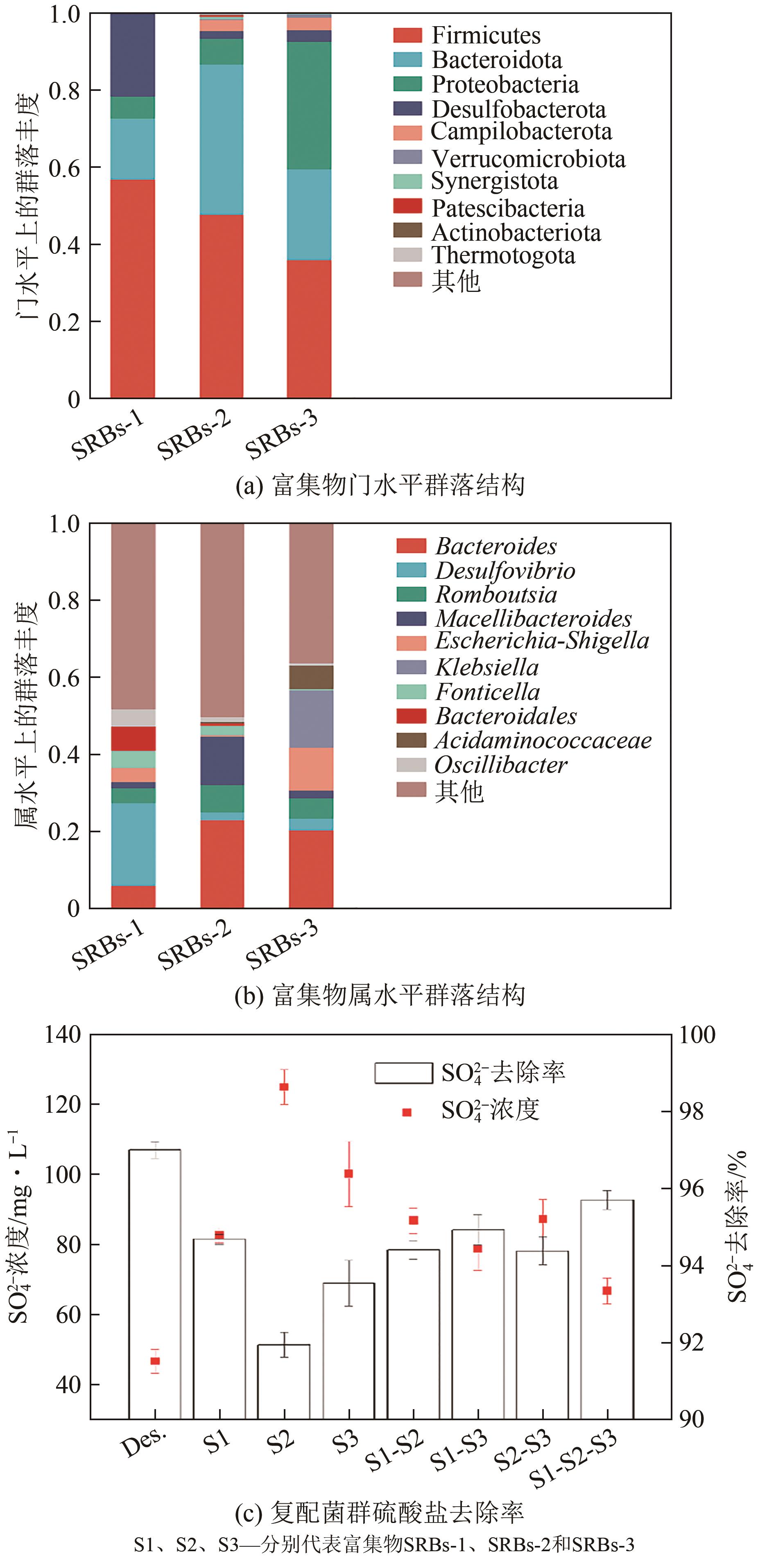
图1 富集物群落结构及复配菌群硫酸盐去除率
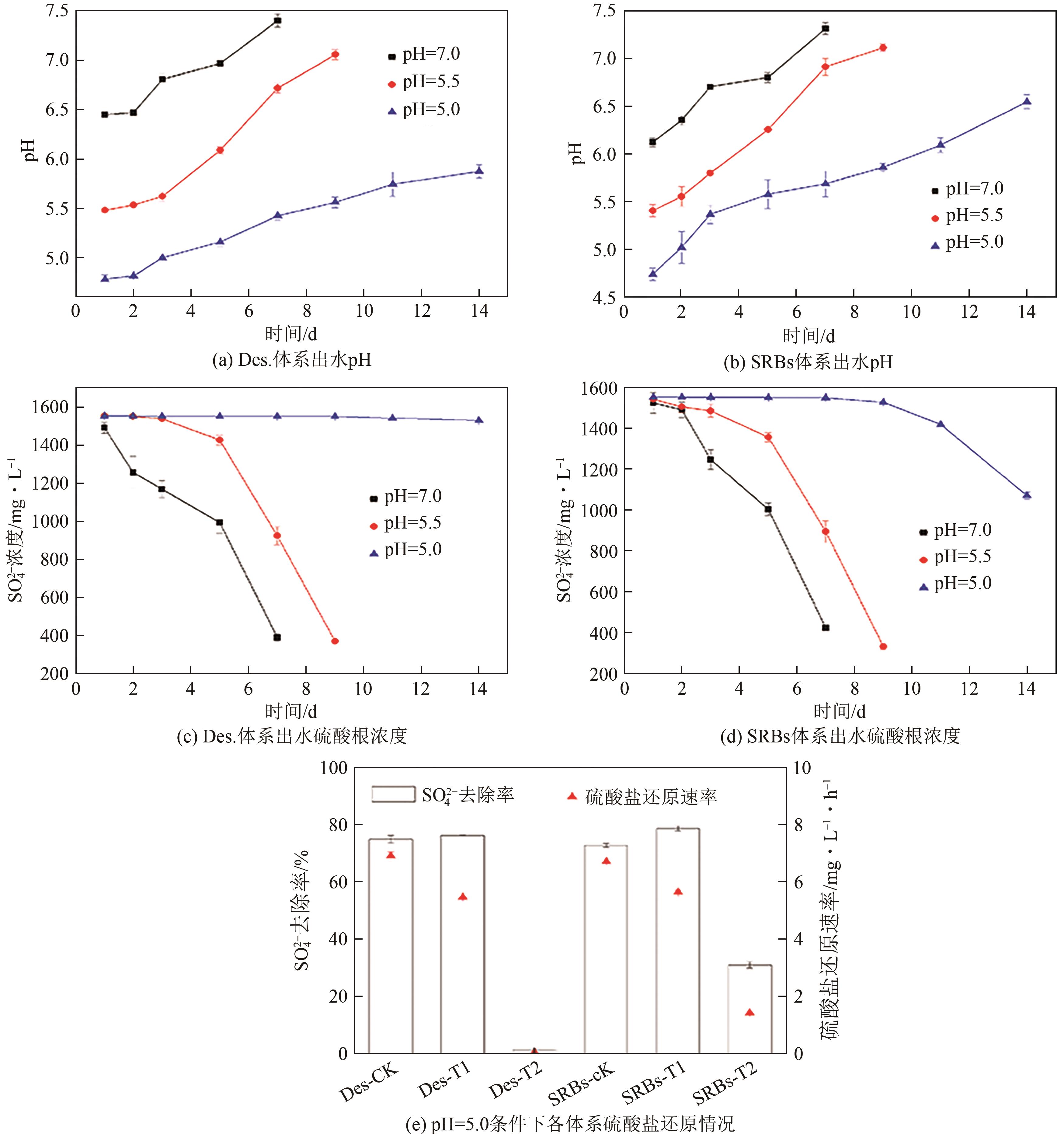
图2 不同pH条件下各体系硫酸盐还原情况
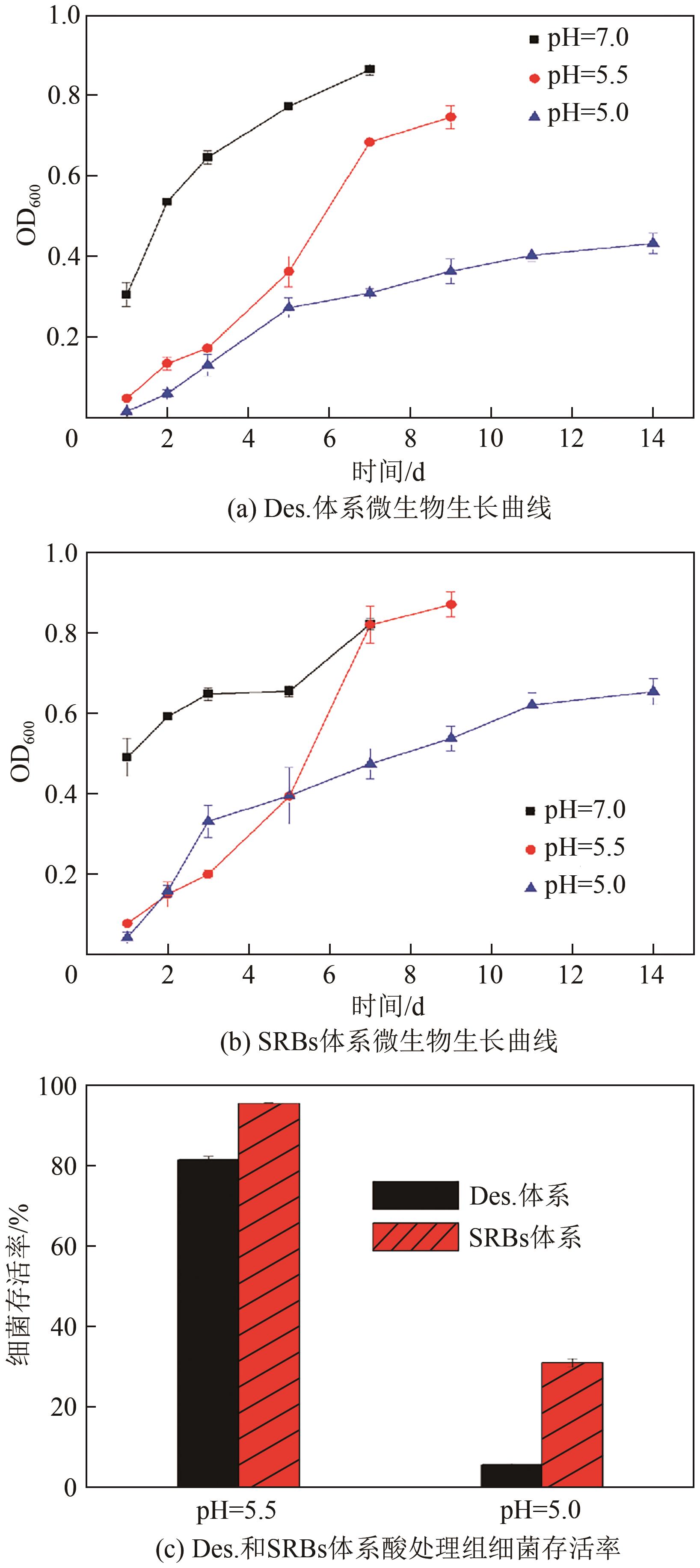
图3 不同pH条件下各体系微生物生长情况
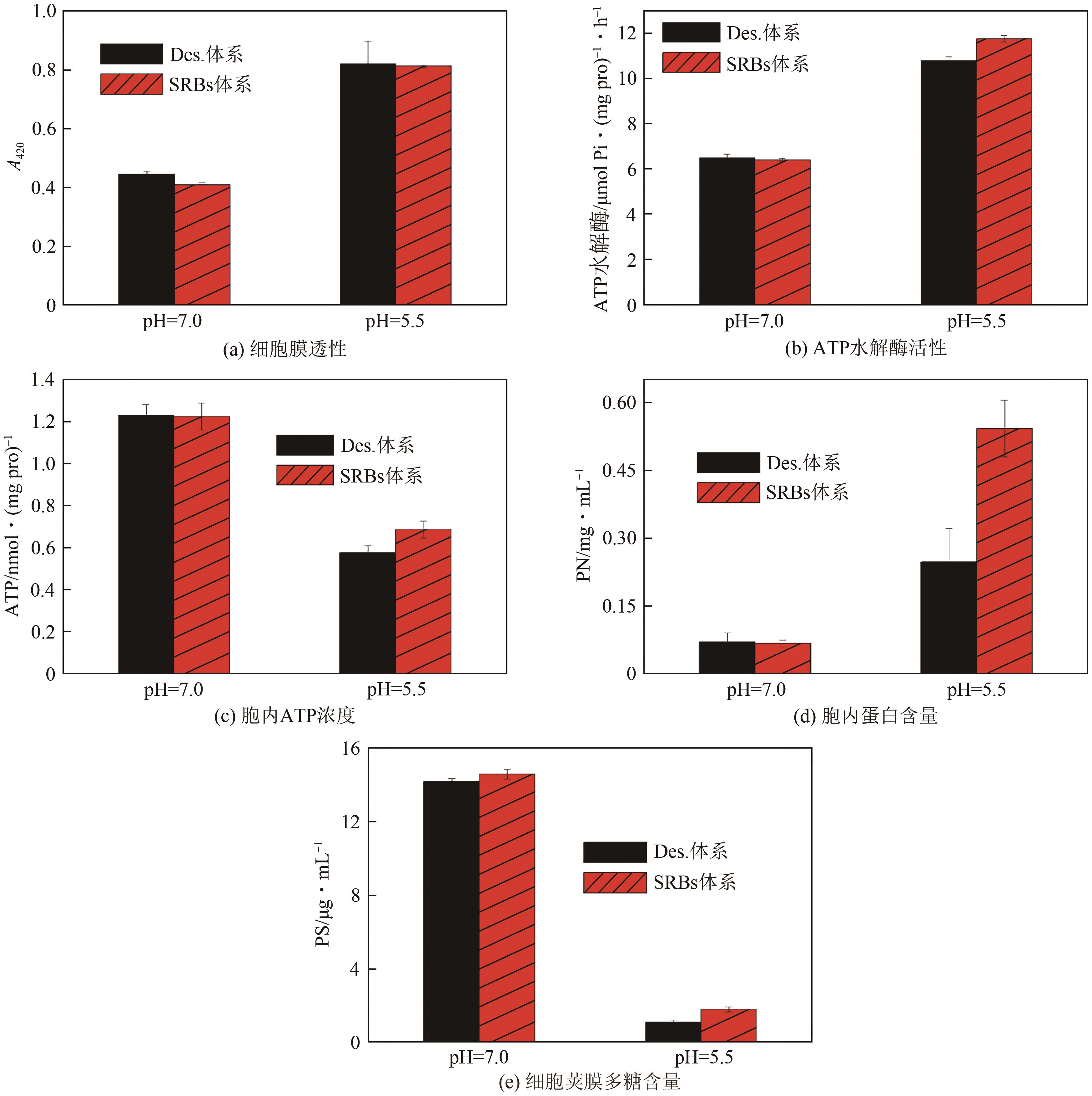
图4 不同pH条件下各体系微生物生理应答
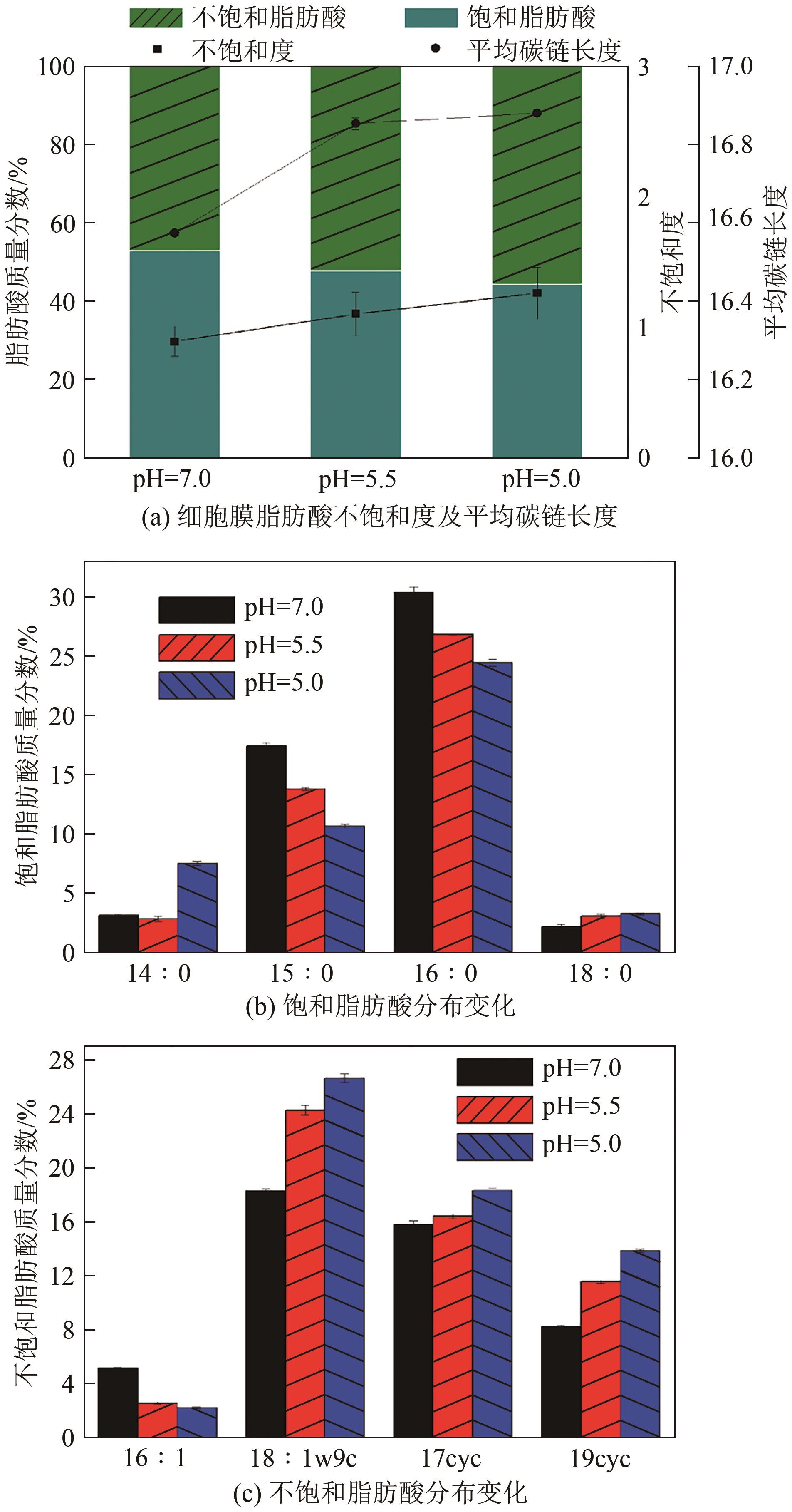
图5 不同pH条件下菌群体系微生物细胞膜脂肪酸组成及分布
| 处理组 | Chao1指数 | ACE指数 | Simpon指数 | Shannon指数 | 覆盖率 |
|---|---|---|---|---|---|
| SRBs-CK | 93.56±4.78 | 97.91±4.66 | 0.16±0.05 | 2.52±0.04 | 0.999 |
| SRBs-T2 | 92.54±11.13 | 93.66±9.42 | 0.16±0.03 | 2.48±0.09 | 0.999 |
表2 SRBs体系不同处理组微生物群落α多样性
| 处理组 | Chao1指数 | ACE指数 | Simpon指数 | Shannon指数 | 覆盖率 |
|---|---|---|---|---|---|
| SRBs-CK | 93.56±4.78 | 97.91±4.66 | 0.16±0.05 | 2.52±0.04 | 0.999 |
| SRBs-T2 | 92.54±11.13 | 93.66±9.42 | 0.16±0.03 | 2.48±0.09 | 0.999 |
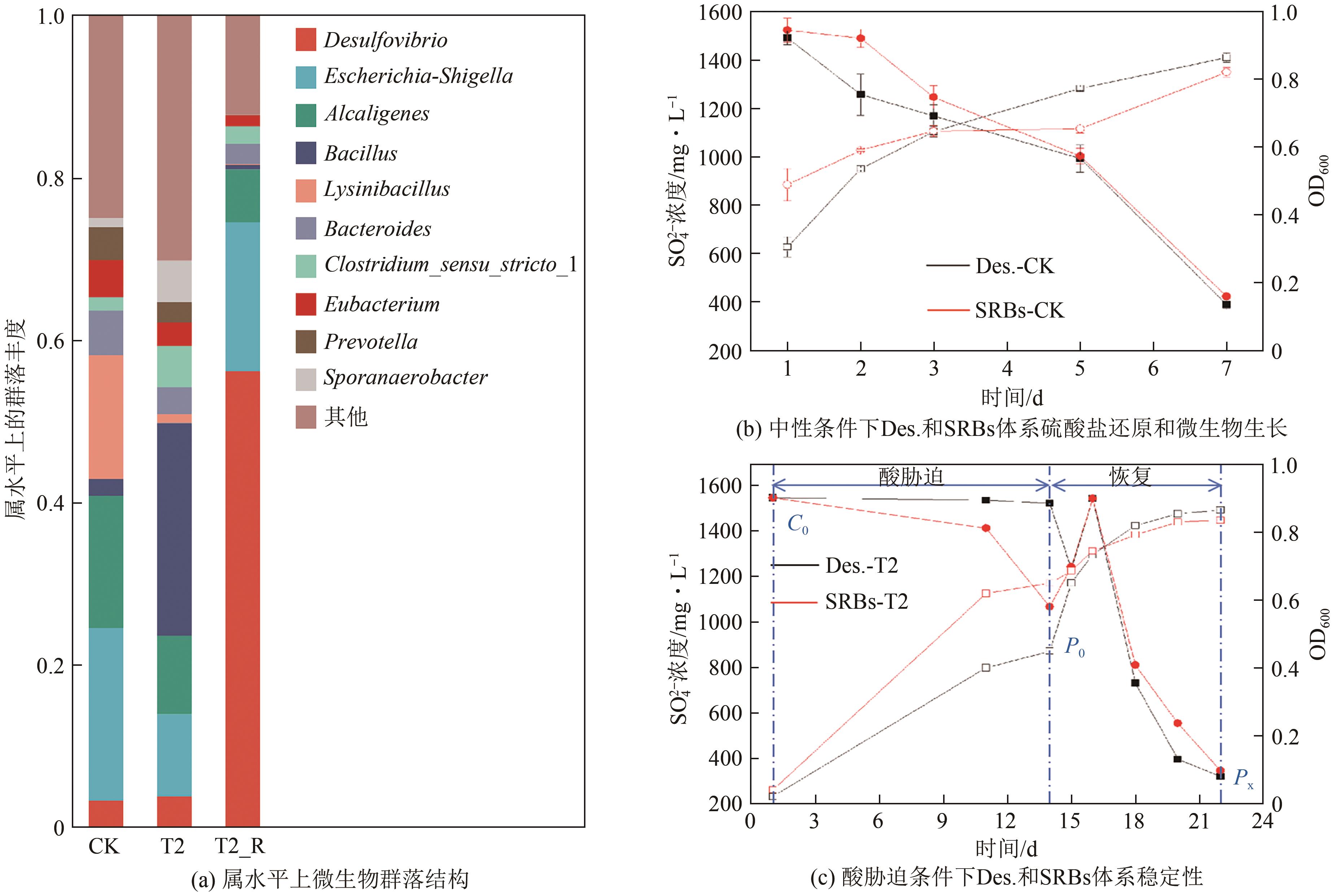
图6 微生物群落结构及抵抗力和恢复力
| 体系稳定性 | 硫酸盐还原性能(SO | 菌密度(OD600) | α多样性(Shannon指数) | 关键物种丰度(Desulfovibrio丰度) | |
|---|---|---|---|---|---|
| Des.-T2 | RS | 0.07 | -0.91 | — | — |
| RL | 0.205 | 43.3 | — | — | |
| SRBs-T2 | RS | 0.53 | -0.88 | 0.97 | 0.73 |
| RL | 0.22 | 20.9 | 0.60 | 17.85 | |
表3 酸胁迫条件下不同体系的稳定性
| 体系稳定性 | 硫酸盐还原性能(SO | 菌密度(OD600) | α多样性(Shannon指数) | 关键物种丰度(Desulfovibrio丰度) | |
|---|---|---|---|---|---|
| Des.-T2 | RS | 0.07 | -0.91 | — | — |
| RL | 0.205 | 43.3 | — | — | |
| SRBs-T2 | RS | 0.53 | -0.88 | 0.97 | 0.73 |
| RL | 0.22 | 20.9 | 0.60 | 17.85 | |
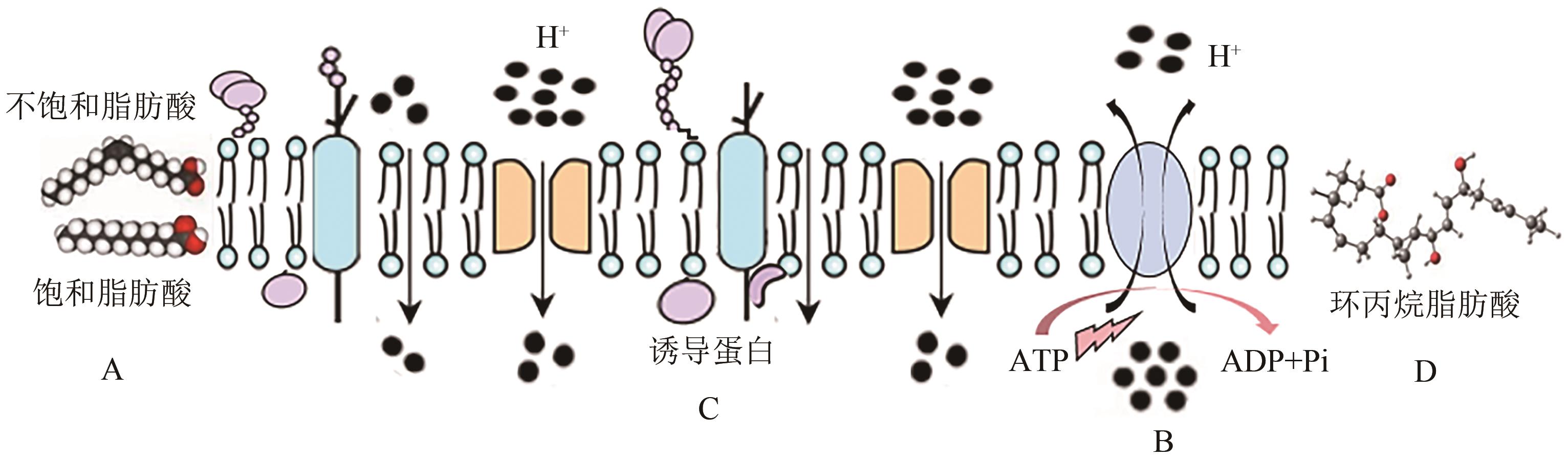
图7 SRBs体系微生物生理应答A—改变细胞膜脂肪酸组成;B—提高H+-ATPase活性(泵出H+);C—产生诱导蛋白(保护修复);D—合成环丙烷脂肪酸(抵御胁迫)
| 1 | ZHANG Zhao, ZHANG Chunhui, YANG Yang, et al. A review of sulfate-reducing bacteria: Metabolism, influencing factors and application in wastewater treatment[J]. Journal of Cleaner Production, 2022, 376: 134109. |
| 2 | NIELSEN Guillaume, COUDERT Lucie, JANIN Amelie, et al. Influence of organic carbon sources on metal removal from mine impacted water using sulfate-reducing bacteria bioreactors in cold climates[J]. Mine Water and the Environment, 2019, 38(1): 104-118. |
| 3 | BAUMGARTNER L K, REID R P, DUPRAZ C, et al. Sulfate reducing bacteria in microbial mats: Changing paradigms, new discoveries[J]. Sedimentary Geology, 2006, 185(3/4): 131-145. |
| 4 | ZHAO Baofu, SUN Hui, JIANG Peng, et al. Study on the treatment of sulfite wastewater by Desulfovibrio [J]. Bioprocess and Biosystems Engineering, 2023, 46(9): 1265-1278. |
| 5 | ZHOU Chen, ZHOU Yun, RITTMANN Bruce E. Reductive precipitation of sulfate and soluble Fe(Ⅲ) by Desulfovibrio vulgaris: Electron donor regulates intracellular electron flow and nano-FeS crystallization[J]. Water Research, 2017, 119: 91-101. |
| 6 | ZHOU Chen, VANNELA Raveender, HAYES Kim F, et al. Effect of growth conditions on microbial activity and iron-sulfide production by Desulfovibrio vulgaris [J]. Journal of Hazardous Materials, 2014, 272: 28-35. |
| 7 | ZENG Qian, HAO Tianwei, MACKEY Hamish Robert, et al. Recent advances in dissimilatory sulfate reduction: From metabolic study to application[J]. Water Research, 2019, 150: 162-181. |
| 8 | 朱晓丽, 张婵娟, 张星, 等. 生物炭固定化硫酸盐还原菌对镉污染土壤的钝化修复[J]. 环境科学学报, 2023, 43(5): 421-429. |
| ZHU Xiaoli, ZHANG Chanjuan, ZHANG Xing, et al. Remediation of Cd2+ contaminated soil by biochar immobilized sulfate reducing bacteria[J]. Acta Scientiae Circumstantiae, 2023, 43(5): 421-429. | |
| 9 | ALAZARD Didier, JOSEPH Manon, Fabienne BATTAGLIA-BRUNET, et al. Desulfosporosinus acidiphilus sp. nov.: A moderately acidophilic sulfate-reducing bacterium isolated from acid mining drainage sediments[J]. Extremophiles, 2010, 14(3): 305-312. |
| 10 | Irene SÁNCHEZ-ANDREA, STAMS Alfons J M, AMILS Ricardo, et al. Enrichment and isolation of acidophilic sulfate-reducing bacteria from Tinto River sediments[J]. Environmental Microbiology Reports, 2013, 5(5): 672-678. |
| 11 | TORBAGHAN Mehrnoush Eskandari, KHALILI TORGHABEH Gholam Hossein. Biological removal of iron and sulfate from synthetic wastewater of cotton delinting factory by using halophilic sulfate-reducing bacteria[J]. Heliyon, 2019, 5(12): e02948. |
| 12 | SANTOS Ana Laura, Barrie JOHNSON D. The effects of temperature and pH on the kinetics of an acidophilic sulfidogenic bioreactor and indigenous microbial communities[J]. Hydrometallurgy, 2017, 168: 116-120. |
| 13 | JAMESON E, ROWE O F, HALLBERG K B, et al. Sulfidogenesis and selective precipitation of metals at low pH mediated by Acidithiobacillus spp. and acidophilic sulfate-reducing bacteria[J]. Hydrometallurgy, 2010, 104(3/4): 488-493. |
| 14 | LI Yongchao, XU Zheng, WU Jixin, et al. Efficiency and mechanisms of antimony removal from wastewater using mixed cultures of iron-oxidizing bacteria and sulfate-reducing bacteria based on scrap iron[J]. Separation and Purification Technology, 2020, 246: 116756. |
| 15 | COSTA Josiel Martins, DE CASTRO Karine Cappuccio, RODRIGUEZ Renata Piacentini, et al. Anaerobic reactors for the treatment of sulphate and metal-rich wastewater: A review[J]. International Journal of Environmental Analytical Chemistry, 2022, 102(4): 923-934. |
| 16 | 庞安冉, 张晓丹, 刘淼, 等. 不同pH值条件下硫酸盐还原菌组成及硫酸盐还原机制分析[J]. 微生物学报, 2024, 64(4): 1081-1094. |
| PANG Anran, ZHANG Xiaodan, LIU Miao, et al. Dominant sulfate-reducing bacteria at different pH and mechanism of sulfate reduction[J]. Acta Microbiologica Sinica, 2024, 64(4): 1081-1094. | |
| 17 | SALO Marja, BOMBERG Malin. Sulfate-reducing bioreactors subjected to high sulfate loading rate or acidity: Variations in microbial consortia[J]. AMB Express, 2022, 12(1): 95. |
| 18 | 张艳梅, 袁涛, 李江, 等. 高效SRB混合菌群构建及其在酸胁迫条件下的性能研究[J]. 化工学报, 2023, 74(6): 2599-2610. |
| ZHANG Yanmei, YUAN Tao, LI Jiang, et al. Study on the construction of high-efficient SRB mixed microflora and its performance under acid stress[J]. CIESC Journal, 2023, 74(6): 2599-2610. | |
| 19 | 王娜. 巴氏醋杆菌对环境胁迫的生理响应机制及提高冻干存活率的研究[D]. 秦皇岛: 河北科技师范学院, 2015. |
| WANG Na. Study on physiological response mechanism of Acetobacter pasteurensis to environmental stress and improvement of freeze-drying survival rate[D]. Qinhuangdao: Hebei Normal University of Science & Technology, 2015. | |
| 20 | 张丽, 李川, 邱清华, 等. 不同pH下瘤胃微生物菌群密度及理化特性的变化[J]. 动物营养学报, 2023, 35(1): 450-459. |
| ZHANG Li, LI Chuan, QIU Qinghua, et al. Changes of rumen microbiota density and physicochemical properties at different pH[J]. Chinese Journal of Animal Nutrition, 2023, 35(1): 450-459. | |
| 21 | 吴重德. 干酪乳杆菌抵御酸胁迫的生理机制解析[D]. 无锡: 江南大学, 2012. |
| WU Zhongde. Analysis of physiological mechanism of Lactobacillus casei resisting acid stress[D]. Wuxi: Jiangnan University, 2012. | |
| 22 | 张群. 琥珀酸放线杆菌受丁二酸胁迫响应的初步研究[D]. 无锡: 江南大学, 2018. |
| ZHANG Qun. Preliminary study on the response of Actinobacillus succinogenes to succinic acid stress[D]. Wuxi: Jiangnan University, 2018. | |
| 23 | LI Yuanjing, YAN Pengfei, LEI Qingyun, et al. Metabolic adaptability shifts of cell membrane fatty acids of Komagataeibacter hansenii HDM1-3 improve acid stress resistance and survival in acidic environments[J]. Journal of Industrial Microbiology & Biotechnology, 2019, 46(11): 1491-1503. |
| 24 | 张周, 陈瑞蕊, 王晓婷, 等. 干旱扰动下长期不同施肥潮土微生物群落稳定性研究[J]. 土壤学报, 2024, 61(1): 211-222. |
| ZHANG Zhou, CHEN Ruirui, WANG Xiaoting, et al. Soil microbial community stability of different fertilization strategies under drought disturbance[J]. Acta Pedologica Sinica, 2024, 61(1): 211-222. | |
| 25 | 张燕英, 王天雨, 孙浩, 等. 山东沿海红纤维虾形草根际微生物群落结构及功能[J]. 烟台大学学报(自然科学与工程版), 2024, 37(1): 26-36. |
| ZHANG Yanying, WANG Tianyu, SUN Hao, et al. Microbial community structure and function in rhizosphere of Phyllospadix iwatensis on Shandong coast[J]. Journal of Yantai University (Natural Science and Engineering Edition), 2024, 37(1): 26-36. | |
| 26 | JI Hongbing, ZHANG Yan, BARARUNYERETSE Prudence, et al. Characterization of microbial communities of soils from gold mine tailings and identification of mercury-resistant strain[J]. Ecotoxicology and Environmental Safety, 2018, 165: 182-193. |
| 27 | WU Yang, HU Wanying, ZHENG Xiong, et al. Valorization of food waste into short-chain fatty acids via enzymatic pretreatment: Effects of fermentation-pH on acid-producing processes and microbial metabolic functions[J]. Waste Management, 2023, 167: 22-30. |
| 28 | Irene SÁNCHEZ-ANDREA, VAN DER GRAAF Charlotte M, HORNUNG Bastian, et al. Acetate degradation at low pH by the moderately acidophilic sulfate reducer Acididesulfobacillus acetoxydans gen. nov. sp. nov[J]. Frontiers in Microbiology, 2022, 13: 816605. |
| 29 | YUE Xuehai, LIU Hong, WEI Haotian, et al. Reactive and microbial inhibitory mechanisms depicting the panoramic view of pH stress effect on common biological nitrification[J]. Water Research, 2023, 231: 119660. |
| 30 | YANG Yishan, KHOO Wei Jie, ZHENG Qianwang, et al. Growth temperature alters Salmonella enteritidis heat/acid resistance, membrane lipid composition and stress/virulence related gene expression[J]. International Journal of Food Microbiology, 2014, 172: 102-109. |
| 31 | 张群, 陈鹏程, 郑璞. 酸胁迫下琥珀酸放线杆菌的生理及转录应答[J]. 微生物学报, 2018, 58(7): 1255-1265. |
| ZHANG Qun, CHEN Pengcheng, ZHENG Pu. Physiological and transcriptional responses of Actinobacillus succinogenes to acid stress[J]. Acta Microbiologica Sinica, 2018, 58(7): 1255-1265. | |
| 32 | ZHANG Jinlai, BAI Qiuyan, PENG Yangzi, et al. High production of triterpenoids in Yarrowia lipolytica through manipulation of lipid components[J]. Biotechnology for Biofuels, 2020, 13: 133. |
| 33 | WU Chongde, ZHANG Juan, CHEN Wei, et al. A combined physiological and proteomic approach to reveal lactic-acid-induced alterations in Lactobacillus casei Zhang and its mutant with enhanced lactic acid tolerance[J]. Applied Microbiology and Biotechnology, 2012, 93(2): 707-722. |
| 34 | PALMGREN Michael, MORSOMME Pierre. The plasma membrane H+-ATPase, a simple polypeptide with a long history[J]. Yeast, 2019, 36(4): 201-210. |
| 35 | LEE Yeji, NASUTION Olviyani, CHOI Eunyong, et al. Transcriptome analysis of acetic-acid-treated yeast cells identifies a large set of genes whose overexpression or deletion enhances acetic acid tolerance[J]. Applied Microbiology and Biotechnology, 2015, 99(15): 6391-6403. |
| 36 | XU Junnan, ZHAO Ning, MENG Xuemei, et al. Transcriptomic and metabolomic profiling uncovers response mechanisms of Alicyclobacillus acidoterrestris DSM 3922T to acid stress[J]. Microbiology Spectrum, 2023, 11(4): e0002223. |
| 37 | 郝雪雁, 刘梦晓, 韩紫依, 等. 大肠杆菌的耐酸机制及其改造研究进展[J]. 微生物学通报, 2023, 50(10): 4667-4680. |
| HAO Xueyan, LIU Mengxiao, HAN Ziyi, et al. Advances in acid-resistant mechanisms and modifications of Escherichia coli [J]. Microbiology China, 2023, 50(10): 4667-4680. | |
| 38 | ZHU Xinhao, GUO Ziyu, WANG Nannan, et al. Environmental stress stimulates microbial activities as indicated by cyclopropane fatty acid enhancement[J]. Science of the Total Environment, 2023, 873: 162338. |
| 39 | JIANG Xueqing, DUAN Yuanyuan, ZHOU Boshen, et al. The cyclopropane fatty acid synthase mediates antibiotic resistance and gastric colonization of Helicobacter pylori [J]. Journal of Bacteriology, 2019, 201(20): e00374-19. |
| 40 | 薛峰, 张娟, 堵国成, 等. 交互保护对干酪乳杆菌ATCC 393TM存活的影响[J]. 微生物学报, 2010, 50(4): 478-484. |
| XUE Feng, ZHANG Juan, DU Guocheng, et al. Influence of cross-protection on the survival of Lactobacillus casei ATCC 393[J]. Acta Microbiologica Sinica, 2010, 50(4): 478-484. | |
| 41 | Avelino ÁLVAREZ-ORDÓÑEZ, Ana FERNÁNDEZ, Mercedes LÓPEZ, et al. Relationship between membrane fatty acid composition and heat resistance of acid and cold stressed Salmonella senftenberg CECT 4384[J]. Food Microbiology, 2009, 26(3): 347-353. |
| 42 | CHEN YUAN yao, GÄNZLE Michael G. Influence of cyclopropane fatty acids on heat, high pressure, acid and oxidative resistance in Escherichia coli [J]. International Journal of Food Microbiology, 2016, 222: 16-22. |
| 43 | SHAN Xiaoran, CHEN Jiayi, ZHANG Jiaen, et al. Divergent responses of growth rate and antioxidative system of ten Bacillus strains to acid stresses[J]. Soil Ecology Letters, 2023, 6(1): 230192. |
| 44 | CHENG Jeffrey K J, Tanja ĐAPA, CHAN Ivan Y L, et al. Regulatory role of anti-sigma factor RsbW in Clostridioides difficile stress response, persistence, and infection[J]. Journal of Bacteriology, 2023, 205(5): e0046622. |
| 45 | 胡大伟, 李帅帅, 刘光辉. 非生物环境因子干扰对微生物群落演替影响的研究进展[J]. 北京航空航天大学学报, 2024, 50(9): 2677-2687. |
| HU Dawei, LI Shuaishuai, LIU Guanghui. Research progress on influence of disturbance of abiotic environmental factors on microbial community succession[J]. Journal of Beijing University of Aeronautics and Astronautics, 2024, 50(9): 2677-2687. | |
| 46 | BOTTON S, VAN HEUSDEN M, PARSONS J R, et al. Resilience of microbial systems towards disturbances[J]. Critical Reviews in Microbiology, 2006, 32(2): 101-112. |
| 47 | 张彬, 刘满强, 钱刘兵, 等. 土壤微生物群落抵抗力和恢复力研究进展[J]. 生态学报, 2023, 43(14): 5674-5685. |
| ZHANG Bin, LIU Manqiang, QIAN Liubing, et al. Resistance and resilience of soil microbial communities: Progress and perspective[J]. Acta Ecologica Sinica, 2023, 43(14): 5674-5685. | |
| 48 | ALLISON Steven D, MARTINY Jennifer B H. Colloquium paper: Resistance, resilience, and redundancy in microbial communities[J]. Proceedings of the National Academy of Sciences of the United States of America, 2008, 105(): 11512-11519. |
| 49 | SHADE Ashley, READ Jordan S, YOUNGBLUT Nicholas D, et al. Lake microbial communities are resilient after a whole-ecosystem disturbance[J]. The ISME Journal, 2012, 6(12): 2153-2167. |
| 50 | BECKER Joachim, EISENHAUER Nico, SCHEU Stefan, et al. Increasing antagonistic interactions cause bacterial communities to collapse at high diversity[J]. Ecology Letters, 2012, 15(5): 468-474. |
| 51 | QIAN Youfen, XU Meiying, DENG Tongchu, et al. Synergistic interactions of Desulfovibrio and Petrimonas for sulfate-reduction coupling polycyclic aromatic hydrocarbon degradation[J]. Journal of Hazardous Materials, 2021, 407: 124385. |
| 52 | HWANG Sun Kyung, Eun Hea JHO. Heavy metal and sulfate removal from sulfate-rich synthetic mine drainages using sulfate reducing bacteria[J]. Science of the Total Environment, 2018, 635: 1308-1316. |
| [1] | 赖俊华, 潘大伟, 巨晓洁, 刘壮, 谢锐, 汪伟, 褚良银. 光栅结构对智能凝胶光栅传感器检测性能的影响规律[J]. 化工进展, 2025, 44(3): 1578-1587. |
| [2] | 白中良, 李萍, 王晖, 李伟, 张强, 李宁. 基于响应曲面法的沥青再生剂配比设计以及抗老化性能[J]. 化工进展, 2025, 44(3): 1607-1618. |
| [3] | 蒋莉萍, 张雪乔, 钟晓娟, 魏于凡, 肖利, 郭旭晶, 羊依金. 钒渣酸浸提铁工艺优化及复合光催化剂的制备[J]. 化工进展, 2025, 44(1): 538-548. |
| [4] | 吴宇琦, 李江涛, 丁建智, 宋秀兰, 苏冰琴. 焙烧镁铝水滑石脱除厌氧消化沼气中CO2的效果及机制[J]. 化工进展, 2024, 43(9): 5250-5261. |
| [5] | 郝康安, 周颖, 刘川, 俞润昊, 黄安荣, 吴翀, 左晓玲. 荧光水凝胶基信息储存材料的构筑及其加密性能研究进展[J]. 化工进展, 2024, 43(9): 5013-5025. |
| [6] | 李斌德, 王碧侠, 袁文龙, 党晓娥, 马红周. 钛白副产硫酸亚铁制备电池级磷酸铁[J]. 化工进展, 2024, 43(8): 4523-4533. |
| [7] | 王洋, 张苗苗, 吕阳, 侯翠红, 危常州, 马文奇, 张福锁, 申建波. pH响应材料及其在智能肥料中的应用[J]. 化工进展, 2024, 43(8): 4477-4489. |
| [8] | 吕青檐, 高汉文, 谢昆谕, 范冬青, 黄龙, 陈志强. 废弃有机物用于混合菌群合成PHA的利用现状与挑战[J]. 化工进展, 2024, 43(6): 3374-3385. |
| [9] | 潘彤彤, 崔香梅. 葡甲胺功能化rGO/MWCNTs-OH复合气凝胶的制备及对硼的吸附[J]. 化工进展, 2024, 43(6): 3386-3397. |
| [10] | 朱连燕, 周幸福. 锰掺杂DSA电极及其对印染废水处理的过程优化[J]. 化工进展, 2024, 43(6): 3459-3467. |
| [11] | 蒋晨光, 张胜振, 张翠清, 郭屹, 孙永伟. 基于DFSS方法优化52#费托蜡的制备工艺[J]. 化工进展, 2024, 43(4): 1742-1753. |
| [12] | 苏茜, 夏志飞, 刘振兴. 基于RBF的油气水段塞流流型超声识别方法[J]. 化工进展, 2024, 43(2): 628-636. |
| [13] | 王一笑, 张丹, 涂茂萍, 周文博, 赵冰超. 双膜量子点表面热流密度场测量技术[J]. 化工进展, 2024, 43(2): 872-881. |
| [14] | 胡恒, 徐娜, 李梓良, 于嘉朋, 李旭, 张玮. T型微反应器中合成脂肪酸甲酯磺酸盐动力学及工艺优化[J]. 化工进展, 2024, 43(12): 6634-6644. |
| [15] | 张志强, 成春春, 左硕, 周娜, 王佳琴, 覃冬兰. 碳酸锂晶体团聚现象及调控方法[J]. 化工进展, 2024, 43(12): 6645-6661. |
| 阅读次数 | ||||||
|
全文 |
|
|||||
|
摘要 |
|
|||||