化工进展 ›› 2025, Vol. 44 ›› Issue (3): 1396-1405.DOI: 10.16085/j.issn.1000-6613.2024-0471
Zn调控Fe基催化剂催化CO2加氢制低碳烯烃
刘江涛( ), 彭冲(), 张永春()
- 大连理工大学化工学院精细化工国家重点实验室,辽宁 大连 116024
-
收稿日期:2024-03-22修回日期:2024-04-16出版日期:2025-03-25发布日期:2025-04-16 -
通讯作者:彭冲,张永春 -
作者简介:刘江涛(1996—),男,硕士,研究方向为工业催化。E-mail:liujt1026@163.com。 -
基金资助:上海市自然科学基金(21ZR1425700);中央高校基本科研业务费专项(DUT23RC(3)044)
Low-carbon olefins from CO2 hydrogenation over Zn-modulated Fe-based catalysts
LIU Jiangtao(), PENG Chong(), ZHANG Yongchun()
- State Key Laboratory of Fine Chemicals, School of Chemical Engineering, Dalian University of Technology, Dalian 116024, Liaoning, China
-
Received:2024-03-22Revised:2024-04-16Online:2025-03-25Published:2025-04-16 -
Contact:PENG Chong, ZHANG Yongchun

摘要:
目前,二氧化碳(CO2)的过度排放导致温室效应、冰川融化和气候异常等问题,为了解决这一问题,提出了CO2加氢制备各种高附加值的化学品,不仅可以有效降低CO2浓度过高的问题,同时也可以实现CO2的资源化利用缓解能源危机。本研究采用共沉淀和等量浸渍的方法制备了Zn调控的K-nFe/Zn催化剂用于CO2加氢制低碳烯烃(C2=~C4=),重点考察了Zn含量对于Fe基催化剂反应活性和目标产物选择性的影响。催化剂评价结果表明,在320℃、3MPa和H2/CO2=3的条件下,当Fe/Zn=1时催化剂表现出最高29.3%的CO2转化率和33.8%的低碳烯烃选择性。表征结果显示,Zn的调控作用可以有效提高Fe纳米粒子的分散程度,降低Fe基催化剂的还原温度,同时Zn也能够促进催化活性相碳化铁的形成,从而提升CO2加氢制低碳烯烃的性能。
中图分类号:
引用本文
刘江涛, 彭冲, 张永春. Zn调控Fe基催化剂催化CO2加氢制低碳烯烃[J]. 化工进展, 2025, 44(3): 1396-1405.
LIU Jiangtao, PENG Chong, ZHANG Yongchun. Low-carbon olefins from CO2 hydrogenation over Zn-modulated Fe-based catalysts[J]. Chemical Industry and Engineering Progress, 2025, 44(3): 1396-1405.
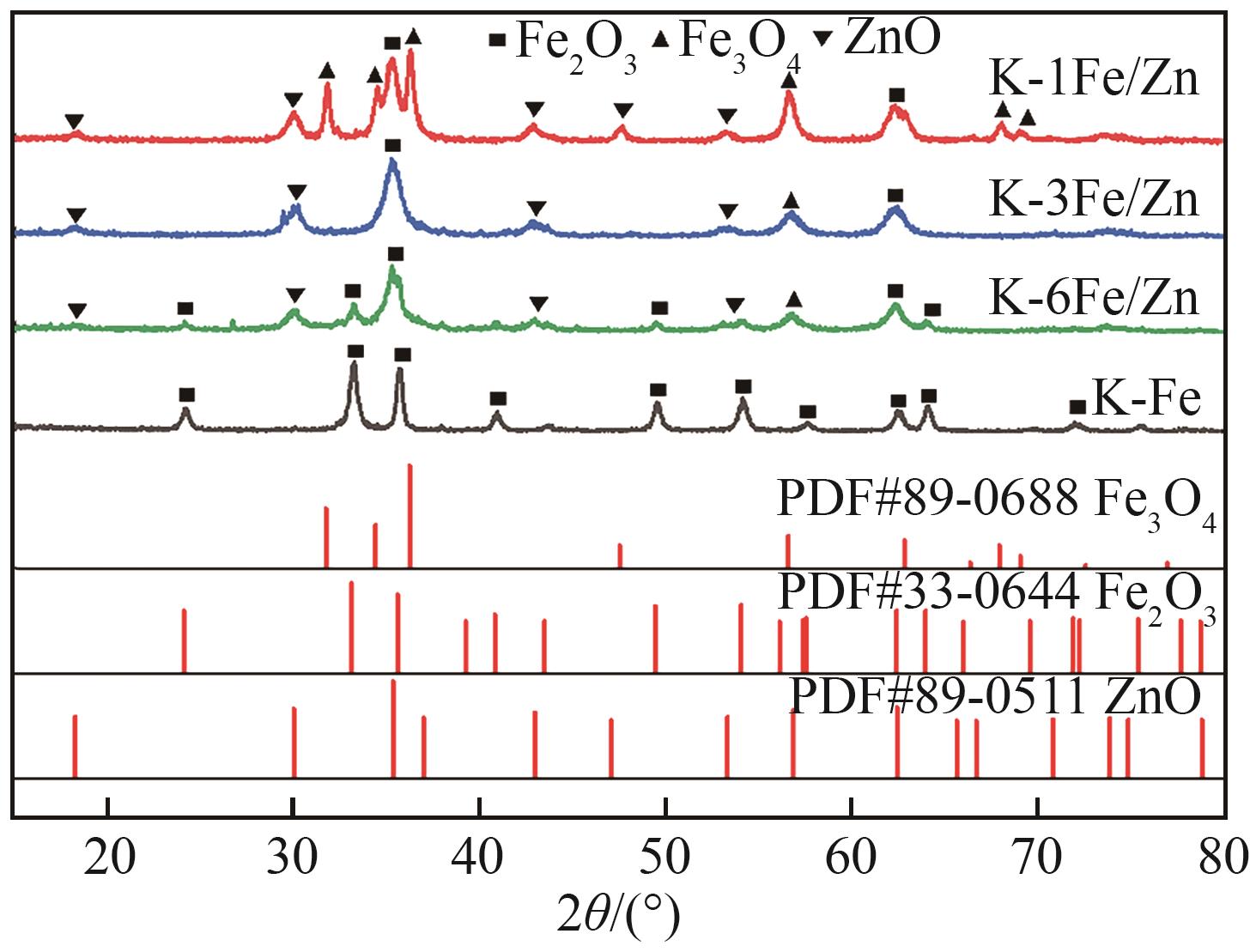
图1 未反应催化剂XRD谱图
| 催化剂 | 氧化铁晶相 | 晶粒尺寸/nm |
|---|---|---|
| K-Fe | Fe2O3 | 33.56 |
| K-6Fe/Zn | Fe2O3 | 28.36 |
| K-3Fe/Zn | Fe2O3 | 25.88 |
| K-1Fe/Zn | Fe2O3 | 24.36 |
表1 Scherrer公式计算的Fe2O3晶粒尺寸
| 催化剂 | 氧化铁晶相 | 晶粒尺寸/nm |
|---|---|---|
| K-Fe | Fe2O3 | 33.56 |
| K-6Fe/Zn | Fe2O3 | 28.36 |
| K-3Fe/Zn | Fe2O3 | 25.88 |
| K-1Fe/Zn | Fe2O3 | 24.36 |
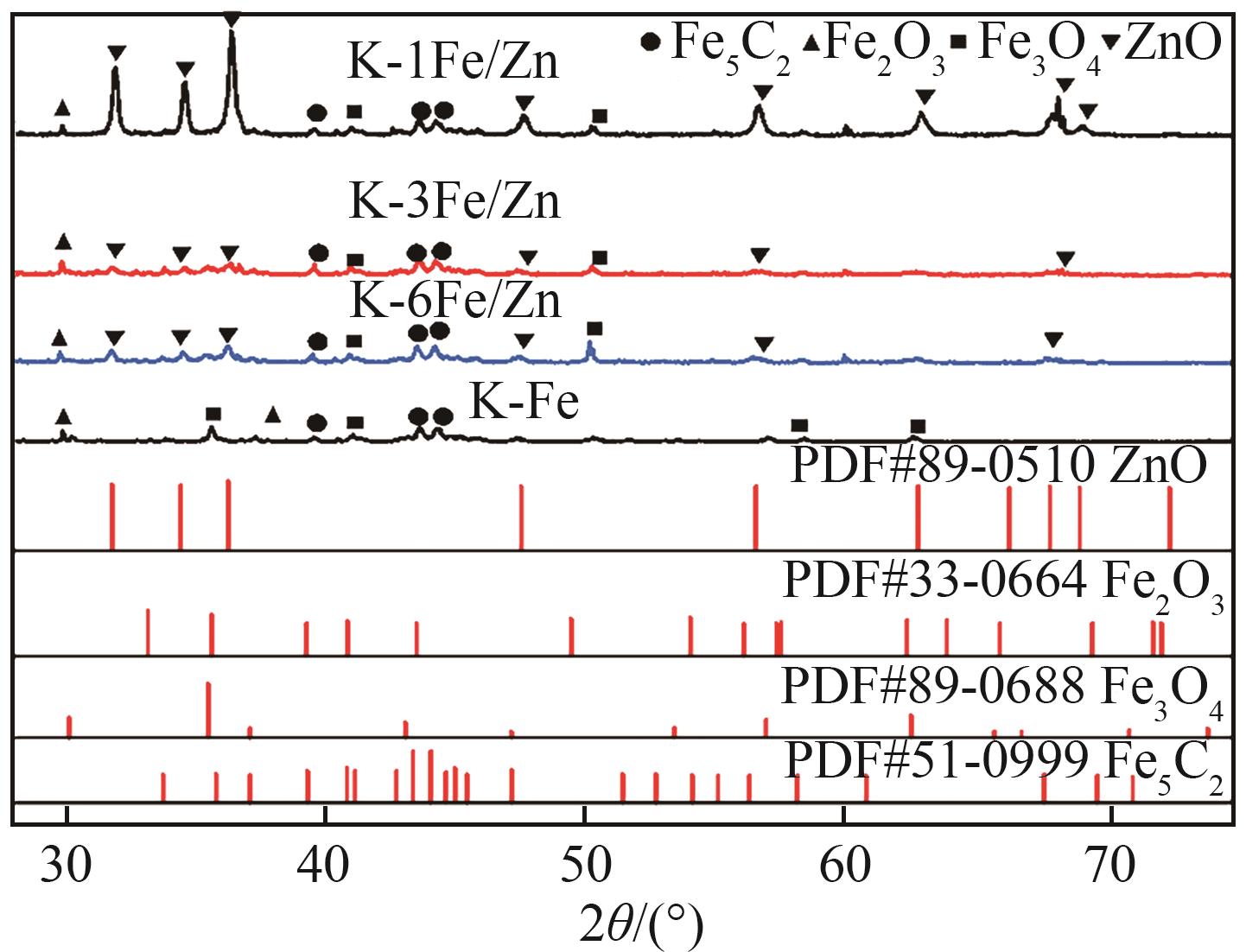
图2 反应后催化剂XRD谱图
| 催化剂 | 比表面积/m2∙g-1 | 孔径/nm | 孔体积/cm3∙g-1 |
|---|---|---|---|
| K-Fe | 30.39 | 11.87 | 0.18 |
| K-6Fe/Zn | 37.72 | 11.48 | 0.21 |
| K-3Fe/Zn | 39.12 | 8.84 | 0.23 |
| K-1Fe/Zn | 44.30 | 6.36 | 0.27 |
表2 催化剂的比表面积和孔隙
| 催化剂 | 比表面积/m2∙g-1 | 孔径/nm | 孔体积/cm3∙g-1 |
|---|---|---|---|
| K-Fe | 30.39 | 11.87 | 0.18 |
| K-6Fe/Zn | 37.72 | 11.48 | 0.21 |
| K-3Fe/Zn | 39.12 | 8.84 | 0.23 |
| K-1Fe/Zn | 44.30 | 6.36 | 0.27 |
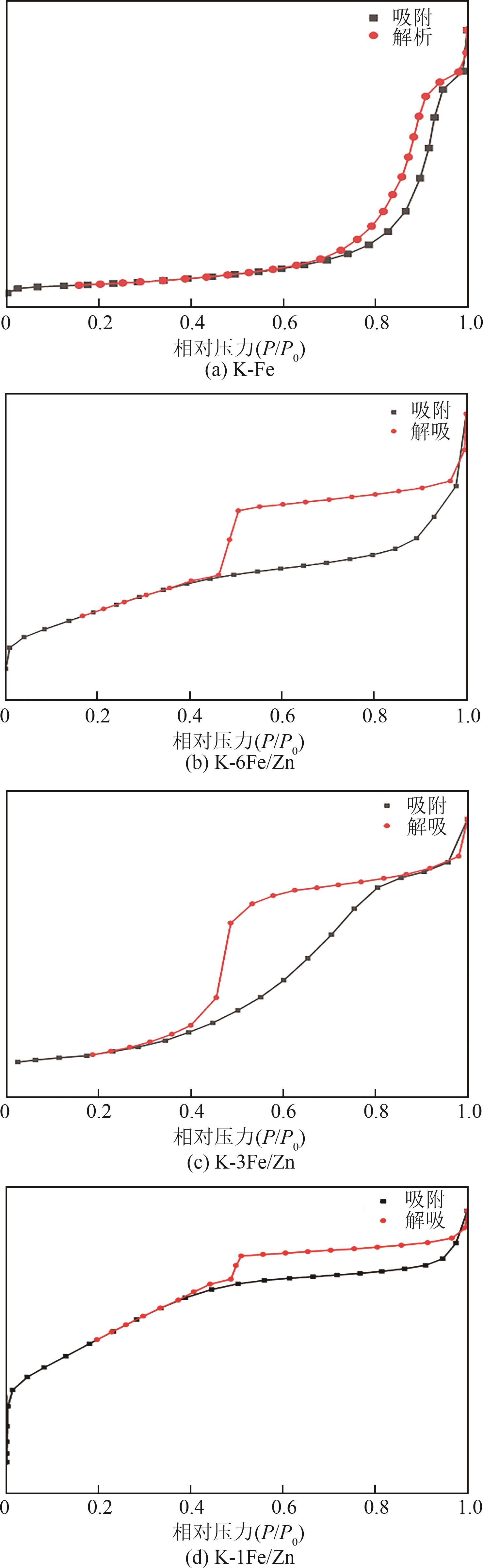
图3 催化剂物理等温吸附脱附曲线
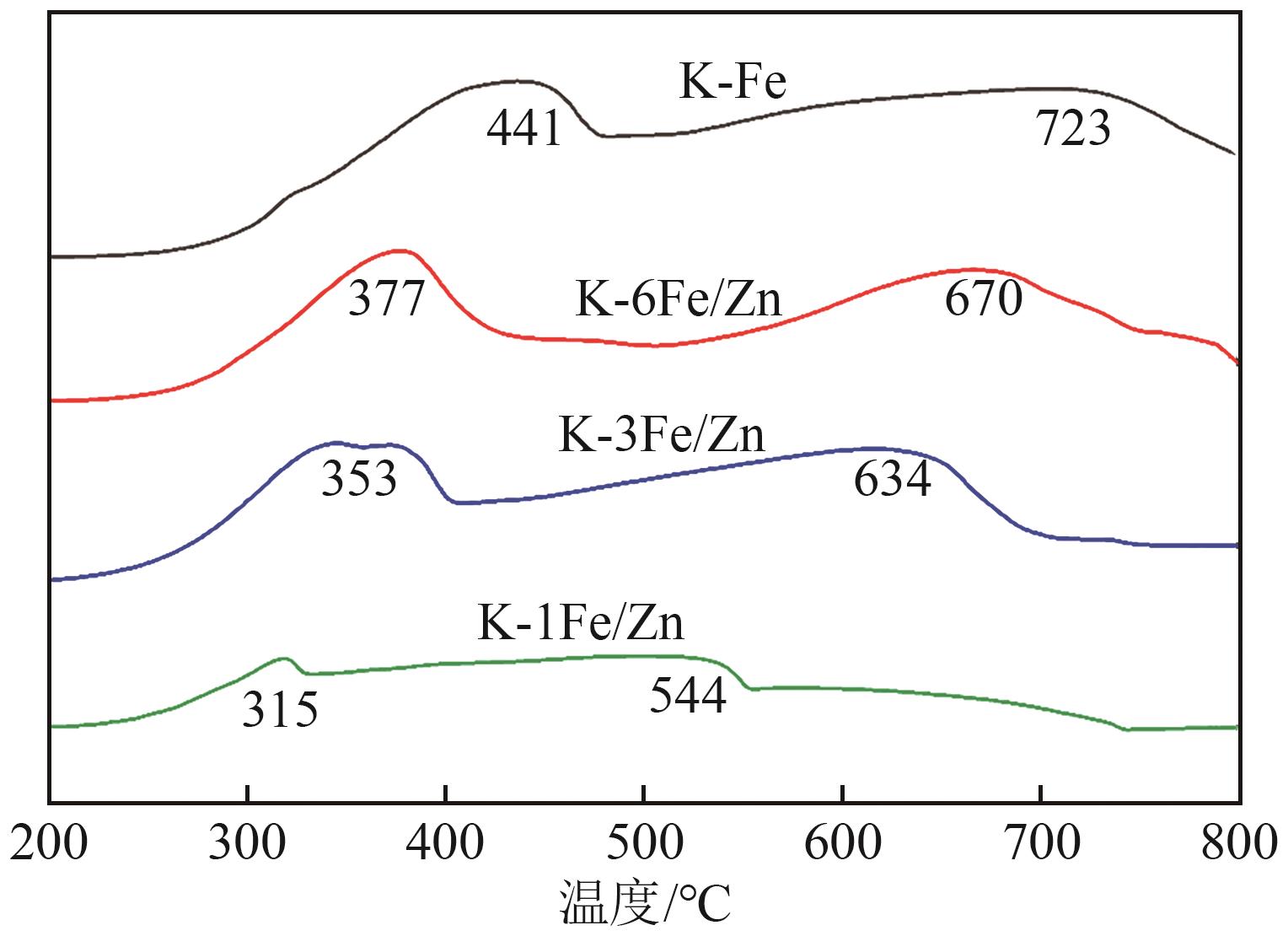
图4 催化剂的H2-TPR曲线
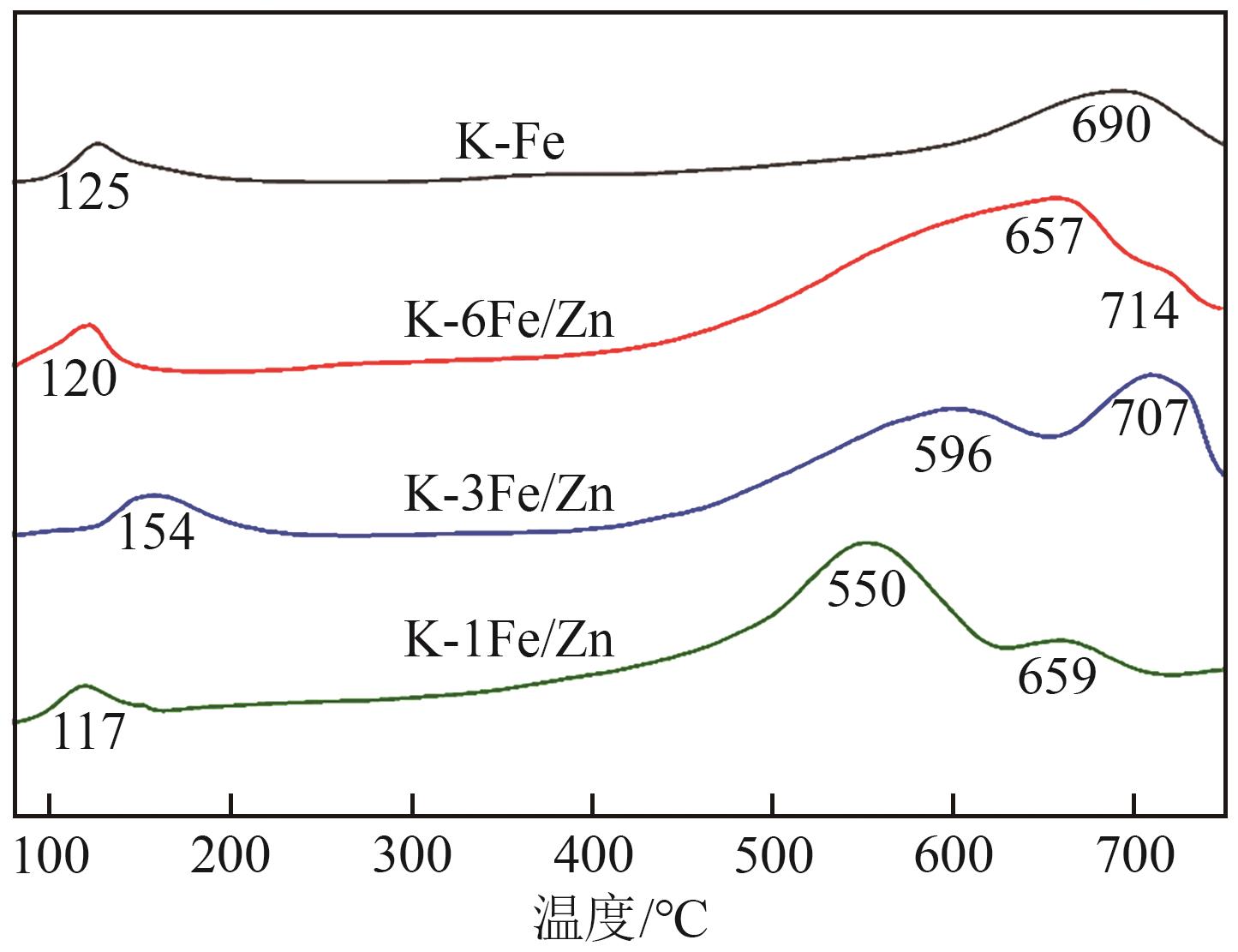
图5 催化剂的CO2-TPD曲线
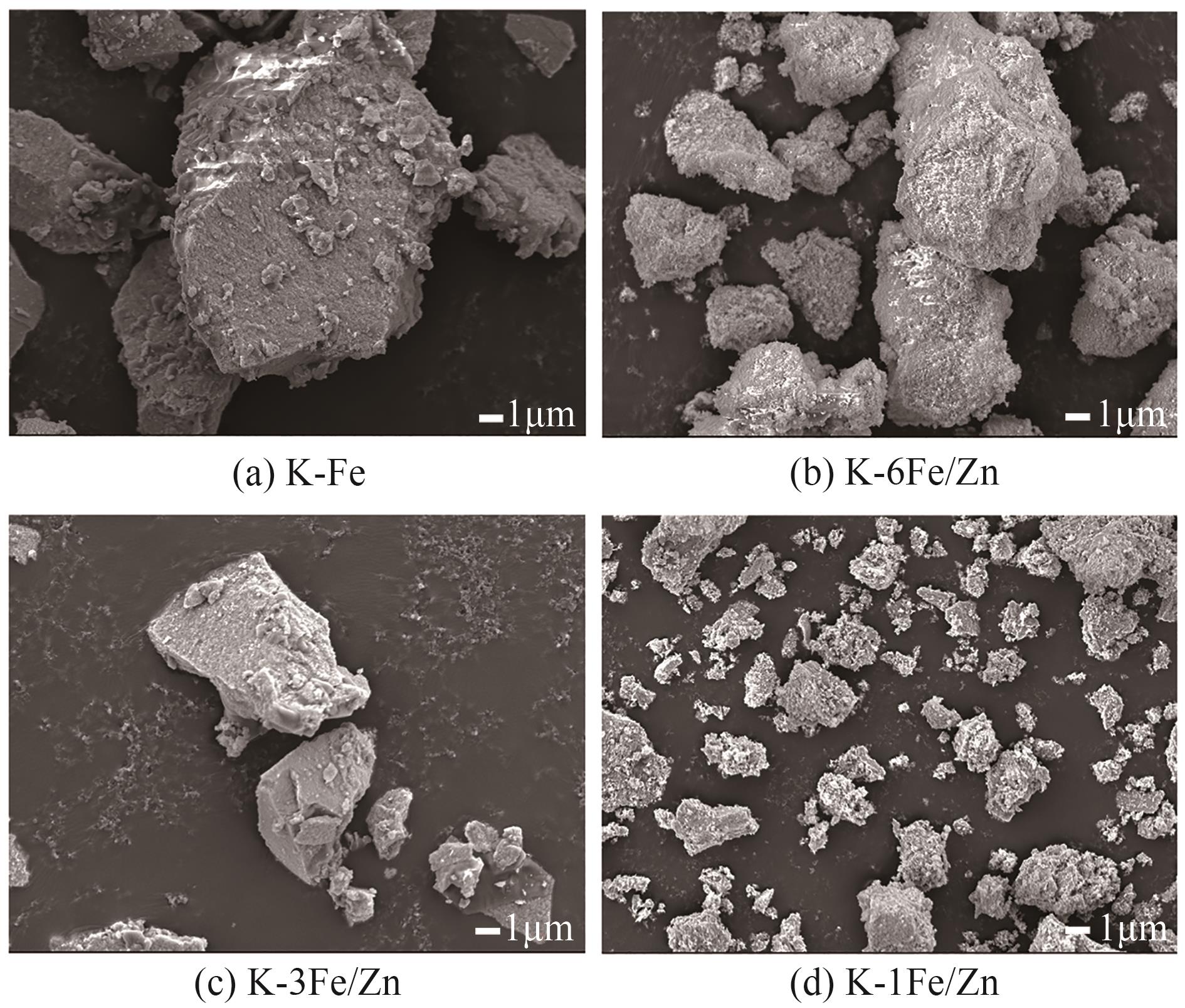
图6 反应前催化剂SEM图
| 元素 | 质量分数/% | 原子分数/% |
|---|---|---|
| Fe | 38.74 | 34.86 |
| Zn | 41.38 | 27.76 |
| O | 18.71 | 36.15 |
| K | 1.17 | 1.23 |
| 总量 | 100 | 100 |
表3 K-1Fe/Zn催化剂的EDS元素含量分析
| 元素 | 质量分数/% | 原子分数/% |
|---|---|---|
| Fe | 38.74 | 34.86 |
| Zn | 41.38 | 27.76 |
| O | 18.71 | 36.15 |
| K | 1.17 | 1.23 |
| 总量 | 100 | 100 |
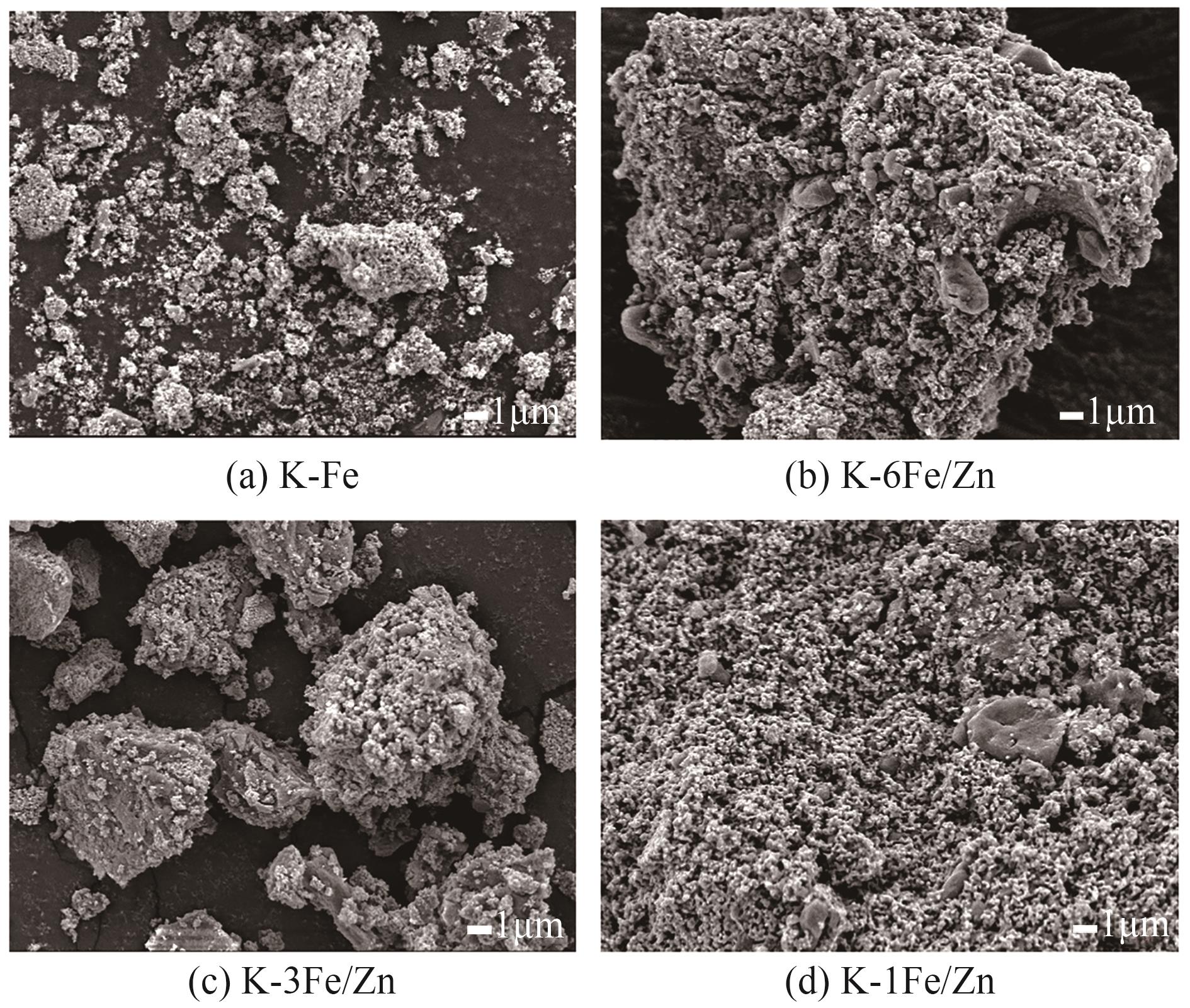
图7 反应后催化剂SEM图
| 元素 | 质量分数/% | 原子分数% |
|---|---|---|
C Fe | 39.7 18.3 | 56.0 16.5 |
| Zn | 30.4 | 20.4 |
| O | 11.1 | 5.5 |
| K | 0.5 | 1.6 |
| 总量 | 100 | 100 |
表4 反应后K-1Fe/Zn催化剂的EDS元素含量分析
| 元素 | 质量分数/% | 原子分数% |
|---|---|---|
C Fe | 39.7 18.3 | 56.0 16.5 |
| Zn | 30.4 | 20.4 |
| O | 11.1 | 5.5 |
| K | 0.5 | 1.6 |
| 总量 | 100 | 100 |
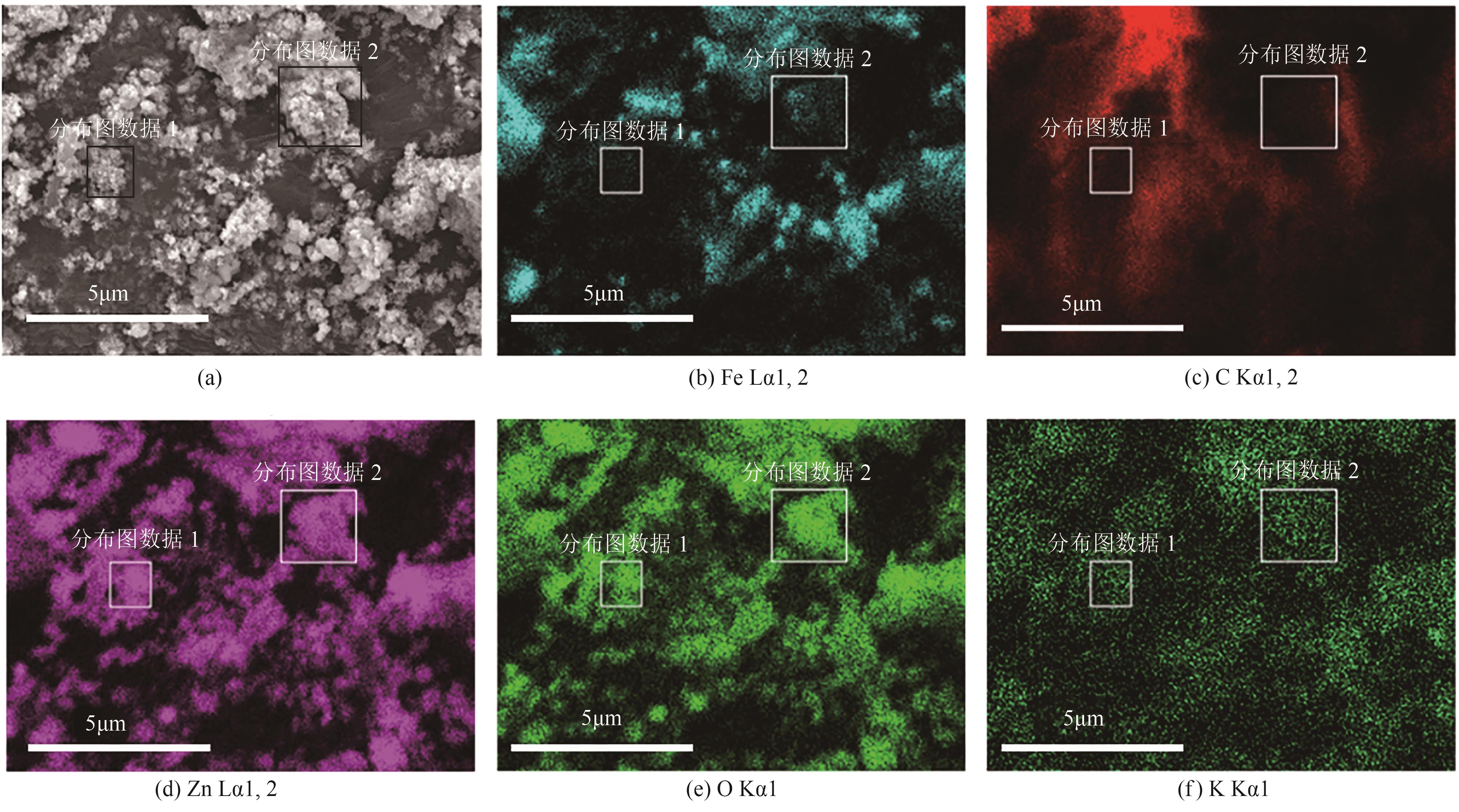
图8 反应后K-1Fe/Zn催化剂的SEM图以及Mapping元素分布
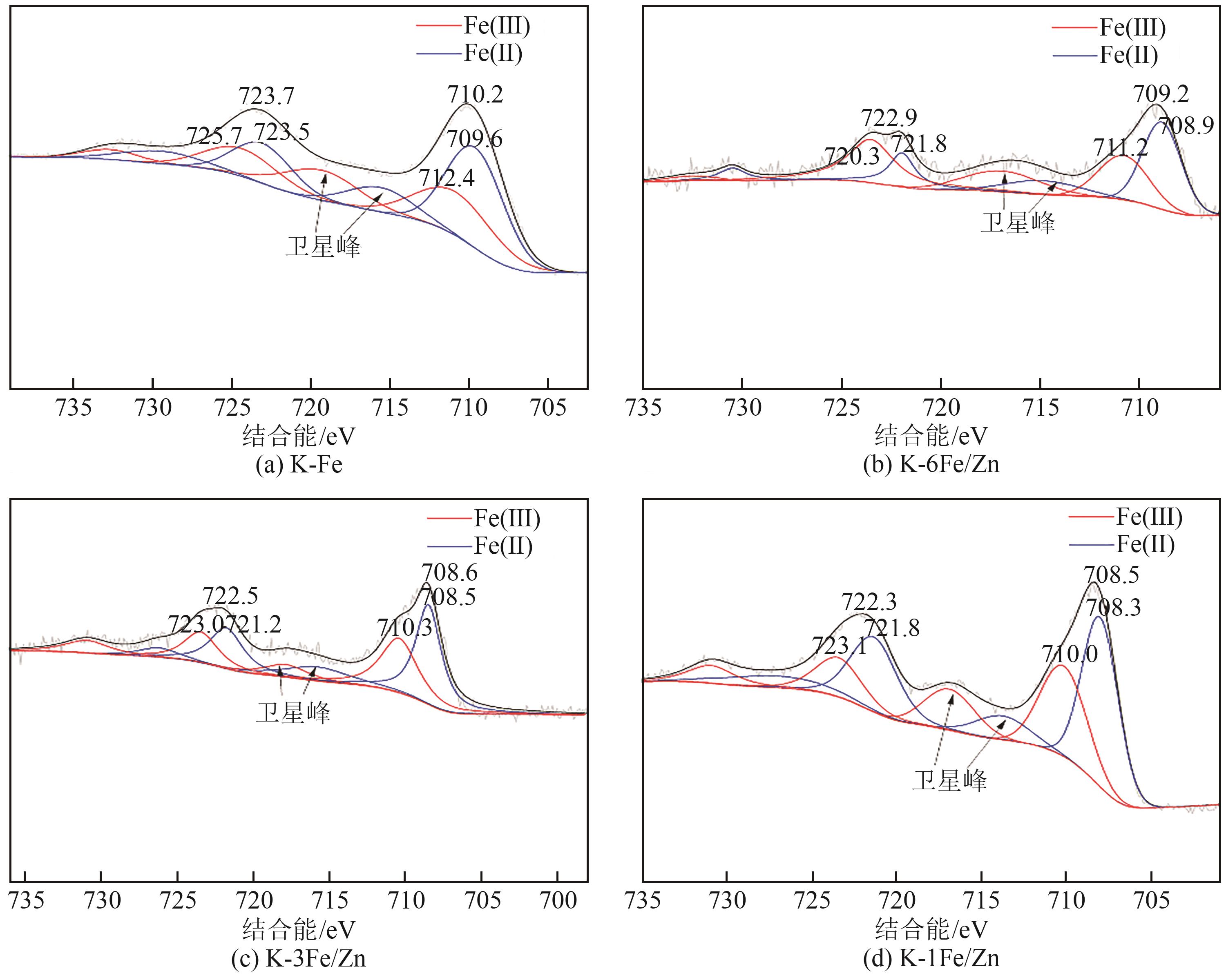
图9 未反应催化剂的XPS谱图
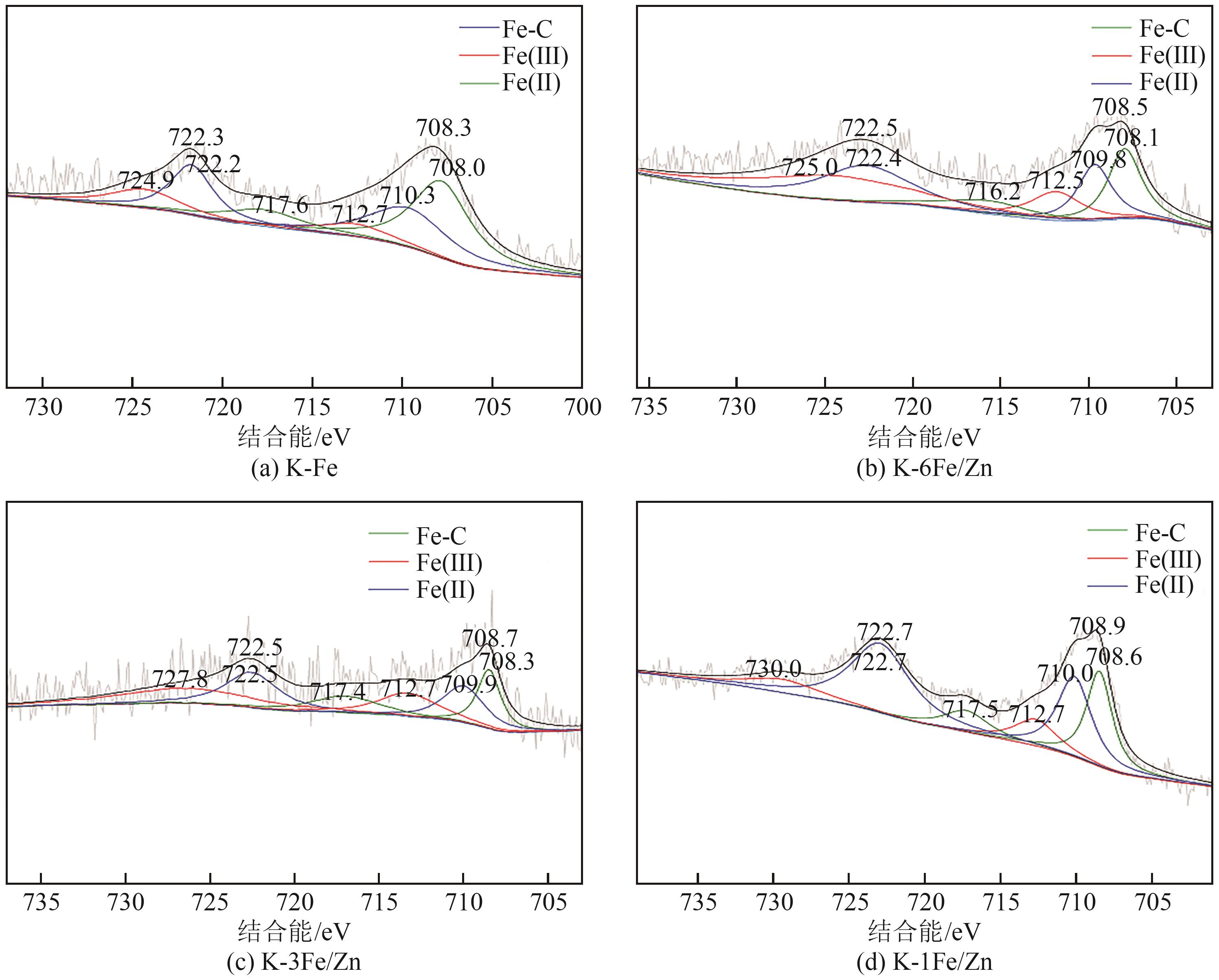
图10 反应后催化剂的XPS谱图
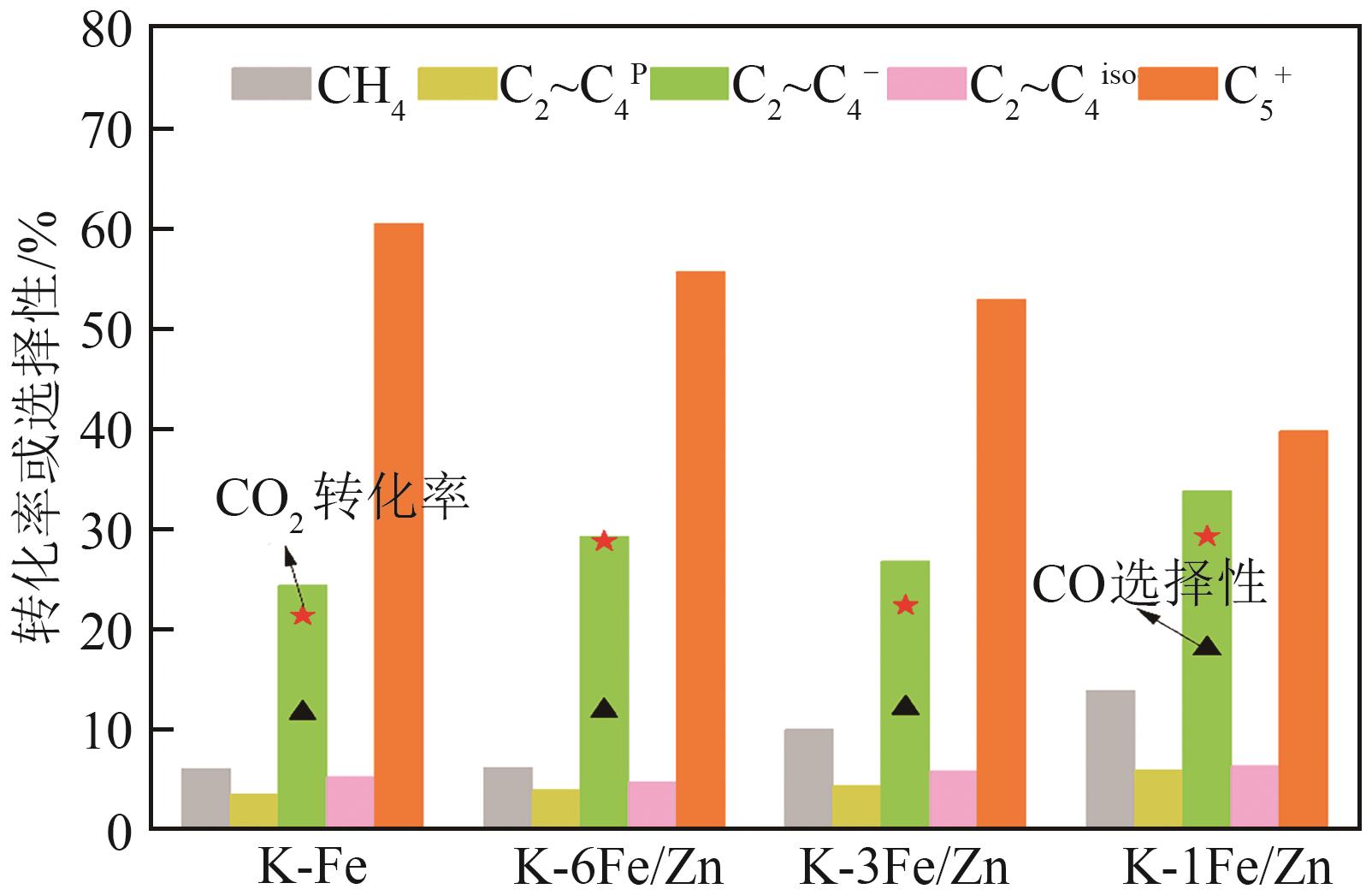
图11 K-nFe/Zn催化剂评价结果
| 催化剂 | CO2转化率/% | CO选择性% | 烃类选择性/% | 参考文献 | |||
|---|---|---|---|---|---|---|---|
| CH4 | C2~C4p | C2~C4= | C5+ | ||||
| Fe3O4 | 27.0 | 35.9 | 43.2 | 33.9 | 5.7 | 17.2 | [ |
| 5Fe-1Zr-Ce-1K | 28.1 | 10.5 | 46.8 | 22.5 | 25.2 | 5.5 | [ |
| 0.1Mn-Na/Fe | 35.7 | 10.9 | 7.3 | 2.5 | 24.1 | 54.7 | [ |
| K-Fe-Co | 23.8 | 31.4 | 17.0 | 4.0 | 11.5 | 36.1 | [ |
| K-1Fe/Zn | 29.3 | 18.1 | 13.9 | 12.4 | 33.8 | 39.8 | 本研究 |
表5 K-1Fe/Zn催化剂与已报道催化剂性能对比
| 催化剂 | CO2转化率/% | CO选择性% | 烃类选择性/% | 参考文献 | |||
|---|---|---|---|---|---|---|---|
| CH4 | C2~C4p | C2~C4= | C5+ | ||||
| Fe3O4 | 27.0 | 35.9 | 43.2 | 33.9 | 5.7 | 17.2 | [ |
| 5Fe-1Zr-Ce-1K | 28.1 | 10.5 | 46.8 | 22.5 | 25.2 | 5.5 | [ |
| 0.1Mn-Na/Fe | 35.7 | 10.9 | 7.3 | 2.5 | 24.1 | 54.7 | [ |
| K-Fe-Co | 23.8 | 31.4 | 17.0 | 4.0 | 11.5 | 36.1 | [ |
| K-1Fe/Zn | 29.3 | 18.1 | 13.9 | 12.4 | 33.8 | 39.8 | 本研究 |
| 1 | BARRIOS Alan J, PERON Deizi V, CHAKKINGAL Anoop, et al. Efficient promoters and reaction paths in the CO2 hydrogenation to light olefins over zirconia-supported iron catalysts[J]. ACS Catalysis, 2022, 12(5): 3211-3225. |
| 2 | YUAN Fei, ZHANG Guanghui, WANG Mingrui, et al. Boosting the production of light olefins from CO2 hydrogenation over Fe-Co bimetallic catalysts derived from layered double hydroxide[J]. Industrial & Engineering Chemistry Research, 2023, 62(21): 8210-8221. |
| 3 | WANG Shunwu, WU Tijun, LIN Jun, et al. Iron-potassium on single-walled carbon nanotubes as efficient catalyst for CO2 hydrogenation to heavy olefins[J]. ACS Catalysis, 2020, 10(11): 6389-6401. |
| 4 | 姜霞, 李雯, 郭云龙, 等. 生物模板法制备金属氧化物及其催化应用研究进展[J]. 化工进展, 2019, 38(1): 485-494. |
| JIANG Xia, LI Wen, GUO Yunlong, et al. Progress on bio-templated synthesis of metal oxides and their catalytic applications[J]. Chemical Industry and Engineering Progress, 2019, 38(1): 485-494. | |
| 5 | 周红军, 周颖, 徐春明. 中国碳中和目标下CO2转化的思考与实践[J]. 化工进展, 2022, 41(6): 3381-3385. |
| ZHOU Hongjun, ZHOU Ying, XU Chunming. Exploration of the CO2 conversion under China’s carbon neutrality goal[J]. Chemical Industry and Engineering Progress, 2022, 41(6): 3381-3385. | |
| 6 | WEBER Daniel, HE Tina, WONG Matthew, et al. Recent advances in the mitigation of the catalyst deactivation of CO2 hydrogenation to light olefins[J]. Catalysts, 2021, 11(12): 1447. |
| 7 | XU Qiangqiang, XU Xingqin, FAN Guoli, et al. Unveiling the roles of Fe-Co interactions over ternary spinel-type ZnCo x Fe2- x O4 catalysts for highly efficient CO2 hydrogenation to produce light olefins[J]. Journal of Catalysis, 2021, 400: 355-366. |
| 8 | 贾晨喜, 邵敬爱, 白小薇, 等. 二氧化碳加氢制甲醇铜基催化剂性能的研究进展[J]. 化工进展, 2020, 39(9): 3658-3668. |
| JIA Chenxi, SHAO Jing’ai, BAI Xiaowei, et al. Review on Cu-based catalysts for CO2 hydrogenation to methanol[J]. Chemical Industry and Engineering Progress, 2020, 39(9): 3658-3668. | |
| 9 | XU Yao, ZHAI Peng, DENG Yuchen, et al. Highly selective olefin production from CO2 hydrogenation on iron catalysts: A subtle synergy between manganese and sodium additives[J]. Angewandte Chemie International Edition, 2020, 59(48): 21736-21744. |
| 10 | KIM Kwang Young, LEE Hojeong, Woo Yeong NOH, et al. Cobalt ferrite nanoparticles to form a catalytic Co-Fe alloy carbide phase for selective CO2 hydrogenation to light olefins[J]. ACS Catalysis, 2020, 10(15): 8660-8671. |
| 11 | WANG Shunwu, JI Yushan, LIU Xuancheng, et al. Potassium as a versatile promoter to tailor the distribution of the olefins in CO2 hydrogenation over iron-based catalyst[J]. ChemCatChem, 2022, 14(6): e202101535. |
| 12 | JIANG Jiandong, WEN Chengyan, TIAN Zhipeng, et al. Manganese-promoted Fe3O4 microsphere for efficient conversion of CO2 to light olefins[J]. Industrial & Engineering Chemistry Research, 2020, 59(5): 2155-2162. |
| 13 | ELISHAV Oren, SHENER Yuval, BEILIN Vadim, et al. Electrospun Fe-Al-O nanobelts for selective CO2 hydrogenation to light olefins[J]. ACS Applied Materials & Interfaces, 2020, 12(22): 24855-24867. |
| 14 | YANG Miao, FAN Dong, WEI Yingxu, et al. Recent progress in methanol-to-olefins (MTO) catalysts[J]. Advanced Materials, 2019, 31(50): 1902181. |
| 15 | BARGER Paul. Methanol to olefins (MTO) and beyond[M]//Zeolites for cleaner technologies. London: Imperial College Press, 2002: 239-260. |
| 16 | TIAN Peng, WEI Yingxu, YE Mao, et al. Methanol to olefins (MTO): From fundamentals to commercialization[J]. ACS Catalysis, 2015, 5(3): 1922-1938. |
| 17 | JIANG Mingyang, LIU Siyi, DENG Huachu, et al. The efficacy and safety of fast track surgery (FTS) in patients after hip fracture surgery: A meta-analysis[J]. Journal of Orthopaedic Surgery and Research, 2021, 16(1): 162. |
| 18 | ZHU Yi fen, XIE Bingqiao, AMAL Rose, et al. Light-enhanced conversion of CO2 to light olefins: Basis in thermal catalysis, current progress, and future prospects[J]. Small Structures, 2023, 4(6): 2200285. |
| 19 | WANG Kai, LIU Na, WEI Jian, et al. Bifunctional CoFe/HZSM-5 catalysts orient CO2 hydrogenation towards liquid hydrocarbons[J]. Chemical Communications, 2023, 59(92): 13767-13770. |
| 20 | HAN Xiao, QING Ming, WANG Hong, et al. Effect of Fe3O4 content on the CO2 selectivity of iron-based catalyst for Fischer-Tropsch synthesis[J]. Journal of Fuel Chemistry and Technology, 2023, 51(2): 155-164. |
| 21 | CHENG Yang, CHEN Yong, ZHANG Shuxian, et al. High-yield production of aromatics over CuFeO2/hierarchical HZSM-5 via CO2 Fischer-Tropsch synthesis[J]. Green Chemistry, 2023, 25(9): 3570-3584. |
| 22 | LIU Renjie, BERCH John N EL, HOUSE Stephen, et al. Reactive separations of CO/CO2 mixtures over Ru-Co single atom alloys[J]. ACS Catalysis, 2023, 13(4): 2449-2461. |
| 23 | TORRES GALVIS Hirsa M, DE JONG Krijn P. Catalysts for production of lower olefins from synthesis gas: A review[J]. ACS Catalysis, 2013, 3(9): 2130-2149. |
| 24 | HAN Seung Ju, HWANG Sun-Mi, PARK Hae-Gu, et al. Identification of active sites for CO2 hydrogenation in Fe catalysts by first-principles microkinetic modelling[J]. Journal of Materials Chemistry A, 2020, 8(26): 13014-13023. |
| 25 | SHAFER Wilson D, JACOBS Gary, GRAHAM Uschi M, et al. Increased CO2 hydrogenation to liquid products using promoted iron catalysts[J]. Journal of Catalysis, 2019, 369: 239-248. |
| 26 | MALHI Haripal Singh, SUN Chao, ZHANG Zhengzhou, et al. Catalytic consequences of the decoration of sodium and zinc atoms during CO2 hydrogenation to olefins over iron-based catalyst[J]. Catalysis Today, 2022, 387: 28-37. |
| 27 | YANG Qingxin, KONDRATENKO Vita A, PETROV Sergey A, et al. Identifying performance descriptors in CO2 hydrogenation over iron-based catalysts promoted with alkali metals[J]. Angewandte Chemie International Edition, 2022, 61(22): e202116517. |
| 28 | ZHAO Yunxia, MA Jiajun, YIN Juli, et al. Alkali metal promotion on Fe-Co-Ni trimetallic catalysts for CO2 hydrogenation to light olefins[J]. Applied Surface Science, 2024, 657: 159783. |
| 29 | WANG Dong, XIE Zhenhua, POROSOFF Marc D, et al. Recent advances in carbon dioxide hydrogenation to produce olefins and aromatics[J]. Chem, 2021, 7(9): 2277-2311. |
| 30 | CHOI Yo Han, JANG Youn Jeong, PARK Hunmin, et al. Carbon dioxide Fischer-Tropsch synthesis: A new path to carbon-neutral fuels[J]. Applied Catalysis B: Environmental, 2017, 202: 605-610. |
| 31 | ZHANG Zhenzhou, WEI Chongyang, JIA Lingyu, et al. Insights into the regulation of FeNa catalysts modified by Mn promoter and their tuning effect on the hydrogenation of CO2 to light olefins[J]. Journal of Catalysis, 2020, 390: 12-22. |
| 32 | ZHANG Jianli, LU Shipeng, SU Xiaojuan, et al. Selective formation of light olefins from CO2 hydrogenation over Fe-Zn-K catalysts[J]. Journal of CO2 Utilization, 2015, 12: 95-100. |
| 33 | GAO Xinhua, ZHANG Jianli, CHEN Ning, et al. Effects of zinc on Fe-based catalysts during the synthesis of light olefins from the Fischer-Tropsch process[J]. Chinese Journal of Catalysis, 2016, 37(4): 510-516. |
| 34 | ZHANG Chao, XU Minjie, YANG Zixu, et al. Uncovering the electronic effects of zinc on the structure of Fe5C2-ZnO catalysts for CO2 hydrogenation to linear α-olefins[J]. Applied Catalysis B: Environmental, 2021, 295: 120287. |
| 35 | SHINAGAWA Tsutomu, IZAKI Masanobu, INUI Haruyuki, et al. Microstructure and electronic structure of transparent ferromagnetic ZnO-spinel iron oxide composite films[J]. Chemistry of Materials, 2006, 18(3): 763-770. |
| 36 | ZHANG Zhiqiang, HUANG Gongxun, TANG Xinglei, et al. Zn and Na promoted Fe catalysts for sustainable production of high-valued olefins by CO2 hydrogenation[J]. Fuel, 2022, 309: 122105. |
| 37 | XU Yuebing, SHI Chengming, LIU Bing, et al. Selective production of aromatics from CO2 [J]. Catalysis Science & Technology, 2019, 9(3): 593-610. |
| 38 | ZHANG Jianli, SU Xiaojuan, WANG Xu, et al. Promotion effects of Ce added Fe–Zr–K on CO2 hydrogenation to light olefins[J]. Reaction Kinetics, Mechanisms and Catalysis, 2018, 124(2): 575-585. |
| 39 | LIANG Binglian, SUN Ting, MA Junguo, et al. Mn decorated Na/Fe catalysts for CO2 hydrogenation to light olefins[J]. Catalysis Science & Technology, 2019, 9(2): 456-464. |
| 40 | JIANG Feng, LIU Bing, GENG Shunshun, et al. Hydrogenation of CO2 into hydrocarbons: Enhanced catalytic activity over Fe-based Fischer-Tropsch catalysts[J]. Catalysis Science & Technology, 2018, 8(16): 4097-4107. |
| [1] | 陶金泉, 贾亦静, 白天瑜, 姚荣鹏, 黄文斌, 崔岩, 周亚松, 魏强. Silicalite-1分子筛的低成本合成及其MTP催化性能[J]. 化工进展, 2025, 44(3): 1550-1558. |
| [2] | 王文, 金央, 李军, 陈建钧, 陈明, 孟昕. 基于FeOOH原位生长制备用于CO2吸收的超疏水PVDF膜[J]. 化工进展, 2025, 44(3): 1570-1577. |
| [3] | 陈宇航, 李巧艳, 梁美生, 宋天远, 汪玥, 李思萌, 周宇璇. Sn掺杂Cu/CeZrO2/γ-Al2O3对三效催化(TWC)反应的作用:提高低温活性和抗硫性[J]. 化工进展, 2025, 44(3): 1368-1377. |
| [4] | 张馨儿, 裴刘军, 周雨蝶, 靳凯丽, 王际平. 基于TiO2的光催化剂利用太阳能裂解水制氢研究进展[J]. 化工进展, 2025, 44(3): 1298-1308. |
| [5] | 刘俊杰, 吴建民, 孙启文, 王建成, 孙燕. 茂金属催化线性α-烯烃聚合获取高分子量产物研究进展[J]. 化工进展, 2025, 44(3): 1309-1322. |
| [6] | 朱国瑜, 葛棋, 付名利. 甲醇重整制氢催化剂耐久性评价和寿命预测方法[J]. 化工进展, 2025, 44(3): 1338-1346. |
| [7] | 谢鑫瑶, 万芬, 伏炫羽, 范雨婷, 陈令修, 李鹏. Cu-Ag纳米团簇CO2电催化还原性能和机理[J]. 化工进展, 2025, 44(3): 1387-1395. |
| [8] | 左骥, 罗莉, 谢永锴, 陈文尧, 钱刚, 周兴贵, 段学志. 甲醇无氧脱氢制甲醛Cu催化剂的粒径效应[J]. 化工进展, 2025, 44(3): 1347-1354. |
| [9] | 毕文涛, 王学林, 曲炜, 王从新, 田志坚. Mg改性对低铂载量Pt/ZSM-22烷烃加氢异构性能的影响[J]. 化工进展, 2025, 44(3): 1355-1367. |
| [10] | 张茂润, 孙伟如, 马天麟, 辛志玲. Mo改性MnCe/SiC低温SCR脱硝催化剂抗SO2中毒性能[J]. 化工进展, 2025, 44(3): 1378-1386. |
| [11] | 张琪, 王涛, 张雪冰, 李为真, 程萌, 张魁, 吕毅军, 门卓武. 合成气/CO2转化制高级醇Fe基催化剂研究进展[J]. 化工进展, 2025, 44(3): 1323-1337. |
| [12] | 张琪, 王涛, 张雪冰, 李为真, 冯波, 蒋智慧, 吕毅军, 门卓武. 合成气制高级醇Co基催化剂研究进展[J]. 化工进展, 2025, 44(2): 773-787. |
| [13] | 贾亦静, 陶金泉, 黄文斌, 刘昊然, 李蓉蓉, 姚荣鹏, 白天瑜, 魏强, 周亚松. CO2加氢制低碳烯烃Fe基催化剂研究进展[J]. 化工进展, 2025, 44(2): 820-833. |
| [14] | 廖旭, 王玮, 黄文婷, 熊文涛, 王泽宇, 覃佐东, 林金清. 生物质基催化剂在二氧化碳转化为环状碳酸酯中的研究进展[J]. 化工进展, 2025, 44(2): 834-846. |
| [15] | 李章良, 杨月珠, 伍传田, 吕源财. 活性炭纤维毡负载N-TiO2/MoS2/N-TiO2固定化漆酶降解双酚A[J]. 化工进展, 2025, 44(2): 887-898. |
| 阅读次数 | ||||||
|
全文 |
|
|||||
|
摘要 |
|
|||||