化工进展 ›› 2025, Vol. 44 ›› Issue (S1): 492-503.DOI: 10.16085/j.issn.1000-6613.2025-0851
• 资源与环境化工 • 上一篇
铜电解液净化除杂研究进展
邹先志1,2( ), 廖亚龙1(), 杨双宇1
- 1.昆明理工大学冶金与能源工程学院, 云南 昆明 650093
2.江西铜业股份有限公司贵溪冶炼厂,江西 贵溪335424
-
收稿日期:2025-06-16修回日期:2025-09-18出版日期:2025-10-25发布日期:2025-11-24 -
通讯作者:廖亚龙 -
作者简介:邹先志(1995—),男,硕士研究生,研究方向为复杂有色金属资源综合利用。E-mail:1135554068@qq.com。 -
基金资助:国家自然科学基金(21978122)
Research progress on purification and impurity removal in copper electrolyte
ZOU Xianzhi1,2(), LIAO Yalong1(), YANG Shuangyu1
- 1.Faculty of Metallurgical and Energy Engineering, Kunming University of Science and Technology, Kunming 650093, Yunnan, China
2.Guixi Smelter of Jiangxi Copper Co. , Ltd. , Guixi 335424, Jiangxi, China
-
Received:2025-06-16Revised:2025-09-18Online:2025-10-25Published:2025-11-24 -
Contact:LIAO Yalong

摘要:
铜电解液净化对确保阴极铜产品质量及有价金属资源的高效回收至关重要。但现有除杂技术普遍存在能耗偏高、易造成二次污染或分离效率不足等问题。本文综述了包括电积、沉淀、离子交换、吸附、溶剂萃取及膜分离等主流净化方法的原理与应用现状,并对比分析了各类方法在工业化应用中的优势与局限性。分析表明,循环电积法是目前国内外大型阴极铜生产企业应用最为广泛的除杂方法,该技术具备处理高浓度铜及杂质离子的能力,且剧毒气体AsH₃的析出风险较低。然而,该除杂方法在能耗与流程整合方面仍存在优化空间,可采用机械式蒸汽再压缩(MVR)技术以显著降低蒸汽消耗,并构建在线监测与人工智能(AI)优化系统,实现对关键工艺参数的精准控制。其除杂技术可作为辅助净化手段,与电积法组合成多技术耦合工艺,未来应重点开发高性能除杂功能材料,推进废酸与有价金属高效回收体系,最终实现铜电解液高效、低耗与绿色的深度净化目标。
中图分类号:
引用本文
邹先志, 廖亚龙, 杨双宇. 铜电解液净化除杂研究进展[J]. 化工进展, 2025, 44(S1): 492-503.
ZOU Xianzhi, LIAO Yalong, YANG Shuangyu. Research progress on purification and impurity removal in copper electrolyte[J]. Chemical Industry and Engineering Progress, 2025, 44(S1): 492-503.
| 种类 | 特性 | 杂质 | 在电解液中的行为 |
|---|---|---|---|
| 第一类 | 电位比铜负 | Zn、Fe、Ni、Pb、Sn等 | 以离子形式随阳极溶解进入电解液或以硫酸盐沉淀等形式进入阳极泥 |
| 第二类 | 电位比铜正 | Au、Ag、Pt、Pd等 | 不溶解,以沉淀形式进入阳极泥 |
| 第三类 | 非金属元素 | O、S、Se、Te等 | 大部分存在于阳极泥中 |
| 第四类 | 电位与铜近 | As、Sb、Bi等 | 电解过程中既能与铜一起溶解进入电解液形成“漂浮阳极泥”,同时存在与铜在阴极上共同析出 |
表1 阳极杂质在电解过程中的行为
| 种类 | 特性 | 杂质 | 在电解液中的行为 |
|---|---|---|---|
| 第一类 | 电位比铜负 | Zn、Fe、Ni、Pb、Sn等 | 以离子形式随阳极溶解进入电解液或以硫酸盐沉淀等形式进入阳极泥 |
| 第二类 | 电位比铜正 | Au、Ag、Pt、Pd等 | 不溶解,以沉淀形式进入阳极泥 |
| 第三类 | 非金属元素 | O、S、Se、Te等 | 大部分存在于阳极泥中 |
| 第四类 | 电位与铜近 | As、Sb、Bi等 | 电解过程中既能与铜一起溶解进入电解液形成“漂浮阳极泥”,同时存在与铜在阴极上共同析出 |
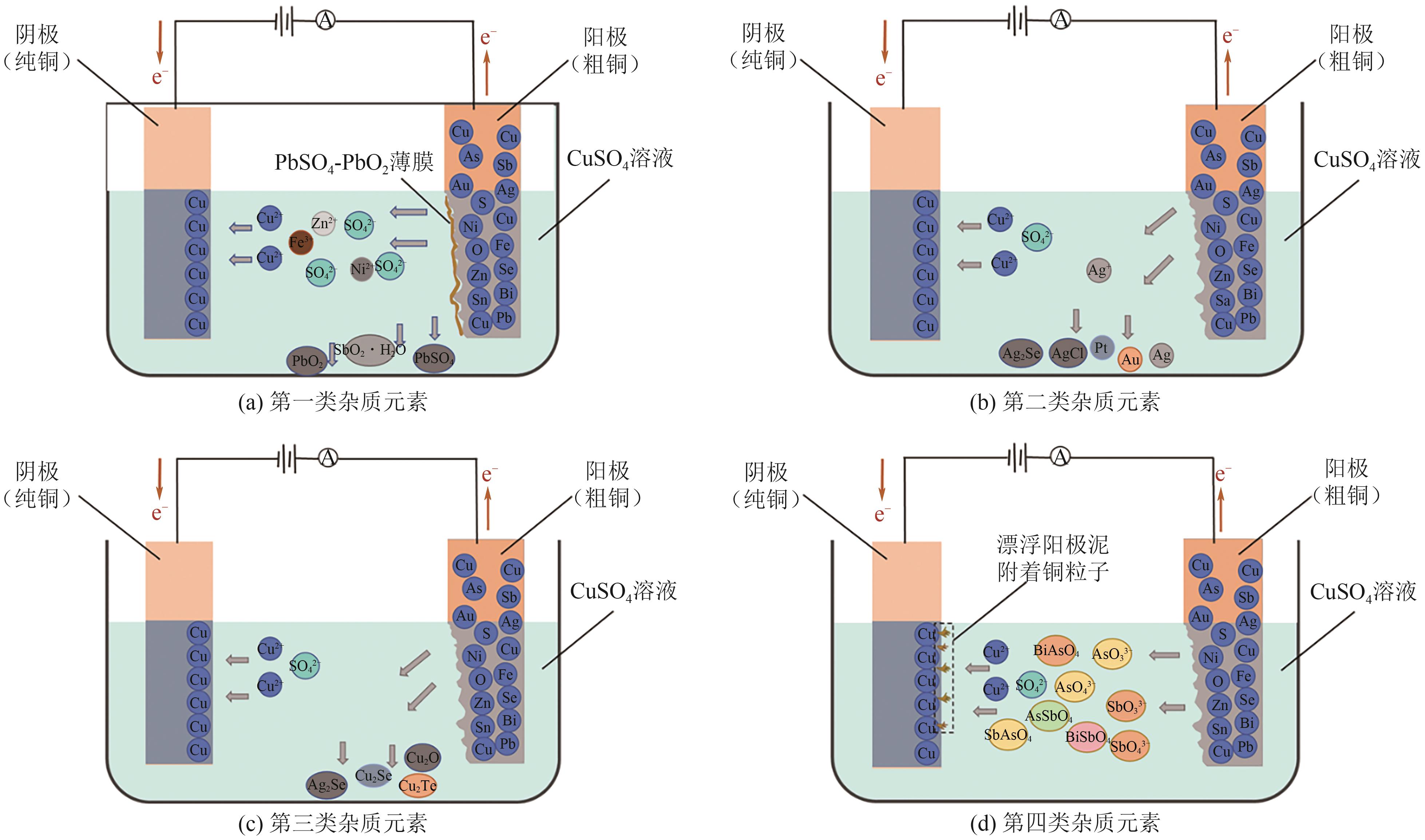
图1 铜电解体系杂质迁移示意
| 元素 | 进入电解液 | 形成漂浮阳极泥 | 进入沉降阳极泥 | 主要存在形态 |
|---|---|---|---|---|
| As | 高 | 中等 | 较低 | 离子形态[As(Ⅲ)、As(Ⅴ)]溶解较多,部分水解 |
| Sb | 中等 | 高 | 中等 | 极易水解形成胶体(如Sb₂O₅·nH₂O) |
| Bi | 中等 | 较低 | 高 | 易与铅等形成不溶化合物(如铋酸铅) |
表2 阳极中砷、锑、铋在电解液和阳极泥中的分布
| 元素 | 进入电解液 | 形成漂浮阳极泥 | 进入沉降阳极泥 | 主要存在形态 |
|---|---|---|---|---|
| As | 高 | 中等 | 较低 | 离子形态[As(Ⅲ)、As(Ⅴ)]溶解较多,部分水解 |
| Sb | 中等 | 高 | 中等 | 极易水解形成胶体(如Sb₂O₅·nH₂O) |
| Bi | 中等 | 较低 | 高 | 易与铅等形成不溶化合物(如铋酸铅) |
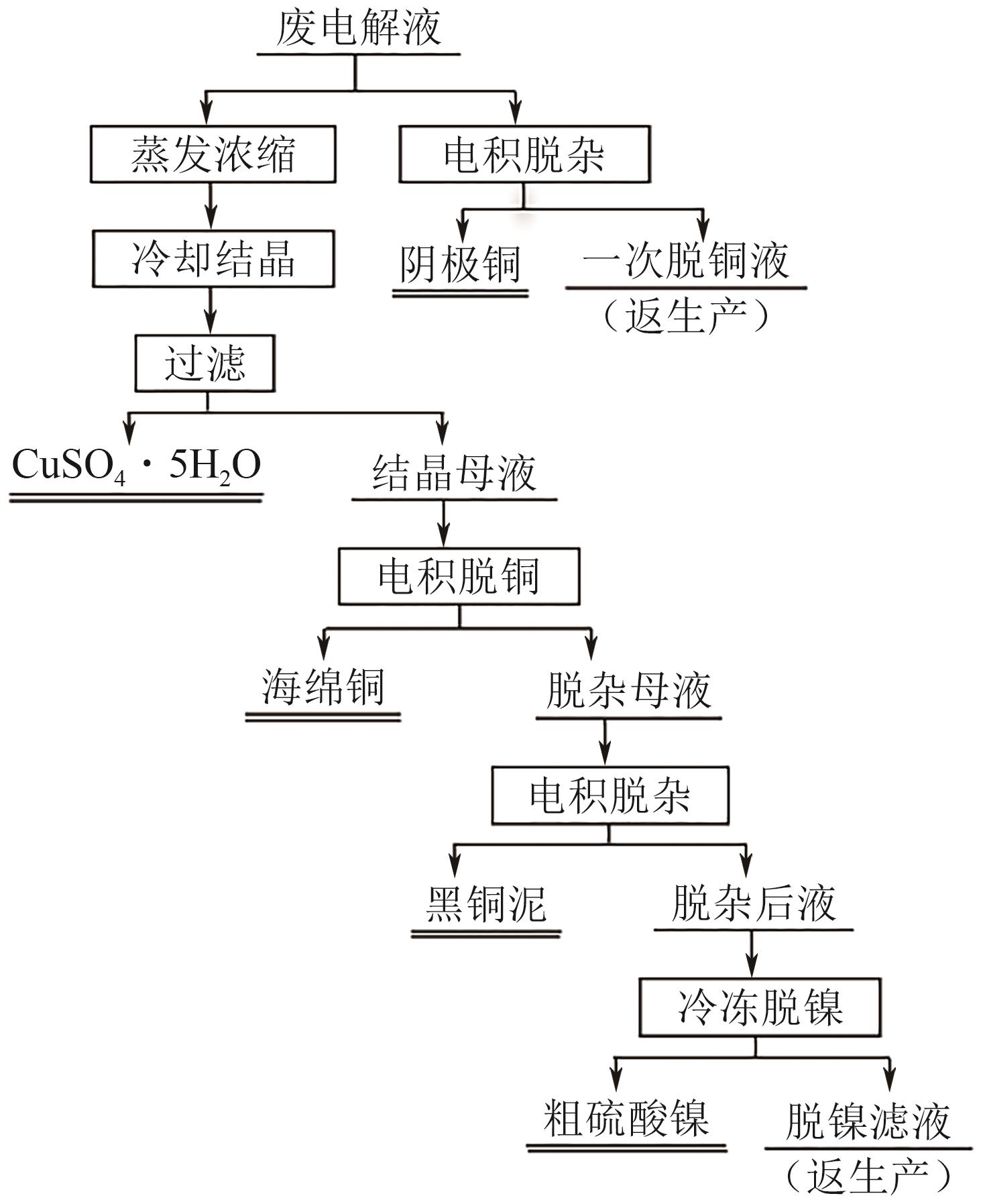
图2 常见循环法脱杂工艺流程
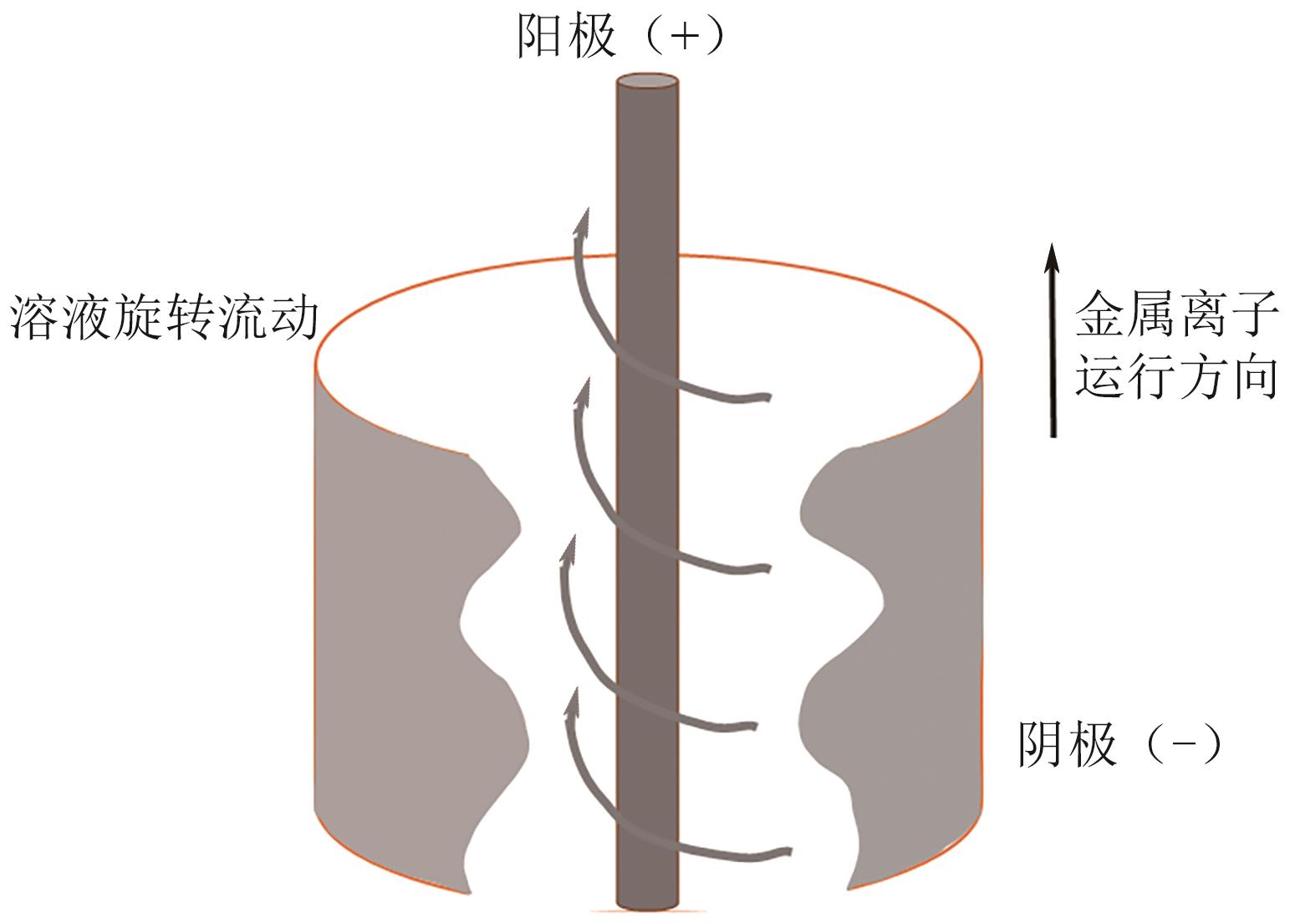
图3 旋流电积示意
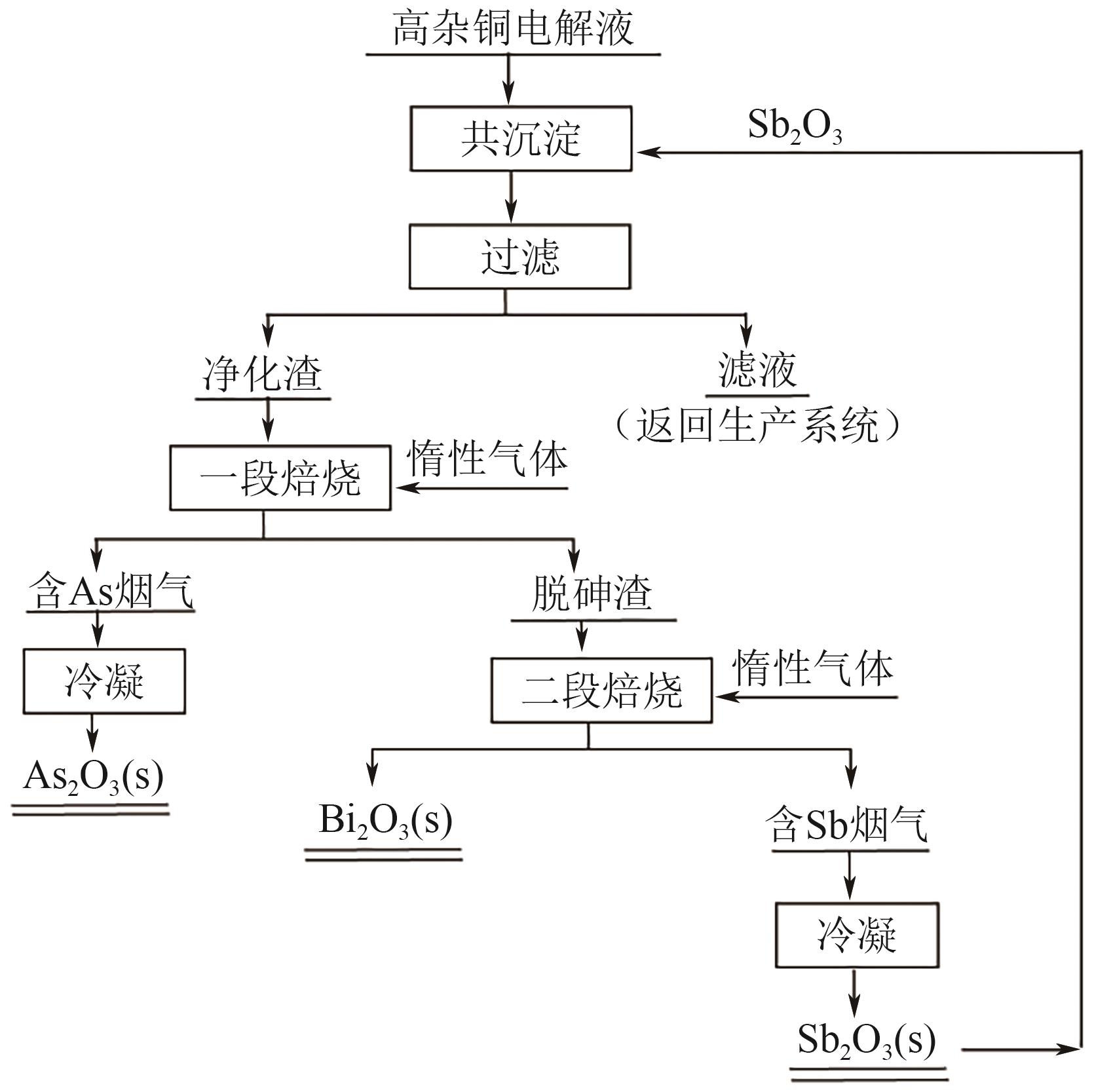
图4 Sb2O3循环净化铜电解液流程
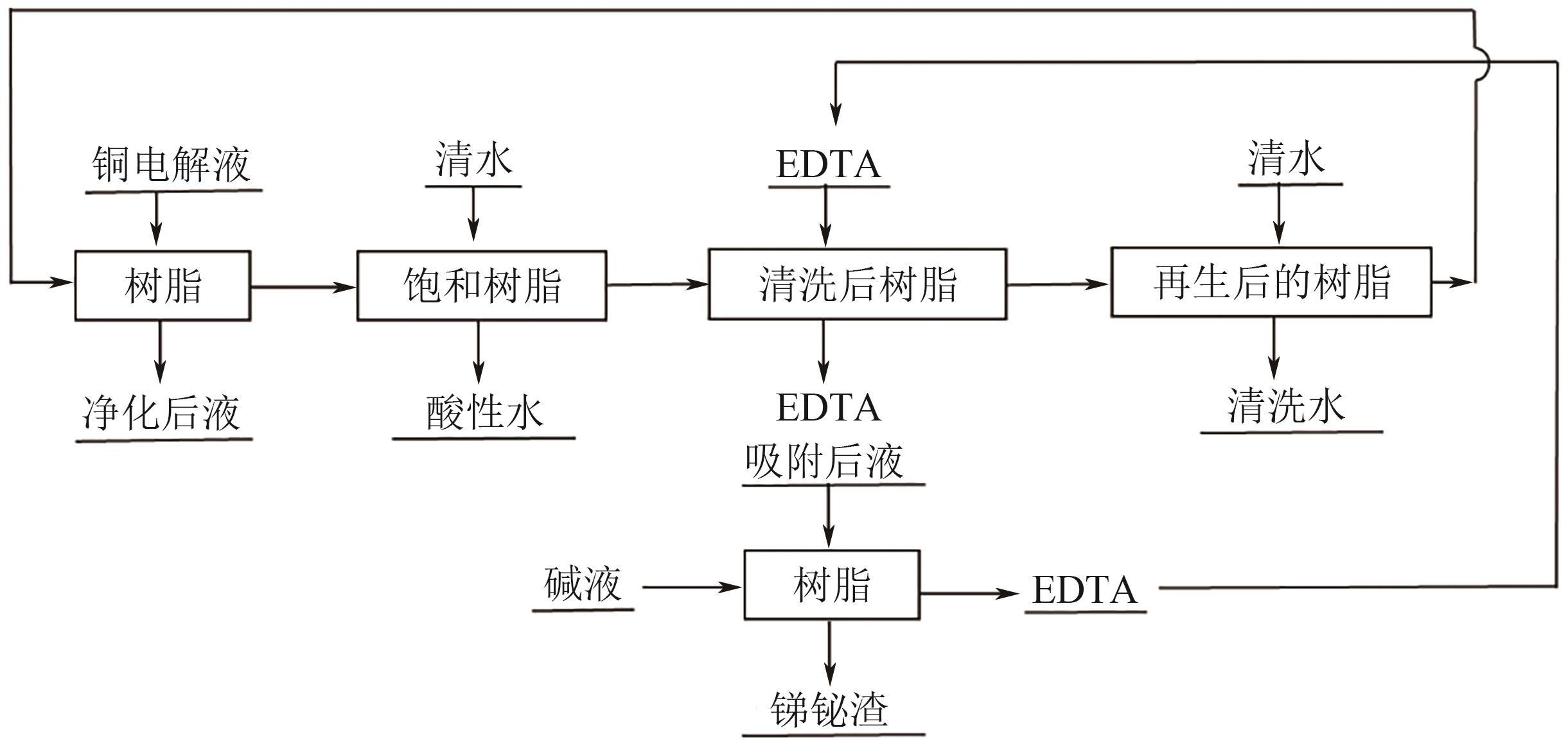
图5 常见树脂吸附脱杂工艺流程
| 方法类型 | 特点 |
|---|---|
| 静电吸引 | 与带负电的砷(AsO₃³⁻、AsO₄³⁻)、铋(BiCl₄⁻)等阴离子相互吸引,作用范围相对较远,是初始吸附的重要步骤 |
| 离子交换 | 吸附剂中的可交换阴离子(如Cl⁻、OH⁻)与溶液中的杂质阴离子进行交换,可逆性相对较高 |
| 表面络合/化学键合 | 吸附剂表面的Sb原子(路易斯酸)与杂质阴离子(路易斯碱)形成内层表面络合物或特定化合物(如Sb-Bi结合物),选择性高,结合牢固,通常是化学吸附,吸热、熵增的自发过程 |
| 共沉淀与表面沉积 | 被吸附的杂质与吸附剂溶解组分或直接在表面形成难溶化合物(如焦锑酸铋)并沉积 |
| 物理筛分(孔道) | 吸附剂的纳米级孔道选择性容纳尺寸匹配的杂质离子 |
表3 复合锑酸盐吸附剂去除砷和铋的主要方法及特点
| 方法类型 | 特点 |
|---|---|
| 静电吸引 | 与带负电的砷(AsO₃³⁻、AsO₄³⁻)、铋(BiCl₄⁻)等阴离子相互吸引,作用范围相对较远,是初始吸附的重要步骤 |
| 离子交换 | 吸附剂中的可交换阴离子(如Cl⁻、OH⁻)与溶液中的杂质阴离子进行交换,可逆性相对较高 |
| 表面络合/化学键合 | 吸附剂表面的Sb原子(路易斯酸)与杂质阴离子(路易斯碱)形成内层表面络合物或特定化合物(如Sb-Bi结合物),选择性高,结合牢固,通常是化学吸附,吸热、熵增的自发过程 |
| 共沉淀与表面沉积 | 被吸附的杂质与吸附剂溶解组分或直接在表面形成难溶化合物(如焦锑酸铋)并沉积 |
| 物理筛分(孔道) | 吸附剂的纳米级孔道选择性容纳尺寸匹配的杂质离子 |
| 萃取剂 | 主要应用 | 特点 |
|---|---|---|
| P204 | 铜电解液除As、Sb、Bi | 萃取率随pH、相比和P204浓度升高而提高 |
| P507 | 铜萃取稀释剂(与P204配合) | 低毒、低挥发,适用于钴、镍等金属萃取 |
| N1923 | 铜电解液除铁 | 有机相循环性好,夹带对铜萃取无影响 |
| N235 | 铜电解液除Sb、Bi | 需助萃剂,适用于高选择性脱除Sb、Bi |
| Cyanex 923 | 多金属分离(Sb、Bi) | 适用于复杂体系逐级分离,减少共萃干扰 |
表4 常见萃取剂在铜电解液净化中的应用特性
| 萃取剂 | 主要应用 | 特点 |
|---|---|---|
| P204 | 铜电解液除As、Sb、Bi | 萃取率随pH、相比和P204浓度升高而提高 |
| P507 | 铜萃取稀释剂(与P204配合) | 低毒、低挥发,适用于钴、镍等金属萃取 |
| N1923 | 铜电解液除铁 | 有机相循环性好,夹带对铜萃取无影响 |
| N235 | 铜电解液除Sb、Bi | 需助萃剂,适用于高选择性脱除Sb、Bi |
| Cyanex 923 | 多金属分离(Sb、Bi) | 适用于复杂体系逐级分离,减少共萃干扰 |
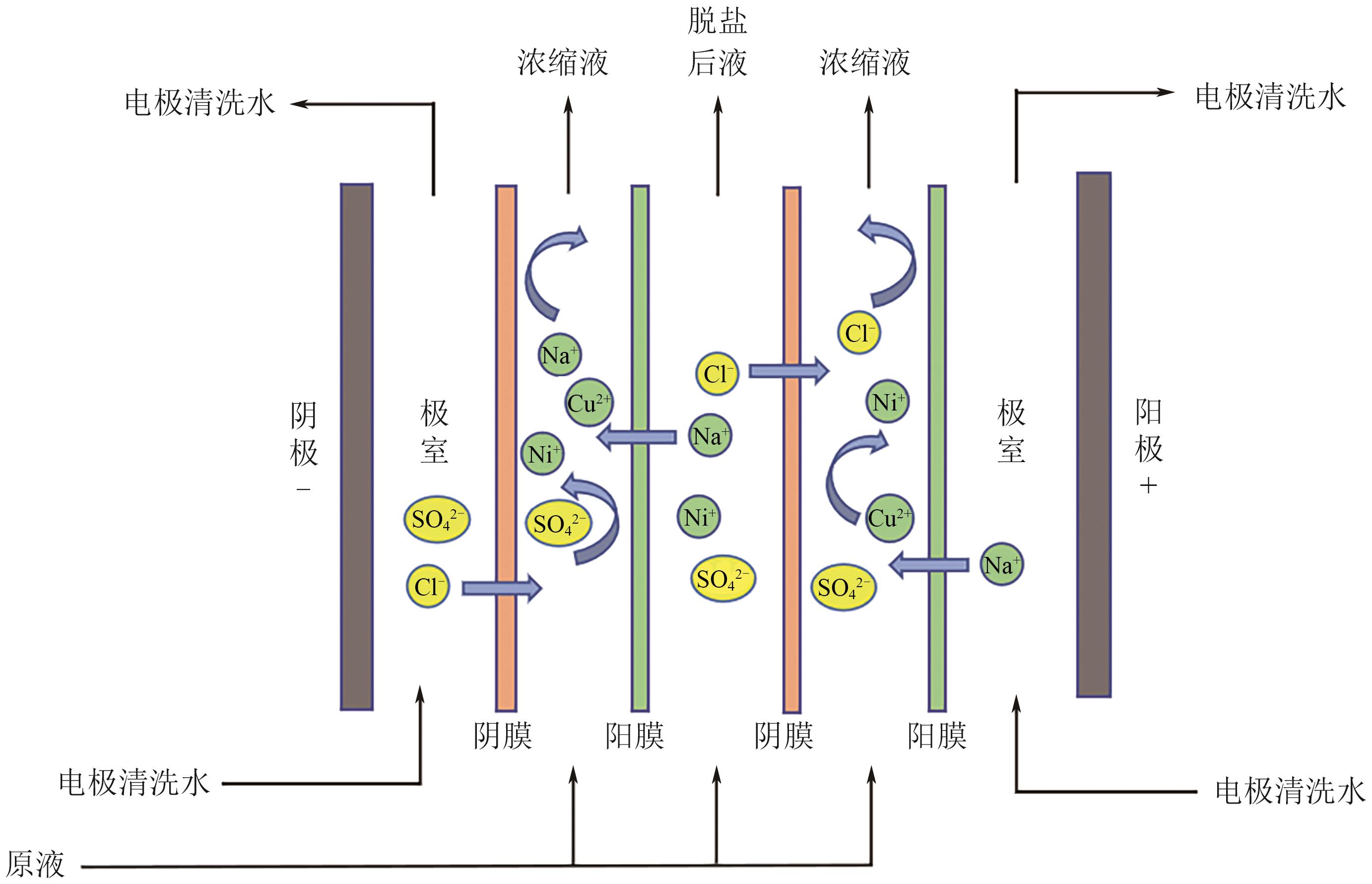
图6 电渗析过程示意图
| [41] | 张素霞. 铜电解净化除锑铋试验研究[D]. 西安: 西安建筑科技大学, 2014. |
| ZHANG Suxia. The experimental study on copper electrolytic purification of removing antimony and bismuth[D]. Xi’an: Xi’an University of Architecture and Technology, 2014. | |
| [42] | 倪志聪. 铜电解液吸附脱砷新工艺研究[D]. 赣州: 江西理工大学, 2018. |
| NI Zhicong. Research on a new technology for arsenic-removal adsorbed from copper electrolyte[D]. Ganzhou: Jiangxi University of Science and Technology, 2018. | |
| [43] | 刘林海, 饶波, 王学军, 等. 活性炭吸附硝酸铜电解液体系中砷的研究[J]. 上饶师范学院学报, 2012, 32(6): 61-64, 88. |
| LIU Linhai, RAO Bo, WANG Xuejun, et al. Study on arsenic adsorption properties by activated carbon from copper nitrate electrolyte[J]. Journal of Shangrao Normal University, 2012, 32(6): 61-64, 88. | |
| [44] | SALARI Katereh, HASHEMIAN Saeedeh, BAEI Mohammad Taghi. Sb(Ⅴ) removal from copper electrorefining electrolyte: Comparative study by different sorbents[J]. Transactions of Nonferrous Metals Society of China, 2017, 27(2): 440-449. |
| [45] | 张喆秋. 锑基吸附剂对铜电解液中铋离子的吸附性能及工艺研究[D]. 赣州: 江西理工大学, 2019. |
| ZHANG Zheqiu. Adsorption properties and technology of antimony-based adsorbents for bismuth ions in copper electrolyte[D]. Ganzhou: Jiangxi University of Science and Technology, 2019. | |
| [46] | WANG Xuewen, CHEN Qiyuan, YIN Zhoulan, et al. Removal of impurities from copper electrolyte with adsorbent containing antimony[J]. Hydrometallurgy, 2003, 69(1/2/3): 39-44. |
| [47] | 韩义忠, 谢祥添, 贾兴州. 锑基吸附剂净化铜电解液试验研究[J]. 中国有色冶金, 2021, 50(3): 16-20. |
| HAN Yizhong, XIE Xiangtian, JIA Xingzhou. Study on adsorption purification process of copper electrolyte by antimony-based adsorbent[J]. China Nonferrous Metallurgy, 2021, 50(3): 16-20. | |
| [1] | 刘若曦, 张楠. 2024年中国铜工业供需形势分析[J]. 中国矿业, 2025, 34(4): 144-152. |
| LIU Ruoxi, ZHANG Nan. Supply and demand situation of China’s copper industry in 2024[J]. China Mining Magazine, 2025, 34(4): 144-152. | |
| [2] | 熊靓辉, 李调丽, 张会琼, 等. 国内外铜矿资源供需现状及趋势分析[J]. 矿产勘查, 2019, 10(2): 159-164. |
| XIONG Lianghui, LI Tiaoli, ZHANG Huiqiong, et al. Analysis on supply and demand status and trend analysis of copper resources in the world and China[J]. Mineral Exploration, 2019, 10(2): 159-164. | |
| [3] | 程永红. 铜电解精炼工(铜电解工、硫酸盐工)[M]. 北京: 冶金工业出版社, 2013: 59-61. |
| CHENG Yonghong. Copper electrolytic refiner (copper electrolytic worker, sulfate worker)[M]. Beijing: Metallurgical Industry Press, 2013: 59-61. | |
| [4] | 彭忠平, 沈强华, 谢文东, 等. 铜精炼过程中砷、锑的脱除研究现状[J]. 有色金属科学与工程, 2021, 12(1): 28-33. |
| PENG Zhongping, SHEN Qianghua, XIE Wendong, et al. Research status of arsenic and antimony removal in copper refining process[J]. Nonferrous Metals Science and Engineering, 2021, 12(1): 28-33. | |
| [5] | OSTANIN N I, RUDOY V M, DEMIN I P, et al. Statistical analysis of the distribution of impurities during copper electrorefining[J]. Russian Journal of Non-Ferrous Metals, 2021, 62(5): 501-507. |
| [6] | 王阗, 许卫, 曹昌盛. 杂质As在铜电解精炼中走向分布研究[J]. 中国有色冶金, 2014, 43(4): 35-37. |
| WANG Tian, XU Wei, CAO Changsheng. Study on distribution of impurity as in copper electro-refining[J]. China Nonferrous Metallurgy, 2014, 43(4): 35-37. | |
| [7] | 张晓丹, 吴星琳, 陈杭, 等. 铜冶炼过程提高镍回收率试验研究[J]. 冶金管理, 2020(17): 41-43. |
| ZHANG Xiaodan, WU Xinglin, CHEN Hang, et al. Experimental study on improving nickel recovery rate in copper smelting process[J]. China Steel Focus, 2020(17): 41-43. | |
| [8] | CHENG Chu, CHEN Chen, LIU Haitao, et al. Migration behavior and distribution of silver in copper electrorefining process[J]. Materials Today Communications, 2025, 46: 112904. |
| [9] | 王辉. 铜电解液砷的净化脱除技术研究[D]. 沈阳: 东北大学, 2021. |
| WANG Hui. Study on purification and removal technology of arsenic in copper electrolyte[D]. Shenyang: Northeastern University, 2021. | |
| [10] | ZHAO Jingya, MENG Yi, LI Chun, et al. The effect of nodulation on the distribution of concentration and current density during copper electrolytic refining[J]. Journal of Physics: Conference Series, 2022, 2285(1): 012015. |
| [11] | 冯闻宇. 铜电解精炼过程典型杂质的迁移规律及其控制研究[D]. 杭州: 浙江工业大学, 2022. |
| FENG Wenyu. Research on the Migration Regularity and Control of Typical Impurities in Copper Electrorefining Process[D]. Hangzhou: Zhejiang University of Technology, 2022. | |
| [12] | YANG Jianguang, LIU Shan, ZENG Weizhi, et al. Experimental analysis of the performance of innovative circulation configurations for cleaner copper electrolysis[J]. Hydrometallurgy, 2019, 189: 105145. |
| [13] | 郑金旺. 铜电解精炼时砷、锑、铋的分配行为及其应用研究[D]. 长沙: 中南大学, 2005. |
| ZHENG Jinwang. Study on the Distribution Behavior of As, Sb and Bi in Copper Electrorefining Process and Its Application[D]. Changsha: Central South University, 2005. | |
| [14] | XIAO Faxin, MAO Jianwei, CAO Dao, et al. Formation of antimonate in co-precipitation reaction of As, Sb and Bi in copper electrolytes[J]. Minerals Engineering, 2012, 35: 9-15. |
| [15] | QIN Songyan, MENG Xin, FANG Yuqian, et al. Deep electrochemical purification of high arsenic-bearing copper refined electrolyte[J]. Journal of Sustainable Metallurgy, 2023, 9(1): 398-407. |
| [16] | 陈玉虎, 俞挺, 马丹辉, 等. 铜电解液电积净液工艺现状[J]. 广州化工, 2020, 48(7): 14-16. |
| [48] | 费维扬. 面向21世纪的溶剂萃取技术[J]. 化工进展, 2000, 19(1): 11-13, 31. |
| FEI Weiyang. Solvent extraction technology facing the 21 ST century[J]. Chemical Industry and Engineering Progress, 2000, 19(1): 11-13, 31. | |
| [49] | 王瑞永, 罗婷. TBP-N235协同萃取铜电解液中的砷[J]. 矿冶工程, 2015, 35(6): 89-92. |
| WANG Ruiyong, LUO Ting. Synergistic extraction of as from copper electrolyte with TBP and N235 [J]. Mining and Metallurgical Engineering, 2015, 35(6): 89-92. | |
| [50] | 王瑞永. C923萃取铜电解液中砷和铋的试验研究[J]. 黄金科学技术, 2015, 23(1): 90-94. |
| WANG Ruiyong. Experimental investigation of using C923 to extract arsenic and bismuth in copper electrolyte[J]. Gold Science and Technology, 2015, 23(1): 90-94. | |
| [51] | 廖家隆. 高砷铜电解液萃取除砷工艺研究[D]. 赣州: 江西理工大学, 2018. |
| LIAO Jialong. Research on the extraction of arsenic from high-arsenic copper electrolyte[D]. Ganzhou: Jiangxi University of Science and Technology, 2018. | |
| [52] | DRZAZGA Michał, CISZEWSKI Mateusz, Sylwia KOZŁOWICZ, et al. Comparison of germanium recovery from copper (Ⅱ) sulfate-based solution using tertiary amine and oxime extractant[J]. Minerals Engineering, 2024, 218: 108984. |
| [53] | 李俊标, 李敬忠, 苏峰, 等. 萃取法回收铜电解液中锑铋研究与实践[J]. 铜业工程, 2017(6): 47-51, 70. |
| LI Junbiao, LI Jingzhong, SU Feng, et al. Extraction recovery of antimony bismuth in copper electrolyte by research and practice[J]. Copper Engineering, 2017(6): 47-51, 70. | |
| [54] | SHABANI Alireza, HOSEINPUR Arman, YOOZBASHIZADEH Hossein, et al. As, Sb, and Fe removal from industrial copper electrolyte by solvent displacement crystallisation technique[J]. Canadian Metallurgical Quarterly, 2019, 58(3): 253-261. |
| [16] | CHEN Yuhu, YU Ting, MA Danhui, et al. Research progress on purification of arsenic by electrolytic method[J]. Guangzhou Chemical Industry, 2020, 48(7): 14-16. |
| [17] | 韩俞凯舟, 杨锦波. 铜电解精炼过程中杂质物质的脱除方法研究[J]. 世界有色金属, 2023(23): 10-12. |
| HAN Yukaizhou, YANG Jinbo. Study on removal of impurities in copper electrolytic refining process[J]. World Nonferrous Metals, 2023(23): 10-12. | |
| [18] | 孙莉, 肖银广. 诱导脱铜靶向脱杂技术的研究与应用[C]//第三届中国铜工业科学技术发展大会论文集. 赣州:国家铜冶炼及加工工程技术研究中心, 2017: 36-39. |
| SUN Li, XIAO Yinguang. Research and Application of Induced Copper Removal-Targeted Impurity Removal Technology [C]//Proceedings of the Third China Copper Industry Science and Technology Development Conference. Ganzhou: National Engineering Research Center for Copper Smelting and Processing, 2017:36-39. | |
| [19] | 洪饶辉. 分段循环式电积脱铜除杂工艺的应用[J]. 有色金属(冶炼部分), 2018(2): 39-42. |
| HONG Raohui. Application of copper removal by segmentation cyclic electrodeposition process[J]. Nonferrous Metals (Extractive Metallurgy), 2018(2): 39-42. | |
| [20] | 陈波, 邓文涛. 循环法在铜电解液脱杂净化工艺中的应用[J]. 世界有色金属, 2019(19): 173-175. |
| CHEN Bo, DENG Wentao. Application of circulation method in the copper electrolyte purification technology[J]. World Nonferrous Metals, 2019(19): 173-175. | |
| [21] | 王卫明, 李丕强. 循环法电积脱铜除杂工艺的应用[C]//第三届中原国际铝加工新技术应用及发展论坛论文集. 郑州, 2021: 278-282. |
| WANG Weiming, LI Piqiang. Application of Segmentation Cyclic Electrodeposition Process for Copper Removal and Impurity Removal [C]//Proceedings of the Third Central Plains International Aluminum Processing New Technology Application and Development Forum. Zhengzhou: Henan Nonferrous Metals Industry Association, 2021: 278-282. | |
| [22] | 吴晓光. 贵冶电解一系统净液改造与优化[J]. 有色金属(冶炼部分), 2011(2): 55-57. |
| WU Xiaoguang. Improvement on electrolyte purification in the No.1 tank house of Guixi smelter[J]. Nonferrous Metals (Extractive Metallurgy), 2011(2): 55-57. | |
| [23] | 邹先志, 李雄梅, 李志明. 降低铜电解液净化工序滤液含铜的生产实践[J]. 化工设计通讯, 2025, 51(4): 1-3, 12. |
| [55] | BENABDALLAH N, LUO D, HADJ YOUCEF M, et al. Increasing the circularity of the copper metallurgical industry: Recovery of Sb(Ⅲ) and Bi(Ⅲ) from hydrochloric solutions by integration of solvating organophosphorous extractants and selective precipitation[J]. Chemical Engineering Journal, 2023, 453: 139811. |
| [56] | 黄文娟. 重金属废水处理中膜分离技术的应用研究[J]. 皮革制作与环保科技, 2022, 3(11): 9-11. |
| HUANG Wenjuan. Application of membrane separation technology in heavy metal wastewater treatment[J]. Leather Manufacture and Environmental Technology, 2022, 3(11): 9-11. | |
| [57] | 赵军生, 魏总. 有色金属选矿废水处理及循环利用技术研究[J]. 世界有色金属, 2024(1): 103-105. |
| ZHAO Junsheng, WEI Zong. Research on treatment and recycling technology of nonferrous metal mineral processing wastewater[J]. World Nonferrous Metals, 2024(1): 103-105. | |
| [58] | 王湛, 宋芃, 陈强, 等. 膜技术及其应用[M]. 北京: 化学工业出版社, 2022: 24-28. |
| WANG Zhan, SONG Peng, CHEN Qiang. Membrane technology and its application[M]. Beijing: Chemical Industry Press, 2022: 24-28. | |
| [59] | 王志高. 膜分离技术在湿法冶金中的应用[C]//第四届全国膜分离技术在冶金工业中应用研讨会论文集. 都江堰, 2014: 64-71. |
| WANG Zhigao. Application of membrane separation technology in hydrometallurgy[C]//Proceedings of the Fourth National Symposium on Application of Membrane Separation Technology in Metallurgical Industry. Dujiangyan: China Membrane Industry Association, 2014: 64-71. | |
| [60] | 李权. 膜分离技术的研究进展及应用展望[J]. 化学工程与装备, 2022(8): 247-248. |
| LI Quan. Research progress and application prospect of membrane separation technology[J]. Chemical Engineering & Equipment, 2022(8): 247-248. | |
| [61] | ZHANG Le, CHEN Ying, ZHANG Huan, et al. Application of membrane separation technology in electroplating wastewater treatment and resource recovery: A review[J]. Nature Environment and Pollution Technology, 2024, 23(2): 649-665. |
| [62] | BARROS Kayo Santana, MACHADO André Luiz Vargas, VIELMO Vicente Schaeffer, et al. Membrane electrolysis for recovering Sb and Bi from elution solutions of ion-exchange resins used in copper electrorefining: A cyclic voltammetric study[J]. Journal of Electroanalytical Chemistry, 2022, 924: 116867. |
| [23] | ZOU Xianzhi, LI Xiongmei, LI Zhiming. Production practice of reducing copper content in purified filtrate of copper electrolyte[J]. Chemical Engineering Design Communications, 2025, 51(4): 1-3, 12. |
| [24] | 王妍. 杂质金属离子作用下铜电解液旋流电积提取金属铜研究[D]. 昆明: 昆明理工大学, 2021. |
| WANG Yan. Study on extraction of copper from copper electrolyte by cyclone electrodeposition under the action of impurity metal ions[D]. Kunming: Kunming University of Science and Technology, 2021. | |
| [25] | 田庆华, 张镇, 李晓静, 等. 高砷铜电解液中旋流电积脱杂[J]. 中国有色金属学报, 2018, 28(8): 1637-1644. |
| TIAN Qinghua, ZHANG Zhen, LI Xiaojing, et al. Remove impurity from high arsenic-content copper electrolyte by cyclone electrowinning technology[J]. The Chinese Journal of Nonferrous Metals, 2018, 28(8): 1637-1644. | |
| [26] | WANG Xuewen, CHEN Qiyuan, YIN Zhoulan, et al. The role of arsenic in the homogeneous precipitation of As, Sb and Bi impurities in copper electrolyte[J]. Hydrometallurgy, 2011, 108(3/4): 199-204. |
| [27] | XIAO Faxin, CAO Dao, MAO Jianwei, et al. Role of Sb(V) in removal of As, Sb and Bi impurities from copper electrolyte[J]. Transactions of Nonferrous Metals Society of China, 2014, 24(1): 271-278. |
| [28] | 毛建伟, 肖发新, 曹岛, 等. 铜电解液中砷氧化还原规律及价态转化途径[J]. 河南科技大学学报(自然科学版), 2013, 34(5): 9-14, 4-5. |
| MAO Jianwei, XIAO Faxin, CAO Dao, et al. Redox rule of arsenic in copper electrolyte and its valence transformation method[J]. Journal of Henan University of Science & Technology (Natural Science), 2013, 34(5): 9-14, 4-5. | |
| [29] | ZERAATI Malihe, CHAUHAN Narendra Pal Singh, SARGAZI Ghasem. Removal of electrolyte impurities from industrial electrolyte of electro-refining copper using green crystallization approach[J]. Chemical Papers, 2021, 75(8): 3873-3880. |
| [30] | 周文科. SO2还原法净化铜电解液工艺研究[D]. 长沙: 中南大学, 2011. |
| ZHOU Wenke. Study on Purification Process of Copper Electrolyte by SO2 Reduction Method[D]. Changsha: Central South University, 2011. | |
| [31] | 匡晨, 王乾坤, 陈杭, 等. 铜电解液中砷净化及资源化利用新工艺研究[J]. 中国有色冶金, 2023, 52(4): 34-43. |
| KUANG Chen, WANG Qiankun, CHEN Hang, et al. A new arsenic removal and utilization process of copper electrolyte[J]. China Nonferrous Metallurgy, 2023, 52(4): 34-43. | |
| [32] | NIE Huaping, CAO Caifang, XU Zhifeng, et al. Novel method to remove arsenic and prepare metal arsenic from copper electrolyte using titanium(Ⅳ) oxysulfate coprecipitation and carbothermal reduction[J]. Separation and Purification Technology, 2020, 231: 115919. |
| [33] | GONG Ao, CAO Caifang, YAN Kang, et al. A novel method for rapid and highly selective removal of arsenic from copper electrolyte using zirconium salts[J]. Chemical Engineering Journal, 2024, 481: 148460. |
| [34] | 黄志华, 金凯, 安登极, 等. 铜电解液含铋复盐沉淀法脱砷新工艺研究[J]. 矿冶工程, 2021, 41(2): 95-98. |
| HUANG Zhihua, JIN Kai, AN Dengji, et al. Arsenic removal from copper electrolyte by precipitation with complex bismuth salts as precipitant[J]. Mining and Metallurgical Engineering, 2021, 41(2): 95-98. | |
| [35] | 胡华舟. 铜电解液共沉淀脱杂技术研究[D]. 赣州: 江西理工大学, 2018. |
| HU Huazhou. Research on the removal of impurities from copper electrolyte by co-precipitation[D]. Ganzhou: Jiangxi University of Science and Technology, 2018. | |
| [36] | 何万年, 赵旺盛, 何思郏. 离子交换法净化铜电解液中的铋和锑[J]. 新疆有色金属, 1997, 20(4): 27-32. |
| HE Wannian, ZHAO Wangsheng, HE Sijia. Purification of bismuth and antimony from copper electrolyte by ion exchange[J]. Xinjiang Youse Jinshu, 1997, 20(4): 27-32. | |
| [37] | ARROYO-TORRALVO F, RODRÍGUEZ-ALMANSA A, RUIZ I, et al. Optimizing operating conditions in an ion-exchange column treatment applied to the removal of Sb and Bi impurities from an electrolyte of a copper electro-refining plant[J]. Hydrometallurgy, 2017, 171: 285-297. |
| [38] | 夏栋, 蒋晓云, 王冲, 等. 铜电解液的净化试验研究[J]. 湿法冶金, 2019, 38(5): 371-374, 379. |
| XIA Dong, JIANG Xiaoyun, WANG Chong, et al. Process of copper electrolyte purification[J]. Hydrometallurgy of China, 2019, 38(5): 371-374, 379. | |
| [39] | 夏栋, 蒋晓云, 刘雅倩, 等. 用树脂吸附从铜电解液中去除锑铋实验[J]. 矿产综合利用, 2023(1): 204-210. |
| XIA Dong, JIANG Xiaoyun, LIU Yaqian, et al. Removal of antimony and bismuth in copper electrolyte by resin adsorption[J]. Multipurpose Utilization of Mineral Resources, 2023(1): 204-210. | |
| [40] | 程霞霞. 树脂除杂技术在铜电解工业化应用研究[J]. 有色金属(冶炼部分), 2018(2): 46-49. |
| CHENG Xiaxia. Study on industrial application of purification with resin in copper electrolysis production[J]. Nonferrous Metals (Extractive Metallurgy), 2018(2): 46-49. | |
| [63] | 罗凯, 徐洁. 膜技术处理铜电解液最佳条件试验[J]. 矿冶工程, 2006, 26(1): 65-67. |
| LUO Kai, XU Jie. Tests for optimum conditions of film technique treatment of copper electrolysis wastewater[J]. Mining and Metallurgical Engineering, 2006, 26(1): 65-67. | |
| [64] | VIELMO Vicente Schaeffer, WELTER Júlia Bitencourt, ROTTA Eduardo Henrique, et al. Enhancing antimony electrowinning from copper electrolyte waste by coupling ion-exchange membrane and mechanical stirring[J]. JOM, 2025, 77(4): 2189-2196. |
| [65] | 孙渊君. 利用膜技术分离铜电解脱铜终液中酸和镍的试验研究[D]. 兰州: 兰州大学, 2014. |
| SUN Yuanjun. The study on the expansion test of the separation of copper and nickel from the copper stripping final using the membrane[D]. Lanzhou: Lanzhou University, 2014. | |
| [66] | CORREA Pedro Pablo, CIPRIANO Aldo, Felipe NUÑEZ, et al. Forecasting copper electrorefining cathode rejection by means of recurrent neural networks with attention mechanism[J]. IEEE Access, 2021, 9: 79080-79088. |
| [67] | NGUYEN H H, BAZHIN V Y. Optimization of the control system for electrolytic copper refining with digital twin during dendritic precipitation[J]. Metallurgist, 2023, 67(1): 41-50. |
| [1] | 武锦怡, 赵睿恺, 邓帅, 张家麒, 高春霄, 刘葳桦, 赵力. 混合绝缘气体变温吸附分离回收SF6的数值模拟[J]. 化工进展, 2025, 44(S1): 19-28. |
| [2] | 符红梅, 刘定华, 刘晓勤. MOF材料在芳烃同分异构体分离中的研究进展[J]. 化工进展, 2025, 44(9): 5006-5017. |
| [3] | 洪凯, 樊欢, 田佳, 张荥斐. 硫化沉淀法处理铜砷多金属酸性废水研究进展[J]. 化工进展, 2025, 44(9): 5301-5314. |
| [4] | 杜璇, 王战宏, 郑彬, 许卫, 王硕, 石鹏, 高国. 钴铁酸浸液分离及电池级磷酸铁回收技术进展[J]. 化工进展, 2025, 44(9): 5327-5338. |
| [5] | 王晓光, 董青, 郎文丽, 洪翔鑫, 黄振祥, 谭凤玉, 雷以柱, 余子夷. 超低浓度甲烷减排与资源化利用研究进展[J]. 化工进展, 2025, 44(9): 5363-5376. |
| [6] | 杨证禄, 杨立峰, 路晓飞, 锁显, 张安运, 崔希利, 邢华斌. 机器学习加速多孔吸附剂筛选发现的研究进展[J]. 化工进展, 2025, 44(8): 4288-4301. |
| [7] | 杨傲, 邓苇, 黎勇, 罗婧, 王梓霖, 张俊, 申威峰. 基于热力学拓扑理论的三塔变压精馏分离四氢呋喃/甲醇/乙醇多目标优化设计[J]. 化工进展, 2025, 44(8): 4582-4593. |
| [8] | 高岩, 李永帅, 李高洋, 潘慧, 凌昊. Agrawal分壁精馏塔的动态控制[J]. 化工进展, 2025, 44(8): 4594-4605. |
| [9] | 汪国超, 丁晖殿, 师丽, 李强, 夏涛, 苑杨. 复合精馏序列的温度推断控制[J]. 化工进展, 2025, 44(8): 4720-4731. |
| [10] | 王阳峰, 蔡海乐, 张舒冬, 朱紫宸, 所聪, 杨雁, 侯栓弟. 钠离子电池石油焦基负极/电解液的相容性[J]. 化工进展, 2025, 44(7): 3850-3859. |
| [11] | 唐轩, 白晓炜, 张飞飞, 李晋平, 杨江峰. 沸石分子筛用于CO2-N2-CH4筛分分离的研究进展[J]. 化工进展, 2025, 44(7): 3938-3949. |
| [12] | 徐茹婷, 赵剑, 孙康, 卢辛成, 蒋剑春, 苏忠高, 刘军利, 陈子标, 苏子寒. 活性炭改性及其对模拟废润滑油的净化性能[J]. 化工进展, 2025, 44(7): 4022-4031. |
| [13] | 陈倩, 仝坤, 谢加才, 邵志国, 聂凡, 李成涛. 含聚油泥处理技术研究进展[J]. 化工进展, 2025, 44(7): 4158-4168. |
| [14] | 李佩燚, 孙波龙, 刘瑞岩, 周歆尧, 刘瑞林, 胡园园, 徐功涛, 李新平. 海藻酸钠/二氧化钛复合多孔材料的制备及油水分离应用[J]. 化工进展, 2025, 44(6): 3053-3061. |
| [15] | 付江, 孙姣霞, 付俊杰, 朱敏, 宋品学, 周怡宁, 樊建新. 疏水改性聚酯纤维织物的自清洁作用及油水分离性能[J]. 化工进展, 2025, 44(6): 3121-3131. |
| 阅读次数 | ||||||
|
全文 |
|
|||||
|
摘要 |
|
|||||