化工进展 ›› 2025, Vol. 44 ›› Issue (9): 5391-5405.DOI: 10.16085/j.issn.1000-6613.2025-0121
• 资源与环境化工 • 上一篇
数值模拟在高放废物处置中的应用:放射性核素迁移机制及其影响因素
段先哲1,2( ), 毕文婷1, 李南2,3, 豆佳乐1, 邵冰清1, 汪佳伟1, 吴鹏1, 黄欢1, 唐振平1,2()
- 1.南华大学资源环境与安全工程学院,湖南 衡阳 421001
2.稀有金属矿产开发与废物地质处置技术湖南省重点实验室,湖南 衡阳 421001
3.南华大学化学化工学院,湖南 衡阳 421001
-
收稿日期:2025-01-21修回日期:2025-04-13出版日期:2025-09-25发布日期:2025-09-30 -
通讯作者:唐振平 -
作者简介:段先哲(1985—),男,博士,副教授,硕士生导师,研究方向为放射性废物处置。E-mail:duanxianzhe@usc.edu.cn。 -
基金资助:国家原子能机构高放废物地质处置创新中心基金(CXJJ21102211);湖南省自然科学基金(2023JJ30505);湖南省教育厅科研项目重点基金(23A0327);衡阳市指导性计划(202121014464);南华大学科研项目(CX20230966);南华大学科研项目(20224130214)
Numerical simulation for disposal of high-level radioactive wastes (HLWs): Mechanisms and influencing factors of radionuclide migration
DUAN Xianzhe1,2(), BI Wenting1, LI Nan2,3, DOU Jiale1, SHAO Bingqing1, WANG Jiawei1, WU Peng1, HUANG Huan1, TANG Zhenping1,2()
- 1.School of Resource Environment and Safety Engineering, University of South China, Hengyang 421001, Hunan, China
2.Hunan Key Laboratory of the Rare Metal Minerals Exploitation and Geological Disposal of Waste, Hengyang 421001, Hunan, China
3.School of Chemical Engineering, University of South China, Hengyang 421001, Hunan, China
-
Received:2025-01-21Revised:2025-04-13Online:2025-09-25Published:2025-09-30 -
Contact:TANG Zhenping

摘要:
核能的开发与利用产生大量高放废物,这些废物具有强放射性、高毒性、热量显著并且半衰期长,很难用传统的物理、化学、生物手段有效去除。目前,深地质处置被广泛认为是高放废物最有效的处理方案,其安全评估的关键在于深入研究放射性核素在地下水中的迁移行为。近年来,数值模拟技术与高放废物处置不断深入结合,以计算机驱动的数值模拟在高放废物处置核素迁移领域取得了巨大进展。本研究通过广泛的文献调研,介绍了高放废物处置中核素迁移的机制与过程,回顾了该领域的数值模拟研究经验,并归纳总结了核素迁移的影响因素,同时对未来高放废物地质处置中核素迁移研究的发展方向提出了展望。研究结果表明,核素迁移模型的选择应综合考虑研究区域的规模和裂隙发育程度;核素的形态与性质是决定核素迁移行为的关键因素,而岩石裂隙网络、胶体存在、地下水成分等因素会显著影响核素的迁移路径和速率。尽管取得了显著进展,数值模拟在实际应用中仍面临诸多挑战,如精确模拟多尺度、多相流动,处理复杂地质结构和异质性材料等。此外,模型验证和不确定性分析也是亟待解决的重要问题。未来研究应着力优化数值模型,提高模拟精度,推动多学科交叉研究,以更好地应对高放废物处置中核素迁移的复杂性和不确定性。
中图分类号:
引用本文
段先哲, 毕文婷, 李南, 豆佳乐, 邵冰清, 汪佳伟, 吴鹏, 黄欢, 唐振平. 数值模拟在高放废物处置中的应用:放射性核素迁移机制及其影响因素[J]. 化工进展, 2025, 44(9): 5391-5405.
DUAN Xianzhe, BI Wenting, LI Nan, DOU Jiale, SHAO Bingqing, WANG Jiawei, WU Peng, HUANG Huan, TANG Zhenping. Numerical simulation for disposal of high-level radioactive wastes (HLWs): Mechanisms and influencing factors of radionuclide migration[J]. Chemical Industry and Engineering Progress, 2025, 44(9): 5391-5405.
| 基本原理 | 处置方法 | 基本思想 | 特点 | |
|---|---|---|---|---|
| 滞留-衰变 | 核嬗变法 | 将高放废物转变为低放废物 | 过程繁杂且耗能大,嬗变后仍然需要处置放射性废物 | |
| 浓缩-封隔 | 隔离法 | |||
| 宇宙隔离 | 将核废物送出地球以外的宇宙空间 | 花费大,受国际形势与技术条件的限制 | ||
| 海洋隔离 | 将高放废物容器置入深海底部黏土沉积物深处 | 违反国际法 | ||
| 岩石融化隔离 | 直接将高放废液注入钻孔或深部岩硐中 | 耗资巨大,技术复杂,目前只是设想 | ||
| 冰层隔离 | 将核废物球放入较为稳定的冰原 | 冰原会发生移动,违反国际法 | ||
| 深地质处置隔离 | 将核废物埋入地层深处 | 可行,且下一代有重新处置废物的选择 | ||
| 稀释-分散 | 稀释法 | 对核废物净化或衰减到排放标准以下再稀释扩散到环境中去 | 不能处置乏燃料产生的废物 | |
表1 高放废物的处理处置方法的比较[2-5]
| 基本原理 | 处置方法 | 基本思想 | 特点 | |
|---|---|---|---|---|
| 滞留-衰变 | 核嬗变法 | 将高放废物转变为低放废物 | 过程繁杂且耗能大,嬗变后仍然需要处置放射性废物 | |
| 浓缩-封隔 | 隔离法 | |||
| 宇宙隔离 | 将核废物送出地球以外的宇宙空间 | 花费大,受国际形势与技术条件的限制 | ||
| 海洋隔离 | 将高放废物容器置入深海底部黏土沉积物深处 | 违反国际法 | ||
| 岩石融化隔离 | 直接将高放废液注入钻孔或深部岩硐中 | 耗资巨大,技术复杂,目前只是设想 | ||
| 冰层隔离 | 将核废物球放入较为稳定的冰原 | 冰原会发生移动,违反国际法 | ||
| 深地质处置隔离 | 将核废物埋入地层深处 | 可行,且下一代有重新处置废物的选择 | ||
| 稀释-分散 | 稀释法 | 对核废物净化或衰减到排放标准以下再稀释扩散到环境中去 | 不能处置乏燃料产生的废物 | |
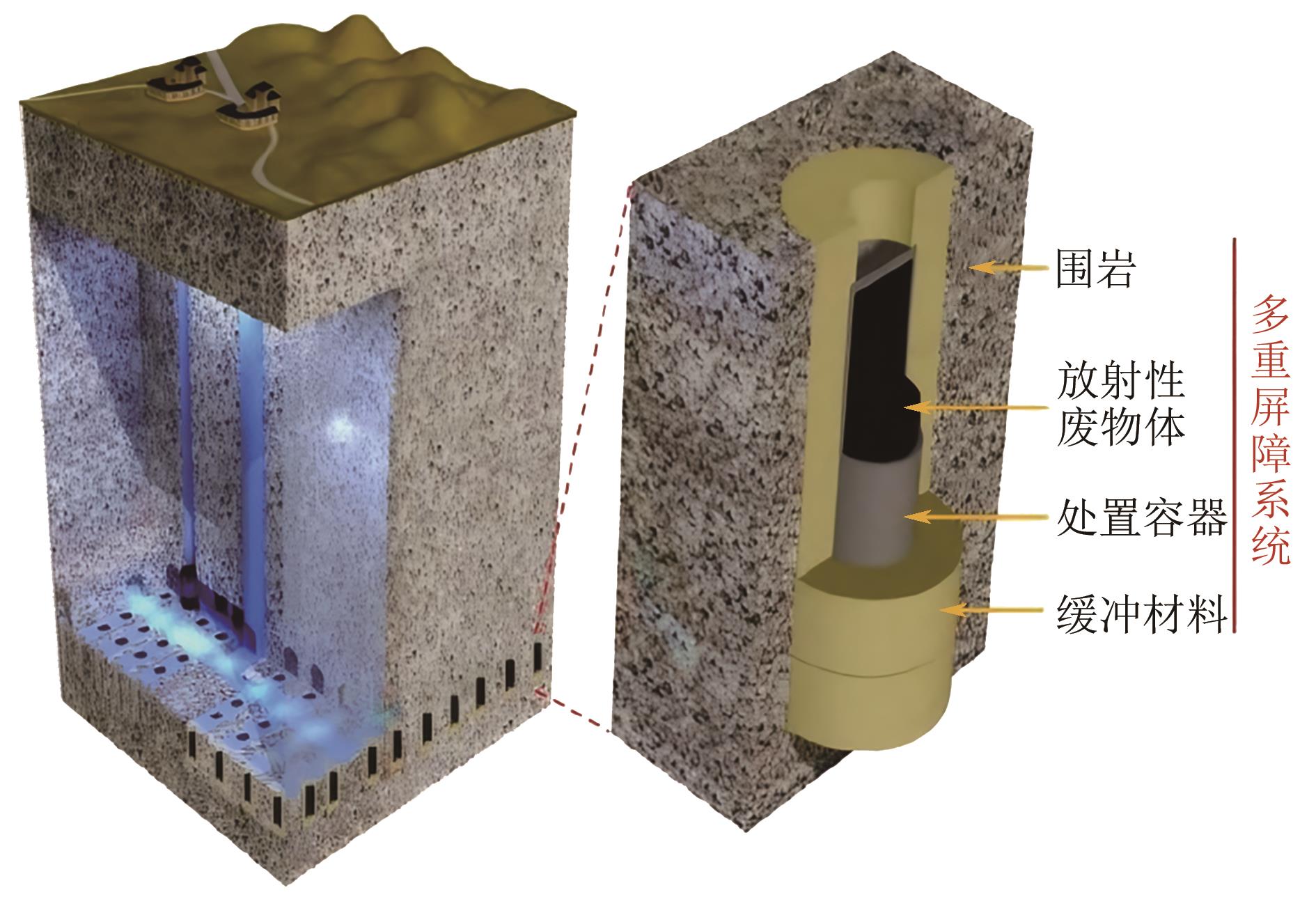
图1 多重屏障系统中核素释出与运移的主要过程示意图[6-7]
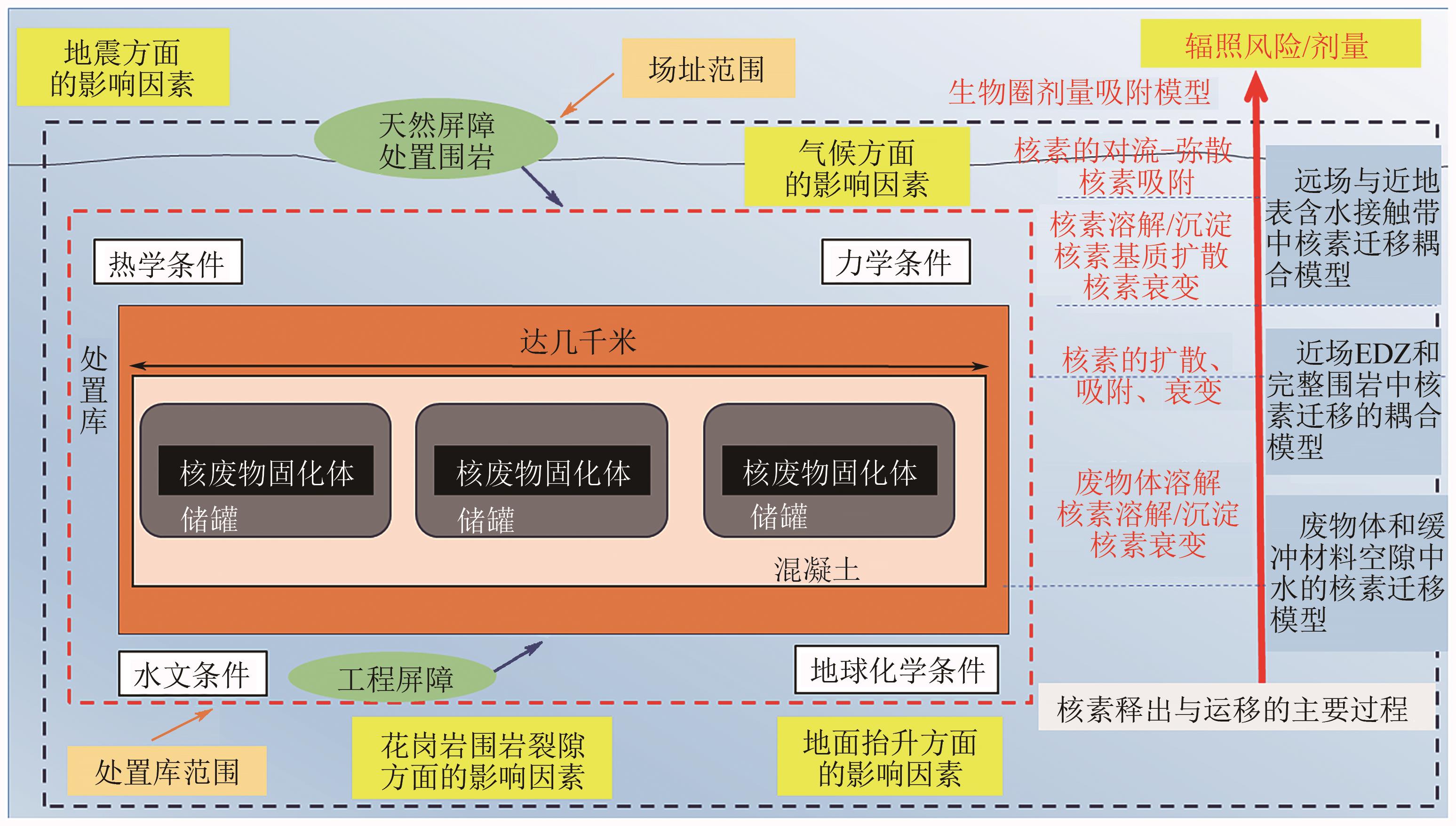
图2 花岗岩处置库选址关键影响因素及多重屏障系统中核素释出与运移的主要过程示意图[6-7]
| 类别 | 低放废物(LLWs) | 中放废物(ILWs) | 高放废物(HLWs) |
|---|---|---|---|
| 放射性水平 | 较低,无需屏蔽 | 中等,需要屏蔽 | 高,需要严格屏蔽并管理 |
| 主要来源 | 铀矿生产、核电站运行、防护用品、医疗废物、科研实验 | 核燃料前处理、乏燃料后处理、污染管道、冷却水沉积物 | 乏燃料、高活性废液、核武器试验 |
| 处理复杂度 | 简单,压缩、固化或浅层填埋 | 复杂,需固化及深地质处置 | 高度复杂,需玻璃固化和深地质处置 |
| 环境风险 | 低,规范管理下影响小 | 较高,若管理不当可能污染地下水 | 极高,管理不当可能造成严重环境和健康危害 |
| 体积比例 | 大,占大部分废物体积 | 较小 | 小,但活度极高 |
| 代表核素 | 86Rb、90Y | 90Sr、137Cs | 79Se、99Tc、237Np、239Pu、241Am |
表2 不同放射性废物类别的来源、特点[8-9]
| 类别 | 低放废物(LLWs) | 中放废物(ILWs) | 高放废物(HLWs) |
|---|---|---|---|
| 放射性水平 | 较低,无需屏蔽 | 中等,需要屏蔽 | 高,需要严格屏蔽并管理 |
| 主要来源 | 铀矿生产、核电站运行、防护用品、医疗废物、科研实验 | 核燃料前处理、乏燃料后处理、污染管道、冷却水沉积物 | 乏燃料、高活性废液、核武器试验 |
| 处理复杂度 | 简单,压缩、固化或浅层填埋 | 复杂,需固化及深地质处置 | 高度复杂,需玻璃固化和深地质处置 |
| 环境风险 | 低,规范管理下影响小 | 较高,若管理不当可能污染地下水 | 极高,管理不当可能造成严重环境和健康危害 |
| 体积比例 | 大,占大部分废物体积 | 较小 | 小,但活度极高 |
| 代表核素 | 86Rb、90Y | 90Sr、137Cs | 79Se、99Tc、237Np、239Pu、241Am |
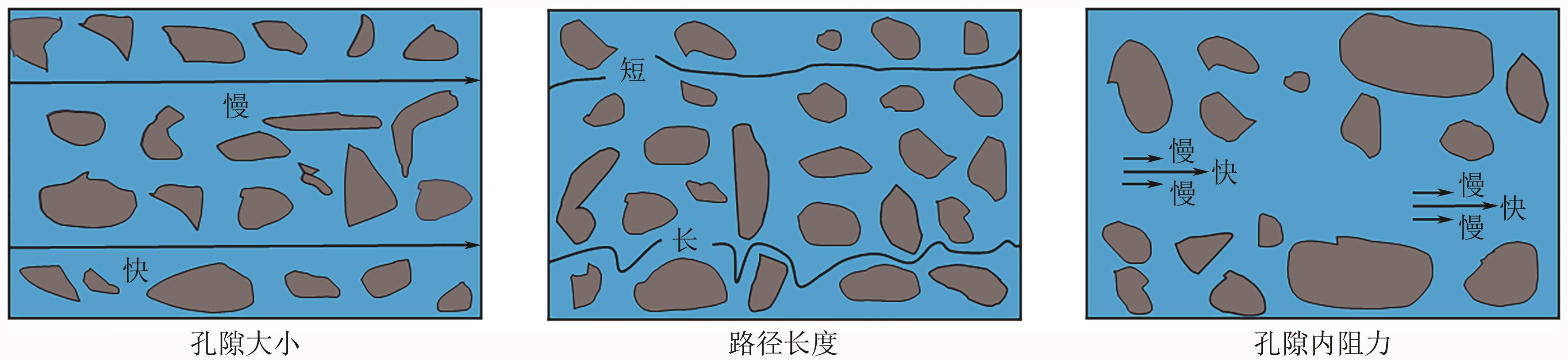
图3 弥散行为在孔隙介质中产生的原因[13]
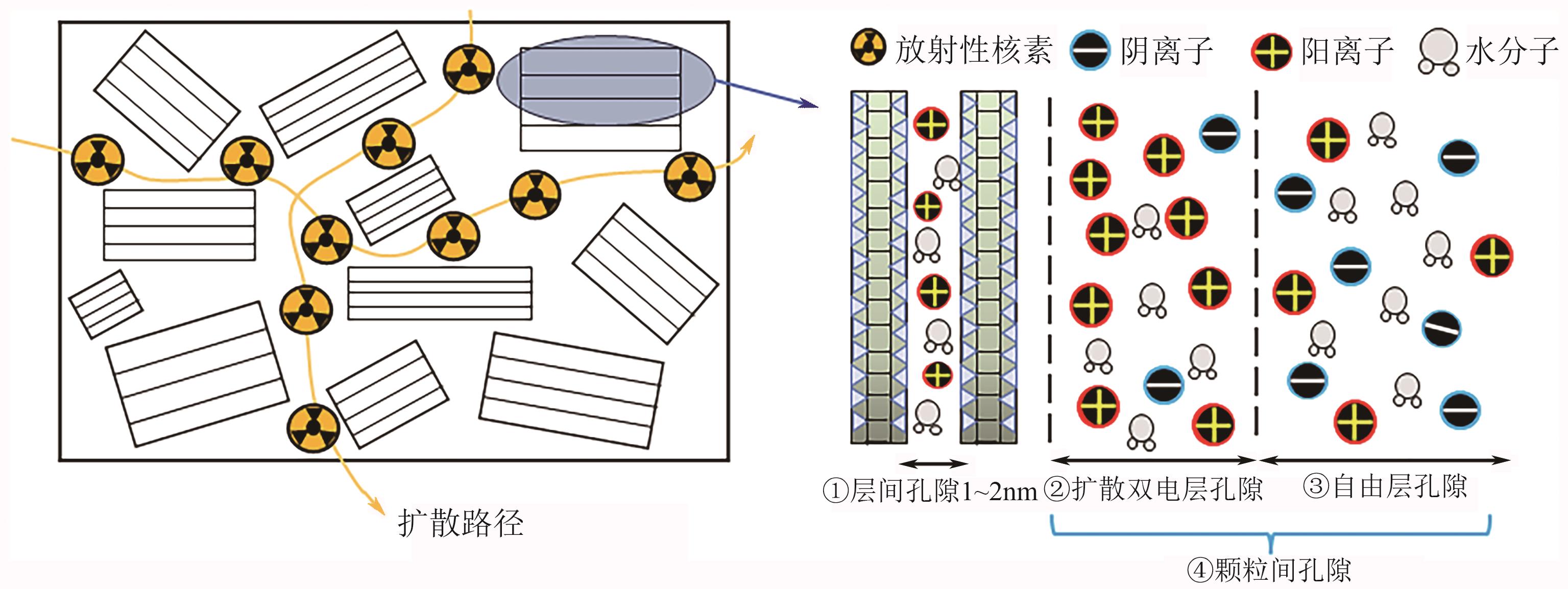
图4 多孔介质孔隙图[13]
| 主要模型 | 适用条件 | 优点 | 缺点 | 常用模拟软件 |
|---|---|---|---|---|
| 等效连续介质模型 | 大区域、裂隙发育程度较高 | 所需数据易于获取技术成熟、操作性强 | 求解精度低、无法细致描述裂隙介质的不连续性和各向异性 | Modflow、GMS、Porflow |
| 离散裂隙网络模型 | 小尺度、单裂隙 | 精度高、拟真性好 | 工作量大、耗时长 | Connectflow |
| 双重介质模型 | 岩块的渗透率远小于裂隙渗透率 | 计算和概念上要求更低反应渗流特征更全面 | 溶质交换项难以确定、适用范围有限、计算复杂 | Though2 |
| 等效-离散耦合模型 | 分区域使用:裂隙密度大时使用等效连续介质模型;裂隙密度小时采用离散裂隙网络模型 | 精度高、拟真性好 | 水量交换难以确定、耦合操作技术难、数学计算难 | Feflow、Hydrogeosphere |
表3 核素迁移模型对比[18-19]
| 主要模型 | 适用条件 | 优点 | 缺点 | 常用模拟软件 |
|---|---|---|---|---|
| 等效连续介质模型 | 大区域、裂隙发育程度较高 | 所需数据易于获取技术成熟、操作性强 | 求解精度低、无法细致描述裂隙介质的不连续性和各向异性 | Modflow、GMS、Porflow |
| 离散裂隙网络模型 | 小尺度、单裂隙 | 精度高、拟真性好 | 工作量大、耗时长 | Connectflow |
| 双重介质模型 | 岩块的渗透率远小于裂隙渗透率 | 计算和概念上要求更低反应渗流特征更全面 | 溶质交换项难以确定、适用范围有限、计算复杂 | Though2 |
| 等效-离散耦合模型 | 分区域使用:裂隙密度大时使用等效连续介质模型;裂隙密度小时采用离散裂隙网络模型 | 精度高、拟真性好 | 水量交换难以确定、耦合操作技术难、数学计算难 | Feflow、Hydrogeosphere |
| [1] | 潘自强, 钱七虎. 高放废物地质处置战略研究[M]. 北京: 原子能出版社, 2009. |
| PAN Ziqiang, QIAN Qihu. Study on geological disposal strategy of high-level radioactive waste[M]. Beijing: Atomic Press, 2009. | |
| [2] | 段先哲, 王灿州, 王驹, 等. 高放废物地质处置进展和安全评价研究[J]. 工业安全与环保, 2021, 47(7): 98-102. |
| DUAN Xianzhe, WANG Canzhou, WANG Ju, et al. Study on the progress and safety assessment of the geological disposal of high-level radioactive waste (HLW)[J]. Industrial Safety and Environmental Protection, 2021, 47(7): 98-102. | |
| [3] | 郝卿, 刘长良, 杜子冰. 核废料处理方法及管理策略研究[J]. 科技信息, 2012 (32): 159-160. |
| HAO Qing, LIU Changliang, DU Zibing. Study on nuclear waste treatment methods and management strategies[J]. Science & Technology Information, 2012(32): 159-160. | |
| [4] | 沈珍瑶. 高放废物的处理处置方法[J]. 辐射防护通讯, 2002, 22(1): 37-39. |
| SHEN Zhenyao. Method to treatment and disposal HLW[J].Radiation Protection Bulletin, 2002, 22(1): 37-39. | |
| [5] | 李楚. 镅在北山预选处置场研究区的赋存形态及迁移行为探究[D]. 抚州: 东华理工大学, 2019. |
| LI Chu. Study on the occurrence and migration behavior of Am in the research area of Beishan Preselected Disposal Site[D]. Fuzhou: East China Institute of Technology, 2019. | |
| [6] | 王驹, 徐国庆, 郑华铃, 等. 中国高放废物地质处置研究进展: 1985—2004[J]. 世界核地质科学, 2005, 22(1): 5-16. |
| WANG Ju, XU Guoqing, ZHENG Hualing, et al. Geological disposal of high level radioactive waste in China: Progress during 1985—2004[J]. World Nuclear Geoscience, 2005, 22(1): 5-16. | |
| [7] | LI Nan, DUAN Xianzhe, PENG Guowen. Engineering barriers in deep geological disposal: Implications for radioactive nuclide migration and long-term safety[J]. Journal of Environmental Radioactivity, 2025, 285:107670. |
| [8] | DUAN Xianzhe, DU Cong, LI Nan, et al. Kinetic simulation of uranium migration in granite fissure media of Beishan, Gansu, China: A case study based on the Laplace transform and inverse transform methods[J]. Nuclear Engineering and Technology, 2025, 57(2):103205. |
| [9] | ZHOU Wanqiang, WANG Xiangyun, LIU Chunli. Solubility, speciation and sorption calculation of americium in far-field and near-field Beishan groundwaters[J]. Journal of Radioanalytical and Nuclear Chemistry, 2025, 334(1): 863-872. |
| [10] | 王驹, 苏锐, 陈亮, 等. 中国高放废物地质处置地下实验室场址筛选[J]. 世界核地质科学, 2022, 39(1): 1-13. |
| WANG Ju, SU Rui, CHEN Liang, et al. Site selection of underground research laboratory for geological disposal of high-level radioactive waste in China[J]. World Nuclear Geoscience, 2022, 39(1): 1-13. | |
| [11] | 王驹. 中国高放废物地质处置21世纪进展[J]. 原子能科学技术, 2019, 53(10): 2072-2082. |
| WANG Ju. Progress of geological disposal of high-level radioactive waste in China in the 21st century[J]. Atomic Energy Science and Technology, 2019, 53(10): 2072-2082. | |
| [12] | 凌辉. 甘肃北山高放废物地质处置库关闭后安全评价[D]. 北京: 核工业北京地质研究院, 2018. |
| LING Hui. Postclosure safety assessment for high-level radioactive waste repository in Beishan, China[D]. Beijing: Beijing Research Institute of Uranium Geology, 2018. | |
| [13] | 谢龙龙, 李洪辉, 赵帅维 等. 放射性废物处置中核素迁移研究现状及展望[J]. 世界核地质科学, 2021, 38(1): 125-133. |
| XIE Longlong, LI Honghui, ZHAO Shuaiwei, et al. Study status and prospect of radionuclide migration in Radioactive Waste Disposal[J]. World Nuclear Geoscience, 2021, 38(1): 125-133. | |
| [14] | 刘东旭. 放射性核素在岩土体中迁移的数值模拟及影响评估研究[D]. 兰州: 兰州大学, 2013. |
| LIU Dongxu. Numerical modeling and impact evaluation of radionuclides migration in rock and soil mass[D]. Lanzhou: Lanzhou University, 2013. | |
| [15] | 韦红钢. 核素在高放废物地质处置预选场的迁移行为研究[D]. 北京: 中国地质大学(北京), 2012. |
| WEI Honggang. Research on radionuclide migration in the groundwater of the geological disposal preliminary site of HLW[D]. Beijing: China University of Geosciences, 2012. | |
| [16] | 吴晓东. 高放废物在地质处置中核素迁移数值模拟研究[D]. 抚州: 东华理工大学, 2012. |
| WU Xiaodong. Nuclide transport numerical simulation of high level radioactive waste geological disposal[D]. Fuzhou: East China Institute of Technology, 2012. | |
| [17] | 周志芳, 王锦国. 裂隙介质水动力学[M]. 北京: 中国水利水电出版社, 2004. |
| ZHOU Zhifang, WANG Jinguo. Dynamics of fluids in fractured media[M]. Beijing: China Water & Power Press, 2004. | |
| [18] | 李露露, 周志超, 邵景力 等. 高放废物深地质处置地下水流数值模拟方法研究进展[J].水文地质工程地质, 2021, 48(6): 13-23. |
| LI Lulu, ZHOU Zhichao, SHAO Jingli, et al. Advances in groundwater numerical simulation in deep geological disposal of high-level radioactive waste[J]. Hydrogeology & Engineering Geology, 2021, 48(6): 13-23. | |
| [19] | 彭志娟. 高放废物处置库EDZ中核素129I、135Cs的迁移模拟研究[D]. 抚州: 东华理工大学, 2019. |
| PENG Zhijuan. Numerical simulation of 129I & 135Cs Nuclide Migration in EDZ of the High-level Radioactive Waste Repository[D]. Fuzhou: East China Institute of Technology, 2019. | |
| [20] | SONG Jie, DONG Mei, KOLTUK Serdar, et al. Hydro-mechanically coupled finite-element analysis of the stability of a fractured-rock slope using the equivalent continuum approach: A case study of planned reservoir banks in Blaubeuren, Germany[J]. Hydrogeology Journal, 2018, 26(3): 803-817. |
| [21] | CHU J, ENGQUIST B, PRODANOVIĆ M, et al. A multiscale method coupling network and continuum models in porous media Ⅱ—Single-and two-phase flows[J]. Advances in Applied Mathematics, Modeling, and Computational Science, 2013: 161-185. |
| [22] | LONG J C S, REMER J S, WILSON C R, et al. Porous media equivalents for networks of discontinuous fractures[J]. Water Resources Research, 1982, 18(3): 645-658. |
| [23] | SUN Lei, LI Mei, ABDELAZIZ Aly, et al. An efficient 3D cell-based discrete fracture-matrix flow model for digitally captured fracture networks[J]. International Journal of Coal Science & Technology, 2023, 10(1): 70. |
| [24] | 魏亚强, 董艳辉, 周鹏鹏, 等. 基于离散裂隙网络模型的核素粒子迁移数值模拟研究[J]. 水文地质工程地质, 2017, 44(1): 123-130. |
| WEI Yaqiang, DONG Yanhui, ZHOU Pengpeng, et al. Numerical simulation of radionuclide particle tracking based on discrete fracture network[J]. Hydrogeology & Engineering Geology, 2017, 44(1): 123-130. | |
| [25] | Wille NORDQVIST A, TSANG Y W, TSANG C F, et al. A variable aperture fracture network model for flow and transport in fractured rocks[J]. Water Resources Research, 1992, 28(6): 1703-1713. |
| [26] | DAI Zhenxue, WOLFSBERG Andrew, REIMUS Paul, et al. Identification of sorption processes and parameters for radionuclide transport in fractured rock[J]. Journal of Hydrology, 2012, 414: 220-230. |
| [27] | VOGLER Daniel, OSTVAR Sassan, PAUSTIAN Rebecca, et al. A hierarchy of models for simulating experimental results from a 3D heterogeneous porous medium[J]. Advances in Water Resources, 2018, 114: 149-163. |
| [28] | 曹潇元, 侯德义, 胡立堂. 甘肃北山区域地下水流数值模拟研究[J]. 水文地质工程地质, 2020, 47(2): 9-16. |
| CAO Xiaoyuan, HOU Deyi, HU Litang. Numerical simulation of regional groundwater flow in the Beishan area of Gansu[J]. Hydrogeology & Engineering Geology, 2020, 47(2): 9-16. | |
| [29] | 黄勇. 多尺度裂隙介质中的水流和溶质运移随机模拟研究[D]. 南京: 河海大学, 2005. |
| HUANG Yong. Stochastic simulation study of flow and solute transport in multi-scales fractured media[D]. Nanjing: Hohai University, 2005. | |
| [30] | WU Na, LIANG Zhengzhao, ZHANG Zhenghu, et al. Development and verification of three-dimensional equivalent discrete fracture network modelling based on the finite element method[J]. Engineering Geology, 2022, 306: 106759. |
| [31] | REN Feng, MA Guowei, FAN Lifeng, et al. Equivalent discrete fracture networks for modelling fluid flow in highly fractured rock mass[J]. Engineering Geology, 2017, 229: 21-30. |
| [32] | CACAS M C, LEDOUX E, DE MARSILY G, et al. Modeling fracture flow with a stochastic discrete fracture network: Calibration and validation: 1. The flow model[J]. Water Resources Research, 1990, 26(3): 479-489. |
| [33] | 刘媛媛, 魏强林, 高柏, 等. 放射性核素在不同介质中的迁移规律研究现状及进展[J]. 有色金属(冶炼部分), 2018(6): 76-82. |
| LIU Yuanyuan, WEI Qianglin, GAO Bai, et al. Current status and progress on migration of radionuclides in different media[J]. Nonferrous Metals (Extractive Metallurgy), 2018(6): 76-82. | |
| [34] | HASSAN Nabil M, HOSODA Masahiro, ISHIKAWA Tetsuo, et al. Radon migration process and its influence factors; review[J]. Japanese Journal of Health Physics, 2009, 44(2): 218-231. |
| [35] | PORCELLI Donald, SWARZENSKI Peter W. The behavior of U- and Th- series nuclides in groundwater[J]. Reviews in Mineralogy and Geochemistry, 2003, 52(1): 317-361. |
| [36] | RIHS Sophie, PRUNIER Jonathan, THIEN Bruno, et al. Using short-lived nuclides of the U- and Th- series to probe the kinetics of colloid migration in forested soils[J]. Geochimica et Cosmochimica Acta, 2011, 75(23): 7707-7724. |
| [37] | MUNIRUZZAMAN Muhammad, ROLLE Massimo. Modeling multicomponent ionic transport in groundwater with IPhreeqc coupling: Electrostatic interactions and geochemical reactions in homogeneous and heterogeneous domains[J]. Advances in Water Resources, 2016, 98: 1-15. |
| [38] | Minh-Ngoc VU, ARMAND Gilles, ZGHONDI Jad, et al. A comparative analysis of different approaches to large-scale modeling for a radioactive waste repository in the Callovo-Oxfordian claystone and sensitivity analysis[J]. Rock Mechanics and Rock Engineering, 2025, 58: 5889-5911. |
| [39] | DE WINDT Laurent, SCHNEIDER H, FERRY C, et al. Modeling spent nuclear fuel alteration and radionuclide migration in disposal conditions[J]. Radiochimica Acta, 2006, 94(9/10/11): 787-794. |
| [40] | KOCH-STEINDL H, PRÖHL G. Considerations on the behavior of long-lived radionuclides in the soil[J]. Radiation and Environmental Biophysics, 2001, 40(2): 93-104. |
| [41] | PÉREZ-MORENO S M, GUERRERO J L, MOSQUEDA F, et al. Hydrochemical behaviour of long-lived natural radionuclides in Spanish groundwaters[J]. Catena, 2020, 191: 104558. |
| [42] | WU Peng, WANG Ju, LING Hui, et al. Safety assessment in the disposal of high-level radioactive wastes (HLWs): A geochemical study of uranium complexes in deep groundwater in granites from Beishan, China[J]. Journal of Radioanalytical and Nuclear Chemistry, 2024, 333(4): 1779-1791. |
| [43] | 王仁超, 朱琳, 杨弢, 等. 综合机制下氯离子扩散迁移模型及敏感性研究[J]. 海洋科学, 2006, 30(7): 21-26. |
| WANG Renchao, ZHU Lin, YANG Tao, et al. A multi-mechanistic chloride diffusion and transport model and sensitivity study[J]. Marine Sciences, 2006, 30(7): 21-26. | |
| [44] | 张诚, 金景福. 红石泉铀矿床铀的迁移形式及沉淀机制[J]. 西北地质科学, 1987(5): 65-74. |
| ZHANG Cheng, JIN Jingfu. The form of uranium migration and the depositional mechanism of uranium of the Hongshiquan deposit[J]. Northwest Geoscience, 1987(5): 65-74. | |
| [45] | 王超梅. 花岗岩裂隙中放射性核素迁移试验及模拟研究[D]. 抚州: 东华理工大学, 2017. |
| WANG Chaomei. Experimental and simulated study of radionuclide migration in fractured granite[D]. Fuzhou: East China Institute of Technology, 2017. | |
| [46] | 康明亮, 陈繁荣, 杨永强, 等. 黄铁矿与某些放射性核素的反应路径模拟[J]. 核化学与放射化学, 2010, 32(3): 160-166. |
| KANG Mingliang, CHEN Fanrong, YANG Yongqiang, et al. Modelling the reactive-path between pyrite and radioactive nuclides[J]. Journal of Nuclear and Radiochemistry, 2010, 32(3): 160-166. | |
| [47] | 康明亮, 蒋美玲, 杨颛维, 等. 铀在北山地下水中的种态分布及溶解度分析[J]. 核化学与放射化学, 2013, 35(3): 160-166. |
| KANG Mingliang, JIANG Meiling, YANG Zhuanwei, et al. Prediction of the species and solubility of uranium in Beishan groundwater[J]. Journal of Nuclear and Radiochemistry, 2013, 35(3): 160-166. | |
| [48] | 覃聃文, 康明亮. PhreePlot绘制某些可变价核素Eh-pH图[J]. 核化学与放射化学, 2017, 39(1): 113-120. |
| QIN Danwen, KANG Mingliang. Application of PhreePlot: Drawing the eh-pH diagram of valence-variable radionuclides[J]. Journal of Nuclear and Radiochemistry, 2017, 39(1): 113-120. | |
| [49] | 刘君. 放射性核素在花岗岩裂隙介质中迁移数值模拟 [D]. 哈尔滨: 哈尔滨工程大学, 2013. |
| LIU Jun. Numerical simulation of radionuclide migration in granite fractured media[D]. Harbin: Harbin Engineering University, 2013. | |
| [50] | 沈珍瑶, 程金茹. 高放射性核废物深地质处置的环境问题[J]. 地质通报, 2002, 21(3): 163-165. |
| SHEN Zhenyao, CHENG Jinru. Environmental problems concerning HLW disposal repositories[J]. Regional Geology of China, 2002, 21(3): 163-165. | |
| [51] | 彭志娟, 李寻, 陈经明, 等. 处置单元核素135Cs迁移数值模拟研究[J]. 地下水, 2018, 40(6): 113-116. |
| PENG Zhijuan, LI Xun, CHEN Jingming, et al. Numerical simulation study on migration of nuclide 135Cs in disposal unit[J]. Ground Water, 2018, 40(6): 113-116. | |
| [52] | BURNETT William C, ELZERMAN Alan W. Nuclide migration and the environmental radiochemistry of Florida phosphogypsum[J]. Journal of Environmental Radioactivity, 2001, 54(1): 27-51. |
| [53] | 康丽, 周书葵, 刘迎九, 等. 铀尾矿库中核素U(Ⅵ)的扩散迁移试验[J]. 安全与环境学报, 2017, 17(3): 1160-1164. |
| KANG Li, ZHOU Shukui, LIU Yingjiu, et al. Experimental simulated research on the diffusion migration of nuclide at the uranium mill-tailing[J]. Journal of Safety and Environment, 2017, 17(3): 1160-1164. | |
| [54] | 陈超, 谢添, 朱君, 等. 放射性核素在饱和多孔介质原状土中运移机制研究[J]. 原子能科学技术, 2022, 56(12): 2625-2635. |
| CHEN Chao, XIE Tian, ZHU Jun, et al. Mechanism of radionuclide migration on saturated and undisturbed soil medium[J]. Atomic Energy Science and Technology, 2022, 56(12): 2625-2635. | |
| [55] | BODVARSSON G S, WU Yushu, ZHANG Keni. Development of discrete flow paths in unsaturated fractures at Yucca Mountain[J]. Journal of Contaminant Hydrology, 2003, 62: 23-42. |
| [56] | MÖRI A, ALEXANDER W R, GECKEIS H, et al. The colloid and radionuclide retardation experiment at the Grimsel Test Site: Influence of bentonite colloids on radionuclide migration in a fractured rock[J]. Colloids and Surfaces A: Physicochemical and Engineering Aspects, 2003, 217(1/2/3): 33-47. |
| [57] | KRISHNAMOORTHY T M, NAIR R N, SARMA T P. Migration of radionuclides from a granite repository[J]. Water Resources Research, 1992, 28(7): 1927-1934. |
| [58] | Àngels PIQUÉ, ARCOS David, GRANDIA Fidel, et al. Conceptual and numerical modeling of radionuclide transport and retention in near-surface systems[J]. Ambio, 2013, 42(4): 476-487. |
| [59] | VANDERGRAAF T T. Radionuclide migration experiments under laboratory conditions[J]. Geophysical Research Letters, 1995, 22(11): 1409-1412. |
| [60] | FUJIMOTO Koichiro, SATO Kiminori, NAKATA Masataka. Cesium diffusion through angstrom-scale open spaces in clay minerals[J]. Journal of the Physical Society of Japan, 2017, 86(3): 034901. |
| [61] | GENS A, SÁNCHEZ M, GUIMARÃES L DO N, et al. A full-scale in situ heating test for high-level nuclear waste disposal: Observations, analysis and interpretation[J]. Géotechnique, 2009, 59(4): 377-399. |
| [62] | Cao Xiaoyuan, Zheng Liange, Hu Litang. Studying the relevance of mechanical process to the geochemical evolution in bentonite buffer of repositories for high-level radioactive waste[J]. Journal of Radioanalytical and Nuclear Chemistry, 2025, 334(2): 1-15. |
| [63] | 邵延江, 王波, 周舵, 等. 模拟高放废物地质处置条件下锝在去离子水体系中的胶体行为[J]. 原子能科学技术, 2023, 57(1): 47-56. |
| SHAO Yanjiang, WANG Bo, ZHOU Duo, et al. Technetium colloidal behavior in deionized water system under simulated HLW geological disposal condition[J]. Atomic Energy Science and Technology, 2023, 57(1): 47-56. | |
| [64] | 田亚坤, 张志军, 郭要辉, 等. 温度-压力耦合作用下尾矿堆中氡的迁移扩散规律研究[J]. 黄金, 2020, 41(12): 81-85. |
| TIAN Yakun, ZHANG Zhijun, GUO Yaohui, et al. Study on the migration and diffusion rule of Rn in tailings stockpile under the coupling effect of temperature and pressure[J]. Gold, 2020, 41(12): 81-85. | |
| [65] | 毛亮, 李洪辉, 赵帅维, 等. 高放废物地质处置关键核素在黏土岩预选区中的迁移模拟研究[J]. 环境科学与管理, 2016, 41(4): 43-47. |
| MAO Liang, LI Honghui, ZHAO Shuaiwei, et al. Migration simulation of geological disposal of high level radioactive waste At A key nuclear claystone preselected area[J]. Environmental Science and Management, 2016, 41(4): 43-47. | |
| [66] | 李俊. 272厂铀尾矿库放射性核素迁移模拟研究[D]. 抚州: 东华理工大学, 2013. |
| LI Jun. 272 mill uranium tailings simulation study of radionuclide migration[D]. Fuzhou: East China Institute of Technology 2013. | |
| [67] | 王嘉瑜. GT-nZVI在含水层中的迁移扩散机制及其修复地下水Cr(Ⅵ)污染效能研究[D]. 成都: 成都理工大学, 2020. |
| WANG Jiayu. Study on the migration mechanism of GT-nZVI in groundwater aquifer and its remediation efficiency of Cr(Ⅵ) pollution[D]. Chengdu: Chengdu University of Technology, 2020. | |
| [68] | 李振泽, 勝見武, 乾徹. 多场耦合作用下溶质运移模型及机制研究[J]. 岩土力学, 2011, 32(S2): 279-283, 289. |
| LI Zhenze, KATSUML Takeshi, Toru INUI. Coupled modeling and mechanism of solute transport in porous media under hydraulic, electric and osmotic gradients[J]. Rock and Soil Mechanics, 2011, 32(S2): 279-283, 289. | |
| [69] | 乔兰, 曹胜飞, 陈亮, 等. 缓冲材料试验台架热-水-力耦合数值模拟研究[J]. 中国矿业, 2013, 22(5): 117-121. |
| QIAO Lan, CAO Shengfei, CHEN Liang, et al. Numerical thermo-hydro-mechanical modeling of buffer material in mock-up test for deep geological disposal[J]. China Mining Magazine, 2013, 22(5): 117-121. | |
| [70] | 王哲, 易发成, 刘艳, 等. 以膨润土为基材的集成缓冲材料对铀的长期阻滞效应研究[J]. 矿物岩石地球化学通报, 2020, 39(2): 200-208, 169. |
| WANG Zhe, YI Facheng, LIU Yan, et al. Study on the long-term retardation effect of bentonite-based integrated buffer material on uranium[J]. Bulletin of Mineralogy, Petrology and Geochemistry, 2020, 39(2): 200-208, 169. | |
| [71] | 李博. 地气作用下地质处置核废物中核素迁移的行为研究[D]. 成都: 成都理工大学, 2018. |
| LI Bo. Study on the behavior of nuclide migration in geological disposal of nuclear waste under geo gas action[D]. Chengdu: Chengdu University of Technology, 2018. | |
| [72] | 包敏, 王群书. 熔岩玻璃体239Pu在地下水中的迁移模拟研究[J]. 原子能科学技术, 2014, 48(10): 1757-1765. |
| BAO Min, WANG Qunshu. Migration simulation of 239Pu in groundwater from melt glass[J]. Atomic Energy Science and Technology, 2014, 48(10): 1757-1765. | |
| [73] | KUROSAWA S, UETA S. Effect of colloids on radionuclide migration for performance assessment of HLW disposal in Japan[J]. Pure and Applied Chemistry, 2013, 73(12): 2027-2037. |
| [74] | BUDDEMEIER Robert W, HUNT James R. Transport of colloidal contaminants in groundwater: Radionuclide migration at the Nevada test site[J]. Applied Geochemistry, 1988, 3(5): 535-548. |
| [75] | 王旭东, 刘志辉, 游志均, 等. 腐殖酸对237Np在石英砂柱中迁移的影响研究[J]. 辐射防护, 2004, 24(6): 383-387, 402. |
| WANG Xudong, LIU Zhihui, YOU Zhijun, et al. Effect of humic acid on migration of 237Np in quartz packed columns[J]. Radiation Protection, 2004, 24(6): 383-387, 402. | |
| [76] | ARCOS David, BRUNO Jordi, KARNLAND Ola. Geochemical model of the granite-bentonite-groundwater interaction at Äspö HRL (LOT experiment)[J]. Applied Clay Science, 2003, 23(1/2/3/4): 219-228. |
| [77] | VITORGE Pierre, CAPDEVILA Hélène. Thermodynamic data for modelling actinide speciation in environmental waters[J]. Radiochimica Acta, 2003, 91(11): 623-632. |
| [78] | GUILLAUMONT Robert, MOMPEAN Federico J. Update on the chemical thermodynamics of uranium, neptunium, plutonium, americium and technetium[M]. Amsterdam: Elsevier, 2003. |
| [79] | 郭辉, 康明亮, 陈万良, 等. 镅在北山地下水中赋存形态及溶解度分析[J]. 辐射防护, 2016, 36(1): 40-46. |
| GUO Hui, KANG Mingliang, CHEN Wanliang, et al. Speciation and solubility of americium in Beishan groundwater[J]. Radiation Protection, 2016, 36(1): 40-46. | |
| [80] | 韦红钢, 周仲魁, 孙占学, 等. 铀在花岗岩介质中的迁移预测[J]. 铀矿冶, 2011, 30(2): 89-94. |
| WEI Honggang, ZHOU Zhongkui, SUN Zhanxue, et al. Prediction of uranium migration in granite media[J]. Uranium Mining and Metallurgy, 2011, 30(2): 89-94. | |
| [81] | 黄诗棋, 胡立堂, 刘东旭, 等. 裂隙介质中Pu迁移的连续时间随机游走模拟[J]. 中国环境科学, 2023, 43(12): 6321-6328. |
| HUANG Shiqi, HU Litang, LIU Dongxu, et al. Transport simulation of Pu through fractured media based on continuous time random walk model[J]. China Environmental Science, 2023, 43(12): 6321-6328. | |
| [82] | 陈永贵, 蔡叶青, 叶为民, 等. 处置库膨润土胶体吸附迁移性及核素共同迁移特性研究进展[J]. 岩土工程学报, 2021, 43(12): 2149-2158. |
| CHEN Yonggui, CAI Yeqing, YE Weimin, et al. Progresses in researches on adsorption and migration properties of bentonite colloids and their co-migration with nuclide in repository[J]. Chinese Journal of Geotechnical Engineering, 2021, 43(12): 2149-2158. | |
| [83] | GADD Geoffrey Michael. Metals, minerals and microbes: Geomicrobiology and bioremediation[J]. Microbiology, 2010, 156(Pt 3): 609-643. |
| [84] | FURNES Harald, STAUDIGEL Hubert. Biological mediation in ocean crust alteration: How deep is the deep biosphere?[J]. Earth and Planetary Science Letters, 1999, 166(3/4): 97-103. |
| [85] | ISABEL SARRÓ M, GARCÍA Ana M, MORENO Diego A. Biofilm formation in spent nuclear fuel pools and bioremediation of radioactive water[J]. International Microbiology, 2005, 8(3): 223-230. |
| [86] | FREDRICKSON James K, ZACHARA John M, BALKWILL David L, et al. Geomicrobiology of high-level nuclear waste-contaminated vadose sediments at the Hanford site, Washington state[J]. Applied and Environmental Microbiology, 2004, 70(7): 4230-4241. |
| [87] | PEDERSEN Karsten. Subterranean microbial populations metabolize hydrogen and acetate under in situ conditions in granitic groundwater at 450 m depth in the Äspö Hard Rock Laboratory, Sweden[J]. FEMS Microbiology Ecology, 2012, 81(1): 217-229. |
| [88] | HALLBECK Lotta, PEDERSEN Karsten. Characterization of microbial processes in deep aquifers of the Fennoscandian Shield[J]. Applied Geochemistry, 2008, 23(7): 1796-1819. |
| [89] | FUJITA Y, FERRIS F G, LAWSON R D, et al. Subscribed content calcium carbonate precipitation by ureolytic subsurface bacteria[J]. Geomicrobiology Journal, 2000, 17(4): 305-318. |
| [90] | 张琼, 陈鲁, 王博, 等. 核电厂周边土壤中放射性核素60Co的淋溶迁移分布[J]. 科技导报, 2022, 40(19): 106-116. |
| ZHANG Qiong, CHEN Lu, WANG Bo, et al. Leaching and vertical transfer of radionuclide 60Co in soils around Nuclear Power Plant[J]. Science & Technology Review, 2022, 40(19): 106-116. | |
| [91] | 郭择德, 王志明, 李书绅, 等. 黄土包气带中放射性核素迁移的现场试验[J]. 辐射防护, 2000, 20(S1): 21-30. |
| GUO Zede, WANG Zhiming, LI Shushen, et al. Field test of radionuclide migration in loess aerated zone[J]. Radiation Protection, 2000, 20(S1): 21-30. | |
| [92] | 李锐仪. 土壤放射性核素的来源与迁移[J]. 环境, 2015(S1): 63-64. |
| LI Ruiyi. Sources and migration of radionuclides in soil[J]. Environment, 2015(S1): 63-64. | |
| [93] | 刘红艳, 杨仲田, 左雅慧. 微生物对高放废物地质处置库的影响[J]. 辐射防护, 2016, 36(5): 307-316. |
| LIU Hongyan, YANG Zhongtian, ZUO Yahui. The effects of microorganisms on HLW geodisposal scenarios[J]. Radiation Protection, 2016, 36(5): 307-316. | |
| [94] | Almudena AGÜERO. Performance assessment model development and parameter acquisition for analysis of the transport of natural radionuclides in a Mediterranean watershed[J]. Science of the Total Environment, 2005, 348(1/2/3): 32-50. |
| [95] | AGÜERO A, PINEDO P, CANCIO D, et al. Spanish methodological approach for biosphere assessment of radioactive waste disposal[J]. Science of the Total Environment, 2007, 384(1/2/3): 36-47. |
| [96] | ALVAGE Karen M, YEH Gour-Tsyh. Development and application of a numerical model of kinetic and equilibrium microbiological and geochemical reactions (BIOKEMOD)[J]. Journal of Hydrology, 1998, 209(1/2/3/4): 27-52. |
| [97] | JOYCE Steven, HARTLEY Lee, APPLEGATE David, et al. Multi-scale groundwater flow modeling during temperate climate conditions for the safety assessment of the proposed high-level nuclear waste repository site at Forsmark, Sweden[J]. Hydrogeology Journal, 2014, 22(6): 1233-1249. |
| [98] | 杨晔. 基于拉格朗日粒子模型的放射性核素迁移模拟研究[D]. 北京: 华北电力大学, 2015. |
| YANG Ye. Research on simulation of the radionuclide migration using Lagrangian particle model[D]. Beijing: North China Electric Power University, 2015. | |
| [99] | 吴晓艳, 熊正为, 彭小勇, 等. 降雨对铀尾矿库地下水中核素迁移影响的模拟研究[J]. 安全与环境学报, 2013, 13(1): 92-95. |
| WU Xiaoyan, XIONG Zhengwei, PENG Xiaoyong, et al. Simulation research on the effects of precipitation on the nuclide migration in the groundwater of the uranium tailings impoundment[J]. Journal of Safety and Environment, 2013, 13(1): 92-95. | |
| [100] | 张亮, 吴吉春, 祝晓彬, 等. TOUGH2在低中放核素地下水迁移模拟中的应用与改进[J]. 工程勘察, 2013, 41(6): 38-42, 65. |
| ZHANG Liang, WU Jichun, ZHU Xiaobin, et al. Modification of TOUGH2 codes and its application in simulating the migration of multiple radionuclide components in groundwater system[J]. Geotechnical Investigation & Surveying, 2013, 41(6): 38-42, 65. | |
| [101] | 史鸿晋. 某铀矿山铀尾矿属性与核素铀的迁移规律及工程阻滞研究[D]. 绵阳: 西南科技大学, 2016. |
| SHI Hongjin. Mineralogy characteristics of uranium mill tailing with the migration regularity and retardation study of uranium[D]. Mianyang: Southwest University of Science and Technology, 2016. |
| [1] | 周敬皓, 张朝阳, 胡昊星, 王思茗, 刘静远, 魏光华. 基于格子玻尔兹曼方法的PEMFC微孔层气体传质分析[J]. 化工进展, 2025, 44(9): 4898-4907. |
| [2] | 王吉龙, 何磊, 苏毅, 唐昭帆. 基于尾气焚烧炉膛天然气无焰燃烧(MILD)数值模拟[J]. 化工进展, 2025, 44(9): 4928-4936. |
| [3] | 龙回龙, 唐浩然, 马源, 秦云锋, 包祎辉, 张增富. 典型水合物相图的数值计算方法[J]. 化工进展, 2025, 44(8): 4871-4878. |
| [4] | 李卡, 夏宇轩, 吴晓琴, 易兰, 罗浩. 双层多孔介质燃烧反应器的孔隙尺度计算流体动力学模拟[J]. 化工进展, 2025, 44(8): 4381-4393. |
| [5] | 李增, 赵云鹏, 李宇慧, 柳楠, 朱春梦, 石孝刚, 高金森, 蓝兴英. 基于CFD模拟的催化裂化沉降器跑剂异常诊断[J]. 化工进展, 2025, 44(8): 4430-4442. |
| [6] | 王兆霖, 张志刚, 周静, 高琛, 彭克臣, 姜敏迪, 奚溪, 徐胜利, 刘红. Gyroid三周期极小曲面换热构件流动换热特性[J]. 化工进展, 2025, 44(8): 4454-4462. |
| [7] | 张建伟, 阴苗苗, 董鑫, 冯颖. 基于振荡射流的撞击流反应器混合特性数值模拟[J]. 化工进展, 2025, 44(8): 4488-4499. |
| [8] | 王雅彬, 赵碧丹, 徐繁, 兰斌, 王军武. 基于结构双流体模型的循环流化床全回路模拟[J]. 化工进展, 2025, 44(8): 4500-4512. |
| [9] | 王蓝欣, 李飞, 钱亚男, 田于杰, 申峻, 王维. 固定床反应器不同水分煤热解数值模拟[J]. 化工进展, 2025, 44(8): 4513-4525. |
| [10] | 安澍, 马永丽, 丰雷, 张紫浩, 刘明言. 网式水基泡沫发泡过程CFD模拟[J]. 化工进展, 2025, 44(8): 4545-4555. |
| [11] | 翟宇航, 丛立新, 韩冰, 王启林, 邹慧传. 大尺度氢气云爆燃压力波形成机制及灾害效应判定[J]. 化工进展, 2025, 44(8): 4709-4719. |
| [12] | 车兴灏, 罗晨辉, 段东全, 冯雅娟, 曹俊雅, 张香兰, 解强. 基于流程模拟的工业涂装行业VOCs治理工程安全评价体系及应用[J]. 化工进展, 2025, 44(8): 4741-4753. |
| [13] | 陈昇, 刘忠伟, 吕蓉蓉, 苗超, 周斯雅, 江晶晶, 陈锐, 黄刚华, 何萌, 朱丽云. 高含硫天然气脱硫净化装置酸气凝露冲蚀多场交互损伤模拟[J]. 化工进展, 2025, 44(8): 4754-4771. |
| [14] | 杨心柳, 刘强, 曹倩, 崔岳铭, 方朝合. 储层渗流对单地热井同轴换热器取热特性的影响[J]. 化工进展, 2025, 44(7): 3860-3868. |
| [15] | 张若琛, 王家瑞, 王斯民, 张早校. 微米级湿颗粒的动态碰撞行为及能量耗散机制[J]. 化工进展, 2025, 44(7): 3718-3726. |
| 阅读次数 | ||||||
|
全文 |
|
|||||
|
摘要 |
|
|||||