化工进展 ›› 2025, Vol. 44 ›› Issue (12): 7270-7280.DOI: 10.16085/j.issn.1000-6613.2024-1988
• 资源与环境化工 • 上一篇
冷轧污泥制备Fe/C催化剂催化降解苯酚
唐燕1,2,3,4( ), 钟广宏1,2,3,4, 李曦同5, 高晓亚1,2,3,4, 朱文杰1,2,3,4(), 罗永明2,3,4
- 1.昆明理工大学环境科学与工程学院,云南 昆明 650500
2.昆明理工大学挥发性有机物污染防治与资源化创新团队,云南 昆明 650500
3.云南省高校恶臭挥发性有机物控制重点实验室,云南 昆明 650500
4.云南省含硫 精细化工重点实验室,云南 昆明 650500
5.云南师范大学能源与环境学院,云南 昆明 650500
-
收稿日期:2024-12-05修回日期:2025-03-11出版日期:2025-12-25发布日期:2026-01-06 -
通讯作者:朱文杰 -
作者简介:唐燕(1996—),女,硕士研究生,研究方向为高级氧化降解水体有机污染物。E-mail:1725183997@qq.com。
Preparation of Fe/C catalyst from cold-rolled sludge for catalytic degradation of phenol
TANG Yan1,2,3,4(), ZHONG Guanghong1,2,3,4, LI Xitong5, GAO Xiaoya1,2,3,4, ZHU Wenjie1,2,3,4(), LUO Yongming2,3,4
- 1.School of Environmental Science and Engineering, Kunming University of Science and Technology, Kunming 650500, Yunnan, China
2.Volatile organic compounds pollution prevention and recycling provincial innovation team in Kunming University of Science and Technology, Kunming 650500, Yunnan, China
3.Key Laboratory of Odor Volatile Organic Compounds Control in Universities in Yunnan Province, Kunming 650500, Yunnan, China
4.Key Laboratory of Yunnan Province for Synthesizing Sulfur-containing Fine Chemical, Kunming 650500, Yunnan, China
5.School of Energy and Environment, Yunnan Normal University,Kunming 650500, Yunnan, China
-
Received:2024-12-05Revised:2025-03-11Online:2025-12-25Published:2026-01-06 -
Contact:ZHU Wenjie

摘要:
以冷轧污泥为原材料,采用氨水预处理-热解法制备得到系列Fe/C催化剂,通过X射线衍射、比表面积分析、傅里叶变换红外光谱、Raman光谱和扫描电子显微镜对催化剂的物理化学性质进行分析,探究不同热解温度下Fe/C催化剂活化过二硫酸盐对苯酚的降解性能,其中600℃下制备的Fe/C催化剂(NFC-600)30min可完全去除苯酚,苯酚的降解符合准一级动力学模型。当pH为3~10时,反应30min后苯酚降解率为81.4%~100%,60min后均达到100%。阐明了NFC-600的主要活性位点为C
中图分类号:
引用本文
唐燕, 钟广宏, 李曦同, 高晓亚, 朱文杰, 罗永明. 冷轧污泥制备Fe/C催化剂催化降解苯酚[J]. 化工进展, 2025, 44(12): 7270-7280.
TANG Yan, ZHONG Guanghong, LI Xitong, GAO Xiaoya, ZHU Wenjie, LUO Yongming. Preparation of Fe/C catalyst from cold-rolled sludge for catalytic degradation of phenol[J]. Chemical Industry and Engineering Progress, 2025, 44(12): 7270-7280.
| 元素 | 质量分数/% |
|---|---|
| C | 8.26 |
| O | 43.50 |
| Na | 1.21 |
| Si | 1.61 |
| P | 4.80 |
| S | 1.05 |
| Ca | 5.87 |
| Ti | 4.17 |
| Fe | 13.00 |
| AI | 15.00 |
表1 热处理后冷轧污泥的元素组分含量
| 元素 | 质量分数/% |
|---|---|
| C | 8.26 |
| O | 43.50 |
| Na | 1.21 |
| Si | 1.61 |
| P | 4.80 |
| S | 1.05 |
| Ca | 5.87 |
| Ti | 4.17 |
| Fe | 13.00 |
| AI | 15.00 |
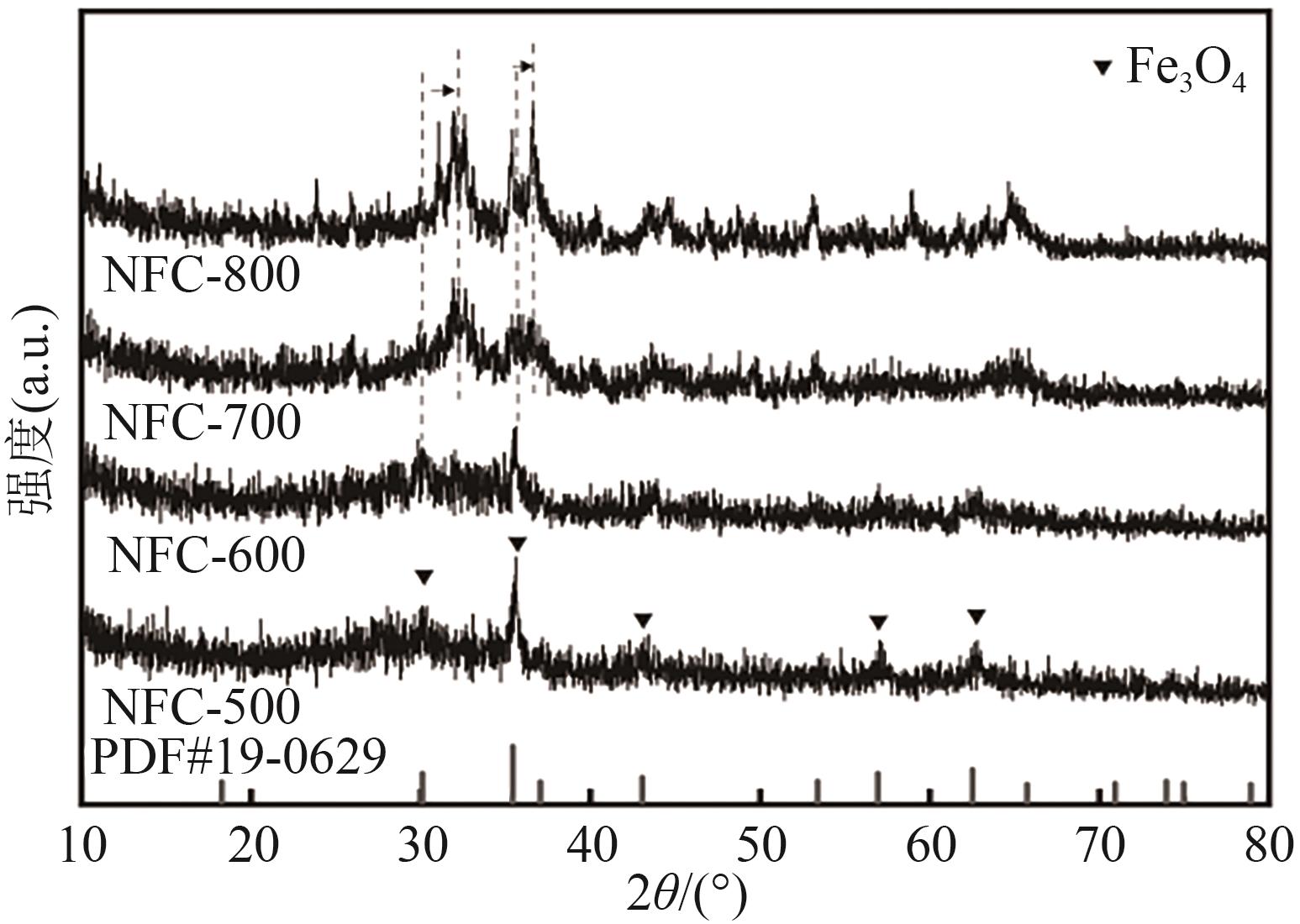
图1 不同类型材料的XRD图
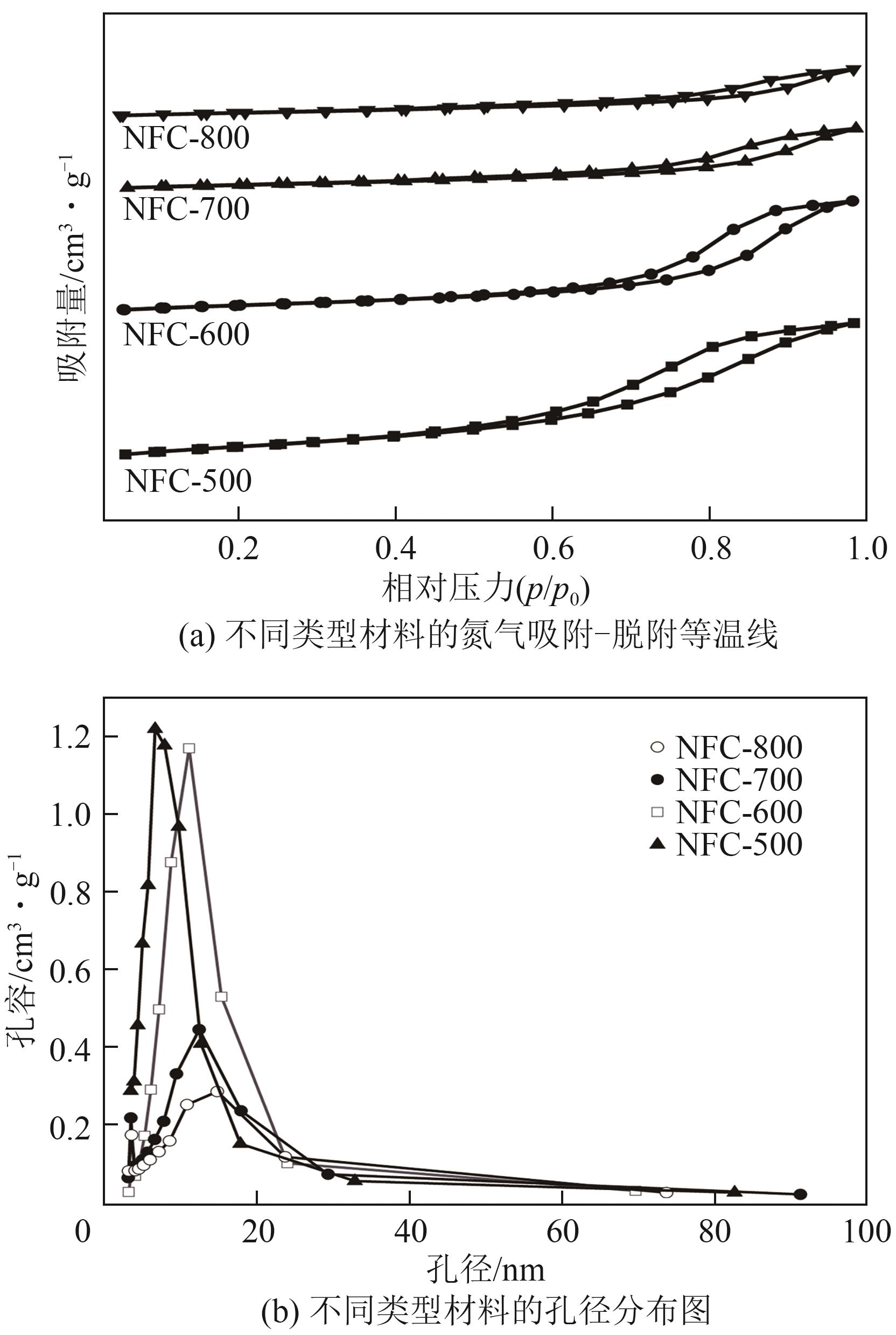
图2 不同类型材料的氮气吸附-脱附等温线和孔径分布图
| 样品 | 比表面积/m2·g-1 | 总孔容/cm3·g-1 | 平均孔径/nm |
|---|---|---|---|
| NFC-500 | 289.18 | 0.511 | 6.6 |
| NFC-600 | 170.50 | 0.407 | 11.1 |
| NFC-700 | 95.56 | 0.229 | 3.4 |
| NFC-800 | 73.64 | 0.180 | 3.5 |
表2 NFC-500、NFC-600、 NFC-700和NFC-800的孔隙结构参数
| 样品 | 比表面积/m2·g-1 | 总孔容/cm3·g-1 | 平均孔径/nm |
|---|---|---|---|
| NFC-500 | 289.18 | 0.511 | 6.6 |
| NFC-600 | 170.50 | 0.407 | 11.1 |
| NFC-700 | 95.56 | 0.229 | 3.4 |
| NFC-800 | 73.64 | 0.180 | 3.5 |
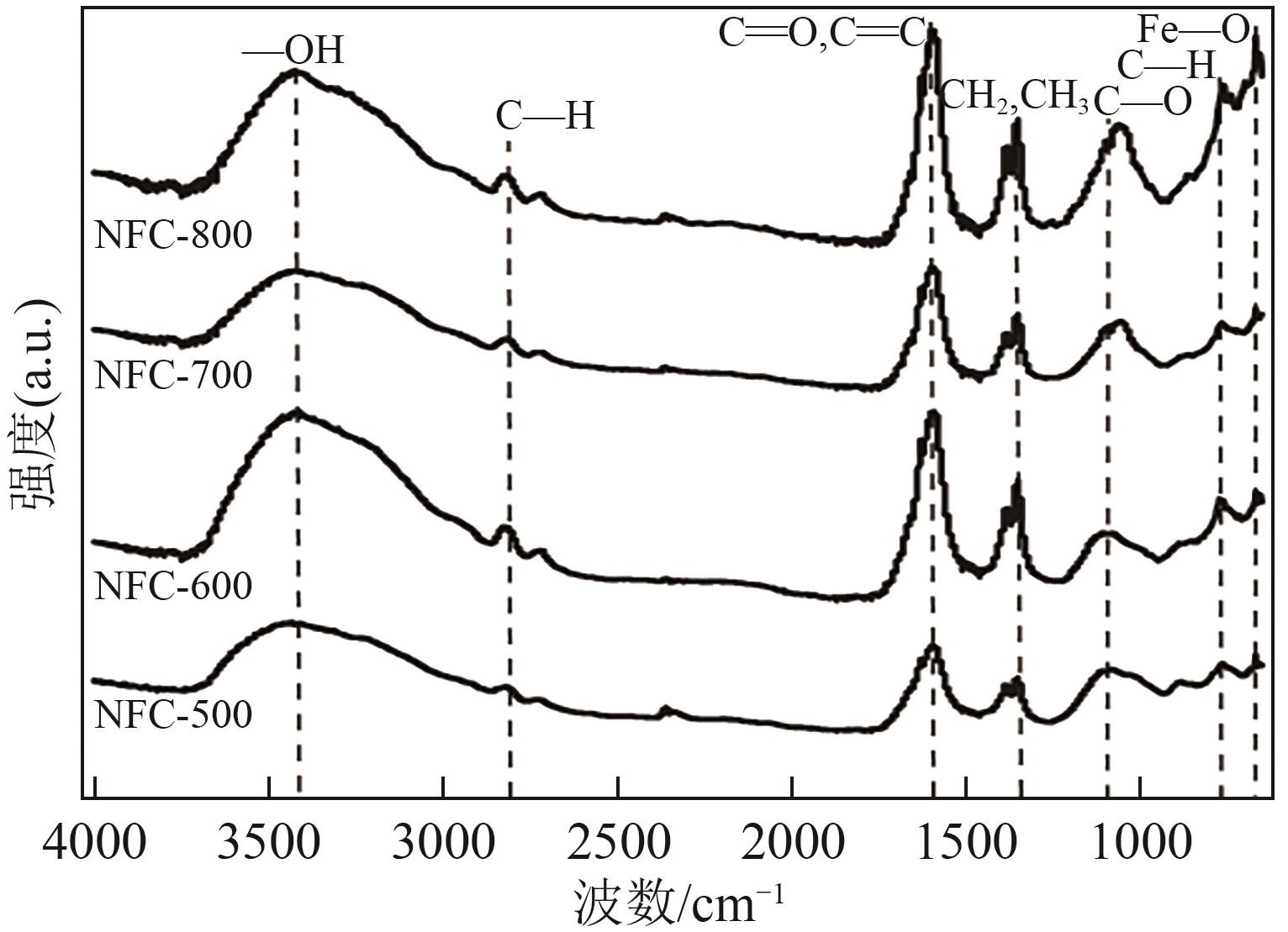
图3 不同类型材料的FTIR图
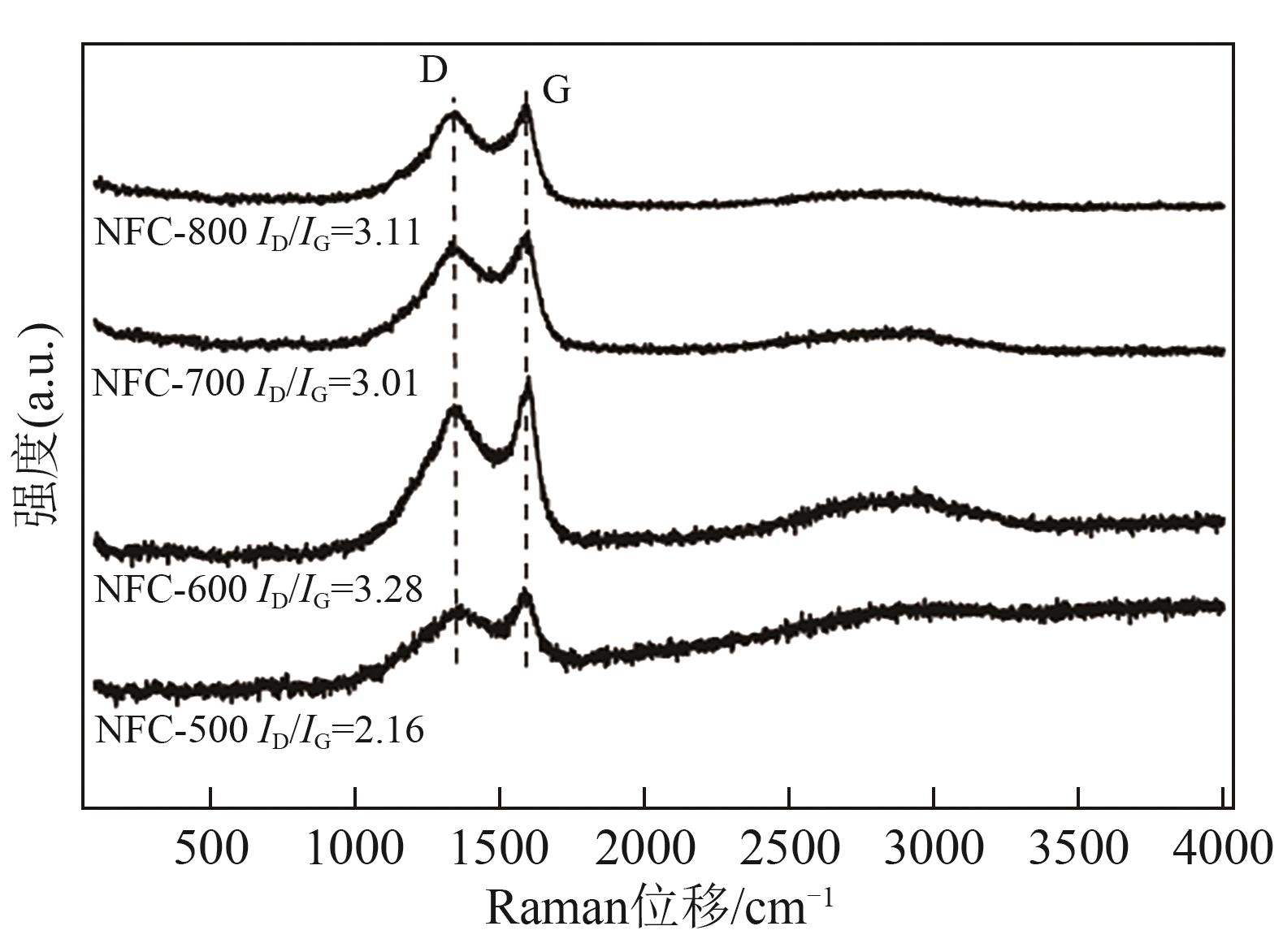
图4 不同类型材料的拉曼光谱图
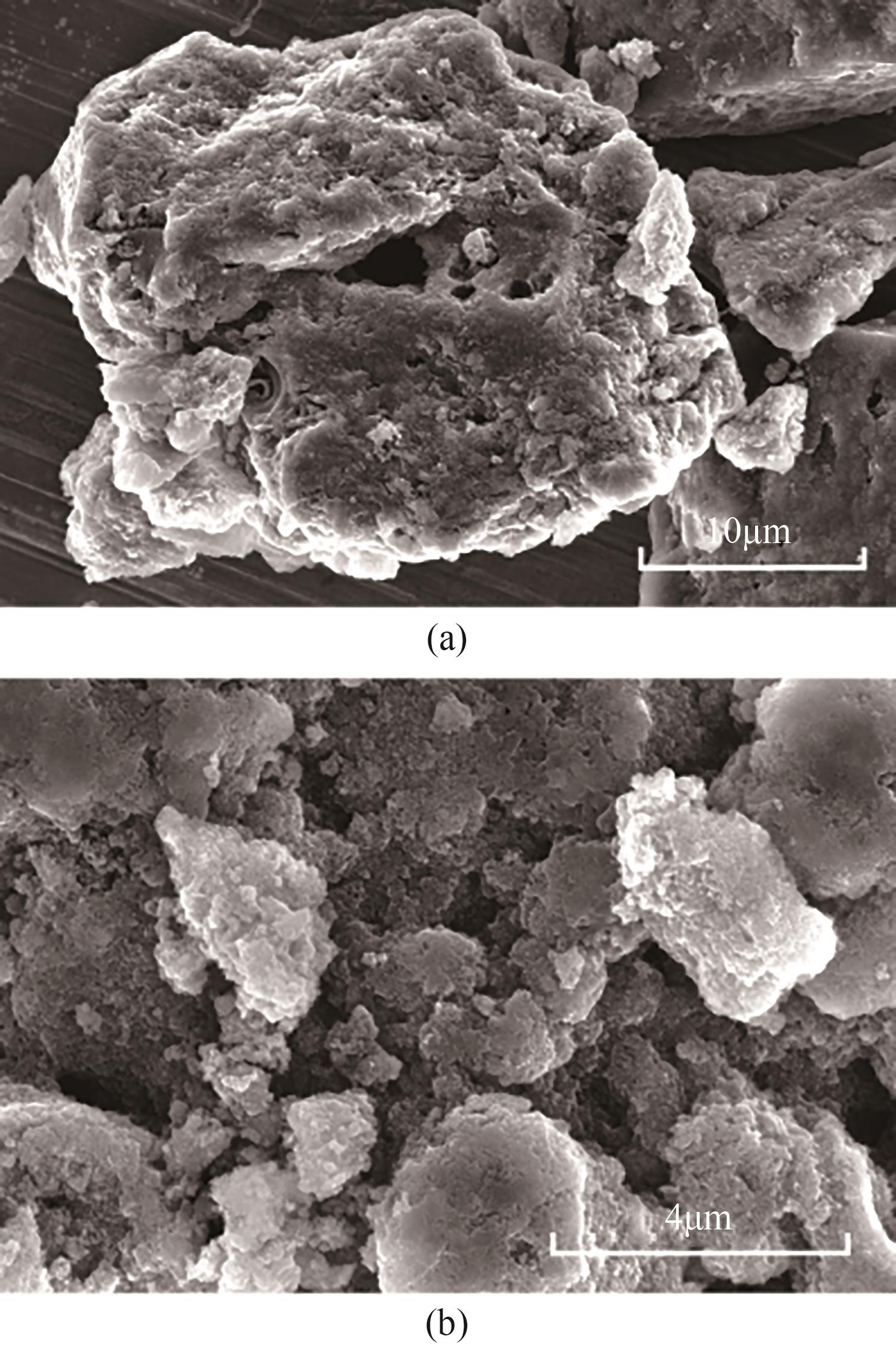
图5 NFC-600的SEM图
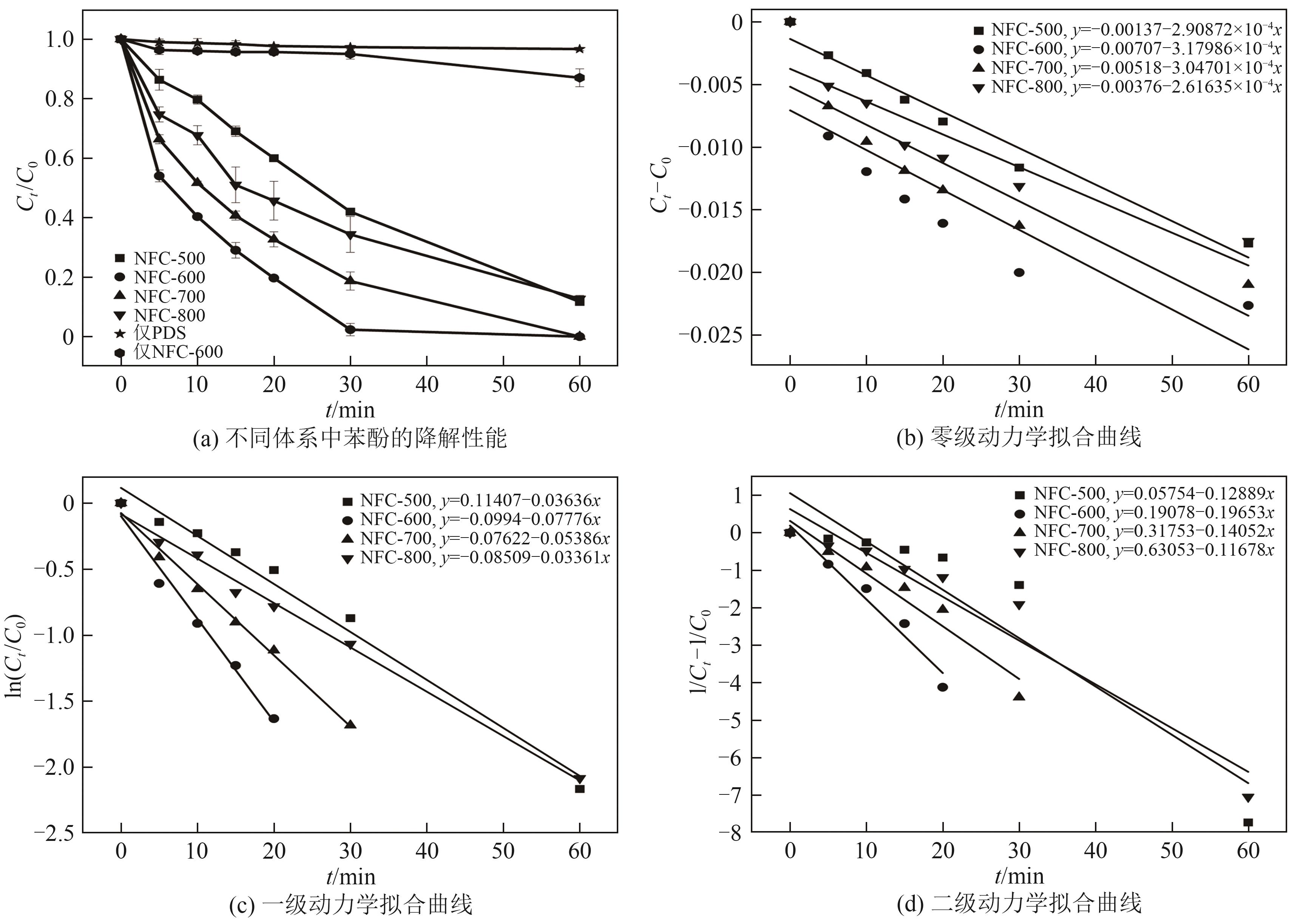
图6 不同体系中苯酚的降解性能以及不同Fe/C催化剂/PDS体系中苯酚的催化降解的零级动力学拟合曲线、一级动力学拟合曲线和二级动力学拟合曲线(实验条件:C苯酚=20mg/L,pH=6.5,C催化剂=0.5g/L,CPDS=1g/L,25℃)
| 不同体系 | 零级反应 | 一级反应 | 二级反应 | |||
|---|---|---|---|---|---|---|
| k/min-1 | R2 | k/min-1 | R2 | k/min-1 | R2 | |
| NFC-500/PDS | 2.9087×10⁻⁴ | 0.970 | 0.03636 | 0.984 | 0.12889 | 0.885 |
| NFC-600/PDS | 3.1799×10⁻⁴ | 0.735 | 0.07776 | 0.982 | 0.19653 | 0.962 |
| NFC-700/PDS | 3.0470×10⁻⁴ | 0.826 | 0.05386 | 0.992 | 0.14052 | 0.944 |
| NFC-800/PDS | 2.6163×10⁻⁴ | 0.855 | 0.03361 | 0.993 | 0.11678 | 0.938 |
表3 不同Fe/C催化剂/过硫酸盐体系降解速率常数
| 不同体系 | 零级反应 | 一级反应 | 二级反应 | |||
|---|---|---|---|---|---|---|
| k/min-1 | R2 | k/min-1 | R2 | k/min-1 | R2 | |
| NFC-500/PDS | 2.9087×10⁻⁴ | 0.970 | 0.03636 | 0.984 | 0.12889 | 0.885 |
| NFC-600/PDS | 3.1799×10⁻⁴ | 0.735 | 0.07776 | 0.982 | 0.19653 | 0.962 |
| NFC-700/PDS | 3.0470×10⁻⁴ | 0.826 | 0.05386 | 0.992 | 0.14052 | 0.944 |
| NFC-800/PDS | 2.6163×10⁻⁴ | 0.855 | 0.03361 | 0.993 | 0.11678 | 0.938 |
| 不同体系 | 铁离子浸出/mg·L-1 |
|---|---|
| NFC-500/PDS | 0.97 |
| NFC-600/PDS | 0.845 |
| NFC-700/PDS | 0.9 |
| NFC-800/PDS | 0.97 |
表4 不同体系降解苯酚60min后铁离子浸出情况
| 不同体系 | 铁离子浸出/mg·L-1 |
|---|---|
| NFC-500/PDS | 0.97 |
| NFC-600/PDS | 0.845 |
| NFC-700/PDS | 0.9 |
| NFC-800/PDS | 0.97 |
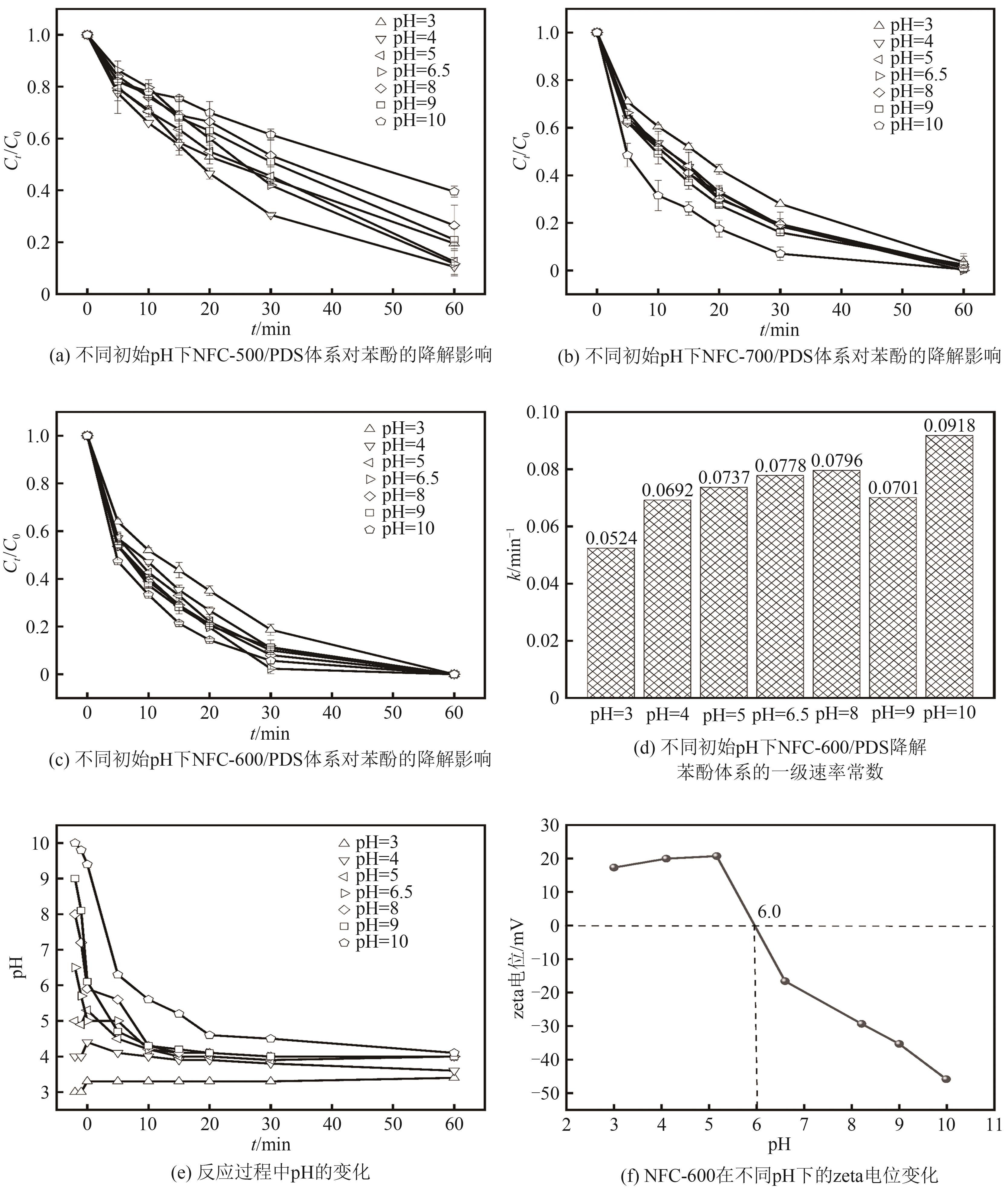
图7 不同初始pH下NFC-500/PDS、NFC-700/PDS和NFC-600/PDS体系对苯酚的降解影响,NFC-600/PDS降解苯酚体系的一级速率常数和反应过程中pH的变化,以及NFC-600在不同pH下的zeta电位变化(实验条件:C苯酚=20mg/L,C催化剂=0.5g/L,CPDS=1g/L,25℃)
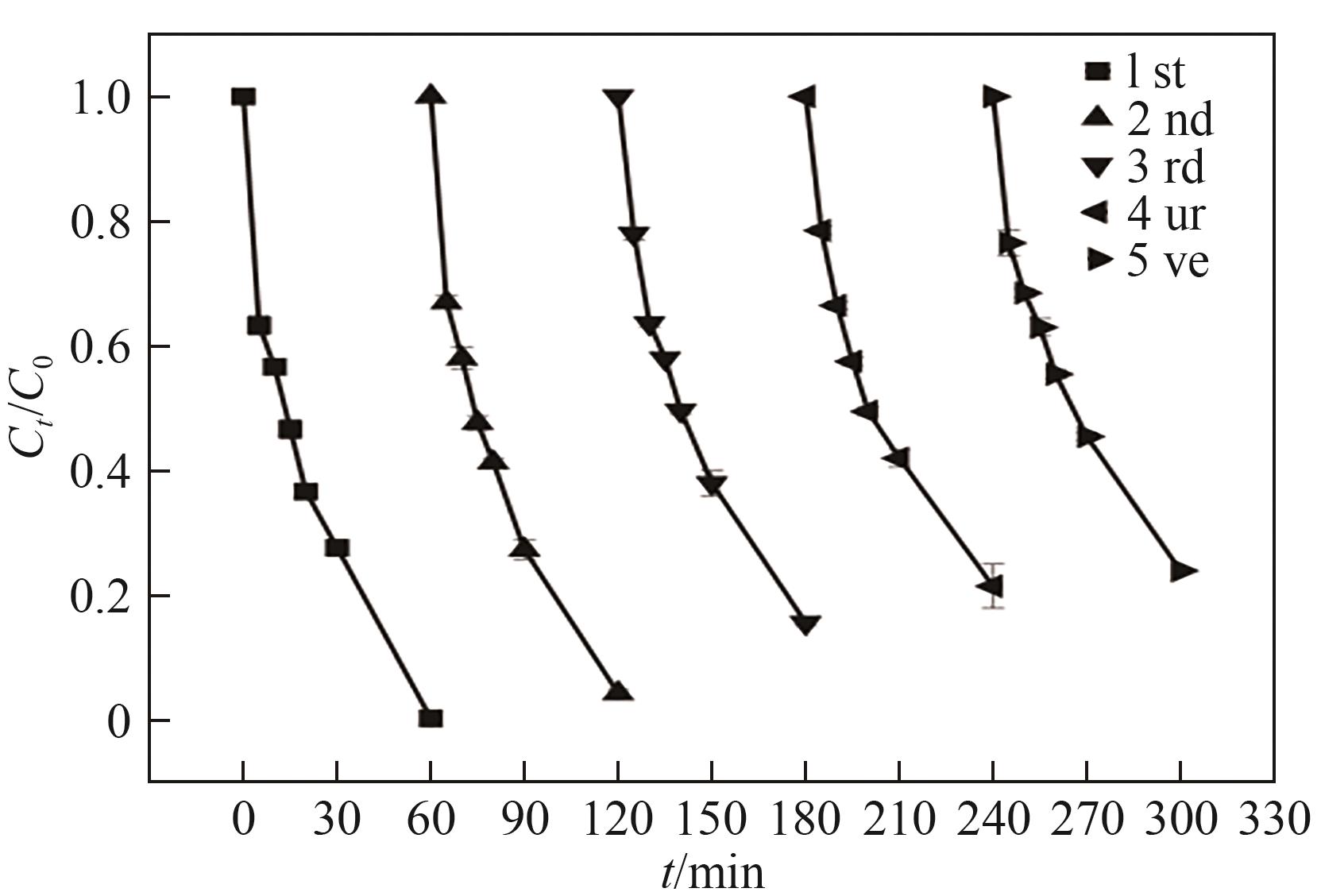
图8 NFC-600催化剂的稳定性实验
| 催化剂 | 催化剂用量/g·L-1 | PDS剂量/g·L-1 | 苯酚浓度/mg·L-1 | 去除效率/% | k/min-1 | pH | 稳定性 | 参考文献 |
|---|---|---|---|---|---|---|---|---|
| N-BC | 0.4 | 1.0 | 50 | 98.8(120min) | 0.0334 | 3~11(2h, 90%) | 循环4次(47.5%) | [ |
| Fe3O4/NC | 1.0 | 2.0 | 20 | 100(120min) | — | 3~9(2h, 95%) | 循环5次(84.3%) | [ |
| nZVI-BC | 0.4 | 0.8 | 50 | 100(60min) | 0.1049 | 3~9(2.5h, 85.72%) | 循环3次(84.5%) | [ |
| FeS@NBCBM | 0.4 | 1.6 | 50 | 92.7(60min) | 0.0316 | 3~9(2.5h, 85.72%) | 循环3次(65%) | [ |
| ZSBC | 1.0 | 1.0 | 50 | 100(180min) | 0.04 | 3~11(2h, 70.7%) | 循环2次(64.5%) | [ |
| B-nZVI | 0.5 | 0.2 | 10 | 73.6(30min) | — | — | — | [ |
| FeO | 0.3 | 0.2 | 0.9 | 97.8(30min) | 0.2359 | 4~8(0.5h, 18.2%) | — | [ |
| GNS TBC900 | 0.1 | 0.4 | 9.4 | 99(180min) | 0.023 | — | 循环3次 (80%) | [ |
| NFC-600 | 0.5 | 1.0 | 20 | 100(30min) | 0.0778 | 3~10(1h, 100%) | 循环5次 (76%) | 本文 |
表5 各种异质过硫酸盐活化材料去除苯酚的实验参数
| 催化剂 | 催化剂用量/g·L-1 | PDS剂量/g·L-1 | 苯酚浓度/mg·L-1 | 去除效率/% | k/min-1 | pH | 稳定性 | 参考文献 |
|---|---|---|---|---|---|---|---|---|
| N-BC | 0.4 | 1.0 | 50 | 98.8(120min) | 0.0334 | 3~11(2h, 90%) | 循环4次(47.5%) | [ |
| Fe3O4/NC | 1.0 | 2.0 | 20 | 100(120min) | — | 3~9(2h, 95%) | 循环5次(84.3%) | [ |
| nZVI-BC | 0.4 | 0.8 | 50 | 100(60min) | 0.1049 | 3~9(2.5h, 85.72%) | 循环3次(84.5%) | [ |
| FeS@NBCBM | 0.4 | 1.6 | 50 | 92.7(60min) | 0.0316 | 3~9(2.5h, 85.72%) | 循环3次(65%) | [ |
| ZSBC | 1.0 | 1.0 | 50 | 100(180min) | 0.04 | 3~11(2h, 70.7%) | 循环2次(64.5%) | [ |
| B-nZVI | 0.5 | 0.2 | 10 | 73.6(30min) | — | — | — | [ |
| FeO | 0.3 | 0.2 | 0.9 | 97.8(30min) | 0.2359 | 4~8(0.5h, 18.2%) | — | [ |
| GNS TBC900 | 0.1 | 0.4 | 9.4 | 99(180min) | 0.023 | — | 循环3次 (80%) | [ |
| NFC-600 | 0.5 | 1.0 | 20 | 100(30min) | 0.0778 | 3~10(1h, 100%) | 循环5次 (76%) | 本文 |
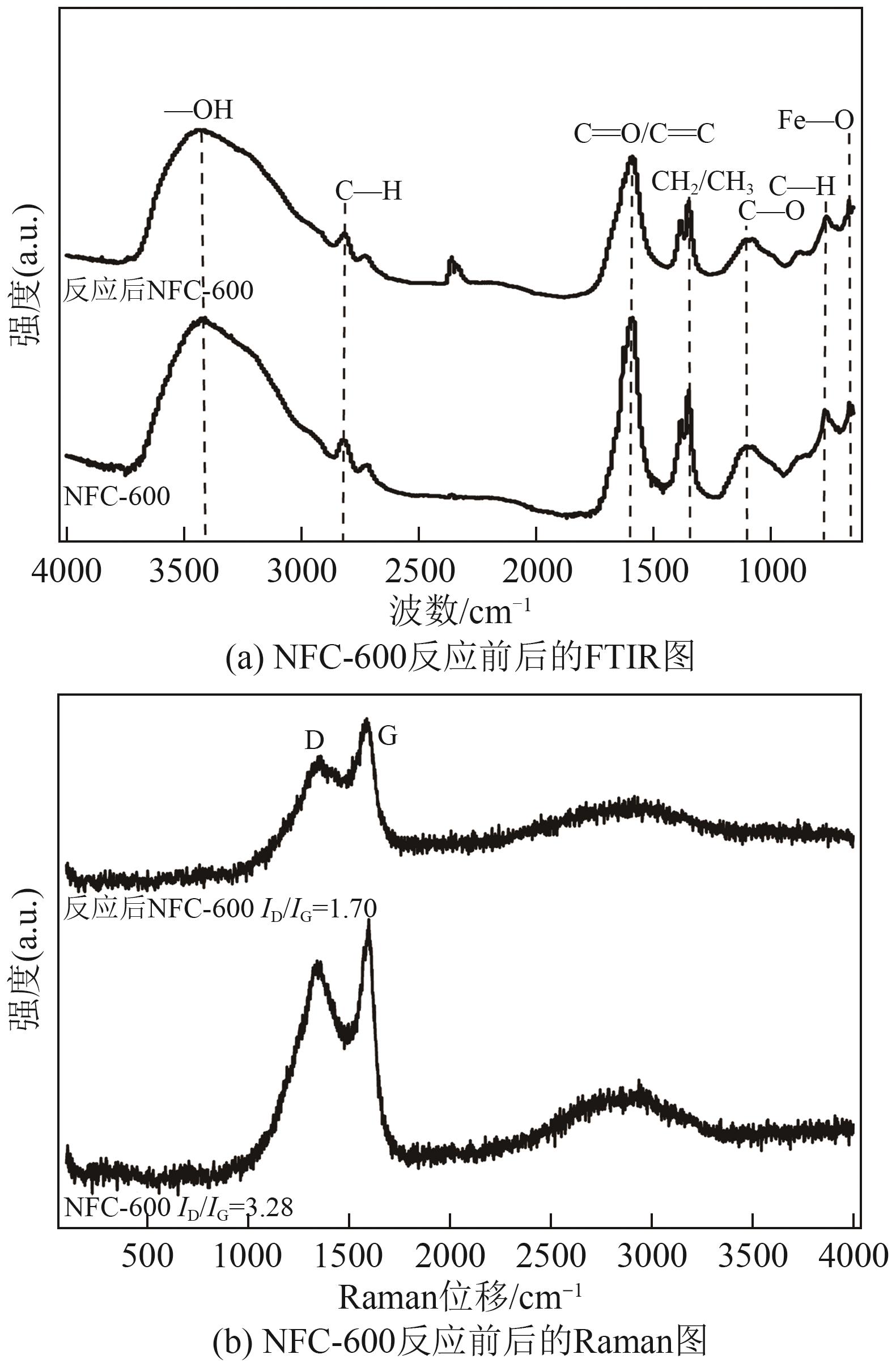
图9 NFC-600反应前后的FTIR和Raman图
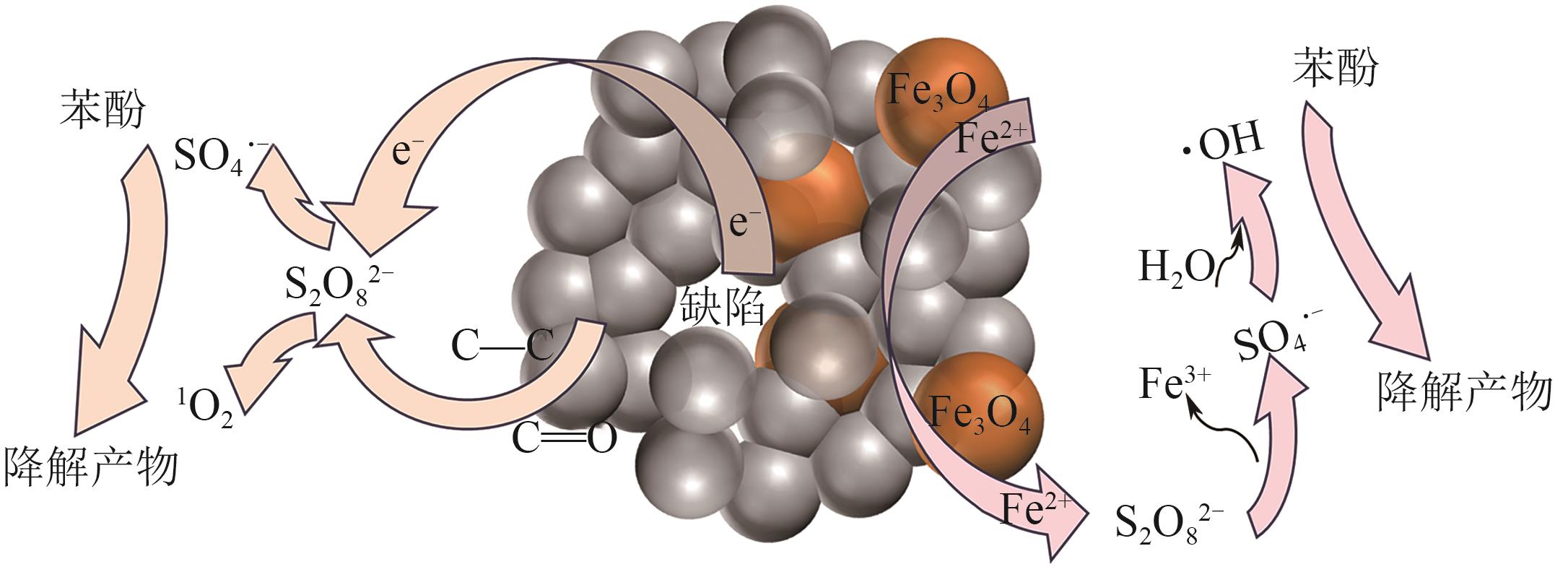
图10 反应机理图
| 中间产物 | 分子式 | 分子量 | 质荷比 |
|---|---|---|---|
| 苯酚(phenol) | C6H5OH | 94.11 | 94.06 |
| 对苯二酚(hydroquinone) | C6H6O2 | 110.11 | 110.01 |
| 邻苯二酚(catechol) | C6H6O2 | 110.11 | 110.01 |
| 四羟基联苯(3,3,4,4-tetrahydroxybiphenyls) | C12H10O4 | 218.21 | 217.05 |
| 对苯醌(1,4-benzoquinone) | C6H4O2 | 108.10 | 108.07 |
| 1,2-苯醌(1,2-benzoquinone) | C6H4O2 | 108.10 | 108.07 |
| 羟基对苯二酚(hydroxy-terephthaquinone) | C6H4O3 | 124.09 | 123.06 |
| 富马酸(fumaric acid) | C4H4O4 | 116.07 | 116.10 |
| 己二烯二酸(muconic acid) | C6H6O4 | 142.11 | 142.15 |
| 马来酸(maleic acid) | C4H4O4 | 116.07 | 115.09 |
| 醋酸(acetic acid) | CH3COOH | 60.05 | 58.95 |
| 草酸(oxalic acid) | C2H2O4 | 90.03 | 88.98 |
| 碳酸(carbonic acid) | CH2O3 | 62.02 | 60.09 |
表6 苯酚降解过程中的中间产物
| 中间产物 | 分子式 | 分子量 | 质荷比 |
|---|---|---|---|
| 苯酚(phenol) | C6H5OH | 94.11 | 94.06 |
| 对苯二酚(hydroquinone) | C6H6O2 | 110.11 | 110.01 |
| 邻苯二酚(catechol) | C6H6O2 | 110.11 | 110.01 |
| 四羟基联苯(3,3,4,4-tetrahydroxybiphenyls) | C12H10O4 | 218.21 | 217.05 |
| 对苯醌(1,4-benzoquinone) | C6H4O2 | 108.10 | 108.07 |
| 1,2-苯醌(1,2-benzoquinone) | C6H4O2 | 108.10 | 108.07 |
| 羟基对苯二酚(hydroxy-terephthaquinone) | C6H4O3 | 124.09 | 123.06 |
| 富马酸(fumaric acid) | C4H4O4 | 116.07 | 116.10 |
| 己二烯二酸(muconic acid) | C6H6O4 | 142.11 | 142.15 |
| 马来酸(maleic acid) | C4H4O4 | 116.07 | 115.09 |
| 醋酸(acetic acid) | CH3COOH | 60.05 | 58.95 |
| 草酸(oxalic acid) | C2H2O4 | 90.03 | 88.98 |
| 碳酸(carbonic acid) | CH2O3 | 62.02 | 60.09 |
| [1] | FAN Xinfei, LI Shanshan, SUN Menghan, et al. Degradation of phenol by coal-based carbon membrane integrating sulfate radicals-based advanced oxidation processes[J]. Ecotoxicology and Environmental Safety, 2019, 185: 109662. |
| [2] | PRABHU Shweta, MOLATH Aleena, CHOKSI Hinal, et al. Classifications of polyphenols and their potential application in human health and diseases[J]. International Journal of Physiology, Nutrition and Physical Education, 2021, 6(1): 293-301. |
| [3] | CHAE Yooeun, KIM Lia, KIM Dokyung, et al. Deriving hazardous concentrations of phenol in soil ecosystems using a species sensitivity distribution approach[J]. Journal of Hazardous Materials, 2020, 399: 123036. |
| [4] | VAIANO V, MATARANGOLO M, MURCIA J J, et al. Enhanced photocatalytic removal of phenol from aqueous solutions using ZnO modified with Ag[J]. Applied Catalysis B: Environmental, 2018, 225: 197-206. |
| [5] | ZAGHLOUL Ghada Y, MOHAMEDEIN Lamiaa I, KELANY Mahmoud S, et al. Impact of total phenolic compounds on ecological and health risks of water and sediments from Timsah Lake, Suez Canal, Egypt[J]. Environmental Science and Pollution Research, 2024, 31(33): 45667-45682. |
| [6] | XIN Ke, XUN Sun, ZHENG Yan, et al. Distributions, compositions, and ecological risk assessment of typical pollutants in surface sediment of Xihe river, China[J]. Research Square, 2021, 152: 110923. |
| [7] | SUN Jianfei, MU Qin, KIMURA Hideo, et al. Oxidative degradation of phenols and substituted phenols in the water and atmosphere: A review[J]. Advanced Composites and Hybrid Materials, 2022, 5(2): 627-640. |
| [8] | MACÍAS-QUIROGA Iván F, HENAO-AGUIRRE Paula A, Alexander MARÍN-FLÓREZ, et al. Bibliometric analysis of advanced oxidation processes (AOPs) in wastewater treatment: Global and Ibero-American research trends[J]. Environmental Science and Pollution Research, 2021, 28(19): 23791-23811. |
| [9] | HUANG Yunxin, ZHAO Shouyan, CHEN Keyu, et al. A review of persulfate-based advanced oxidation system for decontaminating organic wastewater via non-radical regime[J]. Frontiers of Environmental Science & Engineering, 2024, 18(11): 134. |
| [10] | LE MINH TRI Nguyen, THANG Phan Quang, TAN Lam Van, et al. Removal of phenolic compounds from wastewaters by using synthesized Fe-nano zeolite[J]. Journal of Water Process Engineering, 2020, 33: 101070. |
| [11] | WU Liying, LI Zhuoyu, CHENG Pingtong, et al. Efficient activation of peracetic acid by mixed sludge derived biochar: Critical role of persistent free radicals[J]. Water Research, 2022, 223: 119013. |
| [12] | ZHANG Tianfu, LIU Wei, HAN Junwei, et al. Selective separation of calcium from zinc-rich neutralization sludge by sulfidation roasting and HCl leaching[J]. Separation and Purification Technology, 2021, 259: 118064. |
| [13] | SHI Chunhong, ZHANG Yuqi, ZHOU Shuo, et al. Status of research on the resource utilization of stainless steel pickling sludge in China: A review[J]. Environmental Science and Pollution Research International, 2023, 30(39): 90223-90242. |
| [14] | 苍大强, 张玲玲, 刘洋, 等. 国内外钢铁工业固相二次资源利用现状、存在问题与对策[J]. 过程工程学报, 2022, 22(10): 1418-1424. |
| CANG Daqiang, ZHANG Lingling, LIU Yang, et al. Secondary resources utilization, problems and countermeasures of the domestic and oversea steel industry[J]. The Chinese Journal of Process Engineering, 2022, 22(10): 1418-1424. | |
| [15] | HOU Meifang, GUO Yuanyuan, CHEN Xiaoyang, et al. Preparation, characterization and catalytic performance of paper mill sludge and municipal wastewater treatment sludge-based catalysts for Fenton-like oxidation of Rhodamine B[J]. Desalination and Water Treatment, 2017, 84: 190-198. |
| [16] | HUANG Baocheng, JIANG Jun, HUANG Guixiang, et al. Sludge biochar-based catalysts for improved pollutant degradation by activating peroxymonosulfate[J]. Journal of Materials Chemistry A, 2018, 6(19): 8978-8985. |
| [17] | WU Jingqi, WANG Tongshuai, LIU Yuyan, et al. Norfloxacin adsorption and subsequent degradation on ball-milling tailored N-doped biochar[J]. Chemosphere, 2022, 303: 135264. |
| [18] | 徐皓普, 汤波. 碱改性生物炭处理含Cd2+废水效果对比研究[J]. 环境科学与管理, 2022, 47(6): 82-85. |
| XU Haopu, TANG Bo. Study on adsorption mechanism of Cd2+ wastewater by modified biochar[J]. Environmental Science and Management, 2022, 47(6): 82-85. | |
| [19] | JIANG Qun, JIANG Simeng, LI Hui, et al. A stable biochar supported S-nZVI to activate persulfate for effective dichlorination of atrazine[J]. Chemical Engineering Journal, 2022, 431: 133937. |
| [20] | SU Pei, FU Wenyang, DU Xuedong, et al. Confined Fe0@CNTs for highly efficient and super stable activation of persulfate in wide pH ranges: Radicals and non-radical co-catalytic mechanism[J]. Chemical Engineering Journal, 2021, 420: 129446. |
| [21] | SONG Xiangru, LIU Jia, JIANG Qing, et al. Enhanced electron transfer and methane production from low-strength wastewater using a new granular activated carbon modified with nano-Fe3O4 [J]. Chemical Engineering Journal, 2019, 374: 1344-1352. |
| [22] | 徐东卫, 张明举, 申志豪, 等. 氮掺杂碳纳米管原位封装磁性粒子异质结构(Fe3O4@NCNTs)及其轻质宽频吸波性能[J]. 材料研究学报, 2024, 38(6): 430-436. |
| XU Dongwei, ZHANG Mingju, SHEN Zhihao, et al. Microwave absorption performance of encapsulated magnetic particles with nitrogen-doped carbon nanotubes Fe3O4@NCNTs[J]. Chinese Journal of Materials Research, 2024, 38(6): 430-436. | |
| [23] | INDRAYANA I P T, TJUANA L A, TUNY M T, et al. Nanostructure and optical properties of Fe3O4: Effect of calcination temperature and dwelling time[J]. Journal of Physics: Conference Series, 2019, 1341(8): 082044. |
| [24] | KARUME Ibrahim, BBUMBA Simon, TEWOLDE Simon, et al. Impact of carbonization conditions and adsorbate nature on the performance of activated carbon in water treatment[J]. BMC Chemistry, 2023, 17(1): 162. |
| [25] | WU Wei, ZHU Shishu, HUANG Xiaochen, et al. Mechanisms of persulfate activation on biochar derived from two different sludges: Dominance of their intrinsic compositions[J]. Journal of Hazardous Materials, 2021, 408: 124454. |
| [26] | GONG Chuangxin, LIN Wei, DING Xiuxiang, et al. A three-stage process of Mn(Ⅶ)-Fe(Ⅲ)/PDS system for enhancing sludge dewaterability: Effective driving of Fe(Ⅱ)/Fe(Ⅲ) cycle and adequate assurance of ROS[J]. Separation and Purification Technology, 2024, 330: 125377. |
| [27] | GUO Qianqian, QIAO Shixuan, ZHANG Dongming, et al. A comparison of hydrothermal carbonization versus pyrolysis-activation for sludge-derived carbon materials on physiochemical properties and electrochemical performance[J]. Biomass and Bioenergy, 2024, 182: 107079. |
| [28] | YANG Haiping, YAN Rong, CHEN Hanping, et al. Characteristics of hemicellulose, cellulose and lignin pyrolysis[J]. Fuel, 2007, 86(12/13): 1781-1788. |
| [29] | LIANG Jun, XU Xiaoyun, ZHONG Qijun, et al. Roles of the mineral constituents in sludge-derived biochar in persulfate activation for phenol degradation[J]. Journal of Hazardous Materials, 2020, 398: 122861. |
| [30] | DUAN Ran, MA Shuanglong, XU Shengjun, et al. Soybean straw biochar activating peroxydisulfate to simultaneously eliminate tetracycline and tetracycline resistance bacteria: Insights on the mechanism[J]. Water Research, 2022, 218: 118489. |
| [31] | FU Haichao, ZHAO Peng, XU Shengjun, et al. Fabrication of Fe3O4 and graphitized porous biochar composites for activating peroxymonosulfate to degrade p-hydroxybenzoic acid: Insights on the mechanism[J]. Chemical Engineering Journal, 2019, 375: 121980. |
| [32] | HU Peidong, SU Hanrui, CHEN Zhenyu, et al. Selective degradation of organic pollutants using an efficient metal-free catalyst derived from carbonized polypyrrole via peroxymonosulfate activation[J]. Environmental Science & Technology, 2017, 51(19): 11288-11296. |
| [33] | 冯琪瑞, 唐玉朝, 王坤, 等. UV/乙酰丙酮高级氧化体系降解甲基橙的反应机理研究[J]. 环境科学与技术, 2023, 46(12): 29-38. |
| FENG Qirui, TANG Yuchao, WANG Kun, et al. Study on treatment of methyl orange printing/dyeing wastewater by advnaced UV/acetylacetone system[J]. Environmental Science & Technology, 2023, 46(12): 29-38. | |
| [34] | ZHAO Xin, AN Qingda, XIAO Zuoyi, et al. One-step preparation of Fe x O y /N-GN/CNTs heterojunctions as a peroxymonosulfate activator for relatively highly-efficient methylene blue degradation[J]. Chinese Journal of Catalysis, 2018, 39(11): 1842-1853. |
| [35] | YU Qinghui, TANG Mengshuang, LIU Guotao, et al. Phenol removal by activation of persulfate using magnetic carbon generated from sludge and steel converter slag[J]. Chemical Engineering and Processing - Process Intensification, 2023, 186: 109313. |
| [36] | LI Maolin, CHEN Guofang. Revisiting catalytic model reaction p-nitrophenol/NaBH4 using metallic nanoparticles coated on polymeric spheres[J]. Nanoscale, 2013, 5(23): 11919-11927. |
| [37] | ZHENG Wan, XIAO Xin, CHEN Baoliang. A nonradical reaction-dominated phenol degradation with peroxydisulfate catalyzed by nitrogen-doped graphene[J]. Science of the Total Environment, 2019, 667: 287-296. |
| [38] | LU Li, TANG Diyong, LUO Zhipeng, et al. Water hyacinth derived hierarchical porous biochar absorbent: Ideal peroxydisulfate activator for efficient phenol degradation via an electron-transfer pathway[J]. Environmental Research, 2024, 242: 117773. |
| [39] | AHMAD Mushtaque, TEEL Amy L, WATTS Richard J. Mechanism of persulfate activation by phenols[J]. Environmental Science & Technology, 2013, 47(11): 5864-5871. |
| [40] | REN Wei, XIONG Liangliang, NIE Gang, et al. Insights into the electron-transfer regime of peroxydisulfate activation on carbon nanotubes: The role of oxygen functional groups[J]. Environmental Science & Technology, 2020, 54(2): 1267-1275. |
| [41] | FAN Zhixuan, FENG Tao, WU Si, et al. Chitin-derived biochar with nitrogen doping to activate persulfate for phenol degradation: Application potential and electron transfer pathway in system[J]. Chemosphere, 2023, 330: 138641. |
| [42] | 王佩佩, 杨岚, 魏学锋, 等. 氮掺杂碳负载Fe3O4活化过硫酸盐降解苯酚[J]. 化工环保, 2023, 43(3): 339-345. |
| WANG Peipei, YANG Lan, WEI Xuefeng, et al. Activation of persulfate by nitrogen-doped carbon supported Fe3O4 for phenol degradation[J]. Environmental Protection of Chemical Industry, 2023, 43(3): 339-345. | |
| [43] | CAO Bo, QU Jianhua, CHU Yingyu, et al. One-step self-assembly of Fe-biochar composite for enhanced persulfate activation to phenol degradation: Different active sites-induced radical/non-radical mechanism[J]. Chemosphere, 2023, 322: 138168. |
| [44] | QU Jianhua, XU Yuan, ZHANG Xiubo, et al. Ball milling-assisted preparation of N-doped biochar loaded with ferrous sulfide as persulfate activator for phenol degradation: Multiple active sites-triggered radical/non-radical mechanism[J]. Applied Catalysis B: Environmental, 2022, 316: 121639. |
| [45] | BAO Kai, YAN Chongchong, NIU Deli, et al. Persulfate oxidation enhanced extraction to improve the removal of high concentration phenol wastewater[J]. Environmental Science: Water Research & Technology, 2022, 8(5): 981-997. |
| [46] | DIAO Zenghui, XU Xiangrong, CHEN Hui, et al. Simultaneous removal of Cr(Ⅵ) and phenol by persulfate activated with bentonite-supported nanoscale zero-valent iron: Reactivity and mechanism[J]. Journal of Hazardous Materials, 2016, 316: 186-193. |
| [47] | ZHANG Jun, LI Shiyao, XIANG Haotian, et al. Exploring the peroxydisulfate activation by carbon nanotubes for pollutants degradation: Identification of the primary reaction mechanism and key molecular descriptor[J]. Journal of Environmental Chemical Engineering, 2024, 12(2): 112495. |
| [48] | ZHU Shishu, JIN Chao, DUAN Xiaoguang, et al. Nonradical oxidation in persulfate activation by graphene-like nanosheets (GNS): Differentiating the contributions of singlet oxygen (1O2) and sorption-dependent electron transfer[J]. Chemical Engineering Journal, 2020, 393: 124725. |
| [49] | DONG Hao, ZHANG Siyu, GUO Chunli, et al. Amorphous carbon from coal slime for efficient degradation of phenol by non-free radical activation of peroxymonosulfate[J]. Fuel, 2024, 373: 132285. |
| [50] | WEI Yu, LEI Xuefei, LUO Shaohua, et al. Effect of pore-forming agent on degradation of phenol by iron tailings based porous ceramics[J]. Ceramics International, 2024, 50(18): 33791-33801. |
| [51] | XIA Qixing, JIANG Zhaohua, LI Dongqi, et al. Green synthesis of a dendritic Fe3O4@FeO composite modified with polar C-groups for Fenton-like oxidation of phenol[J]. Journal of Alloys and Compounds, 2018, 746: 453-461. |
| [52] | SANG Wenjiao, XU Xinyang, ZHAN Cheng, et al. Recent advances of antibiotics degradation in different environment by iron-based catalysts activated persulfate: A review[J]. Journal of Water Process Engineering, 2022, 49: 103075. |
| [53] | MIAO Xiaozeng, CHEN Xiliang, WU Wenhao, et al. Intrinsic defects enhanced biochar/peroxydisulfate oxidation capacity through electron-transfer regime[J]. Chemical Engineering Journal, 2022, 438: 135606. |
| [54] | CHEN Hongliang, LONG Qian, WEI Fuhua. Heterogeneous activation of peroxide via acid-modified red mud for the degradation of phenol[J]. Desalination and Water Treatment, 2023, 283: 209-221. |
| [55] | OTHMAN Israa, HISHAM ZAIN Jerina, HAIJA Mohammad ABU, et al. Catalytic activation of peroxymonosulfate using CeVO4 for phenol degradation: An insight into the reaction pathway[J]. Applied Catalysis B: Environmental, 2020, 266: 118601. |
| [56] | SUN Zhiming, ZHANG Xinchao, YANG Zhongqing, et al. Efficient peroxymonosulfate activation of immobilized Fe-N-C catalyst on ceramsite for the continuous flow removal of phenol[J]. Chemosphere, 2022, 307: 136149. |
| [1] | 王晓光, 董青, 郎文丽, 洪翔鑫, 黄振祥, 谭凤玉, 雷以柱, 余子夷. 超低浓度甲烷减排与资源化利用研究进展[J]. 化工进展, 2025, 44(9): 5363-5376. |
| [2] | 刘晓峰, 陈小向, 赖文忠, 肖旺钏, 池汝安, 韩庆文, 田民权. 含氟苯酚的合成研究进展[J]. 化工进展, 2025, 44(9): 5234-5254. |
| [3] | 金少青, 范雪研, 唐智谋, 王衍力, 王达锐, 孙洪敏, 杨为民. 基于钛硅分子筛催化的绿色氧化技术进展[J]. 化工进展, 2025, 44(5): 2907-2918. |
| [4] | 袁小鲁, 田宏宇, 李海岩, 苟泽浩, 陆雪峰, 谢方明. 废弃塑料化学回收技术进展[J]. 化工进展, 2025, 44(12): 7205-7213. |
| [5] | 张娟娟, 凌裕, 黎佳茜, 刘雪瑜. PI-g-C3N4光催化剂的制备及其光催化降解苯酚性能[J]. 化工进展, 2025, 44(10): 6102-6114. |
| [6] | 何然, 梁宏, 黄洪, 羊宥郦, 郑强, 李琋. 乙炔黑/Fe3O4阴极制备及电Fenton氧化降解2,4,6-三氯苯酚[J]. 化工进展, 2025, 44(1): 572-582. |
| [7] | 熊小鹤, 张一楠, 张京晶, 杨富鑫, 谭厚章. 基于沉降炉的锅炉耦合掺烧退役风电有机固废实验[J]. 化工进展, 2024, 43(S1): 555-563. |
| [8] | 宋占龙, 汤涛, 潘蔚, 赵希强, 孙静, 毛岩鹏, 王文龙. 微纳米气泡强化臭氧氧化降解含酚废水[J]. 化工进展, 2024, 43(8): 4614-4623. |
| [9] | 王雨菲, 贾宇, 张议升, 薛伟, 李芳, 王延吉. 甲酸为氢源硝基苯转移加氢合成对氨基苯酚[J]. 化工进展, 2024, 43(8): 4421-4431. |
| [10] | 李亚男, 郭凯, 王嘉琪, 武亚宁. 煤气化渣活化过二硫酸盐和过一硫酸盐降解苯酚的比较[J]. 化工进展, 2024, 43(6): 3503-3512. |
| [11] | 杨双霞, 侯建军, 李天津, 陈雷, 孙来芝, 华栋梁. 抗生素菌渣热解技术研究现状及展望[J]. 化工进展, 2024, 43(12): 6933-6943. |
| [12] | 吴佳楠, 张华, 李哲, 徐珊, 尹勇, 张文艺. 牛骨炭载体菌剂(HD)协同蚯蚓生物降解土壤中的2,4-DCP及对微生物群落的影响[J]. 化工进展, 2024, 43(12): 6896-6904. |
| [13] | 王伟涛, 鲍婷玉, 姜旭禄, 何珍红, 王宽, 杨阳, 刘昭铁. 醛酮树脂基非金属催化剂催化氧气氧化苯制备苯酚[J]. 化工进展, 2023, 42(9): 4706-4715. |
| [14] | 张丽宏, 金要茹, 程芳琴. 煤气化渣资源化利用[J]. 化工进展, 2023, 42(8): 4447-4457. |
| [15] | 李文秀, 杨宇航, 黄艳, 王涛, 王镭, 方梦祥. 二氧化碳矿化高钙基固废制备微细碳酸钙研究进展[J]. 化工进展, 2023, 42(4): 2047-2057. |
| 阅读次数 | ||||||
|
全文 |
|
|||||
|
摘要 |
|
|||||