化工进展 ›› 2025, Vol. 44 ›› Issue (11): 6615-6626.DOI: 10.16085/j.issn.1000-6613.2024-1548
• 资源与环境化工 • 上一篇
微纳塑料在饮用水处理过程中的研究进展:归趋、表征与影响特性
朱敏( ), 吴俊康(), 陈蕾, 王郑
- 南京林业大学土木工程学院,江苏 南京 210037
-
收稿日期:2024-09-24修回日期:2024-12-11出版日期:2025-11-25发布日期:2025-12-08 -
通讯作者:吴俊康 -
作者简介:朱敏(1997—),女,硕士研究生,研究方向为供水安全保障技术。E-mail:sylviazm@njfu.edu.cn。 -
基金资助:国家自然科学基金(42077323);江苏省自然科学基金(BK20200778);江苏省高等学校自然科学基金(20KJB560035)
Research progress of micro/nano-plastics in drinking water treatment: Fate, characterization, and influencing characteristics
ZHU Min(), WU Junkang(), CHEN Lei, WANG Zheng
- College of Civil Engineering, Nanjing Forestry University, Nanjing 210037, Jiangsu, China
-
Received:2024-09-24Revised:2024-12-11Online:2025-11-25Published:2025-12-08 -
Contact:WU Junkang

摘要:
塑料产品的广泛使用会产生大量微米级或纳米级尺寸的塑料颗粒,这些颗粒会不可避免地进入天然水体甚至饮用水源。微纳塑料颗粒导致的水污染与饮水安全问题正日益成为全球关注的焦点,而自来水厂是微纳塑料进入城市生活饮用水中的重要媒介之一。本文综述了微纳塑料在自来水厂各级处理单元中(如混凝-沉淀、过滤和消毒等)的行为归趋,并比较介绍了微纳塑料定性与定量分析的检测技术与方法,主要包括红外/拉曼光谱、热裂解‐气相色谱/质谱和热重分析等。此外,本文进一步分析探讨了各级水处理单元技术对微纳塑料赋存形式与理化性质的影响特性,以及由此产生的对水处理单元工艺运行与功能的影响效应,如改变混凝剂投加量、影响过滤过程和降低消毒效果等,同时对未来饮用水处理过程中微纳塑料的研究方向进行了展望,以期为饮用水中微纳塑料的有效去除和保障供水安全提供一定的理论参考和技术支持。
中图分类号:
引用本文
朱敏, 吴俊康, 陈蕾, 王郑. 微纳塑料在饮用水处理过程中的研究进展:归趋、表征与影响特性[J]. 化工进展, 2025, 44(11): 6615-6626.
ZHU Min, WU Junkang, CHEN Lei, WANG Zheng. Research progress of micro/nano-plastics in drinking water treatment: Fate, characterization, and influencing characteristics[J]. Chemical Industry and Engineering Progress, 2025, 44(11): 6615-6626.
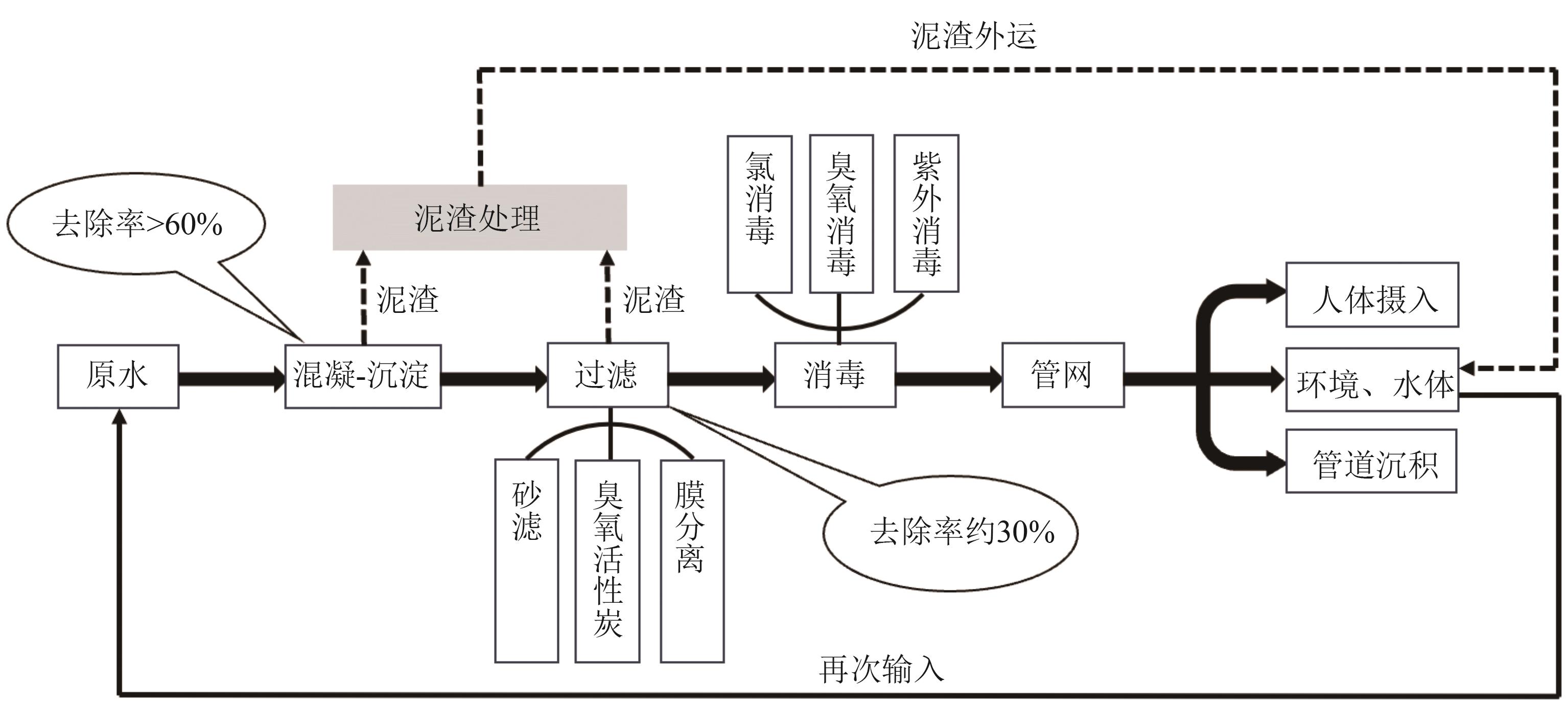
图1 MNP在饮用水各级处理单元中的分布与去除
| 塑料种类 | 尺寸 | 处理单元 | 归趋 | 参考文献 |
|---|---|---|---|---|
| PE, PP, PET, PS | ≥25μm | 混凝沉淀-脉冲澄清-砂滤 | ①超过99%的MP(粒径>100µm)被完全截留 ②约15.4%的MP(粒径>25μm,2.75个/L)逃逸到出水中 ③约61%的MP(粒径<100µm)在混凝沉淀-脉冲澄清单元被截留 ④约24%的MP(25~50µm)在砂滤池中被截留 | [ |
| PET, PVC, PE, PP, PS | 1~100μm以及≥100μm | 混凝沉淀-锰氧化-砂滤-臭氧氧化-活性炭过滤 | ①约62%的MP在混凝沉淀单元被截留,约26%的MP在过滤单元被截留 ②随着粒径的减小(≥100μm降至1~5μm),MP去除效率显著降低(100%降至40%) ③约86%的MP(≥10μm)和94%的MP(<10μm)被截留,小尺寸MP更易逃逸到出水中 | [ |
| PET, PP, PVC | 1~100μm以及≥100μm | 混凝沉淀-砂滤-活性炭过滤 | ①约70%、81%和83%的MP分别在混凝沉淀、砂滤和活性炭过滤单元被截留 ②出水中超过60%的MP的颗粒直径小于10μm,表明小尺寸MP更易逃离饮用水处理单元 | [ |
| PET, PE, PP | 1~100μm以及≥100μm | 混凝沉淀-砂滤-臭氧氧化-活性炭过滤 | ①在混凝沉淀单元,MP相互凝聚成易于沉淀的絮状物,并附着在絮凝体上 ②在过滤单元,29%~44%的MP被砂粒物理截留或黏附在砂粒表面 ③臭氧使得MP破碎,活性炭过滤处理过程中MP被物理吸附和生物降解 | [ |
| PP, PES, PS, PE | 20μm~5mm | 混凝沉淀-砂滤-臭氧氧化-活性炭过滤 | ①约78%的MP在混凝沉淀-砂滤阶段被截留 ②约18%的MP在臭氧-活性炭过滤阶段被截留 ③砂滤出水中MP尺寸均小于500µm ④MP总体截留率约为93% | [ |
表1 微塑料在饮用水处理厂内的归趋
| 塑料种类 | 尺寸 | 处理单元 | 归趋 | 参考文献 |
|---|---|---|---|---|
| PE, PP, PET, PS | ≥25μm | 混凝沉淀-脉冲澄清-砂滤 | ①超过99%的MP(粒径>100µm)被完全截留 ②约15.4%的MP(粒径>25μm,2.75个/L)逃逸到出水中 ③约61%的MP(粒径<100µm)在混凝沉淀-脉冲澄清单元被截留 ④约24%的MP(25~50µm)在砂滤池中被截留 | [ |
| PET, PVC, PE, PP, PS | 1~100μm以及≥100μm | 混凝沉淀-锰氧化-砂滤-臭氧氧化-活性炭过滤 | ①约62%的MP在混凝沉淀单元被截留,约26%的MP在过滤单元被截留 ②随着粒径的减小(≥100μm降至1~5μm),MP去除效率显著降低(100%降至40%) ③约86%的MP(≥10μm)和94%的MP(<10μm)被截留,小尺寸MP更易逃逸到出水中 | [ |
| PET, PP, PVC | 1~100μm以及≥100μm | 混凝沉淀-砂滤-活性炭过滤 | ①约70%、81%和83%的MP分别在混凝沉淀、砂滤和活性炭过滤单元被截留 ②出水中超过60%的MP的颗粒直径小于10μm,表明小尺寸MP更易逃离饮用水处理单元 | [ |
| PET, PE, PP | 1~100μm以及≥100μm | 混凝沉淀-砂滤-臭氧氧化-活性炭过滤 | ①在混凝沉淀单元,MP相互凝聚成易于沉淀的絮状物,并附着在絮凝体上 ②在过滤单元,29%~44%的MP被砂粒物理截留或黏附在砂粒表面 ③臭氧使得MP破碎,活性炭过滤处理过程中MP被物理吸附和生物降解 | [ |
| PP, PES, PS, PE | 20μm~5mm | 混凝沉淀-砂滤-臭氧氧化-活性炭过滤 | ①约78%的MP在混凝沉淀-砂滤阶段被截留 ②约18%的MP在臭氧-活性炭过滤阶段被截留 ③砂滤出水中MP尺寸均小于500µm ④MP总体截留率约为93% | [ |
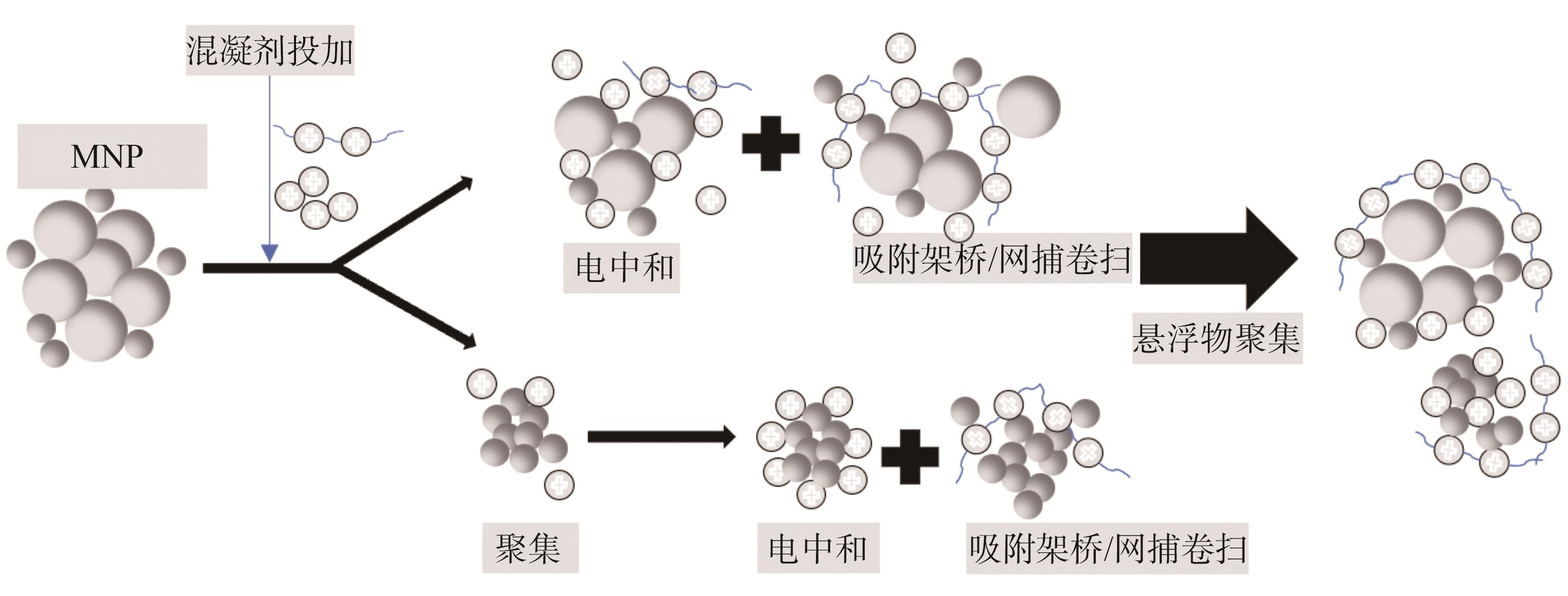
图2 MNP在混凝过程中潜在作用机理
| 种类 | 尺寸 | 混凝剂 | 影响特性 | 参考文献 |
|---|---|---|---|---|
| PE | <0.5mm以及0.5~5mm | 三氯化铁 | ①Fe基混凝剂最佳用量由0.2mmol/L提高至2mmol/L,最佳pH从6上升至8 ②MP粒径由2~5mm降至0.5mm以下,混凝去除率由2.5%上升至6.7% | [ |
| PS、PE | <5mm | 聚合氯化铝和三氯化铁 | ①聚合氯化铝最佳用量由30mg/L增加到180mg/L,三氯化铁最佳用量由30mg/L增加到90mg/L ②与三氯化铁相比,聚合氯化铝与PE-MP的电中和作用更强,聚合氯化铝对MP的混凝效果优于三氯化铁 | [ |
| PS | 5μm | 聚合氯化铝钛、聚合氯化铝和聚合氯化钛 | ①聚合氯化铝和聚合氯化铝钛对PS-MP去除率分别约为28%和35% ②聚合氯化铝钛混凝剂与PS-MP颗粒之间的氢键力更强,因此比其他混凝剂对PS-MP的去除效率更高 | [ |
| PS | 1μm以及6.3μm | 三氯化铁、聚合氯化铝和聚胺 | ①PS-MP尺寸由6.3mm降至1mm,三氯化铁混凝剂量由0.25mmol/L上升至0.4mmol/L,故小尺寸MP可能需要更高的混凝剂量 ②三氯化铁和聚合氯化铝(投加量约1.2mmol/L)对PS-MP的去除率均大于98% | [ |
| PE | 10~100μm | 明矾 | ①在较高剂量(>20mg/L)明矾投加条件下,PE-MP去除率随塑料尺寸(10~100μm)的增加而增加 ②明矾投加量为30mg/L时,对PE-MP的去除率最高,约为70% | [ |
表2 微塑料对混凝过程的影响特性
| 种类 | 尺寸 | 混凝剂 | 影响特性 | 参考文献 |
|---|---|---|---|---|
| PE | <0.5mm以及0.5~5mm | 三氯化铁 | ①Fe基混凝剂最佳用量由0.2mmol/L提高至2mmol/L,最佳pH从6上升至8 ②MP粒径由2~5mm降至0.5mm以下,混凝去除率由2.5%上升至6.7% | [ |
| PS、PE | <5mm | 聚合氯化铝和三氯化铁 | ①聚合氯化铝最佳用量由30mg/L增加到180mg/L,三氯化铁最佳用量由30mg/L增加到90mg/L ②与三氯化铁相比,聚合氯化铝与PE-MP的电中和作用更强,聚合氯化铝对MP的混凝效果优于三氯化铁 | [ |
| PS | 5μm | 聚合氯化铝钛、聚合氯化铝和聚合氯化钛 | ①聚合氯化铝和聚合氯化铝钛对PS-MP去除率分别约为28%和35% ②聚合氯化铝钛混凝剂与PS-MP颗粒之间的氢键力更强,因此比其他混凝剂对PS-MP的去除效率更高 | [ |
| PS | 1μm以及6.3μm | 三氯化铁、聚合氯化铝和聚胺 | ①PS-MP尺寸由6.3mm降至1mm,三氯化铁混凝剂量由0.25mmol/L上升至0.4mmol/L,故小尺寸MP可能需要更高的混凝剂量 ②三氯化铁和聚合氯化铝(投加量约1.2mmol/L)对PS-MP的去除率均大于98% | [ |
| PE | 10~100μm | 明矾 | ①在较高剂量(>20mg/L)明矾投加条件下,PE-MP去除率随塑料尺寸(10~100μm)的增加而增加 ②明矾投加量为30mg/L时,对PE-MP的去除率最高,约为70% | [ |
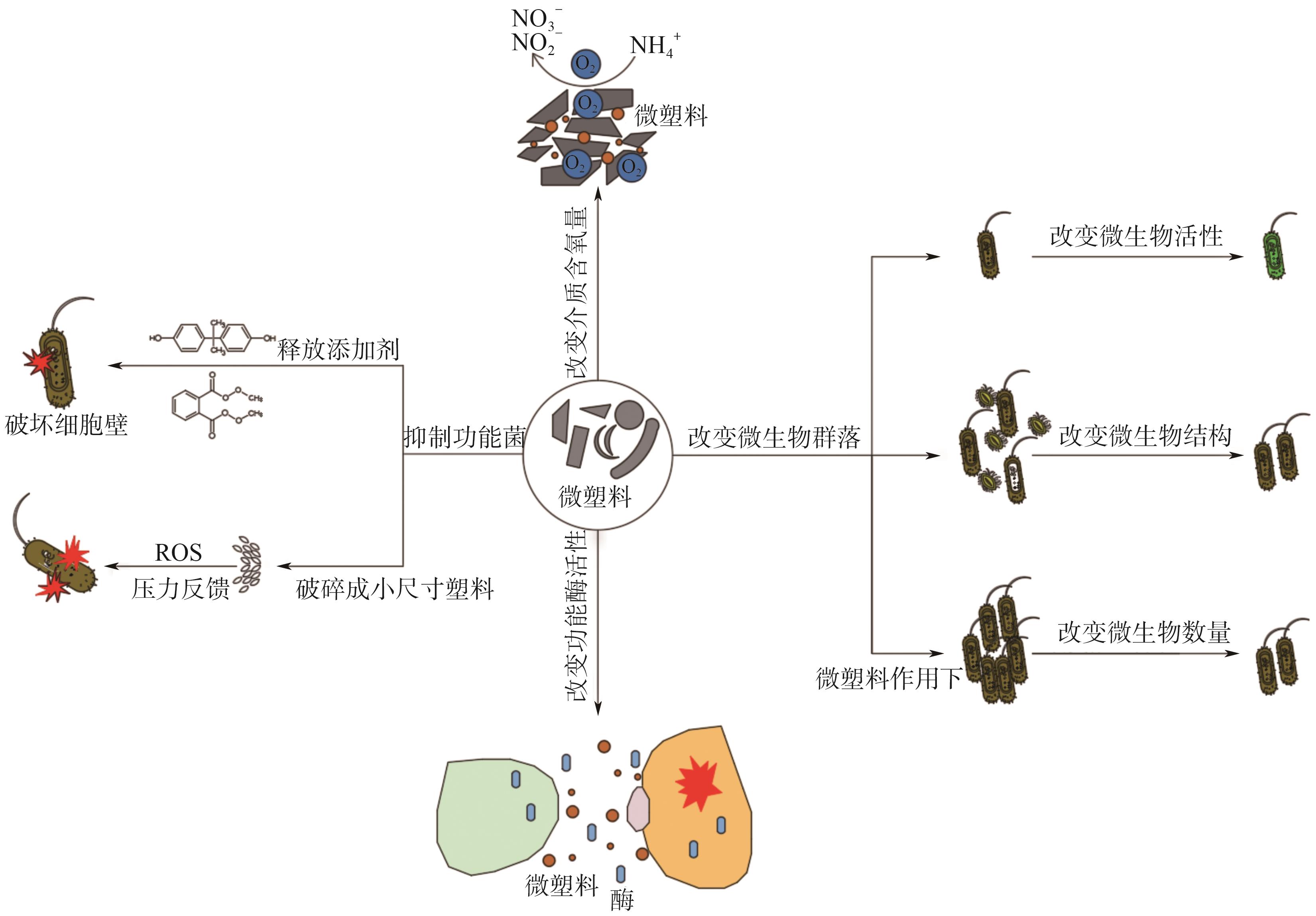
图3 微纳塑料对生物膜生物活性的潜在影响机理[95]
| [1] | ARPIA Arjay A, CHEN Wei-Hsin, UBANDO Aristotle T, et al. Microplastic degradation as a sustainable concurrent approach for producing biofuel and obliterating hazardous environmental effects: A state-of-the-art review[J]. Journal of Hazardous Materials, 2021, 418: 126381. |
| [2] | SHI Xingdong, CHEN Zhijie, LIU Xiaoqing, et al. The photochemical behaviors of microplastics through the lens of reactive oxygen species: Photolysis mechanisms and enhancing photo-transformation of pollutants[J]. Science of the Total Environment, 2022, 846: 157498. |
| [3] | BESSELING Ellen, WEGNER Anna, FOEKEMA Edwin M, et al. Effects of microplastic on fitness and PCB bioaccumulation by the lugworm Arenicola marina (L.)[J]. Environmental Science & Technology, 2013, 47(1): 593-600. |
| [4] | COSTA João Pinto DA, SANTOS Patrícia S M, DUARTE Armando C, et al. (Nano)plastics in the environment—Sources, fates and effects[J]. Science of the Total Environment, 2016, 566: 15-26. |
| [5] | ALIMI Olubukola S, BUDARZ Jeffrey Farner, HERNANDEZ Laura M, et al. Microplastics and nanoplastics in aquatic environments: Aggregation, deposition, and enhanced contaminant transport[J]. Environmental Science & Technology, 2018, 52(4): 1704-1724. |
| [6] | THOMPSON Richard C, Winnie COURTENE-JONES, BOUCHER Julien, et al. Twenty years of microplastic pollution research—What have we learned?[J]. Science, 2024, 386(6720): eadl2746. |
| [7] | LAU Winnie W Y, SHIRAN Yonathan, BAILEY Richard M, et al. Evaluating scenarios toward zero plastic pollution[J]. Science, 2020, 369(6510): 1455-1461. |
| [8] | XUE Jinkai, SAMAEI Seyed Hesam-Aldin, CHEN Jianfei, et al. What have we known so far about microplastics in drinking water treatment? A timely review[J]. Frontiers of Environmental Science & Engineering, 2022, 16(5): 58. |
| [9] | SHEN Maocai, SONG Biao, ZHU Yuan, et al. Removal of microplastics via drinking water treatment: Current knowledge and future directions[J]. Chemosphere, 2020, 251: 126612. |
| [10] | DING Jiannan, ZHANG Shanshan, RAZANAJATOVO Roger Mamitiana, et al. Accumulation, tissue distribution, and biochemical effects of polystyrene microplastics in the freshwater fish red tilapia (Oreochromis niloticus)[J]. Environmental Pollution, 2018, 238: 1-9. |
| [11] | KOSUTH Mary, MASON Sherri A, WATTENBERG Elizabeth V. Anthropogenic contamination of tap water, beer, and sea salt[J]. PLoS One, 2018, 13(4): e0194970. |
| [12] | LUO Hongwei, ZHAO Yaoyao, LI Yu, et al. Aging of microplastics affects their surface properties, thermal decomposition, additives leaching and interactions in simulated fluids[J]. Science of the Total Environment, 2020, 714: 136862. |
| [13] | HERMABESSIERE Ludovic, DEHAUT Alexandre, Ika PAUL-PONT, et al. Occurrence and effects of plastic additives on marine environments and organisms: A review[J]. Chemosphere, 2017, 182: 781-793. |
| [14] | MA Jie, CHEN Fengyuan, XU Huo, et al. Face masks as a source of nanoplastics and microplastics in the environment: Quantification, characterization, and potential for bioaccumulation[J]. Environmental Pollution, 2021, 288: 117748. |
| [15] | BARBOZA Luís Gabriel Antão, Dick VETHAAK A, LAVORANTE Beatriz R B O, et al. Marine microplastic debris: An emerging issue for food security, food safety and human health[J]. Marine Pollution Bulletin, 2018, 133: 336-348. |
| [16] | NOVOTNA Katerina, CERMAKOVA Lenka, PIVOKONSKA Lenka, et al. Microplastics in drinking water treatment—Current knowledge and research needs[J]. Science of the Total Environment, 2019, 667: 730-740. |
| [17] | ZHANG Qun, XU Elvis Genbo, LI Jiana, et al. A review of microplastics in table salt, drinking water, and air: Direct human exposure[J]. Environmental Science & Technology, 2020, 54(7): 3740-3751. |
| [18] | MINTENIG S M, LÖDER M G J, PRIMPKE S, et al. Low numbers of microplastics detected in drinking water from ground water sources[J]. Science of the Total Environment, 2019, 648: 631-635. |
| [19] | PIVOKONSKY Martin, CERMAKOVA Lenka, NOVOTNA Katerina, et al. Occurrence of microplastics in raw and treated drinking water[J]. Science of the Total Environment, 2018, 643: 1644-1651. |
| [20] | TONG Huiyan, JIANG Qianyi, HU Xingshuai, et al. Occurrence and identification of microplastics in tap water from China[J]. Chemosphere, 2020, 252: 126493. |
| [21] | Gerardo PULIDO-REYES, MAGHERINI Leonardo, BIANCO Carlo, et al. Nanoplastics removal during drinking water treatment: Laboratory- and pilot-scale experiments and modeling[J]. Journal of Hazardous Materials, 2022, 436: 129011. |
| [22] | NA Sang-Heon, KIM Min-Ji, KIM Jun-Tae, et al. Microplastic removal in conventional drinking water treatment processes: Performance, mechanism, and potential risk[J]. Water Research, 2021, 202: 117417. |
| [23] | ZHOU Guanyu, WANG Qingguo, LI Jia, et al. Removal of polystyrene and polyethylene microplastics using PAC and FeCl3 coagulation: Performance and mechanism[J]. Science of the Total Environment, 2021, 752: 141837. |
| [24] | Erwan CARRÉ, Jean PÉROT, JAUZEIN Vincent, et al. Impact of suspended particles on UV disinfection of activated-sludge effluent with the aim of reclamation[J]. Journal of Water Process Engineering, 2018, 22: 87-93. |
| [25] | Joan DALMAU-SOLER, Rubèn BALLESTEROS-CANO, et al. Microplastics from headwaters to tap water: Occurrence and removal in a drinking water treatment plant in Barcelona metropolitan area (Catalonia, NE Spain)[J]. Environmental Science and Pollution Research International, 2021, 28(42): 59462-59472. |
| [26] | SARKAR Dhruba Jyoti, SARKAR Soma DAS, Basanta Kumar DAS, et al. Microplastics removal efficiency of drinking water treatment plant with pulse clarifier[J]. Journal of Hazardous Materials, 2021, 413: 125347. |
| [27] | Martin PIVOKONSKÝ, Lenka PIVOKONSKÁ, Kateřina NOVOTNÁ, et al. Occurrence and fate of microplastics at two different drinking water treatment plants within a river catchment[J]. Science of the Total Environment, 2020, 741: 140236. |
| [28] | WANG Zhifeng, LIN Tao, CHEN Wei. Occurrence and removal of microplastics in an advanced drinking water treatment plant (ADWTP)[J]. Science of the Total Environment, 2020, 700: 134520. |
| [29] | 周叶, 高峰, 戚雷强. 混凝水处理法应用现状及强化措施探讨[J]. 净水技术, 2021, 40(S1): 9-14. |
| ZHOU Ye, GAO Feng, QI Leiqiang. Discussion on application status and improvement measures of coagulation technology for water treatment[J]. Water Purification Technology, 2021, 40(S1): 9-14. | |
| [30] | 纪祥廷. 温度及搅拌等因素对混凝法处理污水效果的影响[J]. 低碳世界, 2017, 7(29): 14. |
| JI Xiangting. Influence of temperature and stirring on the effect of coagulation on sewage treatment[J]. Low Carbon World, 2017, 7(29): 14. | |
| [31] | TRIEBSKORN Rita, BRAUNBECK Thomas, GRUMMT Tamara, et al. Relevance of nano- and microplastics for freshwater ecosystems: A critical review[J]. TrAC Trends in Analytical Chemistry, 2019, 110: 375-392. |
| [32] | TALVITIE Julia, MIKOLA Anna, KOISTINEN Arto, et al. Solutions to microplastic pollution—Removal of microplastics from wastewater effluent with advanced wastewater treatment technologies[J]. Water Research, 2017, 123: 401-407. |
| [33] | BAYARKHUU Bolormaa, BYUN Jeehye. Optimization of coagulation and sedimentation conditions by turbidity measurement for nano- and microplastic removal[J]. Chemosphere, 2022, 306: 135572. |
| [34] | 桑稳姣, 张文斌, 卢伟, 等. 聚苯乙烯微塑料对自来水厂混凝絮体的影响[J]. 中国给水排水, 2022, 38(11): 32-37. |
| SANG Wenjiao, ZHANG Wenbin, LU Wei, et al. Effects of polystyrene microplastics on flocs formed in coagulation process of waterworks[J]. China Water & Wastewater, 2022, 38(11): 32-37. | |
| [35] | WANG Wenyu, YANG Min, MA Huifang, et al. Removal behaviors and mechanism of polystyrene microplastics by coagulation/ultrafiltration process: Co-effects of humic acid[J]. Science of the Total Environment, 2023, 881: 163408. |
| [36] | GIGAULT Julien, HADRI Hind EL, NGUYEN Brian, et al. Nanoplastics are neither microplastics nor engineered nanoparticles[J]. Nature Nanotechnology, 2021, 16(5): 501-507. |
| [37] | EMELKO MONICA B, HUCK PETER M, COFFEY BRADLEY M. A review of Cryptosporidium removal by granular media filtration[J]. Journal AWWA, 2005, 97(12): 101-115. |
| [38] | ABULYAZIED D E, EL-ZAIDIA E F M. Nanoindentation and optical properties of high density polyethylene ZnO nanoparticles composites[J]. Journal of Ovonic Research, 2018, 14(5): 359-370. |
| [39] | WU Junyi, ZHANG Yan, TANG Yu. Fragmentation of microplastics in the drinking water treatment process—A case study in Yangtze River region, China[J]. Science of the Total Environment, 2022, 806: 150545. |
| [40] | HE Lei, RONG Haifeng, LI Meng, et al. Bacteria have different effects on the transport behaviors of positively and negatively charged microplastics in porous media[J]. Journal of Hazardous Materials, 2021, 415: 125550. |
| [41] | ROSS P S, VAN DER AA L T J, VAN DIJK T, et al. Effects of water quality changes on performance of biological activated carbon (BAC) filtration[J]. Separation and Purification Technology, 2019, 212: 676-683. |
| [42] | ZHENG Jian, LIN Tao, CHEN Wei, et al. Removal of precursors of typical nitrogenous disinfection byproducts in ozonation integrated with biological activated carbon (O3/BAC)[J]. Chemosphere, 2018, 209: 68-77. |
| [43] | DU Tingting, ADELEYE Adeyemi S, ZHANG Tong, et al. Effects of ozone and produced hydroxyl radicals on the transformation of graphene oxide in aqueous media[J]. Environmental Science: Nano, 2019, 6(8): 2484-2494. |
| [44] | HAO Tianwei, MIAO Manhong, WANG Tong, et al. Physicochemical changes in microplastics and formation of DBPs under ozonation[J]. Chemosphere, 2023, 327: 138488. |
| [45] | LEE Hyeonho, Sung-Ju IM, KIM Yoogon, et al. Effects of microplastics on the removal of trace organic compounds during ozonation: Oxidation and adsorption of trace organic compounds and byproducts[J]. Environmental Pollution, 2021, 280: 116878. |
| [46] | OZEN Banu F, MAUER Lisa J, FLOROS John D. Effects of ozone exposure on the structural, mechanical and barrier properties of select plastic packaging films[J]. Packaging Technology and Science, 2002, 15(6): 301-311. |
| [47] | Carmen SOLÍS-BALBÍN, Daniel SOL, LACA Amanda, et al. Destruction and entrainment of microplastics in ozonation and wet oxidation processes[J]. Journal of Water Process Engineering, 2023, 51: 103456. |
| [48] | KUMAR Rakesh, VERMA Anurag, RAKIB Md Refat Jahan, et al. Adsorptive behavior of micro(nano)plastics through biochar: Co-existence, consequences, and challenges in contaminated ecosystems[J]. Science of the Total Environment, 2023, 856: 159097. |
| [49] | YI Kaixin, HUANG Jinhui, LI Xue, et al. Long-term impacts of polyethylene terephthalate (PET) microplastics in membrane bioreactor[J]. Journal of Environmental Management, 2022, 323: 116234. |
| [50] | GAN Yushuang, GONG Bingrou, HUANG Xiaohua, et al. Response of aerobic granular sludge under acute inhibition by polystyrene microplastics: Activity, aggregation performance, and microbial analysis[J]. Environmental Pollution, 2024, 349: 123923. |
| [51] | ENFRIN Marie, LEE Judy, Pierre LE-CLECH, et al. Kinetic and mechanistic aspects of ultrafiltration membrane fouling by nano- and microplastics[J]. Journal of Membrane Science, 2020, 601: 117890. |
| [52] | Ann-Kathrin MÜLLER, XU Zhikang, GREINER Andreas. Filtration of paint-contaminated water by electrospun membranes[J]. Macromolecular Materials and Engineering, 2022, 307(10): 2200238. |
| [53] | ENFRIN Marie, DUMÉE Ludovic F, LEE Judy. Nano/microplastics in water and wastewater treatment processes—Origin, impact and potential solutions[J]. Water Research, 2019, 161: 621-638. |
| [54] | YE Shujing, CHENG Min, ZENG Guangming, et al. Insights into catalytic removal and separation of attached metals from natural-aged microplastics by magnetic biochar activating oxidation process[J]. Water Research, 2020, 179: 115876. |
| [55] | LAPOINTE Mathieu, FARNER Jeffrey M, HERNANDEZ Laura M, et al. Understanding and improving microplastic removal during water treatment: Impact of coagulation and flocculation[J]. Environmental Science & Technology, 2020, 54(14): 8719-8727. |
| [56] | LIN Jialing, WU Xinni, LIU Yuan, et al. Sinking behavior of polystyrene microplastics after disinfection[J]. Chemical Engineering Journal, 2022, 427: 130908. |
| [57] | KELKAR Varun P, ROLSKY Charles B, PANT Anupum, et al. Chemical and physical changes of microplastics during sterilization by chlorination[J]. Water Research, 2019, 163: 114871. |
| [58] | LIU Jin, ZHANG Tong, TIAN Lili, et al. Aging significantly affects mobility and contaminant-mobilizing ability of nanoplastics in saturated loamy sand[J]. Environmental Science & Technology, 2019, 53(10): 5805-5815. |
| [59] | HYUNJEONG Woo, KANGMIN Seo, YONGHYUN Choi, et al. Methods of analyzing microsized plastics in the environment[J]. Applied Sciences, 2021, 11(22): 10640. |
| [60] | MORGADO Vanessa, GOMES Luís, BETTENCOURT DA SILVA Ricardo J N, et al. Validated spreadsheet for the identification of PE, PET, PP and PS microplastics by micro-ATR-FTIR spectra with known uncertainty[J]. Talanta, 2021, 234: 122624. |
| [61] | 李红岩, 张海峰, 李洁, 等. 饮用水中微塑料污染研究进展[J]. 净水技术, 2019, 38(7): 7-12. |
| LI Hongyan, ZHANG Haifeng, LI Jie, et al. Review of microplastics pollution in drinking water[J]. Water Purification Technology, 2019, 38(7): 7-12. | |
| [62] | SAMANTA Palas, Sukhendu DEY, KUNDU Debajyoti, et al. An insight on sampling, identification, quantification and characteristics of microplastics in solid wastes[J]. Trends in Environmental Analytical Chemistry, 2022, 36: e00181. |
| [63] | CORAMI Fabiana, ROSSO Beatrice, BRAVO Barbara, et al. A novel method for purification, quantitative analysis and characterization of microplastic fibers using micro-FTIR[J]. Chemosphere, 2020, 238: 124564. |
| [64] | TAGG Alexander S, SAPP Melanie, HARRISON Jesse P, et al. Identification and quantification of microplastics in wastewater using focal plane array-based reflectance micro-FT-IR imaging[J]. Analytical Chemistry, 2015, 87(12): 6032-6040. |
| [65] | Paulo RIBEIRO-CLARO, NOLASCO Mariela M, Catarina ARAÚJO. Chapter 5 characterization of microplastics by Raman spectroscopy[J]. Comprehensive Analytical Chemistry, 2017, 75: 119-151. |
| [66] | PASHAEI Reza, Viktorija SABALIAUSKAITĖ, SUZDALEV Sergej, et al. Assessing the occurrence and distribution of microplastics in surface freshwater and wastewaters of Latvia and Lithuania[J]. Toxics, 2023, 11(4): 292. |
| [67] | IVLEVA Natalia P, WIESHEU Alexandra C, NIESSNER Reinhard. Microplastic in aquatic ecosystems[J]. Angewandte Chemie International Edition, 2017, 56(7): 1720-1739. |
| [68] | QIU Qiongxuan, TAN Zhi, WANG Jundong, et al. Extraction, enumeration and identification methods for monitoring microplastics in the environment[J]. Estuarine, Coastal and Shelf Science, 2016, 176: 102-109. |
| [69] | SILVA Ana B, BASTOS Ana S, JUSTINO Celine I L, et al. Microplastics in the environment: Challenges in analytical chemistry—A review[J]. Analytica Chimica Acta, 2018, 1017: 1-19. |
| [70] | FRIES Elke, DEKIFF Jens H, WILLMEYER Jana, et al. Identification of polymer types and additives in marine microplastic particles using pyrolysis-GC/MS and scanning electron microscopy[J]. Environmental Science Processes & Impacts, 2013, 15(10): 1949-1956. |
| [71] | FUNCK Matin, YILDIRIM Aylin, NICKEL Carmen, et al. Identification of microplastics in wastewater after cascade filtration using pyrolysis-GC-MS[J]. MethodsX, 2020, 7: 100778. |
| [72] | LI Zechen, GAO Yan, WU Qihang, et al. Quantifying the occurrence of polystyrene nanoplastics in environmental solid matrices via pyrolysis-gas chromatography/mass spectrometry[J]. Journal of Hazardous Materials, 2022, 440: 129855. |
| [73] | Rosa PEÑALVER, Natalia ARROYO-MANZANARES, Ignacio LÓPEZ-GARCÍA, et al. An overview of microplastics characterization by thermal analysis[J]. Chemosphere, 2020, 242: 125170. |
| [74] | Erik DÜMICHEN, BARTHEL Anne-Kathrin, BRAUN Ulrike, et al. Analysis of polyethylene microplastics in environmental samples, using a thermal decomposition method[J]. Water Research, 2015, 85: 451-457. |
| [75] | YU Jianping, WANG Pingya, NI Fengli, et al. Characterization of microplastics in environment by thermal gravimetric analysis coupled with Fourier transform infrared spectroscopy[J]. Marine Pollution Bulletin, 2019, 145: 153-160. |
| [76] | BISUTTI Isabella, HILKE Ines, RAESSLER Michael. Determination of total organic carbon—An overview of current methods[J]. TrAC Trends in Analytical Chemistry, 2004, 23(10/11): 716-726. |
| [77] | HONG Youngmin, Joosung OH, LEE Ingyu, et al. Total-organic-carbon-based quantitative estimation of microplastics in sewage[J]. Chemical Engineering Journal, 2021, 423: 130182. |
| [78] | LI Peng, LAI Yujian, LI Qingcun, et al. Total organic carbon as a quantitative index of micro- and nano-plastic pollution[J]. Analytical Chemistry, 2022, 94(2): 740-747. |
| [79] | TALLEC Kevin, BLARD Océane, Carmen GONZÁLEZ-FERNÁNDEZ, et al. Surface functionalization determines behavior of nanoplastic solutions in model aquatic environments[J]. Chemosphere, 2019, 225: 639-646. |
| [80] | BELLINGERI Arianna, CASABIANCA Silvia, CAPELLACCI Samuela, et al. Impact of polystyrene nanoparticles on marine diatom Skeletonema marinoi chain assemblages and consequences on their ecological role in marine ecosystems[J]. Environmental Pollution, 2020, 262: 114268. |
| [81] | PRATA Joana Correia, COSTA João P DA, DUARTE Armando C, et al. Methods for sampling and detection of microplastics in water and sediment: A critical review[J]. TrAC Trends in Analytical Chemistry, 2019, 110: 150-159. |
| [82] | MAES Thomas, JESSOP Rebecca, WELLNER Nikolaus, et al. A rapid-screening approach to detect and quantify microplastics based on fluorescent tagging with Nile Red[J]. Scientific Reports, 2017, 7: 44501. |
| [83] | WANG Chun, JIANG Lijuan, LIU Ruiqing, et al. Comprehensive assessment of factors influencing Nile red staining: Eliciting solutions for efficient microplastics analysis[J]. Marine Pollution Bulletin, 2021, 171: 112698. |
| [84] | AOKI Hiroshi. Material-specific determination based on microscopic observation of single microplastic particles stained with fluorescent dyes[J]. Sensors, 2022, 22(9): 3390. |
| [85] | MA Baiwen, XUE Wenjing, DING Yanyan, et al. Removal characteristics of microplastics by Fe-based coagulants during drinking water treatment[J]. Journal of Environmental Sciences, 2019, 78: 267-275. |
| [86] | LIU Beibei, GAO Yue, YUE Qinyan, et al. The suitability and mechanism of polyaluminum-titanium chloride composite coagulant (PATC) for polystyrene microplastic removal: Structural characterization and theoretical calculation[J]. Water Research, 2023, 232: 119690. |
| [87] | RAJALA Katriina, Outi GRÖNFORS, HESAMPOUR Mehrdad, et al. Removal of microplastics from secondary wastewater treatment plant effluent by coagulation/flocculation with iron, aluminum and polyamine-based chemicals[J]. Water Research, 2020, 183: 116045. |
| [88] | SHAHI Nirmal Kumar, MAENG Minsoo, KIM Donghyun, et al. Removal behavior of microplastics using alum coagulant and its enhancement using polyamine-coated sand[J]. Process Safety and Environmental Protection, 2020, 141: 9-17. |
| [89] | MA Baiwen, XUE Wenjing, HU Chengzhi, et al. Characteristics of microplastic removal via coagulation and ultrafiltration during drinking water treatment[J]. Chemical Engineering Journal, 2019, 359: 159-167. |
| [90] | CHABI Kassim, LI Jianguo, YE Chengsong, et al. Rapid sand filtration for <10μm-sized microplastic removal in tap water treatment: Efficiency and adsorption mechanisms[J]. Science of the Total Environment, 2024, 912: 169074. |
| [91] | ZHANG Yongli, DIEHL Allison, LEWANDOWSKI Ashton, et al. Removal efficiency of micro- and nanoplastics (180nm—125μm) during drinking water treatment[J]. Science of the Total Environment, 2020, 720: 137383. |
| [92] | ZHANG Mingzhi, HOU Jun, WU Jun, et al. Effects of input concentration, media particle size, and flow rate on fate of polystyrene nanoplastics in saturated porous media[J]. Science of the Total Environment, 2023, 881: 163237. |
| [93] | HU Enzhu, SHANG Siyao, FU Zhongtian, et al. Cotransport of naphthalene with polystyrene nanoplastics (PSNP) in saturated porous media: Effects of PSNP/naphthalene ratio and ionic strength[J]. Chemosphere, 2020, 245: 125602. |
| [94] | WU Jiayi, LU Lun, WANG Rui, et al. Influence of microplastics on the transport of antibiotics in sand filtration investigated by AFM force spectroscopy[J]. Science of the Total Environment, 2023, 873: 162344. |
| [95] | SHEN Maocai, SONG Biao, ZHOU Chengyun, et al. Recent advances in impacts of microplastics on nitrogen cycling in the environment: A review[J]. Science of the Total Environment, 2022, 815: 152740. |
| [96] | LIANG Zhihua, Atreyee DAS, HU Zhiqiang. Bacterial response to a shock load of nanosilver in an activated sludge treatment system[J]. Water Research, 2010, 44(18): 5432-5438. |
| [97] | Kim So Yoon, Kim Yong Jin, Lee Seung-Woo, et al. Interactions between bacteria and nano (micro)-sized polystyrene particles by bacterial responses and microscopy[J]. Chemosphere, 2022, 306: 135584. |
| [98] | MENG Zhuowen, WU Jingwei, HUANG Shuang, et al. Competitive adsorption behaviors and mechanisms of Cd, Ni, and Cu by biochar when coexisting with microplastics under single, binary, and ternary systems[J]. Science of the Total Environment, 2024, 913: 169524. |
| [99] | SHEN Maocai, ZHAO Yifei, LIU Shiwei, et al. Recent advances on micro/nanoplastic pollution and membrane fouling during water treatment: A review[J]. Science of the Total Environment, 2023, 881: 163467. |
| [100] | HUBE Selina, VERONELLI Stefanie, LI Tian, et al. Microplastics affect membrane biofouling and microbial communities during gravity-driven membrane filtration of primary wastewater[J]. Chemosphere, 2024, 353: 141650. |
| [101] | ADEEL Mister, MANIAKOVA Gulnara, RIZZO Luigi. Tertiary/quaternary treatment of urban wastewater by UV/H2O2 or ozonation: Microplastics may affect removal of E. coli and contaminants of emerging concern[J]. Science of the Total Environment, 2024, 907: 167940. |
| [102] | ZHANG Meihui, Xianghong LYU, YUAN Cheng, et al. Impact of non-aged and UV-aged microplastics on the formation of halogenated disinfection byproducts during chlorination of drinking water and its mechanism[J]. Environmental Pollution, 2024, 344: 123394. |
| [103] | YU Bingqing, ZHANG Min, ZHAO Shasha, et al. Influence of biodegradable plastics on the generation of disinfection byproducts in the chlorination process[J]. Chemosphere, 2024, 362: 142650. |
| [1] | 周渝, 田磊, 黄海涛, 韦奇. 深层过滤运行性能调控方法及实验验证[J]. 化工进展, 2025, 44(7): 3737-3747. |
| [2] | 曹曼曼, 郭英明, 曹袁圆, 张宇宏, 张哲凯. 高铁酸钾强化铁锰氧化膜过滤去除水中双酚A及机理[J]. 化工进展, 2025, 44(7): 4274-4281. |
| [3] | 刘文龙, 马秀清, 李长金, 何东洋, 高觊兴, 张杨, 李满意, 杨卫民, 李好义. LDPE/PEW熔喷超细纤维及其非织造布性能[J]. 化工进展, 2025, 44(7): 4032-4038. |
| [4] | 文钰颖, 陈子依, 陈明星, 张威, 吴艳杰. 高效低阻PMIA/PVDF-HFP纳米纤维膜制备及其细微颗粒去除性能[J]. 化工进展, 2025, 44(10): 5828-5837. |
| [5] | 田晴, 刘青盟, 李方, 杨波, 张思远, 关自良. 细菌的耐盐调控及其在高盐生物脱氮除磷工艺中的应用[J]. 化工进展, 2025, 44(1): 465-476. |
| [6] | 刘青晨, 王华伟, 刘荣稳, 邹融雪, 占美丽, 王亚楠, 孙英杰, 夏正启, 单斌. 混凝-臭氧氧化对渗滤液生化出水有机微污染物的去除效果[J]. 化工进展, 2024, 43(S1): 545-554. |
| [7] | 赵星程, 贾方旭, 刘晨雨, 韩宝红, 梅宁, 姚宏. 实际规模PN/A工艺载体挂膜性能与微生物群落[J]. 化工进展, 2024, 43(9): 5242-5249. |
| [8] | 曾祥菲, 韩昀晖, 林凡, 黄荣, 余茜, 黄瑶, 王蓉, 舒建成, 陈梦君. 锂电负极废涂布浆料破胶减容与资源化利用[J]. 化工进展, 2024, 43(8): 4664-4673. |
| [9] | 付涛, 李立, 高莉宁, 朱富维, 曹炜烨, 陈华鑫. 水泥基硼掺杂石墨相氮化碳降解NO[J]. 化工进展, 2024, 43(8): 4403-4410. |
| [10] | 王宝山, 陈晓杰, 赵培宇, 张许. 基于三维生物膜电极的难生化有机化工废水处理研究进展[J]. 化工进展, 2024, 43(6): 3359-3373. |
| [11] | 郭萌, 郭美欣, 魏思佳, 赵玉娇, 贾璇. 初始pH调控对MEC脱硫性能的影响及其微生物作用机制[J]. 化工进展, 2024, 43(4): 2219-2225. |
| [12] | 海岩, 周鑫, 李艳. 单级固定床生物膜反应器主流厌氧氨氧化快速启动性能[J]. 化工进展, 2024, 43(4): 2201-2209. |
| [13] | 陈林林, 于飞, 马杰. 木头基纤维素/石墨烯分离膜制备及污染物分离性能[J]. 化工进展, 2024, 43(3): 1584-1592. |
| [14] | 陈虎, 王莹, 王璞玉, 吕永康. 假单胞菌属细菌LV1强化序批式生物膜反应器喹啉降解性能[J]. 化工进展, 2024, 43(12): 6995-7003. |
| [15] | 张柏林, 杨泽宇, 张生杨, 刘波, 张深根. 废旧风电叶片在建筑材料中的应用[J]. 化工进展, 2024, 43(11): 6260-6270. |
| 阅读次数 | ||||||
|
全文 |
|
|||||
|
摘要 |
|
|||||