化工进展 ›› 2025, Vol. 44 ›› Issue (3): 1619-1631.DOI: 10.16085/j.issn.1000-6613.2024-0348
全球典型原材料资源关键性评价方法研究进展
高文芳1,2( ), 郭天玥1, 高放3, 于曼1, 崔晗1,4, 李华杰1, 阎文艺2, 吕龙义1(), 孙峙2()
- 1.河北工业大学能源与环境工程学院,天津 300401
2.中国科学院过程工程研究所,国家基础学科公共科学数据中心,北京 100190
3.北控水务(中国)投资有限公司,北京 100102
4.中国科学院生态环境研究中心,城市与区域生态国家重点实验室,北京 100085
-
收稿日期:2024-03-02修回日期:2024-05-25出版日期:2025-03-25发布日期:2025-04-15 -
通讯作者:吕龙义,孙峙 -
作者简介:高文芳(1990—),女,副教授,博士生导师,研究方向为关键金属资源循环技术与评价。E-mail:wfgao@hebut.edu.cn。 -
基金资助:国家自然科学基金(52300232);天津市教委项目(2022KJ098)
A critical review on typical criticality evaluation methods for raw materials worldwide
GAO Wenfang1,2(), GUO Tianyue1, GAO Fang3, YU Man1, CUI Han1,4, LI Huajie1, YAN Wenyi2, LYU Longyi1(), SUN Zhi2()
- 1.School of Energy and Environmental Engineering, Hebei University of Technology, Tianjin 300401, China
2.Chinese Academy of Sciences, Institute of Process Engineering, National Basic Public Science Data Center, Beijing 100190, China
3.Beijing Enterprises Water Group (China) Investment Limited, Beijing 100102, China
4.State Key Laboratory of Urban and Regional Ecology, Research Center for Eco-Environmental Sciences, Chinese Academy of Sciences, Beijing 100085, China
-
Received:2024-03-02Revised:2024-05-25Online:2025-03-25Published:2025-04-15 -
Contact:LYU Longyi, SUN Zhi

摘要:
随着工业化进程的不断发展,人类社会对矿产原材料的开采不断加深,许多资源面临供应危机。为了更好地计算该矿产的关键性,同时满足低碳的需求,众多研究团队的原材料关键性研究方法相继出现。本研究详细论述了美国、欧盟、中国的4种典型原材料关键性评价方法,及另外8种有重要研究价值的方法,针对73种关键性原材料深入分析各方法的优缺点及适用范围。通过对评价方法的评价框架进行梳理、对评价结果进行归纳、对评价的展现形式进行对比、对方法的具体应用进行总结,结果表明,大部分关键性评价都包含供应风险、供应限制的脆弱性以及环境影响三大指标,展现方法大致分为加权求和法和矩阵分析法。分析得出现阶段各评价方法存在评价对象局限、指标不全、准确性不高的问题。在此基础上,对原材料关键性的研究现状进行了讨论,确定了锂、钴等28种公认的关键原材料。最后,提出原材料关键性评价的未来发展需要具备四个基本性质,即全面性、可自定义性、可预见性和准确性,以促进关键性评价在工业生产过程中的普及,为推进工业绿色低碳化提供理论和数据支持。
中图分类号:
引用本文
高文芳, 郭天玥, 高放, 于曼, 崔晗, 李华杰, 阎文艺, 吕龙义, 孙峙. 全球典型原材料资源关键性评价方法研究进展[J]. 化工进展, 2025, 44(3): 1619-1631.
GAO Wenfang, GUO Tianyue, GAO Fang, YU Man, CUI Han, LI Huajie, YAN Wenyi, LYU Longyi, SUN Zhi. A critical review on typical criticality evaluation methods for raw materials worldwide[J]. Chemical Industry and Engineering Progress, 2025, 44(3): 1619-1631.
| 项目 | 中国 科学院[ | Graedel等[ | 日本 低碳 团队[ | 欧盟[ | 韩国地球 科学产业 资源院[ | 美国国家科学 技术委员会(NSTC)[ | 中国 工业 经济所[ | 中国 地质 科学院[ | 美国国家研究 委员会[ | 日本新能源产业技术 开发机构[ | 荷兰 统计 中心[ | 德国技术评估 研究所[ | 次数统计 |
|---|---|---|---|---|---|---|---|---|---|---|---|---|---|
| 供应风险 | |||||||||||||
| 供应集中度 | √ | √ | √ | √ | √ | √ | √ | √ | √ | 9 | |||
| 全球治理指标 | √ | √ | √ | √ | √ | √ | √ | 7 | |||||
| 二次资源利用率 | √ | √ | √ | √ | √ | 5 | |||||||
| 政治影响 | √ | √ | √ | √ | √ | 5 | |||||||
| 人类发展指数 | √ | √ | √ | √ | 4 | ||||||||
| 供应潜力 | √ | √ | √ | √ | 4 | ||||||||
| 可开采年限 | √ | √ | √ | √ | 4 | ||||||||
| 进口依赖性 | √ | √ | √ | 3 | |||||||||
| 伴生金属 | √ | √ | √ | 3 | |||||||||
| 可替代性 | √ | √ | √ | 3 | |||||||||
| 政策潜力指数 | √ | √ | √ | 3 | |||||||||
| 市场规模 | √ | √ | √ | 3 | |||||||||
| 政策感知指数 | √ | 1 | |||||||||||
| 交通条件依赖性 | √ | 1 | |||||||||||
| 资源耗尽时间 | √ | 1 | |||||||||||
| 储量产量比 | √ | 1 | |||||||||||
| 脆弱性/经济重要性 | |||||||||||||
| 替代可能性 | √ | √ | √ | √ | √ | √ | √ | √ | 8 | ||||
| 资源价值重要性 | √ | √ | √ | √ | √ | √ | √ | √ | 8 | ||||
| 需求变化 | √ | √ | √ | √ | 4 | ||||||||
| 价格波动稳定性 | √ | √ | √ | √ | 4 | ||||||||
| 原材料价值 | √ | √ | √ | √ | 4 | ||||||||
| 进口依赖性 | √ | √ | √ | 3 | |||||||||
| 进口厂商集中度 | √ | √ | 2 | ||||||||||
| 未来供需比 | √ | √ | 2 | ||||||||||
| 使用受限 | √ | √ | 2 | ||||||||||
| 价格变动 | √ | √ | 2 | ||||||||||
| 创新可能性 | √ | 1 | |||||||||||
| 环境相关 | |||||||||||||
| 环境影响 | √ | √ | √ | √ | √ | 5 | |||||||
| 原材料毒性等级 | √ | √ | 2 | ||||||||||
| 环境绩效指数 | √ | 1 |
表1 各关键性评价方法中评价指标出现情况汇总
| 项目 | 中国 科学院[ | Graedel等[ | 日本 低碳 团队[ | 欧盟[ | 韩国地球 科学产业 资源院[ | 美国国家科学 技术委员会(NSTC)[ | 中国 工业 经济所[ | 中国 地质 科学院[ | 美国国家研究 委员会[ | 日本新能源产业技术 开发机构[ | 荷兰 统计 中心[ | 德国技术评估 研究所[ | 次数统计 |
|---|---|---|---|---|---|---|---|---|---|---|---|---|---|
| 供应风险 | |||||||||||||
| 供应集中度 | √ | √ | √ | √ | √ | √ | √ | √ | √ | 9 | |||
| 全球治理指标 | √ | √ | √ | √ | √ | √ | √ | 7 | |||||
| 二次资源利用率 | √ | √ | √ | √ | √ | 5 | |||||||
| 政治影响 | √ | √ | √ | √ | √ | 5 | |||||||
| 人类发展指数 | √ | √ | √ | √ | 4 | ||||||||
| 供应潜力 | √ | √ | √ | √ | 4 | ||||||||
| 可开采年限 | √ | √ | √ | √ | 4 | ||||||||
| 进口依赖性 | √ | √ | √ | 3 | |||||||||
| 伴生金属 | √ | √ | √ | 3 | |||||||||
| 可替代性 | √ | √ | √ | 3 | |||||||||
| 政策潜力指数 | √ | √ | √ | 3 | |||||||||
| 市场规模 | √ | √ | √ | 3 | |||||||||
| 政策感知指数 | √ | 1 | |||||||||||
| 交通条件依赖性 | √ | 1 | |||||||||||
| 资源耗尽时间 | √ | 1 | |||||||||||
| 储量产量比 | √ | 1 | |||||||||||
| 脆弱性/经济重要性 | |||||||||||||
| 替代可能性 | √ | √ | √ | √ | √ | √ | √ | √ | 8 | ||||
| 资源价值重要性 | √ | √ | √ | √ | √ | √ | √ | √ | 8 | ||||
| 需求变化 | √ | √ | √ | √ | 4 | ||||||||
| 价格波动稳定性 | √ | √ | √ | √ | 4 | ||||||||
| 原材料价值 | √ | √ | √ | √ | 4 | ||||||||
| 进口依赖性 | √ | √ | √ | 3 | |||||||||
| 进口厂商集中度 | √ | √ | 2 | ||||||||||
| 未来供需比 | √ | √ | 2 | ||||||||||
| 使用受限 | √ | √ | 2 | ||||||||||
| 价格变动 | √ | √ | 2 | ||||||||||
| 创新可能性 | √ | 1 | |||||||||||
| 环境相关 | |||||||||||||
| 环境影响 | √ | √ | √ | √ | √ | 5 | |||||||
| 原材料毒性等级 | √ | √ | 2 | ||||||||||
| 环境绩效指数 | √ | 1 |

图1 Graedel等关键性评价框架[10]
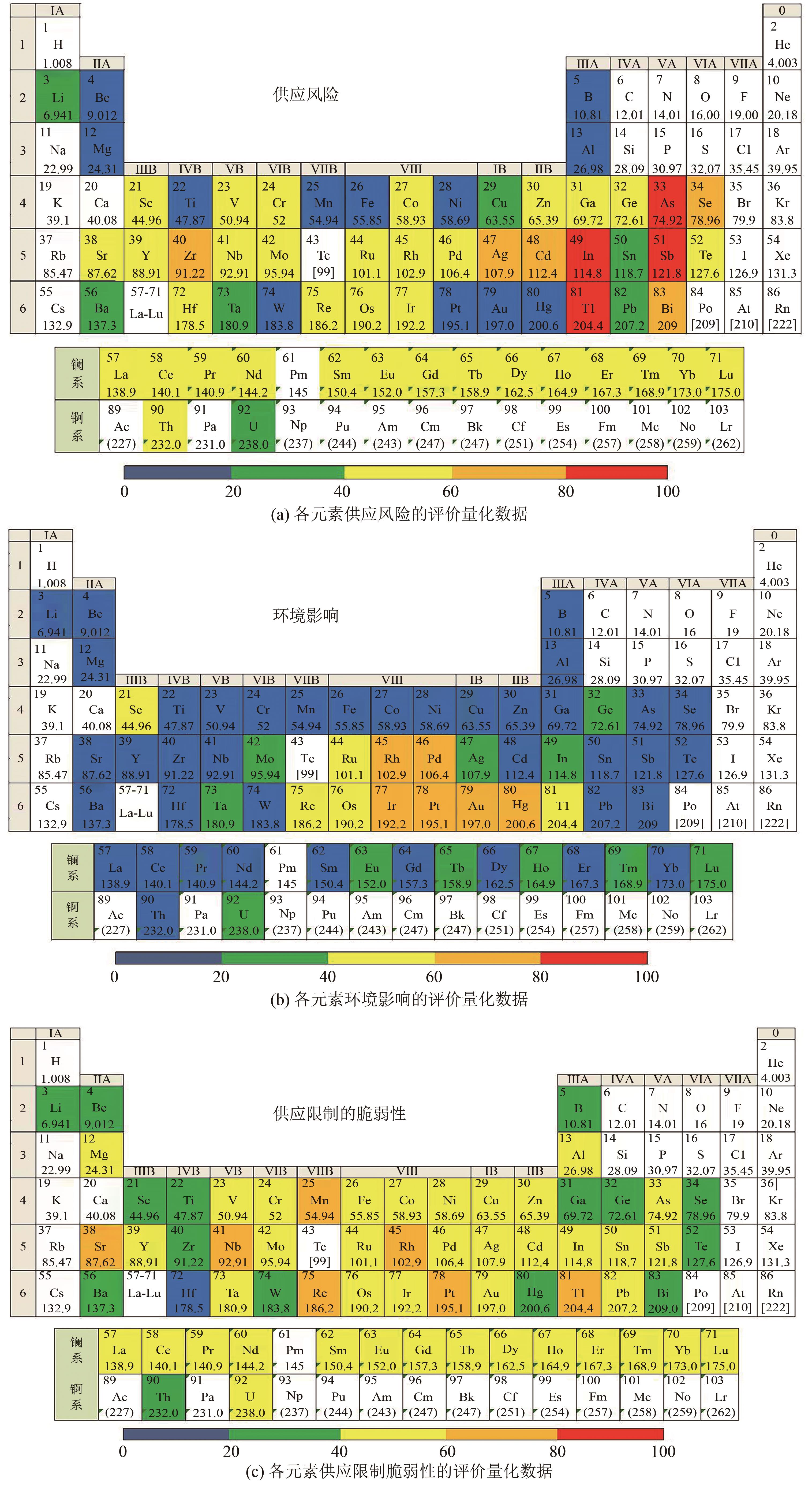
图2 Graedel等关键性评价结果[32,38-40,46]
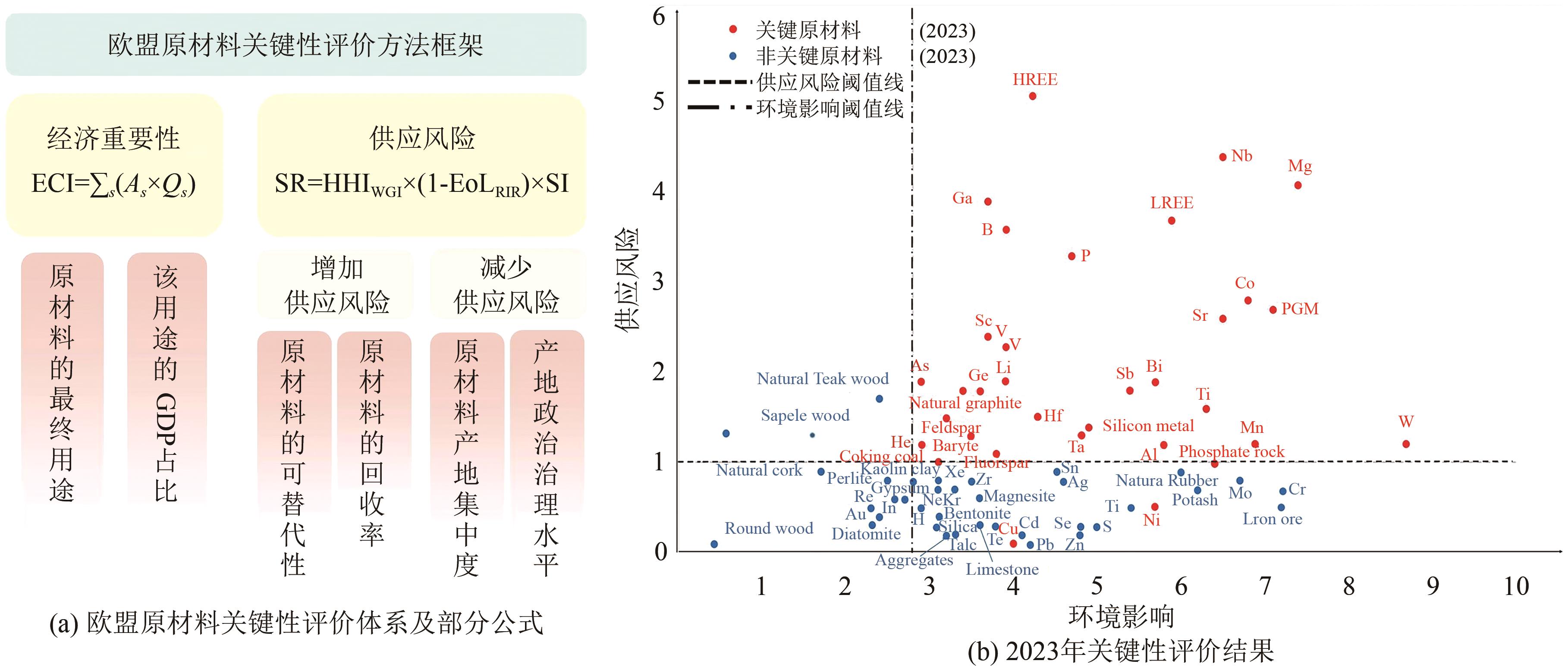
图3 欧盟关键性评价方法及结果[13,48]
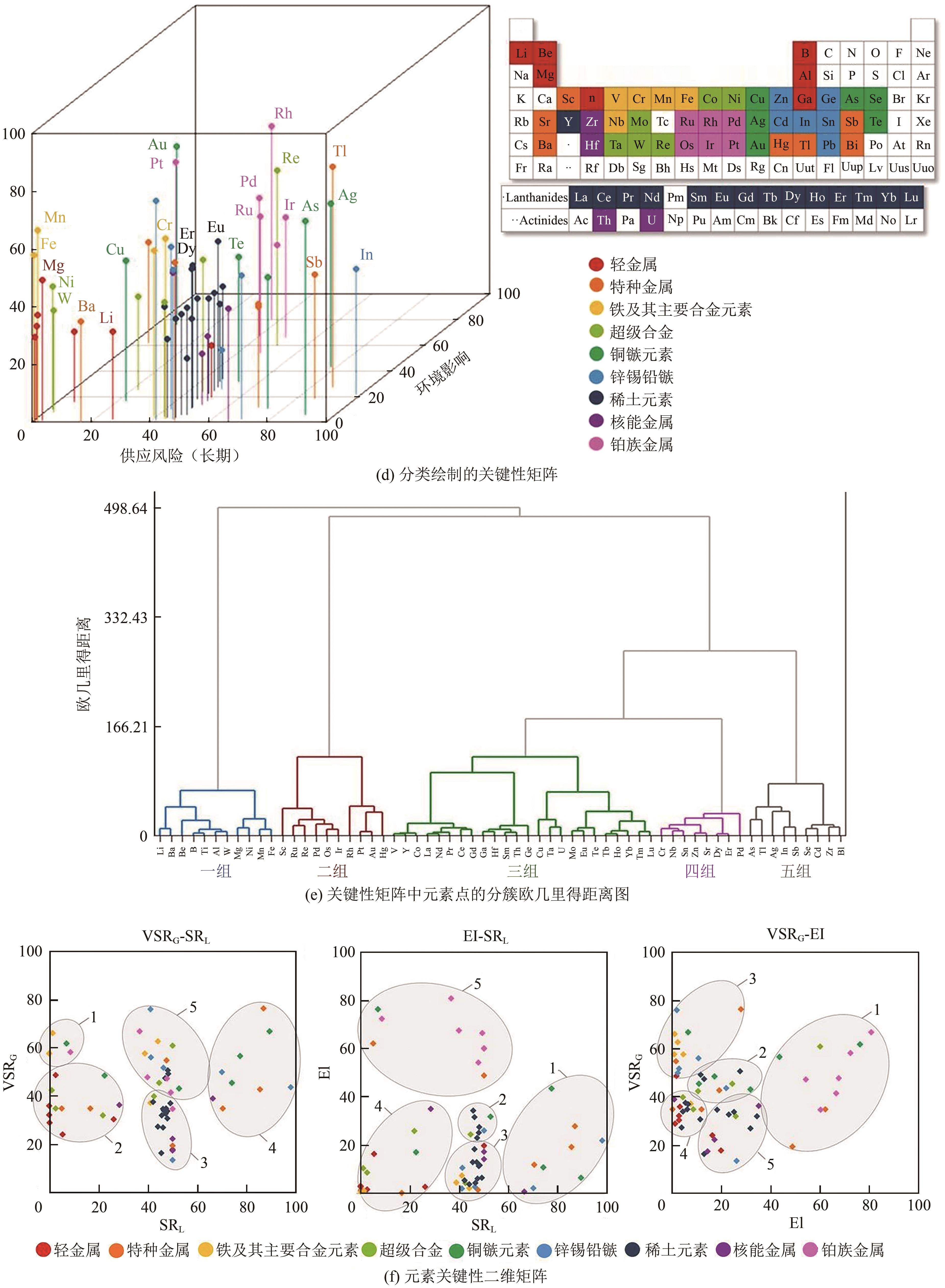
图2 Graedel等关键性评价结果[32,38-40,46](续)
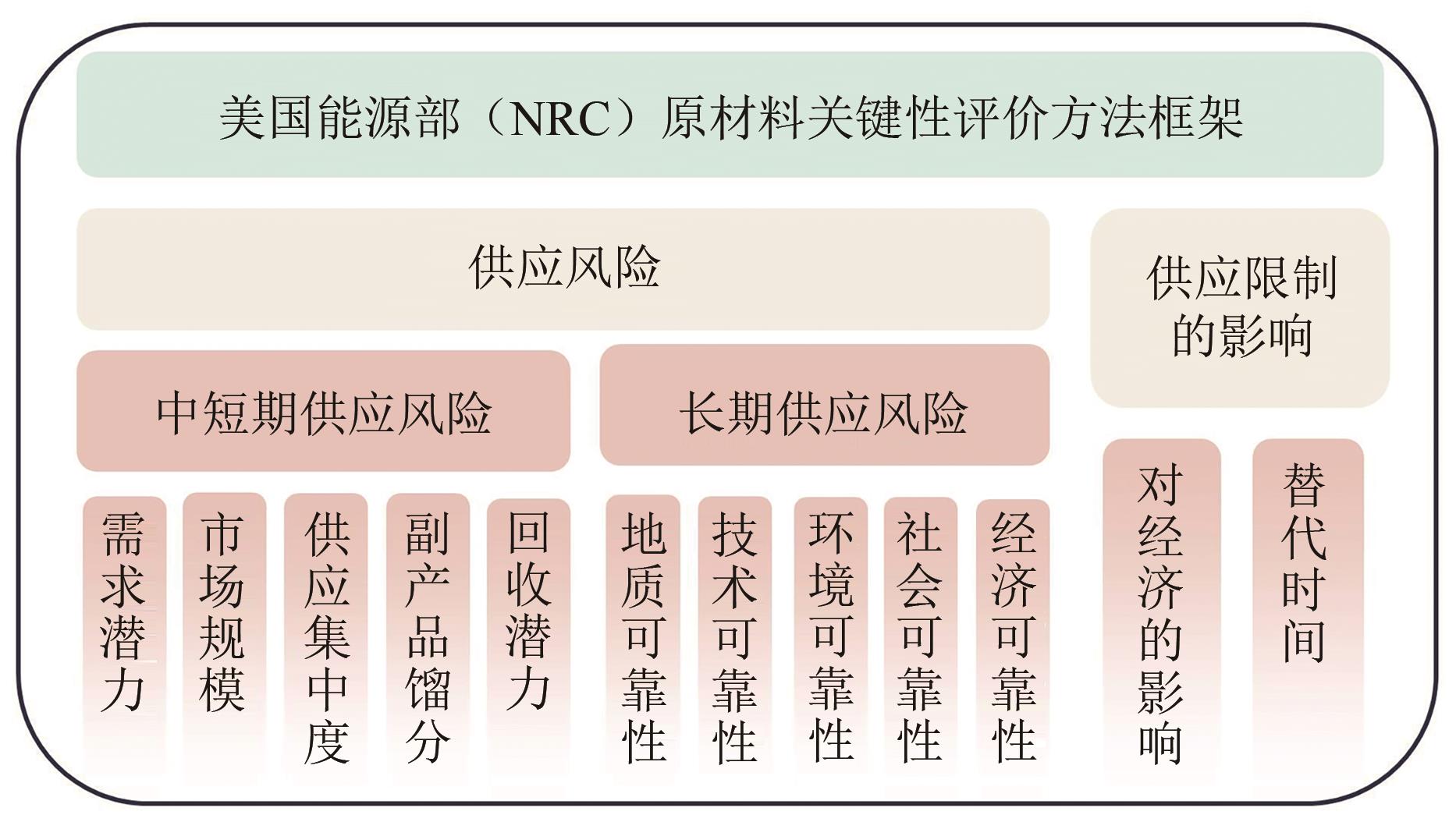
图4 NRC关键性评价方法框架[9]

图5 中国原材料关键性评价框架及结果[12]
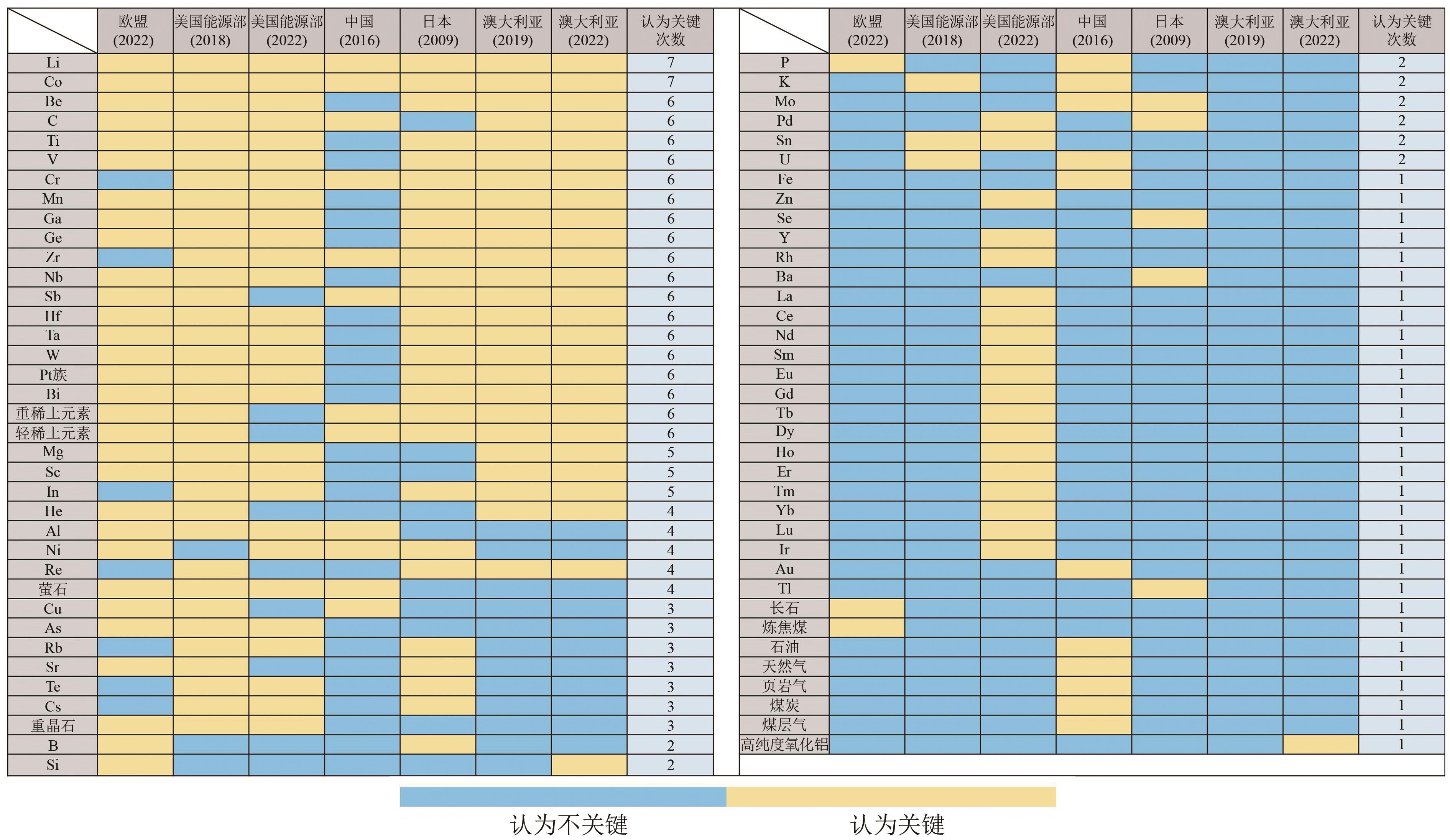
图6 各材料在不同评价方法中的关键性
| 1 | 黄健柏, 孙芳. 中国稀有轻金属关键性动态评估——以锂和铍为例[J]. 长江流域资源与环境, 2020, 29(4): 879-888. |
| HUANG Jianbai, SUN Fang. Dynamic criticality assessment of rare light metals in China: Case study of lithium and beryllium[J]. Resources and Environment in the Yangtze Basin, 2020, 29(4): 879-888. | |
| 2 | MCNICOLL G. United Nations development programme: Human development report 2006. Beyond scarcity: Power, poverty and the global water crisis[J]. Population and Development Review, 2007, 33(1): 198-200. |
| 3 | 王玥, 郑晓洪, 陶天一, 等. 废锂离子电池正极材料中锂元素选择性回收的研究进展[J]. 化工进展, 2022, 41(8): 4530-4543. |
| WANG Yue, ZHENG Xiaohong, TAO Tianyi, et al. Review on selective recovery of lithium from cathode materials in spent lithium-ion batteries[J]. Chemical Industry and Engineering Progress, 2022, 41(8): 4530-4543. | |
| 4 | TANSEL Berrin. From electronic consumer products to e-wastes: Global outlook, waste quantities, recycling challenges[J]. Environment International, 2017, 98: 35-45. |
| 5 | ZHOU Yanjing, LI Jianwu, RECHBERGER Helmut, et al. Dynamic criticality of by-products used in thin-film photovoltaic technologies by 2050[J]. Journal of Cleaner Production, 2020, 263: 121599. |
| 6 | Saleem H ALI, GIURCO Damien, ARNDT Nicholas, et al. Mineral supply for sustainable development requires resource governance[J]. Nature, 2017, 543(7645): 367-372. |
| 7 | 卜祥宁, 任玺冰, 童正, 等. 功率超声对废旧锂离子电池资源化回收利用过程的影响研究进展[J]. 化工进展, 2024, 43(1): 514-528. |
| BU Xiangning, REN Xibing, TONG Zheng, et al. Effect of power ultrasound on resource recycling and utilization of spent lithium-ion batteries: A review[J]. Chemical Industry and Engineering Progress, 2024, 43(1): 514-528. | |
| 8 | ACHZET Benjamin, HELBIG Christoph. How to evaluate raw material supply risks — An overview[J]. Resources Policy, 2013, 38(4): 435-447. |
| 9 | EGGERTM R G, CARPENTER A S, FREIMAN S W, et al. Critical Minerals, and the U. S. Economy[M]. Washington, DC: The National Academies Press, 2008. |
| 10 | GRAEDEL T E, BARR Rachel, CHANDLER Chelsea, et al. Methodology of metal criticality determination[J]. Environmental Science & Technology, 2012, 46(2): 1063-1070. |
| 11 | MORLEY N, EATHERLEY D. Ensuring resource availability for the UK economy[R]. Chester: C-Tech Innovation Ltd., 2008. |
| 12 | YAN Wenyi, WANG Zhaolong, CAO Hongbin, et al. Criticality assessment of metal resources in China[J]. iScience, 2021, 24(6): 102524. |
| 13 | GROHOL M, VEEH C. Study on the critical raw materials for the EU 2023[R]. Luxembourg: Publications Office of the European Union, 2023. |
| 14 | DUCLOS Steven J, OTTO Jeffrey P, KONITZER Douglas G. Design in an era of constrained resources[J]. Mechanical Engineering, 2010, 132(9): 36-40. |
| 15 | KOLOTZEK Christoph, HELBIG Christoph, THORENZ Andrea, et al. A company-oriented model for the assessment of raw material supply risks, environmental impact and social implications[J]. Journal of Cleaner Production, 2018, 176: 566-580. |
| 16 | SCHRIJVERS Dieuwertje, HOOL Alessandra, BLENGINI Gian Andrea, et al. A review of methods and data to determine raw material criticality[J]. Resources, Conservation and Recycling, 2020, 155: 104617. |
| 17 | CHAKHMOURADIAN Anton R, SMITH Martin P, KYNICKY Jindrich. From “strategic” tungsten to “green” neodymium: A century of critical metals at a glance[J]. Ore Geology Reviews, 2015, 64: 455-458. |
| 18 | WATARI Takuma, NANSAI Keisuke, NAKAJIMA Kenichi. Review of critical metal dynamics to 2050 for 48 elements[J]. Resources, Conservation and Recycling, 2020, 155: 104669. |
| 19 | HATAYAMA H, TAHARA K. Criticality assessment of metals for Japan’s resource strategy[J]. Materials Transactions, 2015, 56(2): 229-235. |
| 20 | RANDEBROCK Inka, MARINOVA Sylvia, BACH Vanessa, et al. Adapting the ESSENZ method to assess the criticality of construction materials: Case study of Herne, Germany[J]. Resources, 2023, 12(8): 92. |
| 21 | MIYAMOTO Wataru, KOSAI Shoki, HASHIMOTO Seiji. Evaluating metal criticality for low-carbon power generation technologies in Japan[J]. Minerals, 2019, 9(2): 95. |
| 22 | KIM Yu-Jeong, KIM Dae-Hyung, KIM Jinsoo, et al. Development of the criticality evaluation system for rare metals stockpiling[J]. Journal of the Korean Institute of Resources Recycling, 2018, 27: 66-77. |
| 23 | SCHULZ Klaus J, DEYOUNG John H, SEAL Robert R II, et al. Critical mineral resources of the United States: Economic and environmental geology and prospects for future supply[M]. Reston, Virginia: U. S. Geological Survey, 2017. |
| 24 | 李鹏飞, 杨丹辉, 渠慎宁, 等. 稀有矿产资源的战略性评估——基于战略性新兴产业发展的视角[J]. 中国工业经济, 2014(7): 44-57. |
| LI Pengfei, YANG Danhui, QU Shenning, et al. A strategic assessment of rare minerals — Based on the perspective of strategic emerging industries development[J]. China Industrial Economics, 2014(7): 44-57. | |
| 25 | 张艳飞, 陈其慎, 于汶加, 等. 中国矿产资源重要性二维评价体系构建[J]. 资源科学, 2015, 37(5): 883-890. |
| ZHANG Yanfei, CHEN Qishen, YU Wenjia, et al. Building a two dimensional coordinate evaluation system of mineral resource importance[J]. Resources Science, 2015, 37(5): 883-890. | |
| 26 | ENERGY N, ORGANIZATION I T D. Trend report of development in materials for substitution of scarce metals[R]. Japan: Shinko Research Co, 2009. |
| 27 | VAN DEN BERG P, DE JONG W, SCHREVEN L. Critical materials in the Dutch economy. Preliminary results[M]. Netherlands: CBS, 2010. |
| 28 | ERDMANN L, BEHRENDT S, FEIL M, et al. Kritische Rohstoffe für Deutschland[R]. Berlin, Institut für Zukunftsstudien und Technologiebewertung, 2011. |
| 29 | ZENG Xianlai. Win-Win: Anthropogenic circularity for metal criticality and carbon neutrality[J]. Frontiers of Environmental Science & Engineering, 2022, 17(2): 23. |
| 30 | TERLOUW Tom, ZHANG Xiaojin, BAUER Christian, et al. Towards the determination of metal criticality in home-based battery systems using a life cycle assessment approach[J]. Journal of Cleaner Production, 2019, 221: 667-677. |
| 31 | FANG Sheng, YAN Wenyi, CAO Hongbin, et al. Evaluation on end-of-life LEDs by understanding the criticality and recyclability for metals recycling[J]. Journal of Cleaner Production, 2018, 182: 624-633. |
| 32 | GRAEDEL T E, HARPER E M, NASSAR N T, et al. Criticality of metals and metalloids[J]. Proceedings of the National Academy of Sciences of the United States of America, 2015, 112(14): 4257-4262. |
| 33 | JONES Ben, ELLIOTT Robert J R, Viet NGUYEN-TIEN. The EV revolution: The road ahead for critical raw materials demand[J]. Applied Energy, 2020, 280: 115072. |
| 34 | MANCINI Lucia, SALA Serenella, RECCHIONI Marco, et al. Potential of life cycle assessment for supporting the management of critical raw materials[J]. The International Journal of Life Cycle Assessment, 2015, 20(1): 100-116. |
| 35 | LIM K L, KAZEMIAN H, YAAKOB Z, et al. Solid-state materials and methods for hydrogen storage: A critical review[J]. Chemical Engineering & Technology, 2010, 33(2): 213-226. |
| 36 | ABREU Levi R, NAGANO Marcelo S. A two-stage fuzzy inference model to determine raw materials criticality in life sciences industries[J]. Operations Management Research, 2023, 16(4): 2048-2063. |
| 37 | HOFMANN Margarethe, HOFMANN Heinrich, Christian HAGELÜKEN, et al. Critical raw materials: A perspective from the materials science community[J]. Sustainable Materials and Technologies, 2018, 17: e00074. |
| 38 | NASSAR N T, BARR Rachel, BROWNING M, et al. Criticality of the geological copper family[J]. Environmental Science & Technology, 2012, 46(2): 1071-1078. |
| 39 | NASSAR N T, DU Xiaoyue, GRAEDEL T E. Criticality of the rare earth elements[J]. Journal of Industrial Ecology, 2015, 19(6): 1044-1054. |
| 40 | PANOUSI Stefania, HARPER E M, NUSS Philip, et al. Criticality of seven specialty metals[J]. Journal of Industrial Ecology, 2016, 20(4): 837-853. |
| 41 | HARPER E M, DIAO Zhouwei, PANOUSI Stefania, et al. The criticality of four nuclear energy metals[J]. Resources, Conservation and Recycling, 2015, 95: 193-201. |
| 42 | CIACCI Luca, NUSS Philip, RECK Barbara, et al. Metal criticality determination for Australia, the US, and the planet — Comparing 2008 and 2012 results[J]. Resources, 2016, 5(4): 29. |
| 43 | NUSS Philip, HARPER E M, NASSAR N T, et al. Criticality of iron and its principal alloying elements[J]. Environmental Science & Technology, 2014, 48(7): 4171-4177. |
| 44 | 朱陆陆. 蒙特卡洛方法及应用[D]. 武汉: 华中师范大学, 2014. |
| ZHU Lulu. The Monte Carlo method and its application[D]. Wuhan: Central China Normal University, 2014. | |
| 45 | 罗豪杰, 潘俊, 陈小霞, 等. 基于Monte-Carlo模拟的湖南省典型工厂周边农田土壤重金属区域潜在生态风险特征及来源解析[J]. 环境科学, 2024, 45(2): 1038-1048. |
| LUO Haojie, PAN Jun, CHEN Xiaoxia, et al. Potential ecological risk characteristics and source apportionment of heavy metals in farmland soils around typical factories in Hunan Province based on Monte-Carlo simulation[J]. Environmental Science, 2024, 45(2): 1038-1048. | |
| 46 | E-M HARPER, KAVLAK Goksin, BURMEISTER Lara, et al. Criticality of the geological zinc, tin, and lead family[J]. Journal of Industrial Ecology, 2015, 19(4): 628-644. |
| 47 | ENTR D. Report on critical raw materials for the EU[R]. Luxembourg: Publications Office of the European Union, 2014. |
| 48 | BLENGINI Gian Andrea, NUSS Philip, DEWULF Jo, et al. EU methodology for critical raw materials assessment: Policy needs and proposed solutions for incremental improvements[J]. Resources Policy, 2017, 53: 12-19. |
| 49 | KARALI Nihan, SHAH Nihar. Bolstering supplies of critical raw materials for low-carbon technologies through circular economy strategies[J]. Energy Research & Social Science, 2022, 88: 102534. |
| 50 | GAO Wenfang, SUN Zhi, WU Yufeng, et al. Criticality assessment of metal resources for light-emitting diode (LED) production — A case study in China[J]. Cleaner Engineering and Technology, 2022, 6: 100380. |
| 51 | GÖÇMEN POLAT Elifcan, Melih YÜCESAN, Muhammet GÜL. A comparative framework for criticality assessment of strategic raw materials in Turkey[J]. Resources Policy, 2023, 82: 103511. |
| 52 | DETEIX Lazare, SALOU Thibault, Sophie DROGUÉ, et al. The importance of land in resource criticality assessment methods: A first step towards characterising supply risk[J]. Science of the Total Environment, 2023, 880: 163248. |
| 53 | 宋佳丽. 面向能源金属高效回收的资源关键性评价模型与应用[D]. 天津: 天津大学, 2019. |
| SONG Jiali. Resource criticality evaluation model and applications toward the efficient recovery of energy metals[D]. Tianjin: Tianjin University, 2019. | |
| 54 | THELER Brennan, KAUWE Steven K, SPARKS Taylor D. Materials abundance, price, and availability data from the years 1998 to 2015[J]. Integrating Materials and Manufacturing Innovation, 2020, 9(1): 144-150. |
| 55 | GORMAN Miranda R, DZOMBAK David A. An assessment of the environmental sustainability and circularity of future scenarios of the copper life cycle in the U. S[J]. Sustainability, 2019, 11(20): 5624. |
| 56 | MCDONALD L. Economy begins to rebound as the US expands efforts to strengthen domestic critical mineral supply chains[J]. American Ceramic Society Bulletin, 2022, 101(6): 31. |
| 57 | HABIB Komal, WENZEL Henrik. Exploring rare earths supply constraints for the emerging clean energy technologies and the role of recycling[J]. Journal of Cleaner Production, 2014, 84: 348-359. |
| 58 | NASSAR Nedal T, BRAINARD Jamie, GULLEY Andrew, et al. Evaluating the mineral commodity supply risk of the U. S. manufacturing sector[J]. Science Advances, 2020, 6(8): 8647. |
| 59 | FRONDEL Manuel, GRÖSCHE P, HUCHTERMANN D, et al. Trends der angebots- und nachfragesituation Bei mineralischen rohstoffen: Endbericht. forschungsprojekt nr. 09/05 des bundesministeriums für wirtschaft und technologie (BMWi)[R]. Essen, RWI - Leibniz-Institut für Wirtschaftsforschung, 2007. |
| 60 | MASSARI Stefania, RUBERTI Marcello. Rare earth elements as critical raw materials: Focus on international markets and future strategies[J]. Resources Policy, 2013, 38(1): 36-43. |
| 61 | RABE Wiebke, KOSTKA Genia, SMITH STEGEN Karen. China’s supply of critical raw materials: Risks for Europe’s solar and wind industries?[J]. Energy Policy, 2017, 101: 692-699. |
| 62 | VIVODA Vlado. Friend-shoring and critical minerals: Exploring the role of the minerals security partnership[J]. Energy Research and Social Science, 2023, 100: 103085. |
| 63 | LIN Mi, WU Yusen, QIN Baojia, et al. Response to the upcoming emerging waste: Necessity and feasibility analysis of photovoltaic waste recovery in China[J]. Environmental Science & Technology, 2022, 56(23): 17396-17409. |
| 64 | 陈盼, 施晓清. 京津冀电子废弃物回收利用潜力预测及环境效益评估[J]. 环境科学, 2020, 41(4): 1976-1986. |
| CHEN Pan, SHI Xiaoqing. Predicting the recycling potential and evaluating the environmental benefits of waste electrical and electronic equipment in Beijing-Tianjin-Hebei[J]. Environmental Science, 2020, 41(4): 1976-1986. | |
| 65 | 高敏雪. 《中国统计年鉴》中的主体分类[J]. 中国统计, 2010(3): 38-39. |
| GAO Minxue. Subject classification in China statistical yearbook[J]. China Statistics, 2010(3): 38-39. | |
| 66 | ZONG Yuhang, YAO Peifan, ZHANG Xihua, et al. Material flow analysis on the critical resources from spent power lithium-ion batteries under the framework of China’s recycling policies[J]. Waste Management, 2023, 171: 463-472. |
| 67 | MARINOVA Sylvia, BACH Vanessa, YOKOI Ryosuke, et al. Country-level criticality assessment of abiotic resource use in Japan - Application of the SCARCE method[J]. Journal of Cleaner Production, 2023, 412: 137355. |
| 68 | FERRO Paolo, BONOLLO Franco. Materials selection in a critical raw materials perspective[J]. Materials & Design, 2019, 177: 107848. |
| 69 | MCCAFFREY Dalton M, NASSAR Nedal T, JOWITT Simon M, et al. Embedded critical material flow: The case of niobium, the United States, and China[J]. Resources, Conservation and Recycling, 2023, 188: 106698. |
| 70 | SIDDHANTAKAR Ankesh, Jair SANTILLÁN-SALDIVAR, KIPPES Thomas, et al. Helium resource global supply and demand: Geopolitical supply risk analysis[J]. Resources, Conservation and Recycling, 2023, 193: 106935. |
| 71 | MOTOSHITA Masaharu, PFISTER Stephan, SASAKI Takahiro, et al. Responsibility for sustainable water consumption in the global supply chains[J]. Resources, Conservation and Recycling, 2023, 196: 107055. |
| 72 | 王昊, 霍进达, 曲国瑞, 等. 退役锂电池正极材料资源化回收技术研究进展[J]. 化工进展, 2023, 42(5): 2702-2716. |
| WANG Hao, HUO Jinda, QU Guorui, et al. Research progress of positive electrode material recycling technology for retired lithium batteries[J]. Chemical Industry and Engineering Progress, 2023, 42(5): 2702-2716. | |
| 73 | 张丽宏, 金要茹, 程芳琴. 煤气化渣资源化利用[J]. 化工进展, 2023, 42(8): 4447-4457. |
| ZHANG Lihong, JIN Yaoru, CHENG Fangqin. Resource utilization of coal gasification slag[J]. Chemical Industry and Engineering Progress, 2023, 42(8): 4447-4457. | |
| 74 | 侯殿保, 贺茂勇, 陈育刚, 等. 资源优化配置与循环经济在钾资源开发利用中的应用[J]. 化工进展, 2023, 42(6): 3197-3208. |
| HOU Dianbao, HE Maoyong, CHEN Yugang, et al. Application analysis of resource allocation optimization and circular economy in development and utilization of potassium resources[J]. Chemical Industry and Engineering Progress, 2023, 42(6): 3197-3208. | |
| 75 | FRENZEL M, KULLIK J, REUTER M A, et al. Raw material ‘criticality’ — Sense or nonsense?[J]. Journal of Physics D: Applied Physics, 2017, 50(12): 123002. |
| [1] | 李晶莹, 马龙飞, 潘一搏, 卢山, 张红娟, 徐龙, 马晓迅. 焦炉煤气脱碳法及甲烷化法制液化天然气的生命周期环境影响分析[J]. 化工进展, 2024, 43(5): 2872-2879. |
| [2] | 宗宇航, 迟亚欣, 张西华, 王兆龙, 郑洋, 江永方. 基于网络层次分析法的废电路板树脂粉典型利用处置技术综合评价[J]. 化工进展, 2024, 43(4): 2117-2125. |
| [3] | 姚福春, 毕莹莹, 刘超, 唐晨, 李泽莹, 张耀宗, 孙晓明. 矩阵分析法优化臭氧膜接触传质技术[J]. 化工进展, 2024, 43(11): 6553-6562. |
| [4] | 侯建勇, 严芳, 王浩, 程晓辉, 严厚华, 胡刚. 基于因果-模糊层次分析的湿法脱硫系统运行稳定性综合评价[J]. 化工进展, 2022, 41(2): 569-583. |
| [5] | 赵东亚, 卢帆, 曹磊, 李兆敏, 鹿腾, 杨建平. 基于模糊综合评价的烟道气辅助SAGD过程评价[J]. 化工进展, 2021, 40(1): 89-98. |
| [6] | 于伟静, 马超, 谭闻濒, 崔磊, 陈玉彬, 李昌浩. 燃煤电厂白色烟羽控制研究进展[J]. 化工进展, 2020, 39(S1): 232-241. |
| [7] | 李俊杰,程婉静,梁媚,严晓辉,杨靖东,张岳玲,冯连勇,田亚峻,谢克昌. 基于熵权-层次分析法的中国现代煤化工行业可持续发展综合评价[J]. 化工进展, 2020, 39(4): 1329-1338. |
| [8] | 黄泽健,罗祎青,袁希钢. 水处理集成微藻生物柴油生命周期系统环境影响评价[J]. 化工进展, 2020, 39(1): 34-41. |
| [9] | 于伟静,汪永威,吕小林,熊远南,龙腾,李培正. 燃煤电厂白色烟羽的潜值和控制策略评价[J]. 化工进展, 2019, 38(03): 1579-1586. |
| [10] | 马双忱, 范紫瑄, 温佳琪, 马岚, 赵保华, 张金柱, 孙尧. 基于模糊层次分析的燃煤电厂脱硫废水处理可利用技术评价[J]. 化工进展, 2018, 37(11): 4451-4459. |
| [11] | 周建阳, 罗小平, 李海燕, 郭峰, 邓聪, 谢鸣宇. 纳米粒子浓度对纳米流体流动沸腾传热及压降影响综合评价[J]. 化工进展, 2017, 36(01): 71-80. |
| [12] | 田梦然, 郑艺华, 吴荣华. 水源热泵用换热设备常用金属的腐蚀性能[J]. 化工进展, 2015, 34(12): 4391-4397. |
| [13] | 李惟毅, 郭强, 高静. 内置换热器的不同工质ORC系统的综合评价分析[J]. 化工进展, 2015, 34(08): 2977-2982. |
| [14] | 何长江,关昌峰,张震,何立臣,阎华,杨卫民. 内置开孔螺旋叶片转子换热管强化传热实验[J]. 化工进展, 2014, 33(12): 3189-3193. |
| [15] | 何立臣,关昌峰,何长江,张崇文,贺建芸,阎华 . 同比例大小径转子组合的强化传热实验[J]. 化工进展, 2014, 33(11): 2873-2877. |
| 阅读次数 | ||||||
|
全文 |
|
|||||
|
摘要 |
|
|||||