化工进展 ›› 2025, Vol. 44 ›› Issue (S1): 323-339.DOI: 10.16085/j.issn.1000-6613.2025-0250
• 材料科学与技术 • 上一篇
面向高效储氢MOFs的设计构筑与性能调控研究现状分析及展望
王瑞琪1( ), 刘浩伟1,2, 孙彦丽3, 李荣花1, 王政4, 吴玉花1, 吴建波1, 张慧1, 白红存1,2()
- 1.宁夏大学化学化工学院,宁夏 银川 750021
2.六盘山实验室,宁夏 银川 750004
3.中国人民解放军军事科学院系统工程研究院,北京 102300
4.宁夏大学材料与新能源学院,宁夏 银川 750021
-
收稿日期:2025-02-21修回日期:2025-05-08出版日期:2025-10-25发布日期:2025-11-24 -
通讯作者:白红存 -
作者简介:王瑞琪(2000—),女,硕士研究生,研究方向为储氢材料设计与合成。E-mail:2253842349@qq.com。 -
基金资助:国家自然科学基金(22478206);国家自然科学基金(22169015);六盘山实验室基础科研项目(LPS-2025-KY-D-JC-0019)
Analysis and outlook on the current research state in design, construction and performance regulation of MOFs for efficient hydrogen storage
WANG Ruiqi1(), LIU Haowei1,2, SUN Yanli3, LI Ronghua1, WANG Zheng4, WU Yuhua1, WU Jianbo1, ZHANG Hui1, BAI Hongcun1,2()
- 1.College of Chemistry and Chemical Engineering, Ningxia University, Yinchuan 750021, Ningxia, China
2.Liupanshan Laboratory, Yinchuan 750004, Ningxia, China
3.Institute of Systems Engineering, Academy of Military Sciences, PLA, Beijing 102300, China
4.School of Materials and New Energy, Ningxia University, Yinchuan 750021, Ningxia, China
-
Received:2025-02-21Revised:2025-05-08Online:2025-10-25Published:2025-11-24 -
Contact:BAI Hongcun

摘要:
高效固态储氢材料是氢能安全储运的重要物质基础,也是氢能规模化应用的关键技术问题,对实现“双碳”目标和高质量发展具有重要意义。金属有机骨架(MOFs)材料因比表面积大、稳定性高、结构多样和可定制等优点近年来发展迅速,已成为国际储氢领域的研究重点。MOFs储氢尽管低温表现较好,但室温储氢性能仍不理想,主要受限于氢气与MOFs之间结合较弱。因此,在对MOFs微观结构以及与氢分子相互作用深刻认识基础上开展面向高效储氢MOFs的设计构筑及性能调控研究至关重要。本文综述了MOFs储氢的设计构筑及性能调控的研究现状,并对其未来发展方向进行了展望。重点围绕金属中心和有机配体的选择与组装、MOFs的拓扑结构及其调控机制、低温和室温条件下MOFs储氢的研究进展与应用进行了系统总结。研究分析表明,MOFs的孔道结构是储氢的核心特征;金属中心和有机配体的电子性质对MOFs吸附氢分子影响显著;精确调控孔道结构、孔径设计、金属中心及其有机配体是实现面向高效储氢的MOFs设计构筑的关键路径。此外,引入开放金属位点、功能化有机配体以及纳米粒子,可以显著增强MOFs与氢分子之间的相互作用力,从而提高其储氢性能。针对MOFs储氢研究的应用前景及未来发展,建议从人工智能驱动下储氢MOFs材料设计、储氢性能指标提升、材料规模化低成本制备、扩展MOFs储氢应用等方面持续开展基础研究和技术研发。本文可为面向储氢的MOFs材料高效构筑提供理论支持和指导,助力氢能的高效安全储运。
中图分类号:
引用本文
王瑞琪, 刘浩伟, 孙彦丽, 李荣花, 王政, 吴玉花, 吴建波, 张慧, 白红存. 面向高效储氢MOFs的设计构筑与性能调控研究现状分析及展望[J]. 化工进展, 2025, 44(S1): 323-339.
WANG Ruiqi, LIU Haowei, SUN Yanli, LI Ronghua, WANG Zheng, WU Yuhua, WU Jianbo, ZHANG Hui, BAI Hongcun. Analysis and outlook on the current research state in design, construction and performance regulation of MOFs for efficient hydrogen storage[J]. Chemical Industry and Engineering Progress, 2025, 44(S1): 323-339.
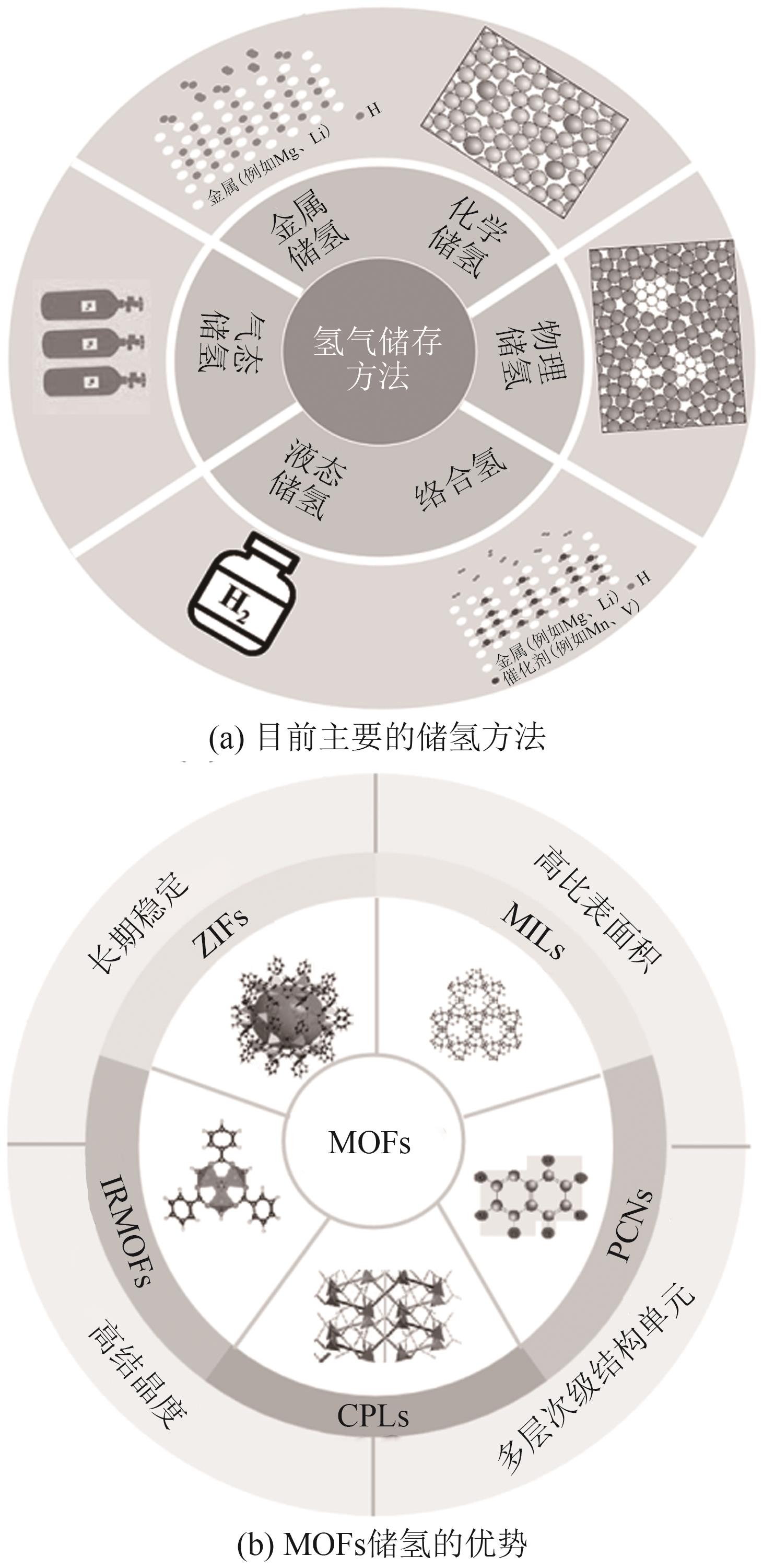
图1 目前主要的储氢方法和MOFs储氢的优势
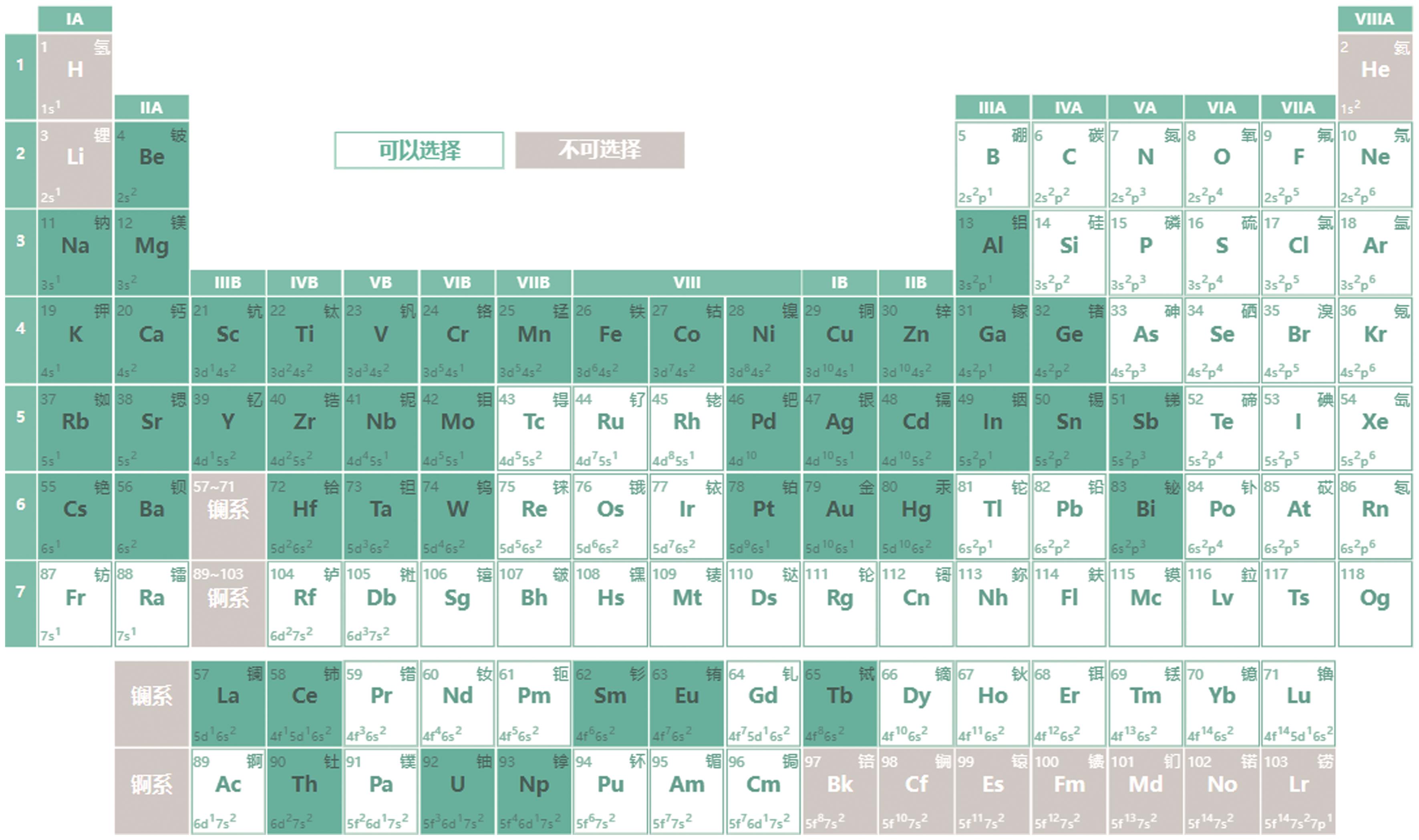
图2 MOFs中金属节点的常见元素选择
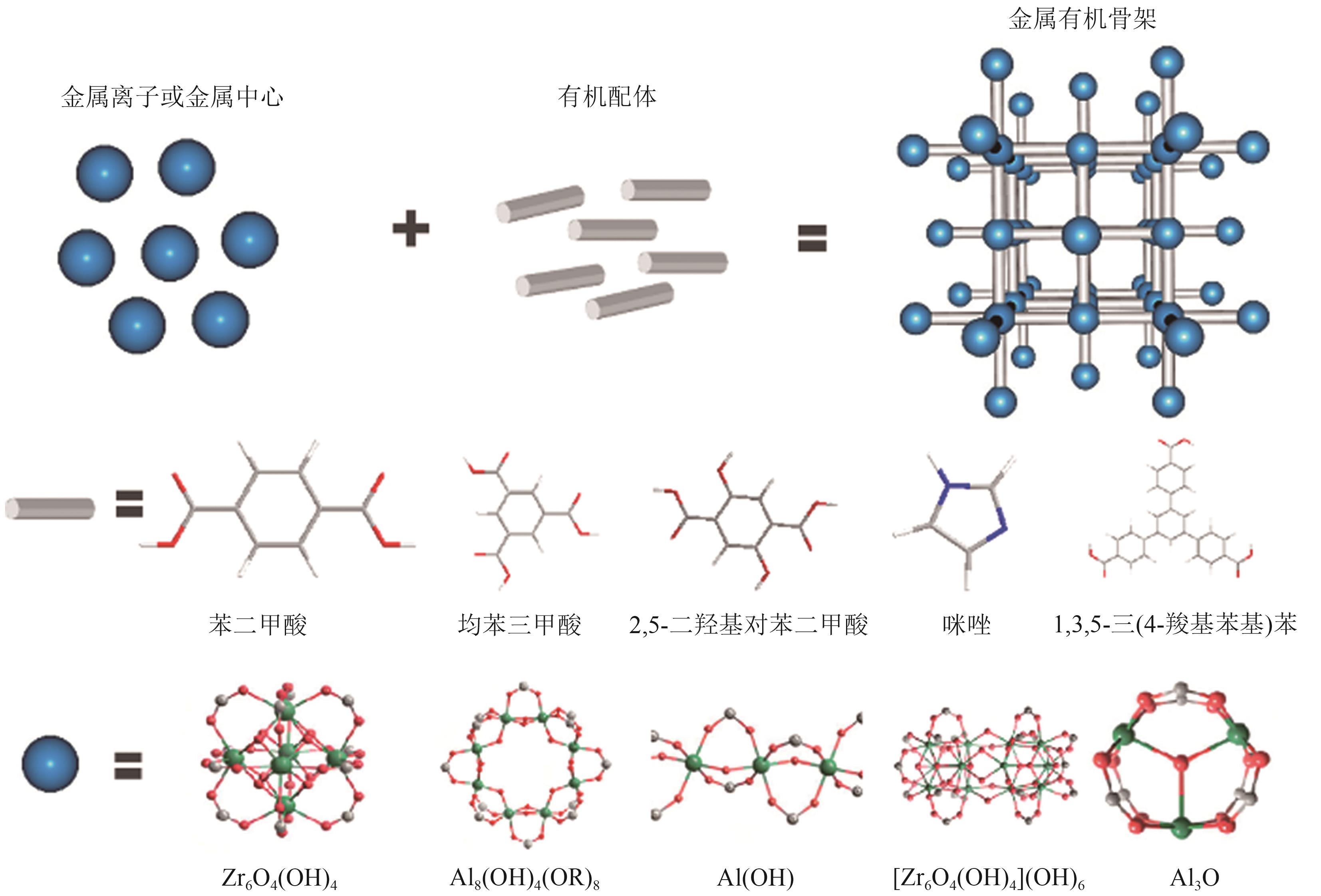
图3 MOFs材料金属中心和有机配体的组装[60]
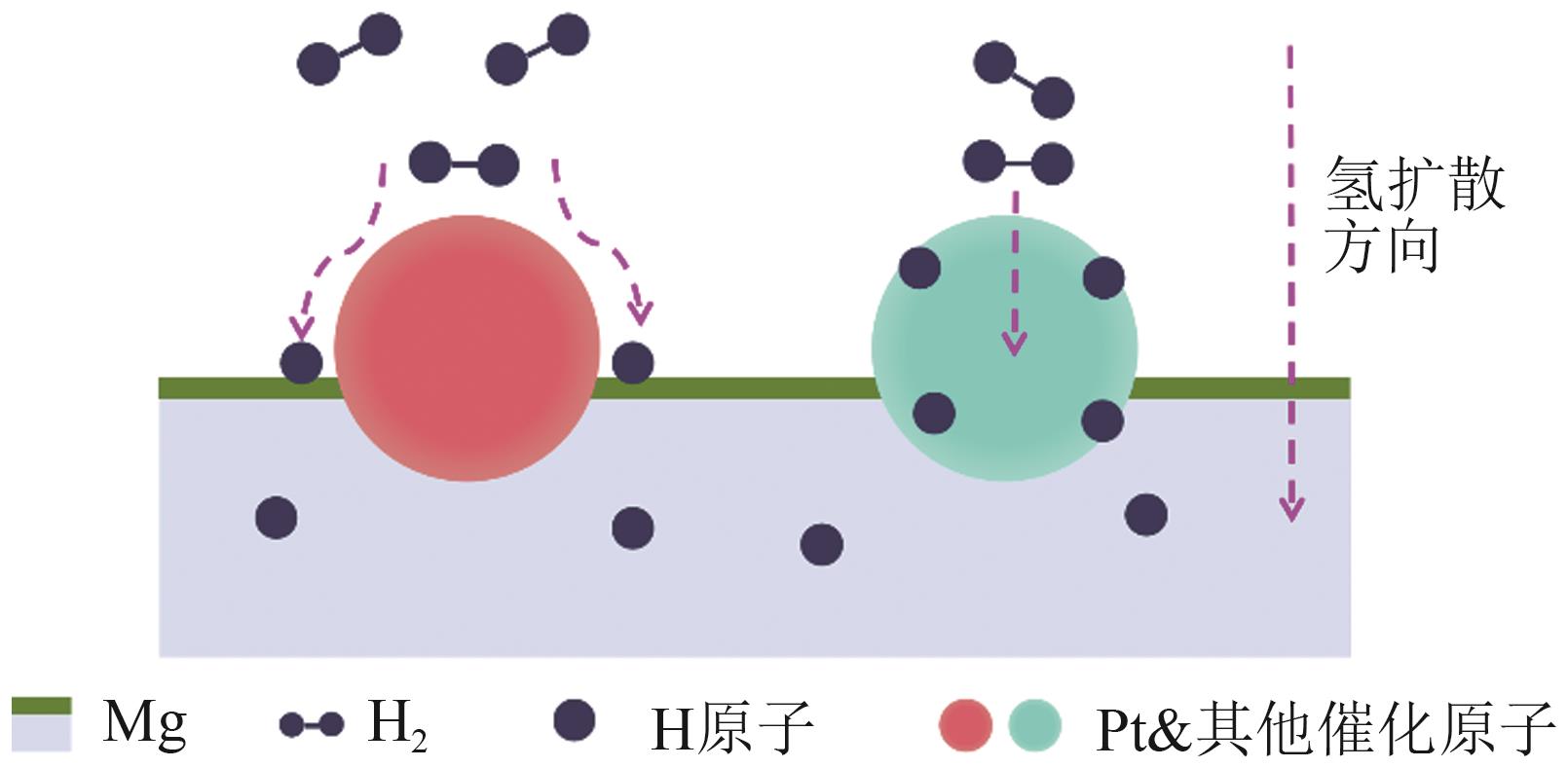
图4 “氢溢流”及“氢泵”效应的微观机制
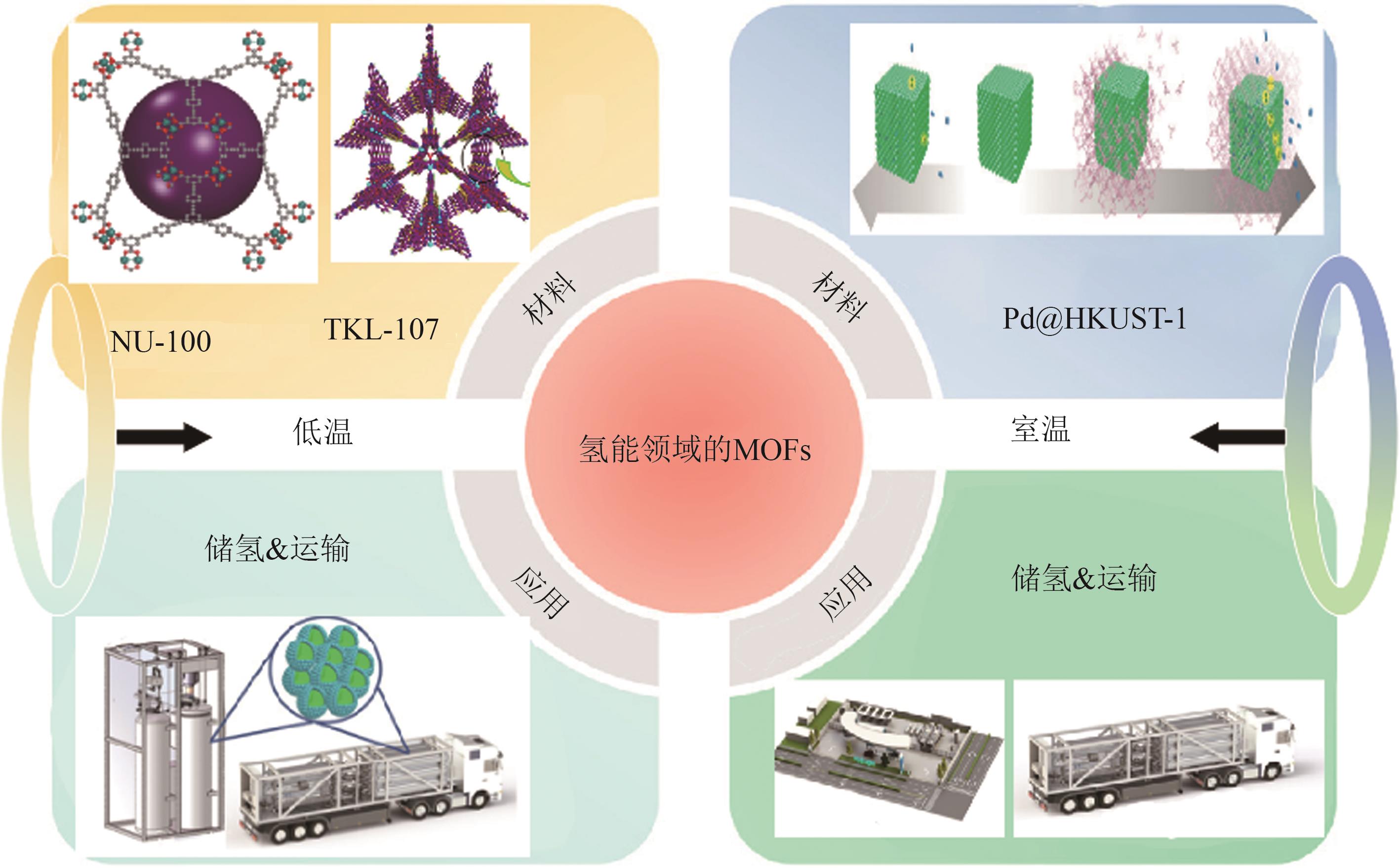
图5 MOFs材料在氢能领域的应用
| 材料 | 比表面积/m2∙g-1 | 总孔容/cm3∙g-1 | 微孔孔容/cm3∙g-1 | 温度T/K | 压力P/MPa | 氢气吸附量(质量分数)/% | 参考文献 |
|---|---|---|---|---|---|---|---|
| Zn4O(BDC)3 | 3800 | — | — | 77 | 17 | 11.5 | [ |
| MOF-177 | 3275 | 2.65 | — | 77 | 10 | 11 | [ |
| MOF-520/GKOH | 3100 | 1.61 | 1.11 | 77 | 0.1 | 10.4 | [ |
| Pd@MOF-808 | 863 | — | 0.45 | 77 | 4 | 8.11 | [ |
| MIL-101 | 3536 | 1.7 | 1.43 | 77 | 5 | 5.8 | [ |
| V(BDC)(TED)0.5 | 1728 | 0.78 | 77 | 2 | 5.13 | [ | |
| Co(BDC)(TED)0.5 | 1628 | 0.74 | 77 | 2 | 4.87 | [ | |
| MOF-174-Mg | 2465 | 0.58 | — | 77 | 2 | 4.69 | [ |
| IRMOF-1 | 3362 | — | — | 78 | 5 | 4.5 | [ |
| MOF-184-Mg | 3154 | 0.62 | — | 77 | 2 | 4.34 | [ |
| UiO-66 | 1561 | 0.67 | 0.58 | 77 | 5 | 3.8 | [ |
| Ce-MOF-808 | 1356 | — | — | 77 | — | 2.95 | [ |
| Cu-MOPF | 2091 | — | — | 77 | 0.1 | 2.8 | [ |
| Cu-MOF | 1953 | — | — | 77 | 0.1 | 2.6 | [ |
| TKL-106 | 1636 | 0.8 | — | 77 | 0.1 | 2.1 | [ |
| SNHKUST-1 | 1444 | — | — | 77 | 0.1 | 1.98 | [ |
| Zr-MOF | 1367 | 0.56 | 0.44 | 77 | 0.1 | 1.5 | [ |
| CAU-1 | 1700 | — | — | 100 | 0.1 | 1.35 | [ |
| 1.26%Mg@SNU-90 | 4154 | — | — | 77 | 0.1 | 1.24 | [ |
表1 MOFs材料在低温、不同压力条件下的氢气吸附容量
| 材料 | 比表面积/m2∙g-1 | 总孔容/cm3∙g-1 | 微孔孔容/cm3∙g-1 | 温度T/K | 压力P/MPa | 氢气吸附量(质量分数)/% | 参考文献 |
|---|---|---|---|---|---|---|---|
| Zn4O(BDC)3 | 3800 | — | — | 77 | 17 | 11.5 | [ |
| MOF-177 | 3275 | 2.65 | — | 77 | 10 | 11 | [ |
| MOF-520/GKOH | 3100 | 1.61 | 1.11 | 77 | 0.1 | 10.4 | [ |
| Pd@MOF-808 | 863 | — | 0.45 | 77 | 4 | 8.11 | [ |
| MIL-101 | 3536 | 1.7 | 1.43 | 77 | 5 | 5.8 | [ |
| V(BDC)(TED)0.5 | 1728 | 0.78 | 77 | 2 | 5.13 | [ | |
| Co(BDC)(TED)0.5 | 1628 | 0.74 | 77 | 2 | 4.87 | [ | |
| MOF-174-Mg | 2465 | 0.58 | — | 77 | 2 | 4.69 | [ |
| IRMOF-1 | 3362 | — | — | 78 | 5 | 4.5 | [ |
| MOF-184-Mg | 3154 | 0.62 | — | 77 | 2 | 4.34 | [ |
| UiO-66 | 1561 | 0.67 | 0.58 | 77 | 5 | 3.8 | [ |
| Ce-MOF-808 | 1356 | — | — | 77 | — | 2.95 | [ |
| Cu-MOPF | 2091 | — | — | 77 | 0.1 | 2.8 | [ |
| Cu-MOF | 1953 | — | — | 77 | 0.1 | 2.6 | [ |
| TKL-106 | 1636 | 0.8 | — | 77 | 0.1 | 2.1 | [ |
| SNHKUST-1 | 1444 | — | — | 77 | 0.1 | 1.98 | [ |
| Zr-MOF | 1367 | 0.56 | 0.44 | 77 | 0.1 | 1.5 | [ |
| CAU-1 | 1700 | — | — | 100 | 0.1 | 1.35 | [ |
| 1.26%Mg@SNU-90 | 4154 | — | — | 77 | 0.1 | 1.24 | [ |
| 材料 | 比表面积/m2∙g-1 | 总孔容/cm3∙g-1 | 微孔孔容/cm3∙g-1 | T/K | P/MPa | 氢气吸附量(质量分数)/% | 参考文献 |
|---|---|---|---|---|---|---|---|
| Li-IRMOF-10 | 1516 | 0.36 | — | 298 | 10 | 5.1 | [ |
| Be-BTB | 4030 | 1.48 | — | 298 | 10 | 2.3 | [ |
| V2Cl2.8(btdd) | 1920 | — | — | 298 | 10 | 1.64 | [ |
| CPO-27-Ni | 1200 | — | 0.47 | 180 | — | 1.3 | [ |
| Cu-BTC/Ni@多壁碳纳米管(f-MWCNT) | 74 | — | — | 298 | 7 | 1.29 | [ |
| MOF-801 | 595 | 0.27 | — | 298 | 0.1 | 1.11 | [ |
| ZIF-8 | 687 | 0.38 | 0.3 | 298 | 1.2 | 0.94 | [ |
| MIL-100(Fe) | 2001 | 1.11 | 0.63 | 298 | 5 | 0.91 | [ |
| CuZIF-8-T | 1974 | — | — | 298 | 10 | 0.7 | [ |
| Cu-MOF/氧化石墨烯(GO) | 1010 | 0.43 | 0.4 | 298 | 0.1 | 0.46 | [ |
| de-MgMOF | 1015 | — | — | 298 | 7 | 0.4 | [ |
| Pd-MIL-101 | 380 | — | — | 298 | 4 | 0.35 | [ |
| UiO-66 | 1231 | 0.6 | 0.43 | 298 | 6 | 0.2 | [ |
| Ce-MOF-808 | 1356 | — | — | 298 | — | 0.13 | [ |
| Mg-MOF-74 | 1262 | — | — | 298 | 7 | 0.1 | [ |
| Co2(BDC)2(dabco) | 1595 | — | — | 298 | 1 | 0.03 | [ |
表2 MOFs材料在室温、不同压力条件下的氢气吸附容量
| 材料 | 比表面积/m2∙g-1 | 总孔容/cm3∙g-1 | 微孔孔容/cm3∙g-1 | T/K | P/MPa | 氢气吸附量(质量分数)/% | 参考文献 |
|---|---|---|---|---|---|---|---|
| Li-IRMOF-10 | 1516 | 0.36 | — | 298 | 10 | 5.1 | [ |
| Be-BTB | 4030 | 1.48 | — | 298 | 10 | 2.3 | [ |
| V2Cl2.8(btdd) | 1920 | — | — | 298 | 10 | 1.64 | [ |
| CPO-27-Ni | 1200 | — | 0.47 | 180 | — | 1.3 | [ |
| Cu-BTC/Ni@多壁碳纳米管(f-MWCNT) | 74 | — | — | 298 | 7 | 1.29 | [ |
| MOF-801 | 595 | 0.27 | — | 298 | 0.1 | 1.11 | [ |
| ZIF-8 | 687 | 0.38 | 0.3 | 298 | 1.2 | 0.94 | [ |
| MIL-100(Fe) | 2001 | 1.11 | 0.63 | 298 | 5 | 0.91 | [ |
| CuZIF-8-T | 1974 | — | — | 298 | 10 | 0.7 | [ |
| Cu-MOF/氧化石墨烯(GO) | 1010 | 0.43 | 0.4 | 298 | 0.1 | 0.46 | [ |
| de-MgMOF | 1015 | — | — | 298 | 7 | 0.4 | [ |
| Pd-MIL-101 | 380 | — | — | 298 | 4 | 0.35 | [ |
| UiO-66 | 1231 | 0.6 | 0.43 | 298 | 6 | 0.2 | [ |
| Ce-MOF-808 | 1356 | — | — | 298 | — | 0.13 | [ |
| Mg-MOF-74 | 1262 | — | — | 298 | 7 | 0.1 | [ |
| Co2(BDC)2(dabco) | 1595 | — | — | 298 | 1 | 0.03 | [ |
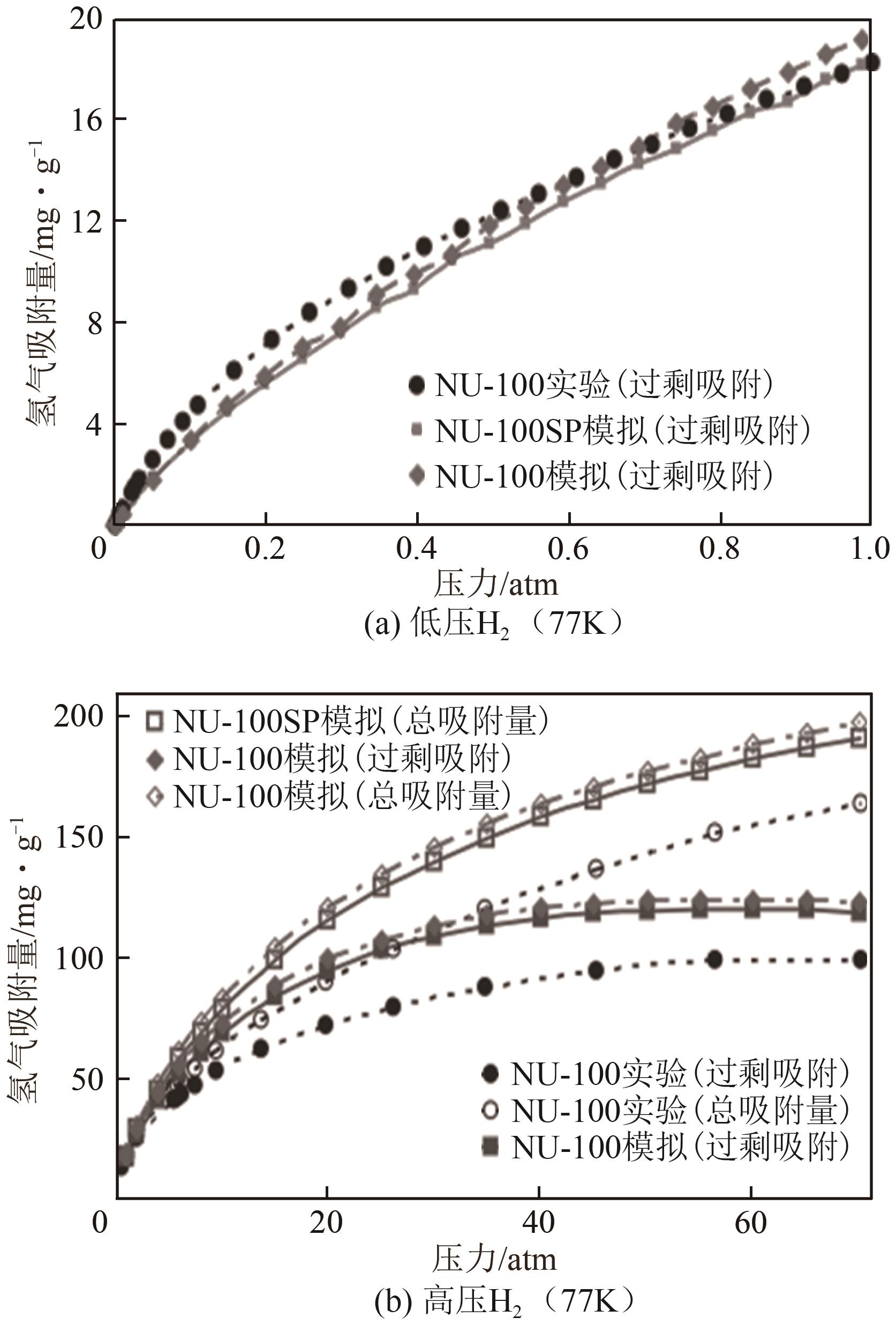
图6 模拟和合成NU-100的吸氢数据[62](1atm=101325Pa)
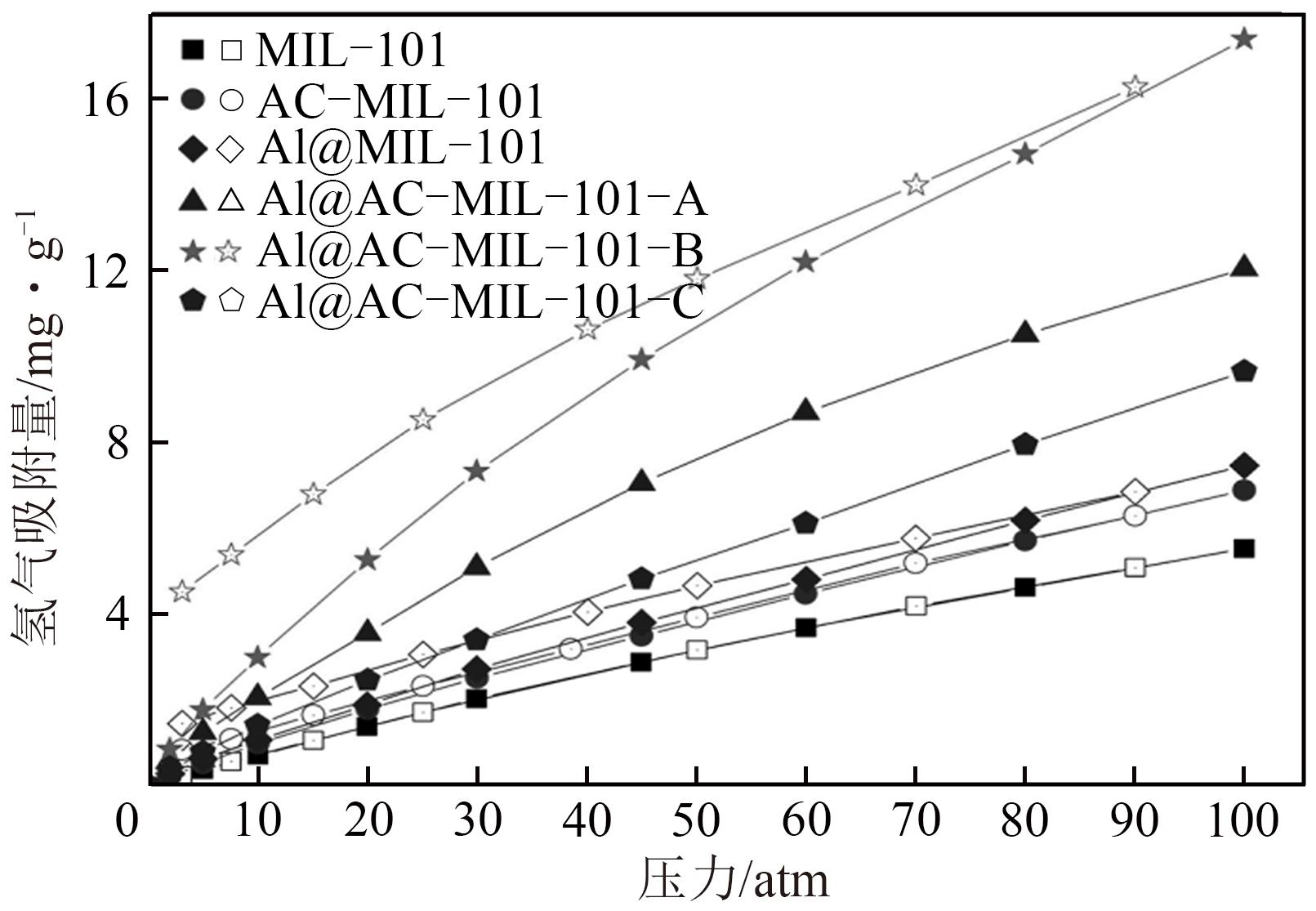
图7 合成材料在298K和0~100bar(1bar=0.1MPa)的氢气吸附脱附等温线[122]
| [1] | VAN DER ZWAAN Bob, FATTAHI Amir, DALLA LONGA Francesco, et al. Electricity- and hydrogen-driven energy system sector-coupling in net-zero CO2 emission pathways[J]. Nature Communications, 2025, 16(1): 1368. |
| [2] | QIANG Yanfei, JI Changwei, WANG Shuofeng, et al. Study on the effect of variable valve timing and spark timing on the performance of the hydrogen-fueled engine with passive pre-chamber ignition under partial load conditions[J]. Energy Conversion and Management, 2024, 302: 118104. |
| [3] | HALDER Pobitra, BABAIE Meisam, SALEK Farhad, et al. Performance, emissions and economic analyses of hydrogen fuel cell vehicles[J]. Renewable and Sustainable Energy Reviews, 2024, 199: 114543. |
| [4] | YAZDI Mohammad, ZAREI Esmaeil, PIRBALOUTI Reza Ghasemi, et al. A comprehensive resilience assessment framework for hydrogen energy infrastructure development[J]. International Journal of Hydrogen Energy, 2024, 51: 928-947. |
| [5] | 刘木子, 史柯柯, 赵强, 等. 固体储氢材料的研究进展[J]. 化工进展, 2023, 42(9): 4746-4769. |
| LIU Muzi, SHI Keke, ZHAO Qiang, et al. Research progress of solid hydrogen storage materials[J]. Chemical Industry and Engineering Progress, 2023, 42(9): 4746-4769. | |
| [6] | GAO Linlin, WANG Haocheng, DONG Xueqiang, et al. Simulation of cryo-adsorptive hydrogen storage of covalent organic frameworks in a wide pressure zone[J]. International Journal of Hydrogen Energy, 2024, 81: 765-773. |
| [7] | LI Yuting, GUO Qifei, DING Zhao, et al. MOFs-based materials for solid-state hydrogen storage: Strategies and perspectives[J]. Chemical Engineering Journal, 2024, 485: 149665. |
| [8] | SALEHABADI Ali, DAWI Elmuez A, SABUR Dhay ALI, et al. Progress on nano-scaled alloys and mixed metal oxides in solid-state hydrogen storage; an overview[J]. Journal of Energy Storage, 2023, 61: 106722. |
| [9] | WEN Yuhui, CHAI Xingzai, GU Yunpeng, et al. Advances in hydrogen storage materials for physical H2 adsorption[J]. International Journal of Hydrogen Energy, 2025, 97: 1261-1274. |
| [10] | THOMAS Tijin, BONTHA Sravani, BISHNOI Ankita, et al. MXene as a hydrogen storage material? A review from fundamentals to practical applications[J]. Journal of Energy Storage, 2024, 88: 111493. |
| [11] | Arturo MORANDÉ, LILLO Patricio, BLANCO Elodie, et al. Modification of a commercial activated carbon with nitrogen and boron: Hydrogen storage application[J]. Journal of Energy Storage, 2023, 64: 107193. |
| [12] | CHAI Haoyang, CHEN Jianyu, YU Yinsheng, et al. Grand canonical Monte Carlo simulations of Cu&Li-based metal organic framework for desirable hydrogen storage[J]. International Journal of Hydrogen Energy, 2024, 61: 424-431. |
| [13] | SEYYEDATTAR Masoud, ZENDEHBOUDI Sohrab, GHAMARTALE Ali, et al. Advancing hydrogen storage predictions in metal-organic frameworks: A comparative study of LightGBM and random forest models with data enhancement[J]. International Journal of Hydrogen Energy, 2024, 69: 158-172. |
| [14] | ABDULKADIR B A, SETIABUDI H D. Bibliometric insights into metal-organic frameworks modified with metal-based materials for hydrogen storage: Prospects, opportunities and challenges[J]. Journal of the Taiwan Institute of Chemical Engineers, 2025, 167: 105893. |
| [15] | ROSI Nathaniel L, ECKERT Juergen, EDDAOUDI Mohamed, et al. Hydrogen storage in microporous metal-organic frameworks[J]. Science, 2003, 300(5622): 1127-1129. |
| [16] | WANG Xuemin, WANG Xixi, ZHAO Lin, et al. Self-reconstruction of cationic activated Ni-MOFs enhanced the intrinsic activity of electrocatalytic water oxidation[J]. Inorganic Chemistry Frontiers, 2022, 9(1): 179-185. |
| [17] | DU Rongting, DU Yali, LIU Xuezhen, et al. NO x removal by selective catalytic reduction with NH3 over MOFs-derived MnTi catalyst[J]. Journal of Environmental Chemical Engineering, 2022, 10(3): 108028. |
| [18] | Elena GARCÍA-ROJAS, TAPIADOR Jesús, LEO Pedro, et al. Catalytical advantages of Hf-MOFs in benzaldehyde acetalization[J]. Catalysis Today, 2024, 434: 114705. |
| [19] | LIU Xiao, FAN Peijie, XIAO Liangping, et al. Reduced Ti-MOFs encapsulated black phosphorus with high stability and enhanced photocatalytic activity[J]. Journal of Energy Chemistry, 2021, 53: 185-191. |
| [20] | 崔守成, 徐洪波, 彭楠. 两种MOFs材料用于O2/He吸附分离的模拟分析[J]. 化工进展, 2023, 42(S1): 382-390. |
| CUI Shoucheng, XU Hongbo, PENG Nan. Simulation analysis of two MOFs materials for O2/He adsorption separation[J]. Chemical Industry and Engineering Progress, 2023, 42(S1): 382-390. | |
| [21] | MIAO Shiyu, GUO Jiarui, DENG Zhimao, et al. Adsorption and reduction of Cr(Ⅵ) in water by iron-based metal-organic frameworks (Fe-MOFs) composite electrospun nanofibrous membranes[J]. Journal of Cleaner Production, 2022, 370: 133566. |
| [22] | WEI Fuhua, GONG Jie, REN Qinhui, et al. Preparation of Zn/Zr-MOFs by microwave-assisted ball milling and adsorption of lomefloxacin hydrochloride and levofloxacin hydrochloride in wastewater[J]. Environmental Research, 2024, 252: 118941. |
| [23] | 陈羿戬, 生梦龙, 李庆华, 等. UiO-66-NH2合成及其在混合基质碳捕集膜中的应用[J]. 洁净煤技术, 2024, 30(10): 58-68. |
| CHEN Yijian, SHENG Menglong, LI Qinghua, et al. Synthesis of UiO-66-NH2 nanoparticles and its application in preparation of mixed-matrix membranes for carbon capture[J]. Clean Coal Technology, 2024, 30(10): 58-68. | |
| [24] | 王涛, 高翔, 高继峰, 等. 改性Cu-BTC基混合基质膜在CO2分离中的应用[J]. 化工进展, 2024, 43(6): 3240-3246. |
| WANG Tao, GAO Xiang, GAO Jifeng, et al. Application of modified Cu-BTC-based mixed matrix membrane in CO2 separation[J]. Chemical Industry and Engineering Progress, 2024, 43(6): 3240-3246. | |
| [25] | WANG Huiling, LI Qiang, CHEN Jin, et al. Efficient solar-driven CO2 methanation and hydrogen storage over nickel catalyst derived from metal-organic frameworks with rich oxygen vacancies[J]. Advanced Science, 2023, 10(34): e2304406. |
| [26] | Miroslav ALMÁŠI. Current development in MOFs for hydrogen storage[M]//Metal-organic framework-based nanomaterials for energy conversion and storage. Amsterdam: Elsevier, 2022: 631-661. |
| [27] | ZHAO Hanqing, ZHANG Hongming, WANG Jiasheng, et al. Theoretical calculation and tests of hydrogen storage properties of nano MoS2 doped Ce-MOF-808[J]. Journal of Energy Storage, 2024, 88: 111526. |
| [28] | BICIL Zeynep, Mehmet DOĞAN. Characterization of activated carbons prepared from almond shells and their hydrogen storage properties[J]. Energy & Fuels, 2021, 35(12): 10227-10240. |
| [29] | REZAIE Shima, Azahara LUNA-TRIGUERO. A comprehensive approach for doping selection and assessment in porous materials for hydrogen storage: CNTs study case[J]. Chemical Engineering Journal, 2024, 489: 151270. |
| [30] | SHI Wenqi, JIN Xu, ZHANG Chenjun, et al. Recent advancement in metal-organic frameworks for hydrogen storage: Mechanisms, influencing factors and enhancement strategies[J]. International Journal of Hydrogen Energy, 2024, 83: 432-449. |
| [31] | ABAZARI Reza, SANATI Soheila, BAJABER Majed A, et al. Design and advanced manufacturing of NU-1000 metal-organic frameworks with future perspectives for environmental and renewable energy applications[J]. Small, 2024, 20(15): e2306353. |
| [32] | SUTTON Ashley L, MARDEL James I, HILL Matthew R. Metal-organic frameworks (MOFs) as hydrogen storage materials at near-ambient temperature[J]. Chemistry—A European Journal, 2024, 30(44): e202400717. |
| [33] | 孙彦丽, 石恒杰, 王瑞琪, 等. 微波制备MIL-101(Cr)多孔材料及其储氢性能[J]. 石油学报(石油加工), 2025, 41(2): 507-517. |
| SUN Yanli, SHI Hengjie, WANG Ruiqi, et al. Microwave preparation of MIL-101(Cr) porous materials and their hydrogen storage properties[J]. Acta Petrolei Sinica (Petroleum Processing Section), 2025, 41(2): 507-517. | |
| [34] | XU Chunping, FANG Ruiqi, LUQUE Rafael, et al. Functional metal-organic frameworks for catalytic applications[J]. Coordination Chemistry Reviews, 2019, 388: 268-292. |
| [35] | KHAN Nazmul Abedin, HASAN Zubair, JHUNG Sung Hwa. Beyond pristine metal-organic frameworks: Preparation and application of nanostructured, nanosized, and analogous MOFs[J]. Coordination Chemistry Reviews, 2018, 376: 20-45. |
| [36] | ZHAO De, SONG Qinhui, LI Yunbin, et al. Isoelectric substitution strategy to construct a partially charged MOF for C2H2 capture and selective dye adsorption[J]. ACS Applied Nano Materials, 2023, 6(11): 9523-9530. |
| [37] | LLABRÉS I XAMENA Françesc X, ABAD Alberto, CORMA Avelino, et al. MOFs as catalysts: Activity, reusability and shape-selectivity of a Pd-containing MOF[J]. Journal of Catalysis, 2007, 250(2): 294-298. |
| [38] | LAN Meng, GUO Ruimei, DOU Yibo, et al. Fabrication of porous Pt-doping heterojunctions by using bimetallic MOF template for photocatalytic hydrogen generation[J]. Nano Energy, 2017, 33: 238-246. |
| [39] | SONG Jiangyan, YU Yongyi, HAN Xiaoshuai, et al. Novel MOF(Zr)-on-MOF(Ce) adsorbent for elimination of excess fluoride from aqueous solution[J]. Journal of Hazardous Materials, 2024, 463: 132843. |
| [40] | VADDIPALLI Srinivasa Rao, SANIVARAPU Suresh Reddy, VENGATESAN Singaram, et al. Heterostructured Au NPs/CdS/LaBTC MOFs photoanode for efficient photoelectrochemical water splitting: Stability enhancement via CdSe QDs to 2D-CdS nanosheets transformation[J]. ACS Applied Materials & Interfaces, 2016, 8(35): 23049-23059. |
| [41] | GARG Akash, Miroslav ALMÁŠI, Jozef BEDNARČÍK, et al. Gd(Ⅲ) metal-organic framework as an effective humidity sensor and its hydrogen adsorption properties[J]. Chemosphere, 2022, 305: 135467. |
| [42] | XU Mingming, LIU Yuhui, ZHANG Xin, et al. Size exclusion propyne/propylene separation in an ultramicroporous yet hydrophobic metal-organic framework[J]. Inorganic Chemistry Frontiers, 2022, 9(19): 4952-4961. |
| [43] | OBESO Juan L, LÓPEZ-CERVANTES Valeria B, FLORES Catalina V, et al. CYCU-3: An Al(Ⅲ)-based MOF for SO2 capture and detection[J]. Dalton Transactions, 2024, 53(10): 4790-4796. |
| [44] | ZHENG Fengbin, LIN Tian, WANG Kun, et al. Recent advances in bimetallic metal-organic frameworks and their derivatives for thermal catalysis[J]. Nano Research, 2023, 16(12): 12919-12935. |
| [45] | ZHUO Chao, WANG Fei, ZHANG Jian. Mixed short and long ligands toward the construction of metal-organic frameworks with large pore openings[J]. Crystal Growth & Design, 2019, 19(6): 3120-3123. |
| [46] | ZHAO Ying, CHAI Yin-Hang, DING Ling, et al. A stable N-containing heterocyclic carboxylic acid ligand Co-MOF for photoelectric performance and anionic dyes adsorption[J]. Arabian Journal of Chemistry, 2023, 16(8): 104878. |
| [47] | 谢有为, 陈静, 于峰, 等. 调节剂对UiO-66在糠醛转移加氢制糠醇反应中催化性能的影响[J]. 化工进展, 2023, 42(11): 5756-5763. |
| XIE Youwei, CHEN Jing, YU Feng, et al. Effect of regulators on the catalytic performance of UiO-66 in furfural transfer hydrogenation to furfuryl alcohol[J]. Chemical Industry and Engineering Progress, 2023, 42(11): 5756-5763. | |
| [48] | BURLAK Pavel V, SAMSONENKO Denis G, KOVALENKO Konstantin A, et al. Structural polymorphism and luminescence properties of zinc(Ⅱ) and cobalt(Ⅱ) MOFs with rigid and flexible ligands[J]. CrystEngComm, 2024, 26(36): 5039-5045. |
| [49] | AHMED Imteaz, MONDOL Md Mahmudul Hassan, JUNG Maeng-Joon, et al. MOFs with bridging or terminal hydroxo ligands: Applications in adsorption, catalysis, and functionalization[J]. Coordination Chemistry Reviews, 2023, 475: 214912. |
| [50] | HAN Zongsu, YANG Yihao, RUSHLOW Joshua, et al. Development of the design and synthesis of metal-organic frameworks (MOFs)-from large scale attempts, functional oriented modifications, to artificial intelligence (AI) predictions[J]. Chemical Society Reviews, 2025, 54(1): 367-395. |
| [51] | ZHANG Jian, ZHAO Tingting, KUSHWAHA Aparna, et al. A new Zn(Ⅱ)-based 3D MOF with PCU-like topology: Potent photocatalyst for nitrofurazone antibiotic degradation[J]. Journal of Molecular Structure, 2025, 1320: 139672. |
| [52] | KUMAR MAKA Vijay, TAMULY Parag, JINDAL Swati, et al. Control of In-MOF topologies and tuning of porosity through ligand structure, functionality and interpenetration: Selective cationic dye exchange[J]. Applied Materials Today, 2020, 19: 100613. |
| [53] | LUTTON-GETHING A R Bonity J, PAMBUDI Fajar I, SPENCER Ben F, et al. Revealing disorder, sorption locations and a sorption-induced single crystal-single crystal transformation in a rare-earth fcu-type metal-organic framework[J]. Inorganic Chemistry, 2024, 63(46): 22315-22322. |
| [54] | QIAO Yu, SUN Chang, JIAN Juan, et al. Metal-induced assembly of two novel MOFs: Sensitive fluorescence sensing properties and insights into mechanisms[J]. Journal of Molecular Structure, 2024, 1317: 139153. |
| [55] | DU Jiakai, CHAI Jiali, LI Qingmeng, et al. Application of two-dimensional layered Mo-MOF@ppy with high valency molybdenum in lithium-ion batteries[J]. Colloids and Surfaces A: Physicochemical and Engineering Aspects, 2022, 632: 127810. |
| [56] | SAHOO Malaya K, SAMANTARA Aneeya K, BEHERA J N. Impact of iron in three-dimensional Co-MOF for electrocatalytic water oxidation[J]. Inorganic Chemistry, 2022, 61(1): 62-72. |
| [57] | VAISHNAVI A L, ANBUMANI P, DUVVURI Rohit, et al. Enhanced hydrogen uptake of high surface area copper carboxylate frameworks/graphene nanoplatelets nanocomposite[J]. Journal of Energy Storage, 2024, 104: 114629. |
| [58] | LIN Zujin, Jian LYU, HONG Maochun, et al. Metal-organic frameworks based on flexible ligands (FL-MOFs): Structures and applications[J]. Chemical Society Reviews, 2014, 43(16): 5867-5895. |
| [59] | WANG He, LIU Xiaokang, ZHAO Yulong, et al. Regulating interaction with surface ligands on Au25 nanoclusters by multivariate metal-organic framework hosts for boosting catalysis[J]. National Science Review, 2024, 11(10): nwae252. |
| [60] | HOWARTH Ashlee J, LIU Yangyang, LI Peng, et al. Chemical, thermal and mechanical stabilities of metal-organic frameworks[J]. Nature Reviews Materials, 2016, 1: 15018. |
| [61] | CHEN Banglin, ZHAO Xuebo, PUTKHAM Apipong, et al. Surface interactions and quantum kinetic molecular sieving for H2 and D2 adsorption on a mixed metal-organic framework material[J]. Journal of the American Chemical Society, 2008, 130(20): 6411-6423. |
| [62] | FARHA Omar K, ÖZGÜR YAZAYDIN A, ERYAZICI Ibrahim, et al. De novo synthesis of a metal-organic framework material featuring ultrahigh surface area and gas storage capacities[J]. Nature Chemistry, 2010, 2(11): 944-948. |
| [63] | ALBOLKANY Mohamed K, LIU Congyan, WANG Yang, et al. Molecular surgery at microporous MOF for mesopore generation and renovation[J]. Angewandte Chemie International Edition, 2021, 60(26): 14601-14608. |
| [64] | BHATT Prashant M, GUILLERM Vincent, DATTA Shuvo Jit, et al. Topology meets reticular chemistry for chemical separations: MOFs as a case study[J]. Chem, 2020, 6(7): 1613-1633. |
| [65] | POURRAHMANI Hossein, MOHAMMADI Mohammad Hadi, POURHASANI Bahar, et al. Simulation and optimization of the impacts of metal-organic frameworks on the hydrogen adsorption using computational fluid dynamics and artificial neural networks[J]. Scientific Reports, 2023, 13(1): 18032. |
| [66] | ZHANG Xuan, ZHENG Qingrong, HE Hongzhou. Machine-learning-based prediction of hydrogen adsorption capacity at varied temperatures and pressures for MOFs adsorbents[J]. Journal of the Taiwan Institute of Chemical Engineers, 2022, 138: 104479. |
| [67] | 王瑞琪, 石恒杰, 孙彦丽, 等. 金属有机框架UiO-66的制备及储氢性能: 微波与传统溶剂热制备的比较[J]. 燃料化学学报(中英文), 2025, 53(4): 565-577. |
| WANG Ruiqi, SHI Hengjie, SUN Yanli, et al. Preparation and hydrogen storage properties of metal-organic framework UiO-66: Comparison of microwave and conventional hydrothermal preparation[J]. Journal of Fuel Chemistry and Technology, 2025, 53(4): 565-577. | |
| [68] | YAGHI Omar M, Michael O’KEEFFE, OCKWIG Nathan W, et al. Reticular synthesis and the design of new materials[J]. Nature, 2003, 423(6941): 705-714. |
| [69] | CHEN Zhijie, LI Penghao, ANDERSON Ryther, et al. Balancing volumetric and gravimetric uptake in highly porous materials for clean energy[J]. Science, 2020, 368(6488): 297-303. |
| [70] | Gérard FÉREY. Metal-organic frameworks: The young child of the porous solids family[M]//From zeolites to porous MOF materials: The 40th anniversary of international zeolite conference, proceedings of the 15th international zeolite conference. Amsterdam: Elsevier, 2007: 66-84. |
| [71] | Mircea DINCĂ, LONG Jeffrey R. Hydrogen storage in microporous metal-organic frameworks with exposed metal sites[J]. Angewandte Chemie International Edition, 2008, 47(36): 6766-6779. |
| [72] | ROWSELL Jesse L C, MILLWARD Andrew R, PARK Kyo Sung, et al. Hydrogen sorption in functionalized metal-organic frameworks[J]. Journal of the American Chemical Society, 2004, 126(18): 5666-5667. |
| [73] | LIU Pengxiao, JIA Yan, NING Yao, et al. Enhanced room-temperature hydrogen storage by CuNi nanoparticles decorated in metal-organic framework UiO-66(Zr)[J]. International Journal of Hydrogen Energy, 2024, 56: 315-322. |
| [74] | HÜLSEY Max J, FUNG Victor, HOU Xudong, et al. Hydrogen spillover and its relation to hydrogenation: Observations on structurally defined single-atom sites[J]. Angewandte Chemie International Edition, 2022, 61(40): e202208237. |
| [75] | REN Jianwei, MUSYOKA Nicholas M, LANGMI Henrietta W, et al. Current research trends and perspectives on materials-based hydrogen storage solutions: A critical review[J]. International Journal of Hydrogen Energy, 2017, 42(1): 289-311. |
| [76] | LIU Shuang, SUN Lixian, XU Fen, et al. Nanosized Cu-MOFs induced by graphene oxide and enhanced gas storage capacity[J]. Energy & Environmental Science, 2013, 6(3): 818-823. |
| [77] | PETITPAS G, BÉNARD P, KLEBANOFF L E, et al. A comparative analysis of the cryo-compression and cryo-adsorption hydrogen storage methods[J]. International Journal of Hydrogen Energy, 2014, 39(20): 10564-10584. |
| [78] | Ignacio LUZ, PARVATHIKAR Sameer, CARPENTER Michael, et al. MOF-derived nanostructured catalysts for low-temperature ammonia synthesis[J]. Catalysis Science & Technology, 2020, 10(1): 105-112. |
| [79] | WANG Yifan, WU Jinghui, GAO Yidi, et al. Accelerating the practical application of MOFs for hydrogen storage—from performance-driven to application-oriented[J]. Green Energy & Environment, 2024, 9(8): 1193-1198. |
| [80] | ZHANG Dashuai, CHANG Ze, LI Yifan, et al. Fluorous metal-organic frameworks with enhanced stability and high H2/CO2 storage capacities[J]. Scientific Reports, 2013, 3: 3312. |
| [81] | KAYE Steven S, DAILLY Anne, YAGHI Omar M, et al. Impact of preparation and handling on the hydrogen storage properties of Zn4O(1, 4-benzenedicarboxylate)3 (MOF-5)[J]. Journal of the American Chemical Society, 2007, 129(46): 14176-14177. |
| [82] | SAHA Dipendu, WEI Zuojun, DENG Shuguang. Equilibrium, kinetics and enthalpy of hydrogen adsorption in MOF-177[J]. International Journal of Hydrogen Energy, 2008, 33(24): 7479-7488. |
| [83] | Barbara SZCZĘŚNIAK, CHOMA Jerzy, JARONIEC Mietek. Development of activated graphene-MOF composites for H2 and CH4 adsorption[J]. Adsorption, 2019, 25(3): 521-528. |
| [84] | XU Jiong, LIU Jin, LI Zhen, et al. Synthesis, structure and properties of Pd@MOF-808[J]. Journal of Materials Science, 2019, 54(19): 12911-12924. |
| [85] | XUAN HUYNH Nguyen Thi, NGAN Vu Thi, YEN NGOC Nguyen Thi, et al. Hydrogen storage in M(BDC)(TED)0.5 metal-organic framework: Physical insights and capacities[J]. RSC Advances, 2024, 14(28): 19891-19902. |
| [86] | Hyunchul OH, MAURER Stefan, Rafael BALDERAS-XICOHTENCATL, et al. Efficient synthesis for large-scale production and characterization for hydrogen storage of ligand exchanged MOF-74/174/184-M (M=Mg2+, Ni2+)[J]. International Journal of Hydrogen Energy, 2017, 42(2): 1027-1035. |
| [87] | MAITY Kartik, KARAN Chandan Kumar, BIRADHA Kumar. Porous metal-organic polyhedral framework containing cuboctahedron cages as SBUs with high affinity for H2 and CO2 sorption: A heterogeneous catalyst for chemical fixation of CO2 [J]. Chemistry—A European Journal, 2018, 24(43): 10988-10993. |
| [88] | ZHANG Yaqing, ZHANG Yujuan, HU Tuoping. A porous three-dimensional Cu-MOF: Preparation and application in supercapacitors, low temperature hydrogen storage and gas separation[J]. Inorganica Chimica Acta, 2025, 575: 122414. |
| [89] | DU Haiqiang, BAI Junfeng, ZUO Congyu, et al. A hierarchical supra-nanostructure of HKUST-1 featuring enhanced H2 adsorption enthalpy and higher mesoporosity[J]. CrystEngComm, 2011, 13(10): 3314-3316. |
| [90] | REN Jianwei, LANGMI Henrietta W, NORTH Brian C, et al. Modulated synthesis of zirconium-metal organic framework (Zr-MOF) for hydrogen storage applications[J]. International Journal of Hydrogen Energy, 2014, 39(2): 890-895. |
| [91] | SCHLEGEL Moritz-C, Daniel TÖBBENS, SVETOGOROV Roman, et al. Conformation-controlled hydrogen storage in the CAU-1 metal-organic framework[J]. Physical Chemistry Chemical Physics, 2016, 18(42): 29258-29267. |
| [92] | Dae-Woon LIM, YOON Ji Woong, Keun Yong RYU, et al. Magnesium nanocrystals embedded in a metal-organic framework: Hybrid hydrogen storage with synergistic effect on physi- and chemisorption[J]. Angewandte Chemie International Edition, 2012, 51(39): 9814-9817. |
| [93] | KANG Pocheng, Yisheng OU, LI Guanlin, et al. Room-temperature hydrogen adsorption via spillover in Pt nanoparticle-decorated UiO-66 nanoparticles: Implications for hydrogen storage[J]. ACS Applied Nano Materials, 2021, 4(10): 11269-11280. |
| [94] | PHAM Thang D, SENGUPTA Debabrata, FARHA Omar K, et al. Investigation of anionic metal-organic frameworks with extra-framework cations for room temperature hydrogen storage[J]. Chemistry of Materials, 2024, 36(8): 3794-3802. |
| [95] | ZHANG Xuan, ZHENG Qingrong, HE Hongzhou. Synergistic effect of hydrogen spillover and nano-confined AlH3 on room temperature hydrogen storage in MOFs: By GCMC, DFT and experiments[J]. International Journal of Hydrogen Energy, 2024, 72: 1224-1235. |
| [96] | BAO Wenzhe, YU Junwei, CHEN Feifei, et al. Controllability construction and structural regulation of metal-organic frameworks for hydrogen storage at ambient condition: A review[J]. International Journal of Hydrogen Energy, 2023, 48(92): 36010-36034. |
| [97] | WANG Jingchuan, LUO Junhong, YAO Yong, et al. Room-temperature hydrogen adsorption in Pd nanoparticle decorated UiO-66-NH2 via spillover[J]. Particuology, 2024, 93: 309-315. |
| [98] | Daniel LÄSSIG, Jörg LINCKE, MOELLMER Jens, et al. A microporous copper metal-organic framework with high H2 and CO2 adsorption capacity at ambient pressure[J]. Angewandte Chemie International Edition, 2011, 50(44): 10344-10348. |
| [99] | XU Yaohui, LI Yuting, GAO Liangjuan, et al. Advances and prospects of nanomaterials for solid-state hydrogen storage[J]. Nanomaterials, 2024, 14(12): 1036. |
| [100] | MADDEN David Gerard, Daniel O’NOLAN, RAMPAL Nakul, et al. Densified HKUST-1 monoliths as a route to high volumetric and gravimetric hydrogen storage capacity[J]. Journal of the American Chemical Society, 2022, 144(30): 13729-13739. |
| [101] | CHEN Zhijie, KIRLIKOVALI Kent O, IDREES Karam B, et al. Porous materials for hydrogen storage[J]. Chem, 2022, 8(3): 693-716. |
| [102] | CHEN Zhijie, KIRLIKOVALI Kent O, LI Peng, et al. Reticular chemistry for highly porous metal-organic frameworks: The chemistry and applications[J]. Accounts of Chemical Research, 2022, 55(4): 579-591. |
| [103] | RAO Dewei, LU Ruifeng, XIAO Chuanyun, et al. Lithium-doped MOF impregnated with lithium-coated fullerenes: A hydrogen storage route for high gravimetric and volumetric uptakes at ambient temperatures[J]. Chemical Communications, 2011, 47(27): 7698-7700. |
| [104] | Wei-Xian LIM, THORNTON Aaron W, HILL Anita J, et al. High performance hydrogen storage from Be-BTB metal-organic framework at room temperature[J]. Langmuir, 2013, 29(27): 8524-8533. |
| [105] | JARAMILLO David E, JIANG Henry Z H, EVANS Hayden A, et al. Ambient-temperature hydrogen storage via vanadium(Ⅱ)-dihydrogen complexation in a metal-organic framework[J]. Journal of the American Chemical Society, 2021, 143(16): 6248-6256. |
| [106] | VITILLO Jenny G, REGLI Laura, CHAVAN Sachin, et al. Role of exposed metal sites in hydrogen storage in MOFs[J]. Journal of the American Chemical Society, 2008, 130(26): 8386-8396. |
| [107] | KONNI Madhavi, DADHICH Anima S, MUKKAMALA Saratchandra Babu. Hydrogen uptake performance of nanocomposites derived from metal-organic framework (Cu-BTC) and metal decorated multi-walled carbon nanotubes (Ni@f-MWCNTs or Pd@f-MWCNTs)[J]. Surfaces and Interfaces, 2020, 21: 100672. |
| [108] | BUTOVA Vera V, PANKIN Ilia A, BURACHEVSKAYA Olga A, et al. New fast synthesis of MOF-801 for water and hydrogen storage: Modulator effect and recycling options[J]. Inorganica Chimica Acta, 2021, 514: 120025. |
| [109] | ARIFIN N F T, YUSOF N, NORDIN N A H M, et al. Comparison of different activated agents on biomass-derived graphene towards the hybrid nanocomposites with zeolitic imidazolate framework-8 for room temperature hydrogen storage[J]. Journal of Environmental Chemical Engineering, 2021, 9(2): 105118. |
| [110] | LIU Chengbao, SHEN Dongchen, TU Zhengkai, et al. Improved room-temperature hydrogen storage performance of lithium-doped MIL-100(Fe)/graphene oxide (GO) composite[J]. International Journal of Hydrogen Energy, 2022, 47(8): 5393-5402. |
| [111] | PINJARI Syedvali, BERA Tapan, KJEANG Erik. Room temperature hydrogen storage enhancement in copper-doped zeolitic imidazolate frameworks with trioctylamine[J]. Sustainable Energy & Fuels, 2023, 7(13): 3142-3151. |
| [112] | VARGHESE Anish Mathai, K Suresh Kumar REDDY, KARANIKOLOS Georgios N. An in-situ-grown Cu-BTC metal-organic framework/graphene oxide hybrid adsorbent for selective hydrogen storage at ambient temperature[J]. Industrial & Engineering Chemistry Research, 2022, 61(18): 6200-6213. |
| [113] | LIU Shiyuan, ZHANG Yue, ZHU Fangzhou, et al. Mg-MOF-74 derived defective framework for hydrogen storage at above-ambient temperature assisted by Pt catalyst[J]. Advanced Science, 2024, 11(18): e2401868. |
| [114] | ZLOTEA Claudia, CAMPESI Renato, CUEVAS Fermin, et al. Pd nanoparticles embedded into a metal-organic framework: Synthesis, structural characteristics, and hydrogen sorption properties[J]. Journal of the American Chemical Society, 2010, 132(9): 2991-2997. |
| [115] | ZHU Longguan, XIAO Hongping. Gas storages in microporous metal-organic framework at ambient temperature[J]. Zeitschrift Für Anorganische und Allgemeine Chemie, 2008, 634(5): 845-847. |
| [116] | SUMIDA Kenji, HORIKE Satoshi, KAYE Steven S, et al. Hydrogenstorage and carbon dioxide capture in an iron-based sodalite-type metal-organic framework (Fe-BTT) discovered via high-throughput methods[J]. Chemical Science, 2010, 1(2): 184-191. |
| [117] | CHEON Young Eun, Myunghyun Paik SUH. Selective gas adsorption in a microporous metal-organic framework constructed of CoII4 clusters[J]. Chemical Communications, 2009(17): 2296-2298. |
| [118] | SABO Michal, HENSCHEL Antje, Heidrun FRÖDE, et al. Solution infiltration of palladium into MOF-5: Synthesis, physisorption and catalytic properties[J]. Journal of Materials Chemistry, 2007, 17(36): 3827-3832. |
| [119] | ZHANG Lina, ZHANG Ke, WANG Chengming, et al. Advances and prospects in metal-organic frameworks as key nexus for chemocatalytic hydrogen production[J]. Small, 2021, 17(52): e2102201. |
| [120] | KONNERTH Hannelore, MATSAGAR Babasaheb M, CHEN Season S, et al. Metal-organic framework (MOF)-derived catalysts for fine chemical production[J]. Coordination Chemistry Reviews, 2020, 416: 213319. |
| [121] | ZHANG Xin, LIN Ruibiao, WANG Jing, et al. Optimization of the pore structures of MOFs for record high hydrogen volumetric working capacity[J]. Advanced Materials, 2020, 32(17): e1907995. |
| [122] | PRABHAKARAN Prasanth Karikkethu, CATOIRE Laurent, DESCHAMPS Johnny. Aluminium doping composite metal-organic framework by alane nanoconfinement: Impact on the room temperature hydrogen uptake[J]. Microporous and Mesoporous Materials, 2017, 243: 214-220. |
| [123] | LI Yingwei, YANG Ralph T. Hydrogen storage in metal-organic frameworks by bridged hydrogen spillover[J]. Journal of the American Chemical Society, 2006, 128(25): 8136-8137. |
| [124] | XIONG Mi, GAO Zhe, QIN Yong. Spillover in heterogeneous catalysis: New insights and opportunities[J]. ACS Catalysis, 2021, 11(5): 3159-3172. |
| [125] | LI Guangqin, KOBAYASHI Hirokazu, TAYLOR Jared M, et al. Hydrogen storage in Pd nanocrystals covered with a metal-organic framework[J]. Nature Materials, 2014, 13(8): 802-806. |
| [126] | CHEN Yanna, SAKATA Osami, NANBA Yusuke, et al. Electronic origin of hydrogen storage in MOF-covered palladium nanocubes investigated by synchrotron X-rays[J]. Communications Chemistry, 2018, 1: 61. |
| [127] | WANG Lifeng, STUCKERT Amy Nicki, CHEN Hao, et al. Effects of Pt particle size on hydrogen storage on Pt-doped metal-organic framework IRMOF-8[J]. The Journal of Physical Chemistry C, 2011, 115(11): 4793-4799. |
| [128] | KIM Jihoon, Shinyoung YEO, JEON Jae-Deok, et al. Enhancement of hydrogen storage capacity and hydrostability of metal-organic frameworks (MOFs) with surface-loaded platinum nanoparticles and carbon black[J]. Microporous and Mesoporous Materials, 2015, 202: 8-15. |
| [129] | Youn-Sang BAE, SNURR Randall Q. Optimal isosteric heat of adsorption for hydrogen storage and delivery using metal-organic frameworks[J]. Microporous and Mesoporous Materials, 2010, 132(1/2): 300-303. |
| [130] | ZHENG Juan, CHEN Luyi, KUANG Yixin, et al. Universal strategy for metal-organic framework growth: From cascading-functional films to MOF-on-MOFs[J]. Small, 2024, 20(34): e2307976. |
| [131] | LIU Shanping, DUPUIS Romain, FAN Dong, et al. Machine learning potential for modelling H2 adsorption/diffusion in MOFs with open metal sites[J]. Chemical Science, 2024, 15(14): 5294-5302. |
| [132] | BHATIA Suresh K, MYERS Alan L. Optimum conditions for adsorptive storage[J]. Langmuir, 2006, 22(4): 1688-1700. |
| [133] | QIAO Lu, LU Changbo, FAN Weidong, et al. Metal-organic framework for hydrogen storage: Advances and challenges brought by the new technologies[J]. International Journal of Hydrogen Energy, 2024, 93: 805-821. |
| [134] | 郑丽君, 龚奇菡, 李雪静, 等. 金属有机骨架用于气体存储、吸附分离的研究进展[J]. 化工进展, 2017, 36(11): 4116-4123. |
| ZHENG Lijun, GONG Qihan, LI Xuejing, et al. Progress of metal-organic frameworks for selective gas storage, adsorption and separation[J]. Chemical Industry and Engineering Progress, 2017, 36(11): 4116-4123. |
| [1] | 刘哲, 周顺利, 李永祥, 张成喜, 刘宜鹏. 烷基萘合成催化剂研究进展[J]. 化工进展, 2025, 44(S1): 144-158. |
| [2] | 王涛, 张雪冰, 张琪, 陈强, 张魁, 门卓武. 还原碳化温度和CO浓度对工业级费托合成沉淀铁催化剂性能的影响[J]. 化工进展, 2025, 44(S1): 178-184. |
| [3] | 吴子锋, 王红娟, 王浩帆, 曹永海, 余皓, 彭峰. 电合成碳酸二甲酯的研究进展[J]. 化工进展, 2025, 44(9): 5033-5042. |
| [4] | 王帅, 张得意, 李超, 乔仁忠. 瑞来巴坦及其中间体的合成研究进展[J]. 化工进展, 2025, 44(9): 5224-5233. |
| [5] | 刘晓峰, 陈小向, 赖文忠, 肖旺钏, 池汝安, 韩庆文, 田民权. 含氟苯酚的合成研究进展[J]. 化工进展, 2025, 44(9): 5234-5254. |
| [6] | 刘见华, 袁振军, 常欣, 赵喜哲, 万烨, 余学功, 杨德仁. 硅基前体在先进集成电路制造中的应用与技术进展[J]. 化工进展, 2025, 44(9): 5255-5264. |
| [7] | 刘通, 乔韦军, 赵思萌, 赵志萍, 汤琼, 刘雷, 董晋湘. 离子液体催化合成长链烷基萘基础油及其摩擦学性能[J]. 化工进展, 2025, 44(9): 5277-5284. |
| [8] | 孙梦圆, 陆诗建, 刘玲, 薛艳阳, 张云蓉, 董琦, 康国俊. 金属有机框架及衍生物在碳捕集领域的研究进展[J]. 化工进展, 2025, 44(9): 5339-5350. |
| [9] | 陈嵩嵩, 鲍艾丽, 霍锋, 侯亚慧, 崔改静, 张军平. 人工智能(AI)在复杂化工过程设计中的应用:现状、挑战与展望[J]. 化工进展, 2025, 44(8): 4821-4837. |
| [10] | 杨证禄, 杨立峰, 路晓飞, 锁显, 张安运, 崔希利, 邢华斌. 机器学习加速多孔吸附剂筛选发现的研究进展[J]. 化工进展, 2025, 44(8): 4288-4301. |
| [11] | 赵用明, 卜亿峰, 王涛, 杜冰, 门卓武. 费托合成催化剂动态置换与稳态工艺的集成优化[J]. 化工进展, 2025, 44(8): 4536-4544. |
| [12] | 杨傲, 邓苇, 黎勇, 罗婧, 王梓霖, 张俊, 申威峰. 基于热力学拓扑理论的三塔变压精馏分离四氢呋喃/甲醇/乙醇多目标优化设计[J]. 化工进展, 2025, 44(8): 4582-4593. |
| [13] | 贾子葶, 崔子元, 王彧斐. 规整化柔性厂区布局优化策略[J]. 化工进展, 2025, 44(8): 4669-4679. |
| [14] | 王惠, 刘家旭. SSZ-39分子筛的合成及其NH3-SCR应用研究进展[J]. 化工进展, 2025, 44(7): 3892-3906. |
| [15] | 梁书玮, 俞杰, 谢钟音, 裴鉴禄, 林中鑫, 陈泽翔. 共价有机框架吸附放射性气态碘的研究进展[J]. 化工进展, 2025, 44(7): 3965-3975. |
| 阅读次数 | ||||||
|
全文 |
|
|||||
|
摘要 |
|
|||||