化工进展 ›› 2025, Vol. 44 ›› Issue (10): 5956-5974.DOI: 10.16085/j.issn.1000-6613.2024-1408
• 资源与环境化工 • 上一篇
共价有机框架材料的合成策略及其在重金属离子吸附中的研究进展
何边燕( ), 王玉冰, 李珊珊(), 延卫()
- 西安市固体废物资源再生与循环利用重点实验室,西安交通大学环境科学与工程系,陕西 西安 710049
-
收稿日期:2024-08-28修回日期:2024-10-14出版日期:2025-10-25发布日期:2025-11-10 -
通讯作者:李珊珊,延卫 -
作者简介:何边燕(2000—),女,博士研究生,研究方向为环境吸附材料设计。E-mail:hby3626@stu.xjtu.edu.cn。 -
基金资助:国家自然科学基金(51978569)
Recent progress on synthesis strategies of covalent organic framework materials and their adsorption application for heavy metal ions
HE Bianyan(), WANG Yubing, LI Shanshan(), YAN Wei()
- Xi’an Key Laboratory of Solid Waste Recycling and Resource Recovery, Department of Environmental Science and Engineering, Xi’an Jiaotong University, Xi’an 710049, Shaanxi, China
-
Received:2024-08-28Revised:2024-10-14Online:2025-10-25Published:2025-11-10 -
Contact:LI Shanshan, YAN Wei

摘要:
在众多重金属离子废水处理技术中,吸附被认定是最出色的技术之一。共价有机框架(COFs)作为一类新兴的有机多孔聚合物,具有高结晶度、大比表面积、高吸附容量等特性。与传统吸附剂相比,这些特性使COFs在吸附去除水体中重金属离子方面具有巨大潜力。本文首先综述了COFs的结构设计和主要的合成策略,而后介绍了本征COFs、官能化COFs和COFs复合材料在去除水体中重金属离子方面的研究进展。重点介绍了N、O、S官能化COFs的吸附性能,并结合空间结构特性阐述了COFs的影响机制。此外,还分析了COFs与重金属离子之间的各种相互作用机理。最后,讨论了目前COFs在去除重金属离子方面存在的问题,提出了官能化和复合材料是COFs吸附剂的未来发展方向,以期为COFs的设计和应用提供参考。
中图分类号:
引用本文
何边燕, 王玉冰, 李珊珊, 延卫. 共价有机框架材料的合成策略及其在重金属离子吸附中的研究进展[J]. 化工进展, 2025, 44(10): 5956-5974.
HE Bianyan, WANG Yubing, LI Shanshan, YAN Wei. Recent progress on synthesis strategies of covalent organic framework materials and their adsorption application for heavy metal ions[J]. Chemical Industry and Engineering Progress, 2025, 44(10): 5956-5974.
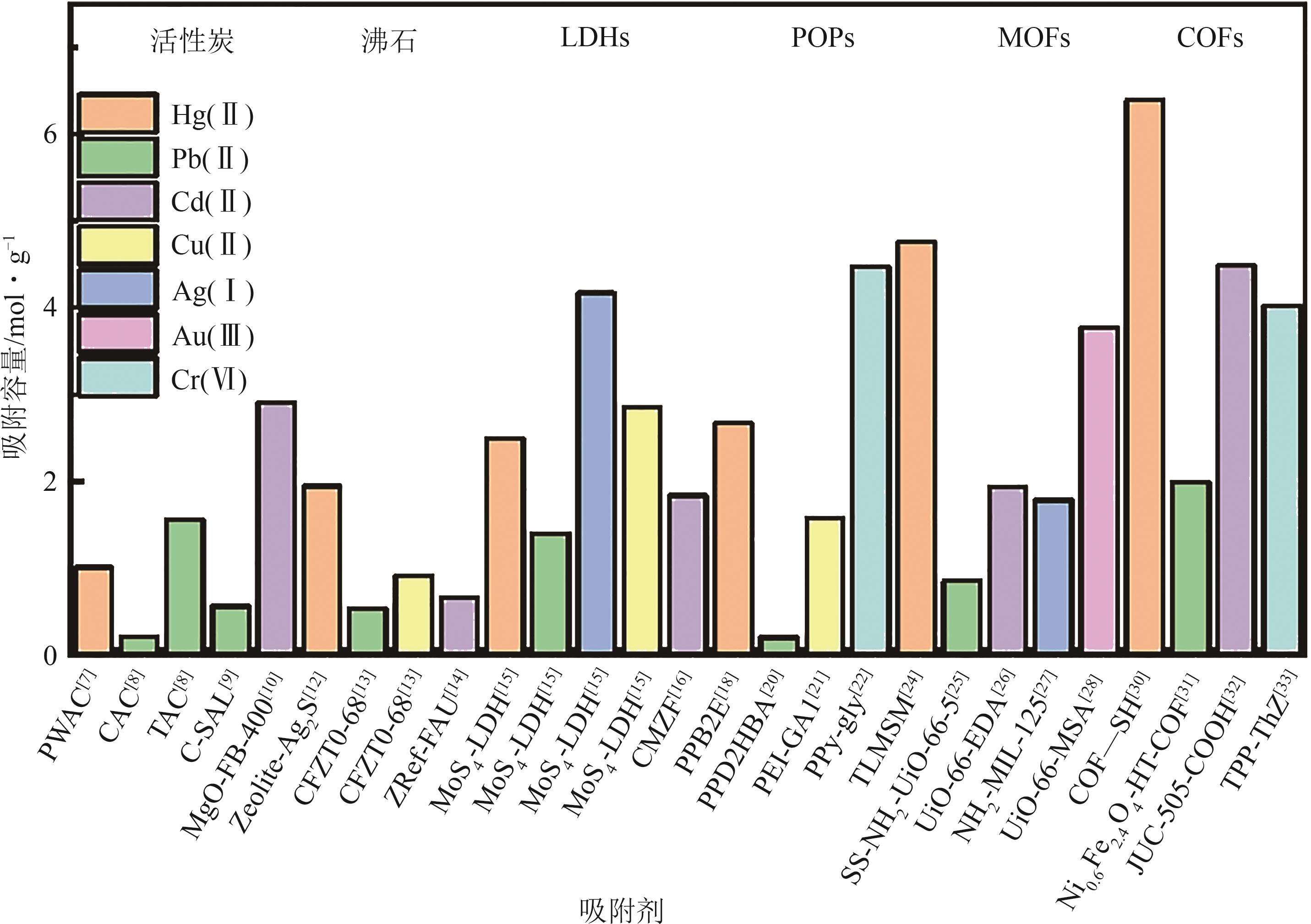
图1 不同类型吸附剂的吸附容量比较
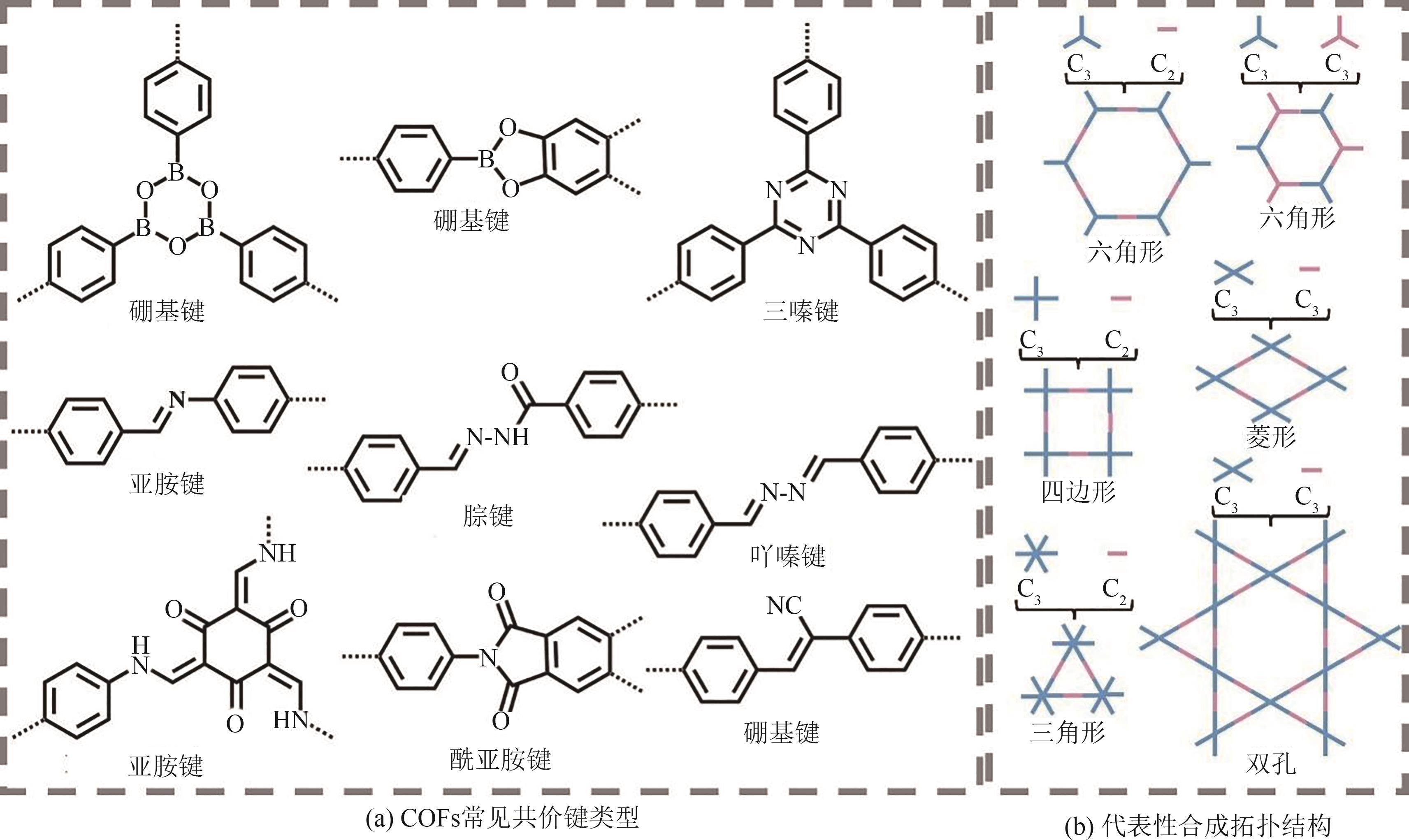
图2 COFs的结构设计
| 制备方法 | 优势 | 劣势 |
|---|---|---|
| 溶剂热法合成 | 结晶度、孔隙率和形貌控制良好 | 反应时间长,反应速度慢 |
| 离子热法合成 | 热稳定性高 | 反应温度高,结晶度差,特殊反应溶剂 |
| 机械化学合成 | 操作方便,生产成本低,生态友好 | 结晶度和孔隙率有限,重现性差 |
| 微波辅助合成 | 反应时间短,产率高 | 密封容器 |
| 声化学合成 | 产率高,操作方便 | 结构多样,纯度低 |
| 界面合成 | 二维薄膜产物 | 结晶度差 |
表1 不同制备方法合成的COFs的比较
| 制备方法 | 优势 | 劣势 |
|---|---|---|
| 溶剂热法合成 | 结晶度、孔隙率和形貌控制良好 | 反应时间长,反应速度慢 |
| 离子热法合成 | 热稳定性高 | 反应温度高,结晶度差,特殊反应溶剂 |
| 机械化学合成 | 操作方便,生产成本低,生态友好 | 结晶度和孔隙率有限,重现性差 |
| 微波辅助合成 | 反应时间短,产率高 | 密封容器 |
| 声化学合成 | 产率高,操作方便 | 结构多样,纯度低 |
| 界面合成 | 二维薄膜产物 | 结晶度差 |
| 目标污染物 | 反应类型 | 吸附剂 | C∶N∶O∶S(摩尔比) | 比表面积/ m2·g-1 | 吸附容量/ mg·g-1 | 参考文献 |
|---|---|---|---|---|---|---|
| Hg(Ⅱ) | Schiff 碱 | 1∶0.07∶0∶0 | 282.2 | <40 | [ | |
| Hg(Ⅱ) | Schiff 碱 | COF-1 | 1∶0.17∶0.17∶0 | 417.4 | 53.1 | [ |
| Hg(Ⅱ) | Schiff 碱 | COF-V | 1∶0.07∶0∶0 | 1152 | 147 | [ |
| Pb(Ⅱ) | Schiff 碱 | 1∶0.07∶0∶0 | 282.2 | <40 | [ | |
| Pb(Ⅱ) | Schiff 碱 | TAVA | 1∶0.15∶0∶0 | 1046.59 | 105 | [ |
| Pb(Ⅱ) | 1∶0.1∶0.2∶0 | 189.824 | 133.92 | [ | ||
| Cd(Ⅱ) | 1∶0.25∶0∶0 | 490 | 29.2 | [ | ||
| Cd(Ⅱ) | Schiff 碱 | 1∶0.11∶0.11∶0 | 885 | 29.6 | [ | |
| Cu(Ⅱ) | Schiff 碱 | TFBODH | 1∶0.5∶0.25∶0 | 94 | 23 | [ |
| Cu(Ⅱ) | Schiff 碱 | TpTc | 1∶0.43∶0.29∶0.14 | 63.5 | 73.5 | [ |
表2 本征COFs去除重金属
| 目标污染物 | 反应类型 | 吸附剂 | C∶N∶O∶S(摩尔比) | 比表面积/ m2·g-1 | 吸附容量/ mg·g-1 | 参考文献 |
|---|---|---|---|---|---|---|
| Hg(Ⅱ) | Schiff 碱 | 1∶0.07∶0∶0 | 282.2 | <40 | [ | |
| Hg(Ⅱ) | Schiff 碱 | COF-1 | 1∶0.17∶0.17∶0 | 417.4 | 53.1 | [ |
| Hg(Ⅱ) | Schiff 碱 | COF-V | 1∶0.07∶0∶0 | 1152 | 147 | [ |
| Pb(Ⅱ) | Schiff 碱 | 1∶0.07∶0∶0 | 282.2 | <40 | [ | |
| Pb(Ⅱ) | Schiff 碱 | TAVA | 1∶0.15∶0∶0 | 1046.59 | 105 | [ |
| Pb(Ⅱ) | 1∶0.1∶0.2∶0 | 189.824 | 133.92 | [ | ||
| Cd(Ⅱ) | 1∶0.25∶0∶0 | 490 | 29.2 | [ | ||
| Cd(Ⅱ) | Schiff 碱 | 1∶0.11∶0.11∶0 | 885 | 29.6 | [ | |
| Cu(Ⅱ) | Schiff 碱 | TFBODH | 1∶0.5∶0.25∶0 | 94 | 23 | [ |
| Cu(Ⅱ) | Schiff 碱 | TpTc | 1∶0.43∶0.29∶0.14 | 63.5 | 73.5 | [ |
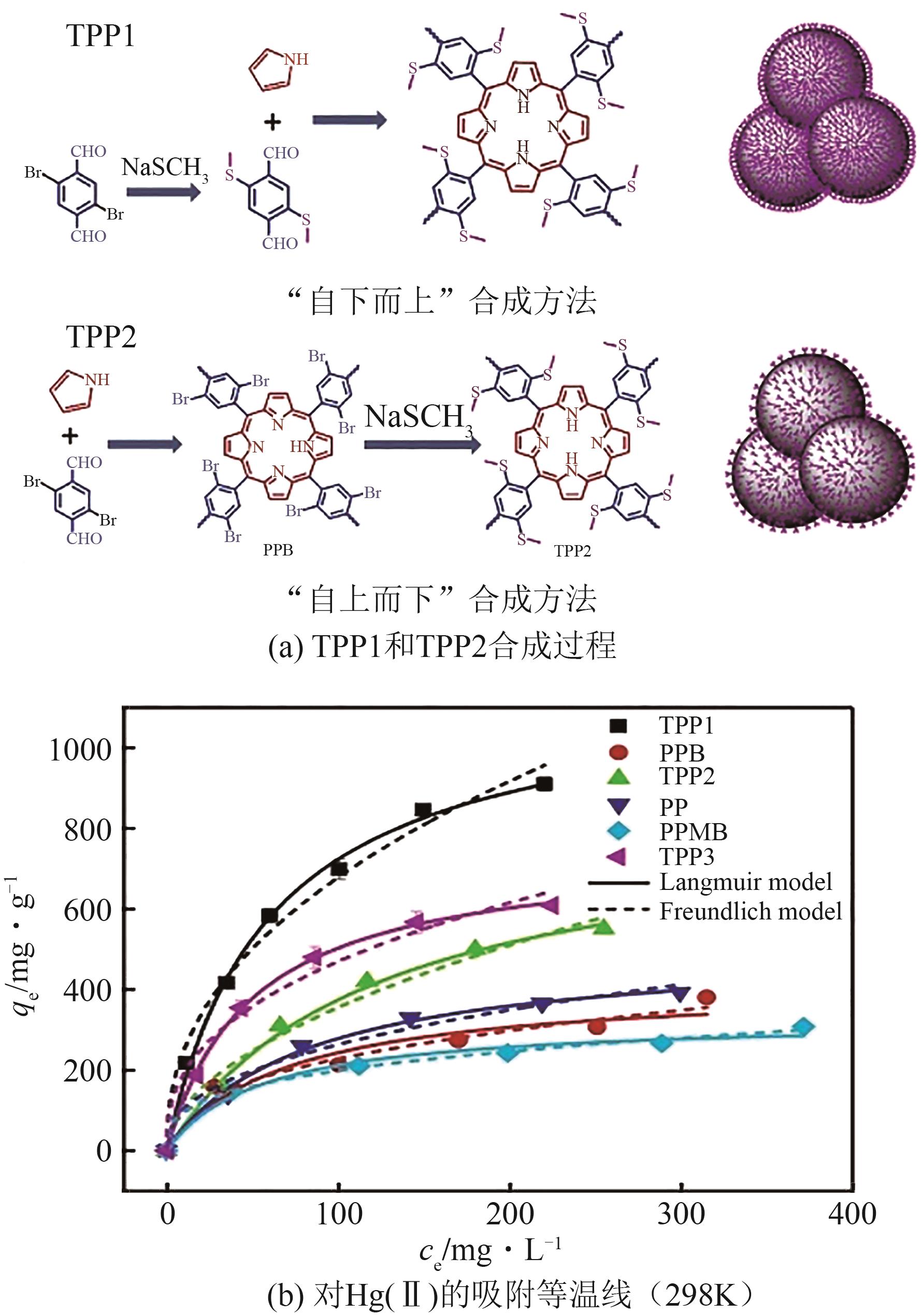
图3 硫醚官能化卟啉基聚合物(TPP1和TPP2)的合成表征和吸附性能[76]
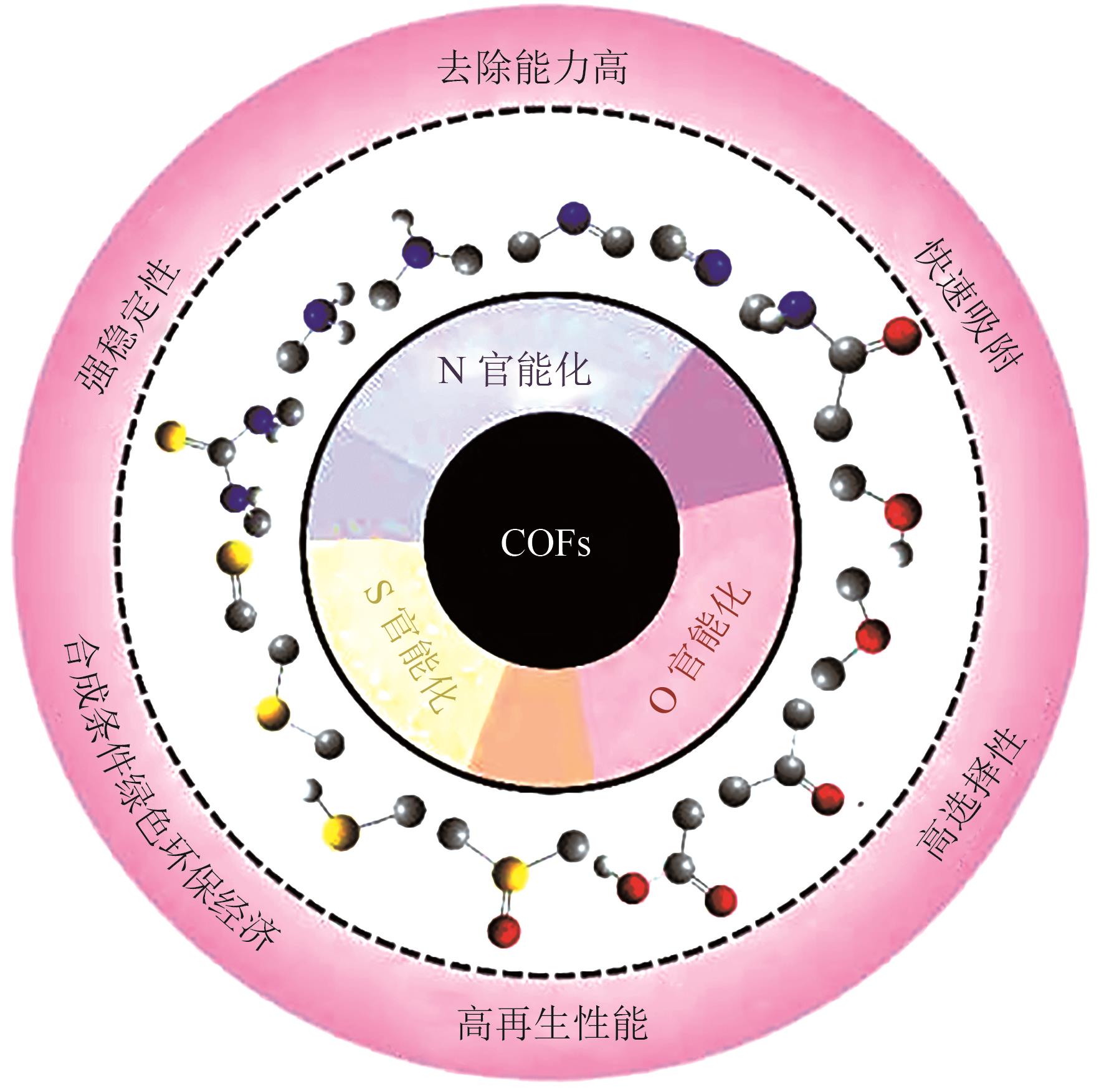
图4 COFs吸附剂的官能化改性标准
| 目标污染物 | 官能化原子 | 反应类型 | 吸附剂 | BET比表面积/m2·g-1 | 吸附容量/mg·g-1 | 等温线 | 参考文献 |
|---|---|---|---|---|---|---|---|
| Hg(Ⅱ) | N | Knoevenagel | Bpy-sp2c-COF | 567 | 718.48 | Langmuir | [ |
| Hg(Ⅱ) | N | Schiff base | Pyridine-COF | 348.5 | 719.4 | Langmuir | [ |
| Hg(Ⅱ) | N | Schiff base | Tpy-COF-2 | 1220 | 295 | Langmuir | [ |
| Hg(Ⅱ) | N | Schiff base | Tpy-COF-1 | 137 | 420 | Langmuir | [ |
| Hg(Ⅱ) | S | Schiff base | TABB-BMTTPA-COF | 1934 | 734 | Langmuir | [ |
| Hg(Ⅱ) | N | Friedel-Crafts | TPA-TPC (3/1) | 148 | 270 | Langmuir | [ |
| Hg(Ⅱ) | N | Friedel-Crafts | TPA-TPC-8MA | 656 | 781 | Freundlich | [ |
| Hg(Ⅱ) | S | Schiff base | JNU-3 | 420 | 959 | Langmuir | [ |
| Hg(Ⅱ) | Schiff base | COF-1 | 417.4 | 53.1 | Langmuir | [ | |
| Hg(Ⅱ) | S | Schiff base | COF-SH | 235.0 | 1282.6 | Langmuir | [ |
| Hg(Ⅱ) | Schiff base | COF-V | 1152 | 147 | Langmuir | [ | |
| Hg(Ⅱ) | S | Schiff base | COF-S-SH | 546 | 1350 | Langmuir | [ |
| Hg(Ⅱ) | N | Schiff base | TBN-1 | 1270.10 | 1630 | Langmuir | [ |
| Hg(Ⅱ) | N、O | Schiff base | TpODH | 835 | 1692 | Langmuir | [ |
| Hg(Ⅱ) | N、S | Schiff base | TPB-DMTP-COF-SH | 291 | 4395 | Langmuir | [ |
| Pb(Ⅱ) | Schiff base | PDA-TFPT-COF | 533.19 | 77.7 | Langmuir | [ | |
| Pb(Ⅱ) | O | Schiff base | DDA-TFPT-COF | 948.04 | 128 | Langmuir | [ |
| Pb(Ⅱ) | N、O | Schotten-Baumann | COF-TP | 11.4 | 140.0 | Freundlich | [ |
| Pb(Ⅱ) | N、O | Schotten-Baumann | COF-TE | 3.5 | 185.7 | Freundlich | [ |
| Pb(Ⅱ) | N | Schiff base | Tpy-COF-1 | 137 | 167 | Langmuir | [ |
| Pb(Ⅱ) | N | Schiff base | Tpy-COF-2 | 1220 | 200 | Langmuir | [ |
| Pb(Ⅱ) | Schiff base | COF-V | 167.3 | 38.24 | Freundlich | [ | |
| Pb(Ⅱ) | S | Schiff base | COF-SH | 40.4 | 239 | Freundlich | [ |
| Pb(Ⅱ) | Schiff base | TAVA | 1046.59 | 105 | Langmuir | [ | |
| Pb(Ⅱ) | S | Schiff base | TAVA-S-Et-SH | 145.70 | 303 | Langmuir | [ |
| Pb(Ⅱ) | SNAr | JUC-500 | 189.824 | 133.92 | Langmuir | [ | |
| Pb(Ⅱ) | N、O | SNAr | COF-NHOH | 37.665 | 368.68 | Langmuir | [ |
| Pb(Ⅱ) | O | SNAr | JUC-505-COOH | 380 | 559 | Langmuir | [ |
| Pb(Ⅱ) | N | Schiff base | TBN-1 | 1270.10 | 730 | Langmuir | [ |
| Cd(Ⅱ) | O | Schiff base | COF-ETTA-2,3-DHA | 1476.5 | 116 | — | [ |
| Cd(Ⅱ) | Schiff base | TpBD COF | 885 | 29.6 | Langmuir | [ | |
| Cd(Ⅱ) | O | Schiff base | TpBD-COOH COF | 339 | 150 | Langmuir | [ |
| Cd(Ⅱ) | N | Schiff base | N-riched COF | 1935 | 396.76 | Langmuir | [ |
| Cd(Ⅱ) | O | SNAr | JUC-505-COOH | 380 | 504 | Langmuir | [ |
| Cu(Ⅱ) | Schiff base | TFBODH | 94 | 23 | Langmuir | [ | |
| Cu(Ⅱ) | O | Schiff base | TpODH | 835 | 324 | Langmuir | [ |
| Cr(Ⅵ) | Schiff base | COF-BTA-BZ | 1048 | 64 | — | [ | |
| Cr(Ⅵ) | O | Schiff base | COF-BTA-DHBZ | 816 | 384 | — | [ |
| Cr(Ⅵ) | O | Schiff base | COF-1 | 28.79 | 462.96 | Langmuir | [ |
| Cr(Ⅵ) | O | Schiff base | COF-2 | 26.40 | 649.35 | Langmuir | [ |
| Au(Ⅲ) | S | Schiff base | TTB-COF | 36 | 560 | — | [ |
| Au(Ⅲ) | O | Scholl | COP-TPC8 | 7.0144 | 943.4 | Langmuir | [ |
| Au(Ⅲ) | O | Scholl | COP-TPC6 | 11.9693 | 1157 | Langmuir | [ |
| Au(Ⅲ) | N | Schiff base | Ionic-COF-Cl | 452.9 | 1270.8 | Langmuir | [ |
表3 官能化COFs去除重金属
| 目标污染物 | 官能化原子 | 反应类型 | 吸附剂 | BET比表面积/m2·g-1 | 吸附容量/mg·g-1 | 等温线 | 参考文献 |
|---|---|---|---|---|---|---|---|
| Hg(Ⅱ) | N | Knoevenagel | Bpy-sp2c-COF | 567 | 718.48 | Langmuir | [ |
| Hg(Ⅱ) | N | Schiff base | Pyridine-COF | 348.5 | 719.4 | Langmuir | [ |
| Hg(Ⅱ) | N | Schiff base | Tpy-COF-2 | 1220 | 295 | Langmuir | [ |
| Hg(Ⅱ) | N | Schiff base | Tpy-COF-1 | 137 | 420 | Langmuir | [ |
| Hg(Ⅱ) | S | Schiff base | TABB-BMTTPA-COF | 1934 | 734 | Langmuir | [ |
| Hg(Ⅱ) | N | Friedel-Crafts | TPA-TPC (3/1) | 148 | 270 | Langmuir | [ |
| Hg(Ⅱ) | N | Friedel-Crafts | TPA-TPC-8MA | 656 | 781 | Freundlich | [ |
| Hg(Ⅱ) | S | Schiff base | JNU-3 | 420 | 959 | Langmuir | [ |
| Hg(Ⅱ) | Schiff base | COF-1 | 417.4 | 53.1 | Langmuir | [ | |
| Hg(Ⅱ) | S | Schiff base | COF-SH | 235.0 | 1282.6 | Langmuir | [ |
| Hg(Ⅱ) | Schiff base | COF-V | 1152 | 147 | Langmuir | [ | |
| Hg(Ⅱ) | S | Schiff base | COF-S-SH | 546 | 1350 | Langmuir | [ |
| Hg(Ⅱ) | N | Schiff base | TBN-1 | 1270.10 | 1630 | Langmuir | [ |
| Hg(Ⅱ) | N、O | Schiff base | TpODH | 835 | 1692 | Langmuir | [ |
| Hg(Ⅱ) | N、S | Schiff base | TPB-DMTP-COF-SH | 291 | 4395 | Langmuir | [ |
| Pb(Ⅱ) | Schiff base | PDA-TFPT-COF | 533.19 | 77.7 | Langmuir | [ | |
| Pb(Ⅱ) | O | Schiff base | DDA-TFPT-COF | 948.04 | 128 | Langmuir | [ |
| Pb(Ⅱ) | N、O | Schotten-Baumann | COF-TP | 11.4 | 140.0 | Freundlich | [ |
| Pb(Ⅱ) | N、O | Schotten-Baumann | COF-TE | 3.5 | 185.7 | Freundlich | [ |
| Pb(Ⅱ) | N | Schiff base | Tpy-COF-1 | 137 | 167 | Langmuir | [ |
| Pb(Ⅱ) | N | Schiff base | Tpy-COF-2 | 1220 | 200 | Langmuir | [ |
| Pb(Ⅱ) | Schiff base | COF-V | 167.3 | 38.24 | Freundlich | [ | |
| Pb(Ⅱ) | S | Schiff base | COF-SH | 40.4 | 239 | Freundlich | [ |
| Pb(Ⅱ) | Schiff base | TAVA | 1046.59 | 105 | Langmuir | [ | |
| Pb(Ⅱ) | S | Schiff base | TAVA-S-Et-SH | 145.70 | 303 | Langmuir | [ |
| Pb(Ⅱ) | SNAr | JUC-500 | 189.824 | 133.92 | Langmuir | [ | |
| Pb(Ⅱ) | N、O | SNAr | COF-NHOH | 37.665 | 368.68 | Langmuir | [ |
| Pb(Ⅱ) | O | SNAr | JUC-505-COOH | 380 | 559 | Langmuir | [ |
| Pb(Ⅱ) | N | Schiff base | TBN-1 | 1270.10 | 730 | Langmuir | [ |
| Cd(Ⅱ) | O | Schiff base | COF-ETTA-2,3-DHA | 1476.5 | 116 | — | [ |
| Cd(Ⅱ) | Schiff base | TpBD COF | 885 | 29.6 | Langmuir | [ | |
| Cd(Ⅱ) | O | Schiff base | TpBD-COOH COF | 339 | 150 | Langmuir | [ |
| Cd(Ⅱ) | N | Schiff base | N-riched COF | 1935 | 396.76 | Langmuir | [ |
| Cd(Ⅱ) | O | SNAr | JUC-505-COOH | 380 | 504 | Langmuir | [ |
| Cu(Ⅱ) | Schiff base | TFBODH | 94 | 23 | Langmuir | [ | |
| Cu(Ⅱ) | O | Schiff base | TpODH | 835 | 324 | Langmuir | [ |
| Cr(Ⅵ) | Schiff base | COF-BTA-BZ | 1048 | 64 | — | [ | |
| Cr(Ⅵ) | O | Schiff base | COF-BTA-DHBZ | 816 | 384 | — | [ |
| Cr(Ⅵ) | O | Schiff base | COF-1 | 28.79 | 462.96 | Langmuir | [ |
| Cr(Ⅵ) | O | Schiff base | COF-2 | 26.40 | 649.35 | Langmuir | [ |
| Au(Ⅲ) | S | Schiff base | TTB-COF | 36 | 560 | — | [ |
| Au(Ⅲ) | O | Scholl | COP-TPC8 | 7.0144 | 943.4 | Langmuir | [ |
| Au(Ⅲ) | O | Scholl | COP-TPC6 | 11.9693 | 1157 | Langmuir | [ |
| Au(Ⅲ) | N | Schiff base | Ionic-COF-Cl | 452.9 | 1270.8 | Langmuir | [ |
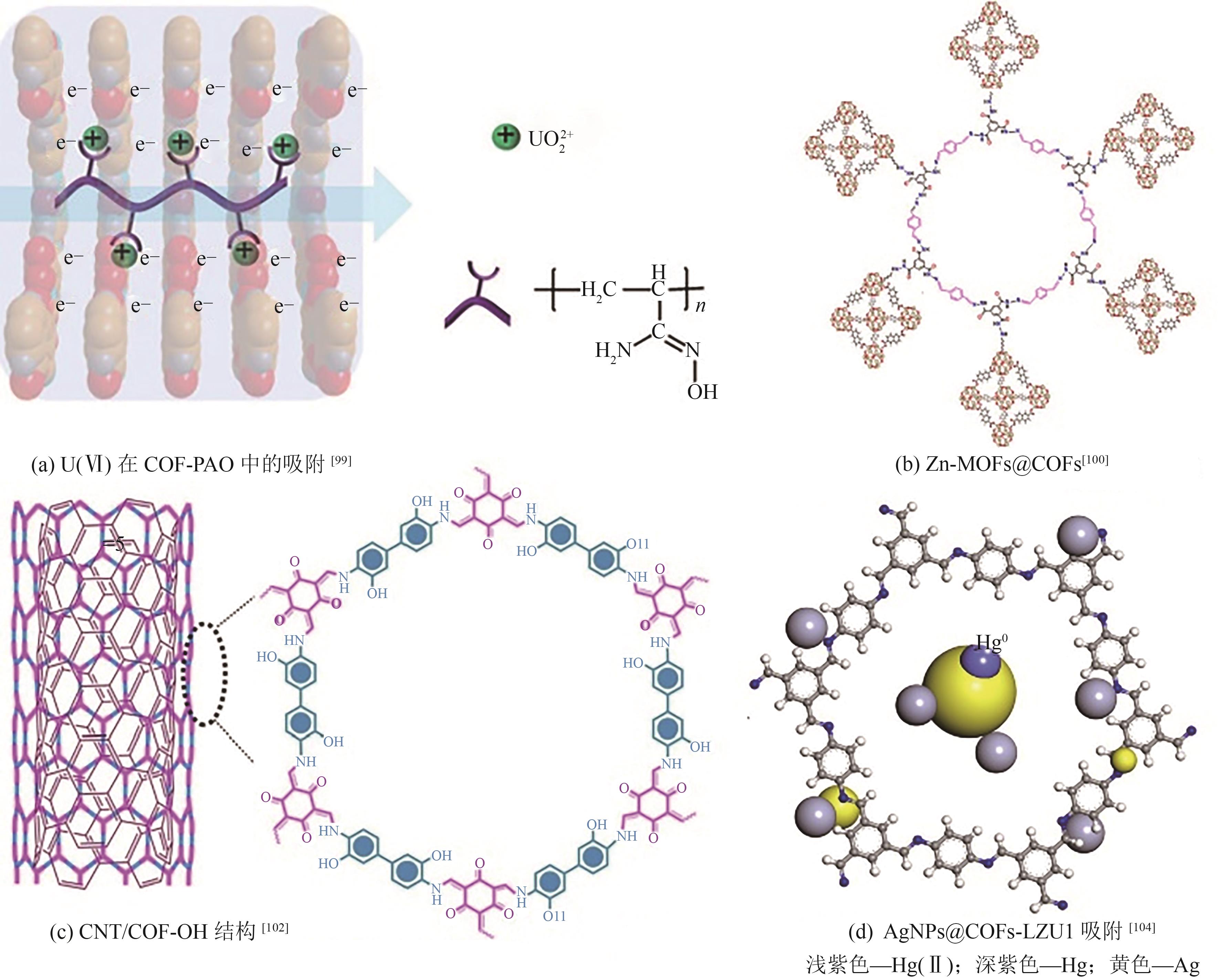
图5 COFs复合材料的功能化吸附应用
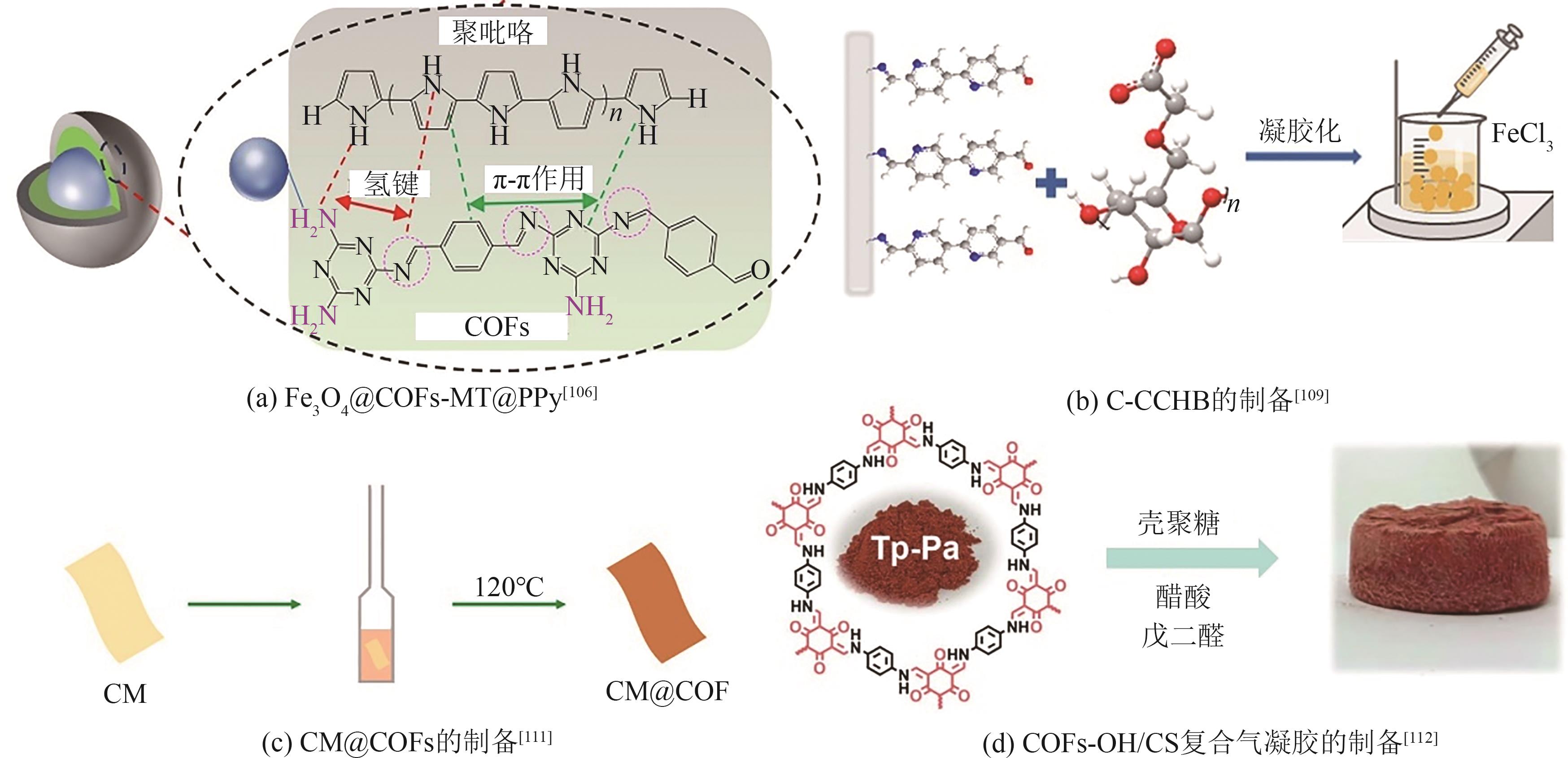
图6 COFs复合材料的载体化吸附应用
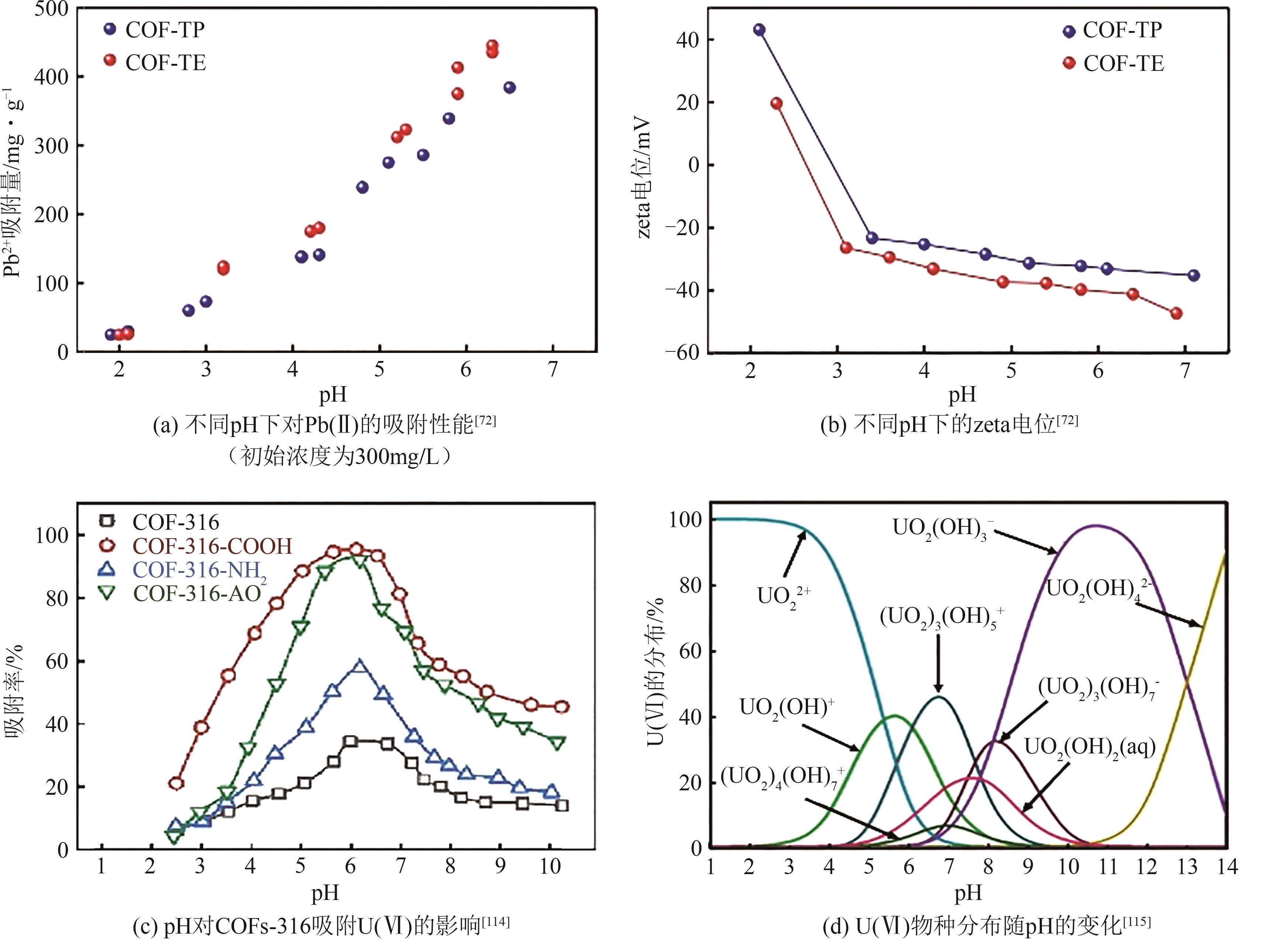
图7 静电相互作用机理
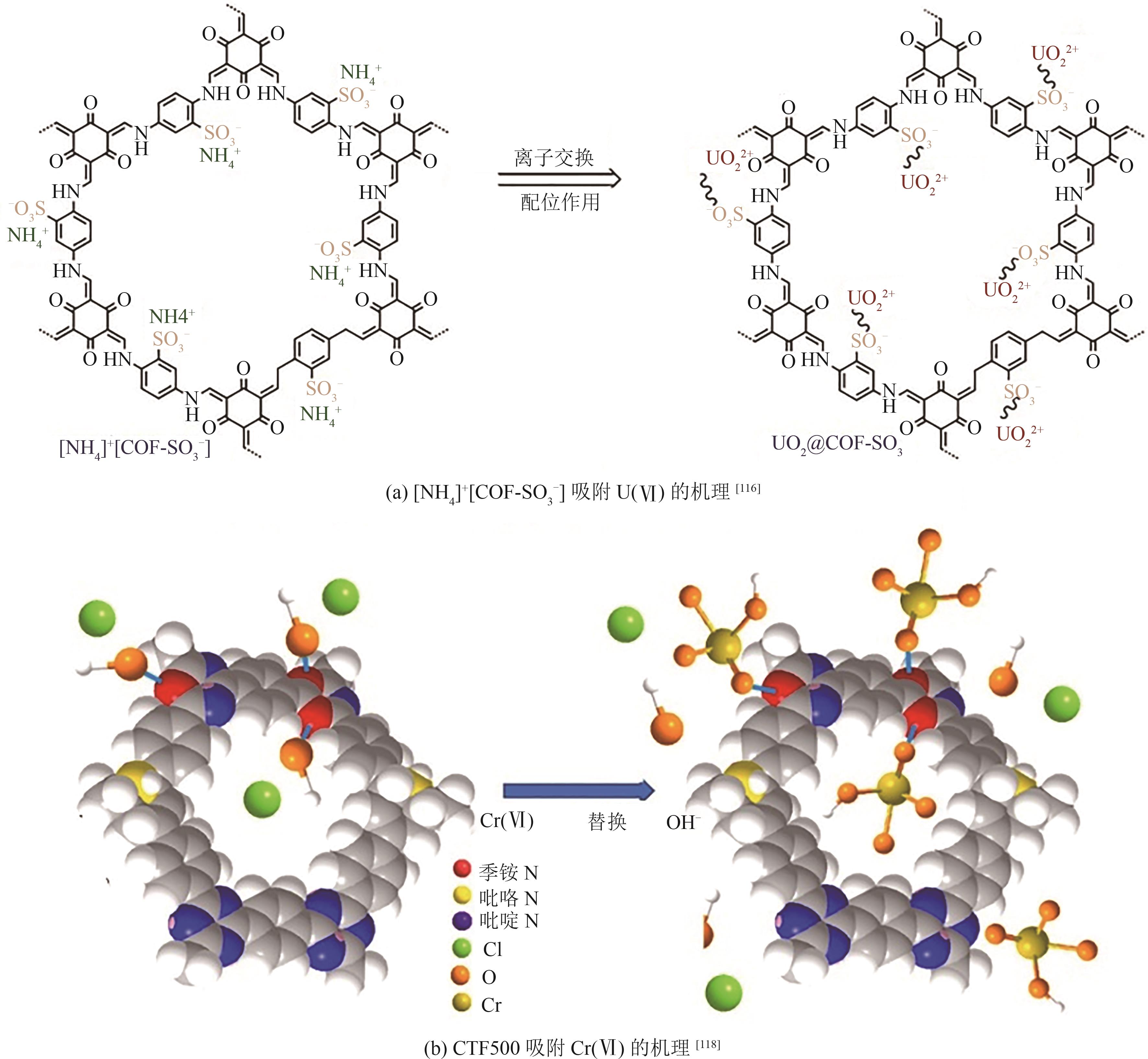
图8 离子交换机理作用机理
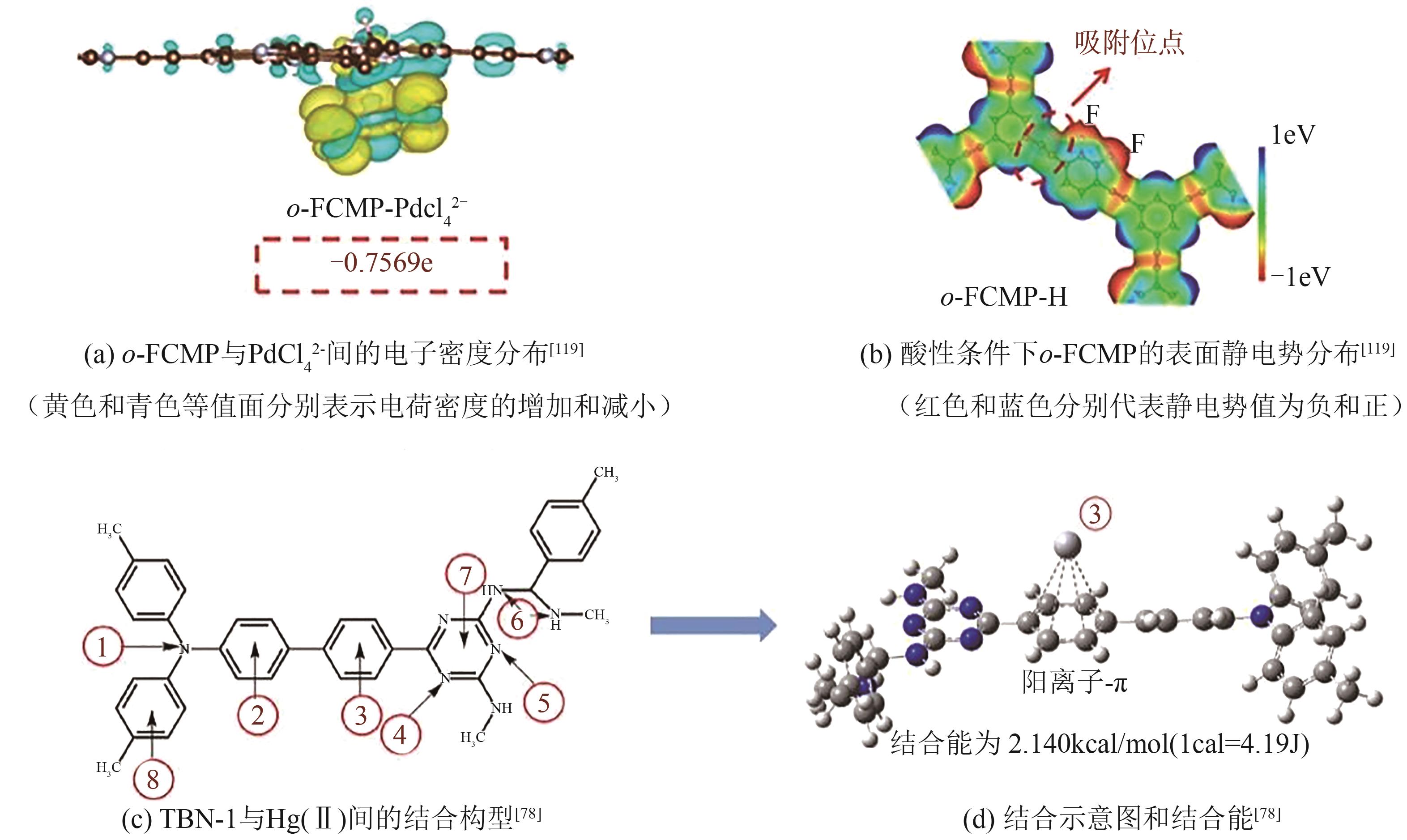
图9 o-FCMP与PdCl42-结合和TBN-1与Hg(Ⅱ)的结合
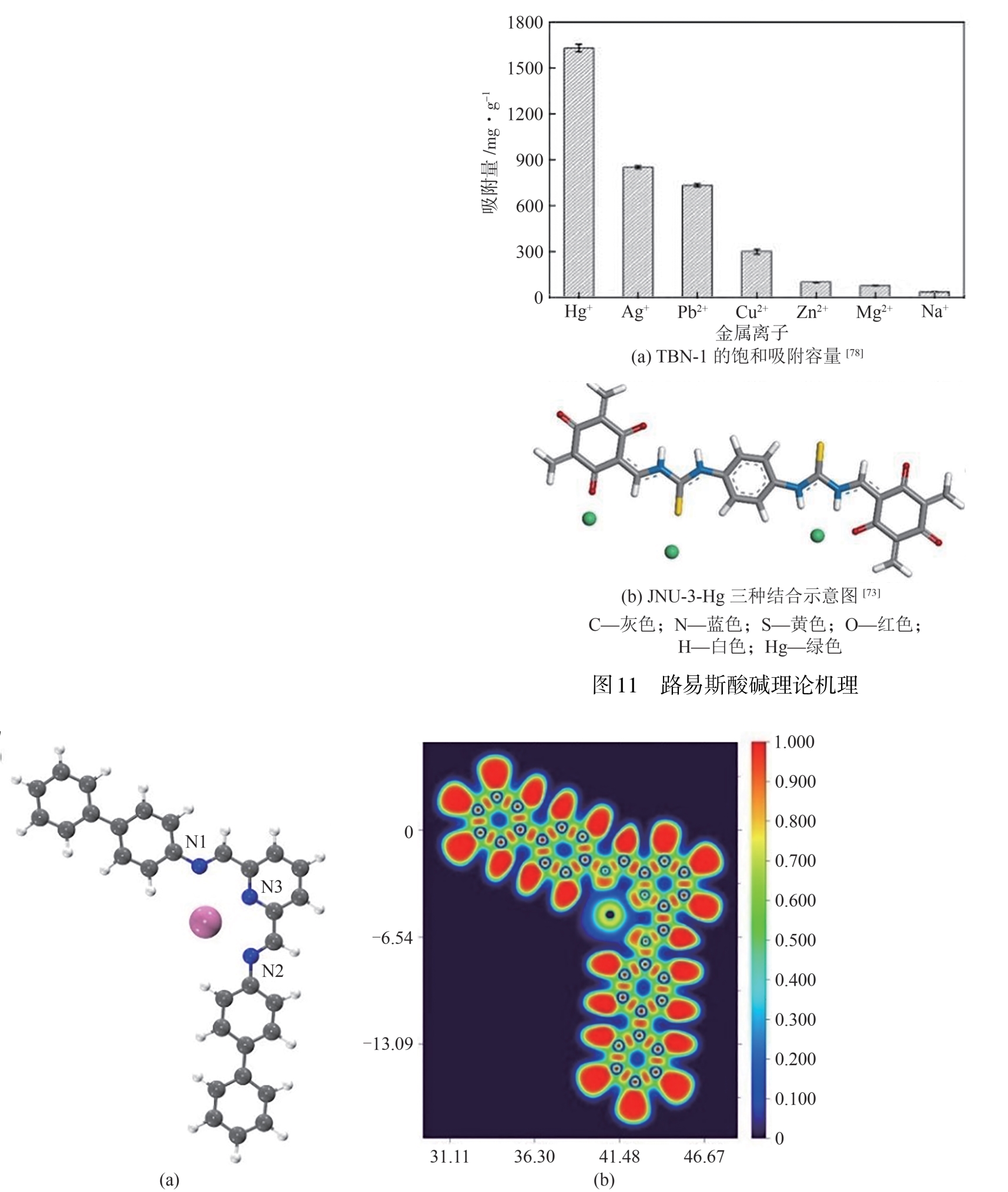
图10 Pyridine-COF@Hg的分子结构示意(a)和ELF示意图(b)[77]
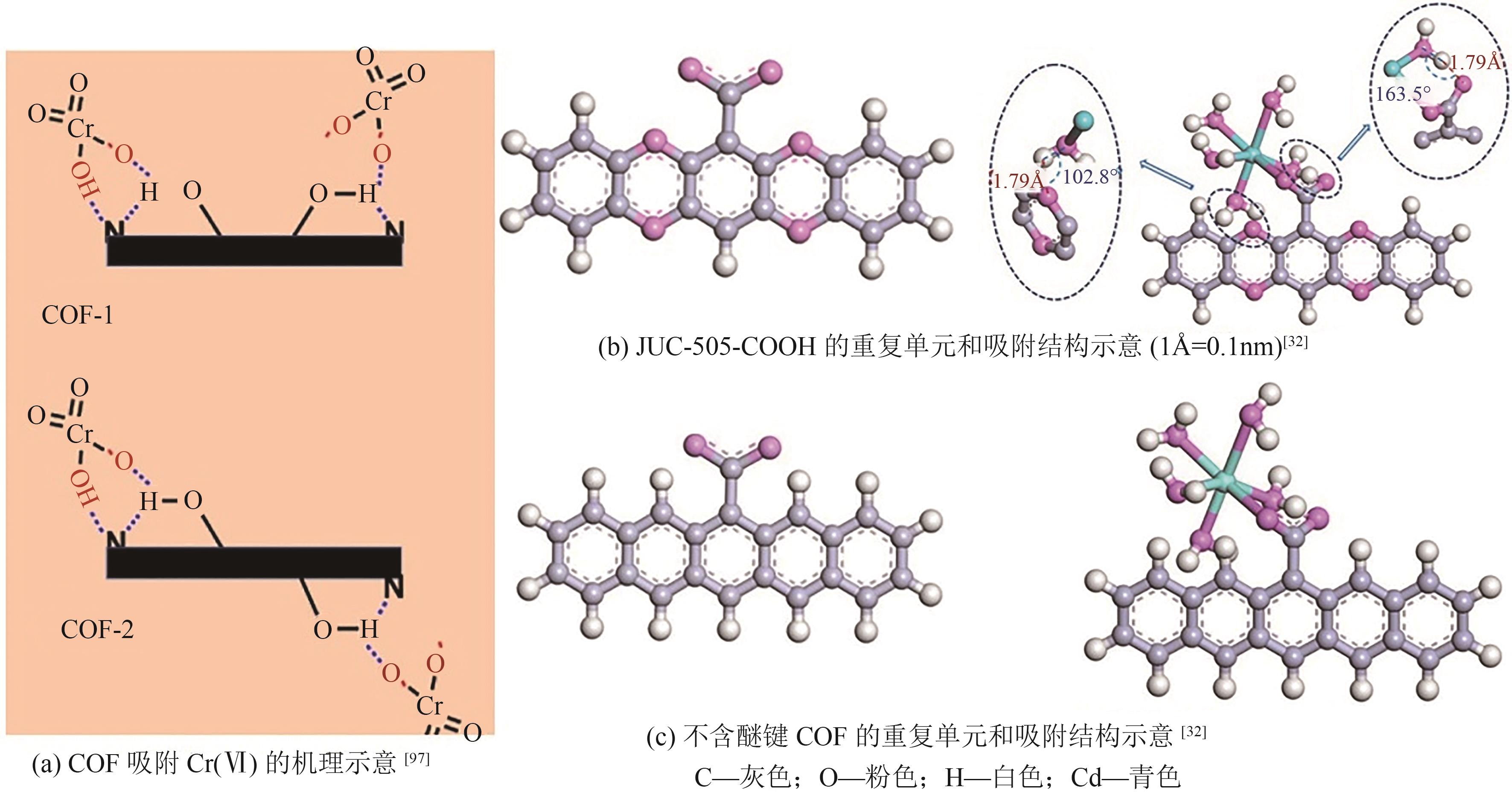
图12 氢键机理示意图
| [1] | LEBRON Yuri Abner Rocha, MOREIRA Victor Rezende, AMARAL Míriam Cristina Santos. Metallic ions recovery from membrane separation processes concentrate: A special look onto ion exchange resins[J]. Chemical Engineering Journal, 2021, 425: 131812. |
| [2] | XIANG Hongrui, MIN Xiaobo, TANG Chongjian, et al. Recent advances in membrane filtration for heavy metal removal from wastewater: A mini review[J]. Journal of Water Process Engineering, 2022, 49: 103023. |
| [3] | YANG Xiong, LIU Lihu, TAN Wenfeng, et al. High-performance Cu2+ adsorption of birnessite using electrochemically controlled redox reactions[J]. Journal of Hazardous Materials, 2018, 354: 107-115. |
| [4] | CHAI Wai Siong, CHEUN Jie Ying, Senthil KUMAR P, et al. A review on conventional and novel materials towards heavy metal adsorption in wastewater treatment application[J]. Journal of Cleaner Production, 2021, 296: 126589. |
| [5] | QASEM Naef A A, MOHAMMED Ramy H, LAWAL Dahiru U. Removal of heavy metal ions from wastewater: A comprehensive and critical review[J]. NPJ Clean Water, 2021, 4: 36. |
| [6] | KHURSHID Hifsa, MUSTAFA Muhammad Raza Ul, Mohamed Hasnain ISA. Adsorption of chromium, copper, lead and mercury ions from aqueous solution using bio and nano adsorbents: A review of recent trends in the application of AC, BC, nZVI and MXene[J]. Environmental Research, 2022, 212: 113138. |
| [7] | SAJJADI Seyed-Ali, MOHAMMADZADEH Alireza, TRAN Hai Nguyen, et al. Efficient mercury removal from wastewater by pistachio wood wastes-derived activated carbon prepared by chemical activation using a novel activating agent[J]. Journal of Environmental Management, 2018, 223: 1001-1009. |
| [8] | Rahim SHAHROKHI-SHAHRAKI, BENALLY Chelsea, EL-DIN Mohamed Gamal, et al. High efficiency removal of heavy metals using tire-derived activated carbon vs commercial activated carbon: Insights into the adsorption mechanisms[J]. Chemosphere, 2021, 264: 128455. |
| [9] | DU Boyu, WANG Yumeng, ZHENG Qian, et al. A novel modified lignin-based adsorbent for removal of malachite green and Pb2+ ions from wastewater[J]. Separation and Purification Technology, 2024, 330: 125495. |
| [10] | QI Xin, YIN Hua, ZHU Minghan, et al. MgO-loaded nitrogen and phosphorus self-doped biochar: High-efficient adsorption of aquatic Cu2+, Cd2+, and Pb2+ and its remediation efficiency on heavy metal contaminated soil[J]. Chemosphere, 2022, 294: 133733. |
| [11] | ABDELRAHMAN Ehab A, ABOU EL-REASH Y G, YOUSSEF Hany M, et al. Utilization of rice husk and waste aluminum cans for the synthesis of some nanosized zeolite, zeolite/zeolite, and geopolymer/zeolite products for the efficient removal of Co(Ⅱ), Cu(Ⅱ), and Zn(Ⅱ) ions from aqueous media[J]. Journal of Hazardous Materials, 2021, 401: 123813. |
| [12] | JENA Kishore K, SURESH KUMAR REDDY K, KARANIKOLOS Georgios N, et al. L-Cysteine and silver nitrate based metal sulfide and Zeolite-Y nano adsorbent for efficient removal of mercury (Ⅱ) ion from wastewater[J]. Applied Surface Science, 2023, 611: 155777. |
| [13] | JOSEPH Ifeoma V, TOSHEVA Lubomira, DOYLE Aidan M. Simultaneous removal of Cd(Ⅱ), Co(Ⅱ), Cu(Ⅱ), Pb(Ⅱ), and Zn(Ⅱ) ions from aqueous solutions via adsorption on FAU-type zeolites prepared from coal fly ash[J]. Journal of Environmental Chemical Engineering, 2020, 8(4): 103895. |
| [14] | HE Tong, LI Qian, LIN Tong, et al. Recent progress on highly efficient removal of heavy metals by layered double hydroxides[J]. Chemical Engineering Journal, 2023, 462: 142041. |
| [15] | MA Lijiao, WANG Qing, ISLAM Saiful M, et al. Highly selective and efficient removal of heavy metals by layered double hydroxide intercalated with the MoS4 2– ion[J]. Journal of the American Chemical Society, 2016, 138(8): 2858-2866. |
| [16] | LIU Junqin, WU Pingxiao, LI Shuaishuai, et al. Synergistic deep removal of As(Ⅲ) and Cd(Ⅱ) by a calcined multifunctional MgZnFe-CO3 layered double hydroxide: Photooxidation, precipitation and adsorption[J]. Chemosphere, 2019, 225: 115-125. |
| [17] | WANG Yubing, LI Shanshan, WU Xiaoxi, et al. Nitrogen-Based conjugated microporous polymers for efficient Hg(Ⅱ) removal from Water: Performance and mechanism[J]. Chemical Engineering Journal, 2023, 471: 144659. |
| [18] | ZHANG Jiarui, HE Bianyan, WANG Yubing, et al. Reticular poly(pyrrole methylene)s synthesized by synchronous-cross-linking process for the capture of Hg(Ⅱ) from water: Adsorption performance and mechanism[J]. Journal of Environmental Chemical Engineering, 2024, 12(3): 112625. |
| [19] | LIU Yunpeng, ZHANG Wenlong, ZHAO Chengcheng, et al. Study on the synthesis of poly(pyrrole methane)s with the hydroxyl in different substituent position and their selective adsorption for Pb2+ [J]. Chemical Engineering Journal, 2019, 361: 528-537. |
| [20] | WANG Zhenyu, ZHANG Aijing, ZHU Mengyuan, et al. Efficient removal of Cr(Ⅵ) through adsorption with reduced Cr(Ⅲ) sequestration by highly hydrophilic poly(pyrrole methane)[J]. Separation and Purification Technology, 2025, 354: 129122. |
| [21] | WANG Shengye, XIAO Ke, MO Yayuan, et al. Selenium(Ⅵ) and copper(Ⅱ) adsorption using polyethyleneimine-based resins: Effect of glutaraldehyde crosslinking and storage condition[J]. Journal of Hazardous Materials, 2020, 386: 121637. |
| [22] | BALLAV Niladri, MAITY Arjun, MISHRA Shivani B. High efficient removal of chromium(Ⅵ) using glycine doped polypyrrole adsorbent from aqueous solution[J]. Chemical Engineering Journal, 2012, 198: 536-546. |
| [23] | LIN Guo, ZENG Biao, LI Jing, et al. A systematic review of metal organic frameworks materials for heavy metal removal: Synthesis, applications and mechanism[J]. Chemical Engineering Journal, 2023, 460: 141710. |
| [24] | FU Kaixing, LIU Xia, Chunyu LYU, et al. Superselective Hg(Ⅱ) removal from water using a thiol-laced MOF-based sponge monolith: Performance and mechanism[J]. Environmental Science & Technology, 2022, 56(4): 2677-2688. |
| [25] | LI Yuhang, WANG Chongchen, ZENG Xu, et al. Seignette salt induced defects in Zr-MOFs for boosted Pb(Ⅱ) adsorption: Universal strategy and mechanism insight[J]. Chemical Engineering Journal, 2022, 442: 136276. |
| [26] | AHMADIJOKANI Farhad, TAJAHMADI Shima, BAHI Addie, et al. Ethylenediamine-functionalized Zr-based MOF for efficient removal of heavy metal ions from water[J]. Chemosphere, 2021, 264: 128466. |
| [27] | REN Xueying, WANG Chongchen, LI Yang, et al. Ag(Ⅰ) removal and recovery from wastewater adopting NH2-MIL-125 as efficient adsorbent: A 3Rs (reduce, recycle and reuse) approach and practice[J]. Chemical Engineering Journal, 2022, 442: 136306. |
| [28] | WANG Chen, XIONG Chao, ZHANG Xusheng, et al. External optimization of Zr-MOF with mercaptosuccinic acid for efficient recovery of gold from solution: Adsorption performance and DFT calculation[J]. Separation and Purification Technology, 2022, 296: 121329. |
| [29] | GENDY Eman A, IFTHIKAR Jerosha, Jawad ALI, et al. Removal of heavy metals by covalent organic frameworks (COFs): A review on its mechanism and adsorption properties[J]. Journal of Environmental Chemical Engineering, 2021, 9(4): 105687. |
| [30] | MA Zhiyao, LIU Fuyang, LIU Nengsheng, et al. Facile synthesis of sulfhydryl modified covalent organic frameworks for high efficient Hg(Ⅱ) removal from water[J]. Journal of Hazardous Materials, 2021, 405: 124190. |
| [31] | WANG Shuai, WANG Hao, WANG Shixing, et al. Novel magnetic covalent organic framework for the selective and effective removal of hazardous metal Pb(Ⅱ) from solution: Synthesis and adsorption characteristics[J]. Separation and Purification Technology, 2023, 307: 122783. |
| [32] | ZHU Ruomeng, ZHANG Pengling, ZHANG Xinxin, et al. Fabrication of synergistic sites on an oxygen-rich covalent organic framework for efficient removal of Cd(Ⅱ) and Pb(Ⅱ) from water[J]. Journal of Hazardous Materials, 2022, 424: 127301. |
| [33] | KOTP Mohammed G, TORAD Nagy L, NARA Hiroki, et al. Tunable thiophene-based conjugated microporous polymers for the disposal of toxic hexavalent chromium[J]. Journal of Materials Chemistry A, 2023, 11(27): 15022-15032. |
| [34] | CÔTÉ Adrien P, BENIN Annabelle I, OCKWIG Nathan W, et al. Porous, crystalline, covalent organic frameworks[J]. Science, 2005, 310(5751): 1166-1170. |
| [35] | William TILFORD R, GEMMILL William R, LOYE Hans-Conrad ZUR, et al. Facile synthesis of a highly crystalline, covalently linked porous boronate network[J]. Chemistry of Materials, 2006, 18(22): 5296-5301. |
| [36] | BOJDYS Michael J, JEROMENOK Jekaterina, THOMAS Arne, et al. Rational extension of the family of layered, covalent, triazine-based frameworks with regular porosity[J]. Advanced Materials, 2010, 22(19): 2202-2205. |
| [37] | DONG Pengfei, XU Xinyu, LUO Rengan, et al. Postsynthetic annulation of three-dimensional covalent organic frameworks for boosting CO2 photoreduction[J]. Journal of the American Chemical Society, 2023, 145(28): 15473-15481. |
| [38] | LIN Song, DIERCKS Christian S, ZHANG Yue biao, et al. Covalent organic frameworks comprising cobalt porphyrins for catalytic CO2 reduction in water[J]. Science, 2015, 349(6253): 1208-1213. |
| [39] | LANNI Laura M, William TILFORD R, BHARATHY Muktha, et al. Enhanced hydrolytic stability of self-assembling alkylated two-dimensional covalent organic frameworks[J]. Journal of the American Chemical Society, 2011, 133(35): 13975-13983. |
| [40] | YANG Shaoxiong, LI Xia, QIN Yu, et al. Modulating the stacking model of covalent organic framework isomers with different generation efficiencies of reactive oxygen species[J]. ACS Applied Materials & Interfaces, 2021, 13(25): 29471-29481. |
| [41] | WANG Xiaohan, ENOMOTO Riku, MURAKAMI Yoichi. Ionic additive strategy to control nucleation and generate larger single crystals of 3D covalent organic frameworks[J]. Chemical Communications, 2021, 57(54): 6656-6659. |
| [42] | FENG Xiao, CHEN Long, DONG Yuping, et al. Porphyrin-based two-dimensional covalent organic frameworks: Synchronized synthetic control of macroscopic structures and pore parameters[J]. Chemical Communications, 2011, 47(7): 1979-1981. |
| [43] | KUHN Pierre, ANTONIETTI Markus, THOMAS Arne. Porous, covalent triazine-based frameworks prepared by ionothermal synthesis[J]. Angewandte Chemie International Edition, 2008, 47(18): 3450-3453. |
| [44] | POUREBRAHIMI Sina, PIROOZ Majid, KAZEMEINI Mohammad, et al. Synthesis, characterization, and gas (SO2, CO2, NO2, CH4, CO, NO, and N2) adsorption properties of the CTF-1 covalent triazine framework-based porous polymer: Experimental and DFT studies[J]. Journal of Porous Materials, 2024, 31(2): 643-657. |
| [45] | ZHU Xiang, TIAN Chengcheng, MAHURIN Shannon M, et al. A superacid-catalyzed synthesis of porous membranes based on triazine frameworks for CO2 separation[J]. Journal of the American Chemical Society, 2012, 134(25): 10478-10484. |
| [46] | ZHANG Siquan, CHENG Guang, GUO Liping, et al. Strong-base-assisted synthesis of a crystalline covalent triazine framework with high hydrophilicity via benzylamine monomer for photocatalytic water splitting[J]. Angewandte Chemie International Edition, 2020, 59(15): 6007-6014. |
| [47] | LAN Zhi'an, WU Meng, FANG Zhongpu, et al. Ionothermal synthesis of covalent triazine frameworks in a NaCl-KCl-ZnCl2 eutectic salt for the hydrogen evolution reaction[J]. Angewandte Chemie International Edition, 2022, 61(18): e202201482. |
| [48] | GUAN Xinyu, MA Yunchao, LI Hui, et al. Fast, ambient temperature and pressure ionothermal synthesis of three-dimensional covalent organic frameworks[J]. Journal of the American Chemical Society, 2018, 140(13): 4494-4498. |
| [49] | BISWAL Bishnu P, CHANDRA Suman, KANDAMBETH Sharath, et al. Mechanochemical synthesis of chemically stable isoreticular covalent organic frameworks[J]. Journal of the American Chemical Society, 2013, 135(14): 5328-5331. |
| [50] | Hongzhou LYU, ZHAO Xiaoli, NIU Hongyun, et al. Ball milling synthesis of covalent organic framework as a highly active photocatalyst for degradation of organic contaminants[J]. Journal of Hazardous Materials, 2019, 369: 494-502. |
| [51] | Gobinda DAS, BALAJI SHINDE Digambar, KANDAMBETH Sharath, et al. Mechanosynthesis of imine, β-ketoenamine, and hydrogen-bonded imine-linked covalent organic frameworks using liquid-assisted grinding[J]. Chemical Communications, 2014, 50(84): 12615-12618. |
| [52] | BROWN Normanda, ALSUDAIRY Ziad, BEHERA Ranjan, et al. Green mechanochemical synthesis of imine-linked covalent organic frameworks for high iodine capture[J]. Green Chemistry, 2023, 25(16): 6287-6296. |
| [53] | EMMERLING Sebastian T, GERMANN Luzia S, JULIEN Patrick A, et al. In situ monitoring of mechanochemical covalent organic framework formation reveals templating effect of liquid additive[J]. Chem, 2021, 7(6): 1639-1652. |
| [54] | HAMZEHPOOR Ehsan, EFFATY Farshid, BORCHERS Tristan H, et al. Mechanochemical synthesis of boroxine-linked covalent organic frameworks[J]. Angewandte Chemie International Edition, 2024: e202404539. |
| [55] | CAMPBELL Neil L, CLOWES Rob, RITCHIE Lyndsey K, et al. Rapid microwave synthesis and purification of porous covalent organic frameworks[J]. Chemistry of Materials, 2009, 21(2): 204-206. |
| [56] | XU Lina, XU Jia, SHAN Baotian, et al. TpPa-2-incorporated mixed matrix membranes for efficient water purification[J]. Journal of Membrane Science, 2017, 526: 355-366. |
| [57] | ZHANG Wang, LI Cun, YUAN Yu peng, et al. Highly energy- and time-efficient synthesis of porous triazine-based framework: Microwave-enhanced ionothermal polymerization and hydrogen uptake[J]. Journal of Materials Chemistry, 2010, 20(31): 6413-6415. |
| [58] | ZHAO Wei, YAN Peiyao, YANG Haofan, et al. Using sound to synthesize covalent organic frameworks in water[J]. Nature Synthesis, 2022, 1: 87-95. |
| [59] | LIU Chunhua, PARK Eunsol, JIN Yinghua, et al. Separation of arylenevinylene macrocycles with a surface-confined two-dimensional covalent organic framework[J]. Angewandte Chemie International Edition, 2018, 57(29): 8984-8988. |
| [60] | ZHANG Penghui, WANG Zhifang, WANG Sa, et al. Fabricating industry-compatible olefin-linked COF resins for oxoanion pollutant scavenging[J]. Angewandte Chemie International Edition, 2022, 61(52): e202213247. |
| [61] | GU He, LIU Xiaolu, WANG Suhua, et al. COF-based composites: Extraordinary removal performance for heavy metals and radionuclides from aqueous solutions[J]. Reviews of Environmental Contamination and Toxicology, 2022, 260(1): 23. |
| [62] | GUO Weikang, LIU Jiale, TAO Haijuan, et al. Covalent organic framework nanoarchitectonics: Recent advances for precious metal recovery[J]. Advanced Materials, 2024, 36(33): 2405399. |
| [63] | SUN Qi, AGUILA Briana, PERMAN Jason, et al. Postsynthetically modified covalent organic frameworks for efficient and effective mercury removal[J]. Journal of the American Chemical Society, 2017, 139(7): 2786-2793. |
| [64] | GHAZI Zahid Ali, KHATTAK Abdul Muqsit, IQBAL Rashid, et al. Adsorptive removal of Cd2+ from aqueous solutions by a highly stable covalent triazine-based framework[J]. New Journal of Chemistry, 2018, 42(12): 10234-10242. |
| [65] | LU Xiaofan, JI Wenhua, YUAN Lin, et al. Preparation of carboxy-functionalized covalent organic framework for efficient removal of Hg2+ and Pb2+ from water[J]. Industrial & Engineering Chemistry Research, 2019, 58(38): 17660-17667. |
| [66] | 贾昊, 姜红新, 李明堂, 等. 羧基共价有机骨架材料对Cd(Ⅱ)的吸附性能及其机理研究[J]. 农业环境科学学报, 2023, 42(1): 177-187. |
| JIA Hao, JIANG Hongxin, LI Mingtang, et al Study on the adsorption performance and mechanism of carboxyl covalent organic framework materials for Cd ( Ⅱ)[J]. Journal of Agricultural Environmental Sciences, 2023, 42 (1): 177-187. | |
| [67] | XIANG Dawei, ZHU Rong, CHEN Yuefeng, et al. Preparation of amidoxime modified covalent organic framework for efficient adsorption of lead ions in aqueous solution[J]. Chemical Engineering Journal, 2024, 492: 152292. |
| [68] | LI Mingyan, CHEN Liangjun, DU Jiawei, et al. Thiol-ene click reaction modified triazinyl-based covalent organic framework for Pb (Ⅱ) ion effective removal[J]. ACS Applied Materials & Interfaces, 2024, 16(7): 8688-8696. |
| [69] | WANG Heping, HE Tengteng, QUAN Dandan, et al. Thiosemicarbazide-linked covalent organic framework: Preparation, properties and applications[J]. ChemistrySelect, 2021, 6(42): 11490-11495. |
| [70] | LI Ya, WANG Chang, MA Shujuan, et al. Fabrication of hydrazone-linked covalent organic frameworks using alkyl amine as building block for high adsorption capacity of metal ions[J]. ACS Applied Materials & Interfaces, 2019, 11(12): 11706-11714. |
| [71] | YANG Cheng xiong, LIU Chang, CAO Yi meng, et al. Facile room-temperature solution-phase synthesis of a spherical covalent organic framework for high-resolution chromatographic separation[J]. Chemical Communications, 2015, 51(61): 12254-12257. |
| [72] | LI Guiliang, YE Jianrong, FANG Qile, et al. Amide-based covalent organic frameworks materials for efficient and recyclable removal of heavy metal lead ( Ⅱ)[J]. Chemical Engineering Journal, 2019, 370: 822-830. |
| [73] | QIAN Hai long, ZHU Meng si, DU Mei lan, et al. Engineering linkage as functional moiety into irreversible thiourea-linked covalent organic framework for ultrafast adsorption of Hg(Ⅱ)[J]. Journal of Hazardous Materials, 2022, 427: 128156. |
| [74] | YUSRAN Yusran, GUAN Xinyu, LI Hui, et al. Postsynthetic functionalization of covalent organic frameworks[J]. National Science Review, 2020, 7(1): 170-190. |
| [75] | Laura MERÍ-BOFÍ, ROYUELA Sergio, ZAMORA Félix, et al. Thiol grafted imine-based covalent organic frameworks for water remediation through selective removal of Hg(Ⅱ)[J]. Journal of Materials Chemistry A, 2017, 5(34): 17973-17981. |
| [76] | WANG Lizhi, WANG Jiajia, WANG You, et al. Thioether-functionalized porphyrin-based polymers for Hg2+ efficient removal in aqueous solution[J]. Journal of Hazardous Materials, 2022, 429: 128303. |
| [77] | FU Quanbin, ZHANG Tingting, SUN Xin, et al. Pyridine-based covalent organic framework for efficient and selective removal of Hg(Ⅱ) from water: Adsorption behavior and adsorption mechanism investigations[J]. Chemical Engineering Journal, 2023, 454: 140154. |
| [78] | SHAN Houchao, LI Shufeng, YANG Zhen, et al. Triazine-based N-rich porous covalent organic polymer for the effective detection and removal of Hg(Ⅱ) from an aqueous solution[J]. Chemical Engineering Journal, 2021, 426: 130757. |
| [79] | ZHU Bin, ZHU Longyi, DENG Shengyuan, et al. A fully π-conjugated covalent organic framework with dual binding sites for ultrasensitive detection and removal of divalent heavy metal ions[J]. Journal of Hazardous Materials, 2023, 459: 132081. |
| [80] | DINARI Mohammad, HATAMI Mohammad. Novel N-riched crystalline covalent organic framework as a highly porous adsorbent for effective cadmium removal[J]. Journal of Environmental Chemical Engineering, 2019, 7(1): 102907. |
| [81] | GUAN Xinyu, LI Hui, MA Yunchao, et al. Chemically stable polyarylether-based covalent organic frameworks[J]. Nature Chemistry, 2019, 11(6): 587-594. |
| [82] | CUI Fuzhi, LIANG Rongrran, QI Qiaoyan, et al. Efficient removal of Cr(Ⅵ) from aqueous solutions by a dual-pore covalent organic framework[J]. Advanced Sustainable Systems, 2019, 3(4): 1800150. |
| [83] | TIAN Yuan, XU Shunqi, LIANG Rongran, et al. Construction of two heteropore covalent organic frameworks with Kagome lattices[J]. CrystEngComm, 2017, 19(33): 4877-4881. |
| [84] | BABUJOHN Nisar Ahamed, ELURI Amoluck, NABEELA V P. One pot synthesis of crystalline covalent organic polymers with tunable pores for the removal of gold and toxic organic pollutants[J]. Chemical Engineering Journal, 2023, 464: 142459. |
| [85] | HUANG Ning, ZHAI Lipeng, XU Hong, et al. Stable covalent organic frameworks for exceptional mercury removal from aqueous solutions[J]. Journal of the American Chemical Society, 2017, 139(6): 2428-2434. |
| [86] | DING San yuan, DONG Ming, WANG Ya wen, et al. Thioether-based fluorescent covalent organic framework for selective detection and facile removal of mercury(Ⅱ)[J]. Journal of the American Chemical Society, 2016, 138(9): 3031-3037. |
| [87] | CAO Ying, HU Xue, ZHU Changqian, et al. Sulfhydryl functionalized covalent organic framework as an efficient adsorbent for selective Pb(Ⅱ) removal[J]. Colloids and Surfaces A: Physicochemical and Engineering Aspects, 2020, 600: 125004. |
| [88] | ZHOU Zhiming, ZHONG Wanfu, CUI Kaixun, et al. A covalent organic framework bearing thioether pendant arms for selective detection and recovery of Au from ultra-low concentration aqueous solution[J]. Chemical Communications, 2018, 54(71): 9977-9980. |
| [89] | JIANG Yunzhe, LIU Chuanyao, HUANG Aisheng. EDTA-functionalized covalent organic framework for the removal of heavy-metal ions[J]. ACS Applied Materials & Interfaces, 2019, 11(35): 32186-32191. |
| [90] | ZHANG Du, CHEN Yiping, WANG Jiajia, et al. Melamine-functionalization of the carbonyl-rich polymers for iodine vapor and Hg2+ capture[J]. Chemical Engineering Journal, 2023, 460: 141669. |
| [91] | ZHAO Jie, QIAO Zelong, HE Yuncheng, et al. Anion-regulated ionic covalent organic frameworks for highly selective recovery of gold from E-waste[J]. Angewandte Chemie International Edition, 2025,64(2): e202414366. |
| [92] | YANG Zhenlian, GU Yangyi, YUAN Baoling, et al. Thio-groups decorated covalent triazine frameworks for selective mercury removal[J]. Journal of Hazardous Materials, 2021, 403: 123702. |
| [93] | WANG Wei, GONG Minjuan, ZHU Donghai, et al. Post-synthetic thiol modification of covalent organic frameworks for mercury(Ⅱ) removal from water[J]. Environmental Science and Ecotechnology, 2023, 14: 100236. |
| [94] | WANG Huaizhen, CHAN Michael Ho-Yeung, Vivian Wing -Wah YAM. Heavy-metal ions removal and iodine capture by terpyridine covalent organic frameworks[J]. Small Methods, 2024,8(11): 2400465. |
| [95] | MA Qi, LIU Xiaoyun, QIAN Jun, et al. Preparation of covalent organic framework with carboxy and triazine for efficient removal of Pb2+ ions[J]. Separation and Purification Technology, 2023, 323: 124368. |
| [96] | LIU Na, SHI Liangfeng, HAN Xianghao, et al. A heteropore covalent organic framework for adsorptive removal of Cd (Ⅱ) from aqueous solutions with high efficiency[J]. Chinese Chemical Letters, 2020, 31(2): 386-390. |
| [97] | ZHU Donghai, ZHOU Shuangxi, ZHOU Ziming, et al. Highly efficient and selective removal of Cr(Ⅵ) by covalent organic frameworks: Structure, performance and mechanism[J]. Colloids and Surfaces A: Physicochemical and Engineering Aspects, 2020, 600: 124910. |
| [98] | ABNEY Carter W, MAYES Richard T, SAITO Tomonori, et al. Materials for the recovery of uranium from seawater[J]. Chemical Reviews, 2017, 117(23): 13935-14013. |
| [99] | CAO Doudou, CUI Fengchao, ZHANG Cheng, et al. In situ synthesis of polyamidoxime chains inside the negative-charged confining fields for efficient adsorption of uranyl ions[J]. Advanced Functional Materials, 2025, 35(3): 2413729. |
| [100] | KUMAR Ajay, ARYA Kushal, MEHRA Sanjay, et al. Luminescent Zn-MOF@COF hybrid for selective decontamination of Cu(Ⅱ) ions and methylene blue dye in aqueous media[J]. Separation and Purification Technology, 2024, 340: 126756. |
| [101] | OLIVEIRA Ana Rita, CORREIA António Alberto, RASTEIRO Maria Graça. Heavy metals removal from aqueous solutions by multiwall carbon nanotubes: Effect of MWCNTs dispersion[J]. Nanomaterials 2021, 11(8): 2082. |
| [102] | LIU Xin, WANG Xun, JIANG Wei, et al. Covalent organic framework modified carbon nanotubes for removal of uranium (Ⅵ) from mining wastewater[J]. Chemical Engineering Journal, 2022, 450: 138062. |
| [103] | MARTINSON Carol A, REDDY K J. Adsorption of arsenic(Ⅲ) and arsenic(Ⅴ) by cupric oxide nanoparticles[J]. Journal of Colloid and Interface Science, 2009, 336(2): 406-411. |
| [104] | WANG Longlong, XU Haomiao, QIU Yixiang, et al. Utilization of Ag nanoparticles anchored in covalent organic frameworks for mercury removal from acidic waste water[J]. Journal of Hazardous Materials, 2020, 389: 121824. |
| [105] | LEUS Karen, FOLENS Karel, NICOMEL Nina Ricci, et al. Removal of arsenic and mercury species from water by covalent triazine framework encapsulated γ-Fe2O3 nanoparticles[J]. Journal of Hazardous Materials, 2018, 353: 312-319. |
| [106] | LIANG Pei, LIU Sijia, LI Mei, et al. Effective adsorption and removal of Cr(Ⅵ) from wastewater using magnetic composites prepared by synergistic effect of polypyrrole and covalent organic frameworks[J]. Separation and Purification Technology, 2024, 336: 126222. |
| [107] | YI Tan, ZHAO Hanyu, MO Qi, et al. From cellulose to cellulose nanofibrils—A comprehensive review of the preparation and modification of cellulose nanofibrils[J]. Materials,2020,13(22): 5062. |
| [108] | WANG Yixiang, CHEN Lingyun. Impacts of nanowhisker on formation kinetics and properties of all-cellulose composite gels[J]. Carbohydrate Polymers, 2011, 83(4): 1937-1946. |
| [109] | ZHAO Bingbing, FU Xu, DI Yaoyue, et al. Covalent organic framework@cellulose nanofibrils@carboxymethyl cellulose composite hydrogel beads for the removal of nickel ions from aqueous solutions[J]. Journal of Molecular Structure, 2024, 1312: 138619. |
| [110] | ZHANG Luwei, MA Shujuan, CHEN Yao, et al. Facile fabrication of biomimetic chitosan membrane with honeycomb-like structure for enrichment of glycosylated peptides[J]. Analytical Chemistry, 2019, 91(4): 2985-2993. |
| [111] | ZHANG Luwei, LI Ya, WANG Yan, et al. Integration of covalent organic frameworks into hydrophilic membrane with hierarchical porous structure for fast adsorption of metal ions[J]. Journal of Hazardous Materials, 2021, 407: 124390. |
| [112] | ZHONG Juan, CAO Yiwen, ZHU Jianhui, et al. Facile construction of phenolic hydroxyl anchored covalent organic frameworks/chitosan composite aerogels for efficient adsorption of Pb(Ⅱ) from water[J]. Separation and Purification Technology, 2025, 354: 129087. |
| [113] | TRAN Hai Nguyen, YOU Shengjie, Ahmad HOSSEINI-BANDEGHARAEI, et al. Mistakes and inconsistencies regarding adsorption of contaminants from aqueous solutions: A critical review[J]. Water Research, 2017, 120: 88-116. |
| [114] | XU Yang, ZHAO Xiaodong, HUA Weiwei, et al. Spatially confined coordination platform in covalent organic framework for selective uranium adsorption from aqueous solutions[J]. Separation and Purification Technology, 2024, 345: 127307. |
| [115] | BI Changlong, ZHANG Chunhong, XU Wenda, et al. Highly efficient antibacterial adsorbent for recovering uranium from seawater based on molecular structure design of PCN-222 post-engineering[J]. Desalination, 2023, 545: 116169. |
| [116] | XIONG Xiaohong, YU Zhiwu, GONG Lele, et al. Ammoniating covalent organic framework (COF) for high-performance and selective extraction of toxic and radioactive uranium ions[J]. Advanced Science, 2019, 6(16): 1900547. |
| [117] | GUPTA Krishna M, ZHANG Kang, JIANG Jianwen. Efficient removal of Pb2+ from aqueous solution by an ionic covalent-organic framework: Molecular simulation study[J]. Industrial & Engineering Chemistry Research, 2018, 57(18): 6477-6482. |
| [118] | ZHOU Shuangxi, ZHOU Ziming, ZHU Donghai, et al. Preparation of covalent triazine-based framework for efficient Cr(Ⅵ) removal from water[J]. Colloids and Surfaces A: Physicochemical and Engineering Aspects, 2022, 632: 127757. |
| [119] | SHENG Xin, SHI Hui, YOU Deng, et al. Specific π δ +-π δ - interaction enables conjugated microporous polymers for highly selective capture of Pd(Ⅱ)[J]. Chemical Engineering Journal, 2022, 437: 135367. |
| [120] | PEARSON Ralph G. Hard and soft acids and bases[J]. Journal of the American Chemical Society, 1963, 85(22): 3533-3539. |
| [1] | 符红梅, 刘定华, 刘晓勤. MOF材料在芳烃同分异构体分离中的研究进展[J]. 化工进展, 2025, 44(9): 5006-5017. |
| [2] | 张文静, 黄致新, 李士腾, 邓帅, 李双俊. 生物质碳气凝胶CO2吸附剂研究进展[J]. 化工进展, 2025, 44(9): 5018-5032. |
| [3] | 李雪娇, 姜宁, 刘鑫浩, 李迪, 徐家川. 聚烯烃热氧老化机理及寿命预测研究进展[J]. 化工进展, 2025, 44(9): 5075-5091. |
| [4] | 王睿, 王海澜, 戴若彬, 王志伟. 工业废水深度处理反渗透膜硅污染研究进展:机理、影响因素与控制策略[J]. 化工进展, 2025, 44(9): 5315-5326. |
| [5] | 孙梦圆, 陆诗建, 刘玲, 薛艳阳, 张云蓉, 董琦, 康国俊. 金属有机框架及衍生物在碳捕集领域的研究进展[J]. 化工进展, 2025, 44(9): 5339-5350. |
| [6] | 操江飞, 雷晓彤, 黄芷怡, 黄建凯, 陈凡, 杨翩翩, 谢春生. 铁氮掺杂碳微球的制备及其活化PS降解罗丹明B[J]. 化工进展, 2025, 44(9): 5406-5415. |
| [7] | 曾金, 高艳, 王赵鹏, 谢雨芸, 刘俊, 梁旗, 王春英. NaYF4:Yb,Tm复合TiO2/Bi2WO6光催化降解2,4-二氯苯氧乙酸机制及产物毒性评价[J]. 化工进展, 2025, 44(9): 5416-5431. |
| [8] | 杨证禄, 杨立峰, 路晓飞, 锁显, 张安运, 崔希利, 邢华斌. 机器学习加速多孔吸附剂筛选发现的研究进展[J]. 化工进展, 2025, 44(8): 4288-4301. |
| [9] | 汤健, 崔旺旺, 陈佳昆, 王天峥, 乔俊飞. 城市固废焚烧过程二 英全生命周期预测模型的构建:耦合数值仿真和模糊森林回归的方法[J]. 化工进展, 2025, 44(8): 4628-4647. 英全生命周期预测模型的构建:耦合数值仿真和模糊森林回归的方法[J]. 化工进展, 2025, 44(8): 4628-4647. |
| [10] | 杨勇, 张钊, 王东亮, 周怀荣, 赵子豪, 李煜坤. 二甲苯异构体不同分离策略的技术经济评价[J]. 化工进展, 2025, 44(8): 4732-4740. |
| [11] | 范开峰, 余春雨, 周诗岽, 万宇飞, 郭晶晶, 李思. 油品顺序输送界面跟踪技术与混油长度模型研究进展[J]. 化工进展, 2025, 44(7): 3697-3708. |
| [12] | 王帅, 钱相臣, 章雷其, 吴启亮, 刘敏. 质子交换膜燃料电池和电解槽关键组件衰减机理[J]. 化工进展, 2025, 44(7): 3804-3815. |
| [13] | 高姣姣, 颜诗宇, 杨太顺, 谢尚志, 杨艳娟, 徐晶. 不同晶型Al2O3负载Ru催化剂对聚乙烯氢解的影响[J]. 化工进展, 2025, 44(7): 3917-3927. |
| [14] | 梁书玮, 俞杰, 谢钟音, 裴鉴禄, 林中鑫, 陈泽翔. 共价有机框架吸附放射性气态碘的研究进展[J]. 化工进展, 2025, 44(7): 3965-3975. |
| [15] | 王影, 汤孟菲, 王莹, 张传芳, 张国杰, 刘俊, 赵钰琼. 碱金属催化煤热解制备CNT复合材料用于吸附罗丹明B[J]. 化工进展, 2025, 44(7): 3985-3996. |
| 阅读次数 | ||||||
|
全文 |
|
|||||
|
摘要 |
|
|||||