Chemical Industry and Engineering Progress ›› 2025, Vol. 44 ›› Issue (S1): 92-101.DOI: 10.16085/j.issn.1000-6613.2025-0383
• Chemical processes and equipment • Previous Articles Next Articles
Impact analysis of carbon emissions and economic performance in combined heat and power units
CHEN Jiaming( ), XU Jiawei, TIAN Xiujun()
- School of Environment, Beijing Jiaotong University, Beijing 100044, China
-
Received:2025-03-12Revised:2025-05-20Online:2025-11-24Published:2025-10-25 -
Contact:TIAN Xiujun
热电联产机组碳排放关联影响因素及经济性分析
陈佳明(), 许珈玮, 田秀君()
- 北京交通大学环境学院,北京 100044
-
通讯作者:田秀君 -
作者简介:陈佳明(2004—),男,本科生,研究方向为环境管理、环境经济等。E-mail:colinchen@bjtu.edu.cn。

CLC Number:
Cite this article
CHEN Jiaming, XU Jiawei, TIAN Xiujun. Impact analysis of carbon emissions and economic performance in combined heat and power units[J]. Chemical Industry and Engineering Progress, 2025, 44(S1): 92-101.
陈佳明, 许珈玮, 田秀君. 热电联产机组碳排放关联影响因素及经济性分析[J]. 化工进展, 2025, 44(S1): 92-101.
share this article
Add to citation manager EndNote|Ris|BibTeX
URL: https://hgjz.cip.com.cn/EN/10.16085/j.issn.1000-6613.2025-0383
| 燃料种类 | 名称 | 基础值 | 来源 |
|---|---|---|---|
| 燃料煤 | 低位发热量/GJ·t-1 | 21.977 | 实测 |
| 收到基元素碳含量/t C·t-1 | 0.5669 | 实测 | |
| 碳氧化率/% | 99.00 | [ | |
| 石油焦 | 低位发热量/GJ·t-1 | 31.998 | 实测 |
| 收到基元素碳含量/t C·t-1 | 0.8799 | 实测 | |
| 碳氧化率/% | 98.00 | [ | |
| 柴油 | 低位发热量/GJ·t-1 | 42.652 | [ |
| 收到基元素碳含量/t C·t-1 | 0.8616 | 实测 | |
| 碳氧化率/% | 98.00 | [ | |
| 瓦斯气 | 低位发热量/GJ·t-1 | 45.998 | [ |
| 收到基元素碳含量/t C·t-1 | 0.8372 | 实测 | |
| 碳氧化率/% | 98.00 | [ | |
| 电 | 电网排放因子/t CO2·MWh-1 | 0.5703 | [ |
| 燃料种类 | 名称 | 基础值 | 来源 |
|---|---|---|---|
| 燃料煤 | 低位发热量/GJ·t-1 | 21.977 | 实测 |
| 收到基元素碳含量/t C·t-1 | 0.5669 | 实测 | |
| 碳氧化率/% | 99.00 | [ | |
| 石油焦 | 低位发热量/GJ·t-1 | 31.998 | 实测 |
| 收到基元素碳含量/t C·t-1 | 0.8799 | 实测 | |
| 碳氧化率/% | 98.00 | [ | |
| 柴油 | 低位发热量/GJ·t-1 | 42.652 | [ |
| 收到基元素碳含量/t C·t-1 | 0.8616 | 实测 | |
| 碳氧化率/% | 98.00 | [ | |
| 瓦斯气 | 低位发热量/GJ·t-1 | 45.998 | [ |
| 收到基元素碳含量/t C·t-1 | 0.8372 | 实测 | |
| 碳氧化率/% | 98.00 | [ | |
| 电 | 电网排放因子/t CO2·MWh-1 | 0.5703 | [ |
| 项目 | 名称 | 基础值 | |
|---|---|---|---|
| 燃料种类 | |||
| 燃料煤 | 消耗量/t·h-1 | 48.01 | |
| 燃煤热量/GJ·h-1 | 1055.05 | ||
| 燃煤二氧化碳排放量/t CO2·h-1 | 98.79 | ||
| 柴油 | 消耗量/t·h-1 | 0.01 | |
| 柴油热量/GJ·h-1 | 0.42 | ||
| 柴油二氧化碳排放量/t CO2·h-1 | 0.03 | ||
| 外购电 | 外购电量/MWh | 0.72 | |
| 外购电碳排放量/t CO2·h-1 | 0.41 | ||
| 机组 | 锅炉高压蒸汽产量/t·h-1 | 279.35 | |
| 机组供热量/GJ·h-1 | 573.91 | ||
| 机组发电量/MWh | 44.27 | ||
| 机组碳排放实际量/t CO2·h-1 | 99.23 | ||
| 机组碳排放配额量/t CO2·h-1 | 94.92 | ||
| 项目 | 名称 | 基础值 | |
|---|---|---|---|
| 燃料种类 | |||
| 燃料煤 | 消耗量/t·h-1 | 48.01 | |
| 燃煤热量/GJ·h-1 | 1055.05 | ||
| 燃煤二氧化碳排放量/t CO2·h-1 | 98.79 | ||
| 柴油 | 消耗量/t·h-1 | 0.01 | |
| 柴油热量/GJ·h-1 | 0.42 | ||
| 柴油二氧化碳排放量/t CO2·h-1 | 0.03 | ||
| 外购电 | 外购电量/MWh | 0.72 | |
| 外购电碳排放量/t CO2·h-1 | 0.41 | ||
| 机组 | 锅炉高压蒸汽产量/t·h-1 | 279.35 | |
| 机组供热量/GJ·h-1 | 573.91 | ||
| 机组发电量/MWh | 44.27 | ||
| 机组碳排放实际量/t CO2·h-1 | 99.23 | ||
| 机组碳排放配额量/t CO2·h-1 | 94.92 | ||
| 项目 | 石油焦热量占锅炉总热量比例 | |||||
|---|---|---|---|---|---|---|
| 0 | 5% | 10% | 15% | 20% | 25% | |
| 燃料总热量 | ||||||
| 燃煤热量/GJ·h-1 | 1055.05 | 1002.28 | 949.50 | 896.73 | 843.96 | 791.18 |
| 石油焦热量/GJ·h-1 | 0.00 | 52.77 | 105.55 | 158.32 | 211.09 | 263.87 |
| 柴油热量/GJ·h-1 | 0.42 | 0.42 | 0.42 | 0.42 | 0.42 | 0.42 |
| 机组碳排放实际量/t CO2·h-1 | 99.23 | 99.50 | 99.77 | 100.05 | 100.32 | 100.59 |
| 机组碳排放配额量/t CO2·h-1 | 94.92 | 94.92 | 94.92 | 94.92 | 94.92 | 94.92 |
| (碳排放实际量-碳排放配额量)/t CO2·h-1 | 4.31 | 4.58 | 4.85 | 5.13 | 5.40 | 5.67 |
| 项目 | 石油焦热量占锅炉总热量比例 | |||||
|---|---|---|---|---|---|---|
| 0 | 5% | 10% | 15% | 20% | 25% | |
| 燃料总热量 | ||||||
| 燃煤热量/GJ·h-1 | 1055.05 | 1002.28 | 949.50 | 896.73 | 843.96 | 791.18 |
| 石油焦热量/GJ·h-1 | 0.00 | 52.77 | 105.55 | 158.32 | 211.09 | 263.87 |
| 柴油热量/GJ·h-1 | 0.42 | 0.42 | 0.42 | 0.42 | 0.42 | 0.42 |
| 机组碳排放实际量/t CO2·h-1 | 99.23 | 99.50 | 99.77 | 100.05 | 100.32 | 100.59 |
| 机组碳排放配额量/t CO2·h-1 | 94.92 | 94.92 | 94.92 | 94.92 | 94.92 | 94.92 |
| (碳排放实际量-碳排放配额量)/t CO2·h-1 | 4.31 | 4.58 | 4.85 | 5.13 | 5.40 | 5.67 |
| 项目 | 瓦斯气热量占锅炉总热量比例 | |||||
|---|---|---|---|---|---|---|
| 0 | 5% | 10% | 15% | 20% | 25% | |
| 燃料总热量 | ||||||
| 燃煤热量/GJ·h-1 | 1055.05 | 1002.28 | 949.50 | 896.73 | 843.96 | 791.18 |
| 瓦斯气热量/GJ·h-1 | 0.00 | 52.77 | 105.55 | 158.32 | 211.09 | 263.87 |
| 柴油热量/GJ·h-1 | 0.42 | 0.42 | 0.42 | 0.42 | 0.42 | 0.42 |
| 机组碳排放实际量/t CO2·h-1 | 99.23 | 97.74 | 96.25 | 94.76 | 93.27 | 91.78 |
| 机组碳排放配额量/t CO2·h-1 | 94.92 | 94.92 | 94.92 | 94.92 | 94.92 | 94.92 |
| (碳排放实际量-碳排放配额量)/t CO2·h-1 | 4.31 | 2.82 | 1.33 | -0.16 | -1.65 | -3.14 |
| 项目 | 瓦斯气热量占锅炉总热量比例 | |||||
|---|---|---|---|---|---|---|
| 0 | 5% | 10% | 15% | 20% | 25% | |
| 燃料总热量 | ||||||
| 燃煤热量/GJ·h-1 | 1055.05 | 1002.28 | 949.50 | 896.73 | 843.96 | 791.18 |
| 瓦斯气热量/GJ·h-1 | 0.00 | 52.77 | 105.55 | 158.32 | 211.09 | 263.87 |
| 柴油热量/GJ·h-1 | 0.42 | 0.42 | 0.42 | 0.42 | 0.42 | 0.42 |
| 机组碳排放实际量/t CO2·h-1 | 99.23 | 97.74 | 96.25 | 94.76 | 93.27 | 91.78 |
| 机组碳排放配额量/t CO2·h-1 | 94.92 | 94.92 | 94.92 | 94.92 | 94.92 | 94.92 |
| (碳排放实际量-碳排放配额量)/t CO2·h-1 | 4.31 | 2.82 | 1.33 | -0.16 | -1.65 | -3.14 |
| 项目 | 数据 | ||||||
|---|---|---|---|---|---|---|---|
| 锅炉热效率/% | 92.00 | 93.00 | 94.00 | 95.00 | 96.00 | 96.20 | 97.00 |
| 燃料总热量/GJ·h-1 | 1055.47 | 1044.12 | 1033.01 | 1022.14 | 1011.49 | 1009.42 | 1001.06 |
| 机组碳排放实际量/t CO2·h-1 | 99.23 | 98.16 | 97.12 | 96.11 | 95.11 | 94.92 | 94.13 |
| 机组碳排放配额量/t CO2·h-1 | 94.92 | 94.92 | 94.92 | 94.92 | 94.92 | 94.92 | 94.92 |
| (碳排放实际量-碳排放配额量)/t CO2·h-1 | 4.31 | 3.24 | 2.20 | 1.19 | 0.19 | 0.00 | -0.79 |
| 项目 | 数据 | ||||||
|---|---|---|---|---|---|---|---|
| 锅炉热效率/% | 92.00 | 93.00 | 94.00 | 95.00 | 96.00 | 96.20 | 97.00 |
| 燃料总热量/GJ·h-1 | 1055.47 | 1044.12 | 1033.01 | 1022.14 | 1011.49 | 1009.42 | 1001.06 |
| 机组碳排放实际量/t CO2·h-1 | 99.23 | 98.16 | 97.12 | 96.11 | 95.11 | 94.92 | 94.13 |
| 机组碳排放配额量/t CO2·h-1 | 94.92 | 94.92 | 94.92 | 94.92 | 94.92 | 94.92 | 94.92 |
| (碳排放实际量-碳排放配额量)/t CO2·h-1 | 4.31 | 3.24 | 2.20 | 1.19 | 0.19 | 0.00 | -0.79 |
| 项目 | 数据 | |||||
|---|---|---|---|---|---|---|
| 机组综合热效率/% | 65.00 | 68.00 | 71.00 | 72.70 | 74.00 | 77.00 |
| 燃料总热量/GJ·h-1 | 1128.13 | 1078.36 | 1032.80 | 1009.34 | 990.93 | 952.32 |
| 机组碳排放实际量/t CO2·h-1 | 106.03 | 101.37 | 97.01 | 94.91 | 93.18 | 89.57 |
| 机组碳排放配额量/t CO2·h-1 | 94.92 | 94.92 | 94.92 | 94.92 | 94.92 | 94.92 |
| 碳排放实际量-碳排放配额量/t CO2·h-1 | 11.11 | 6.45 | 2.09 | -0.01 | -1.74 | -5.35 |
| 项目 | 数据 | |||||
|---|---|---|---|---|---|---|
| 机组综合热效率/% | 65.00 | 68.00 | 71.00 | 72.70 | 74.00 | 77.00 |
| 燃料总热量/GJ·h-1 | 1128.13 | 1078.36 | 1032.80 | 1009.34 | 990.93 | 952.32 |
| 机组碳排放实际量/t CO2·h-1 | 106.03 | 101.37 | 97.01 | 94.91 | 93.18 | 89.57 |
| 机组碳排放配额量/t CO2·h-1 | 94.92 | 94.92 | 94.92 | 94.92 | 94.92 | 94.92 |
| 碳排放实际量-碳排放配额量/t CO2·h-1 | 11.11 | 6.45 | 2.09 | -0.01 | -1.74 | -5.35 |
| 燃料 | 数据 |
|---|---|
| 燃煤/CNY·t-1 | 820 |
| 石油焦/CNY·t-1 | 1670 |
| 瓦斯气/CNY·t-1 | 2487 |
| 柴油/CNY·t-1 | 4800 |
| 燃料 | 数据 |
|---|---|
| 燃煤/CNY·t-1 | 820 |
| 石油焦/CNY·t-1 | 1670 |
| 瓦斯气/CNY·t-1 | 2487 |
| 柴油/CNY·t-1 | 4800 |
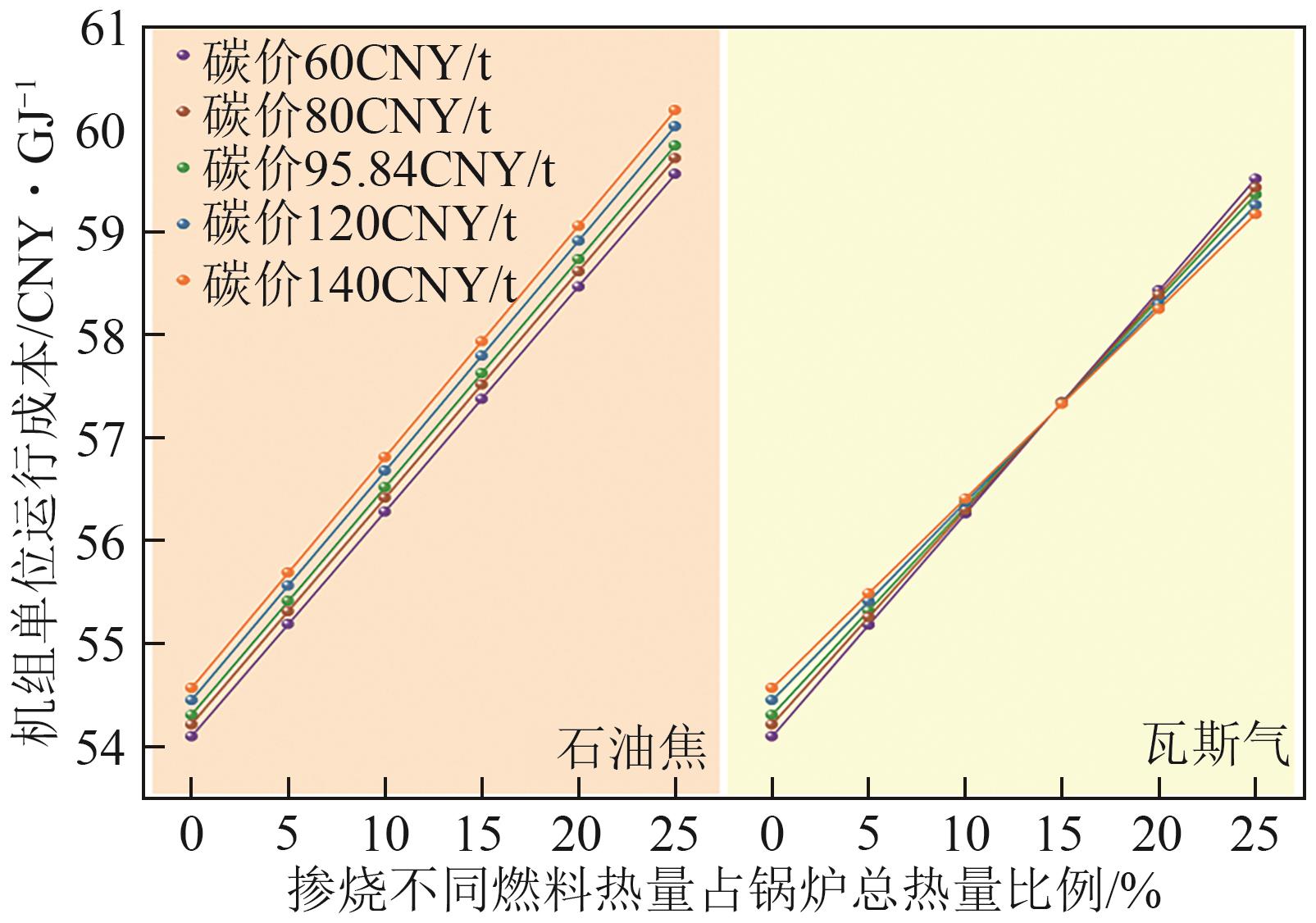
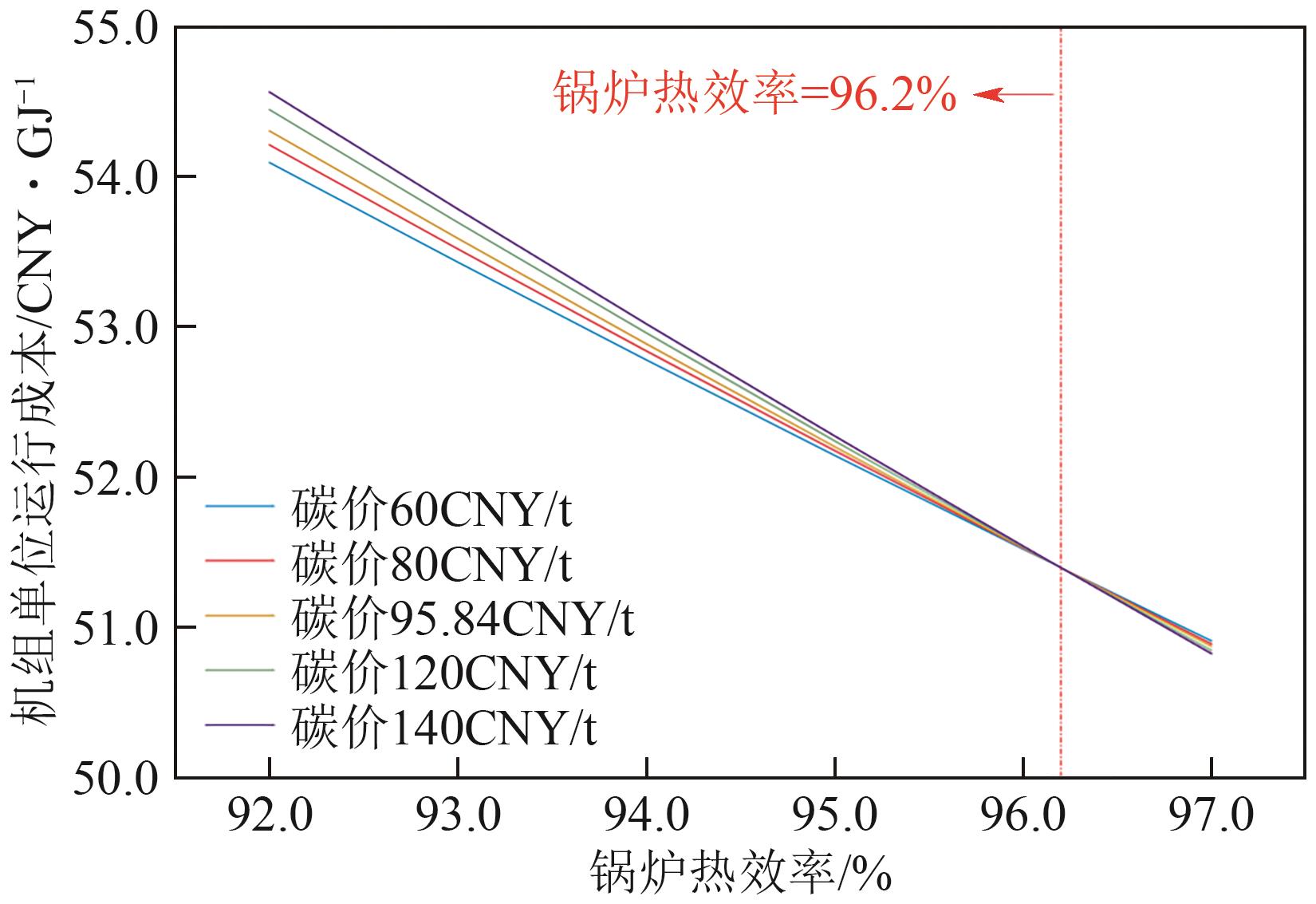
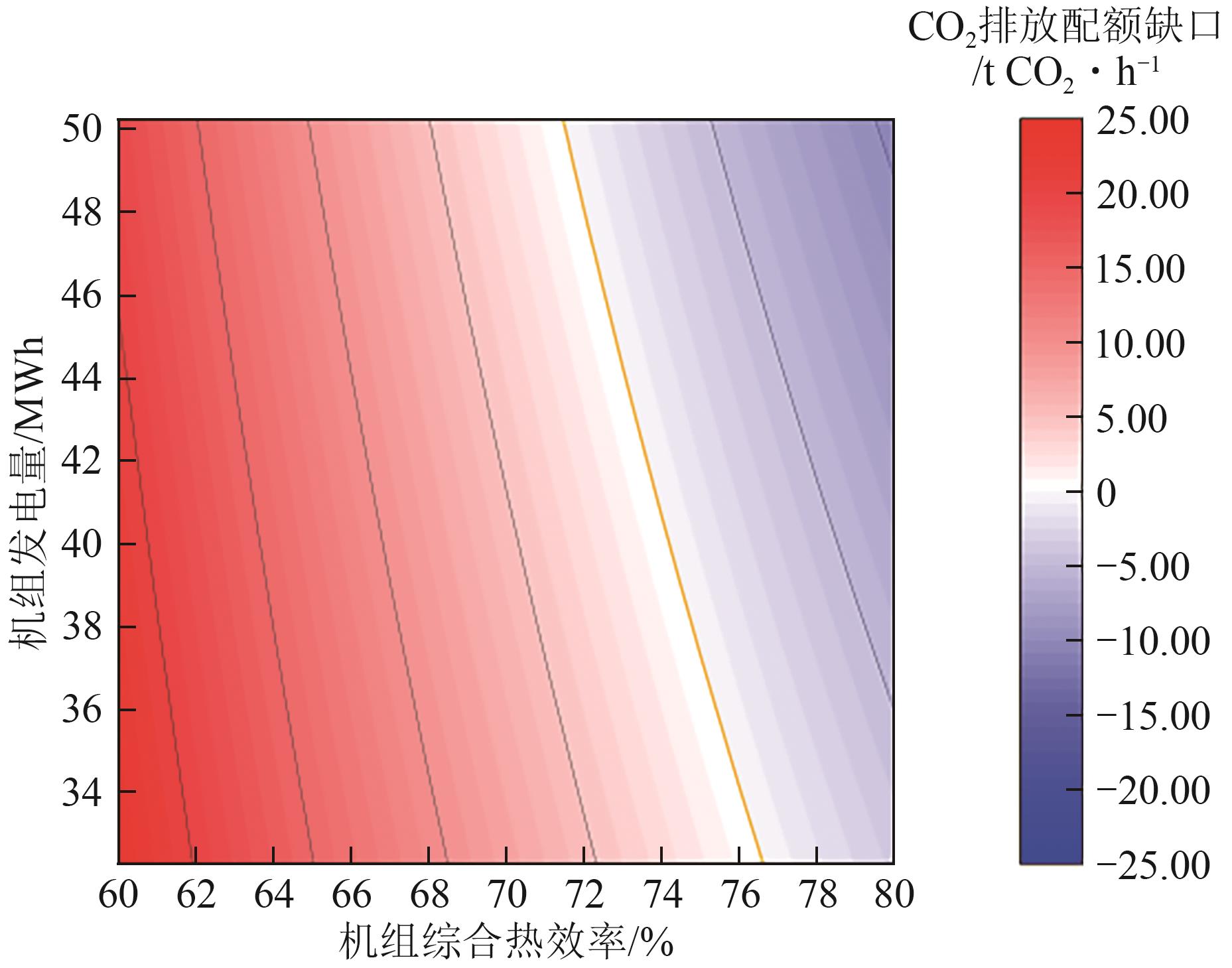
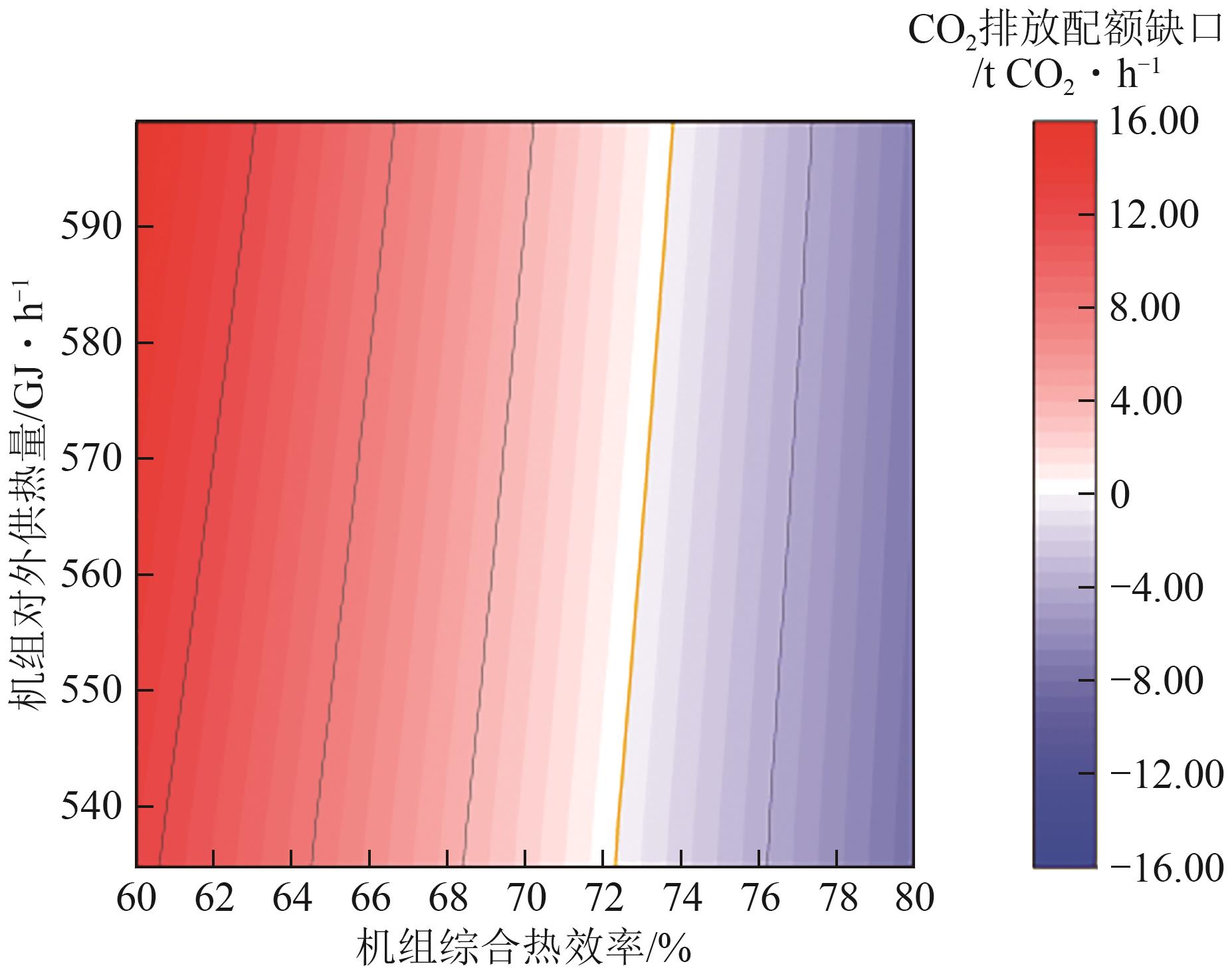
| [1] | 中共中央党校. 习近平在第七十五届联合国大会一般性辩论上的讲话[EB/OL]. (2020-09-22) [2025-03-12]. . |
| Party School of the Central Committee of the CPC. Xi Jinping’s speech at the general debate of the 75th session of the United Nations General Assembly[EB/OL]. (2020-09-22) [2025-03-12]. . | |
| [2] | 中国石化. 石化产业: 在绿色转型中实现高质量发展[EB/OL]. (2023-08-09) [2025-03-12]. . |
| Group Sinopec. Petrochemical industry: Achieving high-quality development through green transition[EB/OL]. (2023-08-09) [2025-03-12]. . | |
| [3] | 中华人民共和国中央人民政府. 2024—2025年节能降碳行动方案[EB/OL]. (2024-05-23) [2025-03-12]. . |
| State Council of the People’s Republic of China. 2024—2025 action plan for energy conservation and carbon reduction[EB/OL]. (2024-05-23) [2025-03-12]. . | |
| [4] | 李明丰, 吴昊, 沈宇 等, 等. “双碳”背景下炼化企业高质量发展路径探讨[J]. 石油学报(石油加工), 2022, 38(3): 493-499. |
| LI Mingfeng, WU Hao, SHEN Yu, et al. High-quality development path for refining and chemical enterprises under the dual carbon background[J]. Acta Petrolei Sinica (Petroleum Processing Section), 2022, 38(3): 493-499. | |
| [5] | 中华人民共和国生态环境部. 企业温室气体排放核算与报告指南 发电设施[EB/OL]. (2022-12-21) [2025-03-12]. . |
| Ministry of Ecology and Environment of the People’s Republic of China. Guidelines for Corporate Greenhouse Gas Emissions. Accounting and reporting: Power generation facilities[EB/OL]. (2022-12-21) [2025-03-12]. . | |
| [6] | 中华人民共和国中央人民政府. 碳排放权交易管理暂行条例[EB/OL]. (2024-01-25) [2025-03-12]. . |
| State Council of the People’s Republic of China. Interim regulations on carbon emission trading management[EB/OL]. (2024-01-25) [2025-03-12]. . | |
| [7] | 吴艺楠, 李冬, 赵芳, 等. 建设项目环境影响评价中温室气体排放核算方法——以火电项目为例[J].环境工程技术学报, 2022, 12(6): 1890-1897. |
| WU Yinan, LI Dong, ZHAO Fang, et al. Research on greenhouse gas emissions accounting methods in environmental impact assessment of construction projects: A case of thermal power project[J]. Journal of Environmental Engineering Technology, 2022, 12(6): 1890-1897. | |
| [8] | 中华人民共和国生态环境部. 2023、2024年度全国碳排放权交易发电行业配额总量和分配方案[EB/OL]. (2024-10-16) [2025-03-12]. . |
| Ministry of Ecology and Environment of the People’s Republic of China. 2023—2024 annual total quota allocation and distribution plan for the power generation sector under the national carbon emission trading scheme[EB/OL]. (2024-10-16) [2025-03-12]. . | |
| [9] | 中华人民共和国生态环境部. 2021、2022年度全国碳排放权交易配额总量设定与分配实施方案(发电行业)[EB/OL]. (2023-03-15) [2025-03-12]. . |
| Ministry of Ecology and Environment of the People’s Republic of China. 2021—2022 annual total quota setting and allocation implementation plan (power generation sector)[EB/OL]. (2023-03-15) [2025-03-12]. . | |
| [10] | 中华人民共和国生态环境部. 关于做好2023—2025年发电行业企业温室气体排放报告管理有关工作的通知[EB/OL]. (2023-02-27) [2025-03-12]. . |
| Ministry of Ecology and Environment of the People’s Republic of China. notice on effectively managing greenhouse gas emissions reporting for enterprises in the power generation sector (2023—2025)[EB/OL]. (2023-02-27) [2025-03-12]. . | |
| [11] | 于伟静, 杨鹏威, 王放放, 等. 双碳战略背景下中国煤电技术发展与挑战[J]. 煤炭学报, 2023, 48(7): 2641-2656. |
| YU Weijing, YANG Pengwei, WANG Fangfang, et al.Research and challenge of coal power technology development in China under the background of dual carbon strategy[J]. Journal of China Coal Society, 2023, 48(7): 2641-2656. | |
| [12] | 梁晰童, 郭丹, 初人庆, 等. 石油焦的高值化利用[J]. 当代化工, 2024, 53(9): 2220-2224. |
| LIANG Xitong, GUO Dan, CHU Renqing, et al. High value utilization of petroleum coke[J]. Contemporary Chemical Industry, 2024, 53(9): 2220-2224. | |
| [13] | 辛海, 杨勇, 闫玉麟, 等. 瓦斯气锅炉热效率提升技术研究[J]. 化工管理, 2025(1): 148-151. |
| XIN Hai, YANG Yong, YAN Yulin, et al. Study on efficiency improvement technology of gas boilers[J]. Chemical Enterprise Management, 2025(1): 148-151. | |
| [14] | 宋大勇, 陈晓龙, 张海涛, 等. 配煤掺烧比例对锅炉运行性能的影响[J]. 化工机械, 2024, 51(6): 841-847. |
| SONG Dayong, CHEN Xiaolong, ZHANG Haitao, et al. Effect of coal blending ratio on the boiler performance[J]. Chemical Engineering & Machinery, 2024, 51(6): 841-847. | |
| [15] | 杜丰. 注汽锅炉过热及提效改造技术的研究[J]. 石油石化节能与计量, 2024, 14(2): 32-35. |
| DU Feng. Research on the overheating and efficiency improvement technology for steam injection boilers[J]. Energy Conservation and Measurement in Petroleum & Petrochemical Industry, 2024, 14(2): 32-35. | |
| [16] | 张思朝. 热电锅炉热效率提升的技术应用研究[J]. 灯与照明, 2025, 49(1): 164-166. |
| ZHANG Sizhao. Research on the application of technologies for improving the thermal efficiency of electric boilers[J]. Light & Lighting, 2025, 49(1): 164-166. | |
| [17] | 田松峰, 徐琛, 张倩, 等. 基于超临界二氧化碳循环的“光火储”一体化发电系统调峰性能研究[J]. 热力发电, 2025, 54(2): 9-20. |
| TIAN Songfeng, XU Chen, ZHANG Qian, et al. Peak regulation performance of “photothermal storage” integrated power generation system based on supercritical carbon dioxide cycle[J]. Thermal Power Generation, 2025, 54(2): 9-20. | |
| [18] | 王科, 吕晨. 中国碳市场建设成效与展望(2024)[J]. 北京理工大学学报(社会科学版), 2024, 26(2): 16-27. |
| WANG Ke, Chen LYU. Achievements and prospect of China’s national carbon market construction (2024)[J]. Journal of Beijing Institute of Technology (Social Sciences Edition), 2024, 26(2): 16-27. | |
| [19] | 白强, 董洁, 田园春. 中国碳排放权交易价格的波动特征及其影响因素研究[J]. 统计与决策, 2022, 38(5): 161-165. |
| BAI Qiang, DONG Jie, TIAN Yuanchun. A study on the volatility characteristics of carbon emission allowance trading prices and their influencing factors in China[J]. Statistics & Decision, 2022, 38(5): 161-165. |
| [1] | XUE Zijie, WU Yan, CUI Ziyuan, XU Guanxin, TANG Shuo, WANG Yufei, MA Mingyan. Long cycle green ammonia synthesis model based on economic analysis: Considering the impact of continuous changes in grid carbon emission factors [J]. Chemical Industry and Engineering Progress, 2025, 44(9): 4917-4927. |
| [2] | WEI Mengyu, TONG Zhangfa, JIANG Yinghua. Multi-objective optimization of municipal solid waste supply chain network based on waste classification [J]. Chemical Industry and Engineering Progress, 2025, 44(8): 4617-4627. |
| [3] | LIU Hanxiao, SHAN Sike, FANG Jian, LIN Qingyang, YU Liyuan, FANG Ni, LIU Xiaowei, LIU Zhong, LU Shijian. Carbon footprint quantification and assessment of combined heat and power generation products [J]. Chemical Industry and Engineering Progress, 2025, 44(7): 4233-4240. |
| [4] | DAI Guilong, LIU Yishuo, MU Longkun, GONG Lingchu. Optimization on coupled heat transfer model performance of cavity-shaped porous solar receivers [J]. Chemical Industry and Engineering Progress, 2025, 44(6): 3258-3270. |
| [5] | SHA Hongyu, JIANG Xingyu, WANG Zisheng, LIU Dan, ZHANG Fei, GE Shaocong, YANG Guozhe. Carbon footprint analysis of tire manufacturing process based on LCA [J]. Chemical Industry and Engineering Progress, 2025, 44(10): 6062-6072. |
| [6] | FU Jun, XU Chungang, LI Yunhao, LI Xiaosen. Research progress on CO2 hydrate formation and carbon sequestration in brine systems [J]. Chemical Industry and Engineering Progress, 2025, 44(10): 5926-5940. |
| [7] | CHEN Wangmi, XI Beidou, LI Mingxiao, YE Meiying, HOU Jiaqi, YU Chengze, WEI Yufang, MENG Fanhua. Research progress on carbon emission reduction technology for pyrolysis system [J]. Chemical Industry and Engineering Progress, 2024, 43(S1): 479-503. |
| [8] | ZHOU Aiguo, ZHENG Jiale, YANG Chuanruo, YANG Xiaoyi, ZHAO Junde, LI Xingchun. Industrial progress in direct air CO2 capture technology [J]. Chemical Industry and Engineering Progress, 2024, 43(6): 2928-2939. |
| [9] | LI Jingying, MA Longfei, PAN Yibo, LU Shan, ZHANG Hongjuan, XU Long, MA Xiaoxun. Life cycle environmental analysis of coke oven gas to liquefied natural gas based on decarburization and methanation processes [J]. Chemical Industry and Engineering Progress, 2024, 43(5): 2872-2879. |
| [10] | DI Zichen, LEI Feixia, CHANG Chenggong, CHEN Wenhui, CHENG Fangqin. Evaluation of hydrocarbon resource utilization potential and low-carbon path in the coking industry [J]. Chemical Industry and Engineering Progress, 2024, 43(5): 2862-2871. |
| [11] | MENG Xingyu, ZONG Yuhang, ZHANG Xihua, YAN Wenyi, SUN Zhi. Analysis on material flows and carbon emissions of nickel resources in China [J]. Chemical Industry and Engineering Progress, 2024, 43(11): 6563-6572. |
| [12] | WANG Fu'an. Consumption and emission reduction of the reactor of 300kt/a propylene oxide process [J]. Chemical Industry and Engineering Progress, 2023, 42(S1): 213-218. |
| [13] | ZHANG Dong, LIU Pengfei, LIU Chunyang, HOU Gang, HUI Bo, AN Zhoujian. Performance analysis of solar PV/T photovoltaic energy storage direct drive CHP system [J]. Chemical Industry and Engineering Progress, 2023, 42(6): 2895-2903. |
| [14] | WANG Zijie, LU Shuyin, ZHAO Ziliang, WANG Ning, GU Yujiong. Analysis of the influence of heating transformation on the performance of thermal power unit [J]. Chemical Industry and Engineering Progress, 2023, 42(5): 2325-2331. |
| [15] | LI Wenxiu, YANG Yuhang, HUANG Yan, WANG Tao, WANG Lei, FANG Mengxiang. Preparation of ultrafine calcium carbonate by CO2 mineralization using high calcium-based solid waste [J]. Chemical Industry and Engineering Progress, 2023, 42(4): 2047-2057. |
| Viewed | ||||||
|
Full text |
|
|||||
|
Abstract |
|
|||||