Chemical Industry and Engineering Progress ›› 2024, Vol. 43 ›› Issue (12): 6592-6607.DOI: 10.16085/j.issn.1000-6613.2024-0563
• Chemical processes and equipment • Previous Articles
Research progress of enhanced heat transfer performance of ultrathin vapor chamber
LIU Tengqing1( ), ZHANG Yaokang1(), WANG Shuangfeng2()
- 1.College of Ocean Engineering and Energy, Guangdong Ocean University, Zhanjiang 524088, Guangdong, China
2.School of Chemistry and Chemical Engineering, South China University of Technology, Guangzhou 510640, Guangdong, China
-
Received:2024-04-07Revised:2024-05-17Online:2025-01-11Published:2024-12-15 -
Contact:WANG Shuangfeng
强化超薄均热板传热性能的研究进展
刘腾庆1(), 张尧康1(), 汪双凤2()
- 1.广东海洋大学海洋工程与能源学院,广东 湛江 524088
2.华南理工大学化学与化工学院,广东 广州 510640
-
通讯作者:汪双凤 -
作者简介:刘腾庆(1990—),男,博士,研究方向为相变流动与传热、新型热管技术。E-mail:tqliu1990@hotmail.com
张尧康(1993—),女,博士,研究方向为相变流动与传热、固态制冷技术。E-mail:zhangyk1129@163.com。 -
基金资助:广东海洋大学科研启动经费(060302072308);国家自然科学基金(52176156)

CLC Number:
Cite this article
LIU Tengqing, ZHANG Yaokang, WANG Shuangfeng. Research progress of enhanced heat transfer performance of ultrathin vapor chamber[J]. Chemical Industry and Engineering Progress, 2024, 43(12): 6592-6607.
刘腾庆, 张尧康, 汪双凤. 强化超薄均热板传热性能的研究进展[J]. 化工进展, 2024, 43(12): 6592-6607.
share this article
Add to citation manager EndNote|Ris|BibTeX
URL: https://hgjz.cip.com.cn/EN/10.16085/j.issn.1000-6613.2024-0563
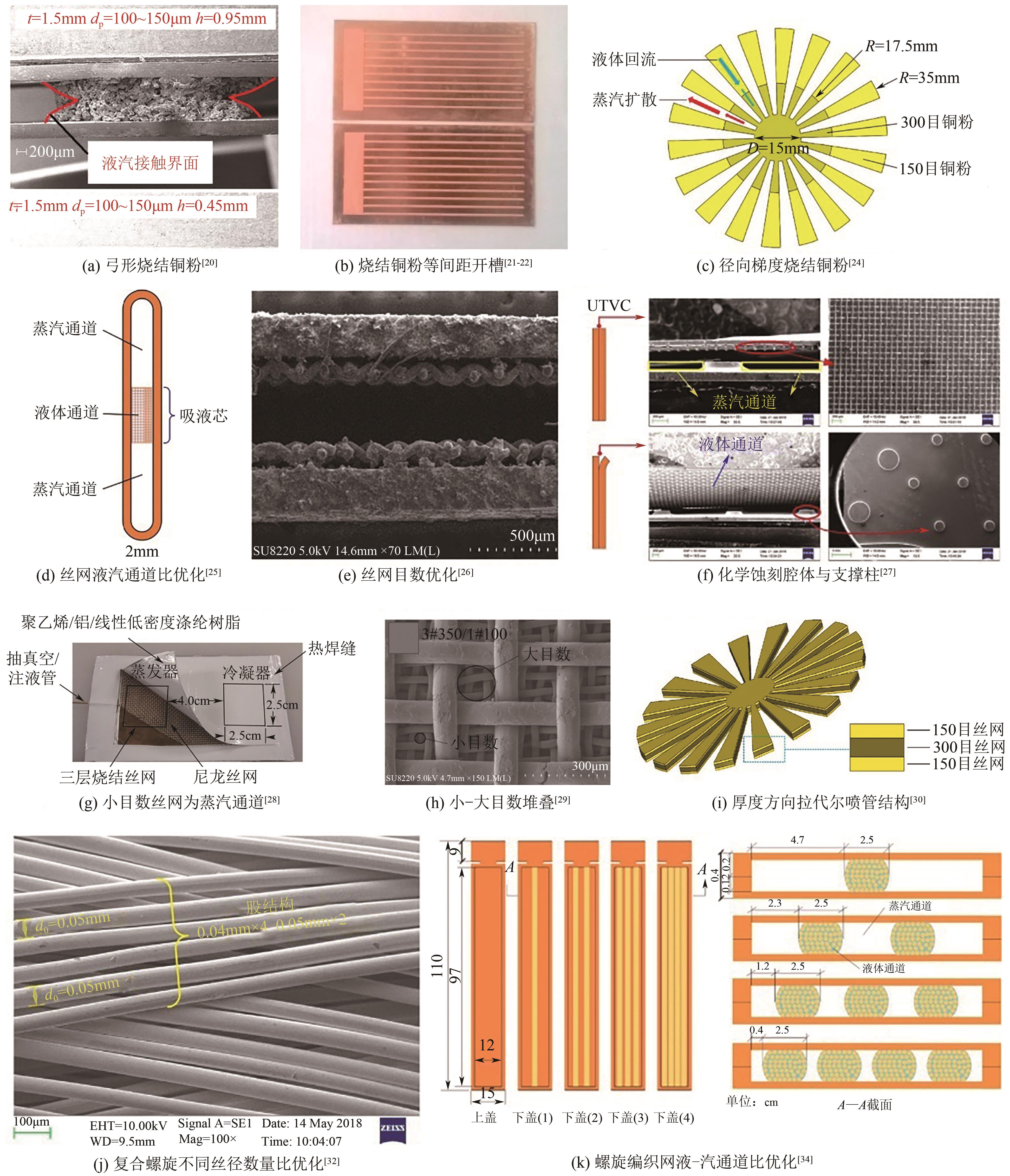
| 参考文献 | 均热板尺寸/mm | 吸液芯结构优化设计 | 热源加热面积/mm | 冷凝方式及冷凝面积 | 均热板传热性能 |
|---|---|---|---|---|---|
| Li等[ | 200×ϕ6× (1.5/1.2/1.0) | 位于中央处的弓形烧结铜粉 | 30×30 | 水冷,50mm×30mm, 水温45℃ | Rcond≤0.05K/W,0.1K/W<Revap<0.55K/W,Qmax=25W |
| Li等[ | 100×50×2 | 烧结铜粉等间隔开槽,30%的300目和70%的150目铜粉混合 | 12×10[ 10×10[ | 水冷,50mm×50mm, 水温25~40℃, 水流量240L/h[ | 水温35℃,Rmin=0.196K/W,Qmax=120W[ |
| 朱明汉等[ | 149×20×0.85 | 烧结铜粉粒径优化(120~180μm、75~120μm、58~75μm) | 25×20 | 水冷,40mm×20mm, 水温30℃,水流量60L/h | 120~180μm:Rmin=0.18K/W,Qmax=15W;58~75μm:Rmin=0.11K/W,Qmax=11W |
| Zhou等[ | ϕ80×2 | 太阳花形状吸液芯,中央300目、外围150目铜粉 | 15×15 | 强制风冷,85mm×85mm, 室温20℃±1℃,流量58cfm | Rmin=0.052K/W,Qmax=200W |
| Zhou等[ | 110×ϕ6×0.75 | 吸液芯位于中央,液-汽流动通道比 | 15×15 | 水冷,40mm×15mm, 水温50℃,水流量20L/h | 当液-汽通道比为67.28%,最佳充液率120%,Qmax=8.5W,ΔT>5℃ |
| Tang等[ | 150×ϕ6×1 | 丝网目数的优化 | 10×10 | 水冷,40mm×15mm, 水温30℃ | 180目最优,R=1.5K/W,Qmax=11W |
| Chen等[ | 104×14×0.4 | 化学蚀刻腔体与支撑柱 | 15×15 | 水冷,30mm×15mm, 水温50℃,水流量20L/h | keff=12000W/(m·K),Qmax=4.50W,ΔT= 4.75℃ |
| Oshman等[ | 130×70×1.31 | 三层200目(大目数)丝网为吸液芯,50目(小目数)丝网为蒸汽通道 | 25×25 | 水冷,25mm×25mm, 水温10℃ | R=1.2~3.0K/W,Qmax=30W |
| Liu等[ | 70×70×1.5 | 小目数丝网(100目)堆叠在大目数丝网上(350目) | 20×20 | 水冷,80mm×80mm, 水温30℃,水流量30L/h | Rmin=0.127K/W,Qmax=230W |
| Zhou等[ | ϕ80×2 | 太阳花形状吸液芯,150-300-150目丝网堆叠,厚度上形成拉伐尔喷管结构 | 15×15 | 自然风冷,无翅片,室温25℃; 强制风冷,85mm×85mm, 室温25℃,流量20.6~72.8cfm | 自然风冷:ΔTmax=2.1℃,Qmax=50W;强制风冷:风量72.8cfm,Rmin=0.48K/W,Qmax=180W |
| Zhou等[ | ϕ80×2 | 太阳花形状吸液芯,中央300目、外围150目丝网 | 15×15 | 水冷,80mm×80mm, 水温15~35℃, 水流量20~60L/h | 水温25℃,水流量40L/h时,Rmin=0.0531K/W,Qmax=420W |
| Zhou等[ | 120×ϕ6×1.1 | 两种丝径复合螺旋编织网,优化两种丝径的比例 | 15×15 | 水冷,40mm×15mm, 水温55℃,水流量20L/h | FOW:R=0.136K/W,Qmax=18W;FIW:R=0.101K/W,Qmax=24W;SIW:R=0.092K/W,Qmax=26W;最佳充液率均为120% |
| Zhou等[ | 115×ϕ5×0.4 | 单种丝径螺旋编织网,优化每股包含丝的数量 | 15×15 | 水冷,40mm×15mm, 水温50℃,水流量20L/h | 9丝NS:R=0.515K/W,Qmax=4.25W;10丝TS:R=0.628K/W,Qmax=5W;11丝ES:R=0.630K/W,Qmax=5.25W |
| Yu等[ | 100×15×0.4 | 螺旋编织网根数,液-汽通道比优化 | 15×15 | 水冷,30mm×15mm, 水温50℃,水流量20L/h | 重力辅助:1根,Qmax=3W;2根,Qmax=4.25W;3根,Qmax=6W;4根,Qmax=4.75W |
| 参考文献 | 均热板尺寸/mm | 吸液芯结构优化设计 | 热源加热面积/mm | 冷凝方式及冷凝面积 | 均热板传热性能 |
|---|---|---|---|---|---|
| Li等[ | 200×ϕ6× (1.5/1.2/1.0) | 位于中央处的弓形烧结铜粉 | 30×30 | 水冷,50mm×30mm, 水温45℃ | Rcond≤0.05K/W,0.1K/W<Revap<0.55K/W,Qmax=25W |
| Li等[ | 100×50×2 | 烧结铜粉等间隔开槽,30%的300目和70%的150目铜粉混合 | 12×10[ 10×10[ | 水冷,50mm×50mm, 水温25~40℃, 水流量240L/h[ | 水温35℃,Rmin=0.196K/W,Qmax=120W[ |
| 朱明汉等[ | 149×20×0.85 | 烧结铜粉粒径优化(120~180μm、75~120μm、58~75μm) | 25×20 | 水冷,40mm×20mm, 水温30℃,水流量60L/h | 120~180μm:Rmin=0.18K/W,Qmax=15W;58~75μm:Rmin=0.11K/W,Qmax=11W |
| Zhou等[ | ϕ80×2 | 太阳花形状吸液芯,中央300目、外围150目铜粉 | 15×15 | 强制风冷,85mm×85mm, 室温20℃±1℃,流量58cfm | Rmin=0.052K/W,Qmax=200W |
| Zhou等[ | 110×ϕ6×0.75 | 吸液芯位于中央,液-汽流动通道比 | 15×15 | 水冷,40mm×15mm, 水温50℃,水流量20L/h | 当液-汽通道比为67.28%,最佳充液率120%,Qmax=8.5W,ΔT>5℃ |
| Tang等[ | 150×ϕ6×1 | 丝网目数的优化 | 10×10 | 水冷,40mm×15mm, 水温30℃ | 180目最优,R=1.5K/W,Qmax=11W |
| Chen等[ | 104×14×0.4 | 化学蚀刻腔体与支撑柱 | 15×15 | 水冷,30mm×15mm, 水温50℃,水流量20L/h | keff=12000W/(m·K),Qmax=4.50W,ΔT= 4.75℃ |
| Oshman等[ | 130×70×1.31 | 三层200目(大目数)丝网为吸液芯,50目(小目数)丝网为蒸汽通道 | 25×25 | 水冷,25mm×25mm, 水温10℃ | R=1.2~3.0K/W,Qmax=30W |
| Liu等[ | 70×70×1.5 | 小目数丝网(100目)堆叠在大目数丝网上(350目) | 20×20 | 水冷,80mm×80mm, 水温30℃,水流量30L/h | Rmin=0.127K/W,Qmax=230W |
| Zhou等[ | ϕ80×2 | 太阳花形状吸液芯,150-300-150目丝网堆叠,厚度上形成拉伐尔喷管结构 | 15×15 | 自然风冷,无翅片,室温25℃; 强制风冷,85mm×85mm, 室温25℃,流量20.6~72.8cfm | 自然风冷:ΔTmax=2.1℃,Qmax=50W;强制风冷:风量72.8cfm,Rmin=0.48K/W,Qmax=180W |
| Zhou等[ | ϕ80×2 | 太阳花形状吸液芯,中央300目、外围150目丝网 | 15×15 | 水冷,80mm×80mm, 水温15~35℃, 水流量20~60L/h | 水温25℃,水流量40L/h时,Rmin=0.0531K/W,Qmax=420W |
| Zhou等[ | 120×ϕ6×1.1 | 两种丝径复合螺旋编织网,优化两种丝径的比例 | 15×15 | 水冷,40mm×15mm, 水温55℃,水流量20L/h | FOW:R=0.136K/W,Qmax=18W;FIW:R=0.101K/W,Qmax=24W;SIW:R=0.092K/W,Qmax=26W;最佳充液率均为120% |
| Zhou等[ | 115×ϕ5×0.4 | 单种丝径螺旋编织网,优化每股包含丝的数量 | 15×15 | 水冷,40mm×15mm, 水温50℃,水流量20L/h | 9丝NS:R=0.515K/W,Qmax=4.25W;10丝TS:R=0.628K/W,Qmax=5W;11丝ES:R=0.630K/W,Qmax=5.25W |
| Yu等[ | 100×15×0.4 | 螺旋编织网根数,液-汽通道比优化 | 15×15 | 水冷,30mm×15mm, 水温50℃,水流量20L/h | 重力辅助:1根,Qmax=3W;2根,Qmax=4.25W;3根,Qmax=6W;4根,Qmax=4.75W |
| 参考文献 | 均热板尺寸 /mm | 吸液芯结构优化设计 | 热源加热 面积/mm | 冷却方式及 冷凝面积 | 均热板传热性能 |
|---|---|---|---|---|---|
| Li等[ | 200×ϕ6×1 | 烧结铜粉-沟槽;丝网-沟槽 | 30×30 | 水冷,50mm×30mm, 水温55℃ | 单弓形烧结铜粉-沟槽:最佳充液率70%,Qmax=12W;双弓形烧结铜粉-沟槽:最佳充液率70%,Qmax=13W;丝网-沟槽:最佳充液率80%,Qmax=14W |
| Zhou等[ | 100×ϕ2×0.8 | 丝网-泡沫铜 | 30×20 | 水冷,30mm×10mm, 水温50℃,水流量20L/h | Rcond=0.45K/W,Revap=0.29K/W,Qmax=5W |
| Oshman等[ | 40×40×1.2 | 丝网-沟槽 | 8×8 | 水冷,20mm×20mm, 水温20℃ | keff=1653W/(m·K),Qmax=40W |
| Xu等[ | 100×50×0.28 | 丝网-沟槽 | 50×8 | 水冷,50mm×25mm, 水温12℃和22℃ | 水温22℃,keff=1398W/(m·K),Rmin=4.38K/W,Qmax=7.9W |
| Yan等[ | 100×18×0.3 | 蒸发端丝网-冷凝端沟槽 | 15×15 | 自然冷却,无翅片, 室温25℃ | 连续沟槽结构:Qmax=5.5W,ΔT=1.3℃;不连续沟槽结构:Qmax=5.5W,ΔT=3.5℃ |
| Huang等[ | 100×15×0.5 | 螺旋编织网-丝网 | 15×15 | 水冷,30mm×15mm, 水温50℃, 水流量20L/h | 4根螺旋编织网-丝网:最佳充液率100%,keff=20900W/(m·K),Qmax=7.58W[ |
| Yu[ | 100×18×0.4 | 螺旋编织网-丝网 | 15×15 | 水冷,30mm×15mm, 水温50℃, 水流量20L/h | 1根螺旋螺旋编织网-丝网:最优充液率100%,R=0.503K/W,Qmax=6W;丝网:最优充液率100%,R=0.583K/W,Qmax=55W |
| Yan等[ | 100×50×0.5 | 螺旋编织网-丝网 | 50×15 | 水冷,50mm×40mm, 水温50℃, 水流量40L/h | 丝网:R=0.26K/W,keff=9976.6W/(m·K),Qmax=55W;1根螺旋编织网+丝网:R=0.14K/W,keff=18640.8W/(m·K),Qmax=55W;3根螺旋编织网+丝网:R=0.16K/W,keff=15979.8W/(m·K),Qmax=55W |
| Yi等[ | 200×8.8×1.5[ 200×8.8×2.0[ | 螺旋编织网-烧结铜粉分段串联[ | 15×15 | 水冷,40mm×15mm, 水温40℃, 水流量35L/h | 螺旋编织网与烧结铜粉的长度之比为50%,性能最优,R=0.2381K/W,Qmax=30W[ |
| 参考文献 | 均热板尺寸 /mm | 吸液芯结构优化设计 | 热源加热 面积/mm | 冷却方式及 冷凝面积 | 均热板传热性能 |
|---|---|---|---|---|---|
| Li等[ | 200×ϕ6×1 | 烧结铜粉-沟槽;丝网-沟槽 | 30×30 | 水冷,50mm×30mm, 水温55℃ | 单弓形烧结铜粉-沟槽:最佳充液率70%,Qmax=12W;双弓形烧结铜粉-沟槽:最佳充液率70%,Qmax=13W;丝网-沟槽:最佳充液率80%,Qmax=14W |
| Zhou等[ | 100×ϕ2×0.8 | 丝网-泡沫铜 | 30×20 | 水冷,30mm×10mm, 水温50℃,水流量20L/h | Rcond=0.45K/W,Revap=0.29K/W,Qmax=5W |
| Oshman等[ | 40×40×1.2 | 丝网-沟槽 | 8×8 | 水冷,20mm×20mm, 水温20℃ | keff=1653W/(m·K),Qmax=40W |
| Xu等[ | 100×50×0.28 | 丝网-沟槽 | 50×8 | 水冷,50mm×25mm, 水温12℃和22℃ | 水温22℃,keff=1398W/(m·K),Rmin=4.38K/W,Qmax=7.9W |
| Yan等[ | 100×18×0.3 | 蒸发端丝网-冷凝端沟槽 | 15×15 | 自然冷却,无翅片, 室温25℃ | 连续沟槽结构:Qmax=5.5W,ΔT=1.3℃;不连续沟槽结构:Qmax=5.5W,ΔT=3.5℃ |
| Huang等[ | 100×15×0.5 | 螺旋编织网-丝网 | 15×15 | 水冷,30mm×15mm, 水温50℃, 水流量20L/h | 4根螺旋编织网-丝网:最佳充液率100%,keff=20900W/(m·K),Qmax=7.58W[ |
| Yu[ | 100×18×0.4 | 螺旋编织网-丝网 | 15×15 | 水冷,30mm×15mm, 水温50℃, 水流量20L/h | 1根螺旋螺旋编织网-丝网:最优充液率100%,R=0.503K/W,Qmax=6W;丝网:最优充液率100%,R=0.583K/W,Qmax=55W |
| Yan等[ | 100×50×0.5 | 螺旋编织网-丝网 | 50×15 | 水冷,50mm×40mm, 水温50℃, 水流量40L/h | 丝网:R=0.26K/W,keff=9976.6W/(m·K),Qmax=55W;1根螺旋编织网+丝网:R=0.14K/W,keff=18640.8W/(m·K),Qmax=55W;3根螺旋编织网+丝网:R=0.16K/W,keff=15979.8W/(m·K),Qmax=55W |
| Yi等[ | 200×8.8×1.5[ 200×8.8×2.0[ | 螺旋编织网-烧结铜粉分段串联[ | 15×15 | 水冷,40mm×15mm, 水温40℃, 水流量35L/h | 螺旋编织网与烧结铜粉的长度之比为50%,性能最优,R=0.2381K/W,Qmax=30W[ |

| 参考文献 | 均热板尺寸 /mm | 表面处理 | 热源加热 面积/mm | 冷却方式及冷凝面积 | 均热板传热性能 |
|---|---|---|---|---|---|
| 刘昌泉等[ | 200×30×1.3 | 烧结铜粉丝-烧结铜粉底层,碱性溶液(KOH和K2S2O8)化学改性形成亲水结构 | 110mm2 | 强制风冷, 70mm×30mm, 室温26℃±0.5℃ | 充液率25%时,亲水改性:Rmin=0.44K/W,Qmax=8.0W; 未改性:Rmin=0.25K/W,Qmax=28.4W |
| 刘昌泉等[ | 200×30×1.3 | 在文献[ | 110mm2 | 强制风冷, 70mm×30mm, 室温26℃±0.5℃ | 充液率30%时,亲-疏水改性:keff=7928W/(m·K),Qmax=39.6W; 亲水改性:keff=15245W/(m·K),Qmax=28.2W; 未改性:keff=15381W/(m·K),Qmax=24.6W |
| Wen等[ | 50×30×1; 50×50×1; 80×30×1; 80×50×1; 80×80×1 | 丝网,碱性溶液(NaClO2、NaOH、Na3PO4·12H2O)化学改性形成亲水草状结构,化学清洁法清除草状结构后,形成亲水微孔结构 | 10×10; 8×8;5×5 | 水冷,25mm×25mm, 水温75℃ | 均热板尺寸:50mm×30mm×1mm, 热源尺寸:5mm×5mm,qmax=429W/cm2 |
| Lee等[ | 106×36×0.67 | 丝网,化学氧化法(NaClO2、NaOH、Na3PO4·12H2O)形成亲水结构 | — | 水冷 | keff=1000W/(m·K),Q=5W |
| Yang等[ | 70×70×0.2[ 70×70×0.246[ | 丝网,碱性溶液(KOH和K2S2O8)化学改性形成亲水花瓣状结构,蒸发表面上由亲水正交网络间隔围绕疏水区域,疏水区域浸于FAS17溶液中形成 | 8×8 | 强制风冷,无翅片,风量6.875cfm,室温22℃ | keff=11914.9W/(m·K),qmax=23.91W/cm2[ 最优充液率:61.6%,最优疏水面积比率为47.9%,keff=13820W/(m·K),qmax=23.91W/cm2[ |
| 杨茂飞等[ | 100×60×0.6 | 丝网内间隔加工出蒸汽通道,碱性溶液(KOH和K2S2O8)在管壳和丝网表面形成亲水结构 | 20×20 | 自然风冷, 30mm×40mm, 室温20℃ | 去离子水最佳充液率均为1.0,Rmin=1.94K/W,Qmax=6W; 乙醇最佳充液率均为1.0,Rmin=2.10K/W,Qmax=6W |
| Lyu等[ | 100×50×0.95[ 100×50×0.5[ | 丝网内间隔加工出蒸汽通道,酸性溶液(HCl)蚀刻-烧结形成亲水结构 | 5×2(2个)[ | 自然风冷,室温20℃,水冷,30mm×40mm,水温25℃,水流量 84L/h[ | 自然风冷:Rmin=0.01(K·cm2)/W,qmax=122.5W/cm2; 水冷:Rmin=0.039(K·cm2)/W,qmax=490W/cm2[ |
| Aoki等[ | 150×9×1.0, 100×9×0.7 | 丝网,位于中央处,氧化还原法形成亲水结构 | 40×10 | 水冷,85mm×10mm(1.0mm厚),45mm×10mm(0.7mm厚), 水温50℃ | 1.0mm厚:R=0.2K/W,Qmax=20W; 0.7mm厚:R=0.4K/W,Qmax=7W |
| Cui等[ | 105×50×0.68 | 丝网内间隔加工出蒸汽通道,热氧化法形成亲水结构 | 10×10 | 自然风冷,无翅片, 室温25℃, 风速0.11m/s | 最佳充液率57%,最佳目数200目, 最佳蒸汽通道1.5mm,Rmin=0.26K/W,Qmax=8W |
| Liu等[ | 70×70×1.5 | 单层丝网,激光蚀刻形成亲水结构 | 14×14 | 水冷,80mm×80mm, 水温30℃, 水流量30L/h | 未改性:Rmin=0.431K/W,Qmax=100W; 改性:Rmin=0.328K/W,Qmax=120W |
| Huang等[ | 100×65×(1.26~1.77) | 丝网,O2等离子气体改性丝网和蒸发表面形成亲水结构 | 20×20 | 水冷,50mm×50mm, 水温50℃,水流量10L/h | Rmin=0.107K/W,keff=5005W/(m·K),Qmax=50W |
| Ahamed等[ | 100×3×0.4 | 纤维,位于中央处,氧化还原法形成亲水结构 | 10×10 | 自然风冷,无翅片, 室温25℃ | keff=3030W/(m·K),Qmax=6W |
| Wang等[ | 吸液芯尺寸 100×10×0.5 | 纤维,碱性溶液(NaOH和K2S2O8)形成亲水结构 | — | — | 毛细上升实验,去离子水,纤维长度的影响:L80抽吸系数W=21.677mm/s0.5,最大上升高度h=95mm,渗透率K=1.927×10-10m2,毛细因子M=1.254µm; L5抽吸系数W=9.056mm/s0.5,最大上升高度h=78.5mm,渗透率K=4.087×10-11m2,毛细因子M=0.221µm |
| Yang等[ | 100×9.1×1.0 | 螺旋编织网,喷灯火焰氧化法形成亲水结构 | 30×9.1 | 水冷,40mm×9.1mm | 最佳充液率125%,Rmin=0.12K/W,Qmax=20W |
| Tang等[ | 110×8.736×1.2, 110×8.85×1.0, 110×8.964×0.8[ 110×8.85×1.0[ | 螺旋编织网,化学氧化(碱性溶液NaOH和K2S2O8)-烧结法形成清水结构 | 25×19 | 水冷,30mm×19mm, 水温47℃,水流量60L/h | 厚度=1.2mm时, 未改性:Rmin=0.2K/W,Qmax=26W; 改性后:Rmin=0.15K/W,Qmax=32W |
| Wu等[ | 吸液芯尺寸, 长×丝径×股数 100mm×0.04mm×6 | 螺旋编织网,化学蚀刻(H2C2O4溶液)-烧结形成亲水结构 | — | — | 毛细上升实验,化学蚀刻: 抽吸系数W=404.457mm/s0.5, 最大上升高度h=91mm; 化学蚀刻-烧结: 抽吸系数W=117.419mm/s0.5, 最大上升高度h=80.6mm |
| Yang等[ | 70×30×(0.53~0.6) | 泡沫铜,碱性溶液(KOH和K2S2O8)形成亲水表面 | 8×8 | 水冷,35mm×30mm | 最佳充液量0.26g,keff=2207W/(m·K),Qmax=22.66W |
| Huang等[ | 110×ϕ6×1.2 | 螺旋编织网-丝网,氧化还原法形成亲水结构 | 15×15 | 水冷,30mm×15mm, 水温50℃,水流量20L/h | 未改性:R=0.2~0.26K/W,Qmax=29W; 改性:R=0.05~0.2K/W,Qmax=38W |
| Yuan等[ | 204×143×0.5 | 螺旋编织网-丝网,化学氧化(碱性溶液NaOH和K2S2O8)形成亲水结构 | 143×40 | 水冷,143mm×70mm, 水温50℃,水流量50L/h | 最佳充液率30%,keff=13237.2W/(m·K),Qmax=90W |
| Zhang等[ | 100×16×0.35 | 螺旋编织网-丝网,化学氧化(碱性溶液NaOH和K2S2O8)-烧结形成亲水结构 | 15×15 | 水冷,15mm×35mm, 水温50℃,水流量20L/h | keff=12454W/(m·K),Qmax=3.5W |
| Zhang等[ | 60×15×2.0 | 螺旋编织网包裹泡沫铜,HCl-H2O2蚀刻形成亲水结构 | 15×15 | 水冷,15mm×15mm, 水温25℃, 水流量250L/h | 未改性:最佳充液率150%,Rmin=0.38K/W,Qmax=15.7W; 改性:最佳充液率140%, Rmin=0.34K/W,Qmax=17.8W |
| Wang等[ | 90×40×0.6 | 泡沫铜-丝网,碱性溶液(KOH和K2S2O8)形成亲水结构 | 10×10 | 水冷,25mm×25mm, 水温25℃, 水流量108L/h | 最佳充液率111.4% Rmin=0.79K/W,Qmax=23.34W |
| 参考文献 | 均热板尺寸 /mm | 表面处理 | 热源加热 面积/mm | 冷却方式及冷凝面积 | 均热板传热性能 |
|---|---|---|---|---|---|
| 刘昌泉等[ | 200×30×1.3 | 烧结铜粉丝-烧结铜粉底层,碱性溶液(KOH和K2S2O8)化学改性形成亲水结构 | 110mm2 | 强制风冷, 70mm×30mm, 室温26℃±0.5℃ | 充液率25%时,亲水改性:Rmin=0.44K/W,Qmax=8.0W; 未改性:Rmin=0.25K/W,Qmax=28.4W |
| 刘昌泉等[ | 200×30×1.3 | 在文献[ | 110mm2 | 强制风冷, 70mm×30mm, 室温26℃±0.5℃ | 充液率30%时,亲-疏水改性:keff=7928W/(m·K),Qmax=39.6W; 亲水改性:keff=15245W/(m·K),Qmax=28.2W; 未改性:keff=15381W/(m·K),Qmax=24.6W |
| Wen等[ | 50×30×1; 50×50×1; 80×30×1; 80×50×1; 80×80×1 | 丝网,碱性溶液(NaClO2、NaOH、Na3PO4·12H2O)化学改性形成亲水草状结构,化学清洁法清除草状结构后,形成亲水微孔结构 | 10×10; 8×8;5×5 | 水冷,25mm×25mm, 水温75℃ | 均热板尺寸:50mm×30mm×1mm, 热源尺寸:5mm×5mm,qmax=429W/cm2 |
| Lee等[ | 106×36×0.67 | 丝网,化学氧化法(NaClO2、NaOH、Na3PO4·12H2O)形成亲水结构 | — | 水冷 | keff=1000W/(m·K),Q=5W |
| Yang等[ | 70×70×0.2[ 70×70×0.246[ | 丝网,碱性溶液(KOH和K2S2O8)化学改性形成亲水花瓣状结构,蒸发表面上由亲水正交网络间隔围绕疏水区域,疏水区域浸于FAS17溶液中形成 | 8×8 | 强制风冷,无翅片,风量6.875cfm,室温22℃ | keff=11914.9W/(m·K),qmax=23.91W/cm2[ 最优充液率:61.6%,最优疏水面积比率为47.9%,keff=13820W/(m·K),qmax=23.91W/cm2[ |
| 杨茂飞等[ | 100×60×0.6 | 丝网内间隔加工出蒸汽通道,碱性溶液(KOH和K2S2O8)在管壳和丝网表面形成亲水结构 | 20×20 | 自然风冷, 30mm×40mm, 室温20℃ | 去离子水最佳充液率均为1.0,Rmin=1.94K/W,Qmax=6W; 乙醇最佳充液率均为1.0,Rmin=2.10K/W,Qmax=6W |
| Lyu等[ | 100×50×0.95[ 100×50×0.5[ | 丝网内间隔加工出蒸汽通道,酸性溶液(HCl)蚀刻-烧结形成亲水结构 | 5×2(2个)[ | 自然风冷,室温20℃,水冷,30mm×40mm,水温25℃,水流量 84L/h[ | 自然风冷:Rmin=0.01(K·cm2)/W,qmax=122.5W/cm2; 水冷:Rmin=0.039(K·cm2)/W,qmax=490W/cm2[ |
| Aoki等[ | 150×9×1.0, 100×9×0.7 | 丝网,位于中央处,氧化还原法形成亲水结构 | 40×10 | 水冷,85mm×10mm(1.0mm厚),45mm×10mm(0.7mm厚), 水温50℃ | 1.0mm厚:R=0.2K/W,Qmax=20W; 0.7mm厚:R=0.4K/W,Qmax=7W |
| Cui等[ | 105×50×0.68 | 丝网内间隔加工出蒸汽通道,热氧化法形成亲水结构 | 10×10 | 自然风冷,无翅片, 室温25℃, 风速0.11m/s | 最佳充液率57%,最佳目数200目, 最佳蒸汽通道1.5mm,Rmin=0.26K/W,Qmax=8W |
| Liu等[ | 70×70×1.5 | 单层丝网,激光蚀刻形成亲水结构 | 14×14 | 水冷,80mm×80mm, 水温30℃, 水流量30L/h | 未改性:Rmin=0.431K/W,Qmax=100W; 改性:Rmin=0.328K/W,Qmax=120W |
| Huang等[ | 100×65×(1.26~1.77) | 丝网,O2等离子气体改性丝网和蒸发表面形成亲水结构 | 20×20 | 水冷,50mm×50mm, 水温50℃,水流量10L/h | Rmin=0.107K/W,keff=5005W/(m·K),Qmax=50W |
| Ahamed等[ | 100×3×0.4 | 纤维,位于中央处,氧化还原法形成亲水结构 | 10×10 | 自然风冷,无翅片, 室温25℃ | keff=3030W/(m·K),Qmax=6W |
| Wang等[ | 吸液芯尺寸 100×10×0.5 | 纤维,碱性溶液(NaOH和K2S2O8)形成亲水结构 | — | — | 毛细上升实验,去离子水,纤维长度的影响:L80抽吸系数W=21.677mm/s0.5,最大上升高度h=95mm,渗透率K=1.927×10-10m2,毛细因子M=1.254µm; L5抽吸系数W=9.056mm/s0.5,最大上升高度h=78.5mm,渗透率K=4.087×10-11m2,毛细因子M=0.221µm |
| Yang等[ | 100×9.1×1.0 | 螺旋编织网,喷灯火焰氧化法形成亲水结构 | 30×9.1 | 水冷,40mm×9.1mm | 最佳充液率125%,Rmin=0.12K/W,Qmax=20W |
| Tang等[ | 110×8.736×1.2, 110×8.85×1.0, 110×8.964×0.8[ 110×8.85×1.0[ | 螺旋编织网,化学氧化(碱性溶液NaOH和K2S2O8)-烧结法形成清水结构 | 25×19 | 水冷,30mm×19mm, 水温47℃,水流量60L/h | 厚度=1.2mm时, 未改性:Rmin=0.2K/W,Qmax=26W; 改性后:Rmin=0.15K/W,Qmax=32W |
| Wu等[ | 吸液芯尺寸, 长×丝径×股数 100mm×0.04mm×6 | 螺旋编织网,化学蚀刻(H2C2O4溶液)-烧结形成亲水结构 | — | — | 毛细上升实验,化学蚀刻: 抽吸系数W=404.457mm/s0.5, 最大上升高度h=91mm; 化学蚀刻-烧结: 抽吸系数W=117.419mm/s0.5, 最大上升高度h=80.6mm |
| Yang等[ | 70×30×(0.53~0.6) | 泡沫铜,碱性溶液(KOH和K2S2O8)形成亲水表面 | 8×8 | 水冷,35mm×30mm | 最佳充液量0.26g,keff=2207W/(m·K),Qmax=22.66W |
| Huang等[ | 110×ϕ6×1.2 | 螺旋编织网-丝网,氧化还原法形成亲水结构 | 15×15 | 水冷,30mm×15mm, 水温50℃,水流量20L/h | 未改性:R=0.2~0.26K/W,Qmax=29W; 改性:R=0.05~0.2K/W,Qmax=38W |
| Yuan等[ | 204×143×0.5 | 螺旋编织网-丝网,化学氧化(碱性溶液NaOH和K2S2O8)形成亲水结构 | 143×40 | 水冷,143mm×70mm, 水温50℃,水流量50L/h | 最佳充液率30%,keff=13237.2W/(m·K),Qmax=90W |
| Zhang等[ | 100×16×0.35 | 螺旋编织网-丝网,化学氧化(碱性溶液NaOH和K2S2O8)-烧结形成亲水结构 | 15×15 | 水冷,15mm×35mm, 水温50℃,水流量20L/h | keff=12454W/(m·K),Qmax=3.5W |
| Zhang等[ | 60×15×2.0 | 螺旋编织网包裹泡沫铜,HCl-H2O2蚀刻形成亲水结构 | 15×15 | 水冷,15mm×15mm, 水温25℃, 水流量250L/h | 未改性:最佳充液率150%,Rmin=0.38K/W,Qmax=15.7W; 改性:最佳充液率140%, Rmin=0.34K/W,Qmax=17.8W |
| Wang等[ | 90×40×0.6 | 泡沫铜-丝网,碱性溶液(KOH和K2S2O8)形成亲水结构 | 10×10 | 水冷,25mm×25mm, 水温25℃, 水流量108L/h | 最佳充液率111.4% Rmin=0.79K/W,Qmax=23.34W |

| 1 | TANG Heng, TANG Yong, WAN Zhenping, et al. Review of applications and developments of ultra-thin micro heat pipes for electronic cooling[J]. Applied energy, 2018, 223: 383-400. |
| 2 | ZHOU Feng, ZHOU Jingzhi, HUAI Xiulan. Advancements and challenges in ultra-thin vapor chambers for high-efficiency electronic thermal management: A comprehensive review[J]. International Journal of Heat and Mass Transfer, 2023, 214: 124453. |
| 3 | DUAN Liuyang, LI Hang, DU Jinguang, et al. Research on the manufacturing process and heat transfer performance of ultra-thin heat pipes: A Review[J]. Materials, 2022, 15(15): 5459. |
| 4 | 洪思慧, 张新强, 汪双凤 等. 基于热管技术的锂离子动力电池热管理系统研究进展[J]. 化工进展, 2014, 33(11): 2923-2927. |
| HONG Sihui, ZHANG Xinqiang, WANG Shuangfeng, et al. Review on application of heat pipe technology in lithium-ion power battery thermal management system[J]. Chemical Industry and Engineering Progress, 2014, 33(11): 2923-2927. | |
| 5 | YIN Shubin, ZHAO Wei, TANG Yong, et al. Ultra-thin vapour chamber based heat dissipation technology for lithium-ion battery[J]. Applied Energy, 2024, 358: 122591. |
| 6 | 刘腾庆,闫文韬,杨鑫 等. 强化平板热管传热性能的研究进展[J]. 化工学报, 2021, 72(11): 5468-5480. |
| LIU Tengqing, YAN Wentao, YANG Xin, et al. Research progress on enhanced thermal performance of flat plate heat pipe[J]. CIESC Journal, 2021, 72(11): 5468-5480. | |
| 7 | NEMATOLLAHISARVESTANI Ali, LEWIS Ryan J, LEE Yung-Cheng. Design of thermal ground planes for cooling of foldable smartphones[J]. Journal of Electronic Packaging, 2019, 141(2): 021004. |
| 8 | LI Quanming, HAN Angel, YANG Guo, et al. Technical challenges and novel passive cooling technologies for ultra-thin notebooks[C]//16th IEEE Intersociety Conference on Thermal and Thermomechanical Phenomena in Electronic Systems (ITherm). IEEE, 2017: 1069-1074. |
| 9 | JIAN Qifei, LI Cong, WANG Li. Analysis on thermal and hydraulic performance of a T-shaped vapor chamber designed for motorcycle led lights[J]. Thermal Science, 2019, 23(1): 137-148. |
| 10 | LUO Lizhong, HUANG Bi, BAI Xingying, et al. Temperature uniformity improvement of a proton exchange membrane fuel cell stack with ultra-thin vapor chambers[J]. Applied energy, 2020, 270: 115192. |
| 11 | LIU Tengqing, HE Xuehao, ZHANG Yaokang, et al. Experimental investigation on thermal performance of ultra-thin flattened heat pipe with middle heating for electronics cooling[J]. Heat Transfer Research, 2024, 55(8): 83-95. |
| 12 | YANG Xin, LIU Tengqing, YAN Wentao, et al. Design, fabrication and heat transfer performance study of a novel flexible flat heat pipe[J]. International Communications in Heat and Mass Transfer, 2023, 142: 106673. |
| 13 | CHEN Zhaoshu, LI Yong, YU Jiu, et al. Fabrication and characterization of ultra-thin vapour chambers with printed copper powder wick[J]. Applied Thermal Engineering, 2022, 201: 117734. |
| 14 | GILLOT Charlotte, AVENAS Yvan, CEZAC Nathalie, et al. Silicon heat pipes used as thermal spreaders[J]. IEEE Transactions on Components and Packaging Technologies, 2003, 26(2): 332-339. |
| 15 | REAY D A. Heat pipes: theory, design and applications[M]. KEW P A, MCGLEN R J. 6th ed. Oxford: Butterworth-Heinemann, 2014. |
| 16 | LI Yuan-Chun, WONG Shwin-Chung. Effects of vapor duct thickness on the capillary blocking and thermal performance of ultra-thin vapor chambers under natural convection cooling[J]. Applied Thermal Engineering, 2021, 195: 117148. |
| 17 | 刘腾庆. 丝网型吸液芯超薄均热板的传热特性研究[D]. 广州: 华南理工大学, 2022. |
| LIU Tengqing. Research on heat transfer characteristics of ultra-thin vapor chamber with screen mesh wick[D]. Guangzhou: South China University of Technology, 2022. | |
| 18 | TANG Heng, XIE Yansong, XIA Liangfeng, et al. Review on the fabrication of surface functional structures for enhancing heat transfer of heat pipes[J]. Applied Thermal Engineering, 2023, 226: 120337. |
| 19 | 胡艳鑫, 黄凯鑫, 陈思旭 等. 自湿润流体的流动与传热特性研究进展[J]. 化工进展, 2017, 36(12): 4329-4342. |
| HU Yanxin, HUANG Kaixin, CHEN Sixu, et al. Research progress of flow and heat transfer characteristics with self-rewetting fluid[J]. Chemical Industry and Engineering Progress, 2017, 36(12): 4329-4342. | |
| 20 | LI Yong, HE Jiabin, HE Hengfei, et al. Investigation of ultra-thin flattened heat pipes with sintered wick structure[J]. Applied Thermal Engineering, 2015, 86: 106-118. |
| 21 | LI Ji, Lucang LYU. Experimental studies on a novel thin flat heat pipe heat spreader[J]. Applied Thermal Engineering, 2016, 93: 139-146. |
| 22 | Lucang LYU, LI Ji. Effect of charging ratio on thermal performance of a miniaturized two-phase super-heat-spreader[J]. International Journal of Heat and Mass Transfer, 2017, 104: 489-492. |
| 23 | 朱明汉, 白鹏飞, 胡艳鑫 等. 烧结多孔槽道吸液芯超薄平板热管的传热性能[J]. 化工学报, 2019, 70(4): 1349-1357. |
| ZHU Minghan, BAI Pengfei, HU Yanxin, et al. Heat transfer performance of ultra-thin plate heat pipe with sintered porous channels structures wick[J]. CIESC Journal, 2019, 70(4): 1349-1357. | |
| 24 | ZHOU Feng, ZHOU Guohui, ZHOU Jingzhi, et al. Performance comparative evaluation of three thin vapor chambers with different wick structures[J]. Applied Thermal Engineering, 2023, 230: 120749. |
| 25 | ZHOU Wenjie, LI Ying, CHEN Zhaoshu, et al. Effect of the passage area ratio of liquid to vapor on an ultra-thin flattened heat pipe[J]. Applied Thermal Engineering, 2019, 162: 114215. |
| 26 | TANG Yongle, HONG Sihui, WANG Shuangfeng, et al. Experimental study on thermal performances of ultra-thin flattened heat pipes[J]. International Journal of Heat and Mass Transfer, 2019, 134: 884-894. |
| 27 | CHEN Zhaoshu, LI Yong, ZHOU Wenjie, et al. Design, fabrication and thermal performance of a novel ultra-thin vapour chamber for cooling electronic devices[J]. Energy Conversion and Management, 2019, 187: 221-231. |
| 28 | OSHMAN Christopher, LI Qian, LIEW Li-Anne, et al. Flat flexible polymer heat pipes[J]. Journal of Micromechanics and Microengineering, 2012, 23(1): 015001. |
| 29 | LIU Tengqing, YAN Wentao, YANG Xin, et al. Improving the thermal performance of thin vapor chamber by optimizing screen mesh wick structure[J]. Thermal Science and Engineering Progress, 2022, 36: 101535. |
| 30 | ZHOU Feng, ZHOU Guohui, ZHOU Jingzhi, et al. Thermal performance evaluation of a novel ultra-thin vapor chamber with Laval-like nozzle composite wick under different air cooling conditions[J]. Case Studies in Thermal Engineering, 2022, 31: 101845. |
| 31 | ZHOU Feng, ZHOU Guohui, ZHOU Jingzhi, et al. A novel ultra-thin vapor chamber with radial-gradient hierarchical wick for high-power electronics cooling[J]. International Journal of Thermal Sciences, 2023, 183: 107896. |
| 32 | ZHOU Wenjie, LI Yong, CHEN Zhaoshu, et al. A novel ultra-thin flattened heat pipe with biporous spiral woven mesh wick for cooling electronic devices[J]. Energy Conversion and Management, 2019, 180: 769-783. |
| 33 | ZHOU Wenjie, LI Yong, CHEN Zhaoshu, et al. Ultra-thin flattened heat pipe with a novel band-shape spiral woven mesh wick for cooling smartphones[J]. International Journal of Heat and Mass Transfer, 2020, 146: 118792. |
| 34 | YU Jiu, LI Yong, CHEN Zhaoshu, et al. Effect of the passage area ratio of wick on an ultra-thin vapour chamber with a spiral woven mesh wick[J]. Applied Thermal Engineering, 2021, 196: 117282. |
| 35 | LI Yong, ZHOU Wenjie, HE Jiabin, et al. Thermal performance of ultra-thin flattened heat pipes with composite wick structure[J]. Applied Thermal Engineering, 2016, 102: 487-499. |
| 36 | ZHOU Wenjie, XIE Peida, LI Yong, et al. Thermal performance of ultra-thin flattened heat pipes[J]. Applied Thermal Engineering, 2017, 117: 773-781. |
| 37 | OSHMAN Christopher, LI Qian, LIEW Li-Anne, et al. Thermal performance of a flat polymer heat pipe heat spreader under high acceleration[J]. Journal of Micromechanics and Microengineering, 2012, 22(4): 045018. |
| 38 | XU Shanshan, LEWIS Ryan J, LIEW Li-Anne, et al. Development of ultra-thin thermal ground planes by using stainless-steel mesh as wicking structure[J]. Journal of Microelectromechanical Systems, 2016, 25(5): 842-844. |
| 39 | YAN Wentao, HE Xuehao, WANG Shuangfeng. Thermal performance of ultra-thin vapor chamber with etched micro-structure for electronics cooling[J]. International Journal of Heat and Mass Transfer, 2024, 222: 125150. |
| 40 | HUANG Guangwen, LIU Wangyu, LUO Yuanqiang, et al. A novel ultra-thin vapor chamber for heat dissipation in ultra-thin portable electronic devices[J]. Applied Thermal Engineering, 2020, 167: 114726. |
| 41 | HUANG Guangwen, LIU Wangyu, LUO Yuanqiang, et al. A new ultra-thin vapor chamber with composite wick for thin electronic products[J]. International Journal of Thermal Sciences, 2021, 170: 107145. |
| 42 | YU Jiu, XIN Zhifeng, ZHANG Ruohan, et al. Effect of spiral woven mesh liquid pumping action on the heat transfer performance of ultrathin vapour chamber[J]. International Journal of Thermal Sciences, 2022, 182: 107799. |
| 43 | YAN Caiman, LI Hongming, TANG Yong, et al. A novel ultra-thin vapor chamber with composite wick for portable electronics cooling[J]. Applied Thermal Engineering, 2023, 226: 120340. |
| 44 | YI Feng, GAN Yunhua, XIN Zhifeng, et al. Analysis of thermal characteristics of the heat pipes with segmented composite wicks[J]. International Journal of Thermal Sciences, 2023, 191: 108341. |
| 45 | YI Feng, GAN Yunhua, XIN Zhifeng, et al. Experimental study on thermal performance of ultra-thin heat pipe with a novel composite wick structure[J]. International Journal of Thermal Sciences, 2023, 193: 108539. |
| 46 | 刘昌泉, 尚炜, 赵举贵 等. 纳米修饰吸液芯超薄平板热管的传热特性[J]. 化工学报, 2017, 68(12): 4508-4516. |
| LIU Changquan, SHANG Wei, ZHAO Jugui, et al. Heat transfer characteristics of ultra-thin flat heat pipe with nano-modified porous wick[J]. CIESC Journal, 2017, 68(12): 4508-4516. | |
| 47 | 刘昌泉, 徐进良, 纪献兵. 超亲水/超疏水匹配超薄热管的传热特性[J]. 化工进展, 2018, 37(6): 2067-2076. |
| LIU Changquan, XU Jinliang, JI Xianbing. Heat transfer characteristics of super-hydrophilic and super-hydrophobic matched ultra-thin heat pipe[J]. Chemical Industry and Engineering Progress, 2018, 37(6): 2067-2076. | |
| 48 | WEN Rongfu, XU Shanshan, LEE Yung-Cheng, et al. Capillary-driven liquid film boiling heat transfer on hybrid mesh wicking structures[J]. Nano Energy, 2018, 51: 373-382. |
| 49 | LI Xiaobo, WANG Songbai, WEN Rongfu, et al. Liquid film boiling enabled ultra-high conductance and high flux heat spreaders[J]. Cell Reports Physical Science, 2022, 3(3). |
| 50 | LEE Daehoon, BYON Chan. Fabrication and characterization of pure-metal-based submillimeter-thick flexible flat heat pipe with innovative wick structures[J]. International Journal of Heat and Mass Transfer, 2018, 122: 306-314. |
| 51 | YANG Yinchuang, LI Jian, WANG Hongzhao, et al. Microstructured wettability pattern for enhancing thermal performance in an ultrathin vapor chamber[J]. Case Studies in Thermal Engineering, 2021, 25: 100906. |
| 52 | YANG Yinchuang, LI Jian, YE Xin, et al. Influence of hydrophobic area fraction of a wettability-patterned evaporator in an ultrathin vapor chamber[J]. International Journal of Heat and Mass Transfer, 2022, 198: 123414. |
| 53 | 杨茂飞, 李金旺, 周刘伟. 亲水改性超薄平板热管传热性能[J]. 化工进展, 2023, 42(2): 692-698. |
| YANG Maofei, LI Jinwang, ZHOU Liuwei. Heat transfer performance of hydrophilic modified ultra-thin flat heat pipe[J]. Chemical Industry and Engineering Progress, 2023, 42(2): 692-698. | |
| 54 | Lucang LYU, LI Ji. Managing high heat flux up to 500W/cm2 through an ultra-thin flat heat pipe with superhydrophilic wick[J]. Applied Thermal Engineering, 2017, 122: 593-600. |
| 55 | LI Ji, Lucang LYU, ZHOU Guohui, et al. Mechanism of a microscale flat plate heat pipe with extremely high nominal thermal conductivity for cooling high-end smartphone chips[J]. Energy Conversion and Management, 2019, 201: 112202. |
| 56 | AOKI Hirofumi, SHIOYA Nobuyoshi, IKEDA Masami, et al. Development of ultra thin plate-type heat pipe with less than 1mm thickness[C]//26th Annual IEEE Semiconductor Thermal Measurement and Management Symposium (SEMI-THERM). IEEE, 2010: 217-222. |
| 57 | CUI Zhuo, JIA Li, WANG Zhou, et al. Thermal performance of an ultra-thin flat heat pipe with striped super-hydrophilic wick structure[J]. Applied Thermal Engineering, 2022, 208: 118249. |
| 58 | LIU Tengqing, YAN Wentao, WU Wei, et al. Thermal performance enhancement of vapor chamber with modified thin screen mesh wick by laser etching[J]. Case Studies in Thermal Engineering, 2021, 28: 101525. |
| 59 | HUANG Guangwen, LIU Wangyu, LUO Yuanqiang, et al. Fabrication and thermal performance of mesh-type ultra-thin vapor chambers[J]. Applied Thermal Engineering, 2019, 162: 114263. |
| 60 | AHAMED Mohammad Shahed, SAITO Yuji, MOCHIZUKI Masataka, et al. Hot spot elimination by thin and smart heat spreader[C]//International Technical Conference and Exhibition on Packaging and Integration of Electronic and Photonic Microsystems. ASME, 2015, IPAC K2015-48019: 1-10. |
| 61 | WANG Junxiang, TANG Yong, HUANG Haoyi, et al. Rice-inspired oriented copper fiber wick with excellent capillary performance for ultra-thin vapor chamber[J]. Applied Thermal Engineering, 2024, 236: 121573. |
| 62 | YANG Kai-Shing, TU Cheng-Wei, ZHANG Wen-Hua, et al. A novel oxidized composite braided wires wick structure applicable for ultra-thin flattened heat pipes[J]. International Communications in Heat and Mass Transfer, 2017, 88: 84-90. |
| 63 | TANG Yong, TANG Heng, LI Jie, et al. Experimental investigation of capillary force in a novel sintered copper mesh wick for ultra-thin heat pipes[J]. Applied Thermal Engineering, 2017, 115: 1020-1030. |
| 64 | TANG Heng, WENG Changxing, TANG Yong, et al. Thermal performance enhancement of an ultra-thin flattened heat pipe with multiple wick structure[J]. Applied Thermal Engineering, 2021, 183: 116203. |
| 65 | TANG Heng, WENG Changxing, TANG Yong, et al. Effect of inclination angle on the thermal performance of an ultrathin heat pipe with multi-scale wick structure[J]. International Communications in Heat and Mass Transfer, 2020, 118: 104908. |
| 66 | WU Chunxia, TANG Yong, ZHU Likuan, et al. Enhanced capillary performance of nanostructures copper woven mesh wick for ultrathin heat pipes[J]. Applied Thermal Engineering, 2024, 242: 122476. |
| 67 | YANG Yinchuang, LIAO Dong, WANG Hongzhao, et al. Development of ultrathin thermal ground plane with multiscale micro/nanostructured wicks[J]. Case Studies in Thermal Engineering, 2020, 22: 100738. |
| 68 | HUANG Guangwen, LIU Wangyu, LUO Yuanqiang, et al. Fabrication and capillary performance of a novel composite wick for ultra-thin heat pipes[J]. International Journal of Heat and Mass Transfer, 2021, 176: 121467. |
| 69 | YUAN Xuepeng, HUANG Yuepeng, ZHENG Xingyu, et al. Experimental study of large-area ultra-thin vapor chamber for microelectronic heat dissipation[J]. Journal of Energy Storage, 2023, 72: 108219. |
| 70 | ZHANG Shiwei, LIU Hang, SHAO Changkun, et al. High performance ultra-thin vapor chamber by reducing liquid film and enhancing capillary wicking[J]. Applied Thermal Engineering, 2024: 122813. |
| 71 | ZHANG Yanhui, ZHAO Zhengang, LUO Chuan, et al. Thermal transfer characteristics of flat plate micro heat pipe with copper spiral woven mesh and a copper foam composite wick[J]. Nanomaterials, 2021, 11(11): 2821. |
| 72 | WANG Menghao, YANG Yinchuang, SUN Yiwei, et al. Experimental study on the thermal performance of ultra-thin flat heat pipes with novel multiscale striped composite wick structures[J]. Heliyon, 2023: e20840. |
| 73 | PATANKAR Gaurav, WEIBEL Justin A, GARIMELLA Suresh V. Working-fluid selection for minimized thermal resistance in ultra-thin vapor chambers[J]. International Journal of Heat and Mass Transfer, 2017, 106: 648-654. |
| 74 | BARUAH Arunjoy, MATHEW John, KRISHNAN Shankar. Investigation of aqueous alcohol solutions as working fluids in an ultra-thin vapor chamber[J]. Experimental Heat Transfer, 2024, 37(7): 1186-1202. |
| [1] | ZHAO Jilong, MA Yinghua, HUANG Guoqing, SHEN Mingyu, CHEN Hongxia. Optimization design of cesium heat pipe based on orthogonal test [J]. Chemical Industry and Engineering Progress, 2024, 43(S1): 94-105. |
| [2] | GUO Wenjie, ZHAI Yuling, CHEN Wenzhe, SHEN Xin, XING Ming. Analysis of convective heat transfer and thermo-economic performance of Al2O3-CuO/water hybrid nanofluids [J]. Chemical Industry and Engineering Progress, 2023, 42(5): 2315-2324. |
| [3] | WANG Chao, WANG Zongyong, ZHANG Wei, HAN Xu, LIU Lei, FU Qihui. Effect of jet impingement nanofluid on heat transfer characteristics of semicircular spiral channels [J]. Chemical Industry and Engineering Progress, 2023, 42(12): 6207-6217. |
| [4] | MEI Xiang, YAO Yuanpeng, WU Huiying. Analysis of heat transfer enhancement mechanism on subcooled flow boiling in interconnected microchannels [J]. Chemical Industry and Engineering Progress, 2022, 41(6): 2884-2892. |
| [5] | Yu SHEN, Zhenhai PAN, Huiying WU. Analysis of bubble dynamics and heat transfer characteristics during flow boiling in square-fin microchannels [J]. Chemical Industry and Engineering Progress, 2020, 39(7): 2548-2555. |
| [6] | Long ZENG,Haiyan LEI,Chuanshan DAI. Heat transfer performance of a convection-enhanced heat transfer element——single-phase natural circulation loop [J]. Chemical Industry and Engineering Progress, 2020, 39(4): 1259-1266. |
| [7] | CAO Hailiang, HUANG Dan, JIA Baoguang, SU Hang, NIAN Zhiyuan, WANG Dingbiao. Numerical simulation of overall heat transfer performance of the rolled curved ribbed tube [J]. Chemical Industry and Engineering Progree, 2015, 34(s1): 35-42. |
| [8] | LI Meng, DAI Chuanshan. An experimental study of enforced heat transfer of four vibrated hot and cold microtube array in an adiabatic cylindrical enclosure [J]. Chemical Industry and Engineering Progree, 2015, 34(06): 1557-1563,1581. |
| [9] | WANG Xinliang 1,YANG Wengang 2,SHI Xiaoping 1,TAO Jinliang 1,XING Xiaokang 1. Experimental research of flow boiling heat transfer with nanotube arrays surface on titanium [J]. Chemical Industry and Engineering Progree, 2013, 32(08): 1771-1774. |
| [10] | HU Zicheng,SONG Xinnan,LI Changfeng,WANG Qian. Research progress of physical properties of surfactant solutions [J]. Chemical Industry and Engineering Progree, 2011, 30(8): 1658-. |
| [11] |
XIE Ying,WU Hongwu.
Influence of surface treatment on properties of vegetable fibre reinforced polymer composite [J]. Chemical Industry and Engineering Progree, 2010, 29(7): 1256-. |
| [12] | HU Peixian,WEN Yuefang,YANG Yonggang,LIU Lang. Effect of surface treatment on soakage of epoxy resin to carbon fibers [J]. Chemical Industry and Engineering Progree, 2009, 28(2): 288-. |
| [13] | JIANG Xiang,ZHU Dongsheng,ZHANG Jingwei,TU Aimin,WANG Changhong. Performance and industrial application of evaporative condenser with special-shape steel tubes [J]. Chemical Industry and Engineering Progree, 2008, 27(9): 1477-. |
| [14] | PENG Xiaofeng;WU Di;ZHANG Yang. Applications and principle of high performance condensers [J]. Chemical Industry and Engineering Progree, 2007, 26(1): 97-. |
| Viewed | ||||||
|
Full text |
|
|||||
|
Abstract |
|
|||||