化工进展 ›› 2025, Vol. 44 ›› Issue (8): 4657-4668.DOI: 10.16085/j.issn.1000-6613.2024-1669
• 过程系统工程的模拟与仿真 • 上一篇
煤制甲醇与绿氢高效耦合新工艺模拟及技术经济分析
杨嘉聪( ), 程光旭(), 贾彤华, 姜召
- 西安交通大学化学工程与技术学院,陕西 西安 710049
-
收稿日期:2024-10-17修回日期:2025-02-12出版日期:2025-08-25发布日期:2025-09-08 -
通讯作者:程光旭 -
作者简介:杨嘉聪(2000—),男,博士研究生,研究方向为能源化工节能技术。E-mail:yjc18571341687@stu.xjtu.edu.cn。 -
基金资助:陕煤-秦岭计划(SMYJY20210296)
Simulation and techno-economic analysis of new efficient coupling processes between coal to methanol and green hydrogen
YANG Jiacong(), CHENG Guangxu(), JIA Tonghua, JIANG Zhao
- School of Chemical Engineering and Technology, Xi’an Jiaotong University, Xi’an 710049, Shaanxi, China
-
Received:2024-10-17Revised:2025-02-12Online:2025-08-25Published:2025-09-08 -
Contact:CHENG Guangxu

摘要:
针对传统煤制甲醇工艺的高碳排放、高能耗、低煤炭资源利用效率等问题,本文提出了分别引入二氧化碳加氢技术和甲烷二氧化碳干重整技术的绿氢高效耦合新工艺Ⅰ和新工艺Ⅱ,以年产3×10⁵t的传统煤制甲醇工艺路线为案例,通过对全流程的理论分析和Aspen仿真模拟,系统地研究了绿氢高效耦合新工艺的物料变化和能耗情况,并从能耗、碳排放强度、碳元素利用率、投资成本和生产成本等多维度进行了技术经济分析和对比。结果表明,相比于传统煤制甲醇工艺,新工艺Ⅰ和新工艺Ⅱ的碳元素利用率从38.74%分别提高到了84.56%和67.60%,生产每吨甲醇煤耗从1.42t均降低到了0.65t,单位甲醇碳排放强度分别下降了62.84%和56.42%,通过分析投资和生产成本发现,受制氢规模影响,新工艺Ⅰ投资较高,新工艺Ⅱ与传统工艺总投资相当。由于氢气成本较高,当前两种新工艺的单位甲醇生产成本分别是传统工艺的1.84倍和1.51倍,随着碳税的增加和制氢成本下降,新工艺将逐渐凸显经济性优势。两种新工艺在实现甲醇扩能增产的同时极大地减少了碳排放,且在能耗和经济性上都更具优势,具有良好的应用前景。
中图分类号:
引用本文
杨嘉聪, 程光旭, 贾彤华, 姜召. 煤制甲醇与绿氢高效耦合新工艺模拟及技术经济分析[J]. 化工进展, 2025, 44(8): 4657-4668.
YANG Jiacong, CHENG Guangxu, JIA Tonghua, JIANG Zhao. Simulation and techno-economic analysis of new efficient coupling processes between coal to methanol and green hydrogen[J]. Chemical Industry and Engineering Progress, 2025, 44(8): 4657-4668.
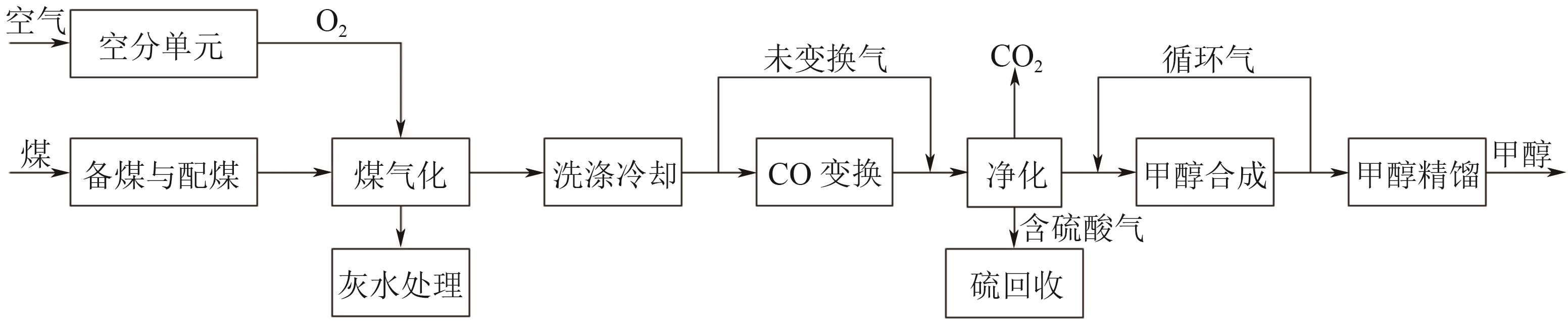
图1 传统煤制甲醇工艺流程
| 工业分析 | 质量分数/% | 元素分析 | 质量分数/% | 硫分析 | 质量分数/% |
|---|---|---|---|---|---|
| 水分 | 7.67 | C | 73.67 | 硫化矿硫 | 30 |
| 固定碳(FC) | 56.33 | H | 6.41 | 硫酸盐硫 | 30 |
| 挥发分(VM) | 34.66 | N | 1.15 | 有机硫 | 40 |
| 灰分(ASH) | 9.01 | S | 0.36 | ||
| O | 9.4 |
表1 煤的物理性质
| 工业分析 | 质量分数/% | 元素分析 | 质量分数/% | 硫分析 | 质量分数/% |
|---|---|---|---|---|---|
| 水分 | 7.67 | C | 73.67 | 硫化矿硫 | 30 |
| 固定碳(FC) | 56.33 | H | 6.41 | 硫酸盐硫 | 30 |
| 挥发分(VM) | 34.66 | N | 1.15 | 有机硫 | 40 |
| 灰分(ASH) | 9.01 | S | 0.36 | ||
| O | 9.4 |
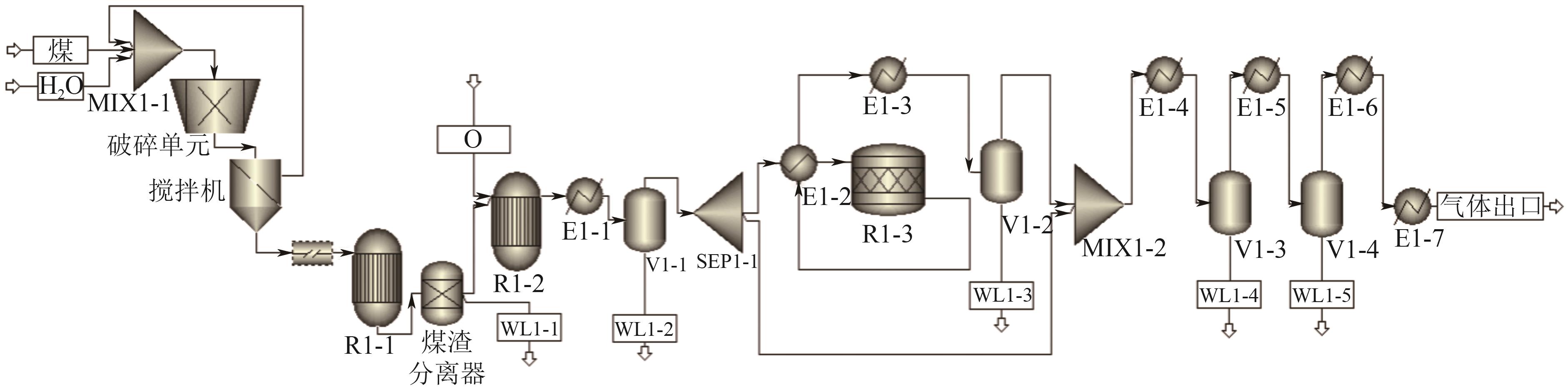
图2 煤气化和变换流程
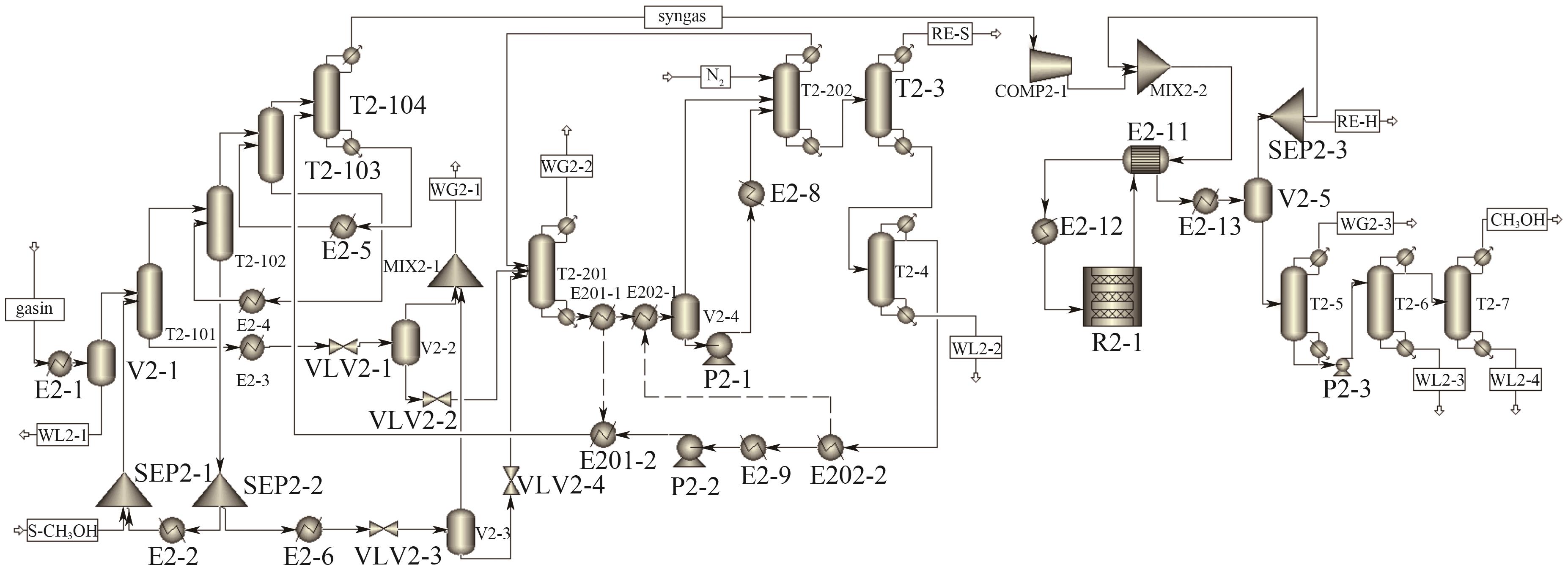
图3 低温甲醇洗和甲醇合成精馏流程
| 工段 | 设备 | 塔板数 | 进料塔板 | 操作压力/kPa |
|---|---|---|---|---|
| 低温甲醇洗 | T2-101 | 15 | 14 | 2830 |
| T2-102 | 3 | 3 | 2810 | |
| T2-103 | 10 | 10 | 2800 | |
| T2-104 | 8 | 8 | 2780 | |
| T2-201 | 40 | 1 | 180 | |
| T2-202 | 15 | 10 | 210 | |
甲醇精馏 (传统工艺) | T2-3 | 12 | 7 | 100 |
| T2-4 | 15 | 1 | 119 | |
| T2-5 | 15 | 10 | 180 | |
| T2-6 | 24 | 20 | 600 | |
| T2-7 | 27 | 20 | 102 | |
| 新工艺Ⅰ | T3-1 | 10 | 7 | 180 |
| T3-2 | 25 | 21 | 600 | |
| T3-3 | 30 | 23 | 102 | |
| 新工艺Ⅱ | T4-1 | 11 | 6 | 180 |
| T4-2 | 22 | 13 | 600 | |
| T4-3 | 20 | 10 | 102 |
表2 主要设备参数
| 工段 | 设备 | 塔板数 | 进料塔板 | 操作压力/kPa |
|---|---|---|---|---|
| 低温甲醇洗 | T2-101 | 15 | 14 | 2830 |
| T2-102 | 3 | 3 | 2810 | |
| T2-103 | 10 | 10 | 2800 | |
| T2-104 | 8 | 8 | 2780 | |
| T2-201 | 40 | 1 | 180 | |
| T2-202 | 15 | 10 | 210 | |
甲醇精馏 (传统工艺) | T2-3 | 12 | 7 | 100 |
| T2-4 | 15 | 1 | 119 | |
| T2-5 | 15 | 10 | 180 | |
| T2-6 | 24 | 20 | 600 | |
| T2-7 | 27 | 20 | 102 | |
| 新工艺Ⅰ | T3-1 | 10 | 7 | 180 |
| T3-2 | 25 | 21 | 600 | |
| T3-3 | 30 | 23 | 102 | |
| 新工艺Ⅱ | T4-1 | 11 | 6 | 180 |
| T4-2 | 22 | 13 | 600 | |
| T4-3 | 20 | 10 | 102 |
| 项目 | 摩尔分数/% | 温度/℃ | |||
|---|---|---|---|---|---|
| H2 | CO2 | CO | CH4 | ||
| 模拟结果(干基) | 33.19 | 19.89 | 46.25 | 0.01 | 1300 |
| 文献结果(干基) | 34.09 | 20.14 | 45.31 | 0.02 | 1300 |
| 生产数据(干基) | 34.14 | 20.25 | 45.53 | 0.07 | 1314 |
表3 粗煤气模拟结果与文献和生产数据对比
| 项目 | 摩尔分数/% | 温度/℃ | |||
|---|---|---|---|---|---|
| H2 | CO2 | CO | CH4 | ||
| 模拟结果(干基) | 33.19 | 19.89 | 46.25 | 0.01 | 1300 |
| 文献结果(干基) | 34.09 | 20.14 | 45.31 | 0.02 | 1300 |
| 生产数据(干基) | 34.14 | 20.25 | 45.53 | 0.07 | 1314 |
| 流程 | 摩尔分数/% | |||||||
|---|---|---|---|---|---|---|---|---|
| H2 | CO2 | CO | N2 | H2O | COS | H2S | CH4 | |
| 气化后 | 23.56 | 14.12 | 32.83 | 0.37 | 29.02 | 45.16×10⁻⁴ | 854.84×10⁻⁴ | 0.01 |
| 变换后 | 38.61 | 29.16 | 17.79 | 0.37 | 13.97 | 45.16×10⁻⁴ | 854.84×10⁻⁴ | 0.01 |
| 净化后 | 66.91 | 1.68 | 30.73 | 0.63 | 0 | 0.01×10⁻⁴ | 0.05×10⁻⁴ | 0.02 |
表4 主要流股组分模拟结果
| 流程 | 摩尔分数/% | |||||||
|---|---|---|---|---|---|---|---|---|
| H2 | CO2 | CO | N2 | H2O | COS | H2S | CH4 | |
| 气化后 | 23.56 | 14.12 | 32.83 | 0.37 | 29.02 | 45.16×10⁻⁴ | 854.84×10⁻⁴ | 0.01 |
| 变换后 | 38.61 | 29.16 | 17.79 | 0.37 | 13.97 | 45.16×10⁻⁴ | 854.84×10⁻⁴ | 0.01 |
| 净化后 | 66.91 | 1.68 | 30.73 | 0.63 | 0 | 0.01×10⁻⁴ | 0.05×10⁻⁴ | 0.02 |
| 流股 | 组分摩尔分数/% | 摩尔流量 /kmol·h-1 | 质量流量 /kg·h-1 | ||||||||
|---|---|---|---|---|---|---|---|---|---|---|---|
| H2 | CO | CO2 | H2O | N2 | CH4 | H2S | COS | CH3OH | |||
| gasin | 38.61 | 17.79 | 29.16 | 13.97 | 0.37 | 0.01 | 854.84×10⁻⁴ | 45.16×10⁻⁴ | 0 | 6435.63 | 136747.37 |
| WG2-1 | 24.00 | 29.73 | 45.23 | 0 | 0.96 | 0.04 | 297.26×10⁻⁴ | 2.74×10⁻⁴ | 0.01 | 9.77 | 283.45 |
| WG2-2 | 0.02 | 0.10 | 99.27 | 0 | 0.60 | 0 | 1.42×10⁻⁴ | 1.40×10⁻⁴ | 0.01 | 1692.25 | 74270.72 |
| WG2-3 | 22.04 | 6.15 | 32.88 | 0 | 11.23 | 1.61 | 598.52×10⁻⁴ | 1.48×10⁻⁴ | 26.02 | 29.80 | 846.60 |
| WL2-1 | 0 | 0 | 0 | 100.00 | 0 | 0 | 0 | 0 | 0 | 898.95 | 16196.88 |
| WL2-2 | 0 | 0 | 0 | 100.00 | 0 | 0 | 0 | 0 | 0 | 1.50 | 27.02 |
| WL2-3 | 0 | 0 | 0 | 99.67 | 0 | 0 | 0 | 0 | 0.33 | 48.90 | 883.22 |
| WL2-4 | 0 | 0 | 0 | 51.19 | 0 | 0 | 0 | 0 | 48.81 | 3.16 | 78.78 |
| N2 | 0 | 0 | 0 | 0 | 100.00 | 0 | 0 | 0 | 0 | 10 | 280.13 |
| RE-S | 0 | 0 | 79.48 | 0 | 0.04 | 0 | 3.17 | 0.17 | 17.14 | 163.49 | 6812.07 |
| RE-H | 67.10 | 9.35 | 2.33 | 0 | 20.64 | 0.27 | 6.29×10⁻⁴ | 0.37×10⁻⁴ | 0.31 | 97.93 | 1069.57 |
| CH3OH | 0 | 0 | 0 | 0 | 0 | 0 | 0 | 0 | 100.00 | 1170.44 | 37502.80 |
表5 低温甲醇洗和甲醇合成精馏流股参数
| 流股 | 组分摩尔分数/% | 摩尔流量 /kmol·h-1 | 质量流量 /kg·h-1 | ||||||||
|---|---|---|---|---|---|---|---|---|---|---|---|
| H2 | CO | CO2 | H2O | N2 | CH4 | H2S | COS | CH3OH | |||
| gasin | 38.61 | 17.79 | 29.16 | 13.97 | 0.37 | 0.01 | 854.84×10⁻⁴ | 45.16×10⁻⁴ | 0 | 6435.63 | 136747.37 |
| WG2-1 | 24.00 | 29.73 | 45.23 | 0 | 0.96 | 0.04 | 297.26×10⁻⁴ | 2.74×10⁻⁴ | 0.01 | 9.77 | 283.45 |
| WG2-2 | 0.02 | 0.10 | 99.27 | 0 | 0.60 | 0 | 1.42×10⁻⁴ | 1.40×10⁻⁴ | 0.01 | 1692.25 | 74270.72 |
| WG2-3 | 22.04 | 6.15 | 32.88 | 0 | 11.23 | 1.61 | 598.52×10⁻⁴ | 1.48×10⁻⁴ | 26.02 | 29.80 | 846.60 |
| WL2-1 | 0 | 0 | 0 | 100.00 | 0 | 0 | 0 | 0 | 0 | 898.95 | 16196.88 |
| WL2-2 | 0 | 0 | 0 | 100.00 | 0 | 0 | 0 | 0 | 0 | 1.50 | 27.02 |
| WL2-3 | 0 | 0 | 0 | 99.67 | 0 | 0 | 0 | 0 | 0.33 | 48.90 | 883.22 |
| WL2-4 | 0 | 0 | 0 | 51.19 | 0 | 0 | 0 | 0 | 48.81 | 3.16 | 78.78 |
| N2 | 0 | 0 | 0 | 0 | 100.00 | 0 | 0 | 0 | 0 | 10 | 280.13 |
| RE-S | 0 | 0 | 79.48 | 0 | 0.04 | 0 | 3.17 | 0.17 | 17.14 | 163.49 | 6812.07 |
| RE-H | 67.10 | 9.35 | 2.33 | 0 | 20.64 | 0.27 | 6.29×10⁻⁴ | 0.37×10⁻⁴ | 0.31 | 97.93 | 1069.57 |
| CH3OH | 0 | 0 | 0 | 0 | 0 | 0 | 0 | 0 | 100.00 | 1170.44 | 37502.80 |
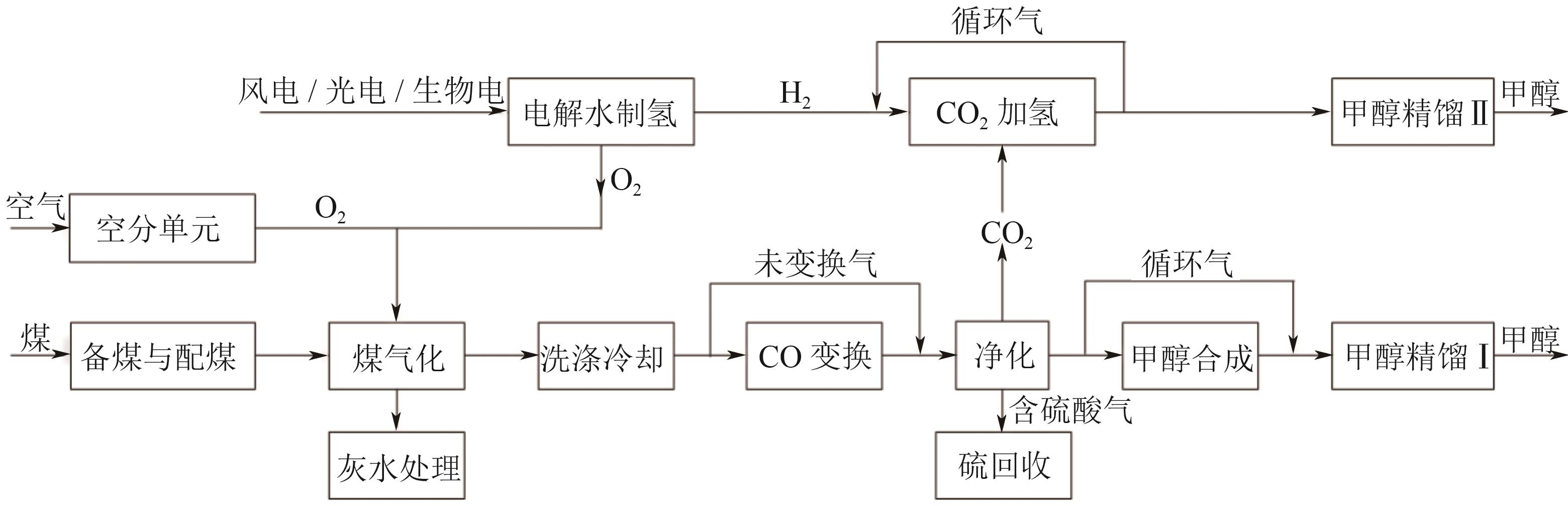
图4 绿氢高效耦合新工艺Ⅰ流程
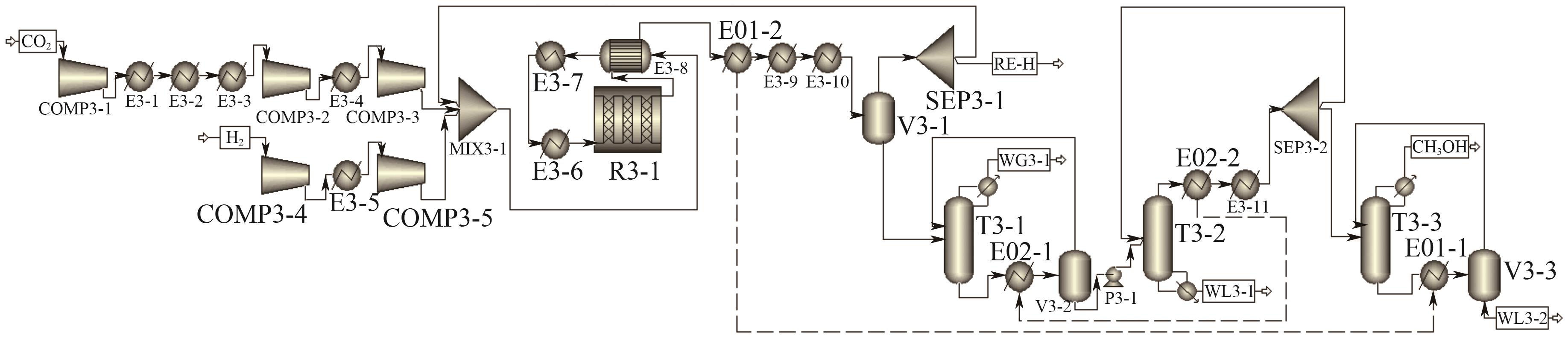
图5 新工艺Ⅰ流程模拟
| 流股 | 组分摩尔分数/% | 摩尔流量 /kmol·h-1 | 质量流量 /kg·h-1 | ||||||||
|---|---|---|---|---|---|---|---|---|---|---|---|
| H2 | CO | CO2 | H2O | N2 | CH4 | H2S | COS | CH3OH | |||
| H2 | 100 | 0 | 0 | 0 | 0 | 0 | 0 | 0 | 0 | 4698.26 | 9471.13 |
| CO2 | 0.02 | 0.10 | 99.27 | 0 | 0.60 | 0 | 1.42×10⁻⁴ | 1.40×10⁻⁴ | 0.01 | 1692.25 | 74270.72 |
| RE-H | 72.44 | 1.98 | 23.86 | 0.04 | 1.52 | 0 | 2.61×10⁻⁴ | 0.16×10⁻⁴ | 0.16 | 660.591 | 8588.21 |
| WG3-1 | 6.56 | 0.30 | 92.93 | 0 | 0.18 | 0.01 | 188.29×10⁻⁴ | 11.71×10⁻⁴ | 0 | 118.791 | 4891.22 |
| WL3-1 | 0 | 0 | 0 | 99.99 | 0 | 0 | 0 | 0 | 0.01 | 1334.74 | 24048.24 |
| WL3-2 | 0 | 0 | 0 | 84.53 | 0 | 0 | 0 | 0 | 15.47 | 91.11 | 1839.02 |
| CH3OH | 0 | 0 | 0 | 0 | 0 | 0 | 0 | 0 | 100.00 | 1384.66 | 44366.22 |
表6 新工艺Ⅰ流股参数
| 流股 | 组分摩尔分数/% | 摩尔流量 /kmol·h-1 | 质量流量 /kg·h-1 | ||||||||
|---|---|---|---|---|---|---|---|---|---|---|---|
| H2 | CO | CO2 | H2O | N2 | CH4 | H2S | COS | CH3OH | |||
| H2 | 100 | 0 | 0 | 0 | 0 | 0 | 0 | 0 | 0 | 4698.26 | 9471.13 |
| CO2 | 0.02 | 0.10 | 99.27 | 0 | 0.60 | 0 | 1.42×10⁻⁴ | 1.40×10⁻⁴ | 0.01 | 1692.25 | 74270.72 |
| RE-H | 72.44 | 1.98 | 23.86 | 0.04 | 1.52 | 0 | 2.61×10⁻⁴ | 0.16×10⁻⁴ | 0.16 | 660.591 | 8588.21 |
| WG3-1 | 6.56 | 0.30 | 92.93 | 0 | 0.18 | 0.01 | 188.29×10⁻⁴ | 11.71×10⁻⁴ | 0 | 118.791 | 4891.22 |
| WL3-1 | 0 | 0 | 0 | 99.99 | 0 | 0 | 0 | 0 | 0.01 | 1334.74 | 24048.24 |
| WL3-2 | 0 | 0 | 0 | 84.53 | 0 | 0 | 0 | 0 | 15.47 | 91.11 | 1839.02 |
| CH3OH | 0 | 0 | 0 | 0 | 0 | 0 | 0 | 0 | 100.00 | 1384.66 | 44366.22 |
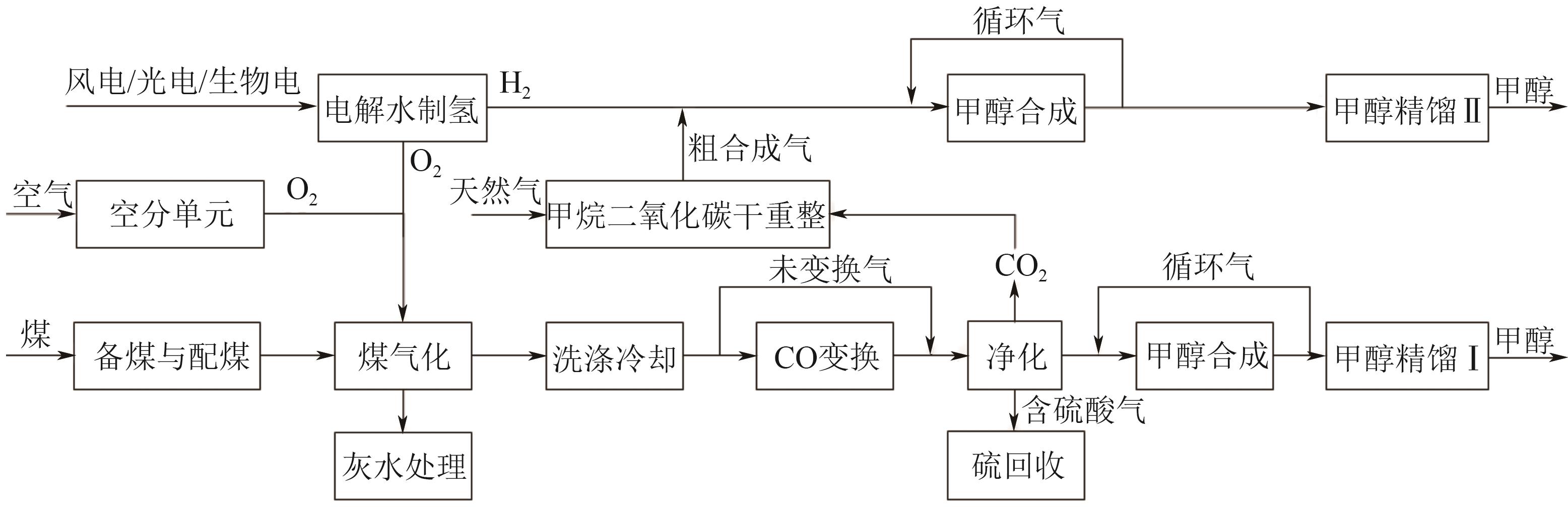
图6 绿氢高效耦合新工艺Ⅱ流程
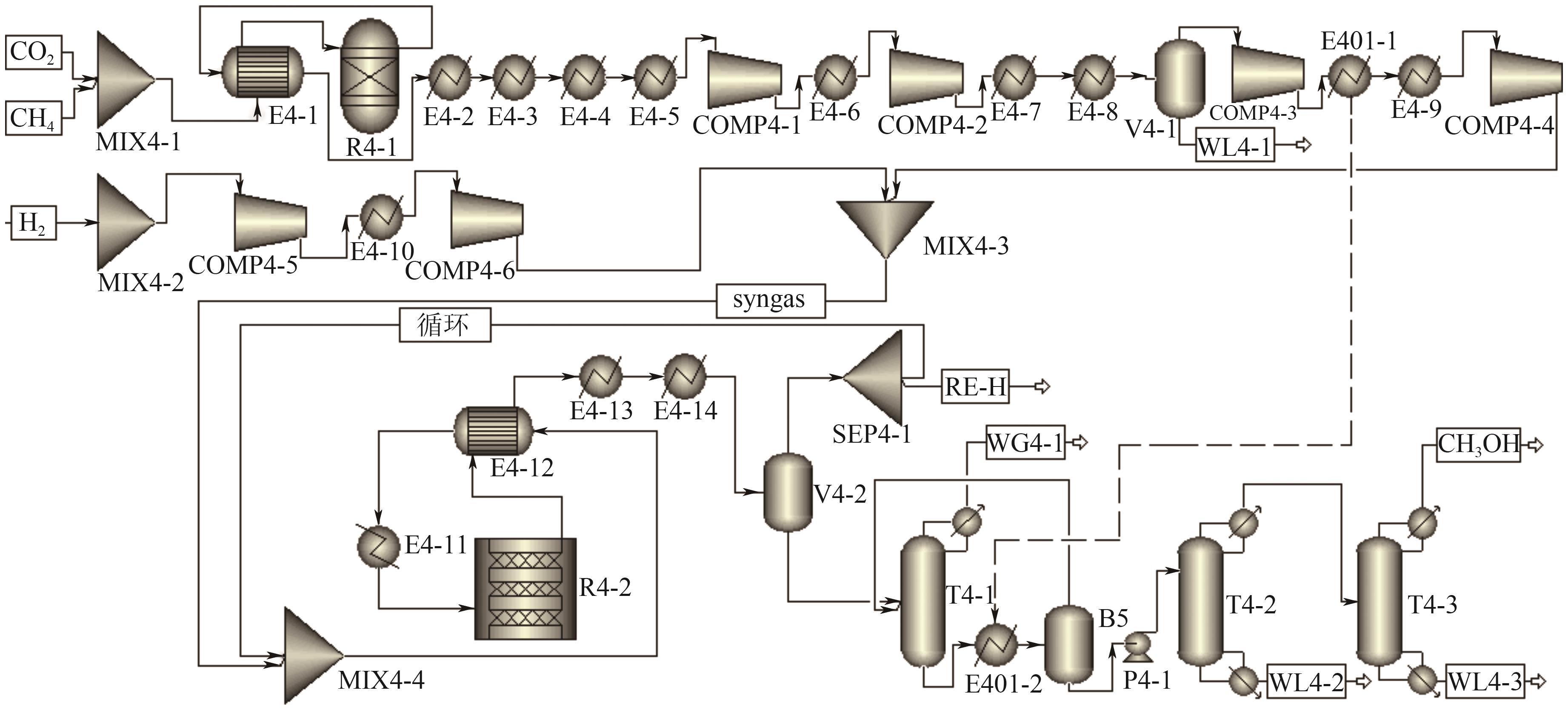
图7 新工艺Ⅱ流程模拟
| 流股 | 组分摩尔分数/% | 摩尔流量 /kmol·h-1 | 质量流量 /kg·h-1 | ||||||||||
|---|---|---|---|---|---|---|---|---|---|---|---|---|---|
| H2 | CO | CO2 | H2O | N2 | CH4 | H2S | COS | C2H6 | C3H8 | CH3OH | |||
| CO2 | 0.02 | 0.10 | 99.27 | 0 | 0.60 | 0 | 1.42×10⁻⁴ | 1.40×10⁻⁴ | 0 | 0 | 0.01 | 799.36 | 35082.89 |
| CH4 | 0 | 0 | 0 | 0 | 4.64 | 94.70 | 0 | 0 | 0.55 | 0.11 | 0 | 761.78 | 12729.67 |
| H2 | 100 | 0 | 0 | 0 | 0 | 0 | 0 | 0 | 0 | 0 | 0 | 1581.75 | 3188.61 |
| WL4-1 | 0 | 0 | 0 | 100.00 | 0 | 0 | 0 | 0 | 0 | 0 | 0 | 35.81 | 645.27 |
| WL4-2 | 0 | 0 | 0 | 100.00 | 0 | 0 | 0 | 0 | 0 | 0 | 0 | 30.34 | 546.69 |
| WL4-3 | 0 | 0 | 0 | 94.62 | 0 | 0 | 0 | 0 | 0 | 0 | 5.38 | 3.26 | 61.29 |
| RE-H | 45.16 | 22.72 | 5.19 | 0 | 16.10 | 10.53 | 2.92×10⁻⁴ | 0 | 0 | 0 | 0.30 | 227.92 | 3613.37 |
| WG4-1 | 8.54 | 8.65 | 42.03 | 0 | 5.08 | 35.68 | 0.02 | 1.13×10⁻⁴ | 0 | 0 | 0 | 62.36 | 1761.64 |
| CH3OH | 0 | 0 | 0 | 0 | 0 | 0 | 0 | 0 | 0 | 0 | 99.99 | 1384.40 | 44358.73 |
表7 新工艺Ⅱ流股参数
| 流股 | 组分摩尔分数/% | 摩尔流量 /kmol·h-1 | 质量流量 /kg·h-1 | ||||||||||
|---|---|---|---|---|---|---|---|---|---|---|---|---|---|
| H2 | CO | CO2 | H2O | N2 | CH4 | H2S | COS | C2H6 | C3H8 | CH3OH | |||
| CO2 | 0.02 | 0.10 | 99.27 | 0 | 0.60 | 0 | 1.42×10⁻⁴ | 1.40×10⁻⁴ | 0 | 0 | 0.01 | 799.36 | 35082.89 |
| CH4 | 0 | 0 | 0 | 0 | 4.64 | 94.70 | 0 | 0 | 0.55 | 0.11 | 0 | 761.78 | 12729.67 |
| H2 | 100 | 0 | 0 | 0 | 0 | 0 | 0 | 0 | 0 | 0 | 0 | 1581.75 | 3188.61 |
| WL4-1 | 0 | 0 | 0 | 100.00 | 0 | 0 | 0 | 0 | 0 | 0 | 0 | 35.81 | 645.27 |
| WL4-2 | 0 | 0 | 0 | 100.00 | 0 | 0 | 0 | 0 | 0 | 0 | 0 | 30.34 | 546.69 |
| WL4-3 | 0 | 0 | 0 | 94.62 | 0 | 0 | 0 | 0 | 0 | 0 | 5.38 | 3.26 | 61.29 |
| RE-H | 45.16 | 22.72 | 5.19 | 0 | 16.10 | 10.53 | 2.92×10⁻⁴ | 0 | 0 | 0 | 0.30 | 227.92 | 3613.37 |
| WG4-1 | 8.54 | 8.65 | 42.03 | 0 | 5.08 | 35.68 | 0.02 | 1.13×10⁻⁴ | 0 | 0 | 0 | 62.36 | 1761.64 |
| CH3OH | 0 | 0 | 0 | 0 | 0 | 0 | 0 | 0 | 0 | 0 | 99.99 | 1384.40 | 44358.73 |
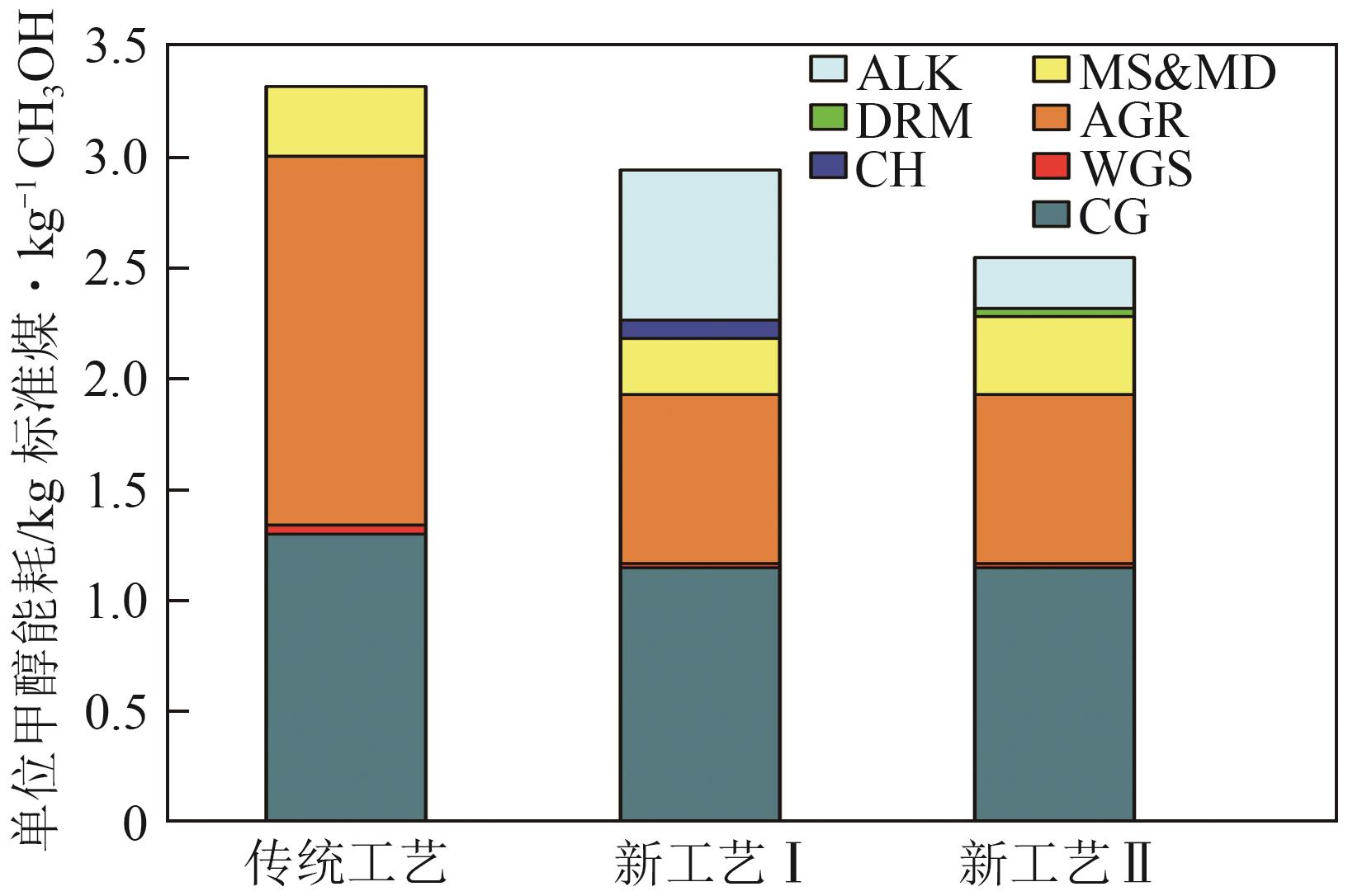
图8 传统工艺与绿氢高效耦合新工艺单位甲醇能耗组成
| 参数 | 传统3×10⁵t煤制甲醇 | 绿氢高效耦合新工艺Ⅰ | 绿氢高效耦合新工艺Ⅱ |
|---|---|---|---|
| 甲醇产量/t | 3×10⁵ | 6.549×10⁵ | 6.549×10⁵ |
| 原料煤消耗量/t | 4.269×10⁵ | 4.269×10⁵ | 4.269×10⁵ |
| 直接CO2排放量/t | 6.431×10⁵ | 1.459×10⁵ | 3.770×10⁵ |
| 生产每吨甲醇耗煤量/t·t-1 | 1.42 | 0.65 | 0.65 |
| 单位甲醇碳排放强度/t·t-1 | 5.92 | 2.20 | 2.58 |
| 绿氢消耗量(标准状况)/m³·h-1 | 0 | 105241 | 35431 |
| 碳元素利用率/% | 38.74 | 84.56 | 67.60 |
表8 新旧工艺的物料和碳排放对比
| 参数 | 传统3×10⁵t煤制甲醇 | 绿氢高效耦合新工艺Ⅰ | 绿氢高效耦合新工艺Ⅱ |
|---|---|---|---|
| 甲醇产量/t | 3×10⁵ | 6.549×10⁵ | 6.549×10⁵ |
| 原料煤消耗量/t | 4.269×10⁵ | 4.269×10⁵ | 4.269×10⁵ |
| 直接CO2排放量/t | 6.431×10⁵ | 1.459×10⁵ | 3.770×10⁵ |
| 生产每吨甲醇耗煤量/t·t-1 | 1.42 | 0.65 | 0.65 |
| 单位甲醇碳排放强度/t·t-1 | 5.92 | 2.20 | 2.58 |
| 绿氢消耗量(标准状况)/m³·h-1 | 0 | 105241 | 35431 |
| 碳元素利用率/% | 38.74 | 84.56 | 67.60 |
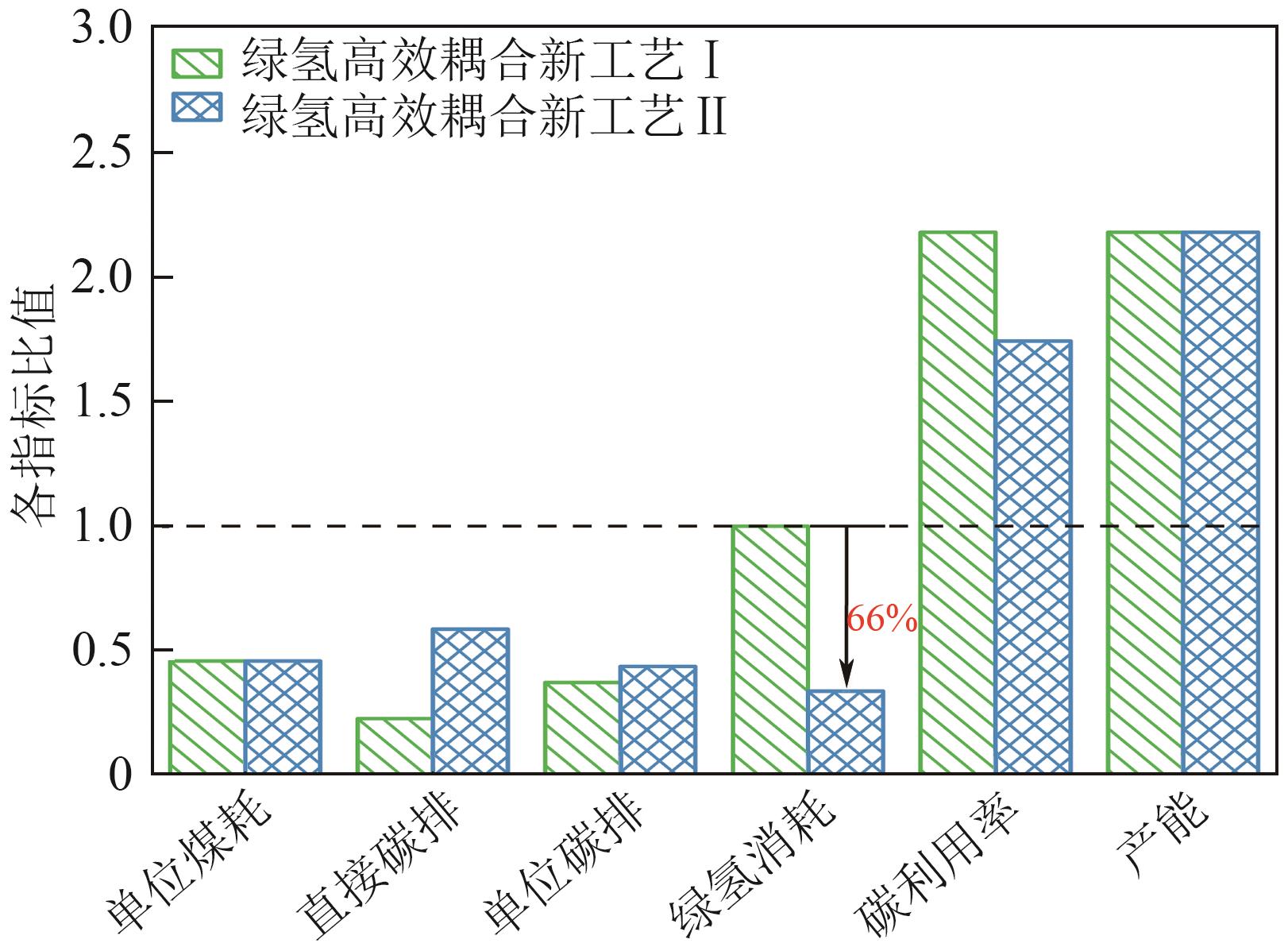
图9 传统工艺与绿氢高效耦合新工艺各指标对比
| 投资组成 | 本文基准/% |
|---|---|
| 直接费用 | 67 |
| 设备费用 | 30 |
| 安装费用 | 8 |
| 仪表和控制费用 | 5 |
| 管道费用 | 5 |
| 电器费用 | 6 |
| 厂房及铺设费用 | 12 |
| 土地费用 | 1 |
| 间接费用 | 33 |
| 工程设计和监督 | 11 |
| 施工费和包工费 | 15 |
| 不可预见费用 | 7 |
| 流动资金 | 15 |
| 总投资 | 115 |
表9 典型化工厂成本组成
| 投资组成 | 本文基准/% |
|---|---|
| 直接费用 | 67 |
| 设备费用 | 30 |
| 安装费用 | 8 |
| 仪表和控制费用 | 5 |
| 管道费用 | 5 |
| 电器费用 | 6 |
| 厂房及铺设费用 | 12 |
| 土地费用 | 1 |
| 间接费用 | 33 |
| 工程设计和监督 | 11 |
| 施工费和包工费 | 15 |
| 不可预见费用 | 7 |
| 流动资金 | 15 |
| 总投资 | 115 |
| 单元 | 基准物 | 基准规模 | n | γ | 基准投资/CNY |
|---|---|---|---|---|---|
| 空气分离(AUS) | 供氧量 | 21.3kg/s | 0.50 | 0.50 | 283×106 |
| 煤预处理(CPP) | 日给煤量 | 27.4kg/s | 0.67 | 0.65 | 180×106 |
| 煤气化(CG) | 日给煤量 | 39.2kg/s | 0.67 | 0.80 | 484×106 |
| 水煤气变换(WGS) | 进料热值 | 1450MW | 0.67 | 0.65 | 244×106 |
| 酸性气体净化脱硫(AGR-S) | 硫输出量 | 29.3mol/s | 0.67 | 0.65 | 275×106 |
| 酸性气体净化脱碳(AGR-C) | CO2脱除量 | 2064.4mol/s | 0.67 | 0.65 | 203×106 |
| 甲醇合成(MS) | 进料气量 | 10810mol/s | 0.67 | 0.65 | 142×106 |
| 甲醇精馏(MD) | 甲醇进料量 | 3.66kg/s | 0.67 | 0.65 | 12×106 |
| 二氧化碳加氢(CH) | 进料气量 | 15kg/s | 0.65 | 0.65 | 101×106 |
| 甲烷干重整(DRM) | 进料气量 | 555.6mol/s | 0.67 | 0.65 | 214×106 |
表10 设备投资基础数据
| 单元 | 基准物 | 基准规模 | n | γ | 基准投资/CNY |
|---|---|---|---|---|---|
| 空气分离(AUS) | 供氧量 | 21.3kg/s | 0.50 | 0.50 | 283×106 |
| 煤预处理(CPP) | 日给煤量 | 27.4kg/s | 0.67 | 0.65 | 180×106 |
| 煤气化(CG) | 日给煤量 | 39.2kg/s | 0.67 | 0.80 | 484×106 |
| 水煤气变换(WGS) | 进料热值 | 1450MW | 0.67 | 0.65 | 244×106 |
| 酸性气体净化脱硫(AGR-S) | 硫输出量 | 29.3mol/s | 0.67 | 0.65 | 275×106 |
| 酸性气体净化脱碳(AGR-C) | CO2脱除量 | 2064.4mol/s | 0.67 | 0.65 | 203×106 |
| 甲醇合成(MS) | 进料气量 | 10810mol/s | 0.67 | 0.65 | 142×106 |
| 甲醇精馏(MD) | 甲醇进料量 | 3.66kg/s | 0.67 | 0.65 | 12×106 |
| 二氧化碳加氢(CH) | 进料气量 | 15kg/s | 0.65 | 0.65 | 101×106 |
| 甲烷干重整(DRM) | 进料气量 | 555.6mol/s | 0.67 | 0.65 | 214×106 |
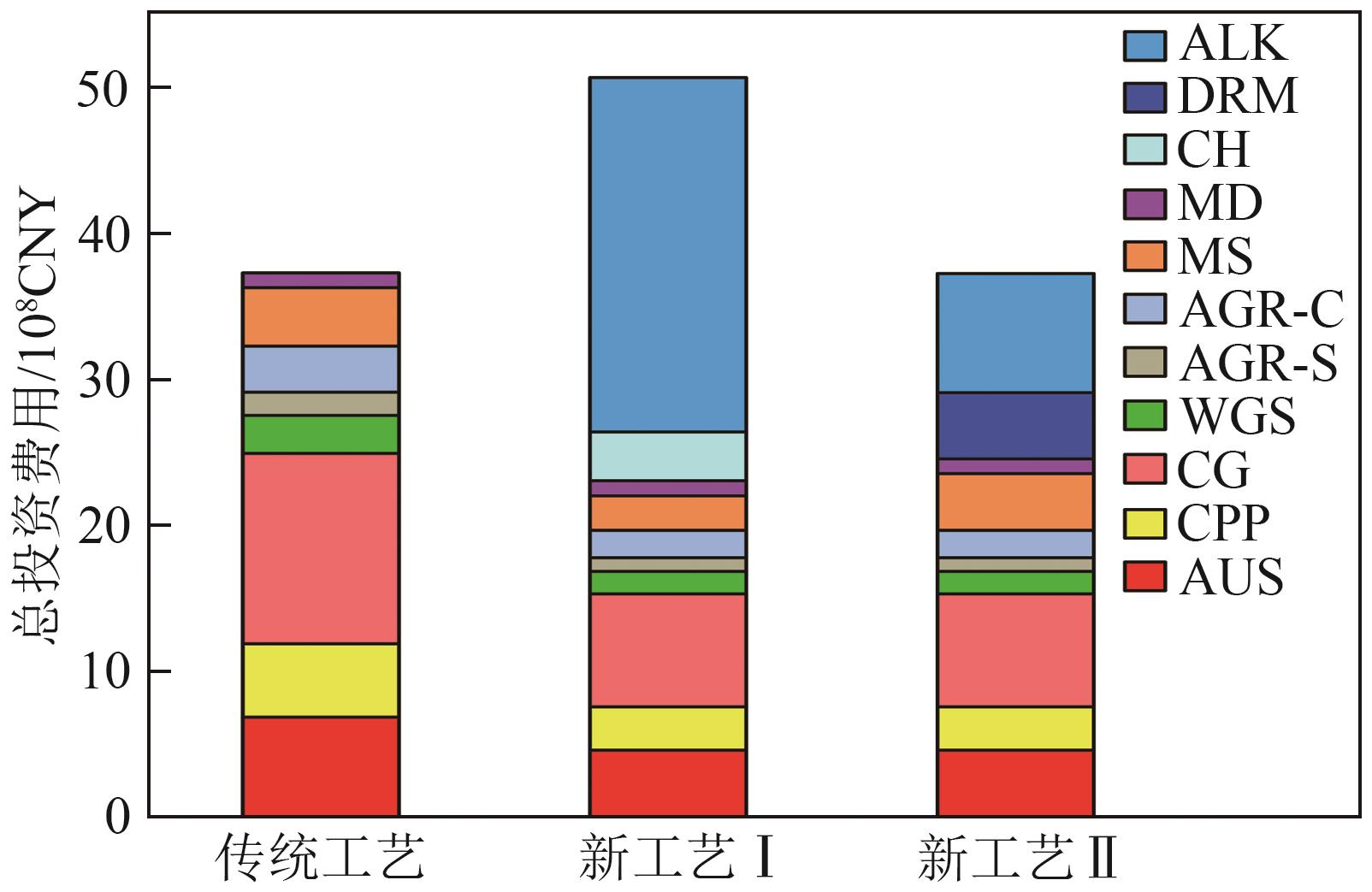
图10 传统工艺与绿氢高效耦合新工艺的投资对比
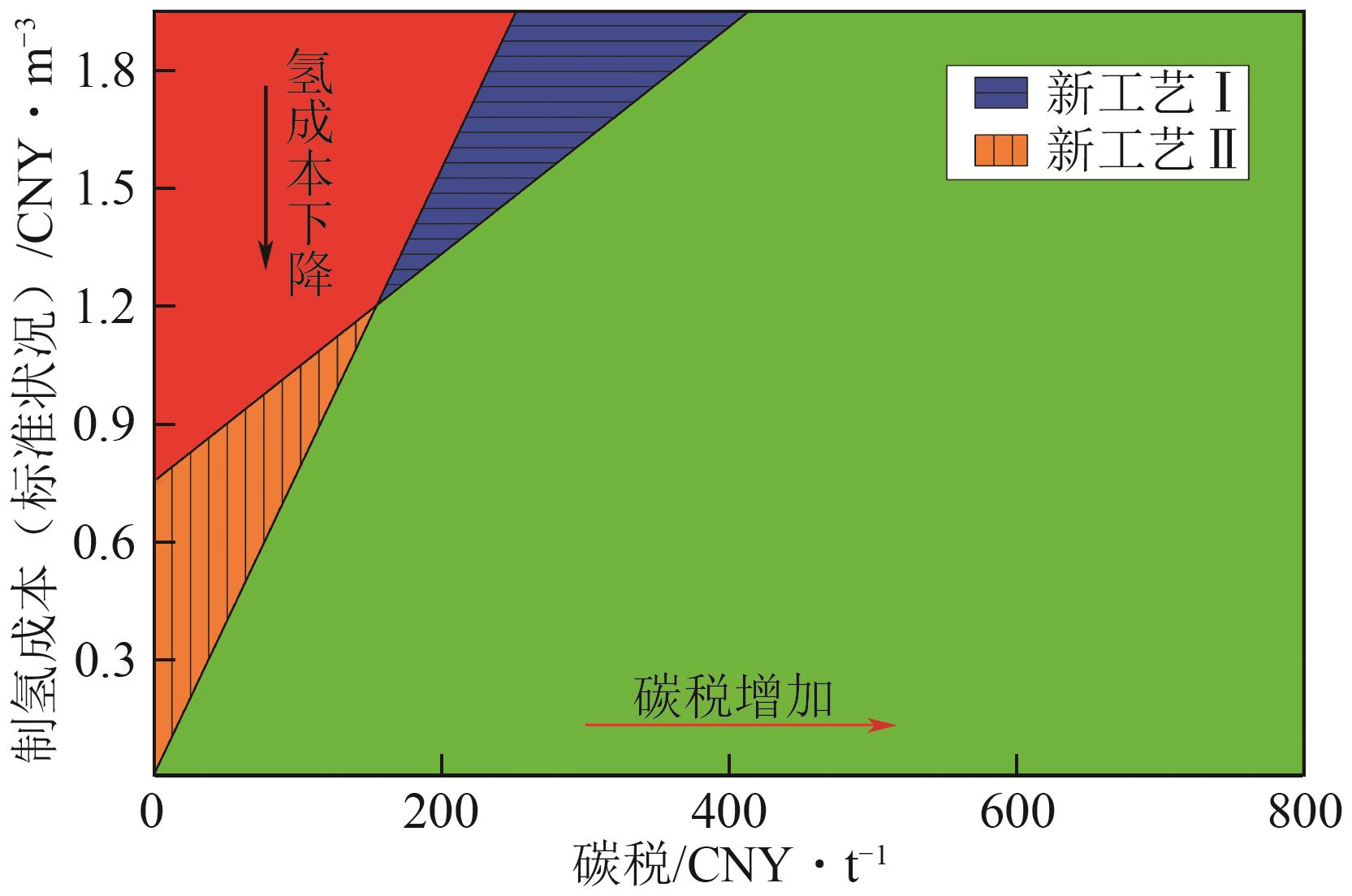
图11 制氢成本和碳税变化对两种新工艺经济性的影响
| [1] | 李晔, 冯伟扬. 国内外甲醇行业发展现状分析[J]. 化学工业, 2024, 42(2): 15-21. |
| LI Ye, FENG Weiyang. Development situation analysis of methanol industry[J]. Chemical Industry, 2024, 42(2): 15-21. | |
| [2] | QIN Zhen, ZHAI Guofu, WU Xiaomei, et al. Carbon footprint evaluation of coal-to-methanol chain with the hierarchical attribution management and life cycle assessment[J]. Energy Conversion and Management, 2016, 124: 168-179. |
| [3] | 林海周, 罗志斌, 裴爱国, 等. 二氧化碳与氢合成甲醇技术和产业化进展[J]. 南方能源建设, 2020, 7(2): 14-19. |
| LIN Haizhou, LUO Zhibin, PEI Aiguo, et al. Technology and industrialization progress on methanol synthesis from carbon dioxide and hydrogen[J]. Southern Energy Construction, 2020, 7(2): 14-19. | |
| [4] | 陶加. 大连物化所二氧化碳加氢制甲醇中试[N/OL]. 中国化工报, 2019-07-10(2B)[2024-10-17]. . |
| TAO Jia. Dalian Institute of Chemical Physics achieves CO2 hydrogenation to methanol pilot plant[N/OL]. China Chemical Industry News, 2019-07-10(2B)[2024-10-17]. . | |
| [5] | 全球首套规模化太阳燃料合成示范项目试车成功[J]. 能源化工, 2020, 41(1): 21. |
| The world’s first large-scale liquid solar fuel synthesis demonstration project has been successfully tested in the new area[J]. Energy Chemical Industry, 2020, 41(1): 21. | |
| [6] | 田井清. 甲烷干重整催化剂的设计及其在工业尾气转化中的应用研究[D]. 上海: 华东师范大学, 2020. |
| TIAN Jingqing. Design of methane dry reforming catalyst and its application in industrial tail gas conversion[D]. Shanghai: East China Normal University, 2020. | |
| [7] | 余长春, 李然家, 周红军, 等. CH4/CO2干重整转化制合成气及其应用研究[C]//第二届中国石油石化节能减排技术交流大会论文集. 2015: 137-145. |
| YU Changchun, LI Ranjia, ZHOU Hongjun, et al. Study on dry reforming of CH4 and CO2 to syngas and its application[C]//Proceedings of the 2th China Petroleum and Petrochemical Technology Exchange Conference on Energy Conservation and Emission Reduction. 2015: 137-145. | |
| [8] | YANG Xiao, YANG Zhuwei, LI Linsen, et al. Improving the anti-coking ability in the Ni-M(M = Ce, Zr, Co)@SiO2 yolk-shell catalysts for dry reforming of methane[J]. Fuel, 2024, 368: 131541. |
| [9] | 曾纪龙. 大型煤制甲醇的气化和合成工艺选择[J]. 煤化工, 2005, 33(5): 5-9. |
| ZENG Jilong. Selection of gasification and synthesis processes for large scale coal-to-methanol plant[J]. Coal Chemical Industry, 2005, 33(5): 5-9. | |
| [10] | 陈倩, 李士雨, 李金来, 等. 水煤浆气化过程的计算机模拟[J]. 计算机与应用化学, 2012, 29(12): 1425-1428. |
| CHEN Qian, LI Shiyu, LI Jinlai, et al. Simulation of water-coal slurry gasification process[J]. Computers and Applied Chemistry, 2012, 29(12): 1425-1428. | |
| [11] | KISS Anton A, PRAGT J J, VOS H J, et al. Novel efficient process for methanol synthesis by CO2 hydrogenation[J]. Chemical Engineering Journal, 2016, 284: 260-269. |
| [12] | 刘玮, 万燕鸣, 熊亚林, 等. 碳中和目标下电解水制氢关键技术及价格平准化分析[J]. 电工技术学报, 2022, 37(11): 2888-2896. |
| LIU Wei, WAN Yanming, XIONG Yalin, et al. Key technology of water electrolysis and levelized cost of hydrogen analysis under carbon neutral vision[J]. Transactions of China Electrotechnical Society, 2022, 37(11): 2888-2896. | |
| [13] | FISHER F, TROPSCH H. Conversion of methane into hydrogen and carbon monoxide[J]. Brennst-Chem, 1928, 3(9): 39-46. |
| [14] | BODROV N M, APELBAUM L O, TEMKIN M I. Kinetics of the reactions of methane with steam on the surface of nickel at 400—600℃[J]. Kinetics and Catalysis, 1968, 9(5): 1065-1071. |
| [15] | 钱慧琳, 冉金玲, 何安帮, 等. 二氧化碳-甲烷干气重整反应及其积炭控制的热力学分析[J]. 低碳化学与化工, 2023, 48(5): 55-61. |
| QIAN Huilin, RAN Jinling, HE Anbang, et al. Thermodynamic analysis of carbon dioxide-methane dry reforming and its carbon deposition control[J]. Low-Carbon Chemistry and Chemical Engineering, 2023, 48(5): 55-61. | |
| [16] | 国家市场监督管理总局, 国家标准化管理委员会. 综合能耗计算通则: [S]. 北京: 中国标准出版社, 2020. |
| State Market Regulatory Administration, Standardization Administration of the People’s Republic of China. General rules for calculation of the comprehensive energy consumption: [S]. Beijing: Standards Press of China, 2020. | |
| [17] | ZHANG Jingpeng, LI Zhengwen, ZHANG Zhihe, et al. Techno-economic analysis of integrating a CO2 hydrogenation-to-methanol unit with a coal-to-methanol process for CO2 reduction[J]. ACS Sustainable Chemistry & Engineering, 2020, 8(49): 18062-18070. |
| [18] | 吕伟, 胡雅萍, 曹效军, 等. 煤化工项目碳排放环境影响评价案例分析与研究[J]. 中国科技纵横, 2023, 1(1): 47-52. |
| LU Wei, HU Yaping, CAO Xiaojun, et al. Case study on environmental impact assessment of carbon emission from coal chemical projects[J]. China Science & Technology Overview, 2023, 1(1): 47-52. | |
| [19] | 杨庆, 许思敏, 张大伟, 等. 石油与煤路线制乙二醇过程的技术经济分析[J]. 化工学报, 2020, 71(5): 2164-2172. |
| YANG Qing, XU Simin, ZHANG Dawei, et al. Techno-economic analysis of oil and coal to ethylene glycol processes[J]. CIESC Journal, 2020, 71(5): 2164-2172. | |
| [20] | LI Guang, CHANG Yuxue, LIU Tao, et al. Hydrogen element flow and economic analyses of a coal direct chemical looping hydrogen generation process[J]. Energy, 2020, 206: 118243. |
| [21] | ZHOU Li, HU Shanying, CHEN Dingjiang, et al. Study on systems based on coal and natural gas for producing dimethyl ether[J]. Industrial & Engineering Chemistry Research, 2009, 48(8): 4101-4108. |
| [22] | YANG Siyu, YANG Qingchun, LI Hengchong, et al. An integrated framework for modeling, synthesis, analysis, and optimization of coal gasification-based energy and chemical processes[J]. Industrial & Engineering Chemistry Research, 2012, 51(48): 15763-15777. |
| [23] | 季东, 王健, 王可, 等. 不同CO2捕集技术的CO2耦合绿氢制甲醇工艺研究[J]. 化工学报, 2022, 73(10): 4565-4575. |
| JI Dong, WANG Jian, WANG Ke, et al. Process research of methanol production by CO2 coupled green hydrogen with different CO2 capture technologies[J]. CIESC Journal, 2022, 73(10): 4565-4575. | |
| [24] | 朱超, 田地, 张浩杰, 等. 二氧化碳加氢制甲醇与电解制甲醇系统技术经济性分析[J]. 天然气化工(C1化学与化工), 2023, 48(1): 117-124. |
| ZHU Chao, TIAN Di, ZHANG Haojie, et al. System techno-economic analysis of CO2 hydrogenation to methanol and electrolysis to methanol[J]. Natural Gas Chemical Industry, 2023, 48(1): 117-124. | |
| [25] | REZAEI Ebrahim, DZURYK Stephen. Techno-economic comparison of reverse water gas shift reaction to steam and dry methane reforming reactions for syngas production[J]. Chemical Engineering Research and Design, 2019, 144: 354-369. |
| [26] | 雷昕儒, 孙喆. 煤化学链气化制甲醇工艺模拟与技术经济分析[J]. 天然气化工(C1化学与化工), 2021, 46(1): 99-106. |
| LEI Xinru, SUN Zhe. Process simulation and techno-economic analysis of methanol production via coal chemical looping gasification[J]. Natural Gas Chemical Industry, 2021, 46(1): 99-106. | |
| [27] | 潘楠, 杨晓丽. 国际碳税政策实践发展与经验借鉴[J]. 金融经济, 2024 (1): 77-85. |
| PAN Nan, YANG Xiaoli. Practical development and experience of international carbon tax policy[J]. Finance Economy, 2024 (1): 77-85. |
| [1] | 杨森, 薛姿杰, 王彧斐, 赵亮, 徐春明. 基于绿氢的化工低碳转型与研究现状[J]. 化工进展, 2025, 44(6): 3288-3304. |
| [2] | 孙仲顺, 刘根, 程春昱, 李美昕, 杨宪坛, 吴志强, 杨伯伦. 生物质热化学转化制备绿氢研究进展[J]. 化工进展, 2025, 44(5): 2667-2682. |
| [3] | 高建刚, 姜亚鹏, 包宝青, 王书琦, 崔书明. 绿氢转化制绿色甲醇与绿氨[J]. 化工进展, 2025, 44(4): 1987-1997. |
| [4] | 秦婷婷, 牛强. 二氧化碳加氢制高级醇Fe基催化剂研究进展[J]. 化工进展, 2025, 44(1): 253-265. |
| [5] | 黄晟, 杨振丽, 李振宇. 氢产业链发展的路径分析[J]. 化工进展, 2024, 43(2): 882-893. |
| [6] | 时永兴, 林刚, 孙晓航, 蒋韦庚, 乔大伟, 颜彬航. 二氧化碳加氢制甲醇过程中铜基催化剂活性位点研究进展[J]. 化工进展, 2023, 42(S1): 287-298. |
| [7] | 相宏伟, 杨勇, 李永旺. 碳中和目标下的煤化工变革与发展[J]. 化工进展, 2022, 41(3): 1399-1408. |
| [8] | 王集杰, 韩哲, 陈思宇, 汤驰洲, 沙峰, 唐珊, 姚婷婷, 李灿. 太阳燃料甲醇合成[J]. 化工进展, 2022, 41(3): 1309-1317. |
| [9] | 刘畅, 刘忠文. CO2加氢一步制二甲醚展望[J]. 化工进展, 2022, 41(3): 1115-1120. |
| [10] | 周颖, 李叶青, 周红军, 徐春明. 生物能源对中国乡村振兴促进的思考与实践[J]. 化工进展, 2022, 41(11): 6195-6199. |
| [11] | 周怀荣, 马迎文, 王可, 李红伟, 孟文亮, 谢江鹏, 李贵贤, 张栋强, 王东亮, 赵永臣. 化学链空分联合化学链制氢的煤制甲醇过程参数优化与分析[J]. 化工进展, 2022, 41(10): 5332-5341. |
| [12] | 刘阳, 吴秀章, 刘永健, 王波. 煤制天然气过程全局能量集成优化[J]. 化工进展, 2021, 40(7): 3719-3727. |
| [13] | 杨庆春, 杨庆, 张金亮, 高明林, 梅树美, 张大伟. 耦合SOEC的煤制乙二醇新工艺开发与系统评价[J]. 化工进展, 2021, 40(11): 6061-6070. |
| [14] | 贾晨喜, 邵敬爱, 白小薇, 肖建军, 杨海平, 陈汉平. 二氧化碳加氢制甲醇铜基催化剂性能的研究进展[J]. 化工进展, 2020, 39(9): 3658-3668. |
| [15] | 刘永健, 吴秀章, 王鹤鸣, 夏俊兵, 王波. 煤制天然气联产化学品工艺路径探讨与分析[J]. 化工进展, 2019, 38(07): 3111-3116. |
| 阅读次数 | ||||||
|
全文 |
|
|||||
|
摘要 |
|
|||||