化工进展 ›› 2025, Vol. 44 ›› Issue (6): 3432-3442.DOI: 10.16085/j.issn.1000-6613.2024-0664
• 能源加工与技术 • 上一篇
低温等离子体协同催化转化生物质气化焦油研究进展
许志成1( ), 高宁博1(), 全翠1,3, 宋庆彬2
- 1.西安交通大学能源与动力工程学院,陕西 西安 710049
2.澳门科技大学创新工程学院,澳门海岸带生态环境国家野外科学观测研究站,澳门 999078
3.陕西威环能科技有限公司,陕西 西安 710086
-
收稿日期:2024-04-19修回日期:2024-09-04出版日期:2025-06-25发布日期:2025-07-08 -
通讯作者:高宁博 -
作者简介:许志成(1994—),男,博士研究生,研究方向为固废资源化利用。E-mail:Kylezcxu@foxmail.com。 -
基金资助:国家自然科学基金(52376207);国家自然科学基金(52276211);陕西省技术创新引导计划(2024QCY-KXJ-046)
Research progress on synergistic catalytic conversion of biomass gasification tar by non-thermal plasma
XU Zhicheng1(), GAO Ningbo1(), QUAN Cui1,3, SONG Qingbin2
- 1.School of Energy and Power Engineering, Xi’an Jiaotong University, Xi’an 710049, Shaanxi, China
2.National Observation and Research Station of Coastal Ecological Environments in Macao, Faculty of Innovation Engineering, Macau University of Science and Technology, Macao SAR 999078, China
3.Shaanxi Weihuanneng Technology Co. , Ltd. , Xi’an 710086, Shaanxi, China
-
Received:2024-04-19Revised:2024-09-04Online:2025-06-25Published:2025-07-08 -
Contact:GAO Ningbo

摘要:
生物质作为一种可再生能源,在全球能源结构中占据重要地位,其通过热化学转化过程生产合成气极具应用价值,但过程中产生的焦油问题严重制约了合成气品质和生物质气化技术的商业化进程。在多种焦油去除方法中,催化重整因其能有效将焦油分解为有价值的气体产物而备受关注。然而,高温条件下的催化剂失活问题仍是亟待解决的关键挑战。低温等离子体(non-thermal plasma,NTP)处理技术因其能够在较低温度下进行高效的焦油分解而显得尤为具有吸引力。通过与非均相催化剂结合形成耦合体系,NTP可以显著增强催化剂活性和稳定性,减少不利副产物生成并提升产物选择性。本文系统阐述了单纯催化体系中焦油重整催化剂的优化及其失活机理,深入探讨了不同NTP与催化剂催化耦合体系对焦油重整效率及机理的优化作用。最后,本文讨论了未来NTP催化技术在生物质气化焦油重整领域的应用前景,强调了从催化剂设计与制备到实际操作工艺参数优化的重要性,以期推动生物质气化产业的持续发展和技术升级。
中图分类号:
引用本文
许志成, 高宁博, 全翠, 宋庆彬. 低温等离子体协同催化转化生物质气化焦油研究进展[J]. 化工进展, 2025, 44(6): 3432-3442.
XU Zhicheng, GAO Ningbo, QUAN Cui, SONG Qingbin. Research progress on synergistic catalytic conversion of biomass gasification tar by non-thermal plasma[J]. Chemical Industry and Engineering Progress, 2025, 44(6): 3432-3442.
| 应用场景 | 焦油最高含量/mg·m-3 | 参考文献 |
|---|---|---|
| 压缩机 | 50~500 | [ |
| 内燃机 | 50~100 | [ |
| 直燃燃气轮机 | <5 | [ |
| 甲醇合成 | <0.1 | [ |
| 燃料电池 | <1.0 | [ |
表1 不同应用场景下焦油最高含量限制
| 应用场景 | 焦油最高含量/mg·m-3 | 参考文献 |
|---|---|---|
| 压缩机 | 50~500 | [ |
| 内燃机 | 50~100 | [ |
| 直燃燃气轮机 | <5 | [ |
| 甲醇合成 | <0.1 | [ |
| 燃料电池 | <1.0 | [ |
| 等离子体反应器 | 焦油模拟物 | 焦油浓度/g·m-3 | 载气种类 | 转化率/% | 能量效率/g·kW-1·h-1 | 参考文献 |
|---|---|---|---|---|---|---|
| 旋转滑动弧等离子体 | 甲苯 | 10.0 | N2/H2O | 85.2 | 11.7 | [ |
| 滑动弧等离子体 | 甲苯 | 16.1 | N2/CO2/H2O | 63.3 | 40.7 | [ |
| 滑动弧等离子体 | 甲苯/萘 | 2 | N2/CO2/H2O | 85.9/68.9 | 2.6 | [ |
| 滑动弧等离子体 | 萘 | 1.1 | N2/H2O | 84.8 | 5.7 | [ |
| 滑动弧等离子体 | 甲苯/萘 | 0.49 | N2/CO2/H2O | 约80 | 53.6 | [ |
| 滑动弧等离子体 | 甲苯 | 23.5 | N2/H2O | 35.8 | 16 | [ |
| 介质阻挡放电等离子体 | 甲苯 | 261 | N2/O2 | 78.0 | 34 | [ |
| 介质阻挡放电等离子体 | 萘 | 90 | N2/H2/CO/CO2 | 60.0 | 2.2 | [ |
| 介质阻挡放电等离子体 | 甲苯 | 20 | H2 | 99.0 | 4.79 | [ |
| 电晕放电等离子体 | 甲苯 | 261 | He/H2O | 35.0 | 25.3 | [ |
| 电晕放电等离子体 | 甲苯 | 70 | 空气 | 50.0 | 2.5 | [ |
| 电晕放电等离子体 | 真实焦油 | 0.7 | 气化尾气 | 62.0 | 11.2 | [ |
| 微波等离子体 | 甲苯 | 10 | N2/H2O | 98.0 | 5.8 | [ |
| 微波等离子体 | 甲苯 | 4.2 | Ar/N2 | 99.0 | 4.5 | [ |
表2 等离子体反应器中焦油重整的性能比较
| 等离子体反应器 | 焦油模拟物 | 焦油浓度/g·m-3 | 载气种类 | 转化率/% | 能量效率/g·kW-1·h-1 | 参考文献 |
|---|---|---|---|---|---|---|
| 旋转滑动弧等离子体 | 甲苯 | 10.0 | N2/H2O | 85.2 | 11.7 | [ |
| 滑动弧等离子体 | 甲苯 | 16.1 | N2/CO2/H2O | 63.3 | 40.7 | [ |
| 滑动弧等离子体 | 甲苯/萘 | 2 | N2/CO2/H2O | 85.9/68.9 | 2.6 | [ |
| 滑动弧等离子体 | 萘 | 1.1 | N2/H2O | 84.8 | 5.7 | [ |
| 滑动弧等离子体 | 甲苯/萘 | 0.49 | N2/CO2/H2O | 约80 | 53.6 | [ |
| 滑动弧等离子体 | 甲苯 | 23.5 | N2/H2O | 35.8 | 16 | [ |
| 介质阻挡放电等离子体 | 甲苯 | 261 | N2/O2 | 78.0 | 34 | [ |
| 介质阻挡放电等离子体 | 萘 | 90 | N2/H2/CO/CO2 | 60.0 | 2.2 | [ |
| 介质阻挡放电等离子体 | 甲苯 | 20 | H2 | 99.0 | 4.79 | [ |
| 电晕放电等离子体 | 甲苯 | 261 | He/H2O | 35.0 | 25.3 | [ |
| 电晕放电等离子体 | 甲苯 | 70 | 空气 | 50.0 | 2.5 | [ |
| 电晕放电等离子体 | 真实焦油 | 0.7 | 气化尾气 | 62.0 | 11.2 | [ |
| 微波等离子体 | 甲苯 | 10 | N2/H2O | 98.0 | 5.8 | [ |
| 微波等离子体 | 甲苯 | 4.2 | Ar/N2 | 99.0 | 4.5 | [ |
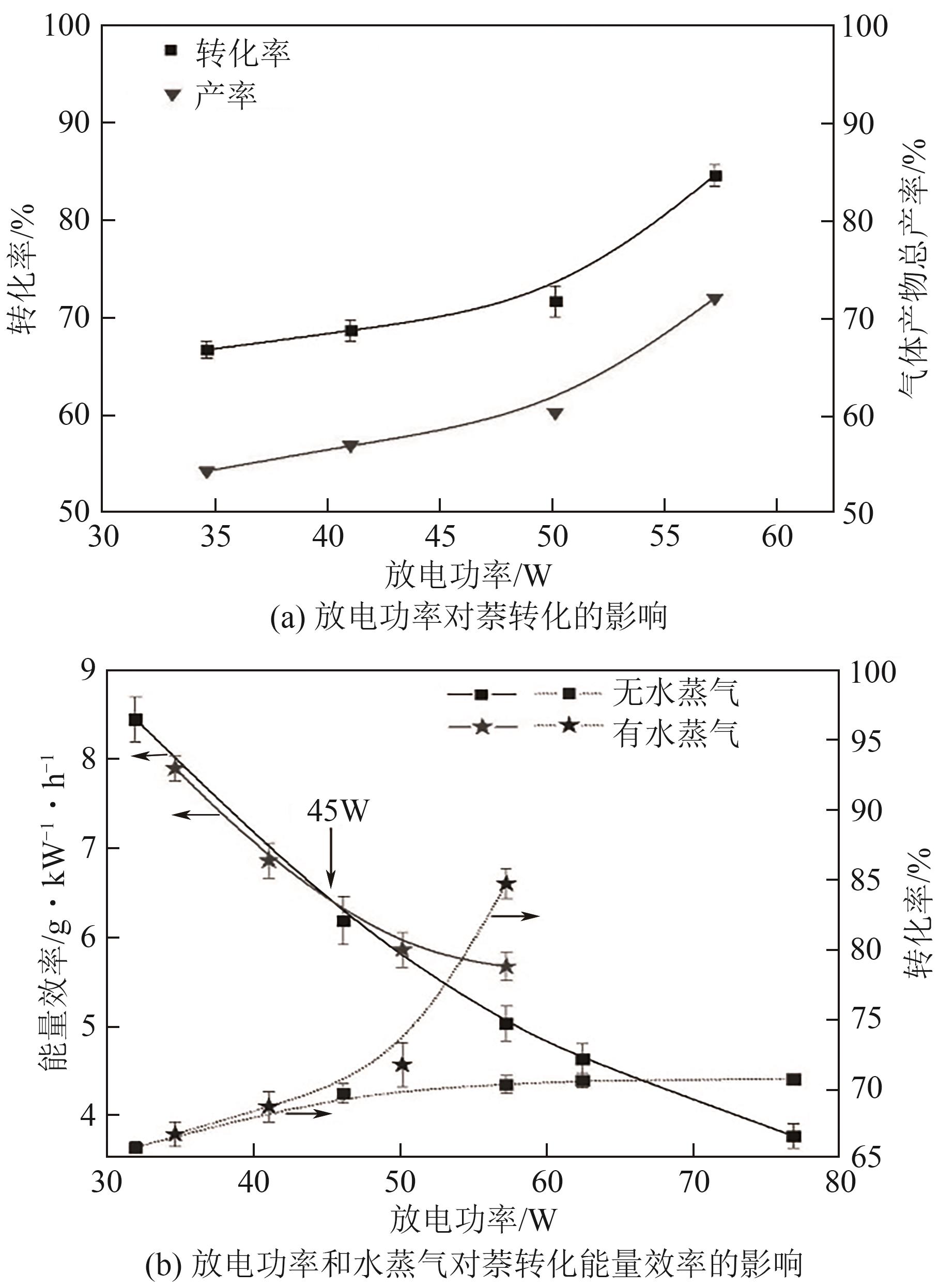
图1 放电功率和水蒸气对萘转化率和能量效率的影响[25]
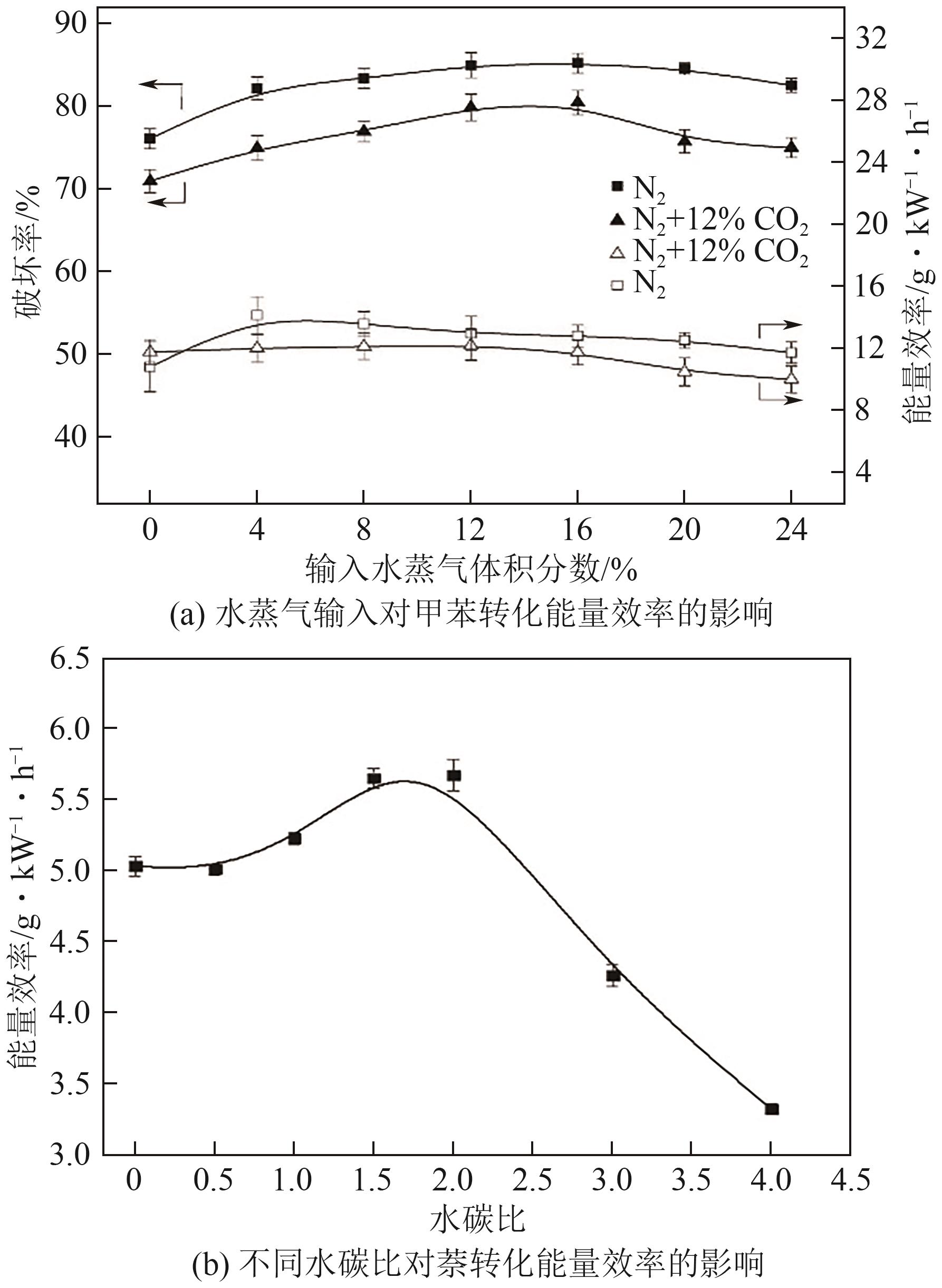
图2 水蒸气和不同水碳比输入对甲苯和萘转化能量效率的影响[22,25]
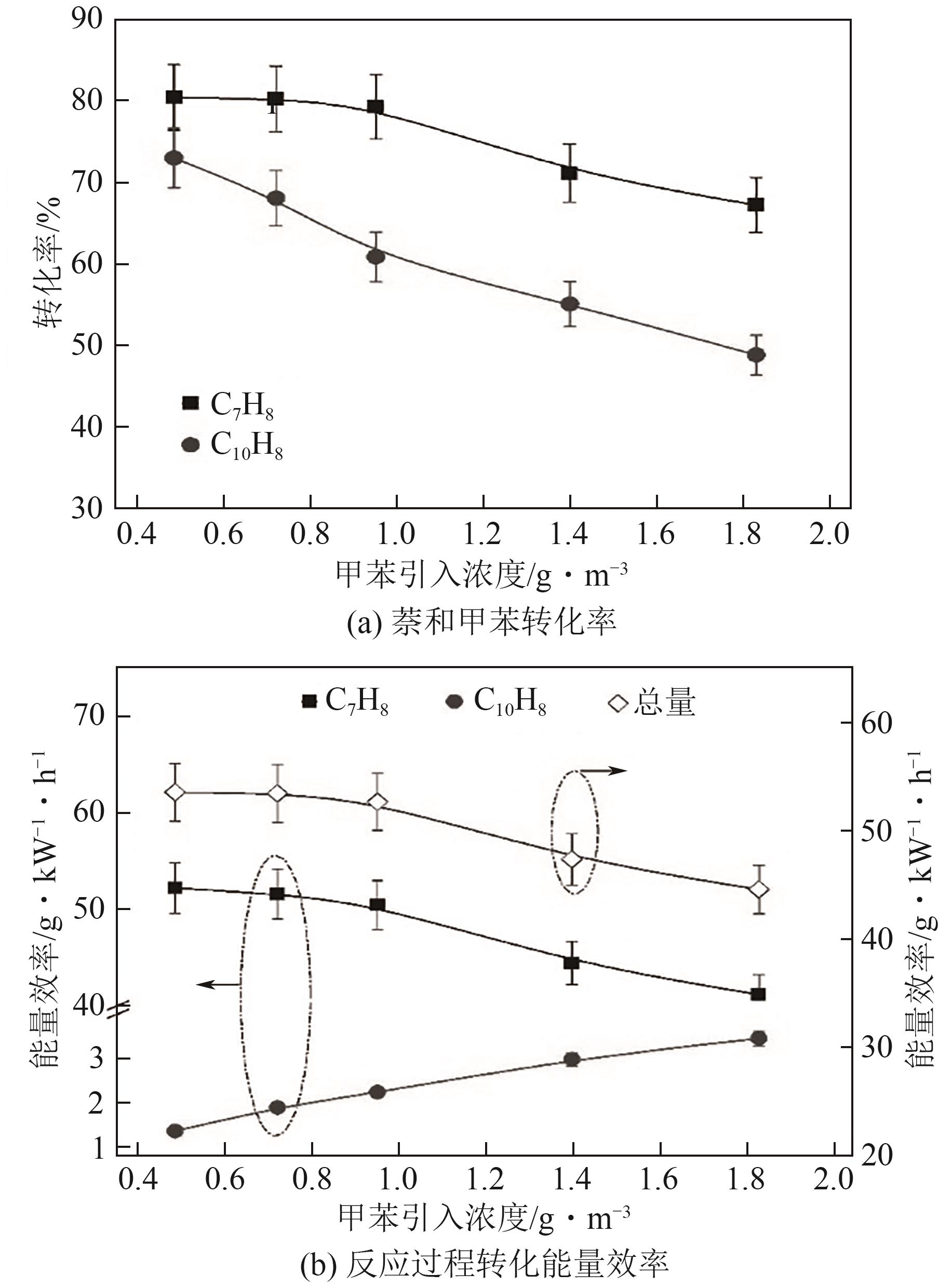
图3 初始萘浓度对转化率及反应过程转化能量效率的影响[26]
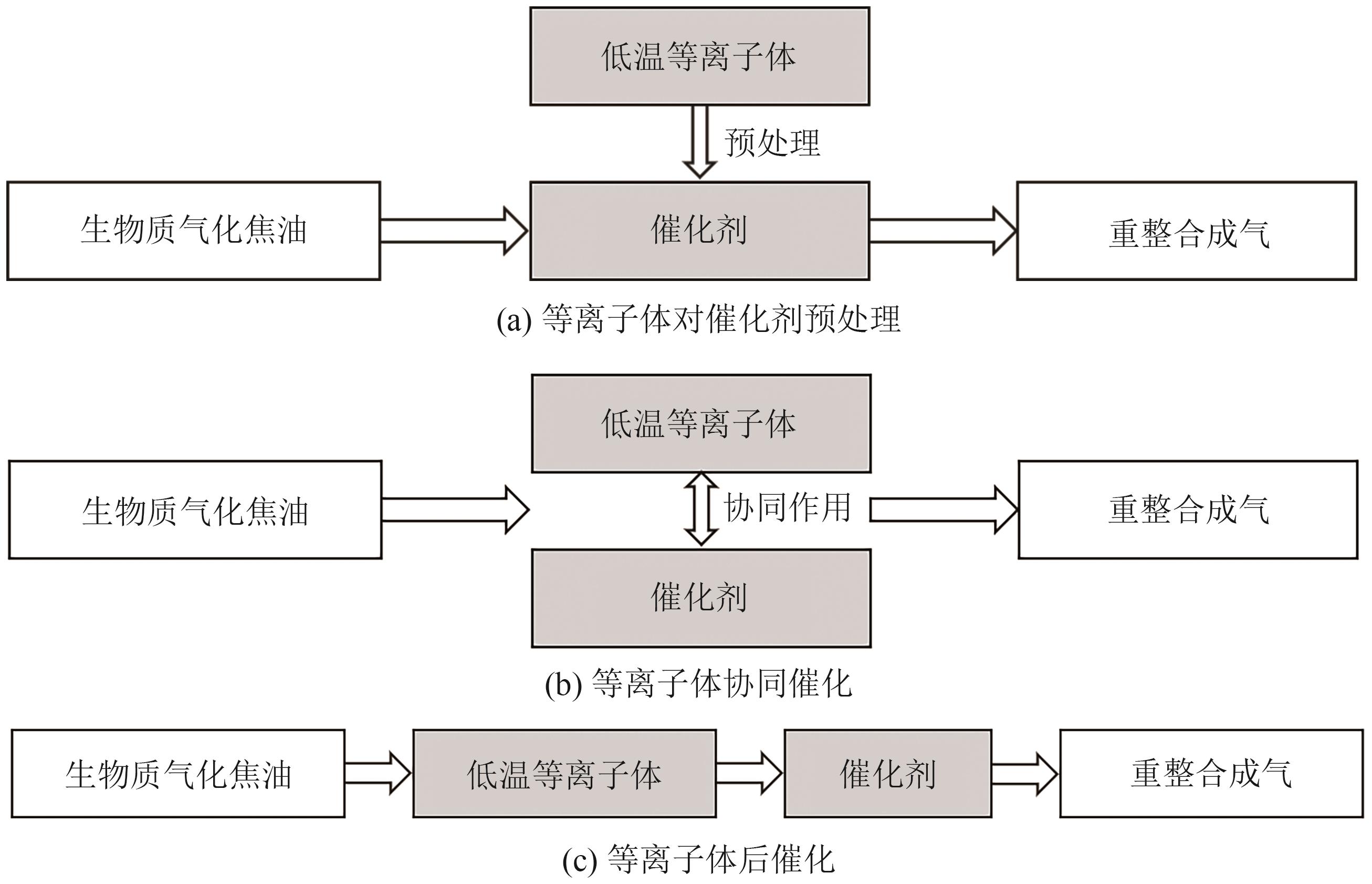
图4 低温等离子体和催化剂不同结合方式催化生物质焦油
| 等离子体耦合体系 | 作用机理 | 优势 | 劣势 |
|---|---|---|---|
| 传统热催化体系 | 通过催化剂在高温条件下催化焦油分子的裂解及重整反应,包括扩散、吸附、活化转化以及脱附,催化剂能够降低反应活化能,促进反应进行生成产物 | 反应转化高效、产物选择性控制较好、应用广泛 | 高温操作、催化剂易失活导致成本较高、能耗较高、反应条件限制较多 |
| 单纯等离子体体系 | 利用等离子体产生的高能粒子能够在较低温度条件下活化焦油分子,打破热力学限制,促进化学反应 | 反应在相对较低温度下发生、无需催化剂即可催化反应进行、反应控制灵活 | 催化效率有限、对特定产物选择性较差、能量利用率较低 |
| 等离子体预处理体系 | 利用等离子体技术对催化剂进行表面改性或激活以改善催化剂的性能,后将催化剂用于传统热催化体系催化焦油重整反应 | 增强催化剂活性并提升其选择性及稳定性、适用范围较广 | 成本相对较高、参数控制复杂、等离子体无法直接催化重整反应 |
| 等离子体后催化体系 | 在等离子体体系后连接传统催化剂体系,等离子体与催化剂在各段分别发挥作用,反应物先经等离子体催化后经催化剂催化 | 促进副产品的分解、提高产物的纯度、等离子体与催化剂段反应条件可分开控制 | 等离子体段产生的短寿命活性物质无法到达催化剂段协助反应、反应器设计较复杂 |
| 等离子体协同催化体系 | 在等离子体放电区域填充催化剂,二者能够产生相互作用,等离子体产生的活性物种可以直接参与反应,共同催化焦油重整反应 | 等离子体与催化剂能产生协同作用、在较低的温度下实现高效反应、提高产物选择性及催化剂稳定性 | 反应机理较为复杂、能量转换效率有待提高、需设计高效协同催化剂 |
表3 不同等离子体与催化剂耦合体系的机理及特点比较
| 等离子体耦合体系 | 作用机理 | 优势 | 劣势 |
|---|---|---|---|
| 传统热催化体系 | 通过催化剂在高温条件下催化焦油分子的裂解及重整反应,包括扩散、吸附、活化转化以及脱附,催化剂能够降低反应活化能,促进反应进行生成产物 | 反应转化高效、产物选择性控制较好、应用广泛 | 高温操作、催化剂易失活导致成本较高、能耗较高、反应条件限制较多 |
| 单纯等离子体体系 | 利用等离子体产生的高能粒子能够在较低温度条件下活化焦油分子,打破热力学限制,促进化学反应 | 反应在相对较低温度下发生、无需催化剂即可催化反应进行、反应控制灵活 | 催化效率有限、对特定产物选择性较差、能量利用率较低 |
| 等离子体预处理体系 | 利用等离子体技术对催化剂进行表面改性或激活以改善催化剂的性能,后将催化剂用于传统热催化体系催化焦油重整反应 | 增强催化剂活性并提升其选择性及稳定性、适用范围较广 | 成本相对较高、参数控制复杂、等离子体无法直接催化重整反应 |
| 等离子体后催化体系 | 在等离子体体系后连接传统催化剂体系,等离子体与催化剂在各段分别发挥作用,反应物先经等离子体催化后经催化剂催化 | 促进副产品的分解、提高产物的纯度、等离子体与催化剂段反应条件可分开控制 | 等离子体段产生的短寿命活性物质无法到达催化剂段协助反应、反应器设计较复杂 |
| 等离子体协同催化体系 | 在等离子体放电区域填充催化剂,二者能够产生相互作用,等离子体产生的活性物种可以直接参与反应,共同催化焦油重整反应 | 等离子体与催化剂能产生协同作用、在较低的温度下实现高效反应、提高产物选择性及催化剂稳定性 | 反应机理较为复杂、能量转换效率有待提高、需设计高效协同催化剂 |
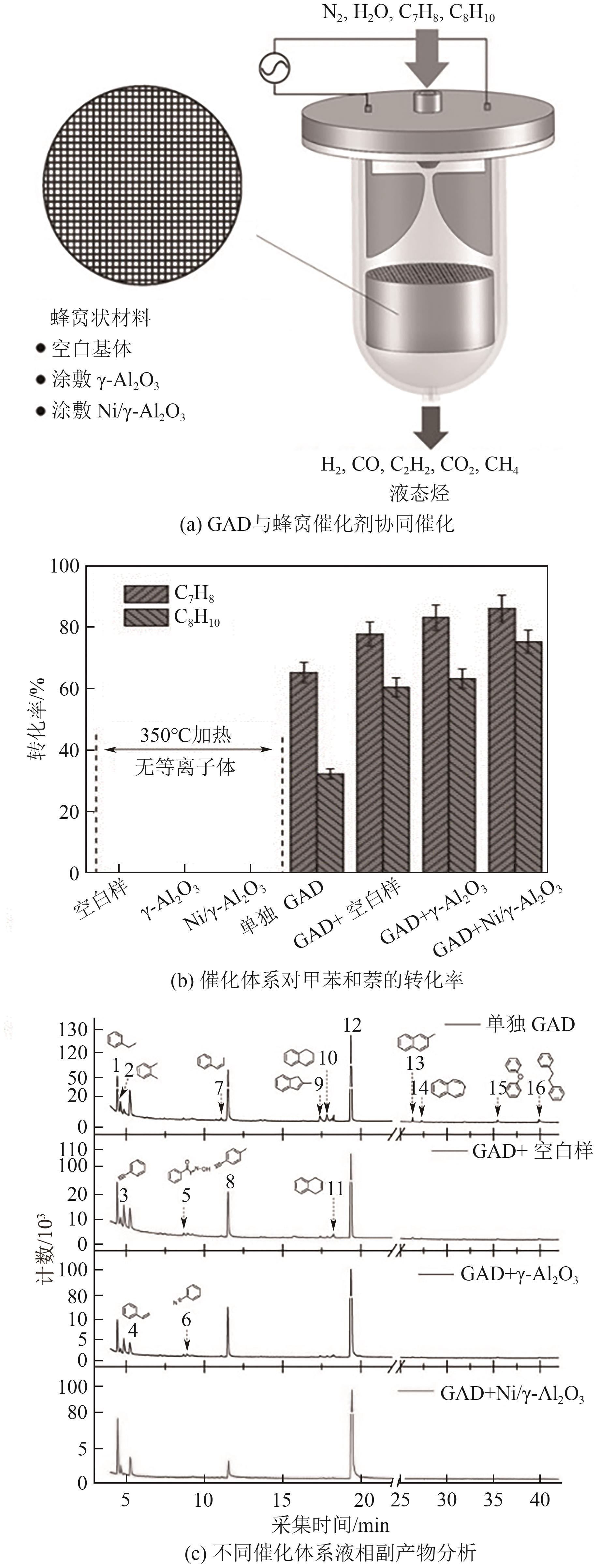
图5 GAD等离子体与蜂窝样催化剂结合催化萘和甲苯混合物重整[44]
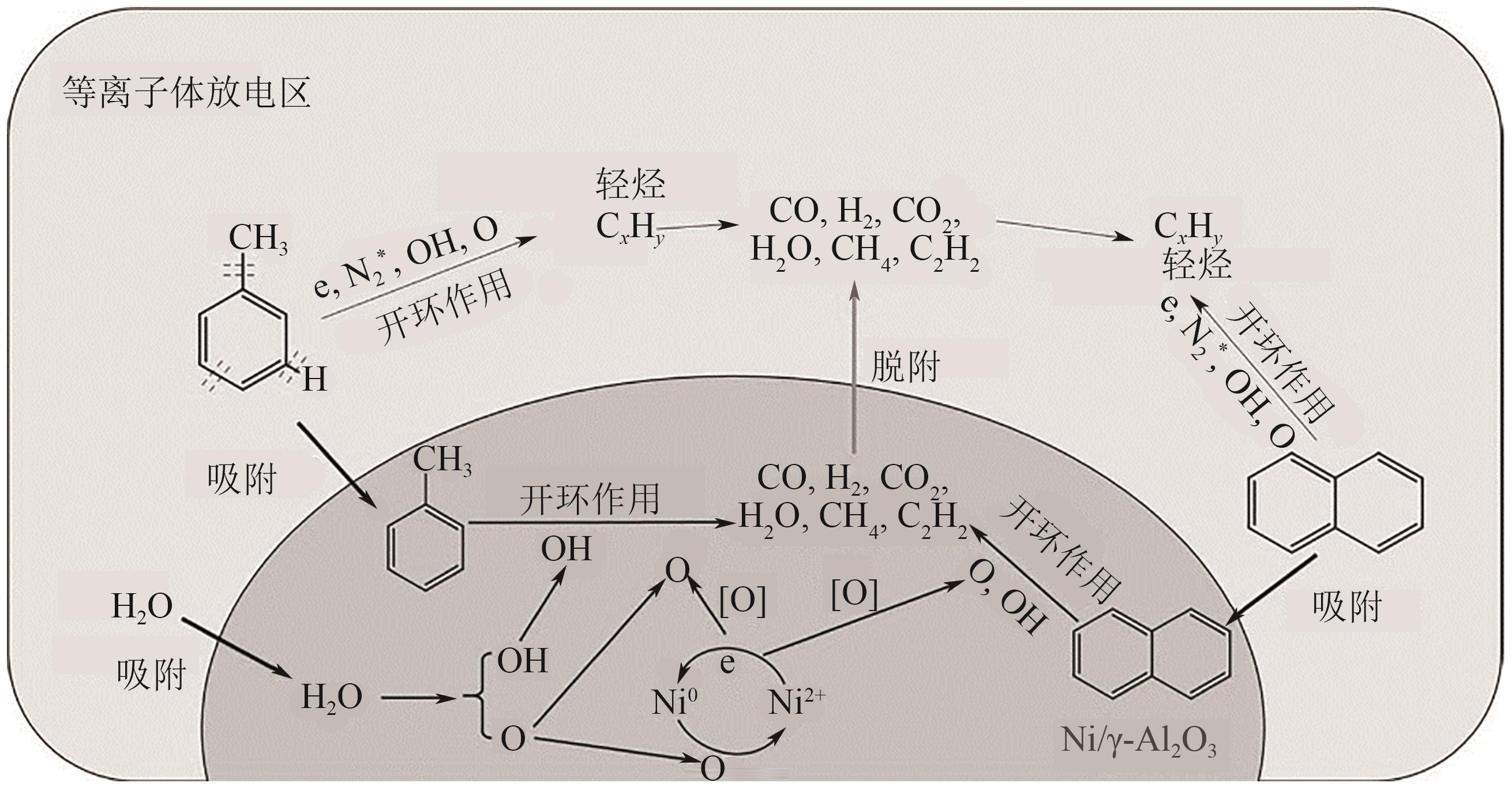
图6 等离子体协同催化剂体系催化焦油重整反应机理[44]
| [1] | SHARMA Prashant, GUPTA Bhupendra, PANDEY Mukesh, et al. Downdraft biomass gasification: A review on concepts, designs analysis, modelling and recent advances[J]. Materials Today: Proceedings, 2021, 46: 5333-5341. |
| [2] | SAYED Enas Taha, WILBERFORCE Tabbi, ELSAID Khaled, et al. A critical review on environmental impacts of renewable energy systems and mitigation strategies: Wind, hydro, biomass and geothermal[J]. Science of the Total Environment, 2021, 766: 144505. |
| [3] | WILLIAMS Alan, JONES Jenny Marie, MA Lin, et al. Pollutants from the combustion of solid biomass fuels[J]. Progress in Energy and Combustion Science, 2012, 38(2): 113-137. |
| [4] | SNOECKX Ramses, BOGAERTS Annemie. Plasma technology—A novel solution for CO2 conversion?[J]. Chemical Society Reviews, 2017, 46(19): 5805-5863. |
| [5] | XU Zhicheng, GAO Ningbo, MA Yan, et al. Biomass volatiles reforming by integrated pyrolysis and plasma-catalysis system for H2 production: Understanding roles of temperature and catalyst[J]. Energy Conversion and Management, 2023, 288: 117159. |
| [6] | ABDOULMOUMINE Nourredine, ADHIKARI Sushil, KULKARNI Avanti, et al. A review on biomass gasification syngas cleanup[J]. Applied Energy, 2015, 155: 294-307. |
| [7] | 郭祥, 李瑞祎, 张蕊, 等. 基于文献计量的生物质气化研究发展态势分析[J]. 环境工程, 2022, 40(7): 232-239. |
| GUO Xiang, LI Ruiyi, ZHANG Rui, et al. Research advances in biomass gasification based on bibliometric analysis[J]. Environmental Engineering, 2022, 40(7): 232-239. | |
| [8] | KUMAR Amit, Prosenjit DAW, MILSTEIN David. Homogeneous catalysis for sustainable energy: Hydrogen and methanol economies, fuels from biomass, and related topics[J]. Chemical Reviews, 2022, 122(1): 385-441. |
| [9] | LI Jian, TAO Junyu, YAN Beibei, et al. Microwave reforming with char-supported nickel-cerium catalysts: A potential approach for thorough conversion of biomass tar model compound[J]. Applied Energy, 2020, 261: 114375. |
| [10] | LIU Lina, ZHANG Zhikun, Sonali DAS, et al. Reforming of tar from biomass gasification in a hybrid catalysis-plasma system: A review[J]. Applied Catalysis B: Environmental, 2019, 250: 250-272. |
| [11] | PATHAK Bimalendu, KAPATEL Dharmesh, BHOI Prakashbhai, et al. Design and development of sand bed filter for upgrading producer gas to IC engine quality fuel[J]. International Energy Journal, 2007, 8(1): 15-20. |
| [12] | SIKARWAR Vineet Singh, ZHAO Ming, CLOUGH Peter, et al. An overview of advances in biomass gasification[J]. Energy & Environmental Science, 2016, 9(10): 2939-2977. |
| [13] | Antonio RÍOS, LÓPEZ-NAVAS Ana Isabel, Cristina DE-FRANCISCO, et al. Psychometric characteristics of the attitude questionnaire toward the donation of organs for transplant (PCID-DTO-RIOS)[J]. Transplantation Proceedings, 2018, 50(2): 345-349. |
| [14] | GAO Ningbo, SIPRA Ayesha Tariq, QUAN Cui. Thermogravimetric analysis and pyrolysis product characterization of municipal solid waste using sludge fly ash as additive[J]. Fuel, 2020, 281: 118572. |
| [15] | 尚双, 兰奎, 王艳, 等. 生物质焦油重整催化剂的研究进展[J]. 生物质化学工程, 2020, 54(6): 65-73. |
| SHANG Shuang, LAN Kui, WANG Yan, et al. Research progress on catalyst for tar reforming in biomass gasification[J]. Biomass Chemical Engineering, 2020, 54(6): 65-73. | |
| [16] | 王学涛, 苏晓昕. 助剂对镍基生物质焦油重整催化剂性能影响的研究进展[J]. 生物质化学工程, 2019, 53(2): 61-66. |
| WANG Xuetao, SU Xiaoxin. Research progress of influence of promoters on performance of nickel-based catalyst for biomass tar reforming[J]. Biomass Chemical Engineering, 2019, 53(2): 61-66. | |
| [17] | ALIPOUR Zahra, BABU BORUGADDA Venu, WANG Hui, et al. Syngas production through dry reforming: A review on catalysts and their materials, preparation methods and reactor type[J]. Chemical Engineering Journal, 2023, 452: 139416. |
| [18] | GAO Ningbo, CHEN Kailun, LAI Xiaoyong, et al. Catalytic steam reforming of real tar under high-efficiency Ni/USY catalyst for H2 production[J]. Fuel, 2021, 306: 121676. |
| [19] | CAO Jingpei, REN Jie, ZHAO Xiaoyan, et al. Effect of atmosphere on carbon deposition of Ni/Al2O3 and Ni-loaded on lignite char during reforming of toluene as a biomass tar model compound[J]. Fuel, 2018, 217: 515-521. |
| [20] | ASGHARI Mohammadreza, HOSSEINZADEH SAMANI Bahram, EBRAHIMI Rahim. Review on non-thermal plasma technology for biodiesel production: Mechanisms, reactors configuration, hybrid reactors[J]. Energy Conversion and Management, 2022, 258: 115514. |
| [21] | LIU Yawen, SONG Jianwei, DIAO Xungang, et al. Removal of tar derived from biomass gasification via synergy of non-thermal plasma and catalysis[J]. Science of the Total Environment, 2020, 721: 137671. |
| [22] | ZHU Fengsen, ZHANG Hao, YANG Haiping, et al. Plasma reforming of tar model compound in a rotating gliding arc reactor: Understanding the effects of CO2 and H2O addition[J]. Fuel, 2020, 259: 116271. |
| [23] | LIU Shiyun, MEI Danhua, WANG Yaolin, et al. Plasma reforming of toluene as a model tar compound from biomass gasification: Effect of CO2 and steam[J]. Waste Disposal & Sustainable Energy, 2019, 1(2): 133-141. |
| [24] | ZHANG Hao, ZHU Fengsen, LI Xiaodong, et al. Steam reforming of toluene and naphthalene as tar surrogate in a gliding arc discharge reactor[J]. Journal of Hazardous Materials, 2019, 369: 244-253. |
| [25] | WANG Yaoling, YANG Haiping, TU Xin. Plasma reforming of naphthalene as a tar model compound of biomass gasification[J]. Energy Conversion and Management, 2019, 187: 593-604. |
| [26] | MEI Danhua, WANG Yaolin, LIU Shiyun, et al. Plasma reforming of biomass gasification tars using mixed naphthalene and toluene as model compounds[J]. Energy Conversion and Management, 2019, 195: 409-419. |
| [27] | LIU Shiyun, MEI Danhua, WANG Li, et al. Steam reforming of toluene as biomass tar model compound in a gliding arc discharge reactor[J]. Chemical Engineering Journal, 2017, 307: 793-802. |
| [28] | LIU Lina, WANG Qiang, SONG Jianwei, et al. Dry reforming of model biomass pyrolysis products to syngas by dielectric barrier discharge plasma[J]. International Journal of Hydrogen Energy, 2018, 43(22): 10281-10293. |
| [29] | Michael HÜBNER, BRANDENBURG Ronny, NEUBAUER York, et al. On the reduction of gas-phase naphthalene using char-particles in a packed-bed atmospheric pressure plasma[J]. Contributions to Plasma Physics, 2015, 55(10): 747-752. |
| [30] | SALEEM Faisal, ZHANG Kui, HARVEY Adam. Temperature dependence of non-thermal plasma assisted hydrocracking of toluene to lower hydrocarbons in a dielectric barrier discharge reactor[J]. Chemical Engineering Journal, 2019, 356: 1062-1069. |
| [31] | TAO Kai, OHTA Naoko, LIU Guiqing, et al. Plasma enhanced catalytic reforming of biomass tar model compound to syngas[J]. Fuel, 2013, 104: 53-57. |
| [32] | MISTA Wlodzimierz, KACPRZYK Ryszard. Decomposition of toluene using non-thermal plasma reactor at room temperature[J]. Catalysis Today, 2008, 137(2/3/4): 345-349. |
| [33] | BERT Van Heesch, GUUS Pemen, YAN Keping, et al. Pulsed corona tar cracker[J]. IEEE Transactions on Plasma Science, 2000, 28(5): 1571-1575. |
| [34] | Piotr JAMRÓZ, Włodzimierz KORDYLEWSKI, WNUKOWSKI Mateusz. Microwave plasma application in decomposition and steam reforming of model tar compounds[J]. Fuel Processing Technology, 2018, 169: 1-14. |
| [35] | ELIOTT Rodrigo Monteiro, NOGUEIRA Manoel, SILVA SOBRINHO Argemiro Soares, et al. Tar reforming under a microwave plasma torch[J]. Energy & Fuels, 2013, 27(2): 1174-1181. |
| [36] | XU Bin, XIE Jianjun, WANG Nantao, et al. Plasma-enabled catalytic steam reforming of toluene as a biomass tar surrogate: Understanding the synergistic effect of plasma catalysis[J]. Chemical Engineering Journal, 2023, 464: 142696. |
| [37] | 彭冲, 刘鹏, 胡永康, 等. 低温等离子体构筑高效Ni基催化剂进展[J]. 化工进展, 2021, 40(7): 3553-3563. |
| PENG Chong, LIU Peng, HU Yongkang, et al. Recent progress in fabricating efficient Ni-based catalysts by cold plasma[J]. Chemical Industry and Engineering Progress, 2021, 40(7): 3553-3563. | |
| [38] | WANG Zhao, ZHANG Yao, NEYTS Erik Cornelis, et al. Catalyst preparation with plasmas: How does it work?[J]. ACS Catalysis, 2018, 8(3): 2093-2110. |
| [39] | FANG Xiuzhong, ZHANG Rui, WANG Yingao, et al. Plasma assisted preparation of highly active NiAl2O4 catalysts for propane steam reforming[J]. International Journal of Hydrogen Energy, 2021, 46(49): 24931-24941. |
| [40] | WANG Bo, XIONG Yingying, HAN Yaoyao, et al. Preparation of stable and highly active Ni/CeO2 catalysts by glow discharge plasma technique for glycerol steam reforming[J]. Applied Catalysis B: Environmental, 2019, 249: 257-265. |
| [41] | LI Xiaohua, YAN Jinlong, SHAO Shanshan, et al. Synthetic HZSM-5/MCM-41 catalyst by direct non-thermal plasma for promoted production of aromatic hydrocarbons by catalytic pyrolysis of rape straw[J]. Journal of Analytical and Applied Pyrolysis, 2022, 161: 105365. |
| [42] | HAFEZKHIABANI Neda, FATHI Sohrab, SHOKRI Babak, et al. A novel method for decoking of Pt-Sn/Al2O3 in the naphtha reforming process using RF and pin-to-plate DBD plasma systems[J]. Applied Catalysis A: General, 2015, 493: 8-16. |
| [43] | LIU Lina, WANG Qiang, SONG Jianwei, et al. Plasma-assisted catalytic reforming of toluene to hydrogen rich syngas[J]. Catalysis Science & Technology, 2017, 7(18): 4216-4231. |
| [44] | MEI Danhua, LIU Shiyun, YANIK Jale, et al. Plasma-catalytic reforming of naphthalene and toluene as biomass tar over honeycomb catalysts in a gliding arc reactor[J]. ACS Sustainable Chemistry & Engineering, 2022, 10(27): 8958-8969. |
| [45] | 陈焕浩, 范晓雷. 非热等离子体催化转化C1分子及其催化剂研究进展[J]. 化工进展, 2021, 40(6): 3034-3045. |
| CHEN Huanhao, FAN Xiaolei. Review on non-thermal plasma (NTP) catalytic conversion of C1 molecules and its catalysts[J]. Chemical Industry and Engineering Progress, 2021, 40(6): 3034-3045. | |
| [46] | 毕文菲, 代成义, 李雪梅, 等. 等离子体与Cu-Pd/S-1催化剂协同催化甲烷转化制低碳烯烃[J]. 化工进展, 2022, 41(1): 227-236. |
| BI Wenfei, DAI Chengyi, LI Xuemei, et al. Synergistic catalysis of methane to light olefins by plasma and Cu-Pd/S-1 catalyst[J]. Chemical Industry and Engineering Progress, 2022, 41(1): 227-236. | |
| [47] | TU Xin, WHITEHEAD John Christopher. Plasma-catalytic dry reforming of methane in an atmospheric dielectric barrier discharge: Understanding the synergistic effect at low temperature[J]. Applied Catalysis B: Environmental, 2012, 125: 439-448. |
| [48] | ZHANG Yuru, VAN LAER Koen, NEYTS Erik Cornelis, et al. Can plasma be formed in catalyst pores? A modeling investigation[J]. Applied Catalysis B: Environmental, 2016, 185: 56-67. |
| [49] | SALEEM Faisal, HARRIS Jack, ZHANG Kui, et al. Non-thermal plasma as a promising route for the removal of tar from the product gas of biomass gasification—A critical review[J]. Chemical Engineering Journal, 2020, 382: 122761. |
| [1] | 曹湘洪, 周峰, 姜睿, 刘诗哲, 方向晨, 亢万忠, 乔金樑, 聂红. 加快我国生物基材料产业发展的对策[J]. 化工进展, 2025, 44(5): 2385-2393. |
| [2] | 钟家伟, 谭涛, 谢君, 陈勇. 生物质高值能源转换技术[J]. 化工进展, 2025, 44(5): 2524-2528. |
| [3] | 聂红, 习远兵, 葛泮珠, 丁石, 张登前. 可持续航空燃料生产路线与展望——以中石化石科院为例[J]. 化工进展, 2025, 44(5): 2529-2534. |
| [4] | 王水众, 宋国勇. 木质素选择性氢解制备高功能化单酚及其高值利用[J]. 化工进展, 2025, 44(5): 2535-2540. |
| [5] | 陈彦君, 戴杰, 单军强, 张思欣, 计磊, 朱晨杰, 应汉杰. 我国纤维素乙醇的研究进展和发展趋势[J]. 化工进展, 2025, 44(5): 2541-2562. |
| [6] | 乔凯, 张震宇, 马会霞, 傅杰, 周峰. 生物基呋喃二甲酸关键技术路线和产业发展现状[J]. 化工进展, 2025, 44(5): 2577-2586. |
| [7] | 许镇浩, 易子骁, 曾晨, 王宇辰, 严凯. 生物质基平台分子转化升级的研究进展[J]. 化工进展, 2025, 44(5): 2642-2654. |
| [8] | 冯娇, 刘明明, 刘耀, 王昕, 陈可泉. 利用可再生原料生物合成脂肪族短链二元胺与醇的研究进展[J]. 化工进展, 2025, 44(5): 2655-2666. |
| [9] | 孙仲顺, 刘根, 程春昱, 李美昕, 杨宪坛, 吴志强, 杨伯伦. 生物质热化学转化制备绿氢研究进展[J]. 化工进展, 2025, 44(5): 2667-2682. |
| [10] | 艾佳臻, 张振磊, 詹国雄, 马龙巍, 史国靖, 尹海川, 张香平. “木质素优先”还原催化分馏工艺与模拟研究进展[J]. 化工进展, 2025, 44(5): 2683-2693. |
| [11] | 丁阿静, 周巧巧, 顾学红. 膜反应器中杨木催化气化制清洁合成气[J]. 化工进展, 2025, 44(5): 2716-2723. |
| [12] | 乔金樑. 原料替代助力我国石化产业高质量发展[J]. 化工进展, 2025, 44(5): 2803-2805. |
| [13] | 周郭宁, 朱昊辰, 贺文智, 李光明. 水热技术用于农业废弃物处理的研究进展Ⅰ:生物原油制备[J]. 化工进展, 2025, 44(4): 2297-2312. |
| [14] | 周郭宁, 朱昊辰, 贺文智, 李光明. 水热技术用于农业废弃物处理的研究进展Ⅱ:水热炭化[J]. 化工进展, 2025, 44(4): 2313-2327. |
| [15] | 邱泽刚, 石亚斐, 李志勤. 生物质衍生芳香族含氧化合物中C—O键断裂研究进展[J]. 化工进展, 2025, 44(3): 1183-1193. |
| 阅读次数 | ||||||
|
全文 |
|
|||||
|
摘要 |
|
|||||