Chemical Industry and Engineering Progress ›› 2025, Vol. 44 ›› Issue (5): 2834-2845.DOI: 10.16085/j.issn.1000-6613.2024-1834
• CO2 emission reduction and utilization • Previous Articles
Synthetic biology enables efficient carbon conservation and fixation in yeasts
SUN Tao( ), WANG Xin, SUN Meili, WANG Kaifeng, JI Xiaojun()
- State Key Laboratory of Materials-Oriented Chemical Engineering, College of Biotechnology and Pharmaceutical Engineering, Nanjing Tech University, Nanjing 211816, Jiangsu, China
-
Received:2024-11-10Revised:2025-02-04Online:2025-05-20Published:2025-05-25 -
Contact:JI Xiaojun
合成生物学优化酵母代谢过程中的碳保存和碳固定
孙涛(), 汪鑫, 孙美莉, 王凯峰, 纪晓俊()
- 南京工业大学生物与制药工程学院,材料化学工程全国重点实验室,江苏 南京 211816
-
通讯作者:纪晓俊 -
作者简介:孙涛(1996—),男,博士研究生,研究方向为微生物代谢工程及合成生物技术。E-mail:taosun@njtech.edu.cn。 -
基金资助:国家自然科学基金面上项目(22178173)

CLC Number:
Cite this article
SUN Tao, WANG Xin, SUN Meili, WANG Kaifeng, JI Xiaojun. Synthetic biology enables efficient carbon conservation and fixation in yeasts[J]. Chemical Industry and Engineering Progress, 2025, 44(5): 2834-2845.
孙涛, 汪鑫, 孙美莉, 王凯峰, 纪晓俊. 合成生物学优化酵母代谢过程中的碳保存和碳固定[J]. 化工进展, 2025, 44(5): 2834-2845.
share this article
Add to citation manager EndNote|Ris|BibTeX
URL: https://hgjz.cip.com.cn/EN/10.16085/j.issn.1000-6613.2024-1834
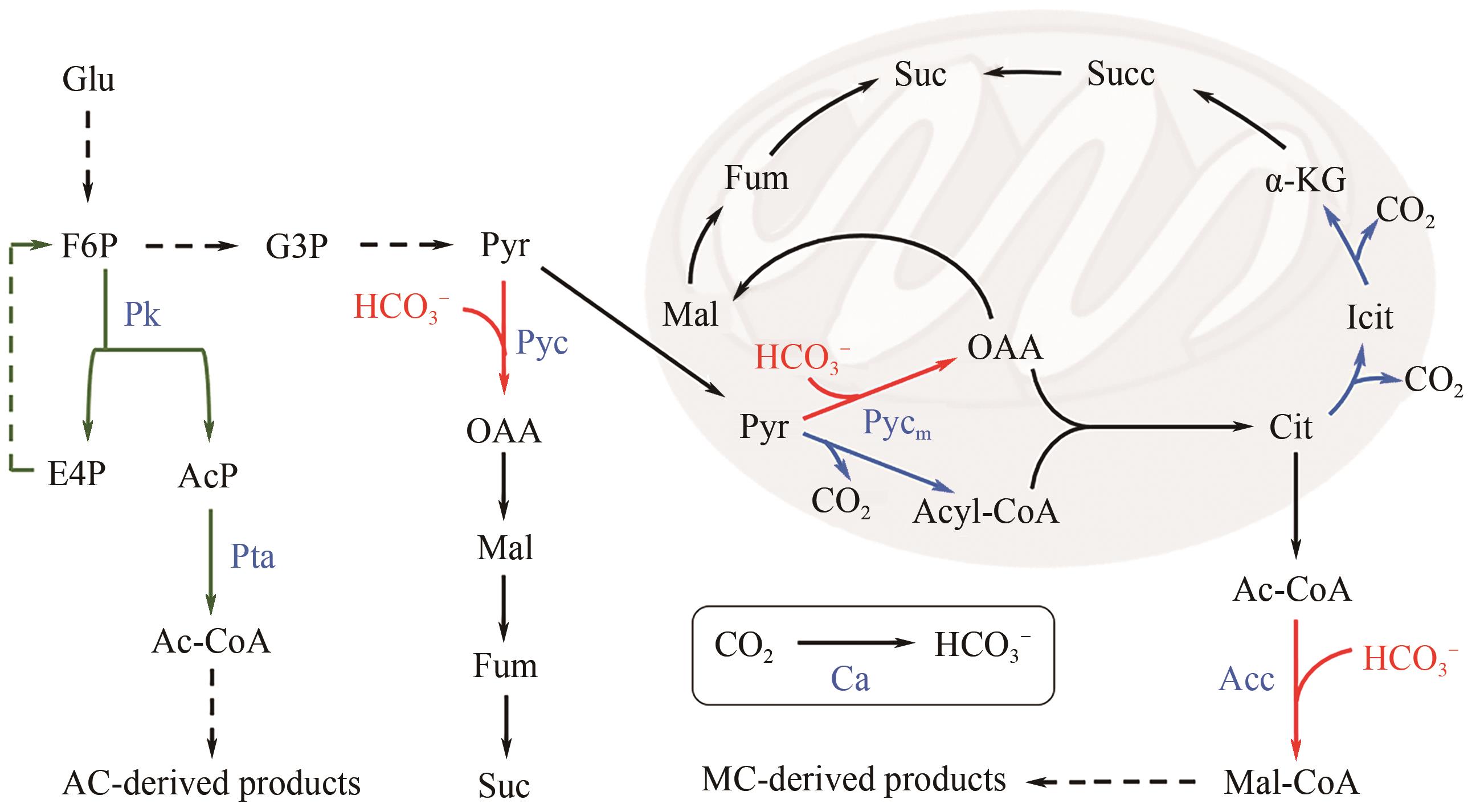
| 菌株 | 碳保存系统 | 改造策略 | 有益效果 | 参考文献 |
|---|---|---|---|---|
| 酿酒酵母 CEN.PK2-1C | NOG途径 | 表达LmPK、CkPTA | β-法尼烯得率提升了25% | [ |
| 酿酒酵母 JS-BE | NOG途径 | 表达LmPK、CkPTA、ZWF1、PPGI1-CTRPGI | β-胡萝卜产量提升了80%,番茄红素产量提升了353% | [ |
| 酿酒酵母IMX581 | GATHCYC途径 | 表达XfsPK*2、BlPTA、SHB17,敲除TKL1,2、TAL、NQM1、PHO13 | 3-羟基丙酸产量提升了109% | [ |
| 酿酒酵母 CEN.PK113-1A | Pyc羧化 | 表达CjFPS1、OpGDH、ScDAK1、ScMDH3、RoFUM、TbFRDg、ScPYC2,敲除GUT1 | 丁二酸产量达到35g/L,得率达到0.6g/g,相当于理论得率的47.1%。 | [ |
| 酿酒酵母 PYC2oe | Pyc羧化 | 敲除MPC3、SDH1 | 丁二酸产量达到45.5g/L,得率达到0.66g/g | [ |
| 酿酒酵母 CEN.PK113-11C | Acc羧化 | 表达ACC1S659A,S1157A | 脂肪酸、脂肪酸乙酯和3-羟基丙酸产量分别提高了0.65倍、3倍和3.5倍 | [ |
| 酿酒酵母 CEN.PK113-11C | Acc羧化 | 表达ACC1S659A,S1157A、NCE103、SUL1,游离质粒筛选标记URA3替换为HIS3 | 3-羟基丙酸产量达到11.25g/L,得率达到0.5625g/g、相当于理论得率的89.3% | [ |
| 酿酒酵母 CEN.PK2-1D | 3-HP分支途径 | 表达CaMCR、CaMCH、MsACR、StHPCD、SePREP、RsMCL、ACH1 | 中康酸产量达到90.78mg/L | [ |
| 解脂耶氏酵母AD | NOG途径 | 表达LmPK、CkPTA | 油脂含量提升了16.4% | [ |
| 解脂耶氏酵母YB-392 | NOG途径 | 表达CaPK*3、TsPTA,敲除PFK | 油脂含量提升了16% | [ |
| 解脂耶氏酵母FY14 | NOG途径 | 表达AnPK*2、BsPTA*2,敲除PFK | β-法尼烯产量提升了87.1% | [ |
| 解脂耶氏酵母PGC91 | Pyc羧化 | 表达TbFRD*2、EcFUM、YlMDH1、YlPYC、YlMDH2、YlFUM | 丁二酸产量达到111.9g/L,得率达到0.79g/g,生产强度达到1.79g/(L·h) | [ |
| 解脂耶氏酵母Po1g | Acc羧化 | 表达ACC1 | 油脂含量增加了2倍 | [ |
| 解脂耶氏酵母Po1g | Acc羧化 | 表达CgBC、HmCA | 脂肪酸含量提高了1.5倍,达到10.7g/L | [ |
| 毕赤酵母CY902 | Pyc羧化 | 表达AsPYC、AsMDH3、SpVHT1、EcPPC、EcSTHA,敲除MAE1 | 苹果酸产量达到199.4g/L,得率达到0.94g/g,生产强度达到1.86g/(L·h) | [ |
| 菌株 | 碳保存系统 | 改造策略 | 有益效果 | 参考文献 |
|---|---|---|---|---|
| 酿酒酵母 CEN.PK2-1C | NOG途径 | 表达LmPK、CkPTA | β-法尼烯得率提升了25% | [ |
| 酿酒酵母 JS-BE | NOG途径 | 表达LmPK、CkPTA、ZWF1、PPGI1-CTRPGI | β-胡萝卜产量提升了80%,番茄红素产量提升了353% | [ |
| 酿酒酵母IMX581 | GATHCYC途径 | 表达XfsPK*2、BlPTA、SHB17,敲除TKL1,2、TAL、NQM1、PHO13 | 3-羟基丙酸产量提升了109% | [ |
| 酿酒酵母 CEN.PK113-1A | Pyc羧化 | 表达CjFPS1、OpGDH、ScDAK1、ScMDH3、RoFUM、TbFRDg、ScPYC2,敲除GUT1 | 丁二酸产量达到35g/L,得率达到0.6g/g,相当于理论得率的47.1%。 | [ |
| 酿酒酵母 PYC2oe | Pyc羧化 | 敲除MPC3、SDH1 | 丁二酸产量达到45.5g/L,得率达到0.66g/g | [ |
| 酿酒酵母 CEN.PK113-11C | Acc羧化 | 表达ACC1S659A,S1157A | 脂肪酸、脂肪酸乙酯和3-羟基丙酸产量分别提高了0.65倍、3倍和3.5倍 | [ |
| 酿酒酵母 CEN.PK113-11C | Acc羧化 | 表达ACC1S659A,S1157A、NCE103、SUL1,游离质粒筛选标记URA3替换为HIS3 | 3-羟基丙酸产量达到11.25g/L,得率达到0.5625g/g、相当于理论得率的89.3% | [ |
| 酿酒酵母 CEN.PK2-1D | 3-HP分支途径 | 表达CaMCR、CaMCH、MsACR、StHPCD、SePREP、RsMCL、ACH1 | 中康酸产量达到90.78mg/L | [ |
| 解脂耶氏酵母AD | NOG途径 | 表达LmPK、CkPTA | 油脂含量提升了16.4% | [ |
| 解脂耶氏酵母YB-392 | NOG途径 | 表达CaPK*3、TsPTA,敲除PFK | 油脂含量提升了16% | [ |
| 解脂耶氏酵母FY14 | NOG途径 | 表达AnPK*2、BsPTA*2,敲除PFK | β-法尼烯产量提升了87.1% | [ |
| 解脂耶氏酵母PGC91 | Pyc羧化 | 表达TbFRD*2、EcFUM、YlMDH1、YlPYC、YlMDH2、YlFUM | 丁二酸产量达到111.9g/L,得率达到0.79g/g,生产强度达到1.79g/(L·h) | [ |
| 解脂耶氏酵母Po1g | Acc羧化 | 表达ACC1 | 油脂含量增加了2倍 | [ |
| 解脂耶氏酵母Po1g | Acc羧化 | 表达CgBC、HmCA | 脂肪酸含量提高了1.5倍,达到10.7g/L | [ |
| 毕赤酵母CY902 | Pyc羧化 | 表达AsPYC、AsMDH3、SpVHT1、EcPPC、EcSTHA,敲除MAE1 | 苹果酸产量达到199.4g/L,得率达到0.94g/g,生产强度达到1.86g/(L·h) | [ |
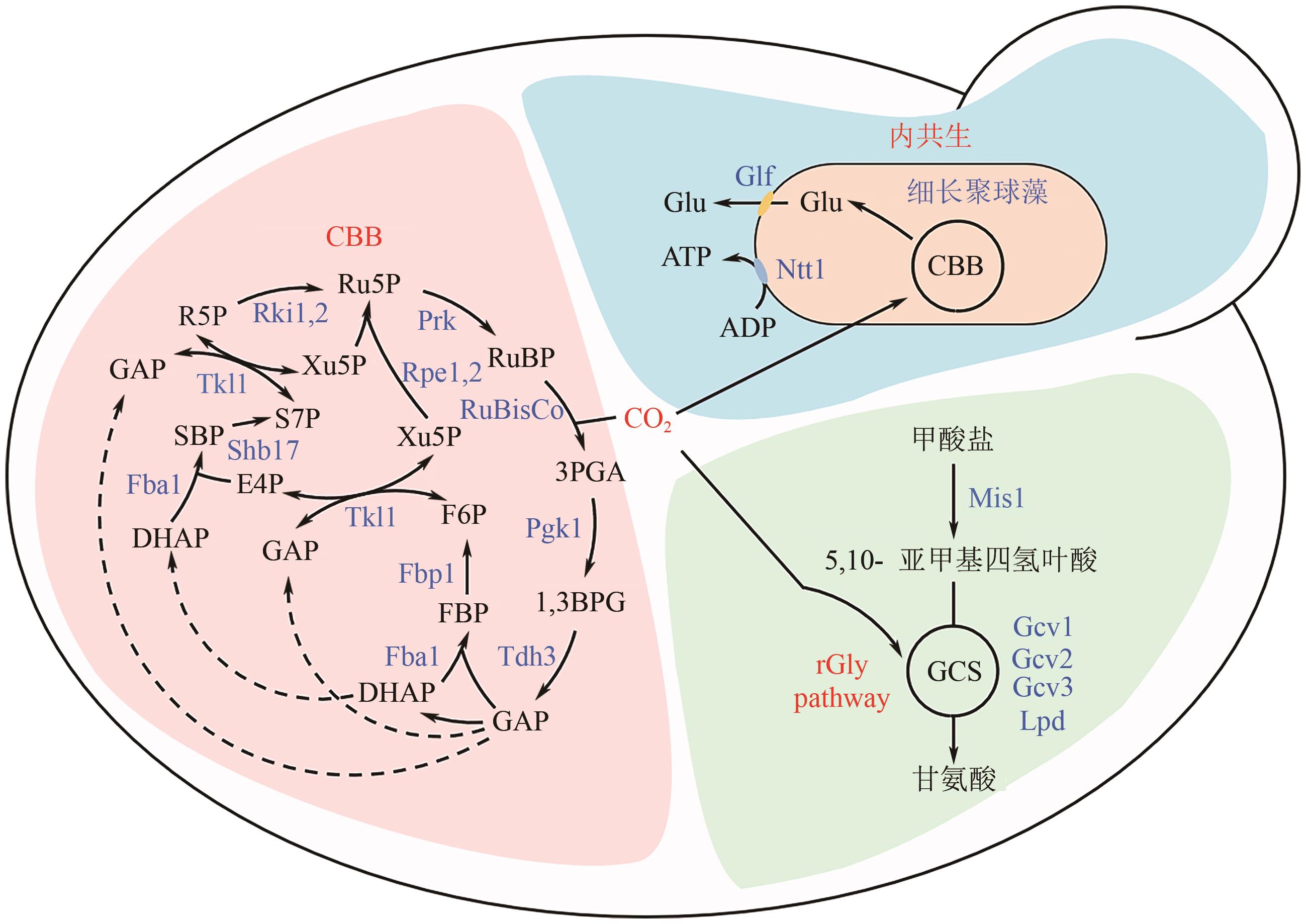
| 菌株 | 碳固定系统 | 改造策略 | 有益效果 | 参考文献 |
|---|---|---|---|---|
| 酿酒酵母 CEN.PK102-3A | RuBisCo 分支途径 | 表达TdCBBM、SoPRK、EcGROEL/S | 乙醇产量提升了11%,甘油产量降低了90% | [ |
| 酿酒酵母IMX581 | RuBisCo 分支途径 | 表达TdCBBM*9、PDAN1-SoPRK、EcGROEL/S、RPE1、TKL1,2、TAL1、NQM1、RKI1,敲除GPD2 | 乙醇得率提升了15%,甘油得率降低了86% | [ |
| 酿酒酵母IMX581 | RuBisCo 分支途径 | 表达TdCBBM*2、PANB1-SoPRK、EcGROEL/S、RPE1、TKL1,2、TAL1、NQM1、RKI1,敲除GPD2 | 乙醛、乙酸和甘油产量分别降低了79%、40%和72% | [ |
| 酿酒酵母 2593 | RuBisCo 分支途径 | 表达TdCBBM*2、PANB1-SoPRK-19aa、EcGROEL/S、RPE1、TKL1,2、TAL1、NQM1、RKI1、ECUT,敲除GPD2、ALD6 | 乙醇得率提升了6%,甘油得率降低了55% | [ |
| 酿酒酵母 SR8 | RuBisCo 分支途径 | 表达RrCBBM*2、SoPRK、EcGROEL/S*2 | 乙醇得率从0.324g/g增加到0.336g/g,回用了7%的CO2 | [ |
| 酿酒酵母 YS58 | RuBisCo 分支途径 | 表达SsXYL1、SsXYL2、XKS1、XYL1R276H、ReCBBL1-CBBS1、ReCFXP1、HSP60-HSP10 | 乙醇得率提升了15%,CO2固定效率达到336.6~436.3mg/L/h | [ |
| 酿酒酵母 DY02 | RuBisCo 分支途径 | 表达ReCBBL1-CBBS1*10、ReCFXP1*2、HSP60-HSP10*2 | 乙醇得率提升了16%,回用了7%的CO2 | [ |
| 酿酒酵母 cox2-60 | 内共生体 系统 | 细长聚球藻SynJEC0:表达SeNTT1、CtINCA、CT_813 | 细长聚球藻/酿酒酵母内共生体可以繁殖15~20代 | [ |
| 酿酒酵母 cox2-60 | 内共生体 系统 | 细长聚球藻SynJEC0:表达SeNTT1、CtINCA、CT_813、ZmGLF、ZmINVA | 细长聚球藻/酿酒酵母内共生体以HCO3-为底物生成柠檬烯 | [ |
| 酿酒酵母 YUW1 | rGly途径 | 表达GCV1,2,3、MIS1 | 工程菌株以甲酸盐和CO2为共底物积累生物量 | [ |
| 酿酒酵母 S288c | rGly途径 | 表达GCV1,2,3、MIS1、EcSHMT,敲除AGX1、GLY1、SER1,适应性进化 | 工程菌株以甲酸盐和CO2为共底物积累生物量 | [ |
| 酿酒酵母BY4741 | MFORG 途径 | 表达PpAOXPTS1、PpFDHPTS1、PpFLDPTS1、PpFGHPTS1、PpMIS1、PpGCV1,2,3、SHM1 | 工程菌株以甲醇和CO2为共底物分别合成了0.07g/L L-乳酸和1.67mg/L 5-氨基乙酰丙酸 | [ |
| 毕赤酵母CBS7435 | CBB循环 | 表达TdCBBM、SoPRK、EcGROEL/S、OpPGK1、OpTDH3、OpTPI1、OpTKL1,敲除DAS1,2、AOX1,适应性进化 | 工程菌株以CO2为底物积累生物量,最大生长速率达到0.018h-1 | [ |
| 毕赤酵母CBS7435 | CBB循环 | 表达TdCBBM、SoPRK、EcGROEL/S、OpPGK1、OpTDH3、OpTPI1、OpTKL1,敲除DAS1,2、AOX1 | 工程菌株以CO2为底物分别合成了2g/L 衣康酸和600mg/L L-乳酸 | [ |
| 毕赤酵母CBS7435 | rGly途径 | 敲除DAS1,2、SHM1 | 工程菌株以甲醇或甲酸盐和CO2为共底物积累生物量 | [ |
| 毕赤酵母 GS115 | MFORG 途径 | 表达GCV1,2,3、MIS1、AOXPTS1、FLDPTS1、FGHPTS1、SHM1,敲除DAS1-2 | 工程菌株以甲醇和CO2为共底物分别合成了0.21g/L L-乳酸和0.71mg/L 5-氨基乙酰丙酸 | [ |
| 菌株 | 碳固定系统 | 改造策略 | 有益效果 | 参考文献 |
|---|---|---|---|---|
| 酿酒酵母 CEN.PK102-3A | RuBisCo 分支途径 | 表达TdCBBM、SoPRK、EcGROEL/S | 乙醇产量提升了11%,甘油产量降低了90% | [ |
| 酿酒酵母IMX581 | RuBisCo 分支途径 | 表达TdCBBM*9、PDAN1-SoPRK、EcGROEL/S、RPE1、TKL1,2、TAL1、NQM1、RKI1,敲除GPD2 | 乙醇得率提升了15%,甘油得率降低了86% | [ |
| 酿酒酵母IMX581 | RuBisCo 分支途径 | 表达TdCBBM*2、PANB1-SoPRK、EcGROEL/S、RPE1、TKL1,2、TAL1、NQM1、RKI1,敲除GPD2 | 乙醛、乙酸和甘油产量分别降低了79%、40%和72% | [ |
| 酿酒酵母 2593 | RuBisCo 分支途径 | 表达TdCBBM*2、PANB1-SoPRK-19aa、EcGROEL/S、RPE1、TKL1,2、TAL1、NQM1、RKI1、ECUT,敲除GPD2、ALD6 | 乙醇得率提升了6%,甘油得率降低了55% | [ |
| 酿酒酵母 SR8 | RuBisCo 分支途径 | 表达RrCBBM*2、SoPRK、EcGROEL/S*2 | 乙醇得率从0.324g/g增加到0.336g/g,回用了7%的CO2 | [ |
| 酿酒酵母 YS58 | RuBisCo 分支途径 | 表达SsXYL1、SsXYL2、XKS1、XYL1R276H、ReCBBL1-CBBS1、ReCFXP1、HSP60-HSP10 | 乙醇得率提升了15%,CO2固定效率达到336.6~436.3mg/L/h | [ |
| 酿酒酵母 DY02 | RuBisCo 分支途径 | 表达ReCBBL1-CBBS1*10、ReCFXP1*2、HSP60-HSP10*2 | 乙醇得率提升了16%,回用了7%的CO2 | [ |
| 酿酒酵母 cox2-60 | 内共生体 系统 | 细长聚球藻SynJEC0:表达SeNTT1、CtINCA、CT_813 | 细长聚球藻/酿酒酵母内共生体可以繁殖15~20代 | [ |
| 酿酒酵母 cox2-60 | 内共生体 系统 | 细长聚球藻SynJEC0:表达SeNTT1、CtINCA、CT_813、ZmGLF、ZmINVA | 细长聚球藻/酿酒酵母内共生体以HCO3-为底物生成柠檬烯 | [ |
| 酿酒酵母 YUW1 | rGly途径 | 表达GCV1,2,3、MIS1 | 工程菌株以甲酸盐和CO2为共底物积累生物量 | [ |
| 酿酒酵母 S288c | rGly途径 | 表达GCV1,2,3、MIS1、EcSHMT,敲除AGX1、GLY1、SER1,适应性进化 | 工程菌株以甲酸盐和CO2为共底物积累生物量 | [ |
| 酿酒酵母BY4741 | MFORG 途径 | 表达PpAOXPTS1、PpFDHPTS1、PpFLDPTS1、PpFGHPTS1、PpMIS1、PpGCV1,2,3、SHM1 | 工程菌株以甲醇和CO2为共底物分别合成了0.07g/L L-乳酸和1.67mg/L 5-氨基乙酰丙酸 | [ |
| 毕赤酵母CBS7435 | CBB循环 | 表达TdCBBM、SoPRK、EcGROEL/S、OpPGK1、OpTDH3、OpTPI1、OpTKL1,敲除DAS1,2、AOX1,适应性进化 | 工程菌株以CO2为底物积累生物量,最大生长速率达到0.018h-1 | [ |
| 毕赤酵母CBS7435 | CBB循环 | 表达TdCBBM、SoPRK、EcGROEL/S、OpPGK1、OpTDH3、OpTPI1、OpTKL1,敲除DAS1,2、AOX1 | 工程菌株以CO2为底物分别合成了2g/L 衣康酸和600mg/L L-乳酸 | [ |
| 毕赤酵母CBS7435 | rGly途径 | 敲除DAS1,2、SHM1 | 工程菌株以甲醇或甲酸盐和CO2为共底物积累生物量 | [ |
| 毕赤酵母 GS115 | MFORG 途径 | 表达GCV1,2,3、MIS1、AOXPTS1、FLDPTS1、FGHPTS1、SHM1,敲除DAS1-2 | 工程菌株以甲醇和CO2为共底物分别合成了0.21g/L L-乳酸和0.71mg/L 5-氨基乙酰丙酸 | [ |
| 1 | WEGAT Vanessa, FABARIUS Jonathan T, SIEBER Volker. Synthetic methylotrophic yeasts for the sustainable fuel and chemical production[J]. Biotechnology for Biofuels and Bioproducts, 2022, 15(1): 113. |
| 2 | TERRER César, PHILLIPS Naiya R, HUNGATE Bruce A, et al. A trade-off between plant and soil carbon storage under elevated CO2 [J]. Nature, 2021, 591(7851): 599-603. |
| 3 | FABARIUS Jonathan Thomas, WEGAT Vanessa, ROTH Arne, et al. Synthetic methylotrophy in yeasts: Towards a circular bioeconomy[J]. Trends in Biotechnology, 2021, 39(4): 348-358. |
| 4 | JEONG Deokyeol, PARK Heeyoung, JANG Byeong-Kwan, et al. Recent advances in the biological valorization of citrus peel waste into fuels and chemicals[J]. Bioresource Technology, 2021, 323: 124603. |
| 5 | GAO Huaxiao, WANG Qian, QI Qingsheng. Synthetic biology optimizes carbon conservation and carbon fixation during microbial carbon metabolism[J]. Chinese Science Bulletin, 2023, 68(19): 2446-2456. |
| 6 | Sze Mun ONN, Gui Jen KOH, Wei Hsum YAP, et al. Recent advances in genetic engineering of microalgae: Bioengineering strategies, regulatory challenges and future perspectives[J]. Journal of Applied Phycology, 2024: 1-18. |
| 7 | KIM Soo Rin, KIM Soo-Jung, KIM Sun-Ki, et al. Yeast metabolic engineering for carbon dioxide fixation and its application[J]. Bioresource Technology, 2022, 346: 126349. |
| 8 | 孙涛, 孙美莉, 陆然, 等. 合成生物学改造酵母驱动丁二酸绿色生物制造[J]. 化工学报, 2024, 75(4): 1382-1393. |
| SUN Tao, SUN Meili, LU Ran, et al. Synthetic biology of yeasts drives green biomanufacturing of succinic acid[J]. CIESC Journal, 2024, 75(4): 1382-1393. | |
| 9 | TRAN Vinh G, MISHRA Somesh, BHAGWAT Sarang S, et al. An end-to-end pipeline for succinic acid production at an industrially relevant scale using Issatchenkia orientalis [J]. Nature Communications, 2023, 14(1): 6152. |
| 10 | MEADOWS Adam L, HAWKINS Kristy M, TSEGAYE Yoseph, et al. Rewriting yeast central carbon metabolism for industrial isoprenoid production[J]. Nature, 2016, 537(7622): 694-697. |
| 11 | XUE Zhixiong, SHARPE Pamela L, HONG Seung-Pyo, et al. Production of omega-3 eicosapentaenoic acid by metabolic engineering of Yarrowia lipolytica [J]. Nature Biotechnology, 2013, 31(8): 734-740. |
| 12 | DU Fei, LI Zijia, LI Xin, et al. Optimizing multicopy chromosomal integration for stable high-performing strains[J]. Nature Chemical Biology, 2024, 20(12): 1670-1679. |
| 13 | CASTRO Evelyn Vásquez, MEMARI Golnaz, Özge ATA, et al. Carbon efficient production of chemicals with yeasts[J]. Yeast, 2023, 40(12): 583-593. |
| 14 | MA Jingbo, GU Yang, MARSAFARI Monireh, et al. Synthetic biology, systems biology, and metabolic engineering of Yarrowia lipolytica toward a sustainable biorefinery platform[J]. Journal of Industrial Microbiology & Biotechnology, 2020, 47(9/10): 845-862. |
| 15 | WANG Kaifeng, SHI Tianqiong, LIN Lu, et al. Engineering Yarrowia lipolytica to produce tailored chain-length fatty acids and their derivatives[J]. ACS Synthetic Biology, 2022, 11(8): 2564-2577. |
| 16 | BOGORAD Igor W, LIN Tzu-Shyang, LIAO James C. Synthetic non-oxidative glycolysis enables complete carbon conservation[J]. Nature, 2013, 502(7473): 693-697. |
| 17 | BAPTISTA Sara L, COSTA Carlos E, CUNHA Joana T, et al. Metabolic engineering of Saccharomyces cerevisiae for the production of top value chemicals from biorefinery carbohydrates[J]. Biotechnology Advances, 2021, 47: 107697. |
| 18 | FAN Jian, ZHANG Yang, LI Wenhao, et al. Multidimensional optimization of Saccharomyces cerevisiae for carotenoid overproduction[J]. Biodesign Research, 2024, 6: 0026. |
| 19 | HELLGREN John, GODINA Alexei, NIELSEN Jens, et al. Promiscuous phosphoketolase and metabolic rewiring enables novel non-oxidative glycolysis in yeast for high-yield production of acetyl-CoA derived products[J]. Metabolic Engineering, 2020, 62: 150-160. |
| 20 | QIAO Kangjian, WASYLENKO Thomas M, ZHOU Kang, et al. Lipid production in Yarrowia lipolytica is maximized by engineering cytosolic redox metabolism[J]. Nature Biotechnology, 2017, 35(2): 173-177. |
| 21 | KAMINENI Annapurna, SHAW Joe. Engineering triacylglycerol production from sugars in oleaginous yeasts[J]. Current Opinion in Biotechnology, 2020, 62: 239-247. |
| 22 | KAMINENI Annapurna, CONSIGLIO Andrew L, MACEWEN Kyle, et al. Increasing lipid yield in Yarrowia lipolytica through phosphoketolase and phosphotransacetylase expression in a phosphofructokinase deletion strain[J]. Biotechnology for Biofuels, 2021, 14(1): 113. |
| 23 | BI Haoran, XU Chenchen, BAO Yufei, et al. Enhancing precursor supply and modulating metabolism to achieve high-level production of β-farnesene in Yarrowia lipolytica [J]. Bioresource Technology, 2023, 382: 129171. |
| 24 | YANG Yaping, LIN Yuheng, LI Lingyun, et al. Regulating malonyl-CoA metabolism via synthetic antisense RNAs for enhanced biosynthesis of natural products[J]. Metabolic Engineering, 2015, 29: 217-226. |
| 25 | YEH L A, SONG C S, KIM K H. Coenzyme A activation of acetyl-CoA carboxylase[J]. Journal of Biological Chemistry, 1981, 256(5): 2289-2296. |
| 26 | LI Jian, MU Xin, DONG Wenyue, et al. A non-carboxylative route for the efficient synthesis of central metabolite malonyl-CoA and its derived products[J]. Nature Catalysis, 2024, 7: 361-374. |
| 27 | PEREIRA Humberto, AZEVEDO Flávio, DOMINGUES Lucília, et al. Expression of Yarrowia lipolytica acetyl-CoA carboxylase in Saccharomyces cerevisiae and its effect on in-vivo accumulation of Malonyl-CoA[J]. Computational and Structural Biotechnology Journal, 2022, 20: 779-787. |
| 28 | VAN ROSSUM Harmen M, KOZAK Barbara U, NIEMEIJER Matthijs S, et al. Alternative reactions at the interface of glycolysis and citric acid cycle in Saccharomyces cerevisiae [J]. FEMS Yeast Research, 2016, 16(3): fow017. |
| 29 | 李娇娇, 祁庆生. 琥珀酸的生物制造: 细菌还是酵母?[J]. 生物产业技术, 2016(1): 49-53. |
| LI Jiaojiao, QI Qingsheng. Bioproduction of succinic acid: Bacteria or yeast?[J]. Biotechnology & Business, 2016(1): 49-53. | |
| 30 | XI Yongyan, XU Hongtao, ZHAN Tao, et al. Metabolic engineering of the acid-tolerant yeast Pichia kudriavzevii for efficient L-malic acid production at low pH[J]. Metabolic Engineering, 2023, 75: 170-180. |
| 31 | MALUBHOY Zahabiya, BAHIA Frederico Mendonça, DE VALK Sophie Claire, et al. Carbon dioxide fixation via production of succinic acid from glycerol in engineered Saccharomyces cerevisiae [J]. Microbial Cell Factories, 2022, 21(1): 102. |
| 32 | Toni RENDULIĆ, PERPELEA Andreea, ORTIZ Juan Paulo Ragas, et al. Mitochondrial membrane transporters as attractive targets for the fermentative production of succinic acid from glycerol in Saccharomyces cerevisiae [J]. FEMS Yeast Research, 2024, 24: foae009. |
| 33 | GUO Qi, YANG Yuxin, LI Dongxun, et al. Advances in multi-enzyme co-localization strategies for the construction of microbial cell factory[J]. Biotechnology Advances, 2024, 77: 108453. |
| 34 | CUI Zhiyong, ZHONG Yutao, SUN Zhijie, et al. Reconfiguration of the reductive TCA cycle enables high-level succinic acid production by Yarrowia lipolytica [J]. Nature Communications, 2023, 14(1): 8480. |
| 35 | WANG Jinpeng, YU Xiao, WANG Kaifeng, et al. Reprogramming the fatty acid metabolism of Yarrowia lipolytica to produce the customized omega-6 polyunsaturated fatty acids[J]. Bioresource Technology, 2023, 383: 129231. |
| 36 | SHI Shuobo, CHEN Yun, SIEWERS Verena, et al. Improving production of malonyl coenzyme A-derived metabolites by abolishing Snf1-dependent regulation of Acc1[J]. mBio, 2014, 5(3): e01130-14. |
| 37 | QIN Ning, LI Lingyun, WAN Xiaozhen, et al. Increased CO2 fixation enables high carbon-yield production of 3-hydroxypropionic acid in yeast[J]. Nature Communications, 2024, 15(1): 1591. |
| 38 | TAI Mitchell, STEPHANOPOULOS Gregory. Engineering the push and pull of lipid biosynthesis in oleaginous yeast Yarrowia lipolytica for biofuel production[J]. Metabolic Engineering, 2013, 15: 1-9. |
| 39 | YOU Seung Kyou, PARK Hyeon Min, LEE Myeong-Eun, et al. Non-photosynthetic CO2 utilization to increase fatty acid production in Yarrowia lipolytica [J]. Journal of Agricultural and Food Chemistry, 2021, 69(40): 11912-11918. |
| 40 | LIU Zihe, WANG Kai, CHEN Yun, et al. Third-generation biorefineries as the means to produce fuels and chemicals from CO2 [J]. Nature Catalysis, 2020, 3: 274-288. |
| 41 | XU Shijie, QIAO Weibo, WANG Zuanwen, et al. Exploiting a heterologous construction of the 3-hydroxypropionic acid carbon fixation pathway with mesaconate as an indicator in Saccharomyces cerevisiae [J]. Bioresources and Bioprocessing, 2023, 10(1): 33. |
| 42 | 陶雨萱, 郭亮, 高聪, 等. 代谢工程改造微生物固定二氧化碳研究进展[J]. 化工进展, 2023, 42(1): 40-52. |
| TAO Yuxuan, GUO Liang, GAO Cong, et al. Progress in metabolic engineering of microorganisms for CO2 fixation[J]. Chemical Industry and Engineering Progress, 2023, 42(1): 40-52. | |
| 43 | XIA Qi, YANG Junzhu, HU Liangwei, et al. Biotransforming CO2 into valuable chemicals[J]. Journal of Cleaner Production, 2024, 434: 140185. |
| 44 | FENG Jia, MA Ding, GAO Siyuan, et al. Recent advances in engineering heterotrophic microorganisms for reinforcing CO2 fixation based on Calvin-Benson-bassham cycle[J]. ACS Sustainable Chemistry & Engineering, 2023, 11(26): 9509-9522. |
| 45 | BLOMBERG Anders, ADLER Lennart. Physiology of osmotolerance in fungi[J]. Advances in Microbial Physiology, 1992, 33: 145-212. |
| 46 | FRANÇOIS Jean Marie, LACHAUX Cléa, MORIN Nicolas. Synthetic biology applied to carbon conservative and carbon dioxide recycling pathways[J]. Frontiers in Bioengineering and Biotechnology, 2020, 7: 446. |
| 47 | Víctor GUADALUPE-MEDINA, WOUTER WISSELINK H, LUTTIK Marijke Ah, et al. Carbon dioxide fixation by Calvin-Cycle enzymes improves ethanol yield in yeast[J]. Biotechnology for Biofuels, 2013, 6(1): 125. |
| 48 | PAPAPETRIDIS Ioannis, GOUDRIAAN Maaike, VITALI María Vázquez, et al. Optimizing anaerobic growth rate and fermentation kinetics in Saccharomyces cerevisiae strains expressing Calvin-cycle enzymes for improved ethanol yield[J]. Biotechnology for Biofuels, 2018, 11: 17. |
| 49 | VAN AALST Aafke C A, JANSEN Mickel L A, MANS Robert, et al. Quantification and mitigation of byproduct formation by low-glycerol-producing Saccharomyces cerevisiae strains containing Calvin-cycle enzymes[J]. Biotechnology for Biofuels and Bioproducts, 2023, 16(1): 81. |
| 50 | MEDINA Víctor Guadalupe, ALMERING Marinka J H, VAN MARIS Antonius J A, et al. Elimination of glycerol production in anaerobic cultures of a Saccharomyces cerevisiae strain engineered to use acetic acid as an electron acceptor[J]. Applied and Environmental Microbiology, 2010, 76(1): 190-195. |
| 51 | VAN AALST Aafke C A, GERAATS Ellen H, JANSEN Mickel L A, et al. Optimizing the balance between heterologous acetate- and CO2-reduction pathways in anaerobic cultures of Saccharomyces cerevisiae strains engineered for low-glycerol production[J]. FEMS Yeast Research, 2023, 23: foad048. |
| 52 | OREB Mislav, DIETZ Heiko, FARWICK Alexander, et al. Novel strategies to improve co-fermentation of pentoses with D-glucose by recombinant yeast strains in lignocellulosic hydrolysates[J]. Bioengineered, 2012, 3(6): 347-351. |
| 53 | KARHUMAA Kaisa, SANCHEZ Rosa Garcia, Bärbel HAHN-HÄGERDAL, et al. Comparison of the xylose reductase-xylitol dehydrogenase and the xylose isomerase pathways for xylose fermentation by recombinant Saccharomyces cerevisiae [J]. Microbial Cell Factories, 2007, 6: 5. |
| 54 | XIA Pengfei, ZHANG Guochang, WALKER Berkley, et al. Recycling carbon dioxide during xylose fermentation by engineered Saccharomyces cerevisiae [J]. ACS Synthetic Biology, 2017, 6(2): 276-283. |
| 55 | LI Yunjie, WANG Miaomiao, CHEN Yawei, et al. Engineered yeast with a CO2-fixation pathway to improve the bio-ethanol production from xylose-mixed sugars[J]. Scientific Reports, 2017, 7: 43875. |
| 56 | PARK Sujeong, PARK Bo-Ram, JEONG Deokyeol, et al. Functional expression of RuBisCO reduces CO2 emission during fermentation by engineered Saccharomyces cerevisiae [J]. Process Biochemistry, 2023, 134: 286-293. |
| 57 | FIELD Christopher B, BEHRENFELD Michael J, RANDERSON James T, et al. Primary production of the biosphere: Integrating terrestrial and oceanic components[J]. Science, 1998, 281(5374): 237-240. |
| 58 | Hannes RUßMAYER, BUCHETICS Markus, GRUBER Clemens, et al. Systems-level organization of yeast methylotrophic lifestyle[J]. BMC Biology, 2015, 13: 80. |
| 59 | GASSLER Thomas, SAUER Michael, GASSER Brigitte, et al. The industrial yeast Pichia pastoris is converted from a heterotroph into an autotroph capable of growth on CO2 [J]. Nature Biotechnology, 2020, 38(2): 210-216. |
| 60 | GASSLER Thomas, BAUMSCHABL Michael, SALLABERGER Jakob, et al. Adaptive laboratory evolution and reverse engineering enhances autotrophic growth in Pichia pastoris [J]. Metabolic Engineering, 2022, 69: 112-121. |
| 61 | BAUMSCHABL Michael, Özge ATA, MITIC Bernd M, et al. Conversion of CO2 into organic acids by engineered autotrophic yeast[J]. Proceedings of the National Academy of Sciences of the United States of America, 2022, 119(47): e2211827119. |
| 62 | GLEIZER Shmuel, Roee BEN-NISSAN, BAR-ON Yinon M, et al. Conversion of Escherichia coli to generate all biomass carbon from CO2 [J]. Cell, 2019, 179(6): 1255-1263. |
| 63 | COURNOYER Jason E, ALTMAN Sarah D, GAO Yangle, et al. Engineering artificial photosynthetic life-forms through endosymbiosis[J]. Nature Communications, 2022, 13(1): 2254. |
| 64 | GAO Yangle, COURNOYER Jason E, DE Bidhan C, et al. Introducing carbon assimilation in yeasts using photosynthetic directed endosymbiosis[J]. Nature Communications, 2024, 15(1): 5947. |
| 65 | Irene SÁNCHEZ-ANDREA, GUEDES Iame Alves, HORNUNG Bastian, et al. The reductive glycine pathway allows autotrophic growth of Desulfovibrio desulfuricans [J]. Nature Communications, 2020, 11(1): 5090. |
| 66 | CLAASSENS Nico J, HE Hai, Arren BAR-EVEN. Synthetic methanol and formate assimilation via modular engineering and selection strategies[J]. Current Issues in Molecular Biology, 2019, 33: 237-248. |
| 67 | DE LA CRUZ Jorge Gonzalez, MACHENS Fabian, MESSERSCHMIDT Katrin, et al. Core catalysis of the reductive glycine pathway demonstrated in yeast[J]. ACS Synthetic Biology, 2019, 8(5): 911-917. |
| 68 | BYSANI Viswanada R, ALAM Ayesha S, Arren BAR-EVEN, et al. Engineering and evolution of the complete Reductive Glycine Pathway in Saccharomyces cerevisiae for formate and CO2 assimilation[J]. Metabolic Engineering, 2024, 81: 167-181. |
| 69 | 郭峰, 张尚杰, 蒋羽佳, 等. 一碳资源在酵母中的利用与转化[J]. 化工进展, 2023, 42(1): 30-39. |
| GUO Feng, ZHANG Shangjie, JIANG Yujia, et al. Biotransformation of one-carbon resources by yeast[J]. Chemical Industry and Engineering Progress, 2023, 42(1): 30-39. | |
| 70 | MITIC Bernd M, TROYER Christina, LUTZ Lisa, et al. The oxygen-tolerant reductive glycine pathway assimilates methanol, formate and CO2 in the yeast Komagataella phaffii [J]. Nature Communications, 2023, 14(1): 7754. |
| 71 | GUO Yuanke, ZHANG Rui, WANG Jing, et al. Engineering yeasts to co-utilize methanol or formate coupled with CO2 fixation[J]. Metabolic Engineering, 2024, 84: 1-12. |
| [1] | LI Yuzhen, HE Mingjing, WANG Haoming, MA Xiaoqing, LIU Licheng, LI Fuli. Current status of the third-generation carbon-one biorefinery using CO2 as raw material [J]. Chemical Industry and Engineering Progress, 2025, 44(5): 2811-2824. |
| [2] | FENG Jiao, LIU Mingming, LIU Yao, WANG Xin, CHEN Kequan. Research progress in the biosynthesis of aliphatic short-chain diamines and diols from renewable feedstocks [J]. Chemical Industry and Engineering Progress, 2025, 44(5): 2655-2666. |
| [3] | TANG Yongsheng, GU Ziyun, CHEN Xiulai. Regulation of microbial cell viability for succinic acid production [J]. Chemical Industry and Engineering Progress, 2025, 44(5): 2489-2504. |
| [4] | SHENG Huakang, ZHANG Bo, SHEN Xiaolin, SUN Xinxiao, WANG Jia, YUAN Qipeng. Microbial synthesis of resveratrol and its derivatives [J]. Chemical Industry and Engineering Progress, 2025, 44(5): 2463-2474. |
| [5] | WANG Yuanyuan, ZHANG Chong, HAN Shuangyan, XING Xinhui. Research progress on bioproduction of recombinant proteins by Pichia pastoris utilizing methanol [J]. Chemical Industry and Engineering Progress, 2025, 44(5): 2441-2450. |
| [6] | WANG Wanying, ZHOU Yingzhe, LIU Huajuan, JIANG Guoqiang. Analysis of competitive advantages and disadvantages in China's biomanufacturing field [J]. Chemical Industry and Engineering Progress, 2024, 43(S1): 662-666. |
| [7] | XU Kai, CUI Jinna, LIU Zhanying. Research progress in the production of cellulosic ethanol via consolidated bioprocessing [J]. Chemical Industry and Engineering Progress, 2024, 43(12): 6873-6882. |
| [8] | YAO Lun, ZHOU Yongjin. Progress in microbial utilization of one-carbon feedstocks for biomanufacturing [J]. Chemical Industry and Engineering Progress, 2023, 42(1): 16-29. |
| [9] | ZHAO Tongxin, ZHAO Lei, ZHANG Yanping, LI Yin. Research progress of formic acid biotransformation [J]. Chemical Industry and Engineering Progress, 2023, 42(1): 67-72. |
| [10] | GUO Feng, ZHANG Shangjie, JIANG Yujia, JIANG Wankui, XIN Fengxue, ZHANG Wenming, JIANG Min. Biotransformation of one-carbon resources by yeast [J]. Chemical Industry and Engineering Progress, 2023, 42(1): 30-39. |
| [11] | TAO Yuxuan, ZHANG Shangjie, JING Yiwen, XIN Fengxue, DONG Weiliang, ZHOU Jie, JIANG Yujia, ZHANG Wenming, JIANG Min. Recent advances in the construction strategy of methylotrophic Escherichia coli [J]. Chemical Industry and Engineering Progress, 2021, 40(7): 3932-3941. |
| [12] | GUO Liang, GAO Cong, ZHANG Li, CHEN Xiulai, LIU Liming. Advances in the suitability of artificial metabolic pathways [J]. Chemical Industry and Engineering Progress, 2021, 40(3): 1252-1261. |
| [13] | WANG Ying, QU Junze, LIANG Nan, HAO He, YUAN Yingjin. Rapid construction and directed evolution of cell factories for carotenoid biosynthesis [J]. Chemical Industry and Engineering Progress, 2021, 40(3): 1187-1201. |
| [14] | LIU Weibing, YE Bangce. Progress of synthetic biology research and biological manufacturing of actinomycetes polyketides [J]. Chemical Industry and Engineering Progress, 2021, 40(3): 1226-1237. |
| [15] | SUN Wentao, LI Chun. Design and construction of microbial cell factory for biosynthesis of plant natural products [J]. Chemical Industry and Engineering Progress, 2021, 40(3): 1202-1214. |
| Viewed | ||||||
|
Full text |
|
|||||
|
Abstract |
|
|||||