Chemical Industry and Engineering Progress ›› 2025, Vol. 44 ›› Issue (11): 6174-6186.DOI: 10.16085/j.issn.1000-6613.2024-1532
• Energy processes and technology • Previous Articles
Research progress on tar reduction in biomass gasification process
XU Naiguang( ), LIU Taotao, SONG Wei, NIE Wenwen, WANG Xueke, YAN Zhaochen, WANG Changsong()
- State Key Laboratory of Materials and Chemical Engineering, Nanjing Tech University, Nanjing 210009, Jiangsu, China
-
Received:2024-09-20Revised:2025-02-02Online:2025-12-08Published:2025-11-25 -
Contact:WANG Changsong
生物质气化过程中焦油减量研究进展
徐乃光(), 刘涛涛, 宋薇, 聂文文, 王雪可, 严兆晨, 王昌松()
- 南京工业大学材料与化学工程国家重点实验室,江苏 南京 210009
-
通讯作者:王昌松 -
作者简介:徐乃光(1996—),男,硕士研究生,研究方向为生物质气化设计。E-mail:981449636@qq.com。 -
基金资助:江苏高校品牌专业建设工程项目;江苏高校优势学科建设工程项目(PPZY2015A044)

CLC Number:
Cite this article
XU Naiguang, LIU Taotao, SONG Wei, NIE Wenwen, WANG Xueke, YAN Zhaochen, WANG Changsong. Research progress on tar reduction in biomass gasification process[J]. Chemical Industry and Engineering Progress, 2025, 44(11): 6174-6186.
徐乃光, 刘涛涛, 宋薇, 聂文文, 王雪可, 严兆晨, 王昌松. 生物质气化过程中焦油减量研究进展[J]. 化工进展, 2025, 44(11): 6174-6186.
share this article
Add to citation manager EndNote|Ris|BibTeX
URL: https://hgjz.cip.com.cn/EN/10.16085/j.issn.1000-6613.2024-1532
| 方法 | 种类 | 描述 | 典型化合物 |
|---|---|---|---|
| 基于形成过程 | 初级焦油 | 400~700℃下低分子量含氧化合物及衍生物 | 甲醇、乙醛、呋喃 |
| 次级焦油 | 700~850℃下酚类和烯烃类转化成的化合物 | 苯酚、丙烯 | |
| 三级焦油 | 850~1000℃下无分支的芳香化合物 | 苯、甲苯、萘、蒽、菲 | |
| 基于芳环的数量 | Ⅰ类 | GC检测不到的重焦油,高温下冷凝 | — |
| Ⅱ类 | 含有杂原子的有机化合物,高水溶性 | 吡啶、苯酚、喹啉 | |
| Ⅲ类 | 单环芳香烃类,通常不会冷凝和水溶 | 甲苯、苯乙烯 | |
| Ⅳ类 | 2~3环芳香烃类,中温、高浓度下冷凝 | 菲、萘、芴 | |
| Ⅴ类 | 4~5环芳香烃类,高温、低浓度下冷凝 | 荧蒽、冠烯 |
| 方法 | 种类 | 描述 | 典型化合物 |
|---|---|---|---|
| 基于形成过程 | 初级焦油 | 400~700℃下低分子量含氧化合物及衍生物 | 甲醇、乙醛、呋喃 |
| 次级焦油 | 700~850℃下酚类和烯烃类转化成的化合物 | 苯酚、丙烯 | |
| 三级焦油 | 850~1000℃下无分支的芳香化合物 | 苯、甲苯、萘、蒽、菲 | |
| 基于芳环的数量 | Ⅰ类 | GC检测不到的重焦油,高温下冷凝 | — |
| Ⅱ类 | 含有杂原子的有机化合物,高水溶性 | 吡啶、苯酚、喹啉 | |
| Ⅲ类 | 单环芳香烃类,通常不会冷凝和水溶 | 甲苯、苯乙烯 | |
| Ⅳ类 | 2~3环芳香烃类,中温、高浓度下冷凝 | 菲、萘、芴 | |
| Ⅴ类 | 4~5环芳香烃类,高温、低浓度下冷凝 | 荧蒽、冠烯 |
| 序号 | 原料 | 生物质成分(质量分数) | 工艺描述 | 气化剂 | 焦油含量 | 参考文献 |
|---|---|---|---|---|---|---|
| #1 | 微晶纤维素 | 99.0%纤维素 | 下吸式固定床气化炉1000℃ | 氮气 | 1.2mg/g | [ |
| 小麦木聚糖 | 99.0%半纤维素 | 1.4mg/g | ||||
| 硫酸盐木质素 | 98.0%木质素 | 3.9mg/g | ||||
| #2 | 松木 | 36.7%纤维素 26.1%半纤维素 27.5%木质素 | 固定床气化炉500℃ | 氮气 | 338mg/g | [ |
| #3 | 芒草 | 45.7%纤维素 22.8%半纤维素 20.2%木质素 | 211mg/g | |||
| #4 | 小麦秸秆 | 33.8%纤维素 21.7%半纤维素 20.5%木质素 | 159mg/g | |||
| #5 | 秸秆 | 40.5%纤维素 24.9%半纤维素 17.6%木质素 | 下吸式固定床气化炉1000℃ | 氮气 | 2mg/g | [ |
| #6 | 松木 | 46.8%纤维素 18.5%半纤维素 27.3%木质素 | 8mg/g | |||
| #7 | 木材颗粒 | 含水率6.9% | 流化床气化炉700℃,粒径20.0mm | 蒸汽 | 190mg/g | [ |
| 粒径5.0mm | 80mg/g | |||||
| #8 | 木材残留物 | 47.6%纤维素 39.0%半纤维素 11.2%木质素 | 上吸式固定床气化炉480℃,粒径30.0mm | 氮气 | 145mg/g | [ |
| 粒径20.0mm | 200mg/g | |||||
| 粒径10.0mm | 260mg/g | |||||
| #9 | 玉米秸秆 | 27.9%纤维素 18.1%半纤维素 23.4%木质素 | 流化床气化炉700℃,ER=0.21 | 空气 | 6.2g/m3 | [ |
| 820℃,ER=0.31 | 4.0g/m3 | |||||
| 700℃,S/B=0.6 | 蒸汽 | 3.5g/m3 | ||||
| #10 | 松木屑 | 含水率10.0% | 上吸式固定床气化炉840℃,粒径2.0mm | 空气 | 79.4g/m3 | [ |
| 粒径7.0mm | 13.0g/m3 | |||||
| 粒径30.0mm | 93.0g/m3 | |||||
| 含水率22.0% | 粒径7.0mm | 6.2g/m3 | ||||
| #11 | 木片 | 含水率6.0% | 流化床气化炉810℃ | 空气 | 8.3g/m3 | [ |
| 含水率19.0% | 5.2g/m3 | |||||
| 含水率30.0% | 5.6g/m3 | |||||
| #12 | 干化污水污泥 | 含水率7.3% | 鼓泡流化床,ER=0.26,659℃ | 蒸汽和氧气 | 98.0g/m3 | [ |
| 778℃ | 31.0g/m3 | |||||
| 894℃ | 21.0g/m3 | |||||
| #13 | 干化污水污泥 | — | 流化床气化炉,818℃,ER=0.22 | 空气 | 296.0mg/m3 | [ |
| 821℃,ER=0.50 | 76.0mg/m3 | |||||
| #14 | 沼渣 | 含水率10.0%~20.0% | 循环流化床气化炉,810℃,ER=0.32 | 空气 | 8.6g/m3 | [ |
| ER=0.36,S/B=0.79 | 空气和蒸汽 | 3.7g/m3 | ||||
| #15 | 松木锯末 | — | 流化床气化炉,900℃ | 氮气 | 154.0g/m3 | [ |
| S/B=1.0 | 蒸汽 | 142.0g/m3 | ||||
| #16 | 稻壳、稻草和聚乙烯 | — | 鼓泡流化床气化炉,850℃,ER=0.2 | 蒸汽和空气 | 12.5g/m3 | [ |
| 蒸汽和60%富氧空气 | 9.0g/m3 | |||||
| #17 | 桉树木片 | — | 上吸式固定床气化炉,ER=0.24,S/B=0.20 | 空气和蒸汽 | 31.6g/m3 | [ |
| ER=0.23,S/B=0.21 | 氧气和蒸汽 | 11.2g/m3 | ||||
| #18 | 云杉 | — | 流化床气化炉0.1MPa,ER=0.22,S/B=1.6 | 空气和蒸汽 | 0.5%(质量分数) | [ |
| 1MPa,ER=0.24,S/B=1.7 | 1.6%(质量分数) | |||||
| #19 | 煤 | — | 高压反应器,2MPa | 氧气和蒸汽 | 3078.5mg/m3 | [ |
| 4MPa | 氧气和蒸汽 | 556.5mg/m3 |
| 序号 | 原料 | 生物质成分(质量分数) | 工艺描述 | 气化剂 | 焦油含量 | 参考文献 |
|---|---|---|---|---|---|---|
| #1 | 微晶纤维素 | 99.0%纤维素 | 下吸式固定床气化炉1000℃ | 氮气 | 1.2mg/g | [ |
| 小麦木聚糖 | 99.0%半纤维素 | 1.4mg/g | ||||
| 硫酸盐木质素 | 98.0%木质素 | 3.9mg/g | ||||
| #2 | 松木 | 36.7%纤维素 26.1%半纤维素 27.5%木质素 | 固定床气化炉500℃ | 氮气 | 338mg/g | [ |
| #3 | 芒草 | 45.7%纤维素 22.8%半纤维素 20.2%木质素 | 211mg/g | |||
| #4 | 小麦秸秆 | 33.8%纤维素 21.7%半纤维素 20.5%木质素 | 159mg/g | |||
| #5 | 秸秆 | 40.5%纤维素 24.9%半纤维素 17.6%木质素 | 下吸式固定床气化炉1000℃ | 氮气 | 2mg/g | [ |
| #6 | 松木 | 46.8%纤维素 18.5%半纤维素 27.3%木质素 | 8mg/g | |||
| #7 | 木材颗粒 | 含水率6.9% | 流化床气化炉700℃,粒径20.0mm | 蒸汽 | 190mg/g | [ |
| 粒径5.0mm | 80mg/g | |||||
| #8 | 木材残留物 | 47.6%纤维素 39.0%半纤维素 11.2%木质素 | 上吸式固定床气化炉480℃,粒径30.0mm | 氮气 | 145mg/g | [ |
| 粒径20.0mm | 200mg/g | |||||
| 粒径10.0mm | 260mg/g | |||||
| #9 | 玉米秸秆 | 27.9%纤维素 18.1%半纤维素 23.4%木质素 | 流化床气化炉700℃,ER=0.21 | 空气 | 6.2g/m3 | [ |
| 820℃,ER=0.31 | 4.0g/m3 | |||||
| 700℃,S/B=0.6 | 蒸汽 | 3.5g/m3 | ||||
| #10 | 松木屑 | 含水率10.0% | 上吸式固定床气化炉840℃,粒径2.0mm | 空气 | 79.4g/m3 | [ |
| 粒径7.0mm | 13.0g/m3 | |||||
| 粒径30.0mm | 93.0g/m3 | |||||
| 含水率22.0% | 粒径7.0mm | 6.2g/m3 | ||||
| #11 | 木片 | 含水率6.0% | 流化床气化炉810℃ | 空气 | 8.3g/m3 | [ |
| 含水率19.0% | 5.2g/m3 | |||||
| 含水率30.0% | 5.6g/m3 | |||||
| #12 | 干化污水污泥 | 含水率7.3% | 鼓泡流化床,ER=0.26,659℃ | 蒸汽和氧气 | 98.0g/m3 | [ |
| 778℃ | 31.0g/m3 | |||||
| 894℃ | 21.0g/m3 | |||||
| #13 | 干化污水污泥 | — | 流化床气化炉,818℃,ER=0.22 | 空气 | 296.0mg/m3 | [ |
| 821℃,ER=0.50 | 76.0mg/m3 | |||||
| #14 | 沼渣 | 含水率10.0%~20.0% | 循环流化床气化炉,810℃,ER=0.32 | 空气 | 8.6g/m3 | [ |
| ER=0.36,S/B=0.79 | 空气和蒸汽 | 3.7g/m3 | ||||
| #15 | 松木锯末 | — | 流化床气化炉,900℃ | 氮气 | 154.0g/m3 | [ |
| S/B=1.0 | 蒸汽 | 142.0g/m3 | ||||
| #16 | 稻壳、稻草和聚乙烯 | — | 鼓泡流化床气化炉,850℃,ER=0.2 | 蒸汽和空气 | 12.5g/m3 | [ |
| 蒸汽和60%富氧空气 | 9.0g/m3 | |||||
| #17 | 桉树木片 | — | 上吸式固定床气化炉,ER=0.24,S/B=0.20 | 空气和蒸汽 | 31.6g/m3 | [ |
| ER=0.23,S/B=0.21 | 氧气和蒸汽 | 11.2g/m3 | ||||
| #18 | 云杉 | — | 流化床气化炉0.1MPa,ER=0.22,S/B=1.6 | 空气和蒸汽 | 0.5%(质量分数) | [ |
| 1MPa,ER=0.24,S/B=1.7 | 1.6%(质量分数) | |||||
| #19 | 煤 | — | 高压反应器,2MPa | 氧气和蒸汽 | 3078.5mg/m3 | [ |
| 4MPa | 氧气和蒸汽 | 556.5mg/m3 |
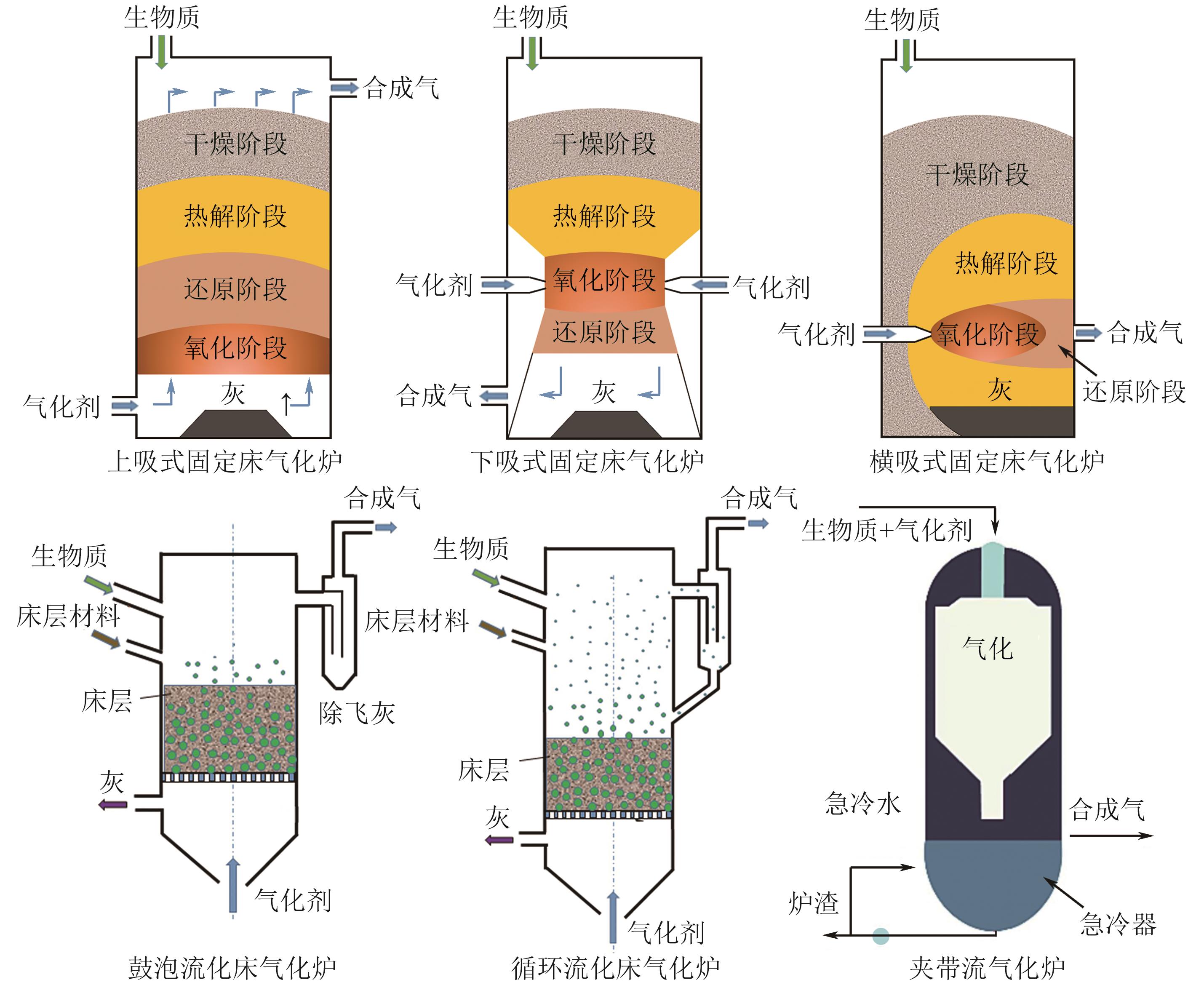
| 气化炉 | 焦油浓度/g·m-3 | 优点 | 缺点 |
|---|---|---|---|
| 上吸式固定床气化炉 | 10~150 | 结构简单、热效率高、可处理高含水率原料 | 气体产率低、启动耗时长、焦油含量高 |
| 下吸式固定床气化炉 | 0.015~0.5 | 结构简单、碳转化率高、焦油含量低 | 热效率低、需要低含水率的原料 |
| 横吸式固定床气化炉 | — | 启动时间短、气化炉高度低 | 热效率低、出口气体温度高 |
| 鼓泡流化床气化炉 | 3~40 | 能适应多种原料、高热负荷、操作灵活 | 对粒径有要求、气体净化需求高 |
| 循环流化床气化炉 | 5~12 | 气化效率高、适应大规模工业化 | 设备投资大,工艺控制难度大 |
| 夹带流气化炉 | 几乎没有 | 高效连续气化、规模大、气体洁净 | 设计和运行复杂,设备投资最高 |
| 气化炉 | 焦油浓度/g·m-3 | 优点 | 缺点 |
|---|---|---|---|
| 上吸式固定床气化炉 | 10~150 | 结构简单、热效率高、可处理高含水率原料 | 气体产率低、启动耗时长、焦油含量高 |
| 下吸式固定床气化炉 | 0.015~0.5 | 结构简单、碳转化率高、焦油含量低 | 热效率低、需要低含水率的原料 |
| 横吸式固定床气化炉 | — | 启动时间短、气化炉高度低 | 热效率低、出口气体温度高 |
| 鼓泡流化床气化炉 | 3~40 | 能适应多种原料、高热负荷、操作灵活 | 对粒径有要求、气体净化需求高 |
| 循环流化床气化炉 | 5~12 | 气化效率高、适应大规模工业化 | 设备投资大,工艺控制难度大 |
| 夹带流气化炉 | 几乎没有 | 高效连续气化、规模大、气体洁净 | 设计和运行复杂,设备投资最高 |
| 催化剂名称 | 主要成分 | 效率/% | 描述 |
|---|---|---|---|
| 白云石 | CaMg(CO3)2 | 40~88[ | 活性高,但机械强度较低,容易磨损 |
| 橄榄石 | (Mg,Fe)2SiO4 | 20~70[ | 机械强度高,活性较低,但可通过活化提高 |
| 镍基催化剂 | Ni,载体(如Al2O3) | 50~99.5[ | 活性高,但易失活,毒性较大 |
| 生物炭催化剂 | 焦炭/负载Ni | 40~94.5[ | 低成本,可再生,活性较低,需要负载金属 |
| 催化剂名称 | 主要成分 | 效率/% | 描述 |
|---|---|---|---|
| 白云石 | CaMg(CO3)2 | 40~88[ | 活性高,但机械强度较低,容易磨损 |
| 橄榄石 | (Mg,Fe)2SiO4 | 20~70[ | 机械强度高,活性较低,但可通过活化提高 |
| 镍基催化剂 | Ni,载体(如Al2O3) | 50~99.5[ | 活性高,但易失活,毒性较大 |
| 生物炭催化剂 | 焦炭/负载Ni | 40~94.5[ | 低成本,可再生,活性较低,需要负载金属 |
| [1] | 解云翔. 中国生物质能发展现状及应用探究[J]. 化学研究, 2022, 33(6): 555-560. |
| XIE Yunxiang. Exploring the current situation and applications of biomass energy development in China[J]. Chemical Research, 2022, 33(6): 555-560. | |
| [2] | International Energy Agency (IEA). Tracking clean energy progress 2023: Assessing critical energy technologies for global clean energy transitions[R]. Paris: IEA, 2023. |
| [3] | BUFFI Marco, PRUSSI Matteo, SCARLAT Nicolae. Energy and environmental assessment of hydrogen from biomass sources: Challenges and perspectives[J]. Biomass and Bioenergy, 2022, 165: 106556. |
| [4] | SANSANIWAL S K, PAL K, ROSEN M A, et al. Recent advances in the development of biomass gasification technology: A comprehensive review[J]. Renewable and Sustainable Energy Reviews, 2017, 72: 363-384. |
| [5] | ABDOULMOUMINE Nourredine, KULKARNI Avanti, ADHIKARI Sushil. Effects of temperature and equivalence ratio on pine syngas primary gases and contaminants in a bench-scale fluidized bed gasifier[J]. Industrial & Engineering Chemistry Research, 2014, 53(14): 5767-5777. |
| [6] | REN Jie, LIU Yiling, ZHAO Xiaoyan, et al. Biomass thermochemical conversion: A review on tar elimination from biomass catalytic gasification[J]. Journal of the Energy Institute, 2020, 93(3): 1083-1098. |
| [7] | MILNE T A, EVANS R J, ABATZOGLOU N. Biomass gasifier “tars”: Their nature, formation, and conversion, NREL/TP-570-25357[R]. US: NERL, 1998. |
| [8] | 李乐豪, 闻光东, 杨启炜, 等. 生物质焦油处理方法研究进展[J]. 化工进展, 2017, 36(7): 2407-2416. |
| LI Lehao, WEN Guangdong, YANG Qiwei, et al. Advance in the treatment methods of biomass tar[J]. Chemical Industry and Engineering Progress, 2017, 36(7): 2407-2416. | |
| [9] | RABOU Luc P L M, ZWART Robin W R, VREUGDENHIL Berend J, et al. Tar in biomass producer gas, the Energy Research Centre of the Netherlands (ECN) experience: An enduring challenge[J]. Energy & Fuels, 2009, 23(12): 6189-6198. |
| [10] | ANIS Samsudin, ZAINAL Z A. Tar reduction in biomass producer gas via mechanical, catalytic and thermal methods: A review[J]. Renewable and Sustainable Energy Reviews, 2011, 15(5): 2355-2377. |
| [11] | JAYANARASIMHAN Ananthanarasimhan, PATHAK Ram Mohan, SHIVAPUJI Anand M, et al. Tar formation in gasification systems: A holistic review of remediation approaches and removal methods[J]. ACS Omega, 2024, 9(2): 2060-2079. |
| [12] | BURHENNE Luisa, MESSMER Jonas, AICHER Thomas, et al. The effect of the biomass components lignin, cellulose and hemicellulose on TGA and fixed bed pyrolysis[J]. Journal of Analytical and Applied Pyrolysis, 2013, 101: 177-184. |
| [13] | LIN Yuchuan, CHO Joungmo, TOMPSETT Geoffrey A, et al. Kinetics and mechanism of cellulose pyrolysis[J]. The Journal of Physical Chemistry C, 2009, 113(46): 20097-20107. |
| [14] | LU Xinyu, GU Xiaoli. A review on lignin pyrolysis: Pyrolytic behavior, mechanism, and relevant upgrading for improving process efficiency[J]. Biotechnology for Biofuels and Bioproducts, 2022, 15(1): 106. |
| [15] | FRENKLACH Michael, WANG Hai. Detailed mechanism and modeling of soot particle formation[M]// Soot Formation in Combustion. Berlin, Heidelberg: Springer Berlin Heidelberg, 1994: 165-192. |
| [16] | FONT PALMA Carolina. Modelling of tar formation and evolution for biomass gasification: A review[J]. Applied Energy, 2013, 111: 129-141. |
| [17] | CORTAZAR M, SANTAMARIA L, LOPEZ G, et al. A comprehensive review of primary strategies for tar removal in biomass gasification[J]. Energy Conversion and Management, 2023, 276: 116496. |
| [18] | SIKARWAR Vineet Singh, ZHAO Ming, CLOUGH Peter, et al. An overview of advances in biomass gasification[J]. Energy & Environmental Science, 2016, 9(10): 2939-2977. |
| [19] | YU Haimiao, WU Zilu, CHEN Geng. Catalytic gasification characteristics of cellulose, hemicellulose and lignin[J]. Renewable Energy, 2018, 121: 559-567. |
| [20] | KONSOMBOON Supatchaya, Jean-Michel COMMANDRÉ, FUKUDA Suneerat. Torrefaction of various biomass feedstocks and its impact on the reduction of tar produced during pyrolysis[J]. Energy & Fuels, 2019, 33(4): 3257-3266. |
| [21] | RAPAGNÀ S, MAZZIOTTI DI CELSO G. Devolatilization of wood particles in a hot fluidized bed: Product yields and conversion rates[J]. Biomass and Bioenergy, 2008, 32(12): 1123-1129. |
| [22] | ELHENAWY Yasser, FOUAD Kareem, MANSI Amr, et al. Experimental analysis and numerical simulation of biomass pyrolysis[J]. Journal of Thermal Analysis and Calorimetry, 2024, 149(19): 10369-10383. |
| [23] | GUO Shuai, WEI Xiao, LI Jian, et al. Experimental study on product gas and tar removal in air-steam gasification of corn straw in a bench-scale internally circulating fluidized bed[J]. Energy & Fuels, 2020, 34(2): 1908-1917. |
| [24] | Arthur JAMES R, YUAN Wenqiao, BOYETTE Michael. The effect of biomass physical properties on top-lit updraft gasification of woodchips[J]. Energies, 2016, 9(4): 283. |
| [25] | PFEIFER Christoph, KOPPATZ Stefan, HOFBAUER Hermann. Steam gasification of various feedstocks at a dual fluidised bed gasifier: Impacts of operation conditions and bed materials[J]. Biomass Conversion and Biorefinery, 2011, 1(1): 39-53. |
| [26] | SCHMID Max, HAFNER Selina, Günter SCHEFFKNECHT. Experimental parameter study on synthesis gas production by steam-oxygen fluidized bed gasification of sewage sludge[J]. Applied Sciences, 2021, 11(2): 579. |
| [27] | CHOI Young-Kon, Ji-Ho KO, KIM Joo-Sik. A new type three-stage gasification of dried sewage sludge: Effects of equivalence ratio, weight ratio of activated carbon to feed, and feed rate on gas composition and tar, NH3, and H2S removal and results of approximately 5h gasification[J]. Energy, 2017, 118: 139-146. |
| [28] | Pavel MILČÁK, Marek BALÁŠ, Martin LISÝ, et al. Digestate and woodchips gasification: A comparison of different gasifying agents[J]. Fuel Processing Technology, 2024, 258: 108091. |
| [29] | ERKIAGA Aitziber, LOPEZ Gartzen, AMUTIO Maider, et al. Influence of operating conditions on the steam gasification of biomass in a conical spouted bed reactor[J]. Chemical Engineering Journal, 2014, 237: 259-267. |
| [30] | PINTO Filomena, Rui ANDRÉ, MIRANDA Miguel, et al. Effect of gasification agent on co-gasification of rice production wastes mixtures[J]. Fuel, 2016, 180: 407-416. |
| [31] | CERONE N, ZIMBARDI F, VILLONE A, et al. Gasification of wood and torrefied wood with air, oxygen, and steam in a fixed-bed pilot plant[J]. Energy & Fuels, 2016, 30(5): 4034-4043. |
| [32] | BERRUECO C, RECARI J, Matas GÜELL B, et al. Pressurized gasification of torrefied woody biomass in a lab scale fluidized bed[J]. Energy, 2014, 70: 68-78. |
| [33] | WIATOWSKI Marian, BASA Wioleta, Magdalena PANKIEWICZ-SPERKA, et al. Experimental study on tar formation during underground coal gasification: Effect of coal rank and gasification pressure on tar yield and chemical composition[J]. Fuel, 2024, 357: 130034. |
| [34] | BEHESHTI S M, GHASSEMI H, SHAHSAVAN-MARKADEH R. Process simulation of biomass gasification in a bubbling fluidized bed reactor[J]. Energy Conversion and Management, 2015, 94: 345-352. |
| [35] | SUSASTRIAWAN A A P, SAPTOADI Harwin, PURNOMO. Small-scale downdraft gasifiers for biomass gasification: A review[J]. Renewable and Sustainable Energy Reviews, 2017, 76: 989-1003. |
| [36] | AKBARIAN Atefeh, ANDOOZ Amirhossein, KOWSARI Elaheh, et al. Challenges and opportunities of lignocellulosic biomass gasification in the path of circular bioeconomy[J]. Bioresource Technology, 2022, 362: 127774. |
| [37] | ASBIK Mohamed, BOUSHAKI Toufik, BELANDRIA Veronica, et al. Suitable thermochemical conversion technology for organic waste recovery in developing countries[M]// Waste Management in Developing Countries. Cham: Springer International Publishing, 2023: 221-251. |
| [38] | SITUMORANG Yohanes Andre, ZHAO Zhongkai, YOSHIDA Akihiro, et al. Small-scale biomass gasification systems for power generation (<200kW class): A review[J]. Renewable and Sustainable Energy Reviews, 2020, 117: 109486. |
| [39] | RAKESH N, DASAPPA S. A critical assessment of tar generated during biomass gasification—Formation, evaluation, issues and mitigation strategies[J]. Renewable and Sustainable Energy Reviews, 2018, 91: 1045-1064. |
| [40] | THOMSON Richard, KWONG Philip, AHMAD Ejaz, et al. Clean syngas from small commercial biomass gasifiers; A review of gasifier development, recent advances and performance evaluation[J]. International Journal of Hydrogen Energy, 2020, 45(41): 21087-21111. |
| [41] | HEIDENREICH Steffen, FOSCOLO Pier Ugo. New concepts in biomass gasification[J]. Progress in Energy and Combustion Science, 2015, 46: 72-95. |
| [42] | CHOPRA S, JAIN A. A review of fixed bed gasification systems for biomass[J]. Agricultural Engineering International: the CIGR Journal, 2007, 9(5): 1-23. |
| [43] | DE Śāntanu, AGARWAL Avinash K, MOHOLKAR V S, et al. Coal and biomass gasification: Recent advances and future challenges[M]// Gas Cleaning and Tar Conversion in Biomass Gasification. Singapore: Springer Nature Singapore, 2018: 151-172. |
| [44] | CHANTHAKETT Apinya, ARIF M T, KHAN M K, et al. Performance assessment of gasification reactors for sustainable management of municipal solid waste[J]. Journal of Environmental Management, 2021, 291: 112661. |
| [45] | SAMIRAN Nor Afzanizam, JAAFAR Mohammad Nazri Mohd, Jo-Han NG, et al. Progress in biomass gasification technique—With focus on Malaysian palm biomass for syngas production[J]. Renewable and Sustainable Energy Reviews, 2016, 62: 1047-1062. |
| [46] | XIAO Ruirui, YANG Wei. Influence of temperature on organic structure of biomass pyrolysis products[J]. Renewable Energy, 2013, 50: 136-141. |
| [47] | MAITLO Ghulamullah, Imran ALI, MANGI Kashif Hussain, et al. Thermochemical conversion of biomass for syngas production: Current status and future trends[J]. Sustainability, 2022, 14(5): 2596. |
| [48] | YAN Beibei, JIA Xiaopeng, LI Jian, et al. In-situ elimination of biomass gasification tar based on the understanding of tar formation process: A review[J]. Journal of the Energy Institute, 2024, 112: 101477. |
| [49] | DIN Zia UD, ZAINAL Z A. Biomass integrated gasification—SOFC systems: Technology overview[J]. Renewable and Sustainable Energy Reviews, 2016, 53: 1356-1376. |
| [50] | REED Thomas B, Agua DAS. Handbook of biomass downdraft gasifier engine systems[M]. Golden, Colo. Solar Technical Information Program, Solar Energy Research Institute, 1988. |
| [51] | ZHAO Yijun, SUN Shaozeng, ZHOU Hao, et al. Experimental study on sawdust air gasification in an entrained-flow reactor[J]. Fuel Processing Technology, 2010, 91(8): 910-914. |
| [52] | DE SALES Cristina Ap Vilas Bôas, MAYA Diego Mauricio Yepes, LORA Electo Eduardo Silva, et al. Experimental study on biomass (Eucalyptus spp.) gasification in a two-stage downdraft reactor by using mixtures of air, saturated steam and oxygen as gasifying agents[J]. Energy Conversion and Management, 2017, 145: 314-323. |
| [53] | SENTHILKUMAR V, PRABHU C. Optimization of design and development of a biomass gasifier—A review[J]. Biofuels, 2024, 15(8): 1079-1097. |
| [54] | RUIZ J A, JUÁREZ M C, MORALES M P, et al. Biomass gasification for electricity generation: Review of current technology barriers[J]. Renewable and Sustainable Energy Reviews, 2013, 18: 174-183. |
| [55] | VARJANI Sunita. Efficient removal of tar employing dolomite catalyst in gasification: Challenges and opportunities[J]. Science of the Total Environment, 2022, 836: 155721. |
| [56] | NARNAWARE S L, PANWAR N L. Catalysts and their role in biomass gasification and tar abetment: A review[J]. Biomass Conversion and Biorefinery, 2021: 1-31. |
| [57] | YIN Fengkui, TREMAIN Priscilla, YU Jianglong, et al. An experimental investigation of the catalytic activity of natural calcium-rich minerals and a novel dual-supported CaO-Ca12Al14O33/Al2O3 catalyst for biotar steam reforming[J]. Energy & Fuels, 2018, 32(4): 4269-4277. |
| [58] | ZHANG Guozhao, LIU Hao, WANG Jia, et al. Catalytic gasification characteristics of rice husk with calcined dolomite[J]. Energy, 2018, 165: 1173-1177. |
| [59] | CHRISTODOULOU Chr, GRIMEKIS D, PANOPOULOS K D, et al. Comparing calcined and un-treated olivine as bed materials for tar reduction in fluidized bed gasification[J]. Fuel Processing Technology, 2014, 124: 275-285. |
| [60] | FURUSAWA Takeshi, SAITO Katsuhiko, KORI Yoshihiko, et al. Steam reforming of naphthalene/benzene with various types of Pt- and Ni-based catalysts for hydrogen production[J]. Fuel, 2013, 103: 111-121. |
| [61] | LI Jianfen, LIU Jianjun, LIAO Shiyan, et al. Hydrogen-rich gas production by air-steam gasification of rice husk using supported nano-NiO/γ-Al2O3 catalyst[J]. International Journal of Hydrogen Energy, 2010, 35(14): 7399-7404. |
| [62] | ZHANG Yu, FENG Dongdong, ZHAO Yijun, et al. Evolution of char structure during in-situ biomass tar reforming: Importance of the coupling effect among the physical-chemical structure of char-based catalysts[J]. Catalysts, 2019, 9(9): 711. |
| [63] | BAI Jing, HE Zheng, YANG Luying, et al. Preparation and characterization of furfural residue derived char-based catalysts for biomass tar cracking[J]. Waste Management, 2024, 179: 182-191. |
| [64] | ZHANG Ruiqin, WANG Yanchang, BROWN Robert C. Steam reforming of tar compounds over Ni/olivine catalysts doped with CeO2 [J]. Energy Conversion and Management, 2007, 48(1): 68-77. |
| [65] | ABEDIN Ashraf, BAI Xinwei, SMITH Mark, et al. Microwave-assisted co-gasification of mixed plastics and corn stover: A synergistic approach to produce clean hydrogen[J]. Energy Conversion and Management, 2023, 280: 116774. |
| [66] | 唐亘炀, 顾菁, 杨秋, 等. 有机固体废弃物化学链气化技术研究进展[J]. 石油学报(石油加工), 2021, 37(3): 700-718. |
| TANG Genyang, GU Jing, YANG Qiu, et al. Research progress in chemical looping gasification technology of organic solid waste[J]. Acta Petrolei Sinica (Petroleum Processing Section), 2021, 37(3): 700-718. | |
| [67] | ZHANG Bo, ZHANG Jing, ZHONG Zhaoping, et al. Syngas production and trace element emissions from microwave-assisted chemical looping gasification of heavy metal hyperaccumulators[J]. Science of the Total Environment, 2019, 659: 612-620. |
| [68] | ZHANG Guoquan, SUN Tianjun, PENG Jiaxi, et al. A comparison of Ni/SiC and Ni/Al2O3 catalyzed total methanation for production of synthetic natural gas[J]. Applied Catalysis A: General, 2013, 462: 75-81. |
| [69] | 顾学红, 周巧巧, 丁阿静, 等. 一种基于膜分离净化的集成式生物质/有机固废转化制合成气方法及装置: CN117701306A[P]. 2024-03-15. |
| [70] | HOTZA Dachamir, DI LUCCIO Marco, WILHELM Michaela, et al. Silicon carbide filters and porous membranes: A review of processing, properties, performance and application[J]. Journal of Membrane Science, 2020, 610: 118193. |
| [1] | LI Junliang, LI Yue, SUN Daolai. Hydrodeoxygenation of 1,2-butanediol to 1-butanol over Cu/SiO2-Al2O3 catalyst [J]. Chemical Industry and Engineering Progress, 2025, 44(S1): 222-231. |
| [2] | LI Ruiying, ZHOU Ying, ZHOU Hongjun, XU Chunming. Biomass-derived nano-carbon-based materials: Opportunities and challenges in electrochemical applications [J]. Chemical Industry and Engineering Progress, 2025, 44(S1): 288-306. |
| [3] | HONG Kang, ZHANG Chong, MA Hongli, SUN Yongrong, JIANG Liqun, BAO Guirong. Research progress of biomass hard charcoal as an anode material for sodium-ion batteries [J]. Chemical Industry and Engineering Progress, 2025, 44(S1): 340-349. |
| [4] | ZHANG Wenjing, HUANG Zhixin, LI Shiteng, DENG Shuai, LI Shuangjun. Biomass carbon aerogels for CO2 adsorbents [J]. Chemical Industry and Engineering Progress, 2025, 44(9): 5018-5032. |
| [5] | LI Zhifu, YANG Xiaodong, WANG Baocai, HU Changliu, PEI Jikai, YAN Longfang, WU Ruifang, ZHANG Changsheng, WANG Yongzhao. Synthesis and properties of high temperature retarder HJ-1 [J]. Chemical Industry and Engineering Progress, 2025, 44(9): 5092-5100. |
| [6] | JIANG Chunxi, LIN Dingbiao, BIAN Yao, ZHOU Wei, LU Haifeng, GUO Xiaolei, LIU Haifeng. Characteristics of rice husk as entrained-flow bed gasification feedstock and their impact on the process [J]. Chemical Industry and Engineering Progress, 2025, 44(9): 4937-4944. |
| [7] | YANG Lanmei, XU Bin, LIU Huacai, YANG Wenshen, YIN Xiuli, WU Chuangzhi. Characterization of tar partial oxidative reforming by dielectric barrier discharge using mixed toluene and benzene as model compounds [J]. Chemical Industry and Engineering Progress, 2025, 44(7): 3869-3878. |
| [8] | ZHANG Jian, LIN Rihui, YIN Jianglin, LI Yanzi, FU Yulu, LIU Xiaoxia. Dry pretreatment of sugarcane trash and preparation and characterization of its acetylated products [J]. Chemical Industry and Engineering Progress, 2025, 44(7): 3997-4005. |
| [9] | ZHANG Jiazheng, MAO Yanpeng, WEI Guangshuo, PANG Dongjie, XU Jian, DONG Jingyi, WANG Xujiang, LI Jingwei, WANG Wenlong. Co-processing technology for utilizing coal gasification slag as an alternative fuel in cement kilns [J]. Chemical Industry and Engineering Progress, 2025, 44(7): 4202-4211. |
| [10] | MI Yifang, WANG Baoguo, WANG Wenqiang, SUN Guojin, CAO Zhihai. Preparation of nitrogen self-doped cyanobacterial biomass-based activated carbon for CO2 adsorption [J]. Chemical Industry and Engineering Progress, 2025, 44(7): 4223-4232. |
| [11] | MA Jing, MA Yulong, ZHU Li, QIAO Song, SUN Yonggang, JI Wenxin. Activation of silica-aluminium minerals of coal gasification coarse slag by different methods [J]. Chemical Industry and Engineering Progress, 2025, 44(7): 4251-4266. |
| [12] | XU Zhicheng, GAO Ningbo, QUAN Cui, SONG Qingbin. Research progress on synergistic catalytic conversion of biomass gasification tar by non-thermal plasma [J]. Chemical Industry and Engineering Progress, 2025, 44(6): 3432-3442. |
| [13] | WU Yali, ZHANG Xiaolin, GAO Limin, HUANG Maocai, CAI Bin, ZHANG Jibing. Technical progress in resource utilization of straw powder/fiber [J]. Chemical Industry and Engineering Progress, 2025, 44(6): 3509-3523. |
| [14] | CAO Xianghong, ZHOU Feng, JIANG Rui, LIU Shizhe, FANG Xiangchen, KANG Wanzhong, QIAO Jinliang, NIE Hong. Strategies to accelerate the development of China's bio-based materials industry [J]. Chemical Industry and Engineering Progress, 2025, 44(5): 2385-2393. |
| [15] | JIANG Qiyi, DENG Xinyue, YUAN Yanting, ZHANG Yaqian, YANG Min, LI Weina, FAN Daidi. Advances in engineering design, optimization and application of targeted therapeutic proteins and peptides [J]. Chemical Industry and Engineering Progress, 2025, 44(5): 2407-2420. |
| Viewed | ||||||
|
Full text |
|
|||||
|
Abstract |
|
|||||