化工进展 ›› 2024, Vol. 43 ›› Issue (8): 4187-4202.DOI: 10.16085/j.issn.1000-6613.2023-1133
• 化工过程与装备 • 上一篇
叶片式分离元件结构及性能影响因素研究进展
焦文磊( ), 刘震(), 陈俊先, 张天钰, 姬忠礼
- 中国石油大学(北京)机械与储运工程学院,过程流体过滤与分离技术北京市重点实验室,北京 102249
-
收稿日期:2023-07-07修回日期:2023-09-20出版日期:2024-08-15发布日期:2024-09-02 -
通讯作者:刘震 -
作者简介:焦文磊(1997—),男,硕士研究生,研究方向为多相流分离。E-mail:15264699594@163.com。 -
基金资助:国家自然科学基金(51904315);中国石油天然气股份有限公司重大科技攻关项目(2019E-2505);国家重点研发计划(2021YFB3801304)
Structure and performance influencing factors of vane separation components: The reviews
JIAO Wenlei(), LIU Zhen(), CHEN Junxian, ZHANG Tianyu, JI Zhongli
- Beijing Key Laboratory of Process Fluid Filtration and Seperation, School of Mechanical and Transportation Engineering, China University of Petroleum, Beijing 102249, China
-
Received:2023-07-07Revised:2023-09-20Online:2024-08-15Published:2024-09-02 -
Contact:LIU Zhen

摘要:
叶片式分离元件是一种主要依靠惯性进行气液分离的元件,因其高处理量、高分离效率和低压降的特点而广泛应用于气液分离领域。本文从叶片式分离元件分离机理、结构及性能影响因素两个方面进行了详细的调研。论述了叶片流道内的液滴惯性分离、液滴撞击以及液膜破裂导致的二次夹带问题等分离机理研究进展,从机理层面分析了二次夹带现象的成因并提出了抑制思路。归纳了叶片式气液分离元件的主要结构特征,分析了曲级数、弯折角度、间距以及疏水钩等结构参数对分离性能的具体影响。通过对比现有不同叶片结构的优缺点与适用场合,提出了增加拦截面积及开辟排液通道的叶片结构设计优化方向。分析了波形板叶片式分离元件及静态起旋转元件的应用现状,为叶片式气液分离技术应用选择及优化提供了参考。归纳了气流速度、压力以及入口湿度等操作工况对波形板叶片式分离元件性能的内在影响规律。最后,结合分离机理、结构研究与性能影响规律对波形板叶片式分离元件的结构设计与性能优化方向进行了总结与展望。
中图分类号:
引用本文
焦文磊, 刘震, 陈俊先, 张天钰, 姬忠礼. 叶片式分离元件结构及性能影响因素研究进展[J]. 化工进展, 2024, 43(8): 4187-4202.
JIAO Wenlei, LIU Zhen, CHEN Junxian, ZHANG Tianyu, JI Zhongli. Structure and performance influencing factors of vane separation components: The reviews[J]. Chemical Industry and Engineering Progress, 2024, 43(8): 4187-4202.
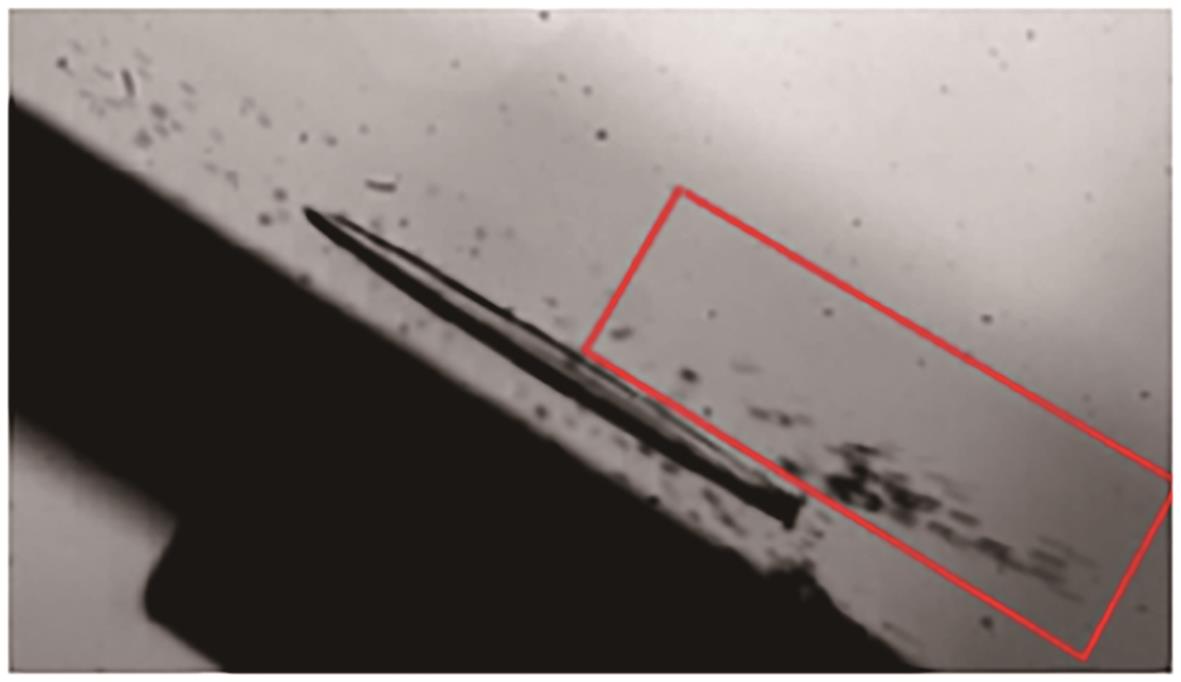
图1 液滴撞击壁面产生二次液滴的过程[18]

图2 液滴以不同速度、角度撞击叶片壁面[14]
| 相关研究 | 液滴参数 | 撞击参数 | 壁面类型 | 研究参数 |
|---|---|---|---|---|
| Chen等[ | 乙醇;液滴直径1.95~2.05mm | 接触角为15°~45° | 不锈钢表面;液膜厚度为75~109µm | 倾斜角度的增加有利于抑制飞溅;当倾角相同时,We对液滴扩散因子影响不大 |
| Ru等[ | 平均粒径224~600µm | 入射速度1m/s | 不锈钢表面 | 液滴最大扩散因子半经验公式: |
| Tang等[ | 水、癸烷、乙醇和十四烷;液滴直径1.9mm | 雷诺数为858~4290 | 不锈钢表面;不同粗糙度(Ra=0.025~6.3µm) | 最大归一化扩展直径: |
| Sikalo等[ | 水、异丙醇(C3H8O)、甘油(85%溶液);液滴直径1.8~3.3mm | 接触角为0°~105° 雷诺数为27~8880 | 光滑玻璃、粗糙玻璃、光滑石蜡;干表面/湿表面、液膜厚度为40~100µm | 在较低角度和光滑或湿润表面易发生反弹;低黏性液滴会反弹或沉积在光滑或湿润表面;高黏度液滴也可能分解出小液滴,具体取决于撞击角度 |
| 樊玉光等[ | 水、甘油(70%);液滴直径50~100µm | 接触角为36°~90° | 液膜厚度为2.5mm | 入射角度30°~90°,飞溅的临界We增大 |
表1 液滴撞击壁面的相关研究
| 相关研究 | 液滴参数 | 撞击参数 | 壁面类型 | 研究参数 |
|---|---|---|---|---|
| Chen等[ | 乙醇;液滴直径1.95~2.05mm | 接触角为15°~45° | 不锈钢表面;液膜厚度为75~109µm | 倾斜角度的增加有利于抑制飞溅;当倾角相同时,We对液滴扩散因子影响不大 |
| Ru等[ | 平均粒径224~600µm | 入射速度1m/s | 不锈钢表面 | 液滴最大扩散因子半经验公式: |
| Tang等[ | 水、癸烷、乙醇和十四烷;液滴直径1.9mm | 雷诺数为858~4290 | 不锈钢表面;不同粗糙度(Ra=0.025~6.3µm) | 最大归一化扩展直径: |
| Sikalo等[ | 水、异丙醇(C3H8O)、甘油(85%溶液);液滴直径1.8~3.3mm | 接触角为0°~105° 雷诺数为27~8880 | 光滑玻璃、粗糙玻璃、光滑石蜡;干表面/湿表面、液膜厚度为40~100µm | 在较低角度和光滑或湿润表面易发生反弹;低黏性液滴会反弹或沉积在光滑或湿润表面;高黏度液滴也可能分解出小液滴,具体取决于撞击角度 |
| 樊玉光等[ | 水、甘油(70%);液滴直径50~100µm | 接触角为36°~90° | 液膜厚度为2.5mm | 入射角度30°~90°,飞溅的临界We增大 |
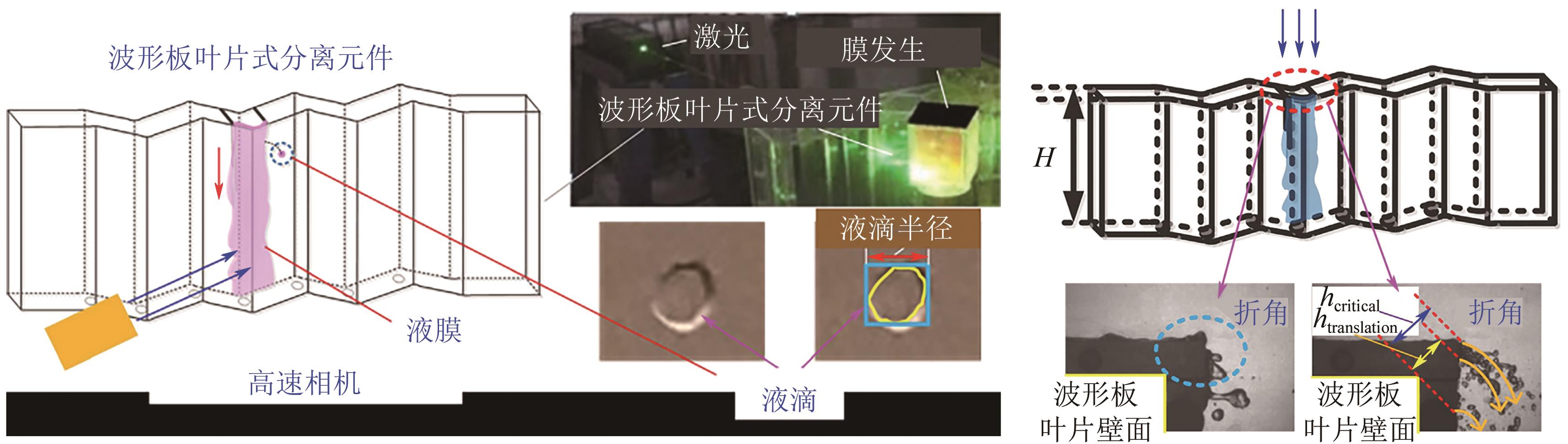
图3 叶片折角部分液膜破裂产生二次液滴的过程[22]
| 相关研究 | 液膜 材料 | 液膜破裂及二次液滴描述 | 适用范围 | |
|---|---|---|---|---|
| Samenfink等[ | 蒸馏水 | 沉积质量分数: | 二次液滴角度: 直径分布: | 1.0<sd<5.0 0.3<h* <3.0 |
| Mao等[ | 含有 荧光剂的水 | 厚度与气流速度关系: | 液膜厚度半经验公式: | 基于三个固定测量位置(46mm、60mm、80mm) |
| Wang等[ | 含有 荧光剂的水 | 水膜击穿的量纲为1临界条件: | 液膜雷诺数与气流韦伯数: | 水膜厚度0.574~1.64mm以上 |
| Wang等[ | 水 | 水膜破裂临界气流速度: 水膜厚度半经验公式: | Re<4055 忽略重力 | |
| Wang等[ | 水 | 临界气流速度: | 层流 | |
| Wang等[ | 含有 荧光剂的水 | 液膜破裂相对高度: | 二次液滴粒径: | Re<2788 中小雷诺数区域 |
| Wang等[ | 含有 荧光剂的水 | 条形液膜夹角经验公式: | Re=1997~4055 | |
| Zeng等[ | 水 | 液膜临界破裂速度: | Re=8640~25900 | |
表2 叶片式分离元件壁面液膜破裂条件及理论公式
| 相关研究 | 液膜 材料 | 液膜破裂及二次液滴描述 | 适用范围 | |
|---|---|---|---|---|
| Samenfink等[ | 蒸馏水 | 沉积质量分数: | 二次液滴角度: 直径分布: | 1.0<sd<5.0 0.3<h* <3.0 |
| Mao等[ | 含有 荧光剂的水 | 厚度与气流速度关系: | 液膜厚度半经验公式: | 基于三个固定测量位置(46mm、60mm、80mm) |
| Wang等[ | 含有 荧光剂的水 | 水膜击穿的量纲为1临界条件: | 液膜雷诺数与气流韦伯数: | 水膜厚度0.574~1.64mm以上 |
| Wang等[ | 水 | 水膜破裂临界气流速度: 水膜厚度半经验公式: | Re<4055 忽略重力 | |
| Wang等[ | 水 | 临界气流速度: | 层流 | |
| Wang等[ | 含有 荧光剂的水 | 液膜破裂相对高度: | 二次液滴粒径: | Re<2788 中小雷诺数区域 |
| Wang等[ | 含有 荧光剂的水 | 条形液膜夹角经验公式: | Re=1997~4055 | |
| Zeng等[ | 水 | 液膜临界破裂速度: | Re=8640~25900 | |

图4 基础结构波形板叶片式分离元件
| 基础结构 | 增强结构的主要功能 | 性能表现 | 参考文献 | ||
|---|---|---|---|---|---|
| 增强捕集 | 降低压损 | 增强疏水 | |||
| 折线形 | — | — | — | 压降较低 | [ |
| — | 开孔/槽 | 双层叶片 | 对粒径10μm液滴具有较高的捕集效率 | [ | |
| 凹槽 | — | — | 可以提高粒径小于20μm液滴的去除效率,压降较高 | [ | |
| 单疏水钩 | — | — | 对于粒径8μm以上的液滴去除效率可以达到90%以上,压降在37~415Pa | [ | |
| 开孔/槽 | 疏水钩 | 降低压损、提高捕集效率。气速5.5m/s效率最高,可达到90%以上 | [ | ||
| 双疏水钩 | — | — | 对于粒径8μm液滴可以达到90%的分离效率 | [ | |
| 开孔/槽 | 疏水钩 | 保证捕集面积的同时减少压损,保证排液,减少二次夹带 | |||
| 多孔材料 | — | — | 可以提高临界气速度(4~5m/s),减少二次夹带 | [ | |
| 疏水钩 | — | 表面改性 | 气速超过5m/s后壁面液膜厚度减小,分离效率下降程度减小 | [ | |
| 流线形 | — | — | — | 粒径25μm液滴的分离效率80%以上,压降10~30Pa(2.5~6m/s) | [ |
| 单疏水钩 | — | 疏水钩 | 对粒径10μm液滴分离效率为65%,粒径20μm液滴分离效率可以达到90%以上 | [ | |
| 双疏水钩 | — | 疏水钩 | 压降10~150Pa(1~6m/s),临界气速度较无钩型提高28%(3~4m/s与4~5m/s) | [ | |
| — | — | 降膜流动 | 接触角越小,浸润面积越大 | [ | |
| 梯形 | — | — | — | 压降10~90Pa(2~7m/s),气速为2m/s时,粒径26μm的液滴100%收集 | [ |
| 双疏水钩 | — | 疏水钩 | 减少二次夹带,增强排液,增大气体容量 | ||
| Ω形 | — | — | — | 20~320Pa(2~8m/s),叶片间距18.2mm时,平均效率在90%以上 | [ |
表3 波形板叶片式分离元件结构及研究方向
| 基础结构 | 增强结构的主要功能 | 性能表现 | 参考文献 | ||
|---|---|---|---|---|---|
| 增强捕集 | 降低压损 | 增强疏水 | |||
| 折线形 | — | — | — | 压降较低 | [ |
| — | 开孔/槽 | 双层叶片 | 对粒径10μm液滴具有较高的捕集效率 | [ | |
| 凹槽 | — | — | 可以提高粒径小于20μm液滴的去除效率,压降较高 | [ | |
| 单疏水钩 | — | — | 对于粒径8μm以上的液滴去除效率可以达到90%以上,压降在37~415Pa | [ | |
| 开孔/槽 | 疏水钩 | 降低压损、提高捕集效率。气速5.5m/s效率最高,可达到90%以上 | [ | ||
| 双疏水钩 | — | — | 对于粒径8μm液滴可以达到90%的分离效率 | [ | |
| 开孔/槽 | 疏水钩 | 保证捕集面积的同时减少压损,保证排液,减少二次夹带 | |||
| 多孔材料 | — | — | 可以提高临界气速度(4~5m/s),减少二次夹带 | [ | |
| 疏水钩 | — | 表面改性 | 气速超过5m/s后壁面液膜厚度减小,分离效率下降程度减小 | [ | |
| 流线形 | — | — | — | 粒径25μm液滴的分离效率80%以上,压降10~30Pa(2.5~6m/s) | [ |
| 单疏水钩 | — | 疏水钩 | 对粒径10μm液滴分离效率为65%,粒径20μm液滴分离效率可以达到90%以上 | [ | |
| 双疏水钩 | — | 疏水钩 | 压降10~150Pa(1~6m/s),临界气速度较无钩型提高28%(3~4m/s与4~5m/s) | [ | |
| — | — | 降膜流动 | 接触角越小,浸润面积越大 | [ | |
| 梯形 | — | — | — | 压降10~90Pa(2~7m/s),气速为2m/s时,粒径26μm的液滴100%收集 | [ |
| 双疏水钩 | — | 疏水钩 | 减少二次夹带,增强排液,增大气体容量 | ||
| Ω形 | — | — | — | 20~320Pa(2~8m/s),叶片间距18.2mm时,平均效率在90%以上 | [ |
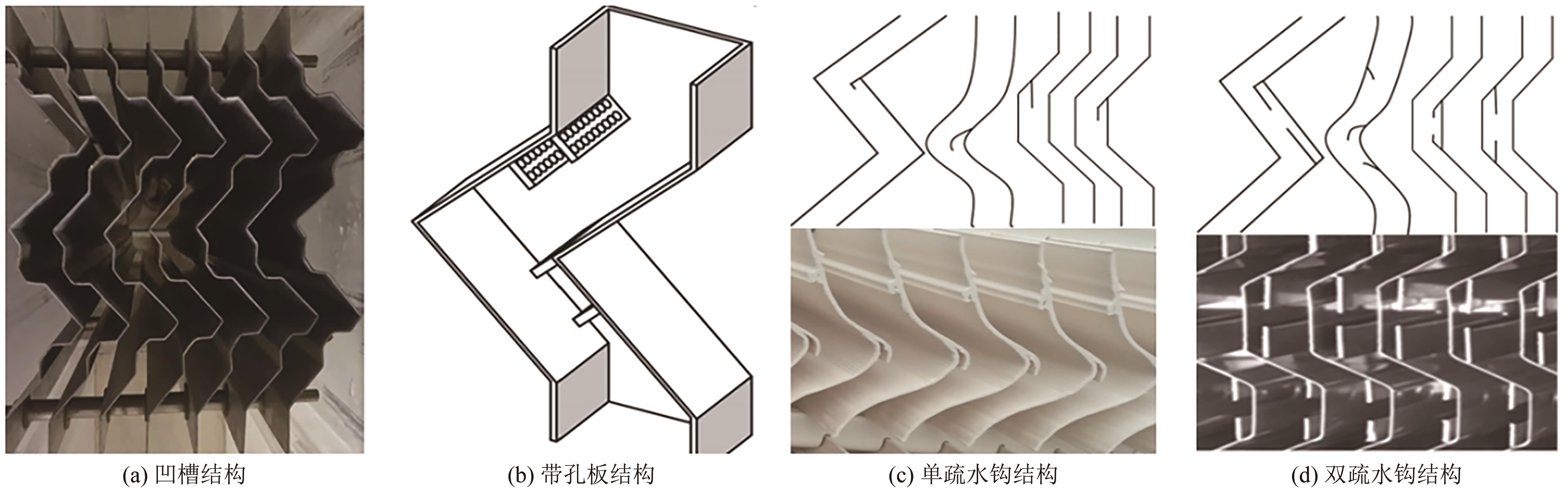
图5 增强结构波形板叶片式分离元件
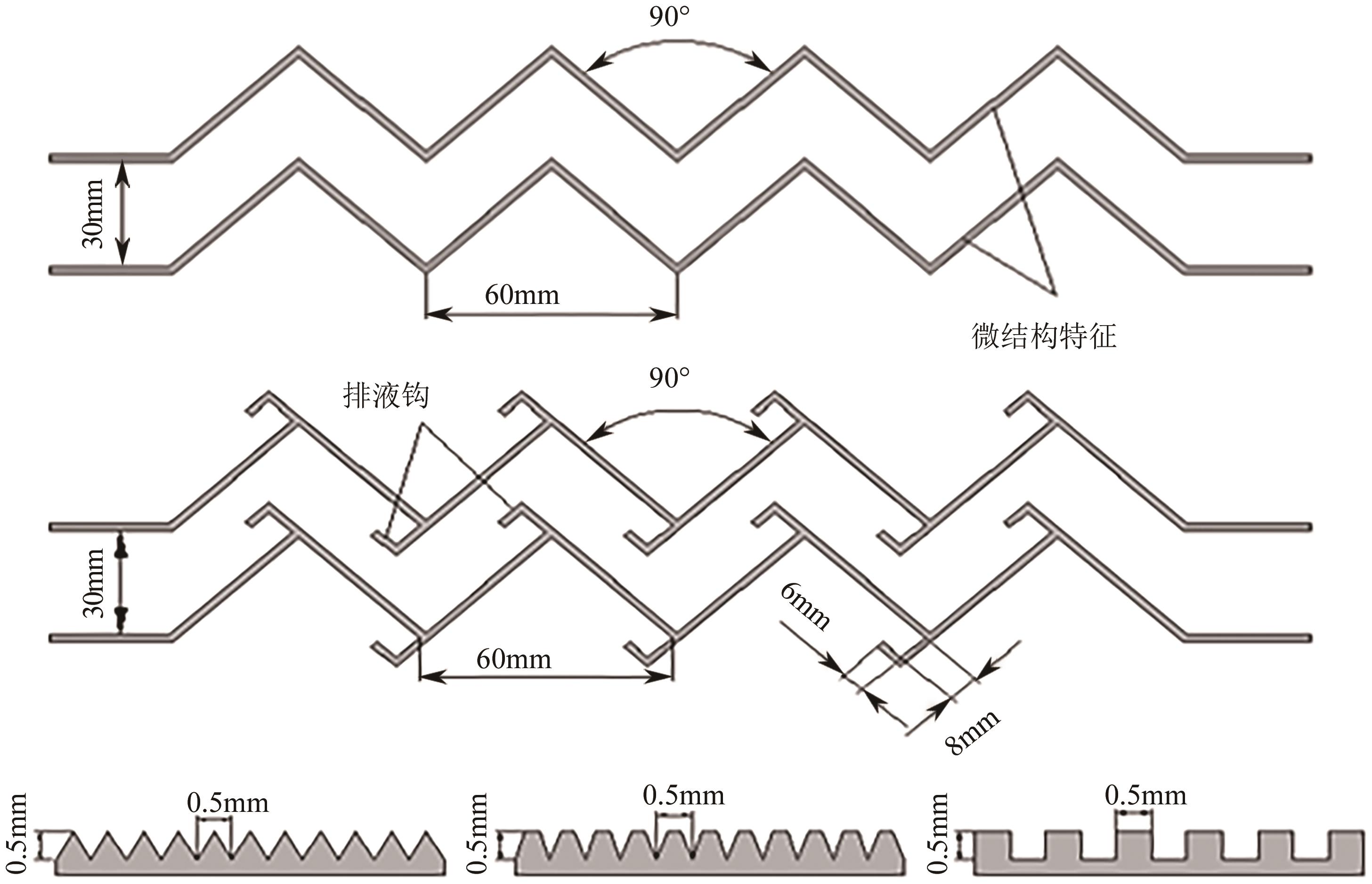
图6 表面结构改性的叶片式分离元件[52]
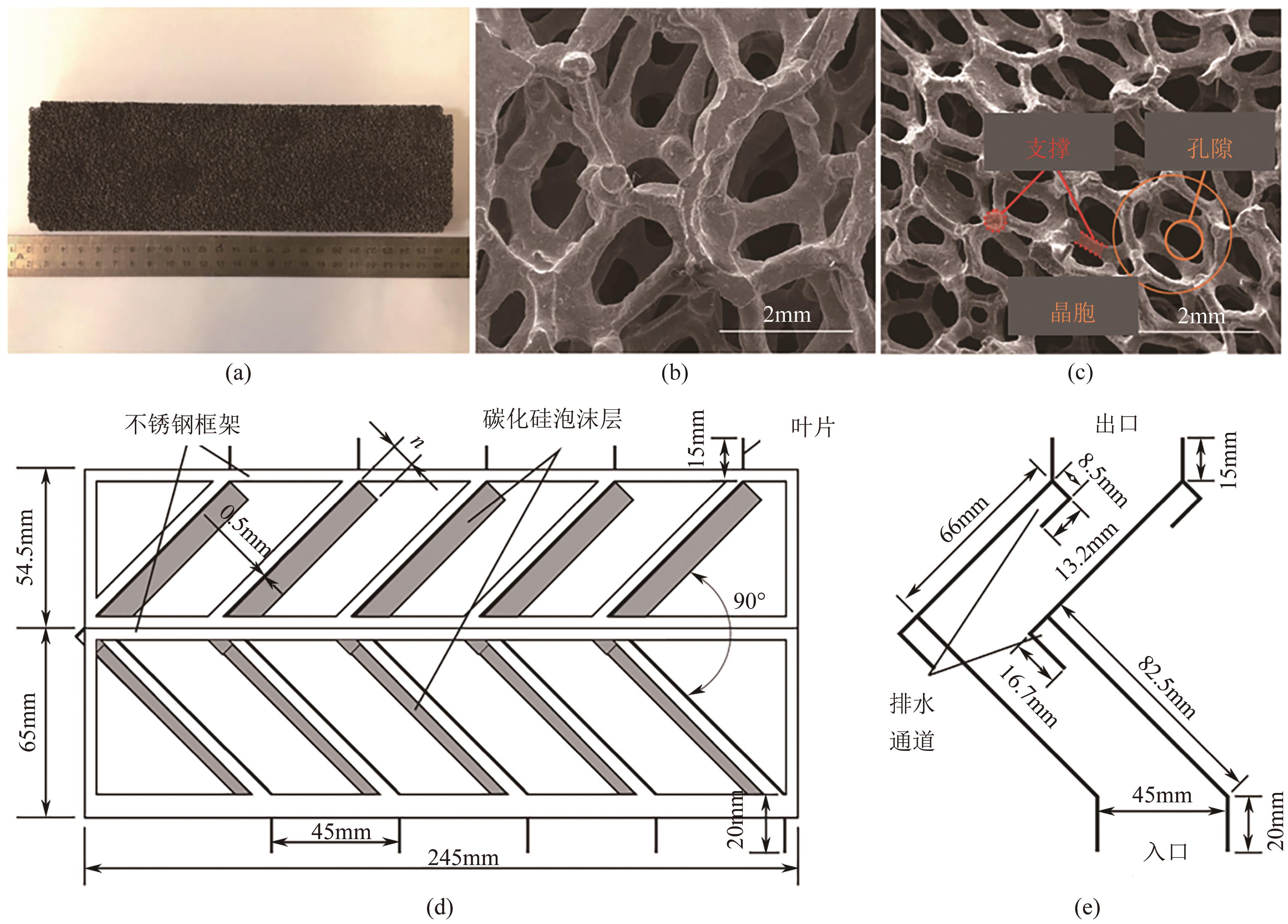
图7 耦合多孔介质的叶片式分离元件[67]
| 结构类型 | 结构参数 | 分离性能的影响 | 参考文献 |
|---|---|---|---|
| 折线形/单钩型 | 疏水钩、叶片间距 | 沿程液滴尺寸有减小的趋势,当加入疏水钩时减小的速率更大,当叶片间距变大时减小变得更慢;气速分别为2.96m/s、4.14m/s、6m/s、8m/s时,折线形入口和出口之间的液滴尺寸减小8%、14%、22%、28%,而带疏水钩的分别减小50%、57%、64%和69% | [ |
| 折线形、单钩型、双钩型 | 疏水钩数量 叶片间距12mm、14mm、16mm、18mm、20mm | 分离效率随着间距的增加而减小,间距相同时单钩效率最高,折线形最低;随着间距增加,压降减小,但达到某一值后下降幅度不明显;带疏水钩结构比无疏水钩结构下降幅度更大 | [ |
| 流线形/单钩型 | 疏水钩 横向间距30mm、20mm | 带有疏水钩结构在相同条件下效率高于无疏水钩结构,压降也会更高;较小的间距分离效率和压力损失较高 | [ |
| 带排液槽结构叶片 | 排液槽高度260mm、200mm 挡板数量1、3 | 挡板数量相同时,排液槽高度越高,分离性能反而下降;排液挡板数量的增加会使得临界分离气速升高;挡板数量增加会使得压降增大,排液槽高度对压降影响不大 | [ |
| 单钩型 | 钩板高度1~15mm、长度 0~9mm、夹角-9°~9° | 分离效率随钩板高度的增加而增加;β>0时,分离效率随钩板长度的增加而减小;β=0时,分离效率随钩板长度的增加而先增加后减小;β<0时,分离效率随着钩板长度的增加而增加;压降随着钩板高度的增加而增加,随着钩板长度的增加而减小,随着角度的增加而减小 | [ |
| 流线形/单钩型 | 弯曲级数;弯曲波长 | 弯曲级数增加,液滴去除效率增加,压降增大;具有较小弯曲波长的叶片(λ/s=2.37)比更大的波长分离效率、压降更高,大波长(λ/s>7.11)叶片,量纲为1的波长增加对分离效率和压降影响不大 | [ |
| 单钩型 | 弯折曲率 | 在一定折角曲率条件下,有助于减少带疏水钩结构叶片的压力损失 | [ |
| 带孔板结构 | 穿孔板间距、数量、厚度、孔隙率、安装角、孔板高度 | 孔板数较少时,捕集效率较高但压损大,随着孔板数量增加,会形成滞流区;板间距较大(15mm)时,捕集能力减弱;孔板厚度对分离效率影响较小,增加厚度,去除效率略微提升,但压损增大;随着孔间距增加(孔隙率降低),整体收集效率提高;压降先增大后减小;随着孔板率增加,效率降低,压降减小并逐渐达到平衡;捕集效率和压降随着安装角度的增大而不断减小,捕集效率随孔板高度的增加而小幅增加 | [ |
表4 结构参数对波形板叶片式分离元件分离性能的影响
| 结构类型 | 结构参数 | 分离性能的影响 | 参考文献 |
|---|---|---|---|
| 折线形/单钩型 | 疏水钩、叶片间距 | 沿程液滴尺寸有减小的趋势,当加入疏水钩时减小的速率更大,当叶片间距变大时减小变得更慢;气速分别为2.96m/s、4.14m/s、6m/s、8m/s时,折线形入口和出口之间的液滴尺寸减小8%、14%、22%、28%,而带疏水钩的分别减小50%、57%、64%和69% | [ |
| 折线形、单钩型、双钩型 | 疏水钩数量 叶片间距12mm、14mm、16mm、18mm、20mm | 分离效率随着间距的增加而减小,间距相同时单钩效率最高,折线形最低;随着间距增加,压降减小,但达到某一值后下降幅度不明显;带疏水钩结构比无疏水钩结构下降幅度更大 | [ |
| 流线形/单钩型 | 疏水钩 横向间距30mm、20mm | 带有疏水钩结构在相同条件下效率高于无疏水钩结构,压降也会更高;较小的间距分离效率和压力损失较高 | [ |
| 带排液槽结构叶片 | 排液槽高度260mm、200mm 挡板数量1、3 | 挡板数量相同时,排液槽高度越高,分离性能反而下降;排液挡板数量的增加会使得临界分离气速升高;挡板数量增加会使得压降增大,排液槽高度对压降影响不大 | [ |
| 单钩型 | 钩板高度1~15mm、长度 0~9mm、夹角-9°~9° | 分离效率随钩板高度的增加而增加;β>0时,分离效率随钩板长度的增加而减小;β=0时,分离效率随钩板长度的增加而先增加后减小;β<0时,分离效率随着钩板长度的增加而增加;压降随着钩板高度的增加而增加,随着钩板长度的增加而减小,随着角度的增加而减小 | [ |
| 流线形/单钩型 | 弯曲级数;弯曲波长 | 弯曲级数增加,液滴去除效率增加,压降增大;具有较小弯曲波长的叶片(λ/s=2.37)比更大的波长分离效率、压降更高,大波长(λ/s>7.11)叶片,量纲为1的波长增加对分离效率和压降影响不大 | [ |
| 单钩型 | 弯折曲率 | 在一定折角曲率条件下,有助于减少带疏水钩结构叶片的压力损失 | [ |
| 带孔板结构 | 穿孔板间距、数量、厚度、孔隙率、安装角、孔板高度 | 孔板数较少时,捕集效率较高但压损大,随着孔板数量增加,会形成滞流区;板间距较大(15mm)时,捕集能力减弱;孔板厚度对分离效率影响较小,增加厚度,去除效率略微提升,但压损增大;随着孔间距增加(孔隙率降低),整体收集效率提高;压降先增大后减小;随着孔板率增加,效率降低,压降减小并逐渐达到平衡;捕集效率和压降随着安装角度的增大而不断减小,捕集效率随孔板高度的增加而小幅增加 | [ |
| 公司单位 | 结构形式 | 分离参数 | 应用场景 |
|---|---|---|---|
| CECO Peerless | 单钩型 | >8μm(100%) | 小容量 |
| Ensepatec | 折线型&疏水槽 | 4.5m/s,气体处理量±30% | 洗涤器、蒸发器 |
| 单钩型/双钩型 | 8~20μm(99.9%) | 液气比>30 | |
| Koch-Glitsch | 梯型&底部排液孔 | 10~40μm;100~872Pa | 黏性液体、高液体负载 |
| 单钩型&疏水槽 | 高压、大容量 | ||
| 双钩型 | 高压、大容量 | ||
| Sulzer | 梯型 | K=0.17m/s;30~40μm | 高黏度流体 |
| 折线型 | K=0.14m/s;25μm | ||
| 单钩型 | K=0.35m/s;25~30μm/35~40μm | 高效气液分离、高黏度易结垢 | |
| 双钩型&疏水孔 | K=0.17~0.45m/s;10~15μm | ||
| AMACS | 梯型 | 20μm(90%),40μm(99.9%);K=0.076~0.351m/s 77.7~1476.38Pa;气体处理范围30%~110% | 丝网后端以提高液体容量、蒸馏塔 |
| 梯型&双钩&疏水槽 |
表5 叶片式分离元件技术现状
| 公司单位 | 结构形式 | 分离参数 | 应用场景 |
|---|---|---|---|
| CECO Peerless | 单钩型 | >8μm(100%) | 小容量 |
| Ensepatec | 折线型&疏水槽 | 4.5m/s,气体处理量±30% | 洗涤器、蒸发器 |
| 单钩型/双钩型 | 8~20μm(99.9%) | 液气比>30 | |
| Koch-Glitsch | 梯型&底部排液孔 | 10~40μm;100~872Pa | 黏性液体、高液体负载 |
| 单钩型&疏水槽 | 高压、大容量 | ||
| 双钩型 | 高压、大容量 | ||
| Sulzer | 梯型 | K=0.17m/s;30~40μm | 高黏度流体 |
| 折线型 | K=0.14m/s;25μm | ||
| 单钩型 | K=0.35m/s;25~30μm/35~40μm | 高效气液分离、高黏度易结垢 | |
| 双钩型&疏水孔 | K=0.17~0.45m/s;10~15μm | ||
| AMACS | 梯型 | 20μm(90%),40μm(99.9%);K=0.076~0.351m/s 77.7~1476.38Pa;气体处理范围30%~110% | 丝网后端以提高液体容量、蒸馏塔 |
| 梯型&双钩&疏水槽 |
| 研究单位 | 结构形式 | 分离性能 | 应用场景 |
|---|---|---|---|
| 美国FMC Technologies公司管式相分离器[ | 分流器、叶片、分离段、气体抽出口、气相及液相出口 | 单级分离,结构简单,但变工况时稳定性较差 | 入口含气率范围为0.5~0.9 |
| 挪威国家石油公司(Statoil) CompactSepTM系统[ | GLCC分离器、管式脱气器和(或)管式脱液器串联 | 分离效果较好,但控制复杂,且二级分离易受一级分离干扰 | 入口含气率范围为0.15~0.6 |
| 哈尔滨工程大学管式气液分离器[ | 多级旋流元件串联、竖直方式 | 分离效率较高,但相同条件下处理液量较低 | 入口含气率范围0.05~0.9 |
表6 大气液比管式分离器技术现状
| 研究单位 | 结构形式 | 分离性能 | 应用场景 |
|---|---|---|---|
| 美国FMC Technologies公司管式相分离器[ | 分流器、叶片、分离段、气体抽出口、气相及液相出口 | 单级分离,结构简单,但变工况时稳定性较差 | 入口含气率范围为0.5~0.9 |
| 挪威国家石油公司(Statoil) CompactSepTM系统[ | GLCC分离器、管式脱气器和(或)管式脱液器串联 | 分离效果较好,但控制复杂,且二级分离易受一级分离干扰 | 入口含气率范围为0.15~0.6 |
| 哈尔滨工程大学管式气液分离器[ | 多级旋流元件串联、竖直方式 | 分离效率较高,但相同条件下处理液量较低 | 入口含气率范围0.05~0.9 |
| 相关研究 | 操作工况 | 研究结果 |
|---|---|---|
| Tang等[ | 2~4m/s;液滴尺寸3.4~13.5μm | 在接近完全分离之前,随着液滴尺寸的增加,分离效率呈上升趋势 |
| 徐旭辉等[ | 入口湿度30%~60% 雷诺数60000~180000 常温常压 | 出口湿度随入口湿度的增加和雷诺数的增加呈增长状态;当入口湿度和雷诺数较低时,出口湿度变化平缓;而当入口湿度和雷诺数较高时,出口湿度较高,变化幅度较大 |
| Song等[ | 2.5~6m/s;粒径分布;常压 | 当液滴直径小于4μm时,分级效率异常的高,发生“鱼钩”效应;小于5μm的液滴出口处液滴质量浓度高于入口,表明发生液滴再夹带 |
| Li等[ | 2~8m/s 0.101MPa,20℃(常温常压) 7MPa,286℃(高温高压) | 分离效率随着气速先增加后减小;随着粒径增大,分级效率显著提高;临界分离粒径随着气速增加而减小。在高温、高压条件下,临界分离粒径增大。 |
| Koopman等[ | 1~19m/s;液体质量分数 2%~9%常温常压 | 带圆孔排液结构的叶片效率随着液滴质量分数的增加而提高,而压降受液滴质量分数的影响不大 |
| Li等[ | 4~12m/s;入口湿度6%、8%常温常压 | 入口湿度差在2%以内时对临界分离气速影响不明显;其他条件相同时,入口湿度越大,效率越高 |
表7 不同工况对叶片式分离元件分离性能的影响
| 相关研究 | 操作工况 | 研究结果 |
|---|---|---|
| Tang等[ | 2~4m/s;液滴尺寸3.4~13.5μm | 在接近完全分离之前,随着液滴尺寸的增加,分离效率呈上升趋势 |
| 徐旭辉等[ | 入口湿度30%~60% 雷诺数60000~180000 常温常压 | 出口湿度随入口湿度的增加和雷诺数的增加呈增长状态;当入口湿度和雷诺数较低时,出口湿度变化平缓;而当入口湿度和雷诺数较高时,出口湿度较高,变化幅度较大 |
| Song等[ | 2.5~6m/s;粒径分布;常压 | 当液滴直径小于4μm时,分级效率异常的高,发生“鱼钩”效应;小于5μm的液滴出口处液滴质量浓度高于入口,表明发生液滴再夹带 |
| Li等[ | 2~8m/s 0.101MPa,20℃(常温常压) 7MPa,286℃(高温高压) | 分离效率随着气速先增加后减小;随着粒径增大,分级效率显著提高;临界分离粒径随着气速增加而减小。在高温、高压条件下,临界分离粒径增大。 |
| Koopman等[ | 1~19m/s;液体质量分数 2%~9%常温常压 | 带圆孔排液结构的叶片效率随着液滴质量分数的增加而提高,而压降受液滴质量分数的影响不大 |
| Li等[ | 4~12m/s;入口湿度6%、8%常温常压 | 入口湿度差在2%以内时对临界分离气速影响不明显;其他条件相同时,入口湿度越大,效率越高 |
| 1 | ZHANG Huang, LIU Qianfeng, QIN Benke, et al. Study on working mechanism of AP1000 moisture separator by numerical modeling[J]. Annals of Nuclear Energy, 2016, 92: 345-354. |
| 2 | ZHAO Fulong, ZHAO Chenru, BO Hanliang. Numerical investigation of the separation performance of full-scale AP1000 steam-water separator[J]. Annals of Nuclear Energy, 2018, 111: 204-223. |
| 3 | 杜利鹏, 张慧, 张文超, 等. 汽水分离技术研究进展分析与展望[J]. 东北电力大学学报, 2019, 39(1): 29-34. |
| DU Lipeng, ZHANG Hui, ZHANG Wenchao, et al. Research progress and prospect of steam-water separation technology[J]. Journal of Northeast Electric Power University, 2019, 39(1): 29-34. | |
| 4 | YANG Linjun, BAO Jingjing, YAN Jinpei, et al. Removal of fine particles in wet flue gas desulfurization system by heterogeneous condensation[J]. Chemical Engineering Journal, 2010, 156(1): 25-32. |
| 5 | ZHANG Rui, WU Hao, SI Xiaodong, et al. Improving the removal of fine particulate matter based on heterogeneous condensation in desulfurized flue gas[J]. Fuel Processing Technology, 2018, 174: 9-16. |
| 6 | CHEN Zhen, YOU Changfu, LIU Hanzi, et al. The synergetic particles collection in three different wet flue gas desulfurization towers: A pilot-scale experimental investigation[J]. Fuel Processing Technology, 2018, 179: 344-350. |
| 7 | 黄锟腾, 陈健勇, 陈颖, 等. 气液分离技术的研究现状[J]. 化工学报, 2021, 72(S1): 30-41. |
| HUANG Kunteng, CHEN Jianyong, CHEN Ying, et al. Research status of vapor-liquid separation technology[J]. CIESC Journal, 2021, 72(S1): 30-41. | |
| 8 | 程元龙, 刘顺隆, 姚明, 等. 船用燃气轮机进气滤清器惯性级内的流场计算和实验验证[J]. 力学学报, 1987, 19(4): 293-304. |
| CHENG Yuanlong, LIU Shunlong, YAO Ming, et al. Flow field calculation and its experimental verification for inertia stage of marine gas turbine air intare filter[J]. Acta Mechanica Sinica, 1987, 19(4): 293-304. | |
| 9 | 翟斌, 卫禹丞, 李梦竹, 等. 船用燃气轮机进气滤清器冲蚀行为研究[J]. 舰船科学技术, 2021, 43(19): 95-101. |
| ZHAI Bin, WEI Yucheng, LI Mengzhu, et al. Research on erosion behavior of inlet filter of marine gas turbine[J]. Ship Science and Technology, 2021, 43(19): 95-101. | |
| 10 | 郑春峰, 杨万有, 孟熙然, 等. 海上高含气井新型井下气液分离器设计及性能评价[J]. 中国海上油气, 2020, 32(6): 128-135. |
| ZHENG Chunfeng, YANG Wanyou, MENG Xiran, et al. Design and performance evaluation of a novel downhole gas-liquid separator for offshore high gas bearing wells[J]. China Offshore Oil and Gas, 2020, 32(6): 128-135. | |
| 11 | NAKAO Toshitsugu, NAGASE Makoto, AOYAMA Goro, et al. Development of simplified wave-type vane in BWR steam dryer and assessment of vane droplet removal characteristics[J]. Journal of Nuclear Science and Technology, 1999, 36(5): 424-432. |
| 12 | 王泽龙, 王建军, 刘宏宇. 两级组合式除雾器的分离性能分析[J]. 化工进展, 2020, 39(3): 890-897. |
| WANG Zelong, WANG Jianjun, LIU Hongyu. Separation performance analysis of a two-stage combined demister[J]. Chemical Industry and Engineering Progress, 2020, 39(3): 890-897. | |
| 13 | SAMENFINK W, ELSÄßER A, DULLENKOPF K, et al. Droplet interaction with shear-driven liquid films: Analysis of deposition and secondary droplet characteristics[J]. International Journal of Heat and Fluid Flow, 1999, 20(5): 462-469. |
| 14 | CHEN Bowen, WANG Bo, MAO Feng, et al. Experimental study of droplet impacting on inclined wetted wall in corrugated plate separator[J]. Annals of Nuclear Energy, 2020, 137: 107155. |
| 15 | 马超, 薄涵亮. 气泡破裂产生膜液滴理论模型的建立与验证[J]. 原子能科学技术, 2015, 49(11): 2036-2043. |
| MA Chao, BO Hanliang. Establishment and verification of theoretical model of film drops produced by bubble bursting[J]. Atomic Energy Science and Technology, 2015, 49(11): 2036-2043. | |
| 16 | ZHANG Huang, LIU Qianfeng. Numerical investigation on performance of moisture separator: Experimental validation, applications and new findings[J]. Annals of Nuclear Energy, 2020, 142: 107362. |
| 17 | 李建新, 李雨铮, 张璜, 等. 基于液滴碰撞模型的AP1000波形板汽-水分离器性能及结构优化研究[J]. 原子能科学技术, 2017, 51(12): 2203-2211. |
| LI Jianxin, LI Yuzheng, ZHANG Huang, et al. Study on separation ability and structure optimization of AP 1000 wave-type plate steam-water separator based on droplet collision model[J]. Atomic Energy Science and Technology, 2017, 51(12): 2203-2211. | |
| 18 | LI Ru, CHEN Bowen, WANG Weibing, et al. Experimental analysis of droplet impacting on inclined wall of the corrugated plate dryer in steam generator of nuclear power plants[J]. Annals of Nuclear Energy, 2022, 172: 109062. |
| 19 | TANG Chenglong, QIN Mengxiao, WENG Xinyan, et al. Dynamics of droplet impact on solid surface with different roughness[J]. International Journal of Multiphase Flow, 2017, 96: 56-69. |
| 20 | ŠIKALO Š, TROPEA C, GANIĆ E N. Impact of droplets onto inclined surfaces[J]. Journal of Colloid and Interface Science, 2005, 286(2): 661-669. |
| 21 | 樊玉光, 刘家豪, 袁淑霞, 等. 波纹板气液分离过程中液滴与液膜作用的动力学过程研究[J]. 石油化工, 2021, 50(4): 307-312. |
| FAN Yuguang, LIU Jiahao, YUAN Shuxia, et al. Study on the kinetic process of liquid droplets acting with liquid film during gas-liquid separation of corrugated plate[J]. Petrochemical Technology, 2021, 50(4): 307-312. | |
| 22 | WANG Bo, KE Bingzheng, CHEN Bowen, et al. Study on the size of secondary droplets generated owing to rupture of liquid film on corrugated plate wall[J]. International Journal of Heat and Mass Transfer, 2020, 147: 118904. |
| 23 | BACHAROUDIS Evangelos, BRATEC Hervé, KEIRSBULCK Laurent, et al. Simplified model for the prediction of the occurrence of film atomization in corner geometries[J]. International Journal of Multiphase Flow, 2014, 58: 325-337. |
| 24 | 叶学民, 李春曦, 阎维平. 切应力协同下受热过冷层流液膜的破断特性[J]. 力学学报, 2011, 43(3): 461-467. |
| YE Xuemin, LI Chunxi, YAN Weiping. Breakdown of locally heated and subcooled laminar films with interfacial shear[J]. Chinese Journal of Theoretical and Applied Mechanics, 2011, 43(3): 461-467. | |
| 25 | WANG Bo, TIAN Ruifeng. Study on characteristics of water film breakdown on the corrugated plate wall under the horizontal shear of airflow[J]. Nuclear Engineering and Design, 2019, 343: 76-84. |
| 26 | WANG Bo, TIAN Ruifeng. Judgement of critical state of water film rupture on corrugated plate wall based on SIFT feature selection algorithm and SVM classification method[J]. Nuclear Engineering and Design, 2019, 347: 132-139. |
| 27 | HARTLEY D E, MURGATROYD W. Criteria for the break-up of thin liquid layers flowing isothermally over solid surfaces[J]. International Journal of Heat and Mass Transfer, 1964, 7(9): 1003-1015. |
| 28 | PARK K, WATKINS A P. Comparison of wall spray impaction models with experimental data on drop velocities and sizes[J]. International Journal of Heat and Fluid Flow, 1996, 17(4): 424-438. |
| 29 | MAO Feng, TIAN Ruifeng, CHEN Yixuan, et al. Re-entrainment in and optimization of a vane mist eliminator[J]. Annals of Nuclear Energy, 2018, 120: 656-665. |
| 30 | WANG Bo, TIAN Ruifeng. Investigation on flow and breakdown characteristics of water film on vertical corrugated plate wall[J]. Annals of Nuclear Energy, 2019, 127: 120-129. |
| 31 | WANG Bo, CHEN Bowen, LI Ru, et al. Analysis of fluctuation and breakdown characteristics of liquid film on corrugated plate wall[J]. Annals of Nuclear Energy, 2020, 135: 106946. |
| 32 | WANG Bo, CHEN Bowen, KE Bingzheng, et al. Study on strip-shaped liquid film in the corrugated plate dryer[J]. Annals of Nuclear Energy, 2020, 139: 107237. |
| 33 | ZENG Jie, WANG Yifei, WEI Zongyao, et al. Thickness distribution and fluctuation characteristics of liquid falling film under turbulent conditions[J]. Chemical Engineering Science, 2022, 248: 117172. |
| 34 | 周宇航, 陈建义, 王亚安, 等. 基于液膜流型的双入口管柱式气液分离器性能研究[J]. 化工学报, 2022, 73(3): 1221-1231. |
| ZHOU Yuhang, CHEN Jianyi, WANG Yaan, et al. Research on performance of dual-inlet gas-liquid cylindrical cyclone based on liquid film flow pattern[J]. CIESC Journal, 2022, 73(3): 1221-1231. | |
| 35 | 孙志春, 郭永红, 肖海平, 等. 鼓泡脱硫塔除雾器除雾特性数值研究及实验验证[J]. 中国电机工程学报, 2010, 30(8): 68-75. |
| SUN Zhichun, GUO Yonghong, XIAO Haiping, et al. Numerical simulation and experimental validation on demisting characteristic of the mist eliminator for jet bubble reactor dusulfurization system[J]. Proceedings of the CSEE, 2010, 30(8): 68-75. | |
| 36 | 郝雅洁, 刘嘉宇, 袁竹林, 等. 除雾器内雾滴运动特性与除雾效率[J]. 化工学报, 2014, 65(12): 4669-4677. |
| HAO Yajie, LIU Jiayu, YUAN Zhulin, et al. Movement characteristics of droplets and demisting efficiency of mist eliminator[J]. CIESC Journal, 2014, 65(12): 4669-4677. | |
| 37 | WANG Jiarong, JI Zhongli, LIU Zhen. Experimental and numerical investigation on the gas–liquid separation performance of a novel vane separator with grooves[J]. Chemical Engineering Research and Design, 2022, 180: 306-317. |
| 38 | FANG Can, ZOU Renjie, LUO Guangqian, et al. CFD simulation design and optimization of a novel zigzag wave-plate mist eliminator with perforated plate[J]. Applied Thermal Engineering, 2021, 184: 116212. |
| 39 | YU Zhikang, SUN Cheng, FANG Jiamei, et al. Water recovery efficiency improvement using the enhanced structure of the mist eliminator[J]. Process Safety and Environmental Protection, 2021, 154: 433-446. |
| 40 | KOOPMAN Hans K, Çağatay KÖKSOY, Özgür ERTUNÇ, et al. An analytical model for droplet separation in vane separators and measurements of grade efficiency and pressure drop[J]. Nuclear Engineering and Design, 2014, 276: 98-106. |
| 41 | JAMES P W, WANG Y, AZZOPARDI B J, et al. The role of drainage channels in the performance of wave-plate mist eliminators[J]. Chemical Engineering Research and Design, 2003, 81(6): 639-648. |
| 42 | KAVOUSI Fatemeh, BEHJAT Yaghoub, SHAHHOSSEINI Shahrokh. Optimal design of drainage channel geometry parameters in vane demister liquid-gas separators[J]. Chemical Engineering Research and Design, 2013, 91(7): 1212-1222. |
| 43 | TANG Ya, XU Yuting, ZHANG Bingjian, et al. An integrated computational strategy for the geometric design and prioritization of wave-plate mist eliminators[J]. Process Safety and Environmental Protection, 2022, 158: 674-686. |
| 44 | 梁奇, 毛荐, 王飞龙, 等. 单钩型波形板气液分离器结构参数优化研究[J]. 工程热物理学报, 2016, 37(4): 796-802. |
| LIANG Qi, MAO Jian, WANG Feilong, et al. Optimization of structural parameters for corrugated plates separator with single scoop[J]. Journal of Engineering Thermophysics, 2016, 37(4): 796-802. | |
| 45 | HAMEDI ESTAKHRSAR M H, RAFEE R. Effects of wavelength and number of bends on the performance of zigzag demisters with drainage channels[J]. Applied Mathematical Modelling, 2016, 40(2): 685-699. |
| 46 | 刘丽艳, 赵晨光. 带液滴辅助捕集结构的折板除雾器分离性能研究[J]. 现代化工, 2015, 35(5): 159-162. |
| LIU Liyan, ZHAO Chenguang. Separation performance of wave-plate mist eliminator with auxiliary capture[J]. Modern Chemical Industry, 2015, 35(5): 159-162. | |
| 47 | FANG Can, ZOU Renjie, LUO Guangqian, et al. Numerical simulation and optimization of coupled demister with directing and perforated plate in MSF plants[J]. Desalination, 2023, 547: 116192. |
| 48 | LIU Yong, QU Zhiguo. Numerical investigation of moisture separators with corrugated plates[J]. Energy Procedia, 2017, 105: 1501-1506. |
| 49 | 徐旭辉, 王伟, 施少波. 双钩波形板气水分离特性的试验研究[J]. 科学技术与工程, 2019, 19(4): 126-130. |
| XU Xuhui, WANG Wei, SHI Shaobo. Experimental study on air-water separation performance of double-hook chevron vane[J]. Science Technology and Engineering, 2019, 19(4): 126-130. | |
| 50 | WANG Pengfei, JIANG Jin, LI Shunyang, et al. Numerical investigation on the fluid droplet separation performance of corrugated plate gas-liquid separators[J]. Separation and Purification Technology, 2020, 248: 117027. |
| 51 | 刘再冲, 陈颖, 莫松平, 等. 多孔泡沫镍分液隔板的气液分离性能研究[J]. 工程热物理学报, 2015, 36(2): 383-387. |
| LIU Zaichong, CHEN Ying, MO Songping, et al. Investigation on the gas-liquid separation performance of a porous nickel foam separation baffle[J]. Journal of Engineering Thermophysics, 2015, 36(2): 383-387. | |
| 52 | 马巍威. 不同排液结构折流板除雾器的分离性能研究和内表面改性技术[D]. 北京:中国石油大学(北京), 2019. |
| MA Weiwei. Separation performance and internal surface modification of wave-plate mist eliminator with different drainage structure[D]. Beijing: China University of Petroleum-Beijing, 2019. | |
| 53 | SONG Jianfei, HU Xuefei. A mathematical model to calculate the separation efficiency of streamlined plate gas-liquid separator[J]. Separation and Purification Technology, 2017, 178: 242-252. |
| 54 | ZHAO Jianzhi, JIN Baosheng, ZHONG Zhaoping. Study of the separation efficiency of a demister vane with response surface methodology[J]. Journal of Hazardous Materials, 2007, 147(1/2): 363-369. |
| 55 | SONG Jianfei, HU Xuefei, ZHANG Jixiang, et al. Experimental study on performance of two types of corrugated plate gas-liquid separators[J]. Energy Procedia, 2017, 142: 3282-3286. |
| 56 | VENKATESAN G, KULASEKHARAN N, INIYAN S. Design and selection of curved vane demisters using Taguchi based CFD analysis[J]. Desalination, 2014, 354: 39-52. |
| 57 | VENKATESAN G, KULASEKHARAN N, INIYAN S. Numerical analysis of curved vane demisters in estimating water droplet separation efficiency[J]. Desalination, 2014, 339: 40-53. |
| 58 | VENKATESAN G, KULASEKHARAN N, INIYAN S. Influence of turbulence models on the performance prediction of flow through curved vane demisters[J]. Desalination, 2013, 329: 19-28. |
| 59 | 王松, 王廷, 张志强, 等. 正交试验方法在波形板分离器数值模拟研究中的应用[J]. 热能动力工程, 2014, 29(4): 434-438, 462-463. |
| WANG Song, WANG Ting, ZHANG Zhiqiang, et al. Applications of the orthogonal test method in the numerical simulation study of waveform plate separators[J]. Journal of Engineering for Thermal Energy and Power, 2014, 29(4): 434-438, 462-463. | |
| 60 | 马巍威, 吴小林, 姬忠礼. 新式波形板除雾器气液分离性能评价和流场分析[J]. 新技术新工艺, 2018(1): 26-31. |
| MA Weiwei, WU Xiaolin, JI Zhongli. Gas-liquid separation performance evaluation and flow field analysis of new type wave plate mist eliminator[J]. New Technology & New Process, 2018(1): 26-31. | |
| 61 | 廖俊华, 薛鹏, 赵梦静, 等. 波纹板填料表面液体降膜流动的特性分析[J]. 过程工程学报, 2021, 21(11): 1287-1296. |
| LIAO Junhua, XUE Peng, ZHAO Mengjing, et al. Analysis of characteristics of liquid falling film flow on corrugated sheet packing[J]. The Chinese Journal of Process Engineering, 2021, 21(11): 1287-1296. | |
| 62 | 谢剑, 何孝天, 程愉, 等. 丝网表面液滴撞击行为及气液分离器设计优化[J]. 工程热物理学报, 2016, 37(6): 1230-1236. |
| XIE Jian, HE Xiaotian, CHENG Yu, et al. Behavior of a droplet impacting on mesh screen and optimal design of the gas-liquid separator[J]. Journal of Engineering Thermophysics, 2016, 37(6): 1230-1236. | |
| 63 | 洪文鹏, 董世平, 马军辉. 基于数值研究的折线型除雾器叶片的优化设计[J]. 东北电力大学学报, 2016, 36(2): 67-71. |
| HONG Wenpeng, DONG Shiping, MA Junhui. Optimal design for the broken line demister baffle with numerical stream simulation[J]. Journal of Northeast Electric Power University, 2016, 36(2): 67-71. | |
| 64 | 张恩实, 王飞飞. 冷却塔折流板除雾器叶片折角优化数值模拟[J]. 流体机械, 2018, 46(7): 69-75, 53. |
| ZHANG Enshi, WANG Feifei. Impact of bend angle on removal efficiency of cooling tower wave-plate mist eliminator by numerical simulation[J]. Fluid Machinery, 2018, 46(7): 69-75, 53. | |
| 65 | PRIETO JIMÉNEZ Natalia, GONZÁLEZ SILVA Germán, CHAVES GUERRERO Arlex. Revisión del proceso de separación de fases del gas natural a Alta presión en la industria Oil&Gas[J]. Entramado, 2019, 15(1): 312-329. |
| 66 | 栾一刚, 孙海鸥, 王松, 等. Ω型惯性气液分离器性能研究[J]. 热能动力工程, 2010, 25(4): 394-398, 466. |
| LUAN Yigang, SUN Haiou, WANG Song, et al. Performance study of a Ω type inertia gas-liquid separator[J]. Journal of Engineering for Thermal Energy and Power, 2010, 25(4): 394-398, 466. | |
| 67 | XU Yichen, YANG Zhenming, ZHANG Jinsong. Study on performance of wave-plate mist eliminator with porous foam layer as enhanced structure. Part II: Experiments[J]. Chemical Engineering Science, 2017, 171: 662-671. |
| 68 | 丁训慎, 崔保元, 薛运煃, 等. 同心立式波形板汽水分离器的试验研究[J]. 核动力工程, 1984, 5(1): 22-28. |
| DING Xunshen, CUI Baoyuan, XUE Yunkui, et al. Test and study of concentric vertical shutter steam separator[J]. Nuclear Power Engineering, 1984, 5(1): 22-28. | |
| 69 | LI Ru, ZHAN Chunyuan, WANG Bo, et al. Experimental study on the influence of drainage tank structure on separation performance of vertical corrugated plate dryer in PWR[J]. Annals of Nuclear Energy, 2022, 177: 109292. |
| 70 | 杨柳, 王世和, 王小明, 等. 湿法烟气脱硫系统除雾器特性试验研究[J]. 热能动力工程, 2005, 20(2): 145-147, 215. |
| YANG Liu, WANG Shihe, WANG Xiaoming, et al. Experimental investigation of the characteristics of a demister in a wet flue-gas desulfurization system[J]. Journal of Engineering for Thermal Energy and Power, 2005, 20(2): 145-147, 215. | |
| 71 | WANG Y I, JAMES P W. Assessment of an eddy-interaction model and its refinements using predictions of droplet deposition in a wave-plate demister[J]. Chemical Engineering Research and Design, 1999, 77(8): 692-698. |
| 72 | 滕建鑫, 杨春英, 贺征. 惯性分离装置的性能分析及结构优化[J]. 化工进展, 2019, 38(5): 2074-2084. |
| TENG Jianxin, YANG Chunying, HE Zheng. Performance analysis and structural optimization of inertial separation devices[J]. Chemical Industry and Engineering Progress, 2019, 38(5): 2074-2084. | |
| 73 | 石振晶, 陶明, 何育东, 等. 喷淋脱硫塔内除雾器性能数值模拟[J]. 热力发电, 2016, 45(3): 92-97, 104. |
| SHI Zhenjing, TAO Ming, HE Yudong, et al. Numerical simulation on demister performance of spray tower desulfurization system[J]. Thermal Power Generation, 2016, 45(3): 92-97, 104. | |
| 74 | 常程, 姬忠礼, 黄金斌, 等. 气液过滤过程中液滴二次夹带现象分析[J]. 化工学报, 2015, 66(4): 1344-1352. |
| CHANG Cheng, JI Zhongli, HUANG Jinbin, et al. Analysis of re-entrainment in process of gas-liquid filtration[J]. CIESC Journal, 2015, 66(4): 1344-1352. | |
| 75 | EDDIE SETEKLEIV A, Thomas HELSØR, SVENDSEN Hallvard F. Liquid holdup in wire-mesh pads[J]. Chemical Engineering Research and Design, 2010, 88(11): 1523-1531. |
| 76 | KREBS Thomas, BALK Wouter, VERBEEK Paul, et al. Debottlenecking of FPSO facilities by compact separators[C]. November 7-10, 2016. Abu Dhabi, United Arab Emirates: Society of Petroleum Engineers, 2016. |
| 77 | KRISTIANSEN O, SORENSEN O, NILSSEN O R. CompactSepTM-Compact subsea gas-liquid separator for high-pressure wellstream boosting[C]. May 2-5, 2016. Houston, TX, United states: Offshore Technology Conference, 2016. |
| 78 | ZENG Xiaobo, FAN Guangming, XU Junxiu, et al. Experimental study on a new gas-liquid separator for a wide range of gas volume fraction[J]. Chemical Engineering Research and Design, 2020, 160: 561-570. |
| 79 | 卫德强, 俞接成, 陈家庆. 结构参数对内联式脱液器分离性能的影响[J]. 科学技术与工程, 2016, 16(17): 86-92. |
| WEI Deqiang, YU Jiecheng, CHEN Jiaqing. The influence of structural parameters on the separation performance of an inline deliquidiser[J]. Science Technology and Engineering, 2016, 16(17): 86-92. | |
| 80 | 刘帅, 王建军, 郭颖, 等. 多管直流式旋流分离器的性能实验与结构优化[J]. 高校化学工程学报, 2018, 32(5): 1042-1053. |
| LIU Shuai, WANG Jianjun, GUO Ying, et al. Performance and structure optimization of a multi-tube axial flow cyclone separator[J]. Journal of Chemical Engineering of Chinese Universities, 2018, 32(5): 1042-1053. | |
| 81 | LI Yuan, QIN Guoliang, XIONG Zhiyi, et al. Gas-liquid separation performance of a micro axial flow cyclone separator[J]. Chemical Engineering Science, 2022, 249: 117234. |
| 82 | WANG Qiangqiang, CHEN Jiaqing, WANG Chunsheng, et al. Design and performance study of a two-stage inline gas-liquid cyclone separator with large range of inlet gas volume fraction[J]. Journal of Petroleum Science and Engineering, 2023, 220: 111218. |
| 83 | 吴恒, 李银龙, 晏刚, 等. 蒸气压缩制冷/热泵系统中的气液分离技术[J]. 化工进展, 2023, 42(3): 1129-1142. |
| WU Heng, LI Yinlong, YAN Gang, et al. Vapor-liquid separation technology in refrigeration/heat pump systems[J]. Chemical Industry and Engineering Progress, 2023, 42(3): 1129-1142. | |
| 84 | JOSANG A. I. Numerical and experimental studies of droplet-gas flow[D]. Porsgrunn: Telemark University College, 2002. |
| 85 | LI Jia, HUANG Suyi, WANG Xiaomo. Numerical study of steam-water separators with wave-type vanes[J]. Chinese Journal of Chemical Engineering, 2007, 15(4): 492-498. |
| 86 | 宋健斐, 刘帅, 马嘉棋, 等. 波纹板气液分离器分离效率测量方法对比[J]. 化工机械, 2021, 48(6): 819-822. |
| SONG Jianfei, LIU Shuai, MA Jiaqi, et al. Comparison of measurement methods for the separation efficiency of corrugated plate gas-liquid separator[J]. Chemical Engineering & Machinery, 2021, 48(6): 819-822. | |
| 87 | 吴小林, 熊至宜, 姬忠礼. 天然气净化用旋风分离器气液分离性能[J]. 化工学报, 2010, 61(9): 2430-2436. |
| WU Xiaolin, XIONG Zhiyi, JI Zhongli. Gas-liquid separation performance of cyclone separator for purification of natural gas[J]. CIESC Journal, 2010, 61(9): 2430-2436. |
| [1] | 冯飞飞, 田斌, 马鹏飞, 韦荐昕, 徐龙, 田原宇, 马晓迅. 木质素分离原理与方法研究进展[J]. 化工进展, 2024, 43(5): 2512-2525. |
| [2] | 吴恒, 李银龙, 晏刚, 熊通, 张浩, 陶骙. 蒸气压缩制冷/热泵系统中的气液分离技术[J]. 化工进展, 2023, 42(3): 1129-1142. |
| [3] | 沈天绪, 沈来宏. 基于3kW塔式串行流化床差异燃料的化学链燃烧解析[J]. 化工进展, 2023, 42(1): 138-147. |
| 阅读次数 | ||||||
|
全文 |
|
|||||
|
摘要 |
|
|||||