Chemical Industry and Engineering Progress ›› 2025, Vol. 44 ›› Issue (8): 4741-4753.DOI: 10.16085/j.issn.1000-6613.2025-0440
• Process systems modeling and simulation • Previous Articles
Safety evaluation system and application of VOCs treatment engineering in industrial coating industry based on process simulation
CHE Xinghao( ), LUO Chenhui, DUAN Dongquan, FENG Yajuan, CAO Junya, ZHANG Xianglan(), XIE Qiang
- School of Chemical & Environmental Engineering, China University of Mining and Technology (Beijing), Beijing 100083, China
-
Received:2025-03-25Revised:2025-04-11Online:2025-09-08Published:2025-08-25 -
Contact:ZHANG Xianglan
基于流程模拟的工业涂装行业VOCs治理工程安全评价体系及应用
车兴灏(), 罗晨辉, 段东全, 冯雅娟, 曹俊雅, 张香兰(), 解强
- 中国矿业大学(北京)化学与环境工程学院,北京 100083
-
通讯作者:张香兰 -
作者简介:车兴灏(2000—),男,硕士研究生,研究方向为VOCs治理工程安全评价。E-mail:cxhcumtb@163.com。 -
基金资助:国家重点研发计划(2022YFC3701904)

CLC Number:
Cite this article
CHE Xinghao, LUO Chenhui, DUAN Dongquan, FENG Yajuan, CAO Junya, ZHANG Xianglan, XIE Qiang. Safety evaluation system and application of VOCs treatment engineering in industrial coating industry based on process simulation[J]. Chemical Industry and Engineering Progress, 2025, 44(8): 4741-4753.
车兴灏, 罗晨辉, 段东全, 冯雅娟, 曹俊雅, 张香兰, 解强. 基于流程模拟的工业涂装行业VOCs治理工程安全评价体系及应用[J]. 化工进展, 2025, 44(8): 4741-4753.
share this article
Add to citation manager EndNote|Ris|BibTeX
URL: https://hgjz.cip.com.cn/EN/10.16085/j.issn.1000-6613.2025-0440
| 物质 | 爆炸极限 | 闪点 | 急性毒性(LC50) |
|---|---|---|---|
| 甲苯 | 1.1%~7.1% | 4℃ | 49g/m3 |
| 物质 | 爆炸极限 | 闪点 | 急性毒性(LC50) |
|---|---|---|---|
| 甲苯 | 1.1%~7.1% | 4℃ | 49g/m3 |
| 序号 | VOCs治理设施选址、布局、消防 | 是否符合 | 存在问题 |
|---|---|---|---|
| 1 | 设计单位是否具备相应行业专业甲级设计资质或环境工程(大气污染防治工程)专项乙级以上设计资质。 | ||
| 2 | VOCs治理设备选址是否符合GB501870的地质条件、水文条件 | ||
| 3 | VOCs治理设备选址是否位于最小频率风向的上风侧(GB501870) | ||
| 4 | VOCs治理区域是否按照GB50016进行厂房火灾分级 | ||
| 5 | 甲、乙类厂房和甲、乙、丙类仓库内的防火墙是否按照GB50016进行设计 | ||
| 6 | VOCs治理区域厂房设置自动灭火系统时是否按照GB50016、GB55037、GB50160进行 | ||
| 7 | VOCs治理区域与厂区内建筑的间距是否符合GB50016 | ||
| 8 | 需要采用防腐蚀材质的设备、管道和管件等的施工和验收应符合HG/T20229的相关规定。 | ||
| …… |
| 序号 | VOCs治理设施选址、布局、消防 | 是否符合 | 存在问题 |
|---|---|---|---|
| 1 | 设计单位是否具备相应行业专业甲级设计资质或环境工程(大气污染防治工程)专项乙级以上设计资质。 | ||
| 2 | VOCs治理设备选址是否符合GB501870的地质条件、水文条件 | ||
| 3 | VOCs治理设备选址是否位于最小频率风向的上风侧(GB501870) | ||
| 4 | VOCs治理区域是否按照GB50016进行厂房火灾分级 | ||
| 5 | 甲、乙类厂房和甲、乙、丙类仓库内的防火墙是否按照GB50016进行设计 | ||
| 6 | VOCs治理区域厂房设置自动灭火系统时是否按照GB50016、GB55037、GB50160进行 | ||
| 7 | VOCs治理区域与厂区内建筑的间距是否符合GB50016 | ||
| 8 | 需要采用防腐蚀材质的设备、管道和管件等的施工和验收应符合HG/T20229的相关规定。 | ||
| …… |
| 序号 | 参数 | 引导词 | 偏差 | 原因 | 后果 | 已有安全措施 | 后果等级 | 现有频率 | 现有风险等级 |
|---|---|---|---|---|---|---|---|---|---|
| 1.1 | 风量 | 无 | 无风量 | 催化床层温度传感器误报警 | 系统停止,生产停止 | 床层设有两个温度传感器 | S1 | F1 | 1 |
| 1.2 | 无风量 | PLC断电 | 系统停止,生产停止 | 配有备用发电机 | S1 | F4 | 4 | ||
| 1.3 | 低 | 低风量 | 催化床层堵塞 | 堵塞导致废气与催化剂床层接触不充分,VOCs排放不达标 | 尾气排放设有VOCs浓度检测仪 | S3 | F2 | 6 | |
| 1.4 | 低风量 | 管路泄漏 | VOCs泄漏,排放不达标甚至引发人员中毒 | VOCs浓度检测设备 | S4 | F2 | 8 | ||
| 1.5 | 高 | 高风量 | 脱附风量过高 | 脱附风量过高,超过处理能力排放超标 | 风机故障报警装置 | S3 | F2 | 6 | |
| 2.1 | 温度 | 高 | 催化床层温度过高 | 电加热故障 | 电加热异常升温,导致催化剂床层过热融化、着火,甚至爆炸 | 催化装置装有两枚热电偶,配有高低位温度警报 | S5 | F1 | 5 |
| 2.2 | 高 | 催化床层温度过高 | VOCs脱附浓度过高 | 浓度过高导致床层过热高温融化、着火,甚至爆炸 | 脱附出气管道安装有 VOCs 浓度检测仪 | S5 | F1 | 5 | |
| 2.3 | 低 | 催化床层温度过低 | 电加热故障 | 电加热故障,加热温度低,VOCs排放不达标 | 催化装置装有两枚热电偶,并配有高低位温度警报 | S2 | F1 | 2 | |
| 2.4 | 温度 | 低 | 循环气温度低 | 补冷风机故障C0301,补冷过多 | 脱附温度不足,脱附不达标,导致VOCs超标排放 | 风机安装有故障报警;废气排放口配有浓度监测 | S3 | F2 | 6 |
| 3.1 | 压力 | 高 | 管路压力高 | 阀门误关 | 阀门受损,甚至管路破损泄漏 | 流量监测器 | S4 | F2 | 8 |
| 4.1 | 浓度 | 高 | VOCs浓度过高 | 活性炭床层脱附,浓度波动 | 浓度过高导致床气体可能达到爆炸下限 | 催化装置装有两枚热电偶,并配有高低位温度警报,入口配有浓度检测装置 | S5 | F1 | 5 |
| 4.2 | 高 | VOCs浓度过高 | 风机流量过低 | 浓度过高导致床气体可能达到爆炸下限,产生爆炸 | 风机安有故障报警,入口配有浓度检测装置 | S5 | F1 | 5 |
| 序号 | 参数 | 引导词 | 偏差 | 原因 | 后果 | 已有安全措施 | 后果等级 | 现有频率 | 现有风险等级 |
|---|---|---|---|---|---|---|---|---|---|
| 1.1 | 风量 | 无 | 无风量 | 催化床层温度传感器误报警 | 系统停止,生产停止 | 床层设有两个温度传感器 | S1 | F1 | 1 |
| 1.2 | 无风量 | PLC断电 | 系统停止,生产停止 | 配有备用发电机 | S1 | F4 | 4 | ||
| 1.3 | 低 | 低风量 | 催化床层堵塞 | 堵塞导致废气与催化剂床层接触不充分,VOCs排放不达标 | 尾气排放设有VOCs浓度检测仪 | S3 | F2 | 6 | |
| 1.4 | 低风量 | 管路泄漏 | VOCs泄漏,排放不达标甚至引发人员中毒 | VOCs浓度检测设备 | S4 | F2 | 8 | ||
| 1.5 | 高 | 高风量 | 脱附风量过高 | 脱附风量过高,超过处理能力排放超标 | 风机故障报警装置 | S3 | F2 | 6 | |
| 2.1 | 温度 | 高 | 催化床层温度过高 | 电加热故障 | 电加热异常升温,导致催化剂床层过热融化、着火,甚至爆炸 | 催化装置装有两枚热电偶,配有高低位温度警报 | S5 | F1 | 5 |
| 2.2 | 高 | 催化床层温度过高 | VOCs脱附浓度过高 | 浓度过高导致床层过热高温融化、着火,甚至爆炸 | 脱附出气管道安装有 VOCs 浓度检测仪 | S5 | F1 | 5 | |
| 2.3 | 低 | 催化床层温度过低 | 电加热故障 | 电加热故障,加热温度低,VOCs排放不达标 | 催化装置装有两枚热电偶,并配有高低位温度警报 | S2 | F1 | 2 | |
| 2.4 | 温度 | 低 | 循环气温度低 | 补冷风机故障C0301,补冷过多 | 脱附温度不足,脱附不达标,导致VOCs超标排放 | 风机安装有故障报警;废气排放口配有浓度监测 | S3 | F2 | 6 |
| 3.1 | 压力 | 高 | 管路压力高 | 阀门误关 | 阀门受损,甚至管路破损泄漏 | 流量监测器 | S4 | F2 | 8 |
| 4.1 | 浓度 | 高 | VOCs浓度过高 | 活性炭床层脱附,浓度波动 | 浓度过高导致床气体可能达到爆炸下限 | 催化装置装有两枚热电偶,并配有高低位温度警报,入口配有浓度检测装置 | S5 | F1 | 5 |
| 4.2 | 高 | VOCs浓度过高 | 风机流量过低 | 浓度过高导致床气体可能达到爆炸下限,产生爆炸 | 风机安有故障报警,入口配有浓度检测装置 | S5 | F1 | 5 |
| 参数 | 数值 |
|---|---|
| 进口风量/m3·h-1 | 100000 |
| 进口温度/℃ | 25 |
| VOCs(甲苯)浓度/mg·m-3 | 400 |
| 单一吸附床层工作风量/m3·h-1 | 25000 |
| 单一吸附床层结束吸附时出口废气浓度/mg·m-3 | 4.36 |
| 脱附气流量/m3·h-1 | 2500 |
| 脱附气温度/℃ | 80 |
| 脱附最高浓度/mg·m-3 | 1985 |
| 参数 | 数值 |
|---|---|
| 进口风量/m3·h-1 | 100000 |
| 进口温度/℃ | 25 |
| VOCs(甲苯)浓度/mg·m-3 | 400 |
| 单一吸附床层工作风量/m3·h-1 | 25000 |
| 单一吸附床层结束吸附时出口废气浓度/mg·m-3 | 4.36 |
| 脱附气流量/m3·h-1 | 2500 |
| 脱附气温度/℃ | 80 |
| 脱附最高浓度/mg·m-3 | 1985 |
| 参考因素 | 事故等级 | ||||
|---|---|---|---|---|---|
S1 (低后果) | S2 (较低后果) | S3 (中后果) | S4 (高后果) | S5 (很高后果) | |
| 人员伤害 | 人员受伤但歇工不足1个工作日 | 无重伤及死亡,歇工1个工作日及以上 | 3人以下重伤,或3~9人轻伤 | 3人以下死亡,或3~9重伤,或10人以上轻伤 | 3人以上死亡,或10~50人重伤 |
| 财产损失 | 少于1万元 | 1万~20万元 | 20万~100万元 | 100万~500万元 | 超过500万元 |
| 环境影响 | 事件影响未超过界区 | 事件不会受到管理部门的通报或违反允许条件 | 事件受到管理部门的通报或违反允许条件 | 重大泄漏,给厂界外环境带来严重影响 | 重大泄漏情况,导致厂界外环境严重受损,带来直接或潜在的健康危害 |
| 声誉影响 | 企业内部关注,形象没有受损 | 社区、周边地区投诉影响部分员工声誉 | 区域性环境影响;政府监管,公众关注负面后果 | 国内影响;政府管制,媒体和公众广泛关注负面后果 | 国际影响 |
| 参考因素 | 事故等级 | ||||
|---|---|---|---|---|---|
S1 (低后果) | S2 (较低后果) | S3 (中后果) | S4 (高后果) | S5 (很高后果) | |
| 人员伤害 | 人员受伤但歇工不足1个工作日 | 无重伤及死亡,歇工1个工作日及以上 | 3人以下重伤,或3~9人轻伤 | 3人以下死亡,或3~9重伤,或10人以上轻伤 | 3人以上死亡,或10~50人重伤 |
| 财产损失 | 少于1万元 | 1万~20万元 | 20万~100万元 | 100万~500万元 | 超过500万元 |
| 环境影响 | 事件影响未超过界区 | 事件不会受到管理部门的通报或违反允许条件 | 事件受到管理部门的通报或违反允许条件 | 重大泄漏,给厂界外环境带来严重影响 | 重大泄漏情况,导致厂界外环境严重受损,带来直接或潜在的健康危害 |
| 声誉影响 | 企业内部关注,形象没有受损 | 社区、周边地区投诉影响部分员工声誉 | 区域性环境影响;政府监管,公众关注负面后果 | 国内影响;政府管制,媒体和公众广泛关注负面后果 | 国际影响 |
| 风险 | 频次/次·a-1 | 后果等级 | ||||
|---|---|---|---|---|---|---|
| S1 | S2 | S3 | S4 | S5 | ||
| F1 | ≤10-4 | 1 | 2 | 3 | 4 | 5 |
| F2 | 10-3~10-4 | 2 | 4 | 6 | 8 | 10 |
| F3 | 10-2~10-3 | 3 | 6 | 9 | 12 | 15 |
| F4 | 10-1~10-2 | 4 | 8 | 12 | 16 | 20 |
| F5 | >10-1 | 5 | 10 | 15 | 20 | 25 |
| 风险 | 频次/次·a-1 | 后果等级 | ||||
|---|---|---|---|---|---|---|
| S1 | S2 | S3 | S4 | S5 | ||
| F1 | ≤10-4 | 1 | 2 | 3 | 4 | 5 |
| F2 | 10-3~10-4 | 2 | 4 | 6 | 8 | 10 |
| F3 | 10-2~10-3 | 3 | 6 | 9 | 12 | 15 |
| F4 | 10-1~10-2 | 4 | 8 | 12 | 16 | 20 |
| F5 | >10-1 | 5 | 10 | 15 | 20 | 25 |

| 扰动参数 | 偏差定量化/% | 甲苯浓度/g·m-3 |
|---|---|---|
| VOCs浓度 | -37.5 | 1.25 |
| -25 | 1.50 | |
| -12.5 | 1.75 | |
| 0 | 2.00 | |
| +25 | 2.50 | |
| +50 | 3.00 | |
| +75 | 3.50 | |
| +100 | 4.00 | |
| +125 | 4.50 |
| 扰动参数 | 偏差定量化/% | 甲苯浓度/g·m-3 |
|---|---|---|
| VOCs浓度 | -37.5 | 1.25 |
| -25 | 1.50 | |
| -12.5 | 1.75 | |
| 0 | 2.00 | |
| +25 | 2.50 | |
| +50 | 3.00 | |
| +75 | 3.50 | |
| +100 | 4.00 | |
| +125 | 4.50 |
| 参数 | 引导词 | 偏差 | 偏差定量化 | 偏离描述 | 后果 |
|---|---|---|---|---|---|
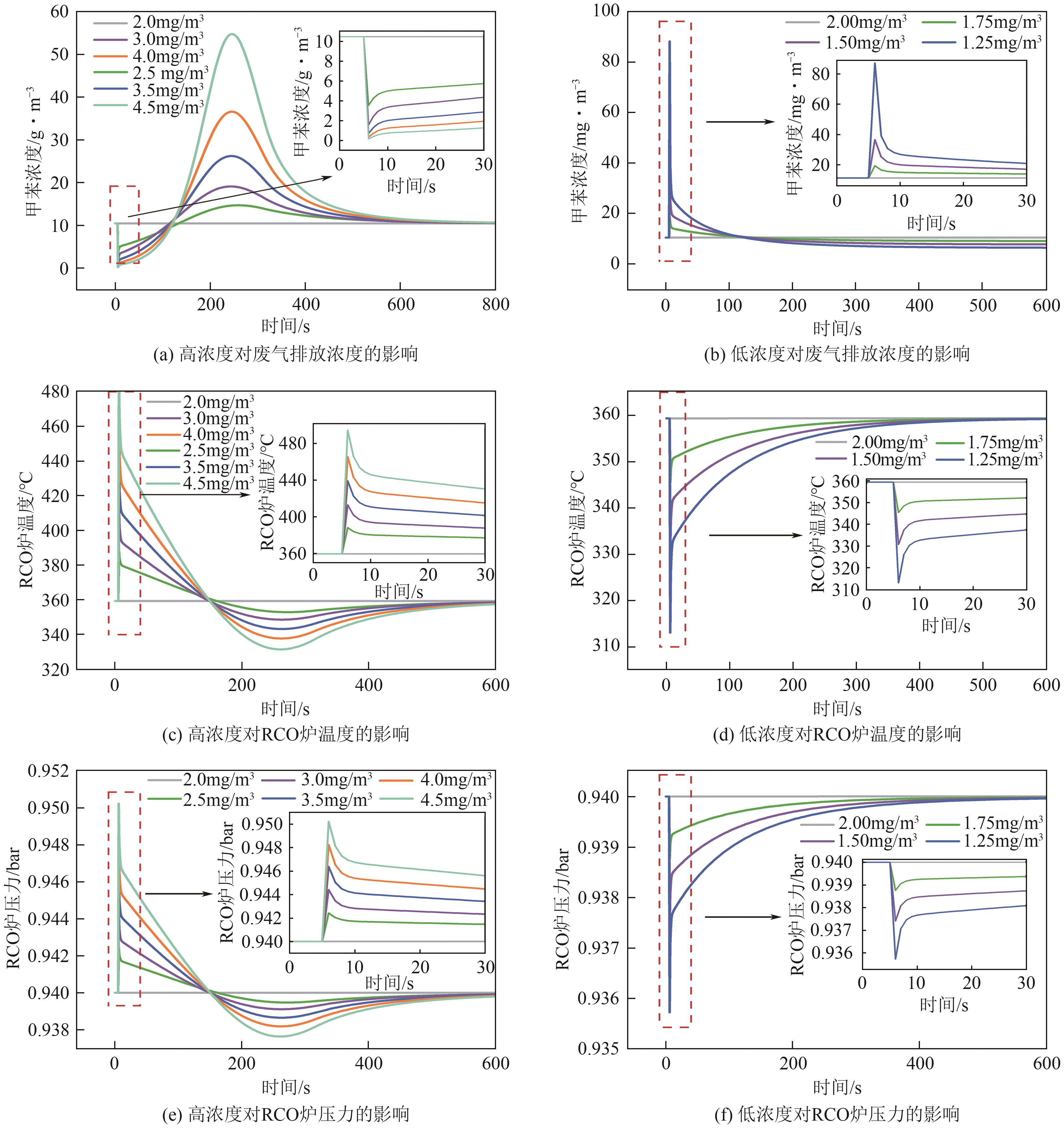
| 浓度 | 低 | 浓度过低 | 低12.5% (1.75g/m3) | 短时间的浓度波动 | 排放出口VOCs浓度短时间达到18.7mg/m3,未超过排放标准 |
| 浓度 | 低 | 浓度过低 | 低25% (1.75g/m3) | 短时间的浓度波动 | 排放出口VOCs浓度短时间达到36.4mg/m3,短时间超过排放标准 |
| 浓度 | 低 | 浓度过低 | 低37.5% (1g/m3) | 短时间的浓度波动 | 排放出口VOCs浓度短时间达到88.2mg/m3,严重超过排放标准 |
| 浓度 | 高 | 浓度高 | 高25% (2.5g/m3) | 短时间的浓度波动 | 排放出口VOCs浓度短时间达到14.7mg/m3,未超过排放标准 |
| 浓度 | 高 | 浓度高 | 高50% (3g/m3) | 短时间的浓度波动 | 排放出口VOCs浓度短时间达到19.1mg/m3,未超过排放标准 |
| 浓度 | 高 | 浓度高 | 高75% (3.5g/m3) | 短时间的浓度波动 | 排放出口VOCs浓度短时间达到26.2mg/m3,短时间超过排放标准 |
| 浓度 | 高 | 浓度高 | 高100% (4g/m3) | 短时间的浓度波动 | 排放出口VOCs浓度短时间达到36.6mg/m3,短时间超过排放标准 |
| 浓度 | 高 | 浓度高 | 高125% (4.5g/m3) | 短时间的浓度波动 | 排放出口VOCs浓度短时间达到54.7mg/m3,严重超过排放标准 |
| 浓度 | 高 | 浓度过高 | 高465% (11.3g/m3) | 脱附浓度异常 | 达到甲苯爆炸下限的1/4 |
| 浓度 | 高 | 浓度过高 | 高610% (14.2g/m3) | 脱附浓度异常 | 达到标准规定的催化剂正常工作温度上线 |
| 浓度 | 高 | 浓度过高 | 高985% (21.7g/m3) | 脱附浓度异常 | 达到催化剂短时间的极限工作温度 |
| 参数 | 引导词 | 偏差 | 偏差定量化 | 偏离描述 | 后果 |
|---|---|---|---|---|---|
| 浓度 | 低 | 浓度过低 | 低12.5% (1.75g/m3) | 短时间的浓度波动 | 排放出口VOCs浓度短时间达到18.7mg/m3,未超过排放标准 |
| 浓度 | 低 | 浓度过低 | 低25% (1.75g/m3) | 短时间的浓度波动 | 排放出口VOCs浓度短时间达到36.4mg/m3,短时间超过排放标准 |
| 浓度 | 低 | 浓度过低 | 低37.5% (1g/m3) | 短时间的浓度波动 | 排放出口VOCs浓度短时间达到88.2mg/m3,严重超过排放标准 |
| 浓度 | 高 | 浓度高 | 高25% (2.5g/m3) | 短时间的浓度波动 | 排放出口VOCs浓度短时间达到14.7mg/m3,未超过排放标准 |
| 浓度 | 高 | 浓度高 | 高50% (3g/m3) | 短时间的浓度波动 | 排放出口VOCs浓度短时间达到19.1mg/m3,未超过排放标准 |
| 浓度 | 高 | 浓度高 | 高75% (3.5g/m3) | 短时间的浓度波动 | 排放出口VOCs浓度短时间达到26.2mg/m3,短时间超过排放标准 |
| 浓度 | 高 | 浓度高 | 高100% (4g/m3) | 短时间的浓度波动 | 排放出口VOCs浓度短时间达到36.6mg/m3,短时间超过排放标准 |
| 浓度 | 高 | 浓度高 | 高125% (4.5g/m3) | 短时间的浓度波动 | 排放出口VOCs浓度短时间达到54.7mg/m3,严重超过排放标准 |
| 浓度 | 高 | 浓度过高 | 高465% (11.3g/m3) | 脱附浓度异常 | 达到甲苯爆炸下限的1/4 |
| 浓度 | 高 | 浓度过高 | 高610% (14.2g/m3) | 脱附浓度异常 | 达到标准规定的催化剂正常工作温度上线 |
| 浓度 | 高 | 浓度过高 | 高985% (21.7g/m3) | 脱附浓度异常 | 达到催化剂短时间的极限工作温度 |
| [1] | 六部委联合印发《“十三五” 挥发性有机物污染防治工作方案》[J]. 中国包装, 2017, 37(11): 9. |
| Six ministries and commissions jointly issued the “Work Plan for the Prevention and Control of Volatile Organic Compounds Pollution in the Thirteenth Five-Year Plan”[J]. China Packaging, 2017, 37(11): 9. | |
| [2] | 席劲瑛, 武俊良, 胡洪营, 等. 工业VOCs气体处理技术应用状况调查分析[J]. 中国环境科学, 2012, 32(11): 1955-1960. |
| XI Jinying, WU Junliang, HU Hongying, et al. Application status of industrial VOCs gas treatment techniques[J]. China Environmental Science, 2012, 32(11): 1955-1960. | |
| [3] | 杨忠霖, 解强, 栾志强. VOCs治理工程安全研究现状[J]. 中国环保产业, 2020(12): 28-32. |
| YANG Zhonglin, XIE Qiang, LUAN Zhiqiang. Current situation of safety researches on VOCs treatment projects[J]. China Environmental Protection Industry, 2020(12): 28-32. | |
| [4] | RAN Huili, XIAO Wu, WANG Mingyang, et al. Quantitative HAZOP analysis of ethylene/ethane hybrid distillationmembrane separation system[J]. Computers and Applied Chemistry, 2012, 29(1): 22-26. |
| [5] | Ján JANOŠOVSKÝ, DANKO Matej, Juraj LABOVSKÝ, et al. The role of a commercial process simulator in computer aided HAZOP approach[J]. Process Safety and Environmental Protection, 2017, 107: 12-21. |
| [6] | DANKO Matej, Juraj LABOVSKÝ, Ján JANOŠOVSKÝ, et al. Utilization of parallel computing in chemical engineering[J]. Acta Chimica Slovaca, 2015, 8(2): 146-151. |
| [7] | 杨忠霖, 解强, 郝郑平, 等. VOCs治理工程安全评价体系研究与构建[J]. 洁净煤技术, 2022, 28(2): 77-85. |
| YANG Zhonglin, XIE Qiang, HAO Zhengping, et al. Research and construction of safety assessment methodology for VOCs treatment projects[J]. Clean Coal Technology, 2022, 28(2): 77-85. | |
| [8] | 杨忠霖. VOCs 治理工程安全评价体系研究与构建[D]. 北京: 中国矿业大学 (北京), 2020. |
| YANG Zhongling. Research and construction of safety evaluation system for VOCs treatment engineering[D]. Beijing: China University of Mining and Technology (Beijing), 2020. | |
| [9] | 卫宏远, 白文帅, 郝琳, 等. 化工过程安全评估[M]. 北京: 化学工业出版社, 2020. |
| WEI Hongyuan, BAI Wenshuai, HAO Lin, et al. Safety assessment of chemical process[M]. Beijing: Chemical Industry Press, 2020. | |
| [10] | 李宁宁. 基于ASPEN的氯乙烯聚合反应过程控制的HAZOP定量风险研究[D]. 昆明: 昆明理工大学, 2023. |
| LI Ningning. HAZOP quantitative risk study of vinyl chloride polymerization process control based on ASPEN[D]. Kunming: Kunming University of Science and Technology, 2023. | |
| [11] | 陈海岭, 蒋军成, 虞奇, 等. Aspen Plus模拟计算在苯硝化HAZOP风险分析中的应用[J]. 中国安全科学学报, 2015, 25(9): 115-120. |
| CHEN Hailing, JIANG Juncheng, YU Qi, et al. Study on application of Aspen Plus simulation calculation in benzene nitration HAZOP risk analysis[J]. China Safety Science Journal, 2015, 25(9): 115-120. | |
| [12] | 刘尚志, 历宏斌, 赵东风, 等. 基于HAZOP-Aspen的油气回收工艺风险分析[J]. 中国安全科学学报, 2021, 31(12): 95-105. |
| LIU Shangzhi, LI Hongbin, ZHAO Dongfeng, et al. Risk analysis of oil and gas recovery process based on HAZOP-Aspen[J]. China Safety Science Journal, 2021, 31(12): 95-105. | |
| [13] | 彭岩. 基于Aspen仿真的乙二醇生产工艺模拟和动态控制及安全性分析[D]. 天津: 天津大学, 2019. |
| PENG Yan. Simulation and dynamic control of ethylene glycol production process based on Aspen simulation and safety analysis[D]. Tianjin: Tianjin University, 2019. | |
| [14] | ZHU Jiaxing, HAO Lin, BAI Wenshuai, et al. Design of plantwide control and safety analysis for diethyl oxalate production via regeneration-coupling circulation by dynamic simulation[J]. Computers & Chemical Engineering, 2019, 121: 111-129. |
| [15] | 刘锐源, 钟美芳, 赵晓雅, 等. 2011—2019年中国工业源挥发性有机物排放特征[J]. 环境科学, 2021, 42(11): 5169-5179. |
| LIU Ruiyuan, ZHONG Meifang, ZHAO Xiaoya, et al. Characteristics of industrial volatile organic compounds (VOCs) emission in China from 2011 to 2019[J]. Environmental Science, 2021, 42(11): 5169-5179. | |
| [16] | 梁小明, 孙西勃, 徐建铁, 等. 中国工业源挥发性有机物排放清单[J]. 环境科学, 2020, 41(11): 4767-4775. |
| LIANG Xiaoming, SUN Xibo, XU Jiantie, et al. Industrial volatile organic compounds (VOCs) emission inventory in China[J]. Environmental Science, 2020, 41(11): 4767-4775. | |
| [17] | 生态环境部大气环境司, 生态环境部环境规划院. 挥发性有机物治理实用手册[M]. 2版. 北京: 中国环境出版集团, 2021. |
| Department of Atmospheric Environment, Ministry of Ecology and Environment, Environmental Planning Institute, Ministry of Ecology and Environment. Manual for the management of volatile organic compounds[M]. 2nd ed. Beijing: China Environmental Publishing Group, 2021. | |
| [18] | 成少鹏. 汽车零部件喷涂VOCs治理技术及应用[D]. 天津: 天津科技大学, 2021. |
| CHENG Shaopeng. Treatment technology and application of VOCs in automotive parts spray painting[D]. Tianjin: Tianjin University of Science & Technology, 2021. | |
| [19] | 范例, 李鹏, 李文生, 等. 重庆市汽车产业园挥发性有机物排放特征[J]. 环境工程技术学报, 2018, 8(5): 571-576. |
| FAN Li, LI Peng, LI Wensheng, et al. Characterization of VOCs emission in automotive industrial park in Chongqing[J]. Journal of Environmental Engineering Technology, 2018, 8(5): 571-576. | |
| [20] | Runhua OU, CHANG Chun, ZENG Yicong, et al. Emission characteristics and ozone formation potentials of VOCs from ultra-low-emission waterborne automotive painting[J]. Chemosphere, 2022, 305: 135469. |
| [21] | 刘文文, 邵霞, 滕巍. 我国木质家具制造行业VOCs排放特征及环境影响[J]. 环境科学, 2024, 45(8): 4470-4483. |
| LIU Wenwen, SHAO Xia, TENG Wei. Emission characteristics and environmental impact of VOCs from wooden furniture-manufacturing industry in China[J]. Environmental Science, 2024, 45(8): 4470-4483. | |
| [22] | 张嘉妮, 曾春玲, 刘锐源, 等. 家具企业挥发性有机物排放特征及其环境影响[J]. 环境科学, 2019, 40(12): 5240-5249. |
| ZHANG Jiani, ZENG Chunling, LIU Ruiyuan, et al. Volatile organic compound emission characteristics of furniture manufacturing enterprises and the influence on the atmospheric environment[J]. Environmental Science, 2019, 40(12): 5240-5249. | |
| [23] | 曾春玲, 邵霞, 刘锐源, 等. 广东省家具行业基于涂料类型的VOCs排放特征及其环境影响[J]. 环境科学, 2021, 42(10): 4641-4649. |
| ZENG Chunling, SHAO Xia, LIU Ruiyuan, et al. Coating-derived VOCs emission characteristics and environmental impacts from the furniture industry in Guangdong Province[J]. Environmental Science, 2021, 42(10): 4641-4649. | |
| [24] | 佟瑞鹏, 张磊, 杨校毅, 等. 家具制造过程中VOCs的来源分析及环境健康风险评价[J]. 环境科学, 2018, 39(2): 672-683. |
| TONG Ruipeng, ZHANG Lei, YANG Xiaoyi, et al. Source analysis and environmental health risk assessment of VOCs in furniture manufacturing[J]. Environmental Science, 2018, 39(2): 672-683. | |
| [25] | 方莉, 刘文文, 陈丹妮, 等. 北京市典型溶剂使用行业VOCs成分谱[J]. 环境科学, 2019, 40(10): 4395-4403. |
| FANG Li, LIU Wenwen, CHEN Danni, et al. Source profiles of volatile organic compounds (VOCs) from typical solvent-based industries in Beijing[J]. Environmental Science, 2019, 40(10): 4395-4403. | |
| [26] | 高宗江. 典型工业涂装行业VOCs排放特征研究[D]. 广州: 华南理工大学, 2015. |
| GAO Zongjiang. Research on the characteristics of VOCs emissions in typical industrial coating industries[D]. Guangzhou: South China University of Technology, 2015. | |
| [27] | 陈小方. 集装箱制造业挥发性有机物排放特征研究[D]. 广州: 华南理工大学, 2018. |
| CHEN Xiaofang. Research on the characteristics of volatile organic compounds emissions in the container manufacturing industry[D]. Guangzhou: South China University of Technology, 2018. | |
| [28] | 董静, 李顺姬, 党小庆, 等. 大气臭氧污染防治——关中地区典型行业VOCs排放源成分谱及环境影响[J/OL]. 中国环境科学, 2024: 1-14. (2024-12-10). . |
| DONG Jing, LI Shunji, DANG Xiaoqing, et al. Prevention and control of atmospheric ozone pollution—Composition spectrum and environmental impact of VOCs emission sources from typical industries in Guanzhong area[J/OL]. China Industrial Economics, 2024: 1-14. (2024-12-10). . | |
| [29] | 王丽娟, 邵霞, 宁淼, 等. 重点工业涂装行业VOCs减排路径与潜力评估[J]. 环境科学研究, 2023, 36(5): 866-874. |
| WANG Lijuan, SHAO Xia, NING Miao, et al. Assessment of VOCs emission reduction path and potential of industrial coating[J]. Research of Environmental Sciences, 2023, 36(5): 866-874. | |
| [30] | SONG M Y, CHUN H. Species and characteristics of volatile organic compounds emitted from an auto-repair painting workshop[J]. Scientific Reports, 2021, 11(1): 16586. |
| [31] | 代雪萍, 王焱, 谢晓峰, 等. 挥发性有机物治理技术研究现状[J]. 材料工程, 2020, 48(11): 1-8. |
| DAI Xueping, WANG Yan, XIE Xiaofeng, et al. Research status of volatile organic compounds treatment technology[J]. Journal of Materials Engineering, 2020, 48(11): 1-8. | |
| [32] | 武宁, 杨忠凯, 李玉, 等. 挥发性有机物治理技术研究进展[J]. 现代化工, 2020, 40(2): 17-22. |
| WU Ning, YANG Zhongkai, LI Yu, et al. Research progress in VOCs treatment technology[J]. Modern Chemical Industry, 2020, 40(2): 17-22. | |
| [33] | 栾志强, 郝郑平, 王喜芹. 工业固定源VOCs治理技术分析评估[J]. 环境科学, 2011, 32(12): 3476-3486. |
| LUAN Zhiqiang, HAO Zhengping, WANG Xiqin. Evaluation of treatment technology of volatile organic compounds for fixed industrial resources[J]. Environmental Science, 2011, 32(12): 3476-3486. | |
| [34] | 周红阳, 周逸寰, 张连秀, 等. VOCs在活性炭中的堆积: 形成机制及影响因素[J]. 化工进展, 2023, 42(11): 5969-5980. |
| ZHOU Hongyang, ZHOU Yihuan, ZHANG Lianxiu, et al. Heel of VOCs in activated carbon: Formation mechanism and influencing factors[J]. Chemical Industry and Engineering Progress, 2023, 42(11): 5969-5980. | |
| [35] | 国家质量监督检验检疫总局, 中国国家标准化管理委员会. 危险与可操作性分析: [S]. 北京: 中国标准出版社, 2017. |
| General Administration of Quality Supervision, Inspection and Quarantine of the People’s Republic of China, Standardization Administration of the People’s Republic of China. Hazard and operability studies (HAZOP studies)—Application guide: [S]. Beijing: Standards Press of China, 2017. | |
| [36] | 中华人民共和国国家质量监督检验检疫总局,中国国家标准化管理委员会. 保护层分析(LOPA)应用指南: [S]. 北京:中国标准出版社,2017. |
| General Administration of Quality Supervision, Inspection and Quarantine of the People’s Republic of China, Standardization Administration of China. Guidelines for the application of layer of protection analysis (LOPA): [S]. Beijing: Standards Press of China, 2017. | |
| [37] | WANG Yong, ZHANG Xia, LIU Xiaobin, et al. Control of extractive distillation process for separating heterogenerous ternary azeotropic mixture via adjusting the solvent content[J]. Separation and Purification Technology, 2018, 191: 8-26. |
| [38] | LUPPI P, BRACCIA L, RULLO Pablo G, et al. Plantwide control design based on the control allocation approach[J]. Industrial & Engineering Chemistry Research, 2018, 57 (1): 268-282. |
| [39] | JOHANSSON Lasse, KARPPINEN Ari, KURPPA Mona, et al. An operational urban air quality model ENFUSER, based on dispersion modelling and data assimilation[J]. Environmental Modelling & Software, 2022, 156: 105460. |
| [40] | MO Ziwei, LIU Chun-Ho. Transport mechanism of urban plume dispersion[J]. Building and Environment, 2019, 161: 106239. |
| [41] | ARYA S P. Air pollution meteorology and dispersion[M]. Cambridge, U.K: Oxford University Press, 1999. |
| [42] | LEVENSPIEL O. Engineering flow and heat exchange[M]. 2nd ed. New York: Springer, 1998 |
| [43] | MCCABE Warren L, SMITH Julian, HARRIOTT Peter. Unit operations of chemical engineering[M]. 7th ed. New York: McGraw-Hill, 2004. |
| [44] | ONARHEIM Kristin, SOLANTAUSTA Yrjö, LEHTO Jani. Process simulation development of fast pyrolysis of wood using Aspen Plus[J]. Energy Fuels, 2015, 29(1): 205-217. |
| [45] | 王志荣, 蒋军成, 李玲. 容器内可燃气体燃爆温度与压力的计算方法[J]. 南京工业大学学报(自然科学版), 2004, 26(1): 9-12. |
| WANG Zhirong, JIANG Juncheng, LI Ling. Computation methods of explosion temperature and pressure of gas explosion in vessels[J]. Journal of Nanjing University, 2004, 26(1): 9-12. | |
| [46] | 傅智敏, 黄金印, 臧娜. 爆炸冲击波伤害破坏作用定量分析[J]. 消防科学与技术, 2009, 28(6): 390-395. |
| FU Zhimin, HUANG Jinyin, ZANG Na. Quantitative analysis for consequence of explosion shock wave[J]. Fire Science and Technology, 2009, 28(6): 390-395. | |
| [47] | 中国安全生产协会注册安全工程师工作委员会. 安全生产技术[M]. 北京: 中国大百科全书出版社, 2011: 97-103. |
| China Association of Safety Production Registered Safety Engineers Working Committee. Safety production technology[M]. Beijing: China Encyclopedia Press, 2011: 97-103. | |
| [48] | 张文海, 陈国华, 潘游, 等. 危险化学品安全管理及定量评价方法[J]. 化工学报, 2004, 55(4): 682-685. |
| ZHANG Wenhai, CHEN Guohua, PAN You, et al. Probing into quantitative methodology on safety management and assessment of hazardous chemicals[J]. Journal of Chemical Industry and Engineering (China), 2004, 55(4): 682-685. |
| [1] | GAO Yan, LI Yongshuai, LI Gaoyang, PAN Hui, LING Hao. Dynamic control for Agrawal divided-wall column [J]. Chemical Industry and Engineering Progress, 2025, 44(8): 4594-4605. |
| [2] | CAO Junya, SONG Shuzhe, HE Peng, WANG Liguo, ZHAO Xuefeng, CAO Yan, LI Huiquan. Dynamic simulation using Aspen chromatography for sequential simulated moving bed separation of coal-based mixed alcohols [J]. Chemical Industry and Engineering Progress, 2025, 44(3): 1228-1242. |
| [3] | CUI Yue, LI Yufeng, LI Wei, HUANG Yeqian, WEI Bei. Research progress and prospect of the application of digital twins in oil and gas field ground systems [J]. Chemical Industry and Engineering Progress, 2025, 44(3): 1194-1205. |
| [4] | LIU Shida, HOU Shuandi, LIU Zhongsheng. Comparative study, prospects, and suggestions of air pollutant control standards related to the petrochemical industry source between China and the United States [J]. Chemical Industry and Engineering Progress, 2024, 43(7): 4089-4101. |
| [5] | LIU Shida, WANG Haiyan, HOU Shuandi, LIU Zhongsheng, LIAO Changjian, WANG Kuanling. Recent advances in safely efficient deep emission reduction, recovery and thermal oxidation of VOCs from petrochemical storage tanks in China [J]. Chemical Industry and Engineering Progress, 2024, 43(4): 2063-2076. |
| [6] | ZHANG Ruijie, LIU Zhilin, WANG Junwen, ZHANG Wei, HAN Deqiu, LI Ting, ZOU Xiong. On-line dynamic simulation and optimization of water-cooled cascade refrigeration system [J]. Chemical Industry and Engineering Progress, 2023, 42(S1): 124-132. |
| [7] | DENG Liping, SHI Haoyu, LIU Xiaolong, CHEN Yaoji, YAN Jingying. Non-noble metal modified vanadium titanium-based catalyst for NH3-SCR denitrification simultaneous control VOCs [J]. Chemical Industry and Engineering Progress, 2023, 42(S1): 542-548. |
| [8] | GE Yafen, SUN Yu, XIAO Peng, LIU Qi, LIU Bo, SUN Chengying, GONG Yanjun. Research progress of zeolite for VOCs removal [J]. Chemical Industry and Engineering Progress, 2023, 42(9): 4716-4730. |
| [9] | XU Wei, LI Kaijun, SONG Linye, ZHANG Xinghui, YAO Shunhua. Research progress of photocatalysis and co-electrochemical degradation of VOCs [J]. Chemical Industry and Engineering Progress, 2023, 42(7): 3520-3531. |
| [10] | LIU Guangping, LU Zhenneng, GONG Yulie. Dynamic response and disturbance optimization of high temperature heat pump steam systems [J]. Chemical Industry and Engineering Progress, 2023, 42(4): 1719-1727. |
| [11] | XIANG Sheng, WANG Chao, ZHUANG Yu, GU Siwen, ZHANG Lei, DU Jian. Design and control of pressure-swing distillation for separating methyl acetate-methanol-ethyl acetate azeotropic system [J]. Chemical Industry and Engineering Progress, 2022, 41(8): 4065-4076. |
| [12] | ZHENG Yamei, LIN Shengnan, JING Guohua, SHEN Huazhen, LYU Bihong. Evaluation of VOCs terminal treatment technology in pesticide production based on fuzzy analytic hierarchy process [J]. Chemical Industry and Engineering Progress, 2022, 41(6): 3372-3380. |
| [13] | ZHANG Ningning, DING Hua, GAO Yan, BAI Xiangfei, ZHANG Yunpeng, SUN Nanxiang. Migration behavior of sodium in Xinjiang Naomaohu coal during the CO2 gasification [J]. Chemical Industry and Engineering Progress, 2022, 41(5): 2348-2355. |
| [14] | YU Bin, LIU Chunhui, ZHENG Guangqiang, QU Guang, WEI Yongtai, WANG Hongxing. Optimization of control of glycol-water separation by heat-integrated pressure swing distillation [J]. Chemical Industry and Engineering Progress, 2021, 40(S2): 56-63. |
| [15] | DU Jiahui, LIU Jia, YANG Juping, QI Hongyi, DOU Xiaona, LI Jian. Recent advances in biological combined technology for VOCs treatment [J]. Chemical Industry and Engineering Progress, 2021, 40(5): 2802-2812. |
| Viewed | ||||||
|
Full text |
|
|||||
|
Abstract |
|
|||||