Chemical Industry and Engineering Progress ›› 2025, Vol. 44 ›› Issue (11): 6368-6375.DOI: 10.16085/j.issn.1000-6613.2024-1632
• Industrial catalysis • Previous Articles
Catalytic hydropyrolysis of polyethylene to gas fuel by waste slag of FCC catalyst
LIU Ping( ), LIAO Songchun, JIN Liujun, SUN Yizhen
- School of Petrochemical Engineering, Changzhou University, Changzhou 213000, Jiangsu, China
-
Received:2024-10-12Revised:2025-02-07Online:2025-12-08Published:2025-11-25 -
Contact:LIU Ping
FCC催化剂废胶渣催化聚乙烯加氢热解制备气体燃料
刘平(), 廖颂春, 金刘君, 孙怡珍
- 常州大学石油化工学院,江苏 常州 213000
-
通讯作者:刘平 -
作者简介:刘平(1983—),女,教授,博士生导师,研究方向为新型催化材料。E-mail:pingliu@cczu.edu.cn。 -
基金资助:江苏省高等学校基础科学(自然科学)研究重大项目(23KJA530001);江苏高校青蓝工程项目

CLC Number:
Cite this article
LIU Ping, LIAO Songchun, JIN Liujun, SUN Yizhen. Catalytic hydropyrolysis of polyethylene to gas fuel by waste slag of FCC catalyst[J]. Chemical Industry and Engineering Progress, 2025, 44(11): 6368-6375.
刘平, 廖颂春, 金刘君, 孙怡珍. FCC催化剂废胶渣催化聚乙烯加氢热解制备气体燃料[J]. 化工进展, 2025, 44(11): 6368-6375.
share this article
Add to citation manager EndNote|Ris|BibTeX
URL: https://hgjz.cip.com.cn/EN/10.16085/j.issn.1000-6613.2024-1632
| 组分 | 质量分数/% | 组分 | 质量分数/% |
|---|---|---|---|
| SiO2 | 52.05 | CaO | 1.89 |
| Na2O | 6.22 | MgO | 0.59 |
| Al2O3 | 19.17 | SO3 | 2.31 |
| La2O3 | 6.28 | Cl | 0.94 |
| CeO2 | 9.28 | K2O | 0.24 |
| Fe2O3 | 0.43 | ReO2 | 0.014 |
| NiO | 0.0091 | Y2O3 | 0.0038 |
| ZnO | 0.044 | TiO2 | 0.066 |
| P2O5 | 0.27 | MnO2 | 0.13 |
| ZrO2 | 0.0043 | SrO | 0.018 |
| CuO | 0.0063 | Ga2O3 | 0.0084 |
| 组分 | 质量分数/% | 组分 | 质量分数/% |
|---|---|---|---|
| SiO2 | 52.05 | CaO | 1.89 |
| Na2O | 6.22 | MgO | 0.59 |
| Al2O3 | 19.17 | SO3 | 2.31 |
| La2O3 | 6.28 | Cl | 0.94 |
| CeO2 | 9.28 | K2O | 0.24 |
| Fe2O3 | 0.43 | ReO2 | 0.014 |
| NiO | 0.0091 | Y2O3 | 0.0038 |
| ZnO | 0.044 | TiO2 | 0.066 |
| P2O5 | 0.27 | MnO2 | 0.13 |
| ZrO2 | 0.0043 | SrO | 0.018 |
| CuO | 0.0063 | Ga2O3 | 0.0084 |
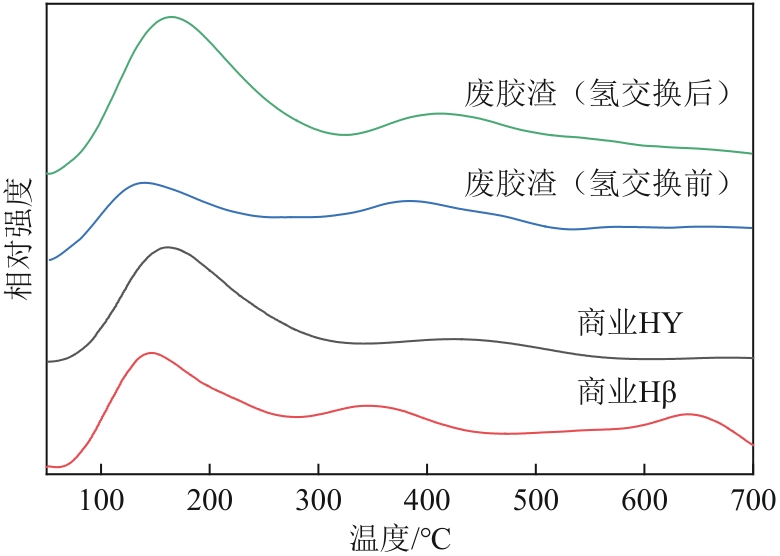
| 催化剂 | 总酸量/mmol·g-1 |
|---|---|
| 氢交换后的FCC催化剂废胶渣 | 1.13 |
| 氢交换前的FCC催化剂废胶渣 | 0.61 |
| 商业HY | 1.02 |
| 商业Hβ | 0.84 |
| 催化剂 | 总酸量/mmol·g-1 |
|---|---|
| 氢交换后的FCC催化剂废胶渣 | 1.13 |
| 氢交换前的FCC催化剂废胶渣 | 0.61 |
| 商业HY | 1.02 |
| 商业Hβ | 0.84 |
| 催化剂 | 气体产物产率(质量分数)/% | 液体产物产率(质量分数)/% | 固体残余率(质量分数)/% |
|---|---|---|---|
| FCC催化剂废胶渣 | 92.1 | 7.9 | 0 |
| 商业HY | 81.3 | 16.3 | 2.4 |
| 商业Hβ | 83.0 | 16.0 | 1.0 |
| 催化剂 | 气体产物产率(质量分数)/% | 液体产物产率(质量分数)/% | 固体残余率(质量分数)/% |
|---|---|---|---|
| FCC催化剂废胶渣 | 92.1 | 7.9 | 0 |
| 商业HY | 81.3 | 16.3 | 2.4 |
| 商业Hβ | 83.0 | 16.0 | 1.0 |
| [1] | 王月, 赵秦峰, 张占全, 等. 碳中和背景下国内外废塑料裂解法回收进展[J]. 化工进展, 2022, 41(3): 1470-1478. |
| WANG Yue, ZHAO Qinfeng, ZHANG Zhanquan, et al. Plastic waste recycling by pyrolysis at home and abroad under the background of carbon neutrality[J]. Chemical Industry and Engineering Progress, 2022, 41(3): 1470-1478. | |
| [2] | ZHANG Fan, ZENG Manhao, YAPPERT Ryan D, et al. Polyethylene upcycling to long-chain alkylaromatics by tandem hydrogenolysis/aromatization[J]. Science, 2020, 370(6515): 437-441. |
| [3] | TENNAKOON Akalanka, WU Xun, PATERSON Alexander L, et al. Catalytic upcycling of high-density polyethylene via a processive mechanism[J]. Nature Catalysis, 2020, 3(11): 893-901. |
| [4] | NAVA Veronica, CHANDRA Sudeep, AHERNE Julian, et al. Plastic debris in lakes and reservoirs[J]. Nature, 2023, 619(7969): 317-322. |
| [5] | MACLEOD Matthew, Hans Peter H ARP, TEKMAN Mine B, et al. The global threat from plastic pollution[J]. Science, 2021, 373(6550): 61-65. |
| [6] | LEE Kyungho, JING Yaxuan, WANG Yanqin, et al. A unified view on catalytic conversion of biomass and waste plastics[J]. Nature Reviews Chemistry, 2022, 6(9): 635-652. |
| [7] | ELORDI G, OLAZAR M, LOPEZ G, et al. Catalytic pyrolysis of HDPE in continuous mode over zeolite catalysts in a conical spouted bed reactor[J]. Journal of Analytical and Applied Pyrolysis, 2009, 85(1/2): 345-351. |
| [8] | WANG Jia, JIANG Jianchun, SUN Yunjuan, et al. Recycling benzene and ethylbenzene from in-situ catalytic fast pyrolysis of plastic wastes[J]. Energy Conversion and Management, 2019, 200: 112088. |
| [9] | SEO Young-Hwa, LEE Kyong-Hwan, SHIN Dae-Hyun. Investigation of catalytic degradation of high-density polyethylene by hydrocarbon group type analysis[J]. Journal of Analytical and Applied Pyrolysis, 2003, 70(2): 383-398. |
| [10] | OBALI Zeynep, SEZGI Naime AslI, Timur DOĞU. Catalytic degradation of polypropylene over alumina loaded mesoporous catalysts[J]. Chemical Engineering Journal, 2012, 207/208: 421-425. |
| [11] | PANDA Achyut K, SINGH RK. Catalytic performances of kaoline and silica alumina in the thermal degradation of polypropylene[J]. Journal of Fuel Chemistry and Technology, 2011, 39(3): 198-202. |
| [12] | PANDA Achyut Kumar, SINGH Raghubansh Kumar. Thermo-catalytic degradation of low density polyethylene to liquid fuel over kaolin catalyst[J]. International Journal of Environment and Waste Management, 2014, 13(1): 104. |
| [13] | AGUADO J, SERRANO D P, MIGUEL G SAN, et al. Feedstock recycling of polyethylene in a two-step thermo-catalytic reaction system[J]. Journal of Analytical and Applied Pyrolysis, 2007, 79(1/2): 415-423. |
| [14] | CHU Mingyu, WANG Xianpeng, WANG Xuchun, et al. Site-selective polyolefin hydrogenolysis on atomic Ru for methanation suppression and liquid fuel production[J]. Research, 2023, 6: 0032. |
| [15] | ZHANG Zedong, WANG Jia, GE Xiaohu, et al. Mixed plastics wastes upcycling with high-stability single-atom Ru catalyst[J]. Journal of the American Chemical Society, 2023, 145(41): 22836-22844. |
| [16] | LI Lin, LUO Hu, SHAO Zilong, et al. Converting plastic wastes to naphtha for closing the plastic loop[J]. Journal of the American Chemical Society, 2023, 145(3): 1847-1854. |
| [17] | CHAUHAN Manav, ANTIL Neha, RANA Bharti, et al. Isoreticular metal-organic frameworks confined mononuclear Ru-hydrides enable highly efficient shape-selective hydrogenolysis of polyolefins[J]. JACS Au, 2023, 3(12): 3473-3484. |
| [18] | KOTS Pavel A, LIU Sibao, VANCE Brandon C, et al. Polypropylene plastic waste conversion to lubricants over Ru/TiO2 catalysts[J]. ACS Catalysis, 2021, 11(13): 8104-8115. |
| [19] | JIA Chuhua, XIE Shaoqu, ZHANG Wanli, et al. Deconstruction of high-density polyethylene into liquid hydrocarbon fuels and lubricants by hydrogenolysis over Ru catalyst[J]. Chem Catalysis, 2021, 1(2): 437-455. |
| [20] | KIM Taehyup, Huy NGUYEN-PHU, KWON Taeeun, et al. Investigating the impact of TiO2 crystalline phases on catalytic properties of Ru/TiO2 for hydrogenolysis of polyethylene plastic waste[J]. Environmental Pollution, 2023, 331: 121876. |
| [21] | LEE Wei-Tse, BOBBINK Felix D, VAN MUYDEN Antoine P, et al. Catalytic hydrocracking of synthetic polymers into grid-compatible gas streams[J]. Cell Reports Physical Science, 2021, 2(2): 100332. |
| [22] | CHEN Ruizhe, CHENG Leilei, GU Jing, et al. Mechanistic understanding of metal-acid synergetic hydroconversion of polyethylene under mild conditions over a Ru/MOR catalyst[J]. Energy Conversion and Management, 2024, 300: 117983. |
| [23] | TOMER Ajay, ISLAM Mazharul M, BAHRI Mounib, et al. Enhanced production and control of liquid alkanes in the hydrogenolysis of polypropylene over shaped Ru/CeO2 catalysts[J]. Applied Catalysis A: General, 2023, 666: 119431. |
| [24] | WANG Cong, YU Kewei, SHELUDKO Boris, et al. A general strategy and a consolidated mechanism for low-methane hydrogenolysis of polyethylene over ruthenium[J]. Applied Catalysis B: Environmental, 2022, 319: 121899. |
| [25] | HU Ping, ZHANG Congyang, CHU Mingyu, et al. Stable interfacial ruthenium species for highly efficient polyolefin upcycling[J]. Journal of the American Chemical Society, 2024, 146(10): 7076-7087. |
| [26] | CELIK Gokhan, KENNEDY Robert M, HACKLER Ryan A, et al. Upcycling single-use polyethylene into high-quality liquid products[J]. ACS Central Science, 2019, 5(11): 1795-1803. |
| [27] | LIU Sibao, KOTS Pavel A, VANCE Brandon C, et al. Plastic waste to fuels by hydrocracking at mild conditions[J]. Science Advances, 2021, 7(17): eabf8283. |
| [28] | ZHANG Wei, KIM Sungmin, WAHL Lennart, et al. Low-temperature upcycling of polyolefins into liquid alkanes via tandem cracking-alkylation[J]. Science, 2023, 379(6634): 807-811. |
| [29] | VANCE Brandon C, KOTS Pavel A, WANG Cong, et al. Ni/SiO2 catalysts for polyolefin deconstruction via the divergent hydrogenolysis mechanism[J]. Applied Catalysis B: Environmental, 2023, 322: 122138. |
| [30] | CEN Ziyu, HAN Xue, LIN Longfei, et al. Upcycling of polyethylene to gasoline through a self-supplied hydrogen strategy in a layered self-pillared zeolite[J]. Nature Chemistry, 2024, 16(6): 871-880. |
| [31] | THOMAS Bejoy, Bibhuti B DAS, SUGUNAN S. Rare earth exchanged (Ce3+, La3+ and RE3+) H-Y zeolites as solid acid catalysts for the synthesis of linear alkyl benzenes[J]. Microporous and Mesoporous Materials, 2006, 95(1/2/3): 329-338. |
| [1] | HONG Kang, ZHANG Chong, MA Hongli, SUN Yongrong, JIANG Liqun, BAO Guirong. Research progress of biomass hard charcoal as an anode material for sodium-ion batteries [J]. Chemical Industry and Engineering Progress, 2025, 44(S1): 340-349. |
| [2] | CHEN Jiaming, XU Jiawei, TIAN Xiujun. Impact analysis of carbon emissions and economic performance in combined heat and power units [J]. Chemical Industry and Engineering Progress, 2025, 44(S1): 92-101. |
| [3] | ZHOU Jinghao, ZHANG Chaoyang, HU Haoxing, WANG Siming, LIU Jingyuan, WEI Guanghua. Numerical analysis of gas transfer in microporous layer of PEMFC based on lattice Boltzmann method [J]. Chemical Industry and Engineering Progress, 2025, 44(9): 4898-4907. |
| [4] | XU Cong, FENG Yingjie, LIU Dongbing, XIE Zaiku. Review of zeolite confined Pt-based catalysts for propane dehydrogenation [J]. Chemical Industry and Engineering Progress, 2025, 44(9): 4954-4967. |
| [5] | WANG Lanxin, LI Fei, QIAN Yanan, TIAN Yujie, SHEN Jun, WANG Wei. Numerical simulation of coal pyrolysis with different moisture content in fixed-bed reactor [J]. Chemical Industry and Engineering Progress, 2025, 44(8): 4513-4525. |
| [6] | YANG Jiacong, CHENG Guangxu, JIA Tonghua, JIANG Zhao. Simulation and techno-economic analysis of new efficient coupling processes between coal to methanol and green hydrogen [J]. Chemical Industry and Engineering Progress, 2025, 44(8): 4657-4668. |
| [7] | DUAN Wuhua, SUN Taoxiang, ZHENG Qiang. Hydraulic performance and mass-transfer efficiency of industrial-scale centrifugal contactors for nuclear industry [J]. Chemical Industry and Engineering Progress, 2025, 44(7): 3709-3717. |
| [8] | WANG Shuai, QIAN Xiangchen, ZHANG Leiqi, WU Qiliang, LIU Min. Degradation mechanism of key components in proton exchange membrane fuel cells and proton exchange membrane electrolysis cells [J]. Chemical Industry and Engineering Progress, 2025, 44(7): 3804-3815. |
| [9] | SHI Qinchuan, WANG Shiyuan, LI Peiya, LU Shuhan, WANG Bo, WANG Jiahui, YANG Fusheng, WANG Bin, YANG Shengchun, FANG Tao. Research on the solubilities of hydrogen in liquid organic hydrogen carriers [J]. Chemical Industry and Engineering Progress, 2025, 44(7): 3816-3827. |
| [10] | GAO Jiaojiao, YAN Shiyu, YANG Taishun, XIE Shangzhi, YANG Yanjuan, XU Jing. Effect of alumina support crystal structure of Ru-based catalysts on polyethylene hydrogenolysis performance [J]. Chemical Industry and Engineering Progress, 2025, 44(7): 3917-3927. |
| [11] | ZHANG Jiazheng, MAO Yanpeng, WEI Guangshuo, PANG Dongjie, XU Jian, DONG Jingyi, WANG Xujiang, LI Jingwei, WANG Wenlong. Co-processing technology for utilizing coal gasification slag as an alternative fuel in cement kilns [J]. Chemical Industry and Engineering Progress, 2025, 44(7): 4202-4211. |
| [12] | ZHOU Ying, BAI Baohua, PU Tian, ZHOU Enze, HU Jianqing, ZHANG Songlin, ZHOU Hongjun, XU Chunming. Construction and demonstration of net-zero industrial parks [J]. Chemical Industry and Engineering Progress, 2025, 44(7): 4282-4286. |
| [13] | YANG Qi, WANG Feng, HAN Shengxian, ZHAN Qingli, HE Jiao, FANG Qinzhu, PENG Wei. Changing law of catalyst average particle size during catalyst loss in fluid catalytic cracking units [J]. Chemical Industry and Engineering Progress, 2025, 44(6): 3364-3371. |
| [14] | LI Hongwei, XU Hanqiao, ZHAO Yan, LIU Yaozong, TENG Zhijun, JI Dong, LI Guixian. Research progress and prospect of platinum-based catalysts for electrocatalytic methanol oxidation [J]. Chemical Industry and Engineering Progress, 2025, 44(6): 3443-3456. |
| [15] | HE Yijian, LIU Xiangkun, SHI Yao, DUAN Xuezhi. Catalyst particle shape design for ethane oxidative dehydrogenation to ethylene [J]. Chemical Industry and Engineering Progress, 2025, 44(6): 3497-3508. |
| Viewed | ||||||
|
Full text |
|
|||||
|
Abstract |
|
|||||