Chemical Industry and Engineering Progress ›› 2025, Vol. 44 ›› Issue (8): 4341-4351.DOI: 10.16085/j.issn.1000-6613.2025-0311
• Micro-mesoscale process and material modeling and simulation • Previous Articles
Structural product formulation design method based on molecular dynamics simulation
QI Yan( ), CHANG Hao, ZHANG Lei()
- Institute of Chemical Process Systems Engineering, School of Chemical Engineering, Dalian University of Technology, Dalian 116024, Liaoning, China
-
Received:2025-02-28Revised:2025-04-11Online:2025-09-08Published:2025-08-25 -
Contact:ZHANG Lei
基于分子动力学模拟的结构性产品配方设计方法
齐妍(), 常昊, 张磊()
- 大连理工大学化工学院,化工系统工程研究所,辽宁 大连 116024
-
通讯作者:张磊 -
作者简介:齐妍(2001—),女,硕士研究生,研究方向为过程系统工程。E-mail:qy2001@mail.dlut.edu.cn。 -
基金资助:国家自然科学基金(22278053);国家自然科学基金(22078041);国家自然科学基金优秀青年科学基金(22422801)

CLC Number:
Cite this article
QI Yan, CHANG Hao, ZHANG Lei. Structural product formulation design method based on molecular dynamics simulation[J]. Chemical Industry and Engineering Progress, 2025, 44(8): 4341-4351.
齐妍, 常昊, 张磊. 基于分子动力学模拟的结构性产品配方设计方法[J]. 化工进展, 2025, 44(8): 4341-4351.
share this article
Add to citation manager EndNote|Ris|BibTeX
URL: https://hgjz.cip.com.cn/EN/10.16085/j.issn.1000-6613.2025-0311
| 产品需求 | 对应属性 | 方法 |
|---|---|---|
| 香味持久 | 香味扩散速率 | 经验规则,实验,MD |
| 泡沫丰富 | 泡沫稳定性,发泡能力 | 经验规则,实验,MD,量子化学方法(QM) |
| 清洁效果好 | 临界胶束浓度 | 经验规则,数据库,实验,基团贡献法 |
| 产品形态 | 亲水亲油平衡 | 数据库,实验,Griffin方法 |
| 环境友好 | 成分、分子量 | 数据库,基团贡献法 |
| 安全无毒 | 成分、分子量 | 数据库,基团贡献法 |
| 成本低 | 成分含量与价格 | 经验规则 |
| 产品需求 | 对应属性 | 方法 |
|---|---|---|
| 香味持久 | 香味扩散速率 | 经验规则,实验,MD |
| 泡沫丰富 | 泡沫稳定性,发泡能力 | 经验规则,实验,MD,量子化学方法(QM) |
| 清洁效果好 | 临界胶束浓度 | 经验规则,数据库,实验,基团贡献法 |
| 产品形态 | 亲水亲油平衡 | 数据库,实验,Griffin方法 |
| 环境友好 | 成分、分子量 | 数据库,基团贡献法 |
| 安全无毒 | 成分、分子量 | 数据库,基团贡献法 |
| 成本低 | 成分含量与价格 | 经验规则 |
| 功能 | 原料 | 质量分数/% |
|---|---|---|
| 发泡剂 | 十二烷基硫酸钠(SDS) | 1~2 |
| 润湿剂 | 甘油(GLY) | 10~50 |
| 润湿剂 | 聚乙二醇(PEG) | 0~10 |
| 芳香剂 | 柠檬烯(PRM) | 1~2 |
| 活性成分 | 氟化钠(NaF) | 0.243 |
| 增白剂 | 焦磷酸二钠(DP) | 4.170 |
| pH调节剂 | 50%氢氧化钠(NaOH)溶液 | 2.300 |
| 溶剂 | 水(H2O) | 补充至100% |
| 功能 | 原料 | 质量分数/% |
|---|---|---|
| 发泡剂 | 十二烷基硫酸钠(SDS) | 1~2 |
| 润湿剂 | 甘油(GLY) | 10~50 |
| 润湿剂 | 聚乙二醇(PEG) | 0~10 |
| 芳香剂 | 柠檬烯(PRM) | 1~2 |
| 活性成分 | 氟化钠(NaF) | 0.243 |
| 增白剂 | 焦磷酸二钠(DP) | 4.170 |
| pH调节剂 | 50%氢氧化钠(NaOH)溶液 | 2.300 |
| 溶剂 | 水(H2O) | 补充至100% |
| 系统 | nwater | nGLY | nPEG | nSDS | nN2 | nO2 | Lx ×Ly ×Lz /Å |
|---|---|---|---|---|---|---|---|
| 50%GLY | 93044 | 19184 | 0 | 3120 | 510 | 146 | 264×264×500 |
| 50%GLY-10%PEG | 73415 | 19184 | 1083 | 3120 | 510 | 146 | 264×264×500 |
| 系统 | nwater | nGLY | nPEG | nSDS | nN2 | nO2 | Lx ×Ly ×Lz /Å |
|---|---|---|---|---|---|---|---|
| 50%GLY | 93044 | 19184 | 0 | 3120 | 510 | 146 | 264×264×500 |
| 50%GLY-10%PEG | 73415 | 19184 | 1083 | 3120 | 510 | 146 | 264×264×500 |
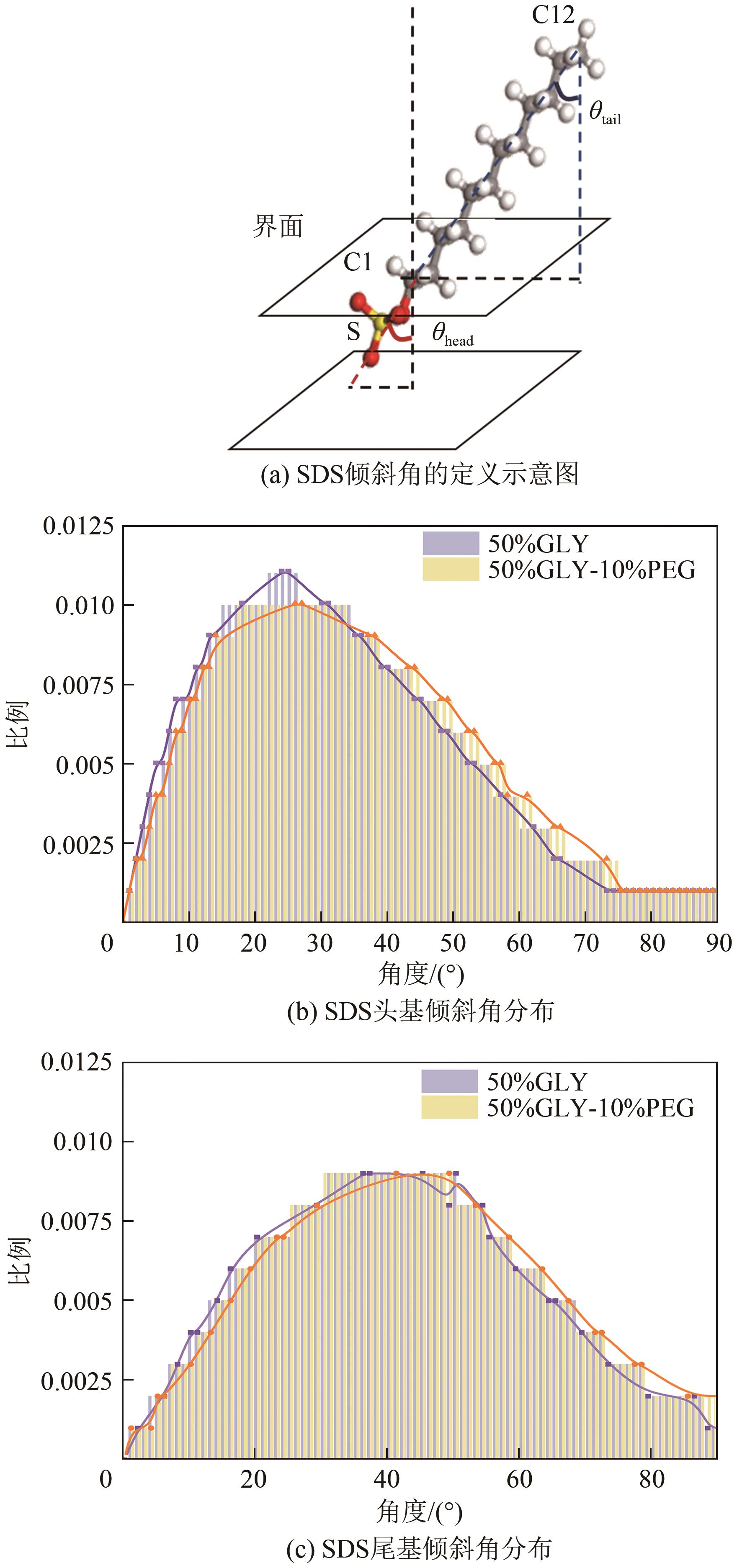
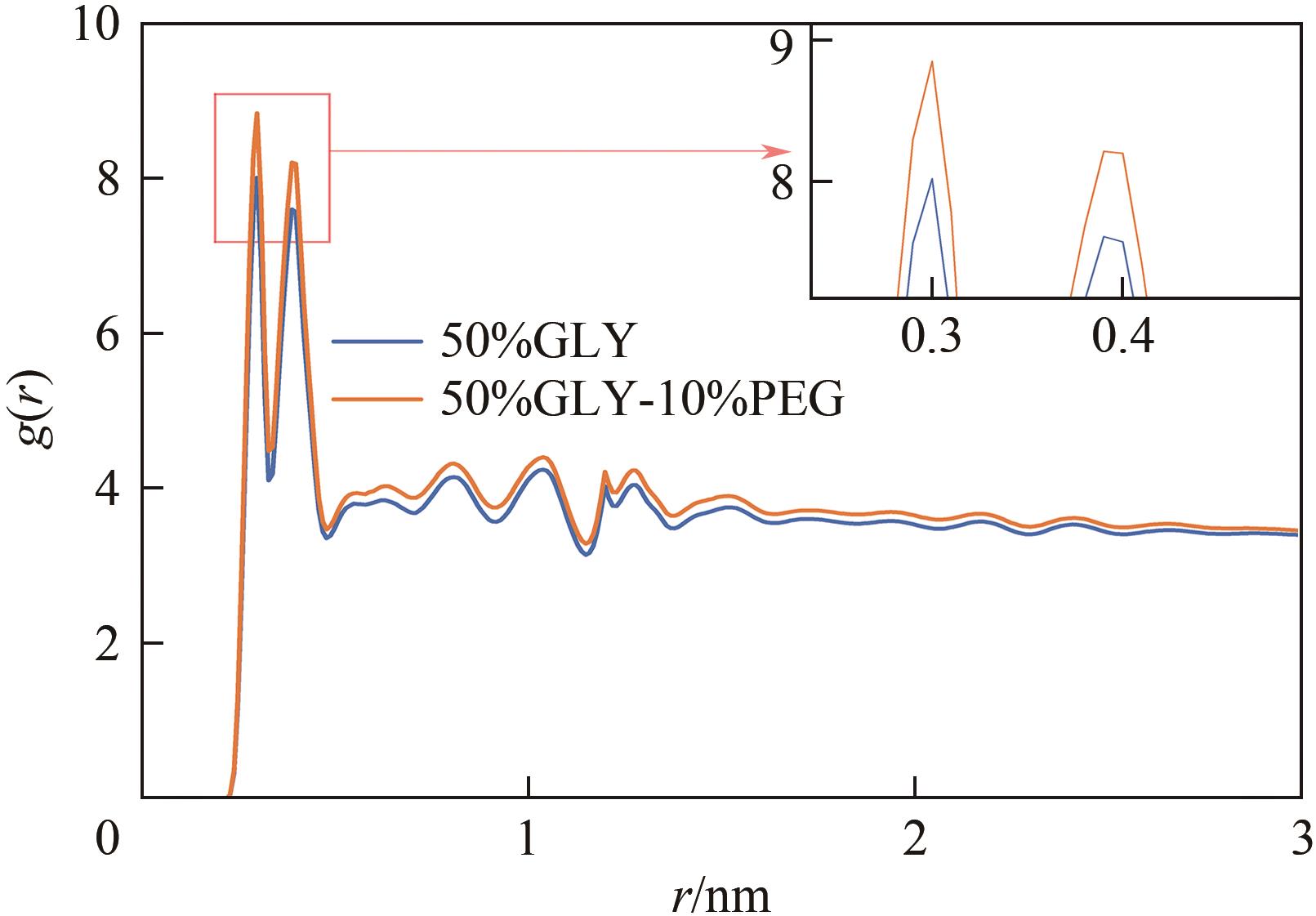
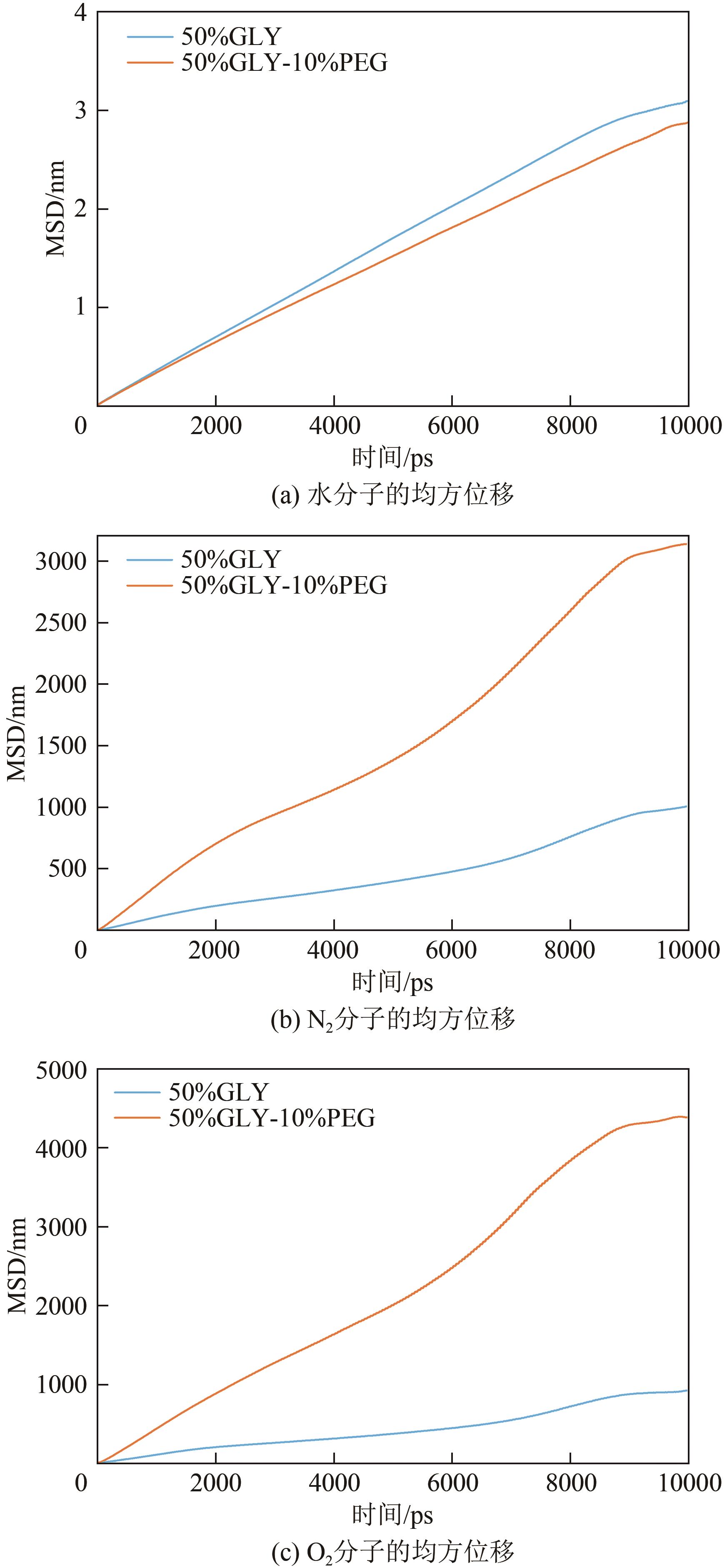
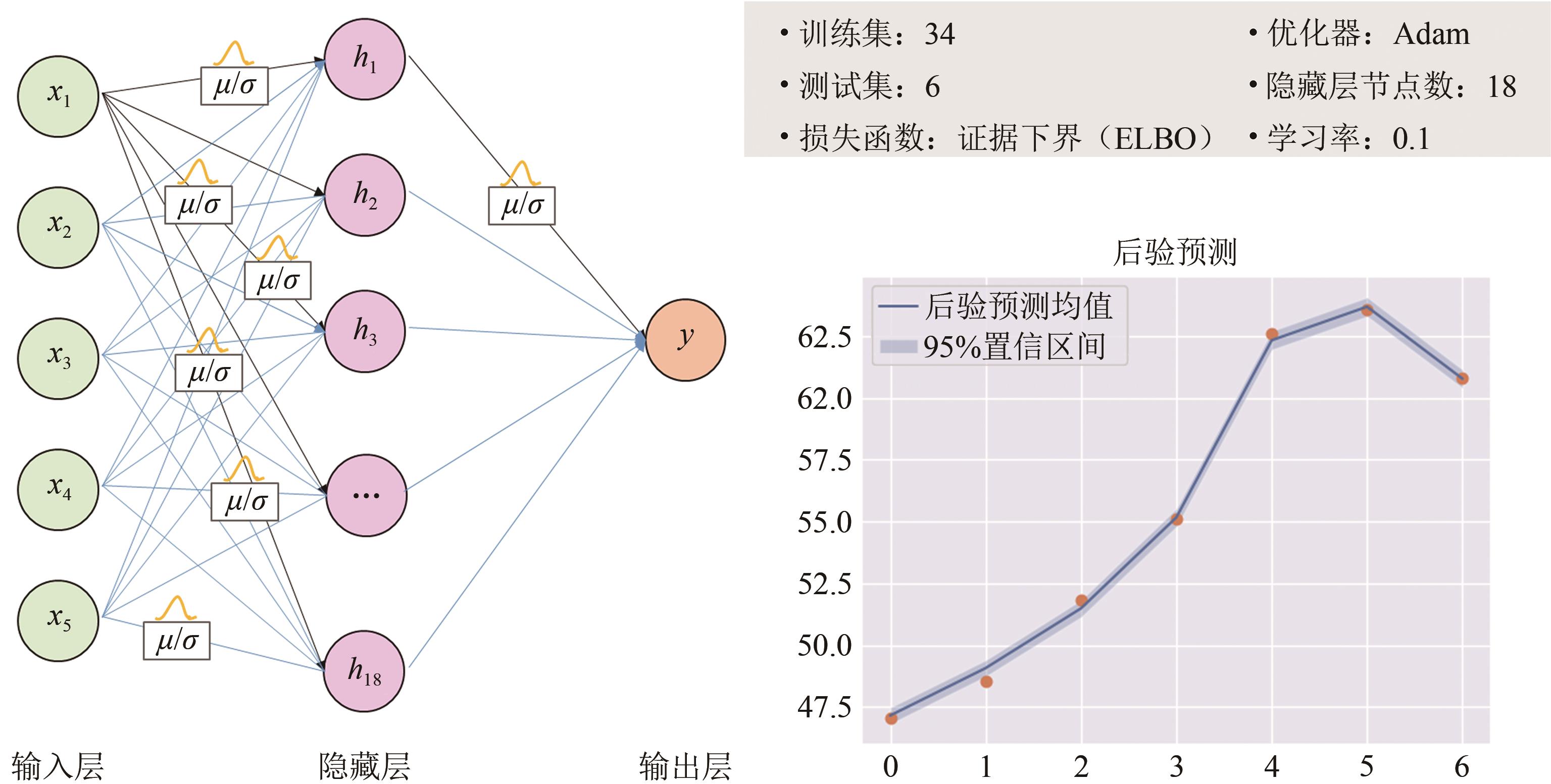
| 序号 | 质量分数/% | ||||||||
|---|---|---|---|---|---|---|---|---|---|
| SDS | GLY | PEG | PRM | NaF | DP | NaOH | H2O | ||
| 1 | 1.86 | 9.80 | 12.74 | 1.86 | 0.243 | 4.17 | 2.3 | 67.027 | 133.5212 |
| 2 | 1.86 | 46.93 | 9.71 | 1.86 | 0.243 | 4.17 | 2.3 | 32.927 | 130.3287 |
| 3 | 1.86 | 26.65 | 7.92 | 1.86 | 0.243 | 4.17 | 2.3 | 54.997 | 130.1674 |
| 4 | 1.86 | 49.77 | 4.56 | 1.86 | 0.243 | 4.17 | 2.3 | 35.237 | 127.8932 |
| 5 | 0.97 | 46.90 | 9.70 | 0.97 | 0.243 | 4.17 | 2.3 | 34.747 | 125.2137 |
| 序号 | 质量分数/% | ||||||||
|---|---|---|---|---|---|---|---|---|---|
| SDS | GLY | PEG | PRM | NaF | DP | NaOH | H2O | ||
| 1 | 1.86 | 9.80 | 12.74 | 1.86 | 0.243 | 4.17 | 2.3 | 67.027 | 133.5212 |
| 2 | 1.86 | 46.93 | 9.71 | 1.86 | 0.243 | 4.17 | 2.3 | 32.927 | 130.3287 |
| 3 | 1.86 | 26.65 | 7.92 | 1.86 | 0.243 | 4.17 | 2.3 | 54.997 | 130.1674 |
| 4 | 1.86 | 49.77 | 4.56 | 1.86 | 0.243 | 4.17 | 2.3 | 35.237 | 127.8932 |
| 5 | 0.97 | 46.90 | 9.70 | 0.97 | 0.243 | 4.17 | 2.3 | 34.747 | 125.2137 |
| [1] | GROSSMANN Ignacio E. Challenges in the new millennium: Product discovery and design, enterprise and supply chain optimization, global life cycle assessment[J]. Computers & Chemical Engineering, 2004, 29(1): 29-39. |
| [2] | ZHANG Lei, BABI Deenesh K, GANI Rafiqul. New vistas in chemical product and process design[J]. Annual Review of Chemical and Biomolecular Engineering, 2016, 7: 557-582. |
| [3] | KONTOGEORGIS Georgios M, JHAMB Spardha, LIANG Xiaodong, et al. Computer-aided design of formulated products[J]. Current Opinion in Colloid & Interface Science, 2022, 57: 101536. |
| [4] | 张磊, 贺丁, 刘琳琳, 等. 基于模型的化工产品设计方法——综述与展望[J]. 化工进展, 2021, 40(4): 1746-1754. |
| ZHANG Lei, HE Ding, LIU Linlin, et al. Model-based chemical product design—Review and perspectives[J]. Chemical Industry and Engineering Progress, 2021, 40(4): 1746-1754. | |
| [5] | GANI Rafiqul. Chemical product design: Challenges and opportunities[J]. Computers & Chemical Engineering, 2004, 28(12): 2441-2457. |
| [6] | VENKATASUBRAMANIAN V, CHAN K, CARUTHERS J M. Computer-aided molecular design using genetic algorithms[J]. Computers & Chemical Engineering, 1994, 18(9): 833-844. |
| [7] | ZHANG Lei, MAO Haitao, ZHUANG Yu, et al. Odor prediction and aroma mixture design using machine learning model and molecular surface charge density profiles[J]. Chemical Engineering Science, 2021, 245: 116947. |
| [8] | ZHAO Yujing, LIU Qilei, WU Xinyuan, et al. De novo drug design framework based on mathematical programming method and deep learning model[J]. AIChE Journal, 2022, 68(9): e17748. |
| [9] | KARUNANITHI Arunprakash T, ACHENIE Luke E K, GANI Rafiqul. A computer-aided molecular design framework for crystallization solvent design[J]. Chemical Engineering Science, 2006, 61(4): 1247-1260. |
| [10] | LIU Qilei, ZHANG Lei, TANG Kun, et al. Computer-aided reaction solvent design considering inertness using group contribution-based reaction thermodynamic model[J]. Chemical Engineering Research and Design, 2019, 152: 123-133. |
| [11] | KATRITZKY Alan R, LOBANOV Victor S, KARELSON Mati. QSPR: The correlation and quantitative prediction of chemical and physical properties from structure[J]. Chemical Society Reviews, 1995, 24(4): 279-287. |
| [12] | HILL Michael. Product and process design for structured products[J]. AIChE Journal, 2004, 50(8): 1656-1661. |
| [13] | WANG Huan, TANG Xueming, EIKE David M, et al. Scission free energies for wormlike surfactant micelles: Development of a simulation protocol, application, and validation for personal care formulations[J]. Langmuir, 2018, 34(4): 1564-1573. |
| [14] | SHARMA Shikha, KAMIL Mohammad. Studies on the interaction between polymer and surfactant in aqueous solutions[J]. Indian Journal of Chemical Technology, 2018, 25(3): 294-299. |
| [15] | KHAN Mohammad Yunus, SAMANTA Abhijit, OJHA Keka, et al. Interaction between aqueous solutions of polymer and surfactant and its effect on physicochemical properties[J]. Asia-Pacific Journal of Chemical Engineering, 2008, 3(5): 579-585. |
| [16] | LA MESA Camillo. Polymer-surfactant and protein-surfactant interactions[J]. Journal of Colloid and Interface Science, 2005, 286(1): 148-157. |
| [17] | BRADBURY Robert, PENFOLD Jeffrey, THOMAS Robert K, et al. Manipulating perfume delivery to the interface using polymer-surfactant interactions[J]. Journal of Colloid and Interface Science, 2016, 466: 220-226. |
| [18] | PENFOLD J, THOMAS R K, BRADBURY R, et al. Probing the surface of aqueous surfactant-perfume mixed solutions during perfume evaporation[J]. Colloids and Surfaces A: Physicochemical and Engineering Aspects, 2017, 520: 178-183. |
| [19] | TANG Haifeng, SONG Jiamei, ZHA Mengling, et al. Molecular dynamics simulation on the structure-activity relationship between the Gemini surfactant and foam properties[J]. AIChE Journal, 2022, 68(5): e17625. |
| [20] | SHANG Barry Z, WANG Zuowei, LARSON Ronald G. Effect of headgroup size, charge, and solvent structure on polymer-micelle interactions, studied by molecular dynamics simulations[J]. The Journal of Physical Chemistry B, 2009, 113(46): 15170-15180. |
| [21] | TANG Xueming, ZOU Weizhong, KOENIG Peter H, et al. Multiscale modeling of the effects of salt and perfume raw materials on the rheological properties of commercial threadlike micellar solutions[J]. The Journal of Physical Chemistry B, 2017, 121(11): 2468-2485. |
| [22] | KUPGAN Grit, ABBOTT Lauren J, HART Kyle E, et al. Modeling amorphous microporous polymers for CO2 capture and separations[J]. Chemical Reviews, 2018, 118(11): 5488-5538. |
| [23] | LIANG Xinyuan, ZHANG Xiang, ZHANG Lei, et al. Computer-aided polymer design: Integrating group contribution and molecular dynamics[J]. Industrial & Engineering Chemistry Research, 2019, 58(34): 15542-15552. |
| [24] | GUO Wenjing, LIU Qilei, ZHANG Lei, et al. Computer-aided design of a perfluorinated sulfonic acid proton exchange membrane using stochastic optimization and molecular dynamic method[J]. Industrial & Engineering Chemistry Research, 2021, 60(49): 18045-18057. |
| [25] | CHENG Kai Cong, KHOO Zhi Sheng, Newton Well LO, et al. Design and performance optimisation of detergent product containing binary mixture of anionic-nonionic surfactants[J]. Heliyon, 2020, 6(5): e03861. |
| [26] | BINDER Kurt, Jürgen HORBACH, Walter KOB, et al. Molecular dynamics simulations[J]. Journal of Physics: Condensed Matter, 2004, 16(5): S429-S453. |
| [27] | JORGENSEN William L, Julian TIRADO-RIVES. Potential energy functions for atomic-level simulations of water and organic and biomolecular systems[J]. Proceedings of the National Academy of Sciences of the United States of America, 2005, 102(19): 6665-6670. |
| [28] | DODDA Leela S, VILSECK Jonah Z, Julian TIRADO-RIVES, et al. 1.14*CM1A-LBCC: Localized bond-charge corrected CM1A charges for condensed-phase simulations[J]. The Journal of Physical Chemistry B, 2017, 121(15): 3864-3870. |
| [29] | DODDA Leela S, DE VACA Israel Cabeza, Julian TIRADO-RIVES, et al. LigParGen web server: An automatic OPLS-AA parameter generator for organic ligands[J]. Nucleic Acids Research, 2017, 45(W1): W331-W336. |
| [30] | EGGIMANN Becky L, SUNNARBORG Amara J, STERN Hudson D, et al. An online parameter and property database for the TraPPE force field[J]. Molecular Simulation, 2014, 40(1/2/3): 101-105. |
| [31] | JANG Seung Soon, GODDARD William A. Structures and properties of Newton black films characterized using molecular dynamics simulations[J]. The Journal of Physical Chemistry B, 2006, 110(15): 7992-8001. |
| [32] | MARTÍNEZ L, ANDRADE R, BIRGIN E G, et al. PACKMOL: A package for building initial configurations for molecular dynamics simulations[J]. Journal of Computational Chemistry, 2009, 30(13): 2157-2164. |
| [33] | ABRAHAM Mark James, MURTOLA Teemu, SCHULZ Roland, et al. GROMACS: High performance molecular simulations through multi-level parallelism from laptops to supercomputers[J]. SoftwareX, 2015, 1: 19-25. |
| [34] | HESS Berk, BEKKER Henk, BERENDSEN Herman J C, et al. LINCS: A linear constraint solver for molecular simulations[J]. Journal of Computational Chemistry, 1997, 18(12): 1463-1472. |
| [35] | DARDEN Tom, YORK Darrin, PEDERSEN Lee. Particle mesh Ewald: An N⋅log(N) method for Ewald sums in large systems[J]. The Journal of Chemical Physics, 1993, 98(12): 10089-10092. |
| [36] | HUMPHREY William, DALKE Andrew, SCHULTEN Klaus. VMD: Visual molecular dynamics[J]. Journal of Molecular Graphics, 1996, 14(1): 33-38. |
| [1] | LI Yanping, YANG Tao, WANG Hongxun, ZHANG Cheng, WEN Guosheng, HAN Zhicheng, LAN Gongjia, YAN Dazhou. Reaction molecular dynamics simulation of the thermal decomposition and reduction system of trichlorosilane in a hydrogen atmosphere [J]. Chemical Industry and Engineering Progress, 2025, 44(8): 4322-4330. |
| [2] | CHEN Yang, LUO Jin, WANG Dianlin, YANG Zuguo, YANG Peng, CHEN Yong, ZHONG Xiang, TANG Li. Experimental study on the effect of surfactant complex systems with different molecular structures on emulsification and viscosity reduction of extra-heavy oil [J]. Chemical Industry and Engineering Progress, 2025, 44(7): 3838-3849. |
| [3] | DAI Yueming, ZHOU Meifang, SHEN Jianhua, JIANG Haibo, LI Chunzhong. Molecular dynamics simulation of sintering mechanism of TiO2 nanoparticles [J]. Chemical Industry and Engineering Progress, 2025, 44(4): 2202-2214. |
| [4] | FENG Peng, XU Donghai, HE Bing, LIU Huanteng, YANG Lijie, WANG Pan, LIU Qingshan. Dissolution characteristics and mechanisms of typical sulphates Na2SO4 and K2SO4 in sub-/supercritical water [J]. Chemical Industry and Engineering Progress, 2025, 44(3): 1706-1715. |
| [5] | LI Haoran, WANG Yan, ZHANG Tao, LYU Li, TANG Wenxiang, TANG Shengwei. Controllable regulation of microdroplets size in W/O microemulsion with Cu(Ac)2-Zn(Ac)2 solution as aqueous phase [J]. Chemical Industry and Engineering Progress, 2024, 43(9): 5168-5176. |
| [6] | MIAO Yihe, WANG Yaozu, LIU Yuhang, ZHU Xuancan, LI Jia, YU Lijun. Research progress on the improving effect of additives on supported amine adsorbents for carbon capture [J]. Chemical Industry and Engineering Progress, 2024, 43(5): 2739-2759. |
| [7] | ZHENG Jia, LIU Yiming, XU Ligang, YAO Lin. Preparation and properties of color-changing hydrogel with dual-stimulation response to temperature and pH [J]. Chemical Industry and Engineering Progress, 2024, 43(12): 6811-6819. |
| [8] | ZHAO Jingchao, TAN Ming. Effect of surfactants on the reduction of industrial saline wastewater by electrodialysis [J]. Chemical Industry and Engineering Progress, 2023, 42(S1): 529-535. |
| [9] | YANG Yang, SUN Zhigao, LI Cuimin, LI Juan, HUANG Haifeng. Promotion on the formation of HCFC-141b hydrate under static conditions by surfactant OP-13 [J]. Chemical Industry and Engineering Progress, 2023, 42(6): 2854-2859. |
| [10] | ZHAO Yi, YANG Zhen, WANG Jia, LI Jingwen, ZHENG Yu. Research progress on molecular dynamics simulation of self-healing behavior of asphalt binder [J]. Chemical Industry and Engineering Progress, 2023, 42(2): 803-813. |
| [11] | CUI Tengda, WEN Hua, ZHAO Ying. Comparative analysis of deposition characteristics of modified droplets impacting lotus leaf surface [J]. Chemical Industry and Engineering Progress, 2023, 42(11): 5882-5890. |
| [12] | LI Xintong, LIU Tianxia, LIU Errui, ZHANG Yaping. Effect of cationic surfactant spraying on electrocatalytic reduction of carbon dioxide to carbon monoxide by ZnMg rod bimetallic hydroxides [J]. Chemical Industry and Engineering Progress, 2023, 42(11): 5738-5746. |
| [13] | DENG Quanlong, DING Houcheng, XU Yuandi, JIANG Zhong’an, YANG Lan, SUN Xuefei. Synergistic dust removal performance of surfactant droplets combined with metal mesh grid [J]. Chemical Industry and Engineering Progress, 2023, 42(1): 546-552. |
| [14] | SONG Chao, YE Xuemin, LI Chunxi. Molecular dynamics study on the influence of self-assembly behaviors of nanoparticles and surfactants on the properties of silicone oil/water interface [J]. Chemical Industry and Engineering Progress, 2022, 41(S1): 366-375. |
| [15] | ZHANG Qingqing, BI Haipu, SHU Zhongjun, OU Hongxiang, WANG Shangbin, WANG Junqi, PAN Yi. Research progress on control behaviors and substitutes of PFOS in foam extinguishing agents [J]. Chemical Industry and Engineering Progress, 2022, 41(S1): 340-350. |
| Viewed | ||||||
|
Full text |
|
|||||
|
Abstract |
|
|||||