化工进展 ›› 2025, Vol. 44 ›› Issue (S1): 350-367.DOI: 10.16085/j.issn.1000-6613.2025-0633
• 材料科学与技术 • 上一篇
染料敏化太阳能电池氧化还原电对
管思颖( ), 问金月, 焦守政(), 郝雨薇, 孙志成
- 北京印刷学院印刷与包装工程学院,印刷电子工程技术研究中心,北京 102600
-
收稿日期:2025-04-29修回日期:2025-08-29出版日期:2025-10-25发布日期:2025-11-24 -
通讯作者:焦守政 -
作者简介:管思颖(1999—),女,硕士研究生,研究方向为印刷电子材料。E-mail:884676098@qq.com。 -
基金资助:国家自然科学基金(22278037);国家自然科学基金(62371051);国家自然科学基金(61971049);国家自然科学基金(62211530446);北京市教育委员会科技研究计划(KM202310015005);北京市自然科学基金(2252034);材料科学与工程学科建设项目(21090124010);博士科研启动基金(27170124011);博士科研启动基金(20190225001);博士科研启动基金(Ed2025001);北京市高等教育学会项目(MS2022094)
Redox couple electrolyte in dye-sensitized solar cells
GUAN Siying(), WEN Jinyue, JIAO Shouzheng(), HAO Yuwei, SUN Zhicheng
- Beijing Engineering Research Center of Printed Electronics, School of Printing and Packaging Engineering, Beijing Institute of Graphic Communication, Beijing 102600, China
-
Received:2025-04-29Revised:2025-08-29Online:2025-10-25Published:2025-11-24 -
Contact:JIAO Shouzheng

摘要:
回顾了染料敏化太阳能电池(DSSC)的发展与工作原理,介绍了电解液氧化还原电对在染料再生与其在电路闭合中的作用及其对开路电压(VOC)、短路电流(JSC)和填充因子(FF)的影响。本文阐述了能级匹配与动力学准则:以染料分子能级的“边界”与氧化还原电位、TiO₂导带位置解释再生与注入驱动力,结合介体扩散与对电极催化说明电流与填充因子来源。研究了近几年I⁻/I
中图分类号:
引用本文
管思颖, 问金月, 焦守政, 郝雨薇, 孙志成. 染料敏化太阳能电池氧化还原电对[J]. 化工进展, 2025, 44(S1): 350-367.
GUAN Siying, WEN Jinyue, JIAO Shouzheng, HAO Yuwei, SUN Zhicheng. Redox couple electrolyte in dye-sensitized solar cells[J]. Chemical Industry and Engineering Progress, 2025, 44(S1): 350-367.
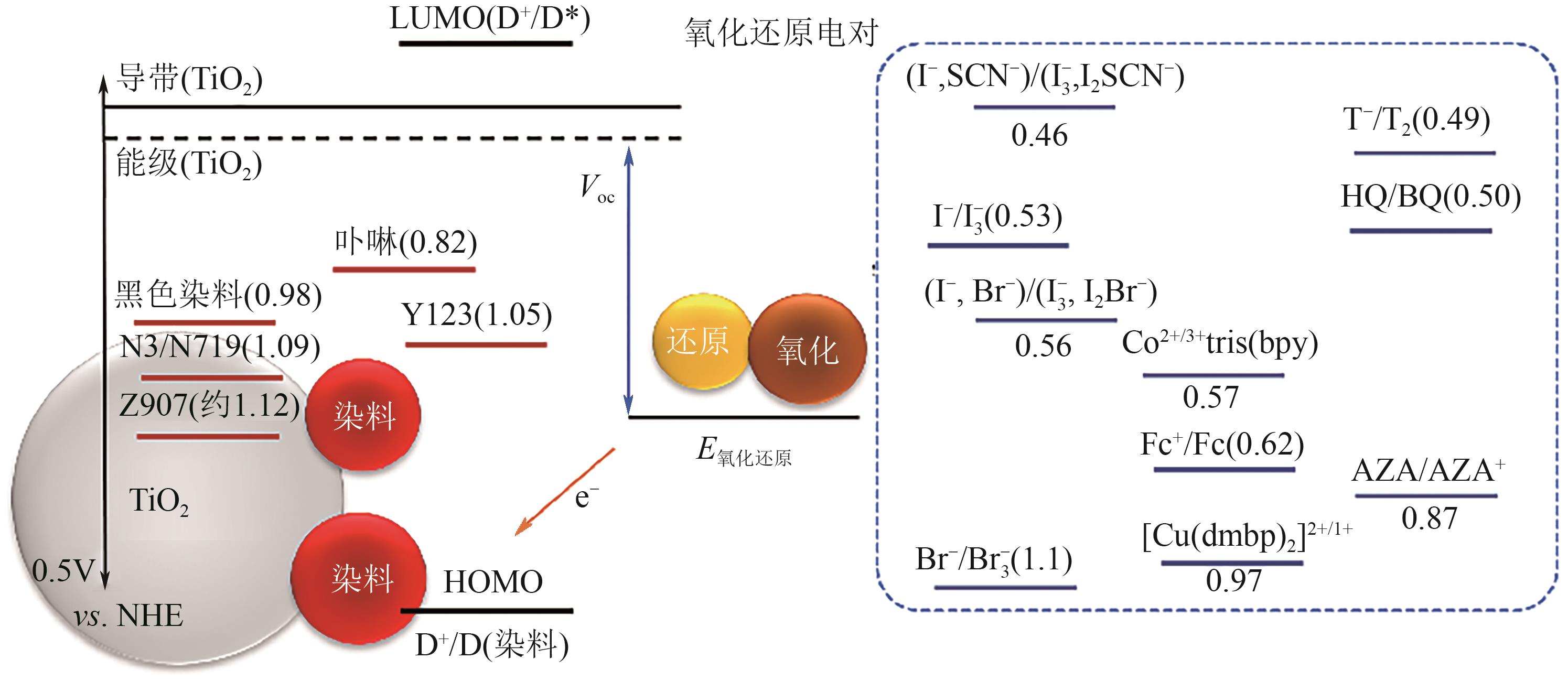
图1 部分代表性氧化还原电对的能级示意图
| 氧化还原电对 | 染料 | 氧化还原电位(vs. NHE)/V | 效率/% | 参考文献 |
|---|---|---|---|---|
| Br | 曙红Y ADEKA-3 | 1.05 | 2.6 3.9 | [ [ |
| DMBIBr/Br2 | TC306 | 1.10 | 5.2 | [ |
表1 Br3-/Br-氧化还原电对电解质在全光强下获得的光电转换效率
| 氧化还原电对 | 染料 | 氧化还原电位(vs. NHE)/V | 效率/% | 参考文献 |
|---|---|---|---|---|
| Br | 曙红Y ADEKA-3 | 1.05 | 2.6 3.9 | [ [ |
| DMBIBr/Br2 | TC306 | 1.10 | 5.2 | [ |
| 氧化还原电对 | 染料 | 氧化还原电位(vs. NHE)/V | 效率/% | 参考文献 |
|---|---|---|---|---|
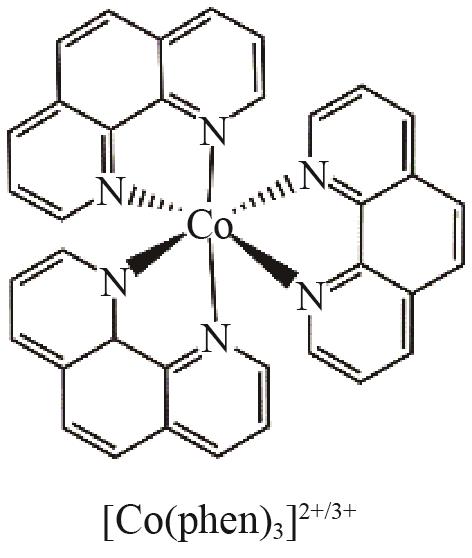 | ADEKA-1/LEG4 SA246 SA634 X73 Y123 | 0.62 | 14.30 9.4 8.2 8.1 11.3 | [ [ [ [ [ |
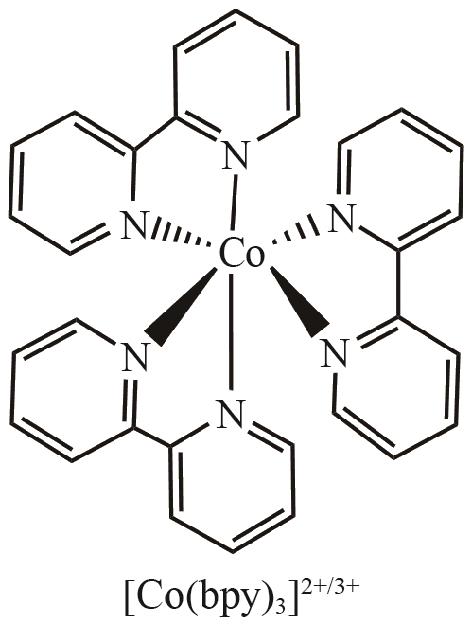 | C218 R6 H2 Y123 | 0.57 | 12.3 12.6 10.3 8.0 | [ [ [ [ |
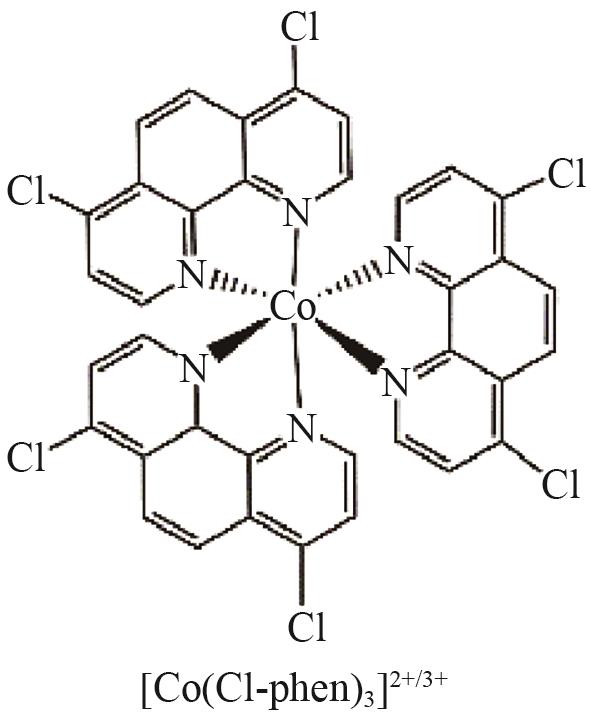 | D35 | 0.72 | 3.10 | [ |
表2 钴配合物电解质电池在全光强下获得的光电转换效率
| 氧化还原电对 | 染料 | 氧化还原电位(vs. NHE)/V | 效率/% | 参考文献 |
|---|---|---|---|---|
| ADEKA-1/LEG4 SA246 SA634 X73 Y123 | 0.62 | 14.30 9.4 8.2 8.1 11.3 | [ [ [ [ [ |
| C218 R6 H2 Y123 | 0.57 | 12.3 12.6 10.3 8.0 | [ [ [ [ |
| D35 | 0.72 | 3.10 | [ |
| 氧化还原电对 | 染料 | 氧化还原电位(vs. NHE)/V | 效率/% | 参考文献 |
|---|---|---|---|---|
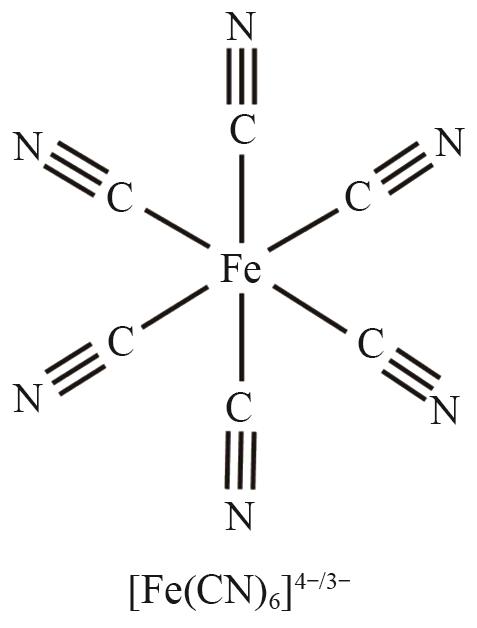 | MK2 | 0.77 | 4.10 | [ |
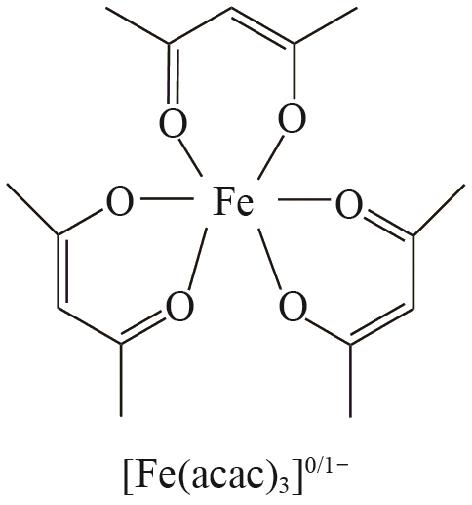 | ZnP1 | -0.20 | 0.92 | [ |
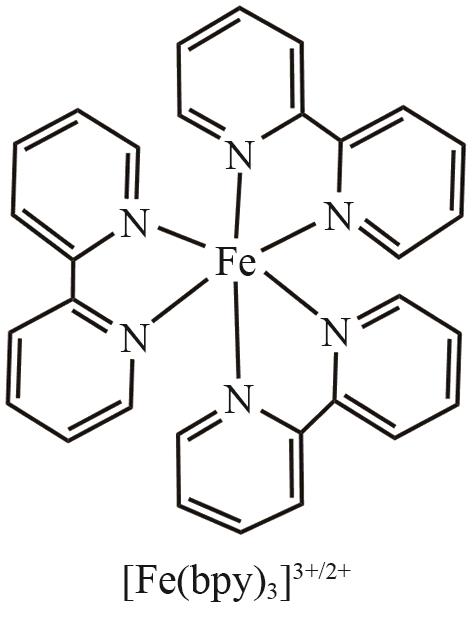 | RR9 [三(2-苯基吡啶)铱2(4,4′-双(二乙基膦甲基)-2,2′-联吡啶)]PF6 | 1.37 | 1.90 0.80 | [ [ |
表3 铁配合物电解质电池在全光强下获得的光电转换效率
| 氧化还原电对 | 染料 | 氧化还原电位(vs. NHE)/V | 效率/% | 参考文献 |
|---|---|---|---|---|
| MK2 | 0.77 | 4.10 | [ |
| ZnP1 | -0.20 | 0.92 | [ |
| RR9 [三(2-苯基吡啶)铱2(4,4′-双(二乙基膦甲基)-2,2′-联吡啶)]PF6 | 1.37 | 1.90 0.80 | [ [ |
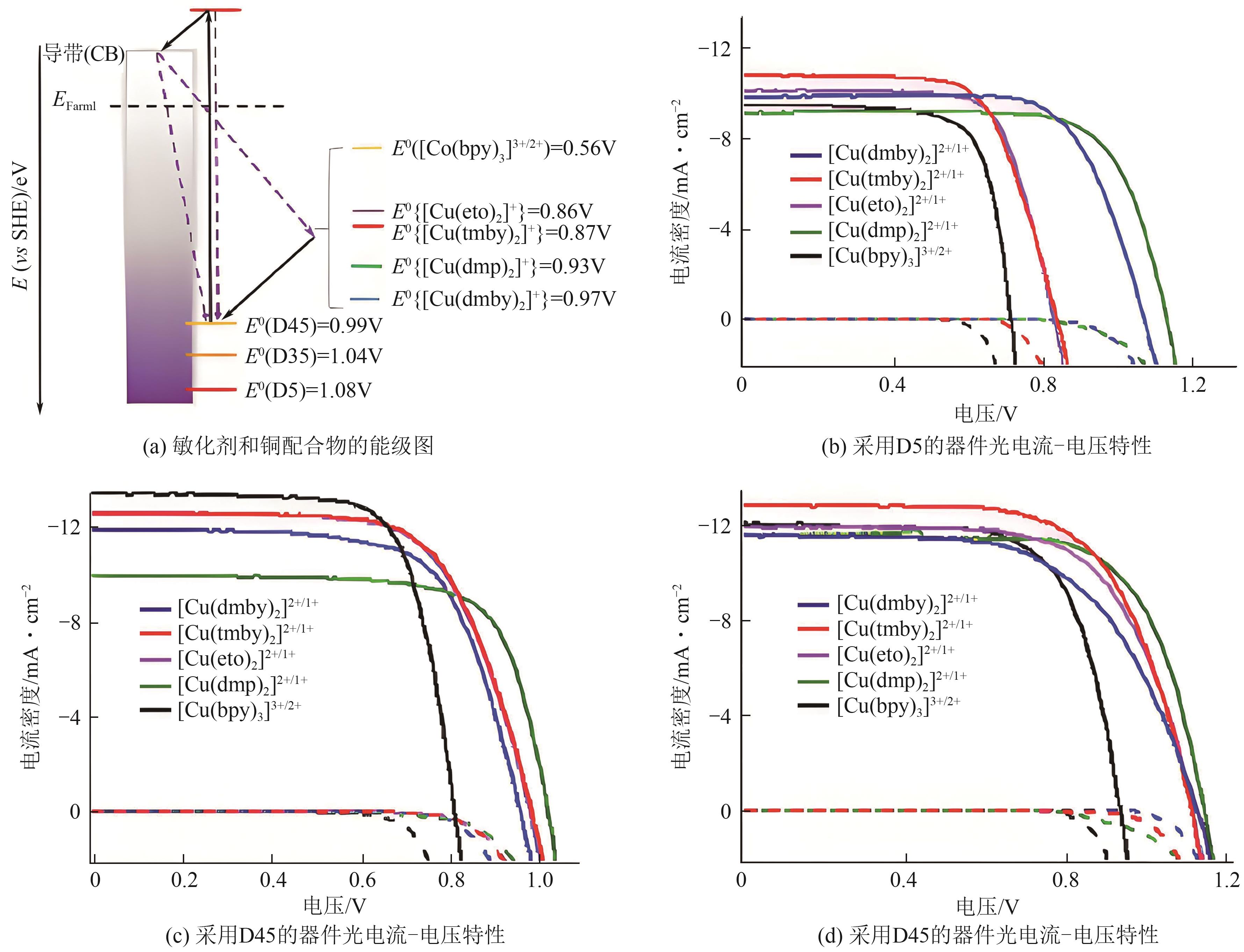
图2 敏化剂和铜配合物的能级图以及采用这些材料器件的光电流-电压特性[51]
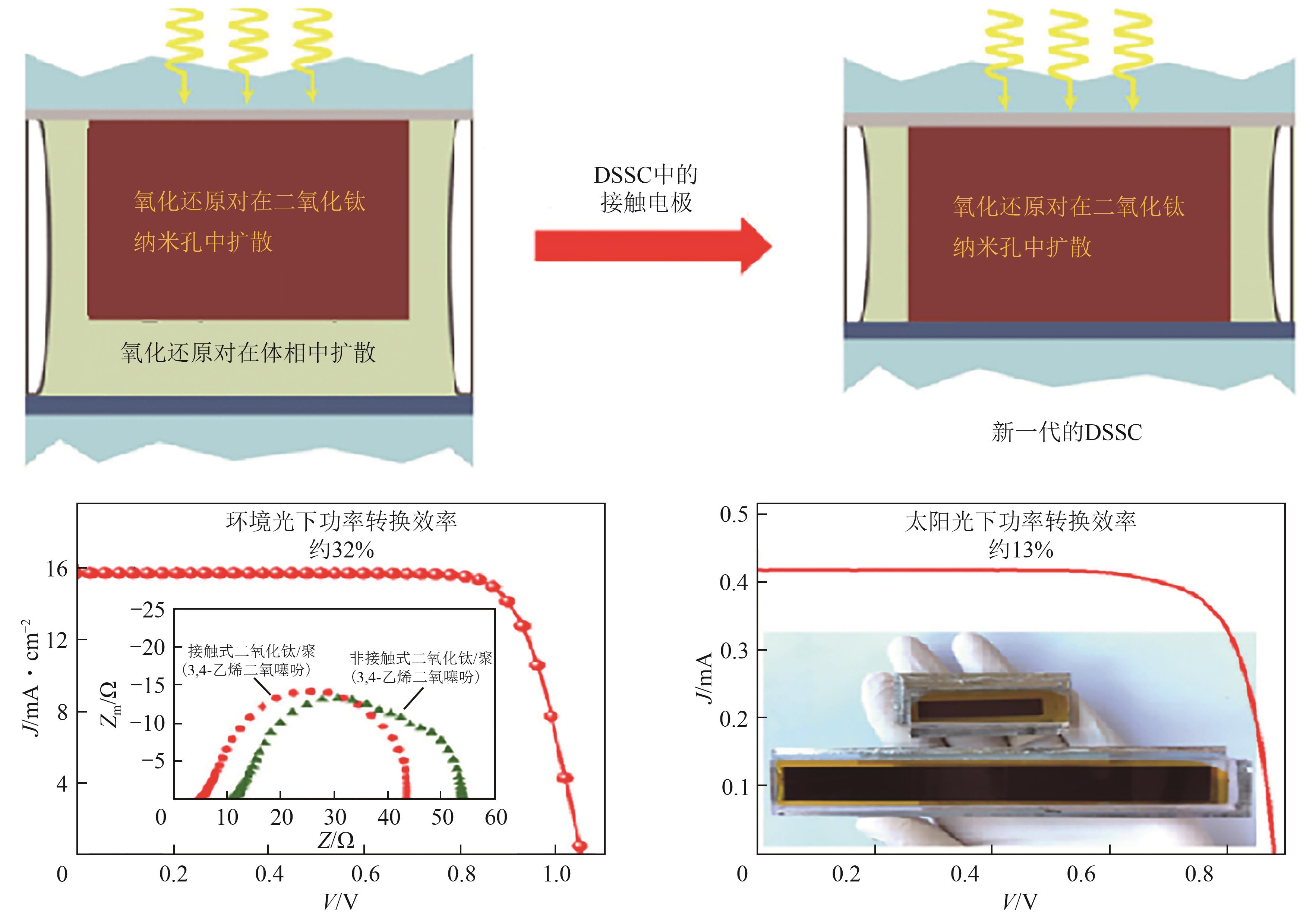
图3 新DSSC架构示意图、敏化TiO2电极和基于PEDOT半导体对电极的DSSC在AM 1.5G条件下和1000lx室内光下的J-V特性曲线[9]
| 氧化还原电对 | 染料 | 氧化还原电位(vs. NHE)/V | 效率/% | 参考文献 |
|---|---|---|---|---|
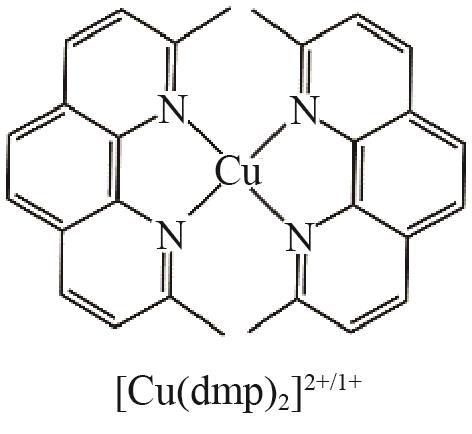 | N719 Y123 D35 | 0.93 | 1.4 10.3 7.5 | [ [ [ |
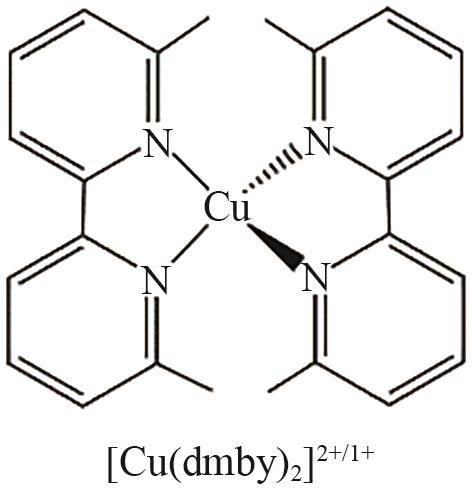 | Y123 | 0.97 | 10.3 | [ |
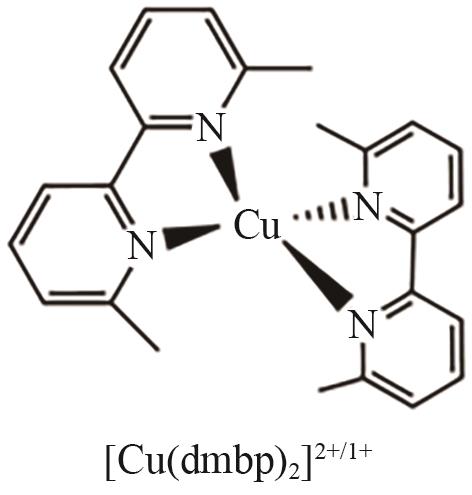 | Y123 | 0.9 | 10.3 | [ |
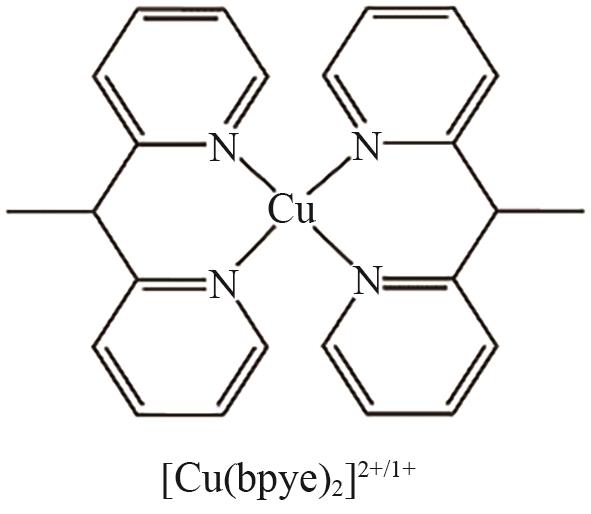 | LEG4 | 0.59 | 9.0 | [ |
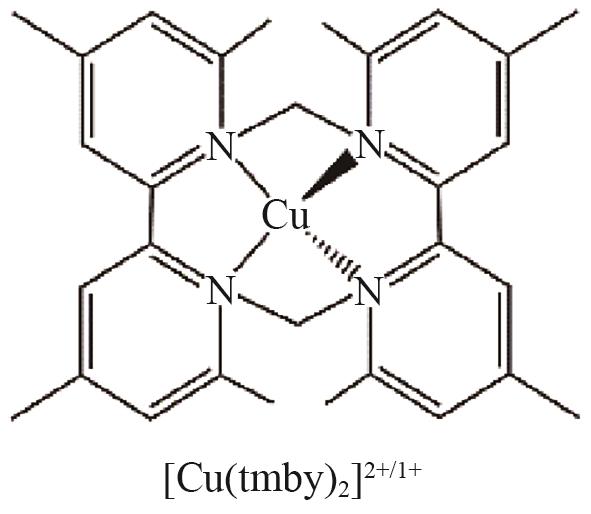 | Y123 D35和XY1 WS-72 L350 XY1和L1 MS5和XY1b SL9和SL10 | 0.87 | 10.00 11.3;28.9(1000lx) 11.6 11.2;28.4(1000lx) 11.5;34(1000lx) 13.5;34.5(1000lx) 15.20 | [ [ [ [ [ [ [ |
表4 铜配合物电解质电池在全光强下获得的光电转换效率
| 氧化还原电对 | 染料 | 氧化还原电位(vs. NHE)/V | 效率/% | 参考文献 |
|---|---|---|---|---|
| N719 Y123 D35 | 0.93 | 1.4 10.3 7.5 | [ [ [ |
| Y123 | 0.97 | 10.3 | [ |
| Y123 | 0.9 | 10.3 | [ |
| LEG4 | 0.59 | 9.0 | [ |
| Y123 D35和XY1 WS-72 L350 XY1和L1 MS5和XY1b SL9和SL10 | 0.87 | 10.00 11.3;28.9(1000lx) 11.6 11.2;28.4(1000lx) 11.5;34(1000lx) 13.5;34.5(1000lx) 15.20 | [ [ [ [ [ [ [ |
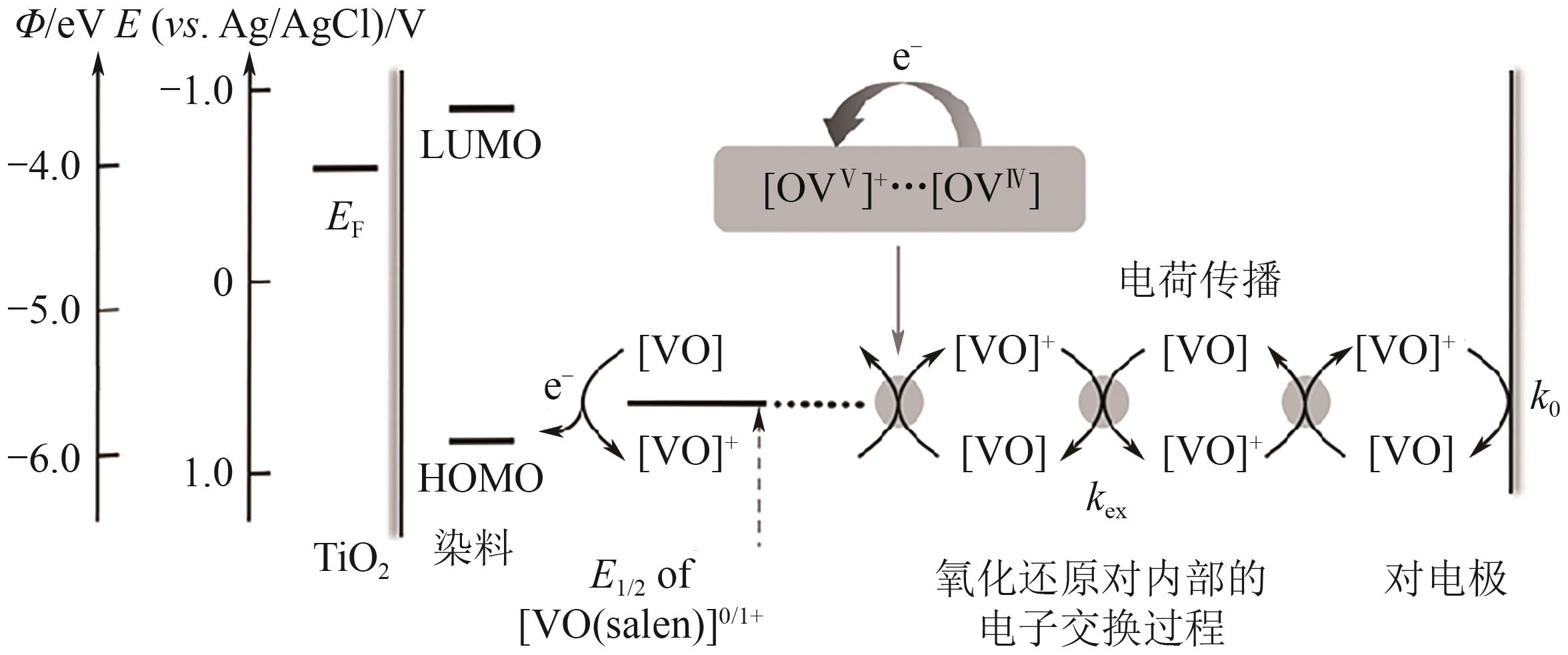
图4 DSSC中[VO(salen)]0/1+ ([VO]0/1+)电对的氧化还原介导过程[63]Φ—功函数;E1/2—半波电位;kex—电子交换速率常数;k0—标准电荷转移速率常数
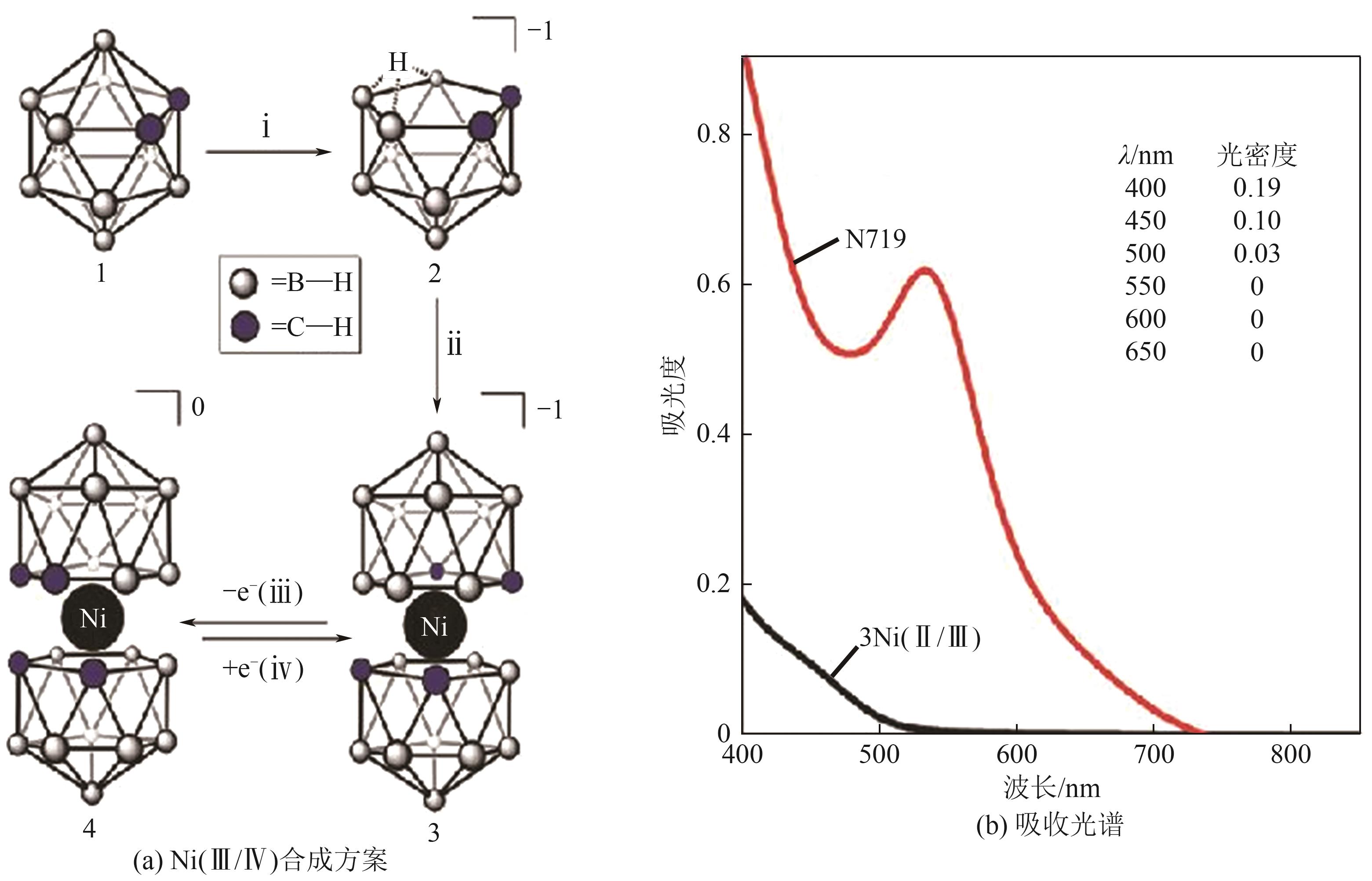
图5 Ni(Ⅲ/Ⅳ)合成方案及N719敏化纳米TiO2薄膜和0.1mol/L 3Ni(Ⅱ/Ⅲ)的光吸收光谱[66]
| 氧化还原电对 | 染料 | 氧化还原电位(vs. NHE)/V | 效率/% | 参考文献 |
|---|---|---|---|---|
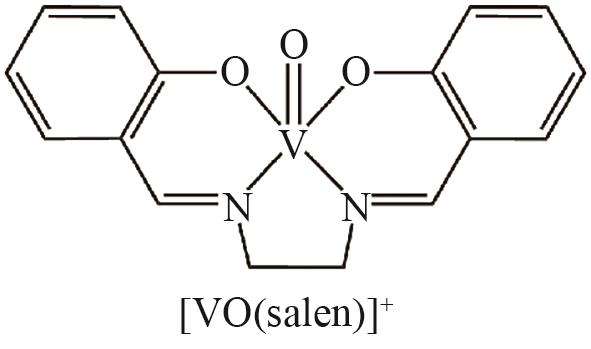 | D205和D131 | 0.84 | 5.4 | [ |
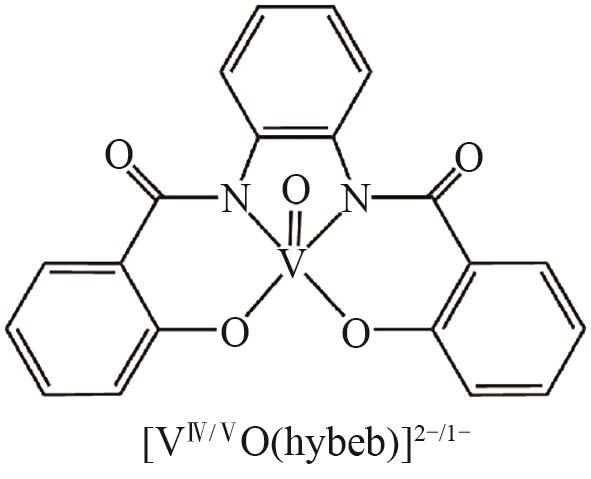 | N719 | 0.58 | 2 | [ |
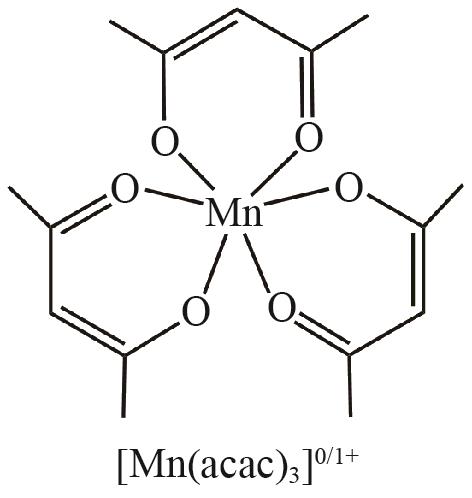 | MK2 | 0.49 | 4.4 | [ |
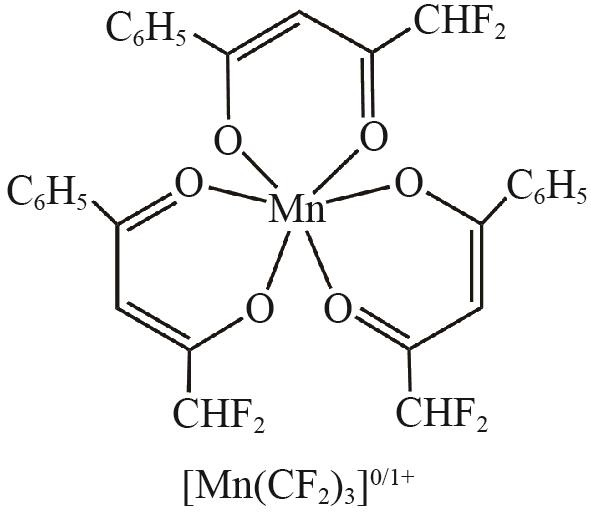 | Z907 | 1.20 | 2.62 | [ |
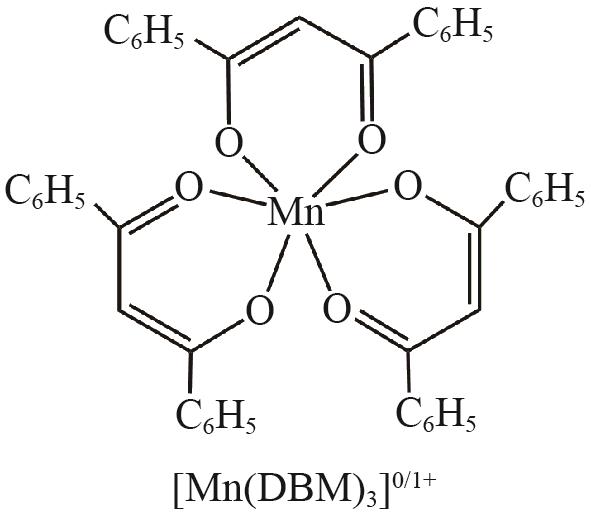 | Z907 | 0.49 | 1.48 | [ |
表5 其他金属配合物电解质在全光强下获得的光电转换效率
| 氧化还原电对 | 染料 | 氧化还原电位(vs. NHE)/V | 效率/% | 参考文献 |
|---|---|---|---|---|
| D205和D131 | 0.84 | 5.4 | [ |
| N719 | 0.58 | 2 | [ |
| MK2 | 0.49 | 4.4 | [ |
| Z907 | 1.20 | 2.62 | [ |
| Z907 | 0.49 | 1.48 | [ |
| 氧化还原电对 | 染料 | 氧化还原电位(vs. NHE)/V | 效率/% | 参考文献 |
|---|---|---|---|---|
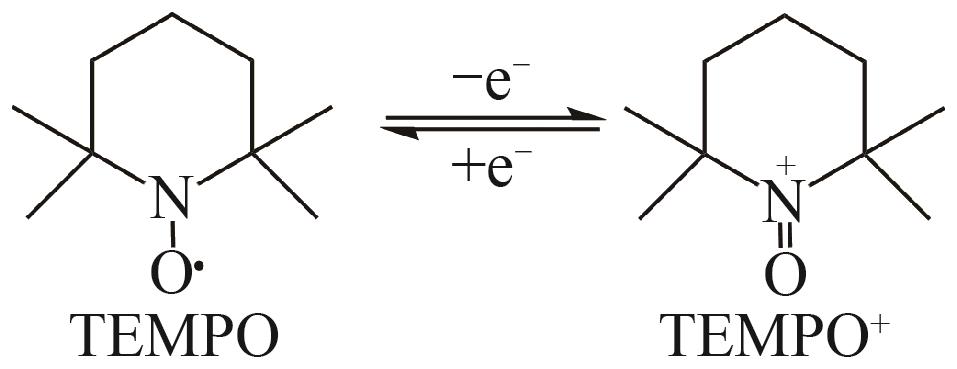 | D149 Y123 N719 Y123 | 0.80 | 5.4 3.9 6.0 2.1 | [ [ [ [ |
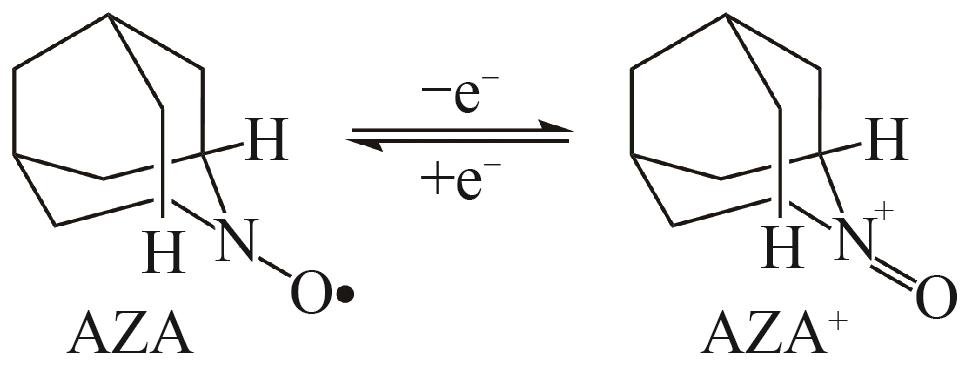 | D205和D131 | 0.87 | 8.1 | [ |
表6 氮氧自由基类氧化还原电对电解质在全光强下获得的光电转换效率
| 氧化还原电对 | 染料 | 氧化还原电位(vs. NHE)/V | 效率/% | 参考文献 |
|---|---|---|---|---|
| D149 Y123 N719 Y123 | 0.80 | 5.4 3.9 6.0 2.1 | [ [ [ [ |
| D205和D131 | 0.87 | 8.1 | [ |
| 氧化还原电对 | 染料 | 氧化还原电位(vs. NHE)/V | 效率/% | 参考文献 |
|---|---|---|---|---|
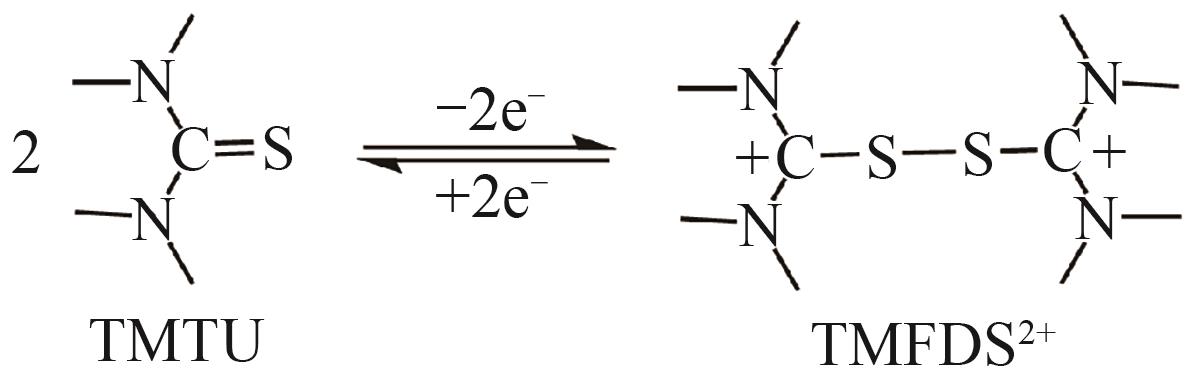 | N3 | 0.23 | 3.1 | [ |
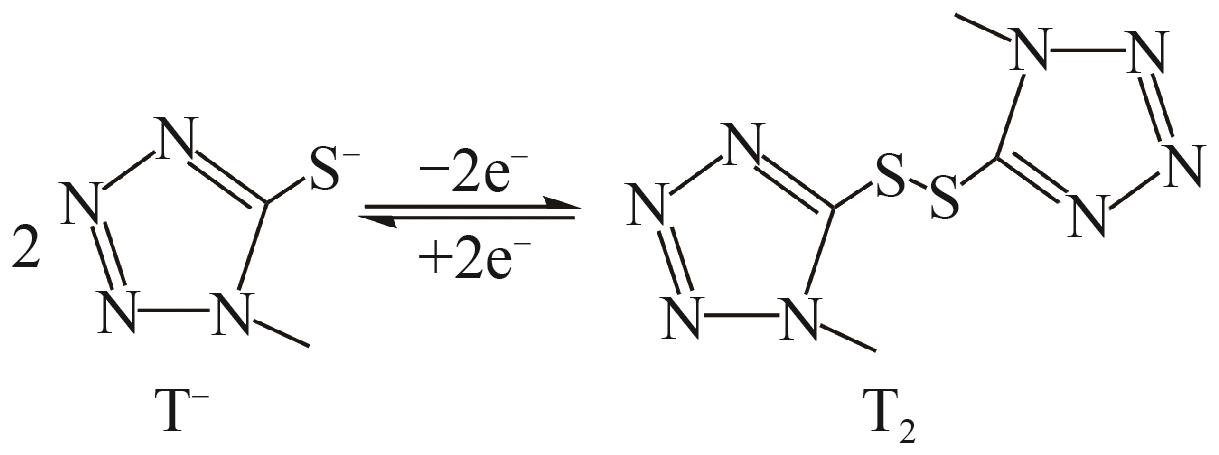 | 含三苯胺取代的六噻吩π-共轭染料/SQ2染料(PMI-6T-TPA/SQ2) PP2-NDI PMI-acac | 0.49 | 1.33 2.27 0.098 | [ [ [ |
表7 硫脲/过硫醚、巯盐/过硫醚氧化还原电对电解质在全光强下获得的光电转换效率
| 氧化还原电对 | 染料 | 氧化还原电位(vs. NHE)/V | 效率/% | 参考文献 |
|---|---|---|---|---|
| N3 | 0.23 | 3.1 | [ |
| 含三苯胺取代的六噻吩π-共轭染料/SQ2染料(PMI-6T-TPA/SQ2) PP2-NDI PMI-acac | 0.49 | 1.33 2.27 0.098 | [ [ [ |
| 氧化还原电对 | 染料 | 氧化还原电位(vs. NHE)/V | 效率/% | 参考文献 |
|---|---|---|---|---|
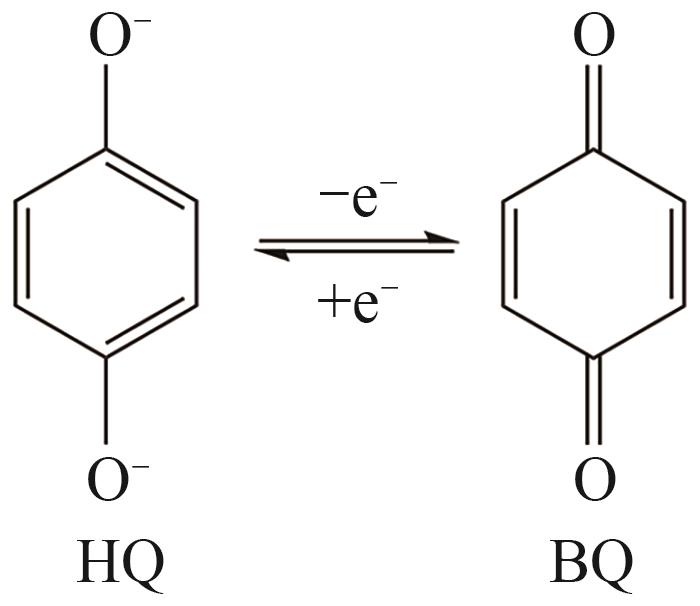 | N719 CM309 | 0.50 | 8.4 6.2 | [ [ |
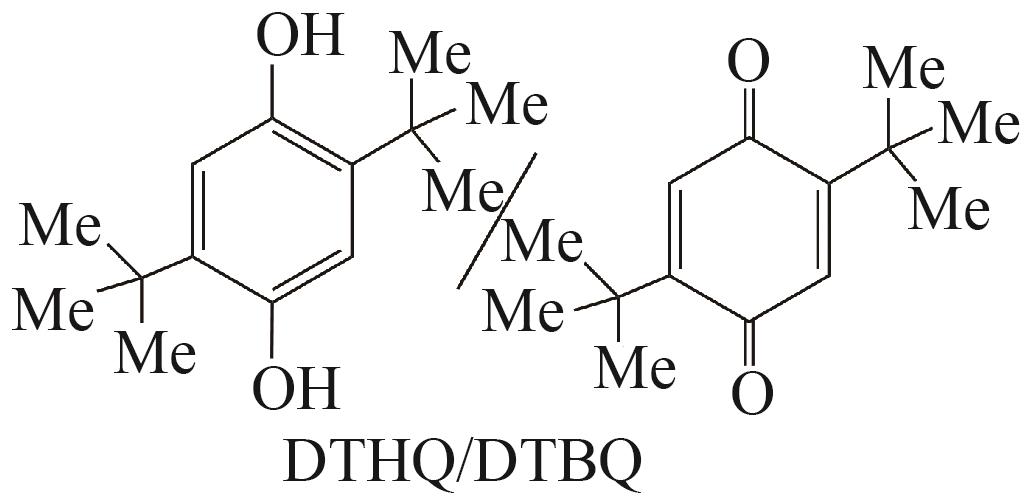 | LEG4 | 0.95 | 1.3 | [ |
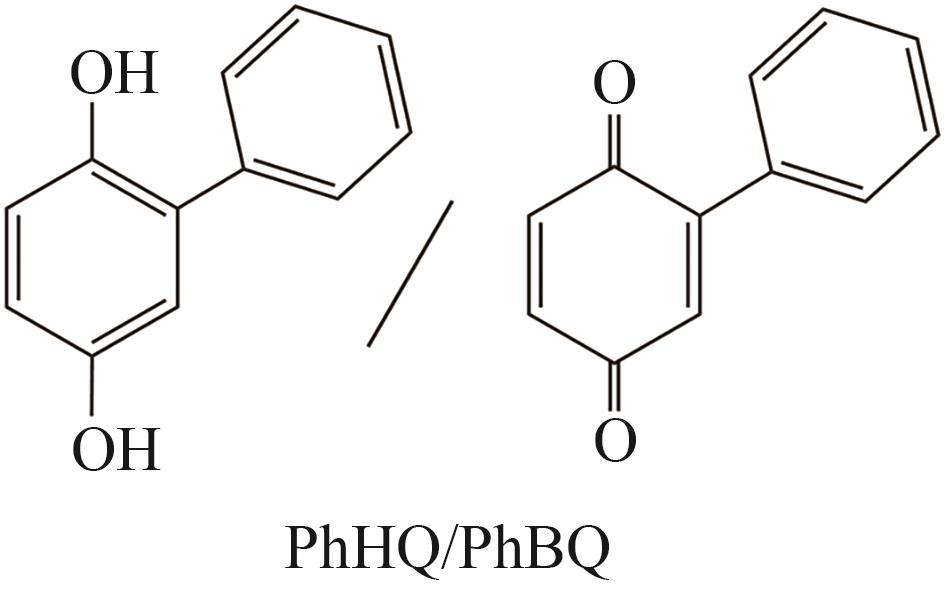 | LEG4 | 0.47 | 2.5 | [ |
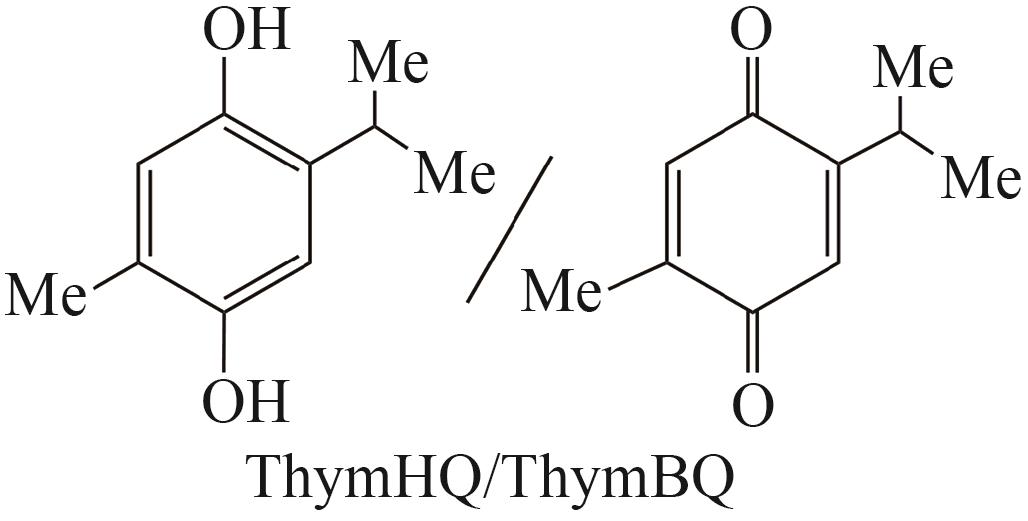 | LEG4 | 0.58 | 2.0 | [ |
表8 对苯二酚/对苯醌氧化还原电对电解质在全光强下获得的光电转换效率
| 氧化还原电对 | 染料 | 氧化还原电位(vs. NHE)/V | 效率/% | 参考文献 |
|---|---|---|---|---|
| N719 CM309 | 0.50 | 8.4 6.2 | [ [ |
| LEG4 | 0.95 | 1.3 | [ |
| LEG4 | 0.47 | 2.5 | [ |
| LEG4 | 0.58 | 2.0 | [ |
| 氧化还原电对 | 染料 | 氧化还原电位(vs. NHE)/V | 效率/% | 参考文献 |
|---|---|---|---|---|
| NMBI/[BuPy]IBr2(NMBI为N-甲基苯并咪唑,BuPy为丁基咪唑) | N3 | 0.50 | 6.4 | [ |
| (I-, Br-)/(I | N719 | 0.56 | 7.06 | [ |
表9 卤间化合物氧化还原电对电解质在全光强下获得的光电转换效率
| 氧化还原电对 | 染料 | 氧化还原电位(vs. NHE)/V | 效率/% | 参考文献 |
|---|---|---|---|---|
| NMBI/[BuPy]IBr2(NMBI为N-甲基苯并咪唑,BuPy为丁基咪唑) | N3 | 0.50 | 6.4 | [ |
| (I-, Br-)/(I | N719 | 0.56 | 7.06 | [ |
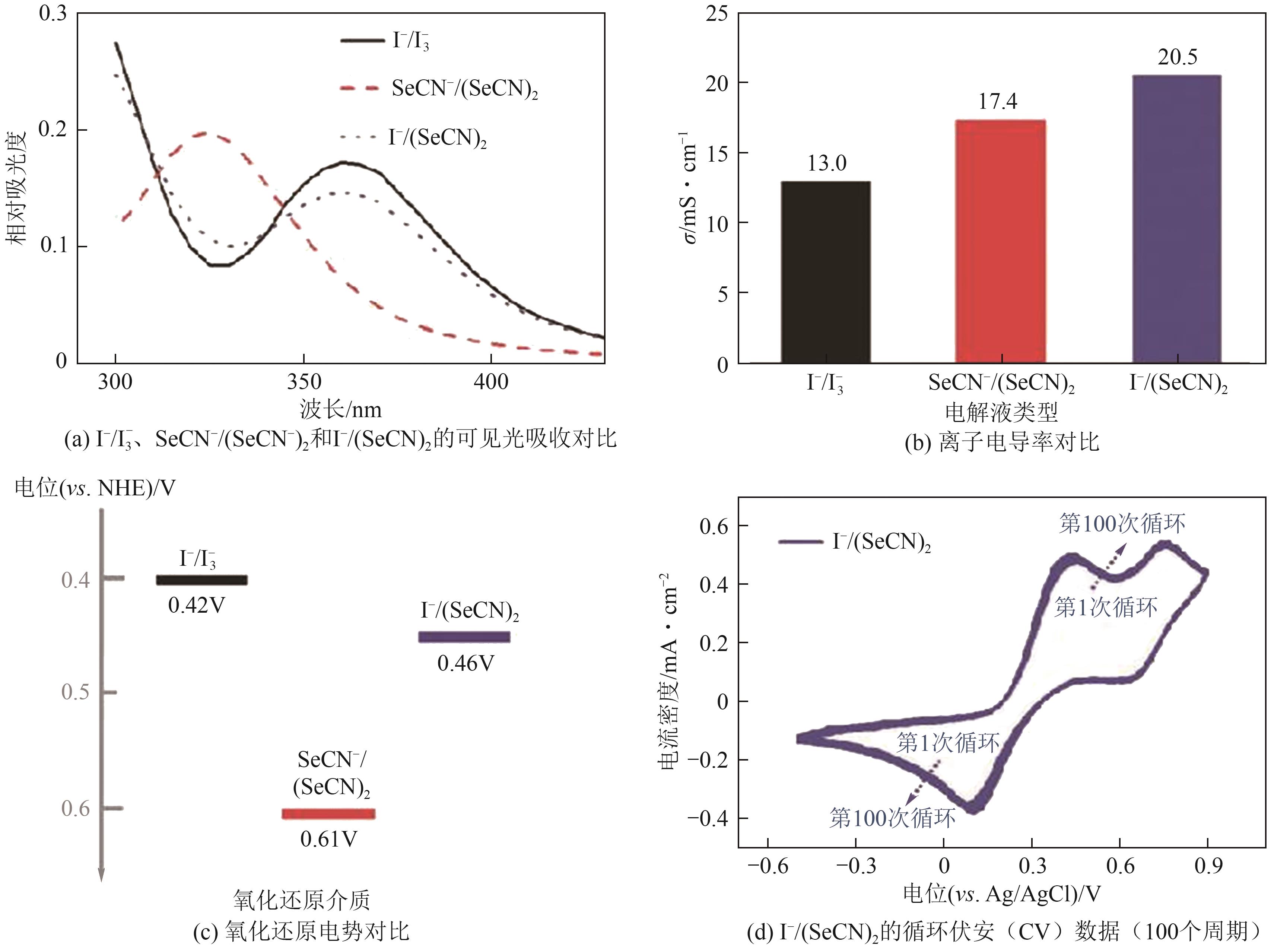
图6 I-/(SeCN)2的性能优势[83]
| 氧化还原电对 | 染料 | 氧化还原电位(vs. NHE)/V | 效率/% | 参考文献 |
|---|---|---|---|---|
| SeCN-/(SeCN) | N3 Z907 Ru(deeb)(bpy)2(PF6)2 | 0.50 | 20(IPCE) 7.5 0.65(IPCE) | [ [ [ |
| SCN-/(SCN) | N3 Ru(deeb)(bpy)2(PF6)2 | 0.77 | 4 0.51(IPCE) | [ [ |
| (I-, SeCN-)/(I | N719 | 0.46 | 6.2 | [ |
| (I-, SCN-)/(I | N719 | 0.46 | 8.42和8.46 | [ |
表10 拟卤素氧化还原电对电解质在全光强下获得的光电转换效率
| 氧化还原电对 | 染料 | 氧化还原电位(vs. NHE)/V | 效率/% | 参考文献 |
|---|---|---|---|---|
| SeCN-/(SeCN) | N3 Z907 Ru(deeb)(bpy)2(PF6)2 | 0.50 | 20(IPCE) 7.5 0.65(IPCE) | [ [ [ |
| SCN-/(SCN) | N3 Ru(deeb)(bpy)2(PF6)2 | 0.77 | 4 0.51(IPCE) | [ [ |
| (I-, SeCN-)/(I | N719 | 0.46 | 6.2 | [ |
| (I-, SCN-)/(I | N719 | 0.46 | 8.42和8.46 | [ |
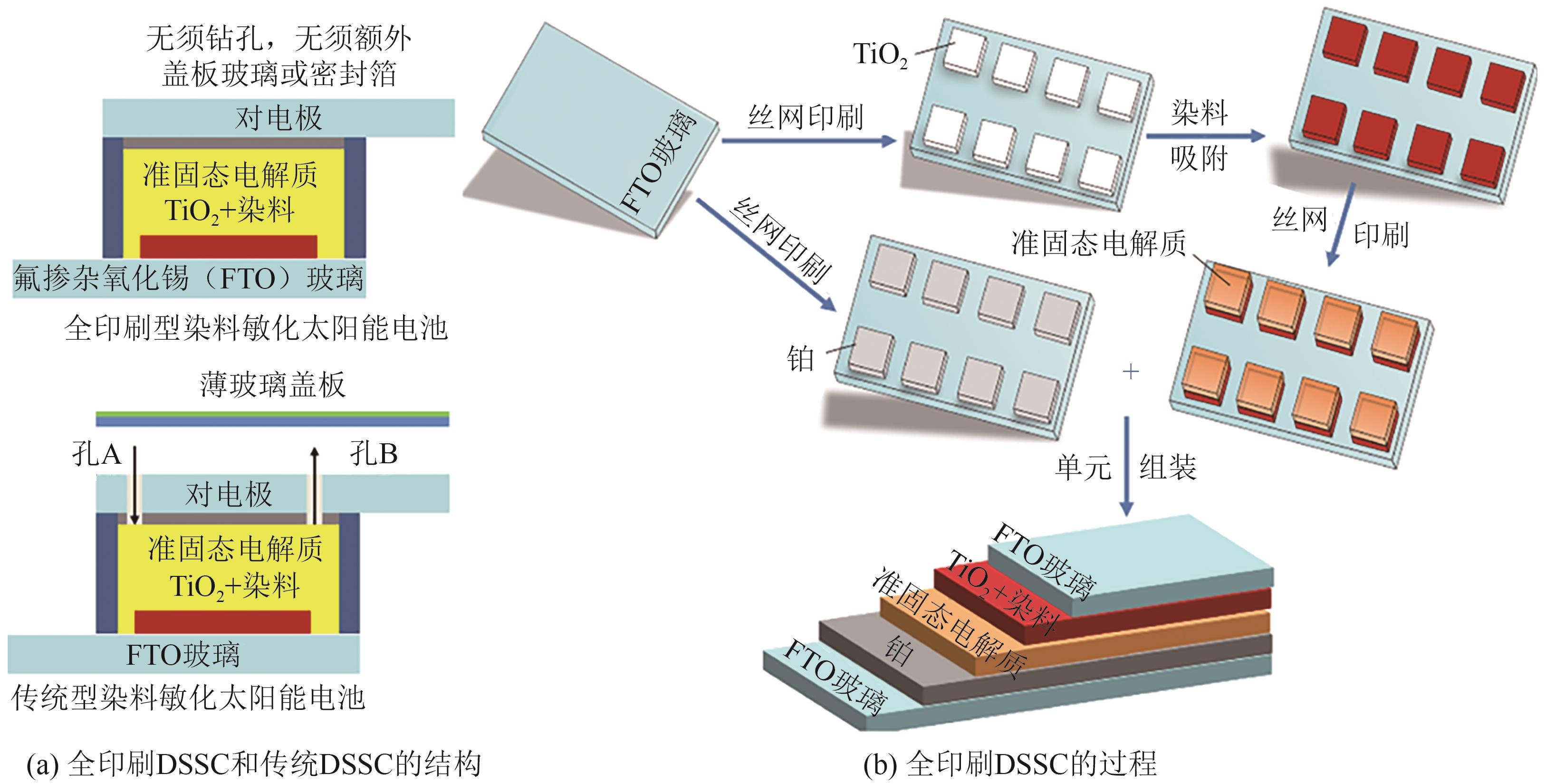
图7 全印刷DSCC和传统DSSC的结构及全印刷DSSC的过程
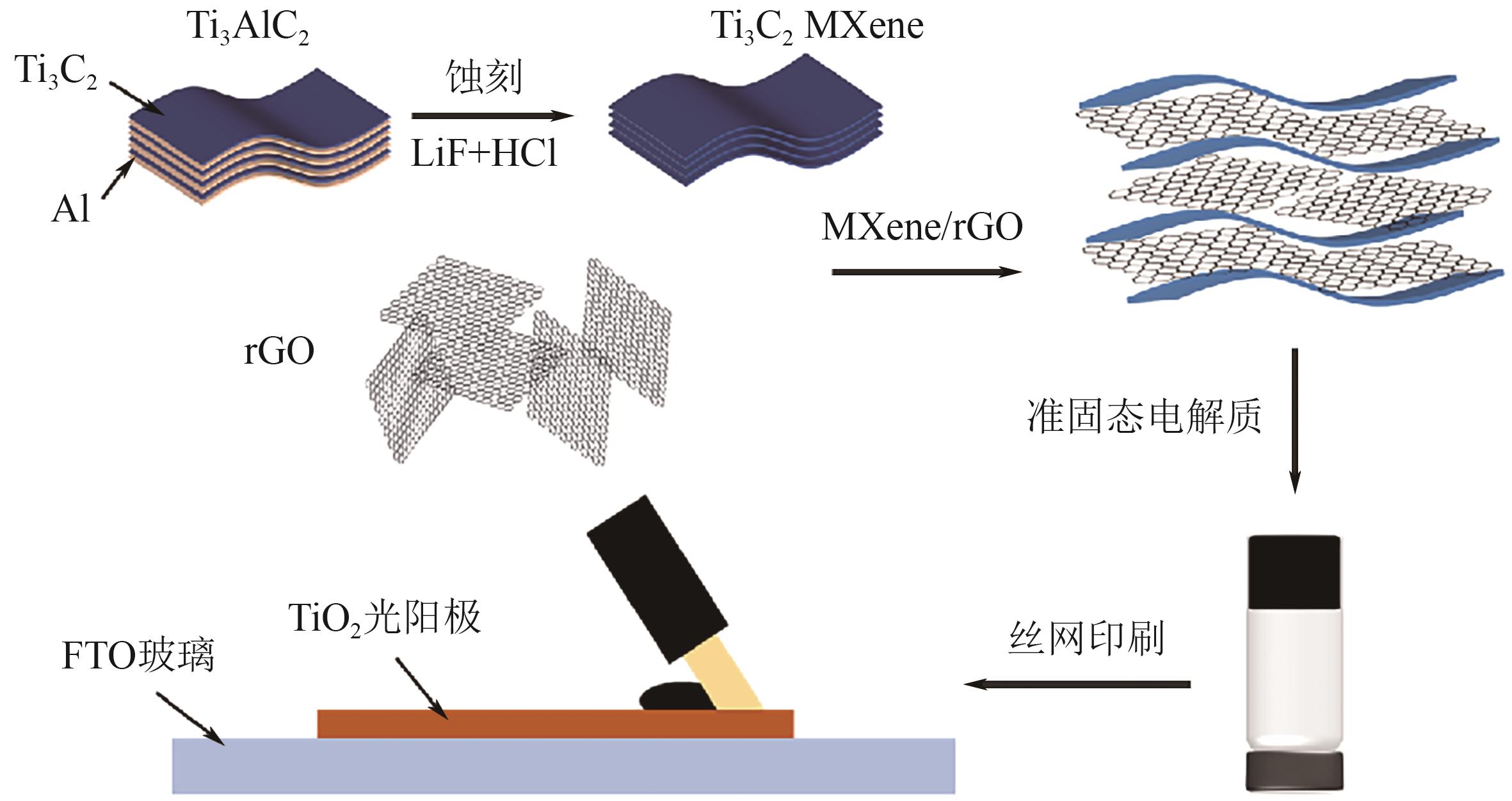
图8 MXene/rGO三维插层结构的合成和DSSC效果的示意图
| 氧化还原电对 | 氧化还原电位 (vs. NHE)/V | 优点 | 局限 | 参考文献 |
|---|---|---|---|---|
| I⁻/I | 0.35~0.4 | 再生快、工艺成熟 | 具有腐蚀性、可见区自吸收、Voc受限,在室内光下表现逊于金属配合物 | [ |
| Co(Ⅱ/Ⅲ)联吡啶/菲咯啉 | 可调(0.55~0.9) | 电位可设计、可降低自吸收、室内表现好 | 分子尺寸大、扩散慢、可能导致复合加剧,存在稳定性方面的问题 | [ |
| Cu(Ⅰ/Ⅱ)联吡啶 | 0.85~1.0 | 高Voc、低驱动力再生可行、室内纪录保持者 | 配体稳定性与长时稳定性需要继续优化 | [ |
| TEMPO/TEMPO⁺ | 0.8~0.9 | 高Voc、低驱动力再生 | 存在稳定性与挥发性问题、长期寿命待提高 | [ |
| HQ/BQ | 0.5~1.0(取决于取代) | 透明度高、低自吸收 | 存在长期稳定性与电极选择性问题 | [ |
| SeCN⁻/(SeCN) | 可调 | 可降低自吸收、部分条件下提升Voc | 体系选择性强、通用性与稳定性待验证 | [ |
表11 目前染料敏化太阳能电池常见电解液氧化还原电对对比
| 氧化还原电对 | 氧化还原电位 (vs. NHE)/V | 优点 | 局限 | 参考文献 |
|---|---|---|---|---|
| I⁻/I | 0.35~0.4 | 再生快、工艺成熟 | 具有腐蚀性、可见区自吸收、Voc受限,在室内光下表现逊于金属配合物 | [ |
| Co(Ⅱ/Ⅲ)联吡啶/菲咯啉 | 可调(0.55~0.9) | 电位可设计、可降低自吸收、室内表现好 | 分子尺寸大、扩散慢、可能导致复合加剧,存在稳定性方面的问题 | [ |
| Cu(Ⅰ/Ⅱ)联吡啶 | 0.85~1.0 | 高Voc、低驱动力再生可行、室内纪录保持者 | 配体稳定性与长时稳定性需要继续优化 | [ |
| TEMPO/TEMPO⁺ | 0.8~0.9 | 高Voc、低驱动力再生 | 存在稳定性与挥发性问题、长期寿命待提高 | [ |
| HQ/BQ | 0.5~1.0(取决于取代) | 透明度高、低自吸收 | 存在长期稳定性与电极选择性问题 | [ |
| SeCN⁻/(SeCN) | 可调 | 可降低自吸收、部分条件下提升Voc | 体系选择性强、通用性与稳定性待验证 | [ |
| [1] | Brian O’REGAN, Michael GRÄTZEL. A low-cost, high-efficiency solar cell based on dye-sensitized colloidal TiO2 films[J]. Nature, 1991, 353(6346): 737-740. |
| [2] | JIAO Shouzheng, WEN Jinyue, ZHOU Yang, et al. Preparation and property studies of polyaniline film for flexible counter electrode of dye-sensitized solar cells by cyclic voltammetry[J]. ChemistrySelect, 2021, 6(2): 230-233. |
| [3] | MATHEW Simon, YELLA Aswani, GAO Peng, et al. Dye-sensitized solar cells with 13% efficiency achieved through the molecular engineering of porphyrin sensitizers[J]. Nature Chemistry, 2014, 6(3): 242-247. |
| [4] | LIU Jiang, DE BASTIANI Michele, AYDIN Erkan, et al. Efficient and stable perovskite-silicon tandem solar cells through contact displacement by MgF x [J]. Science, 2022, 377(6603): 302-306. |
| [5] | HAGFELDT Anders, BOSCHLOO Gerrit, SUN Licheng, et al. Dye-sensitized solar cells[J]. Chemical Reviews, 2010, 110(11): 6595-6663. |
| [6] | MICHAELS Hannes, RINDERLE Michael, FREITAG Richard, et al. Dye-sensitized solar cells under ambient light powering machine learning: Towards autonomous smart sensors for the Internet of Things[J]. Chemical Science, 2020, 11(11): 2895-2906. |
| [7] | 王刚, 段毅, 张杰, 等. 有机-无机杂化钙钛矿太阳能电池研究进展[J]. 化学进展, 2014, 26(7): 1255-1265. |
| WANG Gang, DUAN Yi, ZHANG Jie, et al. Research progress of organic-inorganic hybrid perovskite solar cells[J]. Progress in Chemistry, 2014, 26(7): 1255. | |
| [8] | CHENG Rui, CHUNG Chih-Chun, ZHANG Hong, et al. Tailoring triple-anion perovskite material for indoor light harvesting with restrained halide segregation and record high efficiency beyond 36%[J]. Advanced Energy Materials, 2019, 9(38): 1901980. |
| [9] | CAO Yiming, LIU Yuhang, ZAKEERUDDIN Shaik Mohammed, et al. Direct contact of selective charge extraction layers enables high-efficiency molecular photovoltaics[J]. Joule, 2018, 2(6): 1108-1117. |
| [10] | FREITAG Marina, TEUSCHER Joël, SAYGILI Yasemin, et al. Dye-sensitized solar cells for efficient power generation under ambient lighting[J]. Nature Photonics, 2017, 11(6): 372-378. |
| [11] | KARIM Nayab Abdul, MEHMOOD Umer, ZAHID Hafiza Fizza, et al. Nanostructured photoanode and counter electrode materials for efficient dye-sensitized solar cells (DSSCs)[J]. Solar Energy, 2019, 185: 165-188. |
| [12] | MUÑOZ-GARCÍA Ana Belén, BENESPERI Iacopo, BOSCHLOO Gerrit, et al. Dye-sensitized solar cells strike back[J]. Chemical Society Reviews, 2021, 50(22): 12450-12550. |
| [13] | THOMAS Sara, DEEPAK T G, ANJUSREE G S, et al. A review on counter electrode materials in dye-sensitized solar cells[J]. Journal of Materials Chemistry A, 2014, 2(13): 4474-4490. |
| [14] | 秦东, 郭鑫, 孙浩, 等. 钙钛矿太阳能电池界面修饰研究进展[J]. 化学进展, 2011, 23(2/3): 557-568. |
| QIN Dong, GUO Xin, SUN Hao, et al. Advances in interfacial modification of perovskite solar cells[J]. Progress in Chemistry, 2011, 23(2/3): 557-568. | |
| [15] | PELET Serge, MOSER Jan-E, Michael GRÄTZEL, et al. Investigation of sensitizer adsorption and the influence of specific adsorption of cations (H⁺, Li⁺) on the photovoltaic performance of dye-sensitized nanocrystalline TiO₂ films[J]. The Journal of Physical Chemistry B, 2000, 104(8): 1791-1795. |
| [16] | WU Jihuai, LAN Zhang, LIN Jianming, et al. Electrolytes in dye-sensitized solar cells[J]. Chemical Reviews, 2015, 115(5): 2136-2173. |
| [17] | REN Yameng, CAO Yiming, ZHANG Dan, et al. A blue photosensitizer realizing efficient and stable green solar cells via color tuning by electrolyte[J]. Advanced Materials, 2020, 32(17): 2000193. |
| [18] | ZHANG Yalan, PARK Nam-Gyu. Quasi-two-dimensional perovskite solar cells with efficiency exceeding 22%[J]. ACS Energy Letters, 2022, 7(2): 757-765. |
| [19] | LENNERT Annkatrin, STERNBERG Michelle, MEYER Karsten, et al. Iodine-pseudohalogen ionic liquid-based electrolytes for quasi-solid-state dye-sensitized solar cells[J]. ACS Applied Materials & Interfaces, 2017, 9(39): 33437-33445. |
| [20] | Burak ÜNLÜ, Serbülent TÜRK, Mahmut ÖZACAR. Novel anti-freeze and self-adhesive gellan gum/P3HT/LiCl based gel electrolyte for quasi solid dye sensitized solar cells[J]. Colloids and Surfaces A: Physicochemical and Engineering Aspects, 2023, 674: 131869. |
| [21] | ORANGI Shiva, KOWSARI Elaheh, MOHAMMADIZADEH BOGHRABAD Mohammad, et al. Investigating the efficacy of functionalized graphene oxide with polyhedral oligomeric silsesquioxane as an effective additive in sustainable ionic liquid-based electrolytes for dye-sensitized solar cells through experimental and DFT studies[J]. Journal of Molecular Liquids, 2024, 397: 124057. |
| [22] | ROSA Erlyta Septa, SEPTINA Wilman, MEGANANDA Prisca Carolina, et al. Improved efficiency and stability of dye-sensitized solar cells by using iodide-based electrolyte with high viscosity solvent[J]. Materials Letters, 2024, 358: 135847. |
| [23] | ELBOHY Hytham, ELNEMR Abdel-Menem, GHANDER Ahmed M, et al. Dye-sensitized solar cells with aluminum-doped zinc oxide nanoparticles-loaded electrolyte: A breakthrough solution for recombination and hysteresis suppression[J]. Optical Materials, 2023, 142: 113979. |
| [24] | 赵欣. 可原位固化的离子型纤维素凝胶电解质的研究[D]. 北京: 北京石油化工学院, 2022. |
| ZHAO Xin. Study of in situ solidify ionic cellulose gel electrolyte[D]. Beijing: Beijing Institute of Petrochemical Technology, 2022. | |
| [25] | BOSCHLOO Gerrit, HAGFELDT Anders. Characteristics of the iodide/triiodide redox mediator in dye-sensitized solar cells[J]. Accounts of Chemical Research, 2009, 42(11): 1819-1826. |
| [26] | VENKATESAN Shanmuganathan, LIU I-Ping, TSENG SHAN Chih-Mei, et al. Highly efficient indoor light quasi-solid-state dye sensitized solar cells using cobalt polyethylene oxide-based printable electrolytes[J]. Chemical Engineering Journal, 2020, 394: 124954. |
| [27] | WANG Zhongsheng, SAYAMA Kazuhiro, SUGIHARA Hideki. Efficient eosin Y dye-sensitized solar cell containing Br-/Br3- electrolyte[J]. The Journal of Physical Chemistry B, 2005, 109(47): 22449-22455. |
| [28] | TENG Chao, YANG Xichuan, YUAN Chunze, et al. Two novel carbazole dyes for dye-sensitized solar cells with open-circuit voltages up to 1V based on Br-/Br3- electrolytes[J]. Organic Letters, 2009, 11(23): 5542-5545. |
| [29] | KAKIAGE Kenji, OSADA Hiroyuki, AOYAMA Yohei, et al. Achievement of over 1.4V photovoltage in a dye-sensitized solar cell by the application of a silyl-anchor coumarin dye[J]. Scientific Reports, 2016, 6: 35888. |
| [30] | NUSBAUMER Hervé, MOSER Jacques-E, ZAKEERUDDIN Shaik M, et al. CoⅡ(dbbip)2 2+ complex rivals tri-iodide/iodide redox mediator in dye-sensitized photovoltaic cells[J]. The Journal of Physical Chemistry B, 2001, 105(43): 10461-10464. |
| [31] | YAO Zhaoyang, WU Heng, LI Yang, et al. Dithienopicenocarbazole as the kernel module of low-energy-gap organic dyes for efficient conversion of sunlight to electricity[J]. Energy & Environmental Science, 2015, 8(11): 3192-3197. |
| [32] | FELDT Sandra M, WANG Gang, BOSCHLOO Gerrit, et al. Effects of driving forces for recombination and regeneration on the photovoltaic performance of dye-sensitized solar cells using cobalt polypyridine redox couples[J]. The Journal of Physical Chemistry C, 2011, 115(43): 21500-21507. |
| [33] | KAKIAGE Kenji, AOYAMA Yohei, YANO Toru, et al. Highly-efficient dye-sensitized solar cells with collaborative sensitization by silyl-anchor and carboxy-anchor dyes[J]. Chemical Communications, 2015, 51(88): 15894-15897. |
| [34] | MAGNI Mirko, GIANNUZZI Roberto, COLOMBO Alessia, et al. Tetracoordinated bis-phenanthroline copper-complex couple as efficient redox mediators for dye solar cells[J]. Inorganic Chemistry, 2016, 55(11): 5245-5253. |
| [35] | AGHAZADA Sadig, REN Yameng, WANG Peng, et al. Ligand engineering for the efficient dye-sensitized solar cells with inorganic Pb(Ⅱ)-P and Pb(Ⅱ)-S complexes[J]. Inorganic Chemistry, 2017, 56(21): 13437-13445. |
| [36] | REN Yameng, SUN Danyang, CAO Yiming, et al. A stable blue photosensitizer for color palette of dye-sensitized solar cells reaching 12.6% efficiency[J]. Journal of the American Chemical Society, 2018, 140(7): 2405-2408. |
| [37] | WU Heng, XIE Xinrui, MEI Yayue, et al. Phenalenothiophene-based organic dye for stable and efficient solar cells with a cobalt redox electrolyte[J]. ACS Photonics, 2019, 6(5): 1216-1225. |
| [38] | TAO Lingling, SUN Zhe, CHEN Lei, et al. High performance zinc stannate photoanodes in dye sensitized solar cells with cobalt complex mediators[J]. Chemical Communications, 2020, 56(37): 5042-5045. |
| [39] | Fátima SANTOS, MARTINS Jorge, Jeffrey CAPITÃO, et al. Stable cobalt-mediated monolithic dye-sensitized solar cells by full glass encapsulation[J]. ACS Applied Energy Materials, 2022, 5(6): 7220-7229. |
| [40] | LI Yiming, WANG Jing, WANG Hao, et al. Transparent PEDOT counter electrodes for bifacial dye-sensitized solar cells using a cobalt complex mediator[J]. Chemical Communications, 2023, 59(90): 13482-13485. |
| [41] | ZHANG Weidong, WAN Wang, ZHOU Henghui, et al. In-situ synthesis of magnetite/expanded graphite composite material as high rate negative electrode for rechargeable lithium batteries[J]. Journal of Power Sources, 2013, 223: 119-124. |
| [42] | REN Shuhua, ZHAO Xiangyu, CHEN Ruiyong, et al. A facile synthesis of encapsulated CoFe2O4 into carbon nanofibres and its application as conversion anodes for lithium ion batteries[J]. Journal of Power Sources, 2014, 260: 205-210. |
| [43] | RODRIGUES Roberta R, CHEEMA Hammad, DELCAMP Jared H. A high-voltage molecular-engineered organic sensitizer-iron redox shuttle pair: 1.4V DSSC and 3.3V SSM-DSSC devices[J]. Angewandte Chemie International Edition, 2018, 57(19): 5472-5476. |
| [44] | LU Jianfeng, LIU Zonghao, Narendra PAI, et al. Molecular engineering of zinc-porphyrin sensitisers for p-type dye-sensitised solar cells[J]. ChemPlusChem, 2018, 83(7): 711-720. |
| [45] | Victoria BOBO M, PAUL Avishek, ROBB Alex J, et al. Bis-cyclometalated iridium complexes containing 4,4’-bis(phosphonomethyl)-2,2’-bipyridine ligands: Photophysics, electrochemistry, and high-voltage dye-sensitized solar cells[J]. Inorganic Chemistry, 2020, 59(9): 6351-6358. |
| [46] | MASUD, KIM Hwan Kyu. Redox shuttle-based electrolytes for dye-sensitized solar cells: Comprehensive guidance, recent progress, and future perspective[J]. ACS Omega, 2023, 8(7): 6139-6163. |
| [47] | HATTORI Shigeki, WADA Yuji, YANAGIDA Shozo, et al. Blue copper model complexes with distorted tetragonal geometry acting as effective electron-transfer mediators in dye-sensitized solar cells[J]. Journal of the American Chemical Society, 2005, 127(26): 9648-9654. |
| [48] | CONG Jiayan, KINSCHEL Dominik, DANIEL Quentin, et al. Bis(1,1-bis(2-pyridyl)ethane)copper(Ⅰ/Ⅱ) as an efficient redox couple for liquid dye-sensitized solar cells[J]. Journal of Materials Chemistry A, 2016, 4(38): 14550-14554. |
| [49] | SAYGILI Yasemin, Magnus SÖDERBERG, PELLET Norman, et al. Copper bipyridyl redox mediators for dye-sensitized solar cells with high photovoltage[J]. Journal of the American Chemical Society, 2016, 138(45): 15087-15096. |
| [50] | LI Jiajia, YANG Xichuan, YU Ze, et al. Efficient dye-sensitized solar cells with [copper(6,6′-dimethyl-2,2′-bipyridine)2]2+/1+ redox shuttle[J]. RSC Advances, 2017, 7(8): 4611-4615. |
| [51] | SAYGILI Yasemin, STOJANOVIC Marko, MICHAELS Hannes, et al. Effect of coordination sphere geometry of copper redox mediators on regeneration and recombination behavior in dye-sensitized solar cell applications[J]. ACS Applied Energy Materials, 2018, 1(9): 4950-4962. |
| [52] | ZHANG Weiwei, WU Yongzhen, BAHNG Hee Won, et al. Comprehensive control of voltage loss enables 11.7% efficient solid-state dye-sensitized solar cells[J]. Energy & Environmental Science, 2018, 11(7): 1779-1787. |
| [53] | LIU Yuhang, CAO Yiming, ZHANG Weiwei, et al. Electron-affinity-triggered variations on the optical and electrical properties of dye molecules enabling highly efficient dye-sensitized solar cells[J]. Angewandte Chemie International Edition, 2018, 57(43): 14321-14324. |
| [54] | ZHANG Ming, ZHU Lei, ZHOU Guanqing, et al. Single-layered organic photovoltaics with double cascading charge transport pathways: 18% efficiencies[J]. Nature Communications, 2021, 12: 309. |
| [55] | 李丽华. 基于含硫配体铜(Ⅱ/Ⅰ)电解质的染料敏化太阳能电池研究[D]. 大连: 大连理工大学, 2022. |
| LI Lihua. Study on copper(Ⅱ/Ⅰ) electrolytes with sulfur-containing ligands for dye-sensitized solar cells[D]. Dalian: Dalian University of Technology, 2022. | |
| [56] | ZHANG Dan, STOJANOVIC Marko, REN Yameng, et al. A molecular photosensitizer achieves a Voc of 1.24V enabling highly efficient and stable dye-sensitized solar cells with copper(Ⅱ/Ⅰ)-based electrolyte[J]. Nature Communications, 2021, 12: 1777. |
| [57] | CHEN Yu-Hsuan, CHEN Ching-Chin, NGUYEN Vinh Son, et al. A stable copper-modified bipyridine mediator for highly efficient dye-sensitized solar cells[J]. Cell Reports Physical Science, 2024, 5(9): 102159. |
| [58] | YOSHIKAWA Yutaka, SAKURAI Hiromu, CRANS Debbie C, et al. Structural and redox requirements for the action of anti-diabetic vanadium compounds[J]. Dalton Trans, 2014, 43(19): 6965-6972. |
| [59] | COPPOLA Teresa, VARRA Michela, OLIVIERO Giorgia, et al. Synthesis, structural studies and biological properties of new TBA analogues containing an acyclic nucleotide[J]. Bioorganic & Medicinal Chemistry, 2008, 16(17): 8244-8253. |
| [60] | REHDER Dieter. The future of/for vanadium[J]. Dalton Transactions, 2013, 42(33): 11749. |
| [61] | REDSHAW Carl, TANG Yong. Tridentate ligands and beyond in group Ⅳ metal α-olefin homo-/co-polymerization catalysis[J]. Chemical Society Reviews, 2012, 41(12): 4484-4510. |
| [62] | SCHNEIDER Curtis J, PENNER-HAHN James E, PECORARO Vincent L. Elucidating the protonation site of vanadium peroxide complexes and the implications for biomimetic catalysis[J]. Journal of the American Chemical Society, 2008, 130(9): 2712-2713. |
| [63] | OYAIZU Kenichi, HAYO Noriko, SASADA Yoshito, et al. Enhanced bimolecular exchange reaction through programmed coordination of a five-coordinate oxovanadium complex for efficient redox mediation in dye-sensitized solar cells[J]. Dalton Transactions, 2013, 42(45): 16090-16095. |
| [64] | APOSTOLOPOULOU Andigoni, VLASIOU Manolis, TZIOURIS Petros A, et al. Oxidovanadium(Ⅳ/Ⅴ) complexes as new redox mediators in dye-sensitized solar cells: A combined experimental and theoretical study[J]. Inorganic Chemistry, 2015, 54(8): 3979-3988. |
| [65] | BIGNOZZI C A, ARGAZZI R, BOARETTO R, et al. The role of transition metal complexes in dye sensitized solar devices[J]. Coordination Chemistry Reviews, 2013, 257(9/10): 1472-1492. |
| [66] | LI Tina C, SPOKOYNY Alexander M, SHE Chunxing, et al. Ni(Ⅲ)/(Ⅳ) bis(dicarbollide) as a fast, noncorrosive redox shuttle for dye-sensitized solar cells[J]. Journal of the American Chemical Society, 2010, 132(13): 4580-4582. |
| [67] | SPOKOYNY Alexander M, LI Tina C, FARHA Omar K, et al. Electronic tuning of nickel-based bis(dicarbollide) redox shuttles in dye-sensitized solar cells[J]. Angewandte Chemie International Edition, 2010, 49(31): 5339-5343. |
| [68] | PERERA Ishanie Rangeeka, GUPTA Akhil, XIANG Wanchun, et al. Introducing manganese complexes as redox mediators for dye-sensitized solar cells[J]. Physical Chemistry Chemical Physics, 2014, 16(24): 12021-12028. |
| [69] | CARLI Stefano, BENAZZI Elisabetta, CASARIN Laura, et al. Correction: On the stability of manganese tris(β-diketonate) complexes as redox mediators in DSSCs[J]. Physical Chemistry Chemical Physics, 2016, 18(19): 13718. |
| [70] | ZHANG Z, CHEN P, MURAKAMI T N, et al. The 2,2,6,6-tetramethyl-1-piperidinyloxy radical: An efficient, iodine- free redox mediator for dye-sensitized solar cells[J]. Advanced Functional Materials, 2008, 18(2): 341-346. |
| [71] | RUESS Raffael, HORN Jonas, RINGLEB Andreas, et al. Efficient electron collection by electrodeposited ZnO in dye-sensitized solar cells with TEMPO+/0 as the redox mediator[J]. The Journal of Physical Chemistry C, 2019, 123(36): 22074-22082. |
| [72] | KATO Fumiaki, KIKUCHI Akitomo, OKUYAMA Takumi, et al. Nitroxide radicals as highly reactive redox mediators in dye-sensitized solar cells[J]. Angewandte Chemie International Edition, 2012, 51(40): 10177-10180. |
| [73] | AN Pyeongje, KIM Jae Ho, SHIN Myeonghwan, et al. Efficient and stable fiber dye-sensitized solar cells based on solid-state Li-TFSI electrolytes with 4-oxo-TEMPO derivatives[J]. Nanomaterials, 2022, 12(13): 2309. |
| [74] | HOLZHACKER Daniel, RINGLEB Andreas, SCHLETTWEIN Derck. Impedance spectroscopy using microscopic reference electrodes to analyze different rate-determining steps in aqueous dye-sensitized solar cells using nitroxide radicals as redox mediators[J]. Electrochimica Acta, 2024, 497: 144582. |
| [75] | POWAR Satvasheel, BHARGAVA Rishabh, DAENEKE Torben, et al. Thiolate/disulfide based electrolytes for p-type and tandem dye-sensitized solar cells[J]. Electrochimica Acta, 2015, 182: 458-463. |
| [76] | Yoann FARRÉ, RAISSI Mahfoudh, FIHEY Arnaud, et al. Synthesis and properties of new benzothiadiazole-based push-pull dyes for p-type dye sensitized solar cells[J]. Dyes and Pigments, 2018, 148: 154-166. |
| [77] | Yoann FARRÉ, MASCHIETTO Federica, Jens FÖHLINGER, et al. A comparative investigation of the role of the anchoring group on perylene monoimide dyes in NiO-based dye-sensitized solar cells[J]. ChemSusChem, 2020, 13(7): 1844-1855. |
| [78] | AHMAD BHAT Mohsin. Mechanistic, kinetic and electroanalytical aspects of quinone-hydroquinone redox system in N-alkylimidazolium based room temperature ionic liquids[J]. Electrochimica Acta, 2012, 81: 275-282. |
| [79] | CHENG Ming, YANG Xichuan, ZHANG Fuguo, et al. Efficient dye-sensitized solar cells based on hydroquinone/benzoquinone as a bioinspired redox couple[J]. Angewandte Chemie International Edition, 2012, 51(39): 9896-9899. |
| [80] | CHENG Ming, YANG Xichuan, CHEN Cheng, et al. Dye-sensitized solar cells based on hydroquinone/benzoquinone as bio-inspired redox couple with different counter electrodes[J]. Physical Chemistry Chemical Physics, 2013, 15(36): 15146-15152. |
| [81] | Natalie FLORES-DÍAZ, Andrea SOTO-NAVARRO, FREITAG Marina, et al. Neutral organic redox pairs based on sterically hindered hydroquinone/benzoquinone derivatives for dye-sensitized solar cells[J]. Solar Energy, 2018, 167: 76-83. |
| [82] | YU Zhenhua, BU Chenhao, ZHOU Ziyao, et al. Effect of HAc treatment on an open-environment prepared organic redox couple based on hydroquinone/benzoquinone and its application in dye-sensitized solar cells[J]. Electrochimica Acta, 2013, 107: 695-700. |
| [83] | BERGERON Bryan V, MARTON Andras, OSKAM Gerko, et al. Dye-sensitized SnO2 electrodes with iodide and pseudohalide redox mediators[J]. The Journal of Physical Chemistry B, 2005, 109(2): 937-943. |
| [84] | NATH Narayan Chandra Deb, LEE Jae-Joon. Binary redox electrolytes used in dye-sensitized solar cells[J]. Journal of Industrial and Engineering Chemistry, 2019, 78: 53-65. |
| [85] | GORLOV Mikhail, PETTERSSON Henrik, HAGFELDT Anders, et al. Electrolytes for dye-sensitized solar cells based on interhalogen ionic salts and liquids[J]. Inorganic Chemistry, 2007, 46(9): 3566-3575. |
| [86] | NATH Narayan Chandra Deb, LEE Ho Joon, CHOI Won-Youl, et al. Electrochemical approach to enhance the open-circuit voltage (Voc) of dye-sensitized solar cells (DSSCs)[J]. Electrochimica Acta, 2013, 109: 39-45. |
| [87] | OSKAM Gerko, BERGERON Bryan V, MEYER Gerald J, et al. Pseudohalogens for dye-sensitized TiO2 photoelectrochemical cells[J]. The Journal of Physical Chemistry B, 2001, 105(29): 6867-6873. |
| [88] | WANG Peng, ZAKEERUDDIN Shaik M, MOSER Jacques-E, et al. A solvent-free, SeCN-/(SeCN) 3 - based ionic liquid electrolyte for high-efficiency dye-sensitized nanocrystalline solar cells[J]. Journal of the American Chemical Society, 2004, 126(23): 7164-7165. |
| [89] | NATH Narayan Chandra Deb, JUNG In Soo, PARK Pyo-Jam, et al. Investigating the role of I2SCN- on the Fermi level of electrolyte for dye-sensitized solar cells[J]. Electrochimica Acta, 2015, 161: 95-99. |
| [90] | HAWKRIDGE Fred M. Fundamentals of electrochemical analysis (galus, zbigniew)[J]. Journal of Chemical Education, 1978, 55(5): A248. |
| [91] | JIAO Shouzheng, SUN Zhicheng, WEN Jinyue, et al. Development of rapid curing SiO2 aerogel composite-based quasi-solid-state dye-sensitized solar cells through screen-printing technology[J]. ACS Applied Materials & Interfaces, 2020, 12(43): 48794-48803. |
| [92] | WEN Jinyue, SUN Zhicheng, QIAO Yun, et al. Ti3C2 MXene-reduced graphene oxide composite polymer-based printable electrolyte for quasi-solid-state dye-sensitized solar cells[J]. ACS Applied Energy Materials, 2022, 5(3): 3329-3338. |
| [93] | WEN Jinyue, LIU Yibin, LI Tong, et al. Low cost and strongly adsorbed melamine formaldehyde sponge electrolyte for nontraditional quasi-solid dye-sensitized solar cells[J]. ACS Applied Energy Materials, 2023, 6(9): 4952-4960. |
| [1] | 王于华, 周雪, 谷传涛. 用于高性能全聚合物太阳能电池的区域规整的聚小分子受体研究进展[J]. 化工进展, 2024, 43(S1): 391-402. |
| [2] | 孙善富, 孙明轩, 方亚林, 王莹. 染料敏化太阳能电池非铂对电极研究进展[J]. 化工进展, 2016, 35(10): 3236-3250. |
| [3] | 耿蕊1,2,路胜利2,高建荣1. 染料敏化太阳能电池中TiO2光阳极形貌研究进展[J]. 化工进展, 2014, 33(02): 412-417. |
| [4] | 邢俊恒,夏正斌,张燕红,钟 理. 阳极氧化参数对TiO2薄膜结晶行为影响的研究进展[J]. 化工进展, 2013, 32(03): 592-598. |
| [5] | 孙旭辉1,2,包塔娜1,张凌云1,张国华1,王维广1. 染料敏化太阳能电池的研究进展[J]. 化工进展, 2012, 31(01 ): 47-52. |
| 阅读次数 | ||||||
|
全文 |
|
|||||
|
摘要 |
|
|||||